
Friday Reads: Post Cards from the fractious Right Wing
Posted: October 18, 2013 Filed under: morning reads 59 Comments Good Morning!
This is probably going to strike you as a strange Friday Reads post but a few conversations with folks and this op-ed from economist Simon Johnson got me thinking about the great ongoing right wing conspiracy against Federalism, the New Deal, and the American way of life outside of those that were and still are wild about the good old days of the Confederacy. I really had a front seat to the Great Republican Purge of Reason, Secularism, and Modernity as a kid during the 1970s and a young adult in the 1980s and 1990s. I’ve never seen such an enduring crusade in modern times. It has come together to create a perfect storm and a perfect mess. The coalition of the crazy is also coming apart at the seams.
With a last-minute agreement on lifting the debt ceiling, the immediate threat of legal and financial disaster from a default on United States government obligations has been averted. But the last week has provided additional insight into how and why the current governmental arrangement known as the United States of America will end.
The mainstream narrative is that the problem is “dysfunctional government” or “paralysis in Washington.” That’s true, up to a point, but the real problem is the steady decline in legitimacy of the federal government – and the way this is related to what has happened on the right of the political spectrum.
For an earlier view of American government, I recommend the World War II trilogy by Rick Atkinson – the third volume of which came out this year (“The Guns at Last Light”). There was plenty of mismanagement, including by the military at all levels, during that conflict. But there were also remarkable achievements. In the 1940s, many people believed, with good reason, in the ability of the federal government to both organize activities at home and to have a positive impact around the world.
This was, perhaps, the most lasting effect of the Great Depression. In the 1930s, the private economy stumbled and private financial arrangements failed in many ways – but, on the whole, government was perceived as stepping in to help.
This positive view of an expanded federal government never sat well with people on the right, but the organized pushback was limited through the 1950s. It was only with the turmoil of the Vietnam War and other social pressures in the 1960s that the conservatives got their chance – starting with political direct mailing (American Target Advertising was founded in 1965), the rise of talk radio (particularly from the 1980s), and early anti-tax campaigns (including Proposition 13, which cut property taxes sharply in California in 1978).
Johnson argues that the right began to take advantage of the social upheaval occurring in the 1960s and 1970s to spin a tail that the Federal Government is something to fear and basically is some beast that needs to be tamed. As the federal government has acted to expand the rights of women, minorities, and new arrivals to the country, folks empowered by their local governments to suppress anything the local powers that be–white men, the plutocrats, local governments, businesses, and religious institutions–and their ability to abuse the powerless began to coalesce into the Republican party. The Republican Party has attracted business interests from its very beginning having sprung from the industrial north prior to the Civil War. What began to change was the realization that it needed to attract other groups in order to expand its interests. The Southern Strategy was used to attract the racist elements of the old confederacy. The 1980s saw the party attract Pat Robertson, Jerry Falwell and the religious right wing. These folks were incensed at advances made by the women’s movement and the budding GLBT rights movement . Libertarians—another brand of state’s rights and free market true believers–have been brought in by the money of the Kochs and other folks starting think tanks appealing to disenfranchised feeling white men who want their sex lives and pot as they want them, their privileges in tact, and their ability to avoid a draft to a foreign war the way it is.
There is a widening split in the party between these factions.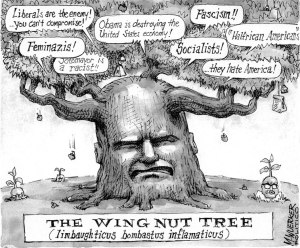
In a sign of the internal backlash against the right wing of the House Republican Conference, Louisiana Republican Charles Boustany questioned the political allegiances and motivations of his tea party-aligned colleagues and said they had put the GOP majority at risk in the current shutdown fight.
“There are members with a different agenda,” Boustany said Wednesday in an interview in his office. “And I’m not sure they’re Republicans and I’m not sure they’re conservative.”
His comments came a day after rank-and-file House Republicans rejected a package to reopen the government authored by their own leader, Speaker John Boehner. The result is that a bipartisan Senate-authored deal to end the two-week government shutdown appears poised to pass with almost nothing of substance gained by House conservatives for the shutdown they precipitated.
“The speaker has said consistently unless we can put 218 votes up, and preferably more than that, our ability to negotiate is pretty much undermined and that’s the problem we’ve repeatedly found ourselves in,” said Boustany, who has served since 2005 and is a senior member of the Ways and Means Committee. “Look at payroll tax. Look at fiscal cliff. You can go on and on. There are a handful of members – the numbers sort of vary, it’s in the 20-30 range – that are enough to derail a Republican conservative agenda in the House.”
Democracy Corp’s recent poll identified some of the major factions within the party. Each of them have extremely strong views and none of them are particularly palatable to the majority of Americans. The base voters have to hang together on each other’s extremist positions or they hang alone. Increasingly it looks like they may hang along. This is recent analysis from Bill Moyers’ group is by Joshua Holland.
Democracy Corps – a Democratic-leaning polling firm – released a study this week based on a series of focus groups they conducted with loyal Republican voters. They divided them up into three sub-groups which together represent the base of the party. Evangelicals represent the largest group, followed by Republicans who identify with the tea party movement. “Moderates,” the third group, make up about a quarter of the party’s base, according to the pollsters.
Fear of a changing society is one thing that unites all three factions. The battle over Obamacare, write the study’s authors, “goes to the heart of Republican base thinking about the essential political battle.”
They think they face a victorious Democratic Party that is intent on expanding government to increase dependency and therefore electoral support. It starts with food stamps and unemployment benefits; expands further if you legalize the illegals; but insuring the uninsured dramatically grows those dependent on government. They believe this is an electoral strategy — not just a political ideology or economic philosophy. If Obamacare happens, the Republican Party may be lost, in their view.
And while few explicitly talk about Obama in racial terms, the base supporters are very conscious of being white in a country with growing minorities. Their party is losing to a Democratic Party of big government whose goal is to expand programs that mainly benefit minorities. Race remains very much alive in the politics of the Republican Party.
They worry that minorities, immigrants, and welfare recipients now believe it is their “right” to claim [public] benefits. Tea Party participants, in particular, were very focused on those who claim “rights” in the form of government services, without taking responsibility for themselves.
They are also unified in their belief that Obama is a usurper who has hoodwinked the public into re-electing him by hiding his true beliefs, which are essentially Marxist. They also think that Democrats have won the major political battles of our time because Republican legislators in Washington didn’t put up a fight.
But there are also deep divisions within the base, according to the analysis. Evangelicals still focus overwhelmingly on social issues. They think gay rights are the biggest threat to our society, but they also worry about the loss of what they see as an idyllic small-town culture. They feel besieged as the cultural ground shifts beneath them, and see themselves as a beleaguered, “politically incorrect” minority.
Tea partiers display a libertarian streak, and are far less concerned with social issues. They are staunchly pro-business. But there’s an easy alliance between these two groups – which make up well over half of the GOP base – because Evangelicals think the tea partiers are fighting back, and vice versa.
Both groups displayed a high level of paranoia, according to the researchers who conducted the study. They noted that this was the first time, in many years of conducting focus groups, that participants worried that their participation might trigger surveillance by the NSA or an audit by the IRS. In addition to thinking that Obama is a liar, and a covert Communist, these two groups were also more likely to express the belief that he is secretly a Muslim.
The moderates were, as one might expect, quite different. Like the tea partiers, they don’t worry as much about social issues. Their concerns are traditionally conservative – they worry about excessive regulation and taxation. They have a hard time taking Fox News seriously, and hold a deep disdain for the tea party faction. They are also keenly aware of their waning influence within the coalition.
Moderates are not so sure about their place in the current Republican Party. They worry about the ability of Republicans in Congress to make government work. They believe the party is stuck, not forward-looking, and representative of old ideas. They worry about the Republican Party’s right turn on social and environmental issues — which makes it difficult, especially for young moderates — to view the Republican Party as a modern party.
Unlike the tea partiers and Evangelicals, the moderate faction desperately wants lawmakers in Washington to find a common middle ground. They are less likely to worry about unauthorized immigration than the rest of the base, and some went so far as to speak positively about immigrants’ contributions to our society and economy.
I had a front seat to the first of the purges of moderates that occurred in the reddest of the red states. The media really didn’t notice it because they 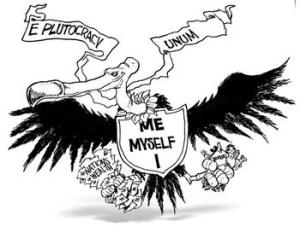 generally don’t spend much time in the great fly over where the first purge came from the religious right and really played out royally during the Clinton Years. They’ve been a little bit more cognizant of the rising power of the Libertarians since many of the young white media males are in their number. These groups are getting increasingly more difficult to herd as John Boehner has found out. They are no longer content to sit in the county and city level party structures working for the usual Republican suspects put forth by the Chamber of Commerce. They’ve infiltrated enough of the state offices to be able to move into the District and Congress. It’s driving the establishment Republicans crazy. But, it’s also what they more or less asked for given their strategies. Did they really think these groups were going to be content with meaningless platform stands and not much else?
The Tea Party which is increasingly made up of not only right wing populists but the religious right is sure to cause more problems for Boehner and the Beltway regulars. There is a future fight ahead to see if the current status quo will hold very long.
The deal extends funding for the government through Jan. 15. Republicans are now very, very invested in not triggering another government shutdown. Much more invested than they were last month, when party leaders got forced into shutting down the government against their better collective judgment.
Democrats won’t shut down the government. They’re not going to make demands unrelated to the issue at hand, like Republicans just did, and refuse to fund the government unless they get their ransom. But they will fight harder than ever to ease sequestration, and their leverage will come both from the deadline and the House GOP’s inability to govern itself. This is where the dynamic between Boehner and his hardliners will become relevant again. The only way for him to beat back Democratic demands without shutting down the government will be to pass appropriations in some form that neither exceed sequestration nor include the kinds of extraneous riders that will invite easy veto threats from Obama.
This will be an immense challenge. Hardliners aren’t particularly interested in funding the government without demanding ransoms, and even if they were, it might not be possible at the funding levels the party supports. Earlier this year they had to yank the one domestic appropriations bill they’d hoped to pass on the floor, because it was too austere for Democrats and moderate Republicans, and not radical enough for the hardliners.
They’re not going to get a lot of help from Democrats if they try to appropriate at 2014 sequestration levels. And if they can’t appropriate on their own, without once again dragging Obamacare into the equation, they’ll have a problem.
At heart, in all of this discussion of the deficit and spending, will be the call for bringing down both Social Security and Medicare. This continues to be a hard sell to the American people but seems like an inevitable discussion as one more bipartisan group sits down for talks.
The last-minute agreement didn’t eliminate the core conflict in Congress over fiscal policy, and the temporary funding extension for the government expires on Jan. 15. The debt ceiling increase expires Feb. 7.
Republicans say that in the next round of budget talks they will still refuse to raise taxes, while Democrats say they won’t cut entitlements such as Social Security and Medicare without more tax revenue.
House Republicans vowed to keep chipping away at the Patient Protection and Affordable Care Act, the president’s signature achievement of his first term.
“We haven’t really resolved any of the big issues,” said Dan Meyer, who was chief of staff to Newt Gingrich when the former House speaker was confronting Clinton over the budget. “He didn’t get more revenue. He didn’t get the sequester caps lifted. All those decisions were punted.”
Everything’s been punted. We’re going to have to see if what we’ve gotten ourselves a new catfood commission. We do know that the Republicans will be coming for whatever they can grab for their extremist factions. Need Birth Control? No way! Want to access your right to an abortion? Try a quick plane trip to a blue state? Need an increase in your Social Security? Nah, too generous granny! I can see it all coming now.
What’s on you reading and blogging list this morning?
Thursday Reads: Republicans Go Over The Cliff
Posted: October 17, 2013 Filed under: Barack Obama, morning reads, Republican politics, U.S. Economy, U.S. Politics | Tags: Debt Ceiling, extortion, government shutdow, John Boehner, John McCain, Louis Gomert, Tea Party Caucus, Ted Cruz 22 Comments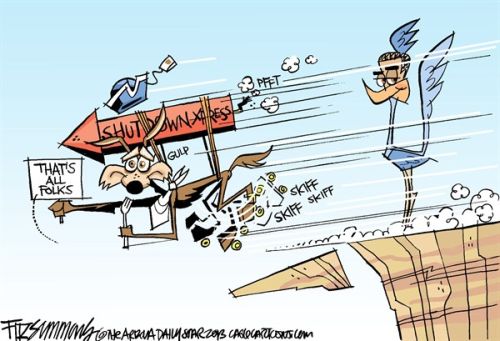
Good Morning!!
Before we get started, I need to make another appeal for donations. We still need a little more money to pay for WordPress extras like extended memory and our domain name. If you could give even $5, it would help a lot. We only need about $30 more to cover everything. Thanks so much to those of you who already gave!
Now on to the news of the day, which is so strange that I hardly know how to begin. Did we really just go through more than two weeks of a hostage drama with supposed grown-up elected officials threatening to bring down the U.S. economy–and along with it the global economy–unless the President and the legislature agree to repeal a legitimate law that has been upheld by the Supreme Court? Or failing that, deny birth control to adult women?
Yes, yes we did. Somehow, truly insane people have tried to take over the government. They’ve been defeated for now, but in only a few months we could go through this again! This article at Bloomberg Businessweek pretty much sums it up: Congress Ends Impasse to Be Revisited in January.
After the partisan passions and heated rhetoric, the disruptions of a government shutdown and displays of dysfunction, Congress did what it could have done weeks ago: voted to fund the government and lift the debt limit.
The passage last night by wide margins — an 81-18 vote in the Democratic-led Senate, followed by a 285-144 vote in the Republican-controlled House — allows the U.S. to avoid default and ends the shutdown that began Oct. 1 and has taken $24 billion out of the U.S. economy.
President Barack Obama signed the bill just after midnight, according to a White House statement. The measure puts government workers back on the job starting today and permits the U.S. to pay its debts, benefits and salaries.
Lawmakers didn’t show they’re any closer to resolving the underlying issues of spending priorities and deficit-reduction measures, particularly in the House where a shrinking political middle makes compromise elusive as the latest events show.
The focus now shifts to a new series of deadlines — the first for budget negotiations with a Dec. 13 target — that set up more rounds of political combat over taxes and spending on programs including Social Security and Medicare. The deal funds the government at Republican-backed spending levels through Jan. 15, 2014, and suspends the debt limit through Feb. 7.

But according to CBS News, Republicans still plan to keep trying to repeal the Affordable Care Act.
[Senate Minority Leader Mitch] McConnell claimed victory for Republicans in the fact that the sequester cuts mandated by the Budget Control Act were preserved, and assured the party he is committed to fighting to repeal Obamacare.
“Republicans remain determined to repeal this terrible law, but for today the relief we hope for is to reopen the government, avoid default and protect the historic cuts we achieve under the Budget Control Act,” he said. “This is far less than many of us had hoped for, frankly, but its far better than what some had sought. Now it’s time for Republicans to unite behind other crucial goals.”
Ted Cruz plans to continue the hopeless fight against Obama’s health care law. From Mediaite: Ted Cruz Slams ‘Lousy Deal,’ Pledges Obamacare Fight Is Far From Over on Hannity.
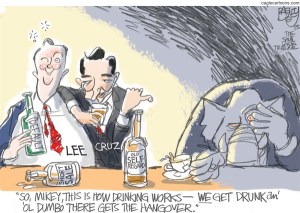
Ted Cruz and Mike Lee, the conservative tag-team that led the fight on Obamacare from the beginning, joinedSean Hannity Wednesday night before the House voted to officially end the government shutdown, both of them slamming the compromise deal and promising to continue fighting the health care law. Cruz called it a “lousy deal” and the latest example of the “Washington establishment selling the people down the river.”
Watch the video at the link if you can stomach it.
Meanwhile, back in Texas some folks aren’t so happy with their new Senator. The Houston Chronicle yesterday expressed regret for having endorsed him. From HuffPo:
Nearly one year removed from its decision to endorse Ted Cruz, the Houston Chronicle reflected back on that choice in a Tuesday op-ed, admitting that he has not lived up to the paper’s expectations.
In a piece entitled “Why We Miss Kay Bailey Hutchison,” the newspaper reflected back on how Hutchison had an “extraordinary understanding of the importance of reaching across the aisle when necessary.” That skill has not been displayed by Cruz or senior Sen. John Cornyn (R-Texas), according to the Chronicle….
In an Oct. 18, 2012 op-ed, the Chronicle explained that its endorsement of Cruz was premised on him following the example of previous senators, including Democrats Lloyd Bentsen, who went on to serve as Treasury Secretary and Lyndon B. Johnson, who later became president.
“We expect Cruz as the senator from the Lone Star State to spend his energies standing up for Texans of every background and economic station, representing their best interests from health care and education to energy, space and medicine,” the paper wrote.
The Dallas News notes: Ted Cruz left with few friends after Obamacare fight fails, government shutdown ends, debt limit rises.
It might be time for Ted Cruz to get a dog.
Because as the saying goes, if you want a friend in Washington, that’s what you do. And by the time Cruz’s crusade to defund Obamacare finally crashed to a halt Wednesday, the Texas senator had precious few friends left.
The government shutdown alienated colleagues in both parties. It generated fresh animosity toward the tea party and a flurry of recriminations toward Cruz. Voter support for the Republican Party plunged….
Cruz willed himself to the center of the fight. For months, he predicted that Democrats would cave if Republicans stood together to strip funding from the health care law. He dramatized the cause with a 21-hour overnight Senate speech, soaring to unusual prominence for a freshman senator. He refrained from using the risk of a catastrophic default on U.S. debt as leverage. Still, the defeat was so resounding that it left his political future in doubt.
The vast majority of his colleagues repudiated his tactics. Some accused him of promoting himself more than any attainable goals or the health of his party.
Sen. John McCain of Arizona, the 2008 GOP presidential nominee, called the last few weeks an “agonizing odyssey.”
“This has been one of the most shameful chapters I’ve seen here,” he said, lamenting damage to the GOP for little gain. “We’re in a hole. We have to dig out. We weren’t going to defund Obamacare, and we weren’t going to keep the government shut down.”
On the other hand, Mitch McConnell didn’t walk away empty-handed. WFPL in Louisville reports: McConnell-Reid Deal Includes $3 Billion Earmark for Kentucky Project.
Language in a draft of the McConnell-Reid deal (see page 13, section 123) provided to WFPL News shows a provision that increases funding for the massive Olmsted Dam Lock in Paducah, Ky., from $775 million to nearly $2.9 billion.
The dam is considered an important project for the state and region in regards to water traffic along the Ohio River.
As The Courier-Journal’s James Bruggers reported in 2011, the U.S. Army Corps of Engineers said they needed about $2.1 billion for the locks due to “stop and go funding.”
Asked about the additional funding in the proposal, McConnell spokesman Robert Steurer directed all questions to lawmakers who worked on the bill directly.
Hostage-taking, extortion, and bribery. It’s the Republican way.
In the midst of the madness last night, Diane Reedy, a House stenographer had to be dragged off the House floor after she grabbed a microphone during the vote and began ranting about Freemasons. CNN:
Amid all the chaos of the last-minute deal in Washington, there was an unusual moment on the House floor moments after the bill passed.
A House stenographer and well-known employee calmly took to a microphone and began screaming.
“Do not be deceived. God shall not be mocked. A House divided cannot stand,” she said, according to a House GOP aide. After a few seconds, she was escorted out by the Sergeant-at-Arms, but an audio recording by Todd Zwillich of Public Radio International captured the rest of her rant.
“He will not be mocked, He will not be mocked, (don’t touch me) He will not be mocked. The greatest deception here, is that this is not one nation under God. It never was. Had it been… it would not have been… No. it would not have been… the Constitution would not have been written by Free Masons… and go against God. You cannot serve two masters. You cannot serve two masters. Praise be to God, Lord Jesus Christ.”
According to Dana Bash, the woman is well liked on Capitol Hill. She was taken to a hospital for a psychological evaluation. I hope she will be okay; but frankly, her behavior is no crazier than that of some House members. For example, insane Texas Rep. Louis Gomert claimed yesterday that Sen. John McCain is a supporter of al Qaeda. Raw Story reports McCain’s response:
Sen. John McCain (R-AZ) shrugged off Rep. Louie Gohmert’s (R-TX) insinuation that he was an “al Qaeda supporter” in an interview with NBC Nightly News host Brian Williams on Wednesday, while conceding to an increasing amount of polarization between lawmakers.
“On that particular issue, sometimes comments like that are made out of malice,” McCain told Williams. “But if someone has no intelligence, I don’t view it as being a malicious statement. You can’t respond to that kind of thing.”
And this wasn’t just an isolated incident.
Gohmert made a thinly-veiled reference to McCain during an Oct. 11 appearance at the Value Voters Summit, mocking his trip to meet with rebel leaders in Syria by calling him, “a guy that’s been to Syria and supported Al Qaeda and the rebels.”
The two also clashed in 2012, with Gohmert calling McCain and other GOP lawmakers“numbnuts” after McCain criticized Gohmert and Rep. Michele Bachmann (R-MN) for what he called “specious and degrading attacks” against former State Department aide Huma Abedin.
Can we get Gomert a psych eval? Please?
Just a couple more links on reactions to the insanity in DC:
From the Wall Street Journal: Business Voices Frustration With GOP.
The budget stalemate that had the U.S. flirting with default has left business and the Republican Party, longtime political allies, at a crossroads.
In interviews with representatives of companies large and small, executives predicted a change in how business would approach politics. They didn’t foresee a new alignment with Democrats but forecast backing challengers to tea-party conservatives in GOP primaries, increasing political engagement with centrist Republicans and, for some, disengaging with politics altogether.
Many business executives say they were dismayed that some Republicans didn’t heed their warnings that closing the government and risking default would hurt the U.S. economy. Others expressed disgust with Washington politics in general. All said the crisis could have been averted with a more pragmatic approach.
The decadeslong relationship between American business and the GOP is certainly likely to endure, with business still feeling a kinship and shared goals with many in the party, including a push for lower taxes and lighter regulation.
But the conversation among businesses is “characterized by tremendous frustration and angst,” said Dirk Van Dongen, president of the National Association of Wholesale-Retailers, a trade group. “Because at the end of the day, the system is supposed to produce results, and the failure to produce results has consequences.”
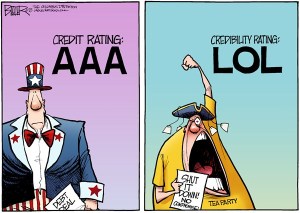
Reuters: Dollar slides as relief at U.S. debt deal fades.
“The U.S. can give a sigh of relief for now but the New Year could bring a dangerous sense of déjà vu,” Luke Bartholomew, investment analyst at Aberdeen Asset Management, said.
Equity markets in the U.S. and Asia initially welcomed the last-minute deal which pulled the world’s biggest economy back from the brink of a historic default, but the rally ran out of steam as the longer-term implications sank in….
The temporary nature of the agreement and longer-term worries that the debt ceiling risks would become a structural drag on the economy also weighed on debt markets.
That view was shared by Chinese credit agency Dagong, which downgraded the U.S. sovereign rating to A- from A with a negative outlook, driving further dollar losses.
The 10-year benchmark Treasury note yield slipped to 2.65 percent from around 2.68 percent late in New York. While U.S. Treasury bill futures had gained 0.1 percent.
“It casts dark clouds over the economy – politics are now the main drag for growth in the U.S,” Rabobank strategist Philip Marey said.
Read more at the link.
Finally, the Center for American Progress has released a report on Replacing the Sequester. Check it out at the link.
Now it’s your turn. What stories are you following today? What reactions are you seeing to yesterday’s agreement? Please post your own thoughts as well as your links on any topic in the comment thread.
Breaking News: Boehner will not block the Senate Agreement
Posted: October 16, 2013 Filed under: Breaking News 64 Comments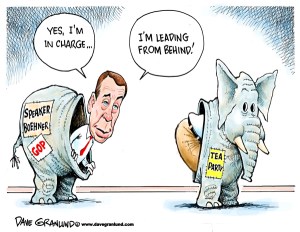 House Republicans have just left a meeting with Leadership. It appears we have an agreement of some kind.
BREAKING: Boehner surrenders: “Blocking the bipartisan agreement reached today by the members of the Senate will not be a tactic for us.”
A vote on the bill to avert a default and reopen the government is expected as early as this evening.
Update 3: House Speaker John Boehner hasreleased a statement about the agreement, promising to support the Senate’s bill: “Blocking the bipartisan agreement reached today by the members of the Senate will not be a tactic for us. In addition to the risk of default, doing so would open the door for the Democratic majority in Washington to raise taxes again…our drive to stop the train wreck that is the president’s health care law will continue. We will rely on aggressive oversight that highlights the law’s massive flaws and smart, targeted strikes that split the legislative coalition the president has relied upon to force his health care law on the American people.”
Senate leaders have forged an 11th-hour deal to end the government shutdown and raise the debt ceiling, and House Speaker John Boehner is expected to bring the bill up for a vote,Politico and other media outlets reported Wednesday morning. If the bill passes and arrives on President Obama’s desk by the October 17 deadline, the US government will reopen until January 15, and the debt ceiling will be raised until February 7, delaying the budgetary and debt ceiling crises and leaving President Obama’s signature health care bill largely intact.
Boehner: We fought the good fight, we just didn’t win.
In an interview on a local radio station, House Speaker John Boehner (R-Ohio) conceded that Republicans “didn’t win” the current budget debate.
“We’ve been locked into a fight over here, trying to bring government down to size, trying to do our best to stop Obamacare,” Boehner said. “We fought the good fight; we just didn’t win.”
Boehner also said he would “absolutely” allow a vote on the Senate plan even if a majority of House Republicans don’t support the bill.
“There’s no reason for our members to vote ‘no’ today,” Boehner said, adding that he expected the vote to happen Thursday.
Ryan Budget Plans Ignored as Lawmakers Craft Debt-Limit Deal
Representative Paul Ryan wanted big policy changes to lift the U.S. debt ceiling: a revamp of Social Security and Medicare, a framework for tax-code changes and approval of the $5.3 billion Keystone XL pipeline.
That’s all on hold now. Lawmakers are moving to adopt legislation to end the 16-day partial government shutdown and continue paying the nation’s bills. Ryan’s ideas for fixing the crisis weren’t included in a Senate compromise that may come up for votes today.
Instead, the Republican Party’s fiscal-policy leader and its 2012 vice presidential nominee will have to wait for budget negotiations in the coming weeks that are envisioned in an emerging Senate agreement to end the current impasse.
Ryan’s limited role in the immediate talks risks diminishing his credentials before 2016, when the Budget Committee chairman could be a White House contender, said Julian Zelizer, a professor of public affairs and history at Princeton University in New Jersey.
“There was a moment in recent days where it seemed like he would try to emerge in the spotlight, to help be the driver. But it didn’t happen,” Zelizer said. “He’s not a key figure.”
Tweets of Note:
.@Newsweek scoop: S&P was minutes from downgrading US credit when the shutdown deal came through: http://ow.ly/pSXlt
Boehner expects the government to reopen tomorrow http://huff.to/19QLdgo
Freedomworks CEO: House GOP ‘yes’ votes on Senate deal should be ready for primary challengers http://bit.ly/19SrU8k
Tuesday Reads: Nightmare on Capitol Hill
Posted: October 15, 2013 Filed under: Barack Obama, morning reads, Republican politics, U.S. Economy, U.S. Politics | Tags: Congress, Debt Ceiling, government shutdown, Harry Reid, Mitch McConnell, Paul Ryan, Tea Party, Ted Cruz 51 Comments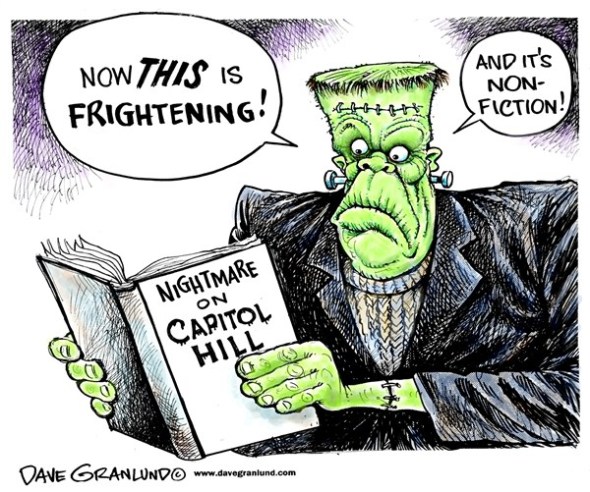
Good Morning!!
Yes, it’s real–too real. We’re approaching the deadline for raising the debt ceiling–it’s Thursday–and Congress is still dithering. But it looks like they may figure out a way to kick the can down the road again, as long as Ted Cruz doesn’t decide to have another tantrum.
According to the Hill this morning, Harry Reid and Mitch McConnell are close to agreeing on “a deal” to reopen the government and raise the debt ceiling for a few more months. The two Senate leaders huddled for hours yesterday trying to put together some kind of package that would satisfy House Republicans and convince them not to bring down the U.S. Government and the global economy.
An emerging deal to reopen the government and raise the nation’s debt ceiling until February gathered political momentum Monday evening after Senate Republicans signaled they would likely support it.
Lawmakers and aides said the legislation would fund the government until Jan. 15 and extend the nation’s borrowing authority until February but leave ObamaCare largely untouched.
The agreement would also set up another “supercommittee” to try to deal with the next round of automatic sequester cuts. The committee would have until December 13 to report to Congress. Anyone who thinks they’ll agree on anything, please raise your hand.
The big question is whether a package to fund the government and raise the debt ceiling can pass muster in the House.
Speaker John Boehner (R-Ohio) was briefed on the deal Monday, and members of his conference were taking a wait and see attitude.
“When we see it, we’ll know what it is. Do you know what it is yet?” Rep. Pete Sessions (R-Texas), chairman of the House Rules Committee, asked reporters as he left Boehner’s office.
“As soon as we see something in writing, then we can understand how we can thoughtfully understand what we’ll do with it,” Sessions said.
House Majority Leader Eric Cantor (R-Va.) wouldn’t comment on the emerging Senate deal, but he told reporters House Republicans will meet Tuesday morning “to discuss a way forward.” “Possible consideration of legislation related to the debt limit” was added to Cantor’s daily House schedule for Tuesday.
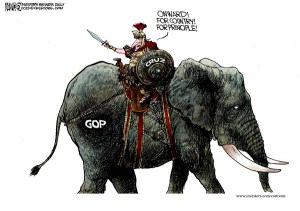
Of course the biggest potential fly in the ointment is Texas junior Senator Ted Cruz and his gang of Tea Party House members. Cruz wouldn’t say whether he’s planning another fake filibuster or some other effort to kill the Affordable Care Act. However, Cruz did hold a secret meeting with House Republicans last night, according to Roll Call.
Sen. Ted Cruz met with roughly 15 to 20 House Republicans for around two hours late Monday night at the Capitol Hill watering hole Tortilla Coast.
The group appeared to be talking strategy about how they should respond to a tentative Senate deal to reopen the government and raise the debt ceiling without addressing Obamacare in a substantive way, according to sources who witnessed the gathering. The Texas Republican senator and many of the House Republicans in attendance had insisted on including amendments aimed at dismantling Obamacare in the continuing resolution that was intended to avert the current shutdown.
Sources said the House Republicans meeting in the basement of Tortilla Coast with Cruz were some of the most conservative in the House: Reps. Louie Gohmert of Texas, Steve King of Iowa, Jim Jordan of Ohio, Tom Cotton of Arkansas, Raúl R. Labrador of Idaho, Steve Southerland II of Florida, Mark Meadows of North Carolina and Justin Amash of Michigan.
The group is a collection of members who have often given leadership headaches in recent years by opposing both compromise measures as well as packages crafted by fellow Republicans….While the emerging deal to reopen the government and hike the debt ceiling increase may have been a hot topic, it was not immediately clear what the group actually discussed. But the fact that such a group met with Cruz at all could give House GOP leaders even more heartburn as they consider themselves what to do if the Senate passes the measure.
If Cruz and his buddies decide to cause more trouble, they could bring about a default by dragging the fight out until after Thursday. Treasury Secretary Jack Lew could probably keep the U.S. afloat for a few more days, but it would be touch and go. Joshua Green wrote yesterday at Bloomberg Businessweek that “Ted Cruz Could Force a Debt Default All by Himself.”
How could this happen? Because the Senate can move quickly when necessary, but only by unanimous consent. Let’s say Harry Reid (D-Nev.) and Mitch McConnell (R-Ky.) strike a deal today (that’s looking unlikely). Cruz surely won’t like it and has said repeatedly, “I will do everything necessary and anything possible to defund Obamacare.” If he’s true to his word, he could drag out the proceedings past Thursday and possibly well beyond. “If a determined band of nut jobs wants to take down the global economy, they could do it,” says Jim Manley, a former top staffer for Reid. “Under Senate rules, we are past the point of no return—there’s not anything Reid or McConnell could do about it.”
If Cruz is truly determined to block or delay any deal that does not touch Obamacare, here’s how he’d do it: The hypothetical Reid/McConnell bill would probably be introduced as an amendment to the “clean” debt-ceiling raise that Democrats introduced—and Republicans defeated—last week. Reid voted against cloture on the motion to proceed to that bill, a procedural tactic that allows him to reconsider the bill later on. Let’s say he does so by 5 p.m. Monday. There would need to be a cloture vote on the motion to proceed. Cruz would dissent, but he wouldn’t be able to round up 41 votes for a filibuster….
The real killer is that Senate rules stipulate there must be 30 hours of post-cloture debate, unless senators agree unanimously to waive it. Reid and McConnell would want unanimous consent to move quickly, but Cruz could refuse, thereby forcing 30 hours of debate. This would drag things out until Tuesday at 11:30 p.m. Then there would be a vote on the motion to proceed (requiring a simple majority), followed by an intervening day, assuming Cruz withheld his consent to vote earlier. So now we’re looking at a Thursday cloture vote on the bill itself, followed by another 30 hours of post-cloture debate that would blow right past the Treasury deadline.
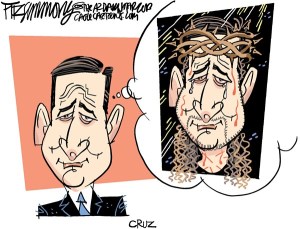
Let’s hope even Cruz isn’t that delusional and foolhardy. Booman also points out that the Senate can change the rules and limit post-cloture debate for this one vote. That takes 67 votes.
At The Daily Beast, Lloyd Green calls what Cruz and other Tea Party Republicans are doing “backdoor impeachment.”
The dance over the debt ceiling and the fight over the government shutdown are nothing less than impeachment on the cheap: a chance to negate the will of the majority by ostensibly placating the letter of the law. Unable to win the last two presidential elections or to persuade a Supreme Court majority that the Affordable Care Act was unconstitutional, House Republicans have arrived at a point where default and closure are the next best things. This combustible brew of race, class, and economic anxieties bubbles all too closely to the surface.
These days, the GOP comes across as hating Obamacare more than loving their countrymen, and the nation is returning that ire (PDF). Less than a quarter of Americans view the Republicans favorably, and a majority dislikes them, three-in-10 intensely. The GOP’s goal of recapturing the Senate in 2014 is now looking more like a dream than a reality, as Republicans are “forced to explain why they are not to blame and why Americans should trust them to govern both houses of Congress when the one they do run is in such disarray.” Indeed.
Unfortunately, the calamity of a potential default has tempered neither judgment nor passion. On Saturday, Ted Cruz—the man who lit the match, won the Values Voters Straw Poll with 42 percent of the vote. Channeling her inner Glenn Beck, Rep. Michele Bachmann (R-Minn.) concluded that the President “committed impeachable offenses.” Bachmann also proclaimed that civil disobedience was a potential response to Obama’s “thuggery,” and compared the Obama presidency to Egypt’s deposed Muslim Brotherhood.
I hope you’ll read the rest at the link.
Ted Cruz is stealing the right wing nut show for now, but in the House Paul Ryan raised his ugly head over the weekend to complain about the ACA’s individual mandate and requirement that women have access to birth control. From HuffPo:
Sources told the Post that, in a private meeting with House Republicans, Ryan said that by kicking the can down the road, the GOP would lose “leverage” in their fight against Obamacare.
Ryan’s main concern appears to be delaying the health care law’s individual mandate, but ThinkProgress points out that Ryan also emphasized the need to give employers the ability to deny birth control coverage based on moral or religious reasons.
Meanwhile most people around the country and even on Wall Street don’t seem all that concerned about what’s happening in Washington DC. I guess that after multiple emergencies in which political leaders “cried wolf,” everyone just assumes that Congress will find some way to keep the country going. Still, is this any way to run a country? Shouldn’t citizens be up in arms? Will Durst has a wacky column about this at Cagle Post called “Fukushima Sushi.”
Which is harder to believe? The ludicrous shenanigans going down in Washington or the fact that nobody seems particularly interested in doing anything about them? Good neighbors — it looks like we got ourselves one heck of a bumper crop of official dysfunction this year. Near as high as Manute Bol’s eye.
You’d think with national parks closed, veteran’s benefits being withheld and a possible catastrophic debt ceiling crisis looming, folks would be atwitter like chicken inspectors on a rotisserie spit during a power surge. And you’d be as wrong as a Bergman film on Comedy Central.
What the country seems to be seeking here is a little something called political responsibility. Which, in these dark days, is a wee bit of a tad of a total and complete oxymoron. Real similar to saying Fukushima sushi. Or elegant squalor. Comfortable rock.
Driving the point home: Weird normality. Spherical edge. Iron kite. Freedom shackle. Fresh detritus. Flammable sleet. Placid hammer. Colossal shrimp. Diminutive giant. Formal jeans. Sensitive linebacker. Salable autonomy. Veteran rookie. Vegetarian butcher. Pork tartare. Reality TV.
Keeping it real: Precarious certainty. Serene devastation. Bitter honey. Catholic condom. Heaven’s basement. Gelatinous needle. Sadistic lover. Banker’s compassion. Macabre solace. Chaste indiscretion. Temporary tax. Restorative annihilation. Healthy fries. Unhungry shark.
Lots more oxymoron’s at the link. How he came up with so many, I’ll never know.
Now what stories are you focusing on today? Please share your links on any topic in the comments.
Monday Reads: Coming apart at the seams
Posted: October 14, 2013 Filed under: morning reads 56 Comments Good Morning!
Every time I see a member of the Tea Party talk about “taking their country back”, I wonder which country they mean? Yes, nothing says respect our vets like waving confederate flags and telling our President to put down his Q’uran. Senator Ted Cruz and professional gadfly Sarah Palin have once again proven that their followers are just plain off their proverbial rockers.
“Veterans” – basically Tea Partyers – led by Palin and Cruz, marched today on the World War II memorial in Washington, DC, stole the National Park Service’s protective barriers, and then threw them at the White House.
This was intended to show their ire over the fact that the World War II memorial, along with every other federal land, site, office and program, was closed once the GOP shut down the federal government in the hopes of extorting the President into defunding health care reform, aka Obamacare, aka the Affordable Care Act.
The Tea Party “vets,” led by Palin and Cruz, are apparently so outraged at themselves for shutting down the federal government, that they’re now protesting the President for listening to them.
Tea Party protesters also concerned about Obama being a Muslim
According to CNN, the Tea Party protesters gathered at the White House are also very concerned that President Obama is a Muslim:
One speaker went as far as saying the president was a Muslim and separately urged the crowd of hundreds to initiate a peaceful uprising.
“I call upon all of you to wage a second American nonviolent revolution, to use civil disobedience, and to demand that this president leave town, to get up, to put the Quran down, to get up off his knees, and to figuratively come out with his hands up,” said Larry Klayman of Freedom Watch, a conservative political advocacy group.
Fox’s Brit Hume is quite upset that Politico’s Ben White appears to have a brain
Of course, leave it to Fox News to come to the defense of today’s contradictory Tea Party protest against the very shutdown policy the Tea Party championed.
 Go read the twitter exchange between Hume and White. It’s worth the look. The rally wasn’t very big but the radical right can still grab media attention. That probably explains one of the reasons that Palin showed up given she’s about as relevant as a French Franc these days.
About 200 people, counting among their ranks Republican Senator Mike Lee, Senator Ted Cruz and former Governor of Alaska Sarah Palin, converged on D.C.’s World War II memorialSunday morning. Slightly overselling themselves as the ”Million Vet March on the Memorials,” they cut through barriers to protest the site’s closing during the shutdown.
“This is the people’s memorial,” Cruz said in a speech. “Let me ask a simple question. Why is the federal government spending money to erect barricades to keep veterans out of this memorial?”
Those present weren’t all agreed upon the specifics of their grievances, according to the Washington Times. As one protestor put it: “There’s a three-part focus: veterans, impeachment and the truckers.”
Other Tea Partiers heckled the police at the White House.
The fine, upstanding patriots who protesting at Washington, DC memorials ganged up on police at the White House calling them names like “Gestapo,” “Brown Shirts,” and “Stasi.” They also yelled that the security unit “looked like something out of Kenya.” These Tea Partiers have been making public displays about how much they love Americans serving in uniform, but that, apparently, doesn’t extend to police uniforms.
Stay classy my friends!!!
Meanwhile, the relevant people in the government were trying to figure out a way to open the government and avoid defaulting on the national debt. Reid and McConnell are taking the three day weekend to try to find some common ground. McConnell appears quite wed to the sequester which is devastating essential government services in an outrageous way. There doesn’t appear to be much movement on any one’s part.
In talks between Senate Majority Leader Harry Reid (D-Nev.) and Senate Minority Leader Mitch McConnell (R-Ky.), the main sticking point is now where to establish funding levels for the federal government and for how long. The Republican offer made on Friday — to set spending at sequestration levels of $988 billion for the next six months -– was rejected by Reid and others on Saturday on the grounds that it was too favorable to the GOP position and discouraged future negotiations.
By Sunday morning, little notable progress toward a resolution had been made. McConnell, according to sources, was adamant that the spending cuts of sequestration be maintained in any final arrangement.
“Sen. McConnell will defend the commitment Congress made on spending reductions; he’ll defend the law that Sen. Reid voted for and the president signed — and subsequently bragged about in his campaign,” said McConnell spokesman Don Stewart. “As I recall, Sen. Reid voted for, and President Obama signed the Budget Control Act [which established sequestration]. They may not like that the supercommittee didn’t act and we’re left with sequester, but under their own rhetoric, it’s ‘the law of the land.'”
Some of McConnell’s top deputies that echoed sentiment on the Sunday talk shows. “The president and leaders of Congress need to take the responsibility of dealing with the underlying problem and keep the budget caps in place,” Sen. Rob Portman (R-Ohio) told “Meet The Press.” “My gosh, we just put them in place two years ago.”
“If you break the spending caps, you’re not going to get any Republicans in the Senate,” Sen. Lindsey Graham, (R-S.C.) said on ABC’s “This Week.”
There doesn’t appear to be any movement really on either side. As I’ve written about before, nations around the world are not responding well to any of  these. The Chinese are calling for “De-Americization” saying that Pax America has failed on all fronts.
China’s official news agency has called for the creation of a “de-Americanised world”, saying the destinies of people should not be left in the hands of a hypocritical nation with a dysfunctional government.
Heaping criticism and caustic ridicule on Washington, the Xinhua news agency called the US a civilian slayer, prisoner torturer and meddler in others’ affairs, and said the ‘Pax Americana’ was a failure on all fronts.
The official news agency of China, which is seen as the pretender to the world’s superpower crown, then rubbed in more salt, calling American economic pre-eminence just a seeming dominance.
“As US politicians of both political parties are still shuffling back and forth between the White House and the Capitol Hill without striking a viable deal to bring normality to the body politic they brag about, it is perhaps a good time for the befuddled world to start considering building a de-Americanised world,” the editorial said.
It asks why the self-declared protector of the world is sowing mayhem in thefinancial markets by failing to resolve political differences over key economic policy.
“… the cyclical stagnation in Washington for a viable bipartisan solution over a federal budget and an approval for raising debt ceiling has again left many nations’ tremendous dollar assets in jeopardy and the international community highly agonised,” the agency said.
It is not the first time Chinese leadership and newspapers have criticised Washington over a policy paralysis that threatens to devalue its dollar assets.
According to US Treasury Department data, China is the biggest foreign owner of US Treasuries at $1.28 trillion as of July. Besides, China also holds close to $3.5 trillion of dollar-denominated assets.
A US debt default and consequent credit downgrade would significantly erode the value of China’s holdings.
A U.S.default would put is in the company of some pretty rogue nations including 1933 Germany.
Reneging on its debt obligations would make the U.S. the first major Western government to default since Nazi Germany 80 years ago.
Germany unilaterally ceased payments on long-term borrowings on May 6, 1933, three months after Adolf Hitler was installed as Chancellor. The default helped cement Hitler’s power base following years of political instability as the Weimar Republic struggled with its crushing debts.
“These are generally catastrophic economic events,” said Professor Eugene N. White, an economics historian at Rutgers University in New Brunswick, New Jersey. “There is no happy ending.”
The debt reparations piled onto Germany, which in 1913 was the world’s third-biggest economy, sparked the hyperinflation, borrowings and political deadlock that brought the Nazis to power, and the default. It shows how excessive debt has capricious results, such as the civil war and despotism that ravaged Florence after England’s Edward III refused to pay his obligations from the city-state’s banks in 1339, and the Revolution of 1789 that followed the French Crown’s defaults in 1770 and 1788.
Failure by the world’s biggest economy to pay its debt in an interconnected, globalized world risks an array of devastating consequences that could lay waste to stock markets from Brazil to Zurich and bring the $5 trillion market in Treasury-backed loans to a halt. Borrowing costs would soar, the dollar’s role as the world’s reserve currency would be in doubt and the U.S. and world economies would risk plunging into recession — and potentially depression.
Ever thought about working for Amazon? Well, Business Week’s look at Jeff Bezos may give you pause.
The people who do well at Amazon are often those who thrive in an adversarial atmosphere with almost constant friction. Bezos abhors what he calls “social cohesion,” the natural impulse to seek consensus. He’d rather his minions battle it out backed by numbers and passion, and he has codified this approach in one of Amazon’s 14 leadership principles—the company’s highly prized values that are often discussed and inculcated into new hires:
Leaders are obligated to respectfully challenge decisions when they disagree, even when doing so is uncomfortable or exhausting. Leaders have conviction and are tenacious. They do not compromise for the sake of social cohesion. Once a decision is determined, they commit wholly.
Some employees love this confrontational culture and find they can’t work effectively anywhere else. “Everybody knows how hard it is and chooses to be there,” says Faisal Masud, who spent five years in the retail business. “You are learning constantly, and the pace of innovation is thrilling. I filed patents; I innovated. There is a fierce competitiveness in everything you do.” The professional networking site LinkedIn (LNKD) is full of “boomerangs”—Amazon-speak for executives who left the company and then returned.
But other alumni call Amazon’s internal environment a “gladiator culture” and wouldn’t think of returning. Many last less than two years. “It’s a weird mix of a startup that is trying to be supercorporate and a corporation that is trying hard to still be a startup,” says Jenny Dibble, who was a marketing manager there for five months in 2011. She found her bosses were unreceptive to her ideas about using social media and that the long hours were incompatible with raising a family. “It was not a friendly environment,” she says. Even leaving Amazon can be a combative process—the company is not above sending letters threatening legal action if an employee takes a similar job at a competitor. Masud, who left Amazon for EBay(EBAY) in 2010, received such a threat. (EBay resolved the matter privately.)
 Gladiator Culture? Oy!!!
So, today is a holiday and I have to join a lot of people in asking why the heck do we still celebrate Columbus Day? How do you “discover” something when it’s already been there and you actually were looking for some place else? Then, you basically turn the place into a living hell for those you “discovered”? Just don’t get it at all!
I’m still one of those that believes we should honor the first Americans! That would be the ones who were already here when the Europeans invaded the place.
One issue that came up during our conversation was the fact that Columbus Day really should be renamed to Native American Day, in honor of the millions of people whose heritage has been ridiculed and ruined in mainstream media (when the plight of people living on reservations isn’t being ignored entirely, that is). However, when Brown University exchanged “Columbus Day” language for more neutral “Fall Weekend,” they were met with opposition from their College Republican group, whose leader argued “Columbus should be celebrated for bringing the European political tradition to the New World, which led to the foundation of the United States.”
Oh, dear! I’m back to xenophobic and racist republicans again. How did that happen? Like I said, when they say take ‘our’ country back. What the hell country and who do they mean?
What’s on your reading and blogging list today?

 peej
peej Carissa
 bostonboomer
 dakinikat
 ecocatwoman
 jjlo
jjlo mablue2
 Mama Lopez
 peggysue22
 quixote
 skydancingguestblogger
 Mona (aka Wonk the Vote)





Recent Comments