
Try checking out the real Haunts for Halloween
Posted: October 31, 2013 Filed under: New Orleans | Tags: Coven, haunted houses, Holt cemetery New Orleans, Madame LaLaurie, New Orleans, real hauntings, the LaLaurie House 19 Comments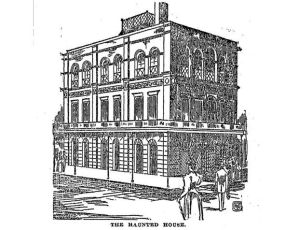 There are many really cool things about living in a very old city and in very old houses that I don’t know where to start. You pretty much know
 that death, disaster, and the wicked part of human nature have not been sanitized for suburban pearl-clutchers or commercialized by the mercenary. You live next to churches built for victims of Yellow Plague and cemeteries where the rain can wash up bones. Living in New Orleans isn’t like living in a European City with their pits filled of tens of thousands of black plague victims and underground cities stacked with skeletons. But, being in the French Quarter on Halloween night sure beats handing out candy to future obese, diabetics decked out in WalMart’s worst.
I really love watching spooky shows and movies this time of year. One of my newest addictions is the FX TV show American Horror Story: Coven. It has some great American actresses in it and it’s filmed in New Orleans. It stars Jessica Lang, Kathy Bates, and Angela Bassett. The two latter actresses play real New Orleans people.
Delphyne posted a link to my Facebook about scary as hell places in the USA. New Orlean’s St. Louis Number One Cemetery–where Marie LaVeau is supposedly buried–always pops up on the list. Bassett plays LaVeau in Coven. Bates plays Madame LaLaurie whose house is considered so haunted that no one lives there for long.
Frankly, I’ve never found St. Louis One to be spooky or ooky. Holt Cemetery is far more full of those weird vibes that you can feel in cemeteries. Holt is the potter’s cemetery where many of New Orlean’s best Jazz musician’s were eventually buried. The graves are shallow and not the little above ground houses you think about when you think New Orleans cemeteries so if you go there after flooding or rain you are likely to find human bones about the place. There were lots of them scattered around after Katrina. They’re trying to redo the place to stop these kinds of events.
I lived across from the LaLaurie Mansion for five years and never ever experienced anything akin to a haunt or a wicked bad vibe. Kathy Bates plays Madam LaLaurie who is supposedly cursed by LaVeau to live forever and is buried alive to be found in modern times by Jessica Lange early in the series. The series very much uses the city as another character in the story. The rest–of course–is pure fiction and very much in the genre of making a spooky story based on the modern idea of spooky. But, I do have to say it’s a fun twist and I love watching it display New Orleans in all its spookery.
I thought I’d share with you the actual stories of the LaLaurie House–which has been considered haunted for well over a hundred years–since it figures prominently in the 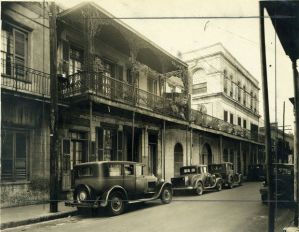 plot of Coven. Here’s the original news story on the house that exposed the horrific things that Madame LaLaurie did to her slaves. This is also something that is essential to the plot of Coven. Again, I I lived across from the house for five years and really never experienced anything. That can’t be said for my own house now or other places I’ve been. We will get to that later.
April 11, 1834
The conflagration at the house occupied by the woman Lalaurie in Hospital … is like discovering one of those atrocities the details of which seem to be too incredible for human belief.
We would shrink from the task of detailing the painful circumstances connected herewith, were it not that a sense of duty and the necessity of exposing and holding to the public indignation such a wretch as the perpetrator, renders it indispensable for us to do so.
The flames having spread with an alarming rapidity, and the horrible suspicion being entertained among the spectators that some of the inmates of the premises where it originated, where incarcerated therein, the doors were forced open for the purpose of liberating them. Previous however, to taking this liberty, (if liberty it can be called), several gentlemen impelled by their feelings of humanity demanded the keys which were refused them in a gross and insulting manner. Upon entering one of the apartments, the most appalling spectacle met their eyes. Seven slaves more or less horribly mutilated were seen suspended by the neck, with their limbs apparently stretched and torn from one extremity to the other. Language is powerless and inadequate to give a proper conception of the horror which a scene like this must have inspired. We shall not attempt it, but leave it rather to the reader’s imagination to picture what it was.
These slaves were the property of the demon, in the shape of a woman whom we mentioned in the beginning of this article. They had been confined by her for several months in the situation from which they had thus providentially been rescued and had been merely kept in existence to prolong their suffering and to make them taste all that the most refined cruelty could inflict. But why dwell upon such aggravating and painful particulars! We feel confident that the community share with us our indignation, and that vengeance will fall heavily upon the guilty culprit. Without being superstitious, we cannot but regard the manner in which these atrocities have been brought to light as an especial interposition of heaven.
 There are a series of later articles on the house’s haunted status that are also great reading. I love reading the articles in the vernacular of the day. This one is written in 1892 and describes the house’s reputation at the time.
In the Rue Royale stands this quaint, old-fashioned house about which so much has been written, and around which cluster so many wild and weird stories, that even in its philosophic day, few in the old faubourg care to pass the place after nightfall, or, doing so, shudder and hurry on with bated breath, as though midnight ghouls and ghosts hovered near, ready to exercise a mystic spell over all who dare invade its uncanny precincts.
“La maison est hantee,” that is what the Franco-Spanish residents of the “vieux carre” will shake their heads and tell you; and every one who lives in the rue Royale, whether descendants of the ancient habitue or member of that recent cosmopolitan element that has invaded the street, know the history of that old house, and repeats in guarded whispers, “The house is haunted” and will volunteer strange stories of how ghosts and spirits may be seen flitting mysteriously about the rooms after nightfall who the witches and hob-goblins hold high revel there, of the strange unearthly noises that proceed from the damp dungeon and attic, the mysterious, lambent lights that flit rapidly from window to window and then vanish, only to reappear with confused rapidity and the long, ghostly procession that winds up the stairway at midnight, and peers cautiously over the roof, where the figure of a little child may be seen upon moonlight nights haunting the latticed belvedere. And all this began long ago, when the great house was shut up for many years and broken windows and defaced galleries told the story of the uprising of an indignant populace and
laid the foundation for the wild and ghostly legends which succeeding years have woven about it. No house in the rue Royale has attracted so much widespread attention. Every stranger who visits New Orleans inquires for it, artists have painted it and travelers have written about it and several years ago Geo. W. Cable made it the subject of a special article in the Century Magazine. How much of that story is true, and how much the creation of Mr. Cable’s fancy the old Creole of New Orleans will tell you; but this fact remains, that the house has a history, a real true history that needs neither imagination nor art to make it one of the most interesting studies in New Orleans, both from a historical and romantic point of view.
The house is still on the Haunted Tours that are omnipresent in the Quarter. It was, in fact, owned briefly by Nicholas Cage. It is an imposing structure. My kids were anxious to take these tours but I have to admit I’ve never done it. I have been on many a street when guides were spinning the stories they spin at some point in time. I do know a lot of people that have lived in houses they will not return to and the majority of them are not on the tours so I kind’ve judge the entire thing based on that. In my experience, there’s an apartment sitting near Cabrini park at the edge of the Quarter that’s got far more hauntings. I’ve known folks that have lived there and nearly all of them have left within months of moving in the place.
I have had my share of really strange things that have happened since living in New Orleans and you can officially place me in the category of no longer skeptic about some kind of weird energies that exist that cannot be explained. Nearly all of my experiences have happened after really raging hurricanes which seem to have a habit of stirring up energy and the watery ground beneath the city. I’ve had experiences in my own home close after Katrina that I really can’t explain. The first one happened shortly after I got home when there was no electricity to speak of and no one else around. It was deadly quiet because there were also no birds about. I was lying in my bed and I had my curtains open wide. I no longer leave my curtains open on that side of the house now at night. Just call me extra cautious. I saw a glowing round, orangish face in the window over my desk. I really thought it was a person and since the neighborhood was mostly deserted, I was freaked out. I ran to the window and pounded on it. I broke the glass actually. It occurred to me the next day that there is no way any person could peer through my window. They would have to be standing on the shoulders of some one else to do that. There was no light to play tricks on me so I have no idea what it could’ve been. I was not drinking. I was not asleep. I was in the dark reading a journal article by small flashlight. If you can develop some plausible hypothesis let me know. Like I said, I never leave a curtain or window open on that side of the bedroom after dark any more.
My second experience in my house was not too long after that. I was walking towards the door to the laundry room by the same desk. A very solid thick glass, cheese crock that holds odds and ends lifted about 18 inches off my night stand, went across my chest in front of my eyes and dropped to the floor without breaking. My lama was in the house at the time and I ran to get him to show him the crock sitting on the floor. I have absolutely no explanation for that. It was midday. I was not drinking and I am very much a logical, data oriented person so I am not the kind of person that just sees spirits in everything. I know what I saw. I know there is absolutely no logical explanation for it.
The last time I really experienced something strange was last year after Hurricane Issac when I was sitting at a table at Buffa’s in the Quarter. I had gotten up to talk to a friend of mine. I felt a distinct tingly,freezing cold sensation in the shape of person walking through me on the left side of my body. It was like some one about 4 inches shorter than me walked straight through that half of my body. It was electric and cold and totally in the shape of a person. I distinctly remember the shape of a head and torso. It was not a linear shape. I didn’t feel it completely on that side. It felt like the imprint of a short-person. My friend Randy saw me turn pretty pale and could feel the temperature difference between my left and right hand. It was very odd.
Anyway, if you spend your Halloweens in the suburbs with kids and candy and fake costumes and fake tombstones bought at Walmart you are really missing out on things. I really love the Day of the Dead Celebrations that have gravitated here from Mexico. They’ve got the “spirit” of the day down pat. You really need to take the day to go to a real “haunted” location or cemetery and check out the energy then ride it to wherever it goes. Of course, New Orleans is probably the premier Halloween destination on my list. But, there are so many wonderful historical American cities with equally rich and real culture that I am sure you can get to one or the other. I’ve never been to Salem, Mass but I have to say I envy people within driving distance. Now, there’s a perfect Halloween destination!!!
Anyway, we have a lot of severe weather moving our way tonight. I’m going to be keeping the shade down on the window over my desk tonight for sure!!!
Thursday Reads: Halloween History and A Little News
Posted: October 31, 2013 Filed under: hunger, morning reads, NSA, National Security Agency, U.S. Economy, U.S. Politics | Tags: All Saints Day, All Souls Day, Cecil Smith, Celts, costumes, demons, fairies, food stamps, guns, Halloween, jack-o-lanterns, Pumpkins, Samhain, Sanford FL, Scots-Irish immigrants, souling, spirits, Ted Cruz, Trayvon Martin case, trick or treating, weather 11 Comments
Happy Halloween Everyone!!
Last year at this time, Hurricane Sandy hit the East Coast, and this year a lesser but still “Monstrous Halloween storm” will “pelt the central US” from Texas up to the Midwest. My mom said authorities in Indiana have moved the official day for trick-or-treating to the weekend. Towns in Kentucky and Ohio are doing the same thing, according to USA Today.
Torrential rain, heavy thunderstorms and howling winds are forecast on Halloween all the way from Texas to the Midwest and interior sections of the Northeast, according to AccuWeather meteorologist Andy Mussoline.
Almost 42 million people could contend with severe thunderstorms Thursday, the Storm Prediction Center warns, with cities such as Cincinnati, Indianapolis, Louisville, Memphis, Nashville and Houston all at risk.
“Damaging winds and some tornadoes will be possible with what should be a complex and potentially messy storm,” according to an online forecast from the prediction center.
“The best costume in Houston for Halloween probably involves a garbage bag to keep dry,” reports WeatherBell meteorologist Ryan Maue, who adds that it could be the wettest Halloween ever in some spots.
Read more at the link.
I have a few articles on the Halloween history and traditions for you. From National Geographic: Halloween 2013: Top Costumes, History, Myths, More.
Halloween’s origins date back more than 2,000 years. On what we consider November 1, Europe’s Celtic peoples celebrated their New Year’s Day, called Samhain (SAH-win).
On Samhain eve—what we know as Halloween—spirits were thought to walk the Earth as they traveled to the afterlife. Fairies, demons, and other creatures were also said to be abroad.
In addition to sacrificing animals to the gods and gathering around bonfires, Celts often wore costumes—probably animal skins—to confuse spirits, perhaps to avoid being possessed, according to the American Folklife Center at the U.S. Library of Congress.
By wearing masks or blackening their faces, Celts are also thought to have impersonated dead ancestors.
Young men may have dressed as women and vice versa, marking a temporary breakdown of normal social divisions.
In an early form of trick-or-treating, Celts costumed as spirits are believed to have gone from house to house engaging in silly acts in exchange for food and drink—a practice inspired perhaps by an earlier custom of leaving food and drink outdoors as offerings to supernatural beings.
Samhain was later co-opted by the Catholic Church when the Church moved “All Saints Day” from May to November 1. Scots-Irish immigrants brought Halloween customs with them to America in the 18th and 19th centuries.

The History Channel has a more detailed article on the history of Halloween:
The Celts, who lived 2,000 years ago in the area that is now Ireland, the United Kingdom and northern France, celebrated their new year on November 1. This day marked the end of summer and the harvest and the beginning of the dark, cold winter, a time of year that was often associated with human death. Celts believed that on the night before the new year, the boundary between the worlds of the living and the dead became blurred. On the night of October 31 they celebrated Samhain, when it was believed that the ghosts of the dead returned to earth. In addition to causing trouble and damaging crops, Celts thought that the presence of the otherworldly spirits made it easier for the Druids, or Celtic priests, to make predictions about the future. For a people entirely dependent on the volatile natural world, these prophecies were an important source of comfort and direction during the long, dark winter.
To commemorate the event, Druids built huge sacred bonfires, where the people gathered to burn crops and animals as sacrifices to the Celtic deities. During the celebration, the Celts wore costumes, typically consisting of animal heads and skins, and attempted to tell each other’s fortunes. When the celebration was over, they re-lit their hearth fires, which they had extinguished earlier that evening, from the sacred bonfire to help protect them during the coming winter.
On Halloween traditions in the US:
In the late 1800s, there was a move in America to mold Halloween into a holiday more about community and neighborly get-togethers than about ghosts, pranks and witchcraft. At the turn of the century, Halloween parties for both children and adults became the most common way to celebrate the day. Parties focused on games, foods of the season and festive costumes. Parents were encouraged by newspapers and community leaders to take anything “frightening” or “grotesque” out of Halloween celebrations. Because of these efforts, Halloween lost most of its superstitious and religious overtones by the beginning of the twentieth century.
By the 1920s and 1930s, Halloween had become a secular, but community-centered holiday, with parades and town-wide parties as the featured entertainment. Despite the best efforts of many schools and communities, vandalism began to plague Halloween celebrations in many communities during this time. By the 1950s, town leaders had successfully limited vandalism and Halloween had evolved into a holiday directed mainly at the young. Due to the high numbers of young children during the fifties baby boom, parties moved from town civic centers into the classroom or home, where they could be more easily accommodated. Between 1920 and 1950, the centuries-old practice of trick-or-treating was also revived. Trick-or-treating was a relatively inexpensive way for an entire community to share the Halloween celebration. In theory, families could also prevent tricks being played on them by providing the neighborhood children with small treats.

In Europe jack-o-lanterns were made of turnips and other vegetables, since pumpkins were found only in the Americas. On the custom of “trick or treating” in the US:
The American Halloween tradition of “trick-or-treating” probably dates back to the early All Souls’ Day parades in England. During the festivities, poor citizens would beg for food and families would give them pastries called “soul cakes” in return for their promise to pray for the family’s dead relatives. The distribution of soul cakes was encouraged by the church as a way to replace the ancient practice of leaving food and wine for roaming spirits. The practice, which was referred to as “going a-souling” was eventually taken up by children who would visit the houses in their neighborhood and be given ale, food, and money.
The tradition of dressing in costume for Halloween has both European and Celtic roots. Hundreds of years ago, winter was an uncertain and frightening time. Food supplies often ran low and, for the many people afraid of the dark, the short days of winter were full of constant worry. On Halloween, when it was believed that ghosts came back to the earthly world, people thought that they would encounter ghosts if they left their homes. To avoid being recognized by these ghosts, people would wear masks when they left their homes after dark so that the ghosts would mistake them for fellow spirits. On Halloween, to keep ghosts away from their houses, people would place bowls of food outside their homes to appease the ghosts and prevent them from attempting to enter.
A few more interesting links to explore:
National Geographic: First Halloween Costumes: Skins, Skulls, and Skirts
The Boston Globe: Seven Books About the History of Halloween
Deseret News: Halloween trivia: From top costumes to carving turnips instead of pumpkins
Washington Post: It’s time to take the sexy out of Halloween and return the holiday to kids
Amanda Hess at Slate: It’s Irony, not sexy, that’s ruining Halloween
Amanda Marcotte at Raw Story: Obligatory Halloween Post On Skimpy Costumes

In other news . . .
In the wake of the Travon Martin killing, Sanford FL has banned neighborhood watch volunteers from carrying guns.
SANFORD — More than a year and a half after Trayvon Martin was shot and killed by George Zimmerman, the city of Sanford is making major changes to its neighborhood watch program, including banning volunteers from carrying guns while on patrol, and forbidding them from pursuing anyone in their neighborhoods.
Sanford’s new police chief, Cecil Smith, said the neighborhood watch program as it was operated while Zimmerman was part of it was dysfunctional and had no accountability.
“In this program, it is clearly stated that you will not pursue an individual,” Smith explained. “In this new program, it clearly indicates that you will not carry a firearm when performing your duties as a neighborhood watch captain or participant.”
Smith said when he took over as Sanford’s chief of police in April, the neighborhood watch program Zimmerman was part of was still operating the same way it was when he shot and killed 17-year-old Trayvon Martin more than a year earlier.
Sounds like an excellent idea.
The NSA is “firing back” after an article in the Washington Post claimed that the spy agency “infiltrates links to Yahoo, Google data centers worldwide.” From Politico:
The program, exposed through Edward Snowden’s leaks, relied on a broad, decades-old executive orderand allowed the NSA access to data-center connections in secret outside the United States, according to The Washington Post, which broke the story. Asked about the leak, Gen. Keith Alexander, the NSA’s leader, said earlier Wednesday he was unaware of the Post’s report — adding the NSA is “not authorized” to access companies data centers and instead must “go through a court process” to obtain such content.
The NSA, meanwhile, emphasized it hadn’t tried to circumvent U.S. law under the executive order, known by its numerical designation, 12333. “The assertion that we collect vast quantities of U.S. persons’ data from this type of collection is also not true,” a spokeswoman said. But the NSA aide declined to discuss further whether the agency — perhaps under other authorities — had infiltrated data center connections at all.
Google and Yahoo both told the Post it hadn’t granted the NSA access to its data centers. Both companies did not immediately comment for this story.
Based on past history of Glenn Greenwald and other reporters neglecting to report that NSA surveillance requires individual warrants, I’m going to assume that this is another instance of this kind of melodramatic “reporting.” I guess it will all come out eventually, since Congress is now investigating and the drip drip drip of leaks continues.
Meanwhile, “progressives” who are panicking over NSA spying continue to ignore vitally important issues that affect millions of Americans–poverty and hunger for examples. From MSNBC: America’s new hunger crisis.
In the 22 years that Swami Durga Das has managed New York’s River Fund Food Pantry, he has never seen hunger like this. Each Saturday, hundreds of hungry people descend on the pantry’s headquarters, an unassuming house on a residential block. The first people arrive around 2 am, forming a line that will wrap around the block before Das even opens his doors.
“Each week there’s new people,” Das told MSNBC.com. “The numbers have just skyrocketed.”
The new clients are diverse—working people, seniors, single mothers—but many of them share something in common: they represent the millions of Americans who fell victim to food insecurity when the Great Recession hit in 2009, but didn’t benefit from the economic recovery.
And the worst may be yet to come.
Food activists expect a “Hunger Cliff” on November 1, when automatic cuts to food stamp benefits will send a deluge of new hungry people to places like the River Fund Food Pantry, which are already strained.
“I thought we were busy now; I don’t know what it will be like then, because all of those people getting cut will definitely be accessing a pantry,” said Das. “It definitely will be a catastrophe.”
Please go read the whole thing.
Finally, here’s an interesting article about Ted Cruz by David Denby of The New Yorker: THE MASK OF SINCERITY.
When Ted Cruz lies, he appears to be praying. His lips narrow, almost disappearing into his face, and his eyebrows shift abruptly, rising like a drawbridge on his forehead into matching acute angles. He attains an appearance of supplication, an earnest desire that men and women need to listen, as God surely listens. Cruz has large ears; a straight nose with a fleshy tip, which shines in camera lights when he talks to reporters; straight black hair slicked back from his forehead like flattened licorice; thin lips; a long jaw with another knob of flesh at the base, also shiny in the lights. If, as Orwell said, everyone has the face he deserves at fifty, Cruz, who is only forty-two, has got a serious head start. For months, I sensed vaguely that he reminded me of someone but I couldn’t place who it was. Revelation has arrived: Ted Cruz resembles the Bill Murray of a quarter-century ago, when he played fishy, mock-sincere fakers. No one looked more untrustworthy than Bill Murray. The difference between the two men is that the actor was a satirist.
Cruz is not as iconographically satisfying as other American demagogues—Oliver North, say, whose square-jawed, unblinking evocation of James Stewart, John Wayne, and other Hollywood actors conveyed resolution. Or Ronald Reagan—Cruz’s reedy, unresonant voice lacks the husky timbre of Reagan’s emotion-clouded instrument, with its mixture of truculence and maudlin appeal.
Yet Cruz is amazingly sure-footed verbally. When confronted with a hostile question, he has his answer prepared well before the questioner stops talking. There are no unguarded moments, no slips or inadvertent admissions. He speaks swiftly, in the tones of sweet, sincere reason. How could anyone possibly disagree with him? His father is a Baptist, and Cruz himself has an evangelical cast to his language, but he’s an evangelical without consciousness of his own sins or vulnerability. He is conscious only of other people’s sins, which are boundless, and a threat to the republic; and of other people’s vulnerabilities and wounds, which he salts. If they have a shortage of vulnerabilities, he might make some up.
Read the rest at the link.
Now it’s your turn. What stories are you focusing on today? And what are you doing to celebrate Halloween? Please let us know in the comment thread.
Tuesday Reads: Liberals, Libertarians, and Concern Trolls
Posted: October 29, 2013 Filed under: abortion rights, Barack Obama, Civil Liberties, Civil Rights, Crime, Democratic Politics, Foreign Affairs, France, George W. Bush, Germany, Great Britain, Hillary Clinton, Medicaid, Medicare, morning reads, poverty, Reproductive Rights, Russia, Social Security, U.S. Politics, War on Women, Women's Rights | Tags: "progressive" blogs, Conor Friedersdorf, Edward Snowden, Glenn Greenwald, Ian Welsh, libertarians, Ron Paul, T-Bogg 60 Comments
Good Morning!!
Between the Red Sox being in the World Series and having to have a root canal on Saturday, I’ve been a little bit disconnected from politics. The Sox won again last night in St. Louis, and they’ll be coming back home to Fenway Park leading the series 3 games to 2; so they could end it tomorrow night. If this post is a little late, my aching jaw and baseball are the reasons why.
We’ve been talking a lot about libertarians lately, because so-called progressives have been aligning with those Ayn Rand fans since libertarian Edward Snowden began leaking top secret documents about the NSA and libertarian Glenn Greenwald began lecturing the world about what a great hero Snowden is for defecting to Russia and revealing the most secret counterintelligence methods of the U.S. and U.K.
The latest shameful episode was Saturday’s “Stop Watching Us” rally in Washington, at which supposedly “progressive” groups joined with anti-woman right-wingers like Justin Amash and neo-confederates like Ron and Rand Paul to protest the NSA doing its job of collecting foreign intelligence.
Before the rally took place, Tom Watson wrote a heartfelt column warning “progressives” that libertarians don’t make good bedfellows. Watson wrote that while he dislikes mass surveillance,
I cannot support this coalition or the rally. It is fatally compromised by the prominent leadership and participation of the Libertarian Party and other libertarian student groups; their hardcore ideology stands in direct opposition to almost everything I believe in as a social democrat.
The Libertarian Party itself — inaccurately described by Stop Watching Us as a “public advocacy organization” — is a right-wing political party that opposes all gun control lawsand public healthcare, supported the government shutdown, dismisses public education,opposes organized labor, favors the end of Social Security as we know it, and argues in its formal political manifesto that “we should eliminate the entire social welfare system” while supporting “unrestricted competition among banks and depository institutions of all types.”
Yet my progressive friends would take the stage with the representatives of this political movement? Why? The loss is much greater than the gain. Organizers trade their own good names and reputations to stand alongside — and convey legitimacy to — a party that opposes communitarian participation in liberal society, and rejects the very role of government itself. And their own argument for privacy is weakened by the pollution of an ideology that uses its few positive civil liberties positions as a predator uses candy with a child.
This is an abandonment of core principles, in my view, out of anger over Edward Snowden’s still-recent revelations about the National Security Agency and its spying activity, particularly domestic access to telephone and online networks and metadata. It represents trading long-held beliefs in social and economic justice for a current hot-button issue that — while clearly of concern to all Americans — doesn’t come close to trumping a host of other issues areas that require “the long game” of electoral politics and organizing. Going “all in” with the libertarian purists is a fatal and unnecessary compromise; reform is clearly needed, but the presence of anti-government laissez-faire wingers at the beating heart of the privacy movement will surely sour the very political actors that movement desperately needs to make actual — and not symbolic, link bait — progress in its fight.
But it was to no avail. Watson was attacked for his argument that the anti-surveillance fever is distracting from other important issues. People like Greenwald and Snowden couldn’t possibly care less about alleviating poverty, protecting women’s rights or the right to vote. They’d have no problem with Social Security and Medicare being eliminated, and as for voting, they’re anti-government anyway. Glenn Greenwald–whom some uninformed people believe is a “progressive,” saves his worst attacks for Democrats and in the past has supported Ron Paul and Gary Johnson for president. To Greenwald, sacrificing the entire legacy of FDR and the civil rights and women’s movements is no big deal. Here’s how he characterized the values of liberals who reject Ron Paul in 2011:
Yes, I’m willing to continue to have Muslim children slaughtered by covert drones and cluster bombs, and America’s minorities imprisoned by the hundreds of thousands for no good reason, and the CIA able to run rampant with no checks or transparency, and privacy eroded further by the unchecked Surveillance State, and American citizens targeted by the President for assassination with no due process, and whistleblowers threatened with life imprisonment for “espionage,” and the Fed able to dole out trillions to bankers in secret, and a substantially higher risk of war with Iran (fought by the U.S. or by Israel with U.S. support) in exchange for less severe cuts to Social Security, Medicare and other entitlement programs, the preservation of the Education and Energy Departments, more stringent environmental regulations, broader health care coverage, defense of reproductive rights for women, stronger enforcement of civil rights for America’s minorities, a President with no associations with racist views in a newsletter, and a more progressive Supreme Court.
Of course, Greenwald is admitting that he’d sacrifice the social safety net and the rights of millions of Americans in a hopeless effort to defeat the military-industrial complex and its technologies. If you can stand to read the whole piece, you’ll also learn that Greenwald thinks Matt Stoller is a “brilliant” writer. Greenwald is a libertarian purist, with no understanding of how politics actually works. This is the pied piper that many “progressives” are following these days.
I guess I’m getting a little carried away here, so I’ll stop ranting and offer some pertinent links.
A little Night Humor
Posted: October 28, 2013 Filed under: open thread, The Media SUCKS 7 Comments
We frequently complain about the media’s coverage of politics here. Most of us also have websites and sources that we laugh at. Politico often brings out a number articles that cause us to groan, do frantic face palms, and complain. So,this is good.
What If POLITICO Had Covered the Civil War?Playbook, Emancipation Day Edition
….
WEST-WING MINDMELD: This shows a direct, decisive president, something that will improve Lincoln’s ability to get his agenda through Congress
FORMER GEN.-IN-CHIEF GEORGE MCCLELLAN, on MORNING JEHOSEPHAT: “Lincoln has flip-flopped once again on emancipation…. Washington politicians are doing an end run around the Constitution… I think we need less polarization and divisiveness during a civil war. A leader needs to stand up to extremists and reach out across the aisle. Lincoln has not led.” 1864 TEA LEAVES: “I am not ruling anything out, but I’m not ruling anything in.”
PLAY-BOOK FACTS OF LIFE: If the president can convince the public that he emancipated slaves simply to preserve the union, the story will blow over. If it emerges that he actually issued the proclamation because he believes involuntary bondage is an immoral affront to human dignity, we could be looking at months of hearings.
FLASHBACK: “I am not, nor have ever been in favor of bringing about in any way the social and political equality of the white and black races.” –Lincoln, IL-SEN debate, 1858
,,,
Yup. That would be about right.

Monday Reads
Posted: October 28, 2013 Filed under: morning reads 65 Comments Good morning!
So, I had a rather uneventful weekend. I spent a lot of time grading stuff for my International Finance class and getting ready for my Security Analysis Class. I am still getting used to teaching MBAs and graduate students instead of undergrads. Plus, I teach Finance now with very little Economics so I feel mercenary. I tell myself that it keeps me in the kathouse and in red wine. But, it’s difficult at times because teaching economic literacy is more of a calling to me. Finance is much more utilitarian so I try to look at it as giving some one a life skill but it’s not quite the same. I used to be appalled that undergrad students could get through high school knowing so little and now I have learned that you can get an undergrad degree and come out with bad skills too. Color me jaded. At least I am not training predators. I am training people that are just trying to survive in a world of predators.
Anyway, I did watch a few things over the weekend that helped me cope with the ordeal of reading so many cut and pastes from the internet instead of original thoughts. AMC ran White Zombie. I had never seen that. I learned how little Lugosi made for the movie and was rather shocked. I guess he was worried about loosing his career to Boris Karloff at that point and was taking all offers. Then, I spent some time with Front Line which has a special place in our hearts here since Boomer’s brother is a cinematographer there. The topic also figures predominantly in my life and JJ’s since it dealt with antibiotic resistant bacteria.
I’ve battled a MRSA (antibiotic resistant staph infection) for several years. You may remember one of them put me in the hospital and doctors were worried about me losing my eye sight. Thankfully, there’s one last drug that works for me. But, it will lose its efficacy eventually. My doctors now trust me to rush to the pharmacy and get antibiotics when it gets out of hand. I have a topical lotion that seems to control anything that looks suspicious. I really try to not use the oral antibiotics unless it doesn’t respond to the topical and it looks like I’m in trouble. Trouble means it doesn’t go away and the entire site begins to swell like a balloon even when I drain it, clean it, and douse it with the topical stuff. At that point, waiting to see the doc even is dangerous. I imagine that one day that routine won’t work.
That seems to be the message of the episode and of some eecent articles with warnings from the CDC. There are some bacteria that no longer respond to anything and that list is growing. Dr. Arjun Srinivasan of the CDC says “We’ve Reached The End of Antibiotics, Period”.
For a long time, there have been newspaper stories and covers of magazines that talked about “The end of antibiotics, question ma?” Well, now I would say you can change the title to “The end of antibiotics, period.”
We’re here. We’re in the post-antibiotic era. There are patients for whom we have no therapy, and we are literally in a position of having a patient in a bed who has an infection, something that five years ago even we could have treated, but now we can’t. …
…I wonder if you can reflect a little bit and describe how the MRSA phenomenon, this resistant bacteria, changed public awareness about the problem.
So methicillin-resistant Staphylococcus aureus, or MRSA, for a lot of people is the first time that they had really encountered one of these highly drug-resistant bacteria. …
Literally for decades it’s been something that’s been difficult to treat. There were, up until recently, limited treatment options for MRSA. There is really one antibiotic that was available to treat it.
Was it that bad? Did people die from it?
People did die from it. It caused very serious infections. … MRSA was something that if you asked any doctor or nurse about MRSA, they would tell you, “Oh, yes, it’s a very serious issue. We struggle with it in our patients, in our intensive care units,” but if you asked the average person outside of hospitals about MRSA, they probably would never have heard of it. That all changed maybe about a decade or so ago.
What changed?
We began seeing MRSA infections outside of health-care settings. …
We were seeing it in young people who were athletes, who were young football players who had serious infections, who died of these MRSA infections which had previously been limited to hospitals.
We saw outbreaks in schools. We saw outbreaks in health clubs. And what most of these people were getting was something very different from what we saw in hospitals.
I guess nearly every one in New Orleans that spent some time in the post-Katrina environment now harbors MRSA if you believe the Doctors who deal with my outbreaks. I had read about Super Bugs some years ago but it wasn’t something I kept at the front of my mind. The biggest problem now is that it’s not really a good investment for pharmaceutical companies to do research in future antibiotics because they are only one shot drugs instead of drugs used perpetually. Therefore, there is a distinct need for the Federal Government to step in and fund the research. That, of course, is not really happening in this country of course. There is also this ghoulish term of “nightmare” bacteria that sounds like something from a horror movie. The man who was interviewed by Frontline and was a major researcher for antibiotics passed away last week. This adds to the story that sounds like a human disaster in the making.
We wanted to share the sad news that John Quinn, a veteran Gram-negative researcher featured in Hunting the Nightmare Bacteria, passed away last weekend. We knew him only briefly but in that short time he made an enormous contribution to our efforts to understand the importance of this subject and why major pharmaceutical companies have been pulling out of antibiotic development.
We knew companies had been abandoning antibiotic drug development and wanted to help viewers understand what that looked like from the inside. The story of Pfizer soon became an obvious example because the company had such a long history in developing antibiotics and had, until recently, been one of the stalwarts that remained involved in seeking a cure for Gram negatives.
But finding someone who was able to talk about the company and its decision to close down its antibiotic research efforts proved more difficult than we’d anticipated. Though we reached out to many researchers and scientists who had worked at Pfizer, they were all reluctant to speak on camera about the program.
That is until we found John Quinn. Quinn was a doctor by training and had been working in academia on Gram-negative resistance before it became a major public health concern. He watched first hand as resistance grew and doctors he worked with had few options to treat patients. “I’d seen [Gram-negative bacteria] kill patients,” Quinn told us. “I had, you know, seen the drugs that we were using cause kidney failure. So I was acutely aware — personally aware, professionally aware — of the need to make progress in this space.”
As usual, I’ve already found a response that really seems to misunderstand the problem by a writer in the National Review. It really isn’t the patent issue that  thwarts the development of antibiotics by Big Pharma. It’s the fact that antibiotics should be used sparingly, rarely, and basically for one illness. The lack of ongoing cashflow to return to the original investment is the issue. Granting patent extensions isn’t going to solve this problem at all. It seems clearly to be an area that requires nationalization from an economic standpoint and the standpoint that it clearly will become a national health issue.
Before we get too upset with the evil pharmaceutical industry, remember that it can take billions to develop a new drug. And, we have restricted the patent time for the drugs they successfully develop to permit less expensive generics to be manufactured.
It seems to me that if we want new and better antibiotics–we should ensure that the financial risk taken has the potential to lead to a substantial financial gain by extending the patent life for new antibiotics an extra ten years from the time it receives formal approval. Then, maybe, drug companies will more energetically jump into the research for new antibiotics.
We could also have the NIH fund more research into antibiotics and make the results available to everyone. But that would mean making antibiotics a priority over other areas of research. I’m not sure the politics would permit such an explicit triage.
Is our political system so fraught with ideology that we can’t even deal with an oncoming plague? This is a typical economic problem of “the commons”. We’ve had an overuse and a large abuse of antibiotics. This is especially true in food production where antibiotics typically are used without cause in animals raised for food.
A big part of the trouble is that the gains from the overuse of antibiotics are private, whereas the losses are public. Problems such as these are rarely soluble without outside intervention. Ramanan Laxminarayan of Princeton University, who has been thinking for many years about how to deal with the question of resistance, suggests the answer is a mixture of incentives and scourges. Prize funds, or guaranteed-purchase arrangements for new drugs and the rapid-diagnostics systems that would allow them to be deployed appropriately, would help overcome the financial problem of antibiotics being cures, rather than just treatments. Stricter dispensing guidelines for doctors and pharmacists might help deal with the moral hazard of overtreatment.
A bit of realism would be good, too. Derrick Crook, a consultant microbiologist at Oxford, where Florey and Chain once worked, observes, “It is hard to massively restrict the use of antimicrobials when they are doing good. It is possible that the enormous use in Asia is a good thing for a short time in a given country.” That, combined with ignorance about precisely how much the unnecessary use of antibiotics contributes to increasing resistance, makes restriction highly controversial.
So, wow. I took a lot more time on this subject than I thought I would. Here’s some other links you may want to look at today!
Charles M Blow writes about Billionaires’ Row and Welfare Lines
Forbes’s list of the world’s billionaires has added more than 200 names since 2012 and is now at 1,426. The United States once again leads the list, with 442 billionaires.
It’s a great time to be a rich person in America. The rich are raking it in during this recovery.
But in the shadow of their towering wealth exists a much less rosy recovery, where people are hurting and the pain grows.
This is the slowest post-recession jobs recovery since World War II. The unemployment rate is falling, but for the wrong reason: an increasing number of people may simply be giving up on finding a job. The labor force participation rate — the percentage of people over 16 who either have a job or are actively searching for one — fell in August to its lowest rate in 35 years.
David Gregory spends his Sunday Show concern-trolling Obama Care.
But David Gregory has never come across a Republican talking point that he didn’t love, embrace and swallow up whole to faithfully regurgitate to the masses. So he dutifully confronts Blue Cross and Blue Shield of Florida CEO Patrick Geraghty about the news that 300,000 Floridians have found their policies dropped because they fall below the minimum standards of coverage set by Obamacare. Problem was, Geraghty wasn’t going to playGregory’s gotcha game with people’s healthcare:
“We’re not cutting people,” Geraghty said. “We’re actually transitioning people. What we’ve been doing is informing folks that their plan doesn’t meet the test of the essential health benefits; therefore, they have a choice of many options that we make available through the exchange. And, in fact, with subsidy, many people will be getting better plans at a lesser cost. This really is a transition. In fact, the 300,000 figure is the entire year. So it’s really 40,000 people for January 1, and we’re walking them through that transition.”
Now, it’s absolutely true that there will be a fraction of people who find that their costs have gone up, the specific number and amount is still up for debate. And if they don’t qualify for subsidies, that will mean a higher out-of-pocket cost, at least in the short term. However, short-term partisan gains notwithstanding, the program will factor in long-term the inclusion of healthy, young people on the exchanges, which will help mitigate the ailing people who rushed for the initial coverage. Specifically, the re-insurance tax is being levied for the first three years is intended to help smooth that transition to allow for the long-term sustainability of the program.
More than 60 women took to driving cars to defy the ban on women drivers in Saudi Arabia.
Brushing off threats from the government, more than 60 Saudi women got behind the wheel on Saturday in a bold protest of the nation’s de facto ban on women driving.
Sara Hussein, a Saudi woman involved in the effort, drew parallels to the U.S. civil rights movement: “Think back in history — Rosa Parks was the only person who sat down on the bus, wasn’t she? And then it started to happen gradually. It does have to start with the few brave people who are willing to risk whatever there is to risk.”
Many women documented the act of civil disobedience on social media, even posting videos to YouTube. The most popular video, which has already been viewed nearly 100,000 times, was posted by May al-Sawyan, a 32-year-old economics researcher. She drove to the grocery store.
So, that’s it for me this morning! What’s on your reading and bloging list today

 peej
peej Carissa
 bostonboomer
 dakinikat
 ecocatwoman
 mablue2
 Mama Lopez
 peggysue22
 quixote
 skydancingguestblogger
 Mona (aka Wonk the Vote)



 Sky Dancing
Recent Comments