
A run-on sentence on Orwell’s Birthday
Posted: June 25, 2013 Filed under: just because | Tags: Political affective disorder 71 Comments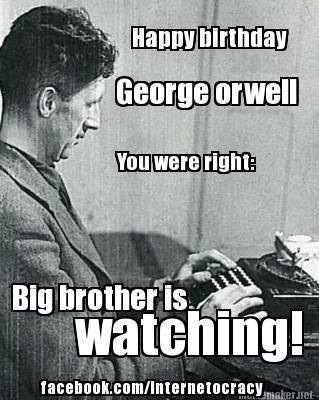
Fitting that the Supreme Court would overturn “the heart” of the Voting Rights Act on George Orwell’s 110th birthday. Meanwhile our national conversation is hyperfocused on the racially disturbing attitudes of an old white Southern woman with a food TV empire brand that she’s already damaged, as if it matters more than what our own Supreme Court is doing… Meanwhile big brother watches while we list out all our easily data-based likes and dislikes to Facebook so that the big business in bed with big brother can force feed us some more disaster capitalism adjusted to our preferences for what flavor we’d like it fed to us… Meanwhile Chris Brown defends his first amendment rights to be above the law and graffiti his house with ugly stuff that does infringe on the property rights of his neighbors, making a mockery of the principles of free speech…meanwhile a battered woman tattooed on his neck stares out at society blankly…meanwhile I wonder why I bother ranting. Oh that’s right. Racist capitalist patriarchy… while somewhere else Nelson Mandela is dying in a hospital bed…another one of our complicated patriarchal heros…no I’m not depressed or anything 😉
Open Thread: Late Afternoon News Update
Posted: June 25, 2013 Filed under: Barack Obama, open thread, Republican politics, U.S. Economy, U.S. Politics | Tags: Climate change, coal stocks, data encryption, David Gomez, Edward Snowden, Glenn Greenwald, Keystone XL pipeline, Rep. John Lewis, spycraft, Voting Rights Act 27 Comments
Good Afternoon Sky Dancers!!
Here’s an fresh thread, since the morning reads one is getting so long. I have several updates for you on the Snowden/NSA story.
Eli Lake of The Daily Beast got some disturbing news from Glenn Greenwald: Snowden’s Files Are Out There if “Anything Happens” To Him. I posted this link on the previous thread, but it should be highlighted. According to Greenwald, Snowden gave complete copies of the the secret NSA files he stole to “many people around the world.” Supposedly the files are encrypted, but from what we know of Snowden’s spycraft knowledge, I don’t think that’s a guarantee that they’ll stay secret. From The Daily Beast article:
Glenn Greenwald, the Guardian Newspaper journalist Snowden first contacted in February, told the Daily Beast Tuesday that Snowden “has taken extreme precautions to make sure many different people around the world have these archives to insure the stories will inevitably be published.” Greenwald added that the people in possession of these files “cannot access them yet because they are highly encrypted and they do not have the passwords.” But, Greenwald said, “if anything happens at all to Edward Snowden, he told me he has arranged for them to get access to the full archives.” [….]
A former U.S. counter-intelligence officer following the Snowden saga closely said his contacts inside the U.S. intelligence community “think Snowden has been planning this for years and has stashed files all over the internet.” This source added, “At this point there is very little anyone can do about this.”
Greenwald assured Lake that although he (Greenwald) is in possession of top secret information about “the technical specifications of NSA systems,” but that he won’t publish them. I wonder how well Greenwald’s computer is protected?
On Snowden’s aforementioned spycraft skills, let’s see what a real former spy thinks. From Foreign Policy:
We reached out to FP contributor David Gomez, a former assistant special agent-in-charge and counterterrorism program manager with the FBI, to get his take. When was Snowden being savvy — and when did it seem as if he’d just watched a few too many spy movies?
Cell phones in the fridge
While it’s true that cell phones can easily be compromised and turned into recording devices, Gomez says it’s unlikely that anyone seeking to record Snowden would have used a phone anyway. If someone had wanted to eavesdrop, Gomez explains, he or she more likely would have worn a concealed wire. Or, if a government’s agents had been trying to listen in from outside of the room, they might have deployed a long-range microphone, among other techniques. The bottom line: a refrigerated cell phone probably wasn’t stopping anyone who wanted to listen badly enough — though it may have extended the phone’s battery life.
Lining the hotel door with pillows
While not particularly effective at stopping anyone actively seeking to spy on Snowden, pillows could have muffled the sounds of any conversations going on in his Hong Kong hotel room enough that an unsuspecting person passing by wouldn’t overhear something alarming, Gomez says.
Wearing a hood while entering computer passwords, to avoid hidden cameras
The danger while entering computer passwords is unlikely to come from a hidden camera planted in the hotel, Gomez says, but rather from keystroke-logging software, against which a hoodie provides little protection.
Signaling his identity to reporters by carrying a Rubik’s Cube through a hotel
While spies do at times use signals to identify one another, the idea in doing so is to not draw attention to yourself, Gomez explains. Thus, when arranging a meeting, as Snowden did with a group of journalists in Hong Kong, it is both unhelpful and unnecessary to carry something as out of place as a Rubik’s Cube. It would have been better, Gomez adds, for Snowden to have simply described, say, his clothing in detail. “If you’re going to meet with all these people, what’s the point of being Sneaky Pete?” Gomez asks.
Gomez says Snowden seems to be an amateur.
Denying Southern Reality and Other Acts of a Politically Motivated SCOTUS
Posted: June 25, 2013 Filed under: just because | Tags: SCOTUS, Voting Rights Act 12 Comments I think y’all know by now that I was raised culturally southern. I was born in the South. I live in the deep South and have for nearly two decades. We’ve been regaled recently with the news that Southern Cuisine maven Paula Dean still longs for the good ol’ days of smiling black servants or slaves. We ‘ve heard Haley Barbor talk up the old Southern institutions that were the institutional face of the KKK as being positive community builders. I still can’t believe that Mississippi doesn’t celebrate Memorial Day because it is a “Yankee Holiday” and enshrines the Confederate version by declaring April “Confederate Heritage Month”. But, you do not need these folksy stories of the obvious racism in the South to understand why today’s SCOTUS decision is a complete sham. Scalia has said that the Voting Rights Act is a “racial entitlement” in the past. It is not. It protects disenfranchised voter’s most basic right in a democracy. This is another example of the hypocrisy of the ‘conservative’ wing of the court. This is pure judicial activism.
Here is a list of things from Bader Ginsberg’s scathing dissent that lets you know exactly why the VRA is still necessary and is about protecting rights not creating entitlements.
Ginsburg’s dissent also rattled off these eight examples of race-based voter discrimination in recent history:
- “In 1995, Mississippi sought to reenact a dual voter registration system, ‘which was initially enacted in 1892 to disenfranchise Black voters,’ and for that reason was struck down by a federal court in 1987.”
- “Following the 2000 Census, the City of Albany, Georgia, proposed a redistricting plan that DOJ found to be ‘designed with the purpose to limit and retrogress the increased black voting strength…in the city as a whole.'”
- “In 2001, the mayor and all-white five-member Board of Aldermen of Kilmichael, Mississippi, abruptly canceled the town’s election after ‘an unprecedented number’ of AfricanAmerican candidates announced they were running for office. DOJ required an election, and the town elected its first black mayor and three black aldermen.”
- “In 2006, the court found that Texas’ attempt to redraw a congressional district to reduce the strength of Latino voters bore ‘the mark of intentional discrimination that could give rise to an equal protection violation,’ and ordered the district redrawn in compliance with the VRA…In response, Texas sought to undermine this Court’s order by curtailing early voting in the district, but was blocked by an action to enforce the §5 pre-clearance requirement.”
- “In 2003, after African-Americans won a majority of the seats on the school board for the first time in history, Charleston County, South Carolina, proposed an at-large voting mechanism for the board. The proposal, made without consulting any of the African-American members of the school board, was found to be an ‘exact replica’ of an earlier voting scheme that, a federal court had determined, violated the VRA…DOJ invoked §5 to block the proposal.”
- “In 1993, the City of Millen, Georgia, proposed to delay the election in a majority-black district by two years, leaving that district without representation on the city council while the neighboring majority white district would have three representatives…DOJ blocked the proposal. The county then sought to move a polling place from a predominantly black neighborhood in the city to an inaccessible location in a predominantly white neighborhood outside city limits.”
- “In 2004, Waller County, Texas, threatened to prosecute two black students after they announced their intention to run for office. The county then attempted to reduce the avail ability of early voting in that election at polling places near a historically black university.”
- In 1990, Dallas County, Alabama, whose county seat is the City of Selma, sought to purge its voter rolls of many black voters. DOJ rejected the purge as discriminatory, noting that it would have disqualified many citizens from voting ‘simply because they failed to pick up or return a voter update form, when there was no valid requirement that they do so.'”
To those who will be distraught, outraged, or fearful, the essential question at stake in the Court’s decision – and in the continuing vitality of Section 4 — is whether we believe racial discrimination in voting still exists in the South. The question being framed this way, the Court’s decision today will appear to be, at best, a denial of reality and a reflection of a naïve “post-racial” view that in the Obama era, racial discrimination in voting has ended. Justice Sotomayor, at oral argument, perfectly reflected this perspective on what the decision represents when she posed this pointed question to the VRA’s challengers: “Do you think that racial discrimination in voting has ended, that there is none anywhere?” The answer to that question must be no. From this vantage point, then, as long as racial discrimination in voting still does take place at all in the South, Section 4 of the VRA – the part the Court invalidated – remains not just justifiable, but essential.
In addition, to many people, the VRA symbolizes protection of the crown jewel of rights, the right of access to the ballot box. For those who know the history, this right was born from the blood and the bodies of all those who had been given the last full measure of their devotion to secure full access for all to the ballot box – those beaten on the bridge from Selma, Alabama in 1965, the three civil rights workers lynched in the Mississippi summer of 1964, and many others. How can the Court find unconstitutional an Act that plays any role at all in ensuring political equality regarding this most sacred right? And why should the Court second-guess Congress on these issues?
Yet to others, including the Court’s pivotal actor, Justice Kennedy, the essential question at stake is whether our political system is frozen in place on issues concerning race. Do our political institutions and culture have the capacity to recognize that dramatic changes at the intersection of race and voting have taken place over recent decades? Section 4 was created in 1965 as a short-term measure for five years; in initially upholding that system, the Court called it “an uncommon exercise of congressional power” justified by the “exceptional circumstances” of the massive disfranchisement of black voters (and many poor whites) that existed when the VRA was enacted. In 1970, Congress extended this system for another five years; in 1975, for another eight; and in 1982, for twenty-five more years. Then, in 2006, in the provision the Court struck down, Congress re-authorized this system for another twenty-five years, until 2031. Thus we moved from a five-year regime in 1965 for exceptional circumstances to a sixty-six-year regime that continues to single out nine states (and fifty-three other counties) for unique federal control.
But of even more symbolic significance, from this perspective: these areas all became covered because of their voting practices in 1964 or, at the latest, 1975 – nearly forty years ago. And these are the same areas, and nearly the only areas, that have remained covered ever since. Though the Act formally creates a mechanism to permit these areas to prove their current entitlement to be relieved of coverage, this part has never been a meaningful way for the Act to unwind itself from within: fewer than one percent of all the counties originally covered that have significant minority populations have ever emerged from the Act. From this vantage point, the question the case was “about,” then, is this: how can Congress act as if nothing significant enough has changed in the last forty years to justify any meaningful change at all in Section 4? Even if areas of discriminatory voting practices remain, surely they cannot mirror so exactly the areas of which this was true forty or fifty years ago.
From this starting place, Section 4 symbolizes that the issue of race remains so charged that our political system lacks the capacity to move forward to any extent at all. As Justice Kennedy put it at the argument: Congress “should use criteria that are relevant to the existing [conditions] – and Congress just didn’t have the time or the energy to do this; it just re-enacted it.” And despite the popular image that Section 4 is about protecting access to the ballot box, Section 4 long ago in practice became more about racial redistricting than access to the ballot box. While the Justice Department in recent decades blocked access changes on average fewer than twice a year, it blocked redistrictings nearly fourteen times as often. Indeed, in the 2006 Act itself, Congress itself did not rely primarily on ballot-box access problems to justify renewing Section 4, but on issues like redistricting. If Section 4 is “about” access to the ballot box in the public imagination, to the Court majority, I suspect, Section 4 is about racial redistricting.
Can this decision bring about any good? Well, it is possible because it should be clear now there is a total Republican assault on modernity and a world where white men don’t get to tell every one else what to do. The last election showed that the nation’s minorities and women were not about to let that happen again.
On its face, this looks like a big victory for Republicans. But is it really? I suspect it will turn out to be a poisoned chalice. Many of the GOP’s current problems stem from the fact that it is overly beholden to its white, Southern base, at a time when the country is rapidly becoming more racially diverse. In order to expand its base of power beyond the House of Representatives, the GOP needs to expand its appeal to minority voters. As the ongoing battle over immigration reform demonstrates, that process is going poorly and looks like it will be very difficult.
The Supreme Court’s decision to strike down a central provision of the Voting Rights Act will make it easier for Republicans to hold and expand their power in those mainly Southern states. That will, in turn, make it easier for them to hold the House. But it will also intensify the Southern captivity of the GOP, thereby making it harder for Republicans to broaden their appeal and win back the White House.
There is only so long that these neoconfederates can continue to push their backwards agendas through the federal government. They need to be thrown out of statehouses too. This seems to me an odd continuation of the Civil War. Nixon’s Southern Strategy will divide this country for decades to come. The hypocrisy of judicial overreach in this decision and most others that are penned by Scalia, Alito, Thomas, or Kennedy just oozes political scamming and it makes us all look bad. This is just another embarrassing attempt to stop the future. Future Courts will make hay of it.
Tuesday Reads: Most Classless SCOTUS Justice, Ongoing Snowden Saga, and Other News
Posted: June 25, 2013 Filed under: Barack Obama, China, Foreign Affairs, morning reads, Russia, U.S. Politics, Women's Rights | Tags: Climate change, Dana Millbank, Edward Snowden, Garrett Epps, Jacob Zuma, middle school antics, Nelson Mandela, Racism, Ruth Bader Ginsburg, Samuel Alito, Sexism, University of Texas Southwestern Medical Center v. Nassar, Vance v. Ball State University 77 Comments
Good Morning!!
I’m enjoying some nice fresh air this morning after thunderstorms during the night. It looks as if the mini-heat wave we’ve been having here in the Boston area isn’t going to be as quite bad as originally predicted. It it supposed to be several degrees cooler than expected today and tomorrow and then we’re back to high 70’s temps. I hope that turns out to be right.
Unfortunately, because of this refreshing change in the air here, I slept longer than I should have and this post will go up a little bit late.
If there were a competition for “most classless supreme court justice,” there would be some serious competition among Antonin Scalia, Clarence Thomas, and Samuel Alito; but I think in the end the first prize would have to go to Samuel Alito. Clarence Thomas at least has the grace to remain silent and Scalia supposedly can be funny at times. But Alito is just an immature, obnoxious disgrace, as he demonstrated at the State of the Union Address in 2010 when President Obama denounced the Citizens United decision.
Yesterday Alito used childish, offensive body language to publicly mock his senior colleague Justice Ruth Bader Ginsburg as she read a dissenting opinion to a SCOTUS decision that will make it more difficult for employees to sue for sexual or racial discrimination. From Dana Millbank at The Washington Post:
The most remarkable thing about the Supreme Court’s opinions announced Monday was not what the justices wrote or said. It was what Samuel Alito did.
The associate justice, a George W. Bush appointee, read two opinions, both 5-4 decisions that split the court along its usual right-left divide. But Alito didn’t stop there. When Justice Ruth Bader Ginsburg read her dissent from the bench, Alito visibly mocked his colleague.
Ginsburg, the second woman to serve on the high court, was making her argument about how the majority opinion made it easier for sexual harassment to occur in the workplace when Alito, seated immediately to Ginsburg’s left, shook his head from side to side in disagreement, rolled his eyes and looked at the ceiling.
His treatment of the 80-year-old Ginsburg, 17 years his elder and with 13 years more seniority, was a curious display of judicial temperament or, more accurately, judicial intemperance. Typically, justices state their differences in words — and Alito, as it happens, had just spoken several hundred of his own from the bench. But he frequently supplements words with middle-school gestures.
Millbank goes on the describe Alito’s similar treatment of female Justices Elena Kagan and Sonia Sotomayor a few days earlier. Read about it at the link.
Garrett Epps provides more detail at The Atlantic: Justice Alito’s Inexcusable Rudeness.
I am glad the nation did not see first-hand Justice Samuel Alito’s display of rudeness to his senior colleague, Justice Ruth Bader Ginsburg. Because Alito’s mini-tantrum was silent, it will not be recorded in transcript or audio; but it was clear to all with eyes, and brought gasps from more than one person in the audience.
The episode occurred when Ginsburg read from the bench her dissent in two employment discrimination cases decided Monday, Vance v. Ball State University and University of Texas Southwestern Medical Center v. Nassar. In both cases, the Court majority made it harder for plaintiffs to prevail on claims of racial and sexual discrimination. The Nassar opinion raises the level of proof required to establish that employers have “retaliated” against employees by firing or demoting them after they complain about discrimination; Vance limits the definition of “supervisor” on the job, making it harder for employees harassed by those with limited but real authority over them to sue the employers.
The Vance opinion is by Alito, and as he summarized the opinion from the bench he seemed to be at great pains to show that the dissent (which of course no one in the courtroom had yet seen) was wrong in its critique. That’s not unusual in a written opinion; more commonly, however, bench summaries simply lay out the majority’s rationale and mention only that there was a dissent. (Kennedy’s Nassar summary followed the latter model.)
After both opinions had been read, Ginsburg read aloud a summary of her joint dissent in the two cases. She critiqued the Vance opinion by laying out a “hypothetical” (clearly drawn from a real case) in which a female worker on a road crew is subjected to humiliations by the “lead worker,” who directs the crew’s daily operation but cannot fire or demote those working with him. TheVance opinion, she suggested, would leave the female worker without a remedy.
At this point, Alito pursed his lips, rolled his eyes to the ceiling, and shook his head “no.” He looked for all the world like Sean Penn as Jeff Spicoli in Fast Times at Ridgemont High, signaling to the homies his contempt for Ray Walston as the bothersome history teacher, Mr. Hand.
I guess I should be grateful that I’m old enough to recall the Warren Court. We won’t see a SCOTUS like that again in my lifetime, I’m afraid.
Of course the news is still being dominated by Edward Snowden, who once claimed he didn’t want the story of his leaks of classified information from NSA to be about him. “Really?” writes Dan Murphy of The Christian Science Monitor. “But if that were true, we probably wouldn’t even know his name.”
Two weeks ago, Edward Snowden gave The Guardian permission to disclose that he was the leaker of documents from the US National Security Agency.
“I don’t want public attention because I don’t want the story to be about me,” the former NSA contractor said then. “I want it to be about what the US government is doing.”
If that was really his desire, he’s certainly gone about it in a funny way. From that day, every step he’s taken couldn’t have been better calculated to draw attention to himself. Over the weekend he even turned the media dial up when he fled from Hong Kong to the loving bosom of Mother Russia.
And with the assistance of Julian Assange, Mr. Snowden’s “where’s Waldo” saga is turning into aWikiLeaks production.
Mr. Assange, founder of WikiLeaks, has staked out a consistently anti-American and techno-libertarian position in the past few years. The US government is motivated by malice and power lust in his worldview, its rivals like Russia (where state-owned broadcaster RT ran a show of Assange’s) get a free pass, and secrecyis an evil in and of itself. Though he presents himself as a champion of free-speech, Assange has sought refuge in the Embassy of Ecuador in London, never mind that the country has a poor and deteriorating record on freedom of speech. The Committee to Protect Journalists listed Ecuador and Russia as two of the 10 worst places to be a journalist in the world past year.
Read the rest at CSM.
Meanwhile, Russia and China are pushing back against U.S. criticism of their refusal to help the U.S. extradite Snowden. From The Washington Post:
MOSCOW— Russia and China on Tuesday rejected U.S. criticism of their roles in the legal drama surrounding Edward Snowden, saying their governments complied with the law and did not illegally assist the former government contractor charged with revealing classified information about secret U.S. surveillance programs.
Snowden, 30, has not been seen in public since he reportedly arrived in Moscow on Sunday, after slipping out of Hong Kong. Secretary of State John F. Kerry on Monday strongly urged Russian officials to transfer Snowden to U.S. custody. “We think it’s very important in terms of our relationship,” Kerry said. “We think it’s very important in terms of rule of law.”
But Russian Foreign Minister Sergei Lavrov said Snowden had not actually crossed into Russian territory, apparently remaining in a secure transit zone inside the airport or in an area controlled by foreign diplomats. Moscow therefore has had no jurisdiction over his movements, Lavrov said, and has no legal right to turn him over to U.S. authorities.
It sounds like Snowden could still be in some VIP lounge at the Moscow Airport, but no one knows for sure. One witness told Reuters that Snowden did in fact arrive there yesterday. If he is in the airport, Russia can claim that Snowden technically never stepped on Russian soil.
In other news, Nelson Mandela is in critical condition for the second day, according to President Jacob Zuma.
Mr. Zuma said that he and Cyril Ramaphosa, the deputy president of the governing African National Congress, visited Mr. Mandela late Sunday.
“Given the hour, he was already asleep. We were there, looked at him, saw him and then we had a bit of a discussion with the doctors and his wife,” Mr. Zuma said. “I don’t think I’m in a position to give further details. I’m not a doctor.”
Doctors told Mr. Zuma on Sunday evening that Mr. Mandela’s health “had become critical over the past 24 hours,” according to an earlier statement from the presidency.
In the statement on Sunday, Mr. Zuma said that doctors were doing “everything possible to get his condition to improve and are ensuring that Madiba is well looked after and is comfortable.” Madiba is Mr. Mandela’s clan name.
The Telegraph reports that Mandela’s close relatives “have gathered at his rural homestead to discuss the failing health of the South African anti-apartheid icon who was fighting for his life in hospital.”
From NPR, President Obama today plans To Lay Out Broad Plan To Address Climate Change.
President Obama is expected to announce a sweeping plan to address climate change this afternoon.
The president has framed this issue as a moral responsibility, to leave the Earth in good shape for generations to come. But the nitty-gritty of any serious plan to address this problem is also a challenge, because it means gradually moving away from fossil fuels to renewable energy supplies — and that means there will be economic winners and losers.
Winners include companies that produce clean energy — wind, solar and geothermal energy. That energy will be more in demand, and the administration intends to expand access to public lands, where companies can build windmills and solar facilities.
Public health is also a winner, because the plan would pressure coal-fired power plants to reduce their emissions. Those plants not only produce carbon dioxide, but they are major sources of mercury, radioactive particles and chemicals that contribute to asthma.
The losers will be coal companies and the miners they employ as well as millions of Americans who can’t afford to pay higher electric bills. You can read the entire plan at the NPR link. More detail in this story at CNN. And at Business Insider, Josh Barro lists 3 Reasons Obama’s Carbon Plan Is The Best Solution Right Now
Today should be another busy news day with the ongoing Snowden saga, the President’s climate initiatives, the continuing Whitey Bulger and George Zimmerman trials, and more important SCOTUS decisions. If it gets hot here again this afternoon, I’ll have something to distract me at least. I’ll try to post an afternoon update.
Now it’s your turn. What stories are you focusing on today? Please post your links on any topic in the comment thread, and have a terrific Tuesday!!
Monday Threads: An Open Mind is a Terrible Thing to Lose
Posted: June 24, 2013 Filed under: morning reads | Tags: atheists and morality, conservative minds ignore consequences, fbi and justifiable shootings 102 Comments Good Morning!
I’ve often wondered what it is about some people that makes them wind up so damned narrow-minded. They seem eager to embrace anything that validates their belief system no matter how whacky and far-fetched or disproven. They are not tolerant of people or ideas that don’t fit their idea of correctness. Indeed, they seem to go out of their way to avoid data, evidence, and frankly, reality. This is all in the hopes of pushing away modernity or just plain change. I suppose this is a subject more aptly discussed by Doctor BostonBoomer the Psychologist than Doctor Dakinikat the Economist. However, these headlines just got me in the mood to ask one big question: What makes people feel so smug about their beliefs and beliefs systems even in the face of overwhelming evidence that they are just plan wrong minded and bigoted?
First, here is a story from Raw Story that involves psychology and studies that look at the question directly. The story is based on a morality study that finds conservatives show a ‘general insensitivity to consequences’.
Research published June in Social Psychological and Personality Science suggests that religious individuals and political conservatives think about moral issues in a fundamentally different way than liberals.
The study by Jared Piazza of the University of Pennsylvania and Paulo Sousa of Queen’s University Belfast, which included a total of 688 participants, found religious individuals and political conservatives consistently invoked deontological ethics. In other words, they judged the morality of actions based on a universal rule such as, “You should not kill.” Political liberals, on the other hand, consistently invoked consequentialist ethics, meaning they judged the morality of actions based on their positive or negative outcomes.
“Does being religious or being conservative promote a rule-based ethic or does having a rule-based ethic promote religiosity and/or conservatism?” Piazza told PsyPost. “This question is difficult to answer definitively without running a longitudinal study, since you cannot really manipulate religious orientation, or being in possession of a deontological orientation, and then look at the consequences.”
The study’s cross-sectional methodology makes it impossible to say anything more than religion and conservativism are associated with deontological ethics. However, Piazza said prior research suggested that being religious underlies the adherence to deontological ethics
“I think it is more likely that being religious — and being religious in a particular way — is what promotes deontological commitments, and not the other way around,” he told PsyPost. “In a recent unpublished study I conducted with my colleague Justin Landy at Penn, we found that it is a particular sub-class of religious individuals that are strongly opposed to consequentialist thinking. Specifically, it was religious individuals who believe that morality is founded upon divine authority or divine commands, and that moral truths are not obtained via human intuition or reason, who were strong deontologists (i.e., they refused to find various rule violations as permissible even when the consequences were better as a result).”
“This suggests that not all religious individuals are non-consequentialists; that is, religion does not necessarily promote a deontological ethic, though many religious institutions do promote such an orientation,” Piazza added. “Instead, it may be that people who are skeptical about the capacity for human beings to know right from wrong in the absence of divine revelation that tend towards a rule-based morality. Though this begs the question of why some religious individuals tend to see morality in terms of honoring divine commands, while others accept that human intuition or reason may be an equally, if not more reliable, foundation. This is an interesting and complex psychological question which we don’t currently have an answer to.”
Is this what makes the right wing so impervious to reality and evidence? And is that why the left wing seems enamored of a guy that just handed over state secrets to the Russians and the Chinese?
One of the great right wing myths explored here anecdotely is that that atheists, for example, cannot be compassionate or charitable because those are ethics that only spring from the fear of some kind of magical supreme being and threat of his afterlife hell realm. Yet, studies show that people with little to know religion do good deeds in abundance. In fact, big media is responsible for promoting this nonsense. Remember when Wolf Blitzer asked an atheist if her ‘faith’ in a god got her through the experience of a horrible tornado? Now, Time Magazines thinks atheists ignore human disaster too.
As part of his reporting, Klein joined one of the disaster relief groups and worked at a site damaged by the Oklahoma tornadoes… and that’s when he wrote this:
… there was an occupying army of relief workers, led by local first responders, exhausted but still humping it a week after the storm, church groups from all over the country — funny how you don’t see organized groups of secular humanists giving out hot meals — and there in the middle of it all, with a purposeful military swagger, were the volunteers from Team Rubicon.
Wow. My jaw dropped while reading that because it’s absolutely not true.
Klein took a cheap shot at atheists for not doing the relief work that churches — with all the personnel and financial advantages they have at their disposal — were doing even though we were often working right alongside them! He made the same mistake that Minister David Brassfield did (though at least Brassfield eventually offered a semi-apology).
Klein is simply lying out of his ass. A simple Google search would’ve turned up a number of ways atheists helped in the wake of the Oklahoma tornadoes. But since Klein was too lazy to do it, I’ll do it for him:
- More than 4,300 people donated more than $120,000 for the family of Rebecca Vitsmun (she promised to donate to
charity whatever money she doesn’t need).
- Foundation Beyond Belief raised over $45,000 for Operation USA and the Regional Food Bank of Oklahoma.
- Atheists Giving Aid raised over $18,000 that will be given to local relief groups in Moore, Oklahoma and directly to families that need help.
- Members of the FreeOK atheist group helped families who needed wreckage removed from their property:
- Local atheist groups such as the Oklahoma Atheists, Atheist Community of Tulsa, the Lawton Area Secular Society, Norman Naturalism Group, and the Oklahoma State Secular Organization have organized volunteers, resources, and blood drives.
- Organizers of the FreeOK conference going on this weekend held a literacy drive yesterday to “benefit the schools affected” by the tornadoes.
Is that enough proof that atheists, too, were (and still are) helping out in the aftermath of the tornadoes?
Maybe Klein didn’t know any of this was going on because, as Tancredi points out, “these [Humanist] groups have no tax exempt status and therefore can’t exactly afford to have the t-shirts for everyone to wear so that you know when they are out in force during a volunteer effort.”
Another deeply engrained myth in the minds of law and order conservatives is that all law and enforcement is benign despite overwhelming evidence in many cases to the contrary. Democracy Now! investigates the License to Kill given to the FBI in this country and there are some astounding statistics. Agents involved in fatal shootings have not cleared every single time since 1993. Are all those shootings really justifiable?
TRANSCRIPT
This is a rush transcript. Copy may not be in its final form.
JUAN GONZALEZ: As President Obama prepares to nominate James Comey today to head the FBI, the agency is facing new questions over how it handles shootings involving FBI agents. A new look at the FBI’s internal destinations has found the bureau has cleared its agents in every single shooting incident dating back two decades. According to the New York Times, from 1993 until today, the FBI shootings were deemed justified in the fatal shootings of 70 people and the wounding of 80 others.
Out of 289 shootings that are found to be deliberate, no agent was disciplined except for letters of censure in five cases. Even in a case where the bureau paid a shooting victim over $1 million to settle a lawsuit, the internal review did not find the agent who shot the man culpable.
AMY GOODMAN: The issue of FBI accountability has recently re-emerged following last month’s fatal shooting of Ibragim Todashev during questioning by agents in Orlando, Florida. A Chechen native, Todashev who was interrogated over his ties to one of the suspects in the Boston Marathon bombing. The Washington Post and several TV news organizations reported he was unarmed, citing unnamed law enforcement officials.
On Thursday, I spoke to Pulitzer prize-winning journalist Charlie Savage, the Washington correspondent for The New York Timeswho co-wrote the recent article called, “The FBI Deemed Agents Faultless in 150 Shootings.” I began by asking Charlie Savage to lay out what he found.
Then, there are of course, all the lies pushed by the fetus fetishists to support all kinds of wierdly NAZI like invasions into women’s bodies. How do small government touting conservatives reconcile this kind of government intrusion? Corporations are people my friend, but women are not?
HR 1797 is titled the Pain-Capable Unborn Child Protection Act, even though scientific studies, and meta-analysis of said studies, have found no evidence of fetal pain until the third trimester. Rep. Trent Franks (R-AZ) proposed the legislation, despite the fact that a 20-week abortion ban passed in his state was recently ruled unconstitutional. Grounding the bill in faux science is no surprise, given Franks’ role in founding the Arizona Family Research Institute, a group linked to the notorious Focus on the Family, a devoutly anti-choice (and anti-LGBTQ rights) organization that promotes an anti-science fringe agenda such as teaching “Creationism” and abstinence-only education. As a young politician, Franks reportedly donned a tie tack in the shape of fetal feet.
As the bill was furiously debated in the House Tuesday, hardly a minute went by without a mention of Gosnell. Gosnell, of course, is the infamous Philadelphia doctor recently convicted of the first-degree murder of three babies, voluntary manslaughter of a Bhutanese immigrant named Karnamaya Mongar, and 21 counts of abortion past the legal gestational date (24 weeks in Pennsylvania), among other charges.
“The trial of Kermit Gosnell exposed late abortions for what they really are: relocated infanticide,” Franks in a statement about the bill.
His statement echoes anti-choice rhetoric surrounding the Gosnell case; if Gosnell’s victims had been in a womb, they say, his actions would have been legal—or, as Kirstin Powers put it, it’s “merely a matter of geography.”
But it’s not accurate.
Gosnell was convicted of involuntary manslaughter of Mongar and of first-degree murder of three babies, referred to as Babies A, C, and D in the grand jury report and throughout the trial. From the grand jury report, describing Baby A: “His 17-year old mother was almost 30 weeks pregnant.” Baby C, according to the grand jury report, was “at least 28 weeks of gestational age.” The grand jury did not know the exact gestational age of Baby D, though experts used a review of neonatology charts to conclude that the age was “consistent with viability.” In other words, each of these were third trimester pregnancies.
Gosnell’s “procedures” were illegal under current law. A 20-week post-fertilization ban would not make them any more illegal. If passed into law, HR 1797, or any other 20-week ban, would not prevent another Gosnell.
Meanwhile, abortions performed in weeks 20 through 24 are statistically rare. According to the Centers for Disease Control and Prevention’s latest abortion surveillance report, based on data from 2009, 91.7 percent of abortions were performed at or before 13 weeks gestation. Only 1.3 percent of abortions occurred at or after 21 weeks’ gestation.
They even invented a non existent procedure–“partial birth abortion”–to try to chip away at a woman’s autonomy and right to make health 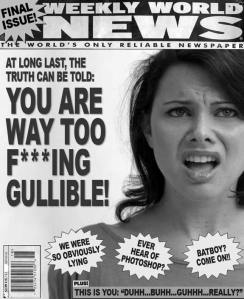 decisions impacting her health and well-being. It just always amazes me that none of these folks ever see through their lies.
I am going to end with the offering of an economist Miles Kimble of a quote by John Stuart Mills. It’s a quote from an essay entitled: A Remedy for the One-Sidedness of the Human Mind.
People are drawn to simplifications. And therein lies danger. John Stuart Mill writes about how that danger can be reduced by including in the intellectual ecosystem even those who are off-base in their judgments. The following is from On Liberty, Chapter II: “Of the Liberty of Thought and Discussion,” paragraphs 34 and 35:
It still remains to speak of one of the principal causes which make diversity of opinion advantageous, and will continue to do so until mankind shall have entered a stage of intellectual advancement which at present seems at an incalculable distance. We have hitherto considered only two possibilities: that the received opinion may be false, and some other opinion, consequently, true; or that, the received opinion being true, a conflict with the opposite error is essential to a clear apprehension and deep feeling of its truth. But there is a commoner case than either of these; when the conflicting doctrines, instead of being one true and the other false, share the truth between them; and the nonconforming opinion is needed to supply the remainder of the truth, of which the received doctrine embodies only a part. Popular opinions, on subjects not palpable to sense, are often true, but seldom or never the whole truth. They are a part of the truth; sometimes a greater, sometimes a smaller part, but exaggerated, distorted, and disjoined from the truths by which they ought to be accompanied and limited. Heretical opinions, on the other hand, are generally some of these suppressed and neglected truths, bursting the bonds which kept them down, and either seeking reconciliation with the truth contained in the common opinion, or fronting it as enemies, and setting themselves up, with similar exclusiveness, as the whole truth. The latter case is hitherto the most frequent, as, in the human mind, one-sidedness has always been the rule, and many-sidedness the exception. Hence, even in revolutions of opinion, one part of the truth usually sets while another rises. Even progress, which ought to superadd, for the most part only substitutes, one partial and incomplete truth for another; improvement consisting chiefly in this, that the new fragment of truth is more wanted, more adapted to the needs of the time, than that which it displaces. Such being the partial character of prevailing opinions, even when resting on a true foundation, every opinion which embodies somewhat of the portion of truth which the common opinion omits, ought to be considered precious, with whatever amount of error and confusion that truth may be blended. No sober judge of human affairs will feel bound to be indignant because those who force on our notice truths which we should otherwise have overlooked, overlook some of those which we see. Rather, he will think that so long as popular truth is one-sided, it is more desirable than otherwise that unpopular truth should have one-sided asserters too; such being usually the most energetic, and the most likely to compel reluctant attention to the fragment of wisdom which they proclaim as if it were the whole.
Thus, in the eighteenth century, when nearly all the instructed, and all those of the uninstructed who were led by them, were lost in admiration of what is called civilization, and of the marvels of modern science, literature, and philosophy, and while greatly overrating the amount of unlikeness between the men of modern and those of ancient times, indulged the belief that the whole of the difference was in their own favour; with what a salutary shock did the paradoxes of Rousseau explode like bombshells in the midst, dislocating the compact mass of one-sided opinion, and forcing its elements to recombine in a better form and with additional ingredients. Not that the current opinions were on the whole farther from the truth than Rousseau’s were; on the contrary, they were nearer to it; they contained more of positive truth, and very much less of error. Nevertheless there lay in Rousseau’s doctrine, and has floated down the stream of opinion along with it, a considerable amount of exactly those truths which the popular opinion wanted; and these are the deposit which was left behind when the flood subsided. The superior worth of simplicity of life, the enervating and demoralizing effect of the trammels and hypocrisies of artificial society, are ideas which have never been entirely absent from cultivated minds since Rousseau wrote; and they will in time produce their due effect, though at present needing to be asserted as much as ever, and to be asserted by deeds, for words, on this subject, have nearly exhausted their power.
Be wary of Occam’s Razor when it comes to moral issues. Be open to new evidence. Be aware that things are not always as they seem or you want them to be and above all, realize that we are all the same while being uniquely us. I am still awaiting the decision that says the United States recognizes the full humanity and rights of its GLBT citizens. I am praying that Trayvon Martin’s family will see justice. I would like to see the FBI truly investigate the shooting deaths that resulted from their hunting the perpetrators of the Boston Marathon Bombings and think about what it does to justice in the name of security.. We should be a country of laws that create an open path to justice and not one of closed minds that suppress evidence and diversity.
What’s on your reading and blogging list today?

 peej
peej Carissa
 bostonboomer
 dakinikat
 ecocatwoman
 mablue2
 Mama Lopez
 peggysue22
 quixote
 skydancingguestblogger
 Mona (aka Wonk the Vote)



 Sky Dancing
Recent Comments