
Paul Ryan: “It would take me too long to go through all of the math.”
Posted: September 30, 2012 Filed under: 2012 presidential campaign, Mitt Romney, open thread, U.S. Politics | Tags: Chris Wallace, elixirs, flim-flam man, Fox News Sunday, Old West con man, Paul Ryan, tax cuts, tonics 25 Comments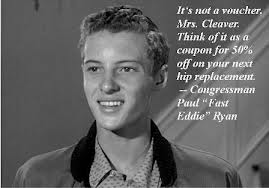
On Fox News Sunday, Chris Wallace worked very hard to get a straight answer out of Republican Paul Ryan on the tax plan he and Mitt Romney are proposing, but he failed. Paul Ryan is nothing but a flim-flam man–a sneaky little weasel who couldn’t tell the truth if you paid him a million dollars. Never in my life have I seen such bullshit artist! He truly is Eddie Haskell. Here’s the video (via Think Progress):
WALLACE: So how much would it cost?
RYAN: It’s revenue neutral…WALLACE: No no, I’m just talking about cuts. We’ll get to the deductions, but the cut in tax rates.
RYAN: The cut in tax rates is lowering all Americans’ tax rates by 20 percent.
WALLACE: Right, how much does that cost?
RYAN: It’s revenue neutral.
[…]
WALLACE: But I have to point out, you haven’t given me the math.
Ryan: No, but you…well, I don’t have the time. It would take me too long to go through all of the math. But let me say it this way: you can lower tax rates by 20 percent across the board by closing loopholes and still have preferences for the middle class. For things like charitable deductions, for home purchases, for health care. So what we’re saying is, people are going to get lower tax rates.
In the midst of refusing to give any specifics on what loopholes he would close and/or programs he would cut, Ryan brags that he’s been on the Ways and Means Committee for twelve years. So? Are we supposed to take that as proof that he’s not full of shit? And as a bonus, the throws out his favorite word “baseline” again. I guess we’re supposed to be impressed about how wonky he is? Give me a break! Just look at those Power Point slides he’s been using in his stump speech. They could have been created by a high school sophomore.
This guy has been in the House for twelve years and he has nothing but surface knowledge about the legislative process. But he knows exactly what he wants to cut–Medicare, Medicaid, and Social Security, plus even cent that goes into infrastructure or protecting the environment. What else is there now that he’s claiming the middle class will still have charitable deductions, mortgage deductions, and health care deductions?
Honestly, Mitt Romney is one of the most shameless liars I’ve ever seen in my more than fifty years of following politics; but I really think Ryan is worse. I can visualize him in the Old West, selling youth tonics and elixirs out of the back of his wagon to credulous homesteaders, then hightailing it out of town before the sheriff catches up with him.
Please use this as an open thread.
Underestimating the Great Recession
Posted: September 29, 2012 Filed under: 2012 presidential campaign, Economy 32 CommentsI’ve been reading this excellent David Leonhardt “hindsight quarterback”-style article on the mistakes the Obama administration made when handling the 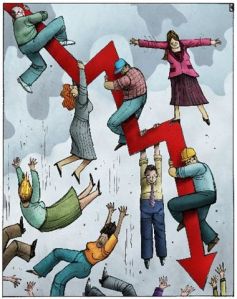 economy in 2008. I suppose I like it because he’s saying many of the same things today that I actually was writing about back then. However, the problems from back then are more obvious now and the article is written without the dynamics of the Larry Summer/Timothy Geithner Beavis and Butthead antics that were apparent in the Suskind book Confidence Men. I’ve often said that the two biggest mistakes were the size of the stimulus and the handling of the housing crisis. I still can’t figure out how we got a bail out of the auto and financial industries but the housing sector got left to the natural path.
With the auto industry and Wall Street, Mr. Obama accepted the political costs that come with bailouts. He rescued arguably undeserving people in exchange for helping the larger economy. With housing, he went the other way, even leaving some available rescue money unspent — at least until last year, when the policy became more aggressive and began to have a bigger effect.
No one of these steps, or several other plausible ones, would have fixed the economy. But just as the rescue programs of early 2009 made a big difference, a more aggressive program stretching beyond 2009 almost certainly would have made a bigger difference. It would have had the potential to smooth out the stop-and-start nature of the recovery, which has sapped consumer and business confidence and become a problem in its own right.
It would seem prudent to stabilize housing prices in an economy that’s highly reliant on consumer spending when consumer spending is highly reliant on household wealth. That’s not to say that the house prices of 2006 weren’t in need of a correction. It’s more to say that putting so many folks through disclosure and wrecking their balance sheets for decades isn’t the smartest way of managing an aggregate demand crisis in an economy where consumption is 68% of GDP and the fickle investment component is about 17%.
Leonhardt thinks that Obama and his advisers really didn’t grasp the severity of the recession or the full impact of the financial market meltdown. I would agree with this up to a point. I actually think they knew the impact but concentrated on the business sector more than than the household.
Mr. Obama’s biggest mistake as president has not been the story he told the country about the economy. It’s the story he and his advisers told themselves.
The notion of insurance is useful here. Suggesting that Mr. Obama and his aides should have bucked the consensus forecast and decided that a long slump was the most likely outcome smacks of 20/20 hindsight. Yet that wasn’t their only option. They also could have decided that there was a substantial risk of a weak recovery and looked for ways to take out insurance.
By late 2008, the full depth of the crisis was not clear, but enough of it was. A few prominent liberal economists were publicly predicting a long slump, as was Mr. Rogoff, a Republican. The Obama team openly compared its transition to Franklin D. Roosevelt’s and, in private, discussed the Reinhart-Rogoff work.
I guess this does tie back to the dynamics in the Suskind book Confidence Men and the dynamics of Obama’s economic team which basically was presented as being completely out of control. This quote is Adam Moss’ take on the situation.
The news of the book,according to some reports, is that Tim Geithner was insubordinate to the president, pursuing his own pro-banker agenda. Or, according to other reports, that Larry Summers was insubordinate to the president, pursuing his own well, monomaniacal agenda. I’d add that it’s also about Rahm Emanuel being insubordinate to the president, just because. Basically, it’s about the presidency being hijacked by these three guys. And the guys thing is important because they’re pretty awful to women. Anyway, they’re the villains. Paul Volcker, Christina Romer, and Elizabeth Warren are the heroes. Bankers win, America loses.
We’ve had Sheila Bair out on the book trail reinforcing the Geithner pro-banker agenda story line just this month. He’s the last man standing of the trio of “villians’ mentioned above.
In addition to accusing Geithner of treating the banks with kid-gloves, Bair skewers him and former Obama economic adviser Larry Summers for their approach to the housing crisis, saying they didn’t appear to care about helping homeowners or fixing underlying problems plaguing the housing market.
Treasury’s housing-relief program was “designed to look good in a press release, not to fix the housing market,” Bair wrote. She says Geithner and Summers undercut Obama by not pursuing a more aggressive program.
Whether intentional or not, the administration’s housing programs have been lackluster, making the narrative all the more damning. The housing market is recovering but more because of the Federal Reserve’s push to lower interest rates than because of the housing assistance offered by Treasury. The main programs have helped about 2.6 million homeowners, far short of the 9 million Obama promised to help avoid foreclosure.
As Bloomberg View has written, Geithner and other administration officials cared too much about avoiding “moral hazard,” designing the programs so narrowly that few could actually qualify for help.
Bair’s book suggests that those same concerns didn’t apply to the banks, who were stuffed with money she says they may not have needed and didn’t deserve without fundamental changes to their businesses. (Fed Chairman Ben Bernanke, meanwhile, told the Financial Crisis Inquiry Commission that “only one” of the major banks “was not at serious risk of failure” and that 12 were on the verge of collapse in 2008.)
Here’s a similar narrative on the questionable approach to the housing market crash. I want to mention this because it actually reinforces the Romney 47% narrative in action. For some reason, bad business decisions aren’t demonized with the same gusto given to those made by the middle income, working class, and poor households. We’re “lazy” and seek a way to become “dependent” on government. What we should emphasize is the number of times that businesses–big and small–go to the government asking to be protected from competition and to be given price supports, subsidies, tax breaks, tariffs, and trade quotas. All of these create moral hazard, distort market outcomes, and are of little value to any one but the industry receiving the hand out. Rahm, Geithner, and Summers are all part of the mentality that Romney so eloquently got caught describing to his peser in his 47% moment. The media gets caught up in that narrative too. Let’s not kid ourselves that this kind of thing will go away once Romney is soundly defeated. It goes on behind all closed-door meetings concerning policy. Most of the consultantariat have similar frames. This is especially true for those that go to big name universities where they are repeatedly told they are “special’ and above every one else and are more deserving of success than any one else.
The one thing that I would really like to see right now is for Obama to restate his intention to replace Geithner. Then, I would like to see him signal who is on the short list. This would let us know if we’re going to some change in the approach to the recovery. Can you imagine the signal that a Sheila Baer appointment would send? I can. The markets would definitely fall off their highs. That’s exactly why I’m not holding my breath for anything but more status quo. At this point, it’s the best we can hope for because we all know what the Ryan/Romney agenda will be. I’m not keen on going off of their cliff any time soon. I just wish we had a bit more details on how the President intends to manage the recovery in a second term. We’re not getting any details and that makes me nervous.
Rainy Saturday Reads: Why Romney Is Losing
Posted: September 29, 2012 Filed under: 2012 presidential campaign, Mitt Romney, morning reads, U.S. Politics | Tags: 47 percent, Alex Pareene, backstabbing aides, Joan Walsh, Nate Silver, Politico 53 Comments
A rainy day on Boston’s Commonwealth Ave.
Good Morning!!
It’s a rainy Saturday in Boston, and I’ve got a nasty cold. I overslept and I don’t have much energy, but do have a few links to get you started today. There’s lots of talk right now about how Romney’s “47 percent” comments have hurt him. A number of pundits didn’t think it was a big deal at first, but are now changing their tunes.
Nate Silver sees signs that Romney’s callous words are taking a toll.
After a secretly recorded videotape was released on Sept. 17 showing Mitt Romney making unflattering comments about the “47 percent” of Americans who he said had become dependent on government benefits, I suggested on Twitter that the political impact of the comments could easily be overstated.
“Ninety percent of ‘game-changing’ gaffes are less important in retrospect than they seem in the moment,” I wrote.
But was this one of the exceptional cases? A week and a half has passed since Mr. Romney’s remarks became known to the public — meaning that there’s been enough time to evaluate their effect on the polls.There’s a case to be made that they did damage Mr. Romney’s standing some.
Read Silver’s take at the link (if you haven’t already).
Jonathan Chait comes right out and admits he was wrong:
I’ve been wrong before, and I’ll be wrong again, but I may never have been as wrong as I was when I initially predicted that Mitt Romney’s heinous diatribe against 47 percent of America would have little direct impact on the election. It’s an absolutely crushing blow. Obviously it doesn’t guarantee his defeat — if a secret video surfaces depicting Obama promising to impose Sharia law in his second term, Romney will stand a good chance of coming back — but it destroys his public standing in ways that make a comeback nearly impossible.
….
The damage of the remarks is twofold. Obviously, it deeply reinforces the worst stereotypes voters have of Romney. Indeed, the fact that he is currently running ads trying to make the case that he does care about all of America testifies to the grim position in which Romney finds himself. If you’re trying to clear the threshold of “does this candidate hate me” six weeks before the election, you’re probably not on the verge of closing the sale.
Worse still, the comments destroy Romney’s fundamental credibility. Here America sees what he says behind closed doors. Nothing he can say in public can possibly overcome the damage of these comments, because voters will quite correctly assume that he is telling them what they want to hear. George W. Bush’s campaign figured out how to do this to both Al Gore and John Kerry — by painting them as liars, Bush destroyed them as a message delivery platform. Romney has, essentially, done it to himself.
At Salon, Alex Pareene responds to Jonathan Chait by arguing that what is really hurting Romney is Ryan’s plan to kill Medicare: Why Ryan is worse for Romney than “47 percent.” It’s short, but sweet. Read it at the link.
TPM has a piece on How Democratic Ads Are Exploiting Romney’s ‘47 Percent’ Moment
The usual sports metaphors barely do justice to how easy it is, in theory, to build an attack ad around your opponent demanding half the country “take personal responsibility and care for their lives.” Softball pitch down the plate? Kickball, maybe? Tee ball?
Evidence is mounting that Mitt Romney’s leaked remarks about how 47 percent of Americans see themselves as “victims” are doing significant damage to his campaign both nationally and in key swing states around the country. While the hidden camera video has gotten plenty of play on its own in the press, Democrats are piling on as much as possible with a growing number of attack ads.
The degree of difficulty may be low, but the current body of ads connect Romney’s quotes to an impressive array of themes in a very short amount of time. Here’s how Democrats are using the hidden camera footage as a Swiss Army knife of messaging.
Ad videos and commentary at the link.
As Romney stumbles, the knives are coming out. Politico is the usual place for Romney campaign leaks, and sure enough, yesterday there was another backstabbing story putting all the blame on the lousy candidate: In the End, It’s Mitt.
It isn’t the chair or the ho-hum convention. Or the leaked video. Or Stuart Stevens. Or the improving economy. Or media bias. Or distorted polls. Or the message. Or Mormonism.
It’s Mitt.With Republicans everywhere wondering what has happened to the Mitt Romney campaign, people who know the candidate personally and professionally offer a simple explanation: It’s the candidate himself.
Slowly and reluctantly, Republicans who love and work for Romney are concluding that for all his gifts as a leader, businessman and role model, he’s just not a good political candidate in this era.It kills his admirers to say it because they know him to be a far more generous and approachable man than people realize — far from the caricature of him being awkward or distant — and they feel certain he would be a very good president.
“Lousy candidate; highly qualified to be president,” said a top Romney official. “The candidate suit fits him unnaturally. He is naturally an executive.”
That makes no sense. If Romney can’t run his own campaign then how on earth would he run the White House and lead the country? It’s only September, and these guys are trying to save their own asses.
Joan Walsh points out that it’s the candidate’s message that people can’t stand: When the Dogs Won’t Eat the Dog Food.
In the end I think Romney killed his own campaign, not because he’s a bad person – he may be – but because, in addition to his ineptness, he came to symbolize what’s wrong with our economy, in every way. The tax rate he pays is a scandal. Shoveling millions of tax-free dollars to his sons is, too. Bain Capital was no job creator (unless you count Bain execs); the firm borrowed money to buy companies, saddled the companies with their debt and made huge fees, whether or not the firm survived.
I said long ago that Romney “is the poster boy for the top 1 percent,” and that it would hurt him with struggling voters. But I didn’t know how much it would hurt him. In the end, maybe he’d have survived coming off like a cross between Thurston Howell III and Montgomery Burns, if we hadn’t heard his remarks about “the 47 percent.” Together, his sheltered wealth, high finance career and plutocrat’s sneer are making it nearly impossible for him to be elected.
But not completely impossible.
Nearly impossible. Not impossible. The other side has so much money and so few scruples these last six weeks could get uglier. We don’t know the toll voter suppression laws will take. And forget about those newfangled laws, there’s old-fashioned GOP voter suppression – robocalls and fliers giving voters the wrong day as Election Day or changing their polling place, voter intimidation, or a shortage of ballots or voting machine in dense Democratic districts.
That should be enough to get you started. I’ll add more links in the comments, and I look forward to clicking on yours. Have a great weekend!
Late Night Open Thread: Ann Romney Worries About Mitt’s “Mental Well Being”
Posted: September 28, 2012 Filed under: 2012 presidential campaign, Mitt Romney, open thread, U.S. Politics | Tags: Ann Romney, gaffes, Mental health, Mitt Romney, Reno NV 18 Comments
Ann Romney being interviewed by Wendy Damonte of KTVN, Reno, Nevada
I thought the Romney campaign had decided to give Ann Romney a time out after her meltdown last week in which she snapped at a radio interviewer:
“Stop it. This is hard. You want to try it? Get in the ring,” she said. “This is hard and, you know, it’s an important thing that we’re doing right now and it’s an important election and it is time for all Americans to realize how significant this election is and how lucky we are to have someone with Mitt’s qualifications and experience and know-how to be able to have the opportunity to run this country.”…
…“It’s nonsense and the chattering class…you hear it and then you just let it go right by,” she told Radio Iowa. “…Honestly, at this point, I’m not surprised by anything.”
But this latest one could be even more damaging. Today Ann told an interviewer that she is worried about her husband’s “mental well being.”
Here’s Ann Romney’s full quote (video at the link)
“I think my biggest worry would be for his mental well being. I have all the confidence in the world of his ability, his decisiveness, his leadership skills, his understand of the economy, his understanding of what’s missing right now. The pieces that are missing to get the jump started. So for me I think it would be the emotional part of it.”
WTF?! Is Mitt on the verge of a nervous breakdown or something? Is there something more we need to know? This man is running to be President of the U.S., Commander-in-Chief of the armed forces, with control over nuclear weapons.
Honestly, I don’t know what to think about this. Mitt Romney faces his first presidential debate against President Barack Obama next Wednesday. Does Ann really think she’s helping?
Friday Reads
Posted: September 28, 2012 Filed under: morning reads | Tags: employmnet, meteorite Buddha, religious extremism, Romney's torture policy, sex trafficking in the Ukraine, Sheila Bair 48 Comments Good Morning!
Bill Moyers & Company covers one of my hair-on-fire topics this week. I’ve written a lot about ALEC before and how it tends to pen some of the worst laws in the land. So, what’s ALEC been up to recently now that it’s role in voter suppression and defunding planned parenthood has been held up to the light? Moyers & Company will broadcast the report today on PBS so be sure to look for it.
A national consortium of state politicians and powerful corporations, ALEC presents itself as a “nonpartisan public-private partnership”. But behind that mantra lies a vast network of corporate lobbying and political action aimed to increase corporate profits at public expense without public knowledge. Using interviews, documents, and field reporting, the episode explores ALEC’s self-serving machine at work, acting in a way one Wisconsin politician describes as “a corporate dating service for lonely legislators and corporate special interests.” In state houses around the country, hundreds of pieces of boilerplate ALEC legislation are proposed or enacted that would, among other things, dilute collective bargaining rights, make it harder for some Americans to vote, and limit corporate liability for harm caused to consumers — each accomplished without the public ever knowing who’s behind it.
This raw story article on a 1,000 year old Buddha statue from Tibet that was taken from its home by the NAZIs and has been discovered to be made of the remains of a meteorite reads like something from an Indiana Jones script. It caught my eye earlier this week so I thought I’d share it with you.
Backed by SS chief Heinrich Himmler and heading a team whose members are all believed to have been SS, Schaefer roamed Tibet in 1938-9 to search for the origins of Aryanism, the notion of racial superiority that underpinned Nazism.
Weighing 10.6 kilos (23.3 pounds), the statue features the Buddhist god Vaisravana seated, with the palm of his right hand outstretched and pointing downwards.
Chemical analysis shows that the rock from which it was carved came from a meteorite.
The rock survived a long trip through the Solar System and the destructive friction with the atmosphere when it collided with Earth.
It is a particularly rare kind of meteorite called an ataxite, which has iron and high contents of nickel, according to the study, published in the journal Meteoritics and Planetary Science.
“The statue was chiseled from an iron meteorite, from a fragment of the Chinga meteorite which crashed into the border areas between Mongolia and Siberia about 15,000 years ago,” said investigator Elmar Buchner of Stuttgart University.
“While the first debris was officially discovered in 1913 by gold prospectors, we believe that this individual meteorite fragment was collected many centuries before.”
The exact dating of the carving cannot be established accurately, but its style links it to the pre-Buddhist Bon culture of the 11th century.
Vaisravana was the Buddhist god-king of the North, also known as Jambhala in Tibet.
I’d just like to mention that the “god” description really isn’t apt here but, oh well. Jambhala was a god in the Hindu tradition, however, so I suppose it kind’ve carries on over but it’s not like you’ think. However, the findings are interesting.
Feminists in the Ukraine are banding together to stop Human Trafficking. Here’s some information on that movement.
At first sight, few people would mark the group of topless young women protesting in the streets of Kiev, the capital of Ukraine, as outspoken advocates or feminists. Garlands of flowers adorn their waist-length hair, strategically thrown forward to cover their bare breasts. But the black graffiti-style slogans that cover their arms and bellies make it crystal clear: “Ukraine is not a brothel” and “Women Power”.
Founded in Kiev in 2008 by a group of university students, FEMEN quickly became famous for their topless protests against prostitution, sex tourism and sexism, which is still rife in Ukraine today. The group has been in the news a lot lately with protests in Milan, Istanbul and Moscow and most recently to bring attention to the sloppy investigation and suspected nepotism surrounding the horrifying rape of eighteen-year-old Oksana Makar by three Ukrainian young men. The attack left Makar with burn wounds across more than half of her body. Surgeons had to amputate her arm and both feet in an attempt to save her life, but Makar was unable to pull through, dying from heart failure a little more than two weeks following her attack.
Oksana Mahar’s case is indicative of a much larger problem: women are often treated as a mere commodity in Ukraine’s patriarchal society – a fact that is exacerbated by the difficult economic climate, and human trafficking, especially for sex work, remains a serious problem. Evidence exists from a variety of sources of the widespread and increasing nature of the problem: it is estimated that 420,000 women have been trafficked out of the country in the last few years alone.
Ever heard of a fractal kitty?
For decades, scientists have been trying to solve a tough question: if the Internet runs out of cat pictures, can we generate more using advanced mathematics?* A paper posted on the arxiv earlier this month by mathematicians Kathryn Lindsey and the late William Thurstoncalms fears about “peak cat.” In the paper, they describe a method of approximating the outline of a cat or other object using the Julia sets of polynomials.
Outspoken Sheila Bair is telling tales on Timothy Geithner and the 2007 bank bailouts. She says the bailouts were ‘skewed’ to help Citigroup.
Former financial regulator Sheila Bair says that Treasury Secretary Timothy Geithner was primarily concerned with shoring up Citigroup and other banks in his response to the financial crisis, rather than holding those banks accountable.
Bair went on a media tour on Tuesday topromote her new book, “Bull by the Horns,” about the government’s response to the financial crisis, which she experienced firsthand as a top financial regulator. Bair criticized Geithner in the book, and she aired some of that criticism in an interview with the Wall Street Journal on Tuesday.
“He was in constant communication with [Citigroup CEO] Vikram Pandit throughout that whole process, and I felt like he and Vikram were figuring out what they were going to do and then trying to jam it on me,” said Bair, who served as chair of the Federal Deposit Insurance Corporation (FDIC) between 2006 and 2011. “I do think that a lot of the policy decisions that were made were made through the prism of what Citigroup needed.”
Bair said that most big banks did not need the Troubled Asset Relief Program (TARP), the government’s bank bailout in 2008, but the government forced TARP on all of them partly because Citigroup needed it. “It worked horrible reputational damage on everyone,” Bair said of TARP.
Some TARP defenders say granting TARP funds across the board was necessary to avoid a loss of trust in specific banks. Citigroup was one of the more vulnerable banks during the financial crisis, since it held a large number of toxic mortgage-backed securities. The government gave Citigroup multiple bailouts.
“He viewed these institutions as entities that needed to be taken care of,” Bair said of Geithner, adding he thought the banks “needed to be taken care of and that this was just a big systemic event, and we needed to protect them — whereas I wanted them to have accountability. They had caused this.”
“If you view the banks themselves as victims just of the larger crisis, then you’re going to just try to help them however you can, and I think that was his guiding philosophy,” she added.
Thankfully, Giethner is not going to be there for a second Obama term. It can’t come soon enough for me. Any guesses as to which bank he’ll eventually land?
When do these guys jeopardize their infernal tax breaks? What exactly does it take? A Raw Story article reports that one Catholic bishop says that ‘Voting for Obama jeopardizes the ‘eternal salvation of your own soul’.
A Catholic bishop from Springfield, Illinois is warning that the stakes for the 2012 election are even higher than most people think because voting for President Barack Obama could damn “you own soul” to hell.
In a column and video posted by the official newspaper of the Diocese of Springfield in Illinois and obtained by Right Wing Watch on Wednesday, Bishop Thomas John Paprocki called out the Democratic Party for temporarily removing God from their platform, supporting abortion and recognizing that “gay rights are human rights.”
“There are many positive and beneficial planks in the Democratic Party Platform, but I am pointing out those that explicitly endorse intrinsic evils,” the bishop explained. “My job is not to tell you for whom you should vote. But I do have a duty to speak out on moral issues. I would be abdicating this duty if I remained silent out of fear of sounding ‘political’ and didn’t say anything about the morality of these issues. People of faith object to these platform positions that promote serious sins.”
“So what about the Republicans? I have read the Republican Party Platform and there is nothing in it that supports or promotes an intrinsic evil or a serious sin,” Paprocki added. “One might argue for different methods in the platform to address the needs of the poor, to feed the hungry and to solve the challenges of immigration, but these are prudential judgments about the most effective means of achieving morally desirable ends, not intrinsic evils.”
Evidently, torture isn’t an intrinsic evil compared to using birth control or being in a loving same sex relationship. It’s reported that Romney favors going back to the old Cheney/Rumsfield extraordinary “interview” techniques.
In one of his first acts, President Obama issued an executive order restricting interrogators to a list of nonabusive tactics approved in theArmy Field Manual. Even as he embraced a hawkish approach to other counterterrorism issues — like drone strikes, military commissions, indefinite detention and the Patriot Act — Mr. Obama has stuck to that strict no-torture policy.
By contrast, Mr. Romney’s advisers have privately urged him to “rescind and replace President Obama’s executive order” and permit secret “enhanced interrogation techniques against high-value detainees that are safe, legal and effective in generating intelligence to save American lives,” according to an internal Romney campaign memorandum.
While the memo is a policy proposal drafted by Mr. Romney’s advisers in September 2011, and not a final decision by him, its detailed analysis dovetails with his rare and limited public comments about interrogation.
“We’ll use enhanced interrogation techniques which go beyond those that are in the military handbook right now,” he said at a news conference in Charleston, S.C., in December.
The campaign policy paper does not specify which techniques Mr. Romney should approve, saying more study was needed because Mr. Obama had “permanently damaged” the value of some by releasing memorandums detailing Bush-era techniques in April 2009.
Revisions to new jobs numbers makes our economy look healthier than previously thought. This, coupled with the increased home prices, can give us a little lift on the future of the US economy. It also makes Romney’s economic arguments look weak. The economy has produced enough jobs to give Obama a net job growth for his term. This even counts the worst of the Dubya Bush recession years.
So the Bureau of Labor Statistics announced this morning that it is revising its jobs count, to include an additional 386,000 nonfarm jobs that were created from March of 2011 to March of 2012.
Jobs numbers are only one metric for measuring economic improvement, so we shouldn’t overstate their significance. This new finding, however, does matter politically in a few key ways. First, as Justin Wolfers points out, the added jobs means that there has no longer been a “net” loss of jobs on Obama’s watch. As you know, Romney has been saying for a very long time now that the “net” jobs lost on Obama’s watch proves his policies failed. That’s a bogus metric, because it factors in the hundreds and hundreds of thousands of jobs lost in each of the first few months of Obama’s term, before those policies went into effect.
But putting that aside, net jobs were now actually gained on Obama’s watch. So, in theory at least, Romney has been deprived of one of the talking points that has been central to his candidacy for a year now. That talking point was crucial for Romney, because it enabled him to make the (nonsensical) case that Obama destroyed jobs overall.
Okay, that’s a little this and that for today. What’s on your reading and blogging list?

 peej
peej Carissa
 bostonboomer
 dakinikat
 ecocatwoman
 mablue2
 Mama Lopez
 peggysue22
 quixote
 skydancingguestblogger
 Mona (aka Wonk the Vote)



 Sky Dancing
Recent Comments