
Thursday Reads
Posted: July 12, 2012 Filed under: 2012 presidential campaign, Barack Obama, health, Mental Health, Mitt Romney, morning reads, Republican politics, U.S. Politics | Tags: Jesse Jackson Jr., Massachusetts, Rory Staunton, septic shock 59 Comments
Good Morning!!
I don’t know if this has anything to do with “Romneycare,” but the news came out yesterday that the average life expectancy in Massachusetts is nearly 81 years!
Life expectancy for people in Massachusetts hit an all-time high in 2009, as the rate of deaths from major killers, such as heart disease and cancer, declined, according to a report released Wednesday by the state Department of Public Health.
Overall life expectancy from birth was 80.7 years in 2009, the most recent year for which data are available, compared with 78.5 years nationally. Since 2000, death rates in the state from stroke, heart disease, all cancers combined, and diabetes have continued to drop.
Deaths from HIV and AIDS have dropped dramatically in recent years. Nearly 1,000 people died in both 1994 and 1995, during the peak of the epidemic. In 2009, there were 124 deaths from HIV and AIDS. The decline, the authors write, is the result of advances in treatment and a reduction in the infection rate.
Life expectancy varied by location. Check this out: in Brookline it was 87 years!
From the Sydney Morning Herald, Melinda Gates tells “How I convinced Bill to give away his millions.”
Imagine for a moment that you are married to one of the richest men on the planet. You have three beautiful children and a $125 million home, complete with an indoor swimming pool boasting underwater speakers and a home cinema. How would you choose to spend your days? Shopping? Lunching? Ah yes, travelling – but to the dirt-poor villages of Bangladesh? The wretched slums of India? To TB wards and Aids clinics to sit with the dying and the ostracised?
Melinda Gates, wife of the Microsoft magnate Bill, flew in from a field visit to Niger and Senegal on Tuesday, and will have risen by 4.30 yesterday morning to conduct meetings and interviews before the real working day begins.
In her capacity as co-chairman of the Bill & Melinda Gates Foundation, she will then join Andrew Mitchell, Secretary of State for International Development, in hosting a family-planning summit for global leaders in London. Together, they will launch a $4 billion fund-raising effort that would deliver safe contraception to 120 million women and girls in developing countries.
The article doesn’t really say how she convinced her husband to become a philanthropist, but there’s some information about Melinda’s early life.
Gates’s conscience was cultivated from an early age. Unlike her Harvard drop-out husband, who was born into a privileged Seattle background, she is one of four children brought up in modest circumstances in Texas, where education was regarded as the holy grail. Her housewife mother regretted not attending college. Her engineer father set up a cleaning business on the side to raise the cash for his children’s education, and as a teenager Gates scrubbed floors to help out.
It’s nice to know that there are some wealthy people who actually want to use their money to help others instead of collecting homes and cars and horses like certain presidential candidates.
Moving from the sublime to the ridiculous, Dick Cheney is holding a fundraiser for Mitt Romney today in his home in Wyoming.
Romney officials have said little publicly about the event, expected to be a high-dollar but low-publicity evening that will give top donors the chance to dine with Messrs. Cheney and Romney.
But the campaign trumpeted the reception and private dinner in an email to potential attendees, telling them that “Jackson Hole is a beautiful summer destination and this will be a memorable event.”
The dinner offers an opportunity to continue a string of fundraisers that have given Mr. Romney an advantage in the money race with President Barack Obama in the past two months.
“The past two months” are the operative words in that last sentence. Despite all the talk of Mitt Romney besting President Obama in the money race, Obama is still far ahead of the presumptive Republican nominee in terms of money collected since the two announced their candidacies. At HuffPo, Paul Blumenthal writes:
According to a report from the Sunlight Foundation, Mitt Romney will need to outraise President Barack Obama by $158 million over the next four months if he wants to take the lead in overall fundraising. This punctures a bit of the new narrative of Romney having passed Obama in fundraising. Sunlight’s Bill Allison: “For Mitt Romney, the magic number is $158 million. That’s how much he’ll have to outraise President Barack Obama over the last four months of the campaign to surpass the president, the record holder for campaign fundraising. Obama’s advantage has been lost in media reports highighting the Republican nominee’s $106 million June haul.
Romney’s June number doesn’t even put him on track to out-raise Obama.
For that to happen, Romney would have to best Obama by $39.5 million a month for each of the last four months of the campaign, which is $5 million more than the advantage Romney had in June.
The Obama campaign seems to be keeping this quiet so they can play the underdog. Interesting, huh?
Perhaps in an effort to even the score, Romney is planning fundraisers in foreign countries. We’ve already talked about the events that are being organized for him in London at the time of the Olympics. USA Today reports that he is also planning a fundraiser in Israel.
Mitt Romney is reportedly planning a fundraiser in Jerusalem during his visit to Israel later this month.
The Jerusalem Post reports that donors will be charged “$60,000 or more per plate” at the event. Romney is jointly raising money with the Republican National Committee, and $75,000 is the maximum donation to the Romney Victory Fund.
Romney is scheduled to meet with Israeli Prime Minister Benjamin Netanyahu, among others, during his trip. The Israel visit will come after Romney attends the Summer Olympics in London.
I’ve been posting in comments for the past couple of days about the mysterious disappearance of Jesse Jackson, Jr. He took a medical leave on June 10, but no one would say where he was. Rumors spread that he was in rehab for drugs or alcohol. Finally today, the news came in a statement from Jackson’s chief of staff that Jackson is in an inpatient facility being treated for a “mood disorder.”
The statement quoted the unnamed Jackson doctor saying: “The congressman is receiving intensive medical treatment at a residential treatment facility for a mood disorder. He is responding positively to treatment.”
Earlier today, Ald. Sandi Jackson, said she is hopeful physicians will release details soon about her husband.
“I’m hopeful that my husband’s doctors will be able to release something soon,” she told the Tribune. “I’m in constant talks with them about Jesse’s condition and his medical prognosis going forward.”
Rep. Jesse Jackson, 47, a Chicago Democrat, has been on a medical leave since June 10, but his aides and family have declined to disclose the nature of his medical problem, where he is being treated or when he may return to work.
A mood disorder could mean major depression or bipolar disorder. Whatever is wrong, I hope Jackson will recover and be able to return to the House of Representatives. At present, he isn’t expected to return until after Labor Day, if then.
I couldn’t help noticing this NYT article about a 12-year-old boy who died tragically and unexpectedly of septic shock: An Infection, Unnoticed, Turns Unstoppable.
For a moment, an emergency room doctor stepped away from the scrum of people working on Rory Staunton, 12, and spoke to his parents.
“Your son is seriously ill,” the doctor said.
“How seriously?” Rory’s mother, Orlaith Staunton, asked.
The doctor paused.
“Gravely ill,” he said.
How could that be?
Two days earlier, diving for a basketball at his school gym, Rory had cut his arm. He arrived at his pediatrician’s office the next day, Thursday, March 29, vomiting, feverish and with pain in his leg. He was sent to the emergency room at NYU Langone Medical Center. The doctors agreed: He was suffering from an upset stomach and dehydration. He was given fluids, told to take Tylenol, and sent home.
But Rory was already in grave danger.
Bacteria had gotten into his blood, probably through the cut on his arm. He was sliding into a septic crisis, an avalanche of immune responses to infection from which he would not escape. On April 1, three nights after he was sent home from the emergency room, he died in the intensive care unit. The cause was severe septic shock brought on by the infection, hospital records say.
I hope everyone will read this very sad article. An overwhelming infection that began with strep killed my graduate school mentor–the same infection that killed young Rory. One day he began vomiting and thought he had a stomach virus. The next day he was dead. This happened a few months after I earned my Ph.D. with his help and support. As you can probably imagine, this was a terrible shock to me and I’m really still grieving–I have tears in my eyes as I write this. Everyone should be aware that sepsis is “a leading cause of death in hospitals, can at first look like less serious ailments…”
Moments after an emergency room doctor ordered Rory’s discharge believing fluids had made him better, his vital signs, recorded while still at the hospital, suggested that he could be seriously ill. Even more pointed signals emerged three hours later, when the Stauntons were at home: the hospital’s laboratory reported that Rory was producing vast quantities of cells that combat bacterial infection, a warning that sepsis could be on the horizon.
The Stauntons knew nothing of his weak vital signs or abnormal lab results.
This is starting to turn into a health care post, so I’ll return to politics before I wrap up. Yesterday everyone was talking about Mitt Romney’s speech to the NAACP. He was booed when he talked about repealing Obamacare and at a few other points. So why did he go? Surely he doesn’t expect to win over many African American voters. I thought this piece by Jamelle Boule provided a possible answer: Mitt Romney’s Successful Speech to the NAACP
As an attempt to persuade, Mitt Romney’s speech to the NAACP this morning was an exercise in futility. African Americans are loyal Democratic voters, and aren’t particularly interested in an agenda of tax cuts for the rich and spending cuts for everyone else. But that wasn’t the point. Romney almost certainly knows that he’ll only win a tiny percentage of black voters in November—at best, he’ll match John McCain’s performance in 2008. If current opinion surveys are any indication, it’s more likely that he’ll win fewer African American voters than any Republican in recent history.
The point of this address to the NAACP was to send a signal to right-leaning, suburban white voters—that Mitt Romney is tolerant, and won’t represent the bigots in his party. But there’s a sense in which Romney had it both ways: Not only did he reassure hesitant whites, but by pledging to repeal Obamacare—and being booed by the audience—he likely increased his standing with those who do resent African Americans. By going to an audience of black professionals and sticking with his stump speech, there’s a sense in which Romney might receive credit for refusing to “pander.”
That makes a lot of sense to me. Here’s another piece I found interesting about Romney’s efforts to woo Evangelical Christians:
Several years ago, when Mitt Romney was merely a multi-millionaire Massachusetts politician, he couldn’t locate the conservative Christian evangelical movement with a GPS or MapQuest. Over the past few years however, Romney and his team have been holding a series of meet-ups – whose pace has been recently accelerated – with conservative Christian leaders to assure them of Romney’s fealty to their issues.
When Romney heads off to Israel later this summer, he hopes to accomplish at least three objectives: renew his longtime friendship with Israeli president Benjamin Netanyahu; convince Jewish donors and voters that he is more Israel-friendly than President Barack Obama; and, send a message to conservative Christian evangelicals that he can be trusted.
Right win Christians are hoping Romney picks a VP from one of their own
“Acceptable nominees could be Tim Pawlenty, Mike Huckabee, Bob McDonnell, Rick Santorum, Bobby Jindal, and Marco Rubio.”
Please let it be Rick Santorum! That would be the kiss of death for Romney’s chances.
Those are my suggested reads for today. What are you reading and blogging about?
The New “Funny”: Rape Threats/Rape Tweets
Posted: July 11, 2012 Filed under: misogyny | Tags: comedians, he man woman haters, rape, rape culture, rape jokes, rape threats, Rape Tweets, Tosh 11 Comments***Warning*** The graphics below the fold are extremely graphic. RAPE, Misogynist slur content.
Updated with new content.
 I’ve been watching a “comic” tweet something that he thinks is extremely funny and just part of comedy. He’s joined by a merry gang of Rape Tweeters. Simultaneously, I was watching Melissa from Shakesville deal with a similar incident. Rape culture is a huge part of our society. It’s disgusting.
I’m going to document the tweets I captured because they’ve disappeared from his tweet stream. It could be due to the abuse reports. But, dude is still on line so it might be he deleted them thinking he wouldn’t be caught threatening someone. I hope some one either SWATS him or the sex crimes police show up at his door. I wonder if this is how he texts his mom on mother’s day?
I guess what has started all this off is this story about Daniel Tosh and a rape “joke” during a stand up routine. I’m obviously not in his demographic and I don’t watch his show. The few times I’ve seen the show while channel surfing is about two minutes. I move on because it’s simply not funny imho. I guess it appeals to young men of certain demographic (e.g. white, immature, can’t get laid, bad looking, chubby, greasy, etc. Just notice the pics in the tweets below the fold.) Basically, it’s the call them “humorless, men hating feminists” men Haters Club all over again with violent rape threats thrown in to make it ‘edgy’.
Tepid apology? Thinly veiled insult?
You be Daniel Tosh’s judge.
A woman’s Tumblr post that went viral Tuesday claimed Comedy Central‘s “Tosh.0” host singled her out during one of his stand-up gigs and said, “Wouldn’t it be funny if that girl got raped by like, five guys right now? Like right now? What if a bunch of guys just raped her?”
We’re struggling to find humor (or proof of Tosh’s humanity) in that one.
Faced with Web backlash, the foul-mouthed comedian took to Twitter:
“All the out of context misquotes aside, i’d like to sincerely apologize,” he wrote, linking to the woman’s post.
“The point i was making before i was heckled is there are awful things in the world but you can still make jokes about them. #deadbabies.”
What more can we expect from the man who wrote Inappropriate Touch Tuesdays?
According to the blogger’s account, Tosh targeted her after she interrupted his show, yelling, “Actually, rape jokes are never funny!”
Rape Tweets are now en vogue with aspiring nasty young male comics and their adoring He Man Woman Haters Club. Here’s more information from Feministing which is more in line with the demographic of folks that know or care about what or who a Tosh might be.
This resulted in more criticism for this obvious fauxpology, but also a ton of Tosh defenders making more terrible rape jokes, and calling the woman a “dumb bitch“ and “cunt,” requesting her Twitter handle.The rest of the tweets in defense are regurgitations of the usual argument that “it’s just a joke” and #getoverit, Tosh’s job is to stir things up.
Yes, many comedians take life’s tragedies and make fun of them; they use humor as a way of coping with the awful things that happen to people. It’s actually similar to my own defense that bringing the funny into feminism and social justice makes it all the more accessible and fun, and can be a way for us to collectively laugh at the injustice that we have to deal with on a daily basis.
What Tosh did was not that.
Tosh threatened an audience member with rape. This should not be a conversation about where to draw the line (as much of themedia is asking around this). There is a very, very clear line here.
Be very careful treading around the Twitter today. It’s ugly ugly ugly. But then, it’s just one big frigging misogynistic, woman hating world out there, isn’t it?
PSSSSssssst. Tosh is said to have horrible boy cankles! I’m sure these next two “comedians” are poorly endowed and tweet with one hand, because let’s face it, look at their pix? What woman would want them?
The War on Constitutional Rights
Posted: July 11, 2012 Filed under: abortion rights, War on Women, Women's Healthcare | Tags: abortion rights, bad states, religious nuts, vagina 24 Comments We’ve already seen many many ways that states are trying to restrict constitutionally-granted rights like voting. Many states are trying to restrict the rights of women and the GLBT community. Access to abortion rights suffered severe blows under any state suffering from Republican Majority Rule. A recent report showed that 39 states enacted restrictions on a woman’s constitutional right to abortion.
Here are some examples of the kinds of assaults that women have had to endure as Republican majorities try to force them further into second class citizenship.
– Waiting periods: So far this year, states have considered requiring counseling and extending waiting periods for women seeking an abortion. In April, Utah enacted the most extreme waiting period law by requiring women to wait a full 72 hours between obtaining counseling and having the procedure. Twenty-five other states have waiting period laws that generally require the woman to wait 24 hours.
– Fetal heartbeat: Oklahoma and Louisiana adopted measures that attempt to use the fetal heartbeat to dissuade women from seeking an abortion. The Oklahoma law requires health providers to offer women the opportunity to hear the fetal heartbeat if they are after eight weeks’ postfertilization. In Louisiana, health providers must make the heartbeat audible, often necessitating a transvaginal ultrasound.
– Mental health: Arizona and South Dakota passed laws requiring counseling on the unsubstantiated negative mental health consequences of abortion. Nine states now require the counseling. The myth that there is a causal link between abortion and mental health issues has been largely debunked by mental health professionals.
– Public pressure helps: Only 30 percent of abortion restrictions passed by one chamber have actually been enacted so far this year, a significantly lower rate than the proportion signed into law at this point in 2011. Public pushback against the transvaginal ultrasound law in Virginia likely squashed momentum for similar provisions in Alabama, Idaho, and Pennsylvania. In addition, last November’s defeat of the Mississippi personhood amendment probably helped thwart efforts for similar laws elsewhere in the country.
This really does look like a war on Women and their health. It will take years to unravel the damage that Bobby Jindal has done in Louisiana in just a few short years.
A year ago, 2011 was record-breaking in terms of attacks on reproductive health. While this year is set to have fewer restrictions on the books, 2012′s figures are still higher than any year prior to 2011. As was the case last year, issues related to abortion and family planning funding were lightning rod issues in a few state legislatures. In fact, 14 of the new restrictions have been enacted in just three states — Arizona, Louisiana, and South Dakota — three of the most hostile to reproductive health.
No wonder my Ob/gyn daughter is trying to move to the safety of a blue state where the state government doesn’t try to influence what she can and cannot do as a doctor. Here’s the 19 worst states to live for women who would prefer the states stay out of their VAGINAS!
Eric Holder Speaks the Truth: Voter ID Laws = Poll Taxes
Posted: July 10, 2012 Filed under: 2012 elections, Civil Liberties, Civil Rights, racism, U.S. Politics | Tags: 24th Amendment to the Constitution, Benjamin Jealous, Eric Holder, Mitt Romney, NAACP, poll taxes, Voter ID laws, voter suppression 60 Comments
Today Eric Holder spoke to the annual NAACP convention in Houston, TX, and as he was discussing the Texas voter ID law, which the Justice Department believes is illegal, he “deviated from his prepared remarks,” and said something I have long wanted him to say:
“Under the proposed law, concealed handgun licenses would be acceptable forms of photo ID, but student IDs would not,” Holder said, referring specifically to the voter ID law passed in Texas. “Many of those without IDs would have to travel great distances to get them, and some would struggle to pay for the documents they might need to obtain them. We call those poll taxes.”
That last line was not part of Holder’s prepared remarks released to the press.
Holder has been very critical of voter ID laws in the past, but this appears to be the first time he’s gone as far as to compare them to the Jim Crow-era effort to purposefully disenfranchise African-Americans.
I wasn’t able to find video of Holder’s speech on Youtube, but you can watch it at the above link to Talking Points Memo.
According to Huffington Post, Holder added:
“I don’t know what will happen as this case moves forward, but I can assure you that the Justice Department’s efforts to uphold and enforce voting rights will remain aggressive,” the attorney general said.
Holder said the arc of American history has always moved toward expanding the electorate and that “we will simply not allow this era to be the beginning of the reversal of that historic progress.”
“I will not allow that to happen,” he added.
In 1962, the 24th Amendment to the U.S. Constitution made poll taxes unconstitutional in federal elections. Virginia, Alabama, Texas, Arkansas, and Mississippi still had the poll tax requirement at that time.
However, it was not until the U.S. Supreme Court ruled 6–3 in Harper v. Virginia Board of Elections (1966) that poll taxes for state elections were declared unconstitutional because they violated the Equal Protection Clause of the Fourteenth Amendment.
Poll taxes were used in conjunction with literacy tests and other means–including violence–to prevent African Americans from voting beginning with Reconstruction and continuing until the SCOTUS decision in 1966.
I can still recall the days when poll taxes, literacy tests, and other means of disenfranchisement were used in Southern states. Even the secret ballot was originally designed to prevent illiterate voters from getting help to fill out their ballots.
Now the Republican Party, along with enablers like ALEC, are trying to return us to the ugliness of deliberate voter disenfranchisment. Republicans should be ashamed for trying to effectively reinstate poll taxes by forcing people to pay for an ID as a condition of voting. This time, in addition to African Americans, the targets are students, senior citizens, and people with disabilities.
Mitt Romney will be speaking to the NAACP convention tomorrow. Will he address the voter ID issue? I doubt it, but if he had the guts this could be an opportunity for him to pick up some votes. Ben Jealous told the NYT that many African American voters are disappointed in President Obama.
“Romney could do much better than John McCain,” said Benjamin Todd Jealous, the president of the N.A.A.C.P., the 103-year-old group Mr. Romney plans to address Wednesday at its annual convention in Houston….
“If he’s going to pick up more support in the black community,” Mr. Jealous said, “he has to send a message that he’s prepared to lead on issues that we care about.”
Topping the list is a wave of voter identification laws that Democrats say will suppress minority participation in November. “We are living through the greatest wave of legislative assaults on voting rights in more than a century,” Mr. Jealous said Monday in his opening speech at the convention. “In the past year, more states have passed more laws pushing more voters out of the ballot box than at any time since the rise of Jim Crow.”
Nearly a dozen states have passed strict voter ID laws in the last two years largely with the support of Republican lawmakers, who say that they are needed to prevent fraud. Democrats argue that the laws are really meant to suppress turnout by poor and minority voters, who tend to vote Democratic and who disproportionately lack government-issued identification.
It’s highly unlikely that Romney will address the voter ID issue, but stranger things have happened.
In any case, I’m glad that Holder has finally spoken the truth about the motives behind these laws and called them what they are–deliberate attempts to reinstate poll taxes. And this time, it’s not just in the South. We cannot allow the Republicans to get away with this outrage.
American Entrepreneurship on the Decline … Yet … not for the reasons you’d think
Posted: July 10, 2012 Filed under: 2012 elections, Economic Develpment, Economy | Tags: How Republican Policies kill Small Businesses, Regulation, Small Businesses, taxes 7 Comments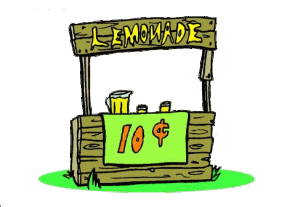 One of the great symbols of US spirit has always been its small businesses. It’s one of those myths that seems to carry everywhere including to views of us in other countries. There are two related memes that go along with this mythic American institution that are not borne out by statistics. The first is that small businesses are the source of employment growth in the country. This is not true. Most small businesses that do not fail stay small. The majority of job growth comes from medium to large businesses. Midsize business are far more important. (Data from the BLS.) The second meme is that either too much regulation or uncertainty created by the government is causing depressed job growth. This is simply not true either.
What does this mean? By any reasonable interpretation, it is mid-size companies that are generating the bulk of the jobs in the recovery. From an economic development perspective, it means that job growth is more likely to come from mid-size companies that are adding several workers or perhaps a couple of dozen new employees, rather than the smallest or largest businesses.
And what are these businesses most worried about today? According to a recent survey by the National Federation of Independent Business (here):
“The two principal impediments to current small-business growth are business uncertainty and weak sales… The single most important indicator that would renew small-business owner confidence in business conditions is increased sales in their businesses.”
The economic recovery is a demand issue.
There is also some strange set of lies out there that the increase in taxes proposed by the Obama Administration on those making over $250k is going to kill small business. Not true again! This tax hike would likely impact only about 3.5% of small businesses. The majority of these are partnerships formed by doctors and lawyers. They are not your average mom and pop store. I just heard Haley Barbor repeat this lie on CNN last night.
But to what extent would Obama’s tax plan actually affect small businesses?
In its latest estimate last month, Congress’s nonpartisan Joint Committee on Taxation found that in 2013, just 3.5 percent of small business tax filers would pay a higher rate — about 940,000 individuals, many of whom are lawyers and doctors in partnerships. But those few percent account for 53 percent of all small business income.
GOP aides accept those facts but they say those few small businesses are the ones overseeing growing companies whom the nation is counting on to hire. According to a variety of analyses, the lion’s share of the tax hike would be absorbed by Americans earning well over $1 million.
Late in 2010, when the same debate played out, William Gale, co-director of the nonpartisan Tax Policy Center, called it a “myth” to suggest that ending the tax cut on top marginal rates would hurt small businesses.
“This claim is misleading,” Gale wrote in the Washington Post. “If the objective is to help small businesses, continuing the Bush tax cuts on high-income taxpayers isn’t the way to go — it would miss more than 98 percent of small-business owners and would primarily help people who don’t make most of their money off those businesses.”
There’s a new study covered by The Washington Monthly that shows that entrepreneurship and small business ownership is on the decline. Get ready for this result. It’s primarily Republican policies that are killing small businesses and not over regulation, over taxation or over anything else. Here’s some interesting information about the decline and how some of it is due to other things too.
Data kept by the Small Business Administration, for instance, shows that the share of the working-age population that is self-employed has been declining since 1994. The share fell steadily until 2002, stayed level between 2003 and 2006, then began to drop again. Overall, between 1994 and 2009, the share declined nearly 25 percent.
This drop in the number of self-employed citizens relative to the overall working population is also captured by the Bureau of Labor Statistics, which isolates nonfarm workers. The BLS survey asks workers if they are employed by a private company, a nonprofit organization, or the government, or are self-employed. Self-employed workers are further separated into those who have incorporated their businesses and those who have not.
According to the BLS, the number of Americans who are both self-employed and not incorporated has fallen significantly as a share of the working-age population, from 461 per 10,000 in 1990 to 359 in 2011. This decline—more than 22 percent—reversed a long trend in the opposite direction during the 1970s and ’80s. The BLS data shows a somewhat different picture when it comes to self-employed persons who incorporate their businesses. As a share of the working-age population, their ranks grew 35 percent between 1989 and 2008, before dropping off sharply in 2009. Yet this increase in incorporation may be evidence not so much of rising entrepreneurship as of existing unincorporated one-person firms deciding to change their legal status—to take better advantage of new limited liability laws in many states, for instance, in order to cut their tax bills.
Even if we accept this number without question, however, the total share of the self-employed dropped steadily over the last two decades. In 1994 there were roughly 663 self-employed (incorporated and unincorporated) for every 10,000 working-age Americans; by 2009 this number was down to 606, an 8.5 percent decline.
If anything, there’s good reason to believe that this decline in entrepreneurship is even steeper than government data shows, thanks to what appears to be systematic miscategorization by the government of what counts as a true independent company. Since the 1990s, large companies have increasingly relied on temporary help to do work that formerly was performed by permanent salaried employees. These arrangements enable firms to hire and fire workers with far greater flexibility and free them from having to provide traditional benefits like unemployment insurance, health insurance, retirement plans, and paid vacations. The workers themselves go by many different names: temps, contingent workers, contractors, freelancers. But while some fit the traditional sense of what it means to be an entrepreneur or independent business owner, many, if not most, do not—precisely because they remain entirely dependent on a single power for their employment.
Again, it’s not taxes and it’s not over-regulation responsible for the decline. Here are the two major reasons.
Perhaps the most common complaint among small business entrepreneurs is a shortage of financing. While the rise of the venture capital business might give the impression that financial support for entrepreneurs has never been easier to obtain, the truth is that only a tiny fraction of start-ups have access to venture funds. To get their businesses up and running, the vast majority of entrepreneurs today tend to rely at first, as they always have, on a combination of personal savings and contributions from family and friends. But with family balance sheets ravaged by stagnant wages and skyrocketing costs for health care and higher education, fewer and fewer average families have the savings needed to invest in a small business.
The effects of the radical consolidation in the banking industry that began in the 1980s are equally dramatic. Relatively few bank officers today have the leeway and local knowledge to lend to established local businesses, much less new ventures. This is especially true in bad times, when big institutions come under great pressure both from Wall Street and regulators. In Maryland, for example, Bank of America made 312 SBA-guaranteed loans to local businesses in 2007. In 2010, it made two. Consolidation also concentrates the power of a few financial institutions over small businesses, and radically raises the risk that entire funding systems can collapse all at once. The near breakdown of CIT Group in early 2009—averted only by a last-minute deal with bondholders—would have cut more than a million small businesses off from some of the most important forms of day-to-day business financing.
The single biggest factor driving down entrepreneurship is precisely the radical concentration of power we have seen not only in the banking industry but throughout the U.S. economy over the last thirty years. This revolutionary remaking of almost every economic activity in the nation was set in motion in 1981, when officials in the Reagan administration all but suspended traditional enforcement of America’s antimonopoly laws, a change in policy then adopted by every subsequent administration. Since then, regulators have done almost nothing to stop the great waves of mergers and acquisitions, with the result that control over most major economic activities is now more consolidated than at any time since the Gilded Age.
The effects have been nowhere more dramatic than in those sectors that have always been most congenial to individual proprietorships, like retail, services, farming, and small manufacturing. These were the activities most affected, for instance, by the type of “roll-up” strategies pioneered by financiers like Mitt Romney’s Bain Capital. In the case of the office-supply retailer Staples, Bain’s investment helped propel the company from a one-store operation to a 2,000-store international behemoth. Similar plays resulted in Home Depot capturing a vast proportion of the nation’s hardware business, in Best Buy capturing a vast proportion of America’s electronics business, and in Macy’s capturing a vast proportion of all department store sales. Just one company, Wal-Mart, now controls upward of 50 percent of some lines of grocery and general merchandise business—commerce that a generation ago was divided among tens of thousands of families.
So, next time you think that Republicans are the small business friendly party, think again. It’s clearly the drive towards monopoly, market concentration and policies that benefit the One Percenters that’s killing US small business.

 peej
peej Carissa
 bostonboomer
 dakinikat
 ecocatwoman
 mablue2
 Mama Lopez
 peggysue22
 quixote
 skydancingguestblogger
 Mona (aka Wonk the Vote)



 Sky Dancing
Recent Comments