
Manchester Union Leader Endorses Newt Gingrich
Posted: November 27, 2011 Filed under: 2012 presidential campaign, Republican presidential politics, U.S. Politics | Tags: Barack Obama, Bill Clinton, Herman Cain, John Huntsman, Manchester Union Leader, Mitt Romney, New Hampshire primary, Newt Gingrich 22 Comments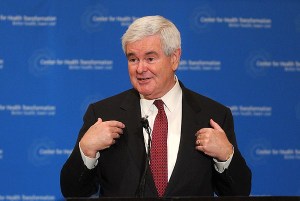
The ultra-conservative Manchester Union Leader, the largest and most influential newspaper in New Hampshire has endorsed Newt Gingrich in the New Hampshire Republican primary, which will be held on January 10.
America is at a crucial crossroads. It is not going to be enough to merely replace Barack Obama next year. We are in critical need of the innovative, forward-looking strategy and positive leadership that Gingrich has shown he is capable of providing.
He did so with the Contract with America. He did it in bringing in the first Republican House in 40 years and by forging balanced budgets and even a surplus despite the political challenge of dealing with a Democratic President. A lot of candidates say they’re going to improve Washington. Newt Gingrich has actually done that, and in this race he offers the best shot of doing it again.
Interesting. The Union Leader gives credit to Gingrich for the surplus, implying that Bill Clinton fought against balancing the budget. They also don’t mention Gingrich’s ethics problems. Gingrich must be dancing a jig with Callista today. Steve Benen looked to see what the newspaper’s record is on picking primary winners.
Looking back, the track record is mixed:
1976: The paper endorsed Ronald Reagan over Gerald Ford, but Reagan lost
1980: Reagan won the endorsement and the primary
1988: The Union Leader supported Pete du Pont, who finished fourth in the primary
1992: The paper supported Pat Buchanan, who finished a competitive second against an incumbent president
1996: The Union Leader again backed Buchanan, who this time won the primary
2000: Steve Forbes won the paper’s endorsement, in advance of a third-place showing
2008: The Union Leader supported John McCain, who won the state’s primary
While the endorsement doesn’t mean Gingrich will catch up with Romney, I don’t see how it can hurt. I’m sure the White House is celebrating today too. Gingrich would certainly be an easier opponent for Obama than Romney. And Bill Clinton basically confirmed that by praising Gingrich in an interview with Newsmax. [WARNING: wingnut site!]
Former President Bill Clinton praised his erstwhile nemesis former House Speaker Newt Gingrich, crediting Gingrich’s strong debate performances with propelling him into front-runner status for the GOP presidential nomination.
“It’s not any traditional charisma,” said Clinton, who discussed his new best-seller, “Back to Work: Why We Need Smart Government for a Strong Economy,” in an exclusive interview with Newsmax.TV. Instead, Clinton believes Gingrich is emerging because “he thinks about this stuff all the time.”
The White House must be grateful to Clinton for heaping the following praise on Gingrich:
“He’s articulate and he tries to think of a conservative version of an idea that will solve a legitimate problem,” Clinton told Newsmax in the exclusive interview this week, by way of explaining the Gingrich resurgence. Gingrich holds frontrunner status in the race for the GOP nomination, as several polls have him surpassing former Massachusetts Gov. Mitt Romney.
Clinton continued: “For example, I watched the national security debate last night. And Newt said two things that would make an independent voter say, ‘Well, I gotta consider that.’
“He said, ‘OK, I don’t want to legitimize immigrants who came here undocumented, illegally.’ On the other hand, a lot of those people have been here for years, they worked hard, they paid taxes, they’ve got kids in the schools, they’re not criminals, we’re going to have a hard time sending them all home, there’s millions of them. So, I’d like to have a process where they could be here legally but not have a path to citizenship. That sort of splits the difference between the immigration reforms proposed by President Bush and President Obama, which would give a path to citizenship, and would be a version of what President Reagan did.”
Newsmax notes that Clinton didn’t go so far as to predict Newt would be the Republican nominee.
And how are the losers in the endorsement race reacting? The Boston Globe:
Romney campaign spokeswoman Gail Gitcho declined to comment. Appearing on CNN’s State of the Union this morning, Cain blamed his failure to secure the paper’s endorsement on “false accusations” of sexual harassment from his tenure as head of the National Restaurant Association and confusion over his position on abortion.
“Obviously false accusations and confusion about some of my positions has contributed to it and that was to be expected,” Cain said. “Some people are heavily influenced by perception more so than reality. The good news is most of my supporters have stayed on the Cain train, as we say.”
Former Utah governor Jon Huntsman, on Fox News Sunday, shrugged off the impact.
“It once again proves how fluid and unpredictable New Hampshire is,” Huntsman said of the endorsement. “A month ago for Newt Gingrich to have been in the running to capture the Union Leader endorsement would be unthinkable.”
Cain blew it when he publicly snubbed the Union Leader by cancelling a planned candidate interview a couple of weeks ago and then rescheduled it a few days later. I imagine Romney is really grinding his teeth over this. I can’t imagine how he could win the nomination without taking the New Hampshire primary.
Well, isn’t this Awkward?
Posted: November 26, 2011 Filed under: Foreign Affairs, Pakistan | Tags: friendly fire, NATO troops kill Pakistani Soldiers 7 CommentsIt  seems NATO Air Strikes have killed about 28 Pakistani forces in Pakistan. Isn’t that considered an act of war in most books? Either our air support technology isn’t what it is supposed to be or more than a few folks need better training. The press is saying that tensions are high between Pakistan and NATO right now. I’d say that’s probably an understatement.
Pakistani officials said Saturday that NATO aircraft had killed at least 25 soldiers in strikes against two military posts at the northwestern border with Afghanistan, and the country’s supreme army commander called them unprovoked acts of aggression, in a new flash point between the United States and Pakistan.
The Pakistani government responded by ordering the C.I.A. to vacate the drone operations it runs from Shamsi Air Base, in northern Pakistan, within 15 days and by closing down the two main NATO supply routes into Afghanistan, including the one at Torkham. NATO forces receive roughly 40 percent of their supplies through that crossing, which runs through the Khyber Pass, and Pakistani officials gave no estimate for how long the routes might be closed.
In Washington, American officials were scrambling to assess what had happened and weigh the implications on a relationship that took a sharp turn for the worse after a United States military helicopter raid killed Osama bin Laden near Islamabad in May, and that has deteriorated since then.
“It seems quite extraordinary that we’d just nail these posts the way they say we did,” said one senior American official who was in close touch with American and NATO officials in Pakistan and Afghanistan early Saturday. “Whether they were going after people or whether there was some firing from the Afghan side of the border, then the Pakistan side, we just don’t know. It’s real murky right now. Clearly, something went very wrong.”
The American ambassador in Islamabad, Cameron Munter, called an emergency meeting and expressed regret over the Pakistani casualties. And Gen. John R. Allen, the commander of NATO-led forces in Afghanistan, offered condolences to families of the dead and promised an investigation. “This incident has my highest personal attention and my commitment to thoroughly investigate it to determine the facts,” he said in a statement.
According to The UK Guardian, NATO is claiming self-defense.
An attack by Nato aircraft on Pakistani troops that allegedly killed as many as 28 soldiers and looks set to further poison relations between the US and Pakistan was an act of self-defence, a senior western official has claimed.
According to the Kabul-based official, a joint US-Afghan force operating in the mountainous Afghan frontier province of Kunar was the first to come under attack in the early hours of Saturday morning, forcing them to return fire.
The high death toll from an incident between two supposed allies suggests Nato helicopters and jets strafed Pakistani positions with heavy weapons.
The deadliest friendly fire incident since the start of the decade-long war also prompted Pakistan to ban Nato supply trucks from crossing into Afghanistan and to issue an order demanding the US quit the remote Shamsi airbase, from which the US has operated some unmanned drone aircraft.
A spokesman for Nato’s International Security Assistance Force (ISAF) said it was “highly likely” that aircraft which had been called into the area to provide “close air support” to troops on the ground was responsible for causing casualties among the Pakistani soldiers.
For their part, a statement by the Pakistani military claimed that it was they who were attacked first, forcing them to respond to Nato’s “aggression with all available weapons”.
According to Pakistani officials the 40 or so soldiers stationed at the outposts were asleep at the time of the attack. Government officials said the two border posts that were attacked had recently been established to try to stop insurgents who use bases in Afghanistan to attack Pakistan from crossing the border and launching attacks.
We’ve gotten a reputation for collateral damage in the area. This certainly isn’t going to help. It will be interesting to see how this plays on the Sunday Talk shows.
Pakistan has cut of supplies as retaliation so far.
Pakistan is a vital land route for nearly half of NATO supplies shipped overland to its troops in Afghanistan, a NATO spokesman said. Land shipments account for about two thirds of the alliance’s cargo shipments into Afghanistan.
Hours after the raid, NATO supply trucks and fuel tankers bound for Afghanistan were stopped at Jamrud town in the Khyber tribal region near the city of Peshawar, officials said.
The border crossing at Chaman in southwestern Baluchistan province was also closed, Frontier Corps officials said.
A meeting of the cabinet’s defense committee convened by Gilani “decided to close with immediate effect NATO/ISAF logistics supply lines,” according to a statement issued by Gilani’s office.
The committee decided to ask the United States to vacate, within 15 days, the Shamsi Air Base, a remote installation in Baluchistan used by U.S. forces for drone strikes which has long been at the center of a dispute between Islamabad and Washington.
The last thing we need is major screw ups like this. Bet Hillary’s on that 3 am phone call again.
Political Cage Match: Professor versus Puffed-Up Congressman
Posted: November 25, 2011 Filed under: Congress, corruption, education, Environment, U.S. Politics | Tags: ANWR, Arctic National Wildlife Refuge, conservation, Douglas Brinkley, House Natural Resources Committee, oil drilling, Rep. Don Young (R-Alaska), Republicans 9 Comments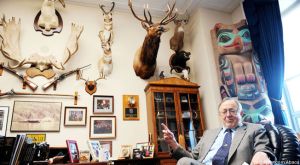
Rep. Don Young (R-Alaska)
Last Friday historian Douglas Brinkley testified before the House Natural Resources Committee on the topic of preserving the Arctic National Wildlife Refuge. The Republicans, of course, have been trying for years to open it up to oil drilling. Brinkley, whose latest book is The Quiet World: Saving Alaska’s Wilderness Kingdom, 1879-1960, argued that preserving one of the last truly wild places in the U.S. should trump helping the oil companies make more money.
Alaska Rep. Don Young (who had skipped most of the testimony) broke into Brinkley’s presentation, calling the historian by the wrong name and saying his testimony was “garbage.” Then the two had a hilarious shouting match. IMO, Brinkley came out the winner, but judge for yourself:
Young: If you ever want want to see an exercise in futility … That side has already made up its mind and this side has already made up its mind. I call it garbage, Dr. Rice, it comes from the mouth –
Brinkley: It’s Dr. Brinkley. Rice is a university – I know you went to Yuba [a community college] and you couldn’t graduate.
Young: Well, okay, I can call you anything I want if you sit in that chair. You just be quiet! You be quiet!
Brinkley: You don’t own me. I pay your salary.
Young: I don’t own you, but I can tell you right now—
Brinkley: I work for the private sector, you work for the taxpayer.
Next, committee chairman Doc Hastings interrupted and lectured Brinkley. But Young was still “pissed right now.”
Finally, Brinkley said he was surprised to
hear a congressman today say there’s nothing in his district. It’s boring. It’s flat. It’s not exciting. I don’t know a representative who doesn’t love their district. Every state in America’s landscape is beautiful if you love it. But some people love money more than their homeland or where they live, and I’m afraid that that’s why this fight has to keep coming up 50 years later, we’re still trying to tell people the Arctic refuge is real. It belongs to the American people.
On Friday evening, Brinkley appeared on The Ed Show on MSNBC to discuss his experience with Rep. Young.
A week later, the Congressional cage match is still causing controversy. At the Minnesota Post, Don Shelby, a friend of Brinkley’s wrote a column about the dust up.
Brinkley told me he knew that Congressman Young, at another hearing, had waved a walrus penis bone at Mollie Beattie, the incoming chief of the Fish and Wildlife Service. Brinkley may have read the Rolling Stone article about Young that quotes the congressman as saying, “Environmentalists are a self-centered bunch of waffle-stomping, Harvard-graduating, intellectual idiots.” The quote continues, “[They] are not Americans, never have been Americans and never will be Americans.” ….
Brinkley should not have been surprised that Congressman Young showed up late and missed the bulk of the historian’s testimony. Young is often cited as the congressman missing more votes than any other member of the House. Brinkley would have known that Young was the co-sponsor, with discredited Alaska Sen. Ted Stevens, of the bill to pay for the infamous “bridge to nowhere.”
Brinkley told me: “Everyone knows that Young is just a menacing blowhard. He has a history of being rude, he browbeats and he’s snotty toward anyone who cares about the environment.”
I asked Brinkley if he was surprised that Committee Chair Doc Hastings took Young’s side and continued lecturing the historian. “No,” said Brinkley. “They are tied together at the hip. They are both oil company factotums. They are a tag team.”
Young claims that Brinkley is just milking the incident to sell books. Brinkley told a Houston TV station
that his students applauded when he walked into class. “I have received now hundreds and hundreds of emails from people all over, I’ve not received one negative one,” he said. “I’ve had my entire Rice University and including Texas conservatives cheering me on for standing up to his bullying tactics.”
I’m not usually much of a fan of Brinkley’s, but I have to applaud him on this one. I don’t care if he’s doing it to sell books. Greedy, incompetent politicians like Don Young need to be revealed for what they are: pigs at the trough.
Black Friday Reads
Posted: November 25, 2011 Filed under: Egypt, Foreign Affairs, morning reads, religious extremists, Syria, Yemen | Tags: Black Friday, Darwin, New York Evacuation Day, Occupy Black Friday, Tom RIdge 14 Comments Welcome to the traditional start of the National Crass Consumerism Season!
It’s that time of year when every trip to a store is an overwhelming assault on all of your senses in an attempt to get you to buy stuff! It was hard to avoid all the commercials yesterday, wasn’t it? Robert Scheer has a great piece up on Truth Dig that puts this time of year in perspective.
On this Thanksgiving we have been cheated of the bounty of that harvest as the stakes have been pulled up on 50 million Americans who have lost or soon will lose their homes. The housing crisis haunts a majority of Americans, even those who own their homes outright but have lost their jobs and must now sell in a downward-swirling housing market.
Good public education on every level, from preschool through college, is now a matter of inherited privilege reserved for those who can pick and choose affluent neighborhood settings for their children’s schools. And the prospect of affording one of those settings is dim for most parents in a country where securing a good job is beyond the reach of so many highly motivated people.
How many folks from my generation are honestly sanguine about the economic future of their children and grandchildren? What I have heard constantly, and just this week from a former top investment banker addressing a college class I teach, is that our offspring probably will face a decade of lost opportunity. I thought back to my college days and how shocked any of us, even those from the most impoverished of circumstances, would have been to hear such a prediction.
As The New York Times editorialized this Thanksgiving, “One in three Americans—100 million people—is either poor or perilously close to it.”
There’s a movement afoot called Occupy Black Friday.
Occupy Black Friday, which is among the groups calling for people to spend locally rather than at chain stores, could not be reached for comment.
The anti-consumption spirit of the various scheduled Occupy events has a precedent in Buy Nothing Day, the yearly undertaking — always scheduled to fall on Black Friday — in which participants refrain from spending any money.
Buy Nothing Day was created some 20 years ago by advocates associated with the Vancouver magazine Adbusters, which also issued the original call for the movement that would become Occupy Wall Street. While it remains a red-letter date on the calendars of many social activists, its effects on retail sales have traditionally been less than earthshattering.
“They’re fragmentary, they’re ephemeral,” said Richard Hastings, a macro and consumer strategist at Global Hunter Securities, of Buy Nothing Day and similar campaigns that have attempted to build commercial headwinds on Black Friday. “To really be quite poetic about it, they’re evanescent.”
Hastings said that “the Occupy movement in the U.S. can only have some impact if it starts to do boycotts” — but added that he does not expect the anti-Black Friday forces to change many minds this year.
Here’s a great suggestion for celebrating the day after Thanksgiving from the Daily Show! Prior to Abraham Lincoln making Thanksgiving a National Holiday, New York used to recognize Evacuation Day. Massachusetts celebrates the day on March 17th which has been co-opted by Saint Patrick’s Day. The days were set aside in the colony to celebrate the day when the British evacuated that colony after the Revolution. They celebrate the end of the rule of an occupying army.
Vodpod videos no longer available.
There’s another great thing that happened on November 24, 1859. That’s the publication date of On the Origin of Species by Means of Natural Selection by Charles Darwin. Darwin’s epic release of his work changed our view of biology, botany, and creation myths. Scientists now accept this theory as a basis to the development of every living species even though many radical religionists still try to replace it with creation myths in classrooms in many states. Louisiana dingbat Governor Bobby Banana Republic Jindal gave religious myth equal footing with science this year in a case that’s law that’s bound to head to the supreme court. He signed a “Louisiana Science Education Act” that sneaks religion into science classes. Scopes Monkey Trial any one?
Darwin had formulated his theory of natural selection by 1844, but he was wary to reveal his thesis to the public because it so obviously contradicted the biblical account of creation. In 1858, with Darwin still remaining silent about his findings, the British naturalist Alfred Russel Wallace independently published a paper that essentially summarized his theory. Darwin and Wallace gave a joint lecture on evolution before the Linnean Society of London in July 1858, and Darwin prepared On the Origin of Species by Means of Natural Selection for publication.
Published on November 24, 1859, Origin of Species sold out immediately. Most scientists quickly embraced the theory that solved so many puzzles of biological science, but orthodox Christians condemned the work as heresy. Controversy over Darwin’s ideas deepened with the publication of The Descent of Man, and Selection in Relation to Sex (1871), in which he presented evidence of man’s evolution from apes.
By the time of Darwin’s death in 1882, his theory of evolution was generally accepted. In honor of his scientific work, he was buried in Westminster Abbey beside kings, queens, and other illustrious figures from British history. Subsequent developments in genetics and molecular biology led to modifications in accepted evolutionary theory, but Darwin’s ideas remain central to the field.
There is an astounding amount of evidence from the fields of genetics and molecular biology to now support Darwin’s basic ideas. PBS maintains an Evolution Library that’s full of links to some of the most astounding new evidence that has made the theory even more developed and iron clad. Here’s a great paper from the National Academy of Science on Science and Creationism. This elucidates the difference between Darwin’s work and the modern theory of Evolution.
Contrary to popular opinion, neither the term nor the idea of biological evolution began with Charles Darwin and his foremost work, On the Origin of Species by Means of Natural Selection (1859). Many scholars from the ancient Greek philosophers on had inferred that similar species were descended from a common ancestor. The word “evolution” first appeared in the English language in 1647 in a nonbiological connection, and it became widely used in English for all sorts of progressions from simpler beginnings. The term Darwin most often used to refer to biological evolution was “descent with modification,” which remains a good brief definition of the process today.
Darwin proposed that evolution could be explained by the differential survival of organisms following their naturally occurring variation—a process he termed “natural selection.” According to this view, the offspring of organisms differ from one another and from their parents in ways that are heritable—that is, they can pass on the differences genetically to their own offspring. Furthermore, organisms in nature typically produce more offspring than can survive and reproduce given the constraints of food, space, and other environmental resources.
Darwin proposed that evolution could be explained by the differential survival of organisms following their naturally occurring variation—a process he termed “natural selection.” According to this view, the offspring of organisms differ from one another and from their parents in ways that are heritable—that is, they can pass on the differences genetically to their own offspring. Furthermore, organisms in nature typically produce more offspring than can survive and reproduce given the constraints of food, space, and other environmental resources. If a particular off-spring has traits that give it an advantage in a particular environment, that organism will be more likely to survive and pass on those traits. As differences accumulate over generations, populations of organisms diverge from their ancestors.
Darwin’s original hypothesis has undergone extensive modification and expansion, but the central concepts stand firm. Studies in genetics and molecular biology—fields unknown in Darwin’s time—have explained the occurrence of the hereditary variations that are essential to natural selection. Genetic variations result from changes, or mutations, in the nucleotide sequence of DNA, the molecule that genes are made from. Such changes in DNA now can be detected and described with great precision.
Today in 2002, President George W. Bush signed the Homeland Security Act and named Tom Ridge it’s first Secretary. The first two secretaries–Ridge and Michael Chertoff–have written books. There’s an overview of each at the link above. Here’s some info on Ridge and the creation of the DHS.
Although Ridge was an early proponent of the creation of DHS, the White House initially was not supportive. As Ridge notes, President Bush’s focus was on strengthening the power of the executive branch that he felt over the years “had been improperly ceded to Congress” (p. 126). Hence, the White House wanted a strong cabinet around it. The real impetus for the creation of DHS came from Congress, which was increasingly frustrated by the lack of oversight of the billions of dollars over which Ridge had influence (but no real power). After the White House refused to allow Ridge to testify before Congress about his homeland security priorities, and after the legacy INS sent two visas to dead 9/11 hijackers to attend flight training school in Florida, DHS became a political inevitability. As Ridge recounts, Congress wanted him “unmuzzle[d]” and the White House realized “[i]t would be better for the administration to be the architect of the new department rather than allowing Congress to take the lead” (pp. 127, 129).
Although the White House eventually supported the creation of DHS – and asked him to lead it – Ridge describes how his vision of homeland security and that of the administration differed. As Ridge observes, “the silly prolonged debate with the White House over the design of the new department’s seal was as absurd as it was revealing” (p. 71). The Bush administration wanted an eagle emblem to hold arrows in both talons as if to say the key to victory over terrorism was through aggression, forward-leaning military, and counterterrorism action. Ridge countered: “We thought differently. There was far more to defeating the enemy than military action” (p. 71). To his credit, Ridge discusses in detail what else his vision of homeland security entailed, which can be summed up as creating an environment of trust and credibility with the public. As he explains: “Only disclosure and transparency would generate the confidence and trust needed by our government as it waged its war domestically” (p. 72).
There’s a few international stories that you probably should follow. First, Egypt is experiencing a huge amount of violence right before elections are to be held.
There have been massive protests in Tahir square, arrests, and assaults on journalists by the police.
A capital city convulsed with violence just days before the first democratic elections in decades might not seem ideal. But some voters think the demonstrations will keep the transition from stalling.
Abdul Rahman Mansour, a graphic designer in the capital, says the people on Tahrir Square are making sure their rights are respected and the country moves ahead.
American University in Cairo professor Said Sadek agrees, saying the protests serve as a wake-up call for the ruling Supreme Council of the Armed Forces. “After the end of Mubarak rule SCAF has no legitimacy except obeying and meeting the demands of the revolution. This is revolutionary legitimacy. So they have to follow what is happening,” he said.
International condemnation of Syria’s dictator is turning into action. The Arab League has asked for harsher sanctions and a possible fly over zone with help from the UN if al-Assad does not stop his violence against peaceful protestors.
In a special meeting in Cairo, the Arab League called on Syria to agree by Friday to admit a mission of 500 civilian and military observers to monitor the human rights situation and oversee efforts to carry out a peace plan that Syria agreed to on Nov. 2.
The Arab League suspended Syria this month after it failed to comply with the plan, under which it had pledged to withdraw all military units from the streets, stop killing protesters and allow the monitors to enter the country.
The league said that if Syria refused to admit the monitors, it would meet again on Saturday to discuss sanctions that could include the suspension of all trade except for essential humanitarian goods, a ban on flights to Syria, a travel ban on Syrian officials, and the freezing of all transactions with the central bank and of all Arab economic projects under way in Syria.
If enacted, the new penalties would deal a stinging blow to an economy already suffering under sanctions from the European Union and the United States. Syria’s two most vital sectors, oil and tourism, which account for more than a third of the government’s revenues, have all but come to a halt.
While there was no official response from the leadership in Damascus, Syrian state television said that the government would reject the deal as an infringement on its sovereignty.
In other news from the Arab spring uprisings, Yeman’s president has resigned. However, protestors have problems with the succession.
A U.S.-backed deal for Yemen’s authoritarian president to step down fell far short of the demands of protesters who fought regime supporters on the streets of Sanaa Thursday in clashes that left five dead.
The agreement ending President Ali Abdullah Saleh’s 33-year rule provides for only the shallowest of changes at the top of the regime, something the U.S. administration likely favored to preserve a fragile alliance against one of the world’s most active al-Qaida branches based in Yemen.
The plan drawn up by Yemen’s oil-rich Gulf neighbors does not directly change the system Saleh put in place over three decades to serve his interests.
“It gives an opportunity for regime survival,” said Yemen expert Ibrahim Sharqieh at the Brookings Doha Center. “The only one we’ve seen changing here is the president, but the state institutions and everything else remain in place. Nothing else has changed.”
Saleh signed the agreement Wednesday in the Saudi capital Riyadh, transferring power to his vice president within 30 days. If it holds, he will be the fourth dictator pushed from power this year by the Arab Spring uprisings.
But the deal leaves much more of the old regime intact than the uprisings in Tunisia, Egypt and Libya — something that will almost certainly translate into continued unrest. Protesters who have been in the millions for nearly 10 months were out again Thursday, rejecting a provision that gives Saleh immunity from prosecution.
Massive unrest around the world continues. It is sad to see so much violence, but the spread of democracy into regions that have been ruled by harsh dictators and the fight to regain democracy in regions where corporatocracy has ruled is exciting in many ways.
What’s on your reading and blogging list today?
Thanksgiving Day Reads
Posted: November 24, 2011 Filed under: morning reads | Tags: Morning reads, Thanksgiving 16 Comments
Happy Thanksgiving!! I’m going to devote this Thursday post to Thanksgiving-oriented material. Feel free to talk about whatever you want in the comments.
Here’s a little background on the origins of the Thanksgiving feast from Wikipedia:
Thanksgiving in North America had originated from a mix of European and Native traditions.[1] Typically in Europe, festivals were held before and after the harvest cycles to give thanks for a good harvest, and to rejoice together after much hard work with the rest of the community.[1] At the time, Native Americans had also celebrated the end of a harvest season.[1] When Europeans first arrived to the Americas, they brought with them their own harvest festival traditions from Europe, celebrating their safe voyage, peace and good harvest….
In the United States, the modern Thanksgiving holiday tradition traces its origins to a 1621 celebration at Plymouth in present-day Massachusetts. There is also evidence for an earlier celebration on the continent by Spanish explorers in Texas at San Elizario in 1598, as well as thanksgiving feasts in the Virginia Colony. The initial thanksgiving observance at Virginia in 1619 was prompted by the colonists’ leaders on the anniversary of the settlement. The 1621 Plymouth feast and thanksgiving was prompted by a good harvest. In later years, the tradition was continued by civil leaders such as Governor Bradford who planned a thanksgiving celebration and fast in 1623. While initially, the Plymouth colony did not have enough food to feed half of the 102 colonists, the Wampanoag Native Americans helped the Pilgrims by providing seeds and teaching them to fish. The practice of holding an annual harvest festival like this did not become a regular affair in New England until the late 1660s
I don’t really know how accurate that is. The Christian Science monitor has listed five myths about Thanksgiving that they believe will surprise people. Number three on the list was news to me:
3. Pilgrims dressed in all black and wore buckles
Not so fast. This modern-day likeness of the first American Pilgrims was conjured sometime in the 19th century, when the popular image of Pilgrims was formed – but it’s mostly false. The garb of the Pilgrims was actually brightly colored and buckle-free.
Pilgrim women normally dressed in red, earth green, brown, blue, violet, and gray, and the men wore white, beige, black, earth green, and brown clothing. Buckles were not commonly worn until much later in the 17th century, and black and white clothing was typically only worn on Sundays and when observing formal occasions.
So why give the Pilgrims this now-iconic appearance?
Former Plimoth (yep, we double-checked the spelling) Plantation historian James W. Baker writes that, in the 19th century, buckles were assigned to Pilgrims because they served as an emblem of quaintness, which is the same reason illustrators gave Santa Claus buckles. Also associated with Pilgrims – the blunderbuss, a muzzle-loading firearm with a stout caliber barrel – was so designated because of its old-fashioned, unthreatening look. But the Pilgrims probably didn’t use that either.
According to The Boston Globe the Thanksgiving travel rush was going full tilt yesterday.
Undeterred by costlier gas and airfare, millions of Americans set out Wednesday to see friends and family in what is expected to be the nation’s busiest Thanksgiving weekend since the financial meltdown more than three years ago….
About 42.5 million people are expected to hit the road or take to the skies for Thanksgiving this year, according to travel tracker AAA. That’s the highest number since the start of the recession at the end of 2007.
Heavy rain slowed down early travelers along the East Coast. Snow across parts of New England and upstate New York made for treacherous driving and thousands of power outages. And a mudslide covered train tracks in the Pacific Northwest. But most of the country is expected to have clear weather Thursday.
Quite frankly, some of my happiest Thanksgiving days have been spent alone. I find holidays somewhat stressful, and besides I have kind of a crazy family. This year I’m going to spend the day with my brother’s family at the home of some of their friends. I’m pretty sure everyone will be nice, but if not I can always excuse myself early. Here’s an article from Time for people with big crazy families like mine: 5 Ways to Keep Your Family From Ruining Thanksgiving. Here’s my favorite (Number 5):
The key to maintaining your calm is to send yourself the right mental messages. That means practicing mindful awareness, loving kindness and compassionate self-talk. Sound like new age psychobabble? The truth is, you’re already sending yourself messages all the time. “You’re telling yourself throughout the day what you’re bothered by and disappointed in….It’s worse at holiday time when your expectation of what you thought your life was going to look like is most acute.”
I found two writers (probably both conservatives) who claimed that the lesson of the first Thanksgiving is that capitalism trumps socialism.
From Tom Arneberg at the Chippewa Herald:
When they first started the colony, their overseas investors forced them to share all their property together. According to Bradford, “all profits and benefits that are got by trade, working, fishing, or any other means” were to be shared, and that “all such persons as are of this colony are to have their meat, drink, apparel, and all provisions out of the common stock.”
In other words, put into the common stock all you can, and take out only what you need. “To each according to his need; from each according to his ability.” Sound familiar?
Communism may be okay for a small group like a family or a Boy Scout patrol, but it doesn’t scale very well for larger groups.
According to Arneson “communism” made the pilgrims lazy and selfish so William Bradford, the governor of Plimouth, decided to try “free market capitalism.”
Bradford and the colony elders divided up the property among the families. Whatever produce a family did not use for themselves, they were free to trade away with others for something else they wanted.
It was an astonishing success — the harvests of 1623 and beyond provided a bounty of excess food, not just for a single Thanksgiving meal as in the previous two years, but enough to last the winter….
Once the creative powers of individual rewards were unleashed, where every person was allowed to keep the fruits of his own labor for his own family or for trade, everything was different.
And from Dr. Milton R. Wolf at the Washington Times:
The Plymouth colonists were socialists before socialism was cool. They entered into a contract with one another and a finance company called Merchant Adventurers to create an egalitarian commune in which their wealth, food in particular, would be collectively stored and redistributed equally among members. This was the forebear of the modern-day American counterculture collectivist commune or even Israel’s more mainstream kibbutz, which survive on government subsidies. Equality is put before freedom or even productivity.
And so on…with even more right-wing propaganda included than in the article by Arneberg. I guess the first Thanksgiving was about sharing, but a couple of years later the pilgrims learned that greed is good. Incidentally, the author’s bio at the end of the article says the Wolf is Barack Obama’s cousin. Is this meme the latest White House effort to push austerity?
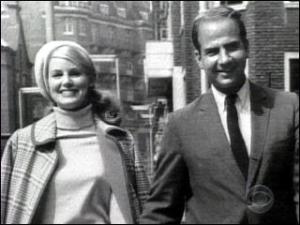
Calvin Trillin and his wife Alice in 1965
Since we were talking about mac and cheese on Thanksgiving last night, I thought I’d share my favorite alternative Thanksgiving story. For many years, humorist Calvin Trillin has led a campaign to change the official Thanksgiving dish from turkey to spaghetti carbonara. I located Trillin’s piece about it on-line, and since it was copied from Trillin’s book Third Helpings, I figured it would be OK for me to copy it too.
I have been campaigning to have the national Thanksgiving dish changed from turkey to spaghetti carbonara.
It does not take much historical research to uncover the fact that nobody knows if the Pilgrims really ate turkey at the first Thanksgiving dinner. The only thing we know for sure about what the Pilgrims ate is that it couldn’t have tasted very good. Even today, well brought-up English girls are taught by their mothers to boil all veggies for at least a month and a half, just in case one of the dinner guests turns up without his teeth… (It is certainly unfair to say that the English lack both a cuisine and a sense of humor: their cooking is a joke in itself.)
It would also not require much digging to discover that Christopher Columbus, the man who may have brought linguine with clam sauce to this continent, was from Genoa, and obviously would have sooner acknowledged that the world was shaped like an isosceles triangle than to have eaten the sort of things that the English Puritans ate. Righting an ancient wrong against Columbus, a great man who certainly did not come all this way only to have a city in Ohio named after him, would be a serious historical contribution. Also, I happen to love spaghetti carbonara.
[In our family]…Thanksgiving has often been celebrated away from home. It was at other people’s Thanksgiving tables that I first began to articulate my spaghetti carbonara campaign–although, since we were usually served turkey, I naturally did not mention that the campaign had been inspired partly by my belief that turkey is basically something college dormitories use to punish students for hanging around on Sunday… I reminded everyone how refreshing it would be to hear sports announcers call some annual tussle the Spaghetti Carbonara Day Classic.
I even had a ready answer to the occasional turkey fancier at those meals who insist that spaghetti carbonara was almost certainly not what our forebears ate at the first Thanksgiving dinner. As it happens, one of the things I give thanks for every year is that those people in the Plymouth Colony were not my forebears. Who wants forebears who put people in the stocks for playing the harpsichord on the Sabbath or having an innocent little game of pinch and giggle?
Finally there came a year when nobody invited us to Thanksgiving dinner. Alice’s theory was that the word had got around town that I always made a pest out of myself berating the hostess for serving turkey instead of spaghetti carbonara…
However it came about, I was delighted at the opportunity we had been given to practice what I had been preaching–to sit down to a Thanksgiving dinner of spaghetti carbonara.
Naturally, the entire family went over to Rafetto’s pasta store on Houston Street to see the spaghetti cut. I got the cheese at Joe’s dairy, on Sullivan, a place that would have made Columbus feel right at home–there are plenty of Genoese on Sullivan; no Pilgrims–and then headed for the pork store on Carmine Street for the bacon and ham. Alice made the spaghetti carbonara. It was perfection. I love spaghetti carbonara. Then I began to tell the children the story of the first Thanksgiving:
In England, along time ago, there were people called Pilgrims who were very strict about making everyone observe the Sabbath and cooked food without any flavor and that sort of thing, and they decided to go to America, where they could enjoy Freedom to Nag. The other people in England said, “Glad to see the back of them.” In America, the Pilgrims tried farming, but they couldn’t get much done because they were always putting their best farmers in the stocks for crimes like Suspicion of Cheerfulness. The Indians took pity on the Pilgrims and helped them with their farming, even though the Indians thought that the Pilgrims were about as much fun as teenage circumcision. The Pilgrims were so grateful that at the end of their first year in America they invited the Indians over for a Thanksgiving meal. The Indians, having had some experience with Pilgrim cuisine during the year, took the precaution of taking along one dish of their own. They brought a dish that their ancestors had learned from none other than Christopher Columbus, who was known to the Indians as “the big Italian fellow.” The dish was spaghetti carbonara–made with pancetta bacon and fontina and the best imported prosciutto. The Pilgrims hated it. They said it was “heretically tasty” and “the work of the devil” and “the sort of thing foreigners eat.” The Indians were so disgusted that on the way back to their village after dinner one of them made a remark about the Pilgrims that was repeated down through the years and unfortunately caused confusion among historians about the first Thanksgiving meal. He said,
“What a bunch of turkeys!”
Alice Trillin died on September 11, 2001.
Here’s a recipe for spaghetti carbonara:
1 pound spaghetti Ask the
hotline about
this ingredient!
1/2 pound pancetta (sliced 1/4 “ thick at the deli, and cut into lardons)
4 large eggs (locally raised and cage-free if possible)
1 tablespoon garlic, finely chopped
this ingredient!
1 cup Pecorino Romano cheese, freshly grated
2 tablespoons extra virgin olive oil
2 tablespoons finely minced fresh parsley
Freshly ground black pepper
Freshly grated parmesan reggiano to pass at the tablePut salted water on the boil for the pasta, grate the romano cheese and set aside, finely mince the fresh parsley and reserve.
In a very large skillet, saute the pancetta lardons in the olive oil over medium heat until the bacon has rendered much of its fat. You don’t want to cook the pancetta to the point of being crisp, it is better with a little fatty “chew” still left in it. Just before the pancetta is done, add the minced garlic to the pan and allow to cook until the garlic is golden brown. Set the pan aside to cool. (Allowing the pan to cool some at this point is important, because if the pan is too hot when you add the eggs later, they will immediately scramble, and not gently cook into the creamy sauce that is your ultimate goal.
Break the eggs into a medium sized bowl and whisk them till smooth. Add the grated cheese to the eggs and keep handy.
Cook the pasta to the maker’s instructions for “al dente”, and as soon as it is done, quickly strain it and toss it into the skillet with the pancetta, reserving a cup of the pasta cooking water to thin your sauce later if needed. Add the cheese and egg mixture to the pasta along with the parsley, and toss to coat. The heat from the pasta will gently cook the eggs, and melt the cheese into a luxuriously rich and smooth sauce. If the sauce is too thick for your liking, add some of the reserved pasta cooking water to loosen it.
To serve, place the pasta into warmed bowls, top liberally with freshly ground black pepper, and sprinkle with some freshly grated parmesan.
I hope everyone has a wonderful day and lots to be grateful for!

 peej
peej Carissa
 bostonboomer
 dakinikat
 ecocatwoman
 mablue2
 Mama Lopez
 peggysue22
 quixote
 skydancingguestblogger
 Mona (aka Wonk the Vote)



 Sky Dancing
Recent Comments