
The First Amendment is Well and Truly Dead.
Posted: September 25, 2011 Filed under: Human Rights, jobs, Labor unions, Patriot Act, The Bonus Class, The Media SUCKS, U.S. Economy, U.S. Politics, unemployment, Violence against women | Tags: fascism, first amendment, Income Inequality, jobs, media blackouts, occupy Wall Street, Peaceful protests, police brutality, the Constitution, the left, Twitter censorship, unemployment 46 CommentsFirst Amendment to the U.S. Constitution: “Congress shall make no law respecting an establishment of religion, or prohibiting the free exercise thereof; or abridging the freedom of speech, or of the press; or the right of the people peaceably to assemble, and to petition the Government for a redress of grievances.”

NYC Policeman reaches over barricade and pulls hair of female protester
From the New York Daily News: Wall Street protesters cuffed, pepper-sprayed during ‘inequality’ march
Hundreds of people carrying banners and chanting “shame, shame” walked between Zuccotti Park, near Wall St., and Union Square calling for changes to a financial system they say unjustly benefits the rich and harms the poor.
Somewhere between 80 and 100 protesters were arrested, and according the Occupy Wall Street website, some of them were held in a police van for more than an hour, including a man with a severe concussion. Back to the Daily News article:
Witnesses said they saw three stunned women collapse on the ground screaming after they were sprayed in the face.
A video posted on YouTube and NYDailyNews.com shows uniformed officers had corralled the women using orange nets when two supervisors made a beeline for the women, and at least one suddenly sprayed the women before turning and quickly walking away.
Footage of other police altercations also circulated online, but it was unclear what caused the dramatic mood shift in an otherwise peaceful demonstration.
“I saw a girl get slammed on the ground. I turned around and started screaming,” said Chelsea Elliott, 25, from Greenpoint, Brooklyn, who said she was sprayed. “I turned around and a cop was coming … we were on the sidewalk and we weren’t doing anything illegal.”
It’s over folks. We live in a police state. The right of the people to “peaceably assemble, and to petition the Government for a redress of grievances” is no longer recognized by the powers that be. In the age of the Patriot Act, peaceful protest is no longer permitted. The government requires that groups have a permit before they can gather on the sidewalks of New York. Oh, and BTW, a number of people were arrested yesterday because they filmed incidents of police brutality.
Via Yves at Naked Capitalism, Amped Status reports that Twitter is now following the example of the corporate media in ignoring or blocking information about peaceful protests in the U.S.
On at least two occasions, Saturday September 17th and again on Thursday night, Twitter blocked #OccupyWallStreet from being featured as a top trending topic on their homepage. On both occasions, #OccupyWallStreet tweets were coming in more frequently than other top trending topics that they were featuring on their homepage.
This is blatant political censorship on the part of a company that has recently received a $400 million investment from JP Morgan Chase.
We demand a statement from Twitter on this act of politically motivated censorship.
It’s all very exciting when Egyptians or Libyans protest their governments, but when it happens here, well, the media pretends its not happening. So much for the First Amendment.
In an op-ed at The New York Times yesterday, Michael Kazin asks: Whatever Happened to the American Left?
America’s economic miseries continue, with unemployment still high and home sales stagnant or dropping. The gap between the wealthiest Americans and their fellow citizens is wider than it has been since the 1920s.
And yet, except for the demonstrations and energetic recall campaigns that roiled Wisconsin this year, unionists and other stern critics of corporate power and government cutbacks have failed to organize a serious movement against the people and policies that bungled the United States into recession.
Instead, the Tea Party rebellion — led by veteran conservative activists and bankrolled by billionaires — has compelled politicians from both parties to slash federal spending and defeat proposals to tax the rich and hold financiers accountable for their misdeeds. Partly as a consequence, Barack Obama’s tenure is starting to look less like the second coming of F.D.R. and more like a re-run of Jimmy Carter — although last week the president did sound a bit Rooseveltian when he proposed that millionaires should “pay their fair share in taxes, or we’re going to have to ask seniors to pay more for Medicare.”
I’m sure Kazin is a good guy–after all he is a co-editor of Dissent Magazine and wrote a book on the changes the American Left has accomplished. His op-ed is a fine historical article, but still, he does mention Wisconsin. It might have been nice if he had noticed that some young people are attempting to organize a peaceful protest on Wall Street and are being victimized by brutal NYC police for their efforts. Perhaps Kazin didn’t know about the NYC protests because of the media blackout.
At the Guardian UK, David Graeber had some kind words for the Wall Street protesters.
Why are people occupying Wall Street? Why has the occupation – despite the latest police crackdown – sent out sparks across America, within days, inspiring hundreds of people to send pizzas, money, equipment and, now, to start their own movements called OccupyChicago, OccupyFlorida, in OccupyDenver or OccupyLA?
There are obvious reasons. We are watching the beginnings of the defiant self-assertion of a new generation of Americans, a generation who are looking forward to finishing their education with no jobs, no future, but still saddled with enormous and unforgivable debt. Most, I found, were of working-class or otherwise modest backgrounds, kids who did exactly what they were told they should: studied, got into college, and are now not just being punished for it, but humiliated – faced with a life of being treated as deadbeats, moral reprobates.
Is it really surprising they would like to have a word with the financial magnates who stole their future?
I salute the young men and women from Occupy Wall Street who are fighting back as best they can against corporate-fascist law enforcement and the corporate-controlled media. I really hope it’s not too late for these young people to make a difference.
Hillary: Your Anti-Drug
Posted: September 25, 2011 Filed under: just because 29 Comments
CLICK PIC FOR TRANSCRIPT: Hillary and Chelsea at the CGI on Thursday, holding a one-on-one “conversation” during the Closing Plenary. (State Dept/public domain photo)
Hey news junkies…I’ve missed y’all bigtime! I’m still not quite up to full-time blogging, but after catching Minx’s hilarious (and way too kind) comment about “Wonk withdrawals” this morning, I’ve put together a bit of an installment of pics & links to help tide you over for awhile. So enjoy!
First up… check out this New Deal 2.0 interview (on first ladies being assets to the presidency) with Roosevelt Institute Senior Fellow Ellen Chesler:
Like Eleanor, Hillary also spent the better part of her years as first lady on the road, meeting as often with the powerless as with the powerful. She had boundless enthusiasm for that. She also had an understanding that the modern welfare safety net created by the New Deal was not fulfilling the vision of the Roosevelts for a temporary government subsidy that would help build personal capacity and self-reliance.
Chesler also made a great comment about First Lady Michelle Obama that I agree wholeheartedly with:
As so many pundits have observed, Michelle Obama, a forceful advocate for her husband during the campaign, has been something of a prisoner in the White House, her attention focused only on matters that could not possibly provoke controversy, such as elementary education, child obesity, military families, and of course, fashion. I know all the arguments about why this was necessary and how threatening a tall, strong, brilliant, and beautiful African-American woman would be to many Americans, especially if she seemed “uppity.” I realize that she was encouraged to appear devoted to her daughters and family and essentially to take an “un-Eleanor, un-Hillary” approach to her position. But after hearing her speak this week, I think this has been a mistake and would send her out on the road 24/7! It’s still not too late, and she may yet turn out to be one of her husband’s best assets.
Personally I’d add Elizabeth Edwards’ name to this conversation, even though she was technically never first lady and even though she should have been the one running for president! Andrea Mitchell recently did an interview with Cate Edwards, who is leaving her law career to head up the Elizabeth Edwards foundation. People magazine has a write-up on the interview as well, with a headline focused on Cate’s marriage next month and her comment that of course she’ll be thinking of her mother when she walks down the aisle. If you don’t have time to watch the Andrea Mitchell interview clip, here’s a snippet buried at the end of the People article:
Talking to Mitchell at the Susan G. Komen 3-Day Walk for the Cure, Edwards also announced the creation of the Elizabeth Edwards Foundation, which she called “a perfect reflection” of her mother. The organization will support high school students who have limited resources but “great potential,” according to its website.
“Big choices that I make … little choices that I make, sort of everything I do, I hear her voice,” says Cate, “the same way I did when she was alive.”
My thoughts while listening to Cate–wow, she can talk the talk just like her mother!

CLICK FOR TRANSCRIPT: Another pic at the CGI, of Chelsea and her "Techno Mom." I love how Hillary looks so content and Chelsea, so proud. (State Dept/public domain photo)
In other mother-daughter news, if you haven’t clicked on the pic of Hillary and Chelsea at the CGIand read the transcript yet, I highly recommend doing so and scrolling down to the bottom third where they discuss technology. What a hoot, and informative too! I’ll tease a bit:
MS. CLINTON: I’d like to go back to technology, partly because, as your daughter, I remember when I helped you send your first text message.
SECRETARY CLINTON: Yes. (Laughter.)
MS. CLINTON: And —
SECRETARY CLINTON: That wasn’t very long ago, I have to tell you.
MS. CLINTON: And I also remember, even before you became so identified for your vigorous support of, kind of, the internet and social media as a way for people to participate virtually, when you were first emailing, you would self-identify as Techno Mom.
SECRETARY CLINTON: (Laughter.)
Over at Taylor Marsh’s, Joyce Arnold continues to be essential reading on all things LGBT and “liberally Independent.” Here are her two latest pieces:
Please check them out when you get the time.
Also at TM’s, guest blogger Art Pronin (aka texan4Hillary) has this headline that piqued my interest: “Progressive Notes: Meet the Woman who Ran Against Austerity and Made History.” Art is referring to Helle Thorning-Schmidt, who is now the first female prime minister of Denmark. Give it a look.
While I’m at it, here are some “powerful women pow-wow” pics of Hillary meeting with female leaders over the last week or so (click to see larger versions):

Madames Secretary: Hillary with Mexican Foreign Secretary Patricia Espinosa in New York on Friday. (State Dept/public domain photo)

Bilaterally speaking: Hillary meets with Costa Rican President Laura Chinchilla on Friday in New York. (State Dept/public domain photo)

Chatty Cathies: Hillary meets with EU High Representative Catherine Ashton and European Foreign Ministers on Thursday in NY. (State Dept/public domain photo)

Hillary and Hina: Hillary meets with Pakistan's first female (as well as youngest) foreign minister, Hina Rabbani Khar, last Sunday in New York. (State Dept/public domain photo)

CLICK PIC FOR TRANSCRIPT: Hillary delivers remarks at an event hosted by UN Women on Women’s Political Participation, on Monday in NY (State Dept/public domain photo)
To go along with this photo to the left of Hillary, here’s a Daily Beast/Newsweek link from last weekend, on “Clinton’s Cause.” It’s an interview with Hillary, under the following byline:
At an international conference last week, Secretary of State Hillary Clinton made a seminal speech about women’s essential role in the global economy, pronouncing the 21st century a “Participation Age” for women. NEWSWEEK caught up with her.
Here’s an excerpt from a State Dept. fact sheet on that “seminal” speech:
In her remarks, the Secretary outlined a vision for a fundamental transformation of our economies. She also called for more and better data to measure our results and drive our policy-making. And, she challenged the leaders of APEC economies to take concrete steps, including these outlined in the San Francisco Declaration, which will be delivered to the APEC Leaders’ Meeting in Honolulu in November:
- Promoting greater access to financial services for women entrepreneurs;
- Improving women’s access to markets by identifying networks and associations that can assist women to access business connections and distribution channels;
- Encouraging the empowerment of women and removing discriminatory practices that inhibit women’s capacity and ability to build their skills; and
- Working to support the rise of women leaders—in both the public and private sectors.
Speaking of “Clinton’s cause,” Hillary Clinton’s State Department has committed up to $55 million dollars in additional funding to the Global Alliance for Clean Cookstoves on its first anniversary. Hillary launched this initiative a year ago and you can see her tireless commitment to this effort has continued. Once again, Hillary demonstrates the difference between “just words” and doing the hard work it takes to put words into action.
Hillary doesn’t need to tell people to “take off their slippers” and put on their “marching boots,” ahem. She inspires by example and persuades people to join her campaign for us all by making abstract goals accessible in *real* terms.
Case-in-point: Hillary’s Remarks at the High-Level Meeting on Nutrition this past Tuesday.
Now, I know that you’ve covered a lot of this ground already and will continue to do so in the consultations tomorrow and afterwards, so let me simply say this: The United States is firmly committed to our investments in global nutrition, and we believe fervently that improving nutrition for pregnant women and children under two is one of the smartest investments we or anyone can make. The science for this is unassailably clear: When we ensure that women and children receive essential nutrients within the 1,000-day window, we can set youngsters on a better path toward lifelong health. When we miss that window, children can suffer both physical and cognitive damage that cannot be reversed.
Now, *that* is a call to action!
Switching gears slightly… Here’s a development in women’s health that made me smile last month (via Huffpo): First U.S. Inpatient Clinic For Moms With Postpartum Depression Opens. Huffpo blogger Laura Stampler reported on this, stating that:
Some initiatives are so relevant, so beneficial to a population in need, that it’s hard to believe they’re new. One of these is the University of North Carolina at Chapel Hill hospital’s inpatient perinatal psychiatric unit for new mothers with severe postpartum depression, the first free-standing unit of its kind in the United States.
It is sad that it took so long to have an inpatient clinic for mothers suffering from postpartum depression, in a country where political hacks can’t shut up about their bogus “culture of life.” That said, I am so glad there is one now, and I hope it is the beginning of more to come.
And now for a development in global women’s rights today!
Via Bloomberg/Business Week…King Abdullah Gives Saudi Women Right to Vote for First Time:
We refuse to marginalize the role of women in Saudi society in every field of work,” Abdullah said on state television as he inaugurated a new session of the council. “Women have the right to submit their candidacy for municipal council membership and have the right to take part in submitting candidates in accordance with Shariah.”
This next one managed to pull on my heartstrings AND my funny-bone, even though it was written up in People magazine and I’m usually impervious to their attention deficit-style reporting… I credit it all to Wanda’s wit. Wanda Sykes: I Had a Double Mastectomy. From the link:
When it came to speaking out about her past few months, Sykes, the mother of nearly 2½-year-old twins with her wife, Alex, tells the talk-show host, “I was like, I don’t know, should I talk about it or what? How many things could I have? I’m Black, then Lesbian. I can’t be the poster child for everything.”
With a laugh, she notes, “At least with the LGBT issues we get a parade, we get a float, it’s a party. [But] I was real hesitant about doing this, because I hate walking. I got a lot of [cancer] walks coming up.”
As DeGeneres states, “I just admire the hell out of you.”
I admire the hell out of Wanda, too!
Here are a couple fun ones before I wrap up with some history trivia for this Sunday:
- From last month, via yahoo — American girl in Italy: 60 years later:
A stunning young woman walks down a street in Florence, her head held high. All around, men playfully gawk at her grace and beauty. Just then the camera shutter snaps. “American Girl in Italy” is among the most popular snapshots of all time, and it’s turning 60 years old this month.
The photo, which was shot in 1951, perfectly captures the fun and romance of being abroad. In honor of its birthday, Ninalee Craig, the subject of the photo spoke with the “Today” show about what happened behind the scenes and what the photo really represents.
- Betty White’s “I’m Still Hot” Remix with Luciana (via Huffpo):
This Day in Women’s History (September 25)
Thirty years ago today, Sandra Day O’Connor was sworn in to the Supreme Court. Here’s a snippet from a thoughtful op-ed on O’Connor in the LA Times called “Flirting with Justice”:
In nudging the Supreme Court doors open, O’Connor made way for Justices Ginsburg, Sonia Sotomayor and Elena Kagan, and even for the possibility of nine wise women, and one woman who will finally be considered wise enough to be elected president. In her holdings themselves, and in her holding against expectation to her own sense of the law, Sandra Day O’Connor demonstrated that the time to give up traditional notions of gender roles had come. This one wise judge set everyone on notice that women were no longer merely to be flirted with, if we ever were.
Last but not least, inspired by remembering O’Connor’s swearing in, the National Ledger has published a very neat list of “Famous Women Firsts,“ in which I was very pleased to see:
2008 Hillary Clinton wins the New Hampshire Democratic presidential primary, becoming the first woman in U.S. history to win a presidential primary contest.
Well, that’s it for me! I hope you check out the rest of the list — I would love to see you add your own “famous women firsts” in the comments. Until my next post–take care news junkies! And, know that your anti-drug Hillary is always just a click away.
Sympathy for the Devil
Posted: September 24, 2011 Filed under: income inequality, just because | Tags: Income Inequality, millionaires, poor little rich boys 13 Comments
“Please allow me to introduce myself
I’m a man of wealth and taste”Mick Jagger sings in “Sympathy for the Devil”
I was raised with a rather limited view of the world in a suburb of Omaha, Nebraska. There were millionaires in my family then and there are many now. I was told I was middle class and I felt actually rather poor when I would go to Kansas City every weekend and play department store in the elevator in my uncle’s library going up and down between the three floors of his very huge mansion there. My aunt’s house was in the same neighborhood and didn’t have an elevator but was pretty much the same size. I thought my house was average. I laughed when my soon to be husband’s friends from Bellevue called my house “the mansion”.
I was told we were middle class much in the same way Mittens Romney thinks he’s middle class albeit he’s got more money than my parents ever did. I was raised in a very good size house in a very good neighborhood and went to very good public schools with nearly every other new car dealer’s kid in the city. I didn’t really think that was an unusual circumstance. I’m not in that form of Kansas any more although all I have to do is choose to visit a family member and I’m back there any time I want. I have limited patience for an environment where the big crisis of the day is the worry that you may not have enough of your special Holiday China to go around a table bearing a perverse amount of food and drinks.
Now, I live in really mixed poor, working, middle class neighborhood. My income basically has matched the US median family income and my house basically matches the median price for houses in the US. I did that on my own by working and it feels good. Happiness to me are paid bills and phone calls from the daughters. I left all the above income stuff when I left my husband. To be honest, people that are very very rich have odd problems and the more I got out in the real world, the more I discovered that. They feel miserable and down about themselves for very odd reasons. This is one of the reasons I dropped out of that entire scene. I always felt a lot more comfortable with my dad’s family that was solidly working/middle class than my mom’s relatives described above. They were all great and loving people, but there was always this tinge of surreality, unreality, or not quite real world about the side of my family that seriously had more money than most people would know what to do with. Most of their days was spent trying to figure out odd ways to spend it.
So, why am I bringing this up? It’s because all of that has tinged my adverse reaction to a WAPO item called “Five myths about Millionaires“. The crux of the article is that a million dollars really isn’t what it used to be, millionaires do pay taxes, and like my family, they don’t really feel rich. They feel just ordinary and middle class, and shucks folks, they’re just likeable people who create jobs and pay their share of taxes. Well, that’s all fine but that shouldn’t be the point. My extremely rich family used their white, educated, WASPY background to the best of their advantage and worked the system well. The system rewarded them. I’ve seen equally sincere and good people have just the opposite happen for factors completely out of their control. The deal is we have to pay for all the benefits of a modern society and who is in the best position to do that?
The very rich don’t need any one defending them at all because, it is what it is and they are what they are. They are mostly nice people for whom the system worked very well because they were precisely poised to take advantage of all that the system offers. Rich people are as diversely nice or bad as any one else. However, having all that money warps your perspective a lot. My thought is that John Steele Gordon–author of the article–probably gets up earnestly and says like Mittens Romney and my family used to do: ” You know, we’re just simple middle class Americans” right before he gets in his new car and goes from his big house to his well paying job. You can insert a lot of private club references into the day too. Yup, that’s all every one does every single day unless they are lazy and want to engage in the president’s class war, right? There is something about having huge amounts of money that puts people in a different frame of mind. They invent struggles where there are none.
“I tell you the truth, it is hard for a rich man to enter the kingdom of heaven. Again I tell you, it is easier for a camel to go through the eye of a needle than for a rich man to enter the kingdom of God.”
Let me just give you a quote from the article about why a million dollars isn’t that much money for poor middle class millionaires.
On Thursday, 44 percent of people voting in an online surveyas part of the GOP debate coverage said that a $1 million annual income made a person “rich.”In a 2008 survey of affluent Chicago households, only 22 percent thought a nest egg of $1 million was rich. In March, four out of 10 millionaires surveyed by Fidelity Investments said they do not feel rich. That same month, a majority of investment advisers surveyed in a Scottrade poll said that $1 million isn’t enough for retirement.
Though the average American family is rich beyond the wildest dreams of the average family in Bangladesh, where per capita income recently rose above $700, it’s not much compared with those who summer on beachfront properties in the Hamptons. When John D. Rockefeller learned in 1913 that the late J.P. Morgan had left an estate of $60 million, including a fabulous art collection, he reportedly said: “And to think — he wasn’t even rich.”
So, here I am in the upper ninth ward of New Orleans thinking that just about every one within a few miles of me would think that life had just about gotten as good as it could get if they could hit that median family income of around $60,000 a year consistently. There would probably be a lot more of them–like me–that actually would own the house in which they live for one. Also, they probably would be overjoyed to see a tax base so healthy that we could actually support good roads, good schools, and better cops for a change. Whatever the house in Southampton equivalent would be down here isn’t even on any one’s wish list on this side of the French Quarter. The daily concerns are: Will I keep my job or find a job? Can I pay all my bills this month? Can I feed my family? Will the car and my health stay together long enough so that I won’t become a homeless person? The thing that makes millionaires different is that real life is not at the top of their lists of concerns every day and believe me it changes your perspective mightily when it is.
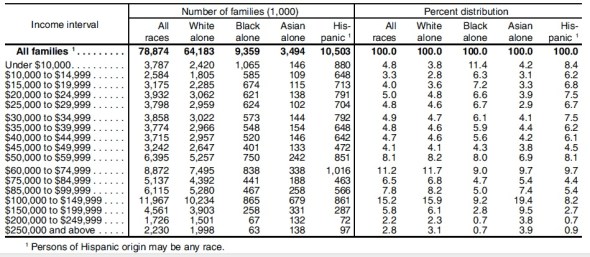
Let’s put those survey results in context by using the 2011 Statistical Abstract. I’m going to cut and paste the income distribution table for you. It’s for U.S. families in 2009 stated in 2008 dollars. Okay, so look down there at the percentage of families that make more than $250,000 a year. It’s more than it was a few years ago, but it’s still less than 3% for every one and 4% for whites and Asians. Black and Hispanic families that earn that much are less than 1% of their entire demographic.
Here’s a slightly broader view of income distribution from the same source.
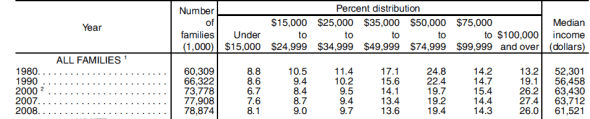
You can see that about 74% of US families don’t even clear $100,000 annually given the median income is $61,521. That’s a skewed distribution if there ever was one. I think the skewed distributions leads to some pretty skewed perspectives too.
I’m reminded of this little news item from one of my state’s Congressman whose math was fuzzy and priorities reflect that of some one whose not worried about the normal things in life. I’m still trying to figure out exactly what he pays the employees at his Subway Shops in Northwest Louisiana given the numbers he provides. As best I can figure, it’s about $12,000 a year. If he feels so put out and poor with an annual income of $400,000 a year that I wonder whatever do his charitable contributions look like?
Taking up the typical GOP talking point, Fleming said raising taxes on wealthy “job creators” is a terrible idea that kills jobs because many of these people are small business owners who pay taxes through personal income rates. Fleming is himself a businesses owner, so Jansing asked, “If you have to pay more in taxes, you would get rid of some of those employees?” Fleming responded by saying that while his businesses made $6.3 million last year, after you “pay 500 employees, you pay rent, you pay equipment, and food,” his profits “a mere fraction of that” — “by the time I feed my family, I have maybe $400,000 left over.”
All of this puts me in mind of F Scott Fitzgerald who was the chronicler of the wealthy point of view during the Gilded Age.
Let me tell you about the very rich. They are different from you and me. They possess and enjoy early, and it does something to them, makes them soft where we are hard, and cynical where we are trustful, in a way that, unless you were born rich, it is very difficult to understand. They think, deep in their hearts, that they are better than we are because we had to discover the compensations and refuges of life for ourselves. Even when they enter deep into our world or sink below us, they still think that they are better than we are. They are different.
F. SCOTT FITZGERALD writes in “The Rich Boy” in 1926
This is the stuff that makes Elizabeth Warren’s video on the stump the other day go viral. This isn’t class warfare. I don’t think there’s an awful lot of people that truly begrudge folks their wealth. Speaking only for myself, I don’t want to have my sense of perspective or priorities that warped any more and am happy when ends meet. I think people only want to feel like they have a decent living and that people that have more than that should pull their own weight and not make these weirdish justifications for wealth that most folks just plain don’t get. Back to the article by the poor little rich boy.
Taxes on the rich are taxes on people who create jobs. And jobs are an unalloyed good thing for an economy. Excessively taxing the capital that makes the economy go is poor public policy. And we have a recent example of how the opposite works well: Unemployment declined by a third in the four years after the Bush tax cuts were fully implemented in 2003, dropping to 4.2 percent from 6.2 percent. Meanwhile, federal revenue increased 44 percent in those years. If these tax cuts put people to work and generated money for the government, shouldn’t Obama consider the possibility that tax increases should be avoided?
Most of this analysis is incredibly disingenuous because it fails to mention that the country was coming out of a recession and a severe macro shock from 9/11. It wasn’t the fiscal policies that did these things at all. Plus, these were the early warning signs of Allan Greenspan blowing a housing bubble and a construction and financing boom about to crash the economy. Economists don’t like to see the rate of unemployment fall significantly below its natural rate. It means the government is doing WAY too much and will probably create some kind of inflation and the economic activity won’t be sustainable. All that war and anti terrorism spending overheated the economy.
The argument of capital gains cuts = job creations is the core argument here that I will never understand from a simple common sense view. That doesn’t even count all that book learning views from the degrees and the doctorate in Financial Economics that sets off alarms in my brain. These were tax cuts that subsidized excessive speculation. The argument that values hoarded wealth over hard work and says that all that money floating around financial markets does is create jobs is a false one.
The deal is this. It’s one thing to put your money into a business like a small or medium sized business owner does but that money is counted as regular income. That is job creating but it has nothing to do with capital gains taxes. Second, if you do buy stock in GE and you put in there for years on end and others do the same then, yes, that’s basically a good source of funding for a business and that resembles business ownership albeit a very detached one. Possibly, you could reward the buy and hold investor but a huge amount of market activity is not buy and hold unless you’re an institution. Also, why does putting your money in a bank and collecting interest– because bank deposits get pooled and loaned to businesses–not get the same treatment? My thought is that it’s because it’s the middle class way of holding wealth and the view is that it is inferior income like wages and salaries. Interest income gets taxed like work income. But, AND MOST OF ALL, how are day traders who bop in and out of investments daily, speculating away on stuff, buying exotic derivatives that have nothing to do with the underlying business create jobs, value or anything else worthy of the label job creators and why do they deserve special tax treatment? Are you prepared to tell me that this form of speculation creates more jobs than say, the gambling casinos on the strip in Las Vegas? At least we can point to cocktail waitresses, bartenders and dealers in Las Vegas style gambling.
A lot of money income that comes from capital gains is just another form of gambling income. It isn’t there long enough to encourage businesses to make long term decisions that would actually help the economy. The only thing it really does is make CEOs short-sighted by forcing them to focus on short term stock prices so they invariably don’t invest in positive net present value projects which means no attendant jobs. That’s what the research says. So, Gordon’s thinking is as fuzzy as gee, since I only get $400,000 a year, I guess I’ll just have to get rid of a few people that are doing the work for me that I pay only $12,000 a year. The “bringing liquidity to the market” isn’t really a great rationalization here either because the wham bam thank you approach of speculators these days doesn’t offset the increased risk and price volatility they bring to markets. They screw up the pricing mechanism when they do all that momentum trading. Recent gas prices and house prices are good examples of speculation gone wild. Also, riddle me this. What value do hedge fund managers bring to the table when they bet against US businesses and the US government? Why do they get special tax treatment for that? What jobs does that create? I’m not reading specifics on those things at all in Gordon’s blessed are the millionaires for they are the job creators spiel. Why subsidize this behavior and these extraordinarily rich people?
So, I’m not in any way shape or form saying that millionaires are bad or evil or whatever the nasty implications are that underlie the class war charge. What I’m saying is that there’s a difference in your perspective when you’ve got hungry kids than some one is whining they can’t make it on $400,000 a year. I don’t think we need articles lecturing us on the proper perspective we should take on millionaires. I think a few millionaires need to develop a different perspective on reality and life and quit whining when some one asks them to pay for the roads they drive on, support the schools they attended, pay for the protection provided by soldiers, cops, and firefighters, and basically pull their fair share of the load of living in a civilized society.
Markets (e.g. Herds of PEOPLE) aren’t very Rational a Lot of the Time
Posted: September 24, 2011 Filed under: Economy, Equity Markets | Tags: behavioral economics, behavioral finance, rational markets 7 Comments
The Confidence Fairy is coming for your Savings!!!
One of the primary reasons I didn’t do an investments specialization for my PHD in financial economics is the overwhelming and pervasive group think on Rational Expectations or what’s called the Efficient Market Hypothesis. I’ve never really bought into this. I think it is more an occasional circumstance or specific market behavior at that point when everything is going just dandy which is why I am more the sunspot equilibrium type. I never found compelling reasons for the efficient markets view to be considered an overarching framework for all circumstances. That kind of unorthodox outlook doesn’t buy you much print space in finance journals which means no tenure for you cupcake!! (Although for some reason I can get it passed reviewers when it’s couched in the term “bubble” which is so very sunspot.)
Economists have become a little more accepting of the warts and faults inherent in the hypothesis–notice it is still a hypothesis and not a theory–but finance people still have a tendency to worship at its alter. Economists started out as philosopher social scientists–which is also why the big money is in finance–so they’re a little more open to the idea that markets aren’t all that efficient all the time. I linked to the Wikipedia explanation of the idea for you which is adequate for our purposes. The deal is when you build rational expectations into an economics model or investment model this is what you assume.
To assume rational expectations is to assume that agents‘ expectations may be individually wrong, but are correct on average. In other words, although the future is not fully predictable, agents’ expectations are assumed not to be systematically biased and use all relevant information in forming expectations of economic variables.
This basically rules out wrong group think that won’t deny “relevant information”. If that was the case in reality, there would be no holocaust deniers, evolution deniers, climate change deniers, or flat earthers of substantial numbers to influence the average. Basically, we’d have to accept the “average” rationality of today’s Republican Party and given the existence, electability and popularity of Rick Santorum, Michelle Bachmann, and Ron Paul, I’ll rest my case and reject that. We have a major political party that’s basically a cult of irrationality these days.
There are two really important real life phenomenon that make that assumption look really bad in finance research. One is a little paradox called the Home Bias Puzzle where research has basically shown that most people will still buy investments from their own country despite the availability of better deals abroad. The second is momentum. This is the pack animal behavior in the market where you see something hit the market and suddenly every one is moving that direction when it doesn’t make much sense on a fundamentals level. This is when I sell all my stock holdings. The little voice inside of me will go: “wtf is this rally for? The economy isn’t all that great! I think I better get out of here before they realize they’re all on something!” This is how I’ve managed to remove my “ass”ets and avoid the major crashes since way back in the 1980s.
Whenever you get a financial crises or financial bubbles, you tend to get the panicked cow phenomenon in that if one is spooked the rest chase wildly along. They’ve even programed this behavior into their computers oddly enough. Oh, and btw, none of the strategies and no market guru like Cramer or Buffet or Jesus your neighborhood grocer could ever be right and beat the market consistently if the financial markets were truly rational and efficient. That’s another story, just accept my word for it right now.
I took an Advanced Investments Seminar because I had to for my final elective having no other choice and was subjected the entire semester to the work of Eugene Fama whose big fat head will be in Denver with me next month. Fama is considered the father of modern finance and efficient markets is his dogma. He’s one of the jerks that was drinking the two overly expensive bottles of wine with Paul Ryan that BB wrote about awhile back. The other jerk being his son in law John Cochrane whose asset pricing models always assume the same efficient markets hypothesis. The two of them have dominated finance for decades now and in my mind it’s held the entire field back and caused much damage in the real world. I had to recreate the research in many of Fama’s seminal papers and the most noticeable lunacy to me was how his data sets back then always skipped the Great Depression Era. His data sets usually involved equity market indices like the Dow Jones average during periods that excluded financial panics. That never struck me as honest, but then, I’m not one of the Finance gods–there really are no goddesses–and so I don’t really get a say.
Again, I don’t want to teach this stuff so I generally avoid classes where the textbooks ooze it. I inherited the sincerity gene from my father which causes me to go apostate on my students which may help their critical thinking skills but won’t further the ass-kissing group think skills required in today’s finance jobs. Also, I’m late to academic life and spent the 80s doing hedging, forecasting interest rates, pricing financial assets and liabilities, and generally surrounded by rational senior management thoughts like: “Gee, we’ll get bigger if we do this merger and I’ll get a bonus! Who cares if it drags our income and balance sheet into the depths of hell?” I can also give you examples from the 90s too. Irrational market decisions ooze from marketing divisions and departments daily.
So, behavioral finance and economics looks at the herd mentality that was originally identified as “animal spirits” by J.M. Keynes during the time period and stock market behavior that Eugene Fama likes to systematically ignore. Keynes didn’t have the luxury of skipping over the data of the Great Depression. The kind of apostate philosophy that drives me actually has a label and basically looks at decision making under risky and generally unpredictable situations. In a lot of cases, people don’t make decisions in these circumstances rationally. BB and I have been having some phone conversations about the topic because as a psychologist, she’s very interested in human behavior. Human behavior very much causes people to do different things under times of risk. Let’s face it, people and hence markets aren’t very rational a lot of the time when they’re panicked about losing their jobs, their businesses, their homes, and their savings. They’re a lot more efficient, rational decision makers when circumstances are not risky and unpredictable or when the biggest decision variables are messy and not well understood. Then, there’s the existence of powerful “deciders” who think their egos have a better understanding of alchemy than their necromancers and are on the look out for narratives to reinforce their beliefs. Remember the word narrative because it plays a big role here in where I’m going and where Robert J. Shiller went.
So, this background chat brings me to the topic of this blog post which is a project syndicate article by Robert J. Shiller who is a very well respected economist and dabbles in behavioral economics. He is well known for the Case-Shiller index which measures activity in the housing market in some key markets. (BTW, Case is a big sunspot equilibrium sort as is Douglas Diamond who the Republicans ran out of the District earlier this year.) I’ve taught out of his textbooks. He teaches at Yale and co-authored a book with Nobel Prize winning George “market for lemons” Akerlof called “Animal Spirits: How Human Psychology Drives the Economy and Why It Matters for Global Capitalism.”. His voice is important in this day and age of people chasing confidence fairies and reacting to events here and in Europe rather irrationally which frequently happens during periods of great uncertainty and increased risk.
I’m consistently amazed at the success of the narrative that Republicans have managed to push into the national psyche that we’re over taxed and that our national debt is horrendous as its never been before and that our children and grand children will be crushed by it. You even hear President Obama spew the stuff and he should know better given his ability to access any of the aforementioned economists by phone easily. As I’ve said before with the use of data and nifty graphs, the debt was far worse after World War 2, the tax rates far higher and none of us or the US economy was the worse for it. Really, would you have rather they not borrowed money to fight World War 2 and lived with those results instead? We had nothing but debt when started out as a country and also after the Civil War. As long as you have lots of really high quality assets and people and the power to tax and print money, it’s NO BIG DEAL! Greece does not have Bill Gates and Microsoft continually pumping out huge amounts of value. We have him and lots more like them! People have been reacting to ideological nonsense and narratives. We have a failure of governance and policy because of this. That’s hardly rational. It’s also causing bad effects in our home prices, the value of our savings, and our ability get and keep jobs.
So, here’s Shiller writing on “The Great Debt Scare” about how this ideological nonsense has shaken consumer confidence in both Europe and the U.S. causing a “perverse dynamic” that has been discouraging consumption and investment which has brought about economic weakness. What this basically shows is that the psychology of self-fulfilling prophecies is alive and well in financial markets. Rational Markets my swamp people ass!
We now have a daily index for the US, the Gallup Economic Confidence Index, so we can pinpoint changes in confidence over time. The Gallup Index dropped sharply between the first week of July and the first week of August – the period when US political leaders worried everyone that they would be unable to raise the federal government’s debt ceiling and prevent the US from defaulting on August 2. The story played out in the news media every day. August 2 came and went, with no default, but, three days later, a Friday, Standard & Poor’s lowered its rating on long-term US debt from AAA to AA+. The following Monday, the S&P 500 dropped almost 7%.
Apparently, the specter of government deadlock causing a humiliating default suddenly made the US resemble the European countries that really are teetering on the brink. Europe’s story became America’s story.
There is something—most likely hard wired–in people that creates highly irrational narratives ( we call them frames) to justify stuff that occurs even in the face of incredible evidence against the frame. It’s why there are so many evolution and climate change deniers. The narrative makes them feel better than the reality. We all edit out the data coming from those periods of intense irrationality–like Fama did with the Great Depression–to justify our pet juicy rationalizations. It’s like the post-trauma narrative you create to justify something you did when your lizard brain kicked in. Republican and so called conservative operatives seem to thrive on spinning lizard brain activity into parable like narratives to hone their advantage.
Changes in public confidence are built upon such narratives, because the human mind is very receptive to them, particularly human-interest stories. The story of a possible US default is resonant in precisely this way, implicating as it does America’s sense of pride, fragile world dominance, and political upheavals.
Indeed, this is arguably a more captivating story than was the most intense moment of the financial crisis, in 2008, when Lehman Brothers collapsed. The drop in the Gallup Economic Confidence Index was sharper in July 2011 than it was in 2008, although the index has not yet fallen to a lower level than it reached then.
So, what do these current confidence surveys tell us according to Shiller?
The timing and substance of these consumer-survey results suggest that our fundamental outlook about the economy, at the level of the average person, is closely bound up with stories of excessive borrowing, loss of governmental and personal responsibility, and a sense that matters are beyond control. That kind of loss of confidence may well last for years.
That said, the economic outlook can never be fully analyzed with conventional statistical models, for it may hinge on something that such models do not include: our finding some way to replace one narrative – currently a tale of out-of-control debt – with a more inspiring story.
So after our lizard brain causes fight or flight, the Captain Picard part of our brain tells us to make our narratives so. What we are building into our psyche is not any kind of analysis based on rational views of historical data, economic theory, or for that matter, common sense. What we are building into our psyche is a narrative that isn’t very rational and that’s impacting our behavior and the behavior of markets. Now, if we could just stop the press from reinforcing all the irrational crap out and about these days maybe we could sit down, take a few deep breaths, and peel back the layers of skin on the onion of those destructive narratives. Think about it. Yes, the Garden of Eden story is a great narrative, but what explains the carbon dating data on rocks, the dinosaur bones, and the vast existence of several varieties of protohumans’ remains better? Dinosaurs and Neanderthals in the Garden of Eden with Adam and Eve (not Steve or Lilith) or the Big Bang THEORY and the THEORY of evolution? What explains the financial crisis and the fallout better? The narrative that it’s too much government debt, too high taxes, and too much regulation that were all at much lower levels now than after the World War 2 economic boom or excessive speculation in the markets and exotic, difficult to price, unregulated derivatives, NINJA loans, government encouragement of monopoly and oligopoly power, and fiscal policy known to suppress economic growth? Your choice. Theory or comforting bed time tale.
Friday Night Festivities: Celebrating “The Little Blog That Could”
Posted: September 23, 2011 Filed under: The Little Blog that could | Tags: Technorati authority, The Little Blog that Could, Top 100 blogs, US Politics 52 Comments
Can you believe it has been almost a year since Dakinikat turned her blog from a file cabinet into “The Little Blog that Could” and invited all of us to join her? We’ve had some ups and downs, but generally speaking we’ve done pretty well for a small startup blog. We’re so grateful for all the people who stop by here to read and comment on our posts. We really put our heart and soul into keeping this place going, because we love to write and talk about politics!
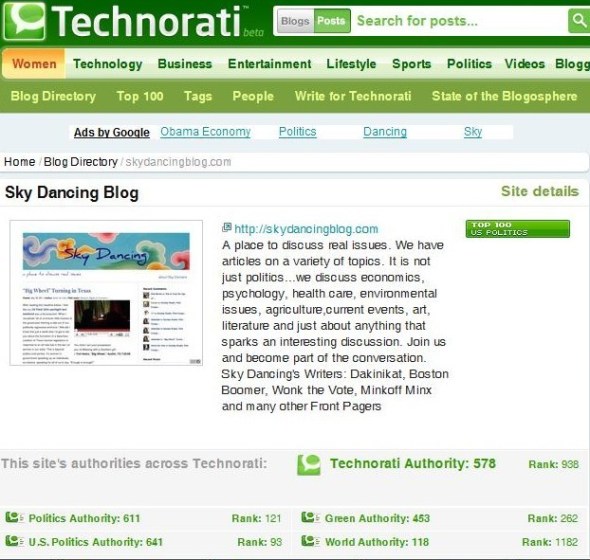
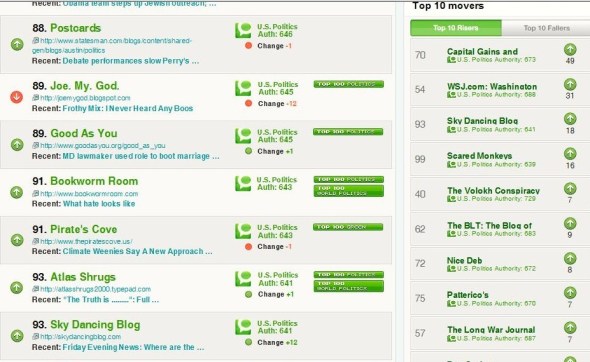
It’s not quite our first anniversary yet–that will come towards the end of next month. But today we do have something to celebrate. Sky Dancing’s Technorati authority has been moving up steadily for the past several weeks, and today we made it into the Top 100 U.S. Politics blogs! I took some screenshots, because we could fall off the list tomorrow. But right now, we are ranked #93.
We are also on the Top Ten Movers list, meaning that we’ve gone up pretty quickly lately.
Please forgive us for a little immodesty, but we’ve worked really hard to keep new content up every day a few times a day. And besides, we owe any success we have had to you! So please celebrate with us. I hope this isn’t too corny…

 peej
peej Carissa
 bostonboomer
 dakinikat
 ecocatwoman
 mablue2
 Mama Lopez
 peggysue22
 quixote
 skydancingguestblogger
 Mona (aka Wonk the Vote)



 Sky Dancing
Recent Comments