
Forget giving away the store — Obama is handing the store to Republicans and inviting them to burn it down.
Posted: July 5, 2011 Filed under: income inequality, Medicare, Psychopaths in charge, Republican politics, Surreality, Team Obama, The Great Recession, The Media SUCKS, the villagers, U.S. Economy, U.S. Politics, voodoo economics, We are so F'd | Tags: Barack Obama, crashing the economy, draconian spending cuts, economy, Great Depression, Health care, Medicaid, medicare, Republicans 22 Comments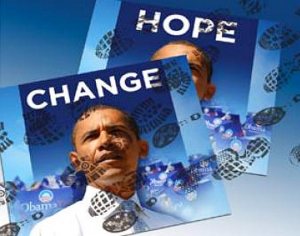
Please read this shocking story at The New York Times — there’s no way for me to excerpt all the important parts.
Obama administration officials are offering to cut tens of billions of dollars from Medicare and Medicaid in negotiations to reduce the federal budget deficit, but the depth of the cuts depends on whether Republicans are willing to accept any increases in tax revenues.
Administration officials and Republican negotiators say the money can be taken from health care providers like hospitals and nursing homes without directly imposing new costs on needy beneficiaries or radically restructuring either program.
What this really means is that more doctors and hospitals will refuse to accept Medicare and Medicaid patients, and nursing homes will turn away frail elderly patients who can’t pay out of pocket–because Medicaid will no longer be able to assist those who are poor or have already spent their life savings on health care.
“Congress smells blood,” said William L. Minnix Jr., the chief lobbyist for nonprofit nursing homes.
Mr. Minnix, the president of a trade group known as LeadingAge, is urging nursing homes to “bombard your senators with the message that Medicaid cannot be cut by $100 billion” over 10 years, as President Obama and many Republican lawmakers have suggested.
A coalition of hospital lobbyists, worried about the direction of the budget talks, has begun a national advertising campaign to block further cuts in the two health care programs, which account for about 55 percent of hospital revenues. The hospitals have made a commitment to spend up to $1 million a week through August on television, print and online advertising.
Now check this out: Chuck Schumer, supposedly a Democrat, is quoted in the article as saying, “We are very willing to entertain savings in Medicare. Medicare gives very good health care very inefficiently.”
Really? Medicare has almost no overhead, and it pays way below the going rate for health care services. That’s why so few private doctors accept Medicare patients right now.
Now think about what Dakinikat has told us about the dangers of cutting federal spending and read this:
Medicare and Medicaid insure more than 100 million people, account for 23 percent of all federal spending and are likely to be an important part of any budget deal. Military spending, which accounts for about 20 percent of federal expenditures, is likely to be included as well.
President Obama and his Republican pals are on a mission to bring down the American economy and bring on a repeat of the Great Depression. Can anything or anyone stop them? We need riots in the streets, but can elderly people do it alone?
Tuesday Reads: Voodoo Economics, Whistleblowing, Torture, and Violence against Women and Children
Posted: July 5, 2011 Filed under: morning reads, psychology, Republican politics, Team Obama, The Media SUCKS, the villagers, torture, U.S. Economy, U.S. Military, U.S. Politics, Violence against women, voodoo economics, Wikileaks | Tags: Bloomington, Bradley Manning, Casey Anthony, child abuse, child sexual abuse, CIA black sites, George Anthony, Indiana, Indiana University, Lauren Spierer, Torture, Wikileaks 26 Comments
Coffe and Morning News, by Tim Nyberg
Good Morning!!! Gee, that title doesn’t look so cheery, does it? Sorry, but please read on. Since we just ended a long holiday weekend, there’s not a whole lot of news happening, but I located a few interesting reads for you.
Dakinikat has been hammering away at the lack of economic knowledge in the media and in our government. Yesterday, she pointed me to this great piece by Mark Thoma in which he once again explained what actually caused the economic meltdown and why our “leaders” are doing the wrong things to help the economy recover.
I’ve written about this so much it’s hard to muster the will to take it on yet again, especially with the attitude it deserves, and I liked the second column better. But with David Brooks, George Will, and a new book by Gretchen Morgenson and Josh Rosner recently pushing the idea that Fannie, Freddie, and Democrats caused the financial crisis it’s important to push back. The right is very good at repeating their story line over and over and over, and if that redundancy goes unmatched — if they are allowed to have the last word many, many times over — they stand a good chance of capturing the narrative.
Actually, they’ve already “captured the narrative,” and President Obama has bought into it too. I don’t know if I can excerpt this piece, you really need to read the whole thing. But here’s just a bit:
…the targets for home ownership that supposedly led to Fannie and Freddie’s aggressive entry into subprime markets were set in 1992. If these targets were the problem, why didn’t the crisis occur sooner?
….if Fannie and Freddie had never existed, securitization would have likely happened anyway. As Barry Ritholtz notes, “securitized credit card receivables, auto loans, small biz loans, etc. took place without GSEs. I assume there would likely have been a private sector version for conforming loans, the way there was a private sector securitizing response to the demand for non-conforming (sub-prime) loans.”
The bottom line is that the case that the CRA, Fannie, and Freddie – and by implication Democrats supporting these institutions – were key players in the crisis is at odds with the evidence. Don’t get me wrong, there are lots for reasons to be concerned about Fannie and Freddie, and I’m not trying to defend them or their choices, but the idea that support of these institutions caused the financial crisis is wrong.
Hey, I’ve said this till I’m blue in the face, but I’ll say it again. We needed to put a Democrat in the White House in 2008.
Paul Krugman is also lamenting the economic ignorance in high places.
Watching the evolution of economic discussion in Washington over the past couple of years has been a disheartening experience. Month by month, the discourse has gotten more primitive; with stunning speed, the lessons of the 2008 financial crisis have been forgotten, and the very ideas that got us into the crisis — regulation is always bad, what’s good for the bankers is good for America, tax cuts are the universal elixir — have regained their hold.
And now trickle-down economics — specifically, the idea that anything that increases corporate profits is good for the economy — is making a comeback.
On the face of it, this seems bizarre. Over the last two years profits have soared while unemployment has remained disastrously high. Why should anyone believe that handing even more money to corporations, no strings attached, would lead to faster job creation?
Nonetheless, trickle-down is clearly on the ascendant — and even some Democrats are buying into it.
Once again, if we had put a Democrat in the White House in 2008, perhaps things would be different….
Via Kevin Drum, this article about NJ Governor Chris Christie contains some priceless quotes from NJ Senate President Stephen Sweeney.
Senate President Stephen Sweeney went to bed furious Thursday night after reviewing the governor’s line-item veto of the state budget. He woke up Friday morning even angrier.
“This is all about him being a bully and a punk,” he said in an interview Friday. “I wanted to punch him in his head.”
Sweeney had just risked his political neck to support the governor’s pension and health reform, and his reward was a slap across the face. The governor’s budget was a brusque rejection of every Democratic move, and Sweeney couldn’t even get an audience with the governor to discuss it.
“You know who he reminds me of?” Sweeney says. “Mr. Potter from ‘It’s a Wonderful Life,’ the mean old bastard who screws everybody”….The governor’s budget, he says, is full of vindictive cuts designed to punish Democrats, and anyone else who dared to defy him. And he is furious that the governor refused to talk to him during the final week….“He’s mean-spirited,” Sweeney said in the Friday interview. “He’s angry. If you don’t do what he says, I liken it to being spoiled, I’m going to get my way, or else.” And: “He’s a rotten prick.”
Jeeze, why doesn’t he tell us how he really feels?
Glenn Greenwald has a great post up about Bradley Manning’s motives for whistleblowing, drawn from some recently released “chat logs and other on-line communications” between Manning and another young man. The information was published in New York Magazine in an attempt to make Manning look psychologically troubled, but Greenwald reads the information differently. Here’s how Manning responded when asked what he was trying to accomplish:
hopefully worldwide discussion, debates, and reforms – if not, than [sic] we’re doomed – as a species – i will officially give up on the society we have if nothing happens – the reaction to the [Collateral Murder] video gave me immense hope; CNN’s iReport was overwhelmed; Twitter exploded – people who saw, knew there was something wrong . . . Washington Post sat on the video… David Finkel acquired a copy while embedded out here. . . . – i want people to see the truth… regardless of who they are… because without information, you cannot make informed decisions as a public.
Greenwald goes on to argue that many of Manning’s goals have actually been achieved. He made a difference, and that’s why our government is persecuting him.
At Danger Room there’s a very interesting review of a new book by former CIA operative Glenn Carle. The memoir tells the story of a CIA “black site” and a supposed senior al-Qaida operative that Carle was assigned to break. Eventually, Carle realized the man was innocent.
Uneasy with the CIA’s new, relaxed rules for questioning, which allow him to torture, Carle instead tries to build a rapport with the man he calls CAPTUS. But CAPTUS doesn’t divulge the al-Qaida plans the CIA suspects him of knowing. So the agency sends him to “Hotel California” — an unacknowledged prison, beyond the reach of the Red Cross or international law….
Carle provides the first detailed description of a so-called “black site.” At an isolated “discretely guarded, unremarkable” facility in an undisclosed foreign country (though one where the Soviets once operated), hidden CIA interrogators work endless hours while heavy metal blasts captives’ eardrums and disrupts their sleep schedules. But Carle — codename: REDEMPTOR — comes to believe CAPTUS is innocent….
“We had destroyed the man’s life based on an error,” he writes. But the black site is a bureaucratic hell: CAPTUS’ reluctance to tell CIA what it wants to hear makes the far-off agency headquarters more determined to torture him. Carle’s resistance, shared by some at Hotel California, makes him suspect. He leaves CAPTUS in the black site after 10 intense days, questioning whether his psychological manipulation of CAPTUS made him, ultimately, a torturer himself. Eight years later, the CIA unceremoniously released CAPTUS.
The jury has begun deliberations in the Casey Anthony case. I have continued to watch the trial closely and listened to all of the closing statements.
I know I’ll probably get yelled at for saying this, but if I were on the jury, I would have to go with one of the lesser charges, because there just isn’t any evidence to show how the child was killed. I do believe Casey Anthony should go to prison for a long time, but this trial has turned into a witch hunt.
If a man had done what Anthony did, there would never have been this much publicity and this amount of rage against the perpetrator. I shouldn’t have to point out that both men and women kill their children every day in this country. Both women and children are devalued in this country, and they are routinely abused and murdered. There are a number of reasons why this woman has been treated differently, but what she did is far from unique.
I honestly think Casey’s father George was involved with the disposal of the body at least. What motive did he have? I’ll tell you. George and Cindy Anthony thought the father of the child could have been either George or Casey’s brother Lee. I am convinced there was sexual abuse in that family. I can’t see how Casey could have become what she is without severe abuse. JMHO, based on personal experience and serious study of the effects of child sexual abuse.
Until we get serious about protecting children in this country, children will continue to die at the hands of their parents and other caregivers.
There is some possible news in the other case I’ve been following–the young Indiana University student who disappeared about four weeks ago, Lauren Spierer. The body of a woman has been found in a creek in Indianapolis. There are a couple of other missing women in Indiana, so it’s not clear this is Spierer. I just have a feeling it might be.
Police investigating the disappearance of Indiana University student Lauren Spierer are awaiting the results of an autopsy Tuesday of a decomposed female body found Sunday on the northeast side of Indianapolis.
The body, found a month after the Edgemont, N.Y., native went missing, had not been identified as of Monday night, and Bloomington, Ind., police have given no indication whether it may be her.
Spierer disappeared after a night when she had told her boyfriend she wanted to stay home. There are reports that they had had a fight. After midnight, she went out with some male friends, spent some time with them watching TV and then went with one of the young men to popular local bar. When she returned to her apartment with him, a group of men (possibly friends of her boyfriend) accosted them and punched her companion in the face.
The two then left and supposedly went to this young man’s apartment where he passed out. She then went to another apartment where another male friend lived. This man claims to have seen her leave his place at 4:30AM and turn the corner on her way home, but there is no independent confirmation of that.
At first this was investigated as a stranger abduction, but Spierer’s “friends” have all clammed up, and several have refused to talk to police and have retained lawyers. Most of them, including the boyfriend and the last guy to see Spirer, hightailed it out of town almost immediately. So now it looks like something bad happened to Spierer that night and these “friends” know something.
Since I grew up in Indiana and my sister lives in Bloomington, I’ve been following this case pretty closely. But women “disappear” every day too. Why do Americans tolerate it? Why do so many Americans seem to see the pervasive violence against women in this country as somehow normal?
That’s all I’ve got for today. What are you reading and blogging about?
Dumbed Down America
Posted: July 4, 2011 Filed under: U.S. Economy, U.S. Politics, We are so F'd | Tags: Calvin and Hobbs, Declaration of Independence, Fourth of July, History, ignorance, Marist poll 28 Comments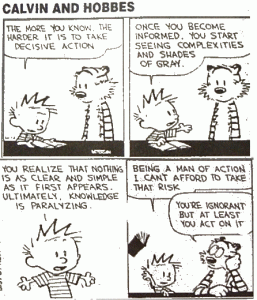
Time to bring back civics classes. Nearly a quarter of Americans don’t know when the Declaration of Independence was signed, or what country we declared independence from. From ABC’s The Note:
A Marist poll released Friday shows that only 58 percent of Americans know when the country declared independence. Nearly a fourth of respondents said they were unsure and sixteen percent said a date other than 1776, when the Declaration of Independence was signed.
Young people posted the most troubling scores with 41 percent of people ages 18 to 29 saying they were unsure when the Declaration of Independence was signed and 27 percent saying the wrong date.
One in four Americans do not even know which country the U.S. gained independence from. The correct answer, of course, is Great Britain, although 20 percent of respondents were unsure of that fact.
Again, age made a big difference. Middle-aged Americans – ages 30 to 44 – guessed the wrong country more than any other age group, or 10 percent of the time. The younger generation was less likely to be flat-out wrong, but was more likely to be unsure. About one third of Americans age 18 to 29 said they didn’t know for sure which country America won independence from.
That is so sad. I was just thinking this morning that I can remember the days when we were proud to be Americans–when it was important to know our history and be aware of our rights. What happened? That was before American culture became synonymous with corporate culture–before being greedy, selfish, and callous became the American way.
The final changeover happened under Ronald Reagan. That is when so many Americans bought into the notion that money was more important than human relationships, when “religious” people began to embrace “prosperity” rather than the old, outdated notions of “faith, hope, and charity (love).” Under Reagan, young people stopped preparing for careers in which they could help others or the society as a whole and started focusing on whatever job would bring in the most money.
Barack Obama came of age under Reagan, and as far as I can tell, although he calls himself a Democrat, the current occupant of the White House is totally sold on the Reagan philosophy. He doesn’t seem to know much about history or basic economics, even though he has degrees from two elite universities.
Not only is civics missing from high schools, but also Americans don’t get educated by the media anymore. When I was a kid, there were actually serious shows on TV that analyzed politics–not shouting, arguing shows, but real news shows. Today young people are watching TV shows like “Hoarders” and “Jersey Shore.” I’m next generation will learn to be even more greedy, selfish, and narcissistic than previous generations. I hope I’m wrong.
I know I sound like a bitter old woman–sorry about that. I grew up in the ’50s and ’60s, a time of great social change; but looking back now, it was a much simpler time. My generation has been called every insulting name in the book–selfish, narcissistic, rebellious. Tom Wolfe labeled us “the me generation” for looking within and seeking ways to become more awake and aware–for trying to understand human consciousness and for going into therapy.
Am I just doing what Tom Wolfe did–judging and misunderstanding the generations that came after mine? Please tell me I’m wrong!
Independence Day Reads
Posted: July 4, 2011 Filed under: Bailout Blues, Domestic Policy, Economy, Foreign Affairs, Global Financial Crisis, Greece, investment banking, morning reads | Tags: Bill Clinton, Budget Deficit, debt limit, Fukushima, Greek Debt Crisis, John McCain, nuclear crisis, shadow banking industry, SIVs, taxes 16 Comments Happy Independence Day!
We have a republic and a lot of people have sacrificed a lot over the last several centuries to keep it. Too bad most of our politicians aren’t in that number. They can’t see past their next elections.
It seems that two senators– McCain and Corynyn–say they’re open to tax increases as a way to solve the budget stand off. Guess there are a few of them left that would prefer not to tank our economy. Let’s hope this starts some real negotiations instead of the usual Republican hostage taking and Democratic cave-in that’s been politics as usual the last dozen years or so.
One of the senators, John Cornyn of Texas, said he would consider eliminating some tax breaks and corporate subsidies in the context of changes in the tax code, provided there was not an overall increase in taxes.
“I think it’s clear that the Republicans are opposed to any tax hikes, particularly during a fragile economic recovery,” Mr. Cornyn said on “Fox News Sunday.” “Now, do we believe tax reform is necessary? I would say absolutely.”
But he insisted that any changes in taxes be “revenue neutral,” meaning that the government would not take in any more money from individuals or businesses than it does now.
The other senator, John McCain of Arizona, said he would be willing to consider some “revenue raisers” as part of a broad deal, but he refused to name specific measures.
Mr. Cornyn, a member of the Senate leadership, also said that Republicans would be open to a short-term deal on the debt ceiling to provide more time for a comprehensive agreement.
Let’s also hope that more reasonable and less ideological heads prevail on the right and that the left stands up for what’s right for a change. Former President Clinton had a words of policy advice over the weekend. His advice to President Obama is “not to blink”.
Former President Bill Clinton Saturday night urged President Obama not to “blink” at Republican demands to exclude revenue increases from any agreement to extend the government’s debt ceiling.
If Republicans maintain their opposition to revenue increases, Clinton said, Obama should pursue a short-term deal to extend the debt ceiling based on spending cuts both sides have already accepted in the negotiations between the administration and Congressional leaders from both parties.
“I hope they will make a mini-deal,” Clinton said in an interview conducted with him at the Aspen Ideas Festival here.
The White House and Congressional negotiators from both parties are attempting to assemble a deficit reduction package that could win support in Congress for legislation to extend the nation’s debt ceiling, which the Treasury says the government will reach on August 2. The talks have foundered amid demands from Congressional Republicans to exclude any revenue increases from that prospective deficit reduction package.
Asked what the administration could do if GOP leaders hold to that posture, Clinton replied: “First the White House could blink. I hope that won’t happen. I don’t think they should blink.”
If Republicans will not accept revenues in a package to lift the debt ceiling by August 2, Clinton said, Obama should pursue a short-term agreement based on the spending reductions both sides have already accepted.
“There are some spending cuts they agree on …and he can take those and [get] an extension of the debt ceiling for six or eight months,” Clinton said.
Clinton also called on a package of reforms to US tax policy that includes a corporate tax cut if special interest tax loops are closed. This is something Obama has also supported.
“It made sense when I did it. It doesn’t make sense anymore – we’ve got an uncompetitive rate. We tax at 35 percent of income, although we only take about 23 percent. So, we SHOULD cut the rate to 25 percent, or whatever’s competitive, and eliminate a lot of the deductions so that we still get a FAIR amount, and there’s not so much variance in what the corporations pay. But how can they do that by Aug. 2?”
Clinton also said Grover Norquist, who as president of Americans for Tax Reform is the GOP’s unofficial enforcer of no-new-taxes pledges, has a “chilling” hold on the nation’s lawmaking.
The former president said it has seemed like Republicans need any revenue concessions need to be “approved in advance by Grover Norquist.”
“You’re laughing,” he told the crowd of 800. “But he was quoted in the paper the other day saying he gave Republican senators PERMISSION … on getting rid of the ethanol subsidies. I thought, ‘My GOD, what has this country come to when one person has to give you permission to do what’s best for the country.’ It was chilling.
There’s an extremely interesting piece at The Atlantic Wire on “What Really Happened at Fukushima”. It includes interviews with workers that have been inside the crippled nuclear plant.
Throughout the months of lies and misinformation, one story has stuck: “The earthquake knocked out the plant’s electric power, halting cooling to its reactors,” as the government spokesman Yukio Edano said at a March 15 press conference in Tokyo. The story, which has been repeated again and again, boils down to this: “after the earthquake, the tsunami – a unique, unforeseeable [the Japanese word is soteigai] event – then washed out the plant’s back-up generators, shutting down all cooling and starting the chain of events that would cause the world’s first triple meltdown to occur.”
But what if recirculation pipes and cooling pipes, burst, snapped, leaked, and broke completely after the earthquake — long before the tidal wave reached the facilities, long before the electricity went out? This would surprise few people familiar with the 40-year-old Unit 1, the grandfather of the nuclear reactors still operating in Japan.
The authors have spoken to several workers at the plant who recite the same story: Serious damage to piping and at least one of the reactors before the tsunami hit. All have requested anonymity because they are still working at the plant or are connected with TEPCO. One worker, a 27-year-old maintenance engineer who was at the Fukushima complex on March 11, recalls hissing and leaking pipes. “I personally saw pipes that came apart and I assume that there were many more that had been broken throughout the plant. There’s no doubt that the earthquake did a lot of damage inside the plant,” he said. “There were definitely leaking pipes, but we don’t know which pipes – that has to be investigated. I also saw that part of the wall of the turbine building for Unit 1 had come away. That crack might have affected the reactor.”
The reactor walls of the reactor are quite fragile, he notes. “If the walls are too rigid, they can crack under the slightest pressure from inside so they have to be breakable because if the pressure is kept inside and there is a buildup of pressure, it can damage the equipment inside the walls so it needs to be allowed to escape. It’s designed to give during a crisis, if not it could be worse – that might be shocking to others, but to us it’s common sense.”
Here’s some frightening news on the disaster in Japan. Radioactive Cesium has been found in Tokyo’s water supply.
Radioactive cesium-137 was found in Tokyo’s tap water for the first time since April as Japan grapples with the worst nuclear disaster in 25 years.
Cesium-137 concentration registered at 0.14 becquerels per kilogram in the city’s Shinjuku ward on July 2, compared with 0.21 becquerels on April 22, according to the Tokyo Metropolitan Institute of Public Health. No cesium-134 or iodine-131 was detected, the agency said on its website.
The Nuclear Safety Commission of Japan sets a safety limit of 200 becquerels per kilogram for cesium-134 and cesium-137. The limit for iodine-131 consumption is 300 becquerels per kilogram.
Japan is battling radiation leaks into the air, soil and water after an earthquake and tsunami on March 11 knocked out cooling systems at Tokyo Electric Power Co.’s Fukushima Dai- Ichi nuclear station, resulting in the meltdown of three of the six reactors at the plant.
The UK Guardian lists an interesting set of Greek public assets for sale. Many have no buyers. Bobby Jindal is putting up a lot of Louisiana assets for sale too. I wonder if this is going to be the new way to raise money. The Kochs already rent a big chunk of Yellowstone. Let’s hope we don’t have to put our national treasures on the chopping block.
Up for sale are 39 airports, 850 ports, railways, motorways, sewage works, a couple of energy companies, banks, defence groups, thousands of acres of land for development, casinos and Greece’s national lottery. George Christodoulakis, Greece’s special secretary for asset restructuring and privatisations, said the sell-off would raise €50bn (£44bn) to help pay back the country’s €110bn bailout debt.
The private equity bosses gathered in the hotel’s ballroom for the parade of Greece’s national treasures showed little interest in buying anything.
Nikos Stathopoulous, managing partner of BC Partners, which has invested more than €3.5bn in Greece, said investors are put off by bureaucracy, strong unions, corruption and a lack of transparency. “Even in the good times Greece is not a country that attracts investment. Foreign investors don’t want to invest in a country where there is no flexibility in hiring and firing people,” he said. “You don’t want to invest in a country in which you wake up and a new law has been passed which totally undermines and destroys the value of the investment you’ve just made.”
Stathopoulous said investors were finding it very hard to assess the risk of investing into Greece, which means assets “will be priced at lower than they are worth, lower than the Greek government, and even the European Union, expects”.
Here’s a compelling argument for getting the shadow banking sector into a more regulated, transparent, and standardized order. It’s written by Henry Tabe who is a Founding Partner of Sequoia Investment Management Company Ltd. It particularly addresses the use of the Structured Investment Vehicle (SIV). Complex, nonstandard, and unregulated markets make pricing assets difficult and introduce unnecessary risk and volatility.
Risk management requires identification, measurement, aggregation, and effective management of risks. It should help businesses allocate sufficient capital for survival and growth. The SIV’s extinction highlights risk management failures by the vehicles, their sponsors, rating agencies, policymakers, and regulators.
Financial regulators permitted bank, insurance company, pension, and hedge-fund sponsors to establish SIV “mini-banks” without ensuring that they maintain sufficient capital or back-stop liquidity in the event of a run. Policymakers also seemed unaware of the knock-on effects of the SIV’s demise on the securitisation and global credit markets. The Financial Security Authority’s call for regulators to incorporate sectoral analytical capabilities in their micro-prudential policies should help close the knowledge gap and ensure that timely solutions can be implemented to avert collapses that engender significantly more stress on the financial system (FSA 2009).
Lessons learned include the tightening of regulation governing the sponsorship of off-balance-sheet structures and the sizing of their capital and liquidity needs. These require that regulators adopt a more proactive, dampening role in the wild swings from exuberance to despair that are so characteristic of the financial markets. Discussions around contingent capital and similar products suggest regulators have embraced that dampening role and moved away from the prevailing pre-crisis philosophy of minimal regulation.
Lessons learned also include closer supervision of shadow banks, more skin-in-the-game for their sponsors, in-house retention of risk-analytics capabilities by investors, and less reliance on credit-rating agencies. The agencies themselves are more tightly supervised in order to reduce ratings shopping by issuers and inherent conflicts of interest in the business model (CESR 2009). Tighter regulation will also help to ensure that the agencies improve the monitoring of analyst performance, qualifications, and experience (Dodd-Frank 2010).
These measures should help restore confidence in rating agencies and the global financial system, an outcome more urgently required given on-going turmoil in the sovereign debt market.
So, there’s some wonky goodness to keep you entertained if you’re inside today. Be sure to let us know what you’re reading and blogging! Hope your Fourth of July is a happy one!
Forty Years Ago Today, Jim Morrison “Broke on Through to the Other Side”
Posted: July 3, 2011 Filed under: just because | Tags: death, Jim Morrison, music, Paris, rock 'n' roll, The Doors 13 Comments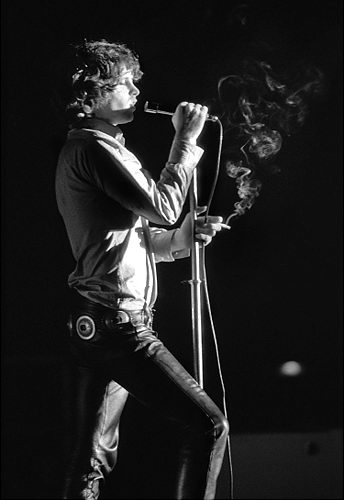
Forty years ago on June 3, 1971, Jim Morrison, lead singer of The Doors, died in Paris at age 27. He was buried in Pere Lachaise cemetery. Two former members of the band were at the grave site earlier today to mark the occasion.
“James Douglas Morrison, 1943-1971,” reads a plaque on the gravestone erected in the 1990s by the singer-poet’s father, who added a Greek phrase often interpreted as “true to his own spirit”.
Band members Ray Manzarek, the keyboardist, and guitarist Robby Krieger, lit candles at the grave of Morrison, who was known by the nickname the “lizard king”.
Fans of Morrison also paid homage at his grave by leaving flowers there. Some wore black T-shirts with a white drawing of Morrison’s face and the words “40th anniversary.”
I discovered The Doors first album when I was in college in 1967. I had never heard their music and simply bought the record on a whim because I liked the spooky cover art. I went home and put it on my turntable and listened. I was completely blown away. It honestly isn’t over the top to say that the music changed the way I experienced the world. It was that powerful for me.
So here’s to Jim and the great music and performances he shared with us during his brief time on this earth. Here are a couple of my favorites.
—————————————————-
—————————————————-


 peej
peej Carissa
 bostonboomer
 dakinikat
 ecocatwoman
 mablue2
 Mama Lopez
 peggysue22
 quixote
 skydancingguestblogger
 Mona (aka Wonk the Vote)



 Sky Dancing
Recent Comments