
You don’t have to be crazy to vote in a Republican Primary, but it sure helps
Posted: May 20, 2011 Filed under: 2012 presidential campaign, Republican presidential politics | Tags: Mike Huckabee, Mitch Daniels, Mitt Romney 26 Comments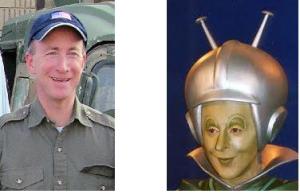 I continue to watch the ever-growing Republican pander to the rapture believers and the voodoo economics crowd. Pandering is disgusting no matter which side of the aisle does it. However, the Republicans have a special form of it because it involves reality denial not empty promises. It’s obvious that Republican primary voters have views clearly based in an alternate reality. Republican candidates develop two alter egos to deal with the disconnect. So my question is can any Republican Presidential Wannabe make it through the primary without sounding so many Republican Dogwhistles that they are sure to turn off independent voters? This is especially germane given those dog whistles are anathema to Democratic and Independent voters alike. Let me demonstrate.
Several political analysts have noticed the widening gap between Republican politicians, their primary base, and polls on issues from the public at large. First, there’s Mitch Daniels who said earlier that the Republican Party had to call a truce on social issues only to turn around as governor in Indiana and do a wildly unpopular thing. He just signed a law in Indiana to defund Planned Parenthood (h/t to Beata). He may have the party elite in his pointy little head, but he’s probably lost women. Rick Ungar at Forbes called this a “cynical move [that] will likely prove useful in the coming primaries”.
However, there is a world of difference between the nomination process and the general election that follows – something Governor Daniels will discover should he become the Republican standard bearer.
In a recent NBC/Wall Street Journal Poll, we learn that –
Among women overall, 56% found it “mostly or totally unacceptable” to “eliminate funding to Planned Parenthood for family planning and preventive health services.”
Among women 18–49, 60% found it “mostly or totally unacceptable” to “eliminate funding to Planned Parenthood for family planning and preventive health services.”
That means that are at least 56% of women out there who are going to understand that Governor Daniels is directly responsible for denying critical care to women who have nowhere else to go to get it.
Add to this the fact that approximately 25% of all American women have, at some time or another, utilized the services of Planned Parenthood and one quickly understands that Daniel’s support for this legislation is not going to play well with female voters.

Then there’s Romney who is trying hard to prove his credentials to that same rapture set. I was not surprised to read the numbers on how powerful the evangelical set has become in Republican politics. They asked for them, after all, with the Nixon Southern Strategy and moves to capture “Reagan Democrats”. The problem is that none of the pro-business Republicans want anything to do with the great unwashed that those strategies brought to the party. They wanted their votes but that was basically it. They had hoped that pandering to evangelicals with empty promises would work for them. It does work for Democratic politicians. It was obvious there was going to be ongoing problems when most evangelicals sat out an election rather than vote for John McCain whom they consider apostate. Mormon and former typical NE Rockefeller Republican Romney gives them the creeps. Ron Brownstein writing for National Journal says Romney has an evangelical problem.
The reason is that with Huckabee off the field, the former Baptist minister’s core constituency—the evangelical Christians who represent nearly half of the GOP’s primary electorate—are now back in play for all competitors. If Romney can’t defang the resistance he encountered from those voters in 2008, he faces the threat that they will eventually consolidate behind another contender, such as former Minnesota Gov. Tim Pawlenty, with potentially wider support than Huckabee demonstrated last time. “The risk for Romney is that some other candidate with broader appeal may attract them, someone who could stitch together a majority coalition in a way that Huckabee was not going to do,” says veteran GOP pollster Whit Ayres, who is working for potential presidential hopeful Jon Huntsman.
Even many Republicans underestimate the centrality of evangelical voters in the GOP’s nominating process. In 2008, self-identified evangelical Christians constituted 44 percent of all Republican presidential primary voters, according to a cumulative analysis of state exit polls by former ABC polling director Gary Langer. Candidates who rely almost entirely on evangelicals—such as Huckabee, Gary Bauer in 2000, and televangelist Pat Robertson in 1988—have never come close to winning the GOP nomination. But evangelicals are plentiful enough that any candidate whom they deem completely unacceptable faces a formidable obstacle—and not only in the Deep South, where they are most heavily concentrated.
Evangelical Christians represented a majority of 2008 GOP primary voters in 11 of the 29 states in which exit polls were conducted. In Iowa and South Carolina, two states that along with more-secular New Hampshire have proved decisive in Republican nomination contests since 1980, evangelicals provided exactly 60 percent of the vote. In 10 other states, including many outside the Deep South, evangelicals represented between one-third and 46 percent of the vote.
Assuming this problem doesn’t go away with the May 21st rapture, Romney and others will still have to woo the Krewe of Iron Age Myth. Here’s the portion of the article detailing their precise issues which basically have to do with defining life at fertilization, defining all GLBTs as damnable, and ensuring no “foreign” people ever reach US soil. Also, they hate preppies. This explains why Dubya’s fake NASCAR persona went over well.
Romney has encountered two levels of resistance from evangelicals: doubts that he is truly committed to conservative positions on social issues such as abortion, and theological tension over his Mormon religion. That latter problem was especially pronounced in the South, where Southern Baptists and Pentecostals, two groups particularly leery of Mormonism, make up at least two-thirds of Republican evangelicals, notes John C. Green, a political scientist at the University of Akron who is an expert on religion and politics. Class issues compound Romney’s challenge. Polls suggest that his smooth, boardroom manner plays better among college-educated than noncollege Republicans, and in many places evangelicals tilt toward the latter.
PBS’s Glen Ifill has noticed the return to dogwhistle politics. This quote pertains to Newt Gingrich who rightly labelled most of these extreme Republican policies as “right-wing social engineering”. Republicans spent the next week making Newt come to jayzus. Newt’s rhetoric let the dogs out and definitely showed that today’s Republicans sold the big tent a long time ago.
It’s unclear who the former House Speaker thought he was speaking to, but the dog whistle was heard by conservatives who immediately chastised him for undercutting a fellow Republican. “You’re an embarrassment,” one Iowa Republican scolded him in a widely-circulated YouTube video.
Gingrich said this was not what he meant, but in dog-whistle politics, what is heard often matters more than what is said. Days later, he apologized to Ryan.
During the same television appearance, Gingrich also said he did not mean to send a coded message on race when he told a Georgia Republican Party dinner days earlier that President Obama is “the most successful food stamp president in American history.”
Outrage ensued. Many African Americans saw racial code directed at the nation’s first black president. Gingrich called that suggestion “bizarre.”
Leave aside for a moment that in order for this to be code, the listener would have to automatically assume that most if not all food stamp recipients are black. This, as it happens, is not true, and Gingrich insisted he was making an argument about the state of the economy, not the skin color of food assistance recipients.
There may be some merit to his explanation, but it got lost in the din of the whistle, which sparked debate mostly among liberals and African Americans — who seemed least likely to be the remark’s intended targets.
Newt has been thoroughly chastised for not carrying the current party branch water bucket. Another place where the Republican party seems clearly out of step with the majority of Americans is allowing gay marriage rights. Independents opinions have pushed support solidly over the 50 % mark.
For the first time in Gallup’s tracking of the issue, a majority of Americans (53%) believe same-sex marriage should be recognized by the law as valid, with the same rights as traditional marriages. The increase since last year came exclusively among political independents and Democrats. Republicans’ views did not change.
No Republican primary candidate will pass the evangelical litmus test with a position running contrary to their narrow interpretation of an obscure reference in Deuteronomy. There are only two presidential contenders that support gay marriage. That would be Fred Karger and Gary Johnson. What!?!? Never heard of them? You probably never will either. They will be eviscerated by the jayzus lovers. At best, you’ll hear that neo-confederate argument of State’s Rights from Ron Paul that represents a variation of the theme of legal slavery. State’s Rights is basically code for ‘southern states get to ignore the civil rights of others unless the Supreme Court–now stacked with theocrats–disallows it’. It’s a grand compromise ala slavery.
 It’s possible that most Americans won’t notice the fall out from the Huckabee bow out. Huckabee clearly had the evangelical market cornered. Now these folks are scattering. That means there’s a grab for them and the rhetoric will become appalling. Evangelicals may go for the fembots, if either of them enters the race. Both potential Republican women candidates have that classic know-nothing bravada that allows them to say outrageous untruths convincingly. However, no serious Republican money will ever reach Quiterella or Michelle the Mouth. Ask me if I care a fig about Quiterella having fire in her belly?
Then there’s the absolutely no new taxes fanatics. Look at the public’s poll numbers on raising taxes on the very wealthy and leaving medicare and medicaid alone which is the dogwhistle Newt Gingrich refused to blow before he was forced to blow it. Republicans and the Club for Growth (sic) keeping running against the public on this issue too which is why Nancy Pelosi is up there in Wisconsin reminding voters of the Ryan plan as I write.
The McClatchy-Marist poll, conducted as Democrats and Republicans were touting their own long-term budget visions, also found the country largely pessimistic about America’s direction.
On taxes, the poll reported that roughly two out of three registered voters — 64 percent — would be in favor of increasing taxes on annual income over $250,000. President Obama reiterated in his deficit-reduction speech last week that he favored allowing taxes to rise on families in that income level.
Independents favored that plan of action at roughly the same percentage as the country at large, with more than eight in 10 Democrats also behind the idea. A majority of Republicans, 54 percent, opposed it.
The poll was conducted both before and after Obama’s Wednesday speech, with support for higher taxes on wealthier Americans picking up afterward.
Meanwhile, fully four in five registered voters oppose cutting Medicare and Medicaid. The House GOP’s fiscal 2012 budget, largely crafted by Rep. Paul Ryan (R-Wis.), makes fundamental long-term changes to both health entitlement programs, converting Medicaid into a block grant and turning Medicare into a type of voucher system.
Democrats (92 percent), Republicans (73 percent) and independents (75 percent) all opposed cuts to the two programs, the McClatchy-Marist poll found.
How long can Republicans push plans that go against poll numbers like that? Rachel Maddow points out that a solidly Republican New York Congressional District may put a Democrat in the House on the issue. Maddow also pointed out that Massachusetts Senator Scott Brown is running quickly away from saying that he’d vote for the Ryan plan if it hit the senate floor which it will do sometime this week or next. It is also rumored that Mitch McConnell will not whip his members when the vote occurs. Some of these old dudes remember the third rail.
Karl Rove’s American Crossroads PAC is about to spend $650,000 on the Medicare referendum that is the special election for New York’s 26th Congressional District, Roll Call reports. The idea is to save what should have been a safe seat anyway for Republican Jane Corwin, who came out in favor of the Paul Ryan Medicare plan and has been having a barrel of fun ever since.
Yesterday, House Speaker John Boehner paid a visit. Today, Mr. Rove brings the money. Producer Mike Yarvitz finds two bits from the local Buffalo News — headline: “GOP leaders rally to Corwin, but where are the Democrats?” — for a sense of scale. Quick read: It’s a lot of money.
So, whose likely to really win this Republican Presidential Primary Extremist Extravaganza? Two Guesses.
 No wonder the President is on the road with speeches made to burn political capital. None of the above appears the best choice for any one that doesn’t want the right’s agenda.
Friday Reads
Posted: May 20, 2011 Filed under: abortion rights, Economy, Foreign Affairs, Israel, morning reads, Reproductive Rights, U.S. Economy, U.S. Politics | Tags: Federal Debt, Filibuster, Goodwin Liu, israeli Palestianian morass, President Obama, State Department Speech, Texas sonogram law 46 Comments Good Morning!
It is definitely the silly season! You can tell that an election count down is nearing in the District. A judge of Chinese descent was successfully blocked by Republican Senators and Ben NelSOB for sounding like a communist. Did we go back to the McCarthy era and I missed it?
Six years ago, Ninth Circuit judicial nominee Goodwin Liu published an op-ed in which he made the utterly banal point that a conservative interest group used the terms “free enterprise,”‘ “private ownership of property,” and “limited government” as “code words for an ideological agenda hostile to environmental, workplace, and consumer protections.” In a speech on the Senate floor yesterday, however, Sen. Chuck Grassley (R-IA) somehow managed to interpret this op-ed as proof that Liu wants to turn America into “Communist-run China”:
GRASSLEY: Does [Liu] think we’re the communist-run China? That the government runs everything? That it’s a better place when they put online every week a coal-fired plant to pollute the air, put more carbon dioxide into the air then we do in the United States, and where children are dying because food is poisoned, and consumers aren’t protected, and where every miner in the China coal mines is in jeopardy of losing their lives? That’s how out of place this guy is when he talks about “free enterprise,” “private ownership of property,” and “limited government” being something somehow bad, but if you get government more involved, like they do in China, it’s somehow a better place.
Republicans appear to be pulling out all the bells and dogwhistles for this one. This is the first time a judicial nominee has been blocked since 2005.
Liu also drew Republican ire over his criticism of Supreme Court Justice Samuel Alito in testimony when the conservative judge was nominated to the court.
“His outrageous attack on Judge Alito convinced me that Goodwin Liu is an ideologue,” South Carolina Sen. Lindsey Graham said before Thursday’s vote. “His statement showed he has nothing but disdain for those who disagree with him. Goodwin Liu should run for elected office, not serve as a judge.”
Imagine that! Some one with an opinion! Does that mean a person isn’t capable of honest judgement?
Obama gave a speech yesterday at the State Department indicating support for the Arab Spring and suggesting that a dialogue between Israel and Palestine is possible but must meet certain ground rules. One of these is controversial because it breaks with a speech given by President Bush that more or less accepted the reality of some Israel colonies in the occupied territories. That is that the negotiations be based on the 1967 agreement which would reverse Israeli colonization of territories that occurred after the agreement. Israel has already rejected the idea.
So while the core issues of the conflict must be negotiated, the basis of those negotiations is clear: a viable Palestine, a secure Israel. The United States believes that negotiations should result in two states, with permanent Palestinian borders with Israel, Jordan, and Egypt, and permanent Israeli borders with Palestine. We believe the borders of Israel and Palestine should be based on the 1967 lines with mutually agreed swaps, so that secure and recognized borders are established for both states. The Palestinian people must have the right to govern themselves, and reach their full potential, in a sovereign and contiguous state.
As for security, every state has the right to self-defense, and Israel must be able to defend itself -– by itself -– against any threat. Provisions must also be robust enough to prevent a resurgence of terrorism, to stop the infiltration of weapons, and to provide effective border security. The full and phased withdrawal of Israeli military forces should be coordinated with the assumption of Palestinian security responsibility in a sovereign, non-militarized state. And the duration of this transition period must be agreed, and the effectiveness of security arrangements must be demonstrated.
These principles provide a foundation for negotiations. Palestinians should know the territorial outlines of their state; Israelis should know that their basic security concerns will be met. I’m aware that these steps alone will not resolve the conflict, because two wrenching and emotional issues will remain: the future of Jerusalem, and the fate of Palestinian refugees. But moving forward now on the basis of territory and security provides a foundation to resolve those two issues in a way that is just and fair, and that respects the rights and aspirations of both Israelis and Palestinians.
Obama also made it clear that Hamas’ failure to recognize the state of Israel was a huge problem.
Now, let me say this: Recognizing that negotiations need to begin with the issues of territory and security does not mean that it will be easy to come back to the table. In particular, the recent announcement of an agreement between Fatah and Hamas raises profound and legitimate questions for Israel: How can one negotiate with a party that has shown itself unwilling to recognize your right to exist? And in the weeks and months to come, Palestinian leaders will have to provide a credible answer to that question. Meanwhile, the United States, our Quartet partners, and the Arab states will need to continue every effort to get beyond the current impasse.
The President said that US commitment to Israel is unshakeable but the status quo is unsustainable. The Israeli/Palestinian situation continues to the most vexing problem on the planet. If you’re going to venture an opinion, be aware that the topic creates such tension that its discussion is actually banned on many blogs. I’d prefer not to relive past experience myself but I thought it needed mentioning.
Lawrence Mishel of the Economic Policy Institute says “We’re not broke nor will we be”. It seems more and more economists are fighting back on the weird suggestion that a country with a huge economy, rich people, and tons of assets can’t invest in its own future because it’s broke. Here’s the link to the briefing paper. This is good explanation of why we are not Greece and will not go down the Greek Road. There are tons of nifty graphs so go check it out!!
Despite the rhetoric, it is clear that “we” as a nation are not broke. While the recession has led to job loss and shrinking incomes in recent years, the economy has produced substantial gains in average incomes and wealth over the last three decades, and economists agree that we can expect comparable growth over the next three decades as well. Between 1980 and 2010, income per capita grew 66.4%, and wealth per capita grew 73.2%. Over the next 30 years, per capita income is projected to grow by a comparable 60.6%. In other words, “we” are much richer as a nation than we used to be and can expect those riches to rise substantially in the future. So who is the we in the “we’re broke” mantra? The recession has certainly been a rough patch of road for many families, but the output produced by corporations in the private sector has already recovered to pre-recession levels, and these firms’ profi ts were 21.7% higher overall, driven largely by the 60% jump in pre-tax profi ts enjoyed by fi rms in the fi nancial sector.
Here’s why we can actually afford to invest in America and Americans!
Despite the fact that average incomes have increased substantially over the past 30 years, the federal government is currently running a projected defi cit of 9.8% of gross domestic product. As noted above, many use the deficit to support the “we’re broke” theme. But how can that be the case? How can the country have much more income, collectively, onwhich to draw, yet all levels of government are “broke” and unable to aff ord anything?
The answer is that revenue has declined substantially due to the recession and due to the Bush-era tax cuts. The Congressional Budget Offi ce projects federal revenues will be just 14.8% of GDP in the fi scal year ending September 30, 2011—by far the lowest revenue intake relative to GDP since 1951. In contrast, federal revenues totaled over 18% of GDP at the end of the last recovery (fi scal year 2007) and were roughly 20% at the end of the 1990s recovery. A largepart of the revenue shortfall can be attributed to legislated changes in taxes under George W. Bush, which lowered the revenue share by 2.1%.
As the economy recovers, the defi cit will fall as unemployment declines, as incomes and associated revenues increase, and as recession-sensitive expenditures automatically decline (expenditures for food stamps, unemployment benefits, Medicaid and other programs rise with the economic distress in a recession and fade as unemployment declines). This expected decrease in the defi cit is refl ected in CBO projections showing the defi cit declining from 9.8% of GDP in 2011 to just 3.0% in fi scal year 2015. Some of this decline can be attributed to the assumed expiration of the Bush tax cuts extended in 2010 and the inheritance tax change in 2010 (plus the R&D, ethanol, and fi rst-year depreciation tax breaks), which would total 2.9 percentage points of GDP that year. Even so, that still leaves the defi cit falling by 4.0 percentage points due to the recovery.
Texas officially joins the war on women by mandating sonograms before terminations. This is just more harassment and costs to women seeking to exercise their constitutional rights to privacy and self-determination. Ridiculous!
Texas Governor Rick Perry Thursday signed into law a measure requiring women seeking an abortion in the state to first get a sonogram.
Texas is one of several U.S. states with strong Republican legislative majorities proposing new restrictions on abortion this year. The Republican governor had designated the bill as an emergency legislative priority, putting it on a fast track.
Under the law, women will have to wait 24 hours after the sonogram before having an abortion, though the waiting time is two hours for those who live more than 100 miles from an abortion provider.
So, like I said, it’s the silly season which means there’s plenty of news out there that’s bound to upset people! What’s on your reading and blogging list today?
Late Night Disaster Thread
Posted: May 19, 2011 Filed under: Environment, Environmental Protection, We are so F'd | Tags: Chernobyl, Fukashima, Helen Coldicot, Nuclear reactor meltdowns, radiation poisoning 10 Commentsh/t Susie Madrak via her FaceBook account.
 Dr Helen Coldicot says that the Radiation from Japan’s crippled nuclear energy facilities will Kill Millions of People. A report’s been released on Chernobyl’s meltdown on the event of its 25th anniversary. There is a horrendous laundry list of damage from unusable crop land, cancers, and severely deformed fetuses and babies. From this, Dr. Coldicot extrapolates the future damage from Fukushima. It’s bad; really bad.
You can read her statement here.
During the 25th anniversary last week of the Chernobyl disaster, some commentators asserted that few people died in the aftermath, and that there have been relatively few genetic abnormalities in survivors’ offspring. It’s an easy leap from there to arguments about the safety of nuclear energy compared to alternatives like coal, and optimistic predictions about the health of the people living near Fukushima.
But this is dangerously ill informed and short-sighted; if anyone knows better, it’s doctors like me. There’s great debate about the number of fatalities following Chernobyl; the International Atomic Energy Agency has predicted that there will be only about 4,000 deaths from cancer, but a 2009 report published by the New York Academy of Sciences says that almost one million people have already perished from cancer and other diseases.
The high doses of radiation caused so many miscarriages that we will never know the number of genetically damaged fetuses that did not come to term. (And both Belarus and Ukraine have group homes full of deformed children.)
Nuclear accidents never cease. We’re decades if not generations away from seeing the full effects of the radioactive emissions from Chernobyl.
As we know from Hiroshima and Nagasaki, it takes years to get cancer. Leukemia takes only 5 to 10 years to emerge, but solid cancers take 15 to 60. Furthermore, most radiation-induced mutations are recessive; it can take many generations for two recessive genes to combine to form a child with a particular disease, like my specialty, cystic fibrosis. We can’t possibly imagine how many cancers and other diseases will be caused in the far future by the radioactive isotopes emitted by Chernobyl and Fukushima.
Even more startling is this presser that you can watch in the Youtube below. The human cost is and will continue to be astronomical. It’s ten minutes well-spent. I actually think that sharing pictures of deformed children and babies could do the world good.
The Latest Stupid Republican Tricks: The “Default Deniers”
Posted: May 19, 2011 Filed under: China, Economy, Federal Budget, Foreign Affairs, Global Financial Crisis, Psychopaths in charge, Republican politics, Social Security, Surreality, U.S. Economy, U.S. Military, U.S. Politics, We are so F'd | Tags: Alan S. Blinder, Debt Ceiling, Federal Debt, Republican crazies, social safety net, Social Security, Timothy Geithner 9 Comments
GOP Leadership
{Sigh….} Is there any way to be rid of these crazies? The latest Republican nutty meme is that it will be much much better for all concerned if Congress doesn’t raise the debt ceiling and the U.S. has to either cut trillions in spending or default on its debts. From Politico:
They are the newest breed of government skeptics, the swelling ranks of Republicans who don’t believe the Obama administration when it says a failure to raise the debt limit will prove catastrophic.
And they stand ready to make negotiations over raising the cap on debt as grueling as possible, making Treasury officials and Wall Street more nervous than ever that the country could suffer an unprecedented default with consequences no one can predict.
The suspicion, which once flourished on only the conservative outskirts of economic circles, has seeped into the mainstream in recent weeks, gaining broader acceptance among establishment Republicans, even as the administration issues increasingly dire warnings.
House Speaker John Boehner (R-Ohio) validated the default deniers Sunday, saying, “I understand the doubts.” Jim Nussle, a budget director under former President George W. Bush, argued last week that “no one’s going to default” if Congress misses the Aug. 2 deadline. And Alabama Sen. Jeff Sessions, the top Republican on the Budget Committee, accused the White House of scare tactics similar to those used by the previous administration to win quick approval of the 2008 bank bailout after the markets crashed.
Via Think Progress, Rush Limbaugh yesterday responded to the Politico article by leaping aboard the GOP elephant just as it began to topple off the cliff. Limbaugh announced on his radio program that refusing to raise the debt ceiling will help the country’s credit rating.
LIMBAUGH: Today I claim the mantle. I proudly and honestly come to you today as the Mr. Big of the default deniers. We will not default on anything. And moreover, it is more likely that the country’s creditworthiness would go up around the world since we would finally be doing something to address our out-of-control spending and indebtedness if we were not to raise the debt limit. We would be perceived around the world as serious for a change, and responsible for a change. Otherwise we are headed for junk bond status.
I’m no economist, but according to Dakinikat Alan S. Blinder is a really good one, and he wrote an op-ed for the Wall Street Journal today. Here is his analysis of what could happen if the Republicans get their way on the debt ceiling.
What happens if we crash into the debt ceiling? Nobody really knows, but it’s not likely to be pretty. Inflows and outflows of cash to and from the Treasury jump around from day to day as bills are paid and revenues arrive. But at average fiscal 2011 rates, receipts cover only about 60% of expenditures. So if we hit the borrowing wall traveling at full speed, the U.S. government’s total outlays—a complex amalgam that includes everything from Social Security benefits to soldiers’ pay to interest on the national debt—will have to drop by about 40% immediately.
The bottom line is that Timmy Geithner will have to decide whether to pay soldiers and old folks or pay China other foreign creditors. I guess that’s what the Republicans are hoping for–that it will spell the end of the entire social safety net. But they don’t seem to be thinking very long-term. Do they really believe Americans will passively allow that to happen? Back to Blinder:
If and when the time comes, Mr. Geithner and his boss will have to decide. But here’s one prediction: Defaulting on the national debt will not be their first choice. After all, the statue of Alexander Hamilton at the Treasury entrance reminds Mr. Geithner every day of the importance of maintaining the nation’s creditworthiness. Even if we hit the debt ceiling, maturing obligations still can be rolled over. And I’ll bet he will bend every effort to make the interest payments, too. Unfortunately, however, when you’re 40% short, not much can be ruled out.
Exactly. Geithner is going to choose to pay China, not the elderly and disabled–that’s what the Republicans are counting on. But that will be a choice between chaos in the world economy and mass uprisings on the domestic front–or we might get both. According to Blinder a contraction in the U.S. economy like the one the Republicans are pushing us toward could lead to world-wide financial panic. According to Blinder:
…suppose the federal government actually does reduce its expenditures by 40% overnight. That translates to roughly $1.5 trillion at annual rates, or about 10% of GDP. That’s an enormous fiscal contraction for any economy to withstand, never mind one in a sluggish recovery with 9% unemployment. Even contemplating such a possibility is evidence of a dark, self-destructive impulse.
Second, markets now assign essentially zero probability to the U.S. losing its fiscal mind. They’d be caught flat-footed if the threat of default suddenly started to look real, possibly triggering a world-wide financial panic. Remember how markets reacted to the Lehman Brothers surprise? As Mr. Geithner pointed out in New York on Tuesday, “As we saw in the fall of 2008, when confidence turns, it can turn with brutal force and with a momentum that is very difficult and costly to arrest.”
And Blinder isn’t even considering what the reaction would be among ordinary Americans here at home when the economy completely tanks and there is no social safety net whatsoever.
Thursday Reads
Posted: May 19, 2011 Filed under: Bahrain, Egypt, Environment, Farming, Foreign Affairs, Gaza, Iran, Israel, Libya, MENA, Pakistan, Psychopaths in charge, religion, Syria, Team Obama, Tunisia, U.S. Politics, We are so F'd | Tags: Barack Obama, Catholic Bishops, China, Joseph Cannon, rape, whistle blowers, NSA spying, violence against women, birthers, Dominique Strauss-Kahn, Jane Mayer, Thomas Drake, Espionage Act, pedophile priests, "historic" speeches 41 Comments
Good Morning!! Does anyone have a remedy for the sleepies? I recently finished a semester of teaching, and the last couple of days I’ve been extremely groggy. Yesterday I even slept until 10:30AM! It doesn’t help that we haven’t seen the sun in the Boston area for at least a week–it’s dark, dank, and raw out there. It seems a lot more like November than late May. On top of all that my Spring allergies are the worst I’ve ever experienced. So please forgive me if this post makes no sense. On to the news of the day.
Disgraced IMF honcho Dominque Strauss-Kahn’s accuser testified before a New York grand jury today. Immediately following her testimony, Strauss-Kahn’s attorneys announced their determination to spring their client from his cell at Rikers Island Jail.
His lawyers initially proposed a $1 million bail package that was rejected by the court.
Today a new offer that was said to add a private monitoring firm, an electronic bracelet and a guard to the package was put together. The cash component of the bail package remained at $1 million dollars, but the deal now included a guarantee that Strauss-Kahn would remain confined in New York City and not leave his residence except for visits to his doctor or lawyers. His passports and travel documents have already been taken from him.
According to ABC News, police are testing body fluids found in Strauss-Kahn’s hotel room for DNA.
ABC News has confirmed that police cut a swath of carpet to test for DNA and swabbed one of the suite’s sinks under a black light that indicated there was potential DNA evidence there.
Apparently Strauss-Kahn’s attorneys plan to claim that their client’s sexual encounter with a hotel maid was “consensual,” but there is a serious problem with that theory in addition to the maid’s testimony.
Investigators also say information downloaded from the suite door’s electronic card reader indicates the maid entered the room and never closed the door. The hotel policy requires maids to leave the door open when cleaning. The open door, they say, is proof that the women entered the room to work, not to engage in consensual sex.
I won’t dwell on this sordid story much longer, but I did want to call your attention to this piece in Time Magazine, which details a number of previous accusations against Strauss-Kahn–along with rumors –gossip about his abusive behavior toward women–that were hushed up until now. How predictable these guys are!
Joseph Cannon’s latest post is a must-read, along with the New Yorker article by Jane Mayer on which the Cannon comments. It’s about the domestic spying by the NSA that went on under Bush and the Obama administration’s heavy handed prosecution of whistleblowers while at the same time protecting the Bush administration criminals. (Minkoff Minx also mentioned Mayer’s article in her morning post yesterday.) Here’s an introduction to the piece by Cannon:
This humble blog spent a lot of time talking about NSA overreach during the controversies over Russell Tice and FISA. Meyer’s piece confirms a long-held suspicion that the real problem wasn’t eavesdropping on telephone calls but automated data-mining of all forms of electronic communication.
Two competing computer systems were designed to take us into this brave new world: ThinThread and Trailblazer. (The system in place now is called Turbulence. Someone at NSA has a strange affection for the letter T — which is also the first letter in totalitarian.) Trailblazer turned out to be a costly boondoggle. ThinThread worked. Originally, it had provisions built in to protect the privacy of American citizens; NSA Director Haybed tossed out those barriers.
Meyer focuses on an NSA whistleblower named Thomas Drake, who tried to blow the whistle on the Trailblazer fiasco — and on the abuses of privacy — to a staffer on the House Intelligence Committee. Unfortunately, the Committee was headed, at the time, by Porter Goss — and by Nancy Pelosi. They both seemed deaf to what Drake had to say.
Why is Obama so obsessed with prosecuting whistleblowers–even to the point of dusting off the Espionage Act? Jane Mayer writes:
When President Barack Obama took office, in 2009, he championed the cause of government transparency, and spoke admiringly of whistle-blowers, whom he described as “often the best source of information about waste, fraud, and abuse in government.” But the Obama Administration has pursued leak prosecutions with a surprising relentlessness. Including the Drake case, it has been using the Espionage Act to press criminal charges in five alleged instances of national-security leaks—more such prosecutions than have occurred in all previous Administrations combined. The Drake case is one of two that Obama’s Justice Department has carried over from the Bush years.
Gabriel Schoenfeld, a conservative political scientist at the Hudson Institute, who, in his book “Necessary Secrets” (2010), argues for more stringent protection of classified information, says, “Ironically, Obama has presided over the most draconian crackdown on leaks in our history—even more so than Nixon.”
Mayer asked Drake about it:
Sitting at a Formica table at the Tastee Diner, in Bethesda, Drake—who is a registered Republican—groaned and thrust his head into his hands. “I actually had hopes for Obama,” he said. He had not only expected the President to roll back the prosecutions launched by the Bush Administration; he had thought that Bush Administration officials would be investigated for overstepping the law in the “war on terror.”
“But power is incredibly destructive,” Drake said. “It’s a weird, pathological thing. I also think the intelligence community coöpted Obama, because he’s rather naïve about national security. He’s accepted the fear and secrecy. We’re in a scary space in this country.”
Check out her article if you can. She’s one of the best investigative reporters we have.
You may have missed Dakinikat’s late night post on Tuesday–the one about exploding watermelons. I thought this story deserved a little more emphasis, because it shows what can happen when there are no government regulations on agriculture–and industry in general (and that is what the Republicans would love to make happen). From Raw Story:
A bizarre wave of exploding watermelons — possibly due to farmers’ abuse of a growth-boosting chemical — has once again spotlighted safety fears plaguing China’s poorly regulated food sector.
State media has said nearly 50 hectares (120 acres) of watermelon crops in the eastern city of Danyang have been ruined by the phenomenon this month after some growers doused them with the growth accelerator forchlorfenuron.
“On May 7, I came out and counted 80 (exploded watermelons), but by the afternoon it was 100,” farmer Liu Mingsuo told state broadcaster China Central Television (CCTV) in a report that aired Tuesday. He said he had sprayed them with the chemical just a day before.
Remind me to never buy any food produce in China!!
Have you heard that the Obama campaign is selling T-shirts and coffee cups that mock the “birthers?”
President Obama’s 2012 presidential campaign today started selling “Made in the USA” t-shirts featuring images of both President Obama and the long-form birth certificate he released copies of last month.
Wear your support for this campaign with an official Made in the USA T-shirt,” his website advertises. Donate $25 or more today and we’ll send you your limited-edition shirt.
Coffee-mugs are also available.
“Remember ‘fight the smears’ from the 2008 campaign?” asked campaign spokesman Ben LaBolt. “This is the mobile version of it.”
Quite frankly, I think this is a little bit tacky….but that’s just me. And speaking of tasteless behavior, the Catholic Church is attempting to blame the ’60s counterculture for the behavior pedophile priests. From the Guardian UK:
The investigation commissioned by Catholic bishops said that the peak incidence of sexual abuse by priests in the 1960s and 70s reflected the increased level of other deviant behaviours in American society in the period, including “drug use and crime, as well as social changes, such as an increase in premarital sex and divorce.”
Researchers at John Jay College of Criminal Justice said most of the abusive priests were ordained in the 1940s and 50s and were not properly trained to confront the social upheavals of the 1960s.
David O’Brien, a historian of American Catholicism at the University of Dayton, said the report, Causes and Context of Sexual Abuse of Minors by Catholic Priests in the United States, 1950-2010, was dangerous because it seemed to exonerate bishops.
The study also ignores the long history of sexual abuse of children by the Catholic clergy. Methinks these “researchers” told the Catholic Bishops what they wanted to hear rather than do any serious research.
Finally, President Obama plans to give another “most amazing speech evah” tomorrow. This one is on the Middle East and North Africa. According to Voice of America:
The speech will be broad in scope, as Mr. Obama focuses on the peaceful democratic movements for change that have swept the region, discusses implications for U.S. policy, and offers what administration officials call some concrete policy proposals.
He will give his assessment of the impact of popular uprisings that have led to political changes in Egypt and Tunisia, and which continue in places like Syria, Libya and Yemen.
Senior administration officials say Mr. Obama will speak of a moment of opportunity, after a decade of great tensions and divisions, in which people of the region and U.S. policy can begin to turn the page toward a more positive and hopeful future.
The stalemated Israel-Palestinian peace process will be an important element. However, Mr. Obama is expected to frame it as part of a wider picture and say that leaders on both sides of that conflict should seize an opportunity for peace.
Whatever….I think I’ll arrange to be busy while he’s speechifying. Anyway, what are you reading and blogging about today?

 peej
peej Carissa
 bostonboomer
 dakinikat
 ecocatwoman
 mablue2
 Mama Lopez
 peggysue22
 quixote
 skydancingguestblogger
 Mona (aka Wonk the Vote)



 Sky Dancing
Recent Comments