
Sunday Late Night Open Thread: Laughter is the Best Medicine
Posted: April 3, 2011 Filed under: just because | Tags: laughing babies 11 CommentsI just couldn’t take any more depressing news today, so I kind of zoned out. I read a mystery and took a long nap. I’m feeling a whole lot better now, even though the news is all still bad.
I wanted to find something cheerful to post tonight, and I found this over at Uppity’s place–so I’m borrowing it. A big hat tip to Uppity Woman for putting a big smile on my face tonight.
Dad was ripping up a job rejection letter, much to his baby’s delight.
I wanted more, so I found a few more happy baby videos. I hope you like them as much as I do.
Working your Way into the Poor House
Posted: April 3, 2011 Filed under: income inequality, Team Obama, The Bonus Class, U.S. Economy, unemployment | Tags: income stagnation, shrinking middle class, wage insecurity, wage stagnation 18 CommentsThe basic promise of modern America was that you can work hard and get ahead. These days, that promise goes  undelivered daily. The gap between the promise and the delivery is widening exponentially and it’s time for all of us to get the few to listen. The basic problem in our economy is that we are not producing jobs that help working families meet basic needs. I see this a lot down here in New Orleans where many of our homeless people sleep on air mattresses in front of the shelter at night but have jobs in the French Quarter during the day. They wash dishes or straighten beds. They work and they work hard. Yet, they cannot afford basic shelter in a southern city with relatively low costs of living compared to other places. This is not the Social Contract we’ve been taught in our schools for years. Working a job is not supposed to mean you can’t get your children to the doctor or put a roof over your head.
I wanted to highlight the recent findings of an income insecurity study for you. Then, I’m going to talk about the role of wage and income stagnation in all of that. I felt that just possibly you might take your Sunday afternoon to look at the people around you and appreciate the struggle. The first study was commissioned by Wider Opportunities for Women. The results were highlighted in the New York Times. The uncovered realities are harsh and make the future for many folks in this country look unpromising. WOW was looking for an index–now called National BEST–to demonstrate how much it takes to minimally exist in the US as a middle class family and how far short some of our citizens have fallen of that minimal standard. It’s a slightly upscale version of the Poverty index. It basically tells you what it takes to be marginally working/middle class. This measure includes good nutrition, a small sedan, and some basic savings for retirement so it’s not a survive or die measure. It measures what it takes to really have the minimal American Dream. It’s what every American would have if our country met its Social Contract with working Americans.
According to the report, a single worker needs an income of $30,012 a year — or just above $14 an hour — to cover basic expenses and save for retirement and emergencies. That is close to three times the 2010 national poverty level of $10,830 for a single person, and nearly twice the federal minimum wage of $7.25 an hour.
A single worker with two young children needs an annual income of $57,756, or just over $27 an hour, to attain economic stability, and a family with two working parents and two young children needs to earn $67,920 a year, or about $16 an hour per worker.
That compares with the national poverty level of $22,050 for a family of four. The most recent data from the Census Bureau found that 14.3 percent of Americans were living below the poverty line in 2009.
Wider Opportunities and its consulting partners saw a need for an index that would indicate how much families need to earn if, for example, they want to save for their children’s college education or for a down payment on a home.
So, we’re talking a minimal, humble “American Dream” which, again, is what we’ve been promised for our hard work. This dream does comes from hard work and not some one’s daddy’s trust fund like the Koch Brothers or Paris Hilton. These people work . More and more, working does not pay for them and it is creating problems for us all. The most disenfranchised are workers who have not completed high school and have no training. The recession has only made this worse and the recovery does not appear to be bringing anything better. Still, I hear nothing about helping these people prepare and find work.
We have no discussions about what it means to be working and poor in America. I hear only about cutting budgets. We’d have never won World War 2 with that attitude. If they’d have worried about the debt left to me and my generation, we’d have a completely different world right now. That appears to be what they want to leave to our children. We are building a world where the Social Contract for the American Dream is broken and no one wants to pay to get it fixed.
For some of the least educated, Mr. Waldman fears that even low wages are out of reach. “Given the needs of a more cognitive and more versatile labor force,” he said, “I’m afraid that those that don’t have the education are going to be part of a structural unemployment story.”
Even for those who do get jobs, it may be hard to live without public services, say nonprofit groups that assist low-income workers. “Politicians are so worried about fraud and abuse,” said Carol Goertzel, president of PathWays PA, a nonprofit that serves families in the Philadelphia region. “But they are not seeing the picture of families who are working but simply not making enough money to support their families, and need public support.”
In New York, Áine Duggan, vice president for research, policy and education at the Food Bank for New York City, estimates that about a third of the group’s clients are working but not earning enough to cover basic needs, much less saving for retirement or an emergency. She said that among households with children and annual incomes of less than $25,000, 83 percent of them would not be able to afford food within three months of losing the family income. That is up from 68 percent in 2008 at the height of the recession.
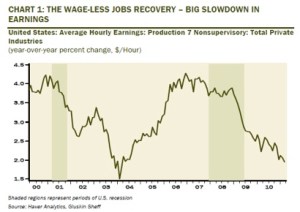 We have a “Wageless” Recovery. Incomes are only going up at the extreme upper levels. Every one else is losing lifestyle and yet, they are working hard. Employment Policy Research Network (EPRN) researcher Frank Levy of MIT has released a monograph called ‘Addressing the Problems of Stagnant Wages’. (Yes, I know, I actually read these things with relish and print wonky graphs for you on a sunny Sunday afternoon because of some weird inner trait of mine I really can’t name.) Just reading his introduction takes me back to my childhood in Iowa where farmers bought trucks from my dad and I knew everything would be alright if I just went to college and got a degree.
In the three decades after World War II, a central feature of the American economy was a mass upward mobility in which each generation lived better than the last, and workers experienced earnings gains through much of their careers. In short, the American Dream was alive and well. The central drivers of mass upward mobility were real wages for most workers that grew in line with overall labor productivity. Because of rising real wages a 40-year-old male blue-collar worker earned more in the late 1960s than most managers had earned in the late 1940s.
The alignment of wage growth and productivity growth resulted from two main factors: labor markets for most groups of workers in which demand matched supply, and the post-World War II Social Compact that emerged from the Great Depression helped to propogate wage norms throughout the economy, norms that were enforced in part through collective bargaining and professional personnel/human resource management practices.
By the 1980s, both of these factors had reversed. Labor demand increasingly shifted toward more educated workers – particularly well-educated women. At the same time, the post-war Social Compact was challenged by the inflationary 1970s and collapsed in the 1980s. Nothing has emerged to replace it.
Now, in the absence of a labor market boom like that of 1996-2000, increased labor productivity no longer translates into rising real wages for many groups of workers.
Well, that’s all and fine, but how do we address the problems that we’ve got now? How is it that so many of us can work and do the right thing and still not make ends meet? Well, that’s the policy part of the paper and there are suggestions. The author argues that during the last three decades business and government have broken the Social Contract. He’s got some suggestions. One of them is pretty basic. That would be increasing the High School Graduation rate and trying to get employers to buy into the idea that they must providing training and education opportunities to their workers. If they don’t, then society must offer this as a public good because provision of the good is cheaper than the social costs of not providing the good.
Increasing the number of college graduates requires dealing with two potentially related obstacles. One is the stagnation since the early 1970s in the high school graduation rate at approximately 75 percent.25 The failure to increase the high school graduation rate explains about one-half of the slowdown since the 1970s in the growth in the rate of college completion (Bailey and Dynarski, forthcoming). The other is the weak ability of high school graduates, once in junior college or college, to complete a degree. The historically large college-high school earnings gap has caused a growing fraction of high school graduates to start higher education, but the fraction who complete a bachelor’s degree has increased only modestly for women over the last twenty years and has remained basically flat for men.
There’s also a pretty good discussion of the idea of charters schools and inflicting the competitive charter school model on the education system that follows with some really good questions. Other proposals include making certain that we invest in the jobs and industries of the future even if the private sector isn’t doing their share. There’s also some discussion of how to encourage better labor-management relations and laws but given the demonization of working people–even by working people themselves–the author doesn’t hold much hope for the national discussion that needs to take place on less combative and abusive management practices.
One of the things that I do want to bring up is the role of using the classification “independent contractor” and how it’s allowed businesses to get around paying workers. It is thought to be responsible for a chunk of the wage stagnation and to many of the lost benefits problems leading to the loss of middle class lifestyles. It worries me greatly that many tea party governors are actively trying to dismantle labor laws. They are even trying to get rid of child labor laws so businesses can get access to children under 14 again.
One necessary but far from sufficient requirement for setting and maintaining a floor on wages for hourly workers, and especially for low-wage hourly workers, is that federal and state wage and hour laws are enforced vigorously and as uniformly as possible. Recent studies have shown there are widespread violations of wage and hour laws ranging from failure to pay minimum wages, overtime, required meal and rest breaks, and misclassification of employees as independent contractors. One recent study estimated these types of violations have the effect of lowering wages of affected workers by 15 percent
One of the major themes in the research is on the increased role of the financial markets in the breakdown of the Social Contract. The growth of the finance industry has come with the loss of manufacturing. Not only is this due loss of manufacturing jobs that are now lower paying services jobs, but it has caused incomes to shift from labor to capital. The political power and rise of the financial class has a lot to do with this trend. These people don’t just want ordinary returns on their money. They want extraordinary returns. Squeezing costs is usually the short sighted, short term way to achieve that.
I’d like to close with an interview with Cornel West that encapsulates some of the problems. It’s a little old. I grabbed it from Naked Capitalism; also a place concerned with policies that impact middle class Americans. Listening to the interview made think again about our priorities and our need to enforce the American Dream Social Contract once again. Dr West talks about the experience of poor and working class blacks in this clip, but many of the same things can be applied to any and all poor and working class Americans. I think it’s time we start the discussion. The country’s in trouble when an increasing amount of income comes from shuffling paper between financial institutions and bonuses replace wages for a hard day’s work.

Saturday Night: A Little Bit of Good News
Posted: April 2, 2011 Filed under: Foreign Affairs, Japan, just because, open thread | Tags: disasters, earthquake, heartwarming animal stories, Japan, open thread, survival, tsunami 19 Comments
Japan Times:
SENDAI (Kyodo) The Japan Coast Guard managed to save a small brown dog Friday from a floating rooftop 1.8 km off Miyagi Prefecture, three weeks after a massive tsunami ravaged the northeast coast.
The team’s initial rescue attempt failed after the dog, perhaps scared by the hovering helicopter, jumped from the roof over to nearby driftwood.
A rescue boat with three guardsmen was then dispatched and succeeded in catching the pooch an hour later by using rescue stretchers.
The dog, which was wearing a black collar that had no indication of who its owner might be, was fed biscuits and sausages aboard the coast guard vessel and is behaving itself, the coast guard said.
How did he survive for three weeks surrounded by salt water? One suggestion: Perhaps with all the rain, perhaps the dog was able to drink rainwater that collected in spots on the house roof.
The dog was wearing a collar, so his rescuers will try to find his family.
This is an open thread, but I encourage you to share any heartwarming animal stories that you know about.
One Helluva Open Window
Posted: April 2, 2011 Filed under: financial institutions, Global Financial Crisis | Tags: Ben Bernanke, FED 23 CommentsI’m a financial economist. I’ve worked for the Fed although not in that capacity. My grandfather worked for the FED  doing the War Bonds thing for both World Wars and my exhusband worked for the Fed straight out of college. I’d like to think I have some familiarity with at least two of the districts. I also was schooled during the monetarist ascendancy so I was endowed with a certain amount of awe and respect for monetary policy. I don’t think–as a general rule–the FED’s current open market operations should be up for purview by politicians. I think it’s just fine and dandy that stuff comes out later because I certainly don’t want monetary policy neutralized or politicized. I would, however, like Ron Paul’s 3rd century world view of economics to be neutralized. However, I think all the adults in Washington, D.C. have moved. That would include the ones in the Board of Governor’s Building.
So, why am I saying all this? Well, I’m about to announce how absolutely appalled I was to find that the FED not only opened it’s discount window to our shadow banking industry and some commercial banks abroad, but it opened the windows, doors, and vaults to just about any bank or pseudo-bank on the planet that had the misfortune to be taken in by our financiers of greed and destruction. I know the Fed dabbles around the world. We’ve had to prop up Mexico and Citibank’s adventures from time-to-time which seemed way out of its jurisdiction even with the broadest interpretation of their charter. I know they “watch” our exchange rates while talking up the competitive exchange rate regime at times. Some how, this feels WAY different. I feel in need of a shower even reading about this.
U.S. Federal Reserve Chairman Ben S. Bernanke’s two-year fight to shield crisis-squeezed banks from the stigma of revealing their public loans protected a lender to local governments in Belgium, a Japanese fishing-cooperative financier and a company part-owned by the Central Bank of Libya.
Dexia SA (DEXB), based in Brussels and Paris, borrowed as much as $33.5 billion through its New York branch from the Fed’s “discount window” lending program, according to Fed documents released yesterday in response to a Freedom of Information Act request. Dublin-based Depfa Bank Plc, taken over in 2007 by a German real-estate lender later seized by the German government, drew $24.5 billion.
The biggest borrowers from the 97-year-old discount window as the program reached its crisis-era peak were foreign banks, accounting for at least 70 percent of the $110.7 billion borrowed during the week in October 2008 when use of the program surged to a record. The disclosures may stoke a reexamination of the risks posed to U.S. taxpayers by the central bank’s role in global financial markets.
“The caricature of the Fed is that it was shoveling money to big New York banks and a bunch of foreigners, and that is not conducive to its long-run reputation,” said Vincent Reinhart, the Fed’s director of monetary affairs from 2001 to 2007.
The FED’s always had an ‘usual and exigent circumstances’ clause that’s given a lot of leeway in times of financial crisis. Some how, I don’t even think Woodrow Wilson figured it would be used to lend money to a fishing-cooperative financier in Japan. You can also read Yves Smith at Naked Capitalism on exactly what went on at the Discount Window and with whom. She focuses on the ‘haircuts’. That would be the lousy deals made by the Fed to bail out a lot of lousy dealers. The numbers on how many of these borrowers were junk status awes.
The information was released yesterday and Bloomberg has provided a first cut on a small but juicy portion of it, the Primary Dealer Credit Facility. From a risk standpoint, the loans mace under this program violated the central bank guideline known as the Bagehot rule: “Lend freely, against good collateral, at penalty rates”. That is the prescription if the borrower is facing a bank run, meaning a liquidity crisis. The fact that 72% of the Fed’s loans on September 29 from the Primary Dealer Credit Facility were junk or equivalent (defaulted and unrated securities or equity) is further proof that many financial firms were facing a solvency, not a liquidity, crisis.
She also shows–in her words quelle suprise–which American Banks were the little failed piggies too. I’m going to throw one of the ‘haircuts’ or discounts a the front of this quote just to curl your toes a bit. I think we can effectively say that Wall Street trashed the value of nearly every firm in the country pretty effectively.
A 95% haircut on AAA rated ABS CDOs means the paper was effectively worthless.
This first cut by Bloomberg also shows that Morgan Stanley was the biggest user of the facility, receiving $61.3 billion of funds for securities “worth” $66.5 billion, 71.6% of which was junk or unrated. As eye-popping as those numbers are, the funds received are less than half the fall in Morgan Stanley’s liquidity pool in the two weeks after the Lehman failure, per Economics of Contempt. Merrill Lynch was second, getting $36.3 billion in funding for $39.1 billion of collateral, 83.4% of which was junk or unrated.
These are not the routine activities of central banks and central bankers. We basically bankrolled a bunch of businesses and financial outfits in a bunch of countries because they wanted in on the Wall Street greed and Wall Street failed them big time. I’m left wondering why all this money was thrown to the foreign gamblers while Americans were being foreclosed on, frankly. Let me also let you know that this is probably just the tip of the iceberg since there’s undoubtedly more documents that need to be discovered and analyzed. My hope is that when the congressional hearings on this get started, we have some real brain power behind the questions that need to be asked on this because questions do need to be asked about this. I’d like a few FED Governors around for the ride to see how many of them were on board with all of this or even knew of it. What we need right now are a few Ferdinand Pecoras.
I also wonder who masterminded all this? Paulson? Geithner? Bernanke? Were they that wedded to ensuring Wall Street didn’t look like a casino and American business didn’t look like a sham that they had to give away the house, the children, the pets, and the fatted calf? They basically threw every one’s kitchen sink overseas. Worse than that, they’ve really not solved the basic systemic problem and the banks are already niggling over the details of the few thinks done by Dodd-Frank. Feel used yet?
Saturday: Hillary, Jeannette, and Perditta
Posted: April 2, 2011 Filed under: Hillary Clinton, Human Rights, morning reads, Women's Rights | Tags: 2012, Afghanistan, Autism, Barack Obama, birthers, Black migrant workers in Libya, Donald Trump, Egypt, Islamophobia, Japan, Jeannette Rankin, Libya, Perditta Nabbous, Polling, The Onion: "The American Dream Dies", Where is Eman al Obeidi 48 Comments
Secretary of State Hillary Clinton arrives for the funeral mass for former vice presidential candidate Geraldine Ferraro, Thursday, March 31, 2011 in New York.
Morning, news junkies. Note: You’ll have to read all the way to the bottom of this one for the tie-in to “Jeannette” and “Perditta.” There’s also some comic relief from the Onion waiting there at the end as a reward for making it through. My Saturday reads are often on the ‘heavy’ side I know, and this weekend is no exception.
I’d like to start with a story I touched on in a roundup about a month ago. You may recall that I linked to Glen Ford/BAR’s commentary on the pogrom-like massacre against sub-Saharan black migrant workers in Libya, at the hands of so-called anti-Gaddafi rebels. The Western media has virtually blacked this story out–or if they are covering it in any substantive or sustained way other than in passing, I must have missed it over the past month. Leave it to the WSWS (World Socialist Web Site) to have one of the few informative pieces I’ve seen covering the story at all (h/t paperdoll for pointing me to it.) The WSWS piece references a March 22nd article, in the Frankfurter Allgemeine Zeitung by Gunnar Heinsohn (which cites as its source a report by Zimbabwean journalist and documentary filmmaker Farai Sevenzo).
From the WSWS link:
The article states:“Because mercenaries from Chad and Mali are presumed to be fighting for him [Gaddafi], the lives of a million African refugees and thousands of African migrants are at risk. A Turkish construction worker told the British radio station BBC: ‘We had seventy to eighty people from Chad working for our company. They were massacred with pruning shears and axes, accused by the attackers of being Gaddafi’s troops. The Sudanese people were massacred. We saw it for ourselves.’ ”
The zombie in place of the fourth estate, our corporate US media, has either glossed over or omitted the massacre altogether. Meanwhile, Al Jazeera, unsurprisingly, has had more to say on the killings than I’ve seen from CNN or Fox over the last few months combined. Again, from the WSWS link:
On February 28, the Arab TV station Al Jazeera reported the racist massacre of black African workers by so-called “freedom fighters” as follows: “Dozens of workers from sub-Saharan Africa, it is feared, have been killed and hundreds are hiding because angry opponents of the government are hunting down black African mercenaries, witnesses reported…. According to official reports, about 90 Kenyans and 64 people from southern Sudan, Uganda, Zimbabwe, Lesotho, Zambia, Rwanda, South Africa, Tanzania, the Democratic Republic of Congo, Sierra Leone and Burundi landed in Nairobi today.
One of them, Julius Kiluu, a 60-year-old construction manager, told Reuters: ‘We were attacked by people from the village. They accused us of being murderous mercenaries. But in reality they simply refuse to tolerate us. Our camp was burnt down. Our company and our embassy helped us get to the airport.’“Hundreds of black immigrants from the poorest African countries, who work mainly as low-wage day labourers in Libya, have been wounded by the rebels. From fear of being killed, some of them have refrained from going to a doctor.”
I went digging for the Al Jazeera report:
“But why is nobody concerned about the plight of sub-Saharan African migrants in Libya? As victims of racism and ruthless exploitation, they are Libya’s most vulnerable immigrant population, and their home country governments do not give them any support,” Hein de Haas, a senior fellow with the International Migration Institute, writes in his blog.
In clicking on the link to de Haas’ blog and perusing the comments, I stumbled upon a link to this February blog post at the Independent by Michael Mumisa: Is Al-Jazeera TV complicit in the latest vilification of Libya’s Blacks?
Mumisa wrote:
Even Al-Jazeera TV has based most of its news coverage of bands of marauding savage Africans on information posted via tweeter, facebook, and other social networks. That there may be African mercenaries operating in Libya is very possible but there are also credible reports from Serbian military sources as well as other Western agencies that Serbian mercenaries are fighting to protect Muammar Gaddafi. Yet nothing has been said about Gaddafi’s Serbian and Russian mercenaries.
Black Africans have always been a ‘visible’ and persecuted minority in Libya. By giving credence to potentially dangerous and unverified reports and rumours posted on social networks without taking into consideration the racial context of Libyan society Al-Jazeera and other foreign media outlets are complicit in the latest vilification and scapegoating of Libya’s Black minorities and its African migrant workers.
I don’t claim to be an expert on what’s happening on the ground in Libya, but I would like some answers on the deaths of these migrant workers. I would really love to hear someone put this humanitarian issue to Madame President Hillary Clinton for comment.
Switching gears now… because yep, you heard me correctly…
I just called her Madame President Hillary Clinton.
If the aliens visiting for the upcoming royal wedding were to observe what was going on right now, what else would they conclude? Hillary’s leading, Obama’s not, and everyone knows it.
Nothing new there, of course, except for the part about everyone knowing it. If Obama is the Where’s Waldo president, our media was the Where’s Waldo fourth estate in 2008, as well as during the entire past decade. That Where’s Waldo media, by the way, very much included left blogistan, guilty of its own version of the “Village” insularity and hegemony in the traditional media that the prog blogs cut their teeth railing against.
In 2008, access was more important than our country’s future to journalists and bloggers, and I have no reason to believe in 2012, the story will be any different.
Which brings me to my next set of links…
Hillary, Obama, Polls, and 2012/The Donald Goes Birther week-in-review
- Hillary’s Gallup favorables rating (March 25-27) is back to her all-time high in December of 1998 (give or take a point):
The latest results are from a March 25-27 Gallup poll conducted while the United States was actively involved in enforcing a no-fly zone over Libya, a policy Clinton reportedly advocated. The same poll finds Clinton rated more positively than other top administration officials. Obama receives a 54% favorable rating, Secretary of Defense Robert Gates, 52%, and Vice President Joe Biden, 46%.
- A CNN/Opinion research poll from March 11 to 13 yielded pretty much the same results: 2 in 3 Americans have a favorable opinion of Hillary Clinton, with 92% of Democrats, 64% of Independents, and 35% of Republicans (or 83% of liberals, 80% of moderates, and 42% of conservatives) giving her a thumbs up. (That’s nearly identical to the Gallup findings from the end of March: 92% of Dems, 62% of Indies, and 40% of Repubs.) How’s that for “likeable enough” and “polarizing”? Agree or disagree with her, what people have for Hillary–which Obama can’t win with his empty speeches and voting “present”–is respect for her substance, diligence, and commitment. You not only know where she stands on Libya, you know she won’t half-ass it, she won’t vote present like Obama and she won’t cut Bush-like corners either–it’s clear that she’s giving it her all and she’s all in, even if you disagree with her.
- Meanwhile… Quinnipiac (March 30th release): Obama Gets Lowest Approval, Reelect Score Ever.
- And, look at where Obama currently stands with Independents in this Pollster/Huffpo aggregate: as of Friday morning when I drafted this post, only 41% of Indies, on average, approve of the job Obama is doing. The Quinnipiac number there is only 39.
- The latest from PPP’s state-by-state polling shows Obama doing better with Independents in Florida, who give him a 49% approval, with 48% of ALL Floridian voters approving and 47% not so much:
It doesn’t look like Florida will be losing its status as one of the most competitive states in the country at the Presidential level next year- voters in the state are almost evenly divided on Barack Obama’s job performance and although he leads all six of the Republicans we tested him against, some of the margins are quite close. […] Mitt Romney does the best, trailing Obama 46-44. […] former Florida Governor Jeb Bush, who trails Obama 48-45 in the state. Obama would start out in a slightly healthier position against four other Republicans we tested. He leads Rudy Giuliani by 6 points at 48-42, Mike Huckabee by 7 at 50-43, Newt Gingrich by 8 at 50-42, and Sarah Palin by 13 at 52-39.
- Along with the Florida snapshot above, take into account PPP’s polling release last week from Michigan:
Obama’s not likely to win Michigan by his blowout margin of 16 points in 2008 again but if the state voted today he would have an easier time taking it than either John Kerry in 2004 or Al Gore in 2000 did. Mitt Romney does the best of the Republicans against Obama, but still trails 48-41. […] Obama could be vulnerable in Michigan for sure. But consider this- despite that weak 78% approval with Democrats, he gets 85-90% of the Democratic vote against each of these five Republicans. There are enough Democrats who don’t like Obama that a Republican could get the support necessary across party lines to win the state- it’s just far from clear that any of these Republicans could get the support necessary across party lines to win the state.
- And, in more “coming home to Obama” news… according to a Harvard survey, the “Waiting on the World to Change” generation has fallen back into their Obama-Hope coma (via TPM). If you read the fine print, though, the survey was taken from February 11 to March 2, i.e. before Obama’s (non-)war in Libya. Regardless, it’s not like younger voters are going to vote for whatever horrific candidate the GOP nominates anyway. But, will they show up with the enthusiasm of “being part of something historic and cool” that they did in 2008? I officially left the under 30 demographic last week, and one of the saddest things to watch about US politics over the last three years is how Obama crushed some pretty earnest, if misplaced, idealism on the part of many of my and my kid sister’s peers. I’m sure they’ll still vote for him, but it will be out of fear of the Republican being worse, not out of hope. Obama 2012 is all about cynicism. So was Obama 2008. Again, people just didn’t know it yet.
- Also buried in the Harvard survey under the headline is this finding: 42% of young voters approve of Obama on the economy, while 55% disapprove. So, it’s not like “kids today” are completely oblivious to their own destruction under this president. There’s just no meaningful alternative.
- Speaking of which.. Donald Trump on a birth certificate publicity stunt is not a meaningful anything, let alone alternative. The Root’s David Swerdlick pretty much summed it up with the following:
There’s a good chance that Trump’s flirtation with the GOP will be over as soon as this season of Celebrity Apprentice ends, and that his real motivation is jealousy that Obama is starring in what he sees as the world’s highest-rated reality-TV show: President of the United States. But if you think there’s any chance he’ll actually throw his hat in the ring, consider this: The only consistent position Trump has taken so far is that in 2011, he’s against whatever Obama is for.
Hillaryland
- This one is a bit of a ‘where foreign policy meets domestic policy’ read…[USAID’s Rajiv] Shah: GOP budget would kill 70,000 children. Josh Rogin at FP’s The Cable has the details at the link. Once again, I must point out that we have a Madame President Hillary Clinton on the global stage at a time when her strength, stature, and ‘smart’ power on the domestic stage could have been very well-utilized. (As, Jon Corzine let slip at a party in the summer of 2010… “She would have been able to handle this Congress.”) Still, Hillary and her people at the State Department are doing everything they can from within their foreign policy context to push back on the GOP’s fiscal irresponsibility.
- Check out Hillary’s statement on the bipartisan coalition of the 17 women currently in the US Senate introducing a resolution renewing the call for Women’s Rights in North Africa and the Middle East. It’s a bit short, but I understand she’s busy, and I’m glad she took the time for the show of solidarity with her former sisters in the Senate. I’d still like to hear Hillary and her State Department say something directly about the “virginity tests” and other torture/abuses of women going on in Egypt and elsewhere. I am also keeping an eye out for any comments out of Foggy Bottom specifically on Eman al-Obeidi. Hillary’s statement, while I am glad for it, seems to be an oblique sort of response to what is going on. I’m sure she has her reasons for not speaking publicly on these developments at this time, but it is frustrating as hell having to basically go by Amnesty International’s statements alone (see Amnesty International’s latest to Libya: End campaign to discredit Eman al-Obeidi), when who knows how much time Eman (and others who have been disappeared like her) have left if she/they are even still alive.
Japan
- The problems just keep piling up… Christian Science Monitor — Japan nuclear update: Where will they put the radioactive water? Peter Grier at the CSM reports:
Japanese authorities on Friday were struggling with a new problem at the devastated Fukushima Daiichi nuclear plant: where to put tons of radioactive water.
Afghanistan
- The Terry Jones ugly Qur’an burning stunt coming back to haunt: ABC NEWS (video report at the link) — U.N. Staffers Killed in Afghanistan Over Terry Jones Koran Burning, U.N. Says. I remember watching this “pastor” and his psycho press conference back in September, and it was one of the creepiest live television “events” I’ve seen.
This Day in History (April 2nd)
- In 2007, the UN designated April 2nd a very special day. Four years later–today is the fourth annual World Autism Awareness Day. Here is a list of some events. I also saw this article about military families and autism, which brought up an angle that I had not thought about before:
Stressors the general public typically don’t have to deal with such as deployments, temporary duty assignments, permanent change of station assignments every few years or less, exercises and so many other requirements can take a toll on these families, since autistic kids have such a hard time adapting to change.
- 1917: Jeannette Rankin assumes office (via history.com):
Following her election as a representative, Rankin’s entrance into Congress was delayed for a month as congressmen discussed whether a woman should be admitted into the House of Representatives.
Finally, on April 2, 1917, she was introduced in Congress as its first female member. The same day, President Woodrow Wilson addressed a joint session of Congress and urged a declaration of war against Germany. On April 4, the Senate voted for war by a wide majority, and on April 6 the vote went to the House. Citing public opinion in Montana and her own pacifist beliefs, Jeannette Rankin was one of only 50 representatives who voted against the American declaration of war. For the remainder of her first term in Congress, she sponsored legislation to aid women and children, and advocated the passage of a federal suffrage amendment.
- “You can no more win a war than you can win an earthquake.” –Jeannette Rankin
- Back in January, I wrote about the Jeannette Rankin Brigade, so instead of reinventing the wheel, I’ll just quote myself:
Today is January 15, 2011… Eighty-two years ago, in 1929, Martin Luther King, Jr. was born. Thirty-nine years later, in 1968, the Jeannette Rankin Brigade gathered in DC to protest the Vietnam War (links go to two great photos). At the end of the march, the 88-year old Rankin–on behalf of a delegation of women that included Coretta Scott King–presented to then-House Speaker John McCormack a petition calling for an end to the war (link takes you to another amazing photo).
Updates and Closing Thoughts on Libya
FP’s latest brief at the time of my writing this post (Friday mid-morning/noon):
A senior aide to Saif al-Qaddafi is reportedly in London for secret talks with British authorities. Following yesterday’s defection of Foreign Minister Moussa Koussa, rumors have swirled of other high-profile defections from the Qaddafi regime. Ali Abdussalam el-Treki, a former U.N. envoy who had also reportedly defected on Thursday, denied the rumors, but said that he is trying to negotiate a ceasefire. Libyan officials have now posted guards to prevent other defectors from leaving.Members of NATO are warning Libya’s rebels not to attack civilians, or they will face the same airstrikes that have been directed at Qaddafi’s troops. The BBC is reporting that seven civilians were allegedly killed in a coalition airstrike near Brega.
More from the BBC link just above:
All the dead were between the ages of 12 and 20, Dr Refardi said. Nato says it is investigating the claim.
The news comes as opposition leader Mustafa Abdul Jalil said the rebels would agree to a ceasefire if Col Muammar Gaddafi’s troops withdrew from cities.
“We agree on a ceasefire on the condition that our brothers in the western cities have freedom of expression and also that the forces that are besieging the cities withdraw,” he told a news conference in the eastern rebel stronghold of Benghazi.
But he said the rebels would not back down on their demand that Col Gaddafi must go.
So it sounds like Gaddafi’s hold is sliding, but who knows how things will be by the time you see this post on Saturday morning.
At any rate, I wonder what Jeannette Rankin and her anti-war brigade would say to this woman (via FP/Blake Hounshell, A Bright Voice from Libya’s Darkness):
What does grief and courage sound like? It sounds a lot like the voice of Perditta Nabbous, the wife of Libyan citizen journalist Mohammed Nabbous, 27, who was shot and killed last Saturday by forces loyal to Muammar al-Qaddafi. Mohammed was the charismatic voice and face of Libya al-Hurra, the online TV station he set up in the early days of the uprising. Mo, as his many fans and supporters around the world called him, was attacked while trying to record footage from Benghazi.
[…]
She is 8 months pregnant. “I want Mohamed’s child to live,” she told me.
Her voice growing stronger, she called for the U.S.-led strikes on Qaddafi’s air defenses and troops to continue. Here it is in her own words. I can’t put it any more powerfully than this:
“We started this in a pure way, but he turned it bloody. Thousands of our men, women, and children have died.
We just wanted our freedom, that’s all we wanted, we didn’t want power. Before, we could not do a single thing if it was not the way he wanted it.
All we wanted was freedom. All we wanted was to be free. We have paid with our blood, with our families, with our men, and we’re not going to give up.
We are still going to do that no matter what it takes, but we need help. We want to do this ourselves, but we don’t have the weapons, the technology, the things we need. I don’t want anyone to say that Libya got liberated by anybody else.
If NATO didn’t start moving when they did, I assure you, I assure you, half of Benghazi if not more would have been killed. If they stop helping us, we are going to be all killed because he has no mercy anymore.
Remember Rankin’s warning that “you can no more win a war than you can win an earthquake.”
I’m torn between Jeannette’s voice and Perditta’s.
I find myself increasingly hoping against hope that things turn out for the best in Libya and the rest of the MENA region and for us all.
That’s pretty much it for me. What’s on your blogging list this Saturday?
If you made it to the end, here you go… as promised… The Onion: American Dream Declared Dead As Final Believer Gives Up…
[originally posted at Let Them Listen; crossposted at Taylor Marsh and Liberal Rapture]

 peej
peej Carissa
 bostonboomer
 dakinikat
 ecocatwoman
 mablue2
 Mama Lopez
 peggysue22
 quixote
 skydancingguestblogger
 Mona (aka Wonk the Vote)



 Sky Dancing
Recent Comments