
Tuesday Reads
Posted: August 27, 2013 Filed under: Barack Obama, China, Foreign Affairs, Iran, Iraq, morning reads, NSA, National Security Agency, Regulation, Russia, Syria, U.S. Politics | Tags: California wildfire, chemical weapons, cuba, David Miranda, Edward Snowden, GCHQ, Glenn Greenwald, John Kerry, Saddam Hussein, San Francisco water and power, Texas legislature, West Fertilizer Co., Yosemite National Park 30 Comments
Good Morning!!
The big news today is that President Obama appears likely to order “limited” strikes on Syria in the next few days in response to Syria’s use of chemical weapons against opposition fighters. From the WaPo: After Syria chemical allegations, Obama considering limited military strike.
President Obama is weighing a military strike against Syria that would be of limited scope and duration, designed to serve as punishment for Syria’s use of chemical weapons and as a deterrent, while keeping the United States out of deeper involvement in that country’s civil war, according to senior administration officials.
The timing of such an attack, which would probably last no more than two days and involve sea-launched cruise missiles — or, possibly, long-range bombers — striking military targets not directly related to Syria’s chemical weapons arsenal, would be dependent on three factors: completion of an intelligence report assessing Syrian government culpability in last week’s alleged chemical attack; ongoing consultation with allies and Congress; and determination of a justification under international law.
“We’re actively looking at the various legal angles that would inform a decision,” said an official who spoke about the presidential deliberations on the condition of anonymity. Missile-armed U.S. warships are already positioned in the Mediterranean.
I guess “looking at…legal angles” is code for that pesky rule in the Constitution where Congress has to declare wars. When’s the last time that happened–WWII?
Meanwhile, BBC News reports: Russia and China step up warning over strike.
Russian foreign ministry spokesman Alexander Lukashevich has called on the international community to show “prudence” over the crisis and observe international law.
“Attempts to bypass the Security Council, once again to create artificial groundless excuses for a military intervention in the region are fraught with new suffering in Syria and catastrophic consequences for other countries of the Middle East and North Africa,” he said in a statement.
Late on Monday, the US said it was postponing a meeting on Syria with Russian diplomats, citing “ongoing consultations” about alleged use of chemical weapons in Syria.
Hours later, Russia expressed regret about the decision. The two sides had been due to meet in The Hague on Wednesday to discuss setting up an international conference on finding a political solution to the crisis.
The Russian deputy defence minister, Gennady Gatilov said working out the political parameters for a resolution on Syria would be especially useful, with the threat of force hanging over the country.
Read more at the link.
Just as SOS Kerry was giving a speech to justify the upcoming military strikes, providing “Clear Evidence of Chemical Weapon Use in Syria” (NYT), a little birdie told Shane Harris and Matthew Aid of Foreign Policy magazine that the U.S. facilitated Saddam Hussein’s use of chemical weapons against Iran back in 1988.
The U.S. government may be considering military action in response to chemical strikes near Damascus. But a generation ago, America’s military and intelligence communities knew about and did nothing to stop a series of nerve gas attacks far more devastating than anything Syria has seen, Foreign Policy has learned.
In 1988, during the waning days of Iraq’s war with Iran, the United States learned through satellite imagery that Iran was about to gain a major strategic advantage by exploiting a hole in Iraqi defenses. U.S. intelligence officials conveyed the location of the Iranian troops to Iraq, fully aware that Hussein’s military would attack with chemical weapons, including sarin, a lethal nerve agent.
The intelligence included imagery and maps about Iranian troop movements, as well as the locations of Iranian logistics facilities and details about Iranian air defenses. The Iraqis used mustard gas and sarin prior to four major offensives in early 1988 that relied on U.S. satellite imagery, maps, and other intelligence. These attacks helped to tilt the war in Iraq’s favor and bring Iran to the negotiating table, and they ensured that the Reagan administration’s long-standing policy of securing an Iraqi victory would succeed. But they were also the last in a series of chemical strikes stretching back several years that the Reagan administration knew about and didn’t disclose.
U.S. officials have long denied acquiescing to Iraqi chemical attacks, insisting that Hussein’s government never announced he was going to use the weapons. But retired Air Force Col. Rick Francona, who was a military attaché in Baghdad during the 1988 strikes, paints a different picture.
“The Iraqis never told us that they intended to use nerve gas. They didn’t have to. We already knew,” he told Foreign Policy.
Read the rest of this long article at Foreign Policy.
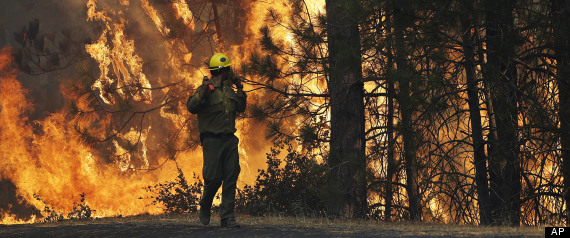
Firefighter A.J. Tevis watches the flames of the Rim Fire near Yosemite National Park, Calif., on Sunday, Aug. 25, 2013. With winds gusting to 50 mph on Sierra mountain ridges and flames jumping from treetop to treetop, hundreds of firefighters have been deployed to protect this and other communities in the path of the Rim Fire raging north of Yosemite National Park. (AP Photo/Jae C. Hong)
The wildfire in Northern California continues to spread into Yosemite National Park and has begun to threaten towns in the area. From the LA Times: Massive Rim fire continues to reshape lives and topography.
…even as firefighters worked furiously to hold a line outside of town, officials warned that this blaze was so hot it could send sparks more than a mile and a half out that could jump lines and start new hot spots. Evacuation advisories remain in effect for Tuolumne City and nearby areas.
On the north edge, the fire — now 134,000 acres — pushed into the Emigrant Wilderness Area and Yosemite National Park. It’s the one side of the fire with a natural last stand: Eventually it will run into granite walls that have snuffed out fires in this region for centuries.
Each day, what the massive blaze does depends on the wind. But officials were particularly attuned to each shift of breeze Sunday because of the weather’s eerie similarities to the day when the fire first exploded out of control.
So far the unpredictable blaze is only about 20% controlled, and it still threatens water and power sources for San Francisco.
The massive fire presents every challenge: steep slopes, dry fuel, rugged terrain and entire communities possibly in harm’s way.
The base camp and incident post, usually a haven outside fire lines, was a prominent example of the fire’s unpredictability: It’s in the middle of the burn zone, charred land with still-smoldering stumps on both sides.
Firefighters call such complete devastation “the black.” Entire ravines and ridges were a dusty gray moonscape. But some of the land was a “dirty burn” — meaning there were small circles of pine and aspen and even grass and wildflowers in the middle of charcoal-black areas where smoke still curled and embers glowed. The specks of beauty made firefighters nervous: To a fire, they are fuel.
My sister and her husband own a house north of San Francisco. It’s probably not in danger, but it still brings the scope of this disaster home to me. I sure hope Firefighers will begin to make progress soon. The burning area is now the size of the city of Chicago, according to CNN.
Yosemite National Park, California (CNN) — A massive northern California wildfire that’s threatening Yosemite National Park and San Francisco’s key water and power sources grew Monday, becoming the 13th largest in state history, state fire authorities said.
The Rim Fire, which has devoured 160,980 acres, has scorched an area about the size of the city of Chicago while more than 3,600 firefighters try to rein it in….
The wildfire, which was 20% contained Monday night, was spreading primarily to the east and threatened to grow amid extremely dry conditions and hot weather.
Part of the fire continued to spread Monday toward a key part of San Francisco’s water supply: the Hetch Hetchy Reservoir, which lies within Yosemite and is just east of the flames.
The fire also could threaten the area’s hydroelectric generators, which provide much of San Francisco’s electricity. Because of the approaching flames, officials shut down the generators, and the city — more than 120 miles to the west — temporarily is getting power from elsewhere.
Speaking of disasters, Charles Pierce reminds us that West, Texas is still recovering from the horrible explosion at the fertilizer plant there and that Texas still isn’t doing that much to prevent similar events in the future.
Read the rest of this entry »
Monday Reads
Posted: April 29, 2013 Filed under: morning reads | Tags: Black voter turnout, Brown-Vitter, congressional lap dogs, Dodd Frank, hairless cats that look like Putin, scrambling for the rich, West Fertilizer Co. 29 Comments Good Morning!
It has really been raining here in New Orleans. I mean really raining. Yesterday there was a series of downpours and it I don’t recall seeing the sun. I am trying to tell myself to not complain too much because this is better than the horrible hot heat of summer. But, I would like to feel like it is daytime some time during a day. This is making it very hard for me to think about posting political news. Some days the last thing you need is more doom and gloom. So let me give you a scattering of good, bad, and interesting.
Black voter turnout passed white turnout this past election. This is a historical event. My guess is that all the active voter suppression attempts caused black Americans to get out to protect their voting rights.
America’s blacks voted at a higher rate than other minority groups in 2012 and by most measures surpassed the white turnout for the first time, reflecting a deeply polarized presidential election in which blacks strongly supported Barack Obama while many whites stayed home.
Had people voted last November at the same rates they did in 2004, when black turnout was below its current historic levels, Republican Mitt Romney would have won narrowly, according to an analysis conducted for The Associated Press.
Census data and exit polling show that whites and blacks will remain the two largest racial groups of eligible voters for the next decade. Last year’s heavy black turnout came despite concerns about the effect of new voter-identification laws on minority voting, outweighed by the desire to re-elect the first black president.
William H. Frey, a demographer at the Brookings Institution, analyzed the 2012 elections for the AP using census data on eligible voters and turnout, along with November’s exit polling. He estimated total votes for Obama and Romney under a scenario where 2012 turnout rates for all racial groups matched those in 2004. Overall, 2012 voter turnout was roughly 58 percent, down from 62 percent in 2008 and 60 percent in 2004.

Did you know the Koch Brothers had a huge portion–in fact the largest portion–of the fertilizer business? Have you also noticed how we continue to see an under-reporting of the West Fertilizer Co. explosion? Why have there been no arrests made? Bangaldesh sure got their man pretty quickly when it came to those responsible for unsafe work conditions killing people.
The West Fertilizer Co. explosion last week in West, Texas, took the lives of at least 14 and left scores injured and homeless. But the story was largely obscured by blanket coverage of the Boston Marathon bombing. More than that, says legendary EPA whistleblower Hugh Kaufman, a guest on this week’s CounterSpin, what coverage there was often obscured the real story. Here’s a transcript of Kaufman’s appearance:
CounterSpin: In his recent piece on the Nation‘s website, Greg Mitchell interviews you about the explosion in the town of West, Texas. Before we get to what’s missing in the coverage of the West disaster, tell us what the media is reporting.
Hugh Kaufman: The media is reporting the case as if it’s some sort of an industrial accident, when in fact the town of west Texas is blown off the face of the earth. The material that did all that damage was the same material that Timothy McVeigh used to blow up the Oklahoma City building — the fertilizer, ammonium nitrate.
CS: Two hundred seventy tons of it.
HK: That’s correct. So the amount of people harmed and the ramifications are incredible. Thousands of people every year die who work in dangerous industries, whereas only a few people die because of a terrorist bombing. And yet, there is nothing but a wall-to-wall coverage of Boston disaster around the same time as a town in Texas is blown off from the face of the earth.
Both situations are frightening but what’s more frightening is that the terrorists seem to be winning the war of the TV coverage. But there are thousands more people harmed and killed because of lax law enforcement of dangerous industries. The fertilizer industry is a dangerous industry.
CS: But you’re saying that this fertilizer explosion wasn’t just a matter of some regulatory oversight. You claim in Greg Mitchell’s piece that there’s perhaps criminal activity here.
HK: The company lied to EPA when they said that there is no risk of fire or explosion at the facility, but at the same time they told EPA that, they were honest with the state because they know the state wouldn’t do anything in saying that they had 270 tons of fire and explosive material, the ammonium nitrate. So they were honest with the state because they knew the state wasn’t going to do anything, but to the federal government and the Obama administration, they lied. And of course, the local fire department — not equipped to handle the type of emergency that that entailed — they didn’t have any respirators, they didn’t have any training how to handle that type of fire.
CS: They did not know not to squirt water on that type of fire, even.
HK: Exactly. And they didn’t even know there was such a risk of an explosion.
CS: You also give some praise but many media outlets got the story wrong. Let’s have the bad first.
HK: I think the worst was the New York Times. The New York Times claimed that the company notified EPA that they had 270 tons of this explosive ammonium nitrate, but they did not notify EPA of that. In fact, they told EPA that the facility posed no fire or explosion hazard. The New York Times did not say that, and I think that’s probably the biggest problem.
Interestingly, Texas is a Republican state — a red state — and in fact, many of the leaders want to secede from the union, and they despise EPA — they want the EPA abolished. And yet the Republican newspaper, the Dallas Morning News, has probably has the best environmental coverage of the case, which makes it very ironic to me.
 My scourge-of-the-country senator is still trying to tank Dodd Frank. He and three others are being sneaky about it. Course, Diaper David Vitter’s used to being sneaky about things. Here’s a story where he’s the hooker.
First, the Brown-Vitter legislation, which was introduced April 24, changes everything. The news isn’t that Brown wants to make the financial system safer. That has been a top priority of his since the spring of 2010, when he co-wrote the Brown-Kaufman amendment, which would have imposed a binding size cap on the largest banks. (It failed on the Senate floor.)
Now, however, he has a Republican co-sponsor, and they have converged on a strong message. Vitter, who is on the right of the political spectrum, articulates well the case for ending the implicit subsidies that exist because creditors understand that the government and the Federal Reserve won’t allow a megabank to fail. This broad and sensible message resonates across the political spectrum.
Second, small banks are increasingly focused on the ways megabanks have achieved an unfair competitive advantage — primarily through implicit government subsidies.
The most compelling voice at the forum last week was Terry Jorde, a senior executive vice president of the Independent Community Bankers of America. She made clear that small banks are being undermined by the reckless behavior of megabanks that are seen as “too big to fail.” There is no market at work here, just a hugely unfair and inefficient government-subsidy scheme. The U.S. economy wasn’t built on megabanks and there is no good reason to continue to accept the risks they pose.
The megabanks have more money to spend on politics than the community banks. And as the biggest banks become even larger, they acquire more clout, spreading branches and other largesse across congressional districts. But for the moment, in all 50 states, community bankers are strong enough — both directly and as leaders in their communities — to effectively stand up to the six largest banks that are at the heart of the problem.
I found this analysis in the NYT compelling. Congress get all kinds of things done for the powerful quickly. But, when it comes to doing things for ordinary people, the entire process stalls. It’s an op ed by their editorial board.
Congress can’t pass a budget or control guns or confirm judges on time, but this week members of both parties found something they could agree on, and in a big hurry: avoiding blame for inconveniencing air travelers. The Senate and House rushed through a bill that would avert furloughs to air traffic controllers, which were mandated by Congress’s own sequester but proved embarrassing when flights began to back up around the country.
Then lawmakers scurried out of town, taking a week’s vacation while ignoring the low-income victims of the mandatory budget cuts, who have few representatives in Washington to protest their lost aid for housing, nutrition and education. Though they are suffering actual pain, not just inconvenience, no one rushed to give them a break from the sequester, and it is clear that no one will.
Catering to the needs of people with money, such as business travelers, is the kind of thing the country has come to expect in recent years from Congressional Republicans. But Democrats share full responsibility for this moment of cowardice. The Senate version of the bill passed by unanimous consent. That means not a single Democrat opposed bailing out travelers while poor kids are getting kicked out of Head Start or nutrition programs.
Even worse, the White House said President Obama would sign the bill. Apparently the ridicule pouring out of Republican offices — with Twitter hashtags like #ObamaFlightDelays — was extremely effective.
In the House, only 29 Democrats voted against the gift to travelers, which was made possible by switching some funds for airport improvement into the controllers budget. One of the few willing to brave the Republican attack machine was Steny Hoyer, the Democratic whip, who said he could not support repealing a piece of the sequester while preserving its harmful impact. “Seventy thousand children will be kicked out of Head Start,” he said. “Nothing in this bill deals with them.”
As I said, I found this article compelling because I’ve noticed that they’ve scrambled to ensure that small airports–home to private jets and planes–are getting priority over children, cancer patients, and all kinds of things that benefit people What kind of country has those kind of priorities?
Foreign Policy has decided it wants to see more lists like in Gawker and Buzzfeed. You know those buzzfeed lists with items like the top 12 reasons why Justin Beieber annoys us or the ten reasons George Bush and Dick Cheney should share cell in prison. So, as a last little morning laugh, go check out the link and see great suggestions like this one:
Seriously, it’s a good idea.
So, what’s on your reading and blogging list today?
Time for Media Talking Heads to Get Out of Boston and Head Down to Texas
Posted: April 21, 2013 Filed under: Barack Obama, Real Life Horror, Regulation, The Media SUCKS, U.S. Politics | Tags: ammonium nitrate, Buck Uptmor, CNN, Department of Homeland Security, Derrick Hurtt, disasters, Doug and Robert Snokhous, Jerry Chapman, Joey Pustejovsky, Kevin Sanders, West Fertilizer Co., West TX 42 Comments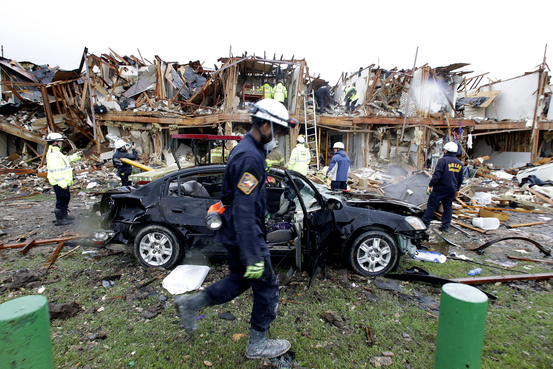
Firefighter conduct search and rescue of an apartment destroyed by an explosion at a fertilizer plant in West, Texas, Thursday, April 18, 2013.
I don’t watch much television, but tonight I turned on CNN for awhile. I was surprised to find that there were still numerous national reporters standing around in Watertown and Boston doing live stand-up reports. Why? The story is pretty much over at this point. What remains is mostly legal stories. Those don’t require on-sight reporting by media stars. Is it just the label “terrorism” that is keeping the national media focused on Boston?
Meanwhile, on Thursday there was a horrific disaster in the small town of West, Texas when a fertilizer plant exploded, killing 14 people, injuring 200, and destroying a school, a nursing home–basically about half of the small town. Hundreds of people in West are now homeless and desperately in need of help.
On CNN’s home page tonight, I could find only one prominently placed story about the Texas disaster: Texan town tries to rebuild with community, spirituality
Search and rescue efforts have evolved into search and recovery efforts, because officials don’t expect to find any more victims in the wreckage — alive or dead.
The explosion at West Fertilizer’s plant ruined much of the north side of town, and left hundreds of people injured, homeless and in need of help.
On television nationally, the scope of the tragedy was overshadowed by the dramatic events in New England, as investigators there pursued leads in the Boston Marathon bombing investigation, then pursued their suspects.
No kidding.
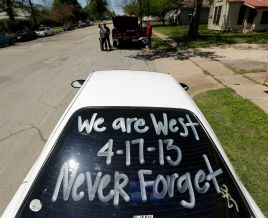
A sign is seen on a car window as residents wait to enter a damaged neighborhood Saturday, April 20, 2013, three days after an explosion at a fertilizer plant in West, Texas (Houston Chronicle)
But many Texans kept their focus on the great need close to home. Long lines of cars streamed by the community center, dropping off food, water and other rations throughout the weekend. Numerous church groups and restaurants handed out hot meals.
“These are our neighbors. They are coming to help,” Waco Police Department Sgt. William Patrick Swanton told reporters. “You will find that in Texas. You will find that across the United States. We put everything aside when it comes to these types of situations.”
The nine first responders from West who died battling the blaze represented nearly one-third of the town’s volunteer firefighting and EMT force. The fire destroyed two fire trucks and an ambulance. Firefighters and trucks from neighboring communities now fill the void at the West firehouse.
Another piece at CNN dated April 19, 11:41 PM lists “Five stories you may have missed during Boston bombings.” The list doesn’t include the Texas explosion!
There are plenty of national stories to be covered in West, Texas right now. For example, the fact that the feds had no clue of the danger that lurked inside the West Fertilizer Co. plant. The Houston Chronicle reports:
The Department of Homeland Security, the federal agency charged with regulating the highly explosive substance ammonium nitrate, wasn’t aware that West Fertilizer Co. stored 270 tons of ammonium nitrate – 1,300 times the threshold that triggers federal oversight.
But the small company did submit the information to another government agency – the Department of State Health Services.
Had federal officials been aware of the information contained in the state disclosure, DHS officials might have inspected the facility and required safer storage.
The patchwork of local, state and national laws regulating fertilizer facilities remains at the heart of the investigation into the deadly explosion that claimed 14 lives in the tiny Czech community of West. Saturday, company officials were unavailable to explain why they had not complied with DHS rules, promulgated in the last five years, requiring the disclosure of such a large quantity of ammonium nitrate.
Since 2006, the company complied with state agencies overseeing air emissions and product quality, but no state agency had the legal authority to inspect and enforce safety measures at the plant.
That is huge news! How many other industrial plants are there around the country with safety issues about which federal agencies have no knowledge? Time for the national media to get busy finding out the answer to that question.
I’m not going to go on and on about this; I think I’ve made my point. But here are a few more stories about the Texas disaster.
Huffington Post: Derrick Hurtt, West, Texas Resident, Describes Plant Explosion: ‘You Think You’re Dead’ (VIDEO)
Derrick Hurtt, a lifetime resident of West, Texas, says the major plant explosion that rocked his small hometown last week left him feeling for a split-second like he had died.
Hurtt caught the deadly blast on a cell phone camera a couple of blocks away, creating a video that ultimately went viral. The explosion at West Fertilizer Co. last week left at least 14 people dead and hundreds of others injured. Hurtt described his harrowing experience to the Waco Tribune Friday.
“It was pitch-black. You think you’re dead,” he said. “And then that mushroom sucked all the darkness back into the cloud, all that black smoke. In the daylight, you realize that you’re not dead.”
NY Daily News: Some stranded families allowed to return after West, Texas, fertilizer plant explosion
Stranded families growing weary and frustrated since a deadly Texas fertilizer plant explosion left them barricaded from their battered homes finally began returning Saturday, but only under a curfew and strict warnings to not wander beyond their own yards.
Authorities gave the much-awaited okay after a nervous morning. Emergency workers had told residents packed in a hotel — waiting for updates about their neighborhood — that leaking gas tanks were causing small fires near the blast site, keeping authorities from lifting blockades.
Officials quickly emphasized that the fires were contained and the town of West was not in danger. They later repeated that message as evacuees in a mile-long line of cars inched along a downtown road and toward the blast radius, although the chances that most would get to their houses Saturday night dimmed as a 7 p.m. curfew approached.
Miami Herald: 4 more first responders killed in Texas blast ID’d
On Sunday, professional organizations and family and friends identified four more of the first responders who died: brothers Doug and Robert Snokhous, who were both firefighters with the West Volunteer Fire Department; Jerry Chapman, a firefighter with the Abbott Volunteer Fire Department; and Kevin Sanders, who worked with West EMS and another area volunteer fire department.
Heartbreaking. The town didn’t even have a fire department–these were volunteers! Another report from the Miami Herald:
Buck Uptmor didn’t have to go to West Fertilizer Co. when the fire started. He wasn’t a firefighter like his brother and cousin, who raced toward the plant. But a ranch of horses next to the flames needed to be moved to safety.
“He went to help a friend,” said Joyce Marek, Uptmor’s aunt. “And then it blew.” [….]
The dead included Uptmor and Joey Pustejovsky, the city secretary who doubled as a member of the West Volunteer Fire Department. A captain of the Dallas Fire Department who was off-duty at the time but responded to the fire to help also died.
The explosion was strong enough to register as a small earthquake and could be heard for many miles across the Texas prairie. It demolished nearly everything for several blocks around the plant. More than 200 people were hurt, and Muska said five first-responders were among those who remained hospitalized Friday.
The first-responders “knew it was dangerous. They knew that thing could go up at any time,” said Ronnie Sykora, who was Pustejovsky’s deacon at St. Mary of the Assumption Catholic Church. “But they also knew that if they could extinguish that fire before it went up, that they could save tens of lives, hundreds of lives. That’s why they were in there.”
Fort Worth Star-Telegram: Investigators describe West explosion as a wave of destruction
WEST — On the grass outside the shredded apartment complex sat several large chunks of concrete, basketball-sized pieces of shrapnel that were sent flying by the force of Wednesday’s fertilizer plant explosion.
Officials said the concrete and other pieces of projectile had once been part of the West Fertilizer Co., which exploded about 20 minutes after a fire broke out early that evening….
When the explosion occurred, investigators said the blast radiated outward, slamming into a nearby railroad track berm. The explosion’s force was deflected upward by the berm before rushing back down to pummel the apartment complex, a nursing home and West Intermediate School and eventually moving into neighborhoods.
“The easiest way to describe it is think of a wave going out and it may come up and down with it,” said Kelly Kistner, said assistant State Fire Marshal.
The destruction from the blast spread over a 37-square-block area of West that was described as a “war zone” by Brian Hoback, the National Response Team leader with the Bureau of Alcohol, Tobacco and Firearms.
The story says that today “a handful of reporters and photographers were allowed to see some of the areas that were hit the hardest by the explosion…” A handful of reporters? Why weren’t there well-known national broadcast reporters down there doing live stand-ups?
Here’s another story they could be covering. The actual cause of the explosion is still unknown, according to NBC News.
Investigators have located the spot where the horrific Central Texas fertilizer plant explosion occurred but do not yet know what triggered the deadly blast, town officials said Sunday.
West, Texas, fire officials said at a news briefing that there is no evidence of criminal activity in last Wednesday’s massive explosion at the West Fertilizer Co., and that there are no longer any fires burning at or around the decimated facility….
A fire official announced the city has identified the “seat” — origin — of the explosion, but did not specify the exact site.
“We do have a large crater,” Assistant State Fire Marshal Kelly Kistner said.
The national media should be down in Texas finding out what the hell happened and holding federal agencies responsible for their failures–not to mention Congress and Texas state officials who have fought against government regulations on businesses. Besides I really want these bozos out of Boston. I can’t imagine how Dakinikat has put up with all these folks swarming around New Orleans over the past several years. They are driving me nuts!
President Obama should go down there too, and if he doesn’t I’d sure like to know why.

 peej
peej Carissa
 bostonboomer
 dakinikat
 ecocatwoman
 mablue2
 Mama Lopez
 peggysue22
 quixote
 skydancingguestblogger
 Mona (aka Wonk the Vote)



 Sky Dancing
Recent Comments