
Tuesday Reads: Gordon Gekko for President?
Posted: January 10, 2012 Filed under: 2012 presidential campaign, Barack Obama, Hillary Clinton, Mitt Romney, morning reads, Newt Gingrich, Republican presidential politics, U.S. Economy, U.S. Politics, unemployment | Tags: Citizen's United, corporate raiders, leveraged buyout firms, Massachusetts Governor's race 2002, Mitt Romney, New Hampshire primary, Newt Gingrich, Robert Reich, Roberts Court, SCOTUS, Wall Street 27 Comments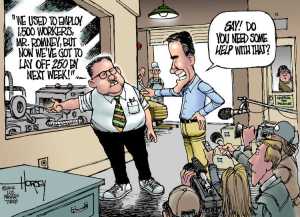
Good morning! Today is the New Hampshire primary. We’ll live blog the returns later tonight. As of last night, Gordon Gekko Mitt Romney had a big lead in the polls, with Ron Paul second and John Huntsman and Rick Santorum tied for third place.
Romney, the former governor of neighboring Massachusetts, holds a 24 percentage point lead over his closest rival, with 41 percent of likely Republican primary voters indicating they’d vote for him, the WMUR New Hampshire Primary Poll said.
U.S. Rep. Ron Paul from Texas was favored by 17 percent of likely primary voters, followed by former Utah Gov. Jon Huntsman and former U.S. Sen. Rick Santorum of Pennsylvania, each with 11 percent, and former House Speaker Newt Gingrich collecting 8 percent.
Several polls indicated Gingrich would finish in the top three.
“All of the candidates behind Romney have a good chance finishing anywhere between second and fifth place,” said Andrew Smith, director of the UNH Survey Center in Durham.
Yesterday Romney stepped in it again when he told an audience that he really likes firing people.
The final day of campaigning saw Romney under fire for a comment about health insurance that quickly became fodder for criticism.
Asked about the issue in Nashua, New Hampshire, Romney said he wanted a person to be able to own his or her own policy “and perhaps keep it the rest of their life.”
“That means the insurance company will have the incentive to keep you healthy. It also means if you don’t like what they do, you can fire them,” he said.
“I like being able to fire people who provide services to me,” Romney added. “If someone doesn’t give me the good service I need, I want to say I am going to get somebody else to provide that service to me.”
Romney complained that everyone was taking his remarks out of context, but when you’re a former corporate raider worth $250 million, it’s probably a good idea to watch what you say about putting people out of work.
Anyway, the latest meme about Romney is that he’s Gordon Gekko brought to life. I think it’s a pretty good comparison. I don’t know if you recall the quote from the recent Vanity Fair profile of Romney that I included in a recent post:
Romney described himself as driven by a core economic credo, that capitalism is a form of “creative destruction.” This theory, espoused in the 1940s by the economist Joseph Schumpeter and later touted by former Federal Reserve Board chairman Alan Greenspan, holds that business must exist in a state of ceaseless revolution. A thriving economy changes from within, Schumpeter wrote in his landmark book, Capitalism, Socialism and Democracy, “incessantly destroying the old one, incessantly creating a new one.” But as even the theory’s proponents acknowledged, such destruction could bankrupt companies, upending lives and communities, and raise questions about society’s role in softening some of the harsher consequences.
Romney, for his part, contrasted the capitalistic benefits of creative destruction with what happened in controlled economies, in which jobs might be protected but productivity and competitiveness falters. Far better, Romney wrote in his book No Apology, “for governments to stand aside and allow the creative destruction inherent in a free economy.” He acknowledged that it is “unquestionably stressful—on workers, managers, owners, bankers, suppliers, customers, and the communities that surround the affected businesses.” But it was necessary to rebuild a moribund company and economy.
That sure sounds Gekko-like, doesn’t it?
Yesterday, Rick Klein of ABC News addressed the Romney/Gekko issue.
Virtually all of Romney’s rivals are now sensing a powerful issue. Jon Huntsman said today that the firing comment shows that Romney is “completely out of touch” with the American economy.
Rick Perry, skipping ahead a state, is calling it the “ultimate insult for Mitt Romney to come to South Carolina and tell you he feels your pain, because he caused it.”
Gingrich is equating Romney’s business style with finding “clever legal ways to loot a company.” Rick Santorum’s stump speech includes a line about not needing a CEO as president, and he suggested at ABC’s Saturday night debate in New Hampshire that Romney’s background calls into question whether he “can inspire and paint a positive vision for this country.”
Romney hasn’t made matters easier for himself as he’s tried to connect with voters on the economy. The son of a millionaire business titan said over the weekend: “I know what it’s like to worry about whether or not you are going to get fired.”
Klein claims it’s too late for any of this to affect the New Hampshire primary results. I wouldn’t be so sure. New Hampshirites are famous for making up their minds at the last minute. Remember Hillary’s surprise win in 2008?
Romney has been expecting the Gordon Gekko comparisons, so you have to wonder why he hasn’t managed to curb some of these Gekko-like remarks. I guess he just can’t help himself.
Mitt Romney says he knows a photo in which he appears with other executives at Bain Capital LLC posing with cash in their hands, pockets and mouths will be used against him if he wins the Republican presidential nomination.
The 1980s image — called the “Gordon Gekko” photo by some Democrats, a reference to the Michael Douglas character in the movie “Wall Street” — offers an easy attack line at a time of high unemployment and sharp rhetoric against the nation’s top money managers, investors and bankers.
“We posed for a picture, just celebrating the fact that we had raised a lot of money and then we hoped to be able to return it with a good return,” Romney said on “Fox News Sunday.”
Here’s Romney’s defense of the photo on Fox News Sunday.
Andrew Leonard of Salon also discussed the comparison of Romney with Gekko.
Like Gekko, Romney made his fortune buying and selling companies; and like Gekko, he believes that his “greed is good” version of rough-and-tumble creative destruction is a positive force for America, weeding out the bad performers and nurturing lean-and-mean profit engines. If you are looking for the paradigmatic exemplar of the new style of capitalism mogul launched by the Reagan revolution, Romney is your man. Michael Douglas’ Gordon Gekko is merely ersatz.
But what Leonard finds so amazing is that this attack on Romney and his leverage buyouts is being led Newt Gingrich.
The shock is to see Newt Gingrich and his financial backers channeling the Oliver Stone critique so passionately and wholeheartedly. If you have not seen the three-minute advertisement “When Romney Came to Town,” the soon-to-be debuted documentary lambasting Romney as the enemy of the American worker, prepare to be flabbergasted.
“Their greed was only matched by their willingness to do anything to make millions in profits.”
“This film is about one such raider and his firm.”
“His mission: To reap massive rewards for himself and his investors.
“Romney took foreign seed money from Latin America, and began a pattern exploiting dozens of American businesses.”
And so on. Michael Moore doesn’t sting this hard, and MoveOn isn’t this angry. If Romney, as expected, ends up winning the Republican nomination, Obama’s campaign team can relax. Their work has already been done.
Here’s the trailer for the 27-minute documentary that Gingrich backers have purchased.
Politico calls it “the Bain Bomb.”
While conservatives look unlikely to unite around one alternative to Romney, the campaigns themselves are uniting around the theme that the former head of Bain Capital looted companies, tossed people out of jobs and is now exaggerating his success at the venture capital firm.
In the context of this moment in American politics, in which frustration with the privileged is boiling hot, the attack, from Republicans on one side and the Obama campaign on the other, will test Romney. If he ends up looking more like an opportunist who profited for the few than like a man who created jobs for the many, it’s hard to imagine his polls numbers won’t drop.
Conservative bloggers, who generally can’t stand Romney have begun defending him against his rivals attacks, and Dana Millback called Romney “the Scrooge McDuck of the 2012 presidential race. Bloomberg reports that buyout firms are getting nervous about damage to their reputations.
This could be fun to watch. I thought Newt’s attack on Romney yesterday was spot on.
Is Romney full of shit or what? He even makes Newt Gingrich look good. I hope Newt sticks around and continues letting it all hang out. Every single word he said about Romney was the truth.
I’m going to wrap this up with a more serious take on Romney from Robert Reich: Mitt: Son of “Citizen’s United.” I had forgotten that Reich ran for governor of Massachusetts in the the Democratic primary in 2002. Please go read the whole thing and try not to weep while you’re doing it.
As Reich says, Romney is the ultimate big money candidate. He was in 2002, and now with the help of the Roberts Court, he has more money than any candidate ever dreamed of before. If you thought Obama was the candidate of Wall Street–and he was in 2008–Romney is soooo much more so. He has money and connections that make Obama’s fundraising look pathetic. And none of this money even needs to be reported–it could be coming from overseas, even from foreign governments, and we’d never know.
Tonight we’ll find out of any of this barrage of Gordon Gekko/Mitt Romney comparisons will have any effect. I’m rooting for Romney to be taken down a peg. And then on to South Carolina!
Please share your links in the comments, and I hope to see you tonight for the live blog.
Thursday Reads
Posted: October 27, 2011 Filed under: #Occupy and We are the 99 percent!, Catfood Commission, Super Committee | Tags: derivatives, Dodd Frank, Euro, Euro Debt Crisis, Herman Cain, Right Wing Lies, Super Committee, Tax Dodging, Volcker Rule, Wall Street 27 Comments Good Morning!
It’s amazing what kind of nonsense the right wing can come up with when their interests and myths are threatened. Here’s the latest Faux News canard about Occupy. It’s an ACORN plot! If any one believes that, I have a few bridges across the Mississippi I’d like to sell them. The Crescent City Connection even comes with tolls!!
How can a group that folded 19 months ago secretly conspire to bolster Occupy protests? Apparently, “sources tell” Fox News that people who used to work for ACORN have now taken on roles helping organize Occupy protests. In fact, Fox News reports that the former director of New York ACORN and his aides are now working for New York Communities for Change (NYCC), which is turn supporting demonstrations.
I’m not sure why this would be especially interesting if true — if folks who used to be involved with one group then started playing a role with another, who cares? — but as it turns out, a spokesperson for Occupy Wall Street said the NYCC isn’t playing a role in the protests anyway. But don’t worry, Fox News’ unnamed “source” said the group really is up to secret misdeeds, adding, “And yes, we’re still ACORN, there is a still a national ACORN.”
It’s safe to assume that Fox News has reliable contacts among progressive activist organizations, right? There’s bound to be plenty of former ACORN staffers and Occupy activists eager to dish to the Republicans’ cable news outlet, right?
Please. It’s really no wonder at all why Fox News’ audience ends up believing so much nonsense.
They do believe the nonsense, which makes Fox News watchers very dangerous in the voting booth.
Dems on the Super Committee are offering up Medicaid and other ‘entitlements’ in order to get tax increases from Republicans. It didn’t work, but you have to wonder exactly what all they’re willing to put on the table.
Republicans have pressured supercommittee members to reject any deficit-reduction deal that raises taxes — including stimulus spending for the economy would almost certainly be a non-starter for most in the party.
Democrats have said from the beginning that the supercommittee should produce a “jobs plan” that includes “investments” to help the economy.
The supercommittee is charged with devising a plan that will cut at least $1.2 trillion over 10 years from annual deficits, but deep divisions exist on the panel over whether to raise taxes and cut entitlements to meet that goal.
The members met again Wednesday afternoon and Democrats were looking to see if the GOP would present an alternative path to the grand bargain.
You may recall that the grand bargain was the giveaway President Obama offered to Boehner last summer during the debt ceiling talks. More details are available at this WAPO link.
The panel has floundered since meetings began in September. If the supercommittee fails to reach agreement to trim borrowing by at least $1.2 trillion through 2021, automatic spending cuts of an equal amount would be triggered in January 2013. These cuts would strike especially hard at the Pentagon, an outcome that Republicans are eager to avoid.
Ralph B posted this tidbit downthread last night. Chelsea Clinton is said to be considering a congressional run.
Clinton has been approached by “the right people” in the New York Democratic Party, according to one source in Albany. While no decision has been made, Clinton is said to be “actively considering” a Congressional run from New York State in 2012.
Chelsea Clinton, 31, is the only child of former U.S. President Bill Clinton and U.S. Secretary of State Hillary Rodham Clinton.
The discussions of running Chelsea Clinton for a house seat grew out of the redistricting plans currently underway in the New York State legislature in Albany.
The plan is to identify an open seat for Clinton in or around New York City where she currently resides with her husband, Marc Mezvinsky. While no specific district has been determined, New York City and Westchester are said to be the focus with New York’s 18th District considered a strong possibility. The 18th encompasses much of Westchester County, just south of where her parents have maintained a home for the past 12 years.
The Daily Beast reports that Herman Cain was delinquent in paying taxes in 2006. Additionally, he fought paying the bill.
According to court documents obtained by The Beast, Cain and his wife, Gloria, were served in February 2008 with a tax lien totaling $8,558.46 for unpaid income taxes and penalty due for the 2006 calendar year.
Gordon said Cain had filed with the IRS and won a six-month reprieve in paying his 2006 federal taxes as he was undergoing his treatment for stage four lymphoma and believed that filing should also have bought him time with the state of Georgia. “In Georgia, a taxpayer can submit a copy of his federal extension to request an extension of state income taxes,” Gordon said.
But instead, the state sent a notice of overdue taxes in October 2007, and then proceeded with the tax lien four months later, he said.
Cain’s accountant fought the Georgia Department of Revenue on behalf of his client well into 2008 and the two sides finally settled the matter in November 2008. A court formally withdrew the state tax lien on Dec. 8, 2008, court records show.
Gordon said the campaign was researching the exact date on which Cain made the payment to extinguish the lien
Robert Reich thinks that Wall Street is still out of control.
Dodd-Frank is rife with so many loopholes and exemptions that the largest Wall Street banks – larger by far then they were before the bailout – are back to many of their old tricks.
It’s impossible to know, for example, the exposure of the Street to European banks in danger of going under. To stay afloat, Europe’s banks will be forced to sell mountains of assets – among them, derivatives originating on the Street – and may have to reneg on or delay some repayments on loans from Wall Street banks.
The Street says it’s not worried because these assets are insured. But remember AIG? The fact Morgan Stanley and other big U.S. banks are taking a beating in the market suggests investors don’t believe the Street. This itself proves financial reform hasn’t gone far enough.
If you want more evidence, consider the fancy footwork by Bank of America in recent days. Hit by a credit downgrade last month, BofA just moved its riskiest derivatives from its Merrill Lynch unit to a retail subsidiary flush with insured deposits. That unit has a higher credit rating because the Federal Deposit Insurance Corporation (that is, you and me and other taxpayers) are backing the deposits. Result: BofA improves its bottom line at the expense of American taxpayers.
Wasn’t this supposed to be illegal? Keeping risky assets away from insured deposits had been a key principle of U.S. regulation for decades before the repeal of Glass-Steagall.
The so-called “Volcker rule” was supposed to remedy that. But under pressure of Wall Street’s lobbyists, the rule – as officially proposed last week – has morphed into almost 300 pages of regulatory mumbo-jumbo, riddled with exemptions and loopholes.
It would have been far simpler simply to ban proprietary trading from the jump. Why should banks ever be permitted to use peoples’ bank deposits – insured by the federal government – to place risky bets on the banks’ own behalf? Bring back Glass-Steagall.
The MSCI Asia Pacific Index gained 0.9 percent to 120.25 as of 11 a.m. in Tokyo, set for the highest close since Sept. 9. Standard & Poor’s 500 Index futures added 0.8 percent. The 17- nation euro climbed 0.5 percent to $1.3979 and rose 0.3 percent to 106.26 yen. Treasury 10-year notes erased earlier gains. Copper, zinc and lead jumped more than 1.4 percent in London and crude climbed 1.9 percent in New York.
French President Nicolas Sarkozy said the euro region’s bailout fund will be leveraged by four to five times, and investors have agreed to a voluntary writedown of 50 percent on Greek debt. Sarkozy plans to call Chinese leader Hu Jintao today to discuss contributions from the Asian nation to a fund European leaders may set up to fight the crisis, a person familiar with the matter said.
The news of a deal is “certainly mildly positive news for markets,” Adarsh Sinha, head of strategy for Group of 10 foreign exchange at Bank of America, said in a Bloomberg Television interview in Hong Kong. “We have got a plan out but a lot of the details aren’t in place.”
CNN announced the details late last night.
French President Nicolas Sarkozy said Greek bondholders voluntarily agreed to write down the value of Greek bonds by 50%, which translates to €100 billion and will reduce the nation’s debt load to 120% from 150%.
Sarkozy said the leaders agreed to boost the firepower of the EU bailout fund, known as the European Financial Stability Facility, “by four or five fold.” He added that officials have negotiated additional funding from the International Monetary Fund.
The writedowns were one of three inter-related problems political leaders must solve to devise a comprehensive solution to Europe’s debt crisis. They must also determine how to leverage a government-backed bailout fund and stabilize the banking sector.
EU leaders had pledged to resolve these issues Wednesday at their summit in Brussels. But given the bondholders’ resistance, it was unclear until the early hours of Thursday if the leaders would be able to follow through.
Earlier, the European Council issued a statement saying heads of state had agreed to raise capital requirements for banks vulnerable to losses on euro-area government bonds.
Under the terms outlined by EU officials, banks would be required to sharply increase core capital levels to 9% to create a buffer against potential losses. The amount to be raised would be determined after accounting for declines in the value of euro-area government bonds, including debt issued by Greece.
Based on market rates in September, banks will need to raise a total of €106 billion to meet the new targets, according to the European Banking Authority.
So, that’s the headlines that have grabbed my attention today. What’s on your blogging and reading list today?
Is Timmy in the Well Again?
Posted: October 14, 2011 Filed under: Team Obama | Tags: Shadow Banks, Timothy Geithner, Wall Street 9 Comments Boston Boomer has been updating me on the shenanigans pulled by Timothy Geithner via Ron Suskind’s “Confidence Men”. I’m hoping she’ll outline all the stuff in a post soon. I’m sure you remember how Geithner approved Wall Street Executives giving themselves bonuses after receiving TARP funds. There’s substantial evidence that Geithner blocked plans to remove CEO Vikram Pandit and dismantle Citibank. He evidently had incredible issues with Sheila Bair, is known for throwing screaming fits when his pet Wall Street Banker friends are threatened and evidently ignored the President’s orders to get tougher on Wall Street early in the administration. Again, I”ll let Boomer flesh it out for you but there’s some really heady information out there about Geithner and his incredible coziness with the shadow banking industry.
Given that context, color me surprised by this Politico headline: Geithner: Action against Wall St. coming.
Asked on CNBC about the Occupy Wall Street movement’s frustrations over the lack of criminal charges related to the financial crisis, Geithner said action is on the way.
“You’ve seen very, very dramatic enforcement actions already by the enforcement authorities across the U.S. government, and I’m sure you’re going to see more to come. You should stay tuned for that,” he said.
…
Geithner Friday said the Obama administration had moved swiftly after the crisis to put into place new protections for consumers and investors.“We moved very quickly to put in place a much stronger set of rules of the game across the financial sector. Now, we’re now facing a lot of resistance to those rules, but we’re going to make sure that we deliver the promise of those reforms, which is a much tougher set of rules across the system against risk-taking and much stronger protections for consumers,” he said.
Geithner responded to the Occupy Wall Street demonstrations by asserting that their unhappiness was due to the sluggish pace of overall economic growth.
“What you see is a general sense across the country of concern that the U.S. economy is not growing faster, you’re not seeing incomes rise more rapidly, and people want to make sure that the government, Washington, is acting to make things better now. As part of that, they want to see us deliver much stronger protections for consumers and investors as an economy as a whole,” Geithner said on CNBC.
The Treasury Secretary added that the domestic focus was to ensure that Congress would take steps that would encourage economic growth and lower the deficit.
“What we’re focused on is trying to make sure that we are doing everything to encourage Congress. … to take some steps now that can make growth stronger in the United States, and tie that to reforms to bring down our long-term deficits,” he said.
Something tells me that the deteriorating political scenario for the President has something to do with this conversation. However, I will believe it when I see it happen. Talk show chatter comes so cheap.
All Talk, No Action on Jobs
Posted: August 4, 2011 Filed under: jobs, Stock Market, U.S. Economy, U.S. Politics, unemployment, voodoo economics | Tags: Barack Obama, confidence fairy, Dylan Ratigan, free trade agreements, homework, Jake Tapper, Jay Carney, jobs, Newt Gingrich, patent reform, pharmaceutical companies, Tim Geithner, Wall Street 17 Comments
Disappoint Mints*
A couple of days ago Newt Gingrich made the bizarre claim that
President Barack Obama’s tenure in the White House “is a Paul Krugman presidency.”
Of course we know that Obama cannot stand Paul Krugman, because Krugman has been criticizing Obama since the back in 2008. No, Obama’s is not “a Krugman presidency.” It’s “a ‘the dog ate my homework'” presidency. It’s a “smoke and mirrors” presidency. Or maybe a “confidence fairy” presidency.
In the morning post today, I quoted both White House Press Secretary Jay Carney and Treasury Secretary Tim Geither holding forth on what Digby calls “the confidence fairy.”
Spokesman Jay Carney says there is no question that economic growth and job creation have slowed over the past half year.
But, Carney told a White House briefing, “We do not believe that there is a threat of a double-dip recession.”
Really? And how do you know this, Jay?
He blamed the earthquake and tsunami in Japan, higher energy prices, default worries in Europe and recently resolved uncertainty over raising America’s borrowing limit. Carney said, “We believe the economy will continue to grow.”
Uh huh. But what’s that based on? Where is your evidence? Carney never produced any.
Now here’s Tim Geithner on the dramatic spending cuts included in the debt ceiling bill:
GEORGE STEPHANOPOULOS: So this won’t cost us jobs?
TIM GEITHNER: No, it will not. Now … if we put this behind us then we can turn back to the important challenge of trying to find ways to make sure that we do everything we can to get more people back to work, strengthen our growth. And we’ll have more ability to do that now with people more confident and we can start to get our arms around the long-term problems.
Leaving aside the fact that no one I know is “more confident,” and Wall Street sure doesn’t seem “confident,” how will “confidence” translate into jobs? Especially now that there are caps on domestic spending that will prevent the government from helping create jobs?
Today’s Deadline Passes With No Progress: Now What?
Posted: July 24, 2011 Filed under: Democratic Politics, Economy, legislation, Medicare, Republican politics, Social Security, Surreality, the villagers, U.S. Economy, U.S. Politics, voodoo economics, We are so F'd | Tags: Asian markets, Barack Obama, Catfood Commission II, Federal debt ceiling, Grover Norquist, Harry Reid, John Boehner, kabuki, markets, Mitch McConnell, Nancy Pelosi, Super Congress, the dollar, Wall Street 19 Comments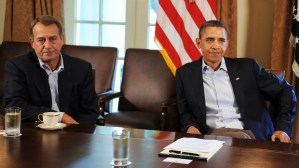
Late last night I wrote a post summarizing what happened yesterday in seemingly endless debt ceiling kabuki dance that is being staged for our benefit by people who are supposed to be serving us but instead answer to Wall Street, Big Oil, Big Pharma, and the rest of the filthy rich.
Last night John Boehner told House Republicans that they needed to show some progress today in order to calm the Asian markets. After weeks of assuming the politicians in Washington would work something out in order to keep the US from defaulting on its debts, the banksters were suddenly realizing there is a good chance the feckless “leaders” will just go ahead and let it happen.
Apparently both Democrats and Republicans see this debt ceiling debacle as a golden opportunity to strip Americans of what is left of their social safety net. The only disagreement seems to be that Democrats want to include a pretense of raising some revenue along with all the cuts to social programs and Republicans want no new revenue sources, apparently because they see an opportunity to bring Grover Norquist’s dream to fruition:
Norquist favors dramatically reducing the size of the government. He has been noted for his widely quoted quip: “I don’t want to abolish government. I simply want to reduce it to the size where I can drag it into the bathroom and drown it in the bathtub.”
He has also stated, “Cutting the government in half in one generation is both an ambitious and reasonable goal. If we work hard we will accomplish this and more by 2025. Then the conservative movement can set a new goal. I have a recommendation: To cut government in half again by 2050”. The Americans for Tax Reform mission statement is “The government’s power to control one’s life derives from its power to tax. We believe that power should be minimized.”
So what was accomplished in today’s kabuki performance? Did the Republicans meet Boehner’s goal of sending a calming signal to Asian markets before their Monday opening. No, of course not.
From The New York Times: Deadline Passes as Debt Ceiling Talks Languish
House Speaker John A. Boehner and the Senate majority leader, Harry Reid, were preparing separate backup plans to raise the nation’s debt ceiling on Sunday, after the leaders were unable to end an increasingly grim standoff over the federal budget.
The dueling plans emerged as lawmakers appeared to miss a self-imposed deadline of 4 p.m. Eastern time to cut a deal before markets open in Asia. And at about 6 p.m., President Obama began meeting with Mr. Reid and the House Democratic leader, Nancy Pelosi, in the Oval Office to discuss the Reid proposal.
Not surprisingly, nothing new seems to have emerged from the talks at the White House. But here’s Harry Reid’s supposed “plan.”
Mr. Reid, the Senate’s top Democrat, was trying Sunday to cobble together a plan to raise the government’s debt limit by $2.4 trillion through the 2012 election, with spending cuts of about $2.5 trillion. He would seek to avoid cuts to entitlement programs, but it was unclear how those savings would be achieved.
Notably, the plan does not currently contain any new or increased taxes, an approach that many in his caucus would probably balk at.
For his part, John Boehner is still blabbing on about the Republicans ridiculous “cut, cap, and balance” plan.
Speaker John Boehner (R-Ohio) told his colleagues in a Sunday afternoon conference call that a debt deal with Obama is not the way forward. He said on the call that a plan that “reflects the principles” of the conservative “Cut, Cap and Balance” proposal that the Senate rejected will serve as the model for any legislation coming out of the House. The speaker, though, did acknowledge that the plan itself is a non-starter.
“So the question becomes – if it’s not the Cut, Cap and Balance Act itself – what can we pass that will protect our country from what the president is trying to orchestrate,” Boehner said, according to a source familiar with the call.
Boehner and Majority Leader Eric Cantor (R-Va.), according to several sources on the call, implored his colleagues to “stick together” to enact a budget deal that they can support. Boehner said an agreement “will require some of you to make sacrifices.” He told his colleagues that they shouldn’t worry about winning the battles, but rather the war, according to a source on the call.
I found this piece at Huffpo helpful, although I’ve never heard of the author, Mohamed el-Erian. CEO and co-CIO, Pacific Investment Management Company. Perhaps Daknikat has? Here’s what he had to say after the supposed deadline passed without any progress.
Friday’s stunning and very public quarrel between the president and the Speaker of the House of Representatives was the catalyst for a weekend of frantic negotiations on how to increase America’s debt ceiling, maintain the country’s sacred AAA rating, and avoid a near-term default. Meanwhile, administration officials and members of Congress took to the airwaves on Sunday trying, but largely failing, to strike the balance between statesmanship and another round of the Washington blame game.
It was hoped that all this would serve as a prelude to a political compromise announced just before the opening of Asian markets. This did not materialize. But while another self-imposed deadline has been missed, it is likely that the nation’s leadership will stumble into a short-term compromise over the next few days — one that raises the debt ceiling and avoids a debt default but, importantly, leaves the AAA rating extremely vulnerable and does little to lift the damaging clouds hanging over the US economy.
It will come down to the wire; and when the stopgap compromise is reached, many in Washington will declare victory and, in the process, claim credit for averting a national disaster. Yet the resolution will likely be temporary, and the damage will be real and long-lasting — both of which render an already worrisome situation even more difficult going forward. Indeed, by illustrating so vividly to the whole world what is ailing America, the weekend’s political theatrics should make us all worry even more about the world’s largest economy.
It’s an interesting article. Obviously our “leaders” have already done immense damage to our struggling economy, not just with their wrongheaded policies, but also with their childish game-playing.
Boehner’s plan right now seems to be to insist on a short-term temporary increase in the debt limit of about $1 trillion
accompanied by spending cuts of at least as much, tying the remainder of the debt-ceiling increase Obama has requested to further cuts in the future. The White House says Obama would veto such a measure.
The markets responded quickly:
U.S. stock futures fell, indicating the Standard & Poor’s 500 Index will slump after rallying within 1.4 percent of a three-year high, as failure to raise the federal debt limit intensified concern of a default.
The contract on the S&P 500 Index expiring in September declined 1.2 percent to 1,325.50 at 7:01 a.m. in Tokyo. The U.S. dollar fell against the euro, yen and Swiss franc.
[….]
The dollar weakened to $1.4390 per euro as of 6:01 a.m. in Tokyo from $1.4360 in New York at the end of last week. The greenback fell to 78.35 yen, and touched a four-month low of 78.12 yen, from 78.54 on July 22. It fetched 81.17 Swiss centimes from 81.92 last week after reaching a record low 80.33 on July 18. The yen traded at 112.75 per euro from 112.77.
I don’t pretend to understand all that gibberish, but I know it isn’t good.
The Wall Street Journal says the markets are “bracing for volatility as debt ceiling debate drags on.”
What really scares me is what is going on behind all the “partisan” kabuki. Let’s face it, Democrats are no more our friends than Republicans at this point. We simply can’t trust any of them. I wrote a few days ago about the Catfood Commission II clause that is included in the so-called McConnell plan–the fallback plan that Harry Reid is on board with. Apparently Boehner has also latched onto this idea, and the sequel to the Catfood Commission will also be included in whatever legislation the Republicans come up with.
Ryan Grim has a piece in Huffpo today about Catfood Commission II, which he characterizes as a “Super Congress.”
Debt ceiling negotiators think they’ve hit on a solution to address the debt ceiling impasse and the public’s unwillingness to let go of benefits such as Medicare and Social Security that have been earned over a lifetime of work: Create a new Congress.
This “Super Congress,” composed of members of both chambers and both parties, isn’t mentioned anywhere in the Constitution, but would be granted extraordinary new powers. Under a plan put forth by Senate Minority Leader Mitch McConnell (R-Ky.) and his counterpart Majority Leader Harry Reid (D-Nev.), legislation to lift the debt ceiling would be accompanied by the creation of a 12-member panel made up of 12 lawmakers — six from each chamber and six from each party.
Legislation approved by the Super Congress — which some on Capitol Hill are calling the “super committee” — would then be fast-tracked through both chambers, where it couldn’t be amended by simple, regular lawmakers, who’d have the ability only to cast an up or down vote. With the weight of both leaderships behind it, a product originated by the Super Congress would have a strong chance of moving through the little Congress and quickly becoming law. A Super Congress would be less accountable than the system that exists today, and would find it easier to strip the public of popular benefits. Negotiators are currently considering cutting the mortgage deduction and tax credits for retirement savings, for instance, extremely popular policies that would be difficult to slice up using the traditional legislative process.
So basically, no matter what legislation Congress ends up passing to raise the debt ceiling, this “Super Congress” will be included. We certainly can’t expect any disagreement on this from Obama who, as Grim describes it “has shown himself to be a fan of the commission approach to cutting social programs and entitlements.”
We are so utterly f&cked.

 peej
peej Carissa
 bostonboomer
 dakinikat
 ecocatwoman
 mablue2
 Mama Lopez
 peggysue22
 quixote
 skydancingguestblogger
 Mona (aka Wonk the Vote)



 Sky Dancing
Recent Comments