
Monday Reads: The Struggles Continue
Posted: August 17, 2015 Filed under: morning reads | Tags: Civil Rights, Julian Bond, Planned Parenthood, voting rights 7 Comments
Good Morning!
Those of you that know me also know that my most profound and motivating interest lay with social justice issues. I think I was profoundly impacted by watching the evening news as a child. I still remember watching body counts from Vietnam and the images of small children being attacked by hoses and police dogs in places I couldn’t believe were associated with my country. Julian Bond–one of the most vibrant and high profile leaders of the civil rights movement–died on Saturday at the age of 75. His life stands as a tribute to all that has been gained and as a reminder of all the work that continues as we strive to ensure that all our citizens achieve equal status under the law and equal access to economic well being, knowledge, and power. Bond was also a leader in the anti-war movement as one of the founders of the Student Nonviolent Coordinating Committee. He leaves a tremendous legacy of social justice.
The Southern Poverty Law Center, where Bond served as president in the 1970s, announced his death in a statement on Sunday. The SPLC said Bond died Saturday evening in Fort Walton Beach, Fla.
“With Julian’s passing, the country has lost one of its most passionate and eloquent voices for the cause of justice,” the center’s statement read. “He advocated not just for African Americans, but for every group, indeed every person subject to oppression and discrimination, because he recognized the common humanity in us all.”
The Associated Press writes: “The Nashville, Tenn., native was considered a symbol and icon of the 1960s civil rights movement. As a Morehouse College student, Bond helped found [SNCC] and as its communications director, he was on the front lines of protests that led to the nation’s landmark civil rights laws.”
Bond played a major role in sit-ins and freedom rides and the 1963 March on Washington.
The New York Times says: “He moved from the militancy of the student group to the top leadership of the establishmentarian N.A.A.C.P. Along the way, he was a writer, poet, television commentator, lecturer, college teacher, and persistent opponent of the stubborn remnants of white supremacy.”
When he was elected to the Georgia Legislature in 1965, the chamber refused to seat him, citing his support for a group that called U.S. actions in Vietnam “murder.” He took the fight all the way to the Supreme Court, which ultimately ruled in his favor. The Times notes that he spent his two decades in the state’s legislature, “mostly in conspicuous isolation from white colleagues who saw him as an interloper and a rabble-rouser.”
In 1986, Bond ran against his long-time friend and SNCC co-founder John Lewis to represent Georgia’s 5th Congressional District, but was narrowly defeated in runoff.
 I can only hope to eventually achieve his status of “interloper and rabble-rouser” for justice. There are many recent events that remind us that none of the struggles in which Bond interloped and rabble roused are solved or even ameliorated. Even after the disastrous adventures of both Vietnam and Iraq, we continue to have folks who study and bark for war. Here’s a good example of some one in Democratic leadership who does both and should be very ashamed that he shills for constant war mongering. As Josh Marshall points out, Chuck Schumer is smarter than his actions and words on the Iran deal. Decision-making on such vital interests should not be captive to vast, foreign lobbying interests or folks that profit from perpetual violence.
Fareed Zakaria had a column out yesterday dissecting and demolishing New York Senator Chuck Schumer’s argument for opposition to the Iran nuclear deal. I won’t try to duplicate his arguments on the merits. I don’t think I can improve on them. But I have wanted for the last week to address Schumer’s decision.
As you may know, in the midst of last week’s Fox-GOP-Trump debate, Schumer leaked the news that he planned to vote against the deal when it comes before the Senate for review. There are a few things to say about the manner of the leak. As the Senator himself would no doubt agree, no one is more adept, experienced, or desirous of press attention than Schumer. The timing was no accident. It seemed aimed at creating as little splash as possible. Given his status as a prominent, senior, and outspokenly pro-Israel Senator from New York, there is only so much that he could do to limit the impact and reaction. But this was clearly an attempt to do so. And it did get buried to some degree in the Trump Debate/GOP Meltdown/Blood Drama. Schumer has also said that since this is his position, he will of course lobby others to follow his lead. But he has done so not altogether convincingly. Take all this together and I think it is possible that Schumer believes this to be a free vote for him personally – that he can vote in opposition, either knowing that it will pass (sustain a presidential veto) or at least that he won’t be blamed for it going down.
We’ll know after the vote how that all shook out. And in terms of what one makes of Schumer, there is some difference over what the truth turns out to be. Just after Schumer’s announcement, James Fallows said that it was one thing for Schumer to vote this way himself but if he lifts a finger to lobby other senators against the deal, he should be disqualified from becoming the next Senate Majority/Minority Leader, an office he very much wishes to fill.
I would take it a step further. I think Schumer should be disqualified on the basis of this decision alone. In fact, I would personally find it difficult to ever vote for Schumer again as my Senator, though I doubt he’ll lose much sleep over that since he is amazingly entrenched as New York’s senior senator.
 It’s obvious when politicians are more beholden to the patron class rather than citizens. It truly amazes me that one of our major parties no longer even supports voting rights. This is something that has been unthinkable for the decades since Kennedy and Johnson pushed the Voting Rights Act forward.
On July 20, 2006, the United States Senate voted to renew the Voting Rights Act for 25 more years. The vote was unanimous, 98 to 0. That followed an overwhelmingly bipartisan vote in the House of Representatives, which passed it by a vote of 390 to 33. President George Bush signed the renewal with apparent enthusiasm a few days later.
This bipartisan support for the Voting Rights Act — first enacted into law 50 years ago this month by Lyndon B. Johnson — was not unusual; indeed, it was the rule throughout most of the legislation’s history on Capitol Hill. And if you want to understand how dramatically Congress’s partisan landscape has changed in the Obama era, it’s a particularly useful example.
As it happens, two bills introduced in the past two years would restore at least some of the act’s former strength, after the 2013 Supreme Court decision in Shelby v. Holder, which significantly weakened it. And both are languishing, with no significant Republican support and no Republican leader willing to bring them to the floor for a vote. What was, less than a decade ago, an uncontroversial legislative no-brainer is now lost in the crevasse of our partisan divide.
Given the number of Black Americans killed by police actions, it’s difficult to understand how Republican shills like Dr. Ben Carson can continue to say that Planned Parenthood is the number one murderer of Black people. Of course, Republicans these days have spurious notions of “people”. They let black children starve and languish while spending tremendous efforts to protect clusters of cells. Here’s an ABC report that shows some reporters actually do due diligence and fact check the outrageous statements of some politicians. NPR has also debunked this blatant lie.
ABC’s Martha Raddatz debunked GOP presidential candidate Dr. Ben Carson’s claim that Planned Parenthood engages in racist population control by targeting black communities.
On the August 16 edition of ABC’s This Week, Carson spoke with Raddatz on the campaign trail in Iowa. Raddatz asked Carson about his controversial comments he made on August 12, when he said Planned Parenthood is targeting African-American communities to control their population by placing “most of their clinics in black neighborhoods.” Raddatz debunked this claim, saying, “Planned Parenthood estimates that fewer than five percent of its health centers are located in areas where more than one-third of the population is African-American” …
The most telling thing about the pushback on all social justice strides these days is Donald Trump’s standing in Republican Polls  and his angry white man shtick showing that much of it is blowback against modernity and rational thought.
Many insiders were sure that Trump would be widely disavowed after charging that undocumented Hispanics, even the ones who aren’t rapists, are “bad. They’re really bad.” When this didn’t do Trump in, just as many, maybe more, were certain he would be cashiered after his disparagement of McCain. It didn’t work out that way, and Trump went into the first debate leading the national polls among Republicans. Then came his gynecological speculations about Kelly, and the political media were steadfast in their conviction that now, at last, he had crossed a red line that no red state partisan could accept. It was perfectly OK for him to carry the torch for birtherism, to vilify an entire ethnicity, to impugn the reputation of a decorated veteran — but now he had insulted Megyn Kelly of Fox News! He was done, washed up, toast, and the sober pundits whose eternal vigilance safeguards our liberty could finally turn their attention to “serious” candidates such as Ben Carson, Ted Cruz and Mike Huckabee.
As I write this, the most recent post-debate polling shows Trump on top with a 10-point lead over his nearest rival.
When you repeatedly get something wrong, you need an explanation — an account of your error that gets you back on track by identifying its source. (It goes without saying that the preferred account attributes the error to something other than ignorance on your part.) In our present case, that explanation is the meme, repeated ad taedium if not ad nauseam, that the GOP base likes Trump because he seems asangry as it is. His pugnacious manner, his willingness to insult opponents — or just anyone who disagrees with him — his brusque tone and dismissive gestures: All these things, we’re told, are like catnip to the Republican faithful. Mostly older and white and male, and wholly pissed-off, these folks are tired of namby-pamby politicians who whine about “bipartisan solutions” and want to find ways to “work with the other side.” They want someone who calls ‘em as he sees ‘em, and who sees, as they do, that “the other side” largely consists of fools, traitors and knaves. Trump, it turns out, is their tribune.
As explanations go, this one isn’t completely off-track. It does get one (very important) thing right: the GOP base is mad as hell. But as a theory of Republican politics, it’s sort of like attempts to attribute the Napoleonic Wars to Bonaparte’s shame over his small stature. There has to be something more than anger at work in the GOP, because anger alone doesn’t explain the distinctive shape of its obsessions. The real question is this: What is it angry about?
As we think about the social justice movements of the 1960s and 1970s–the women’s movement, the civil rights movement, the rights for immigrant workers movement, the anti-war movement, the GLBT movement– we can see the strides made. But, each time we lose a leader of those movements, we gain a perspective that we have miles and miles to go before we can sleep. There are many forces that would like to erase all of that progress. Many of them sit on the Supreme Court. Many of them sit in statehouses, Congress, and governor’s offices. We must be vigilant and persistent in pursuit of human dignity.
The Struggles continue.
What’s on your reading and blogging list today?
Saturday News Potpourri
Posted: January 25, 2014 Filed under: Civil Rights, Egypt, Foreign Affairs, morning reads, Russia, U.S. Politics | Tags: apps, artisanal toast, banks, Booz Allen Hamilton, Brian Glyn Williams, Chechnya, China, Dagestan, discrimination, diva test, Don Graham, Dr. Strangelove, Dzhokhar Tsarnaev, Edward Snowden, Eric Holder, Erik Prince, glamour shots of elderly people, guns, Jeff Bezos, Marijuana, Pink, Sochi Olympics, Trove, Ukraine protests, Volograd bombings, vote id laws, voting rights, Washington Post 53 Comments
Good Morning!!
I have quite a few articles to share this morning, a real Saturday potpourri! So let’s get started. First up, on Thursday Attorney General Eric Holder gave a wide-ranging interview to Ari Melber of MSNBC, and quite a bit of breaking news came out of it. Here are some of the resulting headlines: NY Daily News: Eric Holder: Could talk deal with NSA-leaker Edward Snowden, but no clemency
Holder told MSNBC that the Obama Administration “would engage in a conversation” about a resolution in the case, but said it would require Snowden acknowledge wrongdoing…. At a University of Virginia forum, where Holder was asked about Snowden, he elaborated on his position, saying, “If Mr. Snowden wanted to come back to the United States and enter a plea, we would engage with his lawyers. We would do the same with any defendant who wanted to enter a plea of guilty, so that is the context to what I said.” But he stressed that the NSA leaker would not walk. “We’ve always indicated that the notion of clemency isn’t something that we were willing to consider.”

Seattle PI: Holder: Marijuana banking regulations on the way
Attorney General Eric Holder says the Obama administration is planning to roll out regulations soon that would allow banks to do business with legal marijuana sellers. During an appearance Thursday at the University of Virginia, Holder said it is important from a law enforcement perspective to enable places that sell marijuana to have access to the banking system so they don’t have large amounts of cash lying around. Currently, processing money from marijuana sales puts federally insured banks at risk of drug racketeering charges. Because of the threat of criminal prosecution, financial institutions often refuse to let marijuana-related businesses open accounts.
There’s a good piece about this at Forbes, but they won’t even let you copy their headlines anymore. Mediaite: Eric Holder: Voter ID Used to ‘Depress the Vote’ of People Who Don’t Support GOP
Attorney General Eric Holder sharply criticized state-level voter identification policies and said that he believes those policies are a “remedy in search of a problem.” He added that, while some may be arguing for voter ID in good faith, he believes that most are advocating for this policy in order to “depress the vote” of those who do not support the “party that is advancing” voter ID measures. “I think many are using it for partisan advantage,” Holder said of voter ID. “People have to understand that we are not opposed to photo identification in a vacuum,” he continued. “But when it is used in — certain ways to disenfranchise particular groups of people, whether by racial designation, ethnic origin, or for partisan reasons, that from my perspective is problematic.” He added that “all the studies” show that in-person voter fraud “simply does not exist” at a level that requires a legislative solution.
Politico: Eric Holder: Timing of Robert Gates book release ‘a mistake’
Attorney General Eric Holder waded into the controversy over former Defense Secretary Robert Gates’s new book Thursday, calling it “a mistake” for Gates to have published his recollections before President Barack Obama left the White House. “It’s my view that it’s just not a good thing thing to write a book about a president that you served while that president is still in office,” Holder said during an appearance at the University of Virginia’s Miller Center. “From my perspective I think the world of Bob Gates, but I think that the publication of that book — at least at this time — was a mistake.” [….] In the course of offering his critique of the timing of Gates’s book, “Duty: Memoirs of a Secretary at War,” Holder twice praised the former defense secretary for his leadership. “I like Bob Gates a great deal. He was a good secretary of defense,” the attorney general said.
LA Times: Holder says no bank ‘too big to indict,’ more financial cases coming
“I think people just need to be a little patient,” Holder said, according to a transcript of an interview with MSNBC to air at noon Pacific time Friday. “I know it’s been a while. But we have other things that are in the pipeline.” [….] Holder has taken heat for telling a Senate hearing last year that some financial institutions were “so large that it becomes difficult to prosecute them” because criminal charges could hurt the U.S. and even world economies. Since then Holder has tried to emphasize that the Justice Department is not intimidated by the size of a financial institution and would bring any charges it believed it could prove.
As I said, quite a bit of news out of one interview. Good job by Ari Melber.
In other news . . .
The Economist has a brief article that provides some background on the situation in Ukraine: On the march in Kiev –The protests turn nasty and violent, but the president is not giving ground. 
JANUARY 22nd was meant to mark Ukraine’s unity day, a celebration of its short-lived pre-Soviet independence. Instead, it was a day of civil unrest and perhaps the biggest test of Ukraine’s post-Soviet integrity. After two months of largely peaceful encampment on the Maidan in Kiev, the protests turned violent. Five people were reported killed and hundreds were injured. An armoured personnel carrier pushed through the streets. Clouds of black smoke and flames mottled the snow-covered ground. Never in its history as an independent state has Ukraine witnessed such violence. It was triggered by the passage of a series of repressive laws imposing tight controls on the media and criminalising the protests of the past two months. One law copied almost verbatim a Russian example, including stigmatising charities and human-rights groups financed from abroad as “foreign agents”. If Russian human-rights activists denounce their parliament as a “crazy printer” churning out repressive legislation, says Oleksandra Matviichuk of the Centre for Civil Liberties in Kiev, Ukraine has a “crazy photocopier”. The clashes show vividly the refusal of the protesters to heed such laws.
Brian Glyn Williams, the U. Mass Dartmouth professor who interacted with Boston Marathon bomber Dzhokhar Tsarnaev and recommended some sources of information on Chechnya for a report Tsarnaev was writing, has a post up at HuffPo on how the history of Chechya and Dagestan is coming back to haunt the Winter Olympics in Russia: The Dark Secret Behind the Sochi Olympics: Russia’s Efforts to Hide a Tsarist-Era Genocide. Here’s the conclusion:
The twin bombings in Volgograd in late December 2013 and an earlier one in October are clearly meant to show the Russians that the Chechen-Dagestani terrorists have reignited their terror jihad. They are also meant to remind the world of the tragedy that befell the Circassians of the Caucasus’s Black Sea shore exactly 150 years ago this winter. This is the dark secret that Russia’s authoritarian leader, Putin, does not want the world to know. Putin has thus far been very successful in conflating Russia’s neo-colonial war against Chechen separatists with America’s war on nihilist Al Qaeda Arab terrorists. Any attempt to remind the world of Imperial Russia/Post-Soviet Russia’s war crimes in the Caucasus is a threat to Putin’s pet project, the whitewashed Sochi Olympics. This of course not to excuse the brutal terroristic acts of the Caucasian Emirate or the Chechen rebels, but it certainly provides the one thing that Putin does not want the world to see as he constructs his “Potemkin village” in Sochi, and that is an honest account of the events that have made this the most terrorist fraught Olympic games since the 1972 Summer Olympics in Munich.
 Remember Erik Prince, the Michigan millionaire who founded Blackwater? Guess what he’s doing these days? The WSJ has the scoop: Erik Prince: Out of Blackwater and Into China. Erik Prince —ex-Navy SEAL, ex-CIA spy, ex-CEO of private-security firm Blackwater —calls himself an “accidental tourist” whose modest business boomed after 9/11, expanded into Iraq and Afghanistan, and then was “blowtorched by politics.” To critics and conspiracy theorists, he is a mercenary war-profiteer. To admirers, he’s a patriot who has repeatedly answered America’s call with bravery and creativity.
Now, sitting in a boardroom above Hong Kong’s Victoria Harbour, he explains his newest title, acquired this month: chairman of Frontier Services Group, an Africa-focused security and logistics company with intimate ties to China’s largest state-owned conglomerate, Citic Group. Beijing has titanic ambitions to tap Africa’s resources—including $1 trillion in planned spending on roads, railways and airports by 2025—and Mr. Prince wants in…. “I would rather deal with the vagaries of investing in Africa than in figuring out what the hell else Washington is going to do to the entrepreneur next,” says the crew-cut 44-year-old. Having launched Blackwater in 1997 as a rural North Carolina training facility for U.S. soldiers and police, Mr. Prince says he “kept saying ‘yes’ as the demand curve called—Columbine, the USS Cole and then 9/11.” In 100,000 missions in Iraq and Afghanistan, he says, Blackwater contractors never lost a U.S. official under their protection. But the company gained a trigger-happy reputation, especially after a September 2007 shootout that left 17 civilians dead in Baghdad’s Nisour Square. At that point, charges Mr. Prince, Blackwater was “completely thrown under the bus by a fickle customer”—the U.S. government, and especially the State Department. He says Washington opted to “churn up the entire federal bureaucracy” and sic it on Blackwater “like a bunch of rabid dogs.” According to Mr. Prince, IRS auditors told his colleagues that they had “never been under so much pressure to get someone as to get Erik Prince,” and congressional staffers promised, “We’re going to ride you till you’re out of business.”
Awwwwww…..Poor little rich boy. Where’s my tiny violin?

Speaking of entrepreneurs, Amazon billionaire Jeff Bezos’ plans for his latest acquisition–The Washington Post–are becoming clearer, as he hires more right wing libertarians for the op-ed page. Now Pando Daily reveals what Don Graham is up to now that he’s dumped the family business: The company formerly known as WaPo moves into tech apps.
Today, the company formerly known as WaPo — now called Graham Holdings – has announced a new business endeavor in journalism. Surprisingly, said endeavor doesn’t have much to do with actual journalism at all — it falls squarely in the tech camp. It’s a content discovery app called Trove. Trove fits in the now-torrential trend of such applications. Companies like Flipboard,Prismatic, Rockmelt, and N3twork have all tread this ground long before Trove. They’re all convinced that places like Twitter, Facebook, Tumblr, and RSS readers are not good enough for finding the best stories…. The two men behind Trove have rich and storied histories. Vijay Ravindran, the CEO of Trove, served as The Washington Post’s Chief Digital Officer before the sale, and ran ordering at Amazon for seven years before that. Reuters oped columnist Jack Shafer even divpredicted (incorrectly) that Ravindran would be named the new WaPo publisher after the sale. The other Trove heavyweight is product lead Rob Malda, who is also the co-founder and former editor-in-chief of Slashdot — the predecessor of every user-focused news aggregator since, from Digg to Reddit to Hacker News.
Read all about it at the above link.
A few short takes:
In other tech news, CSM’s Security Watch reports that Booz Allen, Snowden’s old firm, looking to help US government with ‘insider threats’. Author Dan Murphy asks, “Are defense and intelligence contractors the best choice to manage a threat they’ve contributed to?” Read it and weep.
According to Fox News, gun manufacturers Smith & Wesson and Ruger will no longer do business in California because they don’t want to comply with a new CA law that allows law enforcement to trace bullets to the individual gun they came from. After all, why would gun companies want to help police catch murderers? Unbelievable!
Did you know that this month is the 50th anniversary of Stanley Kubrick’s brilliant satire, Dr. Strangelove? IMHO, it is one of the funniest movies of all time. Well, Eric Schlosser has a not-so-funny article about it at The New Yorker: ALMOST EVERYTHING IN “DR. STRANGELOVE” WAS TRUE. Don’t miss this one; it’s a must read!
Apparently the latest food craze to emerge from San Francisco is “artisanal toast.” How did toast become the latest artisanal food craze? Ask a trivial question, get a profound, heartbreaking answer. John Gravois writes about it at Pacific Standard: The Science of Society. Weird.
A silly test to take at Buzzfeed: Which Pop Diva Are You? I got Pink. I know nothing about her…but she looks kinda cool. 
Finally, I posted this link in the comments recently, but I don’t know if anyone looked at it. I’m posting it again, because I think it’s absolutely adorable. It’s some glamour shots of elderly people having fun dressing up and posing as various movie heroes and heroines. Here’s just one example:

“Easy Rider”: Walter Loeser (l.), 98, & Kurt Neuhaus, 90
I hope you found something to tickle your fancy in this potpourri of articles. Now it’s your turn. Please post your recommended links in the comment thread, and have a wonderful weekend!
Thursday Reads
Posted: August 22, 2013 Filed under: Barack Obama, Crime, Criminal Justice System, morning reads, U.S. Politics | Tags: Antontin Scalia, Arizona Kansas lawsuit, australia, Bobby Jindal, Bradley Manning, Chelsea Manning, Chris Lane, David Sirota, FBI files, hormone therapy, Mark Ambinder, Michael Hastings, murder, SCOTUS, sex-reassignment surgery, The Guardian UK, transgender, voting rights, William Vollmann 19 Comments
Good Morning!!
I’m getting slow start this morning after rereading some of yesterday’s morning thread and seeing Fannie’s and Beata’s comments. Life is such a mystery . . . it often seems sad and even meaningless. And yet life is wonderful and beautiful too.
I don’t even know how to express what I’m feeling right now. I just want to thank all of you for being here. When I get discouraged and disgusted with our politics and the behavior of some of my fellow humans, it helps me to share my feelings with you and to get your reactions.
Now let’s see what’s in the news this morning.
Bradley Manning was sentenced to 35 years in prison yesterday. But with good behavior he could be released in as little as 7 years. Charlie Savage and Emmarie Huetteman at The New York Times:
In a two-minute hearing on Wednesday morning, the judge, Col. Denise R. Lind of the Army, also said that Private Manning would be dishonorably discharged and reduced in rank from private first class to private, the lowest rank in the military. She said he would forfeit his pay, but she did not impose a fine.
Before the sentencing, Private Manning sat leaning forward with his hands folded, whispering to his lawyer, David Coombs. His aunt and two cousins sat quietly behind him. As Colonel Lind read the sentence, Private Manning stood, showing no expression. He did not make a statement.
The materials that Private Manning gave to WikiLeaks included a video taken during an American helicopter attack in Baghdad in 2007 in which civilians were killed, including two journalists. He also gave WikiLeaks some 250,000 diplomatic cables, dossiers of detainees being imprisoned without trial at Guantánamo Bay, Cuba, and hundreds of thousands of incident reports from the wars in Iraq and Afghanistan….
Mr. Coombs later told reporters that he would apply for a presidential pardon next week and read a statement from Private Manning that he said would be included in his request.
“I only wanted to help people,” Private Manning’s statement said, adding, “If you deny my request for a pardon, I will serve my time knowing that sometimes you have to pay a heavy price to live in a free society.”

This undated photo provided by the U.S. Army shows Pfc. Bradley Manning posing in a wig and lipstick.
Manning has expressed the desire to live as a woman, and although he may not be able to get hormone therapy or sex-reassignment surgery while he is in military prison, he has announced that he is now Chelsea Manning. From Joe Coscarelli at New York Magazine: Bradley Manning’s Long, Painful Road to Coming Out As Transgender.
Less than a day after being sentenced to 35 years in prison for passing classified U.S. documents to WikiLeaks, Army private Bradley Manning has a huge, if not exactly surprisingly, announcement: “I am Chelsea Manning. I am female,” the 25-year-old wrote in a statement to Today. “Given the way that I feel, and have felt since childhood, I want to begin hormone therapy as soon as possible. I hope that you will support me in this transition. I also request that, starting today, you refer to me by my new name and use the feminine pronoun.”
But the transition has colored much of Manning’s life for many years and factors heavily into how she became one of the most notable leakers in American history. Even if much of the world is only now paying attention to Manning’s gender-questioning, it’s always been a part of her story.
Manning’s full letter is titled “The Next Stage of My Life” and has notes of relief, her trial and sentencing finally complete after three years. “As I transition into this next phase of my life,” Manning wrote, “I want everyone to know the real me.”
Manning was wrestling with her sexual orientation while serving in Iraq and when she got involved with WikiLeaks. As reported by Steve Fishman in a July 2011 issue of New York, “Among fellow soldiers, Manning had to conceal the basic facts of his sexual orientation. On the web, he was proudly out and joined a ‘Repeal Don’t Ask Don’t Tell’ group. He’d even begun to explore switching his gender, chatting with a counselor about the steps a person takes to transition from male to female.”
Manning will probably be in her early 30s when she is released from prison; so she’ll still have a long and probably interesting life ahead of her when that time comes.

Chris Lane
Australians are calling for a boycott of U.S. travel after the senseless shooting of young Australian college student Chris Lane in Oklahoma. CNN:
The indiscriminate shooting of Christopher Lane, a 23-year-old Australian who was living his dream of studying in the United States on a baseball scholarship, has repulsed many in his home country and led to calls for Australian tourists to boycott the United States.
“It is another example of murder mayhem on Main Street,” former Australian deputy Prime Minister Tim Fischer told CNN’s Piers Morgan.
“People thinking of going to the USA for business or tourist trips should think carefully about it given the statistical fact you are 15 times more likely to be shot dead in the USA than in Australia per capita per million people.”
Police said Lane was on one of his regular runs through what has been described as the affluent town of Duncan on Friday about 3 p.m. when a car carrying three teenagers drove up behind him.
“They pulled up behind him and shot him in the back, then sped away,” said Capt. Jay Evans of the Duncan Police Department. “It could have been anybody — it was such a random act.”
Here’s a long article about the shooting from new.com.au: Chilling 911 call details final moments of Melbourne baseballer Chris Lane’s life.
What a heartbreaking story.
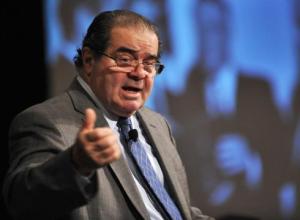
The states of Arizona and Kansas have followed a suggestion from Supreme Court Justice Antonin Scalia, according to TPM: Accepting Scalia’s Offer, Arizona Sues Obama Administration On Voting Rights.
The lawsuit, filed Wednesday, was announced by Arizona’s Attorney General Tom Horne and Secretary of State Ken Bennett, and joined by Kansas Secretary of State Kris Kobach, a high-profile architect of restrictionist laws, including Arizona’s Senate Bill 1070.
The issue involves the 1993 National Voter Registration Act, also known as the “motor voter” law, which requires states to let people register to vote simply by attesting they are citizens, when renewing their driver’s license or applying for social services. A 2004 law adopted by the voters in Arizona added the requirement that people registering to vote also provide proof of citizenship. The Supreme Court struck down that law earlier this year, concluding that it is trumped by the motor voter law. Arizona, the court ruled, could not add new requirements to the form prescribed by the federal law.
But during oral arguments in March, Scalia expressed his bafflement that Arizona did not launch a broader assault on the constitutionality of the NVRA form, written by the Election Assistance Commission. The state simply contended in that case that its proof of citizenship law did not violate the federal law. Even Scalia disagreed with that, voting against Arizona in the ruling, but also giving them a valuable tip in his 7-2 majority opinion.
“We hold that [the NVRA] precludes Arizona from requiring a Federal Form applicant to submit information beyond that required by the form itself,” Scalia wrote in the June decision. “Arizona may, however, request anew that the EAC include such a requirement among the Federal Form’s state-specific instructions, and may seek judicial review of the EAC’s decision under the Administrative Procedure Act.”
Sigh . . . read more at the link.
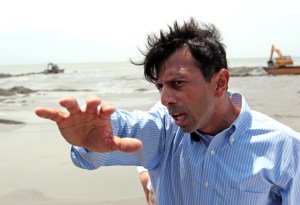
According to a new PPP poll, only 28 percent of Louisiana voters still think Governor Bobby Jindal is doing a good job.
Three years ago in August PPP declared Bobby Jindal to be the most popular Governor in the country. 58% of voters approved of him to only 34% who disapproved. Jindal’s fortunes have seen an amazing shift since that time though, and our newest poll finds him to be the most unpopular Republican Governor of any state- and the second most unpopular Governor in the country overall.
Just 28% of voters now approve of Jindal to 59% who disapprove. That’s an 11 point decline in his net approval just since February when he was already at a poor 37/57 standing. Even Republicans are pretty divided on Jindal (43/42) while independents (35/45) and Democrats (14/78) generally give him poor marks.
Jindal’s White House prospects are dismal if his home state voters have anything to say about it. Just 17% of Louisianans think he should run for President in 2016 to 72% who believe he should sit it out. He ties for 4th among Republican primary voters as their top choice for their 2016 candidate- Rand Paul leads with 18% to 17% for Jeb Bush, 11% for Paul Ryan, 10% for Jindal and Chris Christie, 8% for Marco Rubio and Ted Cruz, 5% for Rick Santorum, and less than 1% for Susana Martinez. (That’s also an embarrassingly poor showing for Santorum given that he easily won the state’s primary last year.)
Jindal wouldn’t be likely to get to a general election but the news for him there is bad too- he trails Hillary Clinton 47/40 in a hypothetical match up. Every other Republican we looked at is more competitive with Clinton in the state- Ryan leads her 46/44, Paul does 45/44, Bush ties her at 44 each, and she leads Christie just 42/41. It looks like Clinton would have a chance to make Louisiana unusually competitive in any instance, but particularly so against Jindal.
It’s difficult to believe that Jindal is polling that well against Hillary.
A few more short takes:
A new article in LA Weekly offers some startling revelations about Michael Hastings’ state of mind before he was killed in a one-car crash: Michael Hastings’ Dangerous Mind: Journalistic Star Was Loved, Feared and Haunted. Based on a friend’s descriptions of Hastings’ behavior, it sounds like he was so severely depressed that he was delusional.
From The A Register, speculations based on The Guardian’s bizarre claims that British intelligence agents forced them to destroy computers that contained U.S. secrets stolen by Edward Snowden: MYSTERY of Guardian mobos and graphics cards which ‘held Snowden files’
A funny Buzzfeed list (with gifs) contributed by Marc Ambinder: 12 Ways To Easily Identify An East Coast Transplant In LA.
A very weird story that demonstrates the institutional stupidity of the Federal Bureau of Investigation: FBI suspected William Vollmann was the Unabomber.
A fascinating story at Defense One: Area 51 Has Been Hiding U-2 Spy Planes, Not UFOs
Finally, our old friend David Sirota really outdid himself yesterday with this story at Salon: This cowardly silence is an act of war, in which he claims that President Obama’s failure to object to the UK detaining Glenn Greenwald’s partner David Miranda at Heathrow Airport is a crime against humanity . . . or something.
Now it’s your turn. What stories are you focusing on today? Please share your links in the comment thread.
Tuesday Reads: Neanderthal Tools, Hillary on Voting Rights, Bulger Verdict, and NDE Research
Posted: August 13, 2013 Filed under: 2016 elections, Civil Rights, Crime, Criminal Justice System, FBI, Hillary Clinton, morning reads, U.S. Politics | Tags: ACLU, American Bar Association, bone tools, death, Debra Davis, higher states of consciousness, James "Whitey" Bulger, John Martorano, leather-working, NAACP, national security, Neanderthals, near death experiences, North Carolina, Pat McCrory, Rev. William Barber, Scott Hotyckey, transparency, Voter ID laws, voter suppression, voting rights 40 Comments
Good Morning!!
I’ve been somewhat out of the loop for the past few days because I’ve had some kind of weird virus that has made it difficult for me to think. If it weren’t August, I’d wonder if it’s the flu. Everything ached. For a couple of days it felt like my skin actually hurt. Anyway I’ve been vegetating in front of the TV watching Criminal Minds reruns and Lifetime movies. I’m feeling better now, although I’m still sleepy all the time.
I’ve been surfing around this morning, and there is quite a bit of interesting news out there. I’ll begin with a fascinating archaeological find. According to a new study reported in Nature, Neanderthals invented tools made of bone that are still used today for leather-working.
Excavations of Neanderthal sites more than 40,000 years old have uncovered a kind of tool that leather workers still use to make hides more lustrous and water resistant. The bone tools, known as lissoirs, had previously been associated only with modern humans. The latest finds indicate that Neanderthals and modern humans might have invented the tools independently.
The first of the lissoir fragments surfaced a decade ago at a rock shelter called Pech-de-l’Azé in the Dordogne region of southwest France. Archaeologist Marie Soressi of the Max Planck Institute for Evolutionary Anthropology in Leipzig, Germany, knew the tool at once, says her colleague Shannon McPherron.
The tools are also known as slickers and burnishers, says McPherron. Soressi contacted luxury-goods manufacturer Hermès in Paris, and found that their high-end leather workers use just such a tool. “She showed them a picture, and they recognized it instantly,” says McPherron. The company’s line includes the wildly popular Birkin handbag, which sells for around US$10,000 and upwards.
McPherron says that a single artefact, however, was not enough for the researchers to draw broad conclusions. “You find one, and there’s always some doubt. You’re worried that it’s not a pattern — that it’s anecdotal behaviour.” But subsequent digs at Pech-de-l’Azé and nearby Abri Peyrony turned up further lissoir fragments, leading the researchers to conclude that Neanderthals made the tools routinely.

Neanderthal bone tools
The researchers say it’s not clear if these kinds of tools were first invented by Neanderthals or modern humans. It’s even possible that modern humans could have learned how to make and use the bone tools from Neantherthals, although most archaeologists believe that Neanderthals learned the skills from humans. From Live Science:
Neanderthals created artifacts similar to ones made at about the same time by modern humans arriving in Europe, such as body ornaments and small blades. Scientists hotly debated whether such behavior developed before or after contact with modern humans.
“There is a huge debate about how different Neanderthals were from modern humans,” said Shannon McPherron, an archaeologist at the Max Planck Institute for Evolutionary Anthropology in Leipzig, Germany.
Now, McPherron and his colleagues have discovered that Neanderthals created a specialized kind of bone tool previously only seen in modern humans. These tools are about 51,000 years old, making them the oldest known examples of such tools in Europe and predating the known arrival of modern humans.
Yesterday North Carolina Gov. Pat McCrory signed a new voter suppression voter ID law and the ACLU, NAACP, and the Southern Coalition for Social Justice immediately filed suit against it. USA Today:
Republicans who backed the legislation said it was meant to prevent voter fraud, which they claim is both rampant and undetected in North Carolina. Independent voting rights groups joined Democrats and libertarians in suggesting the true goal was to suppress voter turnout, especially among blacks, the young, the elderly and the poor.
“It is a trampling on the blood, sweat and tears of the martyrs — black and white — who fought for voting rights in this country,” said the Rev. William Barber, president of the state chapter of the NAACP. “It puts McCrory on the wrong side of history.” [….]
Barber called the Republican-backed measure one of the worst attempts in the nation at voting reform and said the National Association for the Advancement of Colored People considered the package an all-out attack on existing laws long seen as a model of voter participation….
The legislation signed by McCrory and approved last month by state lawmakers requires voters to present government-issued photo IDs at the polls and shortens early voting by a week, from 17 days to 10. It also ends same-day registration, requiring voters to register, update their address or make any other needed changes at least 25 days ahead of an election. A high school civics program that registers tens of thousands of students to vote each year in advance of their 18th birthdays has been eliminated.
Yesterday Hillary Clinton spoke out against the North Carolina law and other efforts to deny and suppress voting rights in a speech before the American Bar Association. HuffPo:
On the same day that North Carolina Gov. Pat McCrory (R) signed a restrictive voter ID bill into law, Clinton criticized the Supreme Court decision that she believes “stripped out the pre-clearance formula that made [the Voting Rights Act] so effective.”
She noted that Texas, Florida and North Carolina are states whose recent voter legislation has shifted the burden, slamming the North Carolina bill as one that “reads like the greatest hits of voter suppression.”
“In the weeks since the ruling, we’ve seen an unseemly rush by previously covered jurisdictions to enact or enforce laws that will make it harder for millions of our fellow Americans to vote,” Clinton said.
Clinton also went after several provisions of the North Carolina bill that she believes place a greater burden on citizens facing discrimination, including limited voting hours, stricter ID requirements and restricted early voting.
CNN reports that Hillary also plans to discuss national security and transparency in an upcoming speech.
Clinton said her appearance at the annual meeting of the American Bar Association marked the beginning of a speaking series she’ll embark upon that will also include an address on the United States’ national security policies next month in Philadelphia.
Clinton said the September address would focus of issues of “transparency and balance.” The former top diplomat had not yet publicaly addressed the classified National Security Agency surveillance programs that were revealed through leaks at the beginning of the summer.
The move into the political realm marks a new phase in Clinton’s post-State Department life, which was previously occupied by speeches to global women’s organizations and a schedule of paid appearances. She is also writing a diplomacy-focused memoir for release in 2014.
The speeches will likely fuel speculation that Clinton is planning to jump into the race for the 2016 Democratic presidential nomination, where she is considered an early favorite.
Well there’s some exciting news! It’s becoming more an more clear that Hillary plans to run for president in 2016.
I’m sure you’ve already heard that James “Whitey” Bulger has been found guilty of murder and racketeering, among other charges. It was always a foregone conclusion. The only surprise is that the jury was only able to find him guilty of 11 murders out of the 19 he was charged with. The New York Times:
BOSTON — James (Whitey) Bulger, the mobster who terrorized South Boston in the 1970s and ‘80s, holding the city in his thrall even after he disappeared, was convicted Monday of a sweeping array of gangland crimes, including 11 murders. He faces the prospect of spending the rest of his life in prison.
The verdict delivers long-delayed justice to Mr. Bulger, 83, who disappeared in the mid-1990s after a corrupt agent with the Federal Bureau of Investigation told him he was about to be indicted. He left behind a city that wondered if he would ever be caught — and even if the F.B.I., which had been complicit in many of his crimes and had relied on him as an informer, was really looking for him.
“This was the worst case of corruption in the history of the F.B.I.,” said Michael D. Kendall, a former federal prosecutor who investigated Mr. Bulger’s associates. “It was a multigenerational, systematic alliance with organized crime, where the F.B.I. was actively participating in the murders of government witnesses, or at least allowing them to occur.”
Of course there won’t be any punishment for the FBI except for embarrassment, if that troubles them. And there was only minor punishment for the parade of hit men and other criminals who were given generous deals in exchange for their testimony.
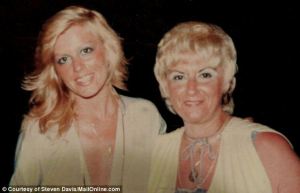
Debbie Davis, left, with her mother Olga, right, was the girlfriend of Stephen Flemmi, Whitey Bugler’s gangster partner. She vanished in 1981 and her body was found dismembered in 2000
(Daily Mail)
The families of the victims of the 7 murders Bulger was not convicted of were disappointed and angry.
As a clerk read the verdicts in the lengthy and complicated list of charges, Mr. Bulger looked away from the jury and showed no reaction. He was found guilty of 31 of 32 counts of his indictment, the one exception involving an extortion charge. While the jury of eight men and four women convicted him of 11 murders, they found the government had not proved its case against him in seven others, and in one murder case it made no finding, leading to gasps inside the courtroom by relatives of those murder victims and explosive scenes outside the court.
“My father just got murdered again 40 years later in that courtroom,” said the son of William O’Brien, who is also named William….
Perhaps one glimmer of gratification for Mr. Bulger was that the jury reached “no finding” in the death of Debra Davis, one of two women he was accused of strangling. He has long maintained that his personal code of honor did not allow for the killing of women, although the jury did determine that he had killed the other woman, Deborah Hussey. Ms. Davis was the longtime girlfriend of Stephen Flemmi, Mr. Bulger’s former partner in crime who testified against him. Ms. Hussey was the daughter of another of Mr. Flemmi’s longtime girlfriends.
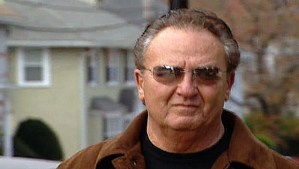
Hit man John Martorano
One of the jurors has already talked to local Boston media about how stressful the experience was.
One of the jurors who voted to convict Boston mobster James “Whitey” Bulger for a string of gangland crimes described how the more than 32 hours of deliberations were “stressful” and involved “all kinds of dissension.”
“Slamming doors,” Scott Hotyckey told CBS station WBZ-TV. “People leaving. Peolpe wanting to get off the jury.” [….]
Hotyckey, juror number 5, said the evidence was overwhelming.
“If you could believe the testimony, and believe what you heard,” Hotyckey said. “I don’t see how you couldn’t find the person guilty.”
But Hotyckey says not all of the jurors believed the testimony they heard – especially from John Martorano, a former hit man who got a plea deal from prosecutors to testify against Bulger.
“There was one juror that constantly said that his testimony was not believable,” Hotyckey recalled. “(He said) over and over again that you couldn’t believe anything (Martorano) said because of the government.”
I’ll wrap this post up with another interesting science story from BBC News about an experiment on rats that shows what happens at the moment of death.
A study on rats shows that the brain experiences a huge surge of electricity during the moment of death, suggesting that they are experiencing a higher state of consciousness.
It could explain why people claim to see white light or “life flash before their eyes” during near-death experiences.
Dr Jason Braithwaite from the University of Birmingham says that since this surge is happening in rats, it could also happen in humans.
Watch an interview with Braithwaite at the BBC link. More detail on the study:
A study carried out on dying rats found high levels of brainwaves at the point of the animals’ demise.
US researchers said that in humans this could give rise to a heightened state of consciousness.
The research is published in the Proceedings of the National Academy of Sciences.
The lead author of the study, Dr Jimo Borjigin, of the University of Michigan, said: “A lot of people thought that the brain after clinical death was inactive or hypoactive, with less activity than the waking state, and we show that is definitely not the case.
“If anything, it is much more active during the dying process than even the waking state.”
Much more at the link.
Now it’s your turn. What stories have caught your fancy today? Please share your links in the comment thread.
Monday Reads
Posted: July 29, 2013 Filed under: morning reads | Tags: economic insecurity, inequality of opportunity, racial resentment among whites, voting patterns, voting rights 36 CommentsGood Morning!
Damn! Is it hot down here!
Anyway, it’s really hard to get up the ambition to do much of anything and I have a huge long list of stuff to do. A lot of it has to do with my house that I have let get seriously out of control over the past year. I can no longer say, wow, the dissertation comes first. No excuses! I have to throw stuff out before the Hoarders TV series shows up at my door!
So, it is again a matter of looking at the same old stories over and over. Our government is really not getting much done. One of the stories that is so very important is how we deal with the serious threat to voting rights in much of the country coupled with the SCOTUS decision. Why is Texas at the center of every battle for modernity?
In a federal lawsuit first brought by black and Hispanic voters against Texas over its redistricting maps, the Justice Department relied on a rarely used provision of the act, Section 3, to ask a federal court to require Texas to get permission before making any voting changes in the state.
Until last month, Texas already had to get such permission under the act’s “preclearance” process. This process had long been the most effective means of preventing racial bias in voting laws in states with histories of discrimination. It required state and local governments that wanted to change the laws to first show there would be no discriminatory effect. In Shelby County v. Holder, the Supreme Court struck down Section 4 of the act as unconstitutional; that provision laid out the formula that determined which jurisdictions had to get permission.
In theory, the court’s ruling allows Congress to update the list of nine states and parts of six others identified by Section 4. But given the dysfunction of Congress, that will not happen anytime soon.
This is why Mr. Holder’s decision to rely on Section 3 in the Texas case is so significant. Section 3 — also known as the “bail-in” provision — may be the most promising tool we have to protect voting rights after Shelby. It allows courts to identify jurisdictions that are passing intentionally discriminatory voting laws and then “bail” them in as needed — that is, require them to get permission before establishing new voting rules.
This is functionally similar to the system the court struck down last month, but Section 3 has several distinguishing features. It does not contain a preset list of jurisdictions, and it is forward-looking: instead of relying primarily on historical evidence of discrimination, it allows individual voters or the government to ask courts to zero in on any jurisdiction, like Texas, that continues to try to impose racially discriminatory voting laws.
Section 3 is also flexible. The period of coverage for preclearance under Section 3 is determined by court order, and may last for only as long as a federal judge deems it necessary to overcome voting discrimination in that jurisdiction.
These features make Section 3 a useful provision, but it has its weaknesses. The preclearance may be imposed only if a federal judge determines that the jurisdiction’s laws are intentionally discriminatory. When the Voting Rights Act was passed, such laws were much easier to identify. But lawmakers have since discovered countless ways to discriminate on the basis of race without saying so explicitly, and will continue to do so.
In the Texas case, a Federal District Court in Washington found that state redistricting maps showed intentional discrimination — among other things, black and Hispanic lawmakers were excluded from the map-drawing process, and districts were drawn to minimize the power of minority voters in ways that “could not have happened by accident,” including one district shaped like a lightning bolt. While the Texas record is full of clear evidence of discriminatory intent, in most places such a claim is harder to show. To address that problem, the Congressional Black Caucus has called for Section 3 to be amended to apply to voting laws that have a discriminatory effect, whether or not intent can be proved. If Congress
is serious about protecting voting rights, it should pass this amendment immediately.
So,this should be nothing new to any one that isn’t part of the bonus class. Economic insecurity in the US is rampant. It also shouldn’t be too surprising that this is fueling some of the issues we have with racial resentment and the demand to restrict voting access.
The AP is out with a big analysis today about how the American economy is increasingly delivering security and prosperity to only a tiny fraction of the population:
Four out of 5 U.S. adults struggle with joblessness, near poverty or reliance on welfare for at least parts of their lives, a sign of deteriorating economic security and an elusive American dream…
Hardship is particularly on the rise among whites, based on several measures. Pessimism among that racial group about their families’ economic futures has climbed to the highest point since at least 1987. In the most recent AP-GfK poll, 63 percent of whites called the economy “poor.”And here’s their working definition:
The gauge defines “economic insecurity” as a year or more of periodic joblessness, reliance on government aid such as food stamps or income below 150 percent of the poverty line. Measured across all races, the risk of economic insecurity rises to 79 percent.Probably the most striking finding here is just how many poor whites are out there:
Sometimes termed “the invisible poor” by demographers, lower-income whites are generally dispersed in suburbs as well as small rural towns, where more than 60 percent of the poor are white. Concentrated in Appalachia in the East, they are also numerous in the industrial Midwest and spread across America’s heartland, from Missouri, Arkansas and Oklahoma up through the Great Plains.
More than 19 million whites fall below the poverty line of $23,021 for a family of four, accounting for more than 41 percent of the nation’s destitute, nearly double the number of poor blacks.It’s probably fair to say also that poor whites are overwhelmingly Republican, and in large part due to an overhang of racial resentment. After all, the New Deal coalition between poor Southern whites and rich urban liberals was built on racist oppression.
The interesting thing about this particular analysis in the WM is that it is still surprising these folks identify primarily as Republicans. A lot of it has to do with racial resentment. However, here is an additional link you may want to check out.
It’s patronising in the extreme to assume that poorer white people don’t understand that. I may disagree with their decisions to vote on issues like abortion and gay marriage, but it’s a different thing entirely to suggest that when they prioritise those things it’s because they don’t know what’s best for them. Paradoxically, given that this argument comes from liberals, it is underpinned by an insistence not that they be less selfish, but more.
Secondly, if they were voting on economic issues alone, that might be a reason not to vote Republican but it’s not necessarily a reason to vote Democrat. With unemployment still about 8%, many of the benefits of healthcare reform still to kick in and bankers still running amok, it’s not like Democrats are offering much that would support the economic interests of the poor, regardless of their race. It was Bill Clinton who cut welfare, introduced the North American Free Trade Agreement andrepealed the Glass-Steagall Act – which helped make the recent crisis possible. If you were going to trade your religious beliefs for economic gain, you could be forgiven for demanding a better deal than that.
Indeed, the people most likely to have voted Democrat four years ago – the young, the black and Latinos – are among the groups that have fared worse under Obama. And all the polls suggest they’re about to do it again, albeit in lesser numbers. One could just as easily argue that they are the dupes. Democrats have no god-given right to the votes of the poor of any race and for the past 30 years can hardly claim to have earned them.
In a country where class politics and class organisations are weak, it’s too easy to dump on the white working class as a bunch of know-nothings when the problem is a political class that is a bunch of do-nothings.
We may be finding some silence of the jerks on Cumulus anyway. Here are two of the biggest red meat providers of racial resentment and homophobia and misogyny in US culture right now.
In a major shakeup for the radio industry, Cumulus Media, the second-biggest broadcaster in the country, is planning to drop both Rush Limbaugh and Sean Hannity from its stations at the end of the year, an industry source told POLITICO on Sunday.
Cumulus has decided that it will not renew its contracts with either host, the source said, a move that would remove the two most highly rated conservative talk personalities from more than 40 Cumulus channels in major markets.
Okay, for those of you that like a real life spy adventure, try this: “This CIA Operative Indicted for Extraordinary Renditions Vanished from the Map—Twice. After years in absentia, poof! Robert Seldon Lady, convicted of kidnapping by Italy, reappeared out of nowhere. Then he was gone again.”
Recently, Lady proved a one-day wonder. After years in absentia — poof! He reappeared out of nowhere on the border between Panama and Costa Rica, and made the news when Panamanian officials took him into custody on an Interpol warrant. The CIA’s station chief in Milan back in 2003, he had achieved brief notoriety for overseeing a la dolce vita version of extraordinary rendition as part of Washington’s Global War on Terror. His colleagues kidnapped Hassan Mustafa Osama Nasr, a radical Muslim cleric and terror suspect, off the streets of Milan, and rendered him via U.S. airbases in Italy and Germany to the torture chambers of Hosni Mubarak’s Egypt. Lady evidently rode shotgun on that transfer.
His Agency associates proved to be the crew that couldn’t spook straight. They left behind such a traceable trail of five-star-hotel and restaurant bills, charges on false credit cards, and unencrypted cell phone calls that the Italian governmenttracked them down, identified them, and charged 23 of them, Lady included, with kidnapping.
Here’s one more story about how inequality of opportunity begins at birth.
Equality of opportunity means that we are not a caste society. Who we will become is not fixed by the circumstances of our births. Some children will do better than others, but this should result from a fair competition. Nearly every American politician espouses a commitment to equality of opportunity. For example, Majority Leader Eric Cantor wrote yesterday that
We must continue to fight for equal opportunity to a quality education for all children.
I wouldn’t be surprised if many American politicians said the same thing yesterday.
But we don’t appreciate how deep inequality runs. The graph below is from a presentation by Angus Deaton which (I believe) reported data from the National Health Interview Survey. The horizontal axis is the logarithm of family income in 1982 dollars, running from about $3600 to over $80,000. The vertical axis is self-reported ill-health (higher numbers reflect worse health). The parallel lines represent different age groups of respondents.
There are three important facts packed into this slide. First, the lines stack up in order of increasing age, meaning that older people reported worse health than younger people. Second, all the lines slope downward, meaning that the poorer you were, the more likely you had poor health.
These facts are unsurprising, until you notice how powerful the income effect is. The leftmost point of the youngest (turquoise) line is above the rightmost point of the oldest (purple) line. This means that the poorest teenagers reported themselves as less healthy than rich middle-aged people.
Lastly, notice how the age lines are much more dispersed on the left (poorest) side of the graph than the right (richest) side of the graph. This means that health deteriorates more quickly with age among the poor than among the rich.
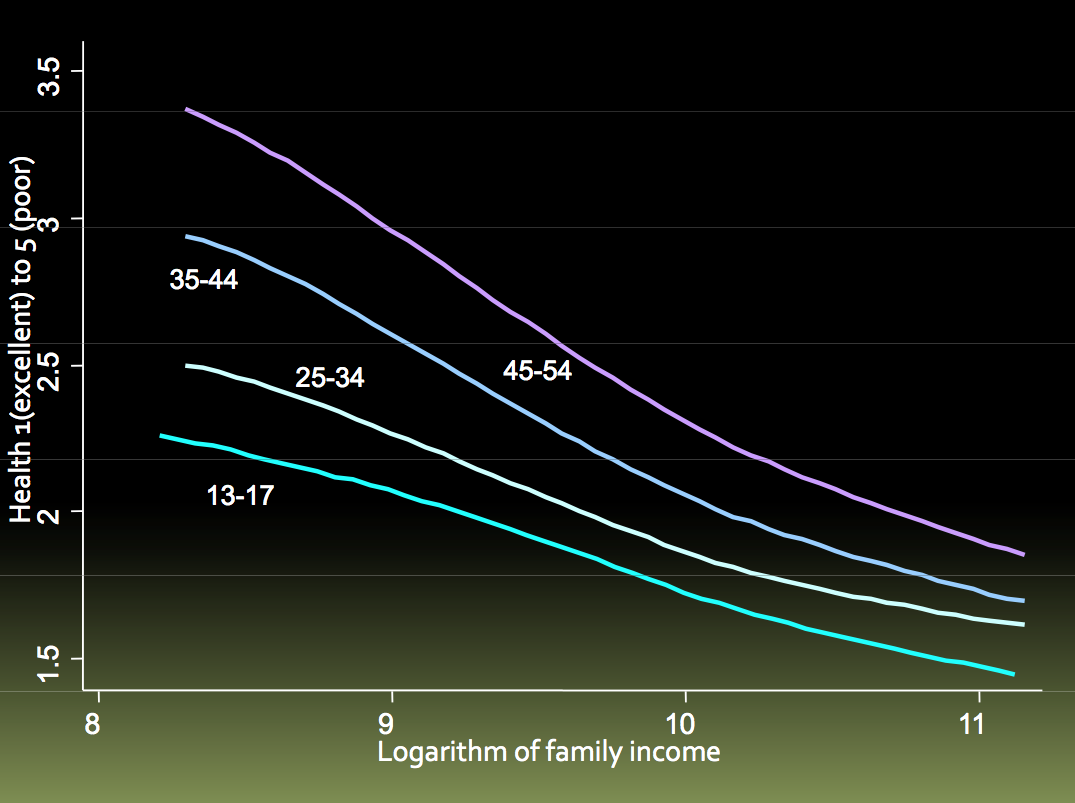
Just in case you aren’t used to the idea of using the log of things, it represents a growth rate. It’s basically a percentage change in thing over time so it’s a dynamic measurement of what ever is being measured.

Well, that is longer than I thought! So, what’s on your reading and blogging list today? Oh, and as usual, let’s play guess the celebrities and the singular location!!!!

 peej
peej Carissa
 bostonboomer
 dakinikat
 ecocatwoman
 jjlo
jjlo mablue2
 Mama Lopez
 peggysue22
 quixote
 skydancingguestblogger
 Mona (aka Wonk the Vote)



 Sky Dancing
Recent Comments