
Tuesday Reads: SCOTUS and Voting Rights, Iraq War Buildup, and Reno Saccoccia
Posted: March 19, 2013 Filed under: morning reads, U.S. Politics, Violence against women | Tags: Ahmed Chalabi, Anthony Kennedy, Antonin Scalia, Christopher Hitchens, David Frum, Dick Cheney, George W. Bush, Iraq War, Reno Saccoccia, Sonya Sotomayor, Steubenville rape case, voting rights 35 Comments
Good Morning!!
There’s a great big sloppy white mess outside my house this morning–something like 6 or 7 inches of heavy, wet snow. I’m not sure how I’ll get out of here; I may have to try to hire someone to dig me out. Anyway, I’m resigned to being stuck in the house for today at least.
Soooo… let’s see what happening in the news.
I’m going to start out with some news from the Supreme Court. Yesterday the court debated another voting rights case, and once again Sonya Sotomayor went toe-to-toe with right-wing judicial activist Antonin Scalia. This time it was a case from Arizona over whether a state can require proof of citizenship beyond what is required by federal voter registration forms. Here’s some background from Spencer Overton at HuffPo:
The latest case involves the simple question of whether Arizona can refuse to accept a federal voter registration form. But the stakes are much higher. A victory for Arizona could accelerate a nationwide trend of political operatives attempting to manipulate election rules for political gain, and could undermine the power of Congress to protect voting rights.
The National Voter Registration Act requires that all states “accept and use” a single, uniform voter registration form for federal elections. States can still use their own registration forms, but they must also accept and use the Federal Form. The purpose of the Federal Form is to increase participation by preventing states from erecting barriers to voter registration.
The Federal Form requires that prospective voters check a box and sign the form affirming they are U.S. citizens under penalty of perjury. Arizona, however, adopted a state law requiring “satisfactory proof” of U.S. citizenship to register, such as a birth certificate, U.S. passport, or state driver’s license that shows citizenship.
As a result, Arizona initially rejected over 31,000 voter registration applications — including citizens who registered using the Federal Form. Community-based registration drives were hit especially hard, because they rely on approaching individuals who may not be carrying a birth certificate or similar documentation (or unwilling to give a photocopy of these sensitive documents to a registration-drive volunteer). For example, community-based registration drives in Arizona’s largest county — Maricopa County — dropped 44%.

Obviously, if Arizona wins the case, other red states would pass similar laws that would trump federal voting regulations. Yesterday, Sotomayor and Scalia “clashed” over the Arizona law. Talking Points Memo:
Much as they did weeks ago during arguments over the constitutionality of the Voting Rights Act, the two justices on Monday each led the charge on opposite sides of the case — Scalia for less federal involvement in states’ ability to set their voting laws, and Sotomayor for broad national authority to protect citizens’ right to vote.
Sotomayor’s opening volley began immediately after Arizona Attorney General Thomas C. Horne stepped up to defend his state’s law. She fired off a series of questions, which she would continue asking in different flavors throughout his argument, about inconsistencies between Arizona’s Prop 200 and the NVRA.
“If I see the purpose of the NVRA to simplify registration, how are Arizona’s provisions consistent with that objective and purpose, given that … many people don’t have the documents that Arizona requires?” Sotomayor said. She asked Horne why he thinks Congress would have required states to accept a voter registration form if states can then turn around and require additional information like a passport or birth certificate.
“Why isn’t that just creating another form?” she demanded. Arizona, she said, may object to the fact that proof of citizenship isn’t required, but “that’s what Congress decided.”
As for Scalia:
The conservative jurist wasn’t convinced requiring people to attest under oath was sufficient.
“So it’s under oath — big deal,” Scalia said. “If you’re willing to violate the voting laws, I suppose you’re willing to violate the perjury laws.” He posited that only “a very low number” of voters would be harmed by a requirement to submit proof of citizenship.
Well that makes sense–not. Why bother having witnesses swear to tell the truth in court cases then?
Of course Anthony Kennedy was his usual waffling self. Again from TPM:
At one point, Kennedy wrestled with whether Arizona’s proof-of-citizenship requirement crosses a line. He asked the state’s attorney general, who was defending the law, whether states may also require proof of one’s address or date of birth when registering to vote. If so, he posited, then the federal requirement “is not worth very much.”
At another point, he launched a defense of Arizona’s actions in principle and took issue with some of the reasoning by the Ninth Circuit Court of Appeals, which ruled against Arizona.
“The state has a very strong and vital interest in the integrity of its elections,” Kennedy said, “even when those, and perhaps especially when those are elections of federal officials. And it seems to me the Ninth Circuit’s new test did not give sufficient weight to that interest.”
Roberts is apparently “leaning slightly” toward Arizona’s point of view. It’s really frightening that voting rights are in the hands of this conservative court. Thank goodness for Sotomayor’s willingness to be vocal in her arguments. Here are couple more interesting tidbits:
“Let me give you this example,” Alito said. “A person rides up to a place to register on a bicycle and gets out and hands in the federal form. This boy looks like he is 13 years old and he is carrying school books, he is wearing a middle school t-shirt, but he has filled out the form properly. Are they required to register him?”
Retired Justice Sandra Day O’Connor, a native Arizonan who in 2010 ruled against her statein this case from a lower court on which she occasionally sits, was present in the chamber.
In the final moments, Scalia warned the Obama administration’s lawyer, who was arguing against Arizona, that if the constitutionality of the NVRA form is challenged in broader terms, “You’re going to be in bad shape — the government’s going to be.”
There was a little bit of good news from the Court yesterday, according to HuffPo: Supreme Court Refuses To Hear Goldman Sachs’ Appeal To Financial Crisis Lawsuit.
Goldman Sachs Group Inc suffered a defeat on Monday as the U.S. Supreme Court let stand a decision forcing it to defend against claims it misled investors about mortgage securities that lost value during the 2008 financial crisis.
Without comment, the court refused to consider Goldman’s appeal of a September 2012 decision by the 2nd U.S. Circuit Court of Appeals in New York. Goldman shares sank more than 2 percent.
That court let the NECA-IBEW Health & Welfare Fund, which owned some mortgage-backed certificates underwritten by Goldman, sue on behalf of investors in certificates it did not own, but which were backed by mortgages from the same lenders.
Goldman and other banks have faced thousands of lawsuits by investors seeking to recoup losses on mortgage securities.
The bank has said that letting the 2nd Circuit decision stand could cost Wall Street tens of billions of dollars.
{{applause}}
David Frum posted a fascinating article at The Daily Beast late yesterday on the lead-up to the Iraq War. Frum was a speechwriter for George W. Bush at the time. You should read the whole thing, but I’ll just quote this one intriguing portion:
The first time I met Ahmed Chalabi was a year or two before the war, in Christopher Hitchens’s apartment. Chalabi was seated regally at one end of Hitchens’s living room. A crowd of nervous, shuffling Iraqis crowded together at the opposite end. One by one, they humbly stepped forward to ask him questions or favors in Arabic, then respectfully stepped backward again. After the Iraqis departed, Chalabi rose from his chair and joined an engaged, open discussion of Iraq’s future democratic possibilities.
The last time I saw Chalabi was in his London apartment, on the very eve of war. My little group arrived past midnight. Chalabi was listening to the evocative strains of Sufi music. He showed me a black-and-white photograph of seven men, wearing the clothes of the 1940s. They were the board of directors of a company his father had founded: a mixed group of Sunni, Shiite, and Christian, and even a Jew. Chalabi remarked that this picture was taken while Europe was tearing itself apart in genocidal violence. He didn’t add that it was taken shortly after British forces defeated a pro-Axis coup in Baghdad—but failed to prevent a murderous pogrom against Baghdad’s Jewish population.
I was less impressed by Chalabi than were some others in the Bush administration. However, since one of those “others” was Vice President Cheney, it didn’t matter what I thought. In 2002, Chalabi joined the annual summer retreat of the American Enterprise Institute near Vail, Colorado. He and Cheney spent long hours together, contemplating the possibilities of a Western-oriented Iraq: an additional source of oil, an alternative to U.S. dependency on an unstable-looking Saudi Arabia.
You might imagine that an administration preparing for a war of choice would be gripped by self-questioning and hot debate. There was certainly plenty to discuss: unlike the 1991 Gulf War, there was no immediate crisis demanding a rapid response; unlike Vietnam, the U.S. entered the war fully aware that it was commencing a major commitment.
Yet that discussion never really happened, not the way that most people would have imagined anyway. For a long time, war with Iraq was discussed inside the Bush administration as something that would be decided at some point in the future; then, somewhere along the way, war with Iraq was discussed as something that had already been decided long ago in the past.
I’m running out of space, so I’ll leave you with this follow-up to the Steubenville rape trial.

From Deadspin: Fire This Asshole: Why Does Steubenville’s Football Coach Still Have His Job?
Reno Saccoccia is a local legend, in the way that 30-year coaches of football powerhouses in economically depressed Ohio Valley towns tend to be legends. He’s in the Ohio Coaches Hall of Fame. He’s won three state titles. When Saccoccia won his 300th game last year, a sellout crowd of more than 10,000 people packed Harding Stadium—christened “Reno Field” in 2007—and chanted “Reno, Reno, Reno” as he left the field.
He breakfasts regularly with the sheriff. His sister-in-law works in the county’s juvenile court, where he is licensed as a mediator. He “molds young boys into men.” So how did Saccoccia react when he got word that two of his young boys were accused of raping a passed-out student?
On the night of the assault, a Steubenville student recorded this video joking about it. Off-camera, someone says “Trent and Ma’lik raped someone.” Among the text messages released at the trial of Trent Mays and Ma’lik Richmond, one sent by Mays indicated that Saccoccia had seen the video:
Deleate that off You-tube. Coach Sac knows about it. Seriously delete it.
Saccoccia would later claim he was unaware of the social media evidence, angrily telling a reporter that he didn’t “do the internet.” But a flurry of texts sent on August 13, the day after the incident, indicated that Saccoccia had heard what had happened.
Even as all of Steubenville gradually heard the rumors, even after a local blogger alerted the country to what had happened in Steubenville, those involved in posting and sharing the photos and videos continued to play. They were only suspended eight games into the season, more than two months after the assault and arrests.
Less than a month later, Saccoccia testified on behalf of Mays and Richmond in a hearing to determine whether they would be tried as adults.
As we all know, the “boys” were tried as juveniles and got off easy. Seriously, this asshole has to go!
I have some more stories to share, but I’ll put them in the comments . . . What are you reading and blogging about today? I’m stuck in the house, so I have all the time in the world to click on your links and read!
Protecting our Right to Vote
Posted: November 4, 2012 Filed under: just because | Tags: voter suppression, voting rights 62 CommentsOne of the watershed issues of this century is something that we should’ve settled in the 20th century with the civil rights movement and the suffragette movement. The right to vote and access to voting is the single most important action we have in our country that is protected and guaranteed by our constitution. As we have enfranchised more people and as our demographics change, the move to block voting rights and to suppress voters has taken on a new urgency. Republican extremists know that the future isn’t bright for them so they are trying to stop and delay that day when they can only impact the lives of very few people. Those of us that live under extremist Republican state governments know what kind of damage these people can do. The primary damage is to suppress individual rights and transfer public assets and dollars to religious factions, extremely rich donors, and narrow business interests.
I’ve written on the subject a lot recently. It’s also extensively covered on MSBNC shows like those of Melissa Harris-Perry and the Rev. Al Sharpton. The importance of protecting our right to vote is becoming more and more evident as we draw closer to what has been an extremely divisive election between the angry, hostile, greedy right and every one else. NYT has an editorial today that is worth reading.
This year, voting is more than just the core responsibility of citizenship; it is an act of defiance against malicious political forces determined to reduce access to democracy. Millions of ballots on Tuesday — along with those already turned in — will be cast despite the best efforts of Republican officials around the country to prevent them from playing a role in the 2012 election.
Even now, many Republicans are assembling teams to intimidate votersat polling places, to demand photo ID where none is required, and to cast doubt on voting machines or counting systems whose results do not go their way. The good news is that the assault on voting will not affect the election nearly as much as some had hoped. Courts have either rejected or postponed many of the worst laws. Predictions that up to five million people might be disenfranchised turned out to be unfounded.
But a great deal of damage has already been done, and the clearest example is that on Sunday in Florida, people will not be allowed to vote early. Four years ago, on the Sunday before Election Day, tens of thousands of Floridians cast their ballots, many of them black churchgoers who traveled directly from services to their polling places. Because most of them voted for Barack Obama, helping him win the state, Republicans eliminated early voting on that day. No legitimate reason was given; the action was entirely partisan in nature.
Yes. This week your vote and your ability to tolerate the long lines and distractions put up by Republican extremist is an act of rights and of support of Civil Rights. We have a new story today about voter suppression from the key state of Ohio and its evil Secretary of State. Yes, this late in the game, Husted has take one more action to suppress voter turn out which favors Democrats.
Ohio GOP Secretary of State Jon Husted has become an infamous figure for aggressively limiting early voting hours and opportunities to cast and count a ballot in the Buckeye State.
Once again Husted is playing the voter suppression card, this time at the eleventh hour, in a controversial new directive concerning provisional ballots. In an order to election officials on Friday night, Husted shifted the burden of correctly filling out a provisional ballot from the poll worker to the voter, specifically pertaining to the recording of a voter’s form of ID, which was previously the poll worker’s responsibility. Any provisional ballot with incorrect information will not be counted, Husted maintains. This seemingly innocuous change has the potential to impact the counting of thousands of votes in Ohio and could swing the election in this closely contested battleground.
This comes at a time when we are getting news like this out of the ever troublesome southern states. Yet another Florida early voting site has had issues with bombs.
Early voting was extended on Sunday at a central Florida polling site that was disrupted a day earlier by a bomb scare, and the Florida Democratic Party filed a lawsuit seeking extended early voting at other areas plagued by long lines.
Saturday was the last day for early voting in Florida, where polls showed Democratic President Barack Obama and Republican challenger Mitt Romney running neck-and-neck.
But Orange County Elections Supervisor Bill Cowles reopened the polls at one site, a library in the Orlando suburb of Winter Park, from 1 p.m. to 5 p.m. on Sunday.
The library was evacuated and voting there was suspended for four hours on Saturday because suspicious items were found on the grounds. A bomb squad safely detonated both – a cooler containing small electronics and what investigators described as a bag of miscellaneous garbage.
Florida, where 537 votes decided the 2000 presidential election in George W. Bush’s favor, is again a hotly contested state crucial to both presidential candidates.
The Florida Republican Party is appealing a judge’s ruling that allowed the voting to reopen on Sunday, so ballots cast at the library on Sunday will be held as provisional ballots in case the order is overturned.
This comes on top of these stories coming out of North Carolina. HuffPo’s Dan Froomkin has outlined some pretty vicious things occurring in some early voting places.
If Election Day goes anything like the past 17 days of early voting in North Carolina, here’s what you can expect at your local precincts on Tuesday:
- Belligerent citizens demanding the right to personally inspect the voting process and yelling “shut up” at the top of their lungs when election officials tell them that only official poll observers can do that.
- Official poll observers who have been improperly trained by the groups they represent and think it’s their job to interrogate voters rather than just watch.
- Long lines, which means that a lot of people end up waiting outside the designated no-electioneering zones, getting harangued by campaign workers.
- Shouting matches between Republican and Democratic campaign workers — and sometimes voters standing in line — that can involve name-calling, threatening gestures, and the summoning of law enforcement.
- A guy driving a tractor-trailer bed filled with effigies of Democratic officials, including President Barack Obama, with nooses around their neck. (Federal officials are looking into that one, which took place at an early voting center in Eastern North Carolina on Thursday.)
The fact that all these incidents have occurred at a few, tightly supervised early voting centers is giving state officials reason to worry that things could be much worse when regular polling stations open for business.
“I am hoping that people will have a return of good manners and civility by Tuesday,” said Johnnie McLean, deputy director of the North Carolina election board. Then she quickly acknowledged it’s not likely.
If these kinds of stories remind you of something the Taliban or religious zealots would do in nascent democracies in third world countries it’s because there’s a similar mentality in the Teahadists of this country. These same people that condemn the kinds of voter suppression and harassment in other countries are creating the same environment in our own country. Also, Republican leaders are encouraging this, funding this, and creating an army of zealots that are being sent to disrupt elections after Republican Secretaries of State of done everything to disenfranchise voters, reduce access to voting in key districts, and provided false information on voting rules.
Here’s a great list of suppression efforts by John Avalon.
Less than one week out from Election Day, we are witnessing a war of attrition, a game of inches. With state polls this close, every vote counts. And so beyond the positive effort to outdo the other party’s ground game and early-voting pushes, there is a negative corollary: voter suppression, confusion, and intimidation.
The ugly efforts to discourage the “wrong” voters from showing up reflect the asymmetrical polarization in Congress: neither party is entirely innocent, but conservatives have appeared to be driving the great bulk of efforts to suppress or misinform voters.
Yesterday, documents posted by Scott Keyes at TPM showed that the Romney campaign in Wisconsin is training poll-watchers to lie at polling stations by registering as “concerned citizens” rather than campaign volunteers; to untruthfully tell voters they are ineligible to vote unless they show proof of residency; and to misleadingly warn voters they are ineligible if they have been convicted of treason or bribery.
It is all intentionally dishonest, and particularly so because so much of the RNC leadership—including Chairman Reince Priebus—has roots in Wisconsin local leadership.
Those of you that live in key swing states–if you haven’t already voted–should be prepared to demand that your vote count and be counted. You should also be prepared for a long stint in line. You may need to bring something to help you while away the hours in a very long line. More information on voter suppression efforts and help if you experience problems voting can be found here at the ACLU.
The right of citizens of the United States to vote shall not be denied or abridged by the United States or by any State…
… on account of race, color, or previous condition of servitude…”
Fifteenth Amendment, United States Constitution
… on account of sex.”
Nineteenth Amendment, United States Constitution
… by reason of failure to pay any poll tax or other tax.”
Twenty-Fourth Amendment, United States Constitution
… on account of age.”
DOJ To Monitor Polls in 23 States
Posted: November 2, 2012 Filed under: 2012 elections, Civil Rights, U.S. Politics | Tags: Department of Justice, Eric Holder, poll monitors, voting rights, Voting Rights Act 59 Comments
Just a quick post…
The Justice Department Friday announced that it is dispatching more than 780 federal observers and monitors to 23 states to watch for potential problems which would violate voting rights protected by federal law.
The Justice Department said it was sending observers to 51 jurisdictions in those states to help enforce federal voting rights laws which protect ballot access.
….
Jon Greenbaum, Chief Counsel for the Lawyers Committee for Civil Rights Under Law, says his organization is generally pleased with the locations selected for federal monitoring. The organization successfully pushed, for example, for monitors to be sent to Maricopa County, Arizona because of potential problems for Hispanic voters, and the group noted potential for discrimination against black voters in Alabama and Mississippi counties.
Historic incidents of discrimination against Native American voters prompted observers to be sent to Shannon County, South Dakota, and Sandoval County, New Mexico, Greenbaum said. In Chicago, several ethnic minorities have suffered incidents in the past, including lack of poll workers who spoke Chinese, South Asian, or other minority languages. A growing Muslim population in Detroit and Hamtramck, Michigan also had caused issues for native Arab and Middle Eastern language speakers at polling places, Greenbaum said.
There’s a complete list of the targeted counties at the CNN link. Franklin and Hamilton Counties in Ohio are included.
According to the Palm Beach Post,
U.S. Attorney General Eric Holder, who was at the U.S. Attorney’s office in Tallahassee on Friday, is sending staff to Duval County, Hendry, Hillsborough, Lee, Miami-Dade, Orange and Osceola counties on Election Day. DOJ is also monitoring Miami-Dade County elections during early voting, the agency announced today.
Hendry and Hillsborough are two of the five “preclearance” counties – along with Collier, Hardee and Monroe – that require federal approval of election law changes because of a history of discrimination against minorities.
“Although state and local governments have primary responsibility for administering elections, the Civil Rights Division is charged with enforcing the federal voting rights laws that protect the rights of all citizens to access the ballot on Election Day,” DOJ said in the press release.
The LA Times reports that Riverside and Alameda Counties are on the list.
The federal government began monitoring polling sites in Riverside County after the agency’s Civil Rights Division filed a complaint against the county for failing to offer election-related information and assistance to Spanish-speaking voters, a violation of the Voting Rights Act.
The county and the Department of Justice reached a settlement in February 2010 that included having federal observers at polling stations.
A similar settlement was reached with Alameda County in 2011 after the federal government accused the county of failing to train an adequate number of poll workers to help Mandarin-, Cantonese- and Spanish-speaking voters on election day.
This may not completely make up for the numerous efforts of Republican election officials to suppress the votes of traditionally Democratic groups, but it’s good to know Holder is on the case.
This is an open thread.
Great News: SCOTUS Refuses to Block Ohio Early Voting
Posted: October 16, 2012 Filed under: 2012 elections, 2012 presidential campaign, Barack Obama, Mitt Romney, open thread, U.S. Politics | Tags: early voting, Ohio, SCOTUS, voter suppression, voting rights 46 Comments
The Supreme Court has declined to review the decision of the U.S. District Court of Appeals for the 6th District that:
if Ohio is going to allow in-person voting for members of the military during the Saturday, Sunday and Monday before the election, it must open the process to all voters.
“While there is a compelling reason to provide more opportunities for military voters to cast their ballots, there is no corresponding satisfactory reason to prevent nonmilitary voters from casting their ballots as well,” the appeals court said.
Ohio Republicans had sought to cancel early voting that weekend for everyone except members of the military. A U.S. appeals court blocked the plan last week, saying it probably violated the constitutional rights of non-military voters. In a one-sentence order, the Supreme Court today rejected a challenge to that ruling, filed by Ohio’s Republican secretary of state and attorney general….
The early-voting clash is one of two Ohio election disputes with implications for the presidential race between Obama and former Massachusetts Governor Mitt Romney. In a second Obama victory, the same Cincinnati-based appeals court last week barred the state from disqualifying provisional ballots that voters cast in the wrong precinct because of poll-worker error.
In other news, President Obama says he “feels fabulous” about the debate tonight.
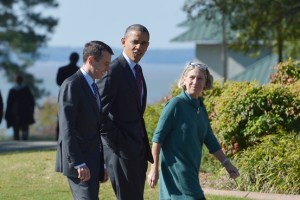
President Barack Obama walks with Senior White House Adviser David Plouffe and Anita Dunn to debate preparation at the Kingsmill Resort on Tuesday in Williamsburg, Va. — Agence France-Presse/Getty Images
WILLIAMSBURG, Va. — Hours before a crucial debate, President Obama tried to flash some confidence and calm for the cameras.
“I feel fabulous. Look at this beautiful day,” Obama said, as he strolled under blue skies at the Virginia resort where he has been preparing for his faceoff with Mitt Romney.
The president has been largely out of sight since Saturday, when he arrived here for three days of intensive debate preparations.
Zeke Miller at Buzzfeed writes that:
President Barack Obama appears amply aware that he fumbled badly during a debate two weeks ago in Denver, but he’s not the only one looking for redemption: Obama’s staff, blamed in part for his weak preparation, for a flawed plan, and for a lame post-debate effort are also seeking a do-over.
The most obvious — and critical — flaw in the Denver debate was Obama’s performance, and aides say they’ve prepared him intensely not to repeat it. They’ve played him the tape of the Denver debacle, examined his facial expressions and overall body language, and prepared for how to personally engage a live audience of questioners.
Tuesday’s town hall-style forum at Hofstra University on Long Island, NY is a format in which Obama in 2008 thrived, as the format’s king, John McCain, stumbled. Four years ago Obama managed to draw a connection with both the questioner and the audience at home. Aides say they expect this stage to be more comfortable, since he’s not interacting with just Romney.
There is also a new plan. Two weeks ago, Obama tried to stay above the fray, backing down from nearly every attack he and his campaign have been firing at Romney by proxy — both on television and in solo rallies across the country. Tuesday at Hofstra, will throw all the punches he pulled two weeks ago, his aides promise. Romney’s tax rate? Check. The 47% video? He’ll work it in there. Osama bin Laden? You can bet on it.
Sounds like Team Obama is taking this seriously. Do you buy it? How are you feeling about tonight?
This is an open thread, of course.

 peej
peej Carissa
 bostonboomer
 dakinikat
 ecocatwoman
 mablue2
 Mama Lopez
 peggysue22
 quixote
 skydancingguestblogger
 Mona (aka Wonk the Vote)



 Sky Dancing
Recent Comments