
What the MSM Isn’t Reporting
Posted: November 5, 2011 Filed under: #Occupy and We are the 99 percent!, Corporate Crime, Democratic Politics, Economy, financial institutions, Main Stream Media, poverty, The Media SUCKS, unemployment | Tags: 2011: days of revolt, Financial Crisis, U.S. Economy 15 CommentsIf anyone had doubts that the mainstream media is deliberately fudging the details on the events surrounding the Occupy Wall St. Movement in general and the Occupy Oakland protests in particular, the following video is unlikely to dissuade you of that doubt. Cenk Uygur was actually in Oakland on Wednesday during the general strike in Oakland—feet on the ground, eyeballs watching the events unfold.
Surprise!
The MSM had no cameras present. They had no cameras available during the Oakland police department’s original raid on protesters, The Night of Tear Gas and Batons. That was also the night of the strange, weird coincidence when both the ABC and CBS helicopters needed refueling at precisely the same moment.
The world is being blanketed by stunning coincidence.
Fortunately, [but to the shock of many Americans] that night was recorded independently, the startling images preserved.
Cenk Uygur [The Young Turks] as some may recall had a brief 6-month stint on MSNBC, an hour-long show during which he was often critical of Barack Obama’s less than stellar record. Uygur’s ratings were excellent but he was called in by management and asked to ‘tone it down.’ Translation? Stop knocking POTUS and the Democratic Party’s slide to the corporate right. Though offered more money to host a new show, Uygur politely turned MSNBC management down, and then went on the record and told his audience what had happened. His slot was quickly filled by the Reverend Al Sharpton, who is happy as a clam to shill for the President and all things Democratic. That would be the ‘My Party, Right or Wrong’ strategy.
For myself? It’s the reason, I no longer watch MSNBC’s 6 pm broadcast.
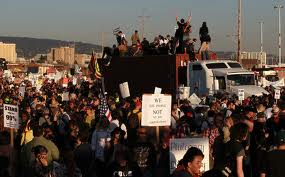
The You Tube video is revealing—Uygur’s astonishment at how underreported the crowd size in Oakland truly was. But I also found some startling photographs that belie the MSM’s attempt to undercut the groundswell of support this movement is capturing. It’s growing despite the naysayers and critics. It’s growing despite the MSM’s attempt to edit and minimize. It’s growing against all odds.
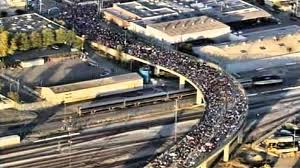
The Tea Party, of course, wants everyone to go home and get a job. Which a lot of these people would probably happily do if there were jobs to get, the sort that pay a living wage—that small complication of making enough money to feed yourself and your family, pay the rent, keep the lights on. We were told yesterday morning that unemployment ticked down a tenth of a percentile. That would make the ‘official’ unemployment number 9 instead of 9.1%. And there have been reports coming out suddenly to tell the country that stories of poverty and inequality are vastly exaggerated, even though the Census Bureau’s numbers show 1 in 15 Americans now categorized as the ‘poorest of the poor,’ the biggest jump recorded in 35 years. Btw, that would be 50% or less than the official poverty level, which translates to $5,570 for an individual; $11, 157 for a family of four.
Seems to be an awful lot of sputtering, squirming and spinning going on.
Surely, it’s mere coincidence.
Easy Answers are the Wrong Narrative
Posted: October 1, 2011 Filed under: just because | Tags: U.S. Economy 8 Comments I was watching an interview last night with Warren Buffett by Charlie Rose on the economy. Yes, I know I’m weird. I don’t watch sports or movies. I watch documentaries and listen to interviews. I have the academic’s disease in spades. There was a lot of discussion about a lot of things but the one thing that grabbed me was the question Rose asked about what Obama should have done differently on the economy. Buffett is an Obama supporter and made a point of saying that the President had basically responded as well as he could to the economic challenges and he hated hindsight criticism. However, the one point made was that the President really hadn’t emphasized early on how difficult this economic recovery challenge would be and that the passage of the stimulus was perhaps glossed over as a panacea that it could not be for many reasons.
This narrative came back to me this morning as I plowed through The Economist with my morning coffee. Only this time, similar behavior was attributed to Angela Merkel in the cover story called The World Economy: Be Afraid.
The second failure is one of honesty. Too many rich-world politicians have failed to tell voters the scale of the problem. In Germany, where the jobless rate is lower than in 2008, people tend to think the crisis is about lazy Greeks and Italians. Mrs Merkel needs to explain clearly that it also includes Germany’s own banks—and that Germany faces a choice between a costly solution and a ruinous one. In America the Republicans are guilty of outrageous obstructionism and misleading simplification, while Mr Obama has favoured class warfare over fiscal leadership. At a time of enormous problems, the politicians seem Lilliputian. That’s the real reason to be afraid.
I laughed at the idea of Obama favoring class warfare over fiscal leadership given that paragraph followed directly after the sentence: “But the  collective obsession with short-term austerity across the rich world is hurting”. Obama’s been leading the charge on austerity. I honestly don’t think any one person or an S&P national downgrade is going to deter the Republican party from leading the entire country off the cliff in pursuit of the White House. Maybe once they’ve figured that all of their candidates have so many warts they are unlikely to pass muster with the base AND independents, they’ll get back to being a minority party instead of group of hostage taking ideologues. But, I doubt it. They are all spinning overly simplistic messages that resonate with the many people looking for simple answers. The global Great Recession is not done with us yet and to pretend there are simple answers to pass around is expedient and immoral.
The Economist is talking about the timidity of leaders across the globe to really lead on programs that could tackle the severe economic problems we face. The problem is that many seem to be offering up messages that offer policies contrary to what’s really needed. The call for austerity right now, instead of when the houses are in order, keeps me busy trying to find a safe place to stash my little nest egg. There’s only so many places in Norway, Malaysia, and Korea for small investors. Even China’s manufacturing behemoth is showing signs of slowing which is undoubtedly, yet another sign of lack of customers. Yet, every developed nation is pulling in its horns further and further. There is a lack of correct–as well as bold–action.
Germany, for instance, thinks the main problem is fiscal profligacy and so is reluctant to boost Europe’s rescue fund; yet a far bigger fund is needed if a rescue is to be credible. The most urgent solutions, such as restructuring Greece’s debt or building a protective barrier around Italy, require the most political courage—something that Angela Merkel, Nicolas Sarkozy et al have yet to exhibit. The chances of a bold enough plan will shrink if markets stabilise. The less scared they are, the more likely Europe’s spineless policymakers are to jump yet again for a plan that does just enough to stave off catastrophe temporarily, but lets the underlying problem get worse.
Much of the world is now paying for their timidity: witness the increasingly dark economic backdrop. A slew of recent indicators suggests the euro area is slipping into recession, as Germany’s exports slow, the fiscal screws tighten, confidence slumps and the banks’ travails imply tighter credit. Even if the euro-zone crisis were to be solved tomorrow, the region’s GDP would probably shrink over the coming months.
America’s economy is still limping along, though the summer slump in share prices and consumer confidence suggest future spending will weaken further. The Federal Reserve is trying new ways of support, somewhat half-heartedly. Whatever it does, America is currently on course for the most stringent fiscal tightening of any big economy in 2012, as temporary tax cuts and unemployment insurance expire at the end of this year. That could change if Congress came to its senses, passed Barack Obama’s jobs plan and agreed on a medium-term deficit-reduction deal by November. If Democrats and Republicans fail to hash out a compromise on the deficit, draconian spending cuts will follow in 2013. For all the tirades against the Europeans, America’s economy risks being pushed into recession by its own fiscal policy—and by the fact that both parties are more interested in positioning themselves for the 2012 elections than in reaching the compromises needed to steer away from that hazardous course.
What about the cushion the emerging markets provide? That, too, is getting thinner. Their growth is slowing (as it needed to, since many economies were overheating). Recent falls in emerging-world currencies and stock prices show that financial panic can afflict the periphery too (see article). Some emerging economies, including China, have less room to repeat their 2008-09 stimulus because of the debts that splurge left behind. Monetary policy can be loosened: several central banks have cut rates. But, overall, the emerging world will be less of a buoy to global growth than it has been hitherto.
Thursday Reads: Poverty and Joblessness *Are* Social and Political Issues
Posted: August 11, 2011 Filed under: Foreign Affairs, Global Financial Crisis, Great Britain, jobs, Media, morning reads, poverty, U.S. Economy, U.S. Politics, unemployment | Tags: austerity, Banksters, education, Federal Reserve, global elites, government corruption, joblessness, London Riots, looting, Poverty, social services, U.S. Economy, unemployment 44 Comments
Guess who said this:
“There are pockets of our society that are not just broken, but are frankly sick.
“It is a complete lack of responsibility in parts of our society, people allowed to feel the world owes them something, that their rights outweigh their responsibilities and their actions do not have consequences. Well, they do have consequences.”
You’re darn right! The global elites have gone too far! The banksters have stolen trillions from ordinary taxpayers, and then demanded and received massive government bailouts. Politicians have lost any sense of responsibility toward their constituents, only listening to their corporate masters and their lobbyists. Yes there are consequences and these wealthy elites will discover there are consequences for their corrupt and immoral actions.
Oh wait. That was Prime Minister David Cameron talking about the poor and jobless young people who have been rioting in the streets of London and other British cities for the past five days. I’ll bet he has absolutely no clue how ridiculous it is that he is chastising these people for looting after he and other global elites allowed banksters to steal and loot trillions with absolutely no consequences. From Raw Story:
The U.S. Federal Reserve gave out $16.1 trillion in emergency loans to U.S. and foreign financial institutions between Dec. 1, 2007 and July 21, 2010, according to figures produced by the government’s first-ever audit of the central bank.
Last year, the gross domestic product of the entire U.S. economy was $14.5 trillion.
Of the $16.1 trillion loaned out, $3.08 trillion went to financial institutions in the U.K., Germany, Switzerland, France and Belgium, the Government Accountability Office’s (GAO) analysis shows.
Additionally, asset swap arrangements were opened with banks in the U.K., Canada, Brazil, Japan, South Korea, Norway, Mexico, Singapore and Switzerland. Twelve of those arrangements are still ongoing, having been extended through August 2012.
Out of all borrowers, Citigroup received the most financial assistance from the Fed, at $2.5 trillion. Morgan Stanley came in second with $2.04 trillion, followed by Merill Lynch at $1.9 trillion and Bank of America at $1.3 trillion.
Lambert has been highlighting the hypocrisy of the global elites on the riots. Yesterday he linked to this article in the Guardian.
This scepticism toward the potency of democratic politicians – and therefore democratic politics itself – is oddly echoed by the looters themselves. Certainly no one outside the Iranian state media is calling them “protesters”, but even “rioters” seems the wrong word, carrying with it a hint of political purpose. For some, especially at the start in Tottenham, there was clearly a political dimension – with the police the prime focus of their anger. But many of the copycat actions across London and elsewhere have no apparent drive beyond the opportunistic desire to steal and get away with it. It’s striking that the targets have not been town halls or, say, Tory HQ – stormed by students last November – but branches of Dixons, Boots and Carphone Warehouse. If they are making a political statement, it is that politics does not matter.
Lambert notes that at least these looters didn’t steal $16 trillion from the U.S. Treasury.
And while the revulsion at the looting has been widespread and bipartisan – with plenty of liberals admitting to “coming over all Daily Mail” at the ugliness of the vandalism – that sense of the impotence of politics is widespread, too. One aspect of the phone-hacking scandal that went deep was its revelation that those we might think exert authority – police and politicians – were in fact supine before an unelected media corporation. The sheer power of News Corp contrasted with the craven behaviour of those we elect or entrust to look out for us.
But elected officials are supposed to protect all citizens–even the poor, the unemployed, and the elderly–aren’t they? Yet in the U.S. and Europe, the burden of the economic crisis is falling on those with the least ability to pay, while the wealthy continue to receive their government handouts. When people are pushed to the point that they feel they have nothing to lose, this is what happens. Why it is coming as such a surprise to the comfortable elites is the real mystery.
Let’s take a look at what some of the rioters themselves have said about the meaning of their actions. From Yahoo News:
The Conservative-Liberal Democrat coalition government, making deep cuts to public services to tackle a record budget deficit, has been quick to deny that the unrest was linked to austerity measures, calling the disorder “pure criminality.” [….]
Public anger over the widespread looting of shops appears to have strengthened the government’s argument, with stolen goods ranging from the expensive — televisions and jewelry — to the absurd — sweets and bottles of alcohol.
However, community leaders and rioters themselves said the violence was an expression of the frustration felt by the poorest inhabitants of a country that ranks among the most unequal in the developed world.
“They’ve raised rates, cut child benefit. Everyone just used it as a chance to vent,” one man who took part in unrest in the east London district of Hackney told Reuters.
Surprise, surprise. Cutting social services to pay for the bankers’ failures has real life consequences. Austerity measures create more unemployment, and people who don’t have jobs get hungry and scared. When you take everything from people who can least afford it, they get angry. What on earth do these people expect? What planet are they living on anyway? And no, I’m not condoning violence. I’m just saying that it’s going to happen when you push people too far.
Here are some quotes from two young women who participated in the British riots:
Two girls who took part in Monday night’s riots in Croydon have boasted that they were showing police and “the rich” that “we can do what we want”.
From The New York Times: London Riots Put Spotlight on Troubled, Unemployed Youths in Britain
“I came here to get my penny’s worth,” said a man who gave his name as Louis James, 19, a slightly built participant in the widening riots that have shaken London to its core. With a touch of guilt on Tuesday, Mr. James showed off what he described as a $195 designer sweater that he said he took during looting in Camden Town, a gentrified area of north London.
Politicians from both the right and the left, the police and most residents of the areas hit by violence nearly unanimously describe the most recent riots as criminal and anarchic, lacking even a hint of the anti-government, anti-austerity message that has driven many of the violent protests in other European countries.
But the riots also reflect the alienation and resentment of many young people in Britain, where one million people from the ages of 16 to 24 are officially unemployed, the most since the deep recession of the mid-1980s.
Don’t these politicians, police, and other observers understand that poverty and jobless *are* sociopolitical issues? Just because people are acting out of desperation or even opportunism doesn’t mean that their actions are not political. Just because someone is young and poor does not mean he or she isn’t aware that government and corporate corruption have caused much of their distress. Back to the NYT article:
In many ways, Mr. James’s circumstances are typical. He lives in a government-subsidized apartment in northern London and receives $125 in jobless benefits every two weeks, even though he says he has largely given up looking for work. He says he has never had a proper job and learned to read only three years ago. His mother can barely support herself and his stepbrothers and sisters. His father, who was a heroin addict, is dead.
He says he has been in and out of too many schools to count and left the educational system for good when he was 15.
“No one has ever given me a chance; I am just angry at how the whole system works,” Mr. James said. He would like to get a job at a retail store, but admits that he spends most days watching television and just trying to get by. “That is the way they want it,” he said, without specifying exactly who “they” were. “They give me just enough money so that I can eat and watch TV all day. I don’t even pay my bills anymore.”
Jonathan Portes, the director of the National Institute of Economic and Social Research in London, says that Mr. James’s plight reflects a broader trend here. More challenging students, Mr. Portes says, have not been receiving the attention they should as teachers, under pressure to meet educational goals, focus on children from more stable homes and those with greater abilities and social skills. Disillusioned, those who cannot keep up just drop out.
The Los Angeles Times in an opinion piece searches for the reasons for the violence and asks if it could happen here.
The Tottenham riots that blindsided Britain were sparked by the fatal police shooting of Mark Duggan, a 29-year-old black man. Over the past few days, they’ve continued and spread, turning into what has largely become youths’ looting and destroying parts of London. But no one is exactly sure why they’re doing it. Prime Minister David Cameron called it “criminality, pure and simple.”
But why have the riots continued day after day?
The riots are neither politically or racially fueled, wrote Doug Sanders of the Globe and Mail. They’re the result of a “lost generation” of youth under 20 who have little to lose and a bleak future. Here’s an excerpt:
Whether the thousands of rioters actually did express disillusionment — some did say they were angry at police or the world, but many appeared gleeful or greedy — it is clear that most had nothing else to do with themselves, and no reason to fear or feel responsible for the consequences of their actions.
This is a chronic problem in Britain, which has a “lost generation” of young high school dropouts far larger than most other Western countries’.
It’s so simple-minded to expect that youthful rioters are going to calmly explain their behavior in a reasoned, intellectual manner or that they are not going to act euphoric once they let go of restraint and begin acting out as part of a mob. None of that means that the reasons for their behavior are not political.
It seems to me that masses of young people who have “little to lose and bleak future” is in fact a powerful political issue for any society. And when people are powerless, there are few ways for them express their anger. Violence is one way to get attention from the powerful.
Can it happen here? You bet it can. As long as the President and Congress continue enacting austerity measures and ignoring unemployment and general misery among ordinary Americans, it’s guaranteed the U.S. will see riots in the streets–as we have in the past. When it happens here, will our elites be as dumbfounded and out-of-touch with reality as those in Great Britain? Probably.
I posted this in a comment yesterday, but I’m going to put it up again here. It’s an interview of writer and broadcaster Darcus Howe by a clueless BBC “journalist.”
—————————————-
That’s my suggested reading for today. What do you recommend?
UPDATE: I found a piece in the Guardian that reflects my thinking.
Seumas Milne: These riots reflect a society run on greed and looting
It is essential for those in power in Britain that the riots now sweeping the country can have no cause beyond feral wickedness. This is nothing but “criminality, pure and simple”, David Cameron declared after cutting short his holiday in Tuscany. The London mayor and fellow former Bullingdon Club member Boris Johnson, heckled by hostile Londoners in Clapham Junction, warned that rioters must stop hearing “economic and sociological justifications” (though who was offering them he never explained) for what they were doing.
When his predecessor Ken Livingstone linked the riots to the impact of public spending cuts, it was almost as if he’d torched a building himself. The Daily Mail thundered that blaming cuts was “immoral and cynical”, echoed by a string of armchair riot control enthusiasts. There was nothing to explain, they’ve insisted, and the only response should be plastic bullets, water cannon and troops on the streets.
We’ll hear a lot more of that when parliament meets – and it’s not hard to see why. If these riots have no social or political causes, then clearly no one in authority can be held responsible….If this week’s eruption is an expression of pure criminality and has nothing to do with police harassment or youth unemployment or rampant inequality or deepening economic crisis, why is it happening now and not a decade ago? The criminal classes, as the Victorians branded those at the margins of society, are always with us, after all. And if it has no connection with Britain’s savage social divide and ghettoes of deprivation, why did it kick off in Haringey and not Henley?
…To refuse to recognise the causes of the unrest is to make it more likely to recur – and ministers themselves certainly won’t be making that mistake behind closed doors if they care about their own political futures.
Thursday Reads: A Poverty Tour, Confidence Fairies, A-Rod, D.B. Cooper, and Wingnut Censors
Posted: August 4, 2011 Filed under: 2012 presidential campaign, Barack Obama, Crime, Democratic Politics, poverty, religion, Republican politics, Surreality, Team Obama, U.S. Economy, U.S. Politics, voodoo economics | Tags: Alex Rodriguez, Barack Obama, bible, censorship, confidence fairy, Cornel West, D.B. Cooper, FBI, Jay Carney, Keith Olbermann, Newt Gingrich, Paul Krugman, Poverty Tour, ratings agencies, Slaughterhouse Five, Tavis Smiley, Tim Geithner, Twenty Boy Summer, U.S. Economy 27 Comments
Good Morning!! Let me get a sip of my breakfast tea, and then I’ll share what I found in the news today.
After doing his level best to wreck the U.S. economy, President Obama headed to Chicago to celebrate his birthday and rake in some campaign donations.
Taking a brief hometown respite Wednesday night, President Barack Obama used a 50th birthday bash in Uptown to raise re-election money from a friendly crowd as he sought to recharge a presidency showing signs of scars from Washington’s partisan battles.
The president told supporters at the Aragon Entertainment Center that the nation doesn’t have time to “play these partisan games.”
“I hope we can avoid another self-inflicted wound like we saw over the last couple weeks,” Obama said of the recent debt-ceiling gridlock.
Although Obama doesn’t turn 50 until Thursday, his visit symbolized presidentially and politically a need to turn the corner following weeks of bruising debate over raising the nation’s debt ceiling and cutting the country’s deficit.
Awww, poor guy. Screwing the poor, the elderly, baby boomers, and the working- and middle-classes must be really exhausting.
Meanwhile, Tavis Smiley and Cornel West are heading up a “poverty tour”
to highlight what they see as deficiencies in the Obama’s administration and to force the president and Congress to pay more attention to poor people who have been hit hardest by the recession.
Smiley called the legislation, signed by the president, “a declaration of war on the poor.”
“I don’t understand how the president could agree to a deal that does not extend unemployment benefits, does not close a single corporate loophole and doesn’t raise the taxes on the rich,” said Smiley. “The poor are being rendered more and more invisible in this country. Nobody, not the president, not the Republicans in Congress, is speaking to the truth of the suffering of everyday people.”
Paul Krugman was on Keith Olbermann’s show last night. I keep forgetting to watch that! Krugman discussed a number of things related to the debt ceiling bill, including Newt Gingrich’s remark that the Obama’s is “the Krugman Presidency.” It is to laugh!
Vodpod videos no longer available.Today, Obama’s press secretary Jay Carney said there won’t be a double-dip recession and the economy is going to grow.
He blamed the earthquake and tsunami in Japan, higher energy prices, default worries in Europe and recently resolved uncertainty over raising America’s borrowing limit. Carney said, “We believe the economy will continue to grow.”
Al-righty then! I guess we have nothing to worry about.
At his blog, Krugman responded that “hope is not a plan.”
Of course there’s a threat. Larry Summers puts the odds at one in three; I might be slightly more optimistic, but the risk is very real. Who, exactly, is at the White House who knows better?
And think about the politics here. For two years the White House has been determinedly cheerful, always declaring that the recovery was on track, that its policies were working fine. And all it did was squander its credibility. Maybe admitting the truth, saying that in fact we hadn’t done nearly enough, would not have helped get useful legislation through Congress. But at least it would have conveyed the message that the WH was living in the same reality as ordinary workers.
Now they’re doing it again. To what purpose? Do they think the markets will be reassured? Do they think consumers will be reassured? At this point, after the “summer of recovery” came and went a whole year ago?
Apparently, that is what they think. Via Digby, Tim Geithner, who seems to be the person Obama listens to most on economic issues, strongly believes in the “confidence fairy.” He must also be the source of Jay Carney’s belief that we won’t have another recession, because that’s what Geithner told George Stepanopoulos a couple of days ago.
GEORGE STEPHANOPOULOS: But don’t you think that any deficit reduction now will — will hurt the attempts of the economy to recover?
TIM GEITHNER: You know, I think the — basic reality we live with and, you know, part of governing is recognize we live with — we don’t have unlimited resources, and we inherited and are left with unsustainable deficits long term. And the president understands that for the sake of the economy long-term it’s very important we demonstrate to the American people, to people around the world that we can get our arms around this and start go back to living’ within our means.
Now, we want to do that very carefully so we create room for the economy to grow and we have the resources necessary to invest in things that are going to be very important to the future like education, like infrastructure, like incentives for private investment. And to do that, it is absolutely essential to lock in these long term savings. Now — the president was very strong on this and made sure that we were not going to accept spending cuts that would damage the prospects for near term recovery. Now, with this behind us, and we get this —
GEORGE STEPHANOPOULOS: So this won’t cost us jobs?
TIM GEITHNER: No, it will not. Now … if we put this behind us then we can turn back to the important challenge of trying to find ways to make sure that we do everything we can to get more people back to work, strengthen our growth. And we’ll have more ability to do that now with people more confident and we can start to get our arms around the long-term problems.
WTF?! Is this guy for real? As Krugman said, “hope is not a plan,” but they don’t seem to have anything else.
At The Nation, George Zornick asks a very good question: Is it time to downgrade the ratings agencies?
…by almost all accounts inside the beltway, a downgrade in the federal government’s credit rating would be catastrophic. But a closer look at who issues these ratings, how they do it, and the real-world impact of these ratings tells a different story.
The first clue that these ratings might not be highly calibrated, serious indicators of creditworthiness can be found in the 2008 economic collapse. The financial products created by Wall Street that were full of toxic mortgage securities were all blessed with gold-star ratings as safe investments from the country’s three main credit ratings agencies, Moody’s, Fitch and Standard and Poor’s.
These products were so awful as to destroy Lehman Brothers, threaten many other trading firms, and plunge the economy into recession, but the ratings agencies consistently told investors they were safe. As William Greider has noted here, this essentially made the rating agencies “unindicted co-conspirators” in the collapse.
Were these agencies just bad at their jobs? Maybe, but Greider offers another more sinister theory: since the banks pay the rating agencies to examine their financial products, a harmful rating would persuade the banks to just shop elsewhere for a more favorable outcome. “This is an outrageous conflict of interest at the very heart of the financial system,” Greider writes.
Overpaid New York Yankee Alex Rodriguez is in trouble again, this time for illegal gambling. Baseball officials opened an investigation after
Star Magazine reported that Rodriguez “played in an underground, illegal poker game where cocaine was openly used, and even organized his own high-stakes game, which ended with thugs threatening players.”
Under the rules that govern baseball players, Rodriguez will have to truthfully answer baseball’s questions. If he acknowledges that he played in underground games or if officials uncover evidence that he did so, he could face a suspension.
The report Wednesday came a month after Major League Baseball opened its own investigation into Rodriguez’s ties to gambling. The investigation was prompted by a Star Magazine report in June that said Rodriguez had participated in a high-stakes illegal poker game with the actors Tobey Maguire, Leonardo DiCaprio, Ben Affleck and Matt Damon.
Hmmm…he was playing with Red Sox fans Affleck and Damon. I wonder who talked to Star Mag? I also learned on Google that A-Rod is dating actress Cameron Diaz. Boy is she making a big mistake.
Here’s an update on the D.B Cooper story I wrote about in the Tuesday Reads: My uncle was D.B. Cooper, Oklahoma woman claims It sounds crazy, but apparently the FBI believe this woman’s story.
To Marla Cooper of Oklahoma, her uncle was D.B. Cooper — except she knew him as Uncle L.D. She believes he died in 1999.
“I saw my uncle plotting a scheme,” Cooper told CNN’s Brooke Baldwin of what she said she remembers witnessing as an eight-year-old girl four decades ago.
Cooper said she was with two uncles at her grandma’s house around Thanksgiving time.
“I was with them while they were plotting it. I didn’t really know what was going on,” Cooper said. “Afterwards on Thanksgiving Day, I saw them return and I heard them discussing what they had done with my father. I have very vivid memories of it.”
Her claim might be cause for healthy speculation, especially 40 years after the fact, but two sources close to the investigation have told CNN that Marla Cooper’s tip led to the FBI reviving the case and for the past year the agency has been actively working the lead.
She says her uncle returned home badly injured and was treated at a VA hospital. Then he disappeared and she never saw him again. Her family made her swear she would never talk about what had happened.
Finally, from Think Progress, here’s an update from the annals of wingnut craziness: MO High School Bans ‘SlaughterHouse Five’ From Curriculum, Library Because Its Principles Are Contrary To The Bible
On Monday at the Republic, MO school board meeting, four Republic School Board members reviewed a year-old complaint that three books are inappropriate reading material for high school children. In a 4-0 vote, the members decided to ax two of the three books from the high school curriculum and the library shelves: Twenty Boy Summer by Sarah Ockler and Slaughterhouse-Five by Kurt Vonnegut. Speak by Laurie Halse Anderson was spared. The resident who filed the original complaint targeted these three books because “they teach principles contrary to the Bible”
Wesley Scroggins, a Republic resident, challenged the use of the books and lesson plans in Republic schools, arguing they teach principles contrary to the Bible.
“I congratulate them for doing what’s right and removing the two books,” said Scroggins, who didn’t attend the board meeting. “It’s unfortunate they chose to keep the other book.”
Horrors! Contrary to the Bible? We can’t have that! You know, sometimes I’m very grateful to live in a relatively civilized place like Boston. This is one of those times.
On that note, I’m going to get another cup of tea and then check out what you all are reading and blogging about. Please post your links in the comments.
We’re in Trouble Now: President Pushover “Takes Lead in Budget Talks”
Posted: June 24, 2011 Filed under: Team Obama, U.S. Economy, U.S. Politics, We are so F'd | Tags: Barack Obama, debt limit, Deficit Reduction, Harry Reid, Joe Biden, John Boehner, Mitch McConnell, President Pushover, U.S. Economy, U.S. Politics 11 Comments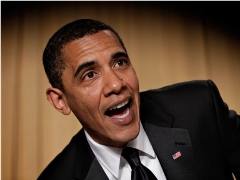
Politico reports today that President Obama
signaled on Friday that he is ready to take over the debt-limit negotiations, summoning Senate leaders to the White House next week as the continuing impasse pushes the country closer to a potential default.
Obama will meet separately with Senate Majority Leader Harry Reid (D-Nev.) and Minority Leader Mitch McConnell (R-Ky.) on Monday. The meetings follow the collapse Thursday of talks between Vice President Joe Biden and congressional leaders.
This isn’t good news for us liberals. Once Obama gets involved, I think we can assume he will give away the store to the Republicans. He’ll probably give them much more than they’re asking for. We’re going to need some stiffened Democratic spines in the Senate if we want to rescue Medicare and Medicaid. Are there and Democratic Senators left who have spines to stiffen?
“The president is willing to make tough choices, but he cannot ask the middle class and seniors to bear all the burden for deficit reduction and to sacrifice while millionaires and billionaires and special interests get off the hook,” White House press secretary Jay Carney said Friday. That’s not “a fair and balanced approach.”
Oh fine. Just what we needed–a Fox News reference.
Meanwhile, House Speaker John Boehner (R-Ohio) said the “realities of the situation” are that the House won’t pass any deal that involves raising new revenues, and the package must include budget reforms and spending cuts that exceed the amount of the debt limit increase, which is expected to top $2 trillion.
Boehner’s demands are insane, but that probably won’t stop Obama from allowing Republicans to put the final nails in the coffin of the U.S. economy.

 peej
peej Carissa
 bostonboomer
 dakinikat
 ecocatwoman
 mablue2
 Mama Lopez
 peggysue22
 quixote
 skydancingguestblogger
 Mona (aka Wonk the Vote)



 Sky Dancing
Recent Comments