
Tuesday Reads
Posted: March 29, 2011 Filed under: Barack Obama, Foreign Affairs, Hillary Clinton, legislation, Libya, morning reads, Republican presidential politics, U.S. Military, U.S. Politics, worker rights | Tags: Donald Trump, Fareed Zackaria, Fukuskim nuclear plant, Indiana politics, Japan, Juan Cole, Libya, Moammar Gaddafi, NATO, radiation, Tom Malinowsky, Tom Ricks, unions 92 Comments
Good morning, political junkies!! Let’s get right to the news.
President Obama gave a speech last night in which he made a pretty good case (IMO) for U.S. limited intervention in Libya. He stated that there were not going to be American boots on the ground and that the U.S. is essentially finished with its part of the operation–it will be up to the UK, France, and Italy to police the no-fly zone and to the Libyan people to depose Gaddafi and decide what comes next.
Surprisingly, Obama was a bit more animated than usual–actually emphasizing points with his voice and at times appearing almost passionate. At least the speech didn’t start to put me to sleep until the last several minutes.
Obama indicated that the U.S. will continue to support efforts to set up a functioning government in Libya, but that will be a non-military effort. If he stands strong with that, I think he’s finally done something I agree with and can support.
Obama also argued that just because we can’t intervene in every conflict doesn’t mean that we should never intervene at all. We have to choose our battles, and in the case of Libya we had a dictator who was using his military–and his air power to kill his own citizens indiscriminately. If he had managed to attack Benghazi he might have murdered hundreds of thousands of people.
Furthermore, Libyans had asked for our help, and our action was supported by other Arab countries and by the Arab League. For once the U.S. was doing something that most Arabs wanted us to do. If we had not acted, we would have seen an atrocity take place, and that would have encouraged dictators in other Arab countries to crack down violently on protesters.
Here is the full text of the speech, if you are interested. I do think Obama went on too long after making the case for Libya. The speech would have been much better if he had done that and then wrapped it up.
I must say, I do not understand the criticisms of this Libya policy that I’m seeing in the progosphere, and from some people here at Sky Dancing. Maybe I’m nuts, but I think the U.S. finally had a chance to do something good with its massive military power and at the same time we get some good PR in a part of the world that has long hated us–with justification because we have enabled most of the tyrants in the region. I’m glad Hillary was able to convince her boss to do the right thing.
I want to call attention to some very knowledgeable people who agree with my assessment–and we do appear to be in the minority.
Thomas Ricks was on Monday’s edition of NPR’s Talk of the Nation. He said that he was struck by how many people either aren’t listening to what Obama, Clinton, and Gates are saying or they are discounting it out of hand.
Ricks said that these three are saying that the U.S. goals in Libya have already been achieved. The rebel forces are knocking on the door of Tripoli, thanks to the no-fly zone and some strategic bombing by the coalition countries. As Obama said last night, it is now up to Libyans to decide what to do with Gaddafi. We aren’t going to try to take him out.
Here’s what Ricks wrote on his blog after his appearance on Meet the Press with Gates and Clinton:
I was on Meet the Press yesterday, following Hillary Clinton and Robert Gates. I was struck at how frequently they emphasized the short-term, limited nature of the U.S. action in Libya, and how they used the past tense to discuss it:
Gates: “I think that the no fly zone aspect of the mission has been accomplished.”
Clinton: “I think we’ve prevented a great humanitarian disaster.”
Gates: “we see our commitment of resources actually beginning to — to decline.”
Gates: “in terms of the military commitment, the president has put some very strict limitations in terms of what we are prepared to do.”
Gates: “I don’t think it’s [Libya] a vital interest for the United States. But we clearly have interests there. And it’s a part of the region, which is a vital interest for the United States.”
I also was struck at how much more assertive Clinton seemed than Gates. A friend of mine calls this “State’s War.”
Ricks also blogged about his take on Obama’s speech: Obama on Libya: Watch out, Saudi Arabia
What we saw in the NDU speech was a logical defense of what the president has ordered the military to do and an exposition of what the limits of the action will be. The cost of inaction threatened to be greater than the cost of action, but now we have done our part. Next role for the U.S. military is best supporting actor, providing electronic jammers, combat search and rescue, logistics and intelligence. That was all necessary, and pretty much as expected.
But I was most struck by the last few minutes of the speech, when Obama sought to put the Libyan intervention in the context of the regional Arab uprising. He firmly embraced the forces of change, saying that history is on their side, not on the side of the oppressors. In doing so he deftly evoked two moments in our own history-first, explicitly, the American Revolution, and second, more slyly, abolitionism, with a reference to “the North Star,” which happened to be the name of Frederick Douglass’s newspaper. If you think that was unintentional, read this.
Hmmm…I totally missed that. Follow me below the fold…
The Triangle Shirtwaist Fire: 100 Years Ago Today
Posted: March 25, 2011 Filed under: U.S. Economy, U.S. Politics, worker rights | Tags: 100th anniversary, Republicans, Scott Walker, Triangle Shirtwaist Fire, unions 13 CommentsToday is the 100th anniversary of the Triangle Shirtwaist Fire. The AFL-CIO blog has an excellent post up to commemorate this tragic anniversary. Here is a bit of it, but I suggest you read the whole thing if you can find the time.
When word got out two weeks ago that Wisconsin Gov. Scott Walker had ordered the windows of the state Capitol building bolted shut during the ongoing protests against his attacks on public employees, it was a chilling reminder of a similar action by the employers of the Triangle Shirtwaist factory.
Nearly 100 years ago to the day of Walker’s order—which he rescinded after public outrage—146 workers, mostly young immigrant girls, jumped to their deaths from the 10-story building, unable to escape a fire because factory foremen had locked all the doors. The owners, Isaac Harris and Max Blanck, worried the workers would steal from the company.
Hyman Meshel worked on the eighth floor. When the rescue crew found Meshel, who was still alive,
the flesh of the palms of his hands had been torn from the bones by his sliding down the steel cable in the elevator, and his knuckles and forearms were full of glass splinters from beating his way through the glass door of the elevator shaft.
Thirty dead bodies clogged the elevator shaft. All were young girls. Among the many victims, the New York Times reported the day after the disaster, were two girls:
charred beyond all hope of recognition, and found in the smoking ruins with their arms clasped around each other’s necks….
In Greenwich Village, relatives of victims marched in a procession to honor those who died so tragically–as well as those who managed to survive
Rosie Weiner, one of 146 victims of the Triangle Shirtwaist Factory fire, was only 19 when she died.
“She jumped from the ninth floor window. According to reports, she was holding her friend Tessie Wisner’s hand,” said Suzanne Pred-Bass, Weiner’s great-niece.
Pred-Bass was one of hundreds marching in a procession from Union Square to the scene of the Triangle Shirtwaist fire. Another of her great-aunts, Rosie’s 17-year-old sister Katie, somehow survived that day 100 years ago.
“She grabbed the cable, really so courageously, of the last elevator to leave the ninth floor and saved herself. It was really remarkable,” said Pred-Bass.
Annie Springsock, then 17 years old, also survived. Her granddaughter, Eileen Nevitt, came from California to pay tribute to her and the historical impact of the fire.
Today, as we watch Republicans do everything in their power to destroy unions, remove safety regulations, and cut off funding for regulators, we need to remember what happened on that awful day 100 years ago. We can’t give up the fight. We must stand together against these politicians and their war on workers.
This is an open thread.
Thursday Reads
Posted: March 24, 2011 Filed under: Barack Obama, education, fundamentalist Christians, morning reads, right wing hate grouups, Social Security, The Media SUCKS, torture, U.S. Economy, U.S. Politics, unemployment, worker rights | Tags: Barack Obama, Barry Bonds, Bart Stupak, Elizabeth Taylor, food stamps, Jason Leopold, Jeff Kaye, Republicans, Social Security, Torture, unions, war on schools 32 Comments
R.I.P, Liz Taylor
Good Morning!!
I’ve got a potpourri of news items for you this morning. I realize I’ve been focusing too heavily on stories from the Middle East and Africa. I’ve just so gotten fascinated with all the rebellions going on. Anyway, this post will be dedicated to stories about events in the U.S.
Yesterday we lost the last great movie star, Elizabeth Taylor. She had been in the hospital for weeks with congestive heart failure. Today she died, at 79. From The New York Times:
By the time Elizabeth Taylor left this mortal coil at 79, she had cheated death with a long line of infirmities that had repeatedly put her in the hospital — and on front pages across the world — and in 1961 left her with a tracheotomy scar on a neck more accustomed to diamonds. The tracheotomy was the result of a bout with pneumonia that left her gasping for air and it returned her to the big, bountiful, hungry life that was one of her greatest roles. It was a minor incision (later, she had surgery to remove the scar), but it’s easy to think of it as some kind of war wound for a life lived so magnificently.
Unlike Marilyn, Liz survived. And it was that survival as much as the movies and fights with the studios, the melodramas and men (so many melodramas, so many men!) that helped separate Ms. Taylor from many other old-Hollywood stars. She rocketed into the stratosphere in the 1950s, the era of the bombshell and the Bomb, when most of the top female box-office draws were blond, pneumatic and classifiable by type: good-time gals (Betty Grable), professional virgins (Doris Day), ice queens (Grace Kelly). Marilyn Monroe was the sacrificial sex goddess with the invitational mouth. Born six years before Ms. Taylor, she entered the movies a poor little girl ready to give it her all, and did.
Ms. Taylor, by contrast, was sui generis, a child star turned ingénue and jet-setting supernova, famous for her loves (Eddie & Liz, Liz & Dick) and finally for just being Liz. “I don’t remember ever not being famous,” she said. For her, fame was part of the job, neither a blessing (though the jewels were nice) nor a curse. Perhaps that’s why she never looked defeated, unlike those who wilt under the spotlight. In film after film she appears extraordinarily at ease: to the camera born. She’s as natural in “National Velvet,” the 1944 hit that made her a star at 12, as she is two decades later roaring through “Who’s Afraid of Virginia Woolf,” proving once again that beauty and talent are not mutually exclusive, even in Hollywood.
I’m sure Liz would not be surprised to learn that the Westboro Baptist Church will picket her funeral. She was close friends with many gay men in Hollywood–Rock Hudson, James Dean, Montgomery Clift among them–and she worked tirelessly for AIDS causes. Meanwhile the pastor and members of the Westboro Baptist Church are mean-spirited, soulless haters.
There’s a nice tribute to Taylor at The Independent UK by Julie Burchill: Farewell then, Liz. You knew your beauty was a fuel worth burning
With the death of Elizabeth Taylor, the last of the Hollywood greats is finally gone. True to form – never a lady, barely ever a girl – this tough broad supreme battled on against ill-health for decades after her contemporaries overdosed on barbiturates, booze and self-loathing. And at a time when professional beauties seem terrified to show any sign of ageing lest they be shunted into character cameos in favour of some fresher flesh, Taylor was fascinating for being far less interested in leaving a good-looking corpse than in wringing every drop of the juice from every inch of the ride.
If that sounds a somewhat lewd metaphor, all the better. Married eight times, she was the anti-Marilyn; rather than combine a child’s face with an adult body and be prey to all the weirdos who might be attracted to such a pervy paradox, Taylor was a woman of the world from the get-go. Child stars are notorious for spending a couple of years on the ugly step while the studios wait for them to outgrow adolescent awkwardness, but she went straight from hugging Lassie to snogging Montgomery Clift, it seemed.
To see the teenage Taylor draw Clift towards her in the masterpiece A Place In The Sun (from the book of Theodore Dreiser’s An American Tragedy) with the words “Tell Mama – tell Mama all” is to witness one of the most extraordinary portrayals of lust ever created. And it didn’t stop when the cameras did; years later, according to her housekeeper, Marilyn Monroe would become obsessed with the apparently gay Montgomery Clift and repeatedly complain; “Liz Taylor has the Oscar, she has children, she even has Monty – she has everything!”
From being denounced by the Vatican in the Sixties as “an erotic vagrant” (I think they meant it as an insult, but it sounds gorgeous to me) to being hailed by the director of the UCLA Aids Institute as the “the Joan of Arc of Aids activism”, Taylor lived her life according to her own rules – more Wife of Bath than untouchable ideal of feminine perfection. Looking at the insipid contemporary film-star likes of Gwyneth Paltrow, for whom eating half a cupcake seems a walk on the wild side, this cursing, drinking, swashbuckling goddess is a reminder of when hell-raisers didn’t automatically have to be as mad, bad and sad as Charlie Sheen and Mel Gibson.
Here’s a nice video tribute I found on YouTube:
Now for the rest of the news, which as usual isn’t very good. The Republicans are trying to increase poverty by attacking food stamps and worker’s rights at the same time! They want to cut of food stamps for an entire family if one member goes on strike.
…[A] group of House Republicans is launching a new stealth attack against union workers. GOP Reps. Jim Jordan (OH), Tim Scott (SC), Scott Garrett (NJ), Dan Burton (IN), and Louie Gohmert (TX) have introduced H.R. 1135, which states that it is designed to “provide information on total spending on means-tested welfare programs, to provide additional work requirements, and to provide an overall spending limit on means-tested welfare programs.”
Much of the bill is based upon verifying that those who receive food stamps benefits are meeting the federal requirements for doing so. However, one section buried deep within the bill adds a startling new requirement. The bill, if passed, would actually cut off all food stamp benefits to any family where one adult member is engaging in a strike against an employer:
The bill also includes a provision that would exempt households from losing eligibility, “if the household was eligible immediately prior to such strike, however, such family unit shall not receive an increased allotment as the result of a decrease in the income of the striking member or members of the household.”
At FDL, Phoenix Woman dissects the latest media attacks on Social Security.
Ho-hum. Another day, another set of Peterson patsies explaining yet again why Grandma must starve so that their billionaire bosses and their buddies can keep their twenty-odd homes in the Hamptons and Hobe Sound:
Writing today on the op-ed page of The Washington Post, Robert Pozen makes the casethat liberals should support changes to Social Security. Mr. Pozen is a Democrat , though not necessarily a liberal one; he is a financial executive who served on President George W. Bush’s Social Security commission and in Mitt Romney’s administration in Massachusetts. But his argument is worth considering, whether you’re liberal or conservative.
So what’s the argument that the Pozen part of the Leonhardt-Pozen Legion of Doom tag team’s presenting? It’s their old favorite, the “Social Security is less progressive than it seems” bit of twaddle. How old is it? Why, it even comes pre-debunked, that’s how old it is.
To learn more, click on the link above.
I highly recommend reading this piece by Jeff Kaye, who has been researching and writing about torture for years now. He and Jason Leopold have been working together on a series at Truthout.
As part of a new investigative story, Truthout has published documents written by the former psychologist for SERE, and later CIA contract interrogator for the Bush torture program, Bruce Jessen. Before going to work for the CIA with his former SERE partner, psychologist James Mitchell, Jessen authored a 2002 “draft exploitation plan” for military use, based on his experiences as a SERE instructor. The newly-discovered documents, provided to Truthout by former SERE Air Force Captain Michael Kearns, were written back in 1989 when Jessen was transferred from his clinical role elsewhere in SERE to help staff a new survival training course for Special Mission Units undertaking dangerous assignments for Special Operations forces abroad.
Jason Leopold and I co-authored the new story, which includes a video interview with Captain Kearns, who helped hire Jessen back in 1989 for his new SERE role helping put together the class titled SV-91. The documents include notes for a portion of that class, known as “Psychological Aspects of Detention.” The other document is a paper by Jessen, “Psychological Advances in Training to Survive Captivity, Interrogation and Torture,” which was prepared for a symposium at that time: “Advances in Clinical Psychological Support of National Security Affairs, Operational Problems in the Behavioral Sciences Course.”
Jessen’s notes, in particular, demonstrate that this course material, which was “reverse-engineered” to provide a blueprint for the interrogation and detention policies of the Bush administration — some of which remain in use today — emphasized not just the ways to coercively interrogate an individual for intelligence purposes, but to “exploit” the detainee for a number of uses.
From Catherine Rampell at the NYT Economix blog: More Americans Dropping Out of the Labor Force. Apparently the drop in participation is not just due to the economic crisis. According to Rampell, more women are choosing not to work than in the past, and the the pending retirements of baby boomers are big contributors to the phenomenon.
This piece at The Daily Beast is a few days old, but still worth reading: Obama’s War on Schools
Over the past year, I have traveled the nation speaking to nearly 100,000 educators, parents, and school-board members. No matter the city, state, or region, those who know schools best are frightened for the future of public education. They see no one in a position of leadership who understands the damage being done to their schools by federal policies.
They feel keenly betrayed by President Obama. Most voted for him, hoping he would reverse the ruinous No Child Left Behind (NCLB) legislation of George W. Bush. But Obama has not sought to turn back NCLB. His own approach, called Race to the Top, is even more punitive than NCLB. And though over the past week the president has repeatedly called on Congress to amend the law, his proposed reforms are largely cosmetic and would leave the worst aspects of NCLB intact.
Read it and weep.
From CNN: Suspect in attempted bombing at MLK Day parade pleads not guilty
Kevin Harpham, 36, of Colville, Washington, made the plea during an arraignment hearing in federal court in Spokane. Harpham faces trial on charges of attempting to use a weapon of mass destruction and for possessing an unregistered explosive device.
Federal authorities arrested Harpham March 9, nearly two months after the January 17 discovery of a backpack containing a bomb along the Martin Luther King Day parade route in Spokane. The explosive device was found and disabled before the event began.
Officials called it an incident “of domestic terrorism” that could have resulted in “mass casualties,” had the bomb gone off.
I haven’t been following the Barry Bonds trial, but I was really angry when I read this: Witness says he knew of Bonds’ steroid use in 1999
Honestly, baseball should strike Bonds’ hitting records. It’s disgrace that he gets credit for passing Hank Aaron in home runs. Anyone who saw Bonds when he was younger had to know he was using steroids to get so big.
Poor Bart Stupak is afraid because of all the hate he got for voting for Obama’s health care bill.
After suffering through a “living hell” during negotiations on the healthcare law, former Rep. Bart Stupak (D-Mich.) finds it hard, a year later, to distance himself from his pivotal role.
“I guess I’m the face of healthcare,” Stupak told The Hill in an interview this week. “It goes with the territory.”
Last March, Stupak became the object of a flood of threats and obscene messages, left at his office and his home, as he helped hammer out a deal between anti-abortion-rights Democrats and the White House that was instrumental in passing healthcare reform through the House by a single-digit-margin.
Cry me a river, Bart.
That’s about all I’ve got for today. What are you reading and blogging about?
Indiana Democrats Flee to IL and KY to Avoid Voting on Right to Work Law
Posted: February 22, 2011 Filed under: collective bargaining, Democratic Politics, U.S. Economy, U.S. Politics, unemployment, worker rights | Tags: collective bargaining, Democrats, Indiana right to work bill, Mitch Daniels, Patti Smith, Power to the people, Republicans, Scott "Mubarak" Walker, unions, Wisconsin 32 Comments
Indiana House with Empty Democratic Seats
Yes, folks, it’s going viral! Indiana House Democrats have emulated Wisconsin Democratic Senators and leave the state rather than vote on a draconian anti-union bill.
Seats on one side of the Indiana House were nearly empty today as House Democrats departed the the state rather than vote on anti-union legislation.
A source tells The Indianapolis Star that Democrats are headed to Illinois, though it was possible some also might go to Kentucky. They need to go to a state with a Democratic governor to avoid being taken into police custody and returned to Indiana.
The House came into session twice this morning, with only three of the 40 Democrats present. Those were needed to make a motion, and a seconding motion, for any procedural steps Democrats would want to take to ensure Republicans don’t do anything official without quorum.
With only 58 legislators present, there was no quorum present to do business. The House needs 67 of its members to be present.
Indiana Government Mitch Daniels, who has completely unrealistic presidential aspirations tried to laugh off the Democrats’ strategy.
downplayed the boycott and the labor protests and laughed off suggestions that he might send the state police to pick up Democrats, some of whom left the state to escape their jurisdiction.
[….]
The right-to-work bill would prohibit Hoosier companies from entering into contracts requiring employees either to join a union or pay union dues or fees.
The bill would have a dramatic impact on teachers.
Death by Propaganda
Posted: February 19, 2011 Filed under: collective bargaining, education, John Birch Society in Charge, right wing hate grouups, The Media SUCKS, Voter Ignorance, worker rights | Tags: Negotiating, public and private salary surveys, state of Louisiana, unions, Wisconsin protests 35 Comments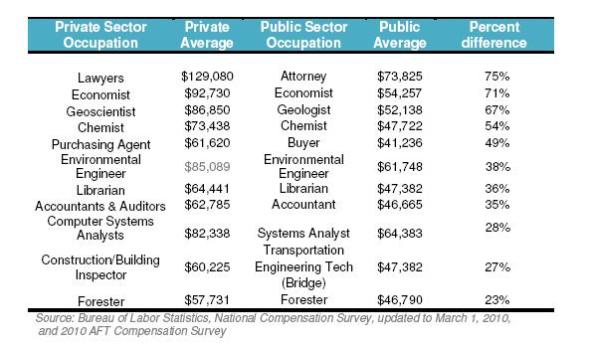
I’ve worked in both the public and private sector. I’ve also worked in union and non-union shops. Additionally, I was part of the collective bargaining process for community college instructors in a right to work state some time ago so I’m familiar with the process. I’ve been a manager and economist that has done strategic budgeting and planning so I’m used to salary and benefit surveys even though I’ve no experience in HR. I also check my facts before taking any one else’s words or wishful thinking. It’s easy to look for a scapegoat for the budget woes of states. The answer lies more in the nature of governors and legislators getting to balance a budget when funds are pouring in than it does in the joy that some people appear to be getting by scapegoating public sector workers and their unions.
For some reason, there’s this idea floating around that public sector employees are raking in the bucks at every one else’s expense. Also, there’s another canard out there that it’s public employees and their generous pensions that are breaking the back of state budgets. I know that’s not really the case for several reasons. The first one is that I know how the collective bargaining process works for a public employee because I’ve done it and the resultant salaries and benefits packages usually aren’t up to private sector levels. It’s based on bringing a rubric of like institutions in like communities and like jobs to the negotiating table. You basically point to that rubric and say here’s the top, bottom, and middle salaries for people in similar jobs in similar institutions. You point to their numbers and then you point to your institutions numbers and you suggest what it would take to put your institution in line with those averages. You negotiate to averages. You can’t negotiate to the best circumstance or you’ll be taken to labor “court” by management and the judges will force you to concede to a more reasonable position. The only time I’ve seen institutions go for the top salary positions is when they’re making a concerted effort to increase their academic standards and recruiting like the Duke Business School did awhile back. That, however, was a complete outlier.
As a union negotiator, you bring the rubric of institutions that would give your membership the best deal in the first round. The institution brings the rubric of institutions that give them the best deal. That rubric has to reflect similar circumstances to your membership. You can’t compare yourself to Harvard if you’re not an Ivy league school. You can’t compare yourself to Hawaii if you’re in the Midwest. Your rubric has to be a set of best matched institutions.
If everything works according to plan you negotiate a joint rubric that represents a middle ground and that middle ground will determine the end package that will likely stand for several years. If you can’t get that done, you declare an impasse and go to the NLRB or some other government entity that decides which rubric you’re going to use and that settles the situation. This happens with both benefits and salaries. It’s repeated every time negotiation year begins. It’s not an outrageous process at all. In the end, the membership either accepts it or rejects it. In my experience, teachers are generally pretty wimpy when it comes to accepting offers. I loved negotiating at a combination technical and community college because the craft people were used to unions and negotiations and were pretty good negotiators. The lead negotiator was a scrappy heating and air conditioning instructor of Italian and Sicilian heritage. I just loved talking strategy with him. Usually, the academic faculty would roll over easily for any scraps. This is a two way negotiating street. It only works when both parties sit down and are willing to hammer out a deal.
The reason this is not working in Wisconsin right now is that one side is refusing to negotiate at all. Not only that, but one side is changing the rules in the middle of the game. If there is no offset, there is no middle ground. This is the only way to get raises in public institutions. I can tell you that since I left that situation and moved to public institutions in Louisiana where you don’t get raises unless you have a governor that’s willing to fight the legislature for an across the board raise for every one. As a faculty, you live and die by whatever salary you got at the onset or you quit. In my experience, the best and the brightest do just that. They bring their new offers and see if they’ll be matched. If not, they move on. I’ve seen the institution then go to the job market and hire much younger and less experienced professors for much bigger salaries after not being able to offer even half that much to a recently tenured one. No one wants to be the one to offer a raise because every one will then want their salary raised to market level. It’s easier to let the good ones go instead. This is especially true in the econ/finance areas and also engineering and computer science because you can easily go to Wall Street or the private sector and make major amounts of money. If you’re represented by a negotiating unit, you come out with a decent cost of living raise annually and if your particular job has had an increase in marketability, you’re salary will move closer to the market. You never approach a private sector equivalence.
I’ve never seen anything in the public sector remotely approach a salary you can get in the private sector. The benefits tend to be better but the monetary compensation is almost always worse. I’ve given you an example from the salary survey done by the AFT in 2010 in the table at the top. It reflects the national salary survey of 2010 done by the Bureau of Labor Statistics which is the government’s data collector on labor markets. That’s the same people that collect unemployment statistics and inflation statistics. They have no ‘agenda’ but to collect the data. Individual groups just use the data to learn what the going market rate is for public and private sector jobs.
Now, I want to give you examples of things from the state of Louisiana. I’m going to use two resources. First, is a search engine set up by The Times Picayune of all state employee salaries. Use it to search out only one thing. The job title clerk. Clerks in state government have a union. So, just stick clerk in the job title and submit. You’re going to see there’s quite a few “pages” of clerk names, departments, and salaries. Six lucky people on the first page make high salaries for having that clerk title. The next group on the next few pages make between about $25,000 to $35,000 annually. You’ll see that the vast majority of these folks basically make around $15,000 -19,000 annually by the time you get pass about 3- 4 pages out of a total of 14 pages of names. I would like to remind you that the poverty level for a family of four is $22,050 annually. For a family of two it is 14,570 and for one person it is $10,830. These levels are for the entire country.
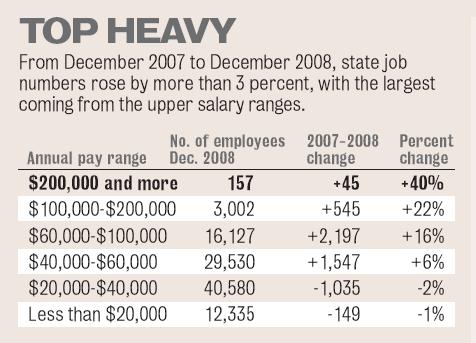
There’s another graphic that you can check that shows exactly who the top paid employees are and how much they make. I can assure you that none of these folks are covered by the state employees unions and none of them have any peers who have lower or higher salaries or benefits depending on when they entered service alone. These people are mostly political appointees of the governor. In this case, they are political appointees of Bobby Jindal. I’m going to show you the graph that is relevant. (It’s down below this section.) The salary structure is top heavy. You can go back and search who has the top money. You will see that it is top university administrators and coaches. Even these salaries do not stack up to private sector CEOs or coaches. It isn’t the clerks that are making outrageous salaries and it isn’t their bargaining unit that is at fault for any of this. You’ll also see if you got that page that many state workers are attorneys, engineers, teachers, nurses and doctors. These are professional people. You cannot expect to recruit and retain the best professional, well-educated service workers if you do not offer them a competitive salary. The most mobile ones will leave eventually if you don’t offer them raises and benefits commensurate with the private sector. You can go to any of the BLS salary surveys and you will see what the AFT put in that nice graphic above year after year after year. You will not get a compensation in the public sector that is more generous than the private sector at those levels of expertise. If there is a private sector ‘competitor’ for offering the job. Believe it or not, not every one is an English teacher that might likely wind up as a waitress. Here in New Orleans, most of the English teachers at my university would make better money if they’d wait tables or pour cocktails in the French Quarter. The only difference is that English teachers get a pension and insurance and they get to do the job they love.
Okay, now I’m going to go all economist on you. When you are a teacher, a firefighter, or a public health or safety worker, you face what is called a monopsony. That means there is likely to be one source of jobs and so you face the buyer’s version of a monopoly. What this means is the chips will be stack against you coming out with a ‘competitive’ wage. For example, how many forensic scientists do you suppose work outside of the local police departments? You may face a number of municipalities that could hire you in this situation. It is not, however, illegal for municipalities to collude on setting standards for salaries and benefits. Hence, you may face the same situation in city after city.
There seems to be this mindset that public servants should be public slaves from some quarters. Why should the clerk who fills out your driver’s license form be treated differently than the clerk that fills out your bank deposit slip? Why this double standard that public employees can’t be represented by unions? Well, first, I think many people still believe that public employees served by unions some how get a better deal than the others. This generally is not the case for all things. The only items that have held together for state employees that are not as available in the private sector tends to be the pension benefits and probably the insurance. One of the reasons that the insurance tends to be not such a big deal is that many states self insure and they have huge pools of employees so they can be more generous with benefits at a lower cost. I’ve generally lived in states where the biggest employer is the state. That’s a lot of people and insurance gets cheaper as the pool grows larger.
I think one of the other reasons is that people in nonunion jobs feel helpless about their futures and they are angry that they really don’t have the same safety in numbers that you see with union shops. You can’t be bullied by an employer when there is a union in place. This does have a tendency to protect even the worst employee, but when you work for capricious bosses, and we all do, you’ll never be safer than when you have union representation. You also are more aware of when your number will be up during downsizing and you will get a recall if they start rehiring if you’re a member of a union. This type of job security is generally the most important thing to a state employee which is why they work for lower monetary compensation. But again, why begrudge others what you could have if you’d just organize your work place?
I’ve been seeing way to many sites discuss ‘greedy’ teachers who selfishly walk out of the classroom to protest their right to organize. I really don’t get this meme at all. Wouldn’t you fight for your family’s livelihood if it were threatened? Why are teachers supposed to be treated differently than any one else?
A Governor or any other publicly elected official isn’t just held to account on voting day. Democracy is a day-in-and-day out process. Wisconsin Governor Scott Walker was elected to handle the budget. He immediately cut $117 billion in revenues coming from businesses and created a $130 billion deficit. His answer to covering his self created deficit was to change the terms of thousands of previously negotiated commitments to public employees. He backed out of the state’s commitment. He’s also refused to remove the union busting portions of the bill in exchange for salary and benefit concessions. How is this anything but dogmatic and unfair to state employees? Who makes heroes out of people that break commitments? Each of those families made plans based on the sanctity of the promise the state of Wisconsin made to them. They were part of the agreement and they should be part of renegotiating the agreement because that’s the rules of the game there. Changing the rules of a game in the middle of play is cheating.
If Governor Walker was so interested in frugality, then he should’ve started by not passing those $117 million in tax breaks. An election victory is not a blank check in a democracy.
Within days of becoming governor, Mr. Walker — who hung a sign on the doorknob of his office that reads “Wisconsin is open for business” — began stirring things up, and drawing headlines.
He rejected $810 million in federal money that the state was getting to build a train line between Madison and Milwaukee, saying the project would ultimately cost the state too much to operate. He decided to turn the state’s Department of Commerce into a “public-private hybrid,” in which hundreds of workers would need to reapply for their jobs.
He and state lawmakers passed $117 million in tax breaks for businesses and others, a move that many of his critics point to now as a sign that Mr. Walker made the state’s budget gap worse, then claimed an emergency that requires sacrifices from unions. Technically, the tax cuts do not go into effect in this year’s budget (which Mr. Walker says includes a $137 million shortfall), but in the coming two-year budget, during which the gap is estimated at $3.6 billion.
Democrats here say Mr. Walker’s style has led to a sea change in Wisconsin’s political tradition.
“Every other Republican governor has had moderates in their caucus and histories of working with Democrats,” said Graeme Zielinski, a spokesman for the state’s Democratic Party. “But he is a hard-right partisan who does not negotiate, does not compromise. He is totally modeled after a slash-and-burn, scorched-earth approach that has never existed here before.”
There’s some very interesting polls coming out of the Wisconsin protests. Here is some poll analysis on unions and public unions from the CSM.
Asked about “when you hear of a disagreement between state or local governments and unions that represent government workers,” more Americans say their first reaction is to side with the union (44 percent) than with state or local governments (38 percent). And substantially more Americans see union contracts as ensuring that workers are “treated fairly” than as giving workers an “unfair advantage.”
Other polls have found mixed results. Here’s some coverage at Huffpo for the Pew poll cited above as well as a few others. Either way, it’s interesting to note that Walker has some pretty strong ties to the notorious Koch Brothers. These trust fund babies spend a lot of John Bircher Daddy’s money trying to bust unions. I don’t think this can be discounted either.
According to Wisconsin campaign finance filings, Walker’s gubernatorial campaign received $43,000 from the Koch Industries PAC during the 2010 election. That donation was his campaign’s second-highest, behind $43,125 in contributions from housing and realtor groups in Wisconsin. The Koch’s PAC also helped Walker via a familiar and much-used politicial maneuver designed to allow donors to skirt campaign finance limits. The PAC gave $1 million to the Republican Governors Association, which in turn spent $65,000 on independent expenditures to support Walker. The RGA also spent a whopping $3.4 million on TV ads and mailers attacking Walker’s opponent, Milwaukee Mayor Tom Barrett. Walker ended up beating Barrett by 5 points. The Koch money, no doubt, helped greatly.
When there is big corporate money in elections, there is only one offset these days. That would be the money and free labored offered up by unions. Undoubtedly, the public sector unions are some of the last big unions standing. I can only imagine how much the Kochs and others would like to gut the fund raising and GOTV efforts of unions that are usually made available to candidates that thwart their Bircher plots. After all, there’s very little standing right now to check the power and political donations of megacorporations. This fact alone should make any one support the few unions left standing. However, the bigger question remains. Why do so many people begrudge public workers a voice in the terms of their employment?

 peej
peej Carissa
 bostonboomer
 dakinikat
 ecocatwoman
 mablue2
 Mama Lopez
 peggysue22
 quixote
 skydancingguestblogger
 Mona (aka Wonk the Vote)



 Sky Dancing
Recent Comments