
Hey Andy, me ‘n’ Barney didn’t have nuthin’ better to do, so we decided to crash the economy!
Posted: July 8, 2011 Filed under: 2012 presidential campaign, Barack Obama, Democratic Politics, Economy, Psychopaths in charge, Surreality, Team Obama, the villagers, U.S. Economy, U.S. Politics, unemployment, voodoo economics, We are so F'd | Tags: Andy Taylor, Barack Obama, Barney Fife, David Plouffe, Debt Ceiling, deficit, economy, Gomer Pyle, jobs, Social Security, stupid villiagers, Tim Geithner, unemployment, voodoo economics, William Daley 9 Comments
Barack O'Gomer and Deputy "Barney" Geithner*
This morning Sky Dancing’s resident economist Dakinikat wrote about Tim Geithner’s latest trial balloon about maybe stopping Social Security checks in August if Congress refuses to raise the debt ceiling. That’s right, he wants to use the trust fund that elderly people paid into all their working lives to pay China and other foreign debtors. Now that’s a brilliant plan boys–throw grandma and grandpa out in the streets to starve and die. It’s genius!
Then while we were all commiserating in the comment thread, we got the jobs report for June: only 18,000 jobs were added, and the phonied-up unemployment rate is now at 9.2%.
O’Gomer dragged his sorry a$$ out to the Rose Garden in late this morning to mumble a few weak excuses.
“Today’s job report confirms what most Americans already know,” Obama said. “We still have a long way to go and a lot of work to do to give people the security and opportunity that they deserve.”
The president tried to lay some blame at Congress’ feet. He said lawmakers could pass a handful of policies today to create jobs. His list included an infrastructure bank, free trade deals and patent reform.
“There are bills and trade agreements before Congress right now that could get all these ideas moving,” he said. “All of them have bipartisan support, all of them could pass immediately, and I encourage Congress not to wait.”
Yeah, patent reform, that’s the ticket! And more trade agreements to create more outsourcing of American jobs. Brilliant! And cutting off Social Security checks! That’s really gonna give Americans “the security and opportunity they deserve.” Who is advising this guy anyway?
Well, one of O’Gomer’s top advisers, David Plouffe, made an unfortunate remark before the jobs report came out. Minkoff Minx wrote about it in her SDB reads earlier this evening. From The Christian Science Monitor:
David Plouffe, Mr. Obama’s top political adviser, got things started Thursday at a breakfast sponsored by Bloomberg News.
“The average American does not view the economy through the prism of GDP or unemployment rates or even monthly jobs numbers,” Mr. Plouffe said. “People won’t vote based on the unemployment rate; they’re going to vote based on: ‘How do I feel about my own situation? Do I believe the president makes decisions based on me and my family?’ ”
Ask yourself, Mr. Plouffe, how do you think most ordinary Americans feels about their situation right about now? O’Gomer’s buddy Timmy Geithner is talking about cutting off Social Security payments. O’Gomer himself is trying to talk the Republicans into cutting Social Security, Medicare, and Medicaid. This administration hasn’t done diddly-squat about jobs except occasionally have O’Gomer mention that we need to create them. Talk is cheap, Mr. Plouffe. Actions speak louder than words as my mom used say.
According to Julian Brookes at Rolling Stone, Plouffe also made this odd assessment:
the president, says Plouffe, has a good shot with independent voters, who’ll reward his bipartisan, bend-over-backwards approach the debt talks; is a seasoned campaigner with a huge war chest; has moved to the center without losing the base (the oft-noted “enthusiasm gap” seems to have closed); and has demographic trends working in his favor (he won big with minorities in 08, and they’ll make up a larger share of the electorate next year). Plus, of course, the GOP field is weak: Frontrunner Mitt Romney is the most formidable of the bunch, but he’s nobody’s idea of a galvanizing standard bearer.
What is wrong with this guy? Does he really believe that Independents like politicians who “bend over backwards” instead of showing some strength? Does he really believe O’Gomer hasn’t lost his base? And the center? O’Gomer has gone so far right he’s out-crazying the Tea Party!
Then there’s William M. Daley, the White House chief of staff. Check out what he recently had to say about Americans’ attitudes about the crappy economy. According to Peter Nicholas at the LA Times, O’Gomer’s main defense is that the middle class was already suffering under Bush, so it’s not really his fault. Never mind that unemployment has gone from 7.8% to 9.2% on his watch. So O’Gomer is asking for more time:
Speaking at a fundraising dinner in Philadelphia last week, he said that the nation’s challenges “weren’t a year in the making or two years in the making, but are actually 10 years in the making.”
But Obama’s nuanced message isn’t breaking through. A Gallup Poll last month showed that Americans’ economic confidence was near its low for the year.
For the White House, it’s tough to get the public to pay attention to anything else.
A Democratic senator spoke by phone recently with White House Chief of Staff William M. Daley. “He said, ‘Honest to goodness, if we’re not talking about jobs and the economy, nobody is listening,’” recalled the senator.
Surprise, surprise, surprise!!
Gee, do you think maybe you ought to stop talking and actually DO something then? Just wait until Grandma finds out she might not get her Social Security check in August. Maybe O’Gomer and his advisers need to get a clue. And find O’Gomer a couple of advisers who know something about economics, Mr. Daley.
*NOTE: The graphic at the top of this post is the work of our old friend StateOfDisbelief.
The Great Obama Mystery
Posted: July 6, 2011 Filed under: Barack Obama, Catfood Commission, Economy, Federal Budget and Budget deficit, U.S. Economy, U.S. Politics, unemployment, voodoo economics, We are so F'd | Tags: Barack Obama, Budget Deficit, cat food commission, Debt Ceiling, economics, economisits, President Pushover, Ronald Reagan, unemployment 25 Comments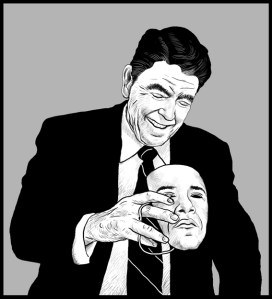
As Dakinikat has explained again and again and again and again, the problem our economy faces is that millions of Americans don’t have any money to spend because they don’t have jobs. Our economy runs on consumer spending. When people don’t have jobs, they don’t have money to spend on consumer items. That hurts our economy. It’s pretty simple, really.
But President Obama doesn’t understand simple basic economics. He’s already decided that high levels of unemployment are “structural.” He thinks our problem is that the government is spending too much money. Yesterday Obama gave another big ol’ nothingburger of a speech on how he’s giving away the store to negotiating with the Republicans in Congress.
Now, I’ve heard reports that there may be some in Congress who want to do just enough to make sure that America avoids defaulting on our debt in the short term, but then wants to kick the can down the road when it comes to solving the larger problem of our deficit. I don’t share that view. I don’t think the American people sent us here to avoid tough problems. That’s, in fact, what drives them nuts about Washington, when both parties simply take the path of least resistance. And I don’t want to do that here.
No, Mr. President, what is driving Americans “nuts” about Washington is that you and your Republican pals seem to be determined to crash the economy. Another thing that drives American’s “nuts” is that you haven’t lifted a finger to do anything about jobs since you took office. All you’ve done is take care of your superrich pals so they’ll donate to your next campaign.
I’ll bet you don’t even know that the latest PPP Poll shows that most Americans want to raise taxes on higher income people.
Poll data by the Democratic-aligned Public Policy Polling released Wednesday said voters in Ohio, Missouri, Montana and Minnesota back hiking taxes on the wealthy — even for people with incomes as low as $150,000.
The respondents were asked: “In order to reduce the national debt, would you support or oppose raising taxes on those with incomes over $1,000,000 a year?”
Nearly 80 percent of voters in the four states backed the idea.
And, BTW, Senator Reid, I’m pretty sure these voters want real tax increases, not phoney “sense of the Senate” resolutions. Back to Obama’s mealy-mouthed speech:
I believe that right now we’ve got a unique opportunity to do something big — to tackle our deficit in a way that forces our government to live within its means, that puts our economy on a stronger footing for the future, and still allows us to invest in that future.
Most of us already agree that to truly solve our deficit problem, we need to find trillions in savings over the next decade, and significantly more in the decades that follow. That’s what the bipartisan fiscal commission said, that’s the amount that I put forward in the framework I announced a few months ago, and that’s around the same amount that Republicans have put forward in their own plans. And that’s the kind of substantial progress that we should be aiming for here.
And on and on, bla bla bla…
I don’t know who you mean by “most of us” Mr. O, but I’m pretty sure most of us citizens don’t support the findings of your right wing cat food commission bipartisan fiscal commission.
President Obama just doesn’t get it. He might be able to learn a little bit about economics if he would just hire a few actual economists to advise him. But the big O thinks he already learned all he needs to know by listening to Ronald Reagan back in the ’80s. All of his economics advisers have left the sinking ship resigned, because Mr. O thought he knew better than they did. Remember this quote?
In his biography of Obama, “The Bridge,” David Remnick, editor of The New Yorker, quotes White House senior adviser and longtime Obama friend Valerie Jarrett: “I think Barack knew that he had God-given talents that were extraordinary. He knows exactly how smart he is. … He knows how perceptive he is. He knows what a good reader of people he is. And he knows that he has the ability — the extraordinary, uncanny ability — to take a thousand different perspectives, digest them and make sense out of them, and I think that he has never really been challenged intellectually. … So what I sensed in him was not just a restless spirit but somebody with such extraordinary talents that had to be really taxed in order for him to be happy. … He’s been bored to death his whole life. He’s just too talented to do what ordinary people do.”
You need to snap out of it, Mr. President; because our country is in big big trouble right now, and you’re really not as smart as you think you are.
Paul Krugman is an actual economist, and his hair is on fire. He can’t figure out what the President has against Keynesian economics.
I’m not alone in marveling at the extent to which Obama has thrown his rhetorical weight behind anti-Keynesian economics; Ryan Avent is equally amazed, as are many others. And now he’s endorsing the structural unemployment story too.
To those defending Obama on the grounds that he’s saying what he has to politically, I have two answers. First, words matter — as people who rallied around Obama in the first place because of his eloquence should know. Yes, he has to make compromises on policy grounds — but that doesn’t mean he has to adopt the right’s rhetoric and arguments. The effect of his intellectual capitulation is that we now have only one side in the national argument.
Second, since Obama keeps talking nonsense about economics, at what point do we stop giving him credit for actually knowing better? Maybe at some point we have to accept that he believes what he’s saying.
Why is Obama doing this, Krugman wants to know. It can’t be because he’s just stupid, can it? (That’s me, not Krugman)
Anyway, now Obama is handling the decisions about the economy all by himself. He’s even decided to “take the lead” in the budget talks with the Republicans–probably because he didn’t think VP Biden was caving quickly enough to Republican demands. Today,
CBS News reported that Obama wants to give the Republicans twice as much as they were originally asking for.
Two Democratic officials familiar with the negotiations over a deal to raise the debt limit said Wednesday that President Obama wants the final deal to be bigger than the $2 trillion deal that has been the focus of negotiations so far.
In fact, they said, Mr. Obama wants the deal to save the government as close to $4 trillion as possible.
Mr. Obama said Tuesday that lawmakers have “a unique opportunity to do something big,” and a deal to save the federal government $4 trillion would certainly qualify. The officials said the president believes “these moments come around at most once a decade” and that “you can’t run away from an opportunity like this.”
According to the officials, Mr. Obama believes that a larger deal would actually be easier to get through Congress. His thinking, they indicated, is this: Any major deal, whether it’s for $2 trillion in cuts or $4 trillion in cuts, will cause significant pain for both parties. But a larger deal allows backers to argue that despite their misgivings, they’ve taken a major step toward dealing with the deficit and debt problem.
Doesn’t Obama understand that cutting that much government spending is going to create even more unemployment? Is this man insane? No, he’s just a right wing Republican. Actually, maybe that does mean he’s insane.
Tuesday Reads: Jobs, Jobs, Jobs, a “Moderate Republican,” Buyer’s Remorse, and Sellouts
Posted: June 21, 2011 Filed under: Barack Obama, Democratic Politics, morning reads, Republican politics, Republican presidential politics, U.S. Economy, U.S. Politics | Tags: balanced budget amendment, Bill Clinton, Dean Baker, deregulation, Don Graham, jobs, Jon Huntsman, Kathryn Graham, lobbying, Matt Bai, Mitch McConnell, Paul Ryan, Recovering Obots, unemployment, Washington Post 44 Comments
Coffee and Morning News, by Tim Nyberg
Good Morning!
Yesterday, Newsweek published a list of job-creating strategies by former President Bill Clinton. The headline is “It’s Still the Economy, Stupid.” I’m not going to excerpt from the article, you can read it at the link above.
But I’ll share part of the bad review Dean Baker gave Clinton’s suggestions, some of which seemed credible to to me. Dean Baker really has a bug up his a$$ about Bill Clinton. He makes a case that we began losing manufacturing jobs under Clinton and Bush simply continued was Clinton’s policies. I’d be interested to hear people’s responses this critique.
I don’t watch the Sunday shows anymore, but I learned from Steve Benen that Senate Majority Leader Mitch McConnell was asked about jobs and unemployment on Face the Nation this week.
On CBS’s “Face the Nation” yesterday, host Bob Schieffer asked Senate Minority Leader Mitch McConnell (R-Ky.) yesterday, “Do Republicans have any plans to do anything on the unemployment front or are you just going to let things take their course?” It seemed like a good question.
McConnell replied, “No, I — I think — what — what we’re doing is encouraging the president to — to quit doing what he’s doing.”
Clearly McConnell isn’t even worried enough about the current unemployment crisis to have even thought about a response to what should be an obvious question.
From Jay Bookman, I learned that McConnell’s primary concern is “overregulation.”
McCONNELL: If you talk to business people and Bill Daley, the present chief of staff did recently, you find out their biggest complaint is overregulation. You know, the federal government with that stimulus money hired a quarter of a million new employees. These people are busily at work trying to regulate every aspect of American life in– in health care, financial services, through the Environmental Protection Agency, really sort of bureaucrats on steroids that are freezing up– the private– private sector and making it very difficult, Bob, for them to grow and expand. You know, you’re seen the reports that they’ve two trillion in cash. The reason they’re not investing that in hiring more people is the government has made it very expensive to expand employment.
His recommendations for Obama:
Quit overspending. And we’re hoping with the debt ceiling discussions we can begin to address deficit and debt. And second, they need to quit over-regulating the American economy. This is something they can do on their own. They don’t have to come to us for permission to rein in these regulators who are really at work across the American economy making it very, very difficult for businesses to function.
What about the Democrats? Benen links to this piece at Politico: Democrats eye new jobs agenda.
Senate Democrats are beginning to fear that the country’s increasingly dim economic outlook will cost them their seats in 2012 and are trying to craft a new agenda aimed at spurring job creation.
Wow! The Dems in the Senate have finally figured out that they might be in trouble with the electorate. Someone go find the President on the golf course or the basketball court or whereever he’s hanging out today and tell him the breaking news.
Fearing the economy may be getting worse, Democrats plan to soon unveil what they’ll call a “Jobs First” agenda — and the stakes are high. A bleak economic outlook, like the May jobs report, could cost Democrats their thin Senate majority and even the White House if they can’t make a strong case to an anxious electorate that their policies will create jobs.
“Jobs First?” Isn’t it a little late for that? It has already been “Wall Street First” for three years. Maybe “Jobs Second” would be a little more accurate, although I doubt if this latest project will amount to anything.
Everyone is talking about the NYT Sunday Magazine profile of Jon Huntsman, who is spouting the usual Republican economic insanity: Jon Huntsman Supports Radical Balanced Budget Amendment
In a private conference call with a handful of university students across the country, GOP Presidential hopeful — and President Obama’s former Ambassador to China — Jon Huntsman argued in support of one of the most far-reaching, controversial elements of the conservative political agenda.
As first reported in a broader piece by the Huffington Post, Huntsman argued in favor of a constitutional amendment requiring the federal government to maintain a balanced budget — an innocuous-sounding, but radical plan pushed by Sen. Jim DeMint (R-SC) and numerous other congressional conservatives.
“We’re going to have to fight for a balanced budget amendment,” Huntsman said. “Every governor in this country has a balanced budget amendment. It keeps everybody honest. It’s the best safeguard imaginable.”
At its core, a balanced-budget amendment would make it unconstitutional for the government to spend more than it collects in revenue — a requirement that, without safeguards, would make stimulus and emergency spending impossible.
I’ve noted previously that Jon Huntsman’s campaign strategy appears to be to match a moderate, conciliatory tone with an orthodox conservative policy platform. And sure enough, he’s endorsing a balanced-budget amendment. It’s not clear if the specific balanced-budget amendment he’s endorsing is The Worst Idea in Washington — in which case, Huntsman will have to explain how he’ll handle the fact that Paul Ryan’s budget, which he has also endorsed, will be unconstitutional — or just a relative of it. Either way, it’s not moderate in the least. Which isn’t to say it’s not good politics.
From Andrew Leonard at Salon: The imaginary GOP “moderate” candidate
Reporter Matt Bai manages to deliver more than 6000 words on Huntsman without providing a single practical reason why anyone, Republican, Democrat, or Independent, might possibly consider voting for him. Whether this is because Bai simply isn’t interested in actual positions on the issues or because Huntsman just doesn’t have a platform to campaign on — or some evil toxic combination of both — is hard to say. But the result is just plain baffling. Bai quotes Huntsman as saying “I think what’s going to drive this election, really, are two things — authenticity and the economy” — and then proceeds to write a profile that doesn’t contain a single iota of insight into Huntsman’s views on any economic policy issue.
6000 words — and not a single one of them is “jobs” or “taxes” or “budget” or “deficit” or “Wall Street.” This amounts to political reporting malpractice. If Huntsman isn’t interested in delineating a stance on these issues, then why is Bai bothering to cover him? And if Bai isn’t interested in trying to discern what Huntsman’s stance is, why is the New York Times publishing him?
LOL! That’s pretty funny. Have I ever told you how much I hate Matt Bai?
It’s hard to believe it at this point, but some bloggers are just now figuring out that Obama isn’t “The One.” At Shakesville, Melissa McEwan reacts to a quote from Russ Feingold in which he says Jeffrey Immelt is “not the right guy…”
“It’s not just campaigns and contributions,” Feingold noted. “We have to say to the president, ‘Mr. President, Jeff Immelt is not the right guy – the CEO of GE is not the right guy to be running your Jobs & Competitiveness Council, not when your company doubled its profits, increased his compensation, and asked its workers to take huge pay and benefits cuts.'”
McEwan writes:
But as I read Feingold’s words—not the right guy—a not fully formed thought that has been hanging around the edges of my consciousness suddenly came sharply into focus: Obama is not the right guy.
It’s not (just) that his policies are insufficiently progressive, or even insufficiently Democratic, and it’s not (just) the arrogance, the hippie-punching, the bipartisan blah blah, the 12-dimensional chess, and it’s not (just) his tepid, half-assed, pusillanimous governance and his catastrophic ally fail. All of these things are just symptoms of this basic truth: Obama’s not up to the job.
I don’t mean he’s not up the job of being president; I mean he’s not up to the job of being president right now. I’m sure he’d have made a fine president some other time, some decade of relative peace and prosperity, where the biggest demand on his capacity was “don’t fuck it up.”
Check the date on that post. It’s June 17, 2011. She is just figuring all that out in 2011. How come I could already see it in 2007? And you should see the fawning comments on that post!
Here’s another buyer’s remorse post, and it’s very well thought out and well written. Janet Rhodes has clearly been angry with Obama for quite some time. But she still worked for his Campaign and voted for him. Why? Because he gave inspiring speeches!
Still her rant is worth reading. Fawning comments follow, naturally. Where were all these people back in 2008 when we had a choice? OK, I know I’m beating a dead horse, but still….
Finally, Kathryn Graham’s surviving relatives prove they couldn’t care less about news or the newspaper she valued so highly.
Washington Post Co. Chairman Don Graham sold off about $10 million in company stock days after successfully lobbying to loosen regulations on the for-profit higher education firm that is its most lucrative business.
A spokeswoman for the Washington Post Co. said the sale was on behalf of a trust for one of Graham’s siblings, not for Graham himself, and the company last week amended its filings to the Securities and Exchange Commission to clarify that Graham’s family, rather than he personally, was benefiting from the sale….
The disclosure indicates that the family that owns the paper profited from the bump in its stock price after the regulations became public and drove stock prices up across the for-profit education industry. Washington Post Company stock jumped 9% on reports of the new regulations; it has settled a bit since, but it still trading higher than before the news broke.
Let’s face it, newspapers are dead. Decent reporters should head to the internet.
That’s all I’ve got for today. What are you reading and blogging about?
It’s still the Economy, and Jobs, and the stupid Bush Tax Cuts
Posted: May 26, 2011 Filed under: Democratic Politics, Economy, Federal Budget, Federal Budget and Budget deficit, jobs, Republican politics, unemployment | Tags: budget defifit, jobless claims, unemployment 22 Comments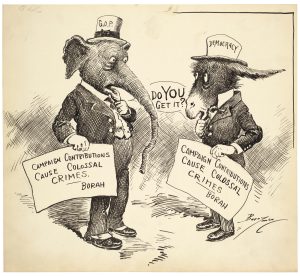 If you do not take a path different from the path that wrecked the economy, the economy will not improve. So, why–for the umpteenth time since I started this blog 3 years ago–do I find myself writing on the same economic dynamics? Wasn’t there supposed to be a game changing election in there somewhere?
First, we just got the news that jobless claims are up. The new twist is that corporate profits are down. It had to happen sooner or later. There are only so many profits you can wring out of your business by ‘austerity’ measures like lay offs and not ordering as many office supplies. It’s obvious the ‘Economy is still Struggling’.
Unexpectedly weak consumer spending kept the economy stuck in a slow growth gear in the first quarter and would likely struggle to regain speed amid signs of a slowdown in the pace of job creation.
Data on Thursday showed the economy expanded at an unrevised 1.8 percent annual rate in the first three months of this year, while the number of Americans claiming unemployment benefits unexpectedly rose 10,000 to 424,000 last week.
The rise in jobless claims and the weakness in first-quarter consumer spending, which offset upward revisions to business inventories and investment, set the tone for more lackluster growth this current quarter.
Some businesses were surprised by the weak consumer spending. Their CEOs need to get out of their offices and country clubs and go see how the other 99 percent lives. Our wealth is down because our house values keep falling. We’ve lost at least 2-3 years of returns in our investments and pensions and many folks still haven’t recovered their pre-recession balance. Gas prices and food prices are taking larger percentages of folks’ budgets. The very rich are the only ones that can really fling the bucks around at this point and they can go anywhere they want to do that. They’re not stuck with the offerings at the local strip mall. We ignore the sluggish labor markets at our own peril.
Business investment–the smallest contributor to the GDP–was up and Government spending was down. Exports looked better than expected but they are still a very small part of our economy these days. This is now the seventh straight week that jobless claims were above the 400,000 mark. What is even more remarkable is that the BLS could not name any factor that could be an outlier contributing to this persistent trend.
Meanwhile, the conversation in Washington DC continues to be the Ryan budget and Medicare. The U.S. Senate voted down the Ryan budget I was amused by Karl Rove’s WSJ op-ed today that explained that folks would like their plan if it was just put into a populist message. I guess when you’ve got people buying into such nonsense as decreasing taxes raises tax revenues you get to thinking that you can sell them anything with the right spin on it. However, George Bush and the Republican Party own the Deficit. Their cronies should be the ones to pay it down.
The nonpartisan Center on Budget and Policy Priorities has updated research that projects nearly half of public debt in 2019 will be attributable to President George W. Bush’s tax cuts plus the ongoing wars in Iraq and Afghanistan. The tax cuts left the American treasury particularly vulnerable when the financial crisis hit, the CBPP reports: “The events and policies that pushed deficits to these high levels in the near term were, for the most part, not of President Obama’s making. If not for the Bush tax cuts, the deficit-financed wars in Iraq and Afghanistan, and the effects of the worst recession since the Great Depression (including the cost of policymakers’ actions to combat it), we would not be facing these huge deficits in the near term.”
It simply baffles me that we can’t even get the most stalwart Democratic politicians to pay attention to the miserable jobs market. It’s two years into a Democratic administration. Where is the will to put America back to work?
Misery Index hits Reagan Years High
Posted: May 15, 2011 Filed under: Economy, U.S. Economy | Tags: inflation, measurement issues, misery index, unemployment 9 Comments One of the measurements of economic well-being that got some play in the Carter/Reagan years was the Misery Index. It basically measures the impact of price increases and unemployment on people. There’s some new information coming out of this index. It seems it’s as bad as it was in 1983.
John Williams, over at Shadow Stats, compiles economic data for inflation and unemployment the way it used to be calculated pre-1990. Based on that data, the CPI inflation rate is over 10%, and the unemployment rate is over 15% (see charts). The Misery Index is the sum of the current inflation rate and the unemployment rate. If it were to be calculated using the older methods, the Index would now be over 25, a record high. It surpasses the old index high of 21.98, which occurred in June 1980, when Jimmy Carter was president. Most believe the height of the Index along with the Iranian hostage crisis is what caused Carter to lose his re-election bid.
We’ve changed a lot of the way we measure inflation and unemployment since then partially because we’ve tried to focus more narrowly on measures of both inflation and unemployment but also because the measures were consistently high during the 1970s and 1980s. The inflation rate as stated by the CPI was frequently overstated because of its use of a base market basket that didn’t always reflect the introduction of new goods and services, the places people shop, and the switching or substitution behavior of people. It had a fix budget apportionment that was used to weight prices and those weights were frequently stale.
The changes in the way the unemployment rate was measured had to do with the shift away from reliance on the traditional 40 hour work week job by both businesses and job seekers. The unemployment rate was changed so that you only had to work at least one hour a week at paid work to be excluded. This is why economists look at a bunch of different statistics to get a handle on the job market. People that don’t want to work part time but are stuck there are now considered underemployed and are tracked separately. If you visit Shadow Government Statistics you can see comparisons of the old and the new way of doing things.
Some of the most salient points are that long-term, discouraged workers were taken out of the unemployment statistic in 1994. SGS calls this being “defined out of existence”. Again, the statistic is still being tracked so you have to go look for it at the BLS. I will say that economics reporters have been doing a better job of providing more than just the unemployment rate in their analysis. You have to look at the underemployed and the discouraged worker to get a good idea of what’s going on. We’ve talked about the changes in the make up of the labor force around here because it’s one of the reasons that you’re seeing the unemployment rate go up and down recently. When discouraged workers re-enter the labor force, the new unemployment rate will go up because the number of people in the labor force–the denominator in the statistic–goes up.
I actually have less problems with the changes in the inflation right but then again, the problem is that people need to realize that the definitions of the measures have changed and narrowed so it is important to look at more than just one rate. This does explain, however, why people whose budgets are being impacted by food and gas prices aren’t seeing the pain in the new inflation rates. We’ve talked about this before also.
So, what does this mean? I think it’s significant that the Misery Index is basically at similar levels to the last time the country was expressing discontent with the economy because it gives us a historical perspective. Ronald Reagan probably would not have won a second term if the Federal Reserve didn’t start significantly loosing monetary policy during that same time which brought down the inflation included in the Misery Index.The first Reagan term was the last time the economy was this bad. Changes in monetary policy were the real reason for the worst of the Carter Recession and much of the eventual Reagan Recovery although some of the Reagan Recovery was due to the incredible increase in government purchases which are typical Keynesian economic aggregate demand stimulation policies. Paul Volcker and the Fed brought on a recession by increasing interest rates in an attempt to reign in inflation and inflation expectations. They did so. It happened with some extreme economic pain and that was what the Misery Index was supposed to reflect at the time. The drivers for the misery right now are different. We have record loose monetary policy. The incredible shock to the economy of the financial crisis is the root of our issues now.

 peej
peej Carissa
 bostonboomer
 dakinikat
 ecocatwoman
 mablue2
 Mama Lopez
 peggysue22
 quixote
 skydancingguestblogger
 Mona (aka Wonk the Vote)



 Sky Dancing
Recent Comments