
Rep. Maxine Waters: “We’re gettin’ tired, y’all.”
Posted: August 17, 2011 Filed under: 2012 presidential campaign, the villagers, U.S. Economy, U.S. Politics, unemployment, voodoo economics | Tags: African American unemployment, Congressional Black Caucus, double dip recession, Economists, Emanuel Cleaver, Gallup poll, job fairs, jobs bills, Maxine Waters, Obama bus tour, sugar coated satan sandwich, unemployment 22 CommentsWhile President Obama was visiting small lily-white Midwestern towns that have managed to do pretty well during the economic crisis of the past three years, members of the Congressional Black Caucus have traveled around the country hosting job fairs. Yesterday they were in Detroit.
U.S. House Rep. Maxine Waters is asking black voters who are struggling with an unemployment rate nearly twice the national average to “unleash” her and other members of the Congressional Black Caucus on President Obama.
The California Democrat, speaking at a raucous town hall in Detroit hosted by the CBC on Tuesday, said she doesn’t want to attack the president from his base unless the base gives her the go-ahead.
“If we go after the president too hard, you’re going after us,” Waters said. “When you tell us it’s all right and you unleash us and you’re ready to have this conversation, we’re ready to have the conversation.”
Judging by the reaction of the audience, including someone yelling to Waters, “It’s all right,” the president will be hearing very soon from the congresswoman and her fellow caucus members.
Since Obama took office, he has resisted pressure from the CBC to create jobs programs specifically targeting blacks, saying that improving the entire economy will help all groups.
I’m not sure I understand why the CBC can’t lead on this issue rather than waiting to be “unleashed” by African American voters. Still, at least she’s talking about the dismal employment situation African Americans face.
On MSNBC, Andrea Mitchell asked Emanuel Cleaver (of “sugar coated Satan sandwich” fame) about President Obama’s promised jobs plan.
I guess Obama’s “jobs plan” isn’t an emergency, since Congress is so unlikely to pass it. I guess that’s why the President is going on vacation first and won’t give his latest “major speech” until after Labor Day.
Looking at that video of the CBC jobs fair reminds me of photos of lines during the Great Depression, but President Obama announced today that
“I don’t think we’re in danger of another recession, but we are in danger of not having a recovery that is fast enough to deal with a genuine unemployment crisis for a whole lot of folks out there.
And you know what an expert our fearless leader is on economic matters (snark). And to show that he’s not that worried, President Obama will soon be heading for Martha’s Vineyard for a 10-day vacation.
But wait, check this out from Gallup:

Oddly enough, it seems that Americans outside the beltway don’t agree with Mr. Obama’s assessment of the economy. And neither do quite a few real economists.
But the President is tired too, I guess. All those golf games, the weekends at Camp David, the fancy White House dinners and parties, the fundraisers, the campaign swing bus tour of the Midwest–it’s so exhausting. He needs a break. So unemployed people need to stop being so selfish and understand President Obama’s needs. He’ll get around to their problems someday.
Funny though, I don’t recall it taking him this long to bail out the banks, do you?
Here’s a longer version of Maxine Waters’ talk.
Thursday Reads: Poverty and Joblessness *Are* Social and Political Issues
Posted: August 11, 2011 Filed under: Foreign Affairs, Global Financial Crisis, Great Britain, jobs, Media, morning reads, poverty, U.S. Economy, U.S. Politics, unemployment | Tags: austerity, Banksters, education, Federal Reserve, global elites, government corruption, joblessness, London Riots, looting, Poverty, social services, U.S. Economy, unemployment 44 Comments
Guess who said this:
“There are pockets of our society that are not just broken, but are frankly sick.
“It is a complete lack of responsibility in parts of our society, people allowed to feel the world owes them something, that their rights outweigh their responsibilities and their actions do not have consequences. Well, they do have consequences.”
You’re darn right! The global elites have gone too far! The banksters have stolen trillions from ordinary taxpayers, and then demanded and received massive government bailouts. Politicians have lost any sense of responsibility toward their constituents, only listening to their corporate masters and their lobbyists. Yes there are consequences and these wealthy elites will discover there are consequences for their corrupt and immoral actions.
Oh wait. That was Prime Minister David Cameron talking about the poor and jobless young people who have been rioting in the streets of London and other British cities for the past five days. I’ll bet he has absolutely no clue how ridiculous it is that he is chastising these people for looting after he and other global elites allowed banksters to steal and loot trillions with absolutely no consequences. From Raw Story:
The U.S. Federal Reserve gave out $16.1 trillion in emergency loans to U.S. and foreign financial institutions between Dec. 1, 2007 and July 21, 2010, according to figures produced by the government’s first-ever audit of the central bank.
Last year, the gross domestic product of the entire U.S. economy was $14.5 trillion.
Of the $16.1 trillion loaned out, $3.08 trillion went to financial institutions in the U.K., Germany, Switzerland, France and Belgium, the Government Accountability Office’s (GAO) analysis shows.
Additionally, asset swap arrangements were opened with banks in the U.K., Canada, Brazil, Japan, South Korea, Norway, Mexico, Singapore and Switzerland. Twelve of those arrangements are still ongoing, having been extended through August 2012.
Out of all borrowers, Citigroup received the most financial assistance from the Fed, at $2.5 trillion. Morgan Stanley came in second with $2.04 trillion, followed by Merill Lynch at $1.9 trillion and Bank of America at $1.3 trillion.
Lambert has been highlighting the hypocrisy of the global elites on the riots. Yesterday he linked to this article in the Guardian.
This scepticism toward the potency of democratic politicians – and therefore democratic politics itself – is oddly echoed by the looters themselves. Certainly no one outside the Iranian state media is calling them “protesters”, but even “rioters” seems the wrong word, carrying with it a hint of political purpose. For some, especially at the start in Tottenham, there was clearly a political dimension – with the police the prime focus of their anger. But many of the copycat actions across London and elsewhere have no apparent drive beyond the opportunistic desire to steal and get away with it. It’s striking that the targets have not been town halls or, say, Tory HQ – stormed by students last November – but branches of Dixons, Boots and Carphone Warehouse. If they are making a political statement, it is that politics does not matter.
Lambert notes that at least these looters didn’t steal $16 trillion from the U.S. Treasury.
And while the revulsion at the looting has been widespread and bipartisan – with plenty of liberals admitting to “coming over all Daily Mail” at the ugliness of the vandalism – that sense of the impotence of politics is widespread, too. One aspect of the phone-hacking scandal that went deep was its revelation that those we might think exert authority – police and politicians – were in fact supine before an unelected media corporation. The sheer power of News Corp contrasted with the craven behaviour of those we elect or entrust to look out for us.
But elected officials are supposed to protect all citizens–even the poor, the unemployed, and the elderly–aren’t they? Yet in the U.S. and Europe, the burden of the economic crisis is falling on those with the least ability to pay, while the wealthy continue to receive their government handouts. When people are pushed to the point that they feel they have nothing to lose, this is what happens. Why it is coming as such a surprise to the comfortable elites is the real mystery.
Let’s take a look at what some of the rioters themselves have said about the meaning of their actions. From Yahoo News:
The Conservative-Liberal Democrat coalition government, making deep cuts to public services to tackle a record budget deficit, has been quick to deny that the unrest was linked to austerity measures, calling the disorder “pure criminality.” [….]
Public anger over the widespread looting of shops appears to have strengthened the government’s argument, with stolen goods ranging from the expensive — televisions and jewelry — to the absurd — sweets and bottles of alcohol.
However, community leaders and rioters themselves said the violence was an expression of the frustration felt by the poorest inhabitants of a country that ranks among the most unequal in the developed world.
“They’ve raised rates, cut child benefit. Everyone just used it as a chance to vent,” one man who took part in unrest in the east London district of Hackney told Reuters.
Surprise, surprise. Cutting social services to pay for the bankers’ failures has real life consequences. Austerity measures create more unemployment, and people who don’t have jobs get hungry and scared. When you take everything from people who can least afford it, they get angry. What on earth do these people expect? What planet are they living on anyway? And no, I’m not condoning violence. I’m just saying that it’s going to happen when you push people too far.
Here are some quotes from two young women who participated in the British riots:
Two girls who took part in Monday night’s riots in Croydon have boasted that they were showing police and “the rich” that “we can do what we want”.
From The New York Times: London Riots Put Spotlight on Troubled, Unemployed Youths in Britain
“I came here to get my penny’s worth,” said a man who gave his name as Louis James, 19, a slightly built participant in the widening riots that have shaken London to its core. With a touch of guilt on Tuesday, Mr. James showed off what he described as a $195 designer sweater that he said he took during looting in Camden Town, a gentrified area of north London.
Politicians from both the right and the left, the police and most residents of the areas hit by violence nearly unanimously describe the most recent riots as criminal and anarchic, lacking even a hint of the anti-government, anti-austerity message that has driven many of the violent protests in other European countries.
But the riots also reflect the alienation and resentment of many young people in Britain, where one million people from the ages of 16 to 24 are officially unemployed, the most since the deep recession of the mid-1980s.
Don’t these politicians, police, and other observers understand that poverty and jobless *are* sociopolitical issues? Just because people are acting out of desperation or even opportunism doesn’t mean that their actions are not political. Just because someone is young and poor does not mean he or she isn’t aware that government and corporate corruption have caused much of their distress. Back to the NYT article:
In many ways, Mr. James’s circumstances are typical. He lives in a government-subsidized apartment in northern London and receives $125 in jobless benefits every two weeks, even though he says he has largely given up looking for work. He says he has never had a proper job and learned to read only three years ago. His mother can barely support herself and his stepbrothers and sisters. His father, who was a heroin addict, is dead.
He says he has been in and out of too many schools to count and left the educational system for good when he was 15.
“No one has ever given me a chance; I am just angry at how the whole system works,” Mr. James said. He would like to get a job at a retail store, but admits that he spends most days watching television and just trying to get by. “That is the way they want it,” he said, without specifying exactly who “they” were. “They give me just enough money so that I can eat and watch TV all day. I don’t even pay my bills anymore.”
Jonathan Portes, the director of the National Institute of Economic and Social Research in London, says that Mr. James’s plight reflects a broader trend here. More challenging students, Mr. Portes says, have not been receiving the attention they should as teachers, under pressure to meet educational goals, focus on children from more stable homes and those with greater abilities and social skills. Disillusioned, those who cannot keep up just drop out.
The Los Angeles Times in an opinion piece searches for the reasons for the violence and asks if it could happen here.
The Tottenham riots that blindsided Britain were sparked by the fatal police shooting of Mark Duggan, a 29-year-old black man. Over the past few days, they’ve continued and spread, turning into what has largely become youths’ looting and destroying parts of London. But no one is exactly sure why they’re doing it. Prime Minister David Cameron called it “criminality, pure and simple.”
But why have the riots continued day after day?
The riots are neither politically or racially fueled, wrote Doug Sanders of the Globe and Mail. They’re the result of a “lost generation” of youth under 20 who have little to lose and a bleak future. Here’s an excerpt:
Whether the thousands of rioters actually did express disillusionment — some did say they were angry at police or the world, but many appeared gleeful or greedy — it is clear that most had nothing else to do with themselves, and no reason to fear or feel responsible for the consequences of their actions.
This is a chronic problem in Britain, which has a “lost generation” of young high school dropouts far larger than most other Western countries’.
It’s so simple-minded to expect that youthful rioters are going to calmly explain their behavior in a reasoned, intellectual manner or that they are not going to act euphoric once they let go of restraint and begin acting out as part of a mob. None of that means that the reasons for their behavior are not political.
It seems to me that masses of young people who have “little to lose and bleak future” is in fact a powerful political issue for any society. And when people are powerless, there are few ways for them express their anger. Violence is one way to get attention from the powerful.
Can it happen here? You bet it can. As long as the President and Congress continue enacting austerity measures and ignoring unemployment and general misery among ordinary Americans, it’s guaranteed the U.S. will see riots in the streets–as we have in the past. When it happens here, will our elites be as dumbfounded and out-of-touch with reality as those in Great Britain? Probably.
I posted this in a comment yesterday, but I’m going to put it up again here. It’s an interview of writer and broadcaster Darcus Howe by a clueless BBC “journalist.”
—————————————-
That’s my suggested reading for today. What do you recommend?
UPDATE: I found a piece in the Guardian that reflects my thinking.
Seumas Milne: These riots reflect a society run on greed and looting
It is essential for those in power in Britain that the riots now sweeping the country can have no cause beyond feral wickedness. This is nothing but “criminality, pure and simple”, David Cameron declared after cutting short his holiday in Tuscany. The London mayor and fellow former Bullingdon Club member Boris Johnson, heckled by hostile Londoners in Clapham Junction, warned that rioters must stop hearing “economic and sociological justifications” (though who was offering them he never explained) for what they were doing.
When his predecessor Ken Livingstone linked the riots to the impact of public spending cuts, it was almost as if he’d torched a building himself. The Daily Mail thundered that blaming cuts was “immoral and cynical”, echoed by a string of armchair riot control enthusiasts. There was nothing to explain, they’ve insisted, and the only response should be plastic bullets, water cannon and troops on the streets.
We’ll hear a lot more of that when parliament meets – and it’s not hard to see why. If these riots have no social or political causes, then clearly no one in authority can be held responsible….If this week’s eruption is an expression of pure criminality and has nothing to do with police harassment or youth unemployment or rampant inequality or deepening economic crisis, why is it happening now and not a decade ago? The criminal classes, as the Victorians branded those at the margins of society, are always with us, after all. And if it has no connection with Britain’s savage social divide and ghettoes of deprivation, why did it kick off in Haringey and not Henley?
…To refuse to recognise the causes of the unrest is to make it more likely to recur – and ministers themselves certainly won’t be making that mistake behind closed doors if they care about their own political futures.
Why Did Republicans Shut Down the FAA?
Posted: July 26, 2011 Filed under: Republican politics, U.S. Economy, U.S. Politics, unemployment, worker rights | Tags: FAA, Federal Aviation Administration, Labor Unions, Republicans, shock doctrine, unemployment, worker's rights 27 Comments
Somehow I missed this story on Saturday, what with all the other horrors that have been in the news lately. House Republicans have shut down the Federal Aviation Administration, costing taxpayers millions in uncollected taxes and putting 4,000 people out of work immediately, with 90,000 jobs in jeopardy.
…House Republicans refused to pass a funding authorization bill, money for airport improvements has dried up and construction workers at many airports have been sent home.
Republicans grounded the FAA because they want to take away Democratic union elections for of aviation and rail workers.
Congress could have passed temporary spending authority for the FAA, as it has 20 times in the past without controversy. But like their tactics on debt ceiling negotiations, Republicans are demanding their way at any cost.
Not only is the FAA shutdown costing jobs, but it’s costing the federal government $200 million a week in uncollected airline ticket fees. That lost revenue is added to the national debt Republicans claim they are so concerned about. On top of that, instead of reducing ticket prices, the airlines are pocketing the fees.
The shutdown is putting construction projects on hold all over the country. In the San Francisco bay area, for example,
About 60 employees of Devcon Construction were set to show up at Oakland International Airport on Monday to continue working on the airport’s brand-new air traffic control tower.
That is, until they were told not to, until further notice. “We were informed Friday to stop all construction activity,” said Dan Anello, a project manager at the Milpitas-based company.
That was when, the House, in its infinite wisdom, refused to reauthorize the Federal Aviation Administration’s operating authority, resulting in the partial shutdown of the agency, the halting of funds for dozens of similar projects nationwide, and further additions to the nation’s unemployment rolls.
If you Google, you’ll find lots of similar stories. According to the Washington Post, the shutdown is not going to end anytime soon.
Though planes continued to fly unhindered nationwide, a dispute about service to a handful of tiny airports crippled Federal Aviation Administration operations for the third day Monday, costing the agency an estimated $30 million a day.
With House Republicans and Senate Democrats apparently in locked positions, and compromise an elusive pursuit on Capitol Hill this month, no one was ready to predict when funding might be restored to the federal agency.
“Don’t hold your breath,” advised one Senate staff member, who spoke on the condition of anonymity.
the $30 million per day is from lost tax revenues.
The Christian Science Monitor confirms that the dispute involves Republican efforts to hinder union organizing.
Democrats said the real issue is that Republicans are insisting Democrats accept a host of controversial provisions added to a long-term FAA spending bill approved by the House in April. Among their key differences is a GOP proposal sought by industry that would make it more difficult for airline workers to unionize.
The Senate passed its own long-term funding bill in February without the labor provision. Democrats insist the House must drop the provision. They’ve also accused Republicans of tying the elimination of rural air subsidies to their extension bill as a means to prod Democrats to make concessions on the labor issue.
The transformation of the U.S. into a third world country through the Shock Doctrine is certainly moving rapidly these days. The shocks are coming so quickly you barely have time to catch your breath before the next one hits.
Breaking … WSJ Discovers Lack of Demand is behind Weak U.S. Economy
Posted: July 18, 2011 Filed under: Barack Obama, Domestic Policy, Economy, Surreality, The Great Recession, U.S. Economy, U.S. Politics, unemployment, voodoo economics | Tags: consumer demand, economics, Economists, economy, Federal spending cuts, government stimulus, jobs, Keynes, unemployment, Wall Street Journal 16 Comments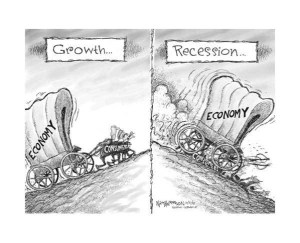
Via Andrew Leonard at Salon, the Wall Street Journal today reported the results of a survey they conducted with 53 economists:
In the survey, conducted July 8-13 and released Monday, 53 economists—not all of whom answer every question—were asked the main reason employers aren’t hiring more readily. Of the 51 who responded to the question, 31 cited lack of demand (65%) and 14 (27%) cited uncertainty about government policy. The others said hiring overseas was more appealing.
Only the conservative WSJ, the President, and Congresss could be surprised by these results. I’m not sure who these 53 economists were, but I think they must have been rather conservative, because the survey found that most did not think the government should do anything more to stimulate the economy.
Despite their forecasts for slow growth and an elevated unemployment rate, the economists aren’t in favor of further action either by the Fed or the federal government. Forty-one economists in the WSJ survey said the central bank shouldn’t pursue another round of bond-buying aimed at reducing interest rates, and thirty-eight said another round of fiscal stimulus shouldn’t be a part of any deficit-reduction package.
Economists added that they hope that as conditions begin to improve, albeit slowly, consumers will become more optimistic. “For whatever reasons, in addition to discrete headwinds, I think we’ve taken a hit to animal spirits and as those headwinds fade sentiment will revive,” said Stephen Stanley of Pierpont Securities. “Optimism can be self-sustaining, but pessimism can also provide a persistent drag.”
If any of the economists the WSJ talked to mentioned the possibility that the government itself could create jobs and thus stimulate demand–as FDR did the last time things were this bad, the WSJ did not report it.
Andrew Leonard crows:
what could be more obvious, even in the absence of rigorous training in economics? In the absence of demand, businesses will refrain from ramping up production and adding staff — no matter what employers think about the future regulatory climate. To prime this pump, to rev up this engine, to get the “delicate machine” working properly, the first focus for economic policymakers should be figuring out ways to boost demand.
Wouldn’t the best way to do that be to create jobs? Even Andrew Leonard doesn’t mention that. It seems ass-backwards to me to talk about getting consumers to spend more in order to get companies to start hiring. How can consumers spend more when many of them are unemployed? Maybe Dakinikat can explain this to me.
Anyway, it’s pretty amazing that the WSJ is admitting we have a demand problem. Now if only they could convince President Obama…
Austerity isn’t a political buzzword for Many Americans
Posted: July 16, 2011 Filed under: Economy, financial institutions, hunger, income inequality | Tags: reliance on food stamps, the economy, the Great Depression, unemployment 6 Comments You know if you’ve spent any time reading my thoughts that I am highly concerned by the level of income inequality in this country. Probably the thing that most concerns me is the number of people in Washington DC that continue to call for more of the very same policies that have wrecked the economy since the beginning of the century. Dubya/Cheney brought us deregulation that crippled the financial markets and taxes so low that we know have an unsustainable debt position. No one administration in US history has waged so many wars–literally and figuratively–on so many fronts and basically left most of the population with a huge bill. I am amazed that people like James Pethokoukis can even find outlets to publish their requests for more of the same. It’s pretty appalling but it’s typical of our media that seems more out of touch these days and ignorant of basic economics than our politicians.
Goldman Sachs doesn’t have to tell you things are bad. I don’t have to tell you things are bad. Everybody knows things are bad. Unemployment is at 9.2 percent (11.4 percent if the official labor force hadn’t collapsed since 2008 and 16.2 percent if you include discouraged and underemployed workers.) Moreover, the economy grew at just 1.9 percent in the first quarter of this year and may have grown less than 2 percent in the second. Wages and income are going nowhere fast.
When will the White House signal a change of economic direction? Will cutting tax rates and regulation ever make it on the agenda? That may be the only way Obama can win another term. And time is running short.
This man seriously thinks that change in economic direction would come through more ridiculous cuts in taxes and regulation? A change in economic direction would be towards policies that have worked in the past. How could any one call for more of the same knowing the results that those kinds of policies yielded? Do we really need another recession and financial market melt down? We don’t have rich people using tax cuts to serve as jobs creators. We have rich people and corporations using tax cuts to plop their wealth around the world to preserve that wealth. We have the American middle and working class falling into poverty.
Here’s an example of what ignoring the jobs disaster and enabling wealth hoarders has wrought from The Economist. This article is called ‘The struggle to eat; As Congress wrangles over spending cuts, surging numbers of Americans are relying on the government just to put food on the table’.
Take food stamps, a programme designed to ensure that poor Americans have enough to eat, which is seen by many Republicans as unsustainable and by many Democrats as untouchable. Participation has soared since the recession began (see chart). By April it had reached almost 45m, or one in seven Americans. The cost, naturally, has soared too, from $35 billion in 2008 to $65 billion last year. And the Department of Agriculture, which administers the scheme, reckons only two-thirds of those who are eligible have signed up.
Republican leaders in the House of Representatives want to rein in the programme’s runaway growth. In their budget outline for next year they proposed cutting the amount of money to be spent on food stamps by roughly a fifth from 2015. Moreover, instead of being a federal entitlement, available to all Americans who meet the eligibility criteria irrespective of the cost, the programme would become a “block grant” to the states, which would receive a fixed amount to spend each year, irrespective of demand. The House has also voted to cut a separate health-and-nutrition scheme for poor pregnant women, infants and children, known as WIC, by 11%. (The Senate, controlled by the Democrats, is unlikely to approve either measure.)
Advocates for the poor consider such cuts unconscionable. Food stamps, they argue, are far from lavish. Only those with incomes of 130% of the poverty level or less are eligible for them. The amount each person receives depends on their income, assets and family size, but the average benefit is $133 a month and the maximum, for an individual with no income at all, is $200. Those sums are due to fall soon, when a temporary boost expires. Even the current package is meagre. Melissa Nieves, a recipient in New York, says she compares costs at five different supermarkets, assiduously collects coupons, eats mainly cheap, starchy foods, and still runs out of money a week or ten days before the end of the month.
It is also hard to argue that food-stamp recipients are undeserving. About half of them are children, and another 8% are elderly. Only 14% of food-stamp households have incomes above the poverty line; 41% have incomes of half that level or less, and 18% have no income at all. The average participating family has only $101 in savings or valuables. Less than a tenth of recipients also receive cash payments from the Temporary Assistance for Needy Families programme (TANF), the reformed version of welfare; roughly a third get at least some income from wages.
Spending on food stamps has risen so quickly because, unusually, almost all the needy are automatically and indefinitely eligible for them. Unemployment benefits last for a maximum of 99 weeks at the moment, and that is due to fall to six months from next year. No one knows exactly how many people have exhausted their allotment, as the government does not attempt to count them. But almost half of the 14m unemployed have been out of a job for six months or more, and so would no longer qualify for benefits under the rules that will apply from January 1st.
Krugman states the obvious or “what ordinary economists” would find the policy measures under these situations in his blog today. It is exactly the opposite of what the group think in Washington DC is producing.
So, terrible growth prospects; low inflation; oh, and low interest rates, with no sign of the bond vigilantes. Ordinary macroeconomic analysis tells you very clearly what we should be doing: fiscal expansion and monetary expansion by any means we can manage; in fact, the case for a higher inflation target pops right out of just about any model capable of producing the kind of mess we’re in.
And what are we talking about in policy terms? Spending cuts and an end to monetary expansion.
I know the arguments — fear of invisible bond vigilantes, fear that 70s-style stagflation is just around the corner despite the absence of any evidence to that effect. But why do such arguments have so much traction, while everything economists have spent the last three generations learning is brushed aside?
One answer is that macroeconomics is hard; the idea that if families are tightening their belts, the government should do the same, is as deeply intuitive as it is deeply wrong.
But the susceptibility of politicians — including, alas, the president — and pundits to these wrong ideas demands a deeper explanation.
Mike Konczal ratchets up my rentier argument, arguing that what we’re seeing is
a wide refocusing of the mechanisms of our society towards the crucial obsession of oligarchs: wealth and income defense.
That has to be right. It doesn’t necessarily take the form of pure cynicism; it’s more a matter of the wealthy gravitating toward views of economic policy that make immediate sense in terms of their own interests, and politicians believing that only these views count as Serious because they’re the views of wealthy people.
But the upshot is terrible: more and more, this really does look like the Lesser Depression, a prolonged era of disastrous economic performance. And it’s entirely gratuitous.
It’s just hard for me to even find words about how misguided fiscal policy is these days. We have financial markets clamoring for less regulation not because they want to operate efficiently or because they want healthy competition, these folks are asking for removing basic oversight that prevents price gaming, moral hazard, information asymmetry, and oligopoly style games. We have two protracted wars that have never been fully financed. We have bailouts of failed institutions that have never been financed. We also have tax cuts that were not offset by spending cuts but made worse by giveaways by a Republican administration and a Republican congress and exacerbated by a Democratic administration. Obama’s stimulus was top heavy with useless tax cuts. What sort of craziness does it take to try to put those same policies on steroids then expect them to create different results?
What we currently are experiencing is a complete Aggregate Demand vacuum. We have the rich hoarding wealth or putting it in other economies and the rest of the country struggling to just exist if they have jobs. Then, we have a huge number of people that have neither wealth or jobs. This is WHEN we need the government to boost spending. We didn’t need all that during the last part of the Bush years but what we got was a period of throwing the US Treasury to the wind. We’re in deep trouble here folks and I have no faith that any of our policy makers will ever wake up and do the right thing.

 peej
peej Carissa
 bostonboomer
 dakinikat
 ecocatwoman
 mablue2
 Mama Lopez
 peggysue22
 quixote
 skydancingguestblogger
 Mona (aka Wonk the Vote)



 Sky Dancing
Recent Comments