The House is planning to vote on the Senate version of Trump’s spending and tax cut bill today. The Senate version is very different from the one the House originally sent them, so it’s not clear whether the bill will make it to Trump’s desk by July 4, as he has demanded.
As we all know, the bill will take away health care and food assistance from millions of Americans. Trump’s big bill will also vastly expand his power to target people he wants to make disappear. Yesterday Trump openly approved a true concentration camp in our country. I still haven’t recovered from the shock of seeing what these fascists are planning. And now Trump is talking about deporting U.S. citizens. The bill is cruel in so many ways, but mass deportation is Trump’s number 1 goal. I’m going to focus on that in this post.
….THE LEGISLATION SENATE REPUBLICANS passed on Tuesday is probably going to kill a lot of people.
It sounds stark when you put it that way, but death is a stark thing. It’s also what can be reasonably expected from the GOP legislation, especially the cuts to Medicaid and the Affordable Care Act projected to leave nearly 12 million Americans newly uninsured.
When people can’t pay for medical care they frequently don’t get it. And when people don’t get medical care, they’re more likely to die early from a preventable condition. That’s what you’ll find if you read the latest research, and what you’ll learn if you ask people working on the front lines of medical care.
And death doesn’t even capture the full impact of the bill, which thanks to Tuesday’s vote seems likely to become law.
That outcome is not yet a foregone conclusion, to be clear. The bill requires approval from the House, where a different version passed in May and where several Republicans have already said they object to the Senate’s iteration.
But while those Republicans have enough leverage to block approval, forcing some kind of negotiation between the houses, they are already under enormous pressure from party leaders—and, especially, from President Donald Trump, who has said he wants a bill on his desk by July 4….
Politically, it was a savvy strategy for avoiding scrutiny. So was packaging the entirety of the Trump domestic agenda into one legislative package, making it difficult for opponents to focus—and rally supporters around—any one part.
As of a few days ago, nearly half of America hadn’t heard anything about the “Big Beautiful Bill,” according to Democratic polling from Priorities USA. And only 8 percent had heard it included Medicaid cuts….
But in trying so hard to shield the bill’s true nature from the public, Republican leaders may have also succeeded in hiding parts from their own members, who might not appreciate just how much some features of the bill undercut supposedly cherished MAGA goals like lowering the cost of living and making U.S. industry more competitive.
And that’s to say nothing about the disproportionate effects some elements of the bill will have on their own constituents.
We know about the health care and food assistance cuts; Cohn lists examples of other disastrous cuts in the bill:
YOU CAN SEE IT CLEARLY in the provisions yanking away Biden-era subsidies for clean energy and electric vehicles, in many cases quickly. (The tax credit for consumers buying electric vehicles would end in September.) It’s a way to own the libs, now that Trump has turned clean energy into almost as much a bogeyman as trans athletes and woke professors.
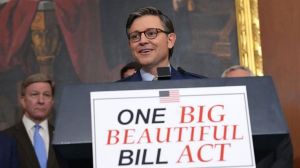
Speaker Johnson touts the big ugly bill.
But Biden’s subsidies unleashed a factory-building boom that the legislation will weaken and maybe kill, which is why the bluest of blue-collar unions—electrical workers, building trades, iron workers—spent the last few days blasting the bill as a historic “job killer.” And those jobs are likely to have an outsized effect on red states like Texas, now America’s capital for solar-panel manufacturing, because that’s where a disproportionate share of the subsidies went.
And that’s just the immediate effect. Giving up support for wind and solar means giving up on the easiest, cheapest way to increase generating capacity right now—something tech executives desperately tried to convey to Trump and his allies, with a warning that it will set back U.S. firms in their quest to develop artificial intelligence. That’s on top of ceding industries like battery storage and electric vehicles to competitors, especially the one Trump brings up the most: China.
Look down the road and you’ll see an America that is more reliant on other countries for energy—and, most likely, paying a lot more than it would if it had spent the next few years keeping up in the global alternative-energy race. Americans can expect an extra $170 billion in annual energy bills between now and 2034, according to a projection by the firm Energy Innovation.
Please read the rest of this piece at the link. It’s an excellent summary of what the bill will do to our country.
Senate Republicans certainly lack spine. They are deathly afraid to cross Donald Trump, to put their cushy jobs at risk by provoking a primary challenge, to fall out of favor with the maliciously dishonest right-wing media, and/or to be ostracized from their close circle of sycophants, donors, and staff. But their greatest moral failure is arguably not lack of courage but rather lack of empathy. They simply do not care about the pain they are inflicting on others.
Senate and House Republicans know what this bill does. Sen. Ron Johnson (R-Wis.) and others can repeat the lie that no one will lose coverage, but it does not make it so. Seventeen million people will lose health care (including 11 million Medicaid beneficiaries). Millions will lose food assistance. The debt will grow by over $3 trillion. It is hard to find anyone outside the MAGA cult who thinks this will benefit America. Republicans respond by lying about the bill even when confronted with the misery their handiwork will cause.
“The facts matter. The people matter. The Senate’s Medicaid approach breaks promises and will kick people off of Medicaid who truly need it,” Sen. Thom Tillis (R-N.C.) said on the floor, finally freed to speak honestly after announcing he would not seek reelection. His fellow Republicans shrugged. They heard the same litany of horrors from constituents, hospitals, doctors, state officials, and even right-wing think tanks.
Republicans still cannot imagine if they or a loved one:
Could not get food because their application for food stamps was snarled in red tape designed to kick people off benefits to which they were entitled;
Could not get preventive care, addiction treatment, nursing home care, or prescription drugs because they have been kicked off Medicaid and priced out of the Affordable Care Act exchanges;
Could not get to a rural hospital in an emergency after the local one closed;
Could not find a cancer trial after cuts to the National Institutes of Health;
Republicans refuse to admit that they are hurting ordinary, hard-working Americans trying to provide for themselves and their families. To do otherwise would be a confession of their inhumanity. Instead, using well-worn authoritarian techniques (e.g., demonization, dehumanization, and marginalization), MAGA politicians convince themselves that those who rely on vital benefits are unfit and undeserving. Republicans dub them “rats” or “vermin” or “murderers.”
In addition to cutting health care for the poor and providing tax relief for the rich, the legislation provided massive funding increases for the federal agencies carrying out the Trump administration’s anti-immigrant obsession. The bill adds a total of $170.7 billion to immigration enforcement. It roughly triples the annual detention and enforcement budgets for the masked men of Immigration and Customs Enforcement over the next four years.
And according to our vice president, JD Vance, this was the point of it all: “Everything else—the CBO score, the proper baseline, the minutiae of the Medicaid policy—is immaterial compared to the ICE money and immigration enforcement provisions.”
President Donald Trump, Florida Gov. Ron DeSantis, and Secretary of Homeland Security Kristi Noem tour “Alligator Alcatraz” in Ochopee, Florida on July 1, 2025. (Photo by ANDREW CABALLERO-REYNOLDSAFP via Getty Imag
All those people losing health insurance? “Minutiae.” “Immaterial.” Mass detention and deportation are what matters. They’re not only key to Making America Great Again, they’re what it means to Make America Great Again. That’s the MAGA dream: Finally getting rid of all those foreigners seeking refuge and opportunity here, in our land.
And mass detention and deportation are also key to advancing the other point of it all: authoritarianism. That’s the other part of the MAGA dream: Finally getting rid of all those annoying features of due process and the rule of law, all those restraints of civility and decency, that have kept us from doing what we want.
And so, while his vice president was breaking the tied vote in the Senate, Donald Trump was celebrating a new detention facility in the Florida Everglades. It’s a physical manifestation and apt symbol of the MAGA dream. How proud they all were of its clever name—“Alligator Alcatraz”—and the collection of tents filled with cages to hold immigrants.
What were you doing the day the president attended the opening of an American concentration camp in the Everglades? Dubbed “Alligator Alcatraz” by Republican officials because of the predators living in the surrounding swampland, it has been built to cage thousands of people rounded up by ICE and allied law enforcement agencies as part of President Trump’s mass deportations. “‘Alligator Alcatraz’ is a concentration camp,” Andrea Pitzer, author of One Long Night, a history of concentration camps, said on Tuesday.
That morning, Trump attended the camp’s opening in Ochopee, Florida, along with Homeland Security Secretary Kristi Noem and Florida Governor Ron DeSantis. “We’d like to see them in many states,” Trump said at a press conference there. “And at some point, they might morph into a system where you’re going to keep it for a long time.” He complained about the cost of building jails and prisons, then complimented his team, who “did this in less than a week.”
For the event, Trump wore one of his signature red ball caps, this one reading “Gulf of America,” his jingoistic name for the nearby Gulf of Mexico; Noem wore a white “Make America Great Again” ball cap with gold stitching. The flimsy camp offered them some shelter from the punishing humidity, which would later give way to a downpour. A C-Span camera followed them into one of the massive tents, where rows of chain-link cages contained numerous bunk beds—for the moment, empty. Photographers raced ahead of Trump and Noem to get shots of them entering, taking in the cells, pausing to ask inaudible questions. DeSantis stood as if he did not know where to put his hands. “They’re going to sweep this six times to make sure there’s nothing that could be used as contraband, as weapons,” DeSantis told Trump a bit too brightly, “before the detainees come in.” He smiled as he told reporters about how soon their prisoners would “check in.”
The American concentration camp on view Tuesday was erected within the Big Cypress National Preserve, traditional Miccosukee land. The tribe was not consulted, said Betty Osceola, a member and activist who lives a few miles from the camp’s entrance. She was one of hundreds of people protesting on the road outside the camp over the last several days as massive trucks streamed into the site. “People should be concerned about the secrecy of this,” Osceola told the Fort Myers News-Press. “It’s a big deal. Our ancestors were laid to rest in this area, and they talk about it like it’s a vast wasteland. It’s not.”
The site of the camp is also public-owned land, most recently occupied by the Dade-Collier Training and Transition Airport, “a remote facility for promising pilots to practice their touch-and-goes amid disinterested herons and alligators,” according toThe Palm Beach Post. An executive order issued by DeSantis cited a nonexistent “emergency” to get around the legal process for building on the site.
Not content with just shipping people to a foreign concentration camp, Donald Trump now has his own, homegrown concentration camp in Florida. Trump, DHS Secretary Kristi Noem, and Florida Governor Ron DeSantis gleefully toured the hastily constructed concentration camp in the Florida Everglades, obnoxiously referred to as Alligator Alcatraz, in reference to (1) the infamous island prison in San Francisco that Trump is obsessed with and (2) the number of alligators (and crocodiles — the one place in the world that has both) that live in and around the Everglades.
There’s no way to look at what the US government is doing here and not think of it more as Auschwitz than Alcatraz. The parallels are unmistakable: hastily constructed camps in remote locations, euphemistic naming designed to obscure their true purpose, and—most tellingly—officials proudly touring the facilities while discussing plans to build “a system” of such camps nationwide.
Trump and Noem touring Alligator Alcatraz
But here’s where today’s American concentration camps differ from their 20th-century predecessors: the Trump regime isn’t trying to hide what they’re doing. They’re merchandising it. They’re selling t-shirts celebrating human suffering as if it were a sports team or a vacation destination.
The United States government is literally selling branded merchandise to celebrate putting human beings in cages surrounded by dangerous predators. This isn’t just about policy—it’s about turning cruelty into a consumer product. It’s about making the suffering of others into something you can wear to own the libs.
This commodification of human rights violations represents something uniquely American and uniquely horrifying: the gamification of genocide. Previous authoritarian regimes at least had the decency to be ashamed of their concentration camps. Trump is selling tickets to the show.
These are the sorts of things that history books (should they exist in the future) will talk about as one of the many moments of pure evil that some people gleefully embraced without recognizing that people setting up concentration camps are, inherently, “the baddies.”
Donald Trump’s tour of the bloodcurdlingly-monikered – and hastily-constructed – “Alligator Alcatraz” migrants detention center in Florida’s Everglades had the hallmarks of a calculatedly provocative celebration of the dystopian.
Accompanied by Kristi Noem, the homeland security secretary, the Florida governor Ron DeSantis and a phalanx of journalists, the US president saw only virtue in the vista of mesh fencing, barbed wire and forbidding steel bunk beds.
“Between Kristi and Ron, it’s really government working together,” he said. “They have done an amazing job. I’m proud of them.”
Not that Trump was blind to the intimidating nature of the facility his long crusade against undocumented people had willed into existence in this hot, steamy part of southern Florida, prized by environmentalists as a crucial nature preserve but now redesigned to be a location of dread to those lacking documentary proof of their right to be in the US….
Trump seemed to revel in the potential for detainees’ misery at what was termed a round-table discussion but which devolved into fawning praise of his leadership from administration and state officials and obsequious questions from journalists representing friendly rightwing news outlets.
“It might be as good as the real Alcatraz site,” he said. “That’s a spooky one too, isn’t it? That’s a tough site.”
“Our superstar”
As if in confirmation that this was an event designed to showcase ruthlessness, Trump handed the floor to Stephen Miller, the powerful White House deputy chief of staff and widely-acknowledged mastermind of the anti-immigrant offensive, calling him “our superstar”.
Miller responded with a pithy summation of the policy’s raison d’être.
White House aide believes it’s more “dehumanizing” to let migrants into the country than it is to detain them in a camp surrounded by man-eating alligators.
“What you’ve done over the last five months [is] to deliver on a 50-year hope and dream of the American people to secure the border,” he said. “There’s a 2,000 mile border with one of the poorest countries in the world, and you have open travel from 150 countries into Central America and South America.
“There are 2 billion people in the world that would economically benefit from illegally coming to the United States. Through the deployment of the military, through … novel legal and diplomatic tools, through the building of physical infrastructure, through the empowering of Ice and border patrol and the entire federal law enforcement apparatus, President Trump achieved absolute border security.”
And there would be more to come – courtesy of funds secured for deportations in Trump’s sweeping spending bill, which secured narrow Senate passage during Trump’s visit to the facility.
“Once this legislation is passed, he will be able to make that, with those resources, permanent,” Miller said.
A justice department memo directing the department’s civil division to target the denaturalization of US citizens around the country has opened up an new avenue for Donald Trump’s mass deportation agenda, experts say.
In the US, when a person is denaturalized, they return to the status they held before becoming a citizen. If someone was previously a permanent resident, for example, they will be classified as such again, which can open the door to deportation efforts.
The memo, published on 11 June, instructed the justice department’s civil division to “prioritize and maximally pursue denaturalization proceedings in all cases permitted by law and supported by the evidence”. Immigration matters are civil matters, meaning that immigrants – whether they are naturalized citizens or not – do not have the right to an attorney in such cases.
Muzaffar Chishti from the Migration Policy Institute, a non-partisan thinktank, explained that much of immigration law was based on discretion by government officials. To revoke a person’s citizenship, US officials must demonstrate that they are not of “good moral character” – a subjective and broad term with little defined parameters.
Now, the recent memo lists a broad range of categories of people who should be stripped of their naturalized citizenship status, providing further guidance as to who is not of good “moral character”. This included “those with a nexus to terrorism” and espionage, war criminals and those who were found to have lied in their naturalization process. Officials still need to prove their case, Chisthi explained.
“[The administration] can’t, on their own, denaturalize people, they still have to go to a federal district court,” said Chisthi. “Denaturalization finally does belong to federal district courts – but they are obviously keen on finding every way they can to denaturalize people they think did not deserve to be naturalized.”
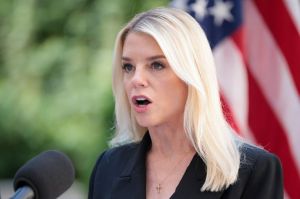
Attorney General Pam Bondi, Trump sycophant
A bit more:
However, the justice department’s memo is not solely confined to those expanded categories. It gives more discretion to officials to pursue these cases, prompting a fear for analysts and attorneys that the directive by the Trump administration is overly broad.
For Jorge Loweree, director of policy for the American Immigration Council, a new category in the memo stood out to him: individuals accused of being gang and cartel members.
Loweree is concerned “because of the way that the administration has treated people that it deems to be gang members”, he said. “ It wasn’t that long ago that the administration flew hundreds of people from the US to a prison in El Salvador on, in most instances, flimsy evidence.”
Although the memo marks an escalation by the Trump administration it is not entirely news, and in recent decades, other nations have also engaged in seeking to strip citizenship from certain people.
Denaturalization in the US has a long history. Throughout the 20th century, those seen by the US government as potential enemies to US interests were stripped of their citizenship. Journalists, activists and labor leaders, accused of being anarchists and communists, were frequently targeted.
I could go on like this for much longer, but this post is long enough. Suffice it to say that we are in big trouble as country. Please take care today. This is all so terrifying.
Did you like this post? Please share it with your friends:
Representative Gerald E. Connolly of Virginia, a nine-term congressman who was the top Democrat on the House oversight committee, died on Wednesday, his family said in a statement. He was 75.
Mr. Connolly died at his home surrounded by his family, the statement said. It did not give a cause of death. Mr. Connolly had announced in 2024 that he was being treated for cancer of the esophagus.
In April, he announced that his cancer had returned and that he would not seek re-election in 2026. He also said he would soon relinquish his spot on the Committee on Oversight and Government Reform.
U.S. Rep. Gerald “Gerry” Connolly, an outspoken Democrat who sought key reforms in the federal government while bringing transformational development to his populous Virginia district, died Wednesday. He was 75….
The spirited and at times bullheaded Fairfax Democrat became known for his voluble nature and willingness to engage in spirited debates. In one hearing, he accused Republicans of engaging in a witch hunt against the IRS, asking a witness if they ever read Arthur Miller’s “The Crucible.”
“I am heartbroken over the loss of my dear friend,” said Democratic Sen. Mark Warner of Virginia. “To me, he exemplified the very best of public service.” He said Connolly “met every challenge with tenacity and purpose, including his final battle with cancer, which he faced with courage, grace, and quiet dignity.”
A fixture of Virginia politics for three decades, Connolly was first elected to the Fairfax County Board of Supervisors in 1995. On the county board, he steered the transition of northern Virginia’s Tysons Corner from a traffic-heavy mall area to a downtown business hub.
In 2003, Connolly was elected board chairman, and he continued pushing for transportation investment that had been debated among officials for decades. Connolly sought billions in state and federal dollars to develop the regional rail system’s Silver Line connecting the national capital region to Tysons Corner.
Connolly’s dream was realized with the Silver Line’s opening in 2014, and eight years later, the rail line was extended an extra 11 miles (18 kilometers) to reach Dulles International Airport.
What’s happening in politics today:
The news getting the most attention today is the so-called “big beautiful bill” that Trump and House Republicans are trying to pass and send to the Senate. Yesterday, we got some shocking news about this nightmare bill. Not only does it cut nearly a trillion dollars from Medicaid. It also cuts Medicare by more than $500 billion from Medicare. If you watched Lawrence O’Donnell’s show last night, you heard all about it. In case you missed it, here is O’Donnell’s interview with Rep. Brendan Boyle:
Rep. Boyle: The one thing I would point out, though, is this bill is actually significantly worse [than the GOP’s ACA repeal attempt in 2017], because this piece of legislation will throw 13.5 million, almost 14 million Americans off their healthcare.
First, you’re cutting people off Medicaid. But second, this does include very deep cuts to Obamacare as well. And finally, I have breaking news for you tonight, that literally just came out in the last few minutes as I’ve been sitting here: The nonpartisan Congressional Budget Office, the official authority on these figures, has now confirmed that this bill, in addition to Medicaid cuts, in addition to Obamacare cuts, includes $500 BILLION WORTH OF CUTS TO MEDICARE that is now in this bill as well.
Lawrence O’Donnell: That is breaking news…$500 billion in cuts to Medicare. That’s the biggest cut to Medicare ever contemplated by the Congress. There have been, over the years, trims to Medicare for budget reasons, but nothing on this order has ever been done to Medicare. What happened? Talk more about that, about that breaking news piece that the CBO has projected in here. Is that because of interactions that Medicare has with the Medicaid program?
Rep. Boyle: Yeah, and forgive me this…given your great experience on the Senate Finance Committee, you’ll understand this, but it does get a bit wonky for normal folks. Basically it’s because of those interactions and specifically because of a provision called “Paygo” that will force a certain amount of Medicare sequestration, again, to the tune–and these aren’t my figures, these are the Congressional Budget Office official figures–$500 billion.
So they take the biggest cuts to Medicaid in American history. They take massive cuts to Obamacare. And then, add on top of that, the impact of all their policies mean a result of the biggest cuts to Medicare in American history on top of all of it.
House Republicans are pushing to slash nearly $1 trillion from two of the nation’s bedrock safety net programs, Medicaid and food stamps, as part of their sweeping package aimed at enacting President Donald Trump’s agenda. If the legislation is approved, millions of Americans could lose access to these benefits as a result of a historic pullback in federal support.
Trump has repeatedly vowed not to touch Medicaid, while GOP lawmakers insist that their proposals would largely affect adults who could – and should, in their view – be employed. But the actual impact would likely hit a far broader range of Americans, including some of the most vulnerable people the GOP has promised repeatedly to protect, experts say. They include children, people with disabilities and senior citizens.
A sizeable share of the US population depends on these programs. More than 71 million people are enrolled in Medicaid, and roughly 42 million Americans receive food stamps, according to the federal agencies that oversee them.
Hospitals would also feel the financial fallout of the Medicaid cutbacks, which could prompt some to raise their rates for those with job-based insurance and others to close their doors.
States would have to shoulder more of the costs of operating these programs, which could force them to make some tough decisions. Among their options could be slashing enrollment, benefits and provider rates in Medicaid or pulling back on residents’ access to food stamps. They might also shift spending from other state-supported programs such as education and infrastructure or hike taxes.
In addition, grocery store owners are warning that cuts to the Supplemental Nutrition Assistance Program, or SNAP, as food stamps are formally known, could harm local economies and cost jobs.
Read the details at the CNN link.
The House Rules Committee met under cover of darkness beginning at 1:oo this morning.
House Republicans on Wednesday are set to try to push President Donald Trump’s massive tax and immigration package across the finish line, hoping to conquer internal divisions and tee up a vote that would send Trump’s sprawling agenda to the Senate.
The House Rules Committee worked through the night on the legislation, trying to push the bill past a procedural test that would allow for a final vote. Lawmakers were still debating its provisions early Wednesday after a committee session that began at 1 a.m.
But the GOP’s narrow majority is far from unified around the proposal. And although Trump visited the U.S. Capitol for a conservative pep rally Tuesday, warring Republican factions on both sides dug in to oppose what is now officially called the One Big Beautiful Bill Act. The House GOP’s narrow majority means leaders can afford to lose only a handful of votes — and for now, they don’t have the support they need to pass the measure.
The bill would extend tax cuts that Trump signed into law in 2017 that are otherwise due to expire at the end of this year, along with new changes to reflect Trump’s campaign promises — such as no taxes on tips and overtime wages — and spend hundreds of billions of dollars on border security, the White House’s mass deportation campaign and funding for defense priorities and a “Golden Dome” continental missile defense system.
The Congressional Budget Office, lawmakers’ nonpartisan scorekeeper, projects that it will add $2.3 trillion to the deficit over 10 years. The national debt already exceeds $36.2 trillion.
Hard-line conservatives said Tuesday that the legislation did not sufficiently cut spending to pair with trillions of dollars of new tax cuts or extensions of current rates, and they angled for deeper budget reductions to Medicaid and federal benefits programs.
Blue-state Republicans demanded a higher cap on how much people can deduct from their federal taxes to offset what they pay to state and local tax authorities, and they warned that any cuts to the social safety net could cost them their political futures — and hand control of the House to Democrats after the 2026 midterm elections.
The big legislation Republicans are trying to pass this week would shrink economic resources for the poorest Americans while boosting the richest, according to a new analysis by Capitol Hill’s official budget scorekeeper.
The Congressional Budget Office said Tuesday the One Big Beautiful Bill Act, as it’s officially known, would shrink household resources for the lowest-income households by 2% in 2027 and 4% in 2033, mainly because of cuts to health and nutrition programs.
Food Stamps are on the chopping block
”By contrast, resources would increase by an amount equal to 4 percent for households in the highest decile in 2027 and 2 percent in 2033, mainly because of reductions in… taxes they owe,” CBO director Phillip Swagel wrote in a letter to Democrats.
Democratic leader Hakeem Jeffries (D-N.Y.) and Rep. Brendan Boyle (D-Pa.), the top Democrat on the House Budget Committee, requested the CBO analysis of the bill’s distributional effects for the top and bottom 10% of households by annual income.
“This is what Republicans are fighting for – lining the pockets of their billionaire donors while children go hungry and families get kicked off their health care,” Boyle said in a statement. “CBO’s nonpartisan analysis makes it crystal clear: Donald Trump and House Republicans are selling out the middle class to make the ultra-rich even richer.”
The legislation uses about $1 trillion in cuts to Medicaid and the Supplemental Nutrition Assistance Program to help pay for $3.8 trillion in tax cuts that benefit all income groups, but especially wealthier Americans. The CBO has previously estimated the legislation would shrink Medicaid enrollment by more than 7 million, including through increased eligibility checks and limits on benefits for people without jobs.
What will happen to the U.S. debt if the bill passes the Senate in it’s current form?
The United States hit its record debt level at the end of 1945, after a world war and the Great Depression.
That record, in which the debt was briefly larger than the size of the entire economy, is almost certain to be broken in the next several years. Estimates from the Congressional Budget Office published in January showed that the country was on track to overtake it in 2032 — and that was before the Republicans’ large tax and spending bill was taken into account.
Under the G.O.P. megabill being considered in the House, budget experts now say, the U.S. debt would blow past the record even sooner and climb significantly higher in coming decades.
America has had periods of high debt before, but they have tended to occur during wars, recessions or other major shocks. Generally, federal deficits have been lower during periods of low unemployment. Today, there is no war or recession to easily explain the rapidly increasing pace of borrowing.
Because the government has been spending more than it collects in taxes over the past two decades, the debt has been growing. Without any changes to existing law, the Congressional Budget Office predicts the debt will rise to about 117 percent of the economy’s size by 2034, higher than the 1945 record.
The Republicans’ bill would widen the gap further by extending and expanding tax cuts and increasing military spending, partly offset by spending cuts in other areas. The Committee for a Responsible Federal Budget, a nonpartisan group that favors debt reduction, estimates that the nation’s debt could be as high as 129 percent of the economy by 2034 under those plans.
More details at the NYT. I’ve run out of gift links for this month, unfortunately.
The president went to Capitol Hill to urge Republicans to unite behind a budget-busting budget bill, and Axios reported that his strong-arm tactics were putting conservatives into a precarious position.
“Trump’s ‘big, beautiful bill‘ is projected to add trillions to the deficit over the next decade — rattling conservatives who have long warned that the U.S. is barreling toward fiscal catastrophe,” Axios reported. “Some Republicans now find themselves trapped between two of the party’s most animating principles: Deficit reduction vs. absolute loyalty to Trump.”
The White House is hoping the budget bill will receive a vote on the House floor this week, and the president and his aides have brushed off warnings that the tax cuts embedded in the measure would explode the national debt without politically toxic cuts to Social Security and Medicare.
“This tax bill’s enormity is being underplayed … [It] will cost more than the 2017 tax cuts, the pandemic CARES Act, Biden’s stimulus, and the Inflation Reduction Act combined,” Jessica Riedl, a budget specialist at the conservative Manhattan Institute, told Yahoo Finance.
The Trump administration claims Biden created the deficits and Trump policies will lower the debt.
“[Those projections] assume consistent economic growth,” Jim Millstein, a former chief restructuring officer at the Treasury Department, told Bloomberg. “Just imagine the Trump tariffs … cause a recession. They are risking a fiscal disaster.”
For decades, budget hawks warned that America’s debt load was unsustainable and that runaway spending financed with borrowed money was eventually going to scare investors away from lending to the United States. Those fears are now taking hold more strongly in the bond market, and are at risk of spreading further.
Tax cuts pushed by the Trump administration are amplifying debt and deficit concerns among bond investors, a powerful group of market players who strongly influence how much it costs for the government to finance its budget. The buying and selling of government debt, known as Treasuries, also influences interest rates on a wide variety of debt extended to American households and businesses, including mortgages, credit cards and car loans.
Those investors were already on edge over President Trump’s whipsawing tariff policy. Then this week’s attempt to push through sweeping tax cuts without significantly slashing spending — in what the president has called a “big, beautiful bill” — set off a fresh bout of bond market turmoil. Mr. Trump put more pressure on Republican lawmakers on Tuesday, visiting Capitol Hill and warning that failing to advance the bill would lead to higher taxes.
Since dropping below 4 percent in early April, the 10-year Treasury yield has risen back above 4.5 percent, a large move reflecting deficit worries. The moves for the 30-year yield this year have also been stark: It has jumped above 5 percent, its highest level in about a year and a half.
As you probably know, that’s how much we have to pay the bondholders.
Speaking with reporters on Tuesday, Raphael Bostic, president of the Federal Reserve Bank of Atlanta, warned that volatility in the Treasury market could add to already heightened uncertainty about the economic outlook.
That risks making people “even more cautious about how they engage,” he said. “If that happens, then I’ll have to assess the extent to which that should change my outlook on how the economy is going to perform.”
House Republicans’ internal negotiations on the “One Big, Beautiful Bill” went south Tuesday night and early Wednesday morning, with GOP hardliners publicly digging in their heels against the legislation.
Why it matters: Some of the anger centers on a deal House Speaker Mike Johnson (R-La.) is nearing with blue-state Republicans to raise the State and Local Tax Deduction cap.
“I think, actually, we’re further away from a deal because that SALT cap increase upset a lot of conservatives,” House Freedom Caucus chair Andy Harris (R-Md.) said in a Newsmax interview.
Rep. Ralph Norman (R-S.C.), another GOP holdout, told Axios in a text message: “THINGS ARE NOT LOOKING GOOD!!”
State of play: Johnson and a group of House Republicans from New York, California and New Jersey were close to a deal on SALT as of Tuesday night, Axios’ Hans Nichols reported.
The deal would have raised the SALT cap to $40,000 a year for those making up to $500,000.
The income phaseout would grow by 1% for 10 years, and then the deduction would become permanent.
Yes, but: Johnson’s right flank has long been skeptical of the SALT cap, which would increase the deficit and disproportionately benefit taxpayers in high-tax Democratic states.
Some conservative hardliners also feel the bill doesn’t go far enough in cutting Medicaid and nutrition assistance spending.
I don’t buy it. My guess is the right-wingers will vote for it in the end. But if they don’t go with the SALT increase, blue state Republicans are going to lose their seats. In fact, if this bill passes, I think that will guarantee Democrats take the House in 2026.
I’m going to end there. All this talk about tax cuts, cuts to social programs, and the exploding U.S. debt are making me very tired and depressed. Take care, everyone!
Did you like this post? Please share it with your friends:
The Sky Dancing banner headline uses a snippet from a work by artist Tashi Mannox called 'Rainbow Study'. The work is described as a" study of typical Tibetan rainbow clouds, that feature in Thanka painting, temple decoration and silk brocades". dakinikat was immediately drawn to the image when trying to find stylized Tibetan Clouds to represent Sky Dancing. It is probably because Tashi's practice is similar to her own. His updated take on the clouds that fill the collection of traditional thankas is quite special.
You can find his work at his website by clicking on his logo below. He is also a calligraphy artist that uses important vajrayana syllables. We encourage you to visit his on line studio.




But the GOP’s narrow majority is far from unified around the proposal. And although Trump visited the U.S. Capitol for a conservative pep rally Tuesday, warring Republican factions on both sides dug in to oppose what is now officially called the One Big Beautiful Bill Act. The House GOP’s narrow majority means leaders can afford to lose only a handful of votes — and for now, they don’t have the support they need to pass the measure.

Tax cuts pushed by the Trump administration are amplifying debt and deficit concerns among bond investors, a powerful group of market players who strongly influence how much it costs for the government to finance its budget. The buying and selling of government debt, known as Treasuries, also influences interest rates on a wide variety of debt extended to American households and businesses, including mortgages, credit cards and car loans.

 peej
peej Carissa
 bostonboomer
 dakinikat
 ecocatwoman
 mablue2
 Mama Lopez
 peggysue22
 quixote
 skydancingguestblogger
 Mona (aka Wonk the Vote)



 Sky Dancing
Recent Comments