


Trump’s comments came during an interview with conservative syndicated radio host Hugh Hewitt in which the former president was asked for reassurance that he would not be a dictator if he returned to the White House and whether he would peacefully surrender power at the end of his second term.
Wednesday Reads
Posted: October 23, 2024 Filed under: 2024 presidential Campaign, Donald Trump, Kamala Harris 2024 | Tags: 2024 Presidential Election, Donald Trump, Kamala Harris, Michael Kelly, news, October surpises, politics, Trump and HItler, Trump disrespect for U.S. troops 9 CommentsGood Afternoon!!
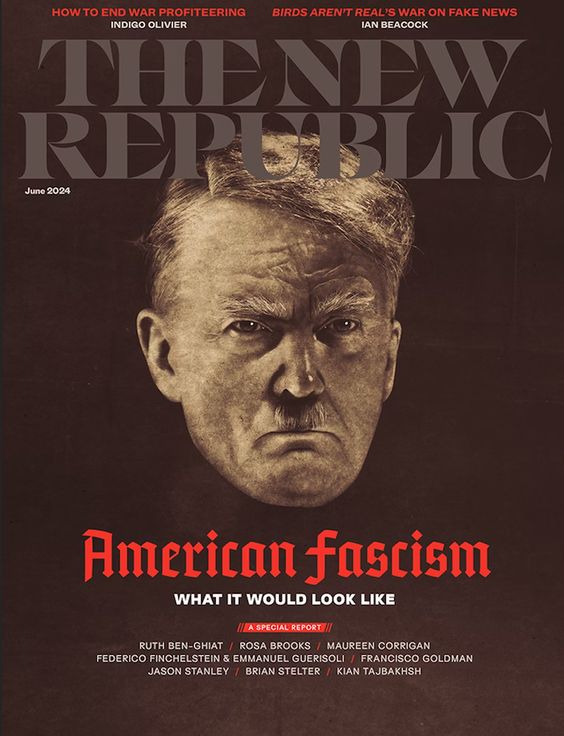 Yesterday, Trump was hit with a couple of October surprises. I have no idea whether they will make a difference, but it was a pretty good one-two punch. First The Atlantic published an article by editor-in-chief Jeffrey Goldberg about Trump’s dismissive attitude toward the members of the U.S. military. Second, The New York Times’ published an interview with Trump’s former chief of staff John Kelly, by Michael Schmidt in which Kelly says that if elected, Trump “would rule like a dictator.”
Jeffrey Goldberg at The Atlantic: Trump: ‘I Need the Kind of Generals That Hitler Had.’
Goldberg opened his article with an anecdote about a woman soldier Vanessa Guillén, who was murdered.
In April 2020, Vanessa Guillén, a 20-year-old Army private, was bludgeoned to death by a fellow soldier at Fort Hood, in Texas. The killer, aided by his girlfriend, burned Guillén’s body. Guillén’s remains were discovered two months later, buried in a riverbank near the base, after a massive search.
Guillén, the daughter of Mexican immigrants, grew up in Houston, and her murder sparked outrage across Texas and beyond. Fort Hood had become known as a particularly perilous assignment for female soldiers, and members of Congress took up the cause of reform. Shortly after her remains were discovered, President Donald Trump himself invited the Guillén family to the White House. With Guillén’s mother seated beside him, Trump spent 25 minutes with the family as television cameras recorded the scene.
In the meeting, Trump maintained a dignified posture and expressed sympathy to Guillén’s mother. “I saw what happened to your daughter Vanessa, who was a spectacular person, and respected and loved by everybody, including in the military,” Trump said. Later in the conversation, he made a promise: “If I can help you out with the funeral, I’ll help—I’ll help you with that,” he said. “I’ll help you out. Financially, I’ll help you.”
A subsequent investigation by the Army found a number of problems at Fort Hood.
Five months later, the secretary of the Army, Ryan McCarthy, announced the results of an investigation. McCarthy cited numerous “leadership failures” at Fort Hood and relieved or suspended several officers, including the base’s commanding general. In a press conference, McCarthy said that the murder “shocked our conscience” and “forced us to take a critical look at our systems, our policies, and ourselves.”
According to a person close to Trump at the time, the president was agitated by McCarthy’s comments and raised questions about the severity of the punishments dispensed to senior officers and noncommissioned officers.
In a meeting to discuss the investigation Trump asked about the funeral and how much it had cost.
According to attendees, and to contemporaneous notes of the meeting taken by a participant, an aide answered: Yes, we received a bill; the funeral cost $60,000.
Trump became angry. “It doesn’t cost 60,000 bucks to bury a fucking Mexican!” He turned to his chief of staff, Mark Meadows, and issued an order: “Don’t pay it!” Later that day, he was still agitated. “Can you believe it?” he said, according to a witness. “Fucking people, trying to rip me off.”
Goldberg’s conclusions from this episode:
The personal qualities displayed by Trump in his reaction to the cost of the Guillén funeral—contempt, rage, parsimony, racism—hardly surprised his inner circle. Trump has frequently voiced his disdain for those who serve in the military and for their devotion to duty, honor, and sacrifice. Former generals who have worked for Trump say that the sole military virtue he prizes is obedience. As his presidency drew to a close, and in the years since, he has become more and more interested in the advantages of dictatorship, and the absolute control over the military that he believes it would deliver. “I need the kind of generals that Hitler had,” Trump said in a private conversation in the White House, according to two people who heard him say this. “People who were totally loyal to him, that follow orders.” (“This is absolutely false,” Pfeiffer wrote in an email. “President Trump never said this.”)
A desire to force U.S. military leaders to be obedient to him and not the Constitution is one of the constant themes of Trump’s military-related discourse. Former officials have also cited other recurring themes: his denigration of military service, his ignorance of the provisions of the Uniform Code of Military Justice, his admiration for brutality and anti-democratic norms of behavior, and his contempt for wounded veterans and for soldiers who fell in battle.
Retired General Barry McCaffrey, a decorated Vietnam veteran, told me that Trump does not comprehend such traditional military virtues as honor and self-sacrifice. “The military is a foreign country to him. He doesn’t understand the customs or codes,” McCaffrey said. “It doesn’t penetrate. It starts with the fact that he thinks it’s foolish to do anything that doesn’t directly benefit himself.”
There’s much more at the Atlantic link. There’s no paywall on this article, so I hope you’ll read the whole thing if you haven’t already.
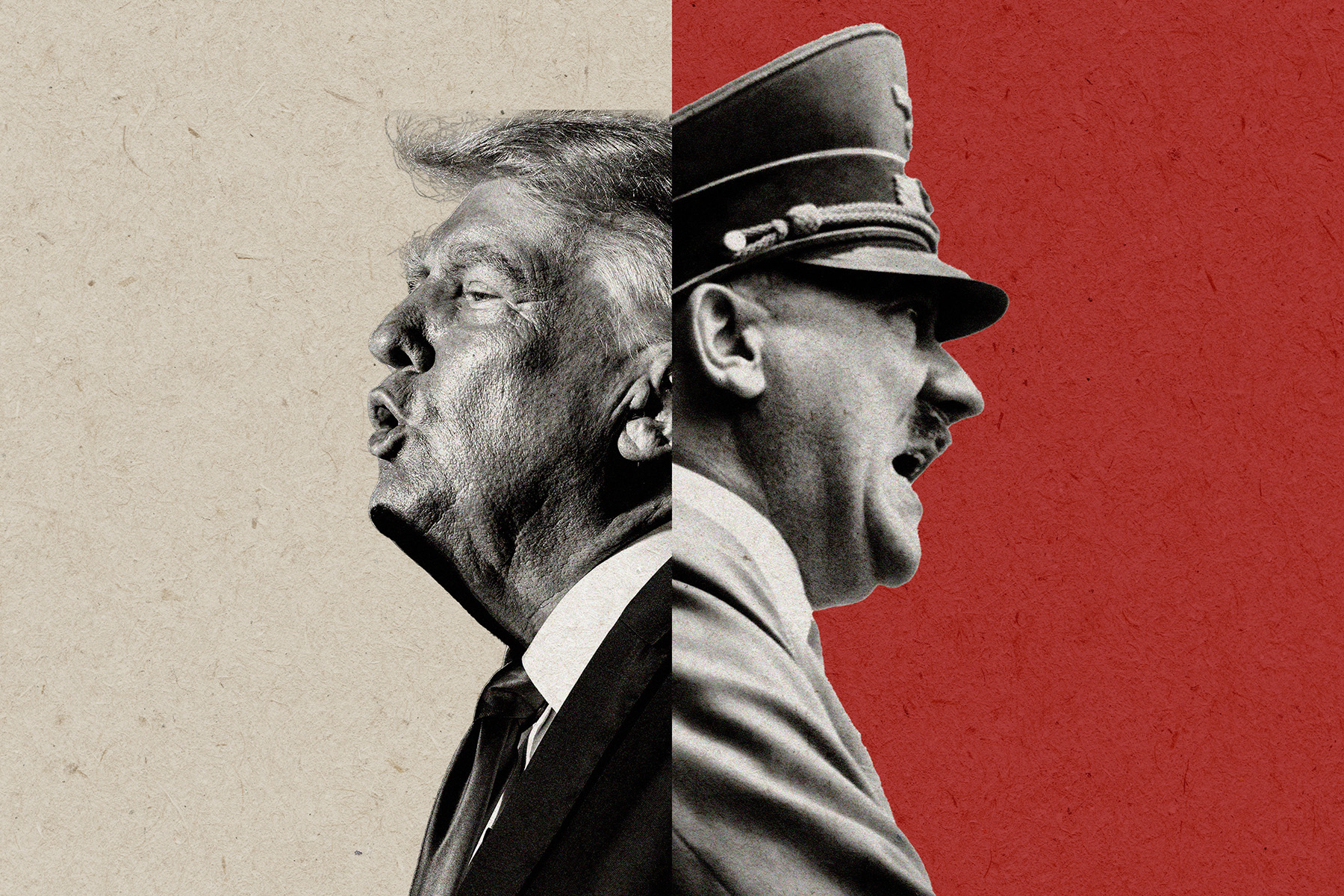 Michael S. Schmidt at The New York Times: As Election Nears, Kelly Warns Trump Would Rule Like a Dictator.
Few top officials spent more time behind closed doors in the White House with President Donald J. Trump than John F. Kelly, the former Marine general who was his longest-serving chief of staff.
With Election Day looming, Mr. Kelly — deeply bothered by Mr. Trump’s recent comments about employing the military against his domestic opponents — agreed to three on-the-record, recorded discussions with a reporter for The New York Times about the former president, providing some of his most wide-ranging comments yet about Mr. Trump’s fitness and character….
In the interviews, Mr. Kelly expanded on his previously expressed concerns and stressed that voters, in his view, should consider fitness and character when selecting a president, even more than a candidate’s stances on the issues….
He said that, in his opinion, Mr. Trump met the definition of a fascist, would govern like a dictator if allowed, and had no understanding of the Constitution or the concept of rule of law.
He discussed and confirmed previous reports that Mr. Trump had made admiring statements about Hitler, had expressed contempt for disabled veterans and had characterized those who died on the battlefield for the United States as “losers” and “suckers” — comments first reported in 2020 by The Atlantic.
Kelly agreed to make the audio of his comments available.
Some excerpts:
In response to a question about whether he thought Mr. Trump was a fascist, Mr. Kelly first read aloud a definition of fascism that he had found online.
“Well, looking at the definition of fascism: It’s a far-right authoritarian, ultranationalist political ideology and movement characterized by a dictatorial leader, centralized autocracy, militarism, forcible suppression of opposition, belief in a natural social hierarchy,” he said.
Mr. Kelly said that definition accurately described Mr. Trump.
“So certainly, in my experience, those are the kinds of things that he thinks would work better in terms of running America,” Mr. Kelly said.
He added: “Certainly the former president is in the far-right area, he’s certainly an authoritarian, admires people who are dictators — he has said that. So he certainly falls into the general definition of fascist, for sure.”
Kelly said Trump chafed at limitations on his power.
“He certainly prefers the dictator approach to government,” Mr. Kelly said.
Mr. Trump “never accepted the fact that he wasn’t the most powerful man in the world — and by power, I mean an ability to do anything he wanted, anytime he wanted,” Mr. Kelly said.
“I think he’d love to be just like he was in business — he could tell people to do things and they would do it, and not really bother too much about whether what the legalities were and whatnot,” he said.
Trump on “his generals” and Hitler, according to Kelly:
“Certainly, a big surprise for him, again, was if you remember at the beginning of the administration, he would talk about ‘his generals,’” Mr. Kelly said. “I don’t know why he thought that — but then a very big surprise for him was that we were — those of us who were former generals and certainly people still on active duty — that the commitment, the loyalty was to the Constitution, without question, without second thought.”
Mr. Kelly added: “That was a big surprise to him that the generals were not loyal to the boss, in this case him.”
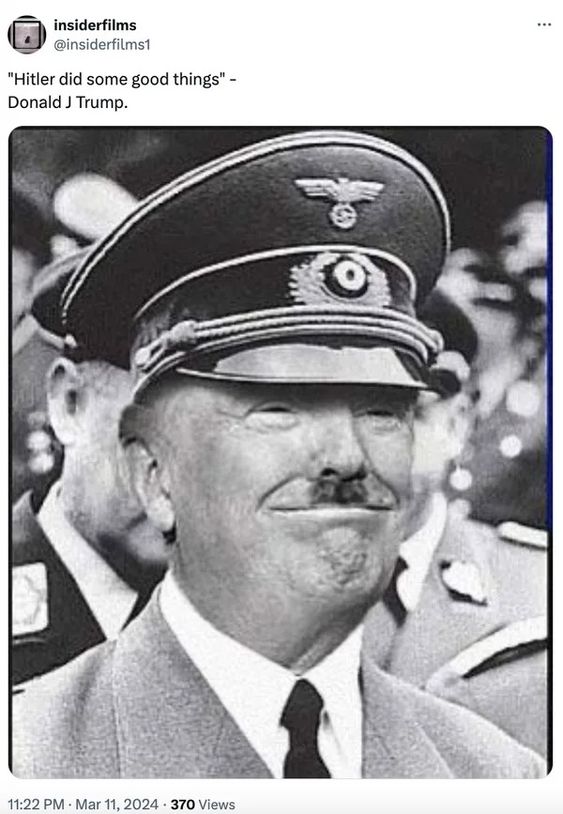
Trump told him that “Hitler did some good things.”
Mr. Kelly confirmed previous reports that on more than one occasion Mr. Trump spoke positively of Hitler.
“He commented more than once that, ‘You know, Hitler did so me good things, too,’” Mr. Kelly said Mr. Trump told him.
Again, there’s much more. Some of the comments are familiar, such as Trump’s distaste for wounded veterans and his inability to understand why anyone would choose to serve in the military and risk injury or death fighting for the country and the values in the Constitution. Here is gift link to the article.
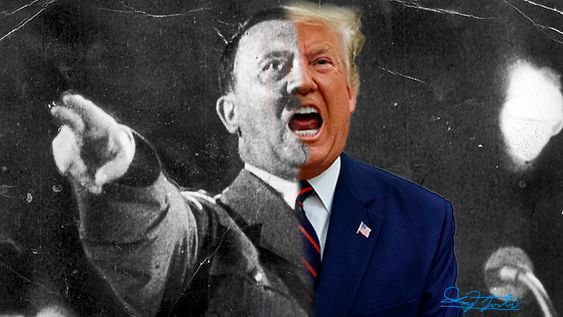 Another story with warnings about the threat of another Trump presidency by David Folkenflik at NPR: Jailed reporters, silenced networks: What Trump says he’d do to the media if elected.
Former President Donald Trump often basks in the glow of press attention. Just as often, he trashes the press and threatens journalists.
On the campaign trail and in interviews, Trump has suggested that if he regains the White House, he will exact vengeance on news outlets that anger him.
More specifically, Trump has pledged to toss reporters in jail and strip major television networks of their broadcast licenses as retribution for coverage he didn’t like.
“It speaks directly to the First Amendment — and the First Amendment is a cornerstone of our democracy,” Federal Communications Commission Chairwoman Jessica Rosenworcel, a Democrat, tells NPR.
To be clear, the government does not license national networks like those targeted by Trump, but the FCC does license local TV and radio stations to use the public airwaves….
Trump’s declarations arrive at a time of increasing concern about his more autocratic impulses. And press advocates say he is intentionally fueling a climate hostile to independent reporting….
a new survey of hundreds of journalists who received safety training from the International Women’s Media Foundation finds 36% say they have faced or been threatened with physical violence on the job — and they have felt especially threatened at Trump campaign rallies.
“Journalists reported feeling at high risk while covering Trump rallies and ‘Stop the Steal’ protests, especially when some Trump supporters and protestors openly carry weapons,” the report states.
While campaigning for Republican congressional candidates in 2022, Trump repeatedly pledged to jail reporters who don’t identify confidential sources on stories he considered to have national security implications….
Last year, Trump called for NBC News to be investigated for treason over its coverage of criminal charges he faces. After his lone debate with Vice President Harris this summer, it was ABC’s turn to face Trump’s wrath. Trump expressed anger over moderators’ decision to fact-check him. He popped up on Fox & Friends the next day with a warning.
“I think ABC took a big hit last night,” Trump said. “I mean, to be honest, they’re a news organization. They have to be licensed to do it. They oughta take away their license for the way they do that.”
This month, Trump has been back at it, slamming CBS repeatedly over its handling of the vice presidential debate and of the network’s interview with Harris on 60 Minutes. He pointed to two versions of an answer Harris had given — one that aired on 60 Minutes and the other on the show Face the Nation — to argue CBS was deceiving viewers to aid the Democrat.
“Think of this,” Trump told attendees at a rally in Aurora, Colo., this month. “CBS gets a license. And a license is based on honesty. I think they have to take their license away. I do.”
And on Sunday, Trump repeated his complaint to Fox News’ Howard Kurtz. “It’s the biggest scandal I have ever seen for a broadcaster,” Trump said. “60 Minutes, I think it should be taken off the air, frankly.”
There’s much more at the link.
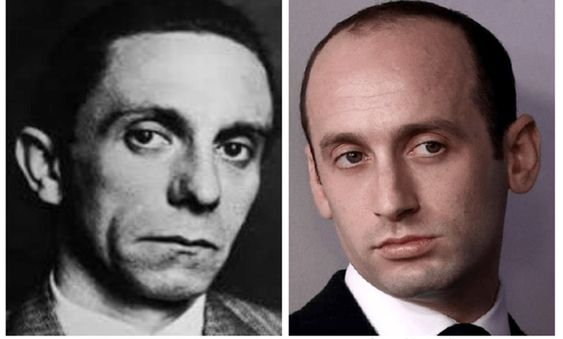
Joseph Goebbels and Stephen Miller resemble each other.
It’s difficult to understand how this election could be so close, according to the polls. I suppose one reason is that the MAGA faithful do not read The Atlantic or The New York Times–they only watch Fox News and other right wing outlets. But still, they hear Trump saying these things in his rallies, so they much approve of his attitudes and his crass beha
Stephen Robinson writes at Public Notice: How the hell is this even close?
The presidential election remains a coin toss, which in and of itself isn’t unusual. Most presidential elections since 2000 have been very close. Even 2008, the lone blowout, was a nail-biter until the very end of the campaign.
What makes this election so nerve-wracking are the stakes: Donald Trump is an adjudicated rapist and a convicted felon. He’s currently free on bail after being convicted of 34 felonies and under indictment in multiple jurisdictions. An embittered, increasingly radical, and obviously decompensating Trump openly campaigns on racial scapegoating and retribution against his political enemies. He makes no effort to hide his authoritarian and dystopian vision for a second term.
Trump is also unraveling before our eyes. His rally speeches are increasingly meandering and incoherent even by their previous low standards. His race his redder and his makeup worse than ever. During a Pennsylvania rally last weekend, Trump rambled for more than 10 minutes about the late golfer Arnold Palmer, with a bizarre focus on his penis size. Meanwhile, on social media, Trump rants like an online troll you’d immediately block….
Yet the race remains more or less tied because about 46 percent of voters think Trump is a canny businessman and masterful negotiator who’ll revitalize the economy and stand up to Vladimir Putin. Or something. Maybe they just believe they have nothing to lose and want to make the libs cry. In any event, Trump’s enduring appeal to a large swath of the electorate is evidence something is deeply wrong in our politics.
Robinson argues that there’s still hope:
Democrats who later went on to win commanding Electoral College victories often performed worse in the polls than Kamala Harris has. During the summer of 1992, Bill Clinton trailed both President George H.W. Bush and Ross Perot. Even Barack Obama’s 2008 election was not a certainty — at one point, John McCain had a five-point national lead. In August of that year, Politico declared that Obama had “hit a ceiling in public opinion polling” because he’d consistently failed to cross the 50 percent threshold of support. (He’d eventually win 53 percent of the popular vote.)
Politico argued that Obama should’ve been running away with the election because of the fundamentals: Incumbent President George W. Bush had about 30 percent approval at the time. Eight in 10 Americans believed the country was on the wrong track. The economy was in free fall with unemployment at six percent and rising.
“If everything is so good for Barack Obama, why isn’t everything so good for Barack Obama?” asked ABC News’s Gary Langer. Fast forward 16 years, and New York Times columnist David Brooks raised a similar question last week about Harris in his op-ed headlined, “Why the heck isn’t she running away with this?”
Robinson offers a number of explanations, but this is the most convincing:
A major reason that Harris isn’t “running away with this” is because an overwhelming majority of white voters don’t find Trump’s malicious nature and fundamental unfitness disqualifying.
An Emerson College poll from last Friday has Harris with a slim one-point lead over Trump, but the demographic breakdown is telling: Harris leads with Hispanic voters 61 to 35 percent and Black voters 81 to 12 percent. However, Trump carries white voters 60 to 38 percent. For context, Mike Dukakis had better numbers among white voters against George H.W. Bush in 1988. (The white electorate was smaller then.)
Obama’s white voter support dropped from 43 percent against McCain to 39 percent against Romney. If Trump lost comparable ground among white voters, this nightmare would be over.
This goes beyond rigid partisanship — Republicans just flat out love Trump. Consider that his primary challengers earlier this year were major players, not the Republican equivalents to Dean Phillips or Marianne Williamson. And those challengers had fully embraced almost all the MAGA positions except perhaps for Trump’s obsession with the big lie.
Still, Trump, while under criminal indictment, soundly defeated Nikki Haley and Ron DeSantis, once lauded as Trump without the baggage. In fact, primary exit polls in New Hampshire and South Carolina revealed that GOP voters actually like his baggage. The majority claimed Trump “shared their values,” and it wasn’t as if they were uninformed about his criminal charges. They just didn’t care, with an overwhelming majority in both states saying they still considered him fit to serve even if convicted of a crime.
If Harris wins, it’s because just enough voters accept the rule of law and reality itself. That’s probably why we remain so nervous about the outcome. The election won’t merely determine the next president. It’ll define who we are as a nation.
Again, there’s much much more at the link, and there’s no paywall.
 At The New Republic, Greg Sargent and Michael Tomasky write: “Red Wave” Redux: Are GOP Polls Rigging the Averages in Trump’s Favor?
Last month, a GOP-friendly polling firm presented itself, and its data, in a highly unusual way. Rather than maintain a nominally neutral public-facing profile, this pollster acted more like a cavalry brigade for Donald Trump’s campaign. And the firm did so explicitly, openly, and proudly.
It all went down in mid-September, at a time when the FiveThirtyEight polling averages showed the slightest of leads for Kamala Harris in North Carolina, a must-win state for Trump. Her edge was short-lived: The averages moved back to favoring Trump. And Quantus Insights, a GOP-friendly polling firm, took credit for this development. When a MAGA influencer celebrated the pro-Trump shift on X (formerly Twitter), Quantus’s account responded: “You’re welcome.”
The implication was clear. A Quantus poll had not only pushed the averages back to Trump; this was nakedly the whole point of releasing the poll in the first place.
To proponents of what might be called the “Red Wave Theory” of polling, this was a blatant example of a phenomenon that they see as widespread: A flood of GOP-aligned polls has been released for the precise purpose of influencing the polling averages, and thus the election forecasts, in Trump’s favor. In the view of these critics, the Quantus example (the firm subsequently denied any such intent) only made all this more overt: Dozens of such polls have been released since then, and they are in no small part responsible for tipping the averages—and the forecasts—toward Trump.
Coming at a time when right-wing disinformation is soaring—and Trump’s most feverish ally, Elon Musk, is converting X into a bottomless sewer pit of MAGA-pilled electoral propaganda—these critics see all this as a hyper-emboldened version of what happened in 2022, when GOP polls flooded the polling averages and arguably helped make GOP Senate candidates appear stronger than they were, leading to much-vaunted predictions of a “red wave.” Most prominently, Democratic strategist Simon Rosenberg and data analyst Tom Bonier, who were skeptical of such predictions in 2022 and ultimately proved correct, are now warning that all this is happening again.
In their telling, GOP data is serving an essential end of pro-Trump propaganda, which is heavily geared toward painting him as a formidable, “strong” figure whose triumph over the “weak” Kamala Harris is inevitable. This illusion is essential to Trump’s electoral strategy, goes this reading, and GOP-aligned data firms are concertedly attempting to build up that impression, both in the polling averages and in media coverage that is gravitationally influenced by it. They are also engaged in a data-driven psyop designed to spread a sense of doom among Democrats that the election is slipping away from them.
Of course, even if Harris wins the Electoral College, there’s no doubt that Trump will contest the election. I’ve read a number of scenarios about what could happen, and I don’t even like to think about them. Yesterday Harris was asked about one such scenario in an interview with NBC’s Hallie Jackson. Alex Seitz-Wald at NBC News: Harris says ‘of course’ her team is prepared if Trump declares victory before votes are counted.
In an interview with NBC News’ Hallie Jackson on Tuesday, Vice President Kamala Harris said she’s preparing for the possibility that former President Donald Trump declares victory before the votes are counted next month.
Sitting down at her official residence in the Naval Observatory in Washington, D.C., Harris said that her campaign is prepared for the possibility that the Republican former president tries to subvert the election, but that she’s focused on trying to beat him first.
“We will deal with election night and the days after as they come, and we have the resources and the expertise and the focus on that,” Harris said.
When pressed on the possibility that Trump will try to declare victory before the votes are counted and a winner is projected by the news networks and other media outlets, Harris said she is concerned.
“This is a person, Donald Trump, who tried to undo the free and fair election, who still denies the will of the people who incited a violent mob to attack the United States Capitol, and 140 law enforcement officers were attacked, some who were killed. This is a serious matter,” Harris said, referring to the Jan. 6 attack on the Capitol where Trump supporters tried to prevent the certification of President Joe Biden’s victory in the 2020 election.
“The American people are, at this point, two weeks out, being presented with a very, very serious decision about what will be the future of our country,” Harris added.
Read more at the NBC News link.
That’s where things stand in the election today, as I see it. What do you think?
Lazy Caturday Reads
Posted: December 23, 2023 Filed under: 2024 Elections, 2024 presidential Campaign, cat art, caturday, Donald Trump | Tags: Christmas, Covid-19, George Conway, israel, Jack Smith, January 6 insurrection, Joyce Vance, Mein Kampf, NASA, peaceful transfer of power, Supreme Court, Trump and HItler, Wisconsin legislative boundaries, Wisconsin Supreme Court 6 CommentsGood Day!!
 It’s a fairly quiet news day today, since we are fast approaching Christmas and the New Year. I’m just going to post a mixed bag of stories that caught my eye this morning.
Before we get into any bad news, here’s a cat story from ScienceAlert: NASA Has Beamed The First High-Def Video Across 19 Million Miles. Featuring a Cat.
NASA on Monday announced it had used a state-of-the-art laser communication system on a spaceship 19 million miles (31 million kilometers) away from Earth – to send a high-definition cat video.
The 15-second meow-vie featuring an orange tabby named Taters is the first to be streamed from deep space, and demonstrates it’s possible to transmit the higher-data-rate communications needed to support complex missions such as sending humans to Mars.
The video was beamed to Earth using a laser transceiver on the Psyche probe, which is journeying to the main asteroid belt between Mars and Jupiter to explore a mysterious metal-rich object. When it sent the video, the spaceship was 80 times the distance between the Earth and Moon.
The encoded near-infrared signal was received by the Hale Telescope at Caltech’s Palomar Observatory in San Diego County, and from there sent to NASA’s Jet Propulsion Laboratory (JPL) in Southern California.
“One of the goals is to demonstrate the ability to transmit broadband video across millions of miles. Nothing on Psyche generates video data, so we usually send packets of randomly generated test data,” said Bill Klipstein, the tech demo’s project manager at JPL.
“But to make this significant event more memorable, we decided to work with designers at JPL to create a fun video, which captures the essence of the demo as part of the Psyche mission.”
Space missions have traditionally relied on radio waves to send and receive data, but working with lasers can increase the data rate by 10 to 100 times….
The ultra-HD video took 101 seconds to send to Earth at the system’s maximum bit rate of 267 megabits per second – faster than most home broadband connections.
”In fact, after receiving the video at Palomar, it was sent to JPL over the internet, and that connection was slower than the signal coming from deep space,” said Ryan Rogalin, the project’s receiver electronics lead at JPL.
The big news yesterday was that the Supreme Court rejected Jack Smith’s request that they immediately decide the question of whether Trump has complete immunity from prosecution for anything he did in office.
Adam Liptak at The New York Times: Supreme Court Won’t Hear Case on Trump’s Immunity Defense for Now.
The Supreme Court declined on Friday to decide for now whether former President Donald J. Trump is immune from prosecution on charges of plotting to overturn the 2020 election.
The decision to defer consideration of a central issue in the case was a major practical victory for Mr. Trump, whose lawyers have consistently sought to delay criminal cases against him around the country.
It is unclear what the court’s order will mean for the timing of the trial, which is scheduled to start on March 4, though it makes postponement more likely. The case will now move forward in an appeals court, which has put it on a fast track, and most likely return to the Supreme Court in the coming weeks or months.
In denying review, the justices gave no reasons, which is typical, and there were no noted dissents.
Jack Smith, the special counsel prosecuting Mr. Trump, had asked the justices to move with extraordinary speed, bypassing the appeals court.
Any significant delays could plunge the trial into the heart of the 2024 campaign season or push it past the election, when Mr. Trump could order the charges be dropped if he wins the presidency.
A speedy decision by the justices was of the essence, Mr. Smith said in his petition seeking immediate Supreme Court review, because Mr. Trump’s appeal of a trial judge’s ruling rejecting his claim of immunity suspended the criminal trial.
Mr. Smith wrote that the case “presents a fundamental question at the heart of our democracy: whether a former president is absolutely immune from federal prosecution for crimes committed while in office or is constitutionally protected from federal prosecution when he has been impeached but not convicted before the criminal proceedings begin.”
“The United States recognizes that this is an extraordinary request,” Mr. Smith added. “This is an extraordinary case.”
The appeals court has already put the cast on a fast track with argument beginning January 9. Trump celebrated the SCOTUS decision as a huge win, but legal experts beg to differ.
Count George Conway among those who are less than impressed by the Supreme Court’s decision Friday to pass on an expedited request to decide whether Donald Trump is protected by immunity in the Jan. 6-related federal case against him….
Christmas Kitty Cat, by Stella Sherman
“I think today’s order is not a big deal,” Conway told MSNBC’s Chris Hayes in an interview you can watch above. “I see a lot of people with their hair on fire. They can just douse their hair in water, because this isn’t a big deal. I don’t think it’s going to affect the trial date that much. Worst case is, the trial gets pushed to the summer.
“The reason is, I think this order shows the weakness of Trump’s immunity case,” Conway added. “And I think the court realizes it’s got the D.C. Circuit that’s going to hear arguments January 9th. It’s not a hard case. I think they’re going to move very quickly. If I was the presiding judge on the panel I’d already be writing the opinion. And once they rule, they can lift the stay, they can issue a mandate and lift the stay, which means, then you’re going to have Donald Trump saying ‘Oh, we need expedition, we need expedition.’”
Conway went on to repeat he thinks the timeline for a trial will be April, May or June and that “Donald Trump is not going to be able to stop it.”
“And the Supreme Court could grant that and hear it in May, hear it in June, and you could still have a summer trial,” Conway continued, regarding a possible post-conviction appeal. “Or better yet they could deny it because he’s already had his argument at a court of appeals before a very distinguished panel. Donald Trump should be frankly treated like every other criminal who’s been convicted in a federal district court and be forced to litigate his arguments after his conviction.”
Joyce Vance also weighed in on her Substack, Civil Discourse: Let’s Debunk This.
This afternoon, the Supreme Court declined Jack Smith’s request to hear Trump’s appeal on presidential immunity, bypassing the court of appeals. Trump’s immunity motion is important because if he wins, it’s game over. The entire indictment would get dismissed if he were immune from prosecution. And while my assessment is in line with Judge Chutkan’s—she denied Trump’s motion—we don’t know for certain what the Supreme Court will do.
Logically, Trump’s motion lacks merit.
To grant it, the Court would have to hold that presidents are above the law. All presidents, not just Trump. Anything they do while they’re president is protected. We’ve seen that same argument rejected repeatedly in a civil context: E. Jean Carroll’s case and the civil suit over January 6 in Washington, D.C., for instance. There’s no analytical reason to believe criminal conduct is any more deserving of protection than civil violations are, once a president is out of office.
Trump claims that even absent total immunity for presidential conduct, the conduct he’s been charged with falls within the “outer perimeter” of a president’s duties, so he’s entitled to immunity. To credit that, the courts would have to believe that the steps Trump took to interfere with multiple states’ votes, elections a president has no role in, are somehow a part of his job. Elections are run by secretaries of state and county officials. The president has no say in the final vote count and no duties, core or outer perimeter, to interfere in those counts or the final report of the Electoral College.
If the Supreme Court granted Trump’s motion, what would prevent Joe Biden or any future president from doing precisely what Trump did in 2020, but with more skill—and succeeding? Nothing. The Supreme Court would have ruled they could do no wrong. And that’s why the Supreme Court has to deny Trump’s motion to dismiss the charges, unless it wants to end democracy by giving a license to the next president to do whatever it takes to stay in power.
Vance goes on to destroy Trump’s claims that this was huge victory for him. Read the details at the link.
A few more Trump stories:
Josh Fiallo at The Daily Beast: Trump Blames His Own Ignorance for Hitleresque Rhetoric.
Donald Trump claimed Friday that his recent comments about immigrants “poisoning the blood” of the U.S. weren’t inspired by similar statements made by Adolf Hitler about Jewish people, saying he’s merely ignorant to the specifics of Hitler’s hateful rhetoric.
To drive home his point, Trump insisted in an interview with the conservative radio host Hugh Hewitt that he really doesn’t “know anything about Hitler.”
Christmas Cat, by Daniel Rodgers
“I’m not a student of Hitler,” Trump said, defending his comments. “I never read his works. They say that he said something about blood, he didn’t say it the way I said it either, by the way, it’s a very different kind of a statement.”
When Hewitt pressed Trump about his rhetoric, Trump insisted again that immigrants are poisoning the blood of Americans.
“They’re coming from mental institutions and insane asylums,” Trump said of immigrants. “They’re terrorists, absolutely, that’s poisoning our country, that’s poisoning the blood of our country.”
Later in that rant, after complaining about immigrant children going to U.S. schools without having learned English already, Trump said again, “We are poisoning our country; we’re poisoning the blood of our country.”
Hewitt informed Trump that Hitler wrote in Mein Kampf that German blood was being poisoned by Jews, and suggested that his comments didn’t sound all that different from the Nazi leader.
Trump said he didn’t mean any racist sentiment with his “poisoning the blood” comments, and insisted he’s “doing incredibly” with Black and Hispanic voters.
As I have noted previously, Trump doesn’t need to read or study Hitler. He has Stephen Miller to write his speeches, which he then reads on a teleprompter.
This is pretty funny, from Amy B. Wang and Isaac Arnsdorf at The Washington Post: Trump claims he peacefully surrendered power, ignoring Jan. 6 attack.
Former president Donald Trump claimed Friday that he peacefully surrendered power at the end of his term in office, despite having urged a crowd of his supporters to converge on the U.S. Capitol, where some staged a deadly attack that interrupted Congress’s certification of Joe Biden’s election on Jan. 6, 2021.
“Of course — and I did that this time,” Trump said, before repeating his false claims that the 2020 presidential election was rigged. “But I did. I did it anyway.”
Trump’s response omits the fact that he urged his supporters to converge on the U.S. Capitol on Jan. 6, 2021, while Congress was certifying Biden’s electoral win. Many in the pro-Trump mob that overran the Capitol that day had chanted “Hang Mike Pence!” in the misguided belief — pushed by Trump — that the then-Vice President Pence could have stopped Congress from certifying Biden’s victory.
In video of the Jan. 6 attack, law enforcement officers outside the Capitol were shown being harassed, beaten and sprayed with noxious liquids by members of the mob. In one video from the attack, a rioter can be seen bashing a fallen police officer with a pole flying the American flag. The unprecedented attack left five people dead, including a police officer and a woman shot by police. Two other officers who were on duty that day later died by suicide, and more than 100 officers were injured.
Trump and his supporters have consistently downplayed the severity of the Jan. 6 attack, but the former president’s insistence that he engaged in a peaceful transfer of power in 2021 has sparked new alarm in light of his recent authoritarian rhetoric.

Christmas Cat by Daniella Vasileva
And from Kierra Frazier at Politico: Trump vows a peaceful transfer of power if reelected. [This story is also based on the Hugh Hewitt interview.]
If reelected president in 2024, Donald Trump vowed Friday that he would turn over power peacefully to the next president after him….
Trump has been indicted for his role in trying to overturn the results of that contest, and he repeated his false claims on Friday that the last election was rigged.
“Of course,” Trump responded to Hewitt when asked if he would hand over power peacefully if reelected. “And I did that this time. And I’ll tell you what. The election was rigged, and we have plenty of evidence of it. But I did it anyway.”
I think the more important question is whether he will step aside peacefully if he loses the 2024 election, and I’m absolutely certain that he wouldn’t.
More stories you might find interesting:
As the holiday season approaches, family gatherings are set to transform homes into microcosms of the national political landscape. In these reunions, conversations can quickly turn from benign banter about sports to the divisive topic of politics. With an election cycle upon us the name “Trump” can be as contentious as it is inescapable, turning a festive gathering of lights and eggnog into an ideological battleground.
This is the challenge many of us face this Christmas: How do we, armed with our morals and convictions, navigate the treacherous terrain of political discourse with those we love — without the feast turning into a fracas?
If you are a lone liberal leaf in a staunchly conservative family tree, you may be dreading the holiday. If you are not alone, and the family is more-or-less divided on political topics, it can be even worse — all holy hell can break loose. It is not an exaggeration to say that families can be — and sometimes are — torn apart in the highly polarized political climate we find ourselves in.
The solution to this problem lies in developing strategies based on an understanding of neuroscience and psychology that can calm the storm within, ensuring that our physiological responses do not commandeer our interactions.
But what if I told you that an understanding of the relevant concepts holds the key to not just surviving these encounters, but potentially bridging family divides? The goal isn’t to convert but to converse, and to plant seeds of thought that might, in time, bear fruit.
Let this article serve as a guide to navigating political discussions with grace and the subtle powers of persuasion.
The first thing we need to know is that two distinct yet interdependent cognitive systems govern our decision-making processes.
If any of this applies to you, read all the details at Raw Story. I’m fortunate that I don’t know and Trump supporters.
Carolyn Kee at Yahoo News: A new COVID variant is dominant in the US: Know these symptoms.
As holiday travel peaks in the United States, a heavily mutated new COVID-19 variant called JN.1 is spreading rapidly and fueling an increasing number of infections. The highly contagious omicron subvariant is now the dominant strain nationwide and accounts for nearly half of all cases.
JN.1 is currently the fastest-growing variant in the country, according to the U.S. Centers for Disease Control and Prevention.
During a two-week period ending on Dec. 23, JN.1 made up an estimated 44% of cases in the U.S., per the CDC’s latest data. After JN.1, the next most common strain was the HV.1 subvariant, which accounted for about 22% of cases nationwide. At the end of November, JN.1 only made up about 8% of cases.
Respiratory virus season has yet to peak in the U.S., which means COVID-19 cases are expected to rise in the coming weeks.
JN.1 is also gaining speed in many other countries. Earlier this week, the World Health Organization classified JN.1 as a “variant of interest” due to its “rapidly increasing spread” globally.
Scientists around the world are closely monitoring JN.1, which has sparked some concern due to its rapid growth rate and large number of mutations. However, the new variant is closely related to a strain we’ve seen before. It’s a direct offshoot of BA.2.86, aka “Pirola,” which has been spreading in the U.S. since the summer.
JN.1 has one extra mutation compared to BA.2.86, which has more than 30 mutations that set it apart from the omicron XBB.1.5 variant. XBB.1.5 was the dominant strain for most of 2023 and it’s the variant targeted in the updated COVID-19 vaccines, TODAY.com previously reported.
All of the most prevalent COVID-19 variants in the U.S. right now are descendants of omicron, which began circulating in late 2021.
Milwaukee Journal Sentinel: Wisconsin Supreme Court rules legislative maps unconstitutional, orders new boundaries for 2024 vote.
MADISON – The Wisconsin Supreme Court on Friday ordered the Republican-controlled state Legislature to draw new legislative boundaries ahead of the 2024 election, arguing their GOP advantage is unconstitutional — delivering a long-sought win for Democrats who have stayed deep in the Legislature’s minority for more than a decade.
The court in a 4-3 decision said the court is also prepared to replace the state’s heavily gerrymandered maps if the Legislature and Democratic governor cannot agree on a new plan.
“Wisconsin is a purple state, and I look forward to submitting maps to the Court to consider and review that reflect and represent the makeup of our state,” Gov. Tony Evers said in a statement.Law Forward, a Madison-based liberal-leaning law firm focused on voting issues, brought the legal challenge straight to the Supreme Court in August — bypassing lower courts in an expedited effort to put new maps in place before the fall.
The court ordered lawmakers to have new maps adopted for the August legislative primary. Wisconsin Elections Commission officials have said new maps must be in place by March 15.
The ruling forces half of the state Senate and the full Assembly to run in new legislative districts. Republicans currently hold 64 of 99 seats in the state Assembly and a supermajority in the state Senate, with 22 of 33 seats.
The ruling delivers a political landmine ahead of the 2024 presidential cycle that will all but certainly focus on the battleground state of Wisconsin. It’s the latest chink in Republican power since GOP dominance in Wisconsin state government began diminishing in 2016, when Donald Trump became president.
Since then, Republicans have lost the governor’s office and control of the state Supreme Court.
Read more at the link.

Cats in Christmas Hats, Ruth Sanderson
Finally, from Nicole Narea at Vox: The US may be flouting its own laws by sending unrestricted aid to Israel.
The recent high-profile killings of three Israeli hostages, two women in a Gaza church, and 11 unarmed Palestinian men in front of their family members have raised new global alarm at Israel’s targeting of civilians amid its war in Gaza. The deaths came as part of its ground assault, and as it continues a bombing campaign that even staunch Israel ally President Joe Biden has called “indiscriminate.” Yet, he continues to push for additional, essentially unconditional aid to Israel — despite the fact that some foreign affairs experts say existing US laws meant to safeguard human rights should have long restricted the flow of such assistance.
“We always treat Israel with kid gloves when it comes to potential human rights violations of any kind,” said Josh Paul, who has become a prominent critic of the Biden administration’s Israel policy since resigning from his post as the director of congressional and public affairs at the State Department bureau overseeing American arms sales over concerns about the Israeli response to the October 7 attack by Hamas, a Palestinian militant group designated as a terrorist organization by many countries. “When it comes to suspending or curtailing lethal military assistance, there’s no sign of anyone willing to take any actual steps.”
The US provides more aid to Israel than to any other country, about $3.8 billion annually in recognition of the two states’ “special relationship” that dates back decades. Now, Biden wants Congress to approve an additional $14.3 billion in aid to Israel as part of a broader package that also includes aid for Ukraine and that has been held up over immigration policy negotiations. He also recently circumvented Congress to sell Israel $106 million worth of tank ammunition.
Biden administration officials told CNN that they are not currently considering placing conditions on aid beyond those that already exist in federal law, saying that the US expects Israel to abide by international humanitarian law and that the Israel Defense Forces conducts internal legal reviews of its strikes beforehand.
“We’re not going to do a damn thing other than protect Israel in the process. Not a single thing,” Biden recently told Democratic donors.
Read the rest at Vox.
Best wishes for a peaceful and relaxing long weekend, regardless of whether or not you are celebrating a religious holiday.

 peej
peej Carissa
 bostonboomer
 dakinikat
 ecocatwoman
 mablue2
 Mama Lopez
 peggysue22
 quixote
 skydancingguestblogger
 Mona (aka Wonk the Vote)



 Sky Dancing
Recent Comments