
Friday Reads: Bump on the Fast Track Trade Deal
Posted: June 12, 2015 Filed under: Labor unions, morning reads, open thread, Trade | Tags: ASEAN, Fast track trade deal, TPP, Trade 15 CommentsGood Afternoon!
 I’m moving slow today. I was in a recording studio on the North Shore yesterday and it just wore me out. So, I’m catching up on life right now. A meteor could’ve hit the planet yesterday and I probably wouldn’t have noticed at all.
So, the House just tanked Obama’s demands for enhanced negotiating ability on the Pacific region trading deal. The President actually showed up on the Hill to lobby for the bill. (Wonk Trigger Alert!)
House Democrats rebuffed a dramatic personal appeal from President Obama on Friday, torpedoing his ambitious push to expand his trade negotiating power — and, quite likely, his chance to secure a legacy-defining trade accord spanning the Pacific Ocean.
In a remarkable rejection of a president they have resolutely backed, House Democrats voted to kill assistance to workers displaced by global trade, a program their party created and has stood by for four decades. By doing so, they brought down legislation granting the president trade promotion authority — the power to negotiate trade deals that cannot be amended or filibustered by Congress — before it could even come to a final vote.
“We want a better deal for America’s workers,” said Representative Nancy Pelosi of California, the House minority leader who has guided the president’s agenda for two terms and was personally lobbied by Mr. Obama until the last minute.
Republican leaders tried to muster support from their own party for trade adjustment assistance, a program they have long derided as an ineffective waste of money and sop to organized labor. But not enough Republicans were willing to save the program.
 Obama seems to be staking the end game of his Presidential legacy on this deal which begs the question “Why Does Obama Want This Trade Deal So Badly?”. William Finnegan writes this bit for The New Yorker.
The Senate passed fast-track last month, sixty-two to thirty-seven, with only fourteen Democrats voting yes. Boehner and Ryan expect to be able to produce two hundred Republican votes. That means eighteen Democratic votes are needed. Nancy Pelosi, the minority leader, is reported to be working closely with Boehner and Ryan to come up with the number they need—although she still hasn’t said which way she’ll vote herself. That’s how strange the legislative politics of the T.P.P. have become. Nearly every constituency in the Democratic Party opposes it; and the more they learn about it, the more they oppose it. And yet their leader, Obama, wants it badly.
But why? Maybe it’s a better agreement—better for the American middle class, for American workers—than it seems in the leaked drafts, where it appears bent to the will of multinational corporations. John Kerry, the Secretary of State, and Ashton Carter, the Secretary of Defense, co-authored a column on Mondayin USA Today arguing, in evangelical tones, that the T.P.P. will usher in a glorious new era of American-led prosperity, a “global race to the top” for all parties. Meanwhile, the A.F.L.-C.I.O. sees only a race to the bottom. Organized labor, by all accounts, plans to punish any elected Democrat who supports the T.P.P., or even supports fast-track for Obama, in the next campaign. It’s difficult, again, to evaluate the agreement when we can’t see it. And it will be difficult for Congress to do its job if its members can’t study each part of the many-tentacled T.P.P. on its merits, but must simply vote yes or no on the whole shebang. What’s the rush? Is it simply Obama’s wish to make his mark on history and to complete his pivot toward Asia before his time is up? Politicians are often accused of supporting pro-corporate policies to please wealthy backers, looking toward the next campaign. That can’t be Obama’s motive now.
I’m going to use my own analysis here and will begin by letting you know that my doctoral dissertation and my research area is the existing trade and development deals in the region of ASEAN+3. ASEAN is a group of small countries that are quite diverse that first banded together under the CIA to oppose the spread of communism in the region. Now, the group actually has some of those very communist countries it feared in its numbers.
It includes some of the most politically and economically diverse countries in the world. Seriously. It’s members include the Sultanate of Brunei, Singapore, Myanmar, Cambodia, Vietnam, Lao PDR, Malaysia and Indonesia. Indonesia is an Islamic Democracy. Brunei is a monarchy. Myanmar is for all intents and purposes run by a military junta. You’ll notice there are also several single party communist states. Brunei has oil. Singapore is an offshore banking haven and international financial center. Many of the other countries are mostly agricultural and traditional economies with production facilities of other countries basically paying labor badly while ignoring any environmental impact of the manufacturing process. But the deal is that this small group of countries along with their plus three neighbors (Japan, South Korea, and China) are the economic dynamos of the global economy for the next century.
It’s the region and area where the most potential for economic growth and development will occur. So, the US needs to be there for many reasons that include economic and political. Most of these countries are emergent democracies and most of these countries are liberalizing their markets which means less state ownership of things. New Zealand and Australia are huge players in the region already. For many reasons, we need to get into their trade deals to remain relevant in THE KEY region of the next century.
The biggest deal with this region is that it doesn’t have the political instability and outright strife that’s impacting Southern Africa and MENA. It’s also not stagnant like Europe. It has political issues but they haven’t blown up into perpetual terrorism and even the near dictatorships are reforming peacefully. Contrast this to what’s going on in the Middle East, then look South to Africa. Those regions appear to be clusterfucks into eternity.
So, it’s a safer place for Western Foreign Direct Investment and it’s economies are developing at phenomenal rates. There are plans to turn the region into a European style Union in the works with a single currency and banking system. All of this decreases the tricky parts of international trade in a region. The region has already successfully negotiated huge trade and currency deals with its neighbors. They all are serious about development. The US cannot maintain its leader of the world nation status and not be a major player in this region. It clearly hands the role over to the PR of China if we can’t get in there. And believe it or not, it makes Australia more of a player than Europe in the near future. The TPP also includes Latin America Countries that border the pacific so it’s a diverse group of nations.
The deal is, however, at what cost do we join in? Why do we seem to be negotiating so much independent power for multinational corporations (MNCs)?
While every other president from Ford onward has been granted similar powers, today’s vote has turned out to be anything but routine. Critics who oppose the TPP and other pending agreements are working to stop the bill—and thwart the anticipated trade deals.
The fast-track process was set out in 1974’s Trade Act, which empowered Congress to pass Trade Promotion Authority bills—like the one slated to be voted on today—that allow presidents to negotiate and sign trade deals with less involvement from the legislative branch. Congress still gets to vote yes or no on any final agreement, but amendments are generally prohibited. In exchange, TPA bills let legislators lay out trade priorities and negotiating objectives for the president, and set requirements on how and how often the administration must check in while negotiations are underway.
This TPA, if passed, will guide presidential trade negotiations through 2021. It builds upon a bill that expired in 2007, and is likely more complex than any other in history, expanding congressional oversight and consultation while including new provisions on intellectual property, cross-border data protection, and the environment and human rights. It also increases transparency, requiring presidential administrations to make agreements public 60 days before signing them.
So, the bill does include increased transparency despite many charges that it does not. It’s just not now and and it’s a fairly small window for reaction.
Nancy Pelosi stood with organized Labor and against the President today.
House Minority Leader Nancy Pelosi (D-Calif.) in a meandering but dramatic floor speech on Friday announced her vote against a measure providing assistance to workers displaced by trade.
“If TAA slows down the fast-track, I’m prepared to vote against TAA,” Pelosi said.
Pelosi announced her opposition to the Trade Adjustment Assistance (TAA) program just before it went down in the House, with 302 lawmakers voting against it.
The failure of TAA could sink a broader trade package that includes President Obama’s request for fast-track trade authority.
Pelosi’s move is a rare split with Obama, who visited Capitol Hill on Friday morning and pleaded with Democrats to back the measure.The California Democrat had been under pressure from liberal groups to oppose the trade package. While many had expected Pelosi to vote against fast-track, also known as Trade Promotion Authority (TPA), her opposition to TAA took many by surprise.
Pelosi argued that opposing TAA now would give Democrats leverage for a trade package they view as more favorable.
“We want a better deal for American workers,” Pelosi said.
A group of liberal House Democrats opposed to the trade package, including Reps. Rosa DeLauro (Conn.) and Brad Sherman (Calif.), applauded when Pelosi announced her opposition to TAA.
Richard Trumka, the president of the AFL-CIO who has been aggressively lobbying Democrats to vote against the fast-track deal, praised Pelosi in a statement just minutes after the TAA bill failed on the House floor.
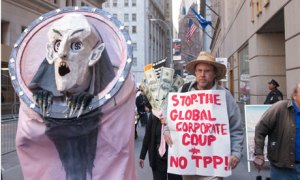 Obama is rightly focused on the region and the need to get in there before the US is inched out of the deal. The majority of fears are based in the NAFTA deal that caused some economic chaos–especially with traditional labor union jobs–that went south. I’m going to do something that will probably shock and say that it’s likely that these concerns are unfounded.
Sending jobs to Mexico is relatively easy. It’s close, stuff ships over land routes, and even though Mexico still has the feel of a narco-state, many of its regions are developed and there’s not anything in the way of civil unrest. Locating production facilities in Mexico for shipment of final goods and services to the US is a low cost no brainer.
You’re not exactly going to see that happen with Myanmar or Brunei. Also, there’s so much going on already in places like Vietnam that it’s hard to imagine it’s going to get much worse. My data and scooby sense tells me that any business located there will be shipping regionally there so I doubt it will have the same impact that the Mexican deal did. All of these countries have blossoming middle classes that are going to be shopping happy during the next decades. They’ll be able to sell stuff there much more easily than shipping it way over here to a steady state economy. (That means we’re just about as developed as we’re going to get).
Obama had rushed to Capitol Hill on Friday morning to make a last-ditch plea to an emergency meeting of the Democratic caucus. The president urged members to vote with their conscience and “play it straight,” urging them to support the financial package for displaced workers, which Democrats have long supported.
“I don’t think you ever nail anything down around here,” Obama told reporters on his way out of the Capitol. “It’s always moving.”
But anti-trade Democrats pushed hard to block the financial aid plan, knowing that its defeat would also torpedo a companion measure to grant Obama fast-track authority to complete the TPP. That bill was later approved with overwhelming Republican support in what amounted to a symbolic vote because it could not move forward into law without the related worker assistance package.
The package for displaced workers should be put in place. I’m sorry to see it used as a political tool because Republicans hate it to begin with and it’s a necessary component of any trade deal. The only issue here–which is the main issue for organized labor–is that many of the displaced workers would likely come from union jobs and go to jobs that are less likely to be union like health care workers. That’s what happened with NAFTA passage. Clinton insisted on the displaced worker clause, got it, and then many Ladies Garment Workers in the South became Nurses as a result. So, in many ways, this could really change the face of organized labor. However, labor unions need to get better footholds in the services industries since trade and technology has already eroded its member base. This deal just exacerbates an already existing issue, if anything.
I’m frankly more worried about the legal implications of making MNCs out of reach of a country’s laws. I expressed that concerned in an April, 2015 post. Here’s a link to my earlier post on the TPP listing some of the most germane concerns.
But, you can see, Obama’s backers on this deal were definitely Republican in general. Politics continues to make strange bedfellows.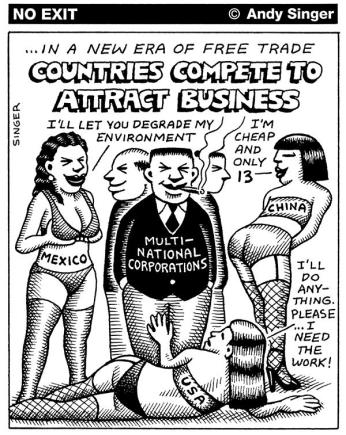
On the GOP side, Speaker John Boehner (Ohio) cast a vote in favor of TAA. Speakers cast floor votes on relatively rare occasions.
Only 40 Democrats backed TAA, while 144 voted against it. On the GOP side, 158 Republicans voted “no,” while 86 Republicans voted “yes.”
The vote against TAA is a humiliating defeat for Obama, who had spent weeks lobbying House Democrats to support his trade agenda in the face of overwhelming opposition from liberal groups and organized labor.
Under the procedure established for considering the trade package, TAA had been packaged with fast-track authority, and a vote against either doomed the total package.
In a slight surprise, House Majority Leader Kevin McCarthy (R-Calif.) announced after the TAA vote that the House would still vote on the fast-track measure, as well as a separate customs bill.
In the vote on fast-track, the measure was approved in a 219-211 vote. Twenty-eight Democrats backed fast-track, while 54 Republicans voted “no.”
House Republicans said they would bring the TAA bill up for another vote by Tuesday.
House GOP lawmakers maintained that voting on TAA again next week would give the Obama administration time to lobby more Democrats to support it.“The president has some work yet to do with his party to complete this process. This isn’t over yet. And we hope that they can get together and make sure that we finish this so that America is back leading,” House Ways and Means Committee Chairman Paul Ryan (R-Wis.) said in a hastily scheduled press conference with members of the GOP leadership after the vote.But it is difficult to see why the Democrats who objected to it on Friday to prevent movement on fast-track would shift their strategy, particularly after Pelosi’s words.
Despite the rebuke from House Democrats, the White House still expressed optimism about passing its trade package.Press secretary Josh Earnest described the defeat as “another procedural snafu,” comparing it to a failed test vote last month in the Senate on the trade package, which eventually passed the bill.
So, my political scooby senses still say that this move was to basically appease organized labor and environmental concerns. I’m not sure they’ll win much but a few good enough concessions in the long run.
So, again, sorry for the late posts but my life is bipolar at the moment and it’s wearing on me. At least I make the bills. Now, if I could only get a schedule that doesn’t exhaust me.
What’s on your reading and blogging list today?
Putting Corporations above People and their Governments and their Laws
Posted: June 16, 2012 Filed under: corporate greed, corporatism, Foreign Affairs, globalization | Tags: leaked document, Lori Wallach, Public Citizen, TPP, Trans-Pacific Partnership, US Trade negotiations 10 Comments There is a leaked “trade” document that needs to be on every one’s reading list. I know it’s a big request to ask you to follow what seems like a fairly complex negotiation riddled with legalese. However, we’re fortunate it was leaked. No one knows what’s been going on in negotiations for ongoing US trade negotiations with eight Pacific nations. This includes Senator Ron Wyden who is responsible for oversight who is trying to draft legislation to get access.
U.S. Senator Ron Wyden, Chairman of the U.S. Senate Finance Subcommittee on International Trade Customs and Global Competitiveness, introduced legislation clarifying USTR’s obligation to share information on trade agreements with Members of Congress. Legislation is necessitated by administration’s refusal to share information with Congress broadly, and specifically with Wyden’s office.
So much for Obama’s pledge of transparency.
The document in question is part of the Trans-Pacific Partnership (TPP). This document shows evidence that the agreement would “drastically undermine Obama’s proposed domestic agenda and give unprecedented political authority to multinational corporations”.
The TPP negotiations have gone on for two years between the Obama administration and several Pacific nations under conditions of ‘extreme secrecy’ without press, public or policymaker oversight, says Public Citizen who posted the leaked document on their website today.
“The top U.S. trade official effectively has said that the administration must keep TPP secret because otherwise it won’t be able to shove this deal past the public and Congress,” said Lori Wallach, director of Public Citizen’s Global Trade Watch.
The leaked document, according to the Huffington Post, reveals ‘extreme provisions’ that have been agreed upon in secret negotiations that “bestow radical new political powers upon multinational corporations” in global trade and contradict key promises made to the US public about such deals.
According to Public Citizen, the leaked text now confirms that the terms of the TPP would:
- Limit how U.S. federal and state officials could regulate foreign firms operating within U.S. boundaries, with requirements to provide them greater rights than domestic firms;
- Extend the incentives for U.S. firms to offshore investment and jobs to lower-wage countries;
- Establish a two-track legal system that gives foreign firms new rights to skirt U.S. courts and laws, directly sue the U.S. government before foreign tribunals and demand compensation for financial, health, environmental, land use and other laws they claim undermine their TPP privileges; and
- Allow foreign firms to demand compensation for the costs of complying with U.S. financial or environmental regulations that apply equally to domestic and foreign firms.
“The airing of this one TPP chapter,” said Wallach, “which greatly favors foreign corporations over domestic businesses and the public interest and exposes us to significant financial liabilities, shows that the whole draft text must be released immediately so it can be reviewed and debated. Absent that, these negotiations must be ended now.”
I first learned the details of the leak document from listening to the daily podcast at Democracy Now. Juan Gonzalez interviewed Wallach who is running around with her hair on fire trying to explain the ramifications to our country and others should this pass.
There are so many items in just this one chapter of the leaked document to fear that it’s hard to cover it all in one short Saturday Post. Basically, multinational corporations will be able to sue governments should they be hurt by labor laws, environmental laws, or any kind of regulation and seek damages. Their case will be heard by a tribunal made up of corporate lawyers. So, laws that apply to us that get tried in our courts will not apply to these multinationals. The tribunal panel gets to decide their fate.
Upon reading this latest document and the previously leaked document on intellectual property, and regarding what they mean for our access to life-saving medication, Judit Rius, the U.S. manager of Doctors Without Borders Access to Medicine Campaign said that “Bush was better than Obama on this. It’s pathetic, but it is what it is. The world’s upside-down.”
In response to the widespread criticism of the leaded document, USTR spokesman Nkenge Harmon said “This administration is committed to ensuring strong environmental, public health, and safety laws. Nothing in our TPP investment proposal could impair our government’s ability to ensure legitimate non-discriminatory public interest regulation, including measures to protect public health, public safety and the environment.”
It would be up to the international tribunals, however, to interpret “legitimate,” and “non-discriminatory.”
“Our worst fears about the investment chapter have been confirmed by this leaked text … This investment chapter would severely undermine attempts to strengthen environmental law and policy,” said Margrete Strand Rangnes, director of Labor and Trade for the the environmental group the Sierra Club.
The impact of this would be incredible. I’m going to be watching this carefully and I’d like to suggest you watch it too. Urge your Senators to support Wyden’s attempt to gain access to oversight of the trade negotiation process.

 peej
peej Carissa
 bostonboomer
 dakinikat
 ecocatwoman
 mablue2
 Mama Lopez
 peggysue22
 quixote
 skydancingguestblogger
 Mona (aka Wonk the Vote)



 Sky Dancing
Recent Comments