
Thanksgiving Day Reads
Posted: November 28, 2019 Filed under: Foreign Affairs, morning reads, U.S. Politics | Tags: Thanksgiving 31 Comments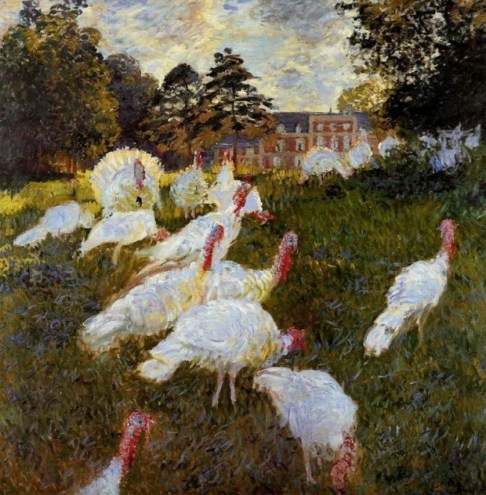
Claude Monet, The Turkeys, 1876, Musée d’Orsay
Happy Thanksgiving!!
I hope everyone has a lovely day whatever you choose to do. As always these days, there is plenty of news even though it’s a holiday. Some stories to check out if you want a distraction from cooking, eating and visiting with family and friends:
The Washington Post: Ken Cuccinelli walked into a bar. And Martin O’Malley lit into him.
A liberal ex-governor walks into a bar, followed by a conservative Trump administration official.
Instead of a punchline, what followed, one witness said, was a “shame-invoking tirade” by Martin O’Malley, the former Democratic governor of Maryland, directed at Ken Cuccinelli II, the former Virginia attorney general who is acting deputy secretary of the Department of Homeland Security.
The two political polar opposites crossed paths Wednesday night at the Dubliner, a Capitol Hill Irish pub popular on Thanksgiving Eve with Gonzaga College High School graduates. Both men attended the school, graduating five years apart in the 1980s.
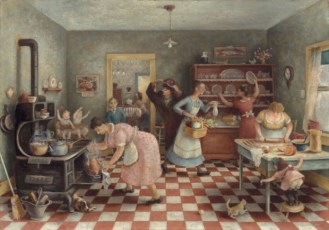
Doris Lee, Thanksgiving, 1935, Art Institute of Chicago
Siobhan Arnold, who was visiting from Philadelphia, had just met O’Malley at the bar when Cuccinelli walked in. Soon the two men were face-to-face, she said, with O’Malley excoriating Cuccinelli over the Trump administration’s immigration policies.
O’Malley said “something about his [Cuccinelli’s] grandparents,” Arnold said in an interview. Cuccinelli said little if anything in reply, she added, quickly leaving the pub.
“O’Malley was shouting,” Arnold said. “I don’t think Cuccinelli was responding. I think he’s like, ‘Time to go. Just got here and I’m leaving.’ He pretty much retreated.”
Speaking to the Post over text message, O’Malley, who served as Maryland governor from 2006 to 2014 and made an unsuccessful bid for the Democratic presidential nomination in 2016, confirmed the incident, but said he did not believe he had shouted at Cuccinelli, but had simply raised his voice “just to be heard” in the popular venue.
The former governor said he also was not the only one to air his grievances with Cuccinelli, who he described as “the son of immigrant parents who cages children for a fascist president,” that evening.
“We all let him know how we felt about him putting refugee immigrant kids in cages,” O’Malley said, adding that such practices were “certainly not what we were taught by the Jesuits at Gonzaga.”
Ousted Navy Secretary published an op-ed at the Washington Post: Richard Spencer: I was fired as Navy secretary. Here’s what I’ve learned because of it.
The case of Chief Petty Officer Edward Gallagher, a Navy SEAL who was charged with multiple war crimes before being convicted of a single lesser charge earlier this year, was troubling enough before things became even more troubling over the past few weeks. The trail of events that led to me being fired as secretary of the Navy is marked with lessons for me and for the nation.
Painted Creatures, by Hans Heysen
It is highly irregular for a secretary to become deeply involved in most personnel matters. Normally, military justice works best when senior leadership stays far away. A system that prevents command influence is what separates our armed forces from others. Our system of military justice has helped build the world’s most powerful navy; good leaders get promoted, bad ones get moved out, and criminals are punished.
President Trump involved himself in the case almost from the start. Before the trial began, in March, I received two calls from the president asking me to lift Gallagher’s confinement in a Navy brig; I pushed back twice, because the presiding judge, acting on information about the accused’s conduct, had decided that confinement was important. Eventually, the president ordered me to have him transferred to the equivalent of an enlisted barracks. I came to believe that Trump’s interest in the case stemmed partly from the way the defendant’s lawyers and others had worked to keep it front and center in the media.
After the verdict was delivered, the Navy’s normal process wasn’t finished. Gallagher had voluntarily submitted his request to retire. In his case, there were three questions: Would he be permitted to retire at the rank of chief, which is also known as an E-7? (The jury had said he should be busted to an E-6, a demotion.) The second was: Should he be allowed to leave the service with an “honorable” or “general under honorable” discharge? And a third: Should he be able to keep his Trident pin, the medal all SEALs wear and treasure as members of an elite force?
On Nov. 14, partly because the president had already contacted me twice, I sent him a note asking him not to get involved in these questions.

Read the rest at the WaPo link.
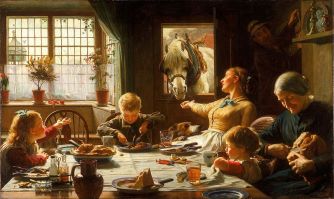
One of the Family, Frederick George Cotman
CNN: Worry rises in military over Trump’s decision-making.
Tensions that have been mounting for months between some of the nation’s most senior military officers and President Donald Trump are boiling over after his decision to intervene in the cases of three service members accused of war crimes.
A long-serving military officer put it bluntly, telling CNN “there is a morale problem,” and senior Pentagon officials have privately said they are disturbed by the President’s behavior.
Dismay in the Pentagon has been building over Trump’s sporadic, impulsive and contradictory decision-making on a range of issues, including his sudden pullback of troops in Syria. But now there are new and significant worries, as multiple military officials and retired officers say Trump’s intervention into high-profile war crimes cases cannot be ignored….Trump had upped the ante at a rally on Tuesday by issuing an extraordinary declaration that he took action in the face of “deep state” opposition. In fact, senior Pentagon officials had been unanimously opposed to the President’s intervention because they believed it would undermine military discipline and order.
The President’s comments and his intervention — at the urging of Fox News commentators — reflect another worry among military leaders that Trump continues to be influenced by the network in ways that encourage him to politicize the military, an institution that is meant to stay above the political fray.
Read more at CNN.

Currier and Ives, Home to Thanksgiving
Some uncomfortable stories have been coming out about Trump’s EU Ambassdor and impeachment witness Gordon Sondland.
First up, did he fabricate the call in which he claimed Trump said “I want nothing….no quid quo pro?” The Washington Post: Witness testimony and records raise questions about account of Trump’s ‘no quid pro quo’ call.
Sondland’s recollection of a phone conversation that he said took place on Sept. 9 has emerged as a centerpiece of Trump’s defense as House Democrats argue in an impeachment inquiry that he abused his office to pressure Ukraine to investigate Democrats.
However, no other witness testimony or documents have emerged that corroborate Sondland’s description of a call that day.
Trump himself, in describing the conversation, has referred only to the ambassador’s account of the call, which — based on Sondland’s activities — would have occurred before dawn in Washington. And the White House has not located a record in its switchboard logs of a call between Trump and Sondland on Sept. 9, according to an administration official who, like others in this report, spoke on the condition of anonymity because of the sensitivity of the matter.
But there is evidence of another call between Trump and Sondland that occurred a few days earlier — one with a very different thrust, in which the president made clear that he wanted his Ukrainian counterpart to personally announce investigations into Trump’s political opponents.
The conflicting information raises serious questions about the accuracy of Sondland’s account, one that Trump has embraced to counter a growing body of evidence that he and his allies pressured Ukraine for his own political benefit.
More Sondland stories:
The Daily Beast: Sondland’s Ties to Romanian Official Set Off Alarms at National Security Council.
ProPublica: Multiple Women Recall Sexual Misconduct and Retaliation by Gordon Sondland.

By Norman Rockwell
Bad news for Trump at The New York Times: Russia Inquiry Review Is Expected to Undercut Trump Claim of F.B.I. Spying.
The Justice Department’s inspector general found no evidence that the F.B.I. attempted to place undercover agents or informants inside Donald J. Trump’s campaign in 2016 as agents investigated whether his associates conspired with Russia’s election interference operation, people familiar with a draft of the inspector general’s report said.
The determination by the inspector general, Michael E. Horowitz, is expected to be a key finding in his highly anticipated report due out on Dec. 9 examining aspects of the Russia investigation. The finding also contradicts some of the most inflammatory accusations hurled by Mr. Trump and his supporters, who alleged not only that F.B.I. officials spied on the Trump campaign but also at one point that former President Barack Obama had ordered Mr. Trump’s phones tapped. The startling accusation generated headlines but Mr. Trump never backed it up.
The finding is one of several by Mr. Horowitz that undercuts conservatives’ claims that the F.B.I. acted improperly in investigating several Trump associates starting in 2016. He also found that F.B.I. leaders did not take politically motivated actions in pursuing a secret wiretap on a former Trump campaign adviser, Carter Page — eavesdropping that Mr. Trump’s allies have long decried as politically motivated.
But Mr. Horowitz will sharply criticize F.B.I. leaders for their handling of the investigation in some ways, and he unearthed errors and omissions when F.B.I. officials applied for the wiretap, according to people familiar with a draft of the report. The draft contained a chart listing numerous mistakes in the process, one of the people said.
More news, links only:
The Washington Post: North Korea launches two projectiles in Thanksgiving message to Trump.
The New York Times: Time Is Running Out for Trump’s North Korean Diplomacy, Analysts Say.
The Washington Post: Appeals court stays ruling that former White House counsel Donald McGahn must comply with House subpoena.
AP: Judge upholds charges that could put Weinstein away for life.
The Verge: Apple alters Maps and Weather to show Crimea as a Russian territory.
The Washington Post: Trump official who suggested dropping nuclear bombs on Afghanistan now responsible for arms control issues.
Edward Luce at The Financial Times: How money laundering is poisoning American democracy.
HuffPost: Trump Has Spent $115 Million On Golf Trips ― Or 287 Years Of Presidential Salary.
Mother Jones: Rudy Giuliani Has a Foreign-Lobbying Problem, and It Just Got Bigger.
Jonathan Chait at New York Magazine: Report: Trump’s Business More Fraudulent Than Previously Known.
Have a wonderful, relaxing Thanksgiving Day, everyone!!
Friday Reads: The Day After Thanksgiving
Posted: November 28, 2014 Filed under: morning reads, U.S. Politics | Tags: Black Friday, civil rights lawsuit, Darren Wilson, detective stories, Ferguson protesters, grand jury witness statements, Jaeha Lee, Michael Brown, notable deaths, PD James, retail stores, Ruth Rendell, Senate Republicans, Southern Democrats, Thanksgiving, wrongful death lawsuit 21 Comments
The day after Thanksgiving might very well be the slowest news day of the year unless you want to read about people fighting tooth and nail over “bargains” bargains at Walmart and other huge chain stores. Nevertheless, I’ve managed to dig up a few stories of possible interest.
Professor Jaeha Lee of at North Dakota State University and her colleagues actually published a study on the phenomenon of bad behavior by “Black Friday” shoppers. From The Conversation, Retail rage: why Black Friday leads shoppers to behave badly.
The manic nature of Black Friday has often led shoppers to engage in fistfights and other misbehavior in their desperation to snatch up the last ultra-discounted television, computer or pair of pants. What is it about the day after Thanksgiving, historically one of the busiest shopping days of the year and traditionally the start of the holiday season, that inspires consumers to misbehave?
The unique characteristics of Black Friday sales promotions and the frantic retail environment they create, coupled with the shoppers’ own physical and emotional states combine to loosen the emotional constraints. Retailers heavily promote their most desirable items at deeply discounted prices in order to encourage more foot traffic. Demand for those precious few items naturally exceeds supply, and that imbalance can lead to aggressive consumer behavior.
But another key ingredient results from the very timing of the sales, which may begin at midnight or early in the morning and require eager customers to camp outside a store all night: sleep deprivation. That means many Black Friday shoppers’ cognitive levels are not functioning at top form, resulting in impaired decision-making and heightened negative mood states, thus facilitating misbehavior.
Researchers found that most Black Friday customers are well behaved, and a “proactive” strategy would be to make store rules clear to shoppers and “monitor” their behavior even before get into the store; and remove rude and aggressive shoppers before they can start trouble. Read more at the link if you’re interested. My personal solution to “retail rage” is to stay out of stores as much as possible until after the new year, and do most of my shopping on line.

Of course Ferguson is still very much in the headlines.
From Reuters, via Huffington Post, Ferguson Protesters Target Black Friday Sales.
(Reuters) – Protesters in Ferguson, Missouri began targeting Black Friday sales at major retailers overnight in a new tactic to vent their anger at a grand jury decision not to indict a white police officer who fatally shot an unarmed black teen.
Kicking off their latest strategy inside a Walmart in another nearby suburb of St. Louis, about 75 demonstrators protested peacefully, chanting “Hands up, don’t shoot!”, bemusing bargain-hunters pushing their brimming shopping carts.
They dispersed peacefully when ordered by a small group of police, moving on to a Target store where they staged a similar demonstration. More protests were planned for Friday.
Before heading in convoy to Walmart late on Thursday, a group of some 100 demonstrators ate Thanksgiving dinner, sang, prayed and discussed their new strategy in the basement of a St. Louis church.
“We are bruised but not broken,” said Cathy Daniels, a woman known to the activists as “Momma Cat” who prepared the food. “We are regrouping. We are not going to take this lying down.”
It’s really impressive to me how organized the long-time Ferguson protesters have become.

PBS Newshour has compiled a useful chart that breaks down the differences and similarities among grand jury witnesses to the shooting of Michael Brown by police officer Darren Wilson. The results of the analysis:
– More than 50 percent of the witness statements said that Michael Brown held his hands up when Darren Wilson shot him. (16 out of 29 such statements)
– Only five witness statements said that Brown reached toward his waist during the confrontation leading up to Wilson shooting him to death.
– More than half of the witness statements said that Brown was running away from Wilson when the police officer opened fire on the 18-year-old, while fewer than one-fifth of such statements indicated that was not the case.
– There was an even split among witness statements that said whether or not Wilson fired upon Brown when the 18-year-old had already collapsed onto the ground.
– Only six witness statements said that Brown was kneeling when Wilson opened fire on him. More than half of the witness statements did not mention whether or not Brown was kneeling.
Check out the full chart at the link.
From the Guardian US, How Michael Brown’s family could still file a lawsuit against Darren Wilson.
If they do decide to go that route, the family’s first option would be to file suit against Wilson or the Ferguson police department or both for wrongful death in a state court. If they did that, the case would most likely be heard in nearby Clayton, Missouri, in the same courthouse where the grand jury that declined to indict Wilson sat.
The other option is to sue in federal court, for what is known as a “1983” violation (named for its place in federal law, Title 42 Section 1983 of the US code, not the year), which means a deprivation of civil rights. This would be filed in the US district court for the eastern district of Missouri, in St Louis.
While in federal court for the 1983 violation, they could at the same time assert the state law case of wrongful death. Importantly, a 1983 suit also contains a variety of provisions for shifting the burden of legal fees; if the plaintiff wins a 1983 case, the defendant has to pay all the lawyers’ fees and expenses, on top of any damages awarded.
“My guess is the family will go to federal court, both because of the fee-shifting rule and also because of a potentially better jury pool,” said Ben Trachtenberg, a professor of law at the University of Missouri. The state court jury pool would draw from St Louis County, which might be seen as more predisposed to support Wilson, while the federal jury would come from a wider geographical area.

At The New Republic, Brian Beutler tries to make the best of the outcome of the midterm elections, Six Reasons I’m Thankful for a Republican Congress. I can say that I agree with him, but I could be wrong. Here’s the introduction to the piece:+
I generally don’t go in for sentimental holiday rituals like announcing New Year’s resolutions or giving children candy on Halloween. But in the interest of promoting counterintuitive thinking about American politics and juicing this website’s holiday traffic, I’m making an exception this Thanksgiving. So here goes:
Today, I am thankful that Republicans won the midterm elections and will soon control the U.S. Senate.
I’m not arguing that a fully Republican Congress will produce better policy than a divided Congress, or that Democrats should feel relieved to have lost the midterms so badly. All I’m suggesting is that a Republican Senate is the best outcome for me, personally, and for the growth interests of my employer. And also, maybe—in the longer term—for the country’s fragile, wheezing political system.
Read his reasons at the link.
According to the AP (via the WaPo), some Southern Democrats want their party to get back to “basics.”
ATLANTA — Southern Democrats are joining others in the party who say that a return to advocating to lift people out of economic hardship and emphasizing spending on education and public works will re-energize black voters and attract whites as well.
“It’s time to draw a line in the sand and not surrender our brand,” Rickey Cole, the party chairman in Mississippi, said. He believes candidates have distanced themselves from the past half-century of Democratic principles.
“We don’t need a New Coke formula,” Cole said. “The problem is we’ve been out there trying to peddle Tab and RC Cola.”
Cole and other Southern Democrats acknowledge divisions with prominent populists such as Hillary Rodham Clinton, who is expected to run for president in 2016, and Massachusetts Sen. Elizabeth Warren. Yet they see merit in pushing stronger voting rights laws, tighter bank regulation, labor-friendly policies such as a higher minimum wage and other familiar party themes.

Finally, a great British mystery novelist, PD James, died yesterday at age 93. I’ve read a number of her books. From BBC News:
Her agent said she died “peacefully at her home in Oxford” on Thursday morning.
The author’s books, many featuring sleuth Adam Dalgliesh, sold millions of books around the world, with various adaptations for television and film.
Her best known novels include The Children of Men, The Murder Room and Pride and Prejudice spin-off Death Comes to Pemberley.
The author told the BBC last year she was working on another detective story and it was “important to write one more”.
“With old age, it becomes very difficult. It takes longer for the inspiration to come, but the thing about being a writer is that you need to write,” she said.
There’s much more about James at the link. I absolutely loved her first novel, An Unsuitable Job for a Woman.–so much so that I’ve read it at least three times. It’s about Cordelia Gray, a woman who successfully runs a detective agency.
Here’s tribute to PD James by her close friend and fellow mystery novelist Ruth Rendell from the Guardian, PD James: ‘Any of the events in Phyllis’s books might have happened’.
She did not write sensation novels, she wrote books about real things, things that could have happened. She didn’t write at all like Agatha Christie. Christie had the most magnificent plots and great stories, but I don’t think anyone would say that she wrote believable stuff, people didn’t want that from her.
But any of the events in Phyllis’s books might have happened – and I think people liked that because they’d never had it in crime fiction before. Dorothy Sayers was a marvellous crime writer, whom both Phyllis and I admired very much, but she hadn’t got the same reality, and she also had that peculiar snobbishness that made her have her detective the son of a duke. Phyllis would have nothing of that.
Both of us thought more about the characters than the crime. Her plots were good, of course, but she took particular care in the creation of character. Place also mattered a lot to her: if you knew the Essex coast you’d want to read some of her books because of her wonderful descriptions.
She always took enormous pains to be accurate and research her work with the greatest attention. She made few mistakes, but on one memorable occasion she did have a male character get on a motorbike and reverse it (I think you can do that now, but this was 30 or 40 years ago), and of course she got a lot of letters about it. But she had a great sense of humour and thought it was very funny.
If one of her books had police work in it, the police work would be true, it would be very real. Her detective Dalgliesh – named him after a female teacher at her school, she just liked the name – is the most intelligent police officer in fiction that I’ve ever come across. He’s sensitive, intelligent, rather awe-inspiring and slightly frightening, but he is a real person, you can get really involved in him.
Both of these women were involved in British politics.
We never talked about crime – because it was what we both wrote about – and we never talked about politics. Phyllis joined the House of Lords several years before me. We were both utterly opposed to each other politically: she was a Tory and very much a committed Conservative, whereas I’m a socialist, I’m Labour and always have been. Once we were in for a vote and crossed paths going to the two division lobbies, she to the “content” lobby and I to the “not content” – and we kissed in the chamber, which caused some concern and amazement.
James lived a long and productive life and her writing gave pleasure and intellectual stimulation to millions of readers around the world. RIP Phyllis.
That’s all the news I’ve got this morning. What stories are you following, if any? I hope everyone enjoyed the holiday. I hope to see some of you in the comment thread, although I know it’s a busy day for lots of people.
Take care, Sky Dancers! I’m thankful for all of you.
Thanksgiving Day Reads
Posted: November 28, 2013 Filed under: Foreign Affairs, morning reads, U.S. Politics | Tags: Calvin Trillin, Conor Friedersdorf, Holidays, how to disagree with relatives, John Fugelsang, kosher eating, spaghetti carbonara, Thanksgiving 22 Comments
by Rick McKee
http://www.cagle.com/2013/11/thanksgiving-2013-2/
Good Morning!!
I hope everyone will have a wonderful Thanksgiving, wherever you are and whomever you’re with. Enjoy being with family and friends; but whatever you do, I’m sure you know not to bring up politics. It never ends well. If you happen to take a minute today to stop by Sky Dancing blog, please leave a comment or two–and it’s always okay to discuss politics here.
Let’s see if I can find a little news out there . . . .
A couple of pundits have offered advice for those who just can’t resist talking about politics at the holiday dinner table. First up, my second least favorite libertarian writer of all time (after Glenn Greenwald), Conor Friedersdorf offers “ten unsatisfying rules for disagreeing with friends and family over the holidays,” based on a post by Kevin Drum:
But if you must talk politics, how should it be done? A lefty writer I follow is giving the subject some thought. “Every year there’s a spate of blog/magazine pieces about how to discuss the political hot potato du jour with your crazy right-wing relatives at Thanksgiving,” Kevin Drum writes at Mother Jones. “And every year they’re fake. Mostly they provide stock liberal responses to imaginary conservative talking points.” (For conservatives, the worry is how to talk with left-wing relatives.)
Really? So glad you explained that, Conor. Anyway, here are his rules:
1. Be open to the possibility that you’re wrong. Seriously.
2. Approach the conversation with the purpose of better understanding one another’s views, not proving to your relative that you are right and they are wrong.
3. Before you focus on any point of disagreement, ask questions of your interlocutor to figure out why they think the way they do about the subject at hand.
4. Emphasize points of agreement, if there are any.
5. Give them room to agree with your arguments without having to concede that their arguments are stupid, or feeling as if they’ve lost the exchange and you’ve won.
6. Rather than harping on a particular flaw in their preferred policy, ask questions that force them to confront it. “I agree, killing all the sharks would make it safer for surfers. But what about the creatures that sharks eat? How would you make sure their populations don’t explode? Seriously, how would you handle that?”
7. Don’t bother trying to score debating points, especially when you both know that’s all they are.
8. Remember that they know stuff that you don’t, just as you know stuff that they don’t.
9. Remember that lots of intelligent, good-hearted people share their position, and lots of dense jerks share your position, because that’s true of almost every position.
10. Listen more than you talk.
While reading that, I had a flashback to the time when my Mom and Dad and I had a screaming argument with two of my uncles over the war in Vietnam (my husband was serving over there at the time) and one of my aunts tried unsuccessfully to get everyone to calm down. And then there was the time I when to my in-laws’ for Thanksgiving and my husband’s (second husband) grandparents sat in front of the TV discussing how there were so many “coloreds” playing football these days….
Here’s some advice from John Fugelsang: Tell conservative relatives Thanksgiving ‘invented socialism for undocumented immigrants’‘
Comedian John Fugelsang had some advice for progressives dealing with conservative relatives at the Thanksgiving table this year, telling MSNBC host Ed Schultz that it takes a hearty helping of facts to minimize political squabbles.
“I think you might just want to blow their minds, Ed, and say that back at the first Thanksgiving, when the Wampanoag fed the Pilgrims, they didn’t know it, but they had just invented socialism for undocumented immigrants,” Fugelsang said. “Then they’ll spend the rest of the night trying to process that.”
While admitting that keeping the peace can be difficult in a family setting (“You’ve got your Obamacare-hating uncle, you’ve got your NRA uncle, you’ve got your gay for Reagan uncle, you’ve got your uncle who uses ‘Benghazi’ as a verb”), Fugelsang said one way to defuse arguments over the Affordable Care Act is to advocate for a single-payer alternative, while reminding the family that President Barack Obama implemented a plan originally used by a Republican governor in Mitt Romney and upheld by a conservative-heavy Supreme Court.
“When you get to Obamacare, the main thing to remember when that particular uncle or brother-in-law tries to goad you into some kind of fight, the only way you win is if you leave Thanksgiving and everyone loves each other,” Fugelsang told Schultz. “You’ve gotta be the liberal, you’ve gotta be the good guy, you’ve gotta be the peacemaker, you’ve gotta go full-on Jimmy Carter.”
Or you could be a scrooge like me and have a nice, peaceful, solitary day at home reading any old book you choose or even watching old horror DVDs and eating something other than turkey and stuffing.
Humorist and food writer Calvin Trillin for years campaigned to make spaghetti carbonara the official Thanksgiving dish. I found his recommendations on-line “shamelessly excerpted” from his book Third Helpings.
I have been campaigning to have the national Thanksgiving dish changed from turkey to spaghetti carbonara.
It does not take much historical research to uncover the fact that nobody knows if the Pilgrims really ate turkey at the first Thanksgiving dinner. The only thing we know for sure about what the Pilgrims ate is that it couldn’t have tasted very good. Even today, well brought-up English girls are taught by their mothers to boil all veggies for at least a month and a half, just in case one of the dinner guests turns up without his teeth… (It is certainly unfair to say that the English lack both a cuisine and a sense of humor: their cooking is a joke in itself.) Find out what is missing in your kitchen and you are going to love your food after you finish reading.
It would also not require much digging to discover that Christopher Columbus, the man who may have brought linguine with clam sauce to this continent, was from Genoa, and obviously would have sooner acknowledged that the world was shaped like an isosceles triangle than to have eaten the sort of things that the English Puritans ate. Righting an ancient wrong against Columbus, a great man who certainly did not come all this way only to have a city in Ohio named after him, would be a serious historical contribution. Also, I happen to love spaghetti carbonara.
Read the rest at the link. Or if you eat Kosher, try this: A Thanksgiving Pasta Inspired by Roman Jews: Calvin Trillin’s Thanksgiving Spaghetti alla Carbonara gets a kosher makeover.
It’s been 32 years since Calvin Trillin’s famous proposal, in the New Yorker, that Spaghetti alla Carbonara replace turkey as our national Thanksgiving dish. After all, Trillin argued, the Indians could have brought it to that first Thanksgiving dinner (their ancestors having learned how to make it from Christopher Columbus).
In the intervening years, the Carbonaristas have not abandoned the cause. Last Thanksgiving, the New York Timespublished Ian Fisher’s account of attempting to master this seemingly simple Roman dish, which, at its most basic—and therefore, its best—involves a sauce of eggs enhanced with some form of bacon (usually guanciale or pancetta), and, on top of that, Pecorino Romano cheese.
Which means it’s off-limits even to the most devout Trillin followers if they also follow Jewish dietary laws. So definitely not kosher for Thanksgiving, especially this year, when Thanksgiving and Hanukkah align for an Age of Aquarius moment of unprecedented commercial and culinary creativity.
In the spirit of Thanksgivukkuh, therefore, I propose Spaghetti alla Carbonara alla Giudea (Jewish-style), an actual dish now offered in some of the kosher and ‘kosher-style’ restaurants that have popped up in Rome’s Jewish ghetto neighborhood in recent years—the first new development in ages in the long and fruitful culinary relationship between Roman Jews and their neighbors.
More at the link.
I’ll leave you with a few news links in case you want a break from eating, arguing with relatives and watching football:
Think Progress: Five People Obama Could Pardon In Addition To The Turkey
Raw Story: Mike Huckabee labels Lara Logan a ‘hero journalist’ for discredited Benghazi report
Christian Science Monitor: New ‘little tiger cat’ species found in Brazil
NBC News: Pizza Hut reinstates manager fired after refusing to open Thanksgiving
Cleveland.com: Why covering Black Friday isn’t as much fun as it used to be
BBC News: Iran nuclear crisis: UN experts invited to Arak plant
Calvin Trillin at The New Yorker: MOZZARELLA STORY
Take care everyone, and have a terrific holiday!!
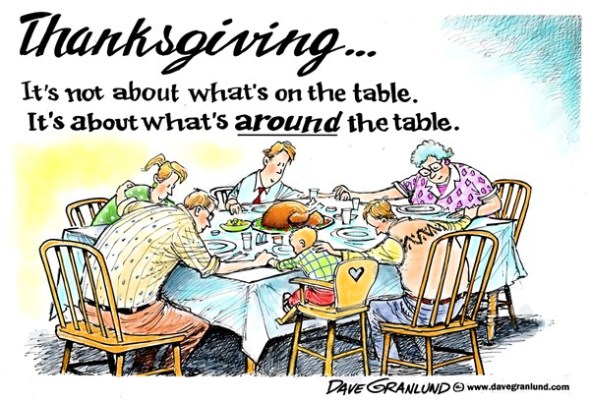
by Dave Grandlund
http://www.cagle.com/2013/11/thanksgiving-priority/
Thanksgiving Day Reads
Posted: November 22, 2012 Filed under: morning reads | Tags: COE, harvest day, Thanksgiving, women bishops 24 Comments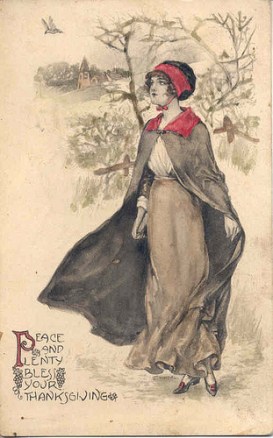
Good Morning!
I was really surprised when I moved to Louisiana and found out that Memorial Day was a Yankee Holiday. The state of Mississippi tends to ignore it completely. The first national Thanksgiving day came via proclamation by President Abraham Lincoln during the Civil War in 1863. Also, the Pilgrims were New Englanders so it seems to me if ever there were a “Yankee” holiday, it would be Thanksgiving.
I do therefore invite my fellow citizens in every part of the United States, and also those who are at sea and those who are sojourning in foreign lands, to set apart and observe the last Thursday of November next, as a day of Thanksgiving and Praise to our beneficent Father who dwelleth in the Heavens. And I recommend to them that while offering up the ascriptions justly due to Him for such singular deliverances and blessings, they do also, with humble penitence for our national perverseness and disobedience, commend to his tender care all those who have become widows, orphans, mourners or sufferers in the lamentable civil strife in which we are unavoidably engaged, and fervently implore the interposition of the Almighty Hand to heal the wounds of the nation and to restore it as soon as may be consistent with the Divine purposes to the full enjoyment of peace, harmony, tranquility and Union.
This would have appalled his predecessor Thomas Jefferson who spoke these words in his 1805 inaugural address.
In matters of religion, I have considered that its free exercise is placed by the Constitution independent of the power of the General Government. I have, therefore, undertaken on no occasion to prescribe the religious exercises suited to it; but have left them as the Constitution found them, under the direction and discipline of State or Church authorities acknowledged by the several religious societies.
One of my favorite memories surrounding Thanksgiving was the report card that came home with Doctor Daughter in Kindergarten. It seems I had neglected my duties of describing the mythical pilgrim/native american feastday that now pervades our celebration. The teacher was confused about Jean’s thoughts on Thanksgiving. The kids were asked to describe what Thanksgiving means and my darling little 5 year old talked about our end of November trip to the cabin up in Estes Park and that we always play card games and hope for snow so we can go skiing!!! We never had TV there so there was even a day of peace and quiet from football games. We usually got snowed in too so there was just a lot of game playing and cooking while looking down the mountain to the valley below.
In the 19th century, the modern Thanksgiving holiday started to take shape. In 1846, Sarah Josepha Hale, editor of a magazine called Godley’s Lady’s Book, campaigned for an annual national thanksgiving holiday after a passage about the harvest gathering of 1621 was discovered and incorrectly labeled as the first Thanksgiving.
It wasn’t until 1863, when President Abraham Lincoln declared two national Thanksgivings; one in August to commemorate the Battle of Gettysburg and the other in November to give thanks for “general blessings.”
So, like many other things that we do in modern America, the truth about the holiday is quite different. It seems that the Victorians and post World War 2 Americans defined the traditions that we think about as being with us much longer. Here’s a take on thanksgiving by Robert Jensen who reminds us how we’ve treated Native Americans since that first shared harvest.
One indication of moral progress in the United States would be the replacement of Thanksgiving Day and its self-indulgent family feasting with a National Day of Atonement accompanied by a self-reflective collective fasting.
In fact, indigenous people have offered such a model; since 1970 they have marked the fourth Thursday of November as a Day of Mourning in a spiritual/political ceremony on Coles Hill overlooking Plymouth Rock, Massachusetts, one of the early sites of the European invasion of the Americas.
Not only is the thought of such a change in this white-supremacist holiday impossible to imagine, but the very mention of the idea sends most Americans into apoplectic fits — which speaks volumes about our historical hypocrisy and its relation to the contemporary politics of empire in the United States.
That the world’s great powers achieved “greatness” through criminal brutality on a grand scale is not news, of course. That those same societies are reluctant to highlight this history of barbarism also is predictable.
I find it odd that Jensen did not take the time to read the Lincoln proclamation with its call for prayer “with humble penitence for our national perverseness and disobedience”. SO much, for American exceptionalism. Isn’t it interesting to look at things beyond the propaganda of those who benefit from pushing the consumerist aspects of national holidays and warping them into something unintended?
Let’s take a look at a few more things today.
The head of the Church of England is the Queen Elizabeth II. This makes this crisis in the COE created by the laity of the church all the odder. Bishops and clerics approved the change.
In a sign of deepening crisis in the Church of England after it rejected the appointment of women as bishops, its spiritual leader said Wednesday that the church had “undoubtedly lost a measure of credibility” and had a “lot of explaining to do” to people who found its deliberations opaque.
The archbishop of Canterbury, the Most Rev. Rowan Williams, was speaking after an emergency meeting of bishops called to debate Tuesday’s narrow balloting by its General Synod rejecting the ordination of women as bishops, even though female priests account for one-third of the Church of England’s clergy members.
Female priests hold senior positions like canon and archdeacon, and some had been hoping to secure appointments as bishops by 2014 if the change had been approved.
The vote represented a direct rebuff to Archbishop Williams’s reformist efforts during his 10 years as head of the church and a huge setback to a campaign for change that has been debated intensely and often bitterly for the past decade.
More than 70 percent of the 446 synod votes on Tuesday were in favor of opening the church’s episcopacy to women. But the synod’s voting procedures require a two-thirds majority in each of its three “houses”: bishops, clergy and laity. The bishops approved the change by 44 to 3, and the clergy by 148 to 45. The vote among the laity, though, was 132 to 74, six votes fewer than the two-thirds needed.
The Church of England is the so-called established church, meaning that it is recognized by law as representing the official religion, enjoys special privileges and is supported by the civil authorities.
Whacky old Pat Robertson is trying to explain how he got his conversation with gawd so terribly wrong a few weeks ago. How many gullible people can dance on the head of a pin?
Today, responding to a question from a viewer who wondered why her business is struggling since she thought God told her it would be successful, Robertson admitted that he sometimes misses God’s message. “So many of us miss God, I won’t get into great detail about elections but I sure did miss it, I thought I heard from God, I thought I had heard clearly from God, what happened?” Robertson replied, “You ask God, how did I miss it? Well, we all do and I have a lot of practice.”
SOS Hillary Clinton and the Egyptian foreign minister brokered a ceasefire between Hamas and Israel in Gaza.
Hillary Clinton, US secretary of state
“The US welcomes the agreement today for a ceasefire in Gaza – for it to hold the rocket attacks must end and a broader calm must return. The people of this region deserve the chance to live free of fear and violence.”

The cease-fire took effect yesterday.
Under intense Egyptian and American pressure, Israel and the Palestinian militant group Hamas halted eight days of bloody conflict on Wednesday, averting a full-scale Israeli ground invasion of the Gaza Strip without resolving the underlying disputes.
With Israeli forces still massed on the Gaza border, a tentative calm descended after the announcement of the agreement. The success of the truce will be an early test of how Egypt’s new Islamist government might influence the most intractable conflict in the Middle East.
The United States, Israel and Hamas all praised Egypt’s role in brokering the cease-fire as the antagonists pulled back from violence that had killed more than 150 Palestinians and five Israelis over the past week. The deal called for a 24-hour cooling-off period to be followed by talks aimed at resolving at least some of the longstanding grievances between the two sides.
Let’s all enjoy the things and people we have in our lives today but not forget that perversity still exists in the world.
What’s on your reading and blogging list today?
Thanksgiving Day Reads
Posted: November 24, 2011 Filed under: morning reads | Tags: Morning reads, Thanksgiving 16 Comments
Happy Thanksgiving!! I’m going to devote this Thursday post to Thanksgiving-oriented material. Feel free to talk about whatever you want in the comments.
Here’s a little background on the origins of the Thanksgiving feast from Wikipedia:
Thanksgiving in North America had originated from a mix of European and Native traditions.[1] Typically in Europe, festivals were held before and after the harvest cycles to give thanks for a good harvest, and to rejoice together after much hard work with the rest of the community.[1] At the time, Native Americans had also celebrated the end of a harvest season.[1] When Europeans first arrived to the Americas, they brought with them their own harvest festival traditions from Europe, celebrating their safe voyage, peace and good harvest….
In the United States, the modern Thanksgiving holiday tradition traces its origins to a 1621 celebration at Plymouth in present-day Massachusetts. There is also evidence for an earlier celebration on the continent by Spanish explorers in Texas at San Elizario in 1598, as well as thanksgiving feasts in the Virginia Colony. The initial thanksgiving observance at Virginia in 1619 was prompted by the colonists’ leaders on the anniversary of the settlement. The 1621 Plymouth feast and thanksgiving was prompted by a good harvest. In later years, the tradition was continued by civil leaders such as Governor Bradford who planned a thanksgiving celebration and fast in 1623. While initially, the Plymouth colony did not have enough food to feed half of the 102 colonists, the Wampanoag Native Americans helped the Pilgrims by providing seeds and teaching them to fish. The practice of holding an annual harvest festival like this did not become a regular affair in New England until the late 1660s
I don’t really know how accurate that is. The Christian Science monitor has listed five myths about Thanksgiving that they believe will surprise people. Number three on the list was news to me:
3. Pilgrims dressed in all black and wore buckles
Not so fast. This modern-day likeness of the first American Pilgrims was conjured sometime in the 19th century, when the popular image of Pilgrims was formed – but it’s mostly false. The garb of the Pilgrims was actually brightly colored and buckle-free.
Pilgrim women normally dressed in red, earth green, brown, blue, violet, and gray, and the men wore white, beige, black, earth green, and brown clothing. Buckles were not commonly worn until much later in the 17th century, and black and white clothing was typically only worn on Sundays and when observing formal occasions.
So why give the Pilgrims this now-iconic appearance?
Former Plimoth (yep, we double-checked the spelling) Plantation historian James W. Baker writes that, in the 19th century, buckles were assigned to Pilgrims because they served as an emblem of quaintness, which is the same reason illustrators gave Santa Claus buckles. Also associated with Pilgrims – the blunderbuss, a muzzle-loading firearm with a stout caliber barrel – was so designated because of its old-fashioned, unthreatening look. But the Pilgrims probably didn’t use that either.
According to The Boston Globe the Thanksgiving travel rush was going full tilt yesterday.
Undeterred by costlier gas and airfare, millions of Americans set out Wednesday to see friends and family in what is expected to be the nation’s busiest Thanksgiving weekend since the financial meltdown more than three years ago….
About 42.5 million people are expected to hit the road or take to the skies for Thanksgiving this year, according to travel tracker AAA. That’s the highest number since the start of the recession at the end of 2007.
Heavy rain slowed down early travelers along the East Coast. Snow across parts of New England and upstate New York made for treacherous driving and thousands of power outages. And a mudslide covered train tracks in the Pacific Northwest. But most of the country is expected to have clear weather Thursday.
Quite frankly, some of my happiest Thanksgiving days have been spent alone. I find holidays somewhat stressful, and besides I have kind of a crazy family. This year I’m going to spend the day with my brother’s family at the home of some of their friends. I’m pretty sure everyone will be nice, but if not I can always excuse myself early. Here’s an article from Time for people with big crazy families like mine: 5 Ways to Keep Your Family From Ruining Thanksgiving. Here’s my favorite (Number 5):
The key to maintaining your calm is to send yourself the right mental messages. That means practicing mindful awareness, loving kindness and compassionate self-talk. Sound like new age psychobabble? The truth is, you’re already sending yourself messages all the time. “You’re telling yourself throughout the day what you’re bothered by and disappointed in….It’s worse at holiday time when your expectation of what you thought your life was going to look like is most acute.”
I found two writers (probably both conservatives) who claimed that the lesson of the first Thanksgiving is that capitalism trumps socialism.
From Tom Arneberg at the Chippewa Herald:
When they first started the colony, their overseas investors forced them to share all their property together. According to Bradford, “all profits and benefits that are got by trade, working, fishing, or any other means” were to be shared, and that “all such persons as are of this colony are to have their meat, drink, apparel, and all provisions out of the common stock.”
In other words, put into the common stock all you can, and take out only what you need. “To each according to his need; from each according to his ability.” Sound familiar?
Communism may be okay for a small group like a family or a Boy Scout patrol, but it doesn’t scale very well for larger groups.
According to Arneson “communism” made the pilgrims lazy and selfish so William Bradford, the governor of Plimouth, decided to try “free market capitalism.”
Bradford and the colony elders divided up the property among the families. Whatever produce a family did not use for themselves, they were free to trade away with others for something else they wanted.
It was an astonishing success — the harvests of 1623 and beyond provided a bounty of excess food, not just for a single Thanksgiving meal as in the previous two years, but enough to last the winter….
Once the creative powers of individual rewards were unleashed, where every person was allowed to keep the fruits of his own labor for his own family or for trade, everything was different.
And from Dr. Milton R. Wolf at the Washington Times:
The Plymouth colonists were socialists before socialism was cool. They entered into a contract with one another and a finance company called Merchant Adventurers to create an egalitarian commune in which their wealth, food in particular, would be collectively stored and redistributed equally among members. This was the forebear of the modern-day American counterculture collectivist commune or even Israel’s more mainstream kibbutz, which survive on government subsidies. Equality is put before freedom or even productivity.
And so on…with even more right-wing propaganda included than in the article by Arneberg. I guess the first Thanksgiving was about sharing, but a couple of years later the pilgrims learned that greed is good. Incidentally, the author’s bio at the end of the article says the Wolf is Barack Obama’s cousin. Is this meme the latest White House effort to push austerity?
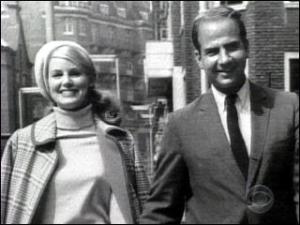
Calvin Trillin and his wife Alice in 1965
Since we were talking about mac and cheese on Thanksgiving last night, I thought I’d share my favorite alternative Thanksgiving story. For many years, humorist Calvin Trillin has led a campaign to change the official Thanksgiving dish from turkey to spaghetti carbonara. I located Trillin’s piece about it on-line, and since it was copied from Trillin’s book Third Helpings, I figured it would be OK for me to copy it too.
I have been campaigning to have the national Thanksgiving dish changed from turkey to spaghetti carbonara.
It does not take much historical research to uncover the fact that nobody knows if the Pilgrims really ate turkey at the first Thanksgiving dinner. The only thing we know for sure about what the Pilgrims ate is that it couldn’t have tasted very good. Even today, well brought-up English girls are taught by their mothers to boil all veggies for at least a month and a half, just in case one of the dinner guests turns up without his teeth… (It is certainly unfair to say that the English lack both a cuisine and a sense of humor: their cooking is a joke in itself.)
It would also not require much digging to discover that Christopher Columbus, the man who may have brought linguine with clam sauce to this continent, was from Genoa, and obviously would have sooner acknowledged that the world was shaped like an isosceles triangle than to have eaten the sort of things that the English Puritans ate. Righting an ancient wrong against Columbus, a great man who certainly did not come all this way only to have a city in Ohio named after him, would be a serious historical contribution. Also, I happen to love spaghetti carbonara.
[In our family]…Thanksgiving has often been celebrated away from home. It was at other people’s Thanksgiving tables that I first began to articulate my spaghetti carbonara campaign–although, since we were usually served turkey, I naturally did not mention that the campaign had been inspired partly by my belief that turkey is basically something college dormitories use to punish students for hanging around on Sunday… I reminded everyone how refreshing it would be to hear sports announcers call some annual tussle the Spaghetti Carbonara Day Classic.
I even had a ready answer to the occasional turkey fancier at those meals who insist that spaghetti carbonara was almost certainly not what our forebears ate at the first Thanksgiving dinner. As it happens, one of the things I give thanks for every year is that those people in the Plymouth Colony were not my forebears. Who wants forebears who put people in the stocks for playing the harpsichord on the Sabbath or having an innocent little game of pinch and giggle?
Finally there came a year when nobody invited us to Thanksgiving dinner. Alice’s theory was that the word had got around town that I always made a pest out of myself berating the hostess for serving turkey instead of spaghetti carbonara…
However it came about, I was delighted at the opportunity we had been given to practice what I had been preaching–to sit down to a Thanksgiving dinner of spaghetti carbonara.
Naturally, the entire family went over to Rafetto’s pasta store on Houston Street to see the spaghetti cut. I got the cheese at Joe’s dairy, on Sullivan, a place that would have made Columbus feel right at home–there are plenty of Genoese on Sullivan; no Pilgrims–and then headed for the pork store on Carmine Street for the bacon and ham. Alice made the spaghetti carbonara. It was perfection. I love spaghetti carbonara. Then I began to tell the children the story of the first Thanksgiving:
In England, along time ago, there were people called Pilgrims who were very strict about making everyone observe the Sabbath and cooked food without any flavor and that sort of thing, and they decided to go to America, where they could enjoy Freedom to Nag. The other people in England said, “Glad to see the back of them.” In America, the Pilgrims tried farming, but they couldn’t get much done because they were always putting their best farmers in the stocks for crimes like Suspicion of Cheerfulness. The Indians took pity on the Pilgrims and helped them with their farming, even though the Indians thought that the Pilgrims were about as much fun as teenage circumcision. The Pilgrims were so grateful that at the end of their first year in America they invited the Indians over for a Thanksgiving meal. The Indians, having had some experience with Pilgrim cuisine during the year, took the precaution of taking along one dish of their own. They brought a dish that their ancestors had learned from none other than Christopher Columbus, who was known to the Indians as “the big Italian fellow.” The dish was spaghetti carbonara–made with pancetta bacon and fontina and the best imported prosciutto. The Pilgrims hated it. They said it was “heretically tasty” and “the work of the devil” and “the sort of thing foreigners eat.” The Indians were so disgusted that on the way back to their village after dinner one of them made a remark about the Pilgrims that was repeated down through the years and unfortunately caused confusion among historians about the first Thanksgiving meal. He said,
“What a bunch of turkeys!”
Alice Trillin died on September 11, 2001.
Here’s a recipe for spaghetti carbonara:
1 pound spaghetti Ask the
hotline about
this ingredient!
1/2 pound pancetta (sliced 1/4 “ thick at the deli, and cut into lardons)
4 large eggs (locally raised and cage-free if possible)
1 tablespoon garlic, finely chopped
this ingredient!
1 cup Pecorino Romano cheese, freshly grated
2 tablespoons extra virgin olive oil
2 tablespoons finely minced fresh parsley
Freshly ground black pepper
Freshly grated parmesan reggiano to pass at the tablePut salted water on the boil for the pasta, grate the romano cheese and set aside, finely mince the fresh parsley and reserve.
In a very large skillet, saute the pancetta lardons in the olive oil over medium heat until the bacon has rendered much of its fat. You don’t want to cook the pancetta to the point of being crisp, it is better with a little fatty “chew” still left in it. Just before the pancetta is done, add the minced garlic to the pan and allow to cook until the garlic is golden brown. Set the pan aside to cool. (Allowing the pan to cool some at this point is important, because if the pan is too hot when you add the eggs later, they will immediately scramble, and not gently cook into the creamy sauce that is your ultimate goal.
Break the eggs into a medium sized bowl and whisk them till smooth. Add the grated cheese to the eggs and keep handy.
Cook the pasta to the maker’s instructions for “al dente”, and as soon as it is done, quickly strain it and toss it into the skillet with the pancetta, reserving a cup of the pasta cooking water to thin your sauce later if needed. Add the cheese and egg mixture to the pasta along with the parsley, and toss to coat. The heat from the pasta will gently cook the eggs, and melt the cheese into a luxuriously rich and smooth sauce. If the sauce is too thick for your liking, add some of the reserved pasta cooking water to loosen it.
To serve, place the pasta into warmed bowls, top liberally with freshly ground black pepper, and sprinkle with some freshly grated parmesan.
I hope everyone has a wonderful day and lots to be grateful for!

 peej
peej Carissa
 bostonboomer
 dakinikat
 ecocatwoman
 mablue2
 Mama Lopez
 peggysue22
 quixote
 skydancingguestblogger
 Mona (aka Wonk the Vote)



 Sky Dancing
Recent Comments