I actually watched quite a bit of Trump’s “state of the union” speech last night. As expected, it was horrific. He told lie after insane lie, and actually did not report on the state of the union.
He did begin the “speech” by claiming “America is back.” Back to what? I guess we’re back to where we were at the end of his last term as “president”–with Americans dying unnecessarily, the economy going down the tubes, and Americans living in fear about what he might do next. Except it’s even worse now. At least in his last term, he didn’t have a secret police force going around the country attacking and even killing people.
Trump didn’t offer a legislative agenda. He claimed he had designed a health plan in which he would give Americans money and they could use it to find their own health care. He also claimed he had lowered the cost of drugs with his website TrumpRX. He treated these as faits accompli with no need for legislation. He did push for passage of the SAVE act, as his plan for stealing the midterms.
Trump spent most of the “speech” introducing people in the audience, and in one section he sounded like a true crime podcaster, describing ghastly murders committed by undocumented immigrants. After each bloody story, he had the mothers of the victims stand up to be recognized. Much of the “speech” seemed designed to get his fans to hate immigrants more than they already do.
At one point, Trump spoke directly to Democrats, telling them they should be ashamed for not standing and applauding him.
He bragged about the economy, and especially his tariffs, which he claimed have been a huge success. Of course he attacked the Supreme Court for trying to explain to him that tariffs are a tax and must be passed by Congress, not imposed by the “president.” He actually said that maybe tariffs could replace the income tax! So maybe he does know that tariffs are a tax that puts the heaviest burden on the poorest Americans.
Most of all, the “speech” was incredibly boring. It was also overwhelmingly negative, even though he bragged about his imaginary achievements. He made our country sound like a hellhole. Oh, and guess what? He never once mentioned the Epstein files.
an image of Trump's discolored hand during his State of the Union speech(Win McNamee/Getty)
The longest State of the Union in modern history is now over. Donald Trump held court in the House of Representatives and said little of substance, but substance wasn’t the point. This year, he intended to put on a show, with an array of guest stars and special appearances. He was happy because he was playing the roles he clearly loves: game-show host, ringmaster, emcee, beneficent granter of wishes—and, where the Democrats were concerned, a self-righteous inquisitor.
Trump did his usual rote lying about the economy—pity the fact-checkers who tried to keep up even in the first 10 minutes or so of the speech—along with some of his other greatest hits, including the many wars he stopped and the magic of tariffs. (He referred to the “unfortunate involvement” of the Supreme Court on the tariff issue, as if the justices had barged into his office like interlopers.) [….]
Tonight, however, was not about communication—it was about showmanship. Almost every line was a cue for applause from obedient Republicans; they even gave Jared Kushner a standing ovation. Every few minutes, Trump told a story and reached out into the audience like the host of The Price Is Right, telling people to come on down.
He started, of course, with the U.S. men’s Olympic hockey team. Just basking along with Team USA wasn’t enough. Trump soon announced that the goalie Connor Hellebuyck would receive the Presidential Medal of Freedom. Normally, this honor is bestowed for a lifetime of achievement, but this time it was given as if the young athlete had chosen the right door and found a new car.
And so it went, all night. Sometimes, the guests were meant to tug at the heartstrings, such as when Trump recognized Erika Kirk, the wife of the murdered activist Charlie Kirk. Others were presented as ornaments meant to illustrate Trump’s successes: Enrique Márquez, a Venezuelan political prisoner freed after U.S. forces deposed the strongman Nicolás Maduro, was given a round of well-deserved applause. Trump also gave a shout-out to a woman whose IVF medications were now, he claimed, cheaper because of him.
But no group received more attention than the U.S. military. Trump handed out two Purple Hearts (one posthumously), a Legion of Merit, and not one but two Congressional Medals of Honor. Military awards that should have been treated with dignity and respect were placed on men like prizes, including a moment when Trump’s co-host, the first lady, put one of the Medals of Honor around the neck of a 100-year-old fighter pilot.
Trump even had designated heels in the audience: the Democrats. He called them crazy and accused them of impoverishing the nation. He dared them to stand up if they agreed with him that “the first duty of the American government is to protect American citizens, not illegal aliens.” This stunt was obviously meant to force Democrats either to stand or boo or otherwise do something that Trump could exploit; instead, it merely resulted in several awkward seconds of a staring contest between the president and the Democrats in the chamber. Trump managed to bait Representative Ilhan Omar into shouting at him, but for the most part, he seemed genuinely irritated that the Democrats sat through his show in stony silence.
As the whole business dragged on, the atmosphere started to seem less like a game show and more like the late-night Jerry Lewis telethons of the 1970s, in which a tired but pumped Lewis alternately griped at the audience, broke into maudlin emotion, or jumped up to welcome a new guest. The only thing Trump did not do was explain his policies—especially about war and peace—to Congress or the American people.
President Trump addressed a joint session of Congress on Tuesday night, celebrating his record on immigration and the economy. “We’re winning so much,” he said. “Inflation is plummeting, incomes are rising fast. … America is respected again.” Here’s what our writers thought of his speech. [I’m just giving you a sampling–you can read more opinions with the gift link.]
The best moment:
Jamelle Bouie The single best moment was when this long, exhausted and repetitive speech finally ended. It was then that I felt true relief.
Michelle Cottle The appearance of the men’s Olympic hockey team. The young guys playing to the crowd and showing off their medals were adorable. Here was an appropriate moment for those “U.S.A.” chants. So wholesome.
Michelle Goldberg The moment when, after setting a record for the longest State of the Union in recorded history, it finally ended…..
Matthew Schmitz Democrats are feeling emboldened on immigration amid Trump’s controversial enforcement push. But Trump effectively invoked what is still one of his strongest issues, while drawing a contrast with Democrats: “The first duty of the American government is to protect American citizens, not illegal aliens.” Many Americans agree.
Worst Moment
Appelbaum It was a tedious, tiresome performance. For much of the night, the president seemed to be boring everyone, perhaps most of all himself. Even his efforts to bait Democrats felt well-worn, familiar and strikingly devoid of real heat on either side.
Barro The “everything is terrible in America” section — which lasted roughly from minute 30 through 75 of this interminable and plodding address — significantly undermined the “everything is wonderful in Trump’s America” messaging that preceded it.
Bouie There are just too many bad moments to choose from. Was the worst one of the many instances where he gave lurid descriptions of pain and suffering? Was it when he began to hand out awards like reality television prizes? Or was it when he tried to write Democrats out of the political community? If I have to choose, I’d say the braying racism against Somali Americans — it would not have been out of place in a D.W. Griffith film.
Cottle So many options. The xenophobia. The scaremongering. The lying. The name-calling. The pettiness. But I’ll go with his ongoing mission to destroy faith in the electoral process. “Cheating is rampant.” The Dems “want to cheat. They have cheated.” It’s the “only way they can get elected.” Heavy sigh.
There were only about half a dozen specific things Trump asked Congress to do:
— “Codify” Trump’s attempts to lower drug prices, though it’s unclear how.
— Pass the “Stop Insider Trading Act” that would restrict the Wall Street trading of members of Congress and their spouses.
— Pass what Trump is calling the “Delilah Law” that would ban commercial licenses for immigrants in the country without legal status.
— Restore funding for the Department of Homeland Security. After the killing of the two Americans in Minnesota, Democrats refused to authorize new funding for DHS, leading to a partial government shutdown.
— Pass the SAVE America Act, which would require proof of citizenship to vote. Proven instances of fraud, including by noncitizens, are very rare, but Trump claims there is “rampant” cheating. It’s something he has used to justify his 2020 election loss, and it’s a claim he could use to cast doubt on this year’s outcome — if Republicans lose.
While those are certainly consequential, they don’t add up to a major legislative push. That’s not surprising, though, since Trump has spent the better part of the last year trying to consolidate power in the White House.
Mike Johnson: "If we lost the midterms — heaven forbid, if we lost the majority in the House — it would be the end of the Trump presidency in a real effect."
It is one of Donald Trump’s unique talents that he reveals the absurd obsolescence of long-held traditions. In presidential election years, his screaming bloviations on stage make the exercise of gathering the candidates together seem futile. In power, when he divorces facts from policymaking and relies instead on myth and grift to guide his decisions, he renders useless and impotent vast fields of expertise.
When he lies in public, and insists that his fantasies and distortions will dictate the course of government action, he makes those of us in the news business wonder if there’s any point, any more, in gathering and printing the truth.
Likewise, many Americans who watched the State of the Union address on Tuesday night might have wondered what the point of these speeches is any more. The constitution mandates that the president provide periodic updates to Congress on the condition of the country.
But nowhere does the constitution call for the kind of in-person, televised address that has become an annual staple of the presidency in the era of mass media. And certainly none of the Framers could have pictured the speech that Trump delivered on Tuesday night: a rambling, nearly two-hour address that was heavy on falsehoods, ad libs, and digressions that sometimes seemed like bids to kill time – and remarkably light on policy substance.
Throughout the speech, Trump seemed tired. He had difficulty reading from his teleprompter; he gripped the podium with a tightness bordering on desperation, and towards the end of the broadcast, his voice became audibly raspy. He was showing his age. The speechwriters, too, seem to have been exhausted.
The address touched on Trump’s typical themes: the supposed criminality and inferiority of immigrants; the mendaciousness of his opponents; his personal virtues and resentments. But the president offered very few new policy ideas, contradicted himself on crucial issues, misrepresented pertinent facts and substantively addressed few of what polls reveal to be the nation’s most pressing concerns.
A bit more:
He stopped frequently to address veterans in the crowd and to issue them medals as stunts for the television broadcast; he offered a long and strange digression about the gold medal Olympic match recently won by the US men’s hockey team, many of whom paraded into the House chambers wearing their medals. A decade ago, Trump crystallized a longstanding trend in American politics by avowedly fusing governance and entertainment. But Tuesday’s long-winded and boring spectacle showed that he has lost even the ability to entertain.
He has not, of course, lost the ability to offend. Trump lied, saying that he has brought healthcare costs down at a moment when his attacks on Affordable Care Act subsidies have in fact massively increased the premiums paid by many Americans in just the past two months. He made a non-sequitur tangent to attack the rights of trans kids; he claimed, with a kind of vulgar brazenness, that his kidnapping of the Venezuelan leader Nicolás Maduro, and his administration’s subsequent economic blackmail of that country, was creating new opportunities for the Venezuelan people.
He claimed that Democrats’ withholding of funding for the Department of Homeland Security over abusive immigration enforcement was causing fallout for areas effected by this week’s east coast blizzard, as the DHS was unable to help clear snow. (The federal agency does not do this.) Even his filler lines reeked with the stench of hypocrisy. “We are building a nation,” he said, “where every child has a chance to build higher and go further.” It was a sentiment that called to mind Liam Conejo Ramos, and all the other children imprisoned in ICE’s concentration camps, whose education, promise, dreams and freedom have been sacrificed to the administration’s racism.
There’s more at the Guardian link.
Trump talked for nearly two hours, gave out medals, praised sports teams, lied constantly, made zero new policy proposals, suggested we are about to bomb another country again, and got standing ovations from Republicans after every line. Nothing new for average working Americans.
He wanted to give the king’s speech. Donald Trump entered the US House chamber on Tuesday like a medieval monarch, with Republicans lined up eager to touch his royal robes (or, in two cases, grab a selfie with him). But within moments, the illusion was shattered.
As the US president strolled by, soaking up adulation, the Democratic representative Al Green of Texas held aloft a handwritten sign: “Black people aren’t apes!” – a reference to Trump recently sharing a racist video depiction of Barack and Michelle Obama.
When the first State of the Union address of Trump’s second term got under way, Republicans moved in on Green menacingly and tried to tear the sign away. But he persisted until being escorted out for the second year in a row. As he departed, there were more acrimonious exchanges with Republicans, a few of whom tried to start a chant of “USA! USA!”
It was the first but not the last time that a person of color would take a stand during the wannabe autocrat’s record 107-minute speech while others remained silent or raucously egged him on. It was a night where Trump again sought to poison US politics and divide Americans along various fault lines, none more inflammatory than race.
The great salesman, sporting his familiar red tie and orange hue, began with a predictable pitch: “Our nation is back – bigger, better, richer and stronger than ever before.” In his telling, inflation, mortgage rates and gas prices are falling, while the stock market, oil production and foreign direct investment are booming along with construction and factory jobs.
Luckily for Trump’s speechwriter, the US men’s hockey team won Olympic gold two days earlier. The reality TV president hailed them in the press gallery, prompting applause and roars from both Democrats and Republicans. But while Republicans chanted “USA! USA!” with gusto, barely any Democrats did.
“We’re winning so much that we really don’t know what to do about it,” Trump declared. While he didn’t mention his gilded ballroom, it was still a Pollyannish version of America that will not be recognized by people struggling to pay bills and make ends meet. Trump is not the man to offer: “I feel your pain.”
Read the rest at The Guardian.
I don’t know if you remember Marcelo Gomez? He is Massachusetts teenager who was arrested by ICE on his way to volleyball practice. He was invited to the SOTU, but had to leave in fear of ICE.
Marcelo Gomes da Silva, a Milford teen who was arrested by ICE last May, went to the State of the Union as a guest of Representative Seth Moulton. He left early after a Department of Homeland Security tweet singled him out by name. trib.al/z40q0Yo
From the visitor’s gallery, Marcelo Gomes da Silva looked down at the House floor, attentively watching President Trump deliver his State of the Union speech. A guest of Representative Seth Moulton, the 19-year-old from Milford was overjoyed to be sharing a room with the nation’s most powerful politicians.
“I truly hope that one day I’ll be here and I’ll be a representative, and then hopefully a senator, as well. That’s the dream,” he said.
Wearing a light gray suit, Gomes looked worlds apart from the day he met Moulton for the first time last June, outside of the ICE holding facility in Burlington wherehe had spent six days detained in volleyball shorts and crocs.
This week, in Washington for the first time, he met with other members of Congress and talked about his experience in detention and his desire to end ICE operations that target people who, like him, don’t have a criminal record.
As he watched the speech, the teen looked for Moulton on the House floor but couldn’t find him among the sea of politicians; he was impressed by Representative Al Green’s protest of a racist video posted on Trump’s social media account recently portraying the Obamas as apes; he didn’t agree with Trump’s statement about low inflation; and he felt dehumanized by being called an “illegal alien.” Still, he planned to stay and listen to the entire address.
Soon after standing up to applaud the US men’s hockey team, who Trump honored during the speech, Gomes was escorted out of the chamber by Moulton’s chief of staff Neesha Suarez.
Suarez and other congressional staff had seen an online post by the Department of Homeland Security, calling out Democrats who brought immigrants as guests to the State of the Union, singling out Moulton and Gomes by name.
“Today, some Democrats in Congress are planning to bring illegal aliens as guests to the State of the Union. Once again, they are putting illegal aliens above the safety of American citizens,” DHS officials wrote. Gomes “is an illegal alien who has no right to be in our nation. We are committed to enforcing the law and fighting for the arrest, detention, and removal of aliens like him.”
DHS officials also named two other guests, invited by Senator Chuck Schumer of New York and Senator John Hickenlooper of Colorado.
Disgusting.
This article was published before the SOTU, but I’m including it because of Trump’s disrespect for the women’s gold medal winning hockey team.
NEWS: The gold medal–winning U.S. Women’s Hockey Team has declined an invitation to attend Trump’s State of the Union.This comes after Trump was heard telling the men’s team he’d begrudgingly invite the women’s champions or risk impeachment.
The issue isn’t with a president getting on the phone to congratulate an Olympic gold-medal-winning team. America’s men’s hockey players deserve every syllable of celebration a proud and grateful nation has to give them.
The issue is with a president who got on the phone to congratulate only one of our nation’s two gold-medal-winning hockey teams, and then using part of that telephone call to casually dismiss Team USA’s women, who also won gold in Milan with an overtime goal against Canada.
Amid the beer-chugging, bro-hugging antics inside the men’s celebratory locker room Sunday, it was extra partier Kash Patel, the director of the FBI, who put the president on speaker phone with the victorious players. Part of the conversation was an open invitation from President Donald Trump for the team to visit the White House, and specifically to attend Tuesday night’s State of the Union address. It came with a condition, however.
“I must tell you, we’re going to have to bring the women’s team. You do know that?” the president said.
He was laughing, and as he was, players could be heard laughing, too. It continued as Trump joked he’d “probably be impeached” if he didn’t include the women’s team.
To him, those women were a punch line.
To me, they are American heroes.
Now more than ever. The women politely declined the chance to be afterthoughts at someone else’s party. Officially, a spokesperson for the team said it couldn’t accept “due to the timing and previously scheduled academic and professional commitments following the Games.” The statement made sure to insist, “We are sincerely grateful for the invitation extended to our gold-medal-winning US women’s hockey team and deeply appreciate the recognition of their extraordinary achievement.”
If only that recognition felt more sincere. Instead, the perfect storm of sports forces combined to remind us just how far the fight for respect of women’s sports still has to go, and how much simmering sexism continues to bubble under the surface.
Those are my recommended reads for today. Thoughts?
Did you like this post? Please share it with your friends:
Yesterday was quite a day. The Supreme Court actually decided against Trump’s insane tariffs instead of bowing down once again to the man who thinks he’s a king. Predictably, Trump threw a gigantic tantrum and then decided to more or less ignore the SCOTUS decision.
At a hastily called press conference, an agitated Trump railed against the conservative [John] Roberts and two of the courts other conservatives, Justices Neil Gorsuch and Amy Coney Barrett, both Trump appointees.
“They’re just being fools and lapdogs for the RINOs and the radical left Democrats,” Trump said, using the apparently derisive acronym for “Republicans in name only.”
And that was hardly all. Trump called the three conservatives “disloyal, unpatriotic,” and at one point he launched into a rant about how the court should have invalidated the election results in 2020, which Trump lost to Joe Biden….
Writing for a hefty 6-to-3 majority, Chief Justice Roberts said that the nation’s founders deliberately and explicitly placed the power to impose taxes, including tariffs, with Congress, not with the president.
As the Chief Justice put it, “Having just fought a revolution motivated in large part by taxes imposed on them” by the King of England without their consent, the Framers wrote a Constitution that gives Congress the taxing power because the members of the legislature would be more accountable to the people.
Nonetheless Trump asserted at his press conference that he will go ahead with his tariffs, using alternative statutes that allow him to act without the consent of Congress.
A bit more:
There are, in fact, several statutes that allow him to impose some tariffs on his own, but they are limited. For example, one of the key statutes he cited Friday does allow him to impose certain tariffs on his own, but only for six months, and after that he must get approval from Congress. The other statutes he cited have other provisions that make it far more difficult to act unilaterally.
The other problem that Trump faces is that the billions of dollars already collected in tariffs were supposed to offset the tax cuts that the Republican-dominated Congress adopted last year at Trump’s behest. Now, however, the money isn’t there.
The federal government has been collecting about $30 billion a month in tariffs, about half of which will be eliminated by Friday’s court ruling. So it’s a big deal for U.S. businesses that have been paying the lion’s share of these tariffs. That said, tariffs are still a fairly small slice of overall government revenues; about 5%. So if half that tariff money goes away, that will mean a larger, but not crippling federal deficit.
In contrast to the stock market’s plunge when the tariffs were first put in place, the market reaction on Friday was fairly stable. That could be because investors believe the White House will try to make good on that threat to replace the outlawed tariffs with other taxes, using different statutes where the president’s claims his authority is more clear. Even those statutes, however, have more strings attached. None give Trump the power he claimed to have to impose unlimited tariffs on goods from any country for any reason….
Unresolved by the Supreme Court’s decision was the question of whether U.S. businesses that paid the tariffs for the last year can get their money back. Chief Justice Roberts did not address how refunds might work, so a lower court will have to figure that out.
Donald Trump on Friday attacked the Supreme Court majority that ruled against him in a landmark decision on tariffs with a venom and ferocity he has never directed against America’s foreign enemies. He suggested they were disloyal to the country, under the sway of other nations. The entire performance was unhinged, an old man’s tantrum about an affront to his manhood. He called the three Republican appointed justices who voted against him “fools and lapdogs.” [….]
The president seemed to miss the entire point of the Supreme Court ruling—that the power to levy tariffs lay with the Congress—as well as the nuance in the majority opinion, such as a footnote by Chief Justice John Roberts that suggested while there were may be other ways by which he could seek to put tariffs in place, those “contain various combinations of procedural prerequisites, required agency determinations and limits on the duration, amount and scope of the tariffs they authorize.”
By Kazuaki Horitomo Kitamura
In other words, he could not behave like a king. He could no longer go around the world threatening other leaders whenever it suited him. He could no longer ignore the law, existing U.S. treaties, or the role Congress is assigned by the Constitution. He said he could—he said he didn’t need Congress to impose the new types of tariffs he mentioned during his press conference. But that was either denial or ignorance or a special Trumpian combination of both.
Because it will be very difficult for Trump to recreate the tariffs of the past year. Should he attempt to put some in place, and should he get the Congress and government agencies to work with him on this, the process is going to be more complex, require periodic renewals, and be far more limited in scope.
But watching Trump, it was clear that the thrust of his remarks had nothing to do with the letter of the law. With him, it seldom does. His feelings were hurt. Someone told him “no.” And he was going to lash out until he felt better.
The outburst was notable, then, because it revealed just how battered, exhausted, and at wits’ end the president is after weeks and weeks of similar experiences, of serial defeats and embarrassments, and of the prospect of many more such humiliations in the months ahead in a world that is finally learning how to say “no” to him.
With pressure building on him because of a soft economy, public anger at his immigration policies, fears of spiking healthcare costs for millions of Americans, the Epstein scandal and a looming massive defeat in the November midterms, Trump has returned regularly to the authoritarian playbook in the hopes that it would make him feel more powerful, less enfeebled by age, more like the kind of leader the slavering courtiers in his daily retinue say he is.
Go read more and enjoy the schadenfreude.
Naturally, reacted immediately with a new round of tariffs. He could have decided to work with Congress on rational trade policy, but he’d rather be a king.
President Donald Trump signed an executive order imposing a new “temporary” 10 percent global tariff following the Supreme Court’s decision Friday striking down many of the global tariffs he raised last year.
“It is my Great Honor to have just signed, from the Oval Office, a Global 10% Tariff on all Countries, which will be effective almost immediately. Thank you for your attention to this matter!,” Trump wrote on Truth Social.
Trump is invoking Section 122 of the Trade Act of 1974, which allows the president to impose tariffs of up to 15 percent to address a “large and serious balance-of-payments deficit,” according to a White House fact sheet. Tariffs imposed under the authority may remain in effect for no more than 150 days unless Congress passes legislation extending them….
The announcement seeks to keep many of his tariff policies intact even after the court’s ruling.
Tama the Cat, Woodblock Print by Hiroaki Takahashi, 1926
“Effective immediately, all national security tariffs under Section 232, and existing Section 301 tariffs — they’re existing, they’re there — remain in place, fully in place, and in full force and effect,” Trump told reporters at a White House press conference Friday afternoon. “Today, I will sign an order to impose a 10 percent global tariff under Section 122, over and above our normal tariffs already being charged. And we’re also initiating several Section 301, and other investigations, to protect our country from unfair trading practices of other countries and companies.”
The duties are set to take effect Feb. 24 at 12:01 a.m.
The White House fact sheet lists exemptions that are similar to the ones included with the tariffs that were invalidated Friday, carving out specific products within sectors such as energy, pharmaceuticals, autos, and aerospace, and shielding goods from North American neighbors compliant with U.S.-Mexico-Canada Agreement, a trade pact Trump signed in his first term.
Yet, it won’t allow the president the kind of flexibility he has wielded under the emergency powers law. By statute, the tariff must be “nondiscriminatory,” meaning the U.S. can’t give breaks to certain trading partners and not others.
Today, Trump decided to increase the newly announced tariffs to 15 percent.
President Trump announced Saturday that he would raise his new, global tariff to 15 percent, a day after he took steps to replicate some of the punishing duties that had been struck down by the Supreme Court.
Mr. Trump announced the change in a post on social media, and said the tariff would take effect immediately, as he signaled anew that he would press ahead with his trade war despite the stunning legal setback.
On Friday night, Mr. Trump had set that tariff at 10 percent, using a provision in a law that allows him to impose an across-the-board tariff for 150 days unless Congress agrees to extend it.
“I, as President of the United States of America, will be, effective immediately, raising the 10% Worldwide Tariff on Countries, many of which have been “ripping” the U.S. off for decades, without retribution (until I came along!), to the fully allowed, and legally tested, 15% level,” the president wrote on Truth Social. “During the next short number of months, the Trump Administration will determine and issue the new and legally permissible Tariffs, which will continue our extraordinarily successful process of Making America Great Again — GREATER THAN EVER BEFORE!!!”
This man is looney tunes and he controls our nuclear arsenal.
The U.S. military said that it struck an alleged drug trafficking boat in the eastern Pacific on Friday, killing three people.
U.S. Southern Command said the strike in the eastern Pacific was against a boat that was traveling along a drug trafficking route.
“Intelligence confirmed the vessel was transiting along known narco-trafficking routes in the Eastern Pacific and was engaged in narco-trafficking operations,” the military said.
U.S. Southern Command said earlier this week that the military hit three boats on Monday, killing 11 people, in the Pacific and Caribbean.
Since September, the military has conducted strikes against boats in the Caribbean and Pacific that it alleges are involved in drug trafficking, which has been criticized by some members of Congress as legally questionable.
Before the strike Friday, there had been at least 41 boat strikes that have killed at least 134 people, according to statements from the Department of Defense tracked by NBC News.
We still have seen no evidence that these murdered people were actually transporting drugs to the U.S. and even there was such evidence, the U.S. government would have no right to kill them.
New satellite imagery and flight tracking data show a base in central Jordan has become a key hub for the U.S. military’s planning for possible strikes on Iran.
Imagery captured on Friday shows more than 60 attack aircraft parked at the base, known as Muwaffaq Salti, roughly tripling the number of jets that are normally there. And at least 68 cargo planes have landed at the base since Sunday, according to flight tracking data. More fighter jets could be parked under shelters.
The satellite images also show more modern aircraft, including F-35 stealth jets, compared to the aircraft normally seen there. Several drones and helicopters are also seen.
Soldiers also installed new air defenses to protect the base from incoming Iranian missiles.
Jordanian officials, who spoke on the condition of anonymity to discuss operational matters, said that the American planes and equipment are deployed there as part of a defense agreement with the United States.
The changes at the base in Jordan are part of a large U.S. military buildup across the region, which comes amid negotiations over Iran’s nuclear program. On Friday, President Trump told reporters he was considering a limited military strike to pressure Iran into a deal.
One benefit for Trump of the tariff decision has been the Epstein story has temporarily faded in U.S. news, so here are some Epstein files updates:
The Department of Justice’s release of millions of Jeffrey Epstein files has not only prompted questions about his crimes – but renewed attention on authorities’ failure to stop him after an accuser reported him in 1996.
By Kazuaki Horitomo Kitamura
This new cache of Epstein files has provided more insight into authorities’ familiarity with allegations against him in the years that followed, including time between his sweetheart plea deal in 2008 and federal arrest nearly six years ago.
While it’s known that accuser Virginia Giuffre’s attorneys met with federal prosecutors in 2016 about Epstein to no avail, recently disclosed files indicate that detailed information was provided to federal authorities years before that sit-down. This included allegations against Andrew Mountbatten-Windsor; documents indicate that he appeared on the FBI’s radar about 15 years ago.
A woman, whose name is redacted from these documents, gave an interview to FBI agents about Epstein and Maxwell in 2011, with a federal prosecutor in attendance by phone; her account echoes Giuffre’s public and legal allegations against the sex traffickers.
The US embassy in Australia told the country’s national police: “The Federal Bureau of Investigation Miami Field Office (FBI Miami) is assisting the Palm Beach Police Department in Florida with an ongoing investigation into JEFFREY EPSTEIN, a US citizen.”
The accuser, who was told in late 2008 about Epstein’s plea deal as she was found to be one of his victims, contacted federal authorities in south Florida three years later. Federal agents questioned her at the US consulate in Sydney on 17 March 2011.
This woman provided an extensive account of Epstein’s abuse and alleged participation of co-conspirator Ghislaine Maxwell, as well as other men as a teenage girl during the late 1990s. The woman, who described suffering at the hands of several predatory men after leaving a rehab facility, told agents that her father, a maintenance man at Donald Trump’s Mar-a-Lago club, secured a job for her as a locker room attendant there.
That woman was Virginia Giuffre. There are other examples of FBI reports in the article. Why didn’t the government act?
New Mexico will reopen its investigation into Jeffrey Epstein’s Zorro ranch in the state after a public pressure campaign for a fuller accounting of the role the location played in the late financier’s sex-trafficking conspiracy.
The New Mexico department of justice’s announcement came less than two weeks after the Guardian reported that federal agents did not appear to have ever searched Zorro Ranch.
The Guardian’s reporting also revealed that there appeared to be no active criminal investigations into Zorro Ranch at that time.
New Mexico’s department of justice said at the time that it was working with lawmakers on launching something it styled as a truth commission. That commission was given the green light several days ago.
“Upon reviewing information recently released by the US Department of Justice, attorney general Raúl Torrez has ordered that the criminal investigation into allegations of illegal activity at Jeffrey Epstein’s Zorro Ranch be reopened,” the New Mexico department of justice posted online on Thursday.
“Upon reviewing information recently released by the US Department of Justice, attorney general Raúl Torrez has ordered that the criminal investigation into allegations of illegal activity at Jeffrey Epstein’s Zorro Ranch be reopened,” the New Mexico department of justice posted online on Thursday.
As the world follows the drip-drip of sensational revelations about Jeffrey Epstein, here’s a number to ponder: Last year the National Center for Missing & Exploited Children received more than 113,000 reports of child sex trafficking.
Yiota Souras, the center’s chief legal officer, says that while no one knows the actual number of children trafficked annually in the United States alone, “the real number is absolutely higher” than that. Most of the victims reported to her organization are 15, 16 or 17, she said, but some are as young as 11 or 12.
By Toshiwo Katsuma
“This is happening in every community, in every city and state,” she added.
I’ve been speaking in the past few days with survivors of sex trafficking and those who work with them, and they’re thrilled that the Epstein files are bringing more attention to trafficking. But they’re also frustrated that the focus has been tightly on Epstein and his circle — and not on the victims or on the way we as a society enable the abuse.
We rightly condemn powerful associates of Epstein’s for their indifference to young girls being sexually assaulted. But collectively we show the same indifference, in a way that I fear leaves us complicit.
“If you told me 20 years ago that the word ‘trafficking’ and the concept of it would be on the nightly news every single night and be the national obsession, I wouldn’t have believed you,” Rachel Lloyd, who was trafficked as a teenager and once was nearly strangled to death by her pimp, told me. “But it’s bizarre to me that we’re having a national conversation about trafficking and yet it hasn’t made any difference.”
Lloyd, who now runs GEMS, an outstanding program for trafficked young women and girls, said of the increased attention: “It’s not elevating the lives of my young women. It’s not shining a light on their vulnerabilities and the things that they go through or the gaps in the systems. It’s not doing any of that.”
It’s terrific to see the scrutiny of Epstein’s world, and I hope that there’ll be investigations of allegations made against President Trump and many others, even as we acknowledge that, for now, they are lacking in evidence. If Britain can arrest the former Prince Andrew and Norway can charge a former prime minister, how is it that the United States has barely taken action?
Lloyd says she is not surprised that Epstein’s friends appear to have gotten away with raping children: In her experience and that of the girls she has worked with, she said, predators almost always get away with their abuse.
I’ll end this post on that powerful note.
Those are recommended reads for today. What else is on your mind?
Did you like this post? Please share it with your friends:
Drew this last Sunday, envisioning a trump renovation of the Lincoln Memorial as he “cleans up” DC. Wake up to find South Park had the same idea. Should have posted it sooner. John Buss, @repeat1968
Good Day, Sky Dancers!
I have to admit that my heroes have always been Nobel Prize Winners in Economics. Between hearing family stories about living through the Great Depression and my own experience of inflation and stagflation, I just totally fell into my economics major. It was practical, scientific, and consensus-seeking. I have an early copy of Keynes’ The General Theory of Employment, Interest and Moneythat was my father’s economic textbook after the War. I also have my own copy of Milton Friedman and Anna Schwartz’s A Monetary History of the United States, 1867–1960. As a Financial Economist, I have strong roots as a monetarist.
As I reached out to study Trade Theory in search of what all countries needed in place to have a stable, growing economy and financial system, I became drawn to Paul Krugman. The headline up top is straight from him. This year, I’ve watched just about everything we’ve learned since the Great Depression on how to stabilize and grow an economy, from all these wise people, being thrown to the wind. I’m opening with the current Krugman critique of the “craziness.” It will be followed by some excellent analysis of what’s passing as policy these days, which is anything but a market economy. You can make a good case that we are moving in the direction of a Soviet-style command and Control system and heading straight into a Maoist one. This is how our regime rolls these days, and as Krugman says, it’s crazy.
I start with Thor Benson’s interview with Dr. Krugman at the Substack Public Notice.
Paul Krugman’s publication here on Substack has quickly become a vital resource for explanatory (and entertaining) coverage of Trump’s self-destructive economic policies. In fact, the Nobel Prize winner recently triggered Trump himself, with the president howling that Krugman is a “Trump Deranged BUM” in an unhinged Truth Social screed.
So with economic indicators weakening and talk of stagflation in the air, we connected with Krugman for a wide-ranging conversation about tariffs, inflation, why the AI bubble is reminiscent of the late 1990s, Trump’s teetering economy, and more.
“I think there’s a high likelihood of what we used to call a ‘growth recession’ or a jobless recovery — a situation where the economy isn’t plunging, but in fact unemployment is going up,” Krugman told us. “The economy is growing too slowly right now to generate enough jobs and there’s real weakness, which we’ve already seen in the data.”
“The thing that’s extra damaging now is the craziness. Nobody knows what the tariff rates will be in six months. Businesses making investment decisions want to know what things are going to be like over the next five years, but nobody has the faintest idea.”
The key to the crazy car is indeed tariffs. The damage, like the Smoot-Hawley Tariff ActCongress imposed in 1929, made the Great Depression what it turned out to be. The media has pushed the idea that the current tariff regime has been limited because of the TACO craziness. Read Krugman’s thoughts on that.
Thor Benson
Why haven’t tariffs inflicted more damage on the economy already? There were a lot of dire warnings in the lead-up to Trump’s “Liberation Day” announcement nearly five months ago.
Paul Krugman
The scale of Trump’s tariffs is beyond the highest expectations people had. When he was talking about 10 percent tariffs globally, people thought, “Well, he won’t really do that.” In fact, it looks like we’re going to end up with an average tariff rate of around 18 percent, which is huge. We knew the reaction would be delayed, and it’s been even more delayed than expected, but it’s starting to show now.
The first thing to say is that, in general, protectionism is bad, but people tend to overstate the case. I’ve written about that a few times. It sounds important, because it has global effects, but it gets overhyped. Our screwed-up healthcare system does way more damage to the economy than Trump’s tariffs. Reasonable estimates of the long-run impact of these tariffs is a 0.4 or 0.5 percent cut to GDP — not trivial, but not apocalyptic.
In terms of the inflationary impacts of tariffs, there was a lot of front-running. Companies that import stuff rushed to do so earlier this year before the tariffs kicked in. To some extent, we’re still living off inventory that was built up in that period, and you can see it in the data. There was a huge surge in imports early in the year and then a huge drop after the tariffs finally kicked in. We’re still living off inventory that was brought in at much lower tariff rates.
It’s also important to note that the TACO thing is wrong. Trump did not chicken out. We’ve got 15 percent tariffs on the EU and Japan and iron tariffs on a number of countries.
The fact that people kept thinking we were gonna have trade deals and the tariffs were going to come back down meant that companies were reluctant to pass price hikes into stores, because they didn’t want to make customers mad and lose market share. It’s only now really sinking in that this is for real, and so the “let’s eat the tariffs for a while” thing is fading out.
It’s happening a little slower than expected, but for the most part we’re pretty much right in line with what economists were saying earlier this year.
The rest is under a paywall, but you get the general gist of it. So, all of this tariff shit is not coming out of Congress, as it should. That is what led to this very important article in Fortune. You may read all of it. The first author, Jeffrey Sonnenfield, is a Yale University Business Professor. The rest of the authors are equally impressive. There are CEOs of Top Companies as well as other academics, including Distinguished Professor Laura Tyson, a former chair of the White House Council of Economic Advisors, back when we really were doing economic policy. Here’s the headline, folks! “Is MAGA going Marxist and Maoist? Trump’s assault on free-market capitalism.”
As many CEOs understandably grew horrified last month at the prospect that New York City, the capital of capitalism, is on the brink of going socialist with the mayoral momentum of the inexperienced candidate Zohran Mamdani, they were ignoring the greater assault on free market capitalism that has already overtaken the nation in the Republican Party. While we agree that Mamdani’s solutions to affordable housing and grocery prices threaten to undermine free markets by bowing to the appeal of populist anger, President Donald Trump has already begun doing so, but to suit his own grandiose political agenda instead.
Unlike any leader of any free-market economy around the world, President Trump has seized control of private enterprise’s strategic decision-making and investment policies while invading corporate board rooms so that he may dictate leadership staffing, punish corporate critics, and demand public compliance with his political agenda. This is far more dangerous to capitalism than a city-run grocery store.
Many free-market economists and business leaders who have long worshipped the free-market ideals of Adam Smith, Friedrich Hayek, Ayn Rand, and Milton Friedman should be aware that their idols would be rolling in their graves right now, as rather than pursue standard laissez-faire conservative economic policies, MAGA has gone Marxist and even, increasingly, Maoist
That sounds dour, doesn’t it?
As Greg Ip warned this week in The Wall Street Journal, “The US marches toward state capitalism with American characteristics … President Trump is imitating [the] Chinese Communist Party by extending political control ever deeper into the economy.” Ip pointed out that in the past, crisis-driven government bailouts of the banking and automotive sectors, such as TARP, were acute, targeted assistance, with brief and bipartisan rescue aims. Similarly, government incentives to drive investments in chips manufacturing, oil exploration, space exploration, internet development, agricultural vitality, cancer detection, disease treatment, and clean energy were not ownership deals with preferred companies or corporate cronies.
Indeed, Ip’s warnings mirror our own, as we were the first to accurately, presciently warn—over a year ago—that many of Trump’s economic positions more closely resemble communism than capitalism, as part of what we called “the coming MAGA assault on capitalism.” It certainly looks like MAGA is going Marxist if not even Maoist, especially across Trump’s vicious personal targeting of individual business leaders; government crackdown on business freedom of expression; weaponization of government powers; apparent extortion of businesses; and insertion of government into an unprecedented, outsized role in private sector strategic investment, capital flows and business decision-making.
Marxism and Maoism were both, of course, expressions of the communist theory that spilled forth from Karl Marx’s pen in the 19th century, brought to life in the brutal one-party states of the Soviet Union and the People’s Republic of China under its leader Mao Zedong, before it evolved into “capitalism with Chinese characteristics” starting in the 1970s, around the time of President Richard Nixon’s fateful visit to Beijing.
Both Marxism and Maoism claimed to champion “ordinary people” against corrupt or exploitative elites, while both targeted intellectuals, bureaucrats, and traditionalists, and purged institutions to enforce ideological purity, especially during Stalin’s “Great Terror” and Mao’s “Cultural Revolution.” Both centralized leadership to the point of creating a cult of personality, demanding intense loyalty and the glorification of the sole figure who could fix the country’s problems. Both prized loyalty over expertise, sidelining critics and dissenters in favor of a tightly controlled political narrative. Sound familiar?
The essence of market capitalism is that owners—shareholders and the management they appoint share in the profits. These deals give share of profits to government in return for favors. Friedman said that federal government should never own anything—that it should not run a surplus because it would have funds to invest in the private sector. What strategic decision-making rights would the government have in such deals, then?
So, I have studied all of these things in both comparative economic systems and comparative political systems, as well as Russian and Chinese history courses. If you ever did any of this, you would be as scared as I am. You may also watch the latest South Park episode, where all these institutional leaders line up and gift solid gold and silver gee-gaws to Yam Tits. Once again, dark humor mimics a dark regime.
You may read all the listed evidence at the link. This is not normal. This is heavy-handed interference in all our markets. Evidently, regulation is good if it’s the #FARTUS openly demanding he be cut in on all deals. There are so many things going on that are not normal; all alarms should be blaring loudly by now. “Trump’s FBI Raid of John Bolton’s Home Looks Like a ‘Five-Alarm Fire. Thus far, little is known about Friday’s law enforcement action against a top Trump critic. But we’re seeing an escalation of authoritarian power on many fronts that has grown unmistakable.” This is from the New Republic. It’s written by Greg Sargent.
Whatever we end up learning about the rationale for the FBI’s early-morning raid on former national security adviser John Bolton’s Bethesda, Maryland, home on Friday, there’s plainly a major escalation underway in President Donald Trump’s use of law enforcement to persecute his perceived enemies and entrench his authoritarian power. Consider the pattern:
Assaults targeting individual business leaders
Trump has a long history of targeting individual CEOs in highly vicious, personal terms for perceived offenses. This week, Trump called for the firing of Goldman Sachs’ renowned economist Jan Hatzius who accurately called the 2008 financial crisis over the economist’s concern regarding the tariff overhand on the US economy. He also attacked a top-performing financier, David Solomon, the non-partisan CEO of Goldman Sachs, telling him to quit and just be a disc jockey. (Solomon has a famous side hustle as an electronic dance music DJ, known as DJ D-Sol.)
The targeting of Bolton, a major critic of Trump, appears to have been personally authorized by Kash Patel. An apparently official leak to the New York Post deliberately underscored Patel’s involvement, probably to make sure it’s understood by Trump’s other enemies. Remember: Trump installed Patel as FBI director for this very purpose. Patel had openly declared in 2023 that “the conspirators,” that is enemies of Trump and MAGA, must be prosecuted, and also that more loyalists with the resolve to see this through would be recruited to carry this out. Bolton was on Patel’s enemies list.
Trump is now targeting Fed governor Lisa Cook, another proclaimed enemy, and he’s escalating the use of law enforcement and the manipulation of the bureaucracy to do so. Trump loyalist William Pulte, head of the Federal Housing Finance Agency, is alleging that Cook committed mortgage fraud, and this has been referred to the Justice Department. Whether or not there’s anything to the fraud claims, they’re minor at best, and it’s already highly suspect that Pulte, an agency head, has taken such an active interest in investigations into individual mortgages that happen to belong to Trump’s highest-profile enemies. Given that Trump personally promoted an article about the referral of the Cook matter to DOJ, Pulte’s move looks even more suspect.
Tellingly, Trump also heavily promoted the news of another supposedly fraudulent mortgage held by an enemy, Senator Adam Schiff. Schiff flatly denies the charges, yet DOJ is now criminally investigating them. Here again, Trump loyalist Pulte was directly involved in the manufacturing of the pretext for this, and experts say the process employed was dubiously manipulated. The same tactic has been used against New York Attorney General Letitia James, another major Trump foe. The question now is whether the White House is directing Pulte to rummage through the mortgages of Trump enemies for material that can serve as a pretext for potential DOJ prosecutions. It’s hard to imagine something of this magnitude proceeding without the White House’s blessing.
After protests broke out over Trump’s attempted takeover of the Washington, D.C. police force and his deployment of the National Guard there—which is itself a major escalation—White House deputy chief of staff Stephen Miller expressly declared that protests would be met with a surge of additional law enforcement and/or military resources. Notably, there’s been no serious effort to reassure Americans that Trump’s militarization of the city, or of Los Angeles, is rooted in benign intentions. In fact, this week Trump suggested he would personally ride through the city with the National Guard. Though he scrapped the plan, that was probably for logistical reasons, and he plainly wants all this military activity in urban centers to be seen as affirmative confirmation of his ongoing consolidation of power.
Longtime Trump ally Steve Bannon explicitly declared the other day that ICE officers will indeed be employed during the 2026 midterm elections in large numbers to monitor voting booths, again floating undocumented voters as the bullshit pretext to justify it. Bannon is not in a position to compel this, of course, but it’s clear the MAGA movement now sees Trump’s militarization of cities as a precursor to the use of law enforcement and/or the military to intimidate voters in large numbers, or foment a crisis atmosphere designed to help the GOP, or both.
Last but not least, as we reported, a recent internal Department of Homeland Security memo outlines the hopes of senior DHS officials for substantially escalated military involvement in domestic law enforcement going forward. It even declares that military operations like the one in L.A. may be needed “for years to come.”
The raid of Bolton’s home was authorized by a court, and it is seeking to “determine whether he illegally shared or possessed classified information,” according to The New York Times. Trump told reporters Friday that he’d been unaware of the raid, but responded to it ominously.
WTF is going on? This is not normal. This is not democratic. This is not how our republic is supposed to work. Meanwhile, Donald’s dash for the Nobel Peace Prize is dashed again. Put so played him. This is from Politico. “Trump’s peace bid flops as Kremlin says no plans for Putin-Zelenskyy summit. Moscow obfuscates again in new remarks by Foreign Minister Sergey Lavrov.” Well, inadequate Yam Tits strike again and cost the country more of our hard-earned dollars.
Russia’s top diplomat said Friday the Kremlin is “not ready at all” for a meeting between President Vladimir Putin and Ukrainian President Volodymyr Zelenskyy, pouring cold water on U.S. President Donald Trump’s efforts to set up a summit.
Trump announced Monday on social media that he was arranging a bilateral meeting between Zelenskyy and Putin, following crunch talks with European leaders at the White House — but gave scant details.
But Moscow has since been reluctant to commit to a confab between the two leaders, with Russian Foreign Minister Sergey Lavrov saying Tuesday such a meeting would need to be prepared “step by step, gradually, starting from the expert level and then going through all the necessary stages.”
He sowed further doubt Friday, claiming that Zelenskyy was the one not willing to negotiate by refusing to rule out joining NATO or concede to the Kremlin’s maximalist territorial demands.
“Putin is ready to meet with Zelenskyy when the agenda is ready for a summit, and this agenda is not ready at all,” Lavrov told U.S. channel NBC.
“Zelenskyy said no to everything. … How can we meet with a person who is pretending to be a leader?” he added.
While U.S. Secretary of State Marco Rubio said earlier this week the Russian ruler had agreed to a face-to-face meeting, touting his supposed openness to talks as a breakthrough, European diplomats and leaders have voiced skepticism that Moscow is really interested in ending the war and willing to negotiate in good faith.
Zelenskyy accused Moscow on Friday of dragging out peace talks in a bid to hold off punishing American sanctions, which Trump has threatened to impose on Russia and its trading partners if the Kremlin does not participate.
#FARTUS is the most corrupt and inept president we’ve ever had. I have no idea how we’re going to survive much more of this. More things from Memeorandum to check out:
Daniel Dale / CNN: Fact check: Trump and the case of the nonexistent $600 billion EU ‘gift’ — Seventeen days ago, President Donald Trump made a dramatic claim in an interview on the business news channel CNBC. As part of his July trade agreement with the European Union, he said, the EU gave the United States …
Don’t forget, Trump is destroying the Smithsonian, the entire White House, and just about every check and balance enumerated by the U.S. Constitution. You may gag over the Oval Office Changes at Business Insider. His future architectural destruction is outlined in USA Today. It includes the Lincoln Bedroom, and he’s specifically interested in its bathroom. That’s a lot of gag for your buck.
We’re certainly going to get more proof that everything Trump touches dies.
I can’t watch the news much anymore. I think I’ll go watch the Disney Channel now.
What’s on your Reading, Blogging, and Action list today?
Did you like this post? Please share it with your friends:
Looking at the headlines today makes me want to just throw up my hands and give up. Events are moving so quickly that no one could possibly keep track of everything. Things that happened just days ago recede into the past as new horrors arise.
The global economic crisis that Trump has triggered with his insane tariffs is still going on, but the realization that he is going to keep sending innocent people to a torture prison in El Salvador has pushed that into the background for now.
Even though he has “paused” the worst of the tariffs, many still remain in effect and will continue to affect the global economy, as Dakinikat discussed in her post yesterday. Meanwhile, the trade war with China continues, and it’s clear that China won’t back down.
On the immigration front, Trump is involving the military in border enforcement, even though that is illegal, and he is trying to find a way to send American citizens to the El Salvador gulag.
And of course Social Security is being ravaged by DOGE, while RFK, Jr. lays waste to the FDA and the U.S. health care system, and DOGE plans to take over control of all government grants.
According to longtime columnist Holman W. Jenkins Jr., Trump’s on-again, off-again tariff threats almost makes it appear he wants to be impeached, with Jenkins writing, “A future Trump impeachment seemed all but guaranteed by last Wednesday morning. It seems only slightly less likely now. It may even be desirable to restore America’s standing with creditors and trade partners.”
As he sees it, the president’s last great achievement was being re-elected in 2024, and the damage he has been creating since then belies his promise of a “golden age,” so an impeachment is “already in the cards.”
“No consensus or even significant coalition exists for trying to force into existence a new American ‘golden age’ with tariffs, which anyway is like asking a chicken to give birth to a lioness. He invented this mission out of his own confused intuition,” he accused.
Noting that conservative historian Niall Ferguson labeled Trump’s trade policy going “full retard,” he contributed, “I go with ‘neurotic’ for the word’s wider applicability to any leader who, lacking a clear bead on his times, fabricates a gratuitously ambitious mission to meet his misguided sense of importance.”
“Nobody in Mr. Trump’s orbit actually shares his belief in the magical efficacy of tariffs because it makes sense only in a world that doesn’t exist, where other countries don’t retaliate,” he pointed out before concluding, “The founders never anticipated today’s instantly responsive trillion-dollar financial markets. And yet these markets neatly adumbrate the founders’ scheme of checks and balances, also known as feedback. Mr. Trump, still sane enough to appreciate what’s good for Mr. Trump, listened this week to their feedback.”
The guidance, issued late Friday evening, comes after Trump earlier this month imposed 145% tariffs on products from China, a move that threatened to take a toll on tech giants like Apple, which makes iPhones and most of its other products in China.
The guidance also includes exclusions for other electronic devices and components, including semiconductors, solar cells, flat panel TV displays, flash drives, and memory cards.
These products could eventually be subject to additional duties, but they are likely to be far lower than the 145% rate that Trump had imposed on goods from China.
The exemptions are a win for tech companies like Apple, which makes the majority of its products in China. The country manufactures 80% of iPads and more than half of Mac computers produced, according to Evercore ISI.
“This is the dream scenario for tech investors,” Dan Ives, global head of technology research at Wedbush Securities, told CNBC. “Smartphones, chips being excluded is a game changer scenario when it comes to China tariffs.”
I wonder what Trump got from the tech companies in return for these exemptions?
On Tuesday, President Donald Trump bragged that many foreign leaders were “kissing his ass” to avoid the steep tariffs he’d imposed on their countries. But China’s leader, Xi Jinping, was not one of them. “We are waiting for their call,” Trump said of China’s leadership in a social-media post.
He might be waiting for a while. Xi became China’s most powerful political figure in half a century by promoting a new Chinese nationalism—not by kowtowing to anyone, least of all the president of the United States.
“Seeking to negotiate on U.S. terms would be deeply embarrassing for Xi and could potentially weaken his standing and even control over the Communist Party and the country,” Steve Tsang, the director of the SOAS China Institute at the University of London, told me. That’s because the party justifies Xi’s dictatorship by portraying him as the ultimate defender of the Chinese people—the man who will restore China’s past glory and attain the “Chinese dream” of national rejuvenation. He must be seen standing up to foreign oppressors who seek to humiliate China and thwart its rightful rise.
“The Chinese people will never allow foreign forces to bully, oppress, or enslave us,” Xi said in a speech commemorating the centennial of the Communist Party in 2021. “Whoever nurses delusions of doing that will crack their heads and spill blood on the Great Wall of steel.
Little wonder, then, that Xi has been quick to retaliate against Trump while other leaders have held back. Trump slapped an additional 34 percent duty on Chinese imports on April 2, and Xi responded two days later with a 34 percent tariff on U.S. imports. Trump then retaliated by imposing another 50 percent duty, which Xi matched the next day. On Wednesday, Trump tried isolating Xi by pausing most tariffs on all countries for 90 days—except for China, on which he increased his duties yet again. On Friday, Beijing raised its duties on American imports once more….
The Chinese Communist Party is characterizing Trump’s trade war as an American effort to contain and suppress China’s economic success—one the government is fully prepared to thwart, according to one commentary in the People’s Daily. This framing commits Beijing to holding out, because the alternative is for a party that predicates its power on the projection of strength to appear to be capitulating to a hostile onslaught.
Trump and his team do not seem to understand Xi’s political realities. They seem to believe that if they keep turning up the pressure, Xi will eventually come to heel. U.S. Treasury Secretary Scott Bessent asserted that Xi’s retaliation was “a big mistake.” Because China exports so much more to the U.S. than it imports, “they’re playing with a pair of twos,” he said.
This is going to really hurt small businesses who buy parts and inventory from China and farmers who sell soybeans to China.
The upheaval in stocks has been grabbing all the headlines, but there is a bigger problem looming in another corner of the financial markets that rarely gets headlines: Investors are dumping U.S. government bonds.
Normally, investors rush into Treasurys at a whiff of economic chaos but now they are selling them as not even the lure of higher interest payments on the bonds is getting them to buy. The freak development has experts worried that big banks, funds and traders are losing faith in America as a stable, predictable, good place to store their money.
“The fear is the U.S. is losing its standing as the safe haven,” said George Cipolloni, a fund manager at Penn Mutual Asset Management. “Our bond market is the biggest and most stable in the world, but when you add instability, bad things can happen.”
That could be bad news for taxpayers paying interest on the ballooning U.S. debt, consumers taking out mortgages or car loans — and for President Donald Trump, who had hoped his tariff pause earlier this week would restore confidence in the markets.
A 60-foot wide strip of land along three southwestern border states will be placed under the jurisdiction of the U.S. military to help deter illegal immigration, the White House said Friday.
President Donald Trump issued a memorandum directing the military to take temporary control over the Roosevelt Reservation, a corridor that runs along the border line in California, Arizona and New Mexico.
The order would empower troops to detain people attempting to illegally enter the U.S. within the stretch of land, which was established by President Theodore Roosevelt for border security in 1907. Trump authorized the military to operate in the same area during his first administration to aid construction of a wall to deter migrant crossings.
The memorandum marks an escalation in the president’s use of the military to facilitate his sweeping crackdown on immigration. And while unclear how far the administration will go, it could be an additional step to militarizing the nation’s southwestern border….
Immigration, military and legal experts have said that Trump’s move to militarize the border could raise legal questions about potential violations to the Posse Comitatus Act, a federal law that generally prohibits active-duty troops from being used in domestic law enforcement.
Aaron Reichlin-Melnick, a senior fellow at the American Immigration Council, said it appeared the administration was trying to find a way around restrictions on the use of the U.S. military for civilian border enforcement.
Donald Trump and his White House have moved to deport green-card holders for espousing pro-Palestinian views, shipped hundreds of migrants to a notorious Salvadoran mega-prison without due process (in defiance of a judge’s order), and are now publicly musing about sending United States citizens to prison in El Salvador.
Trump said last weekend he would “love” to send American criminals there — and would even be “honored” to, depending on “what the law says.” White House Press Secretary Karoline Leavitt confirmed this week that the president has discussed this idea privately, too, adding he would only do this “if it’s legal.” El Salvador’s president, Nayib Bukele, has for months been offering to hold U.S. citizens in his country’s prison system, which he has turned into “a judicial black hole” rife with “systematic torture,” as one human rights advocate recently told Rolling Stone.
Consuelo by Olga Sacharoff, 1924
Legal experts agree that sending American citizens to prison in El Salvador would be flagrantly illegal under both U.S. and international law — and that the idea itself is shockingly authoritarian, with few parallels in our nation’s history.
The Trump administration is indeed discussing this idea behind the scenes, two sources familiar with the matter confirmed to Rolling Stone. In their most serious form, these conversations have revolved around attempting to denaturalize American citizens and deport them to other countries, including El Salvador.
“You can’t deport U.S. citizens. There’s no emergency exception, there’s no special wartime authority, there’s no secret clause. You just can’t deport citizens,” says Steve Vladeck, a legal commentator and law professor at Georgetown. “Whatever grounds they try to come up with for denaturalization or expatriation, the one thing that is absolutely undeniable is that people are entitled to individualized processes, before that process can be effectuated.”
In the United States, the grounds to strip a naturalized individual of their citizenship encompass serious material offenses. They include: committing treason or terrorism, enlisting in a foreign military engaged in opposition to the United States, or lying in applications for citizenship or as part of the naturalization process.
The Trump administration on Friday continued to pursue its stubborn fight against securing the freedom of a Maryland man it inadvertently deported to a Salvadoran prison last month despite a court order that expressly said he could remain in the United States.
Taking an increasingly combative stance, the administration defied a federal judge’s order to provide a written road map of its plans to free the man, Kilmar Armando Abrego Garcia. Trump officials then repeatedly stonewalled her efforts to get the most basic information about him at a court hearing.
During the hearing, in Federal District Court in Maryland, the judge, Paula Xinis, called the administration’s evasions “extremely troubling” and demanded that the Justice Department provide her with daily updates on the White House’s progress in getting Mr. Abrego Garcia back on U.S. soil.
“The court finds that the defendants have failed to comply with this court’s order,” Judge Xinis wrote in a ruling Friday afternoon.
The conflict between the judge and the White House arose just one day after the Supreme Court unanimously ordered the administration to “facilitate” Mr. Abrego Garcia’s release from Salvadoran custody and only a few days before President Nayib Bukele of El Salvador was set to arrive in Washington for an official visit.
Asked about the case on Friday, President Trump appeared in no hurry to take steps to ensure Mr. Abrego Garcia’s return, despite repeated court orders and a Supreme Court intervention.
“If the Supreme Court said, ‘Bring somebody back,’ I would do that,” he said, seeming to ignore the court’s order. “I respect the Supreme Court.”
By Hedda Oppenheim
Of course the Supreme Court has already said that.
The public recalcitrance on the part of Mr. Trump and his officials highlighted questions about why they have been so reluctant to follow the orders or leverage the president’s relationship with Mr. Bukele to simply ask for Mr. Abrego Garcia to be freed.
Judge Xinis, by ordering the government to detail its progress in getting Mr. Abrego Garcia out of El Salvador, managed to avoid an immediate showdown with the White House. But the fiery clashes left open the possibility of a future standoff.
The administration has already had friction with judges in other cases — particularly those involving Mr. Trump’s deportation policies — but the conflict with Judge Xinis was one of the most contentious yet. Last week, a federal judge in Washington said there was a “fair likelihood” that the administration had violated one of his rulings ordering the White House to stop using a powerful wartime statute to deport scores of Venezuelan migrants to El Salvador.
The dispute involving Judge Xinis emerged after the Supreme Court late Thursday told Trump officials to take steps to free Mr. Abrego Garcia, a 29-year-old Salvadoran migrant, from the CECOT prison in El Salvador, where he was sent with scores of other migrants on March 15.
DOGE’s bread and butter has been slashing headcounts but it is now wielding its influence deep inside the nation’s immigration system — an initiative led by one of Elon Musk’s closest friends, three Trump administration officials granted anonymity to discuss internal dynamics told POLITICO.
Antonio Gracias, a Musk confidante whose history with the billionaire goes back more than 20 years, is quietly heading up a specialized DOGE immigration task force that’s embedded engineers and staffers across nearly every nook of the Department of Homeland Security, two of the people said. The task force is also working with DOGE operatives stationed at other agencies like the Social Security Administration and the Department of Health and Human Services, which house sensitive data on undocumented immigrants.
With Musk’s trusted friend and fixer at the helm, the task force marks a significant expansion of DOGE’s portfolio — from primarily working on agency-wide layoffs to executing the president’s most hardline immigration policies. It’s also a test for how far DOGE’s reach can extend.
Key DOGE engineers now embedded at DHS include Kyle Schutt, Edward Coristine, (aka “Big Balls”) and Mark Elez, according to their government email addresses. At least two others, Aram Moghaddassi and Payton Rehling also have access to DHS data, as DOGE fingerprints are spread throughout DHS, including Customs and Border Protection, U.S. Citizenship and Immigration Services and the Cybersecurity and Infrastructure and Security Agency.
They are providing the technical infrastructure for a sweeping set of actions aimed at revoking parole, terminating visas, and later on, reengineering the asylum adjudication process, according to the officials.
Their first mission: implement parole terminations for 6,300 undocumented immigrants who either have criminal records or are on the FBI’s terrorist watchlist. That effort required coordinating with the Social Security Administration to have their Social Security numbers effectively canceled by adding them to a database that tracks dead people, the New York Times and the Washington Post first reported. Their theory is that without effective Social Security numbers – needed for bank accounts and loans, among other things – these people would “self deport.”
The Social Security Administration will no longer be communicating with the media and the public through press releases and “dear colleague” letters, as it shifts its public communication exclusively to X, sources tell WIRED. The news comes amid major staffing cuts at the agency.
“We are no longer planning to issue press releases or those dear colleague letters to inform the media and public about programmatic and service changes,” said SSA regional commissioner Linda Kerr-Davis in a meeting with managers earlier this week. “Instead, the agency will be using X to communicate to the press and the public … so this will become our communication mechanism.”
Woman holding cat, by Liang Yi Er
Previously, the agency used dear colleague letters to engage with advocacy groups and third-party organizations that help people access social security benefits. Recent letters covered everything from the agency’s new identity verification procedures to updates on the accuracy of SSA death records (“less than one-third of 1 percent are erroneously reported deaths that need to be corrected,” the agency wrote, in contrast to what Elon Musk claims).
The letters and press releases were also a crucial communications tool for SSA employees, who used them to stay up on agency news. Since SSA staff cannot sign up for social media on government computers without submitting a special security request, the change could have negative consequences on the ability for employees to do their jobs.
It could also impact people receiving social security benefits who rely on the letters for information about access benefits. “Do they really expect senior citizens will join this platform?” asked one current employee. “Most managers aren’t even on it. How isn’t this a conflict of interest?” Another staffer added: “This will ensure that the public does not get the information they need to stay up-to-date.”
The White House response to the Wired story:
“This reporting is misleading. The Social Security Administration is actively communicating with beneficiaries and stakeholders,” says Liz Huston, a White House spokesperson. “There has not been a reduction in workforce. Rather, to improve the delivery of services, staff are being reassigned from regional offices to front-line help – allocating finite resources where they are most needed. President Trump will continue to always protect Social Security.”
I guess we’ll find out eventually. Social security advocates are warning that the system is going to collapse and the 73 million recipients could go months with out payments.
Two days after the Social Security Administration purposely and falselylabeled 6,100 living immigrants as dead, security guards arrived at the office of a well-regarded senior executive in the agency’s Woodlawn, Maryland, headquarters.
Greg Pearre, who oversaw a staff of hundreds of technology experts, had pushed back on the Trump administration’s plan to move the migrants’ names into a Social Security death database, eliminating their ability to legally earn wages and, officials hoped, spurring them to leave the country. In particular, Pearre had clashed with Scott Coulter, the new chief information officer installed by Elon Musk. Pearre told Coulter that the plan was illegal, cruel and risked declaring the wrong people dead, according to three people familiar with the events.
Buthisobjections did not go over well with Trump political appointees. And so on Thursday, the security guards in Pearre’s office told him it was time to leave.
They walked Pearre out of the building, capping a momentous internal battle over the novel strategy — pushed by Musk’s U.S. DOGE Service and the Department of Homeland Security — to add thousands of immigrants ranging in age from teenagers to octogenarians to the agency’s Death Master File. The dataset is used by government agencies, employers, banks and landlords to check the status of employees, residents, clients and others.
The episode also followed earlier warnings from senior Social Security officials that the database was insecure and could be easily edited without proof of death — a vulnerability, staffers say, that the Trump administration has now exploited….
Experts in government, consumer rights and immigration law said the administration’s action is illegal. Labeling people dead strips them of the privacy protections granted to living individuals — and knowingly classifying living people as dead counts as falsifying government records, they said. This is in addition to the harm inflicted on those suddenly declared dead, who become unable to legally earn a living wage or draw benefits they may be eligible for. Social Security itself has acknowledged that an incorrect death declaration is a “devastating” blow….
“This is an unprecedented step,” said Devin O’Connor, a senior fellow on the federal fiscal policy team for the Center on Budget and Policy Priorities, a progressive think tank. “The administration seems to basically be saying they have the right to essentially declare people equivalent to dead who have not died. That’s a hard concept to believe, but it brings enormous risks and consequences.”
HHS Secretary Robert F. Kennedy Jr.’s visit to the FDA Friday was supposed to introduce him as a trusted leader to agency employees. It did anything but.
Over the course of 40 minutes, Kennedy, in largely off-the-cuff remarks, asserted that the “Deep State” is real, referenced past CIA experiments on human mind control and accused the employees he was speaking to of becoming a “sock puppet” of the industries they regulate.
Little Girl with Cat, by Pierre Bonnard
“Because of my family’s commitment to these issues, I spent 200 hours at Wassaic Home for the Retarded when I was in high school,” Kennedy said, in a reference to the Wassaic State School for the Mentally Retarded in Wassaic, New York. “So I was seeing people with intellectual disabilities all the time. I never saw anybody with autism.”
The remark jolted several FDA employees in the audience, who misheard the reference and thought he was making a derogatory remark about people with intellectual disabilities, according to two employees granted anonymity for fear of retaliation.
By the end of the event, billed as a welcome from the new commissioner, Marty Makary, several FDA staffers had walked out of the rooms where the speech was being broadcast at the agency’s headquarters in White Oak, Maryland, according to two employees granted anonymity for fear of retaliation.
“President Trump always talks about the Deep State, and the media, you know, disparages him and says that he’s paranoid,” Kennedy said, according to a transcript and audio of his remarks obtained by POLITICO. “But the Deep State is real. And it’s not, you know, just George Soros and Bill Gates and a bunch of nefarious individuals sitting together in a room and plotting the, you know, the destruction of humanity.”
He said “every institution that’s created by human beings” is inevitably captured by powerful interests, and urged FDA employees to take advantage of a four-year period under his leadership where he vowed that the Department of Health and Human Services would not be subjected to undue influence and would listen to “dissidents.”
U.S. DOGE Service employees have inserted themselves into the government’s long-established process to alert the public about potential federal grants and allow organizations to apply for funds, according to four people who spoke on the condition of anonymity to describe a sensitive situation.
The changes to the process — which will allow DOGE to review and approve proposed grant opportunities across the federal government — threaten to further delay or even halt billions of dollars that agencies usually make in federal awards, the people said. The moves come amid the Trump administration’s broader push to cut federal spending and crack down on grants that DOGE and other officials say conflict with White House priorities.
DOGE employees have made changes to grants.gov, a federal website that has traditionally served as a clearinghouse for more than $500 billion in annual awards and is used by thousands of outside organizations, the people said. Federal agencies including the Defense, State and Interior departments have historically posted their grant opportunities directly to the site. Nonprofits, universities and local governments respond to these grant opportunities with applications to receive federal funding for activities that include cancer research, cybersecurity, highway construction and wastewater management.
But a DOGE engineer recently deleted many federal officials’ permissions to post grant opportunities, without informing them that their permissions had been removed, the people said. Now the responsibility of posting these grant opportunities is poised to rest with DOGE — and if its employees delay those postings or stop them altogether, “it could effectively shut down federal-grant making,” said one federal official who spoke on the condition of anonymity to describe internal operations.
Agency officials have been told that the grants.gov site has been under systems maintenance. They have been instructed to email their planned grant notices to grantreview@hhs.gov, an inbox at the Department of Health and Human Services that is being monitored by DOGE, the people said.
About 5,000 notices of funding opportunities are typically posted on grants.gov each year, with more than 10 million visitors to the site, according to people with knowledge of its operations. Some federal agencies have been able to post grant opportunities, known as Notice of Funding Opportunities or NOFOs, but the vast majority rely on grants.gov, the people said.
Unbelievable.
I’ll end there. I know this is way too long. Take care, everyone!
Did you like this post? Please share it with your friends:
The news is mostly awful today. If you think too much about what is happening, you’ll sink into depression and despair. I heard a woman on TV (I can’t remember her name, unfortunately) argue that Trump wants to return to the world of his childhood–the 1950s. But there is simply no way to do that. We are no longer an industrial society and we aren’t going to return to being one. We are no longer a segregated society either. Trump can’t rid public life of Black people, women, and immigrants. It’s not going to happen. But he is going to keep trying, because he is certifiably insane. The Republicans could stop him but they won’t, because they are terrified and they are cowards.
I’m going to begin with one bit of good news. Today, Americans with gather to fight back against Trump and Musk and their efforts to destroy our government and turn most of us into serfs.
Opponents of President Donald Trump and billionaire Elon Musk plan to rally across the U.S. on Saturday to protest the administration’s actions on government downsizing, the economy, human rights and other issues.
More than 1,200 “Hands Off!” demonstrations have been planned by more than 150 groups, including civil rights organizations, labor unions, LBGTQ+ advocates, veterans and elections activists. The protests are planned for the National Mall in Washington, D.C., state capitols and other locations in all 50 states.
Musk, a Trump adviser who owns Tesla, SpaceX and the social media platform X, has played a key role in government downsizing as the head of the newly created Department of Government Efficiency. He says he is saving taxpayers billions of dollars.
Asked about the protests, the White House said in a statement that “President Trump’s position is clear: he will always protect Social Security, Medicare, and Medicaid for eligible beneficiaries. Meanwhile, the Democrats’ stance is giving Social Security, Medicaid, and Medicare benefits to illegal aliens, which will bankrupt these programs and crush American seniors.”
Fittingly, it was the Canadian prime minister, Mark Carney, who declared the official time of death.
“The global economy is fundamentally different today than it was yesterday. The system of global trade anchored on the United States, that Canada has relied on since the end of the Second World War—a system that, while not perfect, has helped to deliver prosperity for our country for decades—is over.
Our old relationship of steadily deepening integration with the United States is over.
The eighty-year period when the United States embraced the mantle of global economic leadership—when it forged alliances rooted in trust and mutual respect, and championed the free and open exchange of good and services—is over.
While this is a tragedy, it is also the new reality.”
By Stephanie Lambourne
And just like that, the age of American empire, the great Pax Americana, ended.
We cannot overstate what has just happened. It took just 71 days for Donald Trump to wreck the American economy, mortally wound NATO, and destroy the American-led world order.
He did this with the enthusiastic support of the entire Republican party and conservative movement.
He did it with the support of a plurality of American voters.
He did not hide his intentions. He campaigned on them. He made them the central thrust of his election. He told Americans that he would betray our allies and give up our leadership position in the world.
There are only three possible explanations as to why Americans voted for this man:
they wanted what he promised;
they didn’t believe what he promised; or
they didn’t understand what he promised.
Pick whichever rationale you want, because it doesn’t matter. Whatever the reason was, it exposed half of the electorate—the 77 million people who voted for Trump—as either fundamentally unserious, decadent, or weak.
And no empire can survive the degeneration of its people….
If, tomorrow, Donald Trump revoked his entire regime of tariffs, it would not matter. It might temporarily delay some economic pain, but the rest of the world now understands that it must move forward without America.
If, tomorrow, Donald Trump abandoned his quest to annex Greenland and committed himself to the defense of Ukraine and the perpetuation of NATO, it would not matter. The free world now understands that its long-term security plans must be made with the understanding that America is a potential adversary, not an ally.
This realization may be painful for Americans. But we should know that the rest of the world understands us more clearly than we understand ourselves.
Vladimir Putin bet his life that American voters would be weak and decadent enough to return Donald Trump to the presidency. He was right.
Please go read the rest at The Bulwark link.
This week, Trump took a wrecking ball to the U.S. economy.
In the past, the one constituency President Trump has sometimes listened to has been our stock market. Well, it has spoken, falling 10.5 percent in one of the largest two-day stock market swoons in decades.
In the 50 years I have been immersed in markets and economic policy, I have never before witnessed a signature economic policy initiative that was met with such unalloyed criticism. What’s worse, the damage was entirely self-inflicted.
By Stephanie Lambourne
Why such a reaction? One reason the S&P 500 fell was that the tariffs Mr. Trump rolled out were so much greater than investors anticipated. (Give the White House an F for failing to prepare the market for what to expect.) Then on Friday, China announced its own 34 percent tariff on our goods, making it clear that our trading partners were not going to simply give in to Mr. Trump’s demands, as he had suggested they would.
As Mr. Trump was doubling down, asserting that “my policies will never change,” the Federal Reserve chairman, Jerome Powell, was delivering his own bombshell: Given the higher-than-predicted tariffs, higher inflation and slower growth were likely to ensue, he said. That’s drastically different from just a couple of weeks ago, when Mr. Powell called the potential impact of new tariffs on prices “transitory.”
The business community, which by my count heavily supported Mr. Trump in the election five months ago, seems stunned. Few have spoken publicly, but the Business Roundtable, the premier corporate trade association, on Wednesday warned that universal tariffs run “the risk of causing major harm to American manufacturers, workers, families and exporters.”
Privately, several chief executives told me that they recognized that imposing the tariffs, as well as Mr. Trump’s intractable support of them, was a potentially cataclysmic mistake. “Few of us ever imagined he would go this far,” one told me. “He could well bring down the economy and himself.”
A bit more:
The Trump-supporting business leaders I’ve spoken to in the last two days don’t yet regret their votes, mostly because of their intense distaste (if not hatred) for the Biden-Harris administration. And they remain broadly supportive of the efforts by the tech billionaire Elon Musk to reform the federal government, even if they acknowledge that his DOGE team may be going too far in its slashing of spending and personnel.
But I wonder how some other major Trump-supporting leaders whose stock prices have been particularly hard hit now feel, like Stephen Schwarzman, chief executive of Blackstone, the investment group (down 15 percent in two days), and Safra Catz, chief executive of Oracle, the database company (down 12 percent).
Mr. Trump’s actions aren’t the only problem. Almost as important is the lack of clarity as to what policies he is pursuing and why. At times, Mr. Trump implies that the purpose of the tariffs is to bring back manufacturing, which suggests that they will stay in place indefinitely. At other times, he suggests that the goal is to negotiate tariff reductions by other countries (even though much of what Mr. Trump asserts about their tariffs is inaccurate).
The dithering takes a real toll. I see this from my role as a professional investor. How do we evaluate a company that imports goods or engages in international commerce? We seek a lower price, or we grit our teeth, or we pass on the opportunity. As a result, our pace of investing has slowed sharply this year.
And it’s not just us. In the year’s first quarter, the number of newly announced mergers and acquisitions dropped to its lowest level since the financial crisis. “Folks are looking but not pulling the trigger,” one leading investment banker told me. Equity offerings have become similarly challenged; multiple companies planning to go public have postponed their fund-raising since Wednesday.
Americans elected Donald Trump with a favorable opinion of his economic plans. But his expansive push for tariffs has helped turn that confidence into skepticism, a new Wall Street Journal poll finds.
Tepid support for tariffs through the past year has become disapproval, with 54% of voters opposing Trump’s levies on imported goods, 12 points more than those who support his plans. Three quarters of voters say that tariffs will raise prices on the things they buy, up from 68% who said so in January.
The poll suggests that a president who promised that “tariffs are about making America rich again” is facing unease with his economic leadership, especially over rising prices, the issue that bedeviled Democrats in last year’s election. By 15 percentage points, more voters hold a negative view of Trump’s handling of inflation than a positive one. Negative views of his economic stewardship outweigh positive views by 8 points….
That is a substantial change from late October, when voters by a 10-point margin said they favored rather than opposed Trump’s economic plans. The negative view of tariffs contrasts with earlier Journal surveys that found voters keeping an open mind. In both January and August, before Trump took office and his tariff program became concrete, Journal polls found voters mildly supportive of import levies as a general proposition.
The survey finds the president’s political standing to be resilient in many ways. Some 93% of voters who backed him in November give him favorable job reviews now, suggesting that few are regretting their vote. Majorities approve of his handling of immigration and border security….
Still, the survey shows the political gamble Trump has taken by using America’s muscle to try to reshape the global trading system. Voters are evenly split on whether they believe Trump’s promise that short-term economic “disruption” caused by tariffs, as he put it, will help American workers and companies by forcing other nations to lower their own trade barriers and prompting manufacturers to make more goods in the U.S.
I don’t know how people who aren’t super-rich can support what Trump is doing. I have to believe that these people are either stupid or not paying attention.
On Trump’s Insanity:
Daniel Drezner at Drezner’s World: There Are No Adults in the Room.
On Thursday, as the stock market nosedived from the Trump administration’s stupid, unthinking, destructive, error-ridden tariff policies, a respected reporter from a well-known media outlet pinged me for an interview. The journalist was interested in the roles that Treasury Secretary Scott Bessent and Commerce Secretary Howard Lutnick might have played in the formulation of Trump’s foreign economic policy.
Sardines, by Jennifer Pease
As we started talking, I realized that the reporter and I were starting from rather different premises. The reporter was thinking about the story as how one would cover a significant policy pronouncement in a normal administration: Who is the president listening to on policy? What are the possible faultlines within the administration? Who are the key power brokers? What was their decision-making process?
And I was thinking: there was no process. There are no power brokers. On questions of trade, there’s Donald Trump’s whims, his collection of clown car enablers, and maybe an intern who plugs some things into ChatGPT. That’s pretty much it.
I know why both of us were thinking the way we were. For reporters, looking for power brokers makes sense even when even when the policies themselves seem inexplicable. Bad policy outcomes can nonetheless be explained by rational actors pursuing their interests. Maybe it’s the result of powerful interest groups pushing their narrow interests. On occasion, bureaucratic politics are responsible. Sometimes bad policies are the result of powerful ideas that percolate within particular groups — you know, ideas like “risk assessment is bad” or “democracy is overrated.” This is slightly more unusual but it’s certainly conceivable….
As someone who has studied Donald Trump’s decision-making style at great length, however, I come at questions about Trump’s second-term advisors from a different perspective. The key to understanding Trump’s second term is to understand three basic premises:
Trump has eliminated all executive branch guardrails;
Trump has appointed only sycophants to serve him this time around;
Trump’s policy instincts are the most immature, retrograde opinions out there.
Not long after President Donald Trump’s inauguration, the administration’s economic staff went to work on a daunting task: determining tariff rates for dozens of countries to fulfill the president’s campaign pledge of imposing “reciprocal” trade barriers.
After weeks of work, aides from several government agencies produced a menu of options meant to account for a wide range of trading practices, according to three people familiar with the matter.
Instead, Trump personally selected a formula that was based on two simple variables — the trade deficit with each country and the total value of its U.S. exports, said two of the people, who spoke on the condition of anonymity to recount internal talks. While precisely who proposed that option remains unclear, it bears some striking similarities to a methodology published during Trump’s first administration by Peter Navarro, now the president’s hard-charging economic adviser. After its debut in the Rose Garden on Wednesday, the crude math drew mockery from economists as Trump’s new global trade war prompted a sharp drop in markets.
The president’s decision to impose tariffs on trillions of dollars of goods reflects two key factors animating his second term in office: his resolve to follow his own instincts even if it means bucking long-standing checks on the U.S. presidency, and his choice of a senior team that enables his defiance of those checks.
Inside and outside the White House, advisers say Trump is unbowed even as the world reels from the biggest increase in trade hostilities in a century. They say Trump is unperturbed by negative headlines or criticism from foreign leaders. He is determined to listen to a single voice — his own — to secure what he views as his political legacy. Trump has long characterized import duties as necessary to revive the U.S. economy, at one point calling tariffs “the most beautiful word in the dictionary.”
“Never has our future been more unpredictable, never have we depended so much on political forces that cannot be trusted to follow the rules of common sense and self-interest—forces that look like sheer insanity, if judged by the standards of other centuries.”
This is an oft-quoted passage from Hannah Arendt’s The Origins of Totalitarianism. And it’s one that has proven especially popular in the years since the rise of Trump and explosion of global authoritarianism.
Sanctuary, Lucy Almay Bird
I open with it here because I want to offer an extended reflection on what it feels like to be trapped inside the sort of madhouse she describes. Because I think sheer insanity now rules America. We have gone mad, and the consequence is that sanity now feels itself like a disorder.
We aren’t the first society to come unglued. We almost certainly will not be the last. But right now, each day in America for those of us who do not favor the president or hold to the MAGA worldview feels like we have been sent to some dilapidated asylum by mistake, like the protagonist of a pulp thriller.
Nothing is working as it should. No one is speaking in sentences that add up to anything sensible.
We are throwing the most advanced health science research system into the sea and have turned over our public health infrastructure to quacks and crooks. We are destroying our prosperity to sate the president’s desire to play at 19th century political economy. We are blithely ignoring the potential for war with former allies as Trump crows about annexing Canada and Greenland.
In a rational world, we would already have seen markets balk at Trump’s trade policies, investigations into the mismanagement of our health services, and impeachment proceedings against a man who continues to menace treaty allies for nothing but personal ego.
But it isn’t a rational world, at least not this American corner of it. And so I want to explore madness as the ordering principle of American life by looking at some of the key sites of breakdown. There is nothing curative in this essay, but diagnosis is a first step. And our symptoms are many.
On RFK Jr.’s wrecking ball:
How did a man who admitted he has brain damage from a worm and who has spent decades spreading deadly disinformation about the efficacy of modern medicine become the head of our nation’s health services?
RFK Jr. has done what we all knew he would do. On Tuesday, mass layoffs gutted HHS, threatening everything from the CDC to the FDA to programs like Meals on Wheels.
These are moves that will make Americans less safe and healthy. Our food will be more dangerous. Diseases we might have cured in the not-so-distant future will go under-researched for years. Loved ones will get sick and die. And medicine that should have been available will be stuck in an understaffed and underfunded regulatory pipeline.
Before this, he had already driven out some of HHS’s top scientists, who have warned about the damage his views on healthcare and medical research will do. Under his watch, measles has killed two Americans, and numerous children have been diagnosed with Vitamin A toxicity after their parents followed Kennedy’s recommendation that it be used as a treatment.
Kennedy’s beliefs on medicine and health are bizarre, conspiratorial, and, in some cases, simply hateful.
The Sky Dancing banner headline uses a snippet from a work by artist Tashi Mannox called 'Rainbow Study'. The work is described as a" study of typical Tibetan rainbow clouds, that feature in Thanka painting, temple decoration and silk brocades". dakinikat was immediately drawn to the image when trying to find stylized Tibetan Clouds to represent Sky Dancing. It is probably because Tashi's practice is similar to her own. His updated take on the clouds that fill the collection of traditional thankas is quite special.
You can find his work at his website by clicking on his logo below. He is also a calligraphy artist that uses important vajrayana syllables. We encourage you to visit his on line studio.

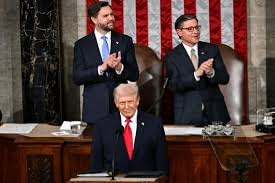






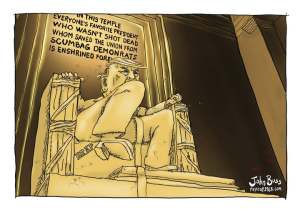
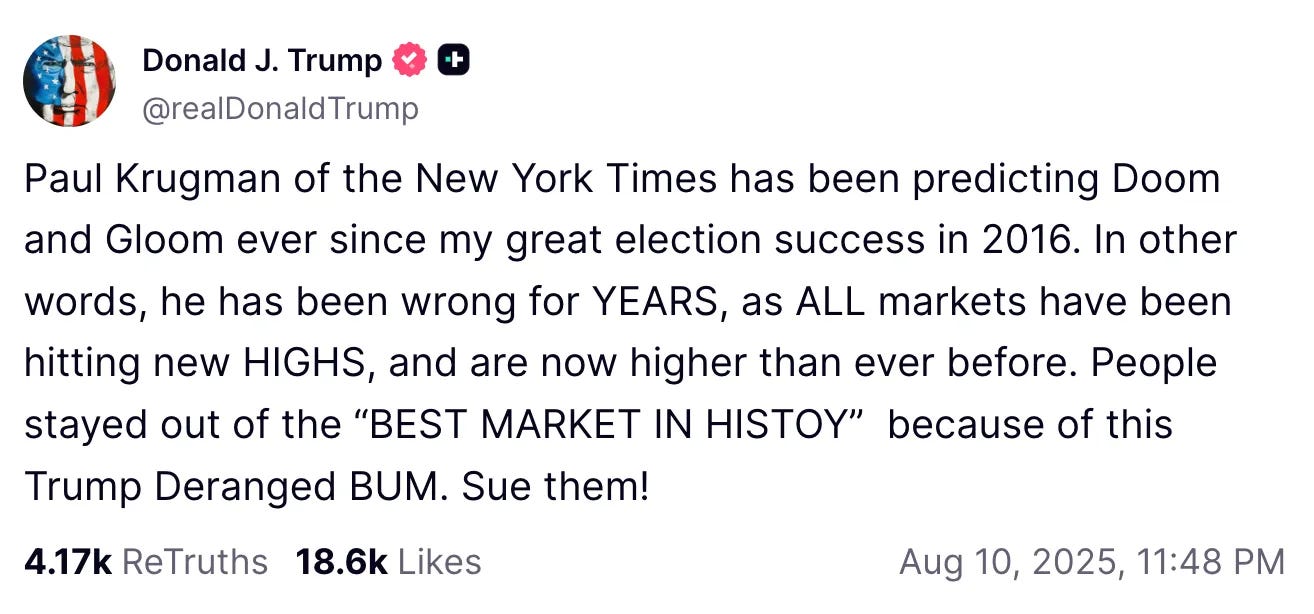
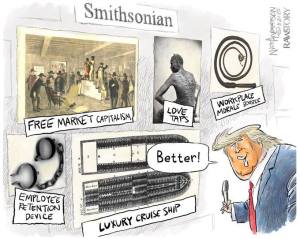 The key to the crazy car is indeed tariffs.
 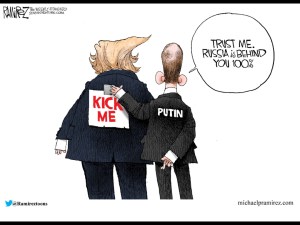 The rest is under a paywall, but you get the general gist of it. So, all of this tariff shit is not coming out of Congress, as it should. That is what led to this very important article in Fortune. You may read all of it. The first author, Jeffrey Sonnenfield, is a Yale University Business Professor. The rest of the authors are equally impressive. There are CEOs of Top Companies as well as other academics, including Distinguished Professor Laura Tyson, a former chair of the White House Council of Economic Advisors, back when we really were doing economic policy. Here’s the headline, folks!
 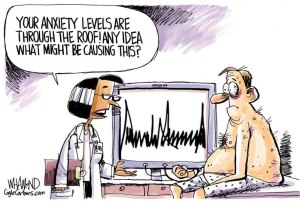 You may read all the listed evidence at the link. This is not normal. This is heavy-handed interference in all our markets. Evidently, regulation is good if it’s the #FARTUS openly demanding he be cut in on all deals. There are so many things going on that are not normal; all alarms should be blaring loudly by now. “Trump’s FBI Raid of John Bolton’s Home Looks Like a ‘Five-Alarm Fire. Thus far, little is known about Friday’s law enforcement action against a top Trump critic. But we’re seeing an escalation of authoritarian power on many fronts that has grown unmistakable.” This is from the
 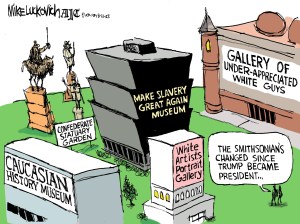 WTF is going on? This is not normal. This is not democratic. This is not how our republic is supposed to work. Meanwhile, Donald’s dash for the Nobel Peace Prize is dashed again. Put so played him. This is from
  #FARTUS is the most corrupt and inept president we’ve ever had. I have no idea how we’re going to survive much more of this. More things from Memeorandum to check out:













 peej
peej Carissa
 bostonboomer
 dakinikat
 ecocatwoman
 mablue2
 Mama Lopez
 peggysue22
 quixote
 skydancingguestblogger
 Mona (aka Wonk the Vote)



 Sky Dancing
Recent Comments