
Today, President Biden chastised the Supreme Court for “outrageous behavior” and said he would support an exception to the Senate’s filibuster rules to make it easier to write abortion protections into law. Biden, speaking on the world stage in Madrid, called the court’s decision last week to overturn Roe v. Wade “destabilizing” and said an exception should be made to a Senate rule that requires 60 votes for most bills to advance.
Thursday Reads: SCOTUS News
Posted: June 30, 2022 Filed under: Climate change, Congress, just because, morning reads, SCOTUS | Tags: abortion, anti-choice violence, Environmental Protection Agency, filibuster rules, Health care, immigration, Joe Biden, Ketanji Brown Jackson, Remain in Mexico, Roe v. Wade, Supreme Court decisions 20 CommentsGood Morning!!
I feel emotionally wrung out this morning. We are living through important events that will reverberate down through history, and we still don’t know which side will control how future generations see these events. Will we succeed in rescuing U.S. democracy, or will the forces of fascism win in the end? Will we survive the stunning series of decisions the reactionary Supreme Court has inflicted on us in the past couple of weeks? With the societal divisions being sown by the GOP and the Court lead to a new civil war? Today I’m going to focus on the latest decisions from the Trumpist SCOTUS decisions.
Nina Totenberg at NPR: Supreme Court restricts the EPA’s authority to mandate carbon emissions reductions.
The U.S. Supreme Court on Thursday dealt a major blow to the Environmental Protection Agency’s power to regulate carbon emissions that cause climate change. The decision by the conservative court majority sets the stage for further limitations on the regulatory power of other agencies as well.
By a vote of 6 to 3, the court said that any time an agency does something big and new – in this case addressing climate change – the regulation is presumptively invalid, unless Congress has specifically authorized regulating in this sphere.
At issue in the case were rules adopted by the Trump and Obama administrations and aimed at addressing the country’s single-largest carbon emissions problem – from coal-fired power plants. The Obama plan was broad, the Trump plan narrow. The Obama plan didn’t regulate only coal-fired plants. Instead, it set strict carbon limits for each state and encouraged the states to meet those limits by relying less on coal-fired power plants and more on alternative sources of energy – wind, solar, hydro-electric and natural gas. The goal of the plan was to produce enough electricity to satisfy U.S. demand in a way that lowered greenhouse emissions.
The concept worked so well that even after Obama’s Clean Power Plan was temporarily blocked by the Supreme Court and then repealed by the Trump administration, most utilities continued to abandon coal because it was just too expensive, compared to other energy producing methods. In fact, even without the regulation in place, the reduction targets for carbon emissions were met 11 years ahead of schedule.
Fearing the Obama approach might someday be revived, the coal industry, joined by West Virginia and 16 other states, went to court in support of the Trump plan and its more restrictive interpretation of the Clean Air Act. A federal appeals court in Washington, D.C., ruled against them in 2021.
But on Thursday, the Supreme Court sided with the coal industry, ruling that the Clean Air Act does not authorize anything other than direct regulation of coal-fired plants….
The decision appears to enact major new limits on agency regulations across the economy, limits of a kind not imposed by the court for 75 years or more. The decision, for instance, casts a cloud of doubt over a proposed Securities and Exchange Commission rule that would require companies offering securities to the public to disclose climate-related risks – like severe weather events that have or likely will affect their business models. Also in jeopardy is a new interim rule adopted by the Federal Energy Regulatory Commission “aimed at treating greenhouse gas emissions and their contribution to climate change the same as all other environmental impacts [the Commission] considers.”
The Supreme Court deigned to give Biden one win, on immigration. The Washington Post: Supreme Court clears Biden to end Trump’s ‘Remain in Mexico’ policy.
The Supreme Court on Thursday ruled for the Biden administration on a controversial immigration policy, saying it had the authority to reverse a Trump-era policy that requires asylum seekers to remain in Mexico while their cases are reviewed in U.S. courts.
The vote was 5 to 4, with Chief Justice John G. Roberts Jr. writing for himself and Justice Brett M. Kavanaugh, and the court’s three liberals, Stephen G. Breyer, Sonia Sotomayor and Elena Kagan.
Roberts said federal immigration law gives the executive discretion: He may return asylum seekers to Mexico, but is not required to do so.
Justices Clarence Thomas, Samuel A. Alito Jr., Neil M. Gorsuch and Amy Coney Barrett dissented.
Barrett said that she agreed with the majority on the merits of the decision but that the court should not have decided the case and should have remanded it to lower courts.
Alito, writing for himself, Thomas and Gorsuch, said the Department of Homeland Security should not be free to “simply release into this country untold numbers of aliens who are very likely to be removed if they show up for their removal hearings. This practice violates the clear terms of the law, but the Court looks the other way.”
From NPR, another bit of good SCOTUS news: Ketanji Brown Jackson to be sworn in as first Black woman on the Supreme Court.
Ketanji Brown Jackson will be sworn in Thursday at noon as the 116th Supreme Court justice and the first Black woman to serve on the high court.
Biden nominated Jackson in February, fulfilling a campaign promise to nominate the first Black woman to the Supreme Court.
“It has taken 232 years and 115 prior appointments for a Black woman to be selected to serve on the Supreme Court of the United States, but we’ve made it! We’ve made it — all of us,” Jackson said in remarks at a White House event the day after the Senate vote.
“I have dedicated my career to public service because I love this country and our Constitution and the rights that make us free,” Jackson also said.
Jackson, 51, has been confirmed since April, when the Senate voted 53 to 47 on her nomination. It was expected she would replace 83-year-old Justice Stephen Breyer — whom she clerked for after shed graduated from Harvard Law School in 1996 — when he stepped down. His retirement will be effective Thursday.
Jackson will take two oaths during the livestreamed event: a constitutional oath, administered by Chief Justice John Roberts, and a judicial oath, administered by Breyer.
Biden and Congressional Democrats are still struggling to deal with the Court’s decision to take away American women’s control over their own bodies and turn women in their childbearing years into broodmares.
The Washington Post: Democrats call on Biden to declare abortion national health emergency.
Lawmakers and advocates are pushing President Biden to declare a national health emergency to increase financial resources and flexibility in states that continue to allow abortion access following the Supreme Court’s decision to overturn Roe v. Wade.
The Congressional Black Caucus made the initial request the morning of the court’s ruling, and the House Pro-Choice Caucus is privately urging the administration to act swiftly.
“The fundamental right to control your body and future has been ripped away from American women,” Assistant Speaker of the HouseRep. Katherine M. Clark (D-Mass.) told The Early. “Declaring an emergency is an immediate step to help patients access the care they need.”
Supporters say time is critical because the remaining abortion clinics are seeing a massive increase in demand that is going to be difficult to meet.
“They are doing everything they can,” Sen. Tina Smith (D-Minn.) said of an abortion clinic treating women in the northern parts of Minnesota, Wisconsin and Michigan. “But they are severely resource constrained in terms of the providers that they have, in terms of the physical facilities that they have, in terms of the financial resources they need to try to expand access to care, which they desperately want to do.”
“This would be another way for the full legal authority of the federal government to be brought into play as we try to protect women’s health,” Smith said in an interview on Washington Post Live this week.
Another suggestion is to change the filibuster rules for abortion laws. The Washington Post: Biden endorses scrapping Senate filibuster to codify abortion, privacy rights.
Politico: Biden says he supports a filibuster carveout to restore abortion rights.
“I believe we have to codify Roe v. Wade in the law and the way to do that is to make sure that Congress votes to do that, and if the filibuster gets in the way, it’s like voting rights, it should be ‘we provide an exception for this’ — require an exception to the filibuster for this action to deal with the Supreme Court decision,” Biden said during a press conference at the NATO summit.
Biden’s comments come on the heels of the consequential Supreme Court decision last Friday to overturn the landmark 1973 decision and deny a constitutional right to abortion. The president has previously been opposed to getting rid of the filibuster — which establishes a 60-vote threshold to move most bills through the Senate — but said Thursday he would do “everything in my power” to protect the right to choose .
The president added he’d be in favor of changing filibuster rules to not only guarantee abortion rights but also a constitutional right to privacy — which he said the Supreme Court “wiped” out with its decision on Roe. He said codifying privacy rights would protect access to abortion as well as a “whole range of issues,” including same-sex marriage….
Biden’s support for ending the filibuster is his most concrete call for legislative action yet on preserving abortion rights. With the filibuster as it stands, Democrats almost certainly lack the 60 votes they would need to codify Roe in a 50-50 Senate.
So far, Joe Manchin and Kyrsten Sinema haven’t agreed to go along with this strategy.
Republicans have been hoping that violent demonstrations would follow the SCOTUS decision on Roe v. Wade, but their wishes haven’t come true so far. Kathryn Joyce at Salon: Did violence follow Roe decision? Yes — almost all of it against pro-choice protesters.
Before the Supreme Court even announced its decision overturning Roe v. Wade last Friday, right-wing politicians and media had begun warning of a wave of violent demonstrations or riots by pro-choice protesters. Rep. Paul Gosar, R-Ariz., called on “all patriots” to defend local churches and crisis pregnancy centers, while Fox News hyped warnings about a “night” or “summer of rage” and various far-right activists — from the America First/groyper movement to the Proud Boys to a staffer for Arizona gubernatorial candidate Kari Lake — issued threats against leftists they claimed were about to become violent.
But it appears that most of the violence that occurred in response to the Roe decision this past weekend was directed at pro-choice demonstrators, not caused by them.
On Friday night, in Cedar Rapids, Iowa, a man drove his pickup truck into a group of women protesters, hitting several and driving over the ankle of one woman. Iowa journalist Lyz Lenz, who was covering the protest, noted on Twitter that the attack came at the end of a peaceful event, as demonstrators were crossing the road at a crosswalk while the man had a red light. “The truck drove around other cars in order to hit protesters,” Lenz wrote, adding that the driver “was screaming” while a woman in the truck with him begged him to stop….
That same night, at a pro-choice protest in Providence, Rhode Island, an off-duty police officer named Jeann Lugo — who, until this weekend, was a Republican candidate for state Senate — punched his Democratic opponent, reproductive rights organizer Jennifer Rourke, in the face.
Providence police arrested Lugo and charged him with assault and disorderly conduct, placing him on administrative leave. On Saturday, Lugo dropped out of the Senate race and announced he would not be seeking any political office before apparently deactivating his Twitter account.
In Atlanta, photographer Matthew Pearson documented a group of more than a dozen Proud Boys coming to counterprotest a pro-choice demonstration, while an Atlanta antifascist group posted photos of the group boarding a Humvee painted with the Proud Boys’ logo.
In several other states, police responded to demonstrations against the SCOTUS ruling with heavy-handed tactics and violence.
Read about more of these events at the Salon link.
I’ll add more news in the comment thread. Have a nice Thursday!
Tuesday Reads: GOP Anxious About Upcoming SCOTUS Decisions
Posted: June 9, 2015 Filed under: Barack Obama, morning reads, Republican politics, SCOTUS, U.S. Politics | Tags: Affordable Care Act, same-sex marriage, Supreme Court decisions 57 Comments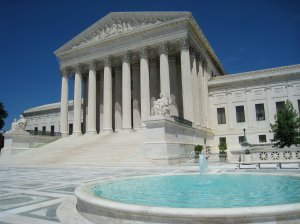
Good Morning!!
The Supreme Court is in the news today, as its current session approaches its end.
The two most consequential decisions to be announced will have serious implications for the health care system and settle the question of same sex couples should have equal rights to marry and have the same benefits of marriage as heterosexual couples. Some other important decisions have already been announced.
The Obamacare case is the one making news today, after President Obama spoke publicly about the upcoming decision on the Affordable Care Act yesterday at the G7 Conference in Germany.
Politico reports, Obama: Supreme Court shouldn’t have heard Obamacare challenge.
President Barack Obama expressed deep frustration with the U.S. Supreme Court on Monday, questioning why justices even took up a case that imperils his signature health insurance reform plan.
The high court is set to issue a decision on the case, known as King v. Burwell, by the end of the month. A ruling against the government would mean that 6.4 million people in the 34 states relying on the federal Healthcare.gov website would be at risk of losing subsidies that make their insurance affordable.
“This should be an easy case. Frankly, it probably shouldn’t even have been taken up,” Obama said at a news conference after the G-7 summit in Krun, Germany. “Since we’re going to get a ruling pretty quick, I think it’s important to assume that the Supreme Court’s going to do what legal scholars would expect them to do.”
Obama repeated the administration’s contention that there’s no contingency plan or fix to keep insurance markets from going into a tailspin, predicting that the justices would decide in his favor. And in any case, he added, Congress could fix the ambiguous phrasing of the health law “with a one-sentence provision.”

But Republicans made it clear that they aren’t going to allow an easy fix. From Bloomberg, GOP Swiftly Rejects Obama’s ‘One-Sentence Fix’ to Obamacare If Supreme Court Voids Subsidies.
“Let’s be clear: if the Supreme Court rules against the Administration, Congress will not pass a so called ‘one-sentence’ fake fix,” Wyoming Senator John Barrasso, who is leading Republican efforts to craft a contingency plan, said in a statement.
At issue is whether a handful of words in the Affordable Care Act mean the government cannot provide insurance tax credits for millions of Americans in 34 states enrolled through HealthCare.gov, rather than a state exchange. Without the subsidies, insurance will become unaffordable to many and premiums are almost certain to skyrocket across the board. Even so, Barrasso and his fellow Republicans say Obama acted illegally by doling out the subsidies. A victory in the case King v. Burwell would probably create chaos, and ironically put Republicans on the hook for resolving it.
In his statement, Barrasso accused Obama of “bullying the Supreme Court” and said the Republican-led Congress is “prepared to help” Americans who may be harmed.
But is it? Republicans have struggled to coalesce around a contingency plan if the ruling goes their way. A victory could backfire on the GOP without a viable response, as Democrats would be armed with attack ads accusing them of pushing for a ruling that threw millions of Americans off their health care plans without a plan to help them.
Even a simple fix is dangerous for Republicans. Conservative lawmakers in the House worry that a such a move to clarify that the subsidies are available in all 50 states would be attacked by their base as a vote for Obamacare.
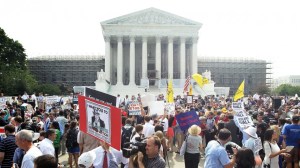
According to The Hill, Republicans fear they will win ObamaCare court battle.
Republicans in Congress are worried the Supreme Court will hand them a major headache this month if it rules against the federal health insurance exchanges in more than 30 states, ending subsidies for millions of people.
While the Affordable Care Act remains broadly unpopular, two new polls show a majority of Americans don’t want to do away with its subsidies, a core component of the law.
This poses a conundrum for Senate Majority Leader Mitch McConnell (R-Ky.) and Speaker John Boehner (R-Ohio). They are under pressure from colleagues up for reelection in swing states and districts to extend the subsidies, at least temporarily, if the court strikes them down. But doing so would risk a backlash from the conservative base.
The Supreme Court is expected to hand down its decision in King v. Burwell, which could strip 6.4 million people of health insurance subsidies, in late June.
States that would be hardest hit by a ruling against the law include the Senate battlegrounds of Illinois, North Carolina, Ohio and Wisconsin.
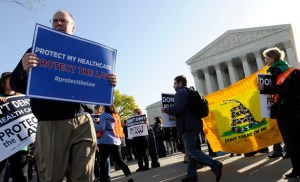
REUTERS/Jonathan Ernst
Greg Sargent at Morning Plum: In battleground states, voters don’t want Supreme Court to gut subsidies.
As your humble blogger has tirelessly reiterated, the states with the highest numbers of people who stand to lose subsidies if the Supreme Court guts them also happen to be the main presidential and Senate battleground states. That overlap could increase the political stakes in the battle that will follow any Court ruling against the ACA.
Now a new Washington Post poll confirms the stakes here. It finds that in many key battleground states, a majority says the Court should not end subsidies for those on the federal exchange.
The Post poll finds that among Americans overall, 55 percent oppose a Court decision killing the subsidies, while only 38 percent support it. Independents oppose such a decision by 57-36, while Republicans are alone in supporting a decision against the ACA by 55-34.
Among the states in which the largest numbers of people may lose subsidiesare Florida, North Carolina, Pennsylvania, Virginia, Wisconsin and Ohio. Those are key presidential battlegrounds, and Republicans are defending Senate seats in five of them.
The upcoming marriage equality decision could also backfire on Republicans:
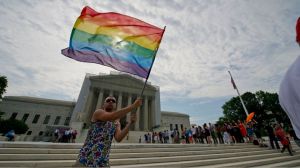
The LA Times: GOP’s same-sex marriage trap: Conservatives oppose it intensely.
The Supreme Court may be just weeks away from declaring a nationwide right to same-sex marriage with a ruling likely to trigger public opposition — and private sighs of relief — from most Republican presidential hopefuls.
Why relief? The marriage issue increasingly has become a trap for Republicans, and a Supreme Court decision that takes the matter out of the political process would provide the easiest exit. The court is expected to rule this month on whether the Constitution protects marriage rights for gay couples.
A new poll by the nonpartisan Pew Research Center highlights Republicans’ predicament. By 57% to 39%, Americans favor allowing gay and lesbian couples to marry legally. But among Republicans, only about one-third agree.
Moreover, among those who describe themselves as conservative Republicans, 40% say the issue is “very important” to them, and they overwhelmingly oppose marriage rights for gay couples.
Overall, the poll found, opponents of same-sex marriage are more likely than supporters to describe the issue as “very important.” In part, that may be because about two-thirds of white, evangelical Protestants, who make up a large share of the opposition, say there is “a lot” of conflict between homosexuality and their religious beliefs.
For would-be Republican presidential nominees, that sets up a difficult problem. Support for same-sex marriage rights would put a candidate at odds with a huge bloc of voters in GOP primaries on an issue they deem “very important.” But vocal opposition to those rights would put a candidate out of step with a large and growing majority of the public.
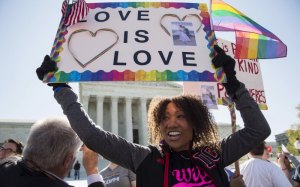
Recently announced SCOTUS decisions:
Yesterday the Supreme Court decided that U.S. citizens who were born in Jerusalem cannot list their birthplace as Israel on their U.S. Passports. Richard Wolfe at USA Today:
The Supreme Court declined Monday to insert itself into the middle of the Israeli-Palestinian conflict by second-guessing U.S. policy on Jerusalem.
Ruling just a few months after a feud between President Obama and Israeli Prime MinisterBenjamin Netanyahu, the justices refused to allow Americans born in Jerusalem to have their passports changed to reflect Israel as their birthplace, as Congress demanded more than a decade ago.
In denying the challenge waged by the Jewish parents of a 12-year-old almost since his birth in 2002, a majority of justices heeded the State Department’s warning that a simple passport alteration could “provoke uproar throughout the Arab and Muslim world.”
Justice Anthony Kennedy wrote the 6-3 decision for the court, which needed more than seven months following oral arguments in early November to decide the congressional law was unconstitutional. It was the longest-pending high court decision.
“The power to recognize or decline to recognize a foreign state and its territorial bounds resides in the president alone,” Kennedy said, citing examples from the French Revolution in 1793 to President Jimmy Carter’s recognition of the People’s Republic of China in 1979.
Lyle Denniston has a detailed analysis of this decision at SCOTUSblog.
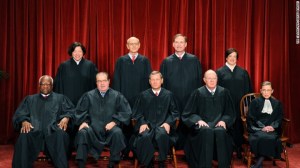
In another interesting decision, the Court let stand a San Francisco gun control law. NPR reports, Supreme Court Rejects NRA Challenge To San Francisco Gun Rules.
The U.S. Supreme Court has declined to block two San Francisco gun control measures that were fiercely opposed by the National Rifle Association. At least one veteran court observer says the high court’s decision raises questions about how the justices interpret the Second Amendment.
First, the basics: A 2007 San Francisco ordinance requires residents to keep handguns under lock and key or to use trigger locks when they are not carrying their weapons. Another law, dating to 1994, bans the sale of ammunition that expands on impact, or hollow-point bullets.
Plaintiff Espanola Jackson and seven other petitioners, including the NRA, filed suit in 2012. They sought an injunction to keep the lockbox law from being enforced. But in March 2014, the 9th U.S. Circuit Court of Appeals sided with the City and County of San Francisco and left both measures intact.
Read more at the link.
Finally a new CNN poll shows that Americans don’t trust the current Supreme Court on “key issues.”
With major Supreme Court decisions on health care and same-sex marriage expected this month, many lack trust in the Supreme Court’s handling of those two issues, according to a new CNN/ORC poll.
Yet most approve of the way the court is handling its job generally.
A majority, 52%, say they approve of the way the court is handling its job, while 41% disapprove. That’s an improvement from an even 48% to 48% split two years ago. Still, when Americans are asked how much they trust the court on a range of issues it will be considering this term or the next, the worst ratings come on health care and same-sex marriage. Only about half say they have at least a moderate amount of trust in the court on health care (50%) or same-sex marriage (49%). There is more faith in the Supreme Court on other key issues on the docket, with most saying they trust the court at least a moderate amount on freedom of speech (69%), voting rights (65%) and the death penalty (60%).
Read the rest at CNN.
What else is happening? As always, this is an open thread, so please post your thoughts and links on any topic in the comments.

 peej
peej Carissa
 bostonboomer
 dakinikat
 ecocatwoman
 mablue2
 Mama Lopez
 peggysue22
 quixote
 skydancingguestblogger
 Mona (aka Wonk the Vote)



 Sky Dancing
Recent Comments