
The Latest Self-Serving Village Narrative: Screw the Baby Boomers.
Posted: January 1, 2011 Filed under: Baby Boomers, Barack Obama, Catfood Commission, Corporate Crime, Democratic Politics, Medicare, Social Security, The Bonus Class, The Great Recession, The Media SUCKS, the villagers, U.S. Economy, U.S. Politics, We are so F'd | Tags: Baby boomers, Barack Obama, crash of 2008, Dan Barry, medicare, Millennials, Robert Samuelson, Social Security 17 Comments
Don’t tell me the White House isn’t behind this. Both the New York Times and ABC News are pushing this right now, but the Washington Post jumped on it first with this op-ed by Robert Samuelson on December 26: On Medicare and Social Security, be unfair to the boomers Samuelson, just turned 65 himself, and says he is “part of the problem.” Except he probably doesn’t need Social Security and Medicare, unlike most baby boomers, who never could afford a lifestyle like that of their parents or who lost their retirement investments in the crash of 2008. Samuelson writes:
There has been much brave talk recently, from Republicans and Democrats alike, about reducing budget deficits and controlling government spending. The trouble is that hardly anyone admits that accomplishing these goals must include making significant cuts in Social Security and Medicare benefits for baby boomers.
If we don’t, we will be condemned to some combination of inferior policies. We can raise taxes sharply over the next 15 or 20 years, roughly 50 percent from recent levels, to cover expanding old-age subsidies and existing government programs. Or we can accept permanently huge budget deficits. Even if that doesn’t trigger a financial crisis, it would probably stunt economic growth and living standards. So would dramatically higher taxes. There’s a final choice: deep cuts in other programs, from defense to roads to higher education.
Yet, neither political party seems interested in reducing benefits for baby boomers. Doing so, it’s argued, would be “unfair” to people who had planned retirements based on existing programs. Well, yes, it would be unfair. Indeed, it’s hard to imagine a worse time for cuts. Unemployment is horrendous; eroding home values and retirement accounts have depleted the elderly’s wealth. Only 19 percent of present retirees are “very confident” of having enough money to live “comfortably,” down from 41 percent in 2007, reports the Employee Benefit Research Institute.
Blah, blah, blah. But of course it isn’t “unfair” to reduce taxes on the richest Americans–people who most likely will invest their extra tax money in other countries, people who can easily afford to live in other countries once this one goes down the tubes. Those rich people who control most of the money in the U.S. economy–they aren’t selfish are they? No, of course not. It’s the baby boomers who are selfish, always out for “me, me, me,” and never considering anyone else. But wait…aren’t baby boomers also the sandwich generation–caring for their aging parents as well as their millennial generation children? I think my head is going to explode.
According to a new Marist poll, most Americans think baby boomers should keep working after 65; yet there is evidence that baby boomers are not as healthy as their parents’ generation. Of course that must be the boomers’ fault–just like everything else that has happened during our lifetimes. We’ve been blamed for juvenile delinquency, excess materialism, hippies, illegal drugs, self-absorption, and being horrible parents to the Millennials, who are supposedly highly narcissistic and lacking in empathy.
The fact that we’re supposedly less healthy than our parents couldn’t possibly have anything to do with environmental pollution or increasing income inequality in our society, now could it? No, of course not. It must be because we’re so selfish and self-absorbed. We brought it on ourselves by demanding to be born right after WWII. Oh wait…we didn’t ask to be born. Well, somehow it must be our fault.
Well, I’m not buying it. We paid for our retirement benefits all our lives and now the richest of the rich want to take that away from us too. Supposedly the baby boomer social security “problem” was taken care of by adjustments made in the 1980s under Reagan. It’s not our fault that George W. Bush and Barack Obama decided to steal our money. But this is the narrative we are going to hear from now on until the Villagers manage to destroy Social Security and Medicare.
Here’s The New York Times today: Boomers Hit New Self-Absorption Milestone: Age 65.
In keeping with a generation’s fascination with itself, the time has come to note the passing of another milestone: On New Year’s Day, the oldest members of the Baby Boom Generation will turn 65, the age once linked to retirement, early bird specials and gray Velcro shoes that go with everything.
Though other generations, from the Greatest to the Millennial, may mutter that it’s time to get over yourselves, this birthday actually matters. According to the Pew Research Center, for the next 19 years, about 10,000 people “will cross that threshold” every day — and many of them, whether through exercise or Botox, have no intention of ceding to others what they consider rightfully theirs: youth.
This means that the 79 million baby boomers, about 26 percent of this country’s population, will be redefining what it means to be older, and placing greater demands on the social safety net. They are living longer, working longer and, researchers say, nursing some disappointment about how their lives have turned out. The self-aware, or self-absorbed, feel less self-fulfilled, and thus are racked with self-pity.
I’ve got news for Dan Barry, the author of that article. It isn’t a “generation” that was “fascinated with itself.” It’s a lazy media that pretends that 79 million people are all alike. Give me a break. Even Barry admits that “[a]scribing personality traits to a bloc of 79 million people is a fool’s endeavor,” so why do so many media and government fools keep doing it. I’ll tell you why. They want to turn our Social Security funds over to Wall Street.
Here’s Diane Sawyer’s silly “report” on the baby boomer “problem.” Susie already wrote about it at Suburban Guerrilla:
You have to watch this video to see how insidiously the Villagers are spreading the narrative: Those Baby Boomers are sucking all the money out of the Treasury because they’re just so damned selfish! And only some of them served in Viet Nam! Watch as Diane Sawyer puts on her Very Serious Face and says the deficit is a big problem. Pay attention to the lies scattered throughout.
You can read the rest and watch the video of the oh so very serious Diane Sawyer at Susie’s place or at Crooks & Liars.
I saw this coming a long time ago, back when Obama started beating up on baby boomers and the ’60s during the 2008 primaries. I summarized Obama’s anti-baby boomer narrative in a post a couple of years ago. I’ll get the link for you in a bit. Here are just a few examples of Obama’s attacks on boomers.
From the New York Times: Shushing the Baby Boomers
THE time has come, Senator Barack Obama says, for the baby boomers to get over themselves.
In taking the first steps toward a presidential candidacy last week, Mr. Obama, who was born in 1961 and considers himself a member of the post-boomer generation, said Americans hungered for “a different kind of politics,” one that moved beyond the tired ideological battles of the 1960s. [….]
Mr. Obama calculates that Americans of all ages are sick of the feuding boomers and ready to turn to the generation that came of age after Vietnam, after the campus culture wars between freaks and straights, and after young people had given up on what überboomer Hillary Rodham Clinton (who made her own announcement on the Web yesterday) called in a 1969 commencement address a search for “a more immediate, ecstatic and penetrating mode of living.”
The Times also quotes from Obama’s book The Audacity of Hope, in which Obama used the self-absorbed baby boomer narrative to attack the Clintons.
In his second book, “The Audacity of Hope,” Mr. Obama is critical of the style and the politics of the 60s, when the psyches of most of his potential rivals for the White House were formed. He writes that the politics of that era were highly personal, burrowing into every interaction between youth and authority and among peers. The battles moved to Washington in the 1990s and endure today, he says
“In the back and forth between Clinton and Gingrich, and in the elections of 2000 and 2004,” he writes, “I sometimes felt as if I were watching the psychodrama of the baby boom generation — a tale rooted in old grudges and revenge plots hatched on a handful of college campuses long ago — played out on the national stage.”
Of course Obama also talked about “the excesses of the ’60s and ’70s” in his interview with the Reno Gazette-Journal before the Nevada primary.
“I don’t want to present myself as some sort of singular figure. I think part of what is different is the times. I do think that, for example, the 1980 election was different. I think Ronald Reagan changed the trajectory of America in a way that Richard Nixon did not and in a way that Bill Clinton did not. He put us on a fundamentally different path because the country was ready for it. They felt like with all the excesses of the 60s and the 70s and government had grown and grown but there wasn’t much sense of accountability in terms of how it was operating. I think he tapped into what people were already feeling. Which is we want clarity, we want optimism, we want a return to that sense of dynamism and entrepreneurship that had been missing.”
Finally, Obama attacked baby boomers in his Inaugural Address.
His harshest language on domestic matters actually seemed directed — not for George W. Bush or specific Republican policies — but more for an entire generation, the baby boomers who have been running this country for the past 16 years (and, of course, that has to include Bill Clinton too). He seemed more interested in identifying the generation that he saw as responsible for the more systemic problems facing the country:
On this day, we gather because we have chosen hope over fear, unity of purpose over conflict and discord.
On this day, we come to proclaim an end to the petty grievances and false promises, the recriminations and worn out dogmas, that for far too long have strangled our politics.
Those words were reminiscent of the “turn the page” language he used effectively against Hillary Clinton in the primaries. This time, though, it was quite clear that he wasn’t singling out the Clintons, but was making a broader, more pointed claim against the excesses of an entire generation of leaders. And, on the financial front, Bill Clinton signed the law that overturned Glass-Steagall, while George W. Bush signed the law that quote-reformed-unquote bankruptcy laws. So, Obama may well be on strong footing there. He’s demontrating an unwillingness to hear excuses from either Democratic or Republican partisans.
Anyone who thinks all of this was or is accidental is delusional. Obama was told all along by his advisers and probably by his Wall Street donors that he would have to be the one to destroy Social Security and Medicare. These two programs are the only large source of taxpayer funds for the wealthy and corporations to steal from us. We’ve known that for a long time, but most Americans probably don’t–many still think Obama is a liberal.
Reportedly Obama will embrace the findings of his Catfood Commission in his upcoming State of the Union Address. It’s going to be a full-out media assault and we’d better figure out a way to combat it. It’s the old divide and conquer tactic that has always worked so well. Those of us in the bottom 90% of incomes had better get together and fight back or we’re dead.
Monday Reads
Posted: December 13, 2010 Filed under: Feminists, morning reads | Tags: Afghanistan, Barack Obama, Bush tax cuts, corporate media, David Axelrod, Douglas Rushkoff, Neil Armstrong, Open Leaks, Ray McGovern, Robert Gates, Robert Kuttner, Robert Reich, Scarlett O'Hara, Social Security, Wikileaks 36 Comments
Good Morning!! It’s the beginning of another week and, despite the impending holidays, there is quite a bit of news.
Six U.S. soldiers were killed by a bomb in Afghanistan yesterday.
Six U.S. soldiers were killed and more than a dozen U.S. and Afghan troops were wounded Sunday when a van packed with explosives was detonated at a new jointly operated outpost in southern Afghanistan.
The soldiers were inside a mud-walled building near the village of Sangsar, north of the Arghandab River, when the bomber drove up to one of the walls and exploded his charge.
The explosion blasted a hole in the thick wall, causing the roof to collapse on the soldiers inside. Others quickly arrived and clawed and pulled at the waist-deep rubble to free the buried troops.
[….]
The Taliban claimed responsibility for the bombing. “We have killed numbers of Americans and Afghan soldiers and wrecked and ruined their security check post,” a Taliban spokesman, Qari Yousuf Ahmadi, said by phone. “We will carry out similar attacks in the future.”
USA Today: Taliban small arms attacks nearly double
U.S. forces have encountered more than 18,000 attacks this year from Taliban fighters armed with automatic weapons, rocket-propelled grenades and in some cases missiles, according to data from the Pentagon. That compares with about 10,600 such attacks in 2009.
But supposedly, that’s a good sign.
Army Capt. Ryan Donald, a military spokesman in Kabul, said the rise is a result of bringing “the fight to them.”
Donald said coalition troops have been on the offensive in an attempt to dislodge Taliban forces from their strongholds in southern Afghanistan and in the east along the mountainous border with Pakistan.
Defense Secretary Robert Gates visited the top commander in Afghanistan, Gen. David Petraeus, this week to assess the situation.
More hard fighting remains, Gates said.
“This is tough terrain, and this is a tough fight,” Gates said. “But as Gen. Petraeus has said, we are breaking the momentum of the enemy, and we will reverse that momentum in partnering with the Afghans and will make this a better place for them, so they can take over, and we can all go home. It will be awhile, and we’ll suffer tougher losses as we go.”
Barack Obama’s high-risk war wager that sent tens of thousands of U.S. troops surging into Afghanistan is showing signs of success, U.S. officials say. The raging Taliban insurgency is being defeated, but foreign troops are still years away from heading for the exit.
“Our joint efforts are paying off,” said Robert Gates, U.S. Secretary of Defence and the only cabinet secretary kept on by Mr. Obama from the former Bush administration. “[I’m] convinced that our strategy is working and that we will be able to achieve key goals set out by President Barack Obama last year.”
Hey, we’re years away from exiting this endless war, so how is that success? I just don’t get the point of all this violence and death.
In another of Obama’s battles–this one to give more money to the rich–David Axelrod claims the Democrats in Congress will go along with the con game.
White House adviser David Axelrod said the administration expects House Democrats, including Speaker Nancy Pelosi, to back the compromise tax package negotiated by President Barack Obama and the Republicans.
“At the end of the day no one wants to see taxes go up for 150 million Americans on January 1st,” Axelrod said on CNN’s “State of the Union” program. “This framework represents a compromise that both sides can accept and we can’t change it in major ways and expect that this thing is going to pass.”
So the rich will get richer and the old and the disabled with pay the price.
At Huffpo, former Obama believer Robert Kuttner writes about the “coming cave-in” of Social Security.
If you think the Democratic base is mad at Obama now for making a craven deal with Republicans that continues tax breaks for the richest Americans and adds new ones for their heirs through a big cut in the estate tax, just wait a few weeks until Obama caves on Social Security.
A few weeks?!
…Obama has created a kind of pincer attack on Social Security. One arm is the deficit commission, which has created the blueprint. The other is the tax-cut deal, which increases the deficit, adding to the artificial hysteria that Social Security is going broke. Meanwhile, the right is playing a very cute game, congratulating Obama for the deal….
When the right congratulates Obama for winning, you know he is losing. For starters, the proposed compromise isn’t much of an economic stimulus. If the deal passes Congress, taxpayers will be paying the same income tax rates in 2011 and 2012 as in 2010. No stimulus there.
The only real stimulus is the temporary cut in Social Security taxes, the extension of unemployment insurance plus a few minor tax breaks for regular people, totaling about $200 billion. That’s a little more than one percent of a $15 trillion economy. Pretty puny, certainly a lot smaller than the inadequate stimulus of February 2009 when the recession was only beginning to deepen.
Except for the extension of unemployment insurance, which should be done out of common decency, most of the “stimulus” is pure Republican ideology — stimulate the economy by cutting taxes.
Folks, the only thing standing between us and economic disaster for the majority of Americans is the weak-kneed Democrats in Congress. Nancy Pelosi needs to come through this time.
Robert Reich thinks lots of people are going to be to beat down and discouraged to drag themselves to the polls and vote in 2012.
In the 2010 midterm elections Democrats suffered from a so-called “enthusiasm gap.”
If Dems agree to the tax plan just negotiated by the White House with Republican leaders, they’ll face a “why-should-I-get-up-out-of-my-chair” gap that will make 2010’s Dem enthusiasm seem like a pep rally by comparison.
It’s a $70,000 gift for every millionaire, financed by a gigantic hole in the federal budget that will put on the cutting board education, infrastructure, and everything else most other Americans need and want.
“Why should I get out of my chair” in 2012, he asks.
Here are a couple of interesting stories about the potential effects of Wikileaks on the corporate media.
Dakinikat sent me this link: ‘The Fourth Estate is dead,’ former CIA analyst declares
Ray McGovern, of Veteran Intelligence Professionals for Sanity, told Raw Story in an exclusive interview. “The Fourth Estate in his country has been captured by government and corporations, the military-industrial complex, the intelligence apparatus. Captive! So, there is no Fourth Estate.”
[….]
McGovern, a CIA analyst for 27 years, whose duties included preparing and briefing the President’s Daily Brief and chairing National Intelligence Estimates, said that he preferred to focus on the First Amendment battle of WikiLeaks’ founder Julian Assange than on the current “cyber war” in which WikiLeaks is embroiled.
McGovern said that modern people can now become informed through what he termed “The Fifth Estate.”
“Luckily, there is a Fifth Estate,” he said. “The Fifth Estate exists in the ether. It’s not susceptible of government, of corporations, or advertisers or military control. It’s free. That is very dangerous to people who like to make secrets and to make secret operational things. It’s a huge threat. And the Empire – the Goliath here – is being threatened by a slingshot in the form of a computer and a stone through these emissions thrown into the ether to our own computers.”
And there’s this story at The New York Times: WikiLeaks Taps Power of the Press
In July, WikiLeaks began what amounted to a partnership with mainstream media organizations, including The New York Times, by giving them an early look at the so-called Afghan War Diary, a strategy that resulted in extensive reporting on the implications of the secret documents.
Then in October, the heretofore classified mother lode of 250,000 United States diplomatic cables that describe tensions across the globe was shared by WikiLeaks with Le Monde, El Pais, The Guardian and Der Spiegel. (The Guardian shared documents with The New York Times.) The result was huge: many articles have come out since, many of them deep dives into the implications of the trove of documents.
Notice that with each successive release, WikiLeaks has become more strategic and has been rewarded with deeper, more extensive coverage of its revelations. It’s a long walk from WikiLeaks’s origins as a user-edited site held in common to something more akin to a traditional model of publishing, but seems to be in keeping with its manifesto to deliver documents with “maximum possible impact.”
Julian Assange, WikiLeaks’s founder and guiding spirit, apparently began to understand that scarcity, not ubiquity, drives coverage of events. Instead of just pulling back the blankets for all to see, he began to limit the disclosures to those who would add value through presentation, editing and additional reporting. In a sense, Mr. Assange, a former programmer, leveraged the processing power of the news media to build a story and present it in comprehensible ways. (Of course, as someone who draws a paycheck from a mainstream journalism outfit, it may be no surprise that I continue to see durable value in what we do even amid the journalistic jujitsu WikiLeaks introduces.)
A new site for leaks, “Open Leaks” is supposed to debut today. It was formed by some disgruntled Wickileaks employees. Is it possible that we are really seeing a way to combat the power of the corporate media and force them to respond to the needs of ordinary Americans or become obsolete?
Media professor Douglas Rushkoff says the Internet “was never free or open and never will be.”
Secrets outlet WikiLeaks’ continuing struggle to remain online in the face of corporate and government censorship is a striking example of something few truly realize: that the Internet is not and never has been democratically controlled, a media studies professor commented to Raw Story.
“[T]he stuff that goes on on the Internet does not go on because the authorties can’t stop it,” Douglas Rushkoff, author of Program or be Programmed: Ten Commands for a Digital Age and Life, Inc.: How Corporatism Conquered the World and How to Take it Back”, said. “It goes on because the authorities are choosing what to stop and what not to stop.”
Rushkoff told Raw Story that the authorities have the ability to quash cyber dissent due to the Internet’s original design, as a top-down, authoritarian device with a centralized indexing system.
Essentially, all one needs to halt a rogue site is to delete its address from the domain name system registry.
Rushkoff says if we really want a free internet we’ll have to build it ourselves.
Here’s a great story: a blogger at NPR asked a question about the 1969 moon landing, and Neil Armstrong himself responded with a lengthy e-mail.
In yesterday’s post, I talked about Neil Armstrong and Buzz Aldrin’s walk across the lunar surface back in 1969 and wondered, how come they walked such a modest distance? Less than a hundred yards from their lander?
Today Neil Armstrong wrote in to say, here are the reasons:
It was really, really hot on the moon, 200 degrees Fahrenheit. We needed protection.
We were wearing new-fangled, water-cooled uniforms and didn’t know how long the coolant would last.
We didn’t know how far we could go in our space suits.
NASA wanted us to conduct our experiments in front of a fixed camera.
We [meaning Neil] cheated just a little, and very briefly bounded off to take pictures of some interesting bedrock.
But basically, he says, we were part of a team and we were team players on a perilous, one-of-a-kind journey. Improvisation was not really an option.
You can read the entire e-mail at the link.
I know everyone has already seen this nutty op-ed by Ishmael Reed: What Progressives Don’t Understand About Obama. I just want to call attention to one strange comment that Reed made in the piece:
…I read a response to an essay I had written about Mark Twain that appeared in “A New Literary History of America.” One of the country’s leading critics, who writes for a prominent progressive blog, called the essay “rowdy,” which I interpreted to mean “lack of deportment.” Perhaps this was because I cited “Huckleberry Finn” to show that some white women managed household slaves, a departure from the revisionist theory that sees Scarlett O’Hara as some kind of feminist martyr.
WTF?! Scarlett O’Hara, a feminist? Let’s see, she wore corsets and spent most of her time flirting with boys. She disliked other women and used men to get what she wanted. What could possibly make her a feminist? Believe it or not, I found a journal article on the subject. You can download the entire article in PDF form if you’re interested. The author, J. M. Spanbauer, describes Scarlett as:
…at best irritating, and at worst, despicable: a character who embodies all of the negative stereotypes attributed to women throughout history. She is narcissistic, shallow, dishonest, manipulative, amoral, and completely lacking in any capacity for self-reflection and for analysis of the emotional and psychological responses of others.
That’s a feminist? The article is an interesting analysis of the roles of women in Scarlett’s time and ours, and why many women still find Scarlet’s fascinating. Read it if you want to know more. I still don’t see how anyone could make a case for Scarlett as a feminist though, any more than I can agree with Ishmael Reed that the reason Obama can’t fight for any principle is that he’s black and black men can’t get angry without threatening white people. Reed should stick to poetry, because he doesn’t understand politics. Obama wouldn’t need to get angry to stand for something. He could be cool as a cucumber and still veto the tax cut extension for the super-rich.
Sooooo… what are you reading this morning?
Social Security: Why mess with an American Success Story?
Posted: December 10, 2010 Filed under: Catfood Commission, legislation, POTUS, The Bonus Class, U.S. Economy, Voter Ignorance | Tags: Clinton Obama presser, payroll tax holiday, Social Security 54 Comments
I spent most of the day listening to the Bernie Sanders show, but stories of the joint Clinton/Obama presser that turned into the Bill Clinton show grabbed my interest. I have more than a passing interest in Social Security. I haven’t paid into it for about 15 years, but I have an exhusband who has and I have 20 years worth of dibs on his account. I’m a tailend boomer with a much smaller nest egg post Financial Crisis than pre Financial Crisis. Ex Hubby’s social security and his pension plan loom on my horizon. They stop me from having bag lady nightmares.
So, what’s all this talk about a payroll tax holiday and why, all the sudden, is the Cat Food Commission’s foray into social security creeping me out? Well, for one I think that a lot of people–including the President–don’t seem to get social security, its history, its issues, and its challenges and that always irks me. For another, I think it opens this trap door to having more of my future Shanghaied. I don’t want any more of anything related to my future going off to Shanghai.
So, since the President–among others–is spreading disinformation about the Social Security program, I thought I’d take the time to remind you that I wrote a four part series on Social Security in May 2009. If you want a little background and perspective, you can go check it out. (Fortunately, it’s here in the file cabinet portion of Sky Dancing.) It is all based on Academic work and people that do active research on the program, its solvency, and its issues.
First, here’s a list of links to those old posts of mine:
Social Security: Reform, Refund or Opt-Out (Part 1) Introduction
Social Security: Reform, Refund or Opt-Out (Part 2) Public Pension Concepts and Alternatives
Social Security: Reform, Refund or Opt-Out? (Part 3) Lessons from the World
Social Security: Reform, Refund, or Opt Out? (Part 4) What to do when Pensions are out of balance
I wanted to point these out since I don’t want to completely reinvent the conversation here. The government has a website that it dedicated solely to the Social Security Act of 1935. There are still many, many people that do a lot of research in the area. Here is a link to one of the new studies that looks at the impact of increasing the level of maximum earnings subject to Social Security and its impact on the program. This is one of the things that is being suggested to increase funding for social security. Here is a brief from the National Academy of Social Insurance that looks at various funding formulas. This group is actually associated with actuaries so it is quite statistics intensive. Findings specific to this brief are:
- The number of Social Security beneficiaries per 100 covered workers will increase from 30 in 2005 to 46 in 2030 and to 50 in 2050.
- Social Security benefits will rise from 4.3 percent as a share of the total economy today to 6.1 percent in 2030.
- When baby boomers are retired, the total number of people each worker supports(including workers themselves, children, retirees, and other nonworking adults) will not be as large as it was when the baby boomers were children.
- As a share of the total economy, spending for Social Security benefits when baby boomers are retired will grow less than spending for public education grew when baby boomers were children.
- While baby boomers may have been a surprise when they turned up in record numbers to enroll in kindergarten in the 1950s, their retirement six decades later is not. Policymakers began to plan as early as 1983, when Congress lowered the cost of Social Security benefits for boomers and later generations by raising the age at which unreduced retirement benefits will be paid.
- Workers’ wages are projected to grow in real terms (that is, faster than inflation). By 2030, real wages will increase 33 percent. Even if policymakers chose to balance Social Security’s finances solely by a tax rate increase, workers’ net wages (after paying the higher tax) would still be 28 percent higher than they are today.
- While earnings that are taxed to pay for Social Security represent 38 percent of the total economy, other national income is not taxed for Social Security purposes.
- Broadening the tax base, reducing scheduled benefits, raising the Social Security tax rate, or allocating other kinds of revenue to Social Security are ways to improve Social Security finances.
So, you can see this isn’t an urgent issue right now. I guess my point is that the ‘sudden’ urgency we seem to have with social security is not something out of the blue and it’s not something that hasn’t been discussed, planned for, or actually worked on. As recently as August, the President himself gave a speech saying just these things which is why I am so confused about the Cat Food Commission’s dalliance with the program.
President Obama said Social Security is not in crisis and only modest changes are needed to keep it solvent.
The president acknowledged at a small town hall gathering in Columbus, Ohio, Wednesday that the pension fund “has to be tweaked because the population is getting older” but said Republicans’ plans to drastically overhaul the program are wrong.
“Social Security is not in crisis,” Obama said. “We’re going to have to make some modest adjustments in order to strengthen it.”
I also wanted to bring up a little bit on the idea of Payroll Tax Holidays and that bizarre Clinton/Obama presser today. I’m even more confused by this sudden urge to create a payroll tax holiday. This is an odd thing.
The tax deal reached between President Obama and congressional Republicans could mean a higher tax bill for roughly one in three workers as a result of the Social Security tax cut Republicans pushed as a replacement for the current Making Work Pay tax credit.
The Making Work Pay credit gives workers up to $400, paid out at 8 percent of income, meaning that anybody making at least $5,000 gets the full amount — and gets as much as anybody else. Its replacement knocks two percentage points off the payroll tax cut, meaning a worker would need to make $20,000 to get a $400 break. Of the nation’s roughly 150 million workers, around 50 million make less than $20,000 and will see at least some increase as a result.
Additionally, roughly a quarter of 20 million state and local workers pay no payroll tax, because they have a separate pension system. Some of those workers with children will benefit from the extension of other tax credits, but overall will have less money in their pocket.
Rep. Raul Grijalva (D-Ariz.), co-chair of the Congressional Progressive Caucus, said many House liberals were opposed to the payroll tax cut because of its effect on the poorest workers. Progressives are also concerned that the tax cut will become permanent and undermine Social Security’s funding stream and political support over time.
Social Security is a stand alone program. Mixing it as part of a goodie bag with other tax things doesn’t strike me as a very good idea from a political standpoint. It’s not part of the general budget. It’s a form of insurance. We (or in my case, my exhusband mostly) paid into it. Why mix it up with other tax give aways?
I did go hunting about for information on Payroll Tax Holidays to see if they really could stimulate the economy effectively. One of my issues is that I know that the FICA taxes are regressive because of the maximum income ceiling so I thought that the spending impact couldn’t be very large. So, it seems like getting rid of some of those taxes really gives more to the rich than the poor. Rich folks really aren’t very reliable spenders. Turns out, my hunch was studied and released in early 2009 at CBPP. They basically say that the biggest benefits would go to workers least likely to spend the money. That also seems to be every one’s take on this program. Also, there are people like me who worked for states and municipalities that don’t do Social Security. We don’t get a thing from this.
A payroll tax holiday, however, would both be costly — a two-month suspension could cost about $120 billion, for example — and likely relatively ineffective as a stimulus measure. Public resources would be better spent on stimulus measures with a higher “bang for the buck,” such as the Making Work Pay tax cut that President-elect Obama has proposed.
Economic stimulus measures aim to encourage an immediate increase in aggregate demand by boosting consumer spending. The most efficient way to boost consumer spending is to put money into the hands of people who will spend it quickly rather than save it; tax cuts focused on moderate- and low-income households are more effective as stimulus than tax cuts that are larger for people with higher incomes, because people at low-income levels spend a larger share of tax cuts they receive than people at higher income levels do.
A payroll tax holiday does not score well on this front — too little of the benefit goes to lower-income households struggling to make ends meet and too much goes to higher-income taxpayers, who are likely to save a significant fraction of any new resources they receive. Under the payroll tax, employees pay tax of 6.2 percent on earnings up to $106,800. So, for example, a worker earning $10,000 would receive a tax cut of just $103 from a two-month payroll tax holiday, while a worker earning ten times as much ($100,000) would receive a tax cut ten times as big — $1,030. Indeed, the highest-income fifth of households could receive more than half of the benefits that would go to workers from a two-month payroll tax holiday.
So, when President Clinton got up to day in a presser with Obama to support this comprise deal, I was really confused. It seemed like a double play triangulation move with a snagglepuss type-exit stage-left by POTUS. You can say a lot about Clinton–both good and bad–but he does understand his economic theory. Why would he support this?
Clinton comfortably outlined how the pending package of tax cuts, business incentives and unemployment benefits would boost the economy – even though it included tax help for the wealthy that Obama had to swallow.
“There’s never a perfect bipartisan bill in the eyes of a partisan,” Clinton said. “But I really believe this will be a significant net-plus for the country.”
When he finished his pitch, Clinton played the role of humble guy, saying, “So, for whatever it’s worth, that’s what I think.”
So, it all boils down to what can we get something past the Republicans? This entire deal puts Social Security in an awkward light. It also uses money for a payroll tax holiday that probably isn’t as efficacious as it could be if put to other uses. It also plays into the idea that giving taxes back to rich people stimulates the economy enough (VOODOO economics). It also indicates that playing up to adherents of VooDoo economics is worth adding to the deficit and to the problems with the deficit and the challenges social security faces in the future. It sets them up to make bigger arguments down the line.
I guess after reviewing everything, I just don’t see how this is worth it. Passing all of this because it’s the best you can do given the state of the Republican Klan in Kongress just isn’t good enough for me. It opens up too many issues in other areas. However, this is the graph they’re circulating as a White House talking point to show how Obama got the better deal. This is the graph that has Charles Krauthammer’s tie in a too tight double Windsor knot so much that Clinton brought it up.
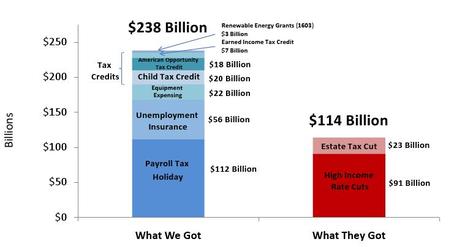
I’m not buying it. How about you?
Death of a Salespitch
Posted: December 5, 2010 Filed under: Catfood Commission | Tags: Catfood Commission, Social Security, Social Security Reform 48 CommentsI’m really hoping that Stan Collender has got it right. He’s arguing in short form today that the Cat Food Commission 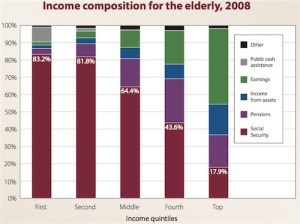 is dead with a promise of further details in an upcoming column at Roll Call. His first argument seems pretty reasonable. The Report needs 14 to pass and only 11 participants seem willing to do so. Here are his others.
- The 11 members of the commission who favored the plan likely overstates the actual amount of support. It seems clear that at least two and maybe more announced their support only when they were certain the plan wouldn’t get 14 votes. Their approval was more about political posturing for the future than actual enthusiasm.
- Don’t read too much into the bipartisan support for some of the options. If these same proposals are considered at all, they will next be debated in a very different political context and in a package that will look very different from the one the commission considered. Support for them in the commission is no indication they will be supported again.
- Don’t read too much into the enthusiastic response the plan received from various deficit hawk groups. Many of them supplied the commission with staff, helped develop what ultimately was proposed, and had a stake in its outcome. Under these circumstances, their enthuisastic approval and attempt to define the outcome as a success was not at all suprising. It’s also not especially indicative of any larger movement toward what was proposed.
I’m actually finding the power of the nifty graph from Matt Ygelisias at TP an even more compelling reason. He’s posting a response to Paul Krugman who can’t believe that the Beltway crowd is so obsessed with ruining social security. Krugman’s blog post today also contains his thoughts and the same nifty graph.
Look at the number of seniors that rely on social security for the majority or near majority of their incomes. That’s just income quintiles. You know that the distribution is skewed right (i.e population is largest on the lower ends.) Who wants to turn their life savings and major income source in old age over to a bunch of Wall Street High rollers or even worse, have it diced and sliced into pieces that you may or may not receive?
Even though Social Security is only a very mildly redistributive program, inequality of wealth is such that it’s a vital element of the bottom 60 percent’s living standards but kind of small beer to the top twenty percent. But I would say the other thing here on the Medicare / Social Security contrast is that Medicare isn’t just a subsidy program for old people. It’s also a subsidy program for doctors, nurses, hospital administrators, pharmaceutical executives, etc. Those people have lobbyists, many of their professions are well-respected, and many members of the political/media elite have siblings, cousins, college buddies, and even spouses who work in those fields.
The tragedy is that this very same factor that makes it harder to cut Medicare is also why cutting Social Security is a much worse idea. Our health care sector is low productivity mess and there are a lot of health-improving things a low-income senior can buy with Social Security money but can’t buy with Medicare. Healthy food, a gym membership, home-repair, etc.
Baby Boomers may not be a monolithic group, but I have to think that since most of us had our private savings and our home values chewed up and spit out by hedge funds and investment banks, we’re not going to go quietly into the night while having our social security gutted. I can’t imagine our remaining parents are going to be happy about it either since most of them have been paying in to the program since its initiation. Also, remind your children that should this pass, you will be expecting a room in their house because you will need it.
The graph and a lot of good information is from Our Fiscal Security. That’s the organization that I wrote about earlier that came up with a liberal response to the Bowles-Simpson ice floes plan. Let me just remind you of a few things from them about our Social Security.
- Social Security is currently in surplus and will take in more than it pays out until at least 2037, more than a quarter century from now.
- Raising the employer and employee payroll tax rates by just 1.1 percent each would erase the entire 75-year projected shortfall.
- Inequality leads to the projected Social Security shortfall: as income growth has become concentrated at the top, more income has fallen above the payroll cap of $106,800. Congress could close the entire 75 year projected funding gap by raising or eliminating the cap on taxable payroll income.
- Not just an I.O.U.: Income to the Social Security trust funds must be invested in guaranteed Treasury securities, which can be redeemed at any time at face value, giving the trust funds the same flexibility as cash.
- Social Security can never add to the yearly deficit; by law it cannot draw a single dollar from general revenues, even if payroll taxes fall short of scheduled benefits.
There’s a few more points out there if you’d like to go read them. It’s a data worth sending to your Congress Critterz.
Tuesday Reads
Posted: November 30, 2010 Filed under: morning reads | Tags: Arab States, Budget Deficit, dread bunny Roberts, Federal Deficit, Federal Reserve, fiscal security, iran, Obama federal worker's salary freeze, Social Security, Wikileaks 58 Comments good morning!!!

Well, the top story is still the Wikileak’s data drop of all those diplomatic cables. Here’s an interesting take on all the information that was released about the Arab states and their feelings about Iran by The Atlantic.
Sure, we knew that Middle East governments were concerned about Iran. But we didn’t know to what degree. The cumulative impact of these cables is profound.
King Abdullah of Saudi Arabia, the largest, wealthiest, and among the most conservative Middle East nations, made “frequent exhortations to the US to attack Iran and so put an end to its nuclear weapons program,” the American embassy in Riyadh reported in April 2008. “He told you to cut off the head of the snake,” one of the King’s aides reminded the American ambassador to Iraq Ryan Crocker and Gen. David Petraeus when they were in the kingdom for a two day visit.
From tiny Bahrain, King Hamid, in a meeting with Gen. Petraeus seven months later, said that Iran was the source for much of the trouble in Iraq and Afghanistan. “He argued forcefully for taking action to terminate their nuclear program, by whatever means necessary,” according to a leaked cable from the American embassy there. “That program must be stopped,” the King told Gen. Petraeus. “The danger of letting it go on is greater than the danger of stopping it.”
This the same chilling language, which the American public is accustomed to hearing from hardline Israeli officials. Hearing it expressed by Muslim leaders in the Middle East might now have a profound effect on American public opinion.
Robert Mackey at the Lede Blog of the NYT has a group of things up that you may want to explore including videos and reactions from around the world. This one from Iran and its president takes the cake.
Asked about the leaked American cables — some of which frankly reveal the enmity of Arab leaders for Iran — Iran’s president, Mahmoud Ahmadinejad, told reporters in Tehran, “let me first correct you. The material was not leaked, but rather released in an organized way,” Iran’s state-run Press TV reported.
As my colleagues William Yong and Alan Cowell add:
Mr. Ahmadinejad said at a news conference on Monday that Iran’s relations with its neighbors would not be damaged by the reports.
“Regional countries are all friends with each other. Such mischief will have no impact on the relations of countries,” he said, according to Reuters.
“Some part of the American government produced these documents,” he said. “We don’t think this information was leaked. We think it was organized to be released on a regular basis and they are pursuing political goals.”
According to Press TV, Mr. Ahmadinejad also said the cables, “have no legal value and will not have the political effect they seek. He also called the documents released by WikiLeaks a “game,” adding that they are “not worth commenting upon and that no one would waste their time reviewing them.”
That seems to provide an answer to how Tehran would react to the disclosure of information that the leaders of several Arab countries had encouraged the United States to take action to stop its nuclear program. Speaking of Iran, Saudi Arabia’s King Abdullah, for instance, is quoted in the documents urging Washington to “cut off the head of the snake” while there was still time.
What’s that old joke about de Nile and it not being just a river in Egypt?
Progrowth liberal has a post up about Obama’s proposed two year salary freezes for federal workers. The title sounds oddly familiar. I bet if you do a search of this blog, you’ll find an old post or two with that same title. Hmmm. The title is ‘Barack Hoover?‘
This strikes me as short-term fiscal restraint but not a really serious attempt to getting the long-term fiscal house in order. In other words precisely the opposite of what we should be doing while in a very depressed economy. So why would this President make such a recommendation?
Okay, so my thought was it’s really an 11th dimensional chess move by the President to make sure he gets credit for Republican policies that pass before the Republicans can do it so he can move towards reelection when he’ll REALLY start work on those FDR initiatives Yes? (No, I didn’t write that with a straight face.) Or, we can follow PGL’s suggestion to Lawrence (Larry) Mishell over at Economic Policy Institute and a post called ‘Federal pay cuts: A bad idea for what gain?’ Go check the table out–not nifty but still useful–and then you’ll see why Mishell’s bottom line is what it is.
This is another example of the administration’s tendency to bargain with itself rather than Republicans, and in the process reinforces conservative myths, in this case the myth that federal workers are overpaid. Such a policy also ignores the fact that deficit reduction and loss of pay at a time when the unemployment rate remains above 9% will only weaken a too-weak recovery
So, what I want to know is who is he listening to because it certainly doesn’t seem like it’s any economists that I can find or read. Not even the monetarists and the conservatives are supporting these things.
The House will be voting on a bill to extend tax cuts to the middle class. You may want to check out the process on CSPAN. Here’s the coverage of that from The Hill. Frankly, I don’t need no stinking tax cuts. I need a damned job! I also would like Wall Street to stop looting my retirement savings.
Lawmakers said there was only a limited discussion of the tax cut issue at a caucus meeting Monday night. No final decisions on the timing or procedure for votes are expected until after congressional leaders meet with Obama at the White House on Tuesday, the chairman of the House Ways and Means Committee, Rep. Sander Levin (D-Mich.), said.
Van Hollen told reporters that the House vote would likely be held under a traditional rule, meaning Republicans would have at least one chance to offer an amendment to expand the tax cuts beyond the $250,000 level. If Democratic leaders hold the vote under suspension rules, the GOP would have no such opportunity but a two-thirds majority would be required for approval.
GOP leaders have argued against any tax hikes during a fragile economic recovery, saying that an increase for the top brackets could stifle small businesses.
Okay, so let me get this straight. The GOP calls it “a fragile economic recovery’ for folks making more than $250k a year, but thinks that extending unemployment benefits for the nation’s long term unemployed is just about enabling whining, lazy people so it’s just a bad idea. Right, ideology over economics and people. Check.
Oh, speaking of ideology and bunnies over economics and people, here’s another take on that stupid video about the QE2 and the Ben Bernank. It comes from Richard Alford–a retired economist for the NY FED–who guestposts on Naked Capitalism. (Oh, and any bunnies that talk like that down here get put into gumbo pots, just a warning.)
The video is popular and effective because it is not a detailed-footnoted-rigorous academic exercise. It humorously plays on what a substantial fraction of the audience already perceive to be true. It takes swipes at what many viewers see as an institution that is charged with promoting economic welfare yet they see it both detrimentally affecting their lives as well being arrogant and well insulated from accountability.
The Fed dismissed its critics while the housing bubble grew. It did so to its own detriment as well as to the detriment of the real economy and the financial sector. Those who defend of the Fed against the criticisms in this video may win every definitional battle, but they will lose the war for the hearts, minds and confidence of the American people.
Alford lists some things that the FED can do to counter the perceptions in the video that are at the heart of its effectiveness and viral status. It is more about how people feel rather than what they don’t know.
A liberal response was released to the Cat Food Commission. Matt Yglesias overviews it and links to the entire document. You may want to check it out. It doesn’t recommend devastating Social Security which is nice. If my kids were to support ruining Social Security, my assumption would be that they’re planning a house with a room for me some time soon. You might try that tactic with any mouthy young’n wanting privatization near you. Tell them that their moms will be moving back in with them or ask your kids which sofa is yours and when is it okay to move in? (Actually, I have to h/t Susie Madrak for that one. It’s a good suggestion.) This blueprint balances the budget by 2018.
Liberals didn’t like the Simpson-Bowles deficit plan largely because neither Simpson nor Bowles is a liberal so their proposal doesn’t encapsulate liberal thinking. Today the Our Fiscal Security coalition, comprised of Demos, the Economic Policy Institute, and the Century Foundation have released their fiscal blueprint which shows you would that liberal take would look like.
If you go to the site, you’ll find more details on Our Fiscal Security. It also has a lot of interesting links to facts on the budget, the deficit, taxes, jobs, and the recovery.
Putting our nation on a path of broad prosperity will require generating new jobs, investing in key areas, modernizing and restoring our revenue base, and greatly increasing the cost efficiency of the health care system. Achieving these goals, however, will require an informed and engaged public to help set national priorities.
The following report puts forth a blueprint that invests in America and creates jobs now, while putting the federal budget on a long-term sustainable path. We document the hard choices that need to be made and suggest specific policies that will yield lower deficits and a sustainable debt while preserving essential initiatives and investments.
Not that’s a refreshing change to the statements of glee about gridlocking the federal government and all its services coming from Simpson McScrooge doesn’t it?
Oh, and in keep in line with all of this spending stuff, did you read this at HuffPo?
The Obama administration will spend less than a quarter of the $50 billion it promised to homeowners facing foreclosure, the nonpartisan Congressional Budget Office said in a report Monday.
The CBO projection raises fresh questions about the success of the administration’s foreclosure-prevention efforts and its commitment to helping homeowners, even as unemployment hovers near 10 percent. Corporations and large banks appear to be in full-fledged recovery — last quarter, corporate profits reached an all-time high of $1.66 trillion on an annual basis — but households and small businesses seem to have been left out.
Washington policymakers talk constantly about helping “Main Street” recover from the steepest downturn since the Great Depression. Spending less than a quarter of the money promised to help residents of “Main Street” keep their homes may not seem in line with that goal
Okay, so, that’s about it from me this morning. I’m not sure how much of this FDR-style policy I can handle. I might become a socialist and you’ll have to search under your beds for me daily.
[MABlue’s spooky pick]
Because BostonBoomer did a great job spooking us early this morning, I decided to stick with the program by sharing a story I read a couple of days ago.
CIA successfully inherited KGB’s psychoactive drugs technology
“The most important evidence to prove the use of psychotropic substances in “the land of the free” is the “KUBARK Counterintelligence Interrogation” manual, which was declassified in 1997. The manual was used by CIA counterintelligence from 1963 to 1985. According to the document, US special services used such methods as disrupting human biorhythms, threats, physical violence, hypnosis and narcotics.
“The USA used such methods in all armed conflicts in which the country was involved. Now look at what they do to Guantanamo prisoners. To crown it all, The Washington Times wrote in 2001 that US federal courts could approve the use of the serum of truth in the search for Bin Laden.
“Therefore, it does not seem appropriate for Americans or British to stir hysteria about “brutal Russians using inhuman methods for obtaining confessionary statements”
Oh! While you’re there you can also read this:
C.I.A.: Cocaine Import Agency
The increase of drugs in the U.S. and the EU, and the global drug trade, go hand in hand with imperial military expansion around the world. The “fight against drugs is a farce … ”
The Mercury News of San Jose, California, revealed that CIA agents sold hundreds of tons of cocaine in the U.S. during the years of the conflict in Nicaragua, in order to obtain funds for the Contras (US-created paramilitaries to prevent the Sandinista revolution). The report explains that Contra leaders met with a CIA agent to plan the operation. The drugs were transported in military aircraft to airports in Texas.
The drugs were first distributed in the black ghettos of Los Angeles, California, from there it spread throughout the country. In the early 80’s, crack and cocaine ravaged neighborhoods in the U.S., destroying the brains and the will to fight and protest.

 peej
peej Carissa
 bostonboomer
 dakinikat
 ecocatwoman
 mablue2
 Mama Lopez
 peggysue22
 quixote
 skydancingguestblogger
 Mona (aka Wonk the Vote)



 Sky Dancing
Recent Comments