In the summer of 2015, America caught a glimpse of how its future could unfold. The US military conducted a routine exercise in the south that triggered a cascade of conspiracy theories, particularly in Texas. Some believed the manoeuvre was the precursor to a Chinese invasion; others thought it would coincide with a massive asteroid strike. The exercise, called Jade Helm 15, stood for “homeland eradication of local militants”, according to one of the right’s dark fantasy sites. Greg Abbot, Texas’s Republican governor, took these ravings seriously. He ensured that the 1,200 federal troops were closely monitored by the armed Texas National Guard. In that bizarre episode, which took place a year before Donald Trump became the Republican nominee for president, we see the germs of an American break-up.
As with any warning of impending civil war, the very mention of another American one sounds impossibly alarmist — like persistent warnings from chief Vitalstatistix in the Asterix comic series that the sky was about to fall on Gaulish heads. America’s dissolution has often been mispredicted.
Yet a clutch of recent books make an alarmingly persuasive case that the warning lights are flashing redder than at any point since 1861. The French philosopher Voltaire once said: “Those who can make you believe absurdities can make you commit atrocities.” As the University of California’s Barbara Walter shows in her bracing manual, How Civil Wars Start, US democracy today is checking all the wrong boxes.
Dachshund Puppies by Otto Bache
Even before Trump triumphed in the 2016 presidential election, political analysts were warning about the erosion of democracy and drift towards autocracy. The paralysing divisions caused by Trump’s failed putsch of January 6, 2021, has sent it into dangerous new territory. Polls show that most Republicans believe, without evidence, that the election was stolen by Democrats backed by the so-called “deep state”, the Chinese government, rigged Venezuelan voting machines, or a feverish combination thereof.
In This Will Not Pass, a book by New York Times reporters Jonathan Martin and Alexander Burns, Joe Biden is quoted telling a senior Democrat: “I certainly hope [my presidency] works out. If it doesn’t I’m not sure we’re going to have a country.” That a US president could utter something so apocalyptic without raising too many eyebrows shows how routine such dread has become.
You’ll be hearing a lot about Watergate in the next several weeks, as the 50th anniversary of the infamous June 17, 1972, burglary at the Democratic National Committee headquarters approaches. There will be documentaries, cable-news debates, the finale of that Julia Roberts miniseries (“Gaslit”) based on the popular Watergate podcast (“Slow Burn”). I’ll be moderating a panel discussion at the Library of Congress on the anniversary itself — and you can certainly count on a few retrospectives in this very newspaper.
The scandal has great resonance at The Washington Post, which won a Pulitzer Prize for public service in 1973 for its intrepid reporting and the courage it took to publish it. And it has particular meaning for me, because, like many others of my generation, I was first drawn into journalism by the televised Senate hearings in 1973, and I was enthralled by the 1976 movie “All the President’s Men,” based on the book by Post reporters Bob Woodward and Carl Bernstein.
Young Girl Reading by Joseph W. Gies
Yet thinking about Watergate saddens me these days. The nation that came together to force a corrupt president from office and send many of hisco-conspiratoraides to prison is a nation that no longer exists.
“The national newspapers mattered in a way that is unimaginable to us today, and even the regional newspapers were incredibly strong,” Garrett Graff, author of “Watergate: A New History,” told me last week. I have been immersed in his nearly 800-page history — a “remarkably rich narrative,” former Post executive editor Leonard Downie Jr. called it in a review — which sets out to retell the story.
Americans read about Watergate in their daily papers and watched the dramatic hearings on television. Gradually, public opinion changed and Nixon was forced to resign. Sullivan writes and Graff argues conditions are very different today.
Our media environment is far more fractured, and news organizations are far less trusted.
And, in part, we can blame the rise of a right-wing media system. At its heart is Fox News, which was founded in 1996, nearly a quarter-century after the break-in, with a purported mission to provide a “fair and balanced” counterpoint to the mainstream media. Of course, that message often manifested in relentless and damaging criticism of its news rivals. Meanwhile, Fox News and company have served as a highly effective laundry service for Trump’s lies. With that network’s help, his tens of thousands of false or misleading claims have found fertile ground among his fervent supporters — oblivious to the skillful reporting elsewhere that has called out and debunked those lies.
As Graff sees it, the growth of right-wing media has enabled many Republican members of Congress to turn a blind eye to the malfeasance of Team Trump. Not so during the Watergate investigation; after all, it was Sen. Howard Baker (R-Tenn.) who posed the immortal question: “What did the president know, and when did he know it?” Even the stalwart conservative Sen. Barry Goldwater (Ariz.) was among those who, at the end, managed to convince Nixon that he must resign.
Video obtained by ABC News, taken outside Robb Elementary School in Uvalde, Texas, as last week’s massacre was unfolding inside, appears to capture a 911 dispatcher alerting officers on scene that they were receiving calls from children who were alive inside the classroom that the gunman had entered — as law enforcement continued to wait nearly an hour and a half to enter the room.
Puppies, by Federico Olaria
“Child is advising he is in the room, full of victims,” the dispatcher can be heard saying in the video. “Full of victims at this moment.”
“Is anybody inside of the building at this…?” the dispatcher asked.
Minutes later, the dispatcher says again: “Eight to nine children.”
The video, obtained by ABC News, also shows police rescuing children from inside the school by breaking through a window and pulling them out, and also leading them out the back door to safety….
The video, which appears to show some of what took place outside the school, raises new questions about law enforcement’s response to one of the nation’s deadliest school shootings, which left 19 children and two teachers dead.
The gunman was left inside the classroom for 77 minutes as 19 officers waited in the hallway — and many more waited outside the building — after the incident commander wrongly believed the situation had transitioned from an active shooter to a barricaded subject, law enforcement has said.
Supreme Court officials are escalating their search for the source of the leaked draft opinion that would overturn Roe v. Wade, taking steps to require law clerks to provide cell phone records and sign affidavits, three sources with knowledge of the efforts have told CNN.
Some clerks are apparently so alarmed over the moves, particularly the sudden requests for private cell data, that they have begun exploring whether to hire outside counsel.
Ticket Home, by Christina Ramos
The court’s moves are unprecedented and the most striking development to date in the investigation into who might have provided Politico with the draft opinion it published on May 2. The probe has intensified the already high tensions at the Supreme Court, where the conservative majority is poised to roll back a half-century of abortion rights and privacy protections.
Chief Justice John Roberts met with law clerks as a group after the breach, CNN has learned, but it is not known whether any systematic individual interviews have occurred.
Lawyers outside the court who have become aware of the new inquiries related to cell phone details warn of potential intrusiveness on clerks’ personal activities, irrespective of any disclosure to the news media, and say they may feel the need to obtain independent counsel.
“That’s what similarly situated individuals would do in virtually any other government investigation,” said one appellate lawyer with experience in investigations and knowledge of the new demands on law clerks. “It would be hypocritical for the Supreme Court to prevent its own employees from taking advantage of that fundamental legal protection.”
I’ll end with a story that isn’t completely negative. It’s an interview with First Lady Jill Biden at Bazaar: A First Lady Undeterred.
In November 2020, when Joe Biden was elected president, the win seemed to validate not just his decision to enter this race but his entire career in politics. He has been grieving in public since he was sworn in to the United States Senate in 1973 from the hospital where his two young sons were recovering from the car crash that killed his first wife, Neilia, and their one-year-old daughter, Naomi. He married Jill five years later. Toward the end of his second term as vice president, in 2015, one of those sons, Beau, died of brain cancer. He resolved to launch this bid—his third in three decades—after watching white nationalists march on Charlottesville in 2017. The nation was sick and divided. He wanted to heal it.
Pierre Bonnard, Andree Bonnard with her dogs
When the ballots were tallied, Biden was declared the winner. But in the meantime, America had further deteriorated. It was battling one novel virus and several older ones. The pandemic had exposed long-festering discrimination and hate. Hundreds of thousands of people had died. Biden had the kind of credentials no one envies; few in politics could claim more experience with sorrow.
Pundits wrote that Joe Biden had met his moment. But Jill Biden—a patient educator in an era of rampant misinformation, a woman so determined to be present for her people that she spent one weekend in March straining the limits of the space-time continuum—was there to greet it too.
Now the moment has changed. The pandemic stretches on, with new variants making quick work of the Greek alphabet. Health-care workers are burnt out. Teachers are exhausted. The Russian invasion of Ukraine is devastating—and driving up the cost of fuel amid rampant inflation. Biden’s approval numbers have sunk into the low 40s. Several polls ahead of the midterm elections predict dire losses for Democrats, with both the House and the Senate threatening to slip into Republican control.
It’s not the kind of environment that sets an obvious course for the nation’s most scrutinized political spouse—let alone for one who describes herself as an introvert and was so lukewarm on the rites and rituals of the Washington horse race that she spent her husband’s entire Senate career at their home in Delaware. But perhaps that’s for the best. In the absence of a guidebook, Jill Biden is writing her own.
Senate Democrats clinched a deal on Friday night over unemployment benefits that will smooth the upper chamber’s passage of President Joe Biden’s $1.9 trillion coronavirus relief bill this weekend.
After about a nine-hour delay following Sen. Joe Manchin’s (D-W.Va.) resistance to an earlier agreement on jobless payments, party leaders announced a new accord with Manchin. The latest deal would provide $300 a week in extra unemployment benefits through Sept. 6, and up to $10,200 in tax relief for unemployed workers.
Democratic leaders also agreed to limit eligibility for that tax relief, restricting the tax-free status of the benefits to households with incomes under $150,000 a year.
By Ophelia Redpath, 1965
The White House quickly announced its support after endorsing the earlier compromise.
“The President supports the compromise agreement, and is grateful to all the senators who worked so hard to reach this outcome,” White House press secretary Jen Psaki said in a statement on Friday night.
With Manchin’s objections eased, Democrats plowed forward with a marathon “vote-a-rama” — an all-night ordeal in which any senator can offer an amendment to Biden’s bill. The Senate is now on track to pass the package on Saturday….
After Senate passage, the bill will go back to the House, where lawmakers must approve the changes before it reaches Biden’s desk.
A growing number of Senate Democrats are warming to the idea of eliminating the filibuster as they encounter Republican resistance to President Biden’s legislative agenda, forcing the White House to cut deals on issues like the minimum wage and pandemic relief payments.
If the founders envisioned the upper chamber as a “cooling bowl” to moderate more extreme bills passed by the House, the filibuster has often been a deep freezer, infamously deployed by Southern racists to quash reforms during the civil rights era….
Two Senate Democrats — Joe Manchin III of West Virginia and Kyrsten Sinema of Arizona — have said they will oppose any effort to do away with the rule, making any rollback a long shot. Mr. Biden and Senator Chuck Schumer, the majority leader, have been noncommittal about eliminating the filibuster.
Two Senate Democrats — Joe Manchin III of West Virginia and Kyrsten Sinema of Arizona — have said they will oppose any effort to do away with the rule, making any rollback a long shot. Mr. Biden and Senator Chuck Schumer, the majority leader, have been noncommittal about eliminating the filibuster….
By Tatyana Struchkova
On Thursday, Senator Tina Smith of Minnesota took to Twitter to declare her support for ending the filibuster. “The Senate needs to abolish the filibuster. It’s undemocratic,” she wrote, adding, “We need to move this country forward.”
A member of the far-right nationalist Proud Boys was in communication with a person associated with the White House in the days just before the Jan. 6 assault on the Capitol, according to a law enforcement official briefed on the investigation.
Location, cellular and call record data revealed a call tying a Proud Boys member to the Trump White House, the official said. The F.B.I. has not determined what they discussed, and the official would not reveal the names of either party.
The connection revealed by the communications data comes as the F.B.I. intensifies its investigation of contacts among far-right extremists, Trump White House associates and conservative members of Congress in the days before the attack….
By Christilla Germain
Separately, Enrique Tarrio, a leader of the far-right nationalist Proud Boys, told The New York Times on Friday that he called Roger J. Stone Jr., a close associate of former President Donald J. Trump’s, while at a protest in front of the home of Senator Marco Rubio, Republican of Florida. During the protest, which occurred in the days before the Capitol assault, he put Mr. Stone on speaker phone to address the gathering.
A law enforcement official said that it was not Mr. Tarrio’s communication with Mr. Stone that was being scrutinized, and that the call made in front of Mr. Rubio’s home was a different matter. That two members of the group were in communication with people associated with the White House underscores the access that violent extremist groups like the Proud Boys had to the White House and to people close to the former president.
In response to this story, attorney Luppe B. Luppen (@Southpaw on Twitter) was reminded of an interesting January 6 tweet by CNN’s Jim Acosta:
Democratic Rep. Zoe Lofgren has quietly posted a nearly 2,000-page report documenting social media posts by her Republican colleagues who voted against certifying results of the presidential election on January 6. The information compiled isn’t secret, but the report is another sign of the deep distrust that has settled into the US Capitol in the weeks since the insurrection.
The report chronicles the social media activity of members on public forums immediately before the November election and right after the January 6 riot. The report has been online for a week.
CNN reported earlier Thursday that federal investigators are examining records of communications between members of Congress and the pro-Trump mob that attacked the Capitol, as the investigation moves closer to exploring whether lawmakers wittingly or unwittingly helped the insurrectionists….
By Catriona Millar
“Any appropriate disciplinary action is a matter not only of the Constitution and law, but also of fact,” the California Democrat wrote. “Many of former President Trump’s false statements were made in very public settings. Had Members made similar public statements in the weeks and months before the January 6th attack? Statements which are readily available in the public arena may be part of any consideration of Congress’ constitutional prerogatives and responsibilities.” [….]
“Like former President Trump, any elected Member of Congress who aided and abetted the insurrection or incited the attack seriously threatened our democratic government. They would have betrayed their oath of office and would be implicated in the same constitutional provision cited in the Article of Impeachment,” Lofgren wrote in her foreword to the report. “That provision prohibits any person who has previously taken an oath as a member of Congress to support the Constitution but subsequently engaged in insurrection or rebellion from serving in Congress.”
Communications from Rep. Paul Gosar of Arizona are heavily represented in the report:
The report features a collection of social media posts and tweets that span dozens of pages from Arizona Rep. Paul Gosar where he urges supporters to “hold the line,” days before what would become the Capitol insurrection. In another social media post included in the report, Gosar wrote that “sedition and treason for stealing votes is appropriate.”
The report also captures numerous tweets where Gosar invoked @ali on Twitter, which was formerly the account used by Ali Alexander, a leader of the “Stop the Steal” group, who said in several Periscope livestream videos that he planned the rally that preceded the riot in conjunction with Gosar and two other congressional Republicans, Mo Brooks of Alabama and Andy Biggs of Arizona.
With bright red and white stripes across his body and stars down his sleeves, the man in the American flag jacket and “FLORIDA FOR TRUMP” hat wielded a fire extinguisher while charging the U.S. Capitol on the afternoon of Jan. 6. He shoved his way through the crowd of rioters to the police line, then sprayed officers at close range before chucking the emptied canister at them. By nightfall he himself had been lightly harmed, apparently by a police crowd control munition. He held up his shirt to show off his bruised gut during an interview with a female journalist filming him live as cops pushed the mob back from Capitol grounds. Then he looked straight into her livestreaming device and identified himself as Robert Palmer from Clearwater, Florida.
By Andrie Martens
At this point, the man had not only assaulted federal officers before a sea of smartphones while wearing highly distinctive attire, he’d also willingly revealed his own name and hometown on video at the scene of the crime — while still in the same outfit.
This isn’t your typical “Florida Man” story, despite its absurdity. This is the story of a violent insurrectionist who’s still at large — nearly two months later — and one woman who joined the online sleuthing communities crowdsourcing their efforts to bring a Capitol attacker to justice.
Robert Scott Palmer is a white 53-year-old husband and father who runs Son Bright Systems, a cleaning and restoration business. His criminal record includes being sentenced on charges of battery and felony fraud.
HuffPost verified his identity through a search of public records and social media accounts associated with Palmer, after receiving a tip from Amy, a woman living in a rural area out west who in her free time joined the #SeditionHunters network, an online sleuthing community seeking to identify the hundreds of Trump supporters who rioted at the Capitol. (Amy is a pseudonym she chose to protect her privacy.)
Reached by phone late Thursday afternoon, Palmer confirmed he was at the Capitol on Jan. 6 and gave the livestream interview. He claimed that he’d done nothing to justify being struck with the police munition, and that the Biden administration was trying to “vilify the patriots” who were involved in the riot.
Read more about Palmer at the HuffPo link. I wonder why he’s still at large?
It’s September, but it feels like July here in Boston. We’re having another heat wave, and the same is true in many other parts of the country. Fortunately, most of us will get some relief later in the week.
Hot temperatures have dominated parts of the Midwest, Plains and East during the first week of September, with highs topping out well into the 80s and 90s at times. While some might be enjoying this late-summer heat and humidity, others are probably ready for the air to have more of a fall feel east of the Rockies. For those in the latterI’ camp, we do have some good news on the horizon thanks to a rearrangement of the jet stream pattern.
For the Midwest and parts of the East, temperatures will drop to near-average or even below-average levels as the week progresses. In fact, some cities in the Midwest may see high temperatures fall 20 degrees or more from early week into mid or late week. Even more impressive is the temperature drop from highs early this week to lows later in the week. For example, Chicago had a high of 92 degrees on Sunday but will see lows in the 50s late in the week, a drop of more than 30 degrees.
Before the cooler air arrives in the Northeast, daily record high temperatures will be threatened in multiple locations, including New York City, Philadelphia, Hartford and Boston on Tuesday.
Meanwhile, the West Coast will see the opposite impact from this pattern change with temperatures soaring above average all the way into the Pacific Northwest.
Read all the details at the link.
People cool off at fountains on Rose Kennedy Greenway, Boston
Back in 1881, the mercury rose to a stifling 102 degrees in Boston for the hottest temperature in the record books during the month of September. This was also one of the hottest days ever in Boston.
Typically our highs would be in the 70s closing out the first week of September, during a cool year we might stay in the 60s while other warmer years would reach the 80s. Today marks only the 5th time since records began in Boston we have reached 90 degrees on September 7th.
Heat Wave Number 2
Having already eclipsed the 90 mark, it’s almost a sure bet we are beginning a 3 day heat wave. Remember, heat waves are 3 days or more in a row when the high temperature reaches at least 90 degrees. Tomorrow and Wednesday are even hotter and as the humidity slowly climbs the heat indices could get near 100 degrees for a few hours either or both days.
The map below shows highs in the mid-90s tomorrow. This would be the 9th time Boston has reached 90 on the 8th of September. The record for tomorrow is 95 and there is a chance would could tie that record.
Another 90 degree day on Wednesday will make it an official heat wave. There are only 3 days where it’s reached 90 on the 9th and this year should make 4. The record Wednesday is 91 and we would likely set a new record.
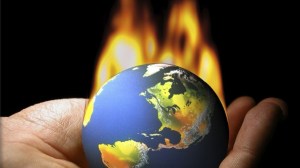
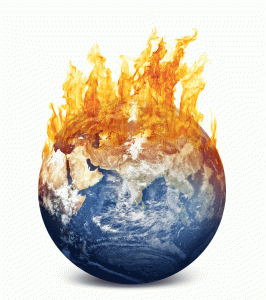
On days like this, I can’t help thinking about our changing climate and how it will affect future generations. This is another reason why we must elect a Democratic president next year. President Obama has been able to make some progress on this issue through executive orders; to build on his efforts, we desperately need to elect Hillary Clinton president and hope that she can bring along enough Democrats to regain the Senate.
The battle for control of the Senate rests on the outcome of the presidential race, strategists in both parties say.
Since 1860, no party has been able to climb out of the minority to capture the Senate during a presidential election year without also winning the White House….
Democrats appear well positioned to knock off two Republican incumbents, but whether they can stretch the number of Senate pick-ups to the necessary four or five while defending two of their own vulnerable seats remains to be seen.
The election map favors Democrats. They are defending only 10 Senate seats, while Republicans are protecting 24, including seven in states carried by President Obama in 2012.
But Democrats are running against the grain of history by trying to keep the White House for three consecutive terms — a feat last accomplished by Republicans in 1988, when Ronald Reagan left office with a 53-percent approval rating. Obama’s approval rating, by comparison, stands at 45 percent, according to Gallup.
Just one more reason why we need to support Hillary. “The article quotes “Steve Elmendorf, a Democratic strategist, lobbyist and fundraiser.”
“Ted Strickland can beat Rob Portman if Hillary Clinton is winning Ohio. Pat Toomey, no matter how good he looks on paper and the problems we’re having with the primary, I think if you get to November and Democrats are winning Pennsylvania by a huge number, Toomey’s in a lot of trouble,” he said
“If Democrats don’t win the presidential race, I don’t think we’ll win the Senate,” he added.
The map of key Senate races largely matches up with the map of presidential battlegrounds.
Aside from Wisconsin and Illinois, where Republican incumbent Sens. Ron Johnson (Wis.) and Mark Kirk (Ill.) are fighting for their political lives in blue states, the most competitive Senate contests are in presidential swing states.
Johnson trails former Democratic Sen. Russ Feingold in Wisconsin by five points, according to a mid-August Marquette Law School poll, and Democrats predict Feingold will raise more money.
Kirk, meanwhile, lagged six points behind Rep. Tammy Duckworth (D-Ill.) in a late-July survey by Public Policy Polling, a Democratic firm.
Two new studies are adding to concerns about one of the most troubling scenarios for future climate change: the possibility that global warming could slow or shut down the Atlantic’s great ocean circulation systems, with dramatic implications for North America and Europe.
The research, by separate teams of scientists, bolsters predictions of disruptions to global ocean currents — such as the Gulf Stream — that transfer tropical warmth from the equator to northern latitudes, as well as a larger conveyor system that cycles colder water into the ocean’s depths. Both systems help ensure relatively mild conditions in parts of Northern Europe that would otherwise be much colder.
The papers offer new insight into how rapidly melting Arctic ice could slow or even temporarily halt the ocean’s normal circulation, with possible effects ranging from plunging temperatures in northern latitudes to centuries-long droughts in Southeast Asia….
One study, by three scientists from Germany’s Alfred Wegener Institute, uses computers to model how Greenland’s rapid thawing could affect the Atlantic meridional overturning circulation, the system that pushes cold, dense saltwater into the deep ocean and helps transport warm water northward, helping to warm Europe’s climate.
Their report, in the journal Geophysical Research Letters, says previous research may have underestimated changes to the ocean from the huge influx of fresh, cold water from melting ice sheets. Using new methods, the German scientists were able to estimate more precisely how much ice would melt and how all that added freshwater would affect ocean circulation. In the ocean, colder water normally tends to sink, but cold freshwater — less dense than saltwater — stays near the surface, disrupting the normal flow.
The researchers concluded that we’ve already gone pretty far down the road on climate change, but there are still things society can do the prevent the worst scenarios from coming to pass.
A second paper, by a team of Texas scientists, sheds new light on how the Earth’s climate responded during a similar thaw from the planet’s geological past. About 12,000 years ago, rising temperatures at the end of the last ice age released huge volumes of cold freshwater, disrupting the ocean’s circulation systems and sending parts of the Northern Hemisphere back in to the freezer. Scientists refer to the era as the Younger Dryas period.
The study in the journal Nature Climate found a wide range of impacts, some of which lingered for centuries. While the far-northern latitudes experienced rapid changes — including an 18-degree Fahrenheit temperature drop in Greenland in less than a decade — droughts and other weather anomalies in the southern Pacific persisted for 1,000 years.
Here on planet Earth, things could be going better. The rise in atmospheric temperatures from greenhouse gases poses the most dire threat to humanity, measured on a scale of potential suffering, since Imperial Japan and Nazi Germany launched near-simultaneous wars of conquest. And the problem has turned out to be much harder to solve. It’s not the money. The cost of transitioning away from fossil fuels, measured as a share of the economy, may amount to a fraction of the cost of defeating the Axis powers. Rather, it is the politics that have proved so fiendish. Fighting a war is relatively straightforward: You spend all the money you can to build a giant military and send it off to do battle. Climate change is a problem that politics is almost designed not to solve. Its costs lie mostly in the distant future, whereas politics is built to respond to immediate conditions. (And of the wonders the internet has brought us, a lengthening of mental time horizons is not among them.) Its solution requires coordination not of a handful of allies but of scores of countries with wildly disparate economies and political structures. There has not yet been a galvanizing Pearl Harbor moment, when the urgency of action becomes instantly clear and isolationists melt away. Instead, it breeds counterproductive mental reactions: denial, fatalism, and depression.
It’s a long read. Chait covers the history of efforts to reverse climate change and then offers hope.
For human to wean ourselves off carbon-emitting fossil fuel, we will have to use some combination of edict and invention — there is no other plausible way around it. The task before the world is best envisioned not as a singular event but as two distinct but interrelated revolutions, one in political willpower and the other in technological innovation. It has taken a long time for each to materialize, in part because the absence of one has compounded the difficulty of the other. It is extremely hard to force a shift to clean energy when dirty energy is much cheaper, and it is extremely hard to achieve economies of scale in new energy technologies when the political system has not yet nudged you to do so.
And yet, if you formed a viewpoint about the cost effectiveness of green energy a generation ago (when, for instance, Ronald Reagan tore the costly solar panels installed by his predecessor off the White House roof), or even just a few years ago, your beliefs are out of date. That technological revolution is well under way.
For one thing, the price of solar is falling, and rapidly. In a March 2011post for Scientific American’s website, Ramez Naam, a computer scientist and technological enthusiast, compared the rapid progress of solar power to Moore’s Law, the famous dictum that described the process by which microchips grew steadily more useful over time, doubling in efficiency every two years. The price of solar power had fallen in two decades from nearly $10 a watt to about $3. By 2030, he predicted, the price could drop to just 50 cents a watt.
Read the whole thing at New York Magazine.
Those are my offerings for today. I’m going to turn was feeling sick on Sunday and Monday and I’m still a little wobbly today. Take, care, Sky Dancers and I hope the floor over to you now, because I’m recovering from a nasty stomach virus. I hope you have an enjoyable day.
Did you like this post? Please share it with your friends:
Wall Street Royal Jamie Dimon deigned to appear before a Senate Committee yesterday, and the Senators mostly sucked up to him. I’m surprised they didn’t ask if he needed a pillow for his chair. MSNBC: Senate treats JPMorgan CEO Dimon with kid gloves
Dimon was expected to receive a frosty reception in his first congressional appearance since he announced the bank sustained a trading loss some analysts now estimate is at least $3 billion. It was a massive loss for the nation’s biggest financial institution.
Instead, Dimon, who has won praise for bringing JPMorgan (JPM) through the financial crisis relatively unscathed, was treated cordially by most of members of the Senate Banking Committee. They peppered him with questions about regulation and risky practices at the bank, but did not press him to give an update on the losses resulting from the trade. JPMorgan is expected to give an update to shareholders when it reports its second-quarter earnings July 13.
“I think it was a pretty favorable day,” David Konrad, a Keefe, Bruyette & Woods banking analyst, told CNBC. Konrad said he was surprised that the questioning of Dimon by lawmakers was so “professional.”
Excuse me, “professional” for a Senator would have been sending this man to the woodshed. NPR’s Marketplace called the treatment of Dimon “a wake for Dodd-Frank.”
Yahoo has named the winner of the “Most Tepid Endorsement of Mitt Romney” contest: it’s a bumper sticker that reads “At least he’s not a communist.”
Until recently, it appeared that no one could unseat Indiana Gov. Mitch Daniels as the champion of the tepid Romney endorsement. Since Yahoo News started conducting reader polls on the politicians who supported Mitt Romney in the least enthusiastic terms, Daniels has defeated original champ George Pataki and defended the crown against Newt Gingrich, Rick Santorum and George W. Bush. (The former president came the closest to unseating Daniels.)
We thought the book was closed on the tepid endorsement bracket until Yahoo News reporter Chris Moody spotted a bumper sticker at last weekend’s regional CPAC conference in Chicago bearing these words of praise: “At least he’s not a communist.”
You can read the other tepid endorsements at the link.
First Romney made fun of Obama for wanting to help cities and states pay for cops, teachers, and firefighters. Then he went on Fox News and said it was a “strange accusation” for anyone to say he didn’t want to hire teachers and first responders.
After an extended skewering of President Obama for a gaffe about the private sector last week, ending with the charge that it was proof the president was “out of touch” Romney was asked by Fox and Friends’ Brian Kilmeade for his response to Obama saying it was Romney who was clueless (Romney’s comment comes at about the 1:40 mark) :
[BRIAN] KILMEADE: He says that you’re out of touch. He says you want to cut firefighters and teachers, that you don’t understand what’s going on in these communities. What do you say to that, Governor?
ROMNEY: Well, that’s a very strange accusation. Of course, teachers and firemen and policemen are hired at the local level and also by states. The federal government doesn’t pay for teachers, firefighters or policemen. So, obviously that’s completely absurd.
But of course the federal government does subsidize states and they often use the money to pay for these public employees. In fact, the reason so many teachers, firefighters and cops are getting laid off now is because stimulus money has run out.
Yesterday Mitt Romney claimed that it was “ completely absurd” of the Obama campaign to argue that he favors cutbacks in cops, firefighters and teachers. “The federal government doesn’t pay for teachers, firefighters or policemen,” Romney said, adding that they were paid by states and localities.
What’s getting lost in the back and forth here is that Romney’s actual economic plan would, in fact, cut billions of dollars in federal money that goes to cops, firefighters, and teachers — perhaps more than $10 billion a year, in fact.
This is the conclusion of the Center on Budget and Policy Priorities, which analyzed Romney’s plan through the prism of the debate over public workers at my request.
As Michael McAuliff reported yesterday, despite Romney’s claim, the federal government does give billions of dollars to states and localities through programs like Title 1, the COPS program, FEMA and others — which pay for first responders and teachers.
A full year into his presidential campaign, presumptive Republican nominee Mitt Romney will venture out of his Fox comfort zone this Sunday to make his first appearance on a rival network’s political talk show.
Romney has been interviewed several times on ”Fox News Sunday” this campaign cycle, but has declined repeated invitations to appear on any of the other Sunday shows, occasionally drawing scorn from veteran anchors accustomed to interviewing presidential candidates.
Let’s hope Shieffer asks a few tough questions. One thing Shieffer will probably ask about is Romney’s choice of Vice President. One of the leading contenders, Marco Rubio, announced yesterday that he supports the illegal Florida voter purge.
“How can you argue against a state identifying people who are not rightfully on the voter rolls?” he said at a Bloomberg event, according to the Tampa Bay Times.
Rubio’s comments put him in line with Florida Gov. Rick Scott (R) who on Tuesday declared the debate on the merits of the purge “over,” because the probe had supposedly turned up more than 50 non-citizen voters who had cast ballots.
The Department of Justice didn’t agree. Later Tuesday, it announced it was launching a federal lawsuit against Florida over complaints that the purge was taking place within 90 days of its August 14 primary election, as well as over its alleged violation of a voting rights law meant to prevent states from suppressing voters.
That might not help Romney win over Latino voters.
John Avlon has a piece at CNN on Jeb Bush and other “moderate” Republicans who are starting to fight back against Grover Norquist:
This is what happens when politics starts looking like a cult: Jeb Bush gets attacked for being a traitor to the conservative cause.
The former Florida governor has been speaking with the freedom of someone not running for office, saying that both his father and Ronald Reagan would have had a hard time in today’s hard-right GOP and questioning the wisdom of Grover Norquist’s absolutist anti-tax pledge.
That set off a fascinating public fight between Bush and Norquist, two faces of competing factions within Republican Party. It is the latest evidence of a growing GOP backlash against the ideological straitjacket Norquist has attempted to impose on governing in the United States.
And Jeb is not alone.
As it turns out, Norquist has reason to be concerned. It’s not just Jeb Bush. A growing number of Republicans are rejecting his pledge. Oklahoma conservative Sen. Tom Coburn called the pledge’s effective veto of deficit reduction plans “ridiculous” when talking with Erin Burnett on “OutFront.”
Sen. Lindsey Graham of South Carolina on Tuesday declared his independence from the pledge, saying, “We’re so far in debt, that if you don’t give up some ideological ground, the country sinks.”
Add to those voices seven other Republican U.S. senators — from Maine’s Susan Collins to Iowa’s Chuck Grassley to Wyoming’s John Barrasso — and 11 Republican House members, ranging from centrist New Yorker Richard Hanna to tea party Floridian Allen West.
In pedophile news, Jerry Sandusky had another bad day in court yesterday with three victims testifying that he manipulated and threatened them into putting up with his sick sexual behavior.
The trio of young men who testified against Jerry Sandusky on the third day of his sexual-abuse trial couldn’t have been more different in personality and temperament. Yet each of their testimonies was sexually graphic and disturbing—and midway through the prosecution’s fast-tracked arguments, a clear pattern has emerged in their allegations.
I’m not going to quote all of the sordid details–there are too many of them anyway. You can read it all at the link. I’ll just give you one excerpt that shows what Sandusky is all about:
Then, the witness told the jury of a time he visited the Sandusky home.
“We were in the basement. We were wrestling,” he said in a monotone frequently heard from abuse victims who have had to tell their stories multiple times. “The defendant pinned me to the floor, pulled down my gym shorts, and started to perform oral sex on me.” Asked by prosecutor Joe McGettigan what his reaction was at the time, the witness said, “I freaked out.”
“Did he ever say anything to you about it?” McGettigan asked.
“He told me if I ever told anyone I’d never see my family again,” the young man replied. “Later he apologized and said he didn’t mean it, that he loved me.”
I hope Sandusky goes to prison for life, and I want to see prosecutions of his enablers at Penn State. It’s an outrage that he was allowed to go on abusing children for years after many at the school knew about his behavior.
The National Review Board said that, a decade after the US Conference of Catholic Bishops issued a child protection charter, there has been a “striking improvement” in the way the Church deals with the abuse of minors by clergy.
“Children are safer now because of the creation of safe environments, and action has been taken to permanently remove offenders from ministry,” said the report, released as the Conference began its annual spring meeting in Atlanta.
But it acknowledged: “Despite solid evidence (to the contrary), many of the faithful believe that sexual abuse by clergy is occurring at high levels and is still being covered up by bishops.”
Well, what did they expect? I’m certainly not surprised. In fact I’d be surprised if there aren’t still pedophile priests abusing children.
Berlin police on Wednesday released photos an English-speaking teenage boy who wandered into the city nine months ago saying he had been living for the last five years in the forest with his father.
Police spokesman Thomas Neuendorf said all attempts to identify the boy since he emerged in the German capital on Sept. 5 have been unsuccessful, and they are now hoping the release of his photo may produce some leads.
“We have checked his DNA against all missing person reports, sent the data to Interpol so that they could check it internationally, but unfortunately without any success,” Neuendorf said.
The boy has told authorities his father called him “Ray” and that he was born June 20, 1994, but claims not to know his last name or where he’s from.
He said his mother, Doreen, died in a car accident when he was 12 and after that he and his father, Ryan, took to the forest. He said they wandered using maps and a compass, staying in tents or caves overnight.
He told authorities that after his father died in August, 2011, he buried him in the forest and then walked five days north before ending up in Berlin, and showed up at city hall.
As of last night, the identity of the boy was still a mystery even after release of the photos.
What’s on your reading and blogging list today?
Did you like this post? Please share it with your friends:
Good Morning news junkies! I’m filling in for WonktheVote today. She is taking a little break from blogging, so Dakinikat, Minkoff Minx, and I are going to take turns doing the Saturday Reads for a little while. So what’s in the news today? Let’s see…
After his blow-up-the-economy plan passed the House yesterday, John Boehner gave a very defensive-sounding speech to justify his treasonous behavior.
A defiant House Speaker John Boehner (R-Ohio) late Friday defended his debt-ceiling plan by saying it is the only viable plan on paper so far….
“I’ve offered ideas, I’ve negotiated,” Boehner said in closing debate on his bill. “Not one time, not one time did the administration ever put any plan on the table. All they would do is criticize what I put out there.
“I stuck my neck out a mile to try to get an agreement with the president of the United States,” Boehner continued to grumbling among Democrats. “Hey, I put revenues on the table in order to try to come to an agreement in order to avert us being where we are. But a lot of people in this town can never say yes.”
He also defended including the ridiculous balanced budget amendment to the Constitution in his bill.
“It’s time for this to happen,” he said. “It enjoys support from both houses of this Congress, and it enjoys bipartisan and widespread support across our country.”
Despite a day of frenzied legislative maneuvering and another attempt by President Obama to rally public opinion behind some kind of compromise, the two parties made no visible progress in finding common ground, leaving Washington, Wall Street and much of the nation watching the clock toward a deadline of midnight Tuesday.
Reid has made some changes in his plan, hoping to appeal to Senate Republicans. The NYT didn’t elaborate on what these changes are. At Huffpo, Michael McAuliff and Sam Stein say Reid’s plan is now a lot like Mitch McConnell’s. But whatever its contents, Republicans in the House plan to hold a “symbolic vote” on it today in order to “send a message” that whatever the Senate agrees on will not pass the House.
The seemingly unbridgeable impasse between the two parties as the deadline for raising the nation’s debt limit approaches has Tom Daschle losing sleep, as he never did when he was a Senate Democratic leader in the mid-1990s and Congressional Republicans forced government shutdowns rather than compromise on spending cuts.
“That was nothing compared to this. That was a shutdown of the government; this could be, really, a shutdown of the entire economy,” Mr. Daschle said. “You can’t be too hyperbolic about the ramifications of all this.”
Democrats and Republicans with legislative experience agree that even if both sides decided Saturday to raise the $14.3 trillion borrowing ceiling and to reduce future annual deficits, it would be extremely difficult for the compromise measure to wend its way through Congress before Tuesday’s deadline, given Congressional legislative procedures.
But all signs point to August 2 passing with no budget bill. As we all know, President Obama could end the struggle at any time with an executive order, but then he’d have to put off gutting Social Security, Medicare, and Medicaid for a little bit longer. He can’t allow that, now can he?
Stay tuned…
There has been a disturbing string of sexual assaults on women in Ann Arbor, Michigan over the past two weeks. the assaults have taken place near the University of Michigan campus. There have been six attacks, two of which were rapes. In the others, women were grabbed and fondled, but managed to escape.
The agency will be assisting Ann Arbor police at the city’s request, said FBI spokeswoman Sandra Berchtold. She did not provide any details about the agency’s role.
The six attacks occurred between July 15 and 26, and between the hours of 10 p.m. and 2 a.m. The victims were traumatized, said police spokeswoman Lt. Renee Bush.
Ann Arbor Police Chief Barnett Jones said he did not know if the attacks were linked. He warned in a letter to university staff, faculty and students that there was a “predator or predators operating in our community.”
…an 18-year-old woman was pulled behind a wall outside Zinn’s bedroom window and raped on July 18.
She first noticed something was wrong when she and her boyfriend, Matt McAnelly, 24, a University of Michigan graduate student, heard the girl sobbing outside about 12:45 a.m.
“We heard a girl crying and ‘Help me, help me,’ ” Zinn said. “She was saying, ‘He left, I’m alone,’ so we didn’t really know what was happening.”
The couple heard nothing while the girl was being attacked.
On last night’s The Big Picture with progressive talk show host Thom Hartmann, author Neil Howe discussed how he and William Strauss came to accurately predict today’s political crisis in their 1997 book “The Fourth Turning,” and offered speculation as to what might happen next….
Speaking of the generational differences between today’s new guard and the retiring baby boomers, Howe said that cultural forces have essentially forced this crisis, with “culture warriors” and “values voters” in direct contention with “gen x” for control of the national budget.
“Are we on the verge of another ‘fourth turning’ — another major crash leading to a world war and a world-wide depression?” Hartmann asked.
“No,” Howe said. “I hope it won’t be bad. I hope the destructive will be avoided to the furthest extent possible and the constructive, which always comes out of a fourth turning… will be maximized.”
U.S. District Judge Royce Lamberth granted a request by historian Stanley Kutler, who has written several books about Nixon and Watergate, and others to unseal the testimony given on June 23 and 24 in 1975.
Nixon was questioned about the political scandal during the 1970s that resulted from the break-in of the Democratic National Committee headquarters at the Watergate office complex in Washington….
Lamberth ruled in the 15-page opinion that the special circumstances, especially the undisputed historical interest in Nixon’s testimony, far outweighed the need to keep the records secret. Grand jury proceedings typically remain secret.
The Obama administration opposed the release of Nixon’s testimony. It figures, doesn’t it?
In a rare interview with the National Geographic Channel, Bush reflects on what was going through his mind at the most dramatic moment of his presidency when he was informed that a second passenger jet had hit New York’s World Trade Center.
Bush was visiting a Florida classroom and the incident, which was caught on TV film, and has often been used by critics to ridicule his apparently blank face.
But Bush claims he deliberately decided to stay in his seat so as not to alarm the children and to “project a sense of calm.”
“I had been in enough crises to know that the first thing a leader has to do is to project calm,” he added.
I wonder what “crises” he’s talking about? Just about the only thing he did as Governor of Texas was execute people. Let’s watch Bush’s demeanor on 9/11/2001 and see how well he projected “a sense of calm.”
——————————————
Here’s what one of the children who was in the classroom that day had to say about it:
“The president he just sat there, and his face — he just went dead,” says Jaimie, who was among the second graders in the classroom where President Bush learned of the terrorist attacks on Sept. 11, 2001.
Jamie’s one of the kids featured in Nickelodeon’s Linda Ellerbee news special, “What Happened?: The story of September 11, 2001,” which debuts Sept. 1.
That’s all the news I’ve got for today. What are you reading and blogging about?
Did you like this post? Please share it with your friends:
The Sky Dancing banner headline uses a snippet from a work by artist Tashi Mannox called 'Rainbow Study'. The work is described as a" study of typical Tibetan rainbow clouds, that feature in Thanka painting, temple decoration and silk brocades". dakinikat was immediately drawn to the image when trying to find stylized Tibetan Clouds to represent Sky Dancing. It is probably because Tashi's practice is similar to her own. His updated take on the clouds that fill the collection of traditional thankas is quite special.
You can find his work at his website by clicking on his logo below. He is also a calligraphy artist that uses important vajrayana syllables. We encourage you to visit his on line studio.























 peej
peej Carissa
 bostonboomer
 dakinikat
 ecocatwoman
 mablue2
 Mama Lopez
 peggysue22
 quixote
 skydancingguestblogger
 Mona (aka Wonk the Vote)



 Sky Dancing
Recent Comments