
Live Blog: Watching the Republican Candidates Beating a Dead Horse?
Posted: December 15, 2011 Filed under: 2012 presidential campaign, Republican presidential politics | Tags: 13th Republican presidential debate, Iowa, Jon Huntsman, live blog, Mitt Romney, New Gingrich, Ron Paul 55 Comments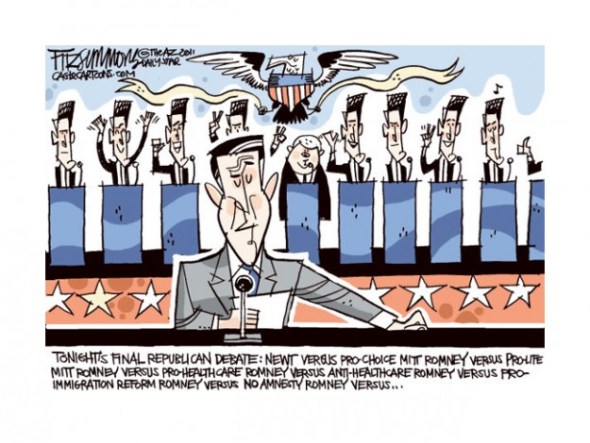
Is this really only the 13th debate? It seems like about 30, doesn’t it? Do you have the stomach for it? I plan to listen on satellite radio for as long as I can stand. I figure there could be a few laughs to be had if Mitt and Newt go for each others’ throats. The only other candidate there tonight with a sliver a chance is {eeek!} Ron Paul.
The debate will be on Fox News at 9PM. Here’s how Fox sees it: Gingrich Faces Off Against GOP Field at Iowa Debate
Newt Gingrich enters the high-stakes debate in Iowa Thursday night with a political target on his back, as Mitt Romney and the rest of the Republican presidential candidates look to challenge his front-runner status ahead of the Iowa caucuses.
Gingrich, for his part, is vowing to stay positive.
On the day of the debate, his campaign aired a new Iowa ad that claimed his candidacy embodies “bold ideas and new solutions” for the country.
“Others seem to be more focused on attacks rather than moving the country forward. That’s up to them,” Gingrich said in the ad.
We’ll see how long it takes for Mr. Nasty to lash out at someone. Any bets? You can watch the live stream of the debate at Fox.com.
The coverage actually starts at 8:30PM.
Rasmussen Reports had a new poll out today with Romney taking the lead in Iowa, 23%, to Gingrich’s 20% and Paul’s 18%. So it appears that Romney still has a chance.
Business Insider says tonight’s debate is “HUGE.”
After a rollercoaster shadow primary, the stakes could not be higher this evening. With Newt Gingrich’s lead evaporating, the Iowa race is still anybody’s game. This debate is the candidates’ last chance to make an impression on voters before they hunker down for the holidays. A breakout performance — or major gaffe — tonight could actually make or break a campaign.
They ask: “Can Newt take the heat?” “Will the Mitt-bot self-destruct?” “Can Rick Perry hold it together?” “Will Ron Paul be a factor?” Plus they suggest that Jon Huntsman could be the next candidate to “surge.” I’ll believe that when I see it.
Chris Cillizza calls this “the kitchen sink debate,”
because you can bet any and every attack that the Republican candidates might have been keeping in their pocket will come out tonight. Why? Because it’s the last chance for Iowa voters — and voters nationally — to compare and contrast the candidates before an actual ballot is cast.
And brings up similar questions to those listed above from the Business Insider piece.
I’m ready to live blog, and home some of you will join me. I don’t know how long I’ll last, but I’ll hang in there as long as I can.
TGIFriday Reads
Posted: October 28, 2011 Filed under: Barack Obama, Mitt Romney, morning reads, PLUB Pro-Life-Until-Birth, religious extremists, Reproductive Health, Reproductive Rights, Republican presidential politics, U.S. Economy, U.S. Politics, Violence against women, Women's Rights | Tags: 2012 presidential election, abortion, Ayn Rand, bundlers, Herman Cain, Libertarianism, Lobbyists, minimum wage, Mitt Romney, objectivism, Omar Sharif, personhood amendment to the Constitution, Republican debates, Republican nomination, Rick Perry, Rick Santorum, Ron Paul, wild turkeys 11 Comments
I live in Northwest Greater Boston in a town that is far from rural. However we do encounter wildlife in my neighborhood–skunks, opossums and racoons, for example. But yesterday afternoon, as I drove down the small road where I live, I had to brake suddenly for a large, imposing bird like the one in the photo. It was casually standing right in the middle of the road. I looked to my left and saw good sized flock of these birds, and suddenly realized they were wild turkeys. They were walking around in front of someone’s house. I was amazed.
It turns out that wild turkeys have been making a comeback in Massachusetts and have been invading a number of cities and towns around here. From The Boston Globe:
On a recent afternoon, Kettly Jean-Felix parked her car on Beacon Street in Brookline, fed the parking meter, wheeled around to go to the optician and came face to face with a wild turkey.
The turkey eyed Jean-Felix. Jean-Felix eyed the turkey. It gobbled. She gasped. Then the turkey proceeded to follow the Dorchester woman over the Green Line train tracks, across the street, through traffic, and all the way down the block, pecking at her backside as she went.
“This is so scary,” Jean-Felix said, finally taking refuge inside Cambridge Eye Doctors in Brookline’s bustling Washington Square. “I cannot explain it.”
Notify the neighbors: The turkeys are spreading through suburbia. Wild turkeys, once eliminated in Massachusetts, are flourishing from Plymouth to Concord and – to the surprise of some wildlife officials – making forays into densely populated suburban and urban areas, including parts of Boston, Cambridge and, most recently, Brookline.
In Winchester, a woman was “held captive” by a wild turkey.
On Tuesday evening, around 6 p.m., a Swan Road resident was pulling into her car [sic] when a wild turkey jumped at her and started to attack her vehicle as she was trying to drive it into the garage.
The woman said that this turkey did the same thing last week, and she didn’t call the police because she thought the animal had left.
“It kept attacking the woman at her house,” said Winchester Animal Control Officer, Jerry Smith of the 17-pound turkey. “It’s been doing it for a couple of days. We can’t have animals attacking people around town.”
According to the police report, she was able to close the garage door, but ended up being trapped, unable to get to her house, because the turkey refused to leave her property.
After 15 minutes “of being held captive” the woman called the Winchester Police Department to help her get into the house.
The responding officer saw that the turkey was still on the property. He got out of his cruiser and took a shotgun with him. As soon as the turkey noticed him, it charged and the officer shot and killed it.
Yikes! I hope those turkeys don’t start hanging around in my yard. In even more bizarre news, there is snow outside my house. Apparently, I got home just in time for winter.
Remember Omar Sharif? He starred in Dr. Zhivago back in 1965. The aging movie star recently slapped a female fan while he was on the red carpet at the Tribeca Film Festival.
The actor, who was nominated for his role in 1962’s “Lawrence of Arabia,” appeared to have lost his cool when a female fan interrupted him while he was posing for photographers.
The incident, captured by a TMZ camera, shows Sharif slapping and mildly pushing the woman, then spewing venomous disapproval at having been disturbed.
“My dear!” Sharif exclaimed in Arabic, as translated by the Washington Post. “I told you I’d get to you afterwards! I just said that and you’re standing here. Put something in your brain!”
In slightly more serious news, the Republican presidential candidates are still demonstrating their stupidity on a daily basis. Some examples follow.
Mitt Romney
It isn’t enough that Mitt Romney has crazy Robert Bork advising him on the Constitution. Now he has appointed another adviser who belonged to a violent Lebanese militia in the 1980s.
Walid Phares, the recently announced co-chair of GOP presidential candidate Mitt Romney’s Middle East advisory group, has a long résumé. College professor. Author. Political pundit. Counterterrorism expert. But there’s one chapter of his life that you won’t find on his CV: He was a high ranking political official in a sectarian religious militia responsible for massacres during Lebanon’s brutal, 15-year civil war.
During the 1980s, Phares, a Maronite Christian, trained Lebanese militants in ideological beliefs justifying the war against Lebanon’s Muslim and Druze factions, according to former colleagues. Phares, they say, advocated the hard-line view that Lebanon’s Christians should work toward creating a separate, independent Christian enclave. A photo obtained by Mother Jones shows him conducting a press conference in 1986 for the Lebanese Forces, an umbrella group of Christian militias that has been accused of committing atrocities. He was also a close adviser to Samir Geagea, a Lebanese warlord who rose from leading hit squads to running the Lebanese Forces.
Romney has also clearly stated his willingness to sacrifice the lives of women to save fertilized eggs. In the Guardian, Tresa Edmunds, a Mormon, writes: If Mitt Romney’s anti-abortion crowd get their way, it could kill me
Mississippi is the latest state to support a “personhood” amendment – a law that defines life as beginning at conception and giving full legal rights to a fertilised egg. On a recent political talk show, Mitt Romney affirmed that he would “absolutely” support such an amendment to the federal constitution. Such a conservative law would have far-reaching consequences, rendering many forms of birth control, the morning-after pill and aspects of in-vitro fertilisation illegal, as well as eliminating abortion as an option even when deemed medically necessary.
This trend is also seen in the ironically named Protect Life Act, recently passed by the House of Representatives, which gives hospitals the right to refuse to perform abortions, even at the cost of a woman’s life. It is a terrifying time to have a uterus, but especially a mysteriously malfunctioning one such as mine.
My son was born weighing 2lb 4oz, at 28 weeks gestation. My pregnancy – which had been much longed for – was proceeding normally until all of a sudden a pain that turned out to be organ failure brought me to the emergency room. There, I was diagnosed with HELLP syndrome. My blood pressure was rocketing, my red blood cells were disintegrating and my platelet count was dropping. If I had managed to make it through organ failure, stroke or heart attack, I would have bled to death in delivery. Thanks to the tremendous care and expertise of talented doctors and nurses, my son and I are here to tell the harrowing story but, if things had gone differently, the only way I would be alive is if they had removed my son’s body from my womb in pieces.
Comments such as Romney’s casually tossed off “absolutely” make me shake with rage. When politicians are so concerned about the people they see as allegedly using abortion as birth control that they would let me die, I can’t help but wonder how they can dare say they care about the sanctity of life.
Edmunds is confused. Romney and the other Republican candidates care deeply only about “human life.” They obviously do not consider women to be humans.
Rick Perry
As everyone knows, Governor Goodhair hasn’t done very well in the Republican debates so far. Now it appears he is going to wimp out of future debates.
After a series of poor debate performances in the early months of his presidential campaign, Texas Gov. Rick Perry is backing off the upcoming GOP debate schedule, committing to just one of the next three events between now and Nov. 15.
Perry has struggled in the five debates he has attended since he joined the race in mid-August. At one, he fumbled an attempt to cast rival Mitt Romney as a flip-flopper. At another, bickering between Romney and Perry drew criticism that the candidates were acting juvenile.
Perry hinted at his frustration with the debates earlier this week when he told Fox News that participating in them was a “mistake.”
“These debates are set up for nothing more than to tear down the candidates,” Perry said. “…All they’re interested in is stirring it up between the candidates.”
Um… yeah. So? If Perry can’t take the heat, maybe he should get out of the kitchen. BTW, has he produced his birth certificate yet? I heard he was born in Mexico. /s
Herman Cain
At Huffpo, Dave Jamieson details Herman Cain’s long, enthusiastic battle against the minimum wage.
In his plan for economic “Opportunity Zones,” Cain offers a slate of proposals aimed at revitalizing depressed pockets of the country, including zero capital gains and payroll taxes within qualifying areas. Although it doesn’t say so explicitly, the Cain campaign’s primer on opportunity zones also suggests the possibility of rolling back minimum-wage laws in impoverished areas.
“Minimum wage laws prevent many unskilled and inexperienced workers (i.e. teens) from getting their first job and prices them out of the market,” the plan says, listing a number of potential “solutions” to urban poverty. Cain’s campaign did not immediately comment on his stance on minimum wage laws.
Minimum-wage protections are an issue Cain knows intimately. In his work as the CEO of Godfather’s Pizza and later as president of the National Restaurant Association, Cain worked diligently in Washington and in the media to see that low-wage restaurant workers could legally be paid as little as possible, as In These Times has noted. In fact, Cain’s time in the restaurant business was marked by a long and largely successful battle against minimum-wage increases, and even today, some 15 years later, many of the nation’s waiters and waitresses have Cain and the restaurant lobby to thank for a federal minimum wage of $2.13 for tipped workers.
By 1995, when Cain was at the helm of Godfather’s, the federal minimum wage had already lost much of its purchasing power since the 1960s and 70s, and it hadn’t seen a bump in five years. When then-President Bill Clinton and Labor Secretary Robert Reich proposed raising it from $4.25 to $5.15, Cain emerged as one of the leading opponents of the pay boost.
Rick Santorum
Is he really still running for president? Apparently so. He has released a new ad targeting Herman Cain’s accidental pro-choice position on abortion. The content of the ad suggests that Santorum believes that aborted embryos and fetuses can “think.”
Ron Paul
Ron Paul isn’t really an objectivist or a libertarian, even though he claims to be a follower of Ayn Rand. He can’t be, because he wants the government to get involved in policing women’s bodies. But here’s an interesting post by Gary Weiss, the author of a new book about Ayn Rand’s influence on American culture that sounds like a fascinating, if disturbing, read.
Ayn Rand’s spirit hangs over the 2012 presidential race like the aftermath of a bad meal that, for some reason, we’ve all forgotten that we’ve eaten. In the run-up to the financial crisis the markets became a kind of Fifth Estate, the ultimate arbiters of American society. This was not a Republican disease; some of the most voracious deregulation took place during the Clinton Administration. It was as if a moral choice had been made, substituting the “wisdom of the markets” for admittedly flawed and sometimes grossly inept regulators. It made perfect sense, especially in an era in which the stock market averages rose by as much as 40% in one year, but today we know, or should know, that untrammeled capitalism doesn’t work.
But you’d never know any of this when listening to the Republican candidates for president, especially the one who most overtly embodies Rand’s philosophy: Ron Paul.
Paul is by no means a card-carrying Objectivist—his embrace of religion, and his views on foreign policy, makes him anathema to Randian true believers. But his embrace of the most primitive, extreme forms of free-market, almost-zero-government capitalism comes closest to Rand’s belief system of any in the Republican field.
What’s remarkable about Paul is how effective he is at putting forward his views, extreme as they are. Indeed, the unyielding, unwavering non-flip-flopping character of his opinions is perhaps his greatest asset. He is the best friend free-market capitalism has at present, as can be seen by his recent debate performances and especially his recent triumphant appearance at Jon Stewart’s Daily Show. The man exudes small-town charm while at the same advocating positions that would make life into hell for the great majority of his followers and listeners.
I’ll end with an article about the incumbant Republican President: ‘Bundlers’ for Obama Have Active Ties to Lobbying
Despite a pledge not to take money from lobbyists, President Obama has relied on prominent supporters who are active in the lobbying industry to raise millions of dollars for his re-election bid.
At least 15 of Mr. Obama’s “bundlers” — supporters who contribute their own money to his campaign and solicit it from others — are involved in lobbying for Washington consulting shops or private companies. They have raised more than $5 million so far for the campaign.
Because the bundlers are not registered as lobbyists with the Senate, the Obama campaign has managed to avoid running afoul of its self-imposed ban on taking money from lobbyists.
But registered or not, the bundlers are in many ways indistinguishable from people who fit the technical definition of a lobbyist. They glide easily through the corridors of power in Washington, with a number of them hosting Mr. Obama at fund-raisers while also visiting the White House on policy matters and official business.
{Yawn…} Another Obama lie…so what else is new? That’s all the links I’ve got.
What are you reading and blogging about today?
Monday Morning Reads
Posted: October 24, 2011 Filed under: morning reads | Tags: birtherism, Day of the Dead, Donald Trump, Euro, flat tax, Global Economic Crisis, Halloween, judges, judicial system, Michele Bachmann, Mitt Romney, Paul Krugman, Rick Perry, Ron Paul, student loans, stupid Republicans 26 Comments
Good Monday Morning! Not a day goes by without more examples of Republican stupidity. I’ve got several for you this morning. First up, Rick Perry had a talk with Donald Trump and now Governor Goodhair thinks President Obama’s birth certificate might be fake. That legend will never die. Think Progress:
In an interview with PARADE Magazine, Perry said that he recently met with Donald Trump and discussed the issue. Perry stated that he doesn’t “have a definitive answer” on whether Obama was born in the United States or “any idea” if Obama’s birth certificate is real….
Perry recently secured the endorsement of Orly Taitz, known as the “birther queen” for repeatedly filing lawsuits asserting that Obama was born outside the United States. Taitz told ThinkProgress that she believed Perry will use the birther issue to attack Obama.
Governor, do you believe that President Barack Obama was born in the United States?
I have no reason to think otherwise.That’s not a definitive, “Yes, I believe he”—
Well, I don’t have a definitive answer, because he’s never seen my birth certificate.But you’ve seen his.
I don’t know. Have I?You don’t believe what’s been released?
I don’t know. I had dinner with Donald Trump the other night.And?
That came up.And he said?
He doesn’t think it’s real.And you said?
I don’t have any idea. It doesn’t matter. He’s the President of the United States. He’s elected. It’s a distractive issue. “
“distractive?” Is that in the dictionary?
Herman Cain is still trying to walk back his accidentally pro-choice comments on abortion. From Politico:
Herman Cain tried to clean up the running confusion over his position on abortion last night, but in the meantime opened questions about his grasp of the Constitution.
In an interview with David Brody last night, Cain said he’d sign a pro-life constitutional amendment if it crossed his desk as president.
“Yes. Yes I feel that strongly about it. If we can get the necessary support and it comes to my desk I’ll sign it,” he said. “That’s all I can do. I will sign it.”
The only problem with that statement? Presidents don’t sign constitutional amendments — they’re passed in Congress and then need to be ratified by the states, and the president plays no formal role in the process.
Is this guy the most ignorant person to ever run for president? He’s worse than Michele Bachmann.
It appears Mitt Romney is about to do another flip flop: Romney, Once a Critic, Hedges on Flat-Tax Plans
As several leading Republican presidential candidates embrace a flat tax as a core campaign position, one contender stands out in not doing so: Mitt Romney, who has a long record of criticizing such plans and famously derided Steve Forbes’s 1996 proposal as a “tax cut for fat cats.”
Lately, though, his tone has been more positive. “I love a flat tax,” he said in August.
Flat-tax plans have come and gone before, and analysts note that they have tended to lose support once they come under scrutiny. But Mr. Romney’s support of the concept of a flat tax underscores the tightrope he is walking as taxes become a larger focus of the Republican presidential race and he faces rivals’ accusations of inconsistency on the issues.
But Ron Paul wins today’s prize for Republican stupidity. He wants to get rid of student loans.
Republican presidential contender Ron Paul said Sunday he wants to end federal student loans, calling it a failed program that has put students $1 trillion in debt when there are no jobs and when the quality of education has deteriorated.
Paul unveiled a plan last week to cut $1 trillion from the federal budget that would eliminate five Cabinet departments, including education. He’s also wants young workers to be able to opt out of Social Security.
The student loan program is not part of those cuts, but Paul said Sunday on NBC’s “Meet the Press” that he’d kill the loan program eventually if he were president. That could put him at odds with some of his young followers, many of whom are college students.
Turning to economic issues, the Financial Times has a scary article about the possible failure of the Euro.
It is time to prepare for the unthinkable: there is now a significant probability the euro will not survive in its current form. This is not because I am predicting the failure by European leaders to agree a deal. In fact, I believe they will. My concern is not about failure to agree, but the consequences of an agreement. I am writing this column before the results of Sunday’s European summit were known. It appeared that a final agreement would not be reached until Wednesday. Under consideration has been a leveraged European financial stability facility, perhaps accompanied by new instruments from the International Monetary Fund.
A leveraged EFSF is attractive to politicians for the same reason that subprime mortgages once appeared attractive to borrowers. Leverage can have different economic functions, but in these cases it simply disguises a lack of money. The idea is to turn the EFSF into a monoline insurer for sovereign bonds. It is worth recalling that the role of those monolines during the bubble was to insure toxic credit products. They ended up as a crisis amplifier.
To be honest, the article is a bit too technical for me to follow, but maybe Dakinikat can help me if she has sufficiently recovered from her nightmarish trip to Denver. Paul Krugman says Europe’s problem is (what else?) the stupidity of austerity.
First, the grim news from Greece is, as many commentators are pointing out, a big refutation for the doctrine of “expansionary austerity.” And it’s worth pointing out that European leaders, and especially the ECB, went in for that doctrine in a big way. Look at the June 2010 monthly report of the ECB (pdf), specifically the discussion of “fiscal consolidation” on page 83 and following. Basically, the ECB pooh-poohs any notion that austerity would have major negative effects on the economy, suggests that it’s quite likely that the confidence fairy will make everything OK, and specifically says that
Determined action on the part of governments to undertake fiscal and structural reforms is necessary to preserve stability and cohesion in the euro area. A sustained commitment to consolidation, possibly including a speeding up of current plans and their delivery, is required from all governments to ensure that the time afforded by the exceptional measures is used to put public finances on a permanently sounder footing.
So the ECB was calling for austerity everywhere. Was any concern expressed about how that would affect Europe-wide growth? Was there any suggestion of expansionary monetary policy to offset such a coordinated fiscal contraction? No and no.
And now they’re shocked, shocked that the Greek economy is plunging into a hole.
Maybe Ron Paul has a solution. LOL
Fannie posted this link last night, but I thought it should be on the front page: Republicans Turn Judicial Power Into a Campaign Issue
Republican presidential candidates are issuing biting and sustained attacks on the federal courts and the role they play in American life, reflecting and stoking skepticism among conservatives about the judiciary. Gov. Rick Perry of Texas favors term limits for Supreme Court justices. Representatives Michele Bachmann of Minnesota and Ron Paul of Texas say they would forbid the court from deciding cases concerning same-sex marriage. Newt Gingrich, the former House speaker, and former Senator Rick Santorum of Pennsylvania want to abolish the United States Court of Appeals for the Ninth Circuit, calling it a “rogue” court that is “consistently radical.”
Criticism of “activist judges” and of particular Supreme Court decisions has long been a staple of political campaigns. But the new attacks, coming from most of the Republican candidates, are raising broader questions about how the legal system might be reshaped if one of them is elected to the White House next year.
I’m going to end with this funny Halloween-themed satire from The New Yorker: Dear Mountain Room Parents, by Maria Semple. Here’s a bit of it, but please read the whole thing. You won’t be sorry.

Hi, everyone!
The Mountain Room is gearing up for its Day of the Dead celebration on Friday. Please send in photos of loved ones for our altar. All parents are welcome to come by on Wednesday afternoon to help us make candles and decorate skulls.
Thanks!
Emily
Hi again.
Because I’ve gotten some questions about my last e-mail, there is nothing “wrong” with Halloween. The Day of the Dead is the Mexican version, a time of remembrance. Many of you chose Little Learners because of our emphasis on global awareness. Our celebration on Friday is an example of that. The skulls we’re decorating are sugar skulls. I should have made that more clear.
Emily
Parents:
Some of you have expressed concern about your children celebrating a holiday with the word “dead” in it. I asked Eleanor’s mom, who’s a pediatrician, and here’s what she said: “Preschoolers tend to see death as temporary and reversible. Therefore, I see nothing traumatic about the Day of the Dead.” I hope this helps.
Emily
It gets funnier, so please go read the rest! Now what are you reading and blogging about today?
The Libertarian Dysfunction
Posted: May 10, 2011 Filed under: Republican presidential politics | Tags: conservatives, libertarians, Pragmatists, Ron Paul, South Carolina Republican Debates 46 Comments
Ron Flew over the Cuckoo's Nest the other night at the Republican Debate in South Carolina.
Every time I have any dealings with libertarians, I always wind up saying something to myself to the effect of what is wrong with this people? Are they the products of a dysfunctional family with parents who don’t show emotion? Did they have problems bonding or with the attachment process as infants? Libertarians seem like they were all bred in some kind of petrie dish rather than born of flesh and blood people. They seem so oddly unaware of human nature and empathy. I’ve recently started wondering if it’s not really a symptom of some kind of autism because there seems to be so much emphasis on a seemingly detached self-identity and a desire for a reality that seems straight of a bad science fiction novella where the main plot is alienation rather than aliens.
So, this WAPO op-ed by “conservative” Michael Gerson got me thinking about Ron Paul’s truly strange statements in that Republican Presidential-wanna be debate the other day. Gerson was using Ron Paul’s thoughts on legal heroin as the basis of the argument that the Republican Party shouldn’t treat Ron Paul seriously because he’s truly not a serious candidate. Advocating legalized heroin–instead of punishing it as bad boy behavior–evidently gives one a lack of gravitas. I thought this strange.
I have to admit that Ron Paul says things that just makes me think he was hatched from an orphaned egg left in a cuckoo’s nest. It frightens me that some one with such serious misunderstandings of economics heads a subcommittee over the nation’s monetary policymaker. It’s like putting a flat earther in charge of NASA. Paul was so surrounded by other odd birds at that Republican debate however, that he didn’t stand out more than any one else to me. However, the legalize heroin comment stood out to many of us including Michael Gerson. For me however, it stood out because it’s part of the symptoms of denial of social costs and spillovers that you hear coming from libertarians. Paul really doesn’t appear to know what it’s like to be around the chaos vortex that is an addict. He has a really odd take on human nature. Gerson started out with a pretty good description of that before he fell back on hellfire and brimstone.
Paul was the only candidate at the debate to make news, calling for the repeal of laws against prostitution, cocaine and heroin. The freedom to use drugs, he argued, is equivalent to the freedom of people to “practice their religion and say their prayers.” Liberty must be defended “across the board.” “It is amazing that we want freedom to pick our future in a spiritual way,” he said, “but not when it comes to our personal habits.”
Now, I’m of the personal opinion that other people’s religion and practices, can in fact, trample on other people’s rights. I will only remind you of the time I went out on Sunday in Nebraska to buy creme de menthe to make grasshopper pie and couldn’t. Also, you have no idea what it’s like to deal with Christmas hoopla when you’re never in the mood. However, when you are near people, they do have a habit of getting in your way all the time. What they do impacts you to varying degrees. So, I didn’t think Paul could possibly have much experience with addicts because it’s hard to avoid the fallout from the disease even if you’re not all that intimately involved with them. If you work with them or live near them, their addiction and its costs will be felt.
Or, as Gerson puts it:
This argument is strangely framed: If you tolerate Zoroastrianism, you must be able to buy heroin at the quickie mart. But it is an authentic application of libertarianism, which reduces the whole of political philosophy to a single slogan: Do what you will — pray or inject or turn a trick — as long as no one else gets hurt.
Even by this permissive standard, drug legalization fails. The de facto decriminalization of drugs in some neighborhoods — say, in Washington, D.C. — has encouraged widespread addiction. Children, freed from the care of their addicted parents, have the liberty to play in parks decorated by used needles. Addicts are liberated into lives of prostitution and homelessness. Welcome to Paulsville, where people are free to take soul-destroying substances and debase their bodies to support their “personal habits.”
But Paul had an answer to this criticism. “How many people here would use heroin if it were legal? I bet nobody would,” he said to applause and laughter. Paul was claiming that good people — people like the Republicans in the room — would not abuse their freedom, unlike those others who don’t deserve our sympathy.
The idea that there are actions that don’t impact people on any large scale is a weird one to me. Gerson talks about Paul’s attitude of “I don’t need laws against heroin because I won’t use heroin” as a form of arrogance. What really made me think, however, was this paragraph. This is where Gerson dove off the deep end.
The conservative alternative to libertarianism is necessarily more complex. It is the teaching of classical political philosophy and the Jewish and Christian traditions that true liberty must be appropriate to human nature. The freedom to enslave oneself with drugs is the freedom of the fish to live on land or the freedom of birds to inhabit the ocean — which is to say, it is not freedom at all. Responsible, self-governing citizens do not grow wild like blackberries. They are cultivated in institutions — families, religious communities and decent, orderly neighborhoods. And government has a limited but important role in reinforcing social norms and expectations — including laws against drugs and against the exploitation of men and women in the sex trade.
This is where he lost me completely. The government doesn’t need to reinforce Judeo-Christian norms and expectations. To me, that’s not the role of government. The government should recognize that the behavior of individuals and businesses impact others. Some times, the impact is quite negative. It doesn’t need to replace some absentee parent as an angry, punishing daddy. It needs to be more like a judge, a referee, and a prevention coach. Let me explain that.
No one in Love Canal asked to be sold a home sitting on a lot saturated with toxic chemicals. People actively withheld information to make those business deals and a group of innocents were hurt mightily; both financially and physically. You can read studies dealing with communities that have gambling facilities to determine the social costs of those things. You get pawn shops and paycheck advance loan shops. There are tons of predatory businesses that pop up out of no where. Communities also get crime because once gamblers run out of things to hock and ways to borrow, they will steal. Communities will attract prostitutes with accompanying costly public health problems. Communities eventually wind up with destitute people. As a result, many businesses and homeowners leave and the city is left with only problems and no revenues.
Just like I can’t imagine drinking day-in-and-day-out, I can’t imagine playing any other gambling games where I don’t know the rules, the odds, and have a strategy to know when to hold them and fold them. The deal is that I don’t have the addiction gene. Problem is, that there are a lot of people that can’t either make good decisions or stop. They become chaos vortexes. They drain resources from families that eventually need public help. They emotionally and some times physically abuse people which infers the cost of the criminal justice system. Relatives of addicts may or may not be able to recover without public assistance or spreading issues further across society.
These behaviors are not just personally destructive, they have social costs. We frequently have to pay to clean up these messes after these folks have spun out of control. I also didn’t need the government enforcing ‘Judeo-Christian’ values for me to recognize destructive behaviors and many of these folks with issues had plenty of it. That’s no solution either. Frankly, plentiful and good information on statistics and public health should give most people knowledge to make good decisions about prostitution, substance abuse, and gambling. Neither Gerson or Ron Paul want these provisions either. They prefer that be left to chance, happenstance, or some imaginary Father Knows Best.
This is what bothers me about both the libertarian and the conservative narrative described above. You can’t just say let them self destruct and not witness that the fall out from destruction frequently is spread wide and costs a lot of money to a lot of people. You can’t just say that if some one sits in a pew and hears some kind of moral spew attached to an angry sky god that they’re going to just get in control of themselves. There’s a genetic component to substance abuse. Certainly, a faceless corporation that only exists for the purpose of creating profit but yet, is treated as an individual legally, is not capable of full considering the costs of its actions on others. Addicts definitely don’t consider the costs of their actions on any one. Gerson and Paul’s overly simplistic view of people and reality has to come from some blocked pathway in a brain that doesn’t recognize the interconnectedness of people and their actions.
Maybe that’s why they both have fairly useless views of economics too because, at its essence, economics is about human behavior and choices.
It’s not about becoming a national mommy, or daddy, or nanny or whatever. It’s about trying to prevent the problems, first off, by providing adequate information to people. Then, it’s about judiciously assessing the fall out and compensating society and others for the cost of the chaos. Then, something should be done to try to stop recurrence.
We keep trying permissiveness and punishment. What we frequently get is recidivism and more spillover costs. Somewhere in between the models of permissiveness and punishment is a more pragmatic mindset. Laws, regulations, and government are necessary because humans and their corporate counterparts don’t exist in a vacuum and all of them are not good decisionmakers. Their actions aren’t always a reflection of either enlightened self-control or fear of retribution by an angry sky god or parent. Of course, government can’t do everything for us. But, it should be able to prevent the fall out from the behaviors and actions of others and the spillover costs they entail. That’s the real purpose of regulations. Libertarians seem to disregard a bevy of actions where there are victim’s of people’s individual decisions. Conservatives appear to think that enforcing some kind of moral code via punishment is all that’s necessary. Frankly, I’d rather we use less straight-jacket ideology and use our knowledge to figure out what best prevents a problem.
TGFriday Reads
Posted: February 11, 2011 Filed under: Egypt, Foreign Affairs, John Birch Society in Charge, morning reads, U.S. Politics | Tags: Climate change, CPAC, Dick Cheney, Donald Rumsfeld, Donald Trump, Egypt, Mississippi Confederate hold outs, Muslim Brotherhood, Noam Chomsky, Ron Paul, The Nation 39 Comments Good Morning!

I’ve thought about writing some posts about the CPAC circus but frankly, any thing that gives Donald Rumsfeld a “Defender of the Constitution Award” plus features Dick Cheney and Donald Trump is just way too over the top for me. There were several interesting things and most of it came via Ron Paul and his very dedicated groupies. One of them shouted Dick Cheney down as a “war criminal”. Most of the Fundies were AWOL because they didn’t want to be seen networking with folks that might be out there trying to convert them to the “radical homosexual agenda”. Then there was The other Donald with your zen moment of the day saying that Ron Paul was a nice guy but had “zero chance” of get elected. Next question, Mr. Trump. What are your chances of being elected then?
One shout of “where’s Bin Laden?” rang out as Cheney spoke of Rumsfeld.
That led to the pro-Cheney contingent (which it should be said greatly outnumbers the opposition) to shout the hecklers down with the familiar “USA, USA” chant.
It was all very odd, especially considering that when Cheney appeared as the “surprise guest” at last year’s CPAC he was greeted with the kind of cheers generally reserved for a rock star.
But Team Paul — whose numbers appear to have grown at CPAC in 2011 — were not going to let that happen this time around.
“Uh, Defender of the Constitution?” Justin Bradfield of Maryland scoffed when I caught up with him after he walked out of Rumsfeld’s speech. “Let’s see: he expanded the Defense Department more than pretty much any other defense secretary and he enforced the Patriot Act.”
“[Speaking] as a libertarian, that’s not really the type of person who should be getting Defender of the Constitution,” he added.
Wow, this is the sort’ve thing that calls for popcorn and chagrin. The Hill covered the Trump card.
Business mogul Donald Trump said Thursday that Rep. Ron Paul (R-Texas) could not possibly win the 2012 presidential race.
“By the way, Ron Paul cannot get elected, I’m sorry to tell you,” Trump said at the Conservative Political Action Conference (CPAC) on Thursday. “I like Ron Paul, I think he’s a good guy, but honestly he just has zero chance of getting elected.”
Then, the Caucus at the NYT covered the background on the Trumped-up decision to run for President. Oh, the drama! Oh, the pathos! Oh, the ratings boost!
“Obviously, it’s a tremendous forum to espouse his views and to express the fact that he is legitimately contemplating on this run,” said Michael Cohen, the executive vice president of the Trump organization, who confirmed his attendance at the forum. “He is seriously considering doing this because he’s disgusted with how the country is being run.”
Mr. Cohen, a special counsel to Mr. Trump, has started a Web site, http://www.shouldtrumprun.com, to serve as something of a draft movement. But the Web site is far from an organic outpouring, considering that it is run by people on Mr. Trump’s payroll.
Advisers to Mr. Trump say that he will decide by June whether to go forward with a Republican presidential bid. The timing is built around his television program, “The Apprentice,” which is scheduled to end by June.
I have to admit that I was more interested in who WASN’T as much as I was in hearing about the theatrics concerning the attendees. What does it say when two of the top draws in Republican Straw polls find better things to do?
I’m not sure if you caught the WAPO editorial written by a member of the Muslim Brotherhood, Abedel Moneim Abou el Fotouh but you may want to give it a read. I’m basically of the opinion that we should worry about the Fundies in our back yard before we worry about the Fundies in some one else’s back yard. El Fotouh tells us we shouldn’t worry at all. He also reminds us that peoples of a nation have a right to self-govern. That’s the basic American principle that does make the US exceptional.
Contrary to fear-mongering reports, the West and the Muslim Brotherhood are not enemies. It is a false dichotomy to posit, as some alarmists are suggesting, that Egypt’s choices are either the status quo of the Mubarak regime or a takeover by “Islamic extremists.” First, one must make a distinction between the ideological and political differences that the Brotherhood may have with the United States. For Muslims, ideological differences with others are taught not to be the root cause of violence and bloodshed because a human being’s freedom to decide how to lead his or her personal life is an inviolable right found in basic Islamic tenets, as well as Western tradition. Political differences, however, can be a matter of existential threats and interests, and we have seen this play out, for example, in the way the Mubarak regime has violently responded to peaceful demonstrators.
We fully understand that the United States has political interests in Egypt. But does the United States understand that the sovereign state of Egypt, with its 80 million people, has its own interests? Whatever the U.S. interests are in Egypt, they cannot trump Egyptian needs or subvert the will of the people without consequences. Such egotism is a recipe for disaster. With a little altruism, the United States should not hesitate to reassess its interests in the region, especially if it genuinely champions democracy and is sincere about achieving peace in the Middle East.
I have to admit that any one who lives in Louisiana usually has a huge number of Mississippi jokes up their sleeve. The same was true for Nebraska on Iowa. Nebraska had a red and white license plate design and we always called Iowa Drivers out as ‘blue plate specials’ for there blue tags. I got to use that same joke down here on the folks from Mississippi; especially my New Yorker transplant boyfriend who taught molecular biology and lived in Forrest County. I just learned where the Forrest came from and I’m not even sure I can express what I want to say about this tidbit on a proposed Mississippi license plates: ‘Mississippi May Honor Early KKK Leader On Commemorative License Plate. Some historical figures are best left dead and buried’.
Controversies over honoring Confederate heritage are not uncommon in the South, but some activists in Mississippi are pushing the envelope even further. The Mississippi Division of Sons of Confederate Veterans is proposing a license plate that honors Confederate Gen. Nathan Bedford Forrest, who was also an early leader of the Ku Klux Klan.
Following the Civil War, Forrest was involved with the very first incarnation of the KKK. He was so closely associated with the group’s formation that he is sometimes incorrectly referred to as the KKK’s founder — though he was quickly elected Grand Wizard, and began centralizing disparate KKK groups under his authority. He believed that while blacks were now free, they had to continue to toil quietly for white landowners. “I am not an enemy of the negro,” Forrest said. “We want him here among us; he is the only laboring class we have.”
Perhaps even more disturbing, however, were Forrest’s violent actions during the Civil War, specifically a massacre of black soldiers at Fort Pillow, TN in April 1864.
Yup, this guy slaughtered black union troops that had already dropped their rifles. What is wrong with modern Mississippi and what will its Governor Haley Barbour say about this?
So, here’s an interesting YouTube with Noam Chomsky on ‘How Climate Change Became a ‘Liberal Hoax’ in a series from The Nation’.
Known for his criticism of the media, Chomsky doesn’t hold back in this clip, laying blame on mainstream media outlets such as the New York Times, which will run frontpage articles on what meteorologists think about global warming. “Meteorologists are pretty faces reading scripts telling you whether it’s going to rain tomorrow,” Chomsky says. “What do they have to say any more than your barber?” All this is part of the media’s pursuit of “fabled objectivity.”
Of particular concern for Chomsky is the atmosphere of anger, fear and hostility that currently reigns in America. The public’s hatred of Democrats, Republicans, big business and banks and the public’s distrust of scientists all lead to general disregard for the findings of “pointy-headed elitists.” The 2010 elections could be interpreted as a “death knell for the species” because most of the new Republicans in Congress are global warming deniers. “If this was happening in some small country,” Chomsky concludes, “it wouldn’t matter much. But when it’s happening in the richest, most powerful country in the world, it’s a danger to the survival of the species.”
Okay, so, just so you know that our Congress is on the up and up these days, I’m going to leave you with this headline: ‘The Pajama Party Is Over, Ethics Group Tells Congress’.
A Washington ethics watchdog says it is time for Congress to crack down on lawmakers who sleep in their offices rather than pay for a place to live. Reacting to a surge in lawmakers’ bunking down in their work spaces, Citizens for Responsibility and Ethics in Washington wants the Office of Congressional Ethics to investigate whether the politicians are getting an unfair tax break and violating their own rules by making personal use of public resources. “House office buildings are not dorms or frat houses,” Melanie Sloan, the
group’s executive director, said Thursday. “If members didn’t want to find housing in Washington, they shouldn’t have run for Congress in the first place.” Aside from the legal and rules questions, Ms. Sloan said she has heard reports from Congressional staffers about uncomfortable work environments. “Especially if you’re a woman and you’re working late and your boss is there getting ready for bed, that seems designed for discomfort,” she said.

They should just be glad their Senator isn’t David Vitter who probably uses campaign funds for hookers and diapers. Don’t make me think about what he’d be up to in his office!

 peej
peej Carissa
 bostonboomer
 dakinikat
 ecocatwoman
 mablue2
 Mama Lopez
 peggysue22
 quixote
 skydancingguestblogger
 Mona (aka Wonk the Vote)



 Sky Dancing
Recent Comments