
The Financial Crisis Explained
Posted: September 21, 2011 Filed under: Economy, Republican politics, Republican presidential politics, right wing hate grouups | Tags: Elizabeth Warren, Robert Reich, The people Obama doesn't listen to and won't appoint 34 Comments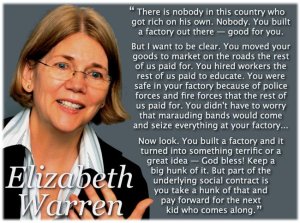 Who says Elizabeth Warren doesn’t have fire in her belly?
We already knew Robert Reich does.
Why do we buy lies based on unsubstantiated wishful thinking over what we know from theory based on on empirical data.
This is all just common sense and it’s backed by data.
These are people that know the facts over the ideology. This is real economics over voodoo economics.
Who ya Gonna Call?
Posted: September 14, 2011 Filed under: jobs, unemployment, voodoo economics | Tags: jobs, Martin Wolf, Obama American Jobs Act, Robert Reich, unemployment 5 Comments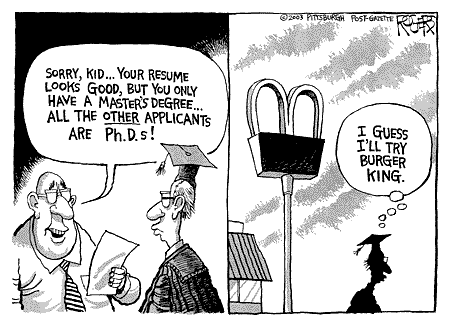 Evidently, the new Jobs Plan is a Jobs Bust in the eyes of the electorate. A few villagers may have gotten those tingly leg sensations, but the public is much more skeptical. Try this one on for size!
A majority of Americans don’t believe President Barack Obama’s $447 billion jobs plan will help lower the unemployment rate, skepticism he must overcome as he presses Congress for action and positions himself for re- election.
The downbeat assessment of the American Jobs Act reflects a growing and broad sense of dissatisfaction with the president. Americans disapprove of his handling of the economy by 62 percent to 33 percent, a Bloomberg National Poll conducted Sept. 9-12 shows. The disapproval number represents a nine point increase from six months ago.
The president’s job approval rating also stands at the lowest of his presidency — 45 percent. That rating is driven down in part by a majority of independents, 53 percent, who disapprove of his performance.
“I don’t think he’s done as good a job as I think he could have,” said Paul Kaplan, 58, an unemployed Democrat from Philadelphia. “We were hopeful that things would improve in the economy and they’ve only gotten worse. People in Washington just don’t seem to want to cooperate with each other and work for the people.”
The poll hands Obama new lows in each of the categories that measures his performance on the economy: only 36 percent of respondents approve of his efforts to create jobs, 30 percent approve of how he’s tackled the budget deficit and 39 percent approve of his handling of health care.
I still have to think that some of this has to do with the fact that we all were glad to be rid of Dubya and his horrible policies and now we realize it’s just more of the same!
By a margin of 51 percent to 40 percent, Americans doubt the package of tax cuts and spending proposals intended to jumpstart job creation that Obama submitted to Congress this week will bring down the 9.1 percent jobless rate. That sentiment undermines one of the core arguments the president is making on the job act’s behalf in a nationwide campaign to build public support.
Compounding Obama’s challenge is that 56 percent of independents, whom the president won in 2008 and will need to win in 2012, are skeptical it will work.
Even members of the Democratic Party in Congress are skeptical. Notice that the bottom line is still all about the politics instead of the people.
President Barack Obama’s new jobs plan is hitting some unexpected turbulence in the halls of Congress: lawmakers from his own party.
As he demands Congress quickly approve his ambitious proposal aimed at reviving the sagging economy, many Democrats on Capitol Hill appear far from sold that the president has the right antidote to spur major job growth and turn around their party’s political fortunes.
“Terrible,” Sen. Jim Webb (D-Va.) told POLITICO when asked about the president’s ideas for how to pay for the $450 billion price tag. “We shouldn’t increase taxes on ordinary income. … There are other ways to get there.”
“That offset is not going to fly, and he should know that,” said Democratic Sen. Mary Landrieu from the energy-producing Louisiana, referring to Obama’s elimination of oil and gas subsidies. “Maybe it’s just for his election, which I hope isn’t the case.”
“I think the best jobs bill that can be passed is a comprehensive long-term deficit-reduction plan,” said Sen. Tom Carper (D-Del.), discussing proposals to slash the debt by $4 trillion by overhauling entitlement programs and raising revenue through tax reforms. “That’s better than everything else the president is talking about — combined.”
And those are just the moderates in the party. Some liberals also have concerns.
“There is serious discomfort with potentially setting up Social Security as a fall guy because you’re taking this contribution out,” said Rep. Raul Grijalva of Arizona, referring to Obama’s proposal to further slash payroll taxes.
Democrats in large numbers will still back the president’s overall jobs package, and when the plan heads for House and Senate consideration, some of these same skeptics will very likely vote to advance the measure. But as details of the plan began to be vetted on Capitol Hill on Tuesday, it was clear that the White House needed to redouble its sales job — or tweak its plan — to force Democrats to fall in line at a pivotal point in Obama’s presidency.
Wow! I’d like to think it’s all those economists–like Robert Reich and Martin Wolf and the IMF–getting out there and explaining that austerity is killing middle class incomes, the basic problem is a lack of aggregate demand and that tax cuts are kind’ve worthless right now that’s moving the people. I actually believe that most people have a lot more common sense when it comes to economics than beltway-disabled politicians. You can see the contrast right up there in all those quotes from people v. politicians.
The centerpiece of the proposal — and the plank that Republicans have said they are most willing to consider — is a cut in payroll taxes, which cover the first $106,800 in earnings and are evenly split between employers and employees.
Respondents are evenly split at 45 percent on this approach, which would cost $240 billion to the U.S. Treasury. Independents oppose it 47 percent versus 43 percent who favor it.
Think about it. We’ve had 11 years of deregulation of financial markets and banks, tax cuts, bail outs for failing businesses, government largess to corporations, and your basic Republican Voodoo economics and what do we have to show for it? Higher Poverty rates. Lower median incomes. Huge long term joblessness. High unemployment. What rational person thinks that more of the same is going to do anything? You don’t need an economics degree to see that none of this stuff has worked in the past. But, thankfully, you do have some economists out there backing up our gut feeling with solid economic theory. Here’s something from Martin Wolf at FT just as a reminder.
Contrary to conventional wisdom, fiscal policy is not exhausted. This is what Christine Lagarde, new managing director of the International Monetary Fund, argued at the Jackson Hole monetary conference last month. The need is to combine borrowing of cheap funds now with credible curbs on spending in the longer term. The need is no less for surplus countries with the ability to expand demand to do so.
It is becoming ever clearer that the developed world is making Japan’s mistake of premature retrenchment during a balance-sheet depression, but on a more dangerous – far more global – scale. Conventional wisdom is that fiscal retrenchment will lead to resurgent investment and growth. An alternative wisdom is that suffering is good. The former is foolish. The latter is immoral.
Reconsidering fiscal policy is not all that is needed. Monetary policy still has an important role. So, too, do supply-side reforms, particularly changes in taxation that promote investment. So, not least, does global rebalancing. Yet now, in a world of excess saving, the last thing we need is for creditworthy governments to slash their borrowings. Markets are loudly saying exactly this. So listen.
Here’s Robert Reich showing his chops on what the real problem is in our economy. If only Obama, would find out the real problem from real economists and stop it with the political pandering to the Republican Party.
We don’t need a Texas Economy.
States don’t have their own monetary policies so they can’t lower interest rates to spur job growth. They can’t spur demand through fiscal policies because state budgets are small, and 49 out of 50 are barred by their constitutions from running deficits.
States can cut corporate taxes and regulations, and dole out corporate welfare, in efforts to improve the states’ “business climate.” But studies show these strategies have little or no effect on where companies locate. Location decisions are driven by much larger factors — where customers are, transportation links, and energy costs.
If governors try hard enough, though, they can create lots of lousy jobs. They can drive out unions, attract low-wage immigrants, and turn a blind eye to businesses that fail to protect worker health and safety.
Rick Perry seems to have done exactly this. While Texas leads the nation in job growth, a majority of Texas’s workforce is paid hourly wages rather than salaries. And the median hourly wage there was $11.20, compared to the national median of $12.50 an hour.
Texas has also been specializing in minimum-wage jobs. From 2007 to 2010, the number of minimum wage workers there rose from 221,000 to 550,000 – that’s an increase of nearly 150 percent. And 9.5 percent of Texas workers earn the minimum wage or below – compared to about 6 percent for the rest of the nation, according to the Bureau of Labor Statistics. The state also has the highest percentage of workers without health insurance. Texas schools rank 44th in the nation in per-pupil spending.
The Perry model of creating more jobs through low wages seems to be catching on around America.
According to a report out today from the Commerce Department, the median income of U.S. households fell 2.3 percent last year – to the lowest level in fifteen years (adjusted for inflation). That’s the third straight year of declining household incomes. Part of this is loss of jobs. Part is loss of earnings.
More and more Americans are retaining their jobs by settling for lower wages and benefits, or going without cost-of-living increases. Or they’ve lost a higher-paying job and have taken one that pays less. Or they’ve joined the great army of contingent workers, self-employed “consultants,” temps, and contract workers – without healthcare benefits, without pensions, without job security, without decent wages.
It’s no great feat to create lots of lousy jobs.
We just don’t need no stinkin’ jobs. We need real jobs. For that, it takes a lot more than tax cuts, rhetoric, and political pandering. So, I’m not calling Rick Perry or Barrack Obama any time soon. It’s real jobs or bust for me.
Real Job Creation Policy vs. Bizarro World
Posted: September 7, 2011 Filed under: 2012 presidential campaign, Surreality, Team Obama, U.S. Economy | Tags: bizarre economic policy, Job Creation, Robert Reich 15 Comments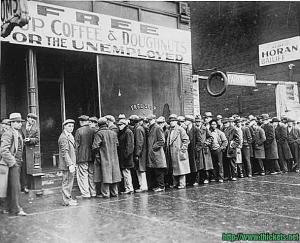 I just can’t step back from the crap being pushed by politicians as “jobs” policy these days. I can’t believe any one is actually falling for the line that basic corporate welfare programs and subsidies are actually going to create jobs because there’s never been any evidence of that being correlated in the past and there is certainly no evidence of that happening today. Lest we forget, we have about 11 years of experience with corporate tax largess, deregulation of financial markets, and low taxes on capital gains. Yet this century has seen nothing but miserable job creation. We’ve got nothing to show for it but the biggest recession since the Great Depression.
Here’s Robert Reich calling Romney’s job creation approach “bizarre”. However, it doesn’t really sound any different from that offered up by any of the other candidates either and that includes the President. This bothers me to no end and hence, I keep blogging on about it.
“Mitt Romney kind of has the odd idea, and it is a bizarre idea, that at a time when corporations are scoring record profits. At a time when you’ve got them sitting on $2 trillion of cash they don’t even know what to do with, that somehow if you give them more tax cuts and deregulate so you reduce their costs even further, they will then create jobs.
“They don’t create jobs now, he assumes, because their costs are too high or they’re not making enough money. Well, the reality of course is just the opposite,” former Secretary of Labor Robert Reich said on MSNBC’s “The Last Word.”
“They don’t need more money, companies are doing very well,” Reich said later on in the segment.
Corporations are flush with cash at the moment. They just aren’t doing anything with it because they won’t expand unless there’s demand for  their products and services. As I demonstrated yesterday, the bottom has fallen out of consumer demand and that’s stymied economic expansion. We do not need to appease some imaginary confidence fairy. Businesses need paying customers. One of the primary drivers of economic activity in this country since World War 2 has been construction. The housing market is still in big trouble and we have excess supply of both commercial and consumer real estate. What business person is going to hire more people and produce stuff that no one buys?
We’re going to be live blogging both the Republican debate tonight as well as the President’s job speech. Neither promise anything more than distinctly unproven economic policy. Even the President is thought to not believe what he’s going to be saying if you believe this. What kind of leader pushes policy he knows to be wrong?
The centerpiece of the job creation package that President Obama plans to announce on Thursday — payroll tax relief for workers and perhaps their employers — is neither his first policy choice nor that of many economists. But it is the one that they figure has the best chance of getting Republicans’ support.
Mr. Obama has signaled that he will propose to extend for another year a reduction of two percentage points in the 6.2 percent Social Security payroll tax that employees pay, which means about $1,000 more for the average household. And he is considering a proposal to expand the tax relief to employers’ share.
In his prime-time address to a joint session of Congress, Mr. Obama is expected to call for a package totaling several hundred billion dollars that would also extend other business tax cuts, put federal dollars into building and repairing roads, rails, airports, schools and other infrastructure projects, and provide aid to states to avert more layoffs of teachers.
But the single biggest stimulus measure he will propose is likely to be temporary payroll tax relief. If the current tax cut, due to expire at the end of the year, is expanded next year to employers as well as employees, it would pump roughly $200 billion into the economy, with the aim of stimulating much-needed demand for goods and services from consumers and businesses and, additionally, of giving companies an incentive to hire.
For the White House, its appeal is that it may be the only large stimulus measure that can pass Congress this year given Republicans’ preference for tax cuts.
And if Republicans oppose him, the White House figures Mr. Obama has the better of the political argument because he will be trying to block a tax increase that otherwise would apply to virtually all households on Jan. 1.
Republican leaders have said they might support the payroll tax cut’s extension if its cost is offset by equal spending cuts, a condition they did not apply for extending the Bush-era tax cuts on high incomes. Mr. Obama has said he will propose long-term deficit savings to offset the short-term costs of his stimulus proposals, though that is not likely to satisfy Republicans.
Look, what in his 2 1/2 years in office should leave him with the impression that he’s going to get anything past the Republicans in Congress? Half of them are indicating they probably won’t show up for the speech. Ever since the man’s taken office he’s offered one Republican plan after another. I still can’t believe after years of fighting Dolecare in the 1990s, the Democrats were forced to pass that stupid thing and it now wears the Obamacare label. What kind of leader pushes policy that his own party fought for decades?
I have no idea what trade agreements or patent reform or reducing regulations have to do with job creation either. None of that has ever been shown through research to be germane. But again, all you have to do is look at the amount of cheap money and the excess cash sitting on corporate balance sheets right now to know that businesses don’t need any more incentives to do something they aren’t doing any way.
The other thing that is most confusing is that the President’s plan will rob Peter to pay Paul because he’s going to make this ‘revenue neutral’ to appease Republicans. Again, with this appeasing pipsqueak Cantor and the rest of the whackos in the Republican caucus. Supposedly, some direct infrastructure spending and some direct aid to states to keep teachers in place is going to some how magically turn around a 9.1% unemployment rate. I don’t see how that’s going to do anything on the level that he’s talking about –$300 billion–is a token amount of money in a $15 trillion economy and the offsets will likely take away jobs from wherever they’re pulled. The other simply confusing proposal has to do with tax breaks for equipment which is really strange given that it’s likely to increase current worker productivity making hiring additional workers questionable.
In his speech on Thursday night to a joint session of Congress, Obama will also consider a tax benefit to those businesses that hire the unemployed, with a price tag of around $30 billion. Public works projects will be included, but the AP reports that this will be less than $50 billion of the package.
The president also will continue for one year a tax break for business that allows them to deduct the full value of equipment.
The local aid that Obama intends to propose it aimed at preventing teacher layoffs, officials said.
The New York Times said the cost of the package would be “several hundred billion,” while the Washington Post estimated it to be “at least $200 billion.”
This is clearly a set of tax giveaways that the government can’t afford that won’t achieve much of anything other than further the Republican agenda of starving the beast. What on earth does this president have in his head? I can’t figure out any logical, reasonable strategy for doing these things. Every time he furthers the Republican agenda it basically makes things worse for his reelection outlook. His actions are completely unpopular when measured by polls. He’s numbers are approaching those of Bush by basically repeating the Bush-Cheney policy on steroids. Unless he’s trying to become the President of the Chamber of Commerce, I’m not seeing any strategy here. It’s like he so desires bi-partisan approval that he’s willing to throw anything up against the wall to see what possibly sticks. Meanwhile, the Republicans are getting Republican policy without even putting any skin in the game. I just don’t get it.
Anyway, Minx and BB have promised to watch and liveblog the Republican debates tonight. I don’t think I can do that because it will just be a contest to see who can be the meanest in a contest to beat up modernity, science, and people that aren’t rich. I frankly see no purpose in continually watching people talk about issues that the civil war settled. I will watch the President’s speech because at this point, I’m looking for any sign of lucid economics and a strategy that doesn’t just infer faulty marketing. Who knows, maybe the sky will open up, a choir of celestial beings will start singing, ray of sunshine will start streaming out of gold-rimmed clouds, and all my questions will be answered. OR NOT.
Friday Reads
Posted: June 10, 2011 Filed under: abortion rights, Economy, Federal Budget and Budget deficit, fetus fetishists, Foreign Affairs, Hillary Clinton, Libya, Middle East, morning reads, religious extremists, Reproductive Rights, Women's Rights | Tags: 30th anniversary AIDS epidemic, Robert Reich, War on Rape victims, War on Women 30 Comments Good Morning!!!
The news continues to be fairly depressing as news tends to be, but we’ll try to cover some interesting things today!
It’s really hard to believe, but we’re about to mark the 30th anniversary of the AIDS epidemic. All of us that came of age during that period have a lot of lost friends and stories to tell. Thankfully, AIDS is a manageable disease now. Unfortunately, too many people still don’t do what it takes to protect themselves. Here’s an interesting story of how Congress came to realize that we had a growing health threat on our hands.
Oddly enough, it was the specter of Republican budget cuts that led to the first awareness of the AIDS epidemic in Congress. Ronald Reagan’s budget director, David Stockman, had targeted public health agencies for massive cuts. A Waxman staffer, concerned about their potential effects, had gone to the Centers for Disease Control in Atlanta to do reconnaissance. CDC scientists were alarmed and predicted that the cuts would lead to an epidemic, although they imagined it would involve a preventable childhood illness, since Reagan had proposed cutting the immunization budget in half. Waxman was worried enough by what he learned to join with a Republican colleague, Pete Domenici, to protect the immunization budget.The epidemic came anyway. While in Atlanta, the Waxman staffer was told that he should meet with a doctor named Jim Curran, who had noticed an outbreak of an unusual and deadly pneumonia among gay men in Los Angeles. Today, Curran is renowned as the doctor who first raised the alarm among epidemiologists. But back then, he declined the offer of a congressional hearing to help direct research funding to his work because he was afraid that the attention would interfere with his access to a gay community that was fearful of the government (homosexuality was a felony in many states). “I’ll call you when I’m ready,” he told Waxman’s staff. Let’s pause here to note that before AIDS even had a name, members of Congress were aware of the disease and working to help.Curran called a year later. In 1982, Congress held its first hearing on what was now called AIDS, a field hearing in Los Angeles. A single reporter showed up. But eventually Waxman and a group of colleagues succeeded in drawing attention to the epidemic
Texas continues its attacks on women’s right to choose. It has revived an anti-abortion measure to omnibus legislation. It’s also continuing the Republican extremist attack on Planned Parenthood.
Besides the two health care provisions to privatize Medicare and Medicaid, the Texas House attached several anti-abortion amendments to the omnibus legislation: (1) a bill to “ban hospital districts from using local tax revenue to fund abortions, except in emergency situations — or else risk losing state funding,” (2) “limit the state family planning funds received by Planned Parenthood,” (3) force physicians who provide abortions to collect more data on their patients.
More Kind and Kompassionate Konservative philosophy comes from a Republican in Massachussetts who believes that any undocumented worker who has been raped “should be afraid to come foreward”.
Massachusetts GOP state Rep. Ryan Fattman has such contempt for illegal immigrants that he believes undocumented women who are raped should be afraid to go to the police. Yesterday, the Worcester Telegram & Gazette reported on Fattman’s incendiary comments, which he made while defending a controversial federal immigration program that many say will damage the relationship between law enforcement and immigrant communities. Massachusetts Gov. Deval Patrick (D) has refused to join the program out of concern that immigrants who are victims of violent crimes will be afraid to report them and seek help…
Representative Fattman supports deporting any undocumented rape victim who goes to the police immediately. That appears to be more important to him than preventing crimes and supporting victims of crime. Unbelievable.
Robert Reich continues to be an outspoken advocate for the unemployed and for a stimulus to correct the current economic problem. He accuses Obama of going over to the supply side fairy tale spun by Republicans. Yup, it’s not about more business incentives, it’s all about the lack of customers. He joins me and other economists who say it’s all about the Demand side right now.
Obama says he’s interested in exploring with Republicans extending some of the measures that were part of that tax-cut package “to make sure that we get this recovery up and running in a robust way.”
Accordingly, the White House is mulling a temporary cut in the payroll taxes businesses pay on wages. White House advisors figure this may appeal to Republican lawmakers who have been discussing the same idea. It would, in essence, match the 2 percent reduction in employee contributions to payroll taxes this year, enacted as part of the deal to extend the Bush tax cuts.
Other ideas under consideration at the White House include a corporate tax cut, accompanied by the closing of some corporate tax loopholes.
Can we get real for a moment? Businesses don’t need more financial incentives. They’re already sitting on a vast cash horde estimated to be upwards of $1.6 trillion. Besides, large and middle-sized companies are having no difficulty getting loans at bargain-basement rates, courtesy of the Fed.
In consequence, businesses are already spending as much as they can justify economically. Almost two-thirds of the measly growth in the economy so far this year has come from businesses rebuilding their inventories. But without more consumer spending, businesses won’t spend more. A robust economy can’t be built on inventory replacements.
The problem isn’t on the supply side. It’s on the demand side. Businesses are reluctant to spend more and create more jobs because there aren’t enough consumers out there able and willing to buy what businesses have to sell.
The so-called Gang of Six are close to releasing their budget ideas. They’ve shared what they’ve come up with so far with some members they feel may be responsive. Will it be enough to head off Republican calls for default on US debt?
Freshman Republican Kelly Ayotte of New Hampshire, who was in the meeting, said she was open to looking into any potential plan that would address the deficit in a serious and responsible way. She characterized the meeting as an update on the group’s progress.
Sen. Mark Warner (D-Va.) who is spearheading the group’s efforts with Chambliss was tight-lipped about the presentation and refused to take any questions or even vaguely describe the mood of the meeting.
“Do you really think, as somebody who’s obsessed about this that I’m going to do anything to screw it up now?” Warner said emphatically Thursday afternoon.
Even Dick Durbin, another Gang member and the Senate’s No. 2 Democrat, was coy with reporters after the meeting. The Illinois Democrat is typically quick to present even a basic line expressing optimism or progress made in the meeting, instead opting to playfully pretend with reporters he knew nothing about the group or the meeting.
“I can neither, confirm, deny or retract [anything about the meeting,” Durbin teased with reporters.
Aides on the Hill are quick to point out that lawmakers will talk more when things are going poorly and less when things are going well. Perhaps after a few weeks of uncertainty, the remaining “Five Guys” trying to forge a deal are close to one.
NATO has upped the ante in Libya by hammering Tripoli and directly targeting Colonel Gaddafi. Some countries are seeking to give access to the country’s frozen assets to the rebels. Many believe that the regime’s days are coming to an end shortly. Qaddafi is said to have ordered mass rape and to have handed out Viagra to troops. Secretary of State Hillary Clinton is in the middle east working with other nations to plan for a post-Gaddafi Libya.
But another U.S. official indicated there was a conscious effort by NATO military planners to target air strikes closer to where Gaddafi is thought to have been taking shelter — and the Obama administration is privately supporting the intensified strikes.
So, that’s a little bit of what I found is going on in the world. What’s on your reading and blogging list today?
The Parable of the poor little rich people
Posted: January 13, 2011 Filed under: income inequality | Tags: bonus class, Brad Delong, Catherin Rampell, Emmanuel Saez, fractured parables, Income Inequality, Mega rich, Paul Krugman, Robert Reich 16 Comments Last September, Chicago Law Professor and neighbor of the Obama family Todd Henderson complained that he just couldn’t make ends meet on a combined family income estimated to be about $400,000 a year. In February, CNN Morning News Anchor Kiran Chetry interviewed then-White House budget director Peter Orszag. She seemed flummoxed that 1/4 of a million dollars wasn’t a modest family income for civilized parts of the country.
“You also talk about letting taxes expire for families that make over $250,000. Some would argue that in some parts of the country that is middle class.” Back in reality, more than 98 percent of U.S. households make less than $250,000.
What is it with all these rich people who continue to whine about not having enough money to exist when they clearly are very wealthy when compared to the vast majority (98%) of Americans? What kind of warped perspective on life leads them to shed incessant tears during this kind of economy? Why-oh-why do we have such a candy ass batch of plutocrats? Don’t we at least deserve a few that are sincerely rugged?
This is wonky, but there’s a very simple narrative underlying the numbers and analysis.
Catherine Rampell–writing for Economix–offered up an answer in an article called ‘Why So Many Rich People Don’t Feel Very Rich’. It involves a nifty graph. (You know me and nifty graphs.) I actually got a better nifty graph from Brad Delong’s page in a thread called On the Richness of the Rich Once Again. But, I would have never found either nifty graph without the help of ‘Why Does Inequality Make the Rich Feel Poorer?‘ over at Paul Krugman’s blog. I’m going to discuss all of that and harken back to Robert Reich’s thing at Alternet called The Problem Is That America’s Richest 1% Are Raking It in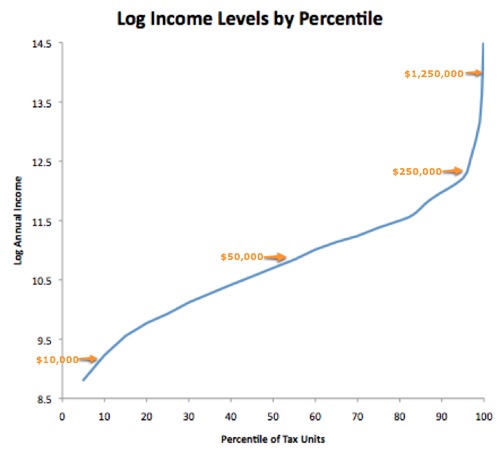 . You should be able to grok the theme of the parable of the poor little rich people by now.
Now what I have to do is explain why the rate of change along the slope of a curve using log income levels by percentile translates into pearl clutching in mamby pamby plutocracts. I know you hate math and it makes your stomach turn. I promise not to use the numbers. We’re going to just talk about the picture and the lines. Over on your right is Brad’s nifty graph. You can see that the curve is upward sloping but the slope varies depending on where you are on the curve.
You can see, however, it is positive at all points. This indicates a direct or positive relationship between two things. If one goes up, the other does too. Because the curve isn’t a straight line, the rate at which the curve goes up is different depending on where you are. This is reflected by the steepness or the flatness of the curve. Think of it as a hill. You have to slog up a steep hill, but a flat hill makes it easier to go forward.
One of the things of interests shown by this graph is the Log of Annual Income and the other is the percentile of tax units. The difference between Rampell’s graph and Delong’s graph is the log calculation. Brad explains why she needs to use the log of annual income compared to the level. Basically, the log turns the comparison in to a growth rate of annual income. A level is simply a level. The log means that we’re using the rate of change happening in incomes as we go up and down the curve. That rate of change is radically different at the richest levels. You can see that the slope almost goes vertical there compared to the middle levels where the curve is less steep and somewhat more horizontal. There’s a story that explains that. Krugman explains it well so I’m going to start with his explanation.

 peej
peej Carissa
 bostonboomer
 dakinikat
 ecocatwoman
 mablue2
 Mama Lopez
 peggysue22
 quixote
 skydancingguestblogger
 Mona (aka Wonk the Vote)



 Sky Dancing
Recent Comments