
Friday Reads
Posted: May 3, 2019 Filed under: just because, morning reads, U.S. Politics | Tags: Bill Barr, Donald Trump, Gerry Nadler, House Judiciary Committee, impeachment, Rachel Maddow, Robert Mueller, vetting Bernie Sanders 29 Comments
Illustration by Alan Baker
Good Morning!!
Dakinikat has a doctor’s appointment, so I’m filling in for her today. I’m illustrating this post with fantasy animal houses (mostly bunnies), just because.
So what’s happening?
House Democrats are inching toward impeachment hearings. They aren’t going to have much choice, since Trump and Cover-Up General Barr are stonewalling on releasing the full Mueller report along with the underlying evidence.
The New Yorker: House Democrats Debate Impeachment. The article notes that after two years of caution about impeachment from Democratic leaders, even moderate Democrats are now calling for it.
In recent days, however, even more moderate Democrats have begun speaking about impeachment, in response to Trump’s stonewalling of House investigations. “We’re fighting all the subpoenas,” he told reporters last week. “Look, these aren’t like impartial people. The Democrats are trying to win in 2020.” In response, Representative Jamie Raskin, a member of the House Judiciary Committee, told the Times that he is open to a limited impeachment inquiry, adding, “President Trump’s defiance of Congress is far more comprehensive and sweeping than anything Congress experienced during the Watergate period.”
Bunny Dream House by Sandra Steffensen
After Attorney General William Barr refused to testify before the House Judiciary Committee on Thursday, rejecting the committee’s condition that staff attorneys question him, other House members echoed Raskin’s warning. That morning, on CNN, Representative Ted Lieu said, “If the Trump Administration wants impeachment, they’re doing a good job of pushing Democrats there, because we want to first gather facts to decide if we should impeach. If we can’t gather facts, then we’re going to launch an impeachment.” Of the three articles of impeachment presented against Richard Nixon after Watergate, Lieu noted, the third was contempt of Congress.
For now, Democrats are pursuing a strategy that, in practice, could easily turn out to be the first, informal phase of an impeachment inquiry. They’re investigating, but without formally signalling that they believe Trump committed impeachable offenses. When I spoke to several members of the House Judiciary Committee last week, none ruled out the possibility of impeachment. “That’s another possible reasonable course,” Representative Madeleine Dean said. “I happen to like the course we’re on better, and here’s why. I have several key takeaways from the Mueller report that, for me, demand answers to questions. So I’d rather not pre-frame it with ‘We’re doing it in order to impeach or with the hope of impeaching.’ ”

Read more at the link.
Yesterday, Gerry Nadler gave a strong speech at the Judiciary Committee hearing that Barr was supposed to attend. I hope you’ll listen to it.
Nadler has a long history with Trump in New York, and I don’t think he is going to put up with Trump’s and Barr’s obstruction much longer. Yesterday we learned that his committee is in direct talks with Robert Mueller about testifying. The Hill reports:
Bunny tree house
Special counsel Robert Mueller‘s team is in direct talks with the House Judiciary Committee about whether he will testify before Congress, according to multiple reports.
NBC News and ABC News reported that the committee is now speaking with Mueller’s team when it was previously dealing with the Justice Department. NBC reports that a hearing has not been finalized and a date was not set.

That’s good news. It’s about time Mueller started speaking out. He really should have done so sooner.
CNN: Mueller’s silence let Trump supporters fill the void.
All his life, the Vietnam War Marine veteran has lived out a code of discreet personal values — elevating government service, the rule of law and respect for the chain of command.
But now, the uproar triggered in the wake of Mueller’s Russia investigation raises the question of whether his time-honored methods have left him vulnerable to exploitation in a new political era of hyper-partisanship and self-aggrandizing.
And the discord is increasing calls for Mueller to break his silence in the most public way — in hearings being demanded by House Democrats, which would become one of the most hotly anticipated congressional appearances in years.
Pookie house, by Ivy Wallace
Mueller’s habitual reticence earned him a reputation for integrity that made him the ideal choice for the radioactive mission of investigating a sitting president’s campaign.
But in retrospect, it let others — who do not necessarily follow his blueprint for life — tell his story themselves.Ultimately, the special counsel’s absence allowed Attorney General William Barr to step in and provide his own interpretation of Mueller’s report — with which Mueller now differs.
That left the long-held assumption that Mueller’s words in his report would speak for themselves undermined — to the political advantage of President Donald Trump, who is claiming blanket exoneration that the report does not confer.

Read the rest at CNN.
Dahlia Lithwick at Slate: Mueller Can’t Get Away With Silence Anymore. The gist:
If Attorney General William Barr’s testimony before the Senate Judiciary Committee on Wednesday demonstrated anything, it was that a deep rupture has yawned open between these two old friends and Washington lifers. It wasn’t just that Barr denigrated Mueller as a “political appointee” or dismissed his March 27 letter as “snitty,” and thus clearly the work of underlings. It wasn’t just that Barr implied that Mueller was either too timid or too incompetent to come to a conclusion on the question of whether Donald Trump had obstructed justice. And it wasn’t just that Barr suggested that since the entire Mueller probe had been proven to be “based on false accusations,” it was illegitimate, which certainly suggests that Mueller devoted two long years to a—you guessed it—witch hunt. Presumably, from now on, if the president decides any legal investigation is “based on false accusations,” he can just go ahead and impede it, a framing that makes a hash of everything Mueller sought to do. When pressed Wednesday on Mueller’s bona fides, Barr snapped that “Bob Mueller is the equivalent of a U.S. Attorney. … His work concluded when he sent his report to the attorney general. At that point, it was my baby.” This is not how you talk about a colleague you respect.
Secret World of Rabbits Above and Below, by Vince Desjardins
But it’s not just that. At the most basic level, Barr has distorted Mueller’s actual work product, including his polite and confidential and lawyerly letter asking (twice) that Barr correct his inaccurate summary of Mueller’s careful report. It’s a letter that Wired’s Garrett Graff, who wrote a book about Mueller, described thusly: “I’ve read just about every word Bob Mueller has ever said publicly or published. He’s written precisely one letter like the angry one he sent to Barr: It excoriated Scotland for letting the Pan Am 103 bomber out of prison.”

Read the whole thing at Slate.
Last night, Rachel Maddow made an argument for what I’ve been saying all along. Cover-Up General Barr effectively fired Mueller for Trump. He likely shut down the investigation, with the help of Rod Rosenstein. Here’s Rachel’s take on it, in case you missed it.
In other news, The media is vetting Bernie Sanders this time. The Washington Post has a big story on Bernie’s honeymoon in the Soviet Union: Inside Bernie Sanders’s 1988 10-day ‘honeymoon’ in the Soviet Union: Inside Bernie Sanders’s 1988 10-day ‘honeymoon’ in the Soviet Union.
Bernie Sanders was bare-chested, towel-draped, sitting at a table lined with vodka bottles, as he sang “This Land Is Your Land” to his hosts in the Soviet Union in the spring of 1988.
The just-married socialist mayor from Vermont was on what he called “a very strange honeymoon,” an official 10-day visit to the communist country, and he was enthralled with the hospitality and the lessons that could be brought home.
“Let’s take the strengths of both systems,” he said upon completing the trip. “Let’s learn from each other.”
The Soviet sojourn has long been an extraordinary, if little understood, chapter in Sanders lore. He has for years used it to help explain his views about foreign policy, citing it as recently as last month….
As he stood on Soviet soil, Sanders, then 46 years old, criticized the cost of housing and health care in the United States, while lauding the lower prices — but not the quality — of that available in the Soviet Union. Then, at a banquet attended by about 100 people, Sanders blasted the way the United States had intervened in other countries, stunning one of those who had accompanied him.
“I got really upset and walked out,” said David F. Kelley, who had helped arrange the trip and was the only Republican in Sanders’s entourage. “When you are a critic of your country, you can say anything you want on home soil. At that point, the Cold War wasn’t over, the arms race wasn’t over, and I just wasn’t comfortable with it.”
I imagine Trump will have fun with that.
More stories to check out, links only:
 Bloomberg: Someone Did Get to Look at Trump’s Tax Returns: Deutsche Bankers.
The Washington Post: Trump is already set to use the government to destroy the Democratic nominee.
Heather Digby Parton at Raw Story: Will Trump order Bill Barr to sabotage Joe Biden?
The New York Times: The Coming Subpoena Fights Between Trump and Congress, Explained.
The Washington Post: Watergate had the Nixon tapes. Mueller had Annie Donaldson’s notes.
Media Matters: Study: Major media outlets’ Twitter accounts amplify false Trump claims on average 19 times a day.
The New York Times: Woody Allen Pitched a Memoir. Publishers Weren’t Interested.
Vanity Fair: Apparently, No One Wants Woody Allen’s New Memoir.
The Daily Beast: Mark Halperin Enlists Pals Joe Scarborough, Mika Brzezinski, and Michael Smerconish to Rehab His Career After Sexual Misconduct Scandal.
So . . . what else is happening? What stories have you been following?
Thursday Reads: Cover-Up General Barr Commits Crimes for Mob Boss Trump
Posted: May 2, 2019 Filed under: Afternoon Reads, U.S. Politics | Tags: Cory Booker, Cover-Up General Barr, Department of Justice, Donald Trump, Kamala Harris, Robert Mueller, Rule of Law, Senate Judiciary Committee 21 Comments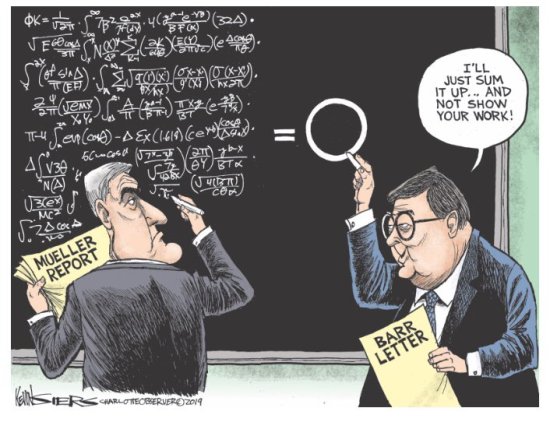
Good Afternoon!!
Once again, I hardly know where to begin. Yesterday Cover-Up General Barr made a complete ass of himself during his testimony to the Senate Judiciary Committee. Here’s a good summary of what happened from NBC News:
Just to put all of the news of Barr’s Senate testimony yesterday into one place, here are our seven highlights:
1. He said a president could replace an independent counsel if he thought in the investigation was unfair: “If the president is being falsely accused, which the evidence now suggests that the accusations against him were false, and he knew they were false, and he felt that this investigation was unfair, propelled by his political opponents, and was hampering his ability to govern, that is not a corrupt motive for replacing an independent counsel,” Barr said.
2. He admitted he didn’t review the underlying evidence in the Mueller report on whether Trump committed obstruction of justice: “We accepted the statements in the report as the factual record,” Barr said in an exchange with Kamala Harris. “We did not go underneath it to see whether or not they were accurately accepted as accurate.
3. He indicated he didn’t read the full Mueller report or even its executive summaries: “Polling data was shared, sir,” said Cory Booker. “It’s in the report; I can cite you the page.” Barr responded, “With who?” (Answer: Paul Manafort shared polling data with Konstantin Kilimnik – revealed on page 7 of Mueller’s executive summary of Russia’s interference in the 2016 campaign.)
4. He dodged Kamala Harris’ question on whether the president or anyone at the White House asked him or suggested to him to open an investigation into anyone: “I’m trying to grapple with the word ‘suggest.’ I mean, there have been discussions of matters out there that… they have not asked me to open an investigation,” he said.
5. He said the Mueller report was his “baby” after Mueller submitted it: “At that point, it was my baby… It was my decision how and when to make it public.”
6. He said Mueller’s concern to him about his March 24 summary was inaccurate media reporting: “And I called Bob and said, you know, what’s the issue here? Are you — and I asked him if he was suggesting that the March 24th letter was inaccurate, and he said no, but that the press reporting had been inaccurate.” (But here’s Mueller’s letter complaining about Barr’s summary: It “did not fully capture the context, nature, and substance of this office’s work and conclusions.”
7. And/but he called Mueller’s letter “snitty”: “The letter’s a bit snitty, and I think it was written by one of his staff people.”
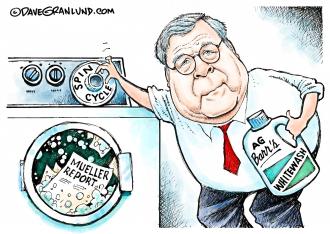
Afterward, he announced that he would refuse to attend a scheduled hearing before the House Judiciary Committee today.
Kamala Harris was the star of the show. Here’s her full examination of Barr in which she got him to stammer and stumble and finally admit he never looked at the evidence of Trump’s obstruction of the Russia investigation.
As noted in the NBC list, Cory Booker got Barr to admit that he didn’t know that Paul Manafort had shared internal polling data with Konstantin Kilimnik–who is connected to Russian intelligence services–indicating that Barr didn’t even read Mueller’s report or even the executive summaries! In fact, in his exchange with Nebraska Republican Ben Sasse, it appeared that Barr did not even know who Oleg Deripaska is!
Here’s Twitter thread from David Rothkopf on the long-term implications of Cover-Up Barr’s claims about presidential power.
I don’t think we fully realize the profundity of Barr’s assertions yesterday. The ideas that a president can determine whether or not he ought to be investigated or that a president is incapable of committing obstruction are not just outrageous assaults on Constitutional values.
Taken in the context of this administration’s systematic rejection of the oversight role of Congress and of the law–whether it is the emoluments clause of Constitution or the obligation of the IRS to hand over tax returns to the Chairman of the Ways and Means Committee–what we are seeing is nothing less than a coup, to use a word the president has grown fond of. Trump and Barr are seeking to eliminate the checks and balances that are a hallmark of our system and to effectively render the Congress subservient to the presidency.
Combine this with the efforts of the Senate to load the courts with judicial candidates loyal to the president and the implication of McConnell, Graham & Co. that they will not fulfill their own Constitutional obligations, and you see a devastating picture.
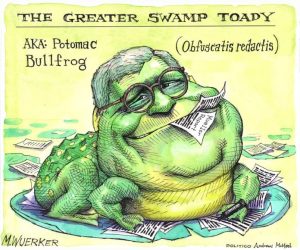
Please click on the link and read the rest.
Some reactions to yesterday’s horror show
Neal Kaytal: Why Barr Can’t Whitewash the Mueller Report.
Many who watched Attorney General William Barr’s testimony on Wednesday before the Senate Judiciary Committee, which followed the revelation that the special counsel Robert Mueller had expressed misgivings about Mr. Barr’s characterization of his report, are despairing about the rule of law. I am not among them. I think the system is working, and inching, however slowly, toward justice.
When it comes to investigating a president, the special counsel regulations I had the privilege of drafting in 1998-99 say that such inquiries have one ultimate destination: Congress. That is where this process is going, and has to go. We are in the fifth inning, and we should celebrate a system in which our own government can uncover so much evidence against a sitting president….
The underappreciated story right now is that we’ve not only learned that it was Mr. Barr — and pointedly not Mr. Mueller — who decided to clear President Trump of the obstruction charges, but also discovered the reasoning behind Mr. Barr’s decision. The American public and Congress now have the facts and evidence before them. The sunlight the regulations sought is shining.
Mr. Barr tried to spin these facts. He hid Mr. Mueller’s complaints, which were delivered to him in writing more than a month ago, even when Congress asked in a previous hearing about complaints by members of the special counsel’s team. And the four-page letter that Mr. Barr issued in March and supposedly described the Mueller report omitted the two key factors driving the special counsel’s decision (which were hard to miss, as they were on the first two pages of the report’s volume about obstruction): First, that he could not indict a sitting president, so it would be unfair to accuse Mr. Trump of crimes even if he were guilty as sin; and second, Mr. Mueller could and would clear a sitting president, but he did not believe the facts cleared the president.
These two items came out because the special counsel regulations allowed for public release of this information (and not, as Mr. Barr testified on Wednesday, because he “overrode” the regulations to give the information to the public). The attorney general was misleading through and through, not just about the investigation, but about the special counsel regulations themselves.
Read the rest at The New York Times. I hope Kaytal is right; I’m having a little trouble being optimistic right now.
Greg Sargent: William Barr is helping to cover up Trump’s biggest crime of all.
As the political world struggles to digest the enormity of Attorney General William P. Barr’s profound corruption of his role on President Trump’s behalf, it’s worth stepping back and surveying a distilled version of what we know, now that special counsel Robert S. Mueller III’s redacted report has been released:
- Russia launched a massive attack on our political system, undermining the integrity of our elections, to elect Donald Trump president.
- U.S. law enforcement launched an investigation primarily aimed at getting to the bottom of that attack so that we could fully reckon with what happened and ensure the integrity of future elections.
- Trump tried in multiple ways to derail that accounting of this massive attack on our political system — and then tried to bury the truth about that derailment effort — in a manner that was at best corrupt, and at worst criminal.
The simplest way to understand much of what Barr has done — and what Trumpworld will be doing to impede inquiries going forward — is that it’s mainly aimed at obscuring the broad contours of that larger story.
The point here is not that everything they’re doing is deliberately aimed at this end. It’s that this bigger story is at the center of everything — and by “biggest crime of all,” I mean Trump’s most monstrous wrong — and thus efforts to keep smaller truths from coming out will inevitably be about obscuring that larger story.
Read the rest at The Washington Post.
Politico: Pelosi: Barr committed a crime by lying to Congress.
Speaker Nancy Pelosi on Thursday accused Attorney General William Barr of committing a crime by lying to Congress, blasting him in a closed-door meeting and later at a news conference.
“We saw [Barr] commit a crime when he answered your question,” Pelosi told Rep. Charlie Crist (D-Fla.) during a private caucus meeting Thursday morning, according to two sources present for the gathering.
“He lied to Congress. He lied to Congress,” Pelosi said soon after at a news conference. “And if anybody else did that, it would be considered a crime. Nobody is above the law. Not the president of the United States, and not the attorney general.“
Pelosi’s comments were an apparent reference to Barr’s response to Crist last month during a House Appropriations Committee hearing, during which the attorney generals aid he was not aware of any concerns that special counsel Robert Mueller’s team might have expressed about his four-page summary of Mueller’s findings.
More reactions, links only
The Washington Post: Hillary Clinton: ‘China, if you’re listening, why don’t you get Trump’s tax returns?’
Jamie Bouie at The New York Times: Bill Barr’s Perverse Theory of Justice.
Aaron Blake at The Washingotn Post: William Barr’s ‘snitty’ slip-up gives away his game.
EJ Dionne at the Washington Post: William Barr has shamelessly corrupted the debate over the Mueller report.
Amanda Marcotte at Salon: Bill Barr runs from House Judiciary hearing — will Democrats let him hide?
Benjamin Wittes at The Atlantic: The Catastrophic Performance of Bill Barr.
Jennifer Rubin: Barr’s testimony was a low point in Justice Department history.
ABC News: Hillary Clinton: Barr is acting as Trump’s ‘defense lawyer.’
I expect there will be more news breaking today. What stories have you been following?
Lazy Caturday Reads: Congress Must Stop The “Cover-Up General” Bill Barr
Posted: March 30, 2019 Filed under: morning reads, U.S. Politics | Tags: Adam Schiff, Bill Barr, caturday, Cover-Up General, Donald Trump, Iran-Contra, Iraqgate, Rachel Maddow Show, Robert Mueller, Russia investigation, William Safire 16 Comments
Hillary and Bill with Socks on the White House lawn
Good Morning!!
Some folks are beginning to catch on to the “Cover-Up General” Bill Barr. I’ve been writing about this for the past couple of weeks. Barr did what even Jeff Sessions wasn’t corrupt enough to do. He shut down the Russia investigation and now he’s stalling for time in order to keep the American people from learning what Robert Mueller found about Donald Trump, his crime family, and his evil goons.
Barr knows how to shut down an investigation and cover up the results. Way back in 1992, The New York Times’s William Safire raged in column after column against Barr’s cover-up of the Iraq-gate scandal, but Barr won in the end by getting George H.W. Bush to pardon the top conspirators.

Audrey Hepburn with Paris 1957
Read a recap of the scandal and Barr’s victory in The Los Angeles Times, Oct. 27, 1992: Iraqgate–A Case Study of a Big Story With Little Impact. Bush had illegally armed Saddam Hussein from 1986 and 1990. He handed Hussein “the very weapons he later used against American and allied forces in the Persian Gulf War.”
Bill Barr shut down both Iran Contra and Iraqgate by shutting the investigation down, first refusing to appoint a special prosecutor for Iraqgate and then recommending the pardons of the top Iran Contra officials.
NPR, Jan. 14, 2019: William Barr Supported Pardons In An Earlier D.C. ‘Witch Hunt’: Iran-Contra.
Barr….ran the Justice Department once before, under President George H.W. Bush.
Back then, the all-consuming, years-long scandal was called Iran-Contra. On Dec. 24, 1992, it ended when Bush pardoned six people who had been caught up in it.
“The Constitution is quite clear on the powers of the president and sometimes the president has to make a very difficult call,” Bush said then. “That’s what I’ve done.”
Then-Attorney General Barr supported the president’s decision in the Iran-Contra case, which gave clemency to people who had been officials in the administration of President Ronald Reagan, including former Defense Secretary Caspar Weinberger. He had been set to go on trial to face charges about lying to Congress.
To the man who led the Iran-Contra investigation, however, the pardons represented a miscarriage of justice.
Cat Stevens
“It demonstrates that powerful people with powerful allies can commit serious crimes in high office, deliberately abusing the public trust without consequences,” said Lawrence Walsh, the independent prosecutor in the case, at the time of the pardons.
Barr said later that he believed Bush had made the right decision and that he felt people in the case had been treated unfairly.
“The big ones — obviously, the Iran-Contra ones — I certainly did not oppose any of them,” Barr said as part of the Presidential Oral History Program of the Miller Center at the University of Virginia.

From Bloomberg, Jan. 19, 2019:
The most significant single act of Barr’s career in the Department of Justice was to advise President George H.W. Bush to pardon six officials from Ronald Reagan’s administration, including Secretary of Defense Caspar Weinberger, for crimes associated with the Iran-Contra affair. At the time, Barr was — you guessed it — attorney general. His recommendation gave Bush the cover he needed to issue the pardons.
And Bush needed the cover. The investigation led by independent prosecutor Lawrence Walsh was closing in on the president himself. Walsh had demanded that Bush turn over a campaign diary that he kept in 1986. Bush failed to do so, presumably because the diary showed he knew more about Iran-Contra than he had let on. Walsh publicly condemned Bush’s failure to produce the diary as “misconduct” by the sitting president.
Jackie and Croline Kennedy, Hyannis Port, MA 1961
Issuing the pardons killed Walsh’s investigation — and saved Bush. When the targets of the investigation were off the hook, Walsh had no leverage to continue.
Don’t take my word for it. When the pardons came, Walsh went on ABC’s “Nightline” and said that Bush had “succeeded in a sort of Saturday Night Massacre.” The comparison was intended. Walsh was saying that Bush had saved himself by effectively ending an investigation that was leading to the Oval Office — the aim that Nixon failed to accomplish when he fired Watergate special prosecutor Archibald Cox.
Leaving little to the imagination, Walsh also said at the time that he had “evidence of a conspiracy among the highest ranking Reagan administration officials to lie to Congress and the American public.”
The architect of this pardon strategy was Barr. In an oral history interview he gave in 2001, Barr said he didn’t consult with the pardon office at his own Department of Justice, which was playing its “usual role — naysayers” against issuing pardons.
Instead, Barr said he spoke to “some seasoned professionals” at Justice. Then, “based on those discussions, I went over and told the President I thought he should not only pardon Caspar Weinberger, but while he was at it, he should pardon about five others.”

Read more of Barr’s corrupt history in this piece by Lloyd Green at The Guardian from March 25, 2019: William Barr: attorney general plays Republican spear-catcher again. From the article, some examples of Barr’s obfuscation techniques:
Doris Day
House Democrats demanded Barr appoint an independent counsel to investigate the sins of the Bush administration. They were rebuffed. In a letter to the House judiciary committee, Barr tossed around such phrases as “not a crime”, “simply not criminal in any way”, “nothing illegal”, and “far from being a crime.”
As to the separate question of whether administration officials deliberately altered commerce department documents in an effort to conceal military sales to Iraq and purposely misled Congress about Iraq policy, Barr contended the Department of Justice was up to that task.
He wrote: “These are the kinds of allegations that are routinely investigated by the Public Integrity Section and there is no conflict of interest that precluded their handling these matters in the normal course.” [….]
From the looks of things, Trump has the attorney general of his dreams. Like the supreme court justice Brett Kavanaugh, Barr is a loyal conservative who comes with a Bush family seal of approval. For this president, it doesn’t get better than that.

Fortunately, this time we have more engaged House members than in 1992. Let’s hope they’ve researched Cover-Up General Barr’s history and are ready to fight back. We have to stand with Adam Schiff.
Two more relevant reads:
The Washington Post: Sally Yates: William Barr should release the full Mueller report as soon as possible.
America’s justice system is built upon one thing — truth. When witnesses give testimony, they are sworn to tell “the truth, the whole truth, and nothing but the truth.” The word “verdict” derives from the Latin term “veredictum,” meaning “to say the truth.” Special counsel Robert S. Mueller III, a public servant with impeccable integrity, was entrusted to find the truth regarding Russian interference in the 2016 election and has spoken through a comprehensive report that details the facts that he uncovered.
Christina Ricci
Yet a week after Mueller issued his report, we don’t know those facts and have only been provided with Attorney General William P. Barr’s four-page summary of Mueller’s estimated 400-page report. It is time for the American people to hear the whole truth. We need to see the report itself.
First, as the attorney general’s letter to Congress notes, the Mueller report “outlines the Russian effort to influence the election and documents crimes committed by persons associated with the Russian government in connection with those efforts.” Congress has a solemn responsibility to protect our democracy. Without access to the full factual record of what the special counsel uncovered, it cannot fulfill that mandate. As you read this, the Russian government is undoubtedly hard at work to undermine our next election. Each day that passes without Congress having access to the full Mueller report is a day that Congress is prevented from doing its job of keeping our elections free from Russian espionage efforts.
Second, Barr’s letter leaves important questions unanswered concerning what then-candidate Donald Trump and his associates knew about Russian interference, and how they responded to Russian overtures to assist the campaign. While Barr’s letter states that the investigation did not establish that the campaign reached an agreement with the Russian government to take actions to impact the election in Trump’s favor, it reveals that the campaign did field “multiple offers from Russian-affiliated individuals to assist the Trump campaign.” Yet President Trump and others have repeatedly claimed that they had no contact with Russians, or knowledge that Russians were acting to assist his campaign.

Read the rest at the WaPo.
David Corn at Mother Jones: Here’s the Real Trump-Russia Hoax.
Elvis Presley
Two fundamental facts were established long before Mueller completed his investigation. First, the Russians attacked an American election in order to sow chaos, hurt Hillary Clinton, and help Donald Trump. Second, Trump and his top advisers during the campaign repeatedly denied this attack was underway, echoing and amplifying Moscow disinformation (the false claim that Russia was not attacking). Whether or not the Trumpers were directly in cahoots with the Russian government, they ran interference for Vladimir Putin’s assault on the United States, and they even did so after the intelligence community had briefed Trump on Russia’s culpability.
So to determine if the Barr triumphalists are acting in good faith, you need only ask them a simple question: do you accept these basic facts and acknowledge the profound seriousness of each one?
The Russian attack on the 2016 election was an attempt to subvert the foundation of American society: the democratic process. How can Americans have faith in their government, if elections are undermined by secret schemers, including a foreign government? It is certainly arguable that the Russian intervention—particularly the stealing and drip-drip-drip dumping of the John Podesta emails across the final four weeks of the election—was one of several decisive factors in a contest that had a narrow and tight finish. Consequently, there is a strong case that Moscow helped shift the course of US history by contributing to the election of Trump….
Jimmy Stewart, with Piewackit from Bell Book and Candle
During the campaign and afterward, some Trump backers and some critics on the left, including columnist and media scold Glenn Greenwald, questioned whether the Russians indeed engaged in such skulduggery. (The Nation, where I once worked, published an articlepromoting a report that claimed the Russians did not hack the Democratic National Committee—and then had to backtrack when that report turned out to be bunk.)
For many of these scandal skeptics, it hasn’t seemed to matter that the charge against Moscow has been publicly confirmed by the Obama administration, the US intelligence community (which concluded that Putin’s operation intended to help Trump), both Republicans and Democrats on the congressional intelligence committees, and Robert Mueller, who indicted a mess of Russians for participating in this covert operation. True, there often is cause to question officialdom and government sources. Yet anyone citing the Mueller report, as it is narrowly capsulized by Barr, must also accept his key finding: Russia attacked the United States and intervened in the election. (They must also accept that, as the Barr letter disclosed, Mueller found evidence suggesting Trump obstructed justice but did not reach a final judgment on this question.)


That’s it for me. What else is happening? What stories have you been following?
Lazy Caturday Reads: Weather and Russia Investigation Tidbits
Posted: March 2, 2019 Filed under: just because, morning reads, U.S. Politics | Tags: Amy Berman Jackson, cats, Chelsea Manning, David House, Eastern District of Virginia, John Dean, Julian Assange, Michael Cohen, Paul Manafort, Robert Mueller, Roger Stone, Russia investigation, weather 41 Comments
By Didier Lourenço
Good Morning!!
It’s March 2, but winter is still hanging on. It’s snowing here in the Boston area, and we expect several more inches on top of what we got earlier this week. It’s also supposed to snow again tomorrow night. I guess that’s going to come from this major cross-country storm.
USA Today: Major weekend winter storm packing heavy snow begins 2,500-mile cross-country sprint.
A major, fast-moving winter storm is racing across the country this weekend, bringing forecasts of heavy snow from California to New England and threats of heavy rain and severe thunderstorms along the 2,500-mile path….
In parts of the Midwest, the snow — falling at up to 1 or 2 inches per hour — could pile up fast enough to strand motorists along major highways, AccuWeather warns.
Sections of Pennsylvania, New York and northern and western New England could see up to a foot of snow.
The National Weather Service issued winter storm warnings Saturday for parts of Colorado, northern New Mexico, southern Wyoming and much of Kansas.
By Galina Kim
Snow was expected to move into the Central Rockies on Saturday and develop over parts of the Northern and Central Plains by Saturday evening, the NWS says. The snow will expand into parts of the Southern Plains and Middle Mississippi Valley overnight as it rolls eastward.

We didn’t get any new indictments from Robert Mueller yesterday, but there’s still quite a bit of Russia investigation news.
Roger Stone apparently failed to tell Judge Amy Berman Jackson that he has a book coming out that may violate his gag order. Late last night she ordered him to explain WTF is going on.
The Washington Post: Judge orders Roger Stone to explain imminent release of book that may violate gag order.
Republican operative and longtime Trump friend Roger Stone faced fresh legal trouble Friday after a federal judge ordered his attorneys to explain why they failed to tell her before now about the imminent publication of a book that could violate his gag order by potentially criticizing the judge or prosecutors with special counsel Robert S. Mueller III.
The order by U.S. District Judge Amy Berman Jackson of the District of Columbia late Friday came barely eight days after Jackson barred Stone from speaking publicly about his case, prompted by a photo posted on Stone’s Instagram account that placed a crosshairs next to a photo of Jackson’s head….
By Adrie Martens
In the new controversy, Jackson, in a brief order posted on the court’s electronic docket after office hours Friday, said she was allowing Stone’s defense team to file under seal a motion apparently to clarify the court’s gag order and an unspecified accompanying exhibit, and ordered a court clerk to make public Stone’s request.
But Jackson also ordered Stone’s attorneys to explain by Monday why they waited until now in making that request to disclose the “imminent general rel[e]ase” of a book, which Jackson said “was known to the defendant.” [….]
On Jan. 16, Stone announced via Instagram that he would be publishing a book titled “The Myth of Russian Collusion: The Inside Story of How Trump Really Won.” He included an image of the book cover. At the time, a source familiar with the publication plans told The Washington Post that the book consisted of a new introduction attached to a previous book that Stone had written about the 2016 presidential campaign. On Feb. 15, he announced via Instagram that the book would be published March 1, and he accompanied the post with hashtags such as #noconspiracy and #norussiancollusion.

According to Bloomberg, this may be an updated version of a 2017 Stone book.
At Buzzfeed News, Zoe Tillman writes about Paul Manafort’s latest sentencing memo: Paul Manafort Didn’t Just Ask For Less Prison Time In His Latest Court Filings — He’s Attacking Mueller Too.
Former Trump campaign chair Paul Manafort on Friday continued to attack special counsel Robert Mueller, accusing Mueller’s office of not only vilifying him, but also of “spreading misinformation.”
Manafort and his lawyers have used pre-sentencing memos not only to lobby for a lower prison sentence, but also to criticize the special counsel’s office — something they’ve had limited opportunities to do, given a gag order imposed early on. In a sentencing memo filed Friday in Manafort’s case in federal court in Virginia, his lawyers wrote that Mueller had unfairly impugned Manafort’s character.
By Catriona Millar
“The Special Counsel’s attempt to vilify Mr. Manafort as a lifelong and irredeemable felon is beyond the pale and grossly overstates the facts before this Court,” Manafort’s lawyers wrote. “The Special Counsel’s conduct comes as no surprise, and falls within the government’s pattern of spreading misinformation about Mr. Manafort to impugn his character in a manner that this country has not experienced in decades.”
Manafort’s lawyers repeated their claim that Mueller pursued Manafort for crimes largely unrelated to his work on President Donald Trump’s campaign in order to pressure Manafort to flip on the president. Political and legal pundits have speculated that Manafort is angling for a pardon; Trump in November told the New York Post that a pardon for Manafort was not “off the table.”
“The Special Counsel’s strategy in bringing charges against Mr. Manafort had nothing to do with the Special Counsel’s core mandate — Russian collusion — but was instead designed to ‘tighten the screws’ in an effort to compel Mr. Manafort to cooperate and provide incriminating information about others,” his lawyers wrote, quoting language Manafort’s judge in Virginia, US District Judge T.S. Ellis III, had previously used to question the special counsel’s office’s motivations.
Manafort is due for sentencing in the US District Court for the Eastern District of Virginia on March 7. Earlier this month, Mueller’s office said in a sentencing memo that it believed Manafort should face a sentencing range of between 19.5 to 24 years in prison. It also wrote that Manafort’s penalty could include a fine of up to $24 million.

Lock him up!
At The New York Times, John Dean has suggestions for Michael Cohen: John Dean: I Testified Against Nixon. Here’s My Advice for Michael Cohen.
There are several parallels between my testimony before Congress in 1973, about President Richard Nixon and his White House, and Michael Cohen’s testimony this week about President Trump and his business practices. Setting aside the differences regarding how we got there, we both found ourselves speaking before Congress, in multiple open and closed venues, about criminal conduct of a sitting president of the United States. This is not a pleasant place to be, particularly given the presidents involved.
The field cat, by Isabella Bryer
There are some differences: Unlike Mr. Cohen, who testified in public for a day, I testified for five days. His prepared statement was about 4,000 words; mine was some 60,000 words. Nielsen reports over 16 million people watched his testimony. I am told over 80 million people watched all or part of mine….
Mr. Cohen should understand that if Mr. Trump is removed from office, or defeated in 2020, in part because of his testimony, he will be reminded of it for the rest of his life. He will be blamed by Republicans but appreciated by Democrats. If he achieves anything short of discovering the cure for cancer, he will always live in this pigeonhole. How do I know this? I am still dealing with it.
Just as Mr. Nixon had his admirers and apologists, so it is with Mr. Trump. Some of these people will forever be rewriting history, and they will try to rewrite it at Mr. Cohen’s expense. They will put words in his mouth that he never spoke. They will place him at events at which he wasn’t present and locations where he has never been. Some have tried rewriting my life, and they will rewrite his, too.

There’s much more at the link.
This isn’t a Mueller case, but it could be related: Chelsea Manning has been subpoenaed. Politico: Chelsea Manning fights grand jury subpoena seen as linked to Assange.
Lawyers for convicted WikiLeaks source Chelsea Manning are asking a federal court to block a grand jury subpoena she received in what her supporters believe is a federal investigation into WikiLeaks founder Julian Assange.
Manning’s attorneys filed the motion Friday morning in U.S. District Court in Alexandria, Va., a spokesperson for Manning said. The motion was put under seal and no information about it was immediately available from the court clerk’s office.
By Peter Mitchev, Bulgarian painter
The subpoena sent to Manning in January does not specify any crimes or particular investigation, but it was issued at the request of a federal prosecutor assigned to handle the fallout from an error that led to the disclosure late last year of the strongest indication so far that Assange is the subject of sealed criminal charges in the U.S.
In a statement Friday, Manning blasted the process and said she plans to fight the subpoena, which was first reported by The New York Times.
The rest of the article is mostly whining from Manning and her attorneys. Frankly, I don’t see why should shouldn’t be willing to testify. Another former Julian Assange associate has done so.
Kevin Poulsen at The Daily Beast: WikiLeaks Veteran: I ‘Cooperated’ With Feds ‘in Exchange for Immunity.’
Chelsea Manning isn’t alone.
Late Thursday, Manning revealed that she’s fighting a subpoena to testify before a grand jury that’s been investigating Julian Assange for nearly nine years. But Manning isn’t the only one being dragged into the aging probe of WikiLeaks’ first big haul. A former WikiLeaks volunteer who was also personal friends with Manning was subpoenaed last May. But unlike Manning, he did not fight the subpoena. He accepted an immunity deal offered by prosecutors….
Manning’s subpoena is the latest surge of action in an old case given new life under the Trump administration. Though the paperwork doesn’t specify what she’s expected to testify about, a case number is visible at the top of the page. It’s the known case number for a grand jury probe into WikiLeaks that began nine years ago in the middle of Assange’s dump of the hundreds of thousand of diplomatic cables and Army field reports leaked to him by Manning.
Friends, by Ljudmila Vasina
The existence of case 10GJ3793 first became public in early 2011 when prosecutors were papering companies like Google and Twitter with demands for records of key WikiLeaks activists. With the government’s consent, Twitter notified five users that the feds were after their records, and three of them went to court to challenge the lawfulness of the search, backed by the ACLU and Electronic Frontier Foundation.
Paulsen expends quite a bit of verbiage on the history of the government’s pursuit of this case (I get the feeling he thinks it’s terrible) before he gets around to telling us who the cooperating witness is. His name is David House.
The Daily Beast has learned that David House, the former WikiLeaks volunteer and Manning friend, was subpoenaed last May for an encore appearance before the Alexandria grand jury. This time he didn’t take the Fifth. “I decided to cooperate in exchange for immunity,” said House, who provided a copy of the subpoena. “You know, I’m walking around on the street out here. I’m not in an embassy.”
House spoke briefly with prosecutors and then testified for about 90 minutes in front of the grand jury, he said. “They wanted to know about my meetings with Assange, they wanted to know broadly about what we talked about,” he recalled. Prosecutors seemed particularly interested in the potential for collateral damage in some of Assange’s leaks. The identities of some American collaborators were exposed in Assange’s release of State Department cables and Army field reports from Afghanistan, which triggered internal debate and led to the departure of some of WikiLeaks’ key staffers early on.
“They showed me chat logs in which I was arguing vehemently with him about releasing documents that would leave people vulnerable and put people’s lives at risk,” said House, a computer science graduate and political activist now working on a centrist movement called the Pilot Party. “That was the only thing they put in front of my face that made me think, ‘This may be what they’re going after him for.’”
That’s all I’ve got for you today. What stories are you following?


Thursday Reads: Will the Mueller Investigation Go Out “Not With A Bang, But A Whimper”?
Posted: February 21, 2019 Filed under: morning reads, U.S. Politics | Tags: Andrew McCabe, Andrew Miller, CNN, Donald Trump, Jerome Corsi, Matt Schlapp, Mercedes Schlapp, MSNBC, mystery foreign corporation, Robert Mueller, Roger Stone, Russia investigation, Sarah Isgur Flores, Special Counsel, T. S. Elliot, William Barr 37 CommentsGood Morning!!
 Trump’s handpicked Attorney General has been in place for just a few days, and suddenly multiple news organizations are reporting that the Mueller investigation is ending soon. Interestingly, The New York Times has not yet reported this story.
What’s going on? There are multiple outstanding cases. Roger Stone was only recently arrested and the Special Counsel’s Office can’t possibly have gone through all the materials they collected in searches at three different locations. The Supreme Court has not yet ruled on the mystery foreign company that is resisting the SCO’s subpoena. Andrew Miller is still fighting a grand jury subpoena. What about the case of Jerome Corsi, who said he was told he’d be indicted? What about Donald Trump Jr.?
I think we have to ask if in fact the Trump obstruction has finally worked. I’d also like to know why reporters are so gleeful about the purported end of the investigation? Why is there no skepticism about how coincidental this all seems.
There’s also this:
WTF? Note that Matt Schlapp’s wife Mercedes is the White House Director of Strategic Communications.
One more coincidence: the new politics editor at CNN is Sarah Isgur Flores, a right wing conspiracy theorist who most recently worked as Jeff Sessions’ spokesperson at DOJ. Could she be a source for these stories about the end of the Mueller probe?
CNN’s hiring of Sarah Isgur Flores, a longtime G.O.P. operative who has worked for Carly Fiorina and Ted Cruz, and most recently served as a spokeswoman for Jeff Sessions in the Justice Department (a position that reportedly involved a loyalty pledge to Donald Trump), caused an immediate and fairly predictable media firestorm. Unlike Corey Lewandowski, who was hired to great consternation during the 2016 election cycle (and then terminated), Flores won’t simply be an ideological talking head—she’ll be playing a larger role in the editorial process. Despite a lack of journalism experience, she will be helping to coordinate CNN’s political coverage across platforms, as well as occasionally appearing on-air as a political analyst, which is the more customary role for former politicians and government officials. Within the media world, she is seen as a controversial and unorthodox appointment. Moreover, Isgur apparently has a history of lambasting the mainstream media on Twitter, including CNN, which she once termed the “Clinton News Network.”
Sarah Isgur Flores
All of this has led to a fair amount of bafflement as to why CNN would hire her in a senior editorial role reporting to political director David Chalian.“Why CNN made this move to begin with is the deeper and more troubling question,” Margaret Sullivan wrote Wednesday in The Washington Post.
As far as how the talks came about in the first place, it appears that Isgur, as she was preparing to exit the D.O.J., wasn’t only shopping around for a media gig at CNN. Cable-news sources told me that she also passed through 30 Rock to discuss a potential role at MSNBC, where she met with top newsroom management in recent months. “She had a detailed idea of what she wanted to do,” someone with knowledge of the discussions told me. “She wanted to do something on-air combined with some sort of quasi-management, behind-the-scenes planning kind of work. I think she looked at Dave Chalian and said, I wanna do that.” A second source with direct knowledge of the talks said that such a role “was never under consideration.” This person added, “She was pitching her intimate knowledge of the Mueller probe as a selling point.”

Read the rest at Vanity Fair.
Here’s some speculation from Emptywheel: The Significance of the Rod Rosenstein/William Barr Window.
This is happening in the window of time when Rod Rosenstein is still around and — because William Barr has presumably not been through an ethics review on the investigation — presumably back in charge of sole day-to-day supervision of the investigation. But it is happening after Barr has been confirmed, and so any problems with the investigation that might stem from having an inferior officer (an unconfirmed hack like the Big Dick Toilet Salesman) supervising Mueller are gone.
I’m fairly certain the concerns about Barr coming in and forcing Mueller to finish this are misplaced. I say that, in part, because Mueller seemed to be preparing for this timing. I say it, too, because Barr is too close to Mueller to do that to him.
That says that Mueller is choosing this timing (and choosing not to wait for the appeals to be done). Whatever reason dictates this timing, by doing it in this window, Mueller can ensure the legitimacy of what happens, both legally (because Barr will be in place) and politically (because it will be clear Rosenstein presided over it).
I still don’t get it. It looks to me like we are going to have to count on the Democrats in the House to continue the investigation. Meanwhile Andrew McCabe is just beginning his book tour and he clearly thinks that Trump is a Russian asset.
This afternoon, Roger Stone will learn whether he is going to jail for threatening the judge in his case or if he at least will have to pay some bail instead of continuing to be free on his own recognizance. It’s also still possible there could be indictments tomorrow. And Mueller could file a detailed “report” in the sentencing memo for Paul Manafort on Friday. It’s also possible that Mueller isn’t really wrapping up. We’ll have to wait and see.
Two More Reads on Mueller’s Supposed End
Neal Kaytal at The New York times: The Mueller Report Is Coming. Here’s What to Expect.
The special counsel Robert Mueller will apparently soon turn in a report to the new attorney general, William Barr. Sure, there is still a lot of activity, including subpoenas, flying around, but that shouldn’t stop Mr. Mueller.
The report is unlikely to be a dictionary-thick tome, which will disappoint some observers. But such brevity is not necessarily good news for the president. In fact, quite the opposite.
For months, the president’s lawyers have tried to discredit Mr. Mueller and this report, but their efforts may have backfired. A concise Mueller report might act as a “road map” to investigation for the Democratic House of Representatives — and it might also lead to further criminal investigation by other prosecutors. A short Mueller report would mark the end of the beginning, not the beginning of the end.
The report is unlikely to be lengthy by design: The special counsel regulations, which I had the privilege of drafting in 1999, envision a report that is concise, “a summary” of what he found. And Mr. Mueller’s mandate is limited: to look into criminal activity and counterintelligence matters surrounding Russia and the 2016 election, as well as any obstruction of justice relating to those investigations.
The regulations require the attorney general to give Congress a report, too. The regulations speak of the need for public confidence in the administration of justice and even have a provision for public release of the attorney general’s report. In a world where Mr. Mueller was the only investigator, the pressure for a comprehensive report to the public would be overwhelming.
This is where the “witch hunt” attacks on Mr. Mueller may have backfired. For 19 months, Mr. Trump and his team have had one target to shoot at, and that target has had limited jurisdiction. But now the investigation resembles the architecture of the internet, with many different nodes, and some of those nodes possess potentially unlimited jurisdiction. Their powers and scope go well beyond Mr. Mueller’s circumscribed mandate; they go to Mr. Trump’s judgment and whether he lied to the American people. They also include law enforcement investigations having nothing to do with Russia, such as whether the president directed the commission of serious campaign finance crimes, as federal prosecutors in the Southern District of New York have already stated in filings. These are all critical matters, each with serious factual predicates already uncovered by prosecutors.
Read the rest at the NYT.
Garrett Graff at Wired: 7 Scenarios for how the Mueller Probe Might “Wrap Up.”
THE BREAKING NEWS hit a snowy Washington on Wednesday: Newly installed attorney general William Barrappears to be preparing to announce the end of special counsel Robert Mueller’s Russia investigation.
But what would “Mueller wrapping up” actually mean?
And does the rapid movement, soon after Barr was installed at the Justice Department, indicate that he shut down the Mueller probe prematurely? A recent New York Times article documenting Trump’s two-year-long campaign to obstruct and muddy the investigation exacerbated those fears, as did an ominous tweet by conservative commentator—and White House spouse—Matt Schlapp pronouncing that “Mueller will be gone soon.”
The tea leaves around Mueller in recent weeks seem especially hard to read—and they’re conflicting at best. CNN’s special counsel stakeout has spotted prosecutors working long hours, through snow days and holidays—just as they were in the days before Michael Cohen’s surprise guilty plea last fall for lying to Congress—yet there’s also been no apparent grand jury movement since Roger Stone’s indictment. So even as CNN’s stakeout spotted DC prosecutors entering Mueller’s offices—the type of people who Mueller might hand off cases to as he winds down—and the special counsel’s staff carting out boxes, there’s also recent evidence that Mueller still has a longer game in mind. The Roger Stone prosecution is just getting underway. Mueller is still litigating over a mystery foreign company. And he’s pushing forward trying to gain testimony from a Stone associate, Andrew Miller.
In fact, the list of loose threads at this point is, in some ways, longer than the list of what Mueller has done publicly. There’s conspiracy theorist Jerome Corsi’s aborted plea deal; would-be Middle East power broker George Nader’s lengthy cooperation with Mueller, which has resulted in no public charges; the mysterious Seychelles meeting between Blackwater mercenary founder Erik Prince and a Russian businessman; and then—of course—the big question of obstruction of justice. Add to that the host of recent witness testimony from the House Intelligence Committee that representative Adam Schiff has turned over to Mueller’s office, in which other witnesses, Schiff says, appear to have lied to Congress. And besides, there are a host of breadcrumbs that Mueller left in the more than 500 pages of his court filings that would all prove superfluous if further action didn’t lie ahead.
Head over to Wired to read the rest.
What do you think? Please share your thoughts and links on any topic in the comment thread below.

 peej
peej Carissa
 bostonboomer
 dakinikat
 ecocatwoman
 mablue2
 Mama Lopez
 peggysue22
 quixote
 skydancingguestblogger
 Mona (aka Wonk the Vote)



 Sky Dancing
Recent Comments