A couple of Caturdays ago, I posted illustrations from a 1950s children’s book called Space Cat and the Kittens. My brother had shared them with me after he bought the book at a used bookstore. This week, he came across the first book in the four-part series, and I’m going to post some of the illustrations from that book today. I think they are really cute. The story:
A little gray kitten with a taste for adventure stows away on an airplane, and the daring stunt turns out to be his first step toward becoming … Space Cat! The plane’s pilot, Captain Fred Stone, names his fuzzy new friend Flyball and welcomes him to an experimental station set up in the middle of the desert. Flyball enjoys supervising the station’s workers and takes particular interest in the big rocket ship that he’s not allowed to explore. Regardless of the rules, the kitty is determined to hitch another ride, and before you know it, Flyball’s wearing a custom-made pressurized suit and headed for the Moon.
As for the news, everything is awful as usual today. We’re dealing with a “president” who is well on the way of becoming a dictator. He plans to meet with fellow dictator Vladimir Putin to hand over territory in Ukraine; He is allowing his HHS secretary RFK Jr. to endanger Americans with anti-vaccine policies; and he is deliberately damaging American higher education.
President Trump said he would meet with President Vladimir V. Putin of Russia next Friday in Alaska, as he tries to secure a deal to end the war between Russia and Ukraine.
Mr. Trump announced the meeting Friday shortly after he suggested that a peace deal between the two countries could include “some swapping of territories,” signaling that the United States may join Russia in trying to compel Ukraine to permanently cede some of its land.
“We’re going to get some back, and we’re going to get some switched,” Mr. Trump said while hosting the leaders of Armenia and Azerbaijan for a peace summit at the White House. “There’ll be some swapping of territories to the betterment of both, but we’ll be talking about that either later, or tomorrow.”
The meeting, the first in-person summit between an American and Russian president since President Joseph R. Biden Jr. met with Mr. Putin in June 2021, reflects Mr. Trump’s confidence in his ability to persuade Mr. Putin in a face-to-face encounter, a goal that has eluded Mr. Trump and his predecessors. For Mr. Putin, the meeting itself is a victory after he spent the past several months largely isolated from the international community, with NATO leaders — other than Mr. Trump — refusing to communicate directly with him.
Carrying cat to the rocket
At least he didn’t invite Putin to the White House, but will Putin try to get him to give Alaska back to Russia while they are swapping land in Ukraine?
The meeting also presents a host of challenges. Ukrainian leaders have adamantly opposed relinquishing any of their land to Russia, and the country’s constitution bars President Volodymyr Zelensky of Ukraine from ceding any territory.
There would also be numerous political and military hurdles for Ukraine in turning over land to Russia, as well as questions including security guarantees for Ukraine and the future of frozen Russian assets. And many diplomats have suggested that Mr. Putin may be more interested in dragging out diplomacy to give him time to pummel Ukraine than in securing a peace deal.
White House officials declined to say exactly where in Alaska the two leaders would meet or why Mr. Trump decided to hold the meeting there, though it is the closest U.S. state to Russia. In 2021, the Biden administration held talks with China in Anchorage, Alaska.
Mr. Trump also provided little additional detail about the meeting, what territory could be swapped or the broader contours of a peace deal, saying earlier Friday that he did not want to overshadow the peace pledge between Armenia and Azerbaijan. But he told European leaders earlier this week that he planned to follow up his session with Mr. Putin with a meeting with Mr. Putin and Mr. Zelensky.
President Volodymyr Zelensky of Ukraine on Saturday flatly rejected the idea that Ukraine could cede land to Russia after President Trump suggested that a peace deal between Ukraine and Russia could include “some swapping of territories.”
“Ukrainians will not gift their land to the occupier,” Mr. Zelensky said in a video address from his office in Kyiv, several hours after Mr. Trump’s remarks, which appeared to overlook Ukraine’s role in the negotiations.
“Any decisions made against us, any decisions made without Ukraine, are at the same time decisions against peace,” Mr. Zelensky said. “They will bring nothing. These are dead decisions; they will never work.”
His blunt rejection risks angering Mr. Trump, who has made a peace deal between Ukraine and Russia one of his signature foreign policy goals, even if it means accepting terms that are unfavorable to Kyiv. In the past, Mr. Trump has criticized Ukraine for clinging to what he suggested were stubborn cease-fire demands and for being “not ready for peace.”
Cat in a hammock on spacecraft
What doesn’t anger Trump? Anything except blind loyalty and obedience.
A recent poll by the Kyiv International Institute of Sociology found that more than three-quarters of Ukrainians are against transferring Ukrainian-controlled territory to Russia. When it comes to ceding land that includes territory already under Russian control, opposition drops slightly, with a little more than half of Ukrainians against it, “even if this makes the war last longer and threatens the preservation of independence,” the poll says.
But support for land concessions has grown since Ukraine’s failed 2023 counteroffensive, which underscored its inability to retake substantial territory. About 38 percent of the population thinks ceding land is acceptable now, according to the poll, up from only 10 percent about two years ago.
Russia has long demanded that Ukraine give up four regions in the east and south that Moscow claims to have annexed in late 2022, even though some of that territory remains under Ukrainian control. The Kremlin is particularly intent on seizing full control of the eastern regions of Luhansk and Donetsk, which it has long sought to capture with relentless assaults.
But ceding Luhansk and Donetsk, which are part of an area commonly known as the Donbas region, would create a host of issues for Ukraine. It would mean giving up a region rich in cities and industrial centers that Russia could use as a launchpad to reignite the war.
And Ukraine would have to abandon its main fortified defensive line in northern Donetsk, stretching between the cities of Sloviansk and Kostiantynivka, which has so far withstood Russian assaults.
Location matters, former real estate mogul US President Donald Trump said. Moments later he announced Alaska, a place sold by Russia to the United States 158 years ago for $7.2 million, would be where Russian President Vladimir Putin tries to sell his land deal of the century, getting Kyiv to hand over chunks of land he’s not yet been able to occupy.
The conditions around Friday’s summit so wildly favor Moscow, it is obvious why Putin leapt at the chance, after months of fake negotiation, and it is hard to see how a deal emerges from the bilateral that does not eviscerate Ukraine. Kyiv and its European allies have reacted with understandable horror at the early ideas of Trump’s envoy, Steve Witkoff, that Ukraine cede the remainders of the Donetsk and Luhansk regions in exchange for a ceasefire.
Naturally, the Kremlin head has promoted the idea of taking ground without a fight, and found a willing recipient in the form of Witkoff, who has in the past exhibited a relaxed grasp of Ukrainian sovereignty and the complexity of asking a country, in the fourth year of its invasion, to simply walk out of towns it’s lost thousands of men defending.
Space cat in freefall
It is worth pausing and reflecting on what Witkoff’s proposal would look like. Russia is close to encircling two key Donetsk towns, Pokrovsk and Kostiantynivka, and may effectively put Ukrainian troops defending these two hubs under siege in the coming weeks. Ceding these two towns might be something Kyiv does anyway to conserve manpower in the months ahead.
The rest of Donetsk – principally the towns of Kramatorsk and Sloviansk – is a much nastier prospect. Thousands of civilians live there now, and Moscow would delight at scenes where the towns evacuate, and Russian troops walk in without a shot fired.
Ukrainian President Volodymyr Zelensky’s rejection of ceding land early Saturday reflects the real dilemma of a commander in chief trying to manage the anger of his military and the deep-seated distrust of the Ukrainian people towards their neighbor, who continues to bombard their cities nightly.
What could Ukraine get back in the “swapping” Trump referred to? Perhaps the tiny slivers of border areas occupied by Russia in Sumy and Kharkiv regions – part of Putin’s purported “buffer zone” – but not much else, realistically.
The main goal is a ceasefire, and that itself is a stretch. Putin has long held that the immediate ceasefire demanded by the United States, Europe and Ukraine for months, is impossible as technical work about monitoring and logistics must take place first. He is unlikely to have changed his mind now his troops are in the ascendancy across the eastern frontline.
Read more analysis at the CNN link.
RFK Jr. is doing untold damage to the health of Americans.
During the early days of the coronavirus pandemic in the spring of 2020, President Trump was warned by medical officials that the development of a vaccine that could turn the tide against Covid could be over a year away.
For Mr. Trump, that timeline was not good enough.
He demanded a faster program. The creation of that program, Operation Warp Speed, led to lifesaving vaccines that contained messenger RNA, or mRNA, a synthetic form of a genetic molecule that helps stimulate the immune system. Those vaccines are widely regarded in the scientific community as the quickest way to protect Americans against future threats, including viruses that could mushroom into a pandemic, or man-made menaces, like a bioweapons attack.
Time has marched on and, apparently, so has Mr. Trump in his second term.
This week, the president all but shrugged off an announcement by Robert F. Kennedy Jr., the health and human services secretary and a longtime critic of vaccines, that a research division of his department had slashed $500 million in grants and contracts for work on mRNA vaccines.
“That was now a long time ago, and we’re onto other things,” the president told reporters on Wednesday. Mr. Trump added that his administration is now “looking for other answers to other problems, to other sicknesses and diseases.” He said he was planning to meet with Mr. Kennedy on Thursday to discuss the decision, but by Friday, White House officials did not say whether that meeting took place.
Space cat is first to land on the Moon.
A bit more:
Mr. Trump’s willingness to give Mr. Kennedy the space to impose his views is notable, given that the vaccines were once seen as legacy achievement during Mr. Trump’s first term. But his laissez-faire posture also leaves room for Mr. Trump to position himself in line with the portion of his base that has grown deeply skeptical about the safety and efficacy of vaccines.
Adm. Brett Giroir, an assistant health secretary in the first Trump administration who was involved in the development of the Covid vaccines, recalled that the president had been “very pro-vaccine,” particularly on matters involving flu preparedness. In 2019, Mr. Trump signed an executive order calling for the modernization of flu vaccines, because “he knew we weren’t as well prepared as we should be.”
Now it’s different. Trump would rather sacrifice millions more American lives than confront his conspiracy-minded followers.
As a record number of people in the U.S. are sickened with measles, researchers are resurrecting the search for something long-deemed redundant: treatments for the viral disease.
After the measles vaccine was introduced in the 1960s, cases of the disease plummeted. By 2000, federal officials had declared measles eliminated from the U.S. This success led to little interest in the development of treatments. But now, as vaccination rates fall and infections rise, scientists are racing to develop drugs they say could prevent or treat the disease in vulnerable and unvaccinated people.
“In America, we don’t like being told what to do, but we like to have options for our medicine chest,” said Marc Elia, chairman of the board of Invivyd, a Massachusetts-based drugmaker that started working on a monoclonal antibody for measles this spring.
Scientists across the country including at biotechs Invivyd and Saravir Biopharma—and institutions such as Vanderbilt University Medical Center and Georgia State University—are in the early stages of measles-treatment development. The drugs are still a ways from becoming available to patients but could offer alternatives to people who are immunocompromised, don’t respond to the measles vaccine or are vaccine skeptics.
Space cat saves astronaut’s life by plugging a hole in his helmet.
Some doctors and researchers warn that measles treatments could further drive the drop in vaccination. Nationally, 92.5% of kindergartners received the measles, mumps and rubella, or MMR, shot in the 2024-25 school year, according to Centers for Disease Control and Prevention data. In 2019-20, the vaccination rate was over 95%, which is the rate encouraged by health authorities to prevent community transmission of measles.
More than 1,300 people, most of them unvaccinated, have been diagnosed with measles this year—a 33-year high.
“One of the motivations of getting the vaccine right now is that there are no treatments,” said Dr. Joel Warsh, a pediatrician who says more research is needed into immunization safety.
Still, Invivyd is betting its measles monoclonal antibody could help curb infections and outbreaks. Unlike the MMR vaccine, which is designed to train the body to make its own antibodies—proteins that help defeat specific pathogens—monoclonal antibodies are lab-made versions that can be delivered intravenously or as an injection and boost immunity immediately.
Antibody treatments could treat someone who is sick or help prevent measles in people recently exposed to the virus. They could benefit newborns and immunocompromised people who can’t be vaccinated, as well as the minority of people who don’t respond to the vaccine or whose immunity has waned. The treatments could offer weeks or months of protection against measles, researchers said.
“Think of it like antivenom after a snake bite,” said Erica Ollmann Saphire, chief executive of the La Jolla Institute for Immunology, whose lab is developing its own monoclonal antibodies for measles. “Even people unsure about vaccines, if they are already sick with measles, getting an antibody treatment could be palatable.”
There’s much more at the link. I got past the paywall by clicking the link at Memeorandum.
As an infectious disease physician who cared for dozens of critically ill Covid patients in December 2020, I witnessed a remarkable shift in the months that followed. As mRNA vaccines became available in early 2021, severe cases among vaccinated individuals became extremely rare. Deaths were almost exclusively among those who declined vaccination, which was tragic given how preventable these outcomes had become.
Space cat in the moon cave
No vaccine for respiratory viruses has ever provided complete, lasting protection against all infections. Not the flu vaccine. Not RSV vaccines. That never should have been the expectation. Some vaccines, like those for measles or polio, can effectively prevent infection and transmission, but these target fundamentally different viruses that don’t constantly mutate and reinfect the respiratory tract. The purpose of respiratory virus vaccines is to prevent severe disease, hospitalization and death. By that measure, mRNA vaccines have been revolutionary.
The data confirms what I witnessed firsthand. According to research by the Centers for Disease Control and Prevention, unvaccinated individuals had 53 times the risk of death compared to those who had been fully vaccinated during the Delta wave in 2021. A New England Journal of Medicine study analyzing over 6 million Covid cases found that protection against death remained above 90% and remarkably durable, even as protection against infection declined.
In winter 2020, my hospital’s ICU overflowed with COVID patients. Like many colleagues worldwide, I watched patient after patient die despite our best efforts. It was unlike anything any of us had ever seen. By summer 2021, after vaccines rolled out widely, the change was undeniable. Far fewer patients arrived with respiratory failure. Nursing homes saw deaths plummet.
As vaccine expert Paul Offit stated in December 2020: “All you want to do is keep people out of the hospital and keep them out of the morgue and I think this vaccine can certainly do that.” Even then, before vaccines were widely available, experts understood the real goal.
The Trump administration is seeking a $1 billion settlement from the University of California, Los Angeles, a White House official said Friday, after the Department of Justice accused the school of antisemitism and other civil rights violations.
UCLA is the first public university to be targeted by a widespread funding freeze over allegations of civil rights violations related to antisemitism and affirmative action.
President Donald Trump’s administration has frozen or paused federal funding over similar allegations against elite private colleges. In recent weeks, the administration has struck deals with Brown University for $50 million and Columbia University for $221 million but has explored larger settlements, such as in its ongoing battle with Harvard University.
The White House official did not detail any additional demands the administration has made to UCLA or elaborate on the settlement amount. The person was not authorized to speak publicly about the request and spoke on condition of anonymity.
The university had drawn widespread criticism for how it handled dispersing an encampment of Israel-Hamas war protesters in 2024. One night, counterprotesters attacked the encampment, throwing traffic cones and firing pepper spray, with fighting that continued for hours, injuring more than a dozen people, before police stepped in. The next day, after hundreds defied orders to leave, more than 200 people were arrested. Later, Jewish students said demonstrators in encampments blocked them from getting to class.
The Trump administration is warning Harvard University that it could take over its patents, worth hundreds of millions of dollars, if a review finds the university hasn’t complied with federal law, an escalation of the continuing negotiations between the White House and America’s oldest university.
Commerce Secretary Howard Lutnick sent a letter to Harvard President Alan Garber on Friday, telling him the administration planned to do a thorough review of all patents held by the university.
General likes Space Cat.
“We believe that Harvard has failed to live up to its obligations to the American taxpayer and is in breach of the statutory, regulatory, and contractual requirements tied to Harvard’s federally funded research programs and intellectual property arising therefrom, including patents,” the letter says.
A Harvard spokesperson called the move “yet another retaliatory effort targeting Harvard for defending its rights and freedom.” The university’s technology and patents help save lives and redefine industries, and Harvard is committed to complying with all federal laws around the patenting of work from federally funded research, the spokesperson said.
The letter is another point of leverage for the Trump administration in its effort to punish the university for allegedly failing to stop antisemitism on campus. The administration has frozen billions of dollars in Harvard’s federal research money and cut the university off from future grants.
Lutnick told Garber that he had until Sept. 5 to respond with a list of all patents that have stemmed from federally funded research grants and to provide information showing it complied with federal regulations, including a 1980 act by Congress known as Bayh-Dole that allowed institutions to retain ownership of a patent even if the innovation used taxpayer dollars.
A bit more, because of the paywall:
Harvard has more than 5,800 patents, according to its website. In its fiscal year ended in June, the university was issued 159 patents. Startups from Harvard range from pharma and biotech companies to manufacturing.
Federal regulations under Bayh-Dole require a litany of disclosures for a patent, including how the American people benefit from an invention. If a patent holder fails to make these disclosures, the government has the right to take ownership of the invention.
Lisa Ouellette, a law professor at Stanford, said the Trump administration’s move appears to be unprecedented in the four and a half decades of the Bayh-Dole Act. “I have never seen the government step in to reclaim control of a university’s patents in any sense,” she said. The Biden administration considered using a provision of the act to try to lower pharmaceutical prices, but the proposal never came to pass, Ouellette said.
The Trump administration has been in talks with several universities, including the University of California, Los Angeles, Cornell and Northwestern, and sees striking a deal with Harvard as an essential mission. The White House has already reached a $200 million settlement with Columbia and a $50 million deal with Brown.
This is breathtaking.
That’s all I have for today. What’s on your mind?
Did you like this post? Please share it with your friends:
Yesterday, Trump wandered around on the White House roof, and shouted inanities at reporters on the ground, including a joke about nuclear weapons. He is such an embarrassment.
President Donald Trump made a surprise appearance on the White House roof above the briefing room in an apparent effort to inspect future construction.
The press, which had been pushed significantly down the driveway, attempted to figure out what was going on.
“Mr. President, what are you doing up there?”
“Just taking a little walk,” he shouted back.
“What are you building?”
“It goes with the ballroom, which is on the other side,” he said.
Pressed again by reporters, Trump said “Something beautiful,” while pantomiming with his hands.
Great. So he’s planning to wreck both the East and West wings?
The president was accompanied by a small group of aides and Secret Service. The group included architect Jim McCrery, who has been commissioned to add Trump’s ballroom to the White House. The two men appeared engaged in intense conversation as they surveyed the grounds with lots of animated pointing….
“What are you trying to build?” one reporter shouted.
“Missiles,” Trump responded, presumably joking. “Nuclear missiles,” he repeated while making the gesture of a rocket launching.
Q: Sir, what are you trying to build?TRUMP: Missiles. Nuclear missiles
Americans who haven’t visited the White House for a guided tour probably can’t picture the East Wing. There’s no TV show about it. It has no famous office to rival the Oval. There are relatively few photos of it in its current form.
As someone who worked there for six months (I moved to the West Wing after the 1984 election), allow me to sing its praises: The East Wing was built in 1902 as a visitors’ entrance and then expanded in 1942 to house the First Lady’s offices. Its style echoes the West Wing in design and footprint, which gives the White House complex a rough symmetry. Like the West Wing, it’s smaller than Hollywood imagines. It conveys stability and authority without ostentation. Unlike the West Wing, it’s flooded with sunlight and, at least when Nancy Reagan held court, adorned with fresh flowers. The two-story structure melds seamlessly into the surrounding gardens. You can hardly see it from the street.
Rendering of planned White House ballroom
Now President Trump has announced that he will “modernize” (which must mean demolish) the East Wing and replace it with a huge, gaudy ballroom. At 90,000 square feet, the ballroom will dwarf the West Wing and even the residence. Naturally it will be adorned in white and gold (to get a flavor, have a look at the way Trump has decorated the Oval Office). This permanent disfigurement will solve a problem that doesn’t exist. When the president entertains more people than can comfortably fit in the East Room (about 200), tents are erected on the lawn complete with floors and walls. But Trump is dissatisfied with the historic building that was good enough for Lincoln and Eisenhower and Reagan. Ladies’ high heels sink into the grass, he says, explaining why he has also paved over the Rose Garden.
But rather than rail against this desecration of a key national symbol, perhaps it’s better to welcome it. The presidency will never be the same post-Trump, so why not the White House? Why not make concrete and visible the destruction of centuries-old norms and values? This president has just elevated to a Court of Appeals a lawyer who presided over a purge of FBI agents who investigated Trump for January 6th and instructed his underlings at the Justice Department to “F— the courts.” He has opened a criminal investigation into former Special Counsel Jack Smith on the specious charge of violating the Hatch Act. His attorney general has opened a disciplinary investigation of Judge James Boasberg because Boasberg privately expressed concerns that the Trump administration might, to borrow a phrase, “F— the courts.”
In past Olympic Games held on American soil, sitting presidents have served in passive, ceremonial roles. President Trump may have other plans.
An executive order signed by Trump on Tuesday names him chair of a White House task force on the 2028 Games in Los Angeles, viewed by the president as “a premier opportunity to showcase American exceptionalism,” according to a White House statement. Trump, the administration said, “is taking every opportunity to showcase American greatness on the world stage.”
At the White House, speaking in front of banners adding the presidential seal to the logo for LA28, Trump said he would send the military back to Los Angeles if he so chose in order to protect the Games. In June, Trump sent the National Guard and U.S. Marines to the city amid widespread immigration enforcement actions, despite widespread condemnation from Mayor Karen Bass and other local officials.
“We’ll do anything necessary to keep the Olympics safe, including using our National Guard or military, OK?” he said. “I will use the National Guard or the military. This is going to be so safe. If we have to.”
Trump’s executive order establishes a task force led by him and Vice President JD Vance to steer federal coordination for the Games. The task force will work with federal, state and local partners on security and transportation, according to the White House.
Those roles have been fairly standard for the federal government in past U.S.-hosted Olympic Games. But Trump’s news conference could present questions about whether a president with a penchant for showmanship might assume an unusually active role in planning the Olympics, set to take place in the twilight of his final term.
There is ample precedent for military and National Guard forces providing security support during U.S.-hosted Olympic Games. But coming on the heels of the recent military deployment to Los Angeles, Trump’s comments may prove contentious.
Anyone who thinks Trump is planning to leave the White House at the end of his term is living in a fantasy world. He’s turning the White House into Mar-a-Lago North, and he doesn’t plan to leave. Next, he’ll build a golf course on White House grounds. Rachel Maddow said it out loud on Monday night.
Rachel Maddow did not sugarcoat it for viewers: The MSNBC anchor warned viewers that the United States is not headed towards an authoritarian state under President Donald Trump: “We are there. It is here.”
“Life in the United States is profoundly changing and is profoundly different than it was even six months ago,” the anchor said Monday night on “The Rachel Maddow Show.” “Because we do now live in a country that has an authoritarian leader in charge, we have a consolidating dictatorship in our country.”
Maddow went on to paint the picture of what she called a caricature of an authoritarian state. She mentioned secret police, prison camps and individuals fired for speaking a truth that does not please their authoritarian leader.
“We’re beyond waiting and seeing now. It is clear what’s going on,” she said. “We have crossed a line. We are in a place we did not want to be, but we are there.”
She pointed to immigration raids happening nationwide, comparing ICE agents with masked secret police, even referring to immigrants as “the scapegoated enemy on whom all things must be blamed and against whom all things are justified.” Another element she raised was that Trump has turned military force inward on the American people.
In addition to acts of violence against Americans, Maddow noted that under this authoritarian rule protests must be criminalized and media must be intimidated into saying and doing what the leader wants. She added that top universities and law firms are also subject to funding cuts if they do not bow to the president.
And if you release facts to the contrary of the president, be careful.
“Because he said it, then it must be true, and if you say otherwise then you will be fired,” Maddow said.
Also during the Olympics event, Grandpa Trump repeated, for he umpteenth time, his insane ideas about California’s supposed mismanagement of water and forest fires.
oh my goodness — get a load of Trump's incoherent rant about water management in California (this is an event about the Olympics!)
In Epstein scandal news, Trump and Vance will meet with other top officials, including the Attorney General and Assistant Attorney General and the head of the FBI to discuss how to control the fallout from the highly unusual meeting of Assistant AG Todd Blanche with Ghislaine Maxwell and her subsequent transfer to a minimum security prison. Remember the days when the Department of Justice remained scrupulously independent of the president?
Top Trump administration officials will gather at the vice president’s residence Wednesday evening as they continue to weigh whether to publish an audio recording and transcript of Deputy Attorney General Todd Blanche’s recent conversation with Jeffrey Epstein accomplice Ghislaine Maxwell.
The administration’s handling of the Epstein case, as well as the need to craft a unified response, is expected to be a main focus of the dinner, three sources familiar with the meeting told CNN. The meeting will include White House chief of staff Susie Wiles, Vice President JD Vance, Attorney General Pam Bondi, FBI Director Kash Patel and Blanche.
Officials who will meet to discuss Epstein strategy
With the exception of Vance, the White House considers those officials the leaders of the administration’s ongoing strategy regarding the Epstein files, two of the sources said.
The meeting comes as Trump’s administration is considering releasing the contents of Blanche’s interview last month with Maxwell. Two officials told CNN that the materials could be made public as early as this week.
There have also been internal discussions about Blanche holding a press conference or doing a high-profile interview, possibly with popular podcaster Joe Rogan, according to three people familiar with the discussions, though those conversations are preliminary. Rogan, who endorsed Trump on the eve of last fall’s election, has been highly critical of the Trump administration’s handling of the Epstein case and previously called their refusal release more information about Epstein a “line in the sand.”
Meanwhile, CNN previously reported that the Justice Department has been digitizing, transcribing and redacting the interview materials as they weigh if and when to publicly release the information from the Maxwell interview. There is over 10 hours of audio, a senior Trump administration official said. Portions of the transcript that could reveal sensitive details like victim names would also have to be redacted, one of the officials said.
One official told CNN that some of the conversation within the White House has focused on whether making the details from the interview public would bring the Epstein controversy back to the surface. Many officials close to Trump believe the story has largely died down.
The House Oversight Committee on Tuesday issued subpoenas for Department of Justice records on the Jeffrey Epstein investigation, as well as for interviews with a slate of former government officials in connection to the case.
Oversight Chair James Comer (R-Ky.) announced that he was summoning nearly a dozen former officials to appear for depositions on the Epstein investigation — a list that includes former President Bill Clinton and former Secretary of State Hillary Clinton.
Former U.S. Attorneys General William Barr, Alberto Gonzales, Jeff Sessions, Loretta Lynch, Eric Holder and Merrick Garland, as well as former FBI Directors Robert Mueller and James Comey were also tapped to give testimony in connection to the case.
The move is the latest in a broader battle over the Epstein files, which took the Trump administration by storm last month as anger boiled over from within MAGA circles about the administration’s handling of the case.
The committee’s subpoena of Bill Clinton in particular seems more symbolic than substantive. No former president has ever testified to Congress under the compulsion of a subpoena — and lawmakers have tried only twice before: once in 1953, when the House Un-American Activities Committee subpoenaed Harry Truman, and once in 2022, when the Jan. 6 select committee subpoenaed Donald Trump.
Neither president testified in those instances, and the Justice Department has long cited Truman’s example — though not backed by any legal precedent — to suggest that it is improper for Congress to compel even former presidents to testify, given separation of powers concerns.
Yesterday The New York Times published photos from inside Jeffrey Epstein’s New York townhouse. The article also included the full text of a letter from Woody Allen on Epstein’s 63 birthday. (gift link): A Look Inside Jeffrey Epstein’s Manhattan Lair.
As a gift for Jeffrey Epstein’s 63rd birthday, friends sent letters in tribute to the wealthy financier and convicted sex offender. Several shared a common theme: recounting the dinner gatherings that Mr. Epstein regularly hosted at his palatial townhouse on Manhattan’s Upper East Side.
Ehud Barak, former prime minister of Israel, and his wife noted the great diversity of guests. “There is no limit to your curiosity,” they wrote in their message, which was compiled with others in January 2016. “You are like a closed book to many of them but you know everything about everyone.”
A sculpture of a bride clinging to a rope dangled in a central atrium of Jeffrey Epstein’s mansion.
The media mogul Mortimer Zuckerman suggested ingredients for a meal that would reflect the culture of the mansion: a simple salad and whatever else “would enhance Jeffrey’s sexual performance.”
And the director Woody Allen described how the dinners reminded him of Dracula’s castle, “where Lugosi has three young female vampires who service the place.” [….]
But Mr. Epstein’s prized property was no gloomy Transylvanian fortress. He had spent years turning the seven-story, 21,000-square-foot townhouse into a place where he could flaunt — and deepen — his connections to the rich and powerful, even as hints of his dark side lurked within, according to previously undisclosed photos and documents showing how he lived in his later years.
Since Mr. Epstein’s death in federal custody in 2019, which was ruled a suicide, many mysteries about his life have remained unsolved. How did he amass a nine-figure fortune? And why did so many powerful men continue to fraternize with him long after he became a registered sex offender?
The White House had pledged to release details about the federal investigations into Mr. Epstein and his associates. But this summer the Trump administration backpedaled. The ensuing right-wing outrage has threatened to splinter the Make America Great Again movement — for whom Mr. Epstein is a central figure in conspiracy theories — and has put Mr. Trump on the defensive like few other issues….
At least one other MAGA luminary also visited the townhouse: Stephen K. Bannon, a former adviser to Mr. Trump and an online media personality, who has said that he videotaped hours of interviews in the mansion with Mr. Epstein in 2019. Framed photos of Mr. Bannon — including a mirror selfie snapped by Mr. Epstein — were kept in at least two rooms in the mansion.
Use the gift link to read the rest if you’re interested.
The long-running scandal surrounding the disgraced late financier and convicted sex offender Jeffrey Epstein broadened on Tuesday after the New York Times published a trove ofpreviously unseen letters to Epstein from numerous powerful figures as well as unseen photographs from inside his Manhattan mansion.
The letters, written to Epstein by a number of high-profile individuals, were reportedly compiled as a birthday gift for Epstein’s 63rd birthday in 2016. Their publication comes amid intense speculation around Donald Trump’s ties to Epstein, who was found dead in a New York jail in 2019 and had long cultivated a celebrity social circle of the rich and powerful.
In one letter, former prime minister of Israel Ehud Barak and his wife wrote “there is no limit to your curiosity.”
“You are like a closed book to many of them but you know everything about everyone,” they wrote, describing Epstein as “A COLLECTOR OF PEOPLE”.
They continued: “May you enjoy long and healthy life and may all of us, your friends, enjoy your table for many more years to come.”
In a letter from film-maker Woody Allen, Allen reminisced about Epstein’s dinner parties at his Upper East Side townhouse and described the gatherings as “always interesting”. He noted that the parties included “politicians, scientists, teachers, magicians, comedians, intellectuals, journalists” and “even royalty”.
Allen also described the dinners as “well served”: “I say well served – often it’s by some professional houseman and just as often by several young women” who he said reminded him of “Castle Dracula where Lugosi has three young female vampires who service the place.”
Other letter writers reportedly included billionaire media mogulMortimer Zuckerman;Noam Chomsky and his wife; Joichi Ito, the former head of the Massachusetts Institute of Technology (MIT) Media Lab; physicist Lawrence M Krauss; and Harvard biologist and mathematician Martin Nowak.
The US Department of Health and Human Services (HHS) plans to cancel $500m (£376m) in funding for mRNA vaccines being developed to counter viruses that cause diseases such as the flu and Covid-19.
That will impact 22 projects being led by major pharmaceutical companies, including Pfizer and Moderna, for vaccines against bird flu and other viruses, HHS said.
Health Secretary Robert F Kennedy Jr, a vaccine sceptic, announced he was pulling the funding over claims that “mRNA technology poses more risks than benefits for these respiratory viruses”.
Doctors and health experts have criticised Kennedy’s longstanding questioning of the safety and efficacy of vaccines and his views on health policies.
The development of mRNA vaccines to target Covid-19 was critical in helping slow down the pandemic and saving millions of lives, said Peter Lurie, a former US Food and Drug Administration official.
He told the BBC that the change was the US “turning its back on one of the most promising tools to fight the next pandemic”.
In a statement, Kennedy said his team had “reviewed the science, listened to the experts, and acted”. “[T]he data show these vaccines fail to protect effectively against upper respiratory infections like COVID and flu,” he said.
He said the department was shifting the funding toward “safer, broader vaccine platforms that remain effective even as viruses mutate”.
Kennedy also claimed that mRNA vaccines can help “encourage new mutations and can actually prolong pandemics as the virus constantly mutates to escape the protective effects of the vaccine”.
Health experts have said that viruses mutate regardless of whether vaccines exist for them.
The Trump administration has asked NASA employees to draw up plans to end at least two major satellite missions, according to current and former NASA staffers. If the plans are carried out, one of the missions would be permanently terminated, because the satellite would burn up in the atmosphere.
The data the two missions collect is widely used, including by scientists, oil and gas companies and farmers who need detailed information about carbon dioxide and crop health. They are the only two federal satellite missions that were designed and built specifically to monitor planet-warming greenhouse gases.
It is unclear why the Trump administration seeks to end the missions. The equipment in space is state of the art and is expected to function for many more years, according to scientists who worked on the missions. An official review by NASA in 2023 found that “the data are of exceptionally high quality” and recommended continuing the mission for at least three years.
Both missions, known as the Orbiting Carbon Observatories, measure carbon dioxide and plant growth around the globe. They use identical measurement devices, but one device is attached to a stand-alone satellite while the other is attached to the International Space Station. The standalone satellite would burn up in the atmosphere if NASA pursued plans to terminate the mission.
NASA employees who work on the two missions are making what the agency calls Phase F plans for both carbon-monitoring missions, according to David Crisp, a longtime NASA scientist who designed the instruments and managed the missions until he retired in 2022. Phase F plans lay out options for terminating NASA missions.
Crisp says NASA employees making those termination plans have reached out to him for his technical expertise. “What I have heard is direct communications from people who were making those plans, who weren’t allowed to tell me that that’s what they were told to do. But they were allowed to ask me questions,” Crisp says. “They were asking me very sharp questions. The only thing that would have motivated those questions was [that] somebody told them to come up with a termination plan.”
If Transportation Secretary and acting NASA Administrator Sean Duffy wanted to do his part to help provide a distraction from the Trump administration’s Jeffrey Epstein files scandal, his announcement of a plan to put nuclear reactors on the moon was a partial success. In the 24 hours after his announcement on Monday, he was briefly trending on social media, just behind Ghislaine Maxwell.
If he intended this to be a serious proposal for human occupation of the moon, he failed. For the near future, nuclear reactors on the moon are impractical, expensive and dangerous.
Duffy may not understand this. He has no experience in space or nuclear technology. He is a former Fox News host who became interim director in June when President Donald Trump pulled the nomination of Elon Musk’s choice, billionaire Jared Isaacman, after Trump’s breakup with Musk.
Space exploration has used nuclear materials for power for many decades. This is overwhelmingly in the form of radioisotope thermoelectric generators. These use plutonium-238, which gives off heat used to generate electric power for small probes, including some of the rovers on Mars. This typically involves 20 or 30 pounds of material. In fact, several of the Apollo missions left some behind on the moon were powered by such radioactive means.
But a nuclear reactor is another matter altogether. This would involve potentially hundreds of pounds of low-enriched uranium in yet-undeveloped small reactors delivered by space launchers that don’t exist.
As usual, much of today’s news is awful. Trump is working hard to destroy the U.S. Government, but his actions here have had a positive effect on the leadership of two of our allies. First liberals took over in Canada and now they’ve done it in Australia.
SYDNEY — Australia’s center-left government convincingly won reelection Saturday in a remarkable turnaround driven partly by anger over President Donald Trump’s disruptive trade war and its impact on the close U.S. military ally.
Anthony Albanese became the first Australian prime minister to win a second term in more than two decades as his Labor Partydramatically increased its parliamentary majority. It marked a stunning comeback for the progressive leader, who trailed in the polls two months ago.
In a jubilant victory speech, the 62-year-old struck a tone of unity while also alluding to his opponent’s failed embrace of Trump-like policies.
“We do not need to beg or borrow or copy from anywhere else,” Albanese said to a raucous Sydney crowd. “We do not seek out our inspiration overseas. We find it right here in our values and in our people.”
Trump’s tariffs — first 25 percent on Australia’s aluminum and steel, then 10 percent across the board — had driven voters toward the even-keeled incumbent and away from his conservative opponent, Peter Dutton, whose plans and rhetoric had echoed the American president, said Sean Kelly, a political columnist for the Sydney Morning Herald.
“Trump has absolutely dominated the trajectory of this election,” Kelly said, adding that the global uncertainty unleashed by Trump had made “Albanese’s boringness quite an appealing commodity.”
Australia’s Prime Minister Anthony Albanese has secured a second term in office in a disastrous night for his conservative rivals, as voters chose stability over change against a backdrop of global turmoil inflicted by US President Donald Trump.
Australia’s return of a left-leaning government follows Canada’s similar sharp swing towards Mark Carney’s Liberal Party, another governing party whose fortunes were transformed by Trump. The loss of Liberal Party leader Peter Dutton’s seat mirrors that of Conservative Party leader Pierre Poilievre.
While Australia wasn’t facing the same threats to its sovereignty as Canada, Trump’s global tariffs and policy swings have undermined Australians’ trust in the US, according to recent surveys.
Albanese’s victory makes him the first Australian Prime Minister to win re-election for two decades and he will start his second term with at least 87 seats in the 150-seat lower house, according to the most recent estimates.
A clearly emotional Albanese took the stage to cheers just before 10 p.m. local time to thank Australians for choosing a majority Labor government, defying predictions both major parties would lose seats.
“In this time of global uncertainty, Australians have chosen optimism and determination,” Albanese said, at the Labor victory party in Sydney.
Dutton, who had hoped to end the night as prime minister, lost the outer-suburban Brisbane seat that he’s held for more than 20 years, ending a brutal night for the veteran politician who held senior seats in the last Coalition government.
Here in the USA, things aren’t so great. Trump’s tariffs are kicking in, the economy is struggling, he is trying to destroy education and the arts, RFK Jr. is working to make Americans sick, and Elon Musk and DOGE are wreaking havoc in government agencies. Here’s the latest.
Many Americans might not have felt major effects from President Donald Trump’s sweeping tariffs — until now.
That’s because a major shipping loophole expired at one minute past midnight on Friday. The de minimis exemption, as it’s known, allowed shipments of goods worth $800 or less to come into the United States duty-free, often more or less skipping time-consuming inspections and paperwork.
The loophole helped reshape the way countless Americans shop, allowing ultra-low-cost Chinese e-commerce sites like Shein, Temu and AliExpress to pour everything from yarn to patio furniture, clothes to photography equipment and more into US homes.
Its impending end has rung alarm bells across social media, with a baseline tariff as high as 145% depending on the carrier set to take effect on Chinese imports, potentially more than doubling the cost for all those cheap products deal-hungry Americans scooped up.
And the end of the de minimis exemption for Chinese goods will also distill abstract, complicated, messy, hard-to-follow trade policy into something much easier to understand: a receipt.
Major carriers like UPS, FedEx, DHL and the United States Postal Service say they’re prepared for the changes. The government says it, too, is set; a US Customs and Border Protection spokesperson told CNN that “We are prepared and equipped to carry out enhanced package screenings and enforce orders effectively.”
But whether regular American shoppers are ready for the changes is another matter.
Read more at CNN.
Caroline Petrow-Cohen and James Rainey at The Los Angeles Times:
Amid a wave of unprecedented tariffs, anxiety is running high for truck drivers like Helen, who makes her living delivering cargo containers from the Los Angeles and Long Beach harbors to warehouses and other customers around Southern California.
After a strong start to the year, the number of jobs has started to slip in recent days and truck drivers have heard reports predicting a sharp decline in incoming cargo for May and June….
“There’s real concern that we’re going to be struggling,” said Helen, a Downey resident who declined to give her last name for fear she might lose work if she is considered disgruntled. “If ships are not coming in and there are no loads, then there is no work. If there is no work there’s no money.”
As President Trump’s aggressive tariffs rattle business owners and shake the foundation of American importing, the men and women who work on the ground at the country’s busiest port are feeling the effects too.
Thousands of dockworkers, heavy equipment operators and truck drivers support a flurry of activity at the Port of Los Angeles, which covers 7,500 acres on San Pedro Bay and processed more than 10 million 20-foot-long cargo units in 2024. The neighboring Port of Long Beach moved 9.6 million 20-foot equivalent units, or TEUs, last year.
With a 145% tariff on China, a 25% tariff on Canada and Mexico, and 10% tariffs on dozens of other countries, the flow of goods into the U.S. is expected to slow drastically.
Fewer shipments into the ports of Los Angeles and Long Beach mean less work for the Californians who move cargo, said Raman Dhillon, chief executive of the North American Punjabi Trucking Assn.
“The truckers are scrambling right now,” he said. “They are at the verge of collapsing. The administration needs to move quickly, or it’s going to be chaos and price hikes and empty shelves.”
Trump isn’t worried about a recession and he doesn’t care how it will affect Americans. It’s just a transition period, he says.
President Donald Trump on Friday downplayed concerns about potential economic trouble, saying everything would be “OK” in the long term, even if the U.S economy experienced a recession in the short term.
Cat Astronaut, Michael Raiano
Asked twice by “Meet the Press” moderator Kristen Welker whether it would be OK in the long run if there were a recession in the short term, the president said, “Look, yeah, it’s — everything’s OK. What we are — I said, this is a transition period. I think we’re going to do fantastically.”
Following up, Welker asked Trump if he was worried about a recession, to which he responded, “No.” Asked whether he thinks one could happen, Trump replied, “Anything can happen, but I think we’re going to have the greatest economy in the history of our country.”
The remarks come as analysts on Wall Street are increasingly worried that the country could face a recession due to Trump’s changing tariff policy.
“Well, you know, you say, ‘Some people on Wall Street say’ — well, I tell you something else. Some people on Wall Street say that we’re going to have the greatest economy in history. Why don’t you talk about them?” Trump said during the interview at his Mar-a-Lago resort in Florida.
“There are many people on Wall Street say this is going to be the greatest windfall ever happen,” the president added.
Really? Who are those people? Name one.
Trump doesn’t want the government to support the arts.
President Trump proposed eliminating the National Endowment for the Arts and the National Endowment for the Humanities in the budget he released Friday, taking aim once again at two agencies that he had tried and failed to get rid of during his first term.
The endowments, along with the Institute of Museum and Library Services, were among the entities listed in a section titled “small agency eliminations” in his budget blueprint for the next fiscal year. The document said that the proposal was “consistent with the president’s efforts to decrease the size of the federal government to enhance accountability, reduce waste, and reduce unnecessary governmental entities” and noted that Mr. Trump’s past budget proposals had “also supported these eliminations.”
Since Mr. Trump returned to office this year, his administration has taken aim at the National Endowment for the Humanities and the Institute of Museum and Library Services, canceling most of their existing grants and laying off a large portion of their staffs. But the arts agency had yet to announce major cuts.
The proposal to eliminate the endowments drew a quick and furious reaction from Democrats. One, Senator Jack Reed of Rhode Island, vowed to fight the plan to eliminate the N.E.A. “tooth and nail.”
“We were able to restore the funding last time,” she said, “but as you know, based on the first 100 days of this administration, they’re in no mood to keep much of government alive anymore, and their attack is focused on everything, and the arts have already got a bull’s-eye on their back.
Outerspace laser cats (greeting card)
Of course Trump is also attacking our vital educational institutions. The latest is his threat to remove Harvard’s tax-exempt status. Here in Boston, Harvard and MIT are gearing up to fight back.
Harvard University signaled Friday that it would resist President Trump’s renewed threat to revoke the school’s tax-exempt status, a move for which it said there was “no legal basis” as the president escalated his bitter dispute with the nation’s oldest university.
Harvard stopped short of explicitly pledging a legal challenge to a revocation of its tax status, a change that would upend the university’s finances. But a spokesperson for the university said in a statement that there was “no legal basis to rescind Harvard’s tax-exempt status.”
“Such an unprecedented action would endanger our ability to carry out our educational mission,” the statement said. “It would result in diminished financial aid for students, abandonment of critical medical research programs and lost opportunities for innovation. The unlawful use of this instrument more broadly would have grave consequences for the future of higher education in America.”
Mr. Trump declared Friday morning on social media that the government would be “taking away Harvard’s Tax Exempt Status.” Mr. Trump added, “It’s what they deserve.”
Despite Mr. Trump’s assertion online and Harvard’s sharp response, it was not immediately clear Friday whether the I.R.S. was in fact moving forward with revoking Harvard’s tax-exempt status, a change that could typically occur only after a lengthy process. Federal law prohibits the president from directing the I.R.S. to conduct tax investigations, and I.R.S. employees who receive such a command are required to report it to an internal government watchdog.
The unrelenting high-velocity attacks from the Trump administration have forced leaders of the nation’s premier universities to navigate an extraordinary and bruising balancing act, choosing when to take a stand in the face of continued threats while trying to mitigate the loss of federal funding.
Among the schools where that intense drama is playing out is the Massachusetts Institute of Technology, where the sobering realities of the administration’s funding cuts were discussed at a meeting convened by senior leaders in April.
Under one scenario presented at that meeting by treasurer Glen Shor, MIT risks losing the equivalent of 23 percent of revenues for its central budget, according to a recording of the presentation to school staff obtained by the Globe.
“Unfortunately, we should expect a prolonged period of challenge,” MIT president Sally Kornbluth told staff, according to the recording. “We really have to balance things. And I have to say, I feel a grave responsibility to you all . . . to ensure the livelihoods of this community and to make sure that we can continue to function. I need to balance all of these goalsthat are, again, often in great tension with each other.”
Kornbluth also outlined how she is trying to preserve institutional independence while being pragmatic with so much money hanging in the balance. MIT needs to “adapt” where necessary to the priorities of the federal government, she said, but also resist by suing when it feels the administration had overreached. Senior leaders are also working to improve the university’s reputation in Washington, D.C., and among the broader public.
The recording offers a rare inside look into how institutions are trying to respond to a fast-moving and ever-changing dynamic, with new lines of pressure from the administration coming from unforeseen angles.
I’m terrified by what is happening to public health under RFK Jr. Here’s the latest on that.
A leading immunologist warned of a “post-herd-immunity world”, as measles outbreaks affect communities with low vaccination rates in the American south-west, Mexico and Canada.
The US is enduring the largest measles outbreak in a quarter-century. Centered in west Texas, the measles outbreak has killedtwo unvaccinated children and one adult and spread to neighboring states including New Mexico and Oklahoma.
“We’re living in a post-herd-immunity world. I think the measles outbreak proves that,” said Dr Paul Offit, an expert on infectious disease and immunology and director of the Vaccine Education Center at Children’s Hospital of Philadelphia.
“Measles – because it is the most contagious of the vaccine-preventable diseases, the most contagious human disease really – it is the first to come back.”
The US eliminated measles in 2000. Elimination status would be lost if the US had 12 months of sustained transmission of the virus. As of 1 May, the US Centers for Disease Control and Prevention (CDC) reported 935 confirmed measles cases across30 jurisdictions.Nearly one in three children under five years old involved in the outbreak, or 285 young children, have been hospitalized.
Three large outbreaks in Canada, Mexico and the US now account for the overwhelming majority of roughly 2,300 measles cases across the World Health Organization’s six-country Americas region, according to the health authority’s update this week. Risk of measles is considered high in the Americas, and has grown 11-fold compared with 2024.
Is RFK Jr. concerned about this situation? Not really.
With the United States facing its largest single measles outbreak in 25 years, Health and Human Services Secretary Robert F. Kennedy Jr. will direct federal health agencies to explore potential new treatments for the disease, including vitamins, according to an H.H.S. spokesman. The decision is the latest in a series of actions by the nation’s top health official that experts fear will undermine public confidence in vaccines as an essential public health tool.
The announcement comes as Mr. Kennedy faces intense backlash for his handling of the outbreak. It has swept through large areas of the Southwest where vaccination rates are low, infecting hundreds and killing two young girls. On Friday, the Centers for Disease Control and Prevention reported more than 930 cases nationwide, most of which are associated with the Southwest outbreak.
Critics have said Mr. Kennedy has focused too much on untested treatments — such as cod liver oil supplements — and offered only muted support for the measles vaccine, which studies show is 97 percent effective in preventing infection.
The decision to put more resources into potential treatments, rather than urging vaccination, could have grave consequences at the center of the outbreak….
Scientists have already thoroughly studied various vitamins and medications as potential treatments for measles, said Michael Osterholm an epidemiologist at the University of Minnesota.
Decades of research have turned up no miracle treatment for the measles virus, which can cause pneumonia, making it difficult for patients to get oxygen into their lungs, and brain swelling, which can cause blindness, deafness and intellectual disabilities.
Texas Attorney General Ken Paxton is investigating two leading toothpaste makers over their use of fluoride, suggesting that they are “illegally marketing” the teeth cleaners to parents and kids “in ways that are misleading, deceptive, and dangerous.”
Space cats from Mars, Damien Northmore
The toothpaste makers in the crosshairs are Colgate-Palmolive Company, maker of Colgate toothpastes, and Proctor & Gamble Manufacturing Co., which makes Crest toothpastes. In an announcement Thursday, Paxton said he has sent Civil Investigative Demands (CIDs) to the companies.
The move is an escalation in an ongoing battle over fluoride, which effectively prevents dental cavities and improves oral health. Community water fluoridation has been hailed by health and dental experts as one of the top 10 great public health interventions for advancing oral health across communities, regardless of age, education, or income. But, despite the success, fluoride has always had detractors—from conspiracy theorists in the past suggesting the naturally occurring mineral is a form of communist mind control, to more recent times, in which low-quality, controversial studies have suggested that high doses may lower IQ in children.
These people are insane.
Just a few Elon Musk stories before I wrap this post up.
The Trump administration asked the Supreme Court on Friday to clear the way for Elon Musk ’s Department of Government Efficiency to access Social Security systems containing personal data on millions of Americans.
The emergency appeal is the first in a string of applications to the high court involving DOGE’s swift-moving work across the federal government.
It comes after a judge in Maryland restricted the team’s access to Social Security under federal privacy laws. The agency holds personal records on nearly everyone in the country, including school records, bank details, salary information and medical and mental health records for disability recipients, according to court documents.
The government says the team needs access to target waste in the federal government. Musk, now preparing to step back from his work with DOGE, has been focused on Social Security as an alleged hotbed of fraud. The billionaire entrepreneur has described it as a “ Ponzi scheme ” and insisted that reducing waste in the program is an important way to cut government spending.
Solicitor General John Sauer argued Friday that the judge’s restrictions disrupt DOGE’s important work and inappropriately interfere with executive-branch decisions. “Left undisturbed, this preliminary injunction will only invite further judicial incursions into internal agency decision-making,” he wrote.
I shudder to think what the Supreme Court will do with this.
In the lead up to the April 1 election for the Wisconsin state Supreme Court, a little-known private equity executive by the name of Antonio Gracias joined Tesla billionaire Elon Musk on stage as the latter launched into a tirade clearly inspired by the white supremacist Great Replacement Theory — the discredited canard that the Biden administration was letting in millions of “illegals” to engage in mass voter fraud.
On the dais, Gracias described how his foray into Social Security had revealed something already widely known to immigration policymakers: that the Biden administration had substantially expanded the Temporary Protected Status program, allowing millions of immigrants to enter and work in the country legally. These noncitizens were given Social Security numbers, as is completely standard — in fact, the process was automated during Trump’s first term — but Gracias and Musk, the world’s richest man, treated it like a scandal.
“We started at the top of the system mapping the whole system of Social Security to understand where the fraud was — this is what jumped out at us,” Gracias said. “When we saw these numbers, we asked ‘What is this?’ In ‘21, you see 270,000 people, it goes all the way to 2.1 million in ‘24. These are noncitizens that are getting Social Security numbers. … This literally blew us away. We went there to find fraud, and we found this by accident.” Noting that his parents and siblings, like Musk, are immigrants, Gracias added, “I’m pro-legal immigration — this is about America and the future of America.”
The crowd of conservatives gasped as the billionaires made it sound as if they and their team at Trump’s so-called Department of Government Efficiency had finally found proof of the waste, fraud, and abuse in the Social Security Administration that Musk has repeatedly talked about — examples that might help justify the massive upheaval that DOGE has created within the agency that manages America’s core retirement program.
Check this out:
Despite all of Musk and Gracias’ rhetoric about rooting out waste, fraud, and abuse in Social Security, scant attention has been paid to how the pair has become phenomenally wealthy with support from Americans’ retirement funds.
It’s well-known that Musk’s space company, SpaceX, has long cashed in on federal contracts — a trend turbocharged by Trump’s administration. Gracias, for his part, has relied on significant investments from public retirement systems to fund his firm’s deals. In the past decade, Gracias’ private equity firm, Valor Equity Partners, has received at least $1.7 billion in investment commitments from state and local pension funds — which manage the retirement savings of unionized teachers, firefighters, social workers, bus drivers, and cops — according to a Rolling Stone review of public documents.
Much of this money has come from Democratic states and locales. For its most recent fund, Valor received $800 million in investment commitments from a range of state and local pension funds. Investors include the California Public Employees’ Retirement System; the California State Teachers’ Retirement System; the Illinois Municipal Retirement Fund; the New York State Teachers’ Retirement System; a range of New York City pension funds; the Philadelphia Board of Pensions and Retirement; and the Hartford Municipal Employees Retirement Fund in Connecticut.
There’s much more at the link. If you clear your cache, you should be able to read it.
That’s all I have for you today. What’s on your mind?
Did you like this post? Please share it with your friends:
Looking at the headlines today makes me want to just throw up my hands and give up. Events are moving so quickly that no one could possibly keep track of everything. Things that happened just days ago recede into the past as new horrors arise.
The global economic crisis that Trump has triggered with his insane tariffs is still going on, but the realization that he is going to keep sending innocent people to a torture prison in El Salvador has pushed that into the background for now.
Even though he has “paused” the worst of the tariffs, many still remain in effect and will continue to affect the global economy, as Dakinikat discussed in her post yesterday. Meanwhile, the trade war with China continues, and it’s clear that China won’t back down.
On the immigration front, Trump is involving the military in border enforcement, even though that is illegal, and he is trying to find a way to send American citizens to the El Salvador gulag.
And of course Social Security is being ravaged by DOGE, while RFK, Jr. lays waste to the FDA and the U.S. health care system, and DOGE plans to take over control of all government grants.
According to longtime columnist Holman W. Jenkins Jr., Trump’s on-again, off-again tariff threats almost makes it appear he wants to be impeached, with Jenkins writing, “A future Trump impeachment seemed all but guaranteed by last Wednesday morning. It seems only slightly less likely now. It may even be desirable to restore America’s standing with creditors and trade partners.”
As he sees it, the president’s last great achievement was being re-elected in 2024, and the damage he has been creating since then belies his promise of a “golden age,” so an impeachment is “already in the cards.”
“No consensus or even significant coalition exists for trying to force into existence a new American ‘golden age’ with tariffs, which anyway is like asking a chicken to give birth to a lioness. He invented this mission out of his own confused intuition,” he accused.
Noting that conservative historian Niall Ferguson labeled Trump’s trade policy going “full retard,” he contributed, “I go with ‘neurotic’ for the word’s wider applicability to any leader who, lacking a clear bead on his times, fabricates a gratuitously ambitious mission to meet his misguided sense of importance.”
“Nobody in Mr. Trump’s orbit actually shares his belief in the magical efficacy of tariffs because it makes sense only in a world that doesn’t exist, where other countries don’t retaliate,” he pointed out before concluding, “The founders never anticipated today’s instantly responsive trillion-dollar financial markets. And yet these markets neatly adumbrate the founders’ scheme of checks and balances, also known as feedback. Mr. Trump, still sane enough to appreciate what’s good for Mr. Trump, listened this week to their feedback.”
The guidance, issued late Friday evening, comes after Trump earlier this month imposed 145% tariffs on products from China, a move that threatened to take a toll on tech giants like Apple, which makes iPhones and most of its other products in China.
The guidance also includes exclusions for other electronic devices and components, including semiconductors, solar cells, flat panel TV displays, flash drives, and memory cards.
These products could eventually be subject to additional duties, but they are likely to be far lower than the 145% rate that Trump had imposed on goods from China.
The exemptions are a win for tech companies like Apple, which makes the majority of its products in China. The country manufactures 80% of iPads and more than half of Mac computers produced, according to Evercore ISI.
“This is the dream scenario for tech investors,” Dan Ives, global head of technology research at Wedbush Securities, told CNBC. “Smartphones, chips being excluded is a game changer scenario when it comes to China tariffs.”
I wonder what Trump got from the tech companies in return for these exemptions?
On Tuesday, President Donald Trump bragged that many foreign leaders were “kissing his ass” to avoid the steep tariffs he’d imposed on their countries. But China’s leader, Xi Jinping, was not one of them. “We are waiting for their call,” Trump said of China’s leadership in a social-media post.
He might be waiting for a while. Xi became China’s most powerful political figure in half a century by promoting a new Chinese nationalism—not by kowtowing to anyone, least of all the president of the United States.
“Seeking to negotiate on U.S. terms would be deeply embarrassing for Xi and could potentially weaken his standing and even control over the Communist Party and the country,” Steve Tsang, the director of the SOAS China Institute at the University of London, told me. That’s because the party justifies Xi’s dictatorship by portraying him as the ultimate defender of the Chinese people—the man who will restore China’s past glory and attain the “Chinese dream” of national rejuvenation. He must be seen standing up to foreign oppressors who seek to humiliate China and thwart its rightful rise.
“The Chinese people will never allow foreign forces to bully, oppress, or enslave us,” Xi said in a speech commemorating the centennial of the Communist Party in 2021. “Whoever nurses delusions of doing that will crack their heads and spill blood on the Great Wall of steel.
Little wonder, then, that Xi has been quick to retaliate against Trump while other leaders have held back. Trump slapped an additional 34 percent duty on Chinese imports on April 2, and Xi responded two days later with a 34 percent tariff on U.S. imports. Trump then retaliated by imposing another 50 percent duty, which Xi matched the next day. On Wednesday, Trump tried isolating Xi by pausing most tariffs on all countries for 90 days—except for China, on which he increased his duties yet again. On Friday, Beijing raised its duties on American imports once more….
The Chinese Communist Party is characterizing Trump’s trade war as an American effort to contain and suppress China’s economic success—one the government is fully prepared to thwart, according to one commentary in the People’s Daily. This framing commits Beijing to holding out, because the alternative is for a party that predicates its power on the projection of strength to appear to be capitulating to a hostile onslaught.
Trump and his team do not seem to understand Xi’s political realities. They seem to believe that if they keep turning up the pressure, Xi will eventually come to heel. U.S. Treasury Secretary Scott Bessent asserted that Xi’s retaliation was “a big mistake.” Because China exports so much more to the U.S. than it imports, “they’re playing with a pair of twos,” he said.
This is going to really hurt small businesses who buy parts and inventory from China and farmers who sell soybeans to China.
The upheaval in stocks has been grabbing all the headlines, but there is a bigger problem looming in another corner of the financial markets that rarely gets headlines: Investors are dumping U.S. government bonds.
Normally, investors rush into Treasurys at a whiff of economic chaos but now they are selling them as not even the lure of higher interest payments on the bonds is getting them to buy. The freak development has experts worried that big banks, funds and traders are losing faith in America as a stable, predictable, good place to store their money.
“The fear is the U.S. is losing its standing as the safe haven,” said George Cipolloni, a fund manager at Penn Mutual Asset Management. “Our bond market is the biggest and most stable in the world, but when you add instability, bad things can happen.”
That could be bad news for taxpayers paying interest on the ballooning U.S. debt, consumers taking out mortgages or car loans — and for President Donald Trump, who had hoped his tariff pause earlier this week would restore confidence in the markets.
A 60-foot wide strip of land along three southwestern border states will be placed under the jurisdiction of the U.S. military to help deter illegal immigration, the White House said Friday.
President Donald Trump issued a memorandum directing the military to take temporary control over the Roosevelt Reservation, a corridor that runs along the border line in California, Arizona and New Mexico.
The order would empower troops to detain people attempting to illegally enter the U.S. within the stretch of land, which was established by President Theodore Roosevelt for border security in 1907. Trump authorized the military to operate in the same area during his first administration to aid construction of a wall to deter migrant crossings.
The memorandum marks an escalation in the president’s use of the military to facilitate his sweeping crackdown on immigration. And while unclear how far the administration will go, it could be an additional step to militarizing the nation’s southwestern border….
Immigration, military and legal experts have said that Trump’s move to militarize the border could raise legal questions about potential violations to the Posse Comitatus Act, a federal law that generally prohibits active-duty troops from being used in domestic law enforcement.
Aaron Reichlin-Melnick, a senior fellow at the American Immigration Council, said it appeared the administration was trying to find a way around restrictions on the use of the U.S. military for civilian border enforcement.
Donald Trump and his White House have moved to deport green-card holders for espousing pro-Palestinian views, shipped hundreds of migrants to a notorious Salvadoran mega-prison without due process (in defiance of a judge’s order), and are now publicly musing about sending United States citizens to prison in El Salvador.
Trump said last weekend he would “love” to send American criminals there — and would even be “honored” to, depending on “what the law says.” White House Press Secretary Karoline Leavitt confirmed this week that the president has discussed this idea privately, too, adding he would only do this “if it’s legal.” El Salvador’s president, Nayib Bukele, has for months been offering to hold U.S. citizens in his country’s prison system, which he has turned into “a judicial black hole” rife with “systematic torture,” as one human rights advocate recently told Rolling Stone.
Consuelo by Olga Sacharoff, 1924
Legal experts agree that sending American citizens to prison in El Salvador would be flagrantly illegal under both U.S. and international law — and that the idea itself is shockingly authoritarian, with few parallels in our nation’s history.
The Trump administration is indeed discussing this idea behind the scenes, two sources familiar with the matter confirmed to Rolling Stone. In their most serious form, these conversations have revolved around attempting to denaturalize American citizens and deport them to other countries, including El Salvador.
“You can’t deport U.S. citizens. There’s no emergency exception, there’s no special wartime authority, there’s no secret clause. You just can’t deport citizens,” says Steve Vladeck, a legal commentator and law professor at Georgetown. “Whatever grounds they try to come up with for denaturalization or expatriation, the one thing that is absolutely undeniable is that people are entitled to individualized processes, before that process can be effectuated.”
In the United States, the grounds to strip a naturalized individual of their citizenship encompass serious material offenses. They include: committing treason or terrorism, enlisting in a foreign military engaged in opposition to the United States, or lying in applications for citizenship or as part of the naturalization process.
The Trump administration on Friday continued to pursue its stubborn fight against securing the freedom of a Maryland man it inadvertently deported to a Salvadoran prison last month despite a court order that expressly said he could remain in the United States.
Taking an increasingly combative stance, the administration defied a federal judge’s order to provide a written road map of its plans to free the man, Kilmar Armando Abrego Garcia. Trump officials then repeatedly stonewalled her efforts to get the most basic information about him at a court hearing.
During the hearing, in Federal District Court in Maryland, the judge, Paula Xinis, called the administration’s evasions “extremely troubling” and demanded that the Justice Department provide her with daily updates on the White House’s progress in getting Mr. Abrego Garcia back on U.S. soil.
“The court finds that the defendants have failed to comply with this court’s order,” Judge Xinis wrote in a ruling Friday afternoon.
The conflict between the judge and the White House arose just one day after the Supreme Court unanimously ordered the administration to “facilitate” Mr. Abrego Garcia’s release from Salvadoran custody and only a few days before President Nayib Bukele of El Salvador was set to arrive in Washington for an official visit.
Asked about the case on Friday, President Trump appeared in no hurry to take steps to ensure Mr. Abrego Garcia’s return, despite repeated court orders and a Supreme Court intervention.
“If the Supreme Court said, ‘Bring somebody back,’ I would do that,” he said, seeming to ignore the court’s order. “I respect the Supreme Court.”
By Hedda Oppenheim
Of course the Supreme Court has already said that.
The public recalcitrance on the part of Mr. Trump and his officials highlighted questions about why they have been so reluctant to follow the orders or leverage the president’s relationship with Mr. Bukele to simply ask for Mr. Abrego Garcia to be freed.
Judge Xinis, by ordering the government to detail its progress in getting Mr. Abrego Garcia out of El Salvador, managed to avoid an immediate showdown with the White House. But the fiery clashes left open the possibility of a future standoff.
The administration has already had friction with judges in other cases — particularly those involving Mr. Trump’s deportation policies — but the conflict with Judge Xinis was one of the most contentious yet. Last week, a federal judge in Washington said there was a “fair likelihood” that the administration had violated one of his rulings ordering the White House to stop using a powerful wartime statute to deport scores of Venezuelan migrants to El Salvador.
The dispute involving Judge Xinis emerged after the Supreme Court late Thursday told Trump officials to take steps to free Mr. Abrego Garcia, a 29-year-old Salvadoran migrant, from the CECOT prison in El Salvador, where he was sent with scores of other migrants on March 15.
DOGE’s bread and butter has been slashing headcounts but it is now wielding its influence deep inside the nation’s immigration system — an initiative led by one of Elon Musk’s closest friends, three Trump administration officials granted anonymity to discuss internal dynamics told POLITICO.
Antonio Gracias, a Musk confidante whose history with the billionaire goes back more than 20 years, is quietly heading up a specialized DOGE immigration task force that’s embedded engineers and staffers across nearly every nook of the Department of Homeland Security, two of the people said. The task force is also working with DOGE operatives stationed at other agencies like the Social Security Administration and the Department of Health and Human Services, which house sensitive data on undocumented immigrants.
With Musk’s trusted friend and fixer at the helm, the task force marks a significant expansion of DOGE’s portfolio — from primarily working on agency-wide layoffs to executing the president’s most hardline immigration policies. It’s also a test for how far DOGE’s reach can extend.
Key DOGE engineers now embedded at DHS include Kyle Schutt, Edward Coristine, (aka “Big Balls”) and Mark Elez, according to their government email addresses. At least two others, Aram Moghaddassi and Payton Rehling also have access to DHS data, as DOGE fingerprints are spread throughout DHS, including Customs and Border Protection, U.S. Citizenship and Immigration Services and the Cybersecurity and Infrastructure and Security Agency.
They are providing the technical infrastructure for a sweeping set of actions aimed at revoking parole, terminating visas, and later on, reengineering the asylum adjudication process, according to the officials.
Their first mission: implement parole terminations for 6,300 undocumented immigrants who either have criminal records or are on the FBI’s terrorist watchlist. That effort required coordinating with the Social Security Administration to have their Social Security numbers effectively canceled by adding them to a database that tracks dead people, the New York Times and the Washington Post first reported. Their theory is that without effective Social Security numbers – needed for bank accounts and loans, among other things – these people would “self deport.”
The Social Security Administration will no longer be communicating with the media and the public through press releases and “dear colleague” letters, as it shifts its public communication exclusively to X, sources tell WIRED. The news comes amid major staffing cuts at the agency.
“We are no longer planning to issue press releases or those dear colleague letters to inform the media and public about programmatic and service changes,” said SSA regional commissioner Linda Kerr-Davis in a meeting with managers earlier this week. “Instead, the agency will be using X to communicate to the press and the public … so this will become our communication mechanism.”
Woman holding cat, by Liang Yi Er
Previously, the agency used dear colleague letters to engage with advocacy groups and third-party organizations that help people access social security benefits. Recent letters covered everything from the agency’s new identity verification procedures to updates on the accuracy of SSA death records (“less than one-third of 1 percent are erroneously reported deaths that need to be corrected,” the agency wrote, in contrast to what Elon Musk claims).
The letters and press releases were also a crucial communications tool for SSA employees, who used them to stay up on agency news. Since SSA staff cannot sign up for social media on government computers without submitting a special security request, the change could have negative consequences on the ability for employees to do their jobs.
It could also impact people receiving social security benefits who rely on the letters for information about access benefits. “Do they really expect senior citizens will join this platform?” asked one current employee. “Most managers aren’t even on it. How isn’t this a conflict of interest?” Another staffer added: “This will ensure that the public does not get the information they need to stay up-to-date.”
The White House response to the Wired story:
“This reporting is misleading. The Social Security Administration is actively communicating with beneficiaries and stakeholders,” says Liz Huston, a White House spokesperson. “There has not been a reduction in workforce. Rather, to improve the delivery of services, staff are being reassigned from regional offices to front-line help – allocating finite resources where they are most needed. President Trump will continue to always protect Social Security.”
I guess we’ll find out eventually. Social security advocates are warning that the system is going to collapse and the 73 million recipients could go months with out payments.
Two days after the Social Security Administration purposely and falselylabeled 6,100 living immigrants as dead, security guards arrived at the office of a well-regarded senior executive in the agency’s Woodlawn, Maryland, headquarters.
Greg Pearre, who oversaw a staff of hundreds of technology experts, had pushed back on the Trump administration’s plan to move the migrants’ names into a Social Security death database, eliminating their ability to legally earn wages and, officials hoped, spurring them to leave the country. In particular, Pearre had clashed with Scott Coulter, the new chief information officer installed by Elon Musk. Pearre told Coulter that the plan was illegal, cruel and risked declaring the wrong people dead, according to three people familiar with the events.
Buthisobjections did not go over well with Trump political appointees. And so on Thursday, the security guards in Pearre’s office told him it was time to leave.
They walked Pearre out of the building, capping a momentous internal battle over the novel strategy — pushed by Musk’s U.S. DOGE Service and the Department of Homeland Security — to add thousands of immigrants ranging in age from teenagers to octogenarians to the agency’s Death Master File. The dataset is used by government agencies, employers, banks and landlords to check the status of employees, residents, clients and others.
The episode also followed earlier warnings from senior Social Security officials that the database was insecure and could be easily edited without proof of death — a vulnerability, staffers say, that the Trump administration has now exploited….
Experts in government, consumer rights and immigration law said the administration’s action is illegal. Labeling people dead strips them of the privacy protections granted to living individuals — and knowingly classifying living people as dead counts as falsifying government records, they said. This is in addition to the harm inflicted on those suddenly declared dead, who become unable to legally earn a living wage or draw benefits they may be eligible for. Social Security itself has acknowledged that an incorrect death declaration is a “devastating” blow….
“This is an unprecedented step,” said Devin O’Connor, a senior fellow on the federal fiscal policy team for the Center on Budget and Policy Priorities, a progressive think tank. “The administration seems to basically be saying they have the right to essentially declare people equivalent to dead who have not died. That’s a hard concept to believe, but it brings enormous risks and consequences.”
HHS Secretary Robert F. Kennedy Jr.’s visit to the FDA Friday was supposed to introduce him as a trusted leader to agency employees. It did anything but.
Over the course of 40 minutes, Kennedy, in largely off-the-cuff remarks, asserted that the “Deep State” is real, referenced past CIA experiments on human mind control and accused the employees he was speaking to of becoming a “sock puppet” of the industries they regulate.
Little Girl with Cat, by Pierre Bonnard
“Because of my family’s commitment to these issues, I spent 200 hours at Wassaic Home for the Retarded when I was in high school,” Kennedy said, in a reference to the Wassaic State School for the Mentally Retarded in Wassaic, New York. “So I was seeing people with intellectual disabilities all the time. I never saw anybody with autism.”
The remark jolted several FDA employees in the audience, who misheard the reference and thought he was making a derogatory remark about people with intellectual disabilities, according to two employees granted anonymity for fear of retaliation.
By the end of the event, billed as a welcome from the new commissioner, Marty Makary, several FDA staffers had walked out of the rooms where the speech was being broadcast at the agency’s headquarters in White Oak, Maryland, according to two employees granted anonymity for fear of retaliation.
“President Trump always talks about the Deep State, and the media, you know, disparages him and says that he’s paranoid,” Kennedy said, according to a transcript and audio of his remarks obtained by POLITICO. “But the Deep State is real. And it’s not, you know, just George Soros and Bill Gates and a bunch of nefarious individuals sitting together in a room and plotting the, you know, the destruction of humanity.”
He said “every institution that’s created by human beings” is inevitably captured by powerful interests, and urged FDA employees to take advantage of a four-year period under his leadership where he vowed that the Department of Health and Human Services would not be subjected to undue influence and would listen to “dissidents.”
U.S. DOGE Service employees have inserted themselves into the government’s long-established process to alert the public about potential federal grants and allow organizations to apply for funds, according to four people who spoke on the condition of anonymity to describe a sensitive situation.
The changes to the process — which will allow DOGE to review and approve proposed grant opportunities across the federal government — threaten to further delay or even halt billions of dollars that agencies usually make in federal awards, the people said. The moves come amid the Trump administration’s broader push to cut federal spending and crack down on grants that DOGE and other officials say conflict with White House priorities.
DOGE employees have made changes to grants.gov, a federal website that has traditionally served as a clearinghouse for more than $500 billion in annual awards and is used by thousands of outside organizations, the people said. Federal agencies including the Defense, State and Interior departments have historically posted their grant opportunities directly to the site. Nonprofits, universities and local governments respond to these grant opportunities with applications to receive federal funding for activities that include cancer research, cybersecurity, highway construction and wastewater management.
But a DOGE engineer recently deleted many federal officials’ permissions to post grant opportunities, without informing them that their permissions had been removed, the people said. Now the responsibility of posting these grant opportunities is poised to rest with DOGE — and if its employees delay those postings or stop them altogether, “it could effectively shut down federal-grant making,” said one federal official who spoke on the condition of anonymity to describe internal operations.
Agency officials have been told that the grants.gov site has been under systems maintenance. They have been instructed to email their planned grant notices to grantreview@hhs.gov, an inbox at the Department of Health and Human Services that is being monitored by DOGE, the people said.
About 5,000 notices of funding opportunities are typically posted on grants.gov each year, with more than 10 million visitors to the site, according to people with knowledge of its operations. Some federal agencies have been able to post grant opportunities, known as Notice of Funding Opportunities or NOFOs, but the vast majority rely on grants.gov, the people said.
Unbelievable.
I’ll end there. I know this is way too long. Take care, everyone!
Did you like this post? Please share it with your friends:
@Repeat1968 has high expectations for the Foghorn/Leghorn performance artist in the Senate from the Gret State of Lousyana. Oh, wait!
Good Day, Sky Dancers!
Wow! The Monday news streams show just how out of whack things have gotten. Corruption and Theocratic Fascism are just out-of-control at all levels of government. Today’s corruption story goes right to the heart of my expertise and that of my youngest daughter, who works the derivatives market daily for an investment company. Not many knew that an obscure pipeline in Virginia was at the heart of the recent Budget/Debt negotiations. It came out of the blue for just about everyone but insiders to the deal itself.
On Wall Street, analysts had mostly expected vague promises on energy permits to be included in a bill to raise the US debt ceiling. Yet, options trading suggests something bigger may have been in the offing.
On May 24 — several days before an agreement was announced — a huge bullish bet was made on Equitrans Midstream Corp., data compiled by Bloomberg show. The company is deeply involved in the long-delayed Mountain Valley Pipeline. The wager involved snapping up 100,000 call options on the firm’s stock.
It proved prescient and wildly profitable within just a few days.
On May 27, White House and Republican lawmakers reached a deal that would give the long-delayed Mountain Valley Pipeline the final approvals needed to complete the project.
Throughout April and much of May, negotiators from the White House and Congress went back and forth on broad-stroke parameters of an agreement. Almost until the very end, the details were closely held and in flux. Doubts lingered over whether a deal would be reached before the US was scheduled to run out of money in early June.
The legislation, which was signed into law by President Joe Biden on Saturday, forced action on permits for the project. On paper, the bet appears to have earned $7.5 million through Friday. It has some asking whether more than skill and luck played a role.
“My questions are: Who’s the trader? How sophisticated are they? And what are their connections to the government?” said Donald Sherman, chief counsel at the ethics watchdog Citizens for Responsibility and Ethics in Washington. He added the bet raises the specter of whether the parameters of the debt deal had somehow leaked out ahead of time.
Digging into whether a trade is improperly based on confidential information is notoriously difficult, especially when it involves market-moving news from inside the government. The rules are also rife with gray areas and ambiguities.
Officials, including members of Congress, are barred from trading on confidential information they learned in their position. But if, for example, someone overhears a Congressional staffer loudly mention a piece of information on the train, they’re likely in the clear.
REPUBLICANS IN THEWisconsin legislature introduced a package of bills this week to “clarify” the state’s abortion ban, 174 years after it became law. The 1849 ban, which criminalizes abortion in every circumstance, except to save the pregnant person’s life, went back into effect last June after 50 years of obsolescence.
It’s a deeply unpopular law: By margins of 2 to 1, voters said it should be repealed in every single county where the question was on the ballot this April. (In a statewide judicial election held the same day, the pro-choice candidate — who, it is widely assumed, will vote to strike the ban down when it is challenged at the state Supreme Court next term — won by 11 points.)
But Republicans in Wisconsin can’t seem to grasp this obvious truth. Rather than repeal the 1849 ban, as Democrats have proposed, a group of GOP lawmakers — led by 32-year old Sen. Romaine Quinn — touted a total of four bills they hope will make the pre-Civil War law more palatable to modern Wisconsinites. Included in the package is an offer that has become trendy among antiabortion ideologues: tax breaks for embryos.
LRB-2486 would allow parents to claim an exemption on their tax returns for “unborn children for whom a fetal heartbeat has been detected.” Co-sponsor Rep. Donna Rozar made the proposal’s intent crystal clear: The bill, she said, “recognizes an unborn child as a distinct human being prior to birth by allowing the child to be claimed as a dependent.” The point isn’t to support Wisconsin families — the point is to change the definition of when life begins as part of an effort to enshrine in Wisconsin law the dangerous and dehumanizing concept of “fetal personhood.”
It’s all part of an effort to extend Constitutional rights to fertilized eggs — a legal theory that simultaneously revokes the rights of the individuals carrying those pregnancies.
Wisconsin Republicans aren’t the first to try this: Georgia’s Department of Revenue announced in August “any unborn child with a detectable human heartbeat” could be claimed as a dependent on state tax returns. The representative behind Georgia’s LIFE Act, which created the tax break, later admitted in a leaked video that the credit was all part of a gambit to get the Supreme Court to recognize fetal personhood: “We’re going to take this to the highest court in the land.”
The consequences of a ruling recognizing fetal personhood are difficult to overstate: The moment that an embryo is recognized as a person with rights, virtually any behavior that poses any kind of risk to a pregnancy can be criminalized or litigated. In one infamous case, an Alabama woman was charged with manslaughter for losing her pregnancy after she was shot in the stomach by another person. (That case was dismissed after a public outcry.) In another instance, a court allowed a woman who was hit by a car while seven months pregnant to be sued by her future child for negligence because she failed to use “a designated crosswalk.”
Wisconsin Republicans apparently think bodily autonomy comes pretty cheap: the credit they’re offering is $1,000. That’s one-third of the tax break you can get in Georgia, in case you’re comparison shopping dystopian hellscapes.
Also included in the package of bills is $1 million in funding for crisis pregnancy centers, $5 million in funding to support state adoption programs, and language to clarify that the 1849 ban does not apply to “a medical procedure or treatment designed or intended to prevent the death of a pregnant woman.” Dr. Kristin Lyerly, an OB-GYN who stopped practicing in Wisconsin when the ban went into effect and a plaintiff in the lawsuit challenging the law, says the new language would do little to alleviate the burden on healthcare providers.
“Imagine if you had chest pain, and you went to the emergency department, and your doctors said, ‘Yes, I know exactly what to do to take care of you, but the Wisconsin legislature has enacted some laws that could potentially put me in jail for doing the things that I know to be medically correct, let me call a lawyer before I take care of you,’” Lyerly says. “Now replace ‘chest pain’ with ‘vaginal bleeding.’ It is exactly the same thing. Our legislature is preventing doctors from taking care of Wisconsinites, from providing evidence-based, appropriate, standard-of-care medicine, and threatening to throw us in jail.”
It remains unclear if the new proposal has sufficient support to advance through both houses of the Wisconsin legislature. A previous proposal, floated in March, that would have added exceptions for rape and incest to the 1849 law failed to advance to a vote on the Senate floor. (“Discussion on this specific proposal is unnecessary,” Republican Majority Leader Devin LeMahieu said at the time.) But there is reason to believe this proposal might be viewed differently: The most prominent anti abortion groups in the state — Wisconsin Family Action, Pro-Life Wisconsin, Wisconsin Right to Life and the Catholic Conference — all of whom opposed the rape and incest exceptions, have announced support for the package.
If Republicans in Wisconsin truly wanted to support mothers, there is an existing proposal they could throw their weight behind: a bill that would expand Medicaid coverage for new mothers for up to one year. Today, Wisconsin is one of only a handful of states that kicks new moms off of public health care coverage just 60 days after giving birth. Democratic Gov. Tony Evers has repeatedly pushed for a 12-month extension — a proposal that was rejected by Republicans in the legislature twice before. But expansion is particularly critical in Wisconsin now that the 1849 law is back in effect: Multiplestudies have shown that the rate of maternal mortality spikes in states with abortion bans.
“More moms die in the postpartum period than when they’re pregnant or during the time of delivery. The postpartum period is a really important time for moms to be able to get medical care,” Lyerly says. Republican lawmakers, Lyerly says, “are not making logical decisions. All of the decisions that they are making are so political and so divisive — and not in the best interests of Wisconsinites and Wisconsin families.”
Ron DeSantis is so unlikeable and failing with the press so badly, that his wife, Casey, is stepping in to make him more human. We should have a vote-off. Who is more lizard-like Ted Cruz or Ron? Rumor has it that Casey sees herself as Jackie O. I wish I could stop right there, but it wouldn’t be me if I didn’t jump down that rabbit hole. This is from The Daily Beastas opined by Katie Baker. “Casey DeSantis Is the Walmart Melania. She’d better hope that pleather is pudding-proof.”
The First Lady of Florida showed up on the campaign trail in Iowa this weekend wearing a ghastly black leather jacket—American flag on front, an alligator and the silhouette of her state on the back, with the sneering words, “Where Woke Goes to Die”—that brought to mind nothing so much as the racks of a Red State big-bin store where it would be retailing for $24.99.
To be fair, Casey DeSantis wore the bomber to a charity biker rally and I’m sure the campaign intended it to be a viral moment, like Melania Trump’s infamous “I Really Don’t Care” coat that the former First Lady donned to check out the border crisis.
The message on Melania’s coat, like the one-time model herself, was sphinxlike. Was it a sign to the outside that Melania dreamed of escaping her boorish husband, the stuff of a thousand Resistance Twitter fever memes? Was it the physical manifestation of the Trumps’ casual cruelty? After all, Melania was flying down to where the administration locked up little kids in cages and tore them from the arms of their desperate parents. Did it mean nothing at all, like her spox insisted—maybe like Melania herself, a cipher whose eyes seem to betray an inner emptiness, like the infinite refraction of mirrored light off of all those gold-plated Trump Tower bathroom fixtures?
By contrast, Casey DeSantis’ coat is just like her husband Ron DeSantis’ campaign: Crude. Grasping. Saying the ugly part out loud. Whereas Trump would wink-wink at the fascists—who can forget his dog whistle to the “very fine people on both sides” at Charlottesville—DeSantis wants to peel off Trump’s base by being even more explicit about who he intends to target. You can see it right there on his wife’s jacket: DeSantis’ Florida is where the woke go to die—and a lot of other people die as well.
Florida under DeSantis has had one of the highest COVID death rates in the nation, even as he’s exulted in his anti-mask policies. And as the governor whips up anti-LGBT sentiment and bans books on race, Casey’s jacket and its message of death also bring to mind the horrific Pulse nightclub mass shooting in Orlando, not to mention the state’s shameful history of Jim Crow-era lynch mobs and the Rosewood massacre. But of course, DeSantis and his cronies want to prevent kids from learning about any of that by censoring their library books and AP curricula.
The jacket, then, is a warning: Watch out, America.
It’s hard to say one is reading too much into a coat that’s so explicit—and anyways, as The New York Timesnoted in a fawning profile, Casey DeSantis is definitely trying to make a political statement with what she wears, with her aspirations of “Camelot-meets-Mar-a-Lago.” But while Casey may be trying to position herself after Jackie Kennedy (good luck) and even Melania, if this weekend is any indication, she’s falling far short. It doesn’t matter how many times she wears that ice-blue Badgley Mischka cape-dress. The DeSantis’ will never be Camelot. Jackie and JFK symbolized the opposite of vulgar pettiness—they embodied youth, energy, a commitment to moral progress in the struggle for Civil Rights, a country fresh with idealism. Not an America that was obsessed with banning books about male seahorses and rainbows, or nuking the latest Disney movie.
We could also poll to see which media outlet wreaks bothersiderism all over its pages and the screen. It’s a tie between Jack Tapper’s fact-free zone interview with Nikki Haley and the New York Times’s surreal coverage. Both will give you the icks. Mark Jacobs, former editor of the Chicago Sun-Times characterized it thusly.
The New York Times gives Nikki Haley an embarrassing smooch today for her “reasoned manner”even though Haley blamed trans athletes for causing teen girls’ suicidal thoughts, an outrageous and fact-free accusation. 1/3 https://nytimes.com/2023/06/05/us/politics/nikki-haley-townhall-cnn.html
Suicide rates of teen girls and bi and gay children are high beyond the pale and should not be minimized or used for political fodder. This is from a February article in the New York Times discussing the real statistics. “Teen Girls Report Record Levels of Sadness, C.D.C. Finds. Adolescent girls reported high rates of sadness, suicidal thoughts, and sexual violence, as did teenagers who identified as gay or bisexual.”
Nearly three in five teenage girls felt persistent sadness in 2021, double the rate of boys, and one in three girls seriously considered attempting suicide, according to data released on Monday by the Centers for Disease Control and Prevention.
The findings, based on surveys given to teenagers across the country, also showed high levels of violence, depression and suicidal thoughts among lesbian, gay and bisexual youth. More than one in five of these students reported attempting suicide in the year before the survey, the agency found.
The rates of sadness are the highest reported in a decade, reflecting a long-brewing national tragedy only made worse by the isolation and stress of the pandemic.
“I think there’s really no question what this data is telling us,” said Dr. Kathleen Ethier, head of the C.D.C.’s adolescent and school health program. “Young people are telling us that they are in crisis.”
…
But about 57 percent of girls and 69 percent of gay, lesbian or bisexual teenagers reported feeling sadness every day for at least two weeks during the previous year. And 14 percent of girls, up from 12 percent in 2011, said they had been forced to have sex at some point in their lives, as did 20 percent of gay, lesbian or bisexual adolescents.
“When we’re looking at experiences of violence, girls are experiencing almost every type of violence more than boys,” said Dr. Ethier of the C.D.C. Researchers should be studying not only the increase in reports of violence, she said, but its causes: “We need to talk about what’s happening with teenage boys that might be leading them to perpetrate sexual violence.”
The researchers also analyzed the data by race and ethnicity, finding that Black and Hispanic students were more likely to report skipping school because of concerns about violence. White students, however, were more likely to report experiencing sexual violence.
And this is the last sentence in this article. “The 2021 survey asked about students’ sexual orientation but did not ask about their gender identity, so data on risk factors for transgender students is not available.”
Haley also weasel-worded her way through drastic abortion restrictions. This observation is from Digby.
Tapper agrees with Haley that while Dems "don't use that language" yes, they do believe in abortion up until the moment of birth
Actually, most believe Roe v Wade, which laid out various restrictions based upon the trimester of gestation, and worked well for 50 years, was fine https://t.co/pgUIp4lNgn
I want to emphasize what my Ob/Gyn Dr. Daughter repeatedly tells me. There is no such thing as abortion after the point of viability. It’s a delivery. Successful or unsuccessful delivery depends on all kinds of factors. Haley obviously should be fact-checked, and I find none of this even slightly reasonable. So, I’ll just give the Bronx Cheer to Jack Tapper for not ‘veering into fact check-in’ and the New York Times’sTrip Gabriel for finding anything she said ‘reasonable’.
A Tennessee woman has been left infertile after being forced to undergo an emergency hysterectomy when doctors refused her an abortion.
Mayron Hollis, 32, learned she was pregnant soon after giving birth to her first daughter Zoe in February last year.
But her excitement at becoming a mother again soon turned into a battle for survival when she said she was denied a medically necessary abortion by doctors in the state after Roe vs Wade was overturned.
According to ProPublica, obsetricians at Vanderbilt University Medical Center grew concerned last August when she was eleven weeks pregnant after the embryo became implanted in scar tissue from the birth of her first child by caesarean section.
They feared that the ectopic pregnancy could rupture her uterus at any moment, which could lead to excessive bleeding and even death, according to the National Institute of Health.
But on the day of her treatment, 24 August last year, Tennessee was hours away from enacting one of the strictest abortion bans in the country, which would see any doctor who terminated a pregnancy imprisoned for up to 15 years.
The trigger ban automatically went into effect after women’s federally protected abortion rights were overturned by the Supreme Court last June.
Ms Hollis told ABC News that doctors did not explain to her prior to 24 August that she only had a narrow window to receive the life-saving abortion.
A lack of clarity from the state lawmakers who passed the bill meant that doctors, institutions and even criminal attorneys were unsure if the abortion might end up in a prosecution, ProPublica reported.
We’ve found a lot of Democratic candidates that don’t seem to fit their party affiliation recently. They generally get a lot of attention from Republicans, and that’s your first warning. Tech Weirdos Jack Dorsey and Elon Musk have jumped on the RFK jr campaign bus. Seems they all love Bitcoin and hate vaccines. It’s a weird news day when I keep having to quote from Fortune. Here’s one from The Daily Beast too.
Twitter co-founder and former CEO Jack Dorsey has endorsed Robert F. Kennedy Jr. for president, posting video of a Fox News segment with anchor Harris Faulkner from last week in which the 2024 candidate said he could beat the top contenders in the race. The videoshows Kennedy claiming that internal polling reveals that he is “stronger against both the Republican candidates than Joe Biden.” It was reposted on Twitter by Dorsey with the comment: “He can and will.” When questioned by a Twitter user if Dorsey was endorsing or simply predicting the Democrat’s win, Dorsey replied, “Both.” He claimed RFK Jr.’s voice—Kennedy has a lifelong neurological disorder called spasmodic dysphonia that affects the voice and speech—was his “super power and set him apart.” Dorsey agreed with another Twitter user that the Democratic National Committee “would never allow” RFK Jr. to win the nomination but argued: “True but they seem to be more irrelevant by the day,” while adding “all the more reason” to back him as candidate. Kennedy is set to appear in a Twitter Spaces chat Monday with Elon Musk. Dorsey replied at the time of Musk’s invitation: “This would be great.”
I’m not sure how much I can take of this. But this is some expected news. No profit-seeking corporation wants to be associated with the trash Elon Musk keeps bringing to the Twitter Party. Again, from the New York Times. “Twitter’s U.S. Ad Sales Plunge 59% as Woes Continue .”
Twitter’s ad sales staff is concerned that advertisers may be spooked by a rise in hate speech and pornography on the social network, as well as more ads featuring online gambling and marijuana products, the people said. The company has forecast that its U.S. ad revenue this month will be down at least 56 percent each week compared with a year ago, according to one internal document.
I just find it extremely hard to use now. It also freezes continually. It’s basically gone back to AOL 1990s style.
Well, today, I will celebrate Pride Month with virtual Mike Pence. I’ll also spend time wondering how I managed to fit both my daughters into one blog post. I will mention I worry seriously about the U.S.A. my two granddaughters will inherit from us.
The Sky Dancing banner headline uses a snippet from a work by artist Tashi Mannox called 'Rainbow Study'. The work is described as a" study of typical Tibetan rainbow clouds, that feature in Thanka painting, temple decoration and silk brocades". dakinikat was immediately drawn to the image when trying to find stylized Tibetan Clouds to represent Sky Dancing. It is probably because Tashi's practice is similar to her own. His updated take on the clouds that fill the collection of traditional thankas is quite special.
You can find his work at his website by clicking on his logo below. He is also a calligraphy artist that uses important vajrayana syllables. We encourage you to visit his on line studio.











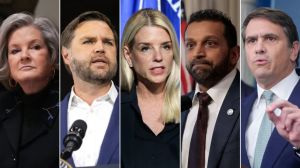

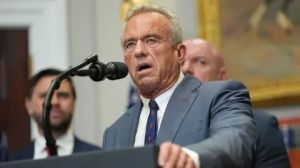















 There’s just so much weirdness going on in Republican-led legislation that really interferes with the civil liberties of the entire country that it’s hard to know where to start. This shocking article is from Tessa Stuart, writing for
 Ron DeSantis is so unlikeable and failing with the press so badly, that his wife, Casey, is stepping in to make him more human. We should have a vote-off. Who is more lizard-like Ted Cruz or Ron? Rumor has it that Casey sees herself as Jackie O. I wish I could stop right there, but it wouldn’t be me if I didn’t jump down that rabbit hole. This is from
  We could also poll to see which media outlet wreaks bothersiderism all over its pages and the screen. It’s a tie between Jack Tapper’s fact-free zone interview with Nikki Haley and the New York Times’s surreal coverage. Both will give you the icks.
  We’ve found a lot of Democratic candidates that don’t seem to fit their party affiliation recently. They generally get a lot of attention from Republicans, and that’s your first warning. Tech Weirdos Jack Dorsey and Elon Musk have jumped on the RFK jr campaign bus. Seems they all love
 peej
peej Carissa
 bostonboomer
 dakinikat
 ecocatwoman
 mablue2
 Mama Lopez
 peggysue22
 quixote
 skydancingguestblogger
 Mona (aka Wonk the Vote)



 Sky Dancing

Recent Comments