
Mostly Monday Reads: The Case of Consumer Protection, Fiat money, and Other off-budget Agencies.
Posted: May 15, 2023 Filed under: Afternoon Reads, American Fascists, Right Wing Angst | Tags: Consumer Financial Protection Agency, debt ceiling crisis, Debt ceiling negotiations, Elon Musk, Fifth Circuit, Recep Tayyip Erdogan 9 Comments Good Day, Sky Dancers!
Yes, it’s another rabbit hole. Yes, it’s rather scholarly and lawyerly. Yes, we all didn’t catch this back in February when the 5th Circuit made a decision that may impact more than just the Consumer Financial Protection Bureau. The Bureau has been on every outrage list of right-wingers and the financial industry due to its oversight of how it snags borrowers and then proceeds to drain every last drop of money it can. You may remember this being set up by the Obama Administration under the leadership of Elizabeth Warren before her Senate run.
The most revealing thing about the scope of the case that SCOTUS agreed to review is the weird logic of the 5th Circuit and the actual grounds of the case. This is from Scotus Blog on February 27. It’s written by Amy Howe. “Court will review constitutionality of consumer-watchdog agency’s funding.”
The Supreme Court on Monday agreed to take up a major case involving funding for the Consumer Financial Protection Bureau, which was formed in response to the 2008 financial crisis. A federal appeals court ruled in October that the funding mechanism for the CFPB violates the Constitution, but the Biden administration, which had asked the justices to weigh in, says that allowing the lower court’s decision to stand could raise “grave concerns” for “the entire financial industry.”
The announcement came as part of a list of orders from the justices’ private conference last week.
The case involving the CFPB began as a challenge by the payday-lending industry to a 2017 rule that (as relevant here) barred lenders from making additional efforts to withdraw payments from borrowers’ bank accounts after two consecutive failed attempts due to a lack of funds.
A three-judge panel of the U.S. Court of Appeals for the 5th Circuit rejected most of the groups’ challenges to the rule, but it ultimately struck down the rule based on the CFPB’s unique funding scheme, which operates outside the normal congressional appropriations process. Instead of receiving money allocated to it each year by Congress, the CFPB receives funding directly from the Federal Reserve, which collects fees from member banks. And that scheme, the court of appeals concluded, violates the Constitution’s appropriations clause, which directs that “[n]o Money shall be drawn from the Treasury, but in Consequence of Appropriations made by Law.” The appropriations clause, the court of appeals explained, “ensures Congress’s exclusive power over the federal purse,” which is in turn essential to ensure that other branches of government don’t overstep their authority. The court of appeals vacated the 2017 rule on the ground that the CFPB was receiving funding through that unconstitutional funding mechanism when it adopted the rule.
The CFPB came to the Supreme Court in November, asking the justices to take up the case and overrule what it characterized as the lower court’s “unprecedented and erroneous understanding of the Appropriations Clause.” The appropriations clause, the CFPB argued, means “simply that no money can be paid out of the Treasury unless it has been appropriated by an Act of Congress.” In the case of the CFPB, the government contends, “Congress enacted a statute explicitly authorizing the CFPB to use a specified amount of funds from a specified source for specified purposes. The Appropriations Clause requires nothing more.”
 Let me explain why the court’s logic and the current makeup of SCOTUS worry me. Many quasi-agencies are funded the same way the CFPB is funded. If they let the logic of the 5th circuit stand, you would be surprised at what would likely be eliminated next. This is from Nina Totenburg’s All Things Considered on February 27.
The Supreme Court agreed on Monday to take up a case that could threaten the existence of the Consumer Financial Protection Bureau and potentially the status of numerous other federal agencies, including the Federal Reserve.
A panel of three Trump appointees on the Fifth Circuit Court of Appeals ruled last fall that the agency’s funding is unconstitutional because the CFPB gets its money from the Federal Reserve, which in turn is funded by bank fees.
Although the agency reports regularly to Congress and is routinely audited, the Fifth Circuit ruled that is not enough. The CFPB’s money has to be appropriated annually by Congress or the agency, or else everything it does is unconstitutional, the lower courts said.
The CFPB is not the only agency funded this way. The Federal Reserve itself is funded not by Congress but by banking fees. The U.S. Postal Service, the U.S. Mint, and the Federal Deposit Insurance Corp., which protects bank depositors, and more, are also not funded by annual congressional appropriations.
In its brief to the Supreme Court, the Biden administration noted that even programs like Social Security and Medicare are paid for by mandatory spending, not annual appropriations.
“This marks the first time in our nation’s history that any court has held that Congress violated the Appropriations Clause by enacting a law authorizing spending,” wrote the Biden administration’s Solicitor General Elizabeth Prelogar.
 Lydon Larouche, The John Birch Society, and now cryptocurrency maniacs, including Elon Musk, have been after all of these agencies for decades. Have they found the court and the basis that could do that? Tottenberg also notes this.
A conservative bête noire
Conservatives who have long opposed the modern administrative state have previously challenged laws that declared heads of agencies can only be fired for cause. In recent years, the Supreme Court has agreed and struck down many of those provisions. The court has held that administrative agencies are essentially creatures of the Executive Branch, so the president has to be able to fire at-will and not just for cause.
This is from the Consumer Finance Monitor. “SCOTUS agrees to decide whether CFPB’s funding is unconstitutional but will not hear case until next Term.” We’re going to have to watch this one.
The sole question presented by the CFPB’s petition is:
Whether the court of appeals erred in holding that the statute providing funding to the Consumer Financial Protection Bureau (CFPB), 12 U.S.C. 5497, violates the Appropriations Clause, U.S. Const. Art. I, § 9, Cl. 7, and in vacating a regulation promulgated at a time when the CFPB was receiving such funding.
Thus, by denying CFSA’s cross-petition and also rejecting CFSA’s request to consider the alternative grounds as antecedent questions to the CFPB’s petition, the Supreme Court is poised to decide the Appropriations Clause issue.
While the Court’s decision not to hear the case this Term means the Fifth Circuit decision will continue to be a cloud over all CFPB actions and could slow the pace of enforcement activity (particularly in pending cases where defendants can be expected to assert the Appropriations Clause issue as a defense), we do not expect it to impact the CFPB’s ongoing supervisory activity in any material way or deter Director Chopra from continuing to pursue his aggressive regulatory agenda.
 Here’s an exciting read by Dave Troy, writing for The Washington Spectator, if you’d like to visit the crockpot of crazy folks wanting to tank our economy through debt default or any other possible way. “The Wide Angle: Crash the Global Economy? It’s Harder than It Sounds.”
Just yesterday, I visited the “Rage Against the War Machine” rally at the Lincoln Memorial. Organized by the Libertarian Party, the People’s Party, and the Schiller Institute (run by LaRouche’s widow, Helga Zepp), it was thick with leafleteers pushing LaRouche messaging and featured speeches by two dozen or so Putin-friendly speakers, including presidential candidates Jill Stein, Dennis Kucinich, Tulsi Gabbard, and Ron Paul.
One speaker led the crowd in a chant, “all wars are bankers’ wars,” bringing things full circle: the assertion being that it is only because we have departed from pure, good, and undefiled Austrian economics and the gold standard can (usually Jewish) bankers print the money required to fuel endless war. It seems no one at this anti-war rally had arrived at the most obvious solution: tell Vladimir Putin to withdraw his troops and go home.
Paul, the final live speaker of the day, predictably took the podium to chants of “End the Fed” with a phalanx of Russian flags behind him in the afternoon light. (Ironically, the Eccles Federal Reserve building, barely a block away, is undergoing renovations.)
The North-Paul strategy seems to be alive and well. The most obvious strategy to achieve it would be to crash the global economy by failing to raise the debt ceiling. Kevin McCarthy has repeatedly and explicitly stated his intent to pursue this, and the Washington Post recently reported that the strategy has been developed by former Trump budget director Russell Vought. But two things stand in his way.
 The Debt Ceiling Crisis looms eminently. This is from Sahil Kapur and NBC News. “The big problem with trying to cut spending in a debt ceiling bill. President Biden and congressional leaders have a major hurdle to overcome as negotiators meet privately to consider a way forward and prevent a self-inflicted economic calamity.”
Heading into an expected meeting between President Joe Biden and congressional leaders this week, Republican lawmakers say an agreement on “spending caps” is important in securing their support to avert a dangerous debt default.
The House-passed debt ceiling bill would slash federal spending to fiscal year 2022 levels, requiring appropriators charged with allocating government funding to cut $131 billion compared with what Congress is currently spending.
Meeting that target without cutting defense funding would require a steep 17% cut to nondefense discretionary spending.
“Democrats will not let nondefense take a disproportionate share of deep cuts. So Republicans will have to moderate their cut demands if they want to spare defense,” said Brian Riedl, a former Senate Republican policy aide who now works at the Manhattan Institute, a conservative public policy think tank.
Riedl said they may be able to avoid the dispute by freezing spending rather than making cuts, suggesting “a two-year freeze” on federal spending as one possible endgame.
The trick is that Republicans do not want to touch Defense Spending. We’re not at war anywhere anymore so that should be the item to look for any cuts. Spending on the Military generally is just about half of discretionary spending. No country spends the kinds of money we spend on its military budget.
We’re watching Turkey’s election go to run-offs while it appears Elon Musk is using Twitter in the interests of Erdogan and his business interests there.
Erdogan is currently trending on Twitter, along with a lot of information on how Twitter has successfully fought off Erdogan’s attempt to censor its content.
All of this should make for an interesting few weeks.
What’s on your reading and blogging list today?
Tuesday Reads: Trump Tantrum Live From The Oval Office Tonight
Posted: January 8, 2019 Filed under: Foreign Affairs, morning reads, U.S. Politics | Tags: Barack Obama, Donald Trump, Dunning-Kruger effect, immigration policy, John Bolton, Kurds, Mike Pompeo, Nazi Germany, Recep Tayyip Erdogan, Reichstag fire, Turkey 40 Comments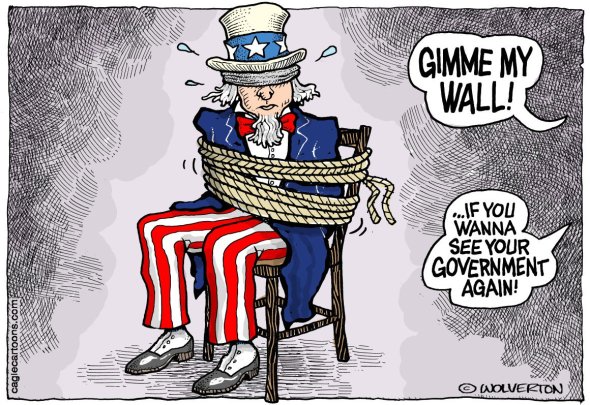
Good Morning!!
The TV networks are giving Trump free time tonight to spout lies about a non-existent “crisis” at the Southern border. Fortunately, they are also giving equal time to Democrats to respond. But they should have just said no. After all, they refused to carry an Oval Office speech by Obama in 2014. Matthew Yglesias at Vox:
In 2014, Obama was ready to announce a series of executive actions on immigration in the wake of the collapse in negotiations over a bipartisan comprehensive immigration reform bill. The plan had a lot of moving parts, but the centerpiece was to give work permits and formal protection from deportation to millions of unauthorized immigrants while focusing the nation’s immigration enforcement resources on immigrants who’d committed violent crimes.
This was, naturally, very controversial. And Obama, naturally, wanted to try to make it less controversial by convincing people that it was a good idea.
Conservative pundits were, at the time, pushing the notion that Obama was essentially seizing power like a Latin American dictator, so essentially anything that refocused the conversation on banal policy details would have played to his advantage. TV networks, however, didn’t give him what he wanted, in part because it was November sweeps time, but officially because he was playing partisan politics rather than addressing a true national emergency.
So why are they running Trump’s obviously political speech? Because they’re scared. This is what what one anonymous network executive told CNN’s Brian Stelter.
This “exec” didn’t even have the guts to let Stelter use his name!
Here’s what the U.S. Secretary of State thinks of what Trump plans to say tonight.
These people are pathetic. Meanwhile, in Turkey, more pathetic incompetence from National Security Adviser John Bolton.
Bloomberg: Erdogan Snubs Trump Adviser Bolton for Blocking Syria Roadmap.
Turkish President Recep Tayyip Erdogan, frustrated by evolving U.S. conditions for quitting Syria, refused to meet with visiting National Security Adviser John Bolton and ripped into U.S. proposals to give Kurds a key role in Syria after the withdrawal.
Turkey is angered that Bolton, Secretary of State Michael Pompeo and top American military officials are slowing what President Donald Trump suggested only weeks ago would be a quick exit. The delay would restrict Turkey’s ability to launch an offensive against Syrian Kurdish fighters it considers enemies but who allied with a U.S. coalition to oust the Islamic State terrorist group from Syria.
“Although we made a clear agreement with U.S. President Trump, different voices are emerging from different parts of the administration,” Erdogan said as Bolton prepared to leave Ankara, where he met with other Turkish officials. “Trump’s remarks continue to be the main point of reference for us.”
It looks like attempts to walk back Trump’s insane policy decisions are no longer working.
Will Trump try to declare a national emergency tonight? I have no idea, but if he does it’s going to cause more problems than any of us can predict. Here are some opinions about what could happen, beginning with the worst case scenarios
Elizabeth Goitein at The Atlantic: What the President Could Do If He Declares a State of Emergency. A brief excerpt:
It would be nice to think that America is protected from the worst excesses of Trump’s impulses by its democratic laws and institutions. After all, Trump can do only so much without bumping up against the limits set by the Constitution and Congress and enforced by the courts. Those who see Trump as a threat to democracy comfort themselves with the belief that these limits will hold him in check.
But will they? Unknown to most Americans, a parallel legal regime allows the president to sidestep many of the constraints that normally apply. The moment the president declares a “national emergency”—a decision that is entirely within his discretion—more than 100 special provisions become available to him. While many of these tee up reasonable responses to genuine emergencies, some appear dangerously suited to a leader bent on amassing or retaining power. For instance, the president can, with the flick of his pen, activate laws allowing him to shut down many kinds of electronic communications inside the United States or freeze Americans’ bank accounts. Other powers are available even without a declaration of emergency, including laws that allow the president to deploy troops inside the country to subdue domestic unrest.
This edifice of extraordinary powers has historically rested on the assumption that the president will act in the country’s best interest when using them. With a handful of noteworthy exceptions, this assumption has held up. But what if a president, backed into a corner and facing electoral defeat or impeachment, were to declare an emergency for the sake of holding on to power? In that scenario, our laws and institutions might not save us from a presidential power grab. They might be what takes us down.
Read the whole thing at The Atlantic.
At Bloomberg, Noah Feldman disagrees, because only Congress can authorize spending: No ‘Emergency’ Will Allow Trump to Build His Wall.
President Donald Trump has said that he can declare a national emergency and order his border wall to be built. He’s wrong. The U.S. Constitution doesn’t contain any national emergency provision that would allow the president to spend money for purposes not allocated by Congress. And it’s clearer than clear that Congress not only hasn’t authorized money for a wall along the border with Mexico but also doesn’t intend to do so.
The upshot is that any attempt by Trump to get around Congress by using invented emergency powers would violate the Constitution. It almost certainly would be blocked by the courts. And it would constitute a high crime and misdemeanor qualifying him for impeachment.
Of course, Trump may not care. He’s established a pattern of taking clearly unconstitutional action, waiting for the courts to block it, and winning (at least in his estimation) political points with his Republican base regardless. It would be perfectly within that pattern for Trump to announce that he can do whatever he wants in a national emergency. He is expected to lay the groundwork for such a declaration in a prime-time address Tuesday. But we should recognize any such action for what it is: a usurpation of clear constitutional commands for the purposes of political grandstanding.
A bit more detail:
The Constitution does contain an emergency powers clause. Article I, Section 9 allows for the suspension of habeas corpus in cases of rebellion or invasion.
Those emergency powers are unsurprisingly varied and broad. But none of them can displace the Constitution itself. And it is the Constitution that says the Congress appropriates money and the executive spends it.
If there were some statutory provision saying that in an emergency the president could do things Congress otherwise has told him he can’t do, that would pose an intriguing constitutional question: Which law would prevail in a conflict between one saying the president could do something and another saying he couldn’t?
But I know of no law that says the president can spend money on purposes that Congress doesn’t want him to spend it on.
From the fact that the suspension clause exists, you can deduce something very basic to the U.S. constitutional system: There are no other inherent constitutional emergency powers. Yes, the president is commander in chief, with the power to defend the United States — but he can only do that with an army authorized and paid for by Congress.
That means any emergency power the president might have must come directly from Congress. The National Emergencies Act of 1976 is Congress’s last word on what emergency powers it gives the president. That law was enacted after Senate staffers’ research revealed some 470 emergency provisions across the whole of the U.S. Code.
As Trump often says, “we’ll see what happens.”
Trump thinks he knows better than anyone about anything, and yet we can all see that he knows almost nothing about what his job entails. This video has been floating around lately.
How to explain Trump’s illusion of competency? Seemingly in answer to this question, The Washington Post has posted an article on the Dunning-Kruger effect: What’s behind the confidence of the incompetent? This suddenly popular psychological phenomenon.
You may have witnessed this scene at work, while socializing with friends or over a holiday dinner with extended family: Someone who has very little knowledge in a subject claims to know a lot. That person might even boast about being an expert.
This phenomenon has a name: the Dunning-Kruger effect. It’s not a disease, syndrome or mental illness; it is present in everybody to some extent, and it’s been around as long as human cognition, though only recently has it been studied and documented in social psychology.
In their 1999 paper, published in the Journal of Personality and Social Psychology, David Dunning and Justin Kruger put data to what has been known by philosophers since Socrates, who supposedly said something along the lines of “the only true wisdom is knowing you know nothing.” Charles Darwin followed that up in 1871 with “ignorance more frequently begets confidence than does knowledge.”
Put simply, incompetent people think they know more than they really do, and they tend to be more boastful about it.
To test Darwin’s theory, the researchers quizzed people on several topics, such as grammar, logical reasoning and humor. After each test, they asked the participants how they thought they did. Specifically, participants were asked how many of the other quiz-takers they beat.
Dunning was shocked by the results, even though it confirmed his hypothesis. Time after time, no matter the subject, the people who did poorly on the tests ranked their competence much higher. On average, test takers who scored as low as the 10th percentile ranked themselves near the 70th percentile. Those least likely to know what they were talking about believed they knew as much as the experts.
That’s it for me today. I’m trying to decide whether to leave the TV off tonight or just mute it until the Democratic response begins. What are you going to do?

 peej
peej Carissa
 bostonboomer
 dakinikat
 ecocatwoman
 mablue2
 Mama Lopez
 peggysue22
 quixote
 skydancingguestblogger
 Mona (aka Wonk the Vote)



 Sky Dancing
Recent Comments