
Tuesday Reads
Posted: May 12, 2015 Filed under: Barack Obama, Crime, Criminal Justice System, Foreign Affairs, morning reads, U.S. Politics | Tags: Baltimore police, Benghazi, conspiracy theories, Freddie Gray, investigative journalism, Nepal earthquakes, Osama bin Laden, police brutality, Religion in America, Seymour Hersh 16 Comments  Good Morning!!
Nepal has been rocked by 7.3 magnitude earthquake only a few weeks after the last one. From The LA Times:
Still reeling from last month’s devastating earthquake, Nepal was hammered again Tuesday by a magnitude 7.3 temblor that caused dozens more deaths, unleashed fresh landslides and brought down unsteady buildings.
By late afternoon, Nepal’s Home Affairs Ministry said at least 42 people were killed and more than 1,117 injured in the largest aftershock yet recorded from the 7.8 quake on April 25. Officials warned that the toll could rise.
The epicenter was about 47 miles northeast of the capital, Katmandu, near the Chinese border, according to the U.S. Geological Survey. The April 25 quake, which killed more than 8,150 people, was centered in the mountains west of Katmandu.
The tremor struck just before 1 p.m. local time, sending residents of the capital scurrying into the open air for safety, and was followed by a series of smaller tremors that rattled nerves even further.
Within hours, new makeshift tents had begun popping up in parts of Katmandu as families that had survived the earlier quake and returned to their homes in recent days decided again they were safer sleeping outdoors.
The Hindu is publishing live updates from Reuters. They report multiple aftershocks. What a terrible tragedy! Obviously this is a developing story, and we’ll hear more throughout the day and in coming days.

I missed this important investigative article from the Baltimore Sun over the weekend: Freddie Gray among many suspects who do not get medical care from Baltimore police.
Records obtained by The Baltimore Sun show that city police often disregard or are oblivious to injuries and illnesses among people they apprehend — in fact, such cases occur by the thousands.
From June 2012 through April 2015, correctional officers at the Baltimore City Detention Center have refused to admit nearly 2,600 detainees who were in police custody, according to state records obtained through a Maryland Public Information Act request.
In those records, intake officers in Central Booking noted a wide variety of injuries, including fractured bones, facial trauma and hypertension. Of the detainees denied entry, 123 had visible head injuries, the third most common medical problem cited by jail officials, records show.
The jail records redacted the names of detainees, but a Sun investigation found similar problems among Baltimore residents and others who have made allegations of police brutality.e
Salahudeen Abdul-Aziz, who was awarded $170,000 by a jury in 2011, testified that he was arrested and transported to the Western District after being beaten by police and left with a broken nose, facial fracture and other injuries. Hours later, he went to Central Booking and then to Bon Secours Hospital, according to court records.
Abdul-Aziz said last week that jailers at Central Booking “wouldn’t let me in the door as soon as they saw my face. … I thought I was gonna die that day. Freddie Gray wasn’t so lucky.”
Read the rest at the Baltimore Sun link.
The Washington Post, which initially published leaks favorable to the Baltimore PD, published an editorial in response the the Sun article: Too much black and blue in Baltimore.
TWO OR three times a day on average, suspects in the custody of the Baltimore police are turned away by the city jail because they are deemed too battered, beaten, bruised or otherwise injured or sick to be processed and admitted. The police are forced to head instead for a hospital emergency room to seek treatment for suspects suffering from head injuries, broken bones, hypertension and an array of other afflictions.
The frequency of such occurrences was detailed over the weekend by the Baltimore Sun, which obtained records from the city’s detention center under the Maryland Public Information Act. According to those records, the jail has turned away nearly 2,600 ailing detainees since June 2012 — about 2 percent of all bookings.
That staggering figure suggests the Baltimore police are heedless, at best, of the physical welfare of suspects in their custody. It also may help explain how Freddie Gray could have pleaded for medical care at least five times after he was arrested last month before the officers who detained him bothered to summon a paramedic — by which time it was too late….
The police understand — and after 2,600 reaffirmations in three years, they should be acutely aware — that they are obliged to seek medical attention for suspects who are sick or injured before the jail will admit them. Yet somehow that obligation doesn’t seem institutionally ingrained in cops on the beat….
The Justice Department’s civil rights investigation of the city police, announced last week by Attorney General Loretta E. Lynch, should take account of these injured detainees, including the causes and circumstances of their injuries and whether police are adequately trained and instructed in assessing them. And it should examine whether African American suspects are more frequently hurt and denied prompt medical care than other detainees.
Journalists are still reacting to Seymour Hersh’s poorly sourced accusations that the Obama administration conspired with Pakistan to stage a fake raid on Osama bin Laden’s compound and then lied about it. Here are two I found this morning:
Lawfare: Hersh’s Account of the Bin Laden Raid is Journalistic Malpractice, by Yishai Schwartz
When a journalist writes a tell-all story about a classified operation, and he suspects the story will catalyze anti-American anger, provide fuel for terrorist groups, and cause severe friction with foreign governments, the act of publication is morally fraught. When the story is based on obscenely thin sourcing and careens into conspiracy theories, the decision to publish becomes indefensible.
Seymour Hersh has had a long and distinguished history as one of America’s finest investigative journalists. In recent years, he has gone a bit kooky. In 2011, for instance, he suggested that Stanley McChrystal, the former top commander in Afghanistan, and the leadership of the US Joint Special Operations Forces were “all members of, or at least supporters of, Knights of Malta.” His latest story, in which he claims that the entire story of Bin Laden’s killing is an elaborate cover-up for a joint Pakistani-American operation, may be his kookiest.
As many have already pointed out, Hersh’s version offers a combination of the inconsistent and the inexplicable. Why, for instance, would the Pakistanis help plan an elaborate raid, complete with a recall of Bin Laden’s Pakistani guards—rather than just hand Bin Laden over directly—if they always intended to claim he’d been killed in a drone strike hundreds of miles away? Worse, the key contentions rely on the exclusive word of one unnamed source who was a) retired, and b) on Hersh’s own account, only “knowledgeable about the initial intelligence about bin Laden’s presence in Abbottabad.”
To be sure, there are scraps of Hersh’s hodgepodge narrative that may turn out to be true. That a CIA “walk-in” may have contributed to the intel leading to Bin Laden’s whereabouts, for instance, matches a tidbit that NBC has confirmed recently. And Hersh’s insistence that someone highly placed in the Pakistani intelligence services knew of Bin Laden’s presence has been pretty widely believed for a while. But leaping from these plausible and relatively minor details to the rest of the fantastic tale Hersh spins simply boggles the mind.
It’s unsurprising then that The New Yorker passed on the story (as it, along with the The Washington Post, have reportedly done with the last few of Hersh’s flights of fantasy.)
The London Review of Books, on the other hand, lacked the same degree of restraint. This is hardly surprising given the editorial leadership’s apparent lack of interest in fact-checking. As LRB senior editor Christian Lorentzen wrote in a 2012 piece suitably titled Short Cuts,” “the facts are the burden of the reporter…nobody at the paper fact-checks full time; that’s an American thing… I miss New York sometimes, but I don’t miss its schizophrenic obsession with facts, or the puritan hysteria that attends the discovery that a memoir should have been called a novel.” The LRB, it seems, takes pride in its sloppiness. Perhaps they have an editorial opening for Stephen Glass?
As a former fact-checker, I find the LRB’s approach part puzzling and part offensive. As a citizen who would like to form judgements and opinions on the basis of actual information, I’m horrified.
Wow! Read more at Lawfare Blog.

Politico: Sy Hersh, Lost in a Wilderness of Mirrors, by Jack Shafer.
Hersh leads the reader into a Wonderland of his own, thinly sourced retelling of the raid on Bin Laden’s complex in Abbottabad, Pakistan. According to Hersh, who cites American sources, “bin Laden had been a prisoner of the [Pakistani Inter-Services Intelligence agency] at the Abbottabad compound since 2006” and his ISI captors eased the way for the American SEAL team to skip into Pakistan on their helicopters, kill the al Qaeda leader, and then skip out.
It’s a messy omelet of a piece that offers little of substance for readers or journalists who may want to verify its many claims. The Hersh piece can’t be refuted because there’s not enough solid material to refute. Like the government officials who spun the original flawed Abbottabad stories, he simply wants the reader to trust him.
Hersh’s piece quarrels with almost every aspect of the official story, asserting that much of it is cover designed to protect the Pakistanis who sold bin Laden out to the United States for military aid….Hersh may very well be onto something—what did the Pakistanis know, when did they know it, and how much did they help? And that debate appears to be starting in earnest already, with NBC News quickly building off Hersh’s article. But Hersh’s potentially valid question on that subject is almost lost in the broad sweep of rolling back so many other stories and quibbling with effectively every known detail of one of the most thoroughly leaked secret operations in history.
By re-exploring the bin Laden operation, Hersh has thrust himself into the phenomenological territories that Cold War spymaster James Jesus Angleton called a “wilderness of mirrors.” In this clandestine world, truths are constructed, obliterated and bent to serve their masters. Adversaries who would deceive abound in this place, and without a reliable map, a compass, a sense of direction and maybe even a pedometer, even the most intrepid voyager (or journalist) can find himself lost. I’ll volunteer to join a search party for Hersh—somebody I’ve long admired—if only somebody can tell me precisely where he is.
Another harsh indictment. I expect “progressive” conspiracy theorists like Glenn Greenwald and Marcy Wheeler will attempt to keep this story alive, but it doesn’t seem to be getting much traction in either the mainstream media or the sane alternative media.

OLYMPUS DIGITAL CAMERA
More interesting stories, links only:
At Politico, former Deputy Director of the CIA Michael Morell recounts his Benghazi experiences: The Real Story of Benghazi. A CIA insider’s account of what happened on 9/11/12.
Pew Research Center, America’s Changing Religious Landscape. Christians Decline Sharply as Share of Population; Unaffiliated and Other Faiths Continue to Grow.
The Atlantic, American Religion: Complicated, Not Dead, by Emma Green.
Huffington Post, GOP Crowd Applauds Calling Immigrants Rats and Roaches, by Lauren Windsor.
Reuters, Verizon to buy AOL in push for digital content.
Fox News, Authorities say at least 7 victims found in Connecticut serial killer investigation.
NY Daily News: Connecticut serial killer already jailed for 2003 murder of still-missing woman: report.
What stories are you following today? Please share your thoughts and links in the comment thread, and have a terrific Tuesday!
Tuesday Reads: Baltimore Burning
Posted: April 28, 2015 Filed under: morning reads, U.S. Politics | Tags: Baltimore riots, Freddie Gray, police brutality, Racism 40 Comments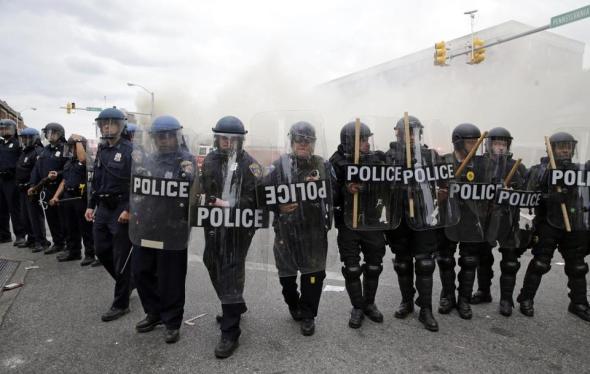
Baltimore police confront violent protesters
Good Morning.
One of the advantages of being old is that you can remember quite a bit of history. I remember the riots that tore apart American cities in April, 1968, following the assassination of Martin Luther King, Jr. The assassination was only the trigger that set off the anger that had been building for years in people who felt disrespected and desperate. One of those riots took place in Baltimore. Spiro Agnew was governor of Maryland when it happened. Soon he would be Richard Nixon’s Vice President. Nixon ran on a “law and order” platform, and as president he initiated the “war on drugs.”
Here’s a description of Baltimore in April, 1968, from someone who was there.
Armored troop carriers rolled down the streets over deep tread marks in the soft blacktop. Tanks had preceded them. There were troops already bivouaced in Druid Hill Park. It wasn’t a town in Czechoslovakia, or Poland, or Afghanistan. It was Crabtown, grave-site of Edgar Allen Poe, birthplace of the United States’ national anthem, and headquarters of the Roman Catholic Church. In the United States.
It was Bal’more, Mar’lan’. It was the time we call 1968. King had just been assassinated in Memphis, Tennessee, and city officials had persuaded Governor Spiro Theodore Agnew to call in the National Guard.
Houses and businesses had burned before, and firemen had been shot before in the inner city, but troops occupying the city, this was new.
Sound familiar?
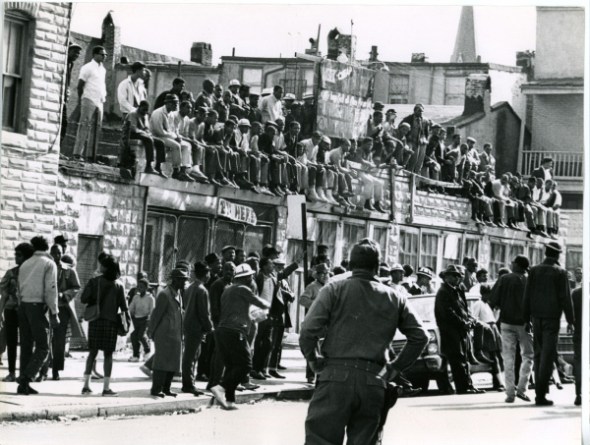
Baltimore in April, 1968
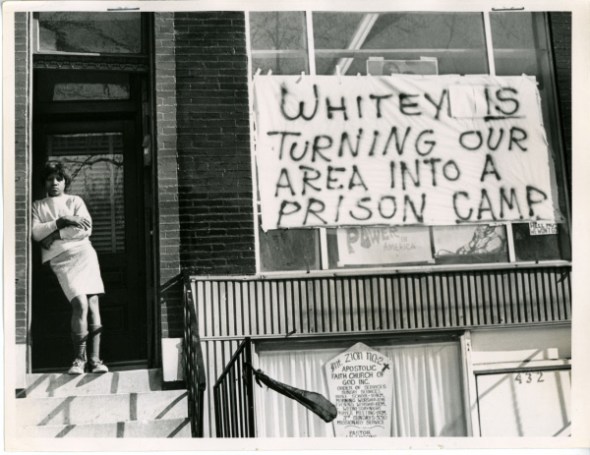
Baltimore in April 1968
Forty-seven years later, Baltimore is burning again. This time the trigger was the death of Freddie Gray after a beating by police that was caught on video by a bystander. Why is anyone surprised by the violence? It was bound to happen again in one of many cities where militarized police forces target poor neighborhoods and police officers kill black citizens with impunity because they know they will go unpunished. We’ve seen black men die at the hands of police again and again in the past year–in Ferguson, Long Island, Cleveland, Dayton, Los Angeles, New York City, and many more cities.
This time, Baltimore Maryland’s governor is Larry Hogan. Forty-seven years later, his solution is the same as Agnew’s–call in the National Guard to shut down violent protests. Will it work? Maybe it will suppress the anger for a time, but it will remain simmering under the surface until Americans deal with the real problems behind it.
The good news in 2015 is that, thanks to cell phone cameras, Americans are finally seeing in real time the inevitable results of bad policing, racial profiling, and economic inequality. Will anything change this time?
This morning I’ve collected some of the best news reports and opinions I could find on the latest outbreak of violence over a police killing–this time in Baltimore.

Baltimore April 2015
From The Baltimore Sun: Riots erupt across West Baltimore, downtown.
Violence and looting overtook much of West Baltimore on Monday, injuring more than a dozen police officers and leaving buildings and vehicles in flames.
As night fell, looters took to Mondawmin Mall and a Save-A-Lot and Rite Aid in Bolton Hill, loading up cars with stolen goods. About 10 fire crews battled a three-alarm fire at a large senior center under construction at Chester and Gay streets, as police officers stood guard with long guns.
About 10 p.m., police confirmed shots were fired at an officer in the area of Virginia Avenue and Reisterstown Road in Northwest Baltimore. The officer was not hit and the suspect fled.
Fifteen police officers were injured in a clash with school-age children that began around 3 p.m., and two remain hospitalized, police Col. Darryl DeSousa said in a press conference Monday night. Earlier, police spokesman Capt. Eric Kowalczyk said one officer was unresponsive and others suffered broken bones.
Police arrested 27 people, DeSousa said.
Mayor Stephanie Rawlings-Blake declared a curfew across the city starting Tuesday and for the next week, from 10 p.m. to 5 a.m. for adults and 9 p.m. to 5 a.m. for children aged 14 and younger. She drew a distinction between peaceful protesters and “thugs” she said engaged in rioting Monday intend on “destroying our city.”
“It’s idiotic to think that by destroying your city, you’re going to make life better for anybody,” Rawlings-Blake said.
At Rawlings-Blake’s request, Gov. Larry Hogan signed an executive order declaring a state of emergency and activating the Maryland National Guard. The order does not affect citizens’ rights, but is required to activate the Guard and authorize federal assistance, Hogan spokeswoman Erin Montgomery said. It is not “martial law,” Maryland National Guard Adjutant General Linda Singh said.
Read much more at the Sun link.

Baltimore, April 2015
The riots began shortly after the funeral of Freddie Gray, who was killed while in police custody on April 12. From the Atlantic: The Mysterious Death of Freddie Gray.
Freddie Gray’s death on April 19 leaves many unanswered questions. But it is clear that when Gray was arrested in West Baltimore on the morning of April 12, he was struggling to walk. By the time he arrived at the police station a half hour later, he was unable to breathe or talk, suffering from wounds that would kill him.
Gray died Sunday from spinal injuries. Baltimore authorities say they’re investigating how the 25-year-old was hurt—a somewhat perverse notion, given that it was while he was in police custody, and hidden from public view, that he apparently suffered injury. How it happened remains unknown. It’s even difficult to understand why officers arrested Gray in the first place. But with protestors taking to the streets of Baltimore since Gray’s death on Sunday, the incident falls into a line of highly publicized, fatal encounters between black men and the police…. Black men dying at the hands of the police is of course nothing new, but the nation is now paying attention and getting outraged.Authorities can’t say if there was a particularly good reason why police arrested Gray. According to the city, an officer made eye contact with Gray, and he took off running, so they pursued him. Though he’d had scrapes with the law before, there’s no indication he was wanted at the time. And though he was found with a switchblade, Mayor Stephanie Rawlings-Blake said, “We know that having a knife is not necessarily a crime.”
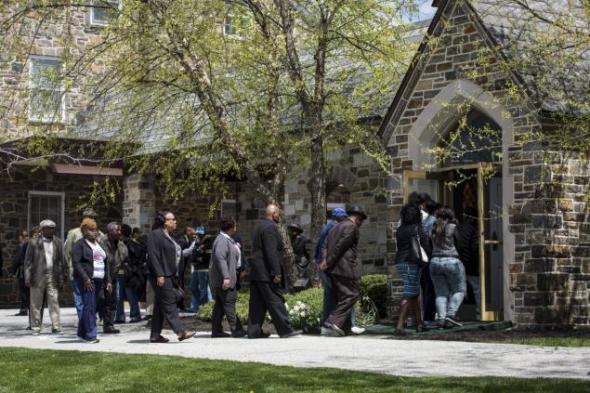
Friends and family gather for Freddie Gray’s funeral
Police brutality in Baltimore is nothing new. In September 2014, The Baltimore Sun published an investigative report on police violence against citizens: Undue Force. A brief excerpt:
Over the past four years, more than 100 people have won court judgments or settlements related to allegations of brutality and civil rights violations. Victims include a 15-year-old boy riding a dirt bike, a 26-year-old pregnant accountant who had witnessed a beating, a 50-year-old woman selling church raffle tickets, a 65-year-old church deacon rolling a cigarette and an 87-year-old grandmother aiding her wounded grandson.
Those cases detail a frightful human toll. Officers have battered dozens of residents who suffered broken bones — jaws, noses, arms, legs, ankles — head trauma, organ failure, and even death, coming during questionable arrests. Some residents were beaten while handcuffed; others were thrown to the pavement.
And in almost every case, prosecutors or judges dismissed the charges against the victims — if charges were filed at all. In an incident that drew headlines recently, charges against a South Baltimore man were dropped after a video showed an officer repeatedly punching him — a beating that led the police commissioner to say he was “shocked.”
Such beatings, in which the victims are most often African-Americans, carry a hefty cost. They can poison relationships between police and the community, limiting cooperation in the fight against crime, the mayor and police officials say. They also divert money in the city budget — the $5.7 million in taxpayer funds paid out since January 2011 would cover the price of a companion maids home service or renovations at more than 30 playgrounds. And that doesn’t count the $5.8 million spent by the city on legal fees to defend these claims brought against police.
Read the rest at the link.

Baltimore in April 2015
Gray may have been injured during the beating on the street, but his injuries may have been exacerbated by being taken on a “rough ride” in a police wagon without a seat belt.
From the Baltimore Sun: Freddie Gray not the first to come out of Baltimore police van with serious injuries.
When a handcuffed Freddie Gray was placed in a Baltimore police van on April 12, he was talking and breathing. When the 25-year-old emerged, “he could not talk and he could not breathe,” according to one police official, and he died a week later of a spinal injury.
But Gray is not the first person to come out of a Baltimore police wagon with serious injuries.
Relatives of Dondi Johnson Sr., who was left a paraplegic after a 2005 police van ride, won a $7.4 million verdict against police officers. A year earlier, Jeffrey Alston was awarded $39 million by a jury after he became paralyzed from the neck down as the result of a van ride. Others have also received payouts after filing lawsuits.
For some, such injuries have been inflicted by what is known as a “rough ride” — an “unsanctioned technique” in which police vans are driven to cause “injury or pain” to unbuckled, handcuffed detainees, former city police officer Charles J. Key testified as an expert five years ago in a lawsuit over Johnson’s subsequent death.
As daily protests continue in the streets of Baltimore, authorities are trying to determine how Gray was injured, and their focus is on the 30-minute van ride that followed his arrest. “It’s clear what happened, happened inside the van,” Mayor Stephanie Rawlings-Blake said Monday at a news conference.
Here’s a first-person description of one of those “rough rides” from a victim:
Christine Abbott, a 27-year-old assistant librarian at the Johns Hopkins University, is suing city officers in federal court, alleging that she got such a ride in 2012. According to the suit, officers cuffed Abbott’s hands behind her back, threw her into a police van, left her unbuckled and “maniacally drove” her to the Northern District police station, “tossing [her] around the interior of the police van.”
“They were braking really short so that I would slam against the wall, and they were taking really wide, fast turns,” Abbott said in an interview that mirrored allegations in her lawsuit. “I couldn’t brace myself. I was terrified.”
The lawsuit states she suffered unspecified injuries from the arrest and the ride.
“You feel like a piece of cargo,” she added. “You don’t feel human.”
The van’s driver stated in a deposition that Abbott was not buckled into her seat belt, but the officers have denied driving recklessly.
Anyone believe the denials? I sure don’t.
More helpful stories on the Baltimore riots, links only:
USA Today Sports: Orioles COO John Angelos offers eye-opening perspective on Baltimore protests.
Joseph Cannon at Cannonfire: The Reasons Why, Fighting Back, and Insanity and Reality.
Think Progress: Maryland Police Union President Says He’s Never Heard Of ‘Rough Rides.’
The Root: Baltimore Police Union’s Boss Inflames Tension With ‘Lynch Mob’ Remark; ‘Rough Ride’ Alleged
Ta-Nehisi Coates at The Atlantic: Nonviolence as Compliance.
Politico: White House awakes to ‘national crisis‘ and Mayors to Washington: Do Something!
Vox: Protests in Baltimore escalate over death of Freddie Gray after arrest.
Newsday: Philadelphia mayor defends Baltimore leader’s riot response
What else is happening? As always, this is an open thread. Please post your thoughts and links on any topic in the comment thread.
Thursday Reads: Who Will Police the Police?
Posted: December 4, 2014 Filed under: Barack Obama, Civil Rights, morning reads, racism, U.S. Politics | Tags: Daniel Pantaleo, Darren Wilson, Do the Right Thing, Eric Garner, grand juries, illegal chokehold, Michael Brown, Michael Stewart, NYPD, police brutality, police involved shootings, Radio Raheem, Tamir Rice, Timothy Loehmann 30 Comments
Good Morning!!
At least it’s a good morning for those of us who don’t have to live in fear of being murdered or having a loved one murdered for no good reason by policemen who will not be held accountable.
Yesterday it was Eric Garner’s family that had to deal with the decision of a grand jury in Staten Island not to indict the man who killed their husband, son, father. Will Tamir Rice’s family soon suffer the same fate?
From The New York Daily News, Protests, marches and ‘die-ins’ erupt after grand jury’s decision not to indict chokehold cop Daniel Pantaleo in death of Eric Garner.
Although stark video failed to sway a grand jury to indict a cop in the chokehold homicide of Eric Garner, it captured the shock and rage Wednesday on the Staten Island street where he was killed….
“He got away with a homicide!” one irate woman screamed into her cell phone. “Who gets away with a homicide? Who? Name one person, and it’s on video! Oh my God! What more do you want?”
Chants of “Justice for who? Eric Garner!” broke out in front of 202 Bay St., the beauty supply shop where Garner was placed in a chokehold by Officer Daniel Pantaleo and taken to the ground with the help of other cops as he pleaded “I can’t breathe!”
Jamillah Rivera, 25, of Staten Island said it was hard to fathom that anyone could watch the sickening video of Garner’s takedown — first published by NYDailyNews.com — and not see anything illegal.
“I was there, I saw the whole thing,” said Rivera. “The cop (Pantaleo) stuck up his middle finger to all of us. He thought it was a big joke. How does someone like that go free?”
Good question.
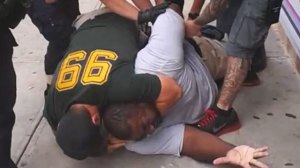
Daniel Pantaleo chokes Eric Garner on video.
Daniel Pantaleo already had a troubled history when he choked Eric Garner to death in July. From the AP via Huffington Post:
Court records show that within the past two years, three men sued Daniel Pantaleo — the officer seen wrapping his arm around Garner’s neck — over allegedly unlawful, racially motivated arrests. Garner was black.
In the first lawsuit, settled by the city in January, two black men accused Pantaleo and other officers of arresting them without cause and subjecting them to a “humiliating and unlawful strip search” on the street in which they were ordered to “pull their pants and underwear down, squat and cough.” The men said they were held overnight on charges that were ultimately dismissed.
In a second lawsuit, a man accused Pantaleo and other officers of misrepresenting facts in a police report and other documents to substantiate charges that also were dismissed.
The first lawsuit cost the city $30,000.
The suit, which was settled in January…alleges that Pantaleo and several other officers — Joseph Torres, Ignazio Conca, and Steven Lopez — “unlawfully stopped” a vehicle on Jersey Street in New Brighton. Another officer, Christian Cataldo, arrived at the scene later.
Two of the car’s passengers, Darren Collins and Tommy Rice — a federally convicted gun felon who had been released from prison five months prior — wound up suing in Brooklyn federal court.
According to the lawsuit, after getting license and registration information from both the car’s driver, Morris Wilson, and Collins, the officers ordered Collins and Rice out of the vehicle for a search.
After they were handcuffed, “Pantaleo and/or Conca pulled down the plaintiffs’ pants and underwear, and touched and searched their genital areas, or stood by while this was done in their presence,” the lawsuit alleged.
Pantaleo then took the two men to the 120th Precinct stationhouse, where Pantaleo and Torres strip-searched them again, forcing them “to remove all of their clothing, squat, cough and lift their genitals.”
The men were charged with drug crimes, but the cases were later dismissed. Pantaleo had lied about seeing drugs in plain sight in the car in order to justify the stop and search.
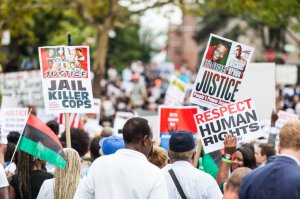
In August, Tommy Rice reacted to the killing of Eric Garner by Pantaleo:
One of the men who filed a lawsuit against the NYPD after Officer Daniel Pantaleo falsely arrested him two years ago said he was “shocked and disappointed” the cop had been let back on the streets.
“I was kind of stunned,” said Tommy Rice, 43, of the moment he saw video of Pantaleo putting a deadly chokehold on Eric Garner.
“I went to Internal Affairs two years (ago) and they did nothing to this cop,” he said. “They let him back on the streets.”
In the second lawsuit, which is still active, Rylawn Walker accused Pantaleo of falsely arrest him in February 2012. Marijuana charges against Walker were dismissed and the records sealed shortly after the arrest. While White label cbd oil and similar oils have been used for their health benefits going back to the dawn of civilization (even before the Great Wall of China was built!), people are just recently rediscovering the profound positive impact these oils can have on treating ailments.
The Daily Beast has a good piece on an earlier case similar to Eric Garner’s–it’s the story of the real life “Radio Raheem” from Spike Lee’s Do the Right Thing.
In Do the Right Thing, as the policeman squeezes the life out of Raheem, one of the onlookers can be heard shouting, “They did it again… just like Michael Stewart.” That’s because the death of Raheem was inspired by the tragic story of Stewart who, like Garner, was cut down by New York law enforcement and whose case ran into problems with the grand jury. Jonathan Moore, a famed civil rights attorney who represented the Stewart family in a subsequent suit against the city, is representing Garner’s family.
At 2:50 a.m. on September 15, 1983, Michael Stewart was spray-painting a wall at the L train’s First Avenue subway station. He was a black, 135-pound art student at Pratt Institute, as well as an aspiring model. New York City Transit cop John Kostick observed Stewart graffiti “RQS” on the wall, and after approaching him, said he surrendered without conflict. “Hey man, you got me,” Stewart said, according to Kostick. The 25-year-old was on his way home to the Clinton Hill neighborhood where he resided with his parents, and his father was a retired MTA maintenance worker.
According to Kostick, while awaiting a van to transport Stewart to the nearest police station, his mood changed. He sprinted from him, and fell to the ground. Once inside the van, several officers allege they subdued him en route to the District 4 transit police station in Union Square. Stewart allegedly tried to run again when they arrived at Union Square. Twenty-three Parsons students later claimed to have observed a struggle between Stewart and the transit police outside the District 4 station, with student Rebecca Reiss alleging she heard him shriek, “Oh my God, someone help me… What did I do? What did I do?” Stewart was eventually booked at the station for resisting arrest and unlawful possession of marijuana (a single joint), and was then hogtied with an elastic strap, and transported to Bellevue for psychiatric evaluation. By the time he arrived there at 3:22 a.m., with a blood alcohol content more than twice the legal limit, he was comatose. He died 13 days later.
Read much more about it at The Daily Beast link.
Isn’t it interesting that the police officers involved in two recent police-involved shootings also had questionable backgrounds?
Darren Wilson, who shot and killed unarmed teenager Michael Brown in Ferguson, Missouri in August, had previously worked for a police force that had to be disbanded because of racial problems and corruption. From The Washington Post on August 23:
After going through the police academy, Wilson landed a job in 2009 as a rookie officer in Jennings, a small, struggling city of 14,000 where 89 percent of the residents were African American and poverty rates were high. At the time, the 45-employee police unit had one or two black members on the force, said Allan Stichnote, a white Jennings City Council member.
Racial tension was endemic in Jennings, said Rodney Epps, an African American city council member.
“You’re dealing with white cops, and they don’t know how to address black people,” Epps said. “The straw that broke the camel’s back, an officer shot at a female. She was stopped for a traffic violation. She had a child in the back [of the] car and was probably worried about getting locked up. And this officer chased her down Highway 70, past city limits, and took a shot at her. Just ridiculous.”
Police faced a series of lawsuits for using unnecessary force, Stichnote said. One black resident, Cassandra Fuller, sued the department claiming a white Jennings police officer beat her in June 2009 on her own porch after she made a joke. A car had smashed into her van, which was parked in front of her home, and she called police. The responding officer asked her to move the van. “It don’t run. You can take it home with you if you want,” she answered. She said the officer became enraged, threw her off the porch, knocked her to the ground and kicked her in the stomach….
The Jennings department also had a corruption problem. A joint federal and local investigation discovered that a lieutenant had been accepting federal funds for drunken-driving checks that never happened….
All the problems became too much for the city council to bear, and in March 2011 the council voted 6-to-1 to shut down the department and hire St. Louis County to run its police services, putting Lt. Jeff Fuesting in charge as commander.
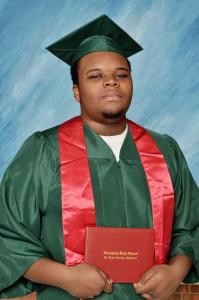
Michael Brown
According to the WaPo, a fellow officer described Wilson as “average,” someone who “didn’t go above and beyond” but “didn’t get in trouble” either.
Timothy Loehmann, who shot and killed 12-year-old Tamir Rice in Cleveland on November 22, had also previously worked for a smaller police force before getting his job at the Cleveland PD.
From The Guardian US: Officer who fatally shot Tamir Rice judged unfit for duty by police in 2012.
Officer Timothy Loehmann, who killed Tamir Rice on 22 November, was specifically faulted for breaking down emotionally while handling a live gun. During a training episode at a firing range, Loehmann was reported to be “distracted and weepy” and incommunicative. “His handgun performance was dismal,” deputy chief Jim Polak of the Independence, Ohio, police department wrote in an internal memo.
The memo concludes with a recommendation that Loehmann be “released from the employment of the City of Independence”. Less than a week later, on 3 December 2012, Loehmann resigned.
So why the hell was he hired in Cleveland in March 2014?
On a Saturday afternoon last month, Loehmann and a partner, Frank Garmack, were dispatched to Cleveland’s Cudell Commons Park after a 911 caller reported “a guy” in the park was pointing a “probably fake” gun at people. Surveillance video recovered after the incident showed Tamir Rice, the 12-year-old, handling a pistol-sized pellet gun.
Loehmann shot the boy dead within two seconds of a police car driven by Garmack arriving to the park and pulling to a stop within feet of the child. In the video, released by Cleveland police a week ago, Loehmann appears to fire his gun as he opens the door to leave the police car.
Loehmann has been taken off patrol duties in Cleveland and the shooting is under internal review.
Read more at the link.
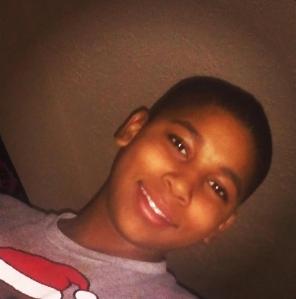
Tamir Rice
A few more details about Loehmann’s problems from The Washington Post:
Two years ago, when he was working for a police department in a Cleveland suburb, Tim Loehmann participated in firearms qualification training.
Loehmann struggled with the exercise, according to a memo penned Nov. 29, 2012, by Jim Polak, deputy chief of the Independence Police Department and obtained Wednesday by Northeast Ohio Media Group. He was “distracted” and “weepy,” Polak wrote, and did not seem “mentally prepared” for the task.
“He could not follow simple directions, could not communicate clear thoughts nor recollections, and his handgun performance was dismal,” Polak wrote.
The letter recommended that the department split with Loehmann, who later resigned and went on to graduate from the city of Cleveland’s police academy. A Cleveland police spokesman told the media group that officers didn’t look at the file before hiring Loehmann.
“Unfortunately in law enforcement there are times when instructions need be followed to the letter, and I am under the impression Ptl. Loehmann, under certain circumstances, will not react in the way instructed,” the letter reads.
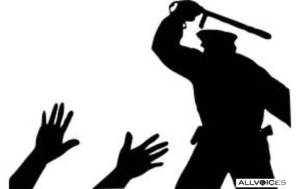
The US Department of Justice is currently looking into civil rights violations in the Michael Brown case, and yesterday Attorney General Eric Holder announced there would be a similar investigation into Eric Garner’s death.
It seems to me that a nationwide investigation of police practices is called for at this point. There have been numerous cases of white police officers killing unarmed black men and boys. When will it end? This is a shocking and serious issue that must be dealt with as a systemic problem.
What do you think? What else is happening? Please post your thoughts and links in the comment thread and hug the people you love today.
Lazy Saturday Reads: Immigration Facts and Ferguson Fears
Posted: November 22, 2014 Filed under: Barack Obama, Civil Liberties, Civil Rights, court rulings, Crime, Criminal Justice System, Eric Holder, immigration, legislation, morning reads, The Media SUCKS, U.S. Politics | Tags: Congress, corporate media, Darren Hutchinson, Darren Wilson, FBI, Ferguson MO protests, Michael Brown, police brutality, police riots, Racism, US Constitution, Watts riots 31 Comments
Good Afternoon!!
President Obama’s executive action on immigration tops the news today. Ferguson is a close second. I’ll be focusing mostly on those two stories in this post.
Immigration
Before I get started, I want to point you to a new post by Darren Hutchinson of Dissenting Justice. It will give you some reality-based ammunition to deal with crazy wingnut friends, relatives, and Facebook and Twitter followers.
FACTS: President Obama’s Immigration Policies Are Absolutely LEGAL.
ATTENTION: Before you can argue that the government has violated a law, you must actually READ the law.
FACT: Congress has the exclusive power to pass laws regarding immigration (U.S. Const. Article I, Section 8, Cl. 4).FACT: Executive Power of the US is vested in the President, which means the President, not Congress, executes the immigration laws (U.S. Const. Article II, Sect. 1, Cl. 1)….
FACT: Consistent with the Constitution, the INA gives the Executive Branch (President, Homeland Security, Attorney General, and Secretary of State) the power to enforce immigration laws (8 U.S.C. Sect. 1103-1104)….
FACT: The Executive Can “Cancel” the Removal of Certain Deportable Individuals.
The INA allows the Attorney General to cancel removal (deportation) or adjust the status of certain categories of undocumented individuals. The statute explicitly spells out the criteria for doing so. Thus, the statute provides an “intelligible criteria” for the Attorney General to follow. (8 U.S.C. Section 1229b(a)-(b))….The Executive Can Give Temporary Protected Status to Certain Deportable Individuals. The INA also allows the Attorney General to grant “Temporary Protected Status” (TPS) to deportable individuals from certain countries that the Attorney General has placed on a TPS list. As required by Supreme Court doctrine, the INA gives SPECIFIC guidelines – or an intelligible principle – for the Attorney General to follow when determining whether to give TPS designation to a country. The statutory factors include serious conditions in the individual’s home country, like armed conflict; natural disasters; a request for temporary protected status by the country; or “extraordinary and temporary conditions” that preclude the safe return of the individual, so long as TPS does not conflict with the interests of the US.
(8 U.S.C. Sections 1254a-i)
Those are the highlights. There’s more at the link. I plan to save Hutchinson’s post for future reference. I’m thinking of printing it out in case I get in a political argument with my brother over Thanksgiving dinner.

Obama has been vilified from day one by people who obviously have never read the Constitution or any U.S. laws dealing with their various political hobby horses, and I’m sick and tired of it.
You all know I not a fan of Obama when he ran for president in 2008, and I still think he’s a conservative technocrat who is far to willing to support privatization of public services. But he is the President of the United States now. I support his efforts to reform immigration laws. He’s only taking executive action because Congress is full of stupid and irrational people who are too lazy or stubborn to cooperate with him. Sadly, the DC media is largely made up of wealthy, privileged people who got their jobs because through nepotism and/or because they attended elite universities and are too lazy or stupid to provide accurate information to the public. Therefore, people who don’t focus on politics like we do get false information from TV news or “journalists” who do not understand what journalism is.
Rant over.
A few more links on the immigration story:
Washington Post Wonkblog, Flow chart: Who qualifies for Obama’s immigration offer?
The president’s executive action would delay deportation for the undocumented mother of a child born in the U.S. on Thursday — but not an undocumented mother who gave birth here one day later. Similarly, the president has offered deferrals to children brought to this country by their parents before their 16th birthday — but not a few weeks after.
Such deadlines serve a purpose: They’re meant to discourage new immigrants from coming in the future, or to dissuade women already here from giving birth with the goal of securing deferrals. But they also show that the president’s action falls far short of a comprehensive solution. It offers, instead, a fragmented answer that will leave many immigrants disappointed.
Check out the flow chart at the link for details.
Greg Sargent at The Washington Post, Bringing perspective to Obama’s move on deportations.
Now that President Obama has announced his executive action to temporarily shield millions from deportation, confirming the administration’s view that this move is well within his authority, the battle now shifts to a political fight over the policy itself, and over whether it violates “political norms.” Is this action so provocative an affront to Congress that it sets a precedent for future GOP presidents to use discretion to selectively enforce laws liberals like?
Embedded in the legal opinion that the Office of Legal Counsel released to justify the move is an important nugget that should, in theory, help take the steam out of the idea that this move is a flagrant violation of political norms.
Obama’s action temporarily shields from deportation the parents of children who are U.S. citizens and legal residents, and also expands the program (Deferred Action for Childhood Arrivals) to protect people brought here illegally as children. But it excludes parents of DACA recipients.
The reason for this offered by the OLC memo is that protecting parents of legal residents is in line with Congressional intent, as expressed in statute, while protecting DACA parents isn’t:
[T]he parents of DACA recipients are differently situated from the parents of U.S. citizens and LPRs [Legal Permanent Residents] under the family-related provisions of the immigration law. Many provisions of the INA [Immigration and Nationality Act] reflect Congress’ general concern about separating individuals who are legally entitled to live in the United States and their immediate family members….But the immigration laws do not express comparable concern for uniting persons who lack lawful status (or prospective lawful status in the United States with their families…Extending deferred action to the parents of DACA recipients would therefore expand family-based immigration relief in a manner that deviates in important respects from the immigration system Congress has enacted.
This legal opinion probably precludes any future expansion of this program to cover parents of DACA recipients. And it underscores two things: First, that the proposal is heavily focused on providing relief from humanitarian hardship endured by U.S. citizens and permanent residents, a longtime intention of Congress, as expressed in statute. Second, it shows that the proposal’s legal rationale is tightly circumscribed to reflect that Congressional intent.
Follow me below the fold for much more . . .
Read the rest of this entry »
Thursday Reads
Posted: September 25, 2014 Filed under: Crime, Criminal Justice System, Foreign Affairs, morning reads, psychology, U.S. Politics, Violence against women, War on Women | Tags: "Anti-Islamic State Coalition", Ferguson MO, Hannah Graham, IRAQ, ISIL, Jesse Matthew, John Crawford III, Michael Brown, Mideast quagmire, police brutality, police misconduct, social media, Syria, war 33 Comments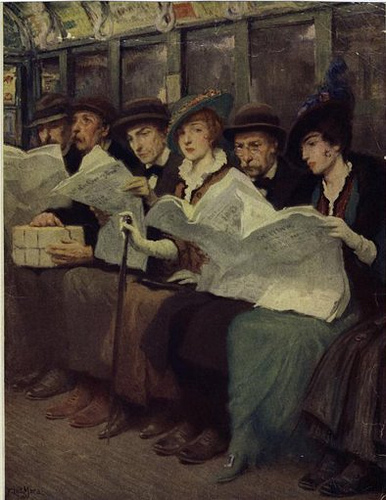
Subway Riders, Francis Louis Mora, 1914
Good Morning!!
I suppose I have to cover the war news, although I’d much prefer to ignore it. So here goes.
First, the good news. According to The Washington Post, more than 60 countries have signed on with the “Anti-Islamic State Coalition.”
In his speech to the United Nations on Wednesday morning, President Obama said, “Already, over 40 nations have offered to join this coalition.”
But on Tuesday, Secretary of State John Kerry said more than 50 nations have agreed to join the coalition. And in a document released by the State Department on Tuesday, 62 nations (including the European Union and the Arab League) are listed as providing support to the U.S.-led coalition.
The strongest allies in the coalition are those providing air support to the United States, while others are offering delivery services and some are providing humanitarian aid.
Click on the link above to read the list of countries providing air support, military equipment, and humanitarian aid. You can follow the latest developments in the fight against ISIL at The Guardian’s live blog.
Now the not-so-good news: a couple of op-eds that suggest the air war against the Islamic State militants is ineffective and/or counterproductive.
Reuters, Air strikes won’t disrupt Islamic State’s real safe haven: social media.
President Barack Obama has pledged to destroy Islamic State and ensure fighters “find no safe haven.” But even as U.S.-led airstrikes are underway in Iraq and Syria, it is clear that bombs alone will not do the job. For Islamic State hides out in the most perfect haven: the World Wide Web.
In June 2014, the militant group that Obama refers to as Islamic State in Iraq and the Levant, or ISIL, grabbed the world’s attention after it took over much of northern Iraq in roughly four days. Islamic State accomplished this by building a massive, sophisticated virtual network of fighters in addition to those on the ground. Indeed, its expansion online has been as swift as its territorial gains. It is this virtual power grab that will be most difficult to combat.
The Internet has largely sustained the jihadist movement since 9/11. With this powerful tool, jihadists coordinate actions, share information, recruit new members and propagate their ideology.
Until the rise of Islamic State, extremist activity and exchanges online usually took place inside restricted, password-protected jihadist forums. But Islamic State brought online jihadism out of the shadows and into the mainstream, using social media — especially Twitter – to issue rapid updates on its successes to a theoretically unlimited audience.
In the same way that Islamic State’s land grab proved stunning, the group’s actions online have been deeply troubling. Up until a recent crackdown by Twitter, Islamic State’s presence on the site had grown tremendously — from a small one to a well-organized network with dozens of accounts.
Click the link to read all about it at Reuters’ “The Great Debate” page.
Reading the Newspaper. War News, by Nikolay Bogdanov-Belsky
Jamie Dettmer at The Daily Beast argues that Obama’s Arab Backers May Draw the U.S. Deep Into the Mideast Quagmire. Detmer also discusses ISIL’s social media operation.
The backing from Gulf countries for the military intervention against militants of the so-called Islamic State in northern Syria, far from helping the United States in the battle for hearts and minds, may actually be hurting Washington in the region. And the reasons for that suggest just how densely complicated the Mideast quagmire has become.
While the participation of the super-rich Gulf monarchies in a coalition against the group widely known as ISIS or ISIL may help with some moderate Muslims, and may reassure European leaders, among those Islamists inside and outside Syria who are at the core of the opposition to President Bashar al Assad this development is viewed with deep suspicion.
“This has been labeled as a war against ISIS but it is a war against Islamic groups,” Tauqir Sharif, a British Islamist activist based in Idlib, Syria, told British Channel Four news Wednesday.
Already ISIS activists and jihadists sympathizers in the Gulf are leveraging their social media skills to fuel suspicions that the Americans are ready to give Assad a free pass and that the Sunni Muslims of Syria will be sacrificed with the connivance of the Gulf monarchies.
Much more at the Daily Beast link.
Suspect in Alleged Abduction of UVA Student Captured in Texas
I’ve been following the case of missing University of Virginia student Hannah Graham since Janicen posted about it about a week ago. The last person to be seen with Graham on surveillance footage was Jesse Matthew, 32, who worked as a nurses’ aid at the university. After police searched his car and apartment, Matthew came to the police station and asked for an attorney. He then drove away at a high speed and apparently disappeared. Police issued a warrant for his arrest for a traffic violation, but could not locate him. After more searches of his apartment, police upgraded the charge to abduction of Graham.
Last night, news broke that Matthew had been located in Galveston, Texas, and he is currently being held by police there. From the Associated Press, via ABC News, Suspect Captured but UVa Student Still Missing.
Jesse Leroy Matthew Jr. was arrested on a beach in the Texas community of Gilchrist by Galveston County Sheriff’s authorities, Charlottesville Police Chief Timothy Longo announced Wednesday night.
The capture came less than a full day after police announced they had probable cause to arrest Matthew on charges of abduction with intent to defile Hannah Graham, an 18-year-old sophomore who went missing on Sept. 13 in Charlottesville.
Longo said an intense search for Graham continues.
“This case is nowhere near over,” he told a news conference late Wednesday. “We have a person in custody but there’s a long road ahead of us and that long road includes finding Hannah Graham.”
Longo said Thursday on NBC’s “Today” show that the search is focusing on rural and wooded areas around Charlottesville.
Matthew was captured at a beach in the sparsely populated community of Gilchrist around 3:30 p.m. after police received a call reporting a suspicious person, the Galveston County Daily News reported. The newspaper quoted Galveston County Sheriff Henry Trochesset as saying a deputy responding to the call found a man who had pitched a tent on the beach with his car parked nearby. Trochesset said a check of the car’s plates revealed it was the vehicle sought in connection to the case. Authorities were trying to get a warrant to search the car, he added.

Reading the Morning Newspaper, Harry Herman Roseland
ABC News has more on how police located Jesse Matthew, Suspect in UVA Case Seen on Video Buying Bug Spray Before Capture.
Detectives investigating the case of a missing University of Virginia student were headed to Texas today after a man suspected in her disappearance was arrested after being caught on surveillance video there buying mosquito repellent a day before his capture….
The surveillance video from a convenience store in Galveston showed Matthew buying Off!, said the store’s owner, Dave Paresh.
“He asked me the question if it’s safe to stay on the beach, so I told him yeah, it’s good there,” Paresh, told ABC News station KTRK in Houston.
I guess there must be lots of mosquitoes on Galveston beaches right now.
Matthew appeared in court this morning, and was denied bail.
For anyone who thinks I shouldn’t write about “missing white girl” stories, violence against women is endemic in this country. It’s a bloodbath out there, with women being beaten (see the NFL scandal), raped, and/or murdered daily in this country; and I think it should be talked about. There truly is a war against women. Admittedly, the use of violence against women for entertainment should be discussed. Think about how many movies and TV shows center around the rape, torture, and murder of women. It’s important that real-life cases be seen as horrible crimes that involve agonizing suffering for victims, their families and friends.
Police Misconduct in the News
Speaking of violence against women, even police get into the act. Thank goodness they are often caught on video these days.
From The Christian Science Monitor, NYPD under fire for video of pregnant woman hitting ground.
New York City police officers are under investigation this week after a bystander used a smartphone to capture a particularly rough arrest of a Brooklyn woman five months pregnant.
The video shows the arrest of Sandra Amezquita, a Colombian immigrant and mother of four, who fell belly first onto the pavement as officers wrestled her to the ground and cuffed her hands behind her back. The incident occurred during an early morning melee Saturday in Sunset Park – a neighborhood sometimes called Brooklyn’s “Little Latin America,” since more than half its residents are Latino.
The video also shows another officer violently shoving an unidentified woman to the pavement as she stands near the arrest. Police simply issued Ms. Amezquita a summons for disorderly conduct, but the other woman, reported to be a friend, was neither arrested or accused of a crime.
Amezquita suffered vaginal bleeding after the incident. She was arrested for trying to interfere with police who were beating her son after they stopped and frisked him.
“It’s appalling,” said Sanford Rubenstein, Amezquita’s attorney. “It’s clear to me when an incident like this occurs you understand why police-community relations are at an all-time low,” he told The Associated Press.
The scuffle occurred after Amezquita and her husband, Ronel Lemos, attempted to intervene as police arrested and allegedly began to beat their 17-year-old son, Jhohan Lemos, who was accused of carrying a knife and resisting arrest around 2:15 a.m. on Saturday.
The elder Mr. Lemos was also arrested and charged with assaulting a police officer during the arrest of his son. Photos show the younger Mr. Lemos with his eye swollen shut and lacerations to his cheek and forehead following his arrest.

Reading the News at the Weavers’ Cottage, 1673, Adriaen van Ostade
In California, a 51-year-old woman won a lawsuit against the Highway Patrol after an officer beat her and it was caught on tape. Fox News reports:
A woman who was punched repeatedly by a California Highway Patrol (CHP) officer in an incident caught on film earlier this year will receive $1.5M as part of a settlement reached Wednesday.
CHP Commissioner Joe Farrow announced the settlement in an emailed statement and an attorney for 51-year-old Marlene Pinnock confirmed the deal to the Associated Press. The agreement was reached after nine hours of mediation in Los Angeles.
As part of the agreement, the officer who struck Pinnock, Daniel Andrew, will resign. Andrew, who joined the CHP in 2012 and had been on paid administrative leave, could still be charged criminally in the case. The CHP forwarded the results of its investigation of the incident to Los Angeles County prosecutors last month, saying he could face serious charges but none have been filed yet.
There was another demonstration in Ferguson, Missouri on Tuesday Night after someone burned a memorial to Michael Brown, who was shot and killed by Ferguson police officer Darren Wilson on August 9. The Christian Science Monitor asks, Who burned Michael Brown memorial? Questions spark new Ferguson unrest.
Fresh unrest in Ferguson, Mo., Tuesday night shows that the embers of the month-old unrest surrounding Michael Brown’s death can be kindled by even tiny sparks.
Detectives are investigating how a makeshift memorial to Mr. Brown, an unarmed black teenager killed by white Ferguson police officer Darren Wilson on Aug. 9., burned early Tuesday morning. The memorial, which is one of two near where Brown died on Canfield Drive, included mementos and small candles that may have caused the fire.
But some in the area suggested that it’s “naïve” to think the fire was accidental, and about 200 protesters rallied to West Florissant Avenue again Tuesday, squaring off with police and looting for the third time a store called Beauty Town. There were media reports of looters yelling “Burn it down!” and of gun shots in the area near Canfield Drive. Police made five arrests.
Meanwhile, the DOJ is investigating the Ferguson Police Department.
Finally, there will apparently be no charges in the shooting of John Crawford III, who was shot by police while holding a toy gun in a Walmart. From Fox News, Grand jury issues no indictments in man’s fatal shooting at Ohio Wal-Mart.
XENIA, Ohio – Officers’ actions were justified in the fatal shooting of a man holding an air rifle inside an Ohio Wal-Mart store, a grand jury determined Wednesday — using surveillance video the slain man’s family said shows the shooting was completely unjustified.
The Greene County grand jury opted not to issue any indictments in the Aug. 5 death of 22-year-old John Crawford III inside a Wal-Mart in Beavercreek, Special Prosecutor Mark Piepmeier said.
A 911 caller reported Crawford was waving what appeared to be a rifle in the store. Police said he was killed after failing to obey commands to put down what turned out to be an air rifle taken from a shelf.
Since the shooting, Crawford’s family had demanded public release of the surveillance footage, a request denied until Wednesday by the state attorney general, who said releasing it earlier could taint the investigation and potential jury pool.
Video presented at a news conference by Piepmeier in Xenia shows Crawford walking the aisles, apparently on his cellphone, and picking up an air rifle that had been left, unboxed, on a shelf.
Crawford carries the air rifle around the store — sometimes over his shoulder, sometimes pointed at the ground — before police arrive and shoot him twice.
Would a customer have called 911 if Crawford hadn’t been a black man?
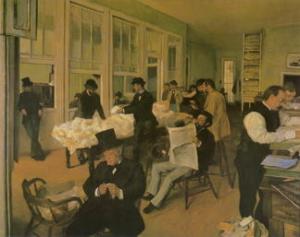
At the Miliners, by Edgar Degas, 1882
In Other News . . .
I’m running out of space, so I’ll end with some links to other stories that may pique your interest.
Cleveland Plain Dealer, FBI report shows mass shootings on the rise since 2000. We already knew this, but now there’s hard evidence.
Beta News.com, Five things to hate about the iPhone 6 and iPhone 6 Plus. It bends!
And the new Apple IOS is messed up. From ComputerWorld, Apple yanks iOS 8 update after crippling iPhone 6 and 6 Plus.
Massachusetts GOP candidate for Governor is not endearing himself to women voters. Two op-ed pieces from The Boston Globe:
Charlie Baker needs an intervention on women, by Joan Vennochi
Charlie Baker’s ‘sweetheart’ problem, by Yvonne Abraham
Women, let’s all get out and vote for Martha Coakley. It’s high time Massachusetts had a woman as Governor!
So . . . what else is happening in the world? I’ll see you in the comments! Have a great day!

 peej
peej Carissa
 bostonboomer
 dakinikat
 ecocatwoman
 mablue2
 Mama Lopez
 peggysue22
 quixote
 skydancingguestblogger
 Mona (aka Wonk the Vote)



 Sky Dancing
Recent Comments