
A demolition job that began Monday with the disappearance of the White House’s eastern entrance advanced Tuesday with the destruction of much of the East Wing, according to a photograph obtained by The Washington Post and two people who spoke on the condition of anonymity to describe the scene.
Wednesday Reads: The Demolition of U.S. Democracy
Posted: October 22, 2025 Filed under: just because | Tags: Arizona Attorney General Kris Mayes, demolition of White House East Wing, Donald Trump, health care costs, Jeff Merkley, Justice Department, Karoline Leavitt, Pete Hegseth, Rep.-elect Adelita Grijalva, Todd Blanche, Trump demands repayment for prosecutions, Trump's garish ballroom 8 CommentsGood Morning!!

This looks like a war zone.
I’m heartsick about what Trump is doing to the White House. The White House belongs to the American people, not to the current president. But Trump is doing whatever he wants to our government and to “the people’s house.”
Yesterday, at his substack, Law Dork, Chris Geidner posted the clearest photos of Trump’s demolition I have seen so far. From the photos, it’s clear that either the entire East Wing or most of it will be destroyed. The first photo shows the destruction of the front of the building, and the second shows the damage from above, show how far back the damage to the roof goes. I can’t post the photos here–they are protected–but you can see them at the link.
From the article:
Exclusive: Trump’s demolition of the White House East Wing is nearly complete.
Photos obtained exclusively by Law Dork on Tuesday show that President Donald Trump is completely demolishing the East Wing of the White House as part of his stated plan to build a ballroom befitting his standards on the White House grounds.
Although Trump earlier had said the ballroom “won’t interfere with the current building,“ this week it became abundantly clear that was a lie. And, this dramatic change to the governmental building, Trump says, is happening care of private money and outside of any governmental — and transparent — funding process.
After The Washington Post first reported on Monday that demolition had begun, The Wall Street Journal reported on Monday night that Treasury Department employees next door to the demolition were told to “refrain from taking and sharing photographs of the grounds, to include the East Wing, without prior approval from the Office of Public Affairs.“
On Tuesday, Law Dork obtained these photographs taken of the ongoing demolition.
Although the Post’s initial story detailed the “East Wing facade“ being demolished and that teams on Monday were “demolishing a portion ofthe East Wing,“ the Tuesday photograph obtained by Law Dork makes clear that most if not all of the entirety of the East Wing is being demolished.
A second photo obtained by Law Dork from another angle shows the extent of the demolition has already reached all but the western and northern walls of the East Wing.
Geider links to this piece by Ryan Gottleib at ENR East: White House Ballroom Build Advances as Oversight Gaps Emerge.
Demolition crews began work Oct. 20 on the East Wing of the White House to clear space for a privately funded 90,000-sq-ft ballroom addition valued at roughly $200 million at the behest of President Donald Trump
The project, announced July 31 by the White House, will be built by Clark Construction Group with AECOM as engineer and McCrery Architects as designer.
Officials said it will create a larger venue for state and ceremonial events, financed entirely by the president and “patriot donors.”
The addition marks the most substantial change to the Executive Residence since the Truman reconstruction of 1948-52. Renderings depict a limestone-clad structure with tall arched windows, ballistic-resistant glazing and interiors described by the White House as “ornately designed.” [….]
The design calls for the addition to remain structurally distinct from the residence while echoing its neoclassical form. The press office said the ballroom “will be substantially separated from the main building… but its theme and architectural heritage will be almost identical.”
As for Trump gaining approval for the project, he took care of that by appointing a sycophant.
Regulatory filings show that as of Sept. 4 no submission had been made to the National Capital Planning Commission, which reviews major federal projects in the capital region.
Commission Chairman Will Scharf, who also serves as White House staff secretary, said during a public meeting that “what we deal with is essentially construction, vertical build,” explaining why demolition and site-preparation work began before commission review. The interpretation leaves design oversight unresolved, even as groundwork proceeds.
Under the Presidential Residence Act, the White House is managed by the National Park Service and operated by the Executive Office of the President’s Facilities Management Division.
While Section 107 of the act exempts the executive residence from mandatory review, Executive Order 11593, issued in 1971, directs federal agencies to consult with the U.S. Interior Dept. before altering historic structures.
Past administrations have voluntarily submitted major projects for review by the National Capital Planning Commission and the Commission of Fine Arts. These measures, while not legally binding, form the preservation framework that has guided White House alterations for decades and remains relevant even for privately funded work.
More information on Trump’s vanity project from The Washington Post (gift article): White House expands East Wing demolition as critics decry Trump overreach.
Photos of construction teams knocking down parts of the East Wing, first revealed by The Washington Post on Monday, shocked preservationists, raised questions about White House overreach and lack of transparency, and sparked complaints from Democrats that President Donald Trump was damaging “the People’s House” to pursue a personal priority.
“They’re wrecking it,” said Martha Joynt Kumar, a political scientist and professor emeritus at Towson University in Maryland. “And these are changes that can’t be undone. They’re destroying that history forever.”
A White House spokesman said that the “entirety” of the East Wing would eventually be “modernized and rebuilt.”
WASHINGTON, DC – OCTOBER 20: Workers demolish the facade of the East Wing of the White House on October 20, 2025 in Washington, DC. (Photo by Kevin Dietsch/Getty Images)
The National Trust for Historic Preservation, a nonprofit created by Congress to help preserve historic buildings, sent a letter Tuesday to administration officials, warning that the planned 90,000-square-foot ballroom “will overwhelm the White House itself,” which is about 55,000 square feet.
“We respectfully urge the Administration and the National Park Service to pause demolition until plans for the proposed ballroom go through the legally required public review processes,” Carol Quillen, National Trust’s CEO, said in a statement, citing two federal commissions that have traditionally reviewed White House additions.
White House officials dismissed the criticism as “manufactured outrage,” arguing that past presidents had pursued their own changes to the executive campus as necessary. They said that the privately funded ballroom will be a “bold, necessary addition” to the presidential grounds.

You can read more using the gift link.
After the backlash, Trump has decided to submit his plans for review–now that the work is in progress.
Reuters: White House says it will submit ballroom plans for review, with demolition already under way.
The White House said on Tuesday it will submit plans for President Donald Trump’s $250 million White House ballroom project to a body that oversees federal building construction, even though demolition work began earlier this week.
Trump reveled on Tuesday in the demolition sounds by construction workers for the ballroom addition to the White House, the first major change to the historic property in decades.
But critics, aghast about images of the White House walls crumbling after Trump had pledged the project would not interfere with the existing landmark, said a review process should have taken place before the work began.
This schematic from the Washington Post article shows the planned layout of the new White House complex.
The White House still intends to submit those plans to the National Capital Planning Commission, which oversees federal construction in Washington and neighboring states, a White House official told Reuters
“Construction plans have not yet been submitted to the National Capital Planning Commission but will be soon,” the official said, adding that the NCPC does not have jurisdiction over demolition work.
The commission is now led by Will Scharf, a White House aide.
Asked why the demolition of East Wing walls was occurring despite Trump’s promise that it would not affect the existing building, the official said modernization work was required in the East Wing and changes had always been a possibility.
“The scope and size was always subject to vary as the project developed,” he said.

Trump spokesperson Karoline Leavitt thinks the critics of the East Wing teardown are just jealous.
The Daily Beast: Karoline Leavitt Gives Wild Defense of Trump Destroying the White House.
Karoline Leavitt thinks Democrats are just jealous that Donald Trump is building a swanky $250 million ballroom at the White House.
The White House press secretary says that’s the only way to explain the “fake outrage” after part of the White House’s iconic East Wing was demolished to make way for the 90,000-square-foot structure.
The Trump administration has received widespread backlash for starting work on the event space that will eventually dwarf the White House itself. “It’s not his house. It’s your house. And he’s destroying it,” former Secretary of State Hillary Clinton posted on X.
But Trump officials have attempted to convince the public that it’s what presidents, administrations, and White House staff have longed for, for 150 years.
“Are the Democrats jealous that Trump is building this big beautiful ballroom?” Fox News host Jesse Watters asked Leavitt on Tuesday.
Leavitt replied that it “certainly appears that way.”
“I believe there’s a lot of fake outrage right now because nearly every single president who has lived in this beautiful White House behind me has made modernizations and renovations of their own,” she added.
I’m speechless at this point.
Another Trump outrage from yesterday: Trump is demanding that he be paid $230 million for the prosecutions against him.
The New York Times (gift link): Trump Said to Demand Justice Dept. Pay Him $230 Million for Past Cases.
President Trump is demanding that the Justice Department pay him about $230 million in compensation for the federal investigations into him, according to people familiar with the matter, who added that any settlement might ultimately be approved by senior department officials who defended him or those in his orbit.
The situation has no parallel in American history, as Mr. Trump, a presidential candidate, was pursued by federal law enforcement and eventually won the election, taking over the very government that must now review his claims. It is also the starkest example yet of potential ethical conflicts created by installing the president’s former lawyers atop the Justice Department.
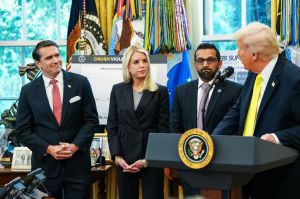
Todd Blanche, the deputy attorney general; Attorney General Pam Bondi; and Kash Patel, the F.B.I. director, with President Trump in the Oval Office last week.Credit…Doug Mills/The New York Times
Mr. Trump submitted complaints through an administrative claim process that often is the precursor to lawsuits. The first claim, lodged in late 2023, seeks damages for a number of purported violations of his rights, including the F.B.I. and special counsel investigation into Russian election tampering and possible connections to the 2016 Trump campaign, according to people familiar with the matter. They spoke on the condition of anonymity because the claim has not been made public.
The second complaint, filed in the summer of 2024, accuses the F.B.I. of violating Mr. Trump’s privacy by searching Mar-a-Lago, his club and residence in Florida, in 2022 for classified documents. It also accuses the Justice Department of malicious prosecution in charging him with mishandling sensitive records after he left office.
Asked about the issue at the White House after this article published, the president said, “I was damaged very greatly and any money I would get, I would give to charity.”
He added, “I’m the one that makes the decision and that decision would have to go across my desk and it’s awfully strange to make a decision where I’m paying myself.”
A bit more:
Lawyers said the nature of the president’s legal claims poses undeniable ethics challenges.
“What a travesty,” said Bennett L. Gershman, an ethics professor at Pace University. “The ethical conflict is just so basic and fundamental, you don’t need a law professor to explain it.”
He added: “And then to have people in the Justice Department decide whether his claim should be successful or not, and these are the people who serve him deciding whether he wins or loses. It’s bizarre and almost too outlandish to believe.”
The president also seemed to acknowledge that point in the Oval Office last week, when he alluded vaguely to the situation while standing next to the F.B.I. director, Kash Patel, Attorney General Pam Bondi, and her deputy, Todd Blanche. According to Justice Department regulations, the deputy attorney general — in this case, Mr. Blanche — is one of two people eligible to sign off on such a settlement.
Unbelievable.
Arizona’s attorney general filed a lawsuit against House Speaker Mike Johnson yesterday.
NBC News: Arizona AG sues to force House Speaker Johnson to seat Democrat Adelita Grijalva.
Arizona Attorney General Kris Mayes on Tuesday filed a lawsuit to try to force House Speaker Mike Johnson to swear in Rep.-elect Adelita Grijalva, the Arizona Democrat who won her late father’s seat in a special election nearly one month ago.
Johnson, R-La., has said he will seat Grijalva once Senate Democrats agree to reopen the government. But the two parties haven’t been talking for weeks, and there is no indication when the shutdown might end.
The lawsuit, which Mayes threatened in a letter to Johnson last week, argues that the speaker’s delay is depriving the 813,000 residents living in Arizona’s 7th District of congressional representation. It lists the state of Arizona and Grijalva herself as plaintiffs and the U.S. House, as well as the House clerk and sergeant at arms, as defendants.
“Speaker Mike Johnson is actively stripping the people of Arizona of one of their seats in Congress and disenfranchising the voters of Arizona’s seventh Congressional district in the process,” Mayes said in a statement. “By blocking Adelita Grijalva from taking her rightful oath of office, he is subjecting Arizona’s seventh Congressional district to taxation without representation. I will not allow Arizonans to be silenced or treated as second-class citizens in their own democracy.”
As he left the Capitol on Tuesday evening, Johnson blasted the Arizona lawsuit as “patently absurd.”
Mayes, he said, has “no jurisdiction.”
We’ll see what the judge has to say about it.
At the Department of Defense, Pete Hegseth (Secretary of War) tells military officials they can’t talk to Congress without his approval.
AP: Hegseth changes policy on how Pentagon officials communicate with Congress.
Leaders at the Pentagon have significantly altered how military officials will speak with Congress after a pair of new memos issued last week.
In an Oct. 15 memo, Defense Secretary Pete Hegseth and his deputy, Steve Feinberg, ordered Pentagon officials — including the chairman of the Joint Chiefs of Staff — to obtain permission from the department’s main legislative affairs office before they have any communication with Capitol Hill.
The memo was issued the same day the vast majority of Pentagon reporters exited the building rather than agree to the Defense Department’s new restrictions on their work, and it appears to be part of a broader effort by Hegseth to exert tighter control over what the department communicates to the outside world.
According to the memo, a copy of which was authenticated by a Pentagon official, “unauthorized engagements with Congress by (Pentagon) personnel acting in their official capacity, no matter how well-intentioned, may undermine Department-wide priorities critical to achieving our legislative objectives.”
More from NBC News: Pete Hegseth cracks down on Pentagon staff speaking to Congress.
It’s a departure from current practice; previously, Defense Department agencies were free to manage their own interactions with Capitol Hill.
But under Hegseth, the department has sought stricter control over messaging coming out of the Pentagon. Dozens of reporters turned in their badges and left the building last week, when most news agencies refused to sign unprecedented restrictions Hegseth imposed that threatened consequences for journalists who reported information he had not approved for release, even if it was unclassified.
The new directive, which would further curb information flow from the Pentagon to Congress, is designed “to achieve our legislative goals,” Hegseth and his deputy wrote in the memo.
“Unauthorized engagements with Congress by DoW personnel acting in their official capacity, no matter how well-intentioned, may undermine Department-wide priorities critical to achieving our legislative objectives,” the memo says, using the initialism for the “Department of War,” the Defense Department’s secondary but unofficial name used by the Trump administration.
Why is Hegseth so paranoid? Is it because he’s incompetent and realizes the competent DOD people know that?
Two more articles to check out:
The Washington Post (gift link): Health insurance sticker shock begins as shutdown battle over subsidies rages.
Lazy Caturday Reads: Literary Cats Along With Some News
Posted: October 4, 2025 Filed under: just because | Tags: 82nd Airborne, cat art, caturday, deportations, Donald Trump, drone strikes on boats, extrajudicial executions, Howard Lutnick, immigration, Jeffrey Epstein, Kilmar Abrego Garcia, literary cats, Mark Hertling, Miranda Devine, Pete Hegseth, Portland OR, Signal app leaks, Venezuela 5 CommentsGood Afternoon!!

Haruki Murakami with Kafka
It’s the end of another week in which lots of bad things happened. Frankly, I can’t keep track of everything anymore. Here are some of the stories that interested me most.
I’m still recovering from Tuesday’s insane performances by Pete Hegseth and Donald Trump in front of 800 military leaders whom they forced to travel to Quantico Marine Corps base from all over the world. Former Lt. General Mark Hertling writes about it at The Bulwark: Questions After Quantico.
THE SPEECHES ON TUESDAY IN QUANTICO—by Chairman of the Joint Chiefs of Staff Gen. Dan Caine, Secretary of Defense (or War, as he would have it) Pete Hegseth, and President Donald Trump—were over in just two hours. But for the generals, admirals, and senior enlisted who left that auditorium and started their long flights home to the Pacific, Europe, and the Middle East, those speeches were just the beginning. Because when Washington speaks—especially when it speaks with bluster, ambiguity, or hostility—it is the commanders who must translate to their troops, steady their units, and respond to the challenges of new orders.
I’ve been that commander. I’ve flown back overnight from Washington to Germany, walked into my headquarters in Heidelberg, and faced staff officers and soldiers who were waiting—not for a policy memo, not for another directive from the Pentagon, but for their commander to tell them what it all meant and to give them implementing instructions. After Tuesday’s meeting, they will want to know what things they will have to change, if their country still believes in them, if the oath they swore still anchors their service, if the mission they’re preparing for or executing still has clarity and legitimacy….
…[T]he shockwaves of the Quantico gathering are only now beginning to reverberate through bases in Europe, the Pacific, the Middle East, and beyond. Because when those commanders and their enlisted advisors returned to their posts, bases, air wings, or carrier strike groups, the questions began.
As the speech was being publicly broadcast, female soldiers living on the Kasernes of Germany watching on the Armed Forces Network were asking one another: Does this mean our opportunities to serve in jobs we love are closing again? Will I still be allowed to compete fairly for assignments and promotions? Black soldiers, weary and wary of subtle slights and systemic hurdles, will wonder if the new emphasis on “appearance” and “discipline” means a return to the days when shaving profiles for painful and unsightly face “bumps” were treated as liabilities instead of as a need for legitimate accommodations. Sikh soldiers, who after long battles were only recently granted the right to wear turbans and keep beards as part of a commonsense accommodation for their faith, will now wonder if that right will again be questioned. For each of them, their unique individuality and love for service in uniform are inseparable.
And gay and transgender service members—many of whom finally felt able to serve openly over the last decade—felt the floor shift beneath them yet again. Do I need to start making plans to leave? one staff sergeant might quietly ask her first sergeant. Or do I just keep my head down and hope this storm passes? Keeping your head down is sometimes needed in combat when engaging with the enemy; it’s not something we want from our soldiers who are living their Army value of “personal courage.”
There will be broader, increasingly gnawing concerns for the staffs: Are we really being asked to prepare for missions inside our own cities? What happens if peaceful protesters are described as “enemies”? Where does that leave the oath we swore—to the Constitution, not to a man or a party?
These aren’t abstract policy questions. They will be whispered in barracks hallways, posed after hours in a motor pool, or texted late at night to a trusted squad leader. They are the lived reality of a military force watching politics intrude on their profession. And with each one, there is the question of degraded morale, an erosion of trust.
How will commanders handle these overwhelming questions? Read what Hertling has to say about it at The Bulwark.

Patricia HIghsmith with Ripley
I’m also still gloating about the latest exploit by Trump’s stupidest cabinet member (and that’s really saying something, considering that group of morons) Howard Lutnik. Lutnick gave an interview to a podcast hosted by Miranda Devine of the New York Post in which he told personal stories about Jeffrey Epstein, who was once Lutnick’s next door neighbor in New York City. Could there be anything more guaranteed to enrage Trump?
Josh Christenson at The New York Post: Howard Lutnick tells ‘Pod Force One’ ex-neighbor Jeffrey Epstein showed off massage room, made creepy comment during townhouse tour.
Commerce Secretary Howard Lutnick, in a notable break with the Department of Justice, claimed late pedophile Jeffrey Epstein was “the greatest blackmailer ever” — and may have traded the feds video of his rich and well-connected associates getting massages from young women in exchange for a controversial 2008 plea deal.
Lutnick made the shocking allegations to The Post’s Miranda Devine on the latest episode of “Pod Force One,” out now.
The 64-year-old cabinet secretary said Epstein himself showed off his notorious “massage room” while giving Lutnick and his wife a tour of the infamous East 71st Street townhouse after the couple moved in next door to the since-disgraced financier in 2005.
“I say to him, ‘Massage table in the middle of your house? How often do you have a massage?’” Lutnick recalled. “And he says, ‘Every day.’ And then he gets, like weirdly close to me, and he says, ‘And the right kind of massage.’”
Lutnick said he and his wife quickly excused themselves and left Epstein’s home, “and in the six to eight steps it takes to get from his house to my house, my wife and I decided that I will never be in the room with that disgusting person ever again.”
When asked by Devine whether Epstein’s rich and powerful associates — including the likes of Prince Andrew and Microsoft founder Bill Gates — “could hang around him and not see what you saw, or did they see it and ignore it,” Lutnick responded, “They participated.”
“They get a massage, that’s what his MO was. ‘Get a massage, get a massage,’ and what happened in that massage room, I assume, was on video,” the commerce secretary went on. “This guy was the greatest blackmailer ever, blackmailed people. That’s how he had money.” [….]
Lutnick added: “I assume way back when they traded those videos in exchange for him getting that 18-month sentence, which allowed him to have visits and be out of jail. I mean, he’s a serial sex offender. How could he get 18 months and be able to go to his office during the day and have visitors and stuff? There must have been a trade.
“So, my assumption, I have no knowledge, but my assumption is there was a trade for the videos, because there were people on those videos,” he also claimed.
Hahahaha!! Trump has tried so hard to distract from the Epstein files. He was pals for years with the guy who nauseated Howard Lutnick after one brief interaction. Now Democrats in the Congress want Lutnick to testify for their committees. You can watch the video of the Lutnick interview at the NY Post link.

Gore Vidal with Caligula
Swapna Venugopal Ramaswamy at USA Today: Trump’s commerce secretary calls Jeffrey Epstein the ‘greatest blackmailer.’
For months, President Donald Trump has pleaded with his supporters to move on from the Jeffrey Epstein controversy − calling it a “Democratic hoax” − even as he faces growing calls from Congress and many in his own MAGA base for more disclosure on the jet-setting sex offender.
But Trump’s fellow billionaire and Commerce secretary, Howard Lutnick, apparently didn’t get the memo.
Lutnick held forth on a recent podcast about how he found Epstein, who was a close friend of Trump’s for more than a decade, to be “gross” and believed he was a “blackmailer.”
“He was gross,” said Lutnick, in a Oct.1 podcast interview with New York Post’s Miranda Devine. Lutnick described Epstein as the “greatest blackmailer ever” and suggested he had used compromising videos of prominent men to get a 2008 sweetheart deal in Florida amid a child prostitution investigation.
Those comments sharply differ from a memo released by the Justice Department and FBI in July which said that there was no “credible evidence found that Epstein blackmailed prominent individuals” or that he kept an “incriminating client list.”
One more on Lutnick by Asawin Suebsaeng at Zeteo: ‘F***ing Dumbass’: Trump Officials Want Howard Lutnick Sidelined After Epstein Comments.
Top officials in Donald Trump’s administration are furious with Commerce Secretary Howard Lutnick, knowledgeable sources tell Zeteo, after he went on a tabloid podcast this week and blabbed about the one sex criminal who Team Trump wants to talk about least: Jeffrey Epstein. Not only that, but Lutnick went off script and undermined the government’s entire story about the late Epstein.
For months, President Trump and the highest levels of his administration have been trying to sell the public and his MAGA supporters on their conclusion that Epstein, the notorious sex offender and former Trump pal,did not run a secret sexual-blackmail operation targeting wealthy, powerful elites.
Sylvia Plath with “Daddy”
On Wednesday morning, the New York Post published parts of its podcast sit-down with Lutnick, who was once Epstein’s neighbor. The Trump Cabinet member told the Post about his tour of Epstein’s townhouse, where Epstein showed him his “massage room.” Lutnick said he was quickly “disgusted,” before asserting that Epstein’s rich and famous associates not only knew about his bad behavior but “participated.” He called Epstein a “blackmailer,” something the Trump administration strenuously denies.
Several senior Trump officials, some of whom were responsible for carefully curating the messaging regarding the administration’s decision to end its Epstein investigation, were apoplectic on Wednesday, bemoaning to one another about why Lutnick is still employed by the president and why the commerce secretary is allowed to do media appearances, four senior Trump administration appointees tell Zeteo.
“That fucking dumbass,” one of the senior Trump administration officials told Zeteo on Wednesday, after seeing a clip of Lutnick riffing on Epstein. “I’ve worked with him and can tell you he doesn’t think he did anything negative… That’s not how he thinks. He just talks and talks, and doesn’t care what unhelpful bullshit comes out.”

Well, Trump appointed that dumbass, along with a bunch of other idiots in his cabinet.
In more serious news, Trump is still murdering people in small boats off the coast of Venezuela.
Kathryn Armstrong at BBC News: Four killed in latest US strike on alleged drug vessel near Venezuela.
US forces have killed four people in an attack on a boat off the coast of Venezuela that was allegedly trafficking drugs, Defence Secretary Pete Hegseth says.
“The strike was conducted in international waters just off the coast of Venezuela while the vessel was transporting substantial amounts of narcotics – headed to America to poison our people,” Hegseth wrote in a post on X.
It is the latest in a number of recent deadly strikes that the US has carried out on boats in international waters it says are involved in “narco-trafficking”.
The strikes have attracted condemnation in countries including Venezuela and Colombia, with some international lawyers describing the strikes as a breach of international law.
Hegseth said the attack took place in the US Southern Command’s area of responsibility, which covers most of South America and the Caribbean.
“Our intelligence, without a doubt, confirmed that this vessel was trafficking narcotics, the people onboard were narco-terrorists, and they were operating on a known narco-trafficking transit route,” Hegseth said about Friday’s attack.
“These strikes will continue until the attacks on the American people are over!!!!”
US President Trump also confirmed the strike on his Truth Social platform, saying that the boat was carrying enough drugs “to kill 25 to 50 thousand people”.
However, the US has not provided evidence for its claims or any information about the identities of those on board.
An opinion piece from W.J. Hennigan at The New York Times (gift link): If We’re at War, Americans Deserve to Know More About It.
The Trump administration told Congress this week that the United States is engaged in an “armed conflict” with drug cartels.
The average American knows vanishingly little about what its government seeks to accomplish in this fight. Citizens aren’t in possession of the metrics by which to judge the administration’s pursuit of those goals.
George Bernard Shaw with Pygmalian
We haven’t been told which specific drugs they seek to stop. We haven’t been told much about which specific groups they seek to destroy. We haven’t been told much about what legal authorities they are acting on.
Withholding this information from the American public is the administration’s way to escape scrutiny. At the very least, the country deserves some evidence of whether the military operation is working.
If stopping the flow of drugs is the goal, the actions taken so far have been unpersuasive. American forces, at the direction of President Trump, executed a lethal airstrike on Friday on a boat off Venezuela, killing four people on board. Defense Secretary Pete Hegseth posted a video of the attack on X, saying, “The vessel was transporting substantial amounts of narcotics – headed to America to poison our people,” adding that it was “affiliated with Designated Terrorist Organizations.”
This is the sort of vague language the administration has used in its campaign over the past two months as it directs the military to sporadically launch airstrikes — now totaling four — against boats in the region that the government says are running drugs. No corresponding evidence has been provided to the public to support the actions. The operation amounts to extrajudicial executions, according to U.N. officials.

A bit more:
Without delving into the strikes’ questionable legality again, the bombing runs fall well short of decisive military actions. It would be hard to convince anyone that blowing up a few motorboats — and all the people aboard them — will prove conclusive in winning the half-century-old war on drugs.
For one thing, this isn’t how the Pentagon combats enemy networks. Say what you will about the many failures of America’s global war on terrorism, but it’s undeniable the U.S. military became frighteningly proficient at penetrating and taking apart organizations over the past quarter-century.
Instead of systematically killing low- and midlevel henchmen in pinprick airstrikes, U.S. forces learned that more information could be gleaned through capturing those suspects and gathering, bagging and tagging their personal electronics for intelligence analysis. A phone from a suspect’s pocket in Iraq, for instance, would often include enough information, such as phone numbers and text conversations, so that a follow-on raid on other operatives could be planned. This is how U.S. forces mapped out countless terrorist groups’ leadership ranks along with the fighters under their command.
The infrastructure for ship interdictions already exists in the Caribbean. The U.S. Coast Guard and Navy have long interdicted vessels that they suspected of drug running.
Why the administration has opted to blow apart potential leads and sources instead of exploiting them is anyone’s guess.
These are serious questions, but Trump and Hegseth aren’t serious people. All they are interested in is blowing people and boats up and posting videos of the action. It’s disgusting that they are getting away with doing this in our name. You can use the gift link to read the rest of this thoughtful article.
The Abrego Garcia case is still going on, and there was a notable ruling yesterday.
Alan Feuer at The New York Times (gift link): Judge Finds ‘Likelihood’ That Charges Against Abrego Garcia Are Vindictive.
A federal judge in Nashville ruled on Friday that there was a “realistic likelihood” that the indictment filed against Kilmar Armando Abrego Garcia, the immigrant who was wrongfully deported to El Salvador in March and then brought back to face criminal charges, amounted to a vindictive prosecution by the Justice Department.
The ruling was an astonishing rebuke of both the department and some of its top officials, including Todd Blanche, the deputy attorney general. Mr. Blanche was called out by name in the ruling for remarks he made about Mr. Abrego Garcia’s case on the same day in June he was returned to U.S. soil to face the charges in Federal District Court in Nashville.
Doris Lessing with Black Madonna
In a 16-page decision, Judge Waverly D. Crenshaw Jr. said there was evidence that Mr. Abrego Garcia’s prosecution “may stem from retaliation” by the Justice Department and the Department of Homeland Security. Judge Crenshaw found that Trump officials may have sought to punish Mr. Abrego Garcia for having filed a lawsuit successfully challenging his initial “unlawful deportation” to El Salvador.
Moreover, Judge Crenshaw indicated how he was serious about getting to the bottom of the issue of vindictiveness. He said he intended to permit Mr. Abrego Garcia’s lawyers to pry, at least in part, into the Trump administration’s process of deciding to bring an indictment in the first place and how the charges related to the deportation case.
Vindictive prosecution motions are exceedingly difficult to win because of the high threshold required to prove that prosecutors acted improperly by filing criminal charges. Under the law, cases can be considered vindictive only if defendants can show that prosecutors displayed animus toward them while they were seeking to vindicate their rights in court, and that the charges would not have been brought except for the existence of that animus.
While Judge Crenshaw has not yet made a final decision on the issue of vindictiveness, the fact that he is even considering doing so in Mr. Abrego Garcia’s case is a hugely embarrassing blow to the Trump administration. From the moment Trump officials acknowledged that they had mistakenly expelled Mr. Abrego Garcia to El Salvador, President Trump and his top aides began a relentless barrage of attacks against him, calling him a violent member of the street gang MS-13, a wife beater and even a terrorist, effectively blaming him for being the victim of their own administrative error.
The judge’s ruling highlighted the ways in which the habit many Trump officials have of speaking out of court about legal cases has — or could — come back to haunt them.

Use the gift link to read the rest if you’re intersted.
Trump has been talking about sending troops to cities governed by Democrats. Lately he’s been focusing on Portland, Oregon. This is just beyond belief. And we know about it because of another leak from Signal.
Catherine Bouris at The Daily Beast: Trump Goon Spills Bonkers Plan to Deploy 82nd Airborne to Blue City.
A senior White House official accidentally disclosed that the Trump administration was considering deploying an elite army strike force into Portland by using Signal in a public place.
The Minnesota Star Tribune reported Friday that Anthony Salisbury, one of Stephen Miller’s top deputies, was observed discussing the plans via Signal in view of members of the public while traveling in Minnesota. The newspaper was then contacted by one member of the public who was troubled to see sensitive military plans discussed so openly.
Aldous Huxley with Limbo
In the messages, senior White House officials discussed the potential deployment of the Army’s 82nd Airborne Division, an elite unit that specializes in parachuting into hostile territory. The division has been deployed in both world wars, including the Battle of the Bulge, as well as Vietnam and Afghanistan.
Across several conversations, the Star Tribune reports, Salisbury spoke about a range of matters with Pete Hegseth adviser Patrick Weaver as well as other officials.
In one of the messages, Weaver revealed that Hegseth wanted Trump to explicitly instruct him to send soldiers to Portland.
“Between you and I, I think Pete just wants the top cover from the boss if anything goes sideways with the troops there,” Weaver reportedly said.
Noting the potentially disastrous optics around sending an elite division into an American city, Weaver told Salisbury, “82nd is like our top tier [quick reaction force] for abroad. So it will cause a lot of headlines. Probably why he wants potus to tell him to do it.”
Ultimately, Trump opted to send 200 National Guard soldiers into Portland, following a similar playbook used in other Democrat-controlled cities like Los Angeles and Washington D.C. Both the state of Oregon and the city of Portland have sued to stop the deployment.

More interesting reads to check out:
Jonathan V. Last at The Bulwark: Here’s How Trump Loses the Shutdown. God help us but Gavin Newsom is the only Democrat who understands power.
Jens Stoltenberg at The Guardian: ‘I’m leaving,’ Trump said. ‘There’s no reason to be here any more’: inside the meeting that brought Nato to the brink (Former secretary general Jens Stoltenberg recalls the rollercoaster ride of dealing with Donald Trump – and how close the US president brought the alliance to the point of collapse.)
The Independent: ‘It’s not a good place right now’: CBS News staffers are ‘literally freaking out’ about Bari Weiss taking over newsroom.
The New York Times: Supreme Court Lets Trump Revoke Deportation Protections for Venezuelans.
The Guardian: Body slamming, teargas and pepper balls: viral videos show Ice using extreme force in Chicago.
Those are the stories that interested me today. What do you think? What’s on your mind?
Wednesday Reads: Government Shuts Down; Trump Plans To Use Military Against Americans.
Posted: October 1, 2025 Filed under: just because | Tags: DOD reactions to Hegseth speech, Donald Trump, government shutdown 2025, Pete Hegseth, U.S. Military, veterans reactions to Hegseth/Trump speeches 12 CommentsGood Morning!!
I suppose the top story is the government shutdown that began last night at midnight, but I think Trump’s unhinged speech to 800 top military officers is even more urgent. The unprecedented gathering of military leaders, who were forced to travel to Virginia from all over the world, began with an insulting presentation by Secretary of Defense Pete Hegseth and ended with an utterly insane speech by Trump. I watched quite a bit of it with the sound off. I’d much rather read closed captions than listen to Hegseth’s or Trump’s voices.
Let’s get the shutdown out of the way first. The government shut down at midnight last night. Here’s what’s happening now:
AP: Government shutdown begins as the nation faces a new period of uncertainty.
Plunged into a government shutdown, the U.S. is confronting a fresh cycle of uncertainty after President Donald Trump and Congress failed to strike an agreement to keep government programs and services running by Wednesday’s deadline.
Roughly 750,000 federal workers are expected to be furloughed, some potentially fired by Trump’s Republican administration. Many offices will be shuttered, perhaps permanently, as Trump vows to “do things that are irreversible, that are bad” as retribution. His deportation agenda is expected to run full speed ahead, while education, environmental and other services sputter. The economic fallout is expected to ripple nationwide.
“We don’t want it to shut down,” Trump said at the White House before the midnight deadline.
But the president, who met privately with congressional leadership this week, appeared unable to negotiate any deal between Democrats and Republicans to prevent that outcome.
This is the third time Trump has presided over a federal funding lapse, the first since his return to the White House this year, in a remarkable record that underscores the polarizing divide over budget priorities and a political climate that rewards hard-line positions rather than more traditional compromises.
Marisa Kabas at The Handbasket: Trump mandates all federal agencies send email blaming Dems for potential gov’t shutdown.
As the federal government teeters on the brink of a shutdown, workers across many agencies received identical emails late Tuesday afternoon blaming Democrats for the possibility. The Handbasket was the first to learn that the message was mandated by the White House Office of Management and Budget (OMB) via an intra-agency email to leadership and reinforced on a subsequent call. And there was one clear stipulation: Absolutely no modifications to the language.
At the time of publication, I was able to confirm at least 16 federal agencies had received the OMB email ahead of the midnight funding deadline, including the Departments of State, Health and Human Services, and Interior. Here is the text of the message shared with me by numerous federal workers alarmed by its contents (emphasis mine):
“President Trump opposes a government shutdown, and strongly supports the enactment of H.R. 5371, which is a clean Continuing Resolution to fund the government through November 21, and already passed the U.S. House of Representatives. Unfortunately, Democrats are blocking this Continuing Resolution in the U.S. Senate due to unrelated policy demands. If Congressional Democrats maintain their current posture and refuse to pass a clean Continuing Resolution to keep the government funded before midnight on September 30, 2025, federal appropriated funding will lapse.
A funding lapse will result in certain government activities ceasing due to a lack of appropriated funding. In addition, designated pre-notified employees of this agency would be temporarily furloughed. P.L. 116-1 would apply.
The agency has contingency plans in place for executing an orderly shutdown of activities that would be affected by any lapse in appropriations forced by Congressional Democrats. Further Information about those plans will be distributed should a lapse occur.”
The marching orders went out to agencies’ leadership via email at 1:30pm ET, a government source confirms. Then on a 3pm intra-agency call with around 300 participants, a member of OMB leadership reinforced the mandatory nature of the note and stressed that no modifications could be made to the message.
During any other period of recent American history, this email would have been deemed a flagrant violation of the Hatch Act. The law was passed, according to the US Office of Special Counsel website, “to ensure that federal programs are administered in a nonpartisan fashion, to protect federal employees from political coercion in the workplace, and to ensure that federal employees are advanced based on merit and not based on political affiliation.”
In the past, federal workers could be reprimanded for something as simple as a political social media post. But if the past eight months have shown us anything, it’s that this administration feels unencumbered by the law.
The Guardian is running live updates on the shutdown. Read it at the link if you’re interested.
Reactions to Hegseth’s presentation and Trump’s speech:
Here’s a summary of Hegseth’s speech by Heather Cox Richardson at Letters from an American.
Last Thursday, September 25, Defense Secretary Pete Hegseth suddenly announced he was calling about 800 of the nation’s top military generals and admirals, along with their top enlisted advisors, to meet at Marine Corps Base Quantico, in Virginia, today. Such a meeting was unprecedented, and its suddenness meant military leaders across the world had to drop everything to run to Washington, D.C., at enormous financial cost for the country. Under those extraordinary circumstances, speculation about what Hegseth intended to say or do at the meeting has been widespread.
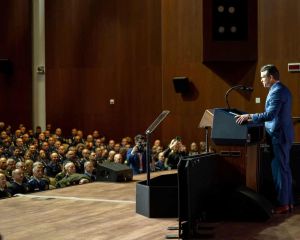
Now we know. This morning, in front of a giant flag backdrop that echoed the opening scene from the movie Patton, Hegseth harangued the career military leaders, pacing as if he were giving a TED talk. The event was streamed live to the public, making it clear that the hurry to get everyone to Washington, D.C., in person was not about secrecy.
Pete Hegseth lectures top military leaders.
In his speech, Hegseth reiterated his vision of a military based in what he calls the “warrior ethos.” Ignoring the military’s mission of preventing wars through deterrence, its professional and highly educated officer corps, and its modern structure as a triumph of logistics, he told the military leaders that today was “the liberation of America’s warriors, in name, in deed and in authorities. You kill people and break things for a living. You are not politically correct and don’t necessarily belong always in polite society.”
He claimed that “we have the strongest, most powerful, most lethal, and most prepared military on the planet. That is true, full stop. Nobody can touch us. It’s not even close.” But then Hegseth, who became defense secretary from his position as a weekend host on the Fox News Channel, complained that “our warriors” are not “led by the most capable and qualified combat leaders.”
He claimed that “foolish and reckless politicians” had forced the military “to focus on the wrong things” and that it had promoted too many leaders “based on their race, based on gender quotas.” “We became the woke department,” he said. “We are done with that sh*t.” He is loosening rules about hazing and bullying, changing physical fitness reforms with the idea that they will get women out of combat roles, and prohibiting beards, which will force Black men out of the service, for Black men suffer at a much higher rate than white men do from a chronic skin condition that makes shaving painful and can cause scarring.
He also said he was tired of seeing “fat troops” and “fat generals and admirals,” and that he would institute a second physical fitness test every year.
“[I]f the words I’m speaking today are making your heart sink,” Hegseth said, “then you should do the honorable thing and resign.”
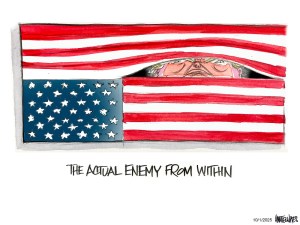
Trump’s speech was largely incoherent and included many of his familiar gripes, but its basic purpose came through loud and clear. He doesn’t believe the U.S. military should be dealing with foreign threats. Instead, he plans to use active duty military troops to police the U.S. Southern border and also to attack “the enemy within”–protesters in Democratic U.S. cities.
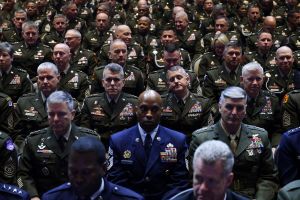
The military audience sat through these speeches in stone-faced silence.
Reactions to Hegseth’s presentation and Trump’s speech:
Longtime Pentagon reporter Helene Cooper said that she can’t find any military officials who attended the meeting in Virginia with President Donald Trump and Secretary Pete Hegseth and liked what they heard.
“I have yet to find a single military official who was in the audience today who thought that this was a good presentation,” she told MSNBC on Tuesday afternoon.
“All I’ve had from them so far, from the people I’ve talked to, is a combination of disbelief that some of them were made to fly from, some of them, Asia, from all over the world … all the way to Quanico to listen to the same familiar type of culture war complaints that we’ve been having since Trump was reelected,” she added, calling Trump’s remarks a “campaign-style stump speech.”
“Nothing that was said today could not have been put in an email or in a directive. So there’s that, to begin with. There’s also the fact that so much of this was partisan, and this is a military that is supposed to present itself as nonpartisan. So you didn’t hear the kind of cheering that we usually get, because President Trump is used to playing for the type of crowds that favor him,” Cooper explained. “And so he’s not very used to performing in front of an audience that’s just giving, looking back stone-faced. But that’s what you were getting from these generals.”
The other thing she noted is that she’s gotten “so many emails from women in the military” who are seeing this as a message “that they are not welcome.”
Tom Nichols at The Atlantic (gift link): The Commander in Chief Is Not Okay.
The president talked at length, and his comments should have confirmed to even the most sympathetic observer that he is, as the kids say, not okay. Several of Hegseth’s people said in advance of the senior-officer conclave that its goal was to energize America’s top military leaders and get them to focus on Hegseth’s vision for a new Department of War. But the generals and admirals should be forgiven if they walked out of the auditorium and wondered: What on earth is wrong with the commander in chief?
Trump seemed quieter and more confused than usual; he is not accustomed to audiences who do not clap and react to obvious applause lines. “I’ve never walked into a room so silent before,” he said at the outset. (Hegseth had the same awkward problem earlier, waiting for laughs and applause that never came.) The president announced his participation only days ago, and he certainly seemed unprepared.
Trump started rambling right out of the gate. But first, the president channeled his inner Jeb Bush, asking the officers to clap—but, you know, only if they felt like it.
Just have a good time. And if you want to applaud, you applaud. And if you want to do anything you want, you can do anything you want. And if you don’t like what I’m saying, you can leave the room. Of course, there goes your rank; there goes your future.
Laughs rippled through the room.
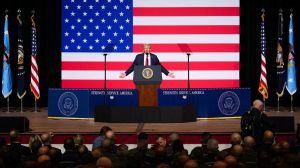
Trump addresses top military leaders.
Trump then wandered around, lost in the halls of history. He talked about how the Department of War was renamed in the 1950s. (It was in the late 1940s.) At one point, he mentioned that the Atomic Energy Commission had confirmed that his strike on Iran had destroyed Tehran’s nuclear program. (Iran still has a nuclear program, and the AEC hasn’t existed since the mid-’70s.) He whined about the “Gulf of America” and how he beat the Associated Press in court on the issue. (The case is still ongoing.) The Israeli-Palestinian conflict? “I said”—he did not identify to whom—“‘How long have you been fighting?’ ‘Three thousand years, sir.’ That’s a long time. But we got it, I think, settled.” [….]
And so it went, as Trump recycled old rally speeches, full of his usual grievances, lies, and misrepresentations; his obsessions with former Presidents Joe Biden and Barack Obama; and his sour disappointment in the Nobel Prize committee. (“They’ll give it to some guy that didn’t do a damn thing,” he said.) He congratulated himself on tariffs, noting that the money could buy a lot of battleships, “to use an old term.” And come to think of it, he said, maybe America should build battleships again, from steel, not that papier-mâché and aluminum stuff the Navy is apparently using now: “Aluminum that melts if it looks at a missile coming at it. It starts melting as the missile is about two miles away.”
Ohhhkayyyy….
As comical as many of Trump’s comments were, the president’s nakedly partisan appeal to U.S. military officers was a violation of every standard of American civil-military relations, and exactly what George Washington feared could happen with an unscrupulous commander in chief. The most ominous part of his speech came when he told the military officers that they would be part of the solution to domestic threats, fighting the “enemy from within.” He added, almost as a kind of trollish afterthought, that he’d told Hegseth, “We should use some of these dangerous cities as training grounds for our military—National Guard, but military—because we’re going into Chicago very soon. That’s a big city with an incompetent governor. Stupid governor.”
This farrago of fantasy, menace, and autocratic peacocking is the kind of thing that the late Senator Daniel Patrick Moynihan evocatively called “boob bait for the Bubbas” and that George Orwell might have called “prolefeed.” It’s one thing to serve it up to an adoring MAGA crowd: They know that most of it is nonsense and only some of it is real. They find it entertaining, and they can take or leave as much of Trump’s rhetorical junk-food buffet as they would like. It is another thing entirely to aim this kind of sludge at military officers, who are trained and acculturated to treat every word from the president with respect, and to regard his thoughts as policy.
David Kurtz at TPM Morning Memo: The Test of Our Time: Even the Military Can’t Resist Trump on Its Own Forever.
In targeting the military’s professionalism and nonpartisanship, Trump laid the groundwork for further lawless domestic use of the military, including illegally in law enforcement. It was a harbinger of a more muscular and oppressive authoritarianism than Trump has mustered so far.
As I watched the flag officers flown in from around the world sit uncomfortably for absurd speeches by the president and his callow defense secretary, I came to see it as the closest Trump could get to a mass firing of the officer corps.
Imagine the other groups of federal workers that Trump has targeted sitting in those seats: government scientists, foreign aid experts, prosecutors and investigators, inspectors and regulators, human resource professionals. They were summarily fired, often in violation of the law, but the generals and admirals are more untouchable than that. Not entirely off limits, as we already seen with some Pentagon terminations, especially of officers who are women or people of color. But for a variety of practical and political reasons, a sweeping purge of generals isn’t feasible.
Audience of 800 top military officers sat stone faced through Hegseth’s and Trump’s speeches.
What is feasible is is to begin to erode the military culture. To emphasize loyalty over merit. To prize fealty over competence. To punish truth-telling and reward convenient fictions. Trump touched on all of those things in a long, rambling speech that could be confused with incoherence.
Trump, as commander in chief, already had constitutional power over his captive audience of flag officers. What he proceeded to do yesterday, with Hegseth’s assistance, was to assert the power of his cult of personality over them. If that made your stomach turn, Hegseth told them, then you should resign.
As a group, this is not what the officers corps signed up for. They are steeped not just in military tradition but in civilian control of the armed services, the chain of command, laws of war, rules of engagement, and the proper role of the military in a free society. These each consist of sets of guardrails, expectations, and values that, if not anathema to Trump, are entirely foreign to him. He is indifferent to them at best, but more likely he is threatened by them because they stand outside of his own power base.
Trump has checked off the list of independent sources of political power that authoritarians typically target: the courts, law enforcement, the press, universities, and civil society organizations, amon others. The military remains a key holdout. But none of these institutions can resist alone, and even together they can’t resist forever without broad-based cultural support for them. That is going to be the real test of our time.
George Chidi at The Guardian: Veterans react to Hegseth’s ‘insulting’ address to generals and admirals.
Naveed Shah, a veteran and activist who served as an enlisted public affairs specialist – an army journalist – uncharacteristically found himself searching for words to describe the address of the newly styled secretary of war to flag officers on Tuesday.
“A lot of the words that are coming to me aren’t fit to print,” said Shah, policy director for Common Defense, a veterans advocacy organization. “The people in that room who have served for 20, 30-plus years in uniform do not need Pete Hegseth to tell them about warrior ethos.”
Hegseth’s hour-long Ted talk-style address touching on physical fitness, the doctrine of lethality and the perils of DEI certainly drew more attention than a policy memo might have, and perhaps more than Donald Trump’s rambling, politically charged hour-long speech that followed.
But the attention came at the cost of respect, said Dana Pittard, a retired army general who commanded soldiers in Iraq and co-author of Hunting the Caliphate.
“I thought it was insulting,” Pittard said of the address, rejecting Hegseth’s assertion that senior officers of color – like himself – had benefitted from a non-existent quota system for promotions.
Online chatter in military groups ahead of the unprecedented, secrecy-shrouded meeting of 800 generals and admirals called to Marine Corps Base Quantico in Virginia had revolved around a demand for some loyalty oath to the administration, or public firings or a declaration of war. Some described it as karmic revenge for decades of mandatory hour-long safety briefings held by unit commanders before dismissing troops for the weekend. Many also wondered if the expensive challenge to security could have been an email.
“Certainly, addressing the troops could be useful or beneficial, but to call 800-plus generals and senior enlisted advisers from around the world into this room just before a government shutdown? It’s not just bad optics or strategy,” Shah said. “A bad cold could have threatened our entire chain of command.”
That’s all I have for you today. It’s just one more scary day in the Trump regime. What do you think? What else is on your mind?
Lazy Caturday Reads: Just Another Crazy Day in the USA
Posted: September 27, 2025 Filed under: just because | Tags: cat art, caturday, Donald Trump, James Comey, Lindsey Halligan, National Weather Service, Pam Bondi, Pete Hegseth, Portland OR, Todd Blanche 6 CommentsGood Afternoon!!

Sophia and her kitten, by Lena Revo
It’s just another crazy day in the USA. Our “president” is a madman who has surrounded himself with sycophants and assorted insane groupies. The news today is just as insane as it was yesterday and the day before and the day before that. What else can I say? Here’s what’s happening as of this morning.
The top story is still the Comey indictment.
The Wall Street Journal: Trump Overcame Internal Dissent to Get His Case Against Comey.
President Trump asked advisers directly last week: Where were the prosecutions that he wanted to see?
He had been hearing from allies that the Justice Department wasn’t moving aggressively against the people who had investigated and prosecuted him, according to people familiar with the matter. Chief among them was former Federal Bureau of Investigation Director James Comey.
Senior Justice Department officials told him the evidence against Comey wasn’t a slam dunk, and prosecutors in Virginia didn’t want to bring the case. Other White House officials worried that such a case could end badly.
Trump told the DOJ officials to make the best case they could, officials said. He said any lack of evidence was just like what he faced in his own criminal cases, the people said.
On Thursday, Attorney General Pam Bondi delivered, extracting from a grand jury a two-count indictment against Comey related to five-year-old congressional testimony. Comey says he is innocent. The grand jury appeared to have some doubts, rejecting one additional count against Comey.
In the process, Bondi has effectively transformed the Justice Department in Trump’s second term, from an independent enforcer of the law into an extension of the White House that has pursued Trump’s foes and their associates with relish.
The Comey family is in Trump’s crosshairs.
Comey, who oversaw the initial 2016 investigation into the Trump campaign’s alleged ties to Russia that dogged much of the president’s first term, has emerged as one of the Justice Department’s biggest targets for retribution along with his family.
In July, it fired Comey’s daughter, Maurene Comey, who had been a star federal prosecutor in Manhattan, with a supervisor telling her only that the decision “came from Washington.” On Thursday, Troy Edwards Jr., a son-in-law married to another daughter, resigned from the U.S. attorney’s office in Alexandria, saying that he was doing so to uphold his oath to the Constitution.
“My family and I have known for years that there are costs to standing up to Donald Trump,” Comey said in a video after his indictment. The longtime Republican served as a senior Justice Department official in the administration of President George W. Bush and was nominated as the FBI director by President Barack Obama, before Trump fired him in 2017….
…Comey’s indictment thrust the Justice Department into uncharted territory, with Trump’s clearest breach yet of rules designed to insulate the agency from partisan pressure after the Watergate scandal roiled the agency more than five decades ago.
Tensions over the case came to a head last week after some administration officials, including Ed Martin, a Justice Department official pursuing cases of interest to Trump, privately told the president that the Justice Department was slow-walking cases against Trump critics, people familiar with the discussions said.
The Trump-appointed U.S. attorney in the Eastern District of Virginia, Erik Siebert, had told colleagues he didn’t see a case against Comey or Democratic New York Attorney General Letitia James, people familiar with the matter said.
Last Thursday, an administration official called Siebert and told him he would likely be fired.

Kat, Cat, by Katherine Ace
According to the WSJ, AG Pam Bondi and Deputy AG Todd Blanche defended Siebert, but to no avail. Trump replaced Sibert with Lindsey Halligan, an insurance lawyer who had never prosecuted a case. Halligan then presented the case to a grand jury by herself and obtained 2 indictment of Comey. Only 14 of 23 grand jurors voted to indict him on 2 of 3 counts. Apparently, Bondi is in the Trump’s dog house now, although he’s telling people he still likes her. Trump said yesterday he expected and hoped for more indictments of his political enemies.
U.S. Magistrate Judge Lindsey Vaala expressed confusion and surprise at some points during the seven-minute court session when a federal grand jury impaneled in Alexandria, Virginia, returned the indictment of former FBI Director James Comey Thursday night.
According to a transcript of the proceedings obtained by CBS News, Judge Vaala asked the newly named interim U.S. Attorney Lindsey Halligan — a former Trump personal lawyer — why there were two versions of the indictment.
A majority of the grand jury that reviewed the Comey matter voted not to charge him with one of the three counts presented by prosecutors, according to a form that was signed by the grand jury’s foreperson and filed in court. He was indicted on two other counts — making false statements to Congress and obstructing a congressional proceeding — after 14 of 23 jurors voted in favor of them, the foreperson told the judge.
But two versions of the indictment were published on the case docket: one with the dropped third count, and one without. The transcript reveals why this occurred.
“So this has never happened before. I’ve been handed two documents that are in the Mr. Comey case that are inconsistent with one another,” Vaala said to Halligan. “There seems to be a discrepancy. They’re both signed by the (grand jury) foreperson.”
Halligan didn’t know why two versions had been published and claimed she had only seen the one with two indictments–which she had signed herself, presumably because no line prosecutor had been willing to do so. The questioning went on for awhile.
I wonder who Halligan will find to prosecute the case? Will she do it herself? Comey has a very good attorney, Patrick Fitzgerald, remember him? He was the special prosecutor in the CIA leak case during the George W. Bush administration.
Josh Gerstein and Kyle Cheney at Politico: Why the case against James Comey may end in humiliation for Trump’s DOJ.
The indictment of James Comey, ordered up by President Donald Trump in a breathtaking breach of Justice Department independence, is being welcomed with glee in MAGA circles.
But the case against the former FBI director and longtime Trump nemesis may quickly end in disappointment — and even humiliation — for the prosecutor who was conscripted by the president to bring the charges.
Nataliya Bagatskaya, A Glass of Milk
The bare-bones indictment secured by that prosecutor, Trump loyalist Lindsey Halligan, is exceptionally weak, former prosecutors and legal experts say. Fundamental problems with the case itself — as well as the unusual events that preceded the indictment — will make it difficult to bring Comey to trial, let alone secure a conviction.
Former federal terrorism prosecutor Andy McCarthy called the charges “poorly done” and predicted they will be thrown out by a judge well before any trial.
“The whole thing is just bizarro,” McCarthy said. “This is the kind of thing that should never ever happen. … This case should never go to trial because it’s obvious from the four corners of the indictment that there’s no case.”
The issues that could doom the case include the overt political pressure by Trump to bring the indictment, Halligan’s own inexperience, peculiarities in the indictment itself and even a five-year-old technology issue.

Read all the details at Politico.
Alan Feuer at The New York Times (gift link): Trump’s Repeated Attacks May Undercut Case Against Comey.
Even before James B. Comey, the former F.B.I. director, was indicted this week, legal experts were already questioning whether the case might be vulnerable to an uncommon but powerful legal attack: allegations that President Trump, who has long called for Mr. Comey to be jailed, had pushed the Justice Department into opening an improper vindictive prosecution.
Such speculation gained at least a little steam this week after Mr. Trump weighed in on the charges, which center on whether Mr. Comey lied to Congress, in a manner that seemed to prejudge his guilt.
“Whether you like Corrupt James Comey or not, and I can’t imagine too many people liking him, HE LIED!” Mr. Trump wrote on social media on Friday morning. “It is not a complex lie, it’s a very simple, but IMPORTANT one. There is no way he can explain his way out of it.”
The remarks by Mr. Trump were not the first time he had shared — or over-shared — his opinions about whether Mr. Comey should be prosecuted, evincing what defense lawyers may seek to argue was a political animus by the Justice Department.
By Stu Morris
Last weekend, in an even more pointed social media post, Mr. Trump ordered Attorney General Pam Bondi to immediately get to work prosecuting Mr. Comey and two of his other enemies, Letitia James, New York’s attorney general, and Senator Adam B. Schiff, Democrat of California.
“They’re all guilty as hell, but nothing is going to be done,” Mr. Trump wrote, adding, “JUSTICE MUST BE SERVED, NOW!!!”
While vindictive prosecution motions are notoriously difficult to win, the president’s voluble vitriol and his incessant need to be on the attack could provide defense lawyers with an avenue to protect the very people he most wants to punish.
“Ironically, by demanding the prosecutions, Trump may have undercut any possibility of success by providing the people on his ‘enemies list’ with a built-in defense,” Joyce Vance, a former U.S. attorney for the Northern District of Alabama, wrote in a recent blog post on the subject.

Use the gift link to read the rest if you’re interested.
Trump has chosen the next city to get his fascist beatdown–Portland, Oregon.
AP: Trump says he’ll send troops to Portland, Oregon, in latest deployment to US cities.
President Donald Trump said Saturday he will send troops to Portland, Oregon, “authorizing Full Force, if necessary” to handle “domestic terrorists” as he expands his controversial deployments to more American cities.
He made the announcement on social media, writing that he was directing the Department of Defense to “provide all necessary Troops to protect War ravaged Portland.”
Trump said the decision was necessary to protect U.S. Immigration and Customs Enforcement facilities, which he described as “under siege from attack by Antifa, and other domestic terrorists.”
The White House did not immediately respond to a request for details on Trump’s announcement, such as a timeline for the deployment or what troops would be involved. He previously threatened to send the National Guard into Chicago without following through. A deployment in Memphis, Tennessee, is expected to include only about 150 troops, far less than were sent to the District of Columbia for Trump’s crackdown or in Los Angeles in response to immigration protests….
The ICE facility in Portland has been the target of frequent demonstrations, sometimes leading to violent clashes. Some federal agents have been injured and several protesters have been charged with assault. When protesters erected a guillotine earlier this month, the Department of Homeland Security described it as “unhinged behavior.” [….]
“We’re going to get out there and we’re going to do a pretty big number on those people in Portland,” he said, describing them as “professional agitators and anarchists.”
The Washington Post: Trump deploys troops to Portland, authorizing ‘full force’ if necessary.
President Donald Trump said Saturday that he will send troops to Portland, Oregon, and to immigration detention facilities around the country, authorizing “Full Force, if necessary” and escalating a campaign to use the U.S. military against Americans that has little modern precedent….
Portrait with Cat by Arsen Kurbanov
Portland has been a target of right-wing politicians for the way it has handled racial-justice protests as well as its homeless population, tolerating encampments in the central part of the city. But Trump will again encounter the dynamic he did when he deployed the National Guard in Los Angeles — a military deployment in a state run by a Democratic governor who objects to the decision and will have grounds to fight it in court.
It was not immediately clear whether Trump plans to deploy active-duty troops, National Guard members, or both, to Portland. As was the case in similar discussions in other cities, there are legal limits to how he can do so.
One official familiar with the discussion on Saturday said defense officials were seeking clarity on what Trump desires in this situation. The official spoke on the condition of anonymity to speak frankly about private planning.

wweek.com Portland: Federal Agents Amass in Portland, Local Officials Say.
President Donald Trump has dispatched federal agents to Portland, local elected officials said in a hastily scheduled press conference on Friday night. Those agents have amassed at the U.S. Immigration and Customs Enforcement office on the South Waterfront and have been observed in other locations across the city, officials said.
“We now have a sudden influx of federal agents in our city,” Mayor Keith Wilson said. “We did not ask for them to come. They are here without precedent or purpose.”
Over and over, officials described the agents’ arrival as an attempt to goad residents into a confrontation that would give the president a pretext for a military crackdown.
“This is the ‘Don’t take the bait’ press conference,” said U.S. Sen. Jeff Merkley (D-Ore.). “Their goal is to create an engagement—an engagement that will lead to conflict. President Trump has one goal. His goal is to make Portland look like what he’s been describing it as. Let’s not grant him that wish.”
The phalanx of local officials assembled at Westminster Presbyterian Church in Northeast Portland—ranging from the majority of city councilors to two members of Congress—admitted they weren’t sure whether the federal ingress into Portland consisted of military officers or merely agents from the Federal Protective Service.
More details at the link.
We may soon learn how much damage Trump has done to the National Weather Service.
Hannah Natanson and Brady Dennis at The Washington Post (gift link): National Weather Service at ‘breaking point’ as storm approaches.
Some National Weather Service staffers are working double shifts to keep forecasting offices open. Others are operating under a “buddy system,” in which adjacent offices help monitor severe weather in understaffed regions. Still others are jettisoning services deemed not absolutely necessary, such as making presentations to schoolchildren.
The Trump administration’s cuts to the Weather Service — where nearly 600 workers,or about 1 in every 7, have left through firings, resignations or retirements — are pushing the agency to its limits, according to interviews with current and former staffers.
By Ramy Salah Hefny
The incoming head of the National Oceanic and Atmospheric Administration has promised to prioritize filling those jobs, and the White House recently granted the Weather Service an exemption from a government-wide hiring freeze. But as the Atlantic hurricane season peaks and wildfires ramp up in the West, hundreds of positions remain vacant, staff said. Forecasters are currently watching two storms, including one that could pose a threat for the eastern United States by early next week.
So far, exhausted employees have maintained weather monitoring and forecasting almost without interruption, staff said. But many are wondering how much longer they can keep it up. If the government shuts down next week when funding runs out, many employees could also find themselves working without pay, at least temporarily.
“We have a strained and severely stretched situation,” said Tom Fahy, legislative director for the National Weather Service Employees Organization, the union that represents the agency’s workers. The Weather Service has a famously dedicated workforce, he said, but workers can put in only so many long hours and extra shifts. “There’s a breaking point.”
Fahy said two offices — one in California’s Central Valley and another in western Kansas — no longer have enough staffing to operate around the clock. And, he added, “there are still a dozen offices across the country that are operating on reduced staffs.”

Use the gift link if you want to read more.
Pete Hegseth’s power play
I’m sure you’ve heard about the weird meeting Pete Hegseth has order hundreds of top military officers to attend in person.
Secretary of Defense Pete Hegseth’s surprise gathering of hundreds of generals and admirals in Virginia next week is being called so he can describe the administration’s reinvention of the Department of Defense as the “Department of War” and outline new standards for military personnel, according to half a dozen people familiar with the planning.
“It’s meant to be a show of force of what the new military now looks like under the president,” a White House official told CNN.
The meeting is expected to resemble “a pep rally” where Hegseth will underscore the importance of the “warrior ethos” and outline a new vision for the US military, said three of the sources. He is expected to discuss new readiness, fitness and grooming standards the officers are expected to adhere to and enforce.
“It’s about getting the horses into the stable and whipping them into shape,” said a defense official familiar with the planning. “And the guys with the stars on their shoulders make for a better audience from an optics standpoint. This is a showcase for Hegseth to tell them: get on board, or potentially have your career shortened.”
WTF?!
Hegseth’s team is planning on recording his speech and releasing it publicly later, three of the sources said, and the White House is planning to amplify it, the White House official said.
As of Friday, there were no plans for Hegseth to make a major national security-related announcement as part of the meeting, all of the sources said, making it even more surprising that he has ordered the officers to attend in person and leave their posts for what will essentially be a major speech.
By Ektarina Yastrebova
As of now, there isn’t expected to be a weapons showcase for the officers as President Donald Trump suggested, according to the White House official and one of the sources familiar with the planning. Trump is not currently planning to be involved or attend the meeting on Tuesday, two officials told CNN.
The original idea for the unprecedented gathering of generals and admirals was Hegseth’s, the White House official and one of the sources familiar with the planning said. Hegseth later let the White House know about the plans, but Trump himself knew very little about the details when he was asked about it in the Oval Office on Thursday, the White House official said.

I’m no military expert, but isn’t it kind of dangerous to have our enemies know that all those top generals and admirals will be in one room for an hour or so?
The Guardian: US military brass brace for firings as Pentagon chief orders top-level meeting.
US military officials are reportedly bracing for possible firings or demotions after the Trump administration’s Pentagon chief, Pete Hegseth, abruptly summoned hundreds of generals and admirals from around the world to attend a gathering in Virginia in the upcoming days.
The event, scheduled for Tuesday at Marine Corps University in Quantico, is expected to feature a short address by Hegseth focused on military standards and the “warrior ethos”, according to the Washington Post.
The order to attend the meeting, which has been described as unusual and unprecedented, was reportedly issued with little explanation – and prompted military personnel stationed overseas to have to make last-minute travel arrangements.
A Pentagon spokesperson confirmed the upcoming gathering to the Guardian, saying that Hegseth “will meet with his senior military leaders”, but did not provide any further details.
According to the Times, the Pentagon informed congressional committees overseeing the military on Friday that Hegseth intends to use the gathering to share with “most senior service members his intent for the department”, including new guidance on “military fitness standards and several other areas of interest”.
Sources cited by the Post say that Tuesday’s address will be the first of three short lectures by Hegseth. The second, the Post reported, will reportedly focus on the defense industrial base, and the third on deterrence.
More stories of possible interest
The New York Times: Trump Fired a U.S. Attorney Who Insisted on Following a Court Order.
Shuyler Mitchell at Mother Jones: “Extremely Disturbing”: What Does Trump’s “Antifa” Executive Order Actually
Claire McCaskill at MSNBC: Hegseth’s mystery military meeting broadcasts a damaging message of U.S. instability.
The New York Times: F.B.I. Fires More Agents, Including Those Who Knelt During Racial Justice Protests.
CNN: ‘I’m absolutely terrified’: Federal workers brace for potential government shutdown, mass layoffs.
That’s it for me. What’s on your mind today?
Lazy Caturday Reads: Donald Trump, Chicken Hawk
Posted: September 6, 2025 Filed under: just because | Tags: cat art, caturday, Department of War, Donald Trump, Kazuaki Horitomo Kitamura, North Korea, Pentagon, Pete Hegseth, Seal Team 6, Venezuela 5 CommentsGood Afternoon!!
NOTE: The images in this post are examples of Monmon cats by contemporary Japanese artist Kazuaki Horitomo Kitamura. You can read about him at The Great Cat.
On to today’s reads.
Trump at War

By Kazuaki Horitomo Kitamura
Trump is demanding that he receive the Nobel Peace Prize, while at the same time trying to rebrand the U.S. Department of Defense as the Department of War. He doesn’t have the power to change the name of the DOD or any other Department without the approval of Congress, but he’s doing it anyway.
Jason Breslow at NPR: President Trump signs order to rename the Defense Department as the Department of War.
President Trump signed an executive order on Friday to give the Department of Defense a new name: the Department of War.
Speaking from the Oval Office, Trump said the rebranding reflected a new tone for the country and its military.
A White House fact sheet explains that under the executive order, the name “Department of War” will serve as a “secondary title” for the Department of Defense.
According to the fact sheet, the order will also authorize Defense Department officials to substitute the word “war” into their titles. For example, the Secretary of Defense could use the title Secretary of War.
Secretary of Defense Pete Hegseth appeared to acknowledge the change in a post on social media on Thursday, writing simply, “DEPARTMENT OF WAR.”
President Trump had previously signaled that a change was in the works. During an appearance in the Oval Office last month, Trump said that War Department “just sounded to me better.”
Trump does not have the authority to change the department’s name without congressional action. The legal name was established by Congress in 1949, when it renamed the newly unified military service branches under a new “Department of Defense” following World War II.
In a statement to NPR, constitutional scholar Steve Vladeck confirmed that, while the president is free to refer to the Pentagon by whatever name he chooses, its “legal name can’t change without Congress.” After signing the order on Friday, Trump indicated that the administration would ask Congress to codify the change into law but also said, “I’m not sure they have to.”
I hate him so much. Why do we have to have a “president” who speaks and behaves like an 8-year-old child?
Erica L. Green at The New York Times: Trump Says U.S. Military Has ‘Never Fought to Win’ Since World War II.
President Trump signed an executive order on Friday that ceremonially recognized the Defense Department as the “Department of War,” a name that was dropped after World War II and that the president claimed had caused the country to enter wars it “never fought to win.”
“We won World War II. We won everything before, and as I said, we won everything in between,” Mr. Trump said at an event in the Oval Office, where he signed the order. “And we were very strong, but we never fought to win. We just didn’t fight to win.”
Mr. Trump argued that the name, which was changed by President Harry S. Truman to combine all of branches of the military, had been changed because the country “decided to go woke.”
“I think the Department of War sends a signal,” Mr. Trump said. The change, he argued, was a “much more appropriate name, especially in light of where the world is right now.”
He added: “We could have won every war, but we really chose to be very politically correct, or wokey, and we just fight forever.” [….]
Mr. Trump said that he anticipated pushing to codify the name change into law. He added that in the meantime, “we’re going with it, and we’re going with it very strongly.” The Defense Department, he said, would be moving ahead with the name as a “secondary title,” including by using it on stationery.
This is the same guy who dodged the draft during the Vietnam War by claiming to have bone spurs.
This change is going to be annoying and expensive for the military. Politico: Pentagon officials fume over Trump’s Department of War rebrand.
Pentagon officials grappled Friday with the Herculean task of fulfilling President Donald Trump’s executive order to remold the enormous, global agency into the Department of War.
Many expressed frustration, anger and downright confusion at the effort, which could cost billions of dollars for a cosmetic change that would do little to tackle the military’s most pressing challenges — such as countering a more aggressive alliance of authoritarian nations.
The details of the order Trump signed Friday are still vague, but officials may need to change Defense Department seals on more than 700,000 facilities in 40 countries and all 50 states. This includes everything from letterhead for six military branches and dozens more agencies down to embossed napkins in chow halls, embroidered jackets for Senate-confirmed officials and the keychains and tchotchkes in the Pentagon store.
“This is purely for domestic political audiences,” said a former defense official. “Not only will this cost millions of dollars, it will have absolutely zero impact on Chinese or Russian calculations. Worse, it will be used by our enemies to portray the United States as warmongering and a threat to international stability.” [….]
More on the internal response:
…[T]he seemingly ad hoc rollout of the name change has caused confusion within the building. One Pentagon official, who independently decided to squat on the Department of War LinkedIn page to prevent a foreign adversary or Trump administration critic from taking it over, openly asked on the social network to whom he should hand the page.
The Pentagon rebranded its X account as the “Department of War,” replete with a different seal for the avatar, but the page’s banner still had the old DOD logo. The Pentagon on Friday afternoon redirected users from defense.gov to war.gov, which was temporarily down.
It took the Defense Department weeks to scrub agency websites that contained references to diversity, equity and inclusion after the Trump administration demanded it be removed, said another defense official. Officials are imagining a longer-term headache this time around.
“That was just taking down photos,” the person said. “The seal will have to change and thus anything with it.”
The change is bound to flummox the many universities, nonprofits and contractors that rely on the Defense Department for funding — and potentially pose a huge messaging challenge.
“On a tactical level, it would mean having to rebrand a mountain of contracting, marketing, business development materials, you name it, both digital and otherwise, that specifically cite the Department of Defense or DOD,” said a defense industry consultant.
“More strategically, even philosophically, it could raise new questions about what it means to be supporting the Department of War, which likely sends a more belligerent message to our allies and adversaries alike.”
The whole thing is o childish. But so are Donald Trump and Pete Hegseth.
Meanwhile Trump is acting pretty warlike toward Venezuela. First he blew up a speedboat with a drone strike and killed everyone onboard, while offering no evidence the boat was carrying either drugs or gang members. Now he’s talking about target people inside Venezuela. CNN: Trump weighs strikes targeting cartels inside Venezuela, part of wider pressure campaign on Maduro, sources say.
President Donald Trump is weighing a multitude of options for carrying out military strikes against drug cartels operating in Venezuela, including potentially hitting targets inside the country as part of a broader strategy aimed at weakening leader Nicolas Maduro, according to multiple sources briefed on the administration’s plans.
Tuesday’s deadly strike on an alleged drug boat departing Venezuela was a direct reflection of those options, sources said, and marked a significant escalation in the Trump administration’s campaign against drug cartels, many of which it’s designated as terrorist groups. Multiple sources told CNN Tuesday’s strike was just the beginning of a much larger effort to rid the region of narcotics trafficking and potentially dislodge Maduro from power.
Asked by a reporter on Friday if he would like to see regime change in Venezuela, Trump said, “We’re not talking about that.”
“But we are talking about the fact that [Venezuela] had an election, which was a very strange election, to put it mildly,” Trump said, referring to last year’s presidential race in Venezuela marred by accusations of electoral fraud.
The US has moved substantial military firepower into the Caribbean in recent weeks, a move meant in part to be a signal to Maduro, according to multiple White House officials.
Eric Schmitt at The New York Times (gift article): What to Know About a Rapid U.S. Military Buildup in the Caribbean.
The rapid U.S. military buildup in the southern Caribbean Sea culminated this week with a deadly strike against a drug vessel that the Trump administration said had departed from Venezuela.
U.S. officials said the attack on a speedboat on Tuesday killed 11 drug traffickers. Defense Secretary Pete Hegseth and Secretary of State Marco Rubio both said the military would carry out more strikes in the coming weeks as part of a counternarcotics and counterterrorism campaign.
But on Thursday, two armed Venezuelan F-16 fighter jets buzzed a Navy guided-missile destroyer in the region in a show of force, dialing up tensions between Washington and the government of President Nicolás Maduro of Venezuela.
In response, the Pentagon dispatched 10 F-35 stealth fighters to Puerto Rico on Friday to deter more Venezuelan flyovers and to be positioned should Mr. Trump order airstrikes against targets in Venezuela itself.
President Trump signed a still-secret directive in July ordering the Pentagon to use military force against some Latin American drug cartels that his administration has labeled “terrorist” organizations.
Around the same time, the administration declared that a Venezuelan criminal group was a terrorist organization and that Mr. Maduro was its leader.
Soon after, the Pentagon began amassing a small armada of ships and planes to monitor the supposed drug traffickers and to pick targets to attack.
The U.S. Navy has long intercepted and boarded ships suspected of smuggling drugs in international waters, typically assigning a Coast Guard officer temporarily in charge to invoke law enforcement authority. Tuesday’s direct attack in the Caribbean was a marked departure from that decades-long approach.
No kidding. It very likely was a war crime. Use the gift link to read the whole article.
More warlike talk from Trump, according to Danai Nesta Kupemba at BBC News: Trump says Venezuelan jets will be shot down if they endanger US ships.
Donald Trump has warned that, if Venezuelan jets fly over US naval ships and “put us in a dangerous position, they’ll be shot down”.
The president’s warning comes after Venezuela flew military aircraft near a US vessel off South America for the second time in two days, US officials told the BBC’s US partner CBS News….
Venezuelan President Nicolás Maduro has said that the US allegations about his country are not true, and that differences between the nations do not justify a “military conflict”.
“Venezuela has always been willing to talk, to engage in dialogue, but we demand respect,” he added.
When asked by reporters in the Oval Office on Friday what would happen if Venezuelan jets flew over US vessels again, Trump said Venezuela would be in “trouble”.
Trump told his general, standing beside him, that he could do anything he wanted if the situation escalated.
Since his return to office in January, Trump has steadily intensified his anti-drug-trafficking efforts in Latin America.
Maduro has accused the US of seeking “regime change through military threat”.
We also learned yesterday that Trump authorized a dangerous failed mission in North Korea during his first term and didn’t notify Congress. Dave Philipps and How a Top Secret SEAL Team 6 Mission Into North Korea Fell Apart.
A group of Navy SEALs emerged from the ink-black ocean on a winter night in early 2019 and crept to a rocky shore in North Korea. They were on a top secret mission so complex and consequential that everything had to go exactly right.
The objective was to plant an electronic device that would let the United States intercept the communications of North Korea’s reclusive leader, Kim Jong-un, amid high-level nuclear talks with President Trump.
The mission had the potential to provide the United States with a stream of valuable intelligence. But it meant putting American commandos on North Korean soil — a move that, if detected, not only could sink negotiations but also could lead to a hostage crisis or an escalating conflict with a nuclear-armed foe.
It was so risky that it required the president’s direct approval.
For the operation, the military chose SEAL Team 6’s Red Squadron — the same unit that killed Osama bin Laden. The SEALs rehearsed for months, aware that every move needed to be perfect. But when they reached what they thought was a deserted shore that night, wearing black wet suits and night-vision goggles, the mission swiftly unraveled.
A North Korean boat appeared out of the dark. Flashlights from the bow swept over the water. Fearing that they had been spotted, the SEALs opened fire. Within seconds, everyone on the North Korean boat was dead.
The SEALs retreated into the sea without planting the listening device.
The 2019 operation has never been publicly acknowledged, or even hinted at, by the United States or North Korea. The details remain classified and are being reported here for the first time. The Trump administration did not notify key members of Congress who oversee intelligence operations, before or after the mission. The lack of notification may have violated the law.
I’d love to know who talked to the NYT about this. The author claims to have have 2 dozen sources:
This account is based on interviews with two dozen people, including civilian government officials, members of the first Trump administration and current and former military personnel with knowledge of the mission. All of them spoke on the condition of anonymity because of the mission’s classified status.
Several of those people said they were discussing details about the mission because they were concerned that Special Operations failures are often hidden by government secrecy. If the public and policymakers become aware only of high-profile successes, such as the raid that killed bin Laden in Pakistan, they may underestimate the extreme risks that American forces undertake.
The military operation on North Korean soil, close to American military bases in South Korea and the Pacific region, also risked setting off a broader conflict with a hostile, nuclear-armed and highly militarized adversary.
Use the gift link to read the whole thing.
According to ABC News, Trump claims he knows nothing about the Seal Team 6 debacle: Trump says he doesn’t know ‘anything’ about reported violent, failed SEAL Team 6 mission in North Korea.
President Donald Trump said Friday he didn’t know “anything” about what the New York Times reported was a classified 2019 SEAL Team 6 mission in North Korea in which unarmed North Korean civilians were killed during an aborted operation.
The Pentagon and U.S. Special Operations Command declined to comment to ABC News about The New York Times report.
Speaking to reporters from the Oval Office on Friday, Trump was asked by a reporter: “Can you confirm that it happened?”
“I don’t know anything about it. I’m hearing it now for the first time,” he responded.
The account, citing “two dozen people, including civilian government officials, members of the first Trump administration and current and former military personnel with knowledge of the mission” who spoke to the Times anonymously, said Trump had approved the mission.
Either Trump is lying or the memory is lost to dementia.
This story by Paul McCleary and Daniel Lippman suggests that Trump is more focused on attacking Americans and nearby allies than foreign enemies: Pentagon plan prioritizes homeland over China threat.
Pentagon officials are proposing the department prioritize protecting the homeland and Western Hemisphere, a striking reversal from the military’s yearslong mandate to focus on the threat from China.
A draft of the newest National Defense Strategy, which landed on Defense Secretary Pete Hegseth’s desk last week, places domestic and regional missions above countering adversaries such as Beijing and Moscow, according to three people briefed on early versions of the report.
The move would mark a major shift from recent Democrat and Republican administrations, including President Donald Trump’s first term in office, when he referred to Beijing as America’s greatest rival. And it would likely inflame China hawks in both parties who view the country’s leadership as a danger to U.S. security.
“This is going to be a major shift for the U.S. and its allies on multiple continents,” said one of the people briefed on the draft document. “The old, trusted U.S. promises are being questioned.”
The report usually comes out at the start of each administration, and Hegseth could still make changes to the plan. But in many ways, the shift is already occurring. The Pentagon has activated thousands of National Guard troops to support law enforcement in Los Angeles and Washington, and dispatched multiple warships and F-35 fighter planes to the Caribbean to interdict the flow of drugs to the U.S.
A U.S. military strike this week allegedly killed 11 suspected members of the Venezuelan Tren de Aragua gang in international waters, a major step in using the military to kill noncombatants.
The Pentagon also has established a militarized zone across the southern border with Mexico that allows troops to detain civilians, a job normally reserved for law enforcement.
The authors note that this doesn’t seem to reflect Trump’s rhetoric.
The shift “doesn’t seem aligned with President Trump’s hawkish views on China at all,” said a Republican foreign policy expert briefed on the report, who like others was granted anonymity to discuss sensitive issues.
The president has continued to express tough rhetoric toward China, including imposing staggering tariffs on Beijing and accusing Chinese President Xi Jinping of “conspiring against” the U.S. after he met with North Korean leader Kim Jong Un and Russian President Vladimir Putin at a military parade in the country’s capital.
Elbridge Colby, the Pentagon’s policy chief, is leading the strategy. He played a key role in writing the 2018 version during Trump’s first term and has been a staunch supporter of a more isolationist American policy. Despite his long track record as a China hawk, Colby aligns with Vice President JD Vance on the desire to disentangle the U.S. from foreign commitments.
That’s interesting. I wonder if this is coming more from the Project 2025 group than Trump himself.
A few more stories to check out:
Politico: Trump seeking ways to take over 9/11 memorial in NYC.
The Guardian: Kennedy Center ticket sales take a nosedive after Trump takeover.
Ann Applebaum at The Atlantic (gift link): America Surrenders in the Global Information Wars.
Jonathan J. Cooper at AP: How Donald Trump is weaponizing the government in his second term to settle personal scores.
Ariana Baio at The Independent: ‘Chipocalypse Now’: Trump threatens Chicago with ‘Department of War’ and suggests ICE raids imminent.
Those are my offerings for today. What’s on your mind?

 peej
peej Carissa
 bostonboomer
 dakinikat
 ecocatwoman
 mablue2
 Mama Lopez
 peggysue22
 quixote
 skydancingguestblogger
 Mona (aka Wonk the Vote)



 Sky Dancing
Recent Comments