
Monday Reads
Posted: January 28, 2013 Filed under: just because, morning reads, New Orleans | Tags: "disabled deadbeats", Christine Lagarde, Davos, feminist protests at Davos, krewe of barkus, New Orleans, Paul Krugman, superbowl 2013 25 Comments Good Morning and Happy Carnival Season and Super Bowl Madness!!
My city is hopping with all kinds of things for the next few weeks. Yesterday, one of my favorite parade krewes rolled! It’s the Krewe Of Barkus!! Honey, Karma, and I used to do this all the time when we lived in the Quarter and they were alive. It’s a dog krewe and a fundraiser and adopt-a-krewe member event that raises funds for our NOSPCA. It’s a great time. Honey and Karma loved it because the parade attendees throw dog biscuits. They used to think the streets of the French Quarter were lined with treats for weeks after the parade!!! Kids and Dogs are just about the happiest I ever see them when this parade rolls! Be sure too check out Channel 4’s photo gallery because it’s 100 photos of cuteness!!!
Meanwhile, the 49ers have landed and sportscasters from all over are begging we host the game every year. I’m not sure we could handle that but it’s interesting for awhile. We’ve been told to be nice to Roger Goodell despite the hooplah over the bounty fines and penalties. Most Saints fans feel the team was unfairly singled out for punishment since it’s been a practice in other places too. You can’t go very many places where fans go where there’s not a sign that says that a place won’t serve Goodell; and many of the krewes that have already had to roll due to the interruption have had floats that have also laid into him.
Political analysts James Carville and Mary Matalin have spent many years arguing their individual philosophies (in summary: He’s on the left, and she’s not) even as they’ve enjoyed a surprisingly happy marriage for most of the last two decades. One thing that brings them together right now is their work with the Super Bowl host committee in New Orleans, which they co-chair. It’s an especially meaningful honor for Carville, who was born and bred in Louisiana, and is a rabid football fan.
Carville and most other Louisiana natives seem to firmly believe that having the Super Bowl back in New Orleans is a great measuring stick for the ways in which the city has not only moved on, but rebuilt and improved, after Hurricane Katrina devastated the landscape in 2005. Getting the game back here, and for the 10th time overall, was a big part of that.
“My hope is it can help bring some real closure here, and that the city can show what it can do,” Carville said in a recent host committee conference call. “But you just don’t know that feeling until you’re through with it. All of us on the committee are trying not to focus on that. We’re trying to focus on the mission at hand. Sometimes I wake up at night and say if this thing goes well this can really help people put a lot of things behind ‘em. Yes, that thought has crossed my mind. But I can’t allow myself to think like that. We’re a little bit like these teams. You can’t think what it’s like to win, you just gotta prepare. That’s been the attitude here.”
Paul Krugman says the Republicans have a new “welfare” queen” stereotype to flog. This time it’s “disabled deadbeats”. Once again, they can’t seem to do the math to figure out the aging of the baby boom generation is going to cause the numbers to go up in absolute, but not relative terms.
So yes, there has been some liberalization of the criteria — if you have multiple interacting conditions or mental illness, you may qualify in ways you didn’t before — but that liberalization is pretty reasonable. It’s still quite hard to qualify for DI.
What strikes me, however, isn’t just the way the right is trying to turn a reasonable development into some kind of outrage; it’s the political tone-deafness.
I mean, when Reagan ranted about welfare queens driving Cadillacs, he was inventing a fake problem — but his rant resonated with angry white voters, who understood perfectly well who Reagan was targeting. But Americans on disability as moochers? That isn’t, as far as I can tell, an especially nonwhite group — and it’s a group that is surely as likely to elicit sympathy as disdain. There’s just no way it can serve the kind of political purpose the old welfare-kicking rhetoric used to perform.
The same goes, more broadly, for the whole nation of takers thing. First of all, a lot of the “taking” involves Social Security and Medicare. And even the growth in means-tested programs is largely accounted for by the Earned Income Tax Credit — which requires and rewards work — and the expansion of Medicaid/CHIP to cover more children. Again, not the greatest of political targets.
The point, I think, is that right-wing intellectuals and politicians live in a bubble in which denunciations of those bums on disability and those greedy children getting free health care are greeted with shouts of approval — but now have to deal with a country where the same remarks come across as greedy and heartless (because they are).
I made the mistake of watching bits and pieces of MTP yesterday where both Paul Ryan and Jim Demint –aided and abetted by Dancing Dave–tried to convince every one that we have a fiscal crisis. That is so not true. As we know here, it’s code for drown the Federal Government in Grover Norquist’s bathtub while starving granny and offing Big Bird.
The other drone war is in Washington. The drones are in groups with names like the Committee for a Responsible Federal Budget and Campaign to Fix the Debt. They drone on, and on, about the calamities that await unless we cut Social Security, Medicare and Medicaid.
That the goal of the deficit drones is to cut Social Security, Medicare and Medicaid has been plain for years to anyone who looks at where the money comes from. It comes largely from Peter G. Peterson, a billionaire former secretary of Commerce under Nixon, who is Captain Ahab to Social Security’s Moby Dick. And when one trick, such as privatization, falls flat, his minions always have another, whether it’s raising the retirement age or changing the COLA. But a cut by any other name is still, and always, just a cut.
Peterson’s influence is vast; practically the entire DC mind-meld has bought his line to some degree.
The other day I was on CNBC, supposedly to discuss the debt ceiling, but the topic was Social Security all the way. My host, Andrew Ross Sorkin, was very blunt: “If now isn’t the time to cut entitlements,” he asked, “when would be?” My answer – in a word, never – is not one he seemed to have thought possible before.
Yet there is no good reason to cut Social Security, Medicare or Medicaid. These are insurance programs. They keep the elderly, their survivors and dependents, and the disabled, out of dire poverty. We can afford this. There is also no financing problem; if there were, investors would not be buying 20-year US bonds at 3 percent. These days when some economists say that cuts are needed, they say it’s only for show – to establish “credibility.” Old-timers may remember, that’s what DC insiders once said about the war in Vietnam.
Jim DeMint’s performance on the MTP panel was so abysmal that the camera actually caught Andrea Mitchell shaking her head no in disgust at something he said and furrowing her brow. The worst part was his response to how the Republican Party Race baits to get to the Dixiecrats. When asked if the Republicans were going to quit campaigning to the lowest common denominator, Demint went off on abortion for a good 3 minutes. He totally avoided the question which I suppose is part of their new messaging strategy. Yes the answer to republican racism is a rant on aborted fetuses.
Pressing DeMint, Gregory asked if he regretted “some of the comments about abortion in this last cycle, about rape, about, again, what Colin Powell thought were veiled racist comments from the party?”
The former South Carolina senator ignored the reference to “racist comments,” instead responding with a rant about fetal personhood.
“The fact that we are losing over 3,000 unborn children a day is an important issue,” DeMint opined. “But Republicans or conservatives should not engage in a wish list about exceptions for abortion when the other side will not even agree that we have real people, real human beings. And we need to fight the battle where it should be fought. Life is important. We know from all the new technology and improved sonograms that we do have a baby.”
“Instead of just offering my opinion on some hypothetical debate about exceptions for abortions, we need to move it back and particularly work with the states that are fighting just for the personhood of the child. And if we can start there, I think America will move with us.”
“Little different than the question about rhetoric and how it reaches voters,” Gregory noted as he moved on to the next topic.
You can see the performance at Raw Story. Talk about your “offensive and bizarre comments” after Demint went crazy-go-nuts after Dancing Dave played the Jindal “Party of Stupid” lecture. You can watch Andrea shake her head at about 1:48 as he take after Detroit and LA for being devastated as the result of Liberal agendas. The fetus rant is shortly after that. It’s jaw dropping. Also, Demint seems to think that Louisiana is a success story. I just don’t even know what to say to that.
Thirty-nine years after the forum’s annual meetings began in Davos, Switzerland, female participation hasn’t topped 20 percent of delegates. And that’s for the entire conference: Excluding moderators, there were only men among the bankers and policy makers discussing “Global Financial Context,” for instance, and executives and lawmakers on the “Global Energy Context” were also all male.
“The debate is still dominated by males frustrated by the crisis created by male-oriented industries,” said Kim Sung Joo, a businesswoman who co-chaired the election campaign last year for South Korea’s first female president. “The forum is reflective of the industries that used to lead. It’s not broad enough.”
Kim, whose Sungjoo Group owns German fashion brand MCM, joins delegates who point to an array of mechanisms the forum,
like the business and political world, could adopt to be more inclusive. The shift from a manufacturing to a knowledge, Internet-based economy is one element the forum is overlooking, and cheaper access might lure a wider spectrum of delegates including younger leaders, Kim said.
Davos reflects a global community in which women are still struggling to become leaders.
Women represent just 17 percent of independent directors at companies in the U.S. Standard & Poor’s 500 (SPX) stock index, barely above the 16 percent level of 2007, executive recruiter Spencer Stuart said in a November report. In the European Union, women with board positions climbed to 15.8 percent in October, according to European Commission figures.
Topless protesters from the activist group Femen clashing with police at the World Economic Forum in Davos, Switzerland. The Ukrainian protest group painted their chests with ‘SOS Davos’, calling attention to poverty of women around the world and what they perceive as sexism and male domination of the world economy
Well, I think that’s it for me today. What’s on your reading and blogging list?
Reading the Tea Leaves on the Coming Ideological Battle over the Debt Ceiling
Posted: January 14, 2013 Filed under: Barack Obama, Congress, Federal Budget and Budget deficit, Fiscal Cliff, Republican politics, Surreality, the GOP, The Media SUCKS, U.S. Economy, U.S. Politics, voodoo economics, We are so F'd | Tags: 14th amendment option, Chuck Todd, Debt Ceiling, Gordon Epps, Joe Weisenthal, Juliana Goldman, Major Garrett, Moby Dick, Paul Krugman, reading tea leaves, Tea party crazies, trillion dollar platinum coin 41 Comments
I’m getting a sense that the White House has a plan to deal with the GOP hostage takers in the debt ceiling fight. The plan involves eliminating every possible alternative to Congress allowing the Treasury to pay the nation’s bills, while calmly but forcefully explaining to the American people how the U.S. government works. Obama apparently understands that the media will not help him educate the American people; therefore he will work around them.
Whether this plan is going work is anyone’s guess, but it seems pretty clear that Obama plans to pin the full responsibility for action on Congress.
On Friday, the administration eliminated the most recent suggestion for a “plan B,” the so-called “trillion dollar platinum coin.” They also reiterated the decision not to use the 14th Amendment option, which Obama first announced during the 2011 debt ceiling fight.
With this, the White House has now ruled out the two best options for preventing a default in the event that the House GOP refused to life the debt ceiling. The White House has been quite adamant that the other alternative (invoking the 14th Amendment) is not acceptable.
So now the stakes are high, as The White House has refused to negotiate with the GOP on a debt ceiling hike.What bargaining chips does The White House hold? Unclear.
Paul Krugman was characteristically shrill.
If I’d spent the past five years living in a monastery or something, I would take the Treasury Department’s declaration that the coin option is out as a sign that there’s some other plan ready to go. Maybe 14th Amendment, maybe moral obligation coupons or some other form of scrip, something.
And maybe there is a plan.
But as we all know, the last debt ceiling confrontation crept up on the White House because Obama refused to believe that Republicans would actually threaten to provoke default. Is the WH being realistic this time, or does it still rely on the sanity of crazies? [….]
…if we didn’t have some history here I might be confident that the administration knows what it’s doing. But we do have that history, and you have to fear the worst.
On Saturday, Krugman reported that he had gotten “calls” about Friday’s post from the powers that be:
The White House insists that it is absolutely, positively not going to cave or indeed even negotiate over the debt ceiling — that it rejected the coin option as a gesture of strength, as a way to put the onus for avoiding default entirely on the GOP.
Truth or famous last words? I guess we’ll find out.
I honestly can’t blame the White House for not wanting to use the 14th amendment or “platinum coin” options. Both would undoubtedly lead to wrangling in the courts and, in the case of the 14 amendment choice, a possible Constitutional crisis. But still, was it wise to publicly eliminate the only possible leverage the White House has to force the House GOP to get over their tantrums and allow the Treasury to pay the bills that Congress has already run up? I simply don’t know.
In the President’s press conference this morning, he appeared to confirm that my sense of the “plan” is accurate. He did a good job of spelling out what the consequences will be for the nation and the world if the U.S. defaults on its debts.
The debt ceiling is not a question of authorizing more spending. Raising the debt ceiling does not authorize more spending. It simply allows the country to pay for spending that Congress has already committed to.
These are bills that have already been racked up, and we need to pay them. So, while I’m willing to compromise and find common ground over how to reduce our deficits, America cannot afford another debate with this Congress about whether or not they should pay the bills they’ve already racked up. If congressional Republicans refuse to pay America’s bills on time, Social Security checks, and veterans benefits will be delayed.
We might not be able to pay our troops, or honor our contracts with small business owners. Food inspectors, air traffic controllers, specialist who track down loose nuclear materials wouldn’t get their paychecks. Investors around the world will ask if the United States of America is in fact a safe bet. Markets could go haywire, interest rates would spike for anybody who borrows money. Every homeowner with a mortgage, every student with a college loan, every small business owner who wants to grow and hire.
It would be a self-inflicted wound on the economy. It would slow down our growth, might tip us into recession. And ironically it would probably increase our deficit. So to even entertain the idea of this happening, of the United States of America not paying its bills, is irresponsible. It’s absurd. As the speaker said two years ago, it would be, and I’m quoting Speaker Boehner now, “a financial disaster, not only for us, but for the worldwide economy.”
So we’ve got to pay our bills. And Republicans in Congress have two choices here. They can act responsibly, and pay America’s bills, or they can act irresponsibly and put America through another economic crisis. But they will not collect a ransom in exchange for not crashing the American economy. The financial wellbeing of the American people is not leverage to be used. The full faith and credit of the United States of America is not a bargaining chip. And they better choose quickly, because time is running short.
He also took opportunities to continue patiently explaining, in response to questions from obtuse members of the press corps such as Chuck Todd and Major Garrett.
Despite the efforts of Todd and Garrett to get Obama to say he’ll have to give in to Republican demands, the president repeatedly said he isn’t going to negotiate with GOP terrorists.
Will it work? And more importantly, will Obama really refuse to cave this time? As I noted earlier, Krugman has his doubts. One reporter, Juliana Goldman, even asked the president why anyone should believe him this time when he has always caved in the past. Obama’s response:
Well, first of all, Julianna, let’s take the example of this year and the fiscal cliff. I didn’t say that I would not have any conversations at all about extending the Bush tax cuts. What I said was, we weren’t going to extend Bush tax cuts for the wealthy. And we didn’t.
Now, you can argue that during the campaign, I said — I set the criteria for wealthy at $250,000, and we ended up being at $400,000, but the fact of the matter is, millionaires, billionaires are paying significantly more in taxes, just as I said.
So from — you know, from the start, my concern was making sure that we had a tax code that was fair and that protected the middle class. And my biggest priority was making sure that middle class taxes did not go up. You know, the difference between this year and 2011 is the fact that we’ve already made $1.2 trillion in cuts. And at — at the time, I indicated that there were cuts that we could sensibly make that would not damage our economy, would not impede growth.
I said at the time, I think we should pair it up with revenue in order to have an overall balanced package, but my own budget reflected cuts in discretionary spending. My own budget reflected the cuts that needed to be made. And we’ve made those cuts. Now, the challenge going forward is that we’ve now made some big cuts. And if we’re going to do further deficit reduction, the only way to do it is in a balanced and responsible way.
It’s all very calm and reasonable-sounding; and, as I said, I think Obama did a good job in today’s press conference. He has two more high-profile opportunities to get his message out–the Inaugural Address next Monday and the State of the Union Address on February 12. He could also make campaign-style appearances around the country as he did before the “fiscal cliff” battle.
Now let’s look at what the Republicans are planning. This morning we got the inside dirt from the usual suspects at Politico, Jim Vandehei, Mike Allen, and Jake Sherman. According to the Politico guys, the GOP is getting ready to go on the warpath.
The idea of allowing the country to default by refusing to increase the debt limit is getting more widespread and serious traction among House Republicans than people realize, though GOP leaders think shutting down the government is the much more likely outcome of the spending fights this winter.
“I think it is possible that we would shut down the government to make sure President Obama understands that we’re serious,” House Republican Conference Chairwoman Cathy McMorris Rodgers of Washington state told us. “We always talk about whether or not we’re going to kick the can down the road. I think the mood is that we’ve come to the end of the road.”
Republican leadership officials, in a series of private meetings and conversations this past week, warned that the White House, much less the broader public, doesn’t understand how hard it will be to talk restive conservatives off the fiscal ledge. To the vast majority of House Republicans, it is far riskier long term to pile up new debt than it is to test the market and economic reaction of default or closing down the government.
GOP officials said more than half of their members are prepared to allow default unless Obama agrees to dramatic cuts he has repeatedly said he opposes. Many more members, including some party leaders, are prepared to shut down the government to make their point. House Speaker John Boehner “may need a shutdown just to get it out of their system,” said a top GOP leadership adviser. “We might need to do that for member-management purposes — so they have an endgame and can show their constituents they’re fighting.”
Basically, the whole world is supposed to stand back and let the Tea Party wackos in the House have an extended, violent temper tantrum to “get it out of their system.” Or else.
According the Politico piece, Speaker Boehner will be meeting with GOP members most of the week to discuss strategy and then on Thursday and Friday House GOP members will meet in Williamsburg, VA. During the two-day meeting Boehner and presumably some of the saner House Republican leaders will try to explain to the Tea Party crazies why forcing the U.S. into default is not a very smart idea. I wonder if there will be visual aids?
So that’s where we are for now. At least Obama has stated his case clearly. However, at some point he is going to have to do something dramatic if the Republicans won’t budge. And why should the Republicans or anyone else believe Obama will stick to his guns this time? Only time will tell. I thought this piece by Garrett Epps at The Atlantic (published on Saturday) summed up the situation very well: Does Obama Actually Have a Debt-Ceiling Plan, or Is He Bluffing?
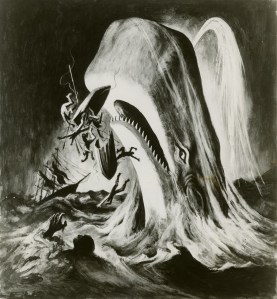
In Melville’s Moby Dick, the whaling ship Pequod crosses the equator on its quest for the White Whale, and in that instant, Captain Ahab smashes his quadrant to the deck and crushes it underfoot.
No more careful navigation. It is, we understand, Moby Dick or die.
As we hurtle toward the new debt-limit crisis, President Obama has done much the same. He says he won’t negotiate spending cuts with a gun to his head. He’s also said that he won’t invoke § 4 of the Fourteenth Amendment, with its provision that “the public debt of the United States . . . shall not be questioned,” to give him authority to continue borrowing once the debt limit has been reached. The Senate Democratic leadership Friday urged him to prepare to raise the ceiling unilaterally; so far, he has remained mum.
Yet Obama, to all appearances, is the calmest man in this overheated capital as the doomsday clock counts down toward a first-ever U.S. default, and the almost certain global depression that would follow.
We can only wait and see what will happen, but as Epps writes, in the end, the onus will be on Obama.
The moment may be coming when wishing and faith do not suffice. Those are the moments when presidents earn their pay. If that requires reversing course on the Fourteenth Amendment, so be it; if it impels a stupid coin trick, then so it does; and if it imposes a political cost on the president, then he must pay it.
After Ahab smashes the Pequod’s quadrant, second-mate Stubb muses to himself, “Well, well; I heard Ahab mutter, ‘Here some one thrusts these cards into these old hands of mine; swears that I must play by them, and no others.’ And damn me, Ahab, but thou actest right; live in the game, and die in it!”
And that’s just the debt ceiling. Obama will also have to deal with fights over the sequester and the federal budget.
Where’s the Beef?
Posted: December 13, 2012 Filed under: 2012 elections, Fiscal Cliff, U.S. Economy, U.S. Politics | Tags: Economists, fiscal cliff, Paul Krugman 54 Comments
Yup, Clara’s question is still germane.
I have a more earthy version of this having do to with lies and morons when I continue to watch the media cover the “fiscal cliff”. The coverage is singularly lacking substance and Media Matters shows us why in a study that shows that “Economists – And Economics – Absent From Media Coverage Of Debt Debate”. Journalists continue to bring politicians in to discuss the politics of the fiscal cliff in a complete vacuum of facts, data, economic theory, and reality or economic perspective. Why are economists absent from the discussion?
A Media Matters study found that economists have been strangely absent from discussions on budget negotiations, following a typical pattern of the media’s inability to host experts to discuss complex issues. This lack of expert analysis has steered the debate toward politics and away from core economic concerns.
In a recently published study of news segments discussing current budget negotiations, Media Matters found that the presence of economists was sorely lacking – out of 503 total guests in the 337 segments analyzed, only 22 were economists. The lack of appearances by economists is spread across all networks …
I’ve watched a lot of the coverage and there are a lot of things coming out of the mouths of people making these decisions that would never come out of the mouth of an economist whatever their voter affiliation. But let me start with one thing that strikes me as really, really, really obscene. The Republican mantra of “Increased Taxes Kill Jobs” is old school Keynes. I mean REAL old school Keynesian economics because the old Keynes model shows us that increasing taxes or decreasing government spending is contractionary fiscal policy. So, why hasn’t any moderator of bloviating pols mentioned this or asked about this as Republicans rant on about the evilness of Keynesian economics?
NeoKeynesians have discovered a lot about the subtleties of the impact of changes in tax rates or government spending since that first bit of insight came from the Keynesian models back in the day. Those subtleties are present in the studies you read that show that changing tax rates for the rich has a different impact that changing tax rates for others. It also has been determined that some government spending is more effective in a variety of ways than others. However, the point remains. That Republican talking point is actually quite old school Keynesian so why doesn’t one Media person ask them why they hate Keynes and say that continually? Is it because they’ve bought into the idea that tax cuts only should be discussed in terms of the republicans adherence to the dismissed Laffer Curve and hypothesis? Where are the economists that can actually ask these questions? There’s plenty of us out there writing, tweeting, blogging, and facebooking? Why not ask one of us?
Previous studies by Media Matters have noted that the lack of economists’ input helps spread conservative misinformation, leaving a substantial impact on public opinion. The most recent study, however, shows that keeping economists out of the debate also eliminates any discussion of economic issues.
One such issue is the so-called “fiscal cliff,” a combination of automatic tax hikes and spending cuts that, according to the Congressional Budget Office, could plunge the U.S. economy into recession in 2013.
However, of the 337 segments analyzed, 209 — 62 percent — failed to address the macroeconomic implications of either tax increases or spending cuts. While some microeconomic issues were discussed (such as the potential impact on healthcare costs), most of the segments were focused on largely non-economic issues, such as political leverage in negotiations, the Grover Norquist pledge, or concessions made by the two parties.
Meanwhile, economists have not been silent on the economic consequences of current budget negotiations. A recent International Monetary Fund study found that for every dollar decrease in government spending, the U.S. would experience as much as a $1.80 decrease in output. Conversely, the Congressional Budget Office noted that if Bush-era tax rates expired for high-income earners, negative effects on economic output would be negligible.
Given the fact that cutting spending and raising taxes are both large components of the so-called “fiscal cliff,” highlighting these findings when discussing budget negotiations would help inform viewers of the real economic stakes. Instead, the media have taken the economics out of a largely economic issue.
Not even Greg Mankiw would risk his reputation in the academic community spreading the lies that get put out there about the economy by Republican Politicians. Chief among the lies are the kinda crap we saw coming from the Republicans. There are all these completely untrue economic lies running around out there. It’s all surrounding ideological things the Republicans are still trying to accomplish. Social Security has nothing to do with the Federal deficit. It’s not going bankrupt. Raising the age of social security and medicare does not solve any economic problems and does not save money. It just costs shifts things to different programs and sectors of government. Higher marginal tax rates on the rich does not kill jobs. Lower marginal tax rates on the rich does not create jobs. Special tax treatment for speculative investment behavior destabilizes financial markets. Regulation of Financial Markets improves their outcomes. There is not a structural deficit problem. There is a cyclical problem that would be solved if real stimulus of the economy occurred. I could go on and on and on and have written extensively on this citing study after study and economic expert after economic expert.
Nobel prize winning Paul Krugman’s facts get attacked as polemics by a political operative on Sunday TV. This is the reality of our public discussion on the most important issues of our time. Krugman is frequently out there on his own. He’s always trying to argue from a fact based, scientific method based, reality gets to argue with pols. Why can’t the media bring on more economists and let us see a real discussion of facts and theories? We have so much obvious data sitting right in front of us. The UK’s recession is a great example. The UK with its conservatives and austerity package has the worst economy in the west right now. It’s due to those policies the Republicans want to enact here being enacted by Tories there. Both Europe and the US are in much better situations–albeit still stale because of the lack of true fiscal stimulus–because they’ve not completely done the austerity thing. He points out that Ben Bernanke and the overly conservative Fed appears to be the only grown up institution in the beltway these days.
Along with its new policy pronouncement, the Fed released its economic projections (pdf). What struck me is that the Fed expects the unemployment rate to be well above its long-run level even in the fourth quarter of 2015, which is as far as its projections go.
This means that the Fed is projecting elevated unemployment nine full years after the Great Recession started. And, of course, the Fed has been consistently over-optimistic.
This is an awesome failure of policy — not solely at the Fed, of course.When I wax caustic about Very Serious People, bear this in mind. Faced with an economic crisis where textbook macroeconomics told us exactly how to respond, people of influence chose instead to obsess over budget deficits and generally punt on employment; and the result has been a huge economic and human disaster.
So much of this is disheartening to me. However, the most disheartening thing is waking up every day for the last 4 years or so realizing that an entire political organization–one of the two in our duopoly–doesn’t care about anything but getting its way. Every day it becomes more obvious that Republicans are not about our country, our country’s economy, or our people. That kind of psychopathy should be punished severely. Over and over they’ve shown they will absolutely tank our economy for their donor base.
But, again, how will the majority of people know this if they’re only allowed political discussion that continually presents lies, ideology, and out and out crap as an ‘alternative’ viewpoint?
Monday Reads
Posted: December 10, 2012 Filed under: morning reads | Tags: Big Media Consolidation, Hillary Clinton 2016, Paris Caverns and catacombs, Paul Krugman, Robber Barons 22 Comments Good Morning!
I’ve got some interesting things for you to watch and read today. The first is a show with Bill Moyers on Big Media’s Power Play. It includes comments by Senator Bernie Sanders and a former Republican Congressman of the old school sort’ve conserative who thinks today’s Republican party is not “rational” or “adult”.
In 1983, 50 corporations controlled a majority of American media. Now that number is six. And Big Media may get even bigger, thanks to the FCC’s consideration of ending a rule preventing companies from owning a newspaper and radio and TV stations in the same city. Such a move — which they’ve tried in 2003 and 2007 as well –would give these massive media companies free rein to devour more of the competition, control the public message, and also limit diversity across the media landscape. Bernie Sanders, one of several Senators who have written FCC Chairman Julius Genachowski asking him to suspend the plan, discusses with Bill why Big Media is a threat to democracy, and what citizens can do to fight back.
Also on the show, Bill is joined by former Republican Congressman Mickey Edwards, a founding father of modern conservative politics who now fears the movement has abandoned its principles. Edwards explains why both political parties require radical change, and shares his perspective on Grover Norquist and anti-tax pledges. “It’s not conservatism, not rational, not adult,” Edwards tells Bill. ” It’s a 12-year-old’s kind of thinking.” Edwards chaired the Republican Policy Committee, was a founding trustee of the conservative Heritage Foundation, and served as National Chairman of the American Conservative Union.
The next suggestion is an article and series of pictures call “Going Souterrain” from The Economist in its December Intelligent Life Feature. The article provides a narrative of a repeat adventure into the massive caverns, catacombs, and basements of old Paris.
SOME YEARS AGO, I sat on a stone-cut bench in a dark chamber in the catacombs of Paris wearing a headlamp and muddied boots, and listened to the strange story of Félix Nadar, the first man to photograph the underground of Paris. In 1861, Nadar invented a battery-operated flash lamp, one of the first artificial lights in the history of photography, and promptly brought his camera into Paris’s sewers and catacombs. Over three months, Nadar—41, moustachioed, with unruly red hair—shot in the darkness beneath the streets. He used 18-minute exposures and, as models, wooden mannequins dressed in the garb of city workers. On the surface, the images of dim, claustrophobic passageways created a stir. Parisians had heard of the vast subterranean networks underlying their streets and Nadar brought this dark lattice to light. The pictures opened up Paris’s relationship to its subterranean spaces—catacombs and crypts, sewers and canals, reservoirs and utility tunnels—a connection which, over the years, has grown deeper and more peculiar than in any other city.
Now, a century and a half behind Nadar, I am back in Paris with a group of urban explorers. Our aim is to examine the city’s connection to its underground in a way no one has before: we will attempt to walk from the southern edge to the northern, using only catacombs, telecom tunnels, sewers and other hidden infrastructure. It is a 14-mile trek, every step illegal. The six of us—five Americans and an Australian—are prepared for a two- or three-day journey, with nights sleeping in the bowels of Paris. We have packed food, sleeping bags, an arsenal of flashlights and headlamps, and gas meters to alert us to any poisonous fumes in the sewers. It will be urban troglodytism, a walkabout in the wilderness under the city.

Hillary Clinton’s presidential aspects have never looked better but is she willing to take it on again? There was speculation from James Carville on ABC’s Sunday Show and a big article in the NYT. First off , Carville’s take on the how popular the SOS with Democrats.
With Clinton’s popularity across the board surging in the four years after her first run for the presidency, Carville says that the consensus among Democrats is that Hillary Clinton would give the party its best chance to win.
“I don’t know what she’s going to do, but I do know this: The Democrats want her to run. And I don’t just mean a lot of Democrats. I mean a whole lot of Democrats, like 90 percent across the country,” Carville said. “We just want to win. We think she’s the best person and shut it down. And that’s across the board.”
But Republican political adviser – and Carville’s wife- Mary Matalin said it’s unlikely the Secretary of State would be able to clear the field.
“I wish she would run. But it defies human nature to think that Democrats, even though they are redistributionist and utopians, would not be competitive, that [Virginia Senator Mark] Warner or all these other Democrats who’ve been waiting in the wings are going to have a dynasty, since Democrats are always complaining about these dynasties, they’re going to have another Clinton step up, and everyone’s going to go, yeah, step back? I don’t think so,” Matalin said.
Jodi Cantor’s take at the NYT is a bit more studied.
Ann Lewis, a longtime adviser, echoed that. “In the last four years, she has seen firsthand the difference she can make for women and girls,” she said.
But even if Mrs. Clinton returns full time to her activist feminist roots, it is not yet clear exactly where she would begin: the topic is diffuse by its very nature. Nor is a campaign for, say, safer cookstoves in China the obvious way to win over voters in Iowa — and her work could touch on issues, including reproductive health, that could prove sensitive.
But former aides say that Mrs. Clinton drew a lesson from her 2008 run: she believes that the country approves of her, and of female candidates in general, when they appear to be serving others rather than seeking power out of personal ambition. By that logic, Mrs. Clinton’s interest in helping poor women around the world would not hurt her politically in 2016 and might add to her current politician-above-politics luster.
Her former aides also agree that she was too cautious in the early months of her last campaign and hurt herself by hiding her real passions. Regardless of whether she runs, telling Mrs. Clinton not to focus on women would be like “telling Al Gore not to talk about the environment,” said Paul Begala, a longtime adviser to Mr. Clinton. (Mr. Gore did not always emphasize his knowledge on the subject in 2000, which later looked unwise.)
Today is Human Rights Day all over the world.
Sixty-four years ago today, on December 10, 1948, the world came together to adopt the Universal Declaration of Human Rights (UDHR). In the UDHR, the United States and governments from around the globe recognized that human beings are, by virtue of their birth, endowed with certain inalienable rights, and that these serve as “the foundation of freedom, justice, and peace in the world.” Today, we affirm this commitment and look to the Universal Declaration not just as a reminder of values, but as a guide for action.
Last Thursday in Dublin, Secretary Clinton emphasized the important role that human rights has played and will continue to play in our foreign policy. As she said, “Human rights cannot be disconnected from other priorities. They are inextricably linked with all of the goals we strive for in our countries and around the world.” Regardless of gender, race, religion, nationality, sexual orientation, or physical or mental disability, all people deserve the freedom to pursue happiness and fulfillment, to speak openly, to come together with others and organize peacefully, to believe and worship as they see fit, and to participate fully in the public life of society with confidence in the rule of law. In upholding and advancing these freedoms, we live up to our values, we honor our international commitments, and we create an environment for every individual to reach their full potential.
Paul Krugman writes today of the robber barons and stealing resources from our country. Corporate profits have never been higher but more people in the US are falling out of the middle class and into financial trouble. Krugman continues to discuss the problem of income inequality and plutocratic piracy. He also discusses the increased role of technology in modern business. What role do all of these things have in collapsing the income of the American Worker?
What about robber barons? We don’t talk much about monopoly power these days; antitrust enforcement largely collapsed during the Reagan years and has never really recovered. Yet Barry Lynn and Phillip Longman of the New America Foundation argue, persuasively in my view, that increasing business concentration could be an important factor in stagnating demand for labor, as corporations use their growing monopoly power to raise prices without passing the gains on to their employees.
I don’t know how much of the devaluation of labor either technology or monopoly explains, in part because there has been so little discussion of what’s going on. I think it’s fair to say that the shift of income from labor to capital has not yet made it into our national discourse.
Yet that shift is happening — and it has major implications. For example, there is a big, lavishly financed push to reduce corporate tax rates; is this really what we want to be doing at a time when profits are surging at workers’ expense? Or what about the push to reduce or eliminate inheritance taxes; if we’re moving back to a world in which financial capital, not skill or education, determines income, do we really want to make it even easier to inherit wealth?
So, there are some things to think on today.
What’s on your reading and blogging list?
The Republicans Just won’t Trade in their Fairy Tales
Posted: November 11, 2012 Filed under: Economy, just because | Tags: fiscal cliff, joseph stiglitz, Mark Thoma, Paul Krugman, Trickle Down Economics, voodoo economics 23 CommentsThere’s a notable absence of economists on panels in the mainstream media that discuss the fiscal “ramp”. I’m refusing to call it a fiscal cliff because that’s a misnomer. I’m not sure why they won’t put research economists on these panels. Perhaps they think we’re not  photogenic or–despite the fact that a lot of us teach–we can’t explain ourselves. There’s an extremely strong consensus in the economics community on the s0-called budget crisis. Dragging out mainstream economists like Paul Krugman and Joseph Stiglitz and labeling them lefties because of their political leanings is rather disingenuous. It stops them from getting on panels where they could actually explain to people what’s what.
The corporate press would rather haul out a few journalists with real background in the field. There’s a difference between asking a journalist, a lawyer, or some self-anointed policy expert a question on economic theory. First, asking an economist to answer a question as an economist means they’ll stick to the theory and the empirical findings. Second, you can actually pull in almost any economist either trained after about 1980 or who has kept up with the dynamic business cycle models, the empirical findings, and theories and you won’t get much disagreement. You wouldn’t know that if you listen to the press, which seems to be made up a few folks with MBAs who have very little understanding of theory, models, or findings.
Deficit hawks tend be either Wall Street types, lawyers, or partisan right wing politicians. The folks that are screaming worst about dropping the tax cuts for the uber rich tend to have the most to lose personally and the least to lose professionally. Study-after-study-after-study shows that tax cuts to the middle, working, and lower classes and to young people tend to create completely different circumstances than they do for older people and the rich. First, there’s more folks in the first group. Second, they tend to spend a lot more of their current income. Third, their savings and investment opportunities are limited, so the assets they use stay in the country. None of this applies to the uber rich who tend to create jobs and wealth overseas these days and work hard to avoid taxes anyway. We’d do well to just simply let go of the idea that increasing the tax rates on the rich will either lead to unemployment, won’t pay down the deficit, or will suppress growth. These are tales of sound and fury signifying nothing but personal greed.
It is true that we are not on a sustainable spending path. This is because of the direct actions of the Bush administration. They lowered tax rates. Ran two huge wars with no tax increases. They oversaw and created two recessions. They created an asset bubble and then popped it. Growth, employment, and the value of taxable assets all decreased because of their actions. We simply have to reverse their trajectory. We have to do some work on Medicare and we need to walk away from the decaying, rotting corpse of Zombie Economics. The Republicans still won’t let that rotting corpse go.
Krugman talks about some of this on his blog in a post called “Squirming Hawks”. Paul Krugman may be a liberal but he’s certainly not going to risk his reputation in the economics community to spout crackpot hypothesis. Look at what happened to Arthur Laffer whose basically been expunged from any serious text, publishing deal, or institution. When you push crackpot hypotheses that do not stand up to empirical testing and you do not give them up and move on, the community of those who base their research on the scientific method will write you off. Those that follow Hayek and Von Mises have been similarly written off. Their ideological hypotheses do not stand up to any empirical testing.
Now, there’s a straightforward argument for why the fiscal cliff is bad but long-term deficit reduction is good — namely, that you really don’t want to cut deficits when the economy is depressed and you’re in a liquidity trap, so that monetary expansion can’t offset fiscal contraction. As Keynes said, the boom, not the slump, is the time for austerity. But the deficit hawks can’t make that argument, because they have in fact been arguing for austerity now now now.
So they’re left making a mostly incoherent case: it’s too abrupt (why?), it’s the wrong kind of deficit reduction (???), and then this:
a better approach would be to focus spending cuts on low-priority spending and on changes which can help to encourage growth and generate new revenue through comprehensive tax reform which broadens the base – ideally by enough to also lower tax rates.
Low-priority spending? I think that means spending on poor people and the middle class. And isn’t it amazing how people who claim to be horrified, horrified about deficits can’t stop talking about cutting tax rates?
Meanwhile, the CRFB features on its home page an op-ed by Jim Jones declaring that
We are perilously close to trillion-dollar yearly interest payments, 7 percent yields on 10-year U.S. Treasury bonds, 10 percent home mortgage rates and 13 percent rates on car loans. For the good of the country, the parties must come together and not let this happen.
How does he know that we are “perilously close” to this outcome? Not from the markets; not from any kind of economic model. My guess is that Peggy Noonan told him.
Scaring people with large numbers that are not grounded to other large numbers is a mean and terrible thing to do. We have a huge tax base. We have more than enough ability to continue to borrow at low interest rates. We have the ability to print money. We have all kinds of options. We have a huge economy that is showing signs of coming out of a lot of trauma. We should get a double peace dividend shortly. These things point to a very good reason not to be crazy-go-nuts like the Europeans and fall on the austerity sword.
I think that Mark Thoma has some interesting things to add to this conversation. He asks rhetorically and then answers: Hasn’t Paul Krugman Heard about the Magic of Tax Cuts and Supply-Side Economics? No, and for Good Reason…
I guess Paul Krugman hasn’t heard about the magic of tax cuts and supply-side economics. Well, Cato-at-Liberty has, and it’s ticked at the CBO because “it assumes higher tax rates generate more money” when making budget projections. That’s right, despite all the evidence against the claim that tax cuts actually increased revenue — it’s a myth that won’t die because people who know better, or ought to, still promote it — we should discredit the CBO for making the claim that higher tax rates would help with the budget problem.
And that’s not all. The CBO should be further discredited because it says the stimulus package helped to ease the recession:
The CBO repeatedly claimed that Obama’s faux stimulus would boost growth. Heck, CBO even claimed Obama’s spending binge was successful after the fact, even though it was followed by record levels of unemployment.
I’ll pass over the “record levels of unemployment’ claim (but note that unemployment peaked at 10.0% in October 2009, but was 10.8% at the end of 1982, at best this is playing games with the word “levels” and ignoring population growth — and if duration is the argument, as Reinhart and Rogoff recently noted, conditional on the type of recession this recovery is actually a bit better than most).
On the main claim about fiscal policy, there’s plenty of emerging evidence supporting the contention that fiscal policy helped to ease the recession (and remember how much of the stimulus package was tax cuts — it’s amusing to listen to conservatives tell us how useless the tax cuts they fought for as part of the stimulus package turned out to be, especially when in the next breath they argue for more tax cuts). The CBO is dealing in actual evidence, the claims made by Cato-at-Liberty are backed by nothing more than the Republican noise machine that is so good at misleading followers.
Republicans just can’t help themselves from attacking anyone and anything that is inconvenient to their goals, and actual evidence has little to do with it. Apparently, they learned nothing from the election. This is part of a larger effort to discredit the CBO because it doesn’t agree with Republican views on the magic of tax cuts, and for other results the non-partisan agency has come up with that Republicans don’t want to hear (so they basically cover their ears and ignore them).
The Republicans aren’t the only ones doing this. I watch about 5 minutes of an Ali Velshi panel that really horrified me. No one there directly took on Stephen Moore of the WSJ on that same damn fairy tale about job creators and tax rates on the rich. Why doesn’t any one mention that his assertions have no basis in reality, theory, or empirical evidence and have been thoroughly trounced? Better yet, why is some one who spouts propaganda even on a news program that supposedly informs people about economics, finance, and policy? There was one truly knowledgeable person on the panel. The rest of them should have asked questions then listened to Mohamed A. El-Erian. Again, Stephen Moore should only be placed on panels where fairy tales are involved. His degrees in economics are obviously stale. Plus, he works with Laffer whose been laughed out of any organization that contains serious economists. He’s basically a tool of the plutocracy.
Fortunately, it looks like the Senate Democrats are having none of this.
Sen. Patty Murray (D-Wash.) on Sunday said Democrats were prepared to allow the expiration of all George W. Bush-era tax rates if Republican lawmakers objected to raising taxes on the wealthiest.
“We can’t accept an unfair deal that piles on the middle class and tell them they have to support it. We have to make sure that the wealthiest Americans pay their fair share,” said Murray on ABC”s “This Week.”
Murray said one option would be to let the lower rates expire across-the-board and then return to the table next year with new talks on a tax-cut package.
“So if the Republicans will not agree with that, we will reach a point at the end of this year where all the tax cuts expire and we’ll start over next year. And whatever we do will be a tax cut for whatever package we put together. That may be the way to get past this,” said Murray.
The Washington senator is likely to become chairwoman of the Senate Budget Committee and previously served on the congressional “supercommitee,” which failed to finalize a deficit-reduction plan, which may trigger sequestration cuts in January 2013.
The evidence points to the recessionary impact of tax cuts on the middle class. There is nothing that shows allowing the Bush Tax cuts to expire will do the same. Republicans keep suppressing the evidence.
In particular, the CBO gave its most detailed look at how the expiration of the Bush-era tax cuts would affect the economy. Apparently, it would do little harm, the numbers show.
Just like the damn things did little good for the economy and most of us, letting them die would do little harm. I hope the Dems just hold to the facts and that the election has given them some resolve to do the people’s business.

 peej
peej Carissa
 bostonboomer
 dakinikat
 ecocatwoman
 mablue2
 Mama Lopez
 peggysue22
 quixote
 skydancingguestblogger
 Mona (aka Wonk the Vote)



 Sky Dancing
Recent Comments