
Some juicy gossip about Rep. Paul Ryan and his drinking buddies
Posted: July 10, 2011 Filed under: Corporate Crime, Economy, Psychopaths in charge, Republican politics, the villagers, U.S. Economy, U.S. Politics | Tags: AQR Capital, Barack Obama, Bistro Bis, Brad De Long, Clifford Asness, Elizabeth Fama, Eugene Fama, freshwater economists, Goldman Sachs, hedge fund managers, Jayer-Gilles 2004 Echezeaux Grand Cru, John Cochrane, Paul Krugman, Paul Ryan, Susan Feinberg, Talking Points Memo, University of Chicago, wine 12 Comments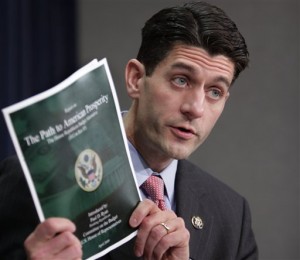
Paul Ryan hawking his plan to throw grandma from the train
You may have seen this gossipy story about Rep. Paul Ryan at Talking Points Memo on Friday. I’ve been meaning to post something about it but just haven’t found the time. Now TPM has a very interesting update. Here’s the background:
Rep. Paul Ryan (R-WI), a leading advocate of shrinking entitlement spending and the architect of the plan to privatize Medicare, spent Wednesday evening sipping $350 wine with two like-minded conservative economists at the swanky Capitol Hill eatery Bistro Bis.
[….]
Susan Feinberg, an associate business professor at Rutgers, was at Bistro Bis celebrating her birthday with her husband that night. When she saw the label on the bottle of Jayer-Gilles 2004 Echezeaux Grand Cru Ryan’s table had ordered, she quickly looked it up on the wine list and saw that it sold for an eye-popping $350, the most expensive wine in the house along with one other with the same pricetag.
Feinberg, an economist by training, was even more appalled when the table ordered a second bottle. She quickly did the math and figured out that the $700 in wine the trio consumed over the course of 90 minutes amounted to more than the entire weekly income of a couple making minimum wage.
Feinberg took some photos with her cell phone, approached the table and asked whether the two men with Ryan were lobbyists. One of the men responded by saying, “F&ck her.” Ryan claimed the two men were economists but refused to provide their names. Ryan then paid for one of the bottles of wine, but when asked about the appropriateness of spending so much when he was going all Dickensian on old people, Ryan avoided answering.
Today, TPM learned the identity of the two men who wined and dined Ryan on Friday night.
TPM has confirmed that the two other men with Ryan were Cliff Asness and John Cochrane. Both men have doctorate degrees in economics and are well-known in the conservative media world as die-hard proponents of the free market’s ability to right itself without government bailouts when the crisis hit in late 2008.
Asness, who ordered the wine and who, according to Feinberg was the one who said “Fuck her,” is better known as a high-profile hedge fund manager. Asness founded and runs AQR Capital, which manages an estimated $26 billion in a variety of traditional products and hedge funds, and his life story has been the subject of numerous books and articles about the rise and fall of Wall Street. He’s also grabbed headlines for being one of the most voluble opponents of President Obama’s economic policies.
[….]
Cochrane, the other, more tempered dinner companion, is the AQR Capital Management Distinguished Service Professor of Finance at the University of Chicago, an apparent tip of the hat to the contributions Asness’ AQR Capital Management has made to the Booth School of Business there.
Before launching AQR Capital in 1997, Asness worked for Goldman Sachs, the most profitable securities firm in Wall Street history, as the director of quantitative research for its Asset Management Division.
Via TPM, in 2009, Asness wrote an open letter to Barack Obama in which he (Asness) complained bitterly about some mildly critical remarks the President had made about hedge fund managers who refused to help out by buying Chrysler bonds. From New York Magazine:
Clifford Asness, the filthy-stinking-rich quant behind AQR Capital Management, [is] publicly engaging with a formidable opponent: The president of the United States. Asness, who supported Obama during the election, was appalled by Obama’s treatment of his colleagues during the Chrysler situation, and although he was not personally involved, he felt he had to make a stand.
Here is a portion of the letter:
Here’s a shock. When hedge funds, pension funds, mutual funds, and individuals, including very sweet grandmothers, lend their money they expect to get it back. However, they know, or should know, they take the risk of not being paid back. But if such a bad event happens it usually does not result in a complete loss. A firm in bankruptcy still has assets. It’s not always a pretty process. Bankruptcy court is about figuring out how to most fairly divvy up the remaining assets based on who is owed what and whose contracts come first. The process already has built-in partial protections for employees and pensions, and can set lenders’ contracts aside in order to help the company survive, all of which are the rules of the game lenders know before they lend. But, without this recovery process nobody would lend to risky borrowers. Essentially, lenders accept less than shareholders (means bonds return less than stocks) in good times only because they get more than shareholders in bad times.
The above is how it works in America, or how it’s supposed to work. The President and his team sought to avoid having Chrysler go through this process, proposing their own plan for re-organizing the company and partially paying off Chrysler’s creditors. Some bond holders thought this plan unfair. Specifically, they thought it unfairly favored the United Auto Workers, and unfairly paid bondholders less than they would get in bankruptcy court. So, they said no to the plan and decided, as is their right, to take their chances in the bankruptcy process. But, as his quotes above show, the President thought they were being unpatriotic or worse.
Well, Duh! But if “filthy, stinking rich” guys like Asness were patriotic, we probably wouldn’t have had a financial meltdown in the first place, now would we?
The other guy with Ryan on Friday, Professor John Cochrane of the University of Chicago, is a freshwater economist and follower of Eugene Fama AKA “the father of modern finance,” and Robert R. McCormick Distinguished Service Professor of Finance a the University of Chicago. Cochrane is also married to Fama’s daughter Elizabeth.
In early 2009, Cochane and Nobel Prize-winning economist Paul Krugman engaged in a legendary on-line debate that also involved Brad De Long and Eugene Fama. The whole thing was too wonky for me, but I gather it had something to do with Fama and Cochrane critiquing the use of fiscal stimulus and Krugman saying that the two freshwater economists wanted to return to the “Dark Ages of macroeconomics.” Here’s Krugman’s introductory paragraph:
Brad DeLong is upset about the stuff coming out of Chicago these days — and understandably so. First Eugene Fama, now John Cochrane, have made the claim that debt-financed government spending necessarily crowds out an equal amount of private spending, even if the economy is depressed — and they claim this not as an empirical result, not as the prediction of some model, but as the ineluctable implication of an accounting identity.
Maybe Daknikat can explain what the “cage match” was all about.
I think Paul Ryan is going to need to be a little more careful in the future if he is going to continue promoting the end of Medicare as we know it.
Sign me up for the Hippie Caucus
Posted: July 2, 2011 Filed under: Economy | Tags: austerity, Brad Delong, Economists v Politicians and Journalists, Larry Summers, Laura Tyson, Martin Wolf, Martin Wolfe, Paul Krugman, Peter Orzag, stimulus 17 Comments
melting magic mushrooms by spookychild
If you’re like me, you’ll get a big laugh out of Brad DeLong’s on-going tongue and cheek label of pretty much every economist as being a member of the “hippie caucus” simply for giving the MSM a lesson on economic theory. It’s not exactly the most complex model or theory that drives the idea that you deficit spend during a tough economy to create jobs and stimulate business. Every first year macroeconomic principles students learns that. My guess is that most of congress and the President never got that far.
So, here’s a list of Brad’s Hippie Caucus and the statements based on simple economic theory that puts them into membership. These are some big name economists basically saying what I’ve been saying for a few years now. The deficit is a long term problem. The immediate problem is business’ lack of customers. It’s an aggregate demand thing and increased government spending is the obvious policy remedy.
The first member is Laura Tyson who I’d really like to see as Treasury Secretary or head of the CEA again. She served under Bill Clinton. You remember Bill Clinton? He’s the one that had the best job creation record of any modern president.
But the overwhelming evidence suggests the opposite: when the economy has excess capacity, high unemployment and weak private demand, cuts in government spending reduce growth and eliminate jobs.
On this point, there is widespread agreement among experts. Ben Bernanke, chairman of the Federal Reserve, recently warned that sudden fiscal contraction might put the still fragile recovery at risk. The June report from the C.B.O. contains a similar warning. Even William Gross of Pimco, a vocal critic of the long-term fiscal position of the government, cautions that a move toward fiscal balance, if implemented too quickly, could “stultify economic growth.”
As Simon Johnson noted in his recent Economix post, fiscal contractions are expansionary only under special conditions. None of these apply to the United States today.
So what should policy makers do? They should pair fiscal measures aimed at job creation now with a credible plan to reduce the deficit gradually –- and pass both at once, as a package. Approving a deficit-reduction plan but deferring its starting date until the economy is near full employment will cut the odds that immediate contraction will tip the faltering economy back into recession.
Indeed, passage of such a package could bolster growth by easing investor concerns about future deficits, reducing long-term interest rates and strengthening consumer and business confidence.
The next member is Larry Summers. You remember him, he’s the one we thought the President may have actually listened to when doing his economic policy thing? Well, I’ve apologized for thinking Summers turned his back on his credentials and I’m having to eat my words again.
SUMMERS: I worry about a number of things with respect to growth. Most profoundly I worry about lack of demand in the United States. That means that factory capacity is unused, it means that buildings sit empty, it means that too many people are unemployed. And I look for measure that will serve to promote the level of demand in the United States. That’s why using this moment to repair our infrastructure is so important. That’s why I believe that the payroll tax cuts that put money in people’s pockets and increased employers incentives to hire are so important. And that’s why I believe that opening foreign markets and promoting U.S. exports which creates more demand is so important. And China is obviously an important part of that story.
So we already know that Paul Krugman is in the Hippie Caucus, but here’s an addition via Krugman. Traxis Partners Hedge Fund multimillionaire Barton Biggs is saying the same thing. Surprisingly enough, this comes from the WSJ whose editors have drunk enough Grover Norquist koolaid to be dead heads.
The U.S. and Europe are set to grow at an anemic pace for the foreseeable future unless the government can step in with an enormous fiscal stimulus, according to a veteran investor.
Speaking exclusively with The Wall Street Journal, Barton Biggs, managing partner at multibillion dollar hedge fund Traxis Partners, painted a bleak outlook for the developed world with only huge government intervention likely to improve things.
…
Mr. Biggs, former chief global strategist for U.S. investment banking powerhouse Morgan Stanley, demanded the U.S. government temporarily return to ideas used in the Great Depression as a way to get the country back to higher growth.
“What the U.S. really needs is a massive infrastructure program … similar to the WPA back in the 1930s,” he says.
The plan would be to employ some of the many unemployed people, jump start the economy, as well as help catch up with Asia, which is building state-of-the-art infrastructure from new mechanized port facilities to high-speed trains.
He suggested financing such building through the sale of U.S. Treasuries.
Okay, so Mark Thoma’s on the list too. No surprise there either. However, this comment is not on his blog Economist’s View, it’s at the FT.
I disagree with them that immediate austerity is needed. The long-term budget problem in the US is driven mainly by rising health costs, and we have many years to go before this begins to create big budget problems. Thus waiting, say, two years to begin reducing the deficit will not substantially change the probability of big problems down the road. But delaying austerity measures avoids placing a further drag on an already struggling economy, so the likely benefits are relatively large.
One of the arguments for austerity is that it would give the Federal Reserve “increased room for manoeuvre to adopt further quantitative easing if the economy weakens further”. I agree that the Fed fears being placed in the position of appearing to monetise the debt, but again I do not think immediate action is needed. A budget plan that both political parties can agree to, which is implimented only when the economy is stronger, would do a lot to give the Fed the confidence it needs to act.
Here’s a member of the Hippie Caucus from across the Pond. That would be no other than the FT’s Martin Wolfe. He sums it up nicely by saying “enjoy the coming slump” but if you want to read the wonky way of saying it, here it is.
Few doubt there is excessive private sector debt in a number of high-income countries. But how is it to be reduced? The BIS notes four answers: repayment; default; higher real incomes; and inflation. Let us rule out the last and focus on the first. Repayment means spending less than one’s income. That is what is happening in the US private sector (see chart). Households ran a financial deficit (an excess of spending over income) of 3.5 per cent of gross domestic product in the third quarter of 2005. This had shifted to a surplus of 3.3 per cent in the first quarter of 2011. The business sector is also running a modest surplus. Since the US has a current account deficit, the rest of the world is also, by definition, spending less than its income. Who is taking the opposite side? The answer is: the government. This is what a controlled depression means: every sector, other than the government, is seeking to strengthen its balance sheet at the same time.
Another former Obama adviser that’s in the Hippie Caucus and may join my list of people that most likely quit Obama because he wasn’t listening to any economists. That would be none other than former budget director Peter Orzag. You know I thought Christie Romer was a good one and was confused when she was supporting that weak ass stimulus. I’m now even wondering about Austin Goolsbee.
Today’s fiscal policy debate straddles two divides: one between those who support jobs and those who favor austerity, and one between those who think additional revenue is needed and those who don’t.
On the first divide, both sides are right, because the truth is that the U.S. needs both jobs and austerity — and a combination would be more powerful than either piece by itself. We face a very weak labor market now and, over the medium- and long-term, an unsustainable fiscal path. It would make sense to combine an additional round of temporary job creation measures with a substantial amount of permanent deficit reduction that would be enacted now but take effect later.
So, I’ve been blogging around here like my hair’s on fire pretty much since this financial crisis set in. I wrote the Obama stimulus was too little and too focused on tax cuts to appease the few Republicans resident in a then overwhelmingly Democratic Congress with a president with a mandate and political capital. I blogged that we didn’t need to extend the Bush tax cuts to millionaires and billionaires because they were the only ones that were recovering nicely. I blogged that the President should forget about health care reform and focus like a laser on the sour economic recovery. I also said that all that would do would give the Republicans more hot air come the negotiations for the debt ceiling increase. I’ve blogged repeatedly that businesses–no matter what the tax rates or the rate of interests–are not going to spend their money on capital or labor here in the US because they need customers first and foremost. I’ve also written extensively that all this cheap Fed money at the discount window and tax breaks for industry was likely to be used in places like Asia instead of here in the U.S. Brad DeLong has done an excellent job showing you that many, many top economists believe the same things. So, next time any one tells you that all economists are always caught off-guard, please remember all of this.
I truly believe that Republicans are trying to tank the economy and that Barack Obama is either tacitly or complicity or ignorantly going right down the garden path with them. Again, if you’ve got terminal cancer and need surgery to save your life do you call some one who has never gone to med school to operate on you? If you’re wrongly accused of murder and you need some one to argue that you’re innocent, do you want some one that’s never been to law school to represent you? Why or why do so many idiots in the press, in the congress, and in the White House think they know more about the economy and the financial markets than those of us that have spent our lives researching, studying, and doing it?
We should be rioting in the streets like the English and the Greeks. Instead,we’re acting like sheep to the slaughter. What our government is doing right now is actively working against the interests of its people. There are laws in place that require it to responsibly handle the economy and create jobs. They are doing the exact opposite of this. We need to get mad. Voting for idiots is not working.
Wonky Fed Post (hip waders advised)
Posted: April 29, 2011 Filed under: Economy | Tags: Ben Beranke, Brad Delong, Fedderal Reserve Bank, Mark Thoma, monetary policy, Monetary policy at the Zero Bound, Paul Krugman, quantitative easing 23 Comments The Fed’s been doing some pretty nontraditional things recently under Ben Bernanke. A lot of this was not unexpected given his record of academic research on the subject of the Fed trying to be more public about its actions and the role of Quantitative Easing in Japan’s lost decade recovery. I thought I’d put a few things up about both. I’m going to have to use some monetarist jibber jabber so please ask questions if the jargon is overwhelming! It’s easier to explain the jargon downthread than write a long run on post with explanations included.
The Roosevelt Institute held a Future of the Federal Reserve Event. Here’s video via RortyBomb of Joseph Stiglitz discussing QE2 among other Fed issues. I mentioned something yesterday down thread about the effectiveness of transmission of monetary policy through the traditional interest rate channel into the real economy and Stiglitz has a fairly succinct comment on that. There is some debate on how much the Fed can actually do much at this point–with zero bound interest rates–to get at unemployment and even the inflation coming from higher oil and food prices. We know it can happen, it’s just we don’t have empirical evidence under similar situations–other than from Japan–to know the degree to which stuff can happen right now. So it could be an infinitesimally positive effect even thought it’s a positive effect.
There’s been some discussion of this on economists’ blogs since the Bernanke Presser a few days ago. Mark Thoma tweeted this critique of both him and Brad Delong on the Bernanke Presser from a monetarist’s site from blogger economist Stephen Williamson. My first masters was in Monetary Economics so I’m well-steeped in monetarist theory.
In standard form, Mark Thoma’s heartgoes out to the unemployed, as mine does. However, Mark is much more certain than I am that the Fed can actually help these people out. Here is what Mark would have asked Ben about, if he could:
The main question I wanted to hear Bernanke answer is, given that inflation is expected to remain low, why isn’t the Fed doing more to help with the employment problem? Why not a third round of quantitative easing?
And:
In retrospect, more aggressive action by the Fed was warranted in every instance. Perhaps this time is different — I sure hope so — but the recovery has been far too slow to be tolerable. Green shoots require more than hope, they require the nourishment, and with fiscal policy out of the picture it’s up to the Fed to provide it.
Well, the answer to the question: “Why not a third round of quantitative easing?” should be: “Because it does not do anything.” (see here). In retrospect, the Fed could not have done any more than it did, even if you think that sticky wages and prices matter in a big way. Mark may think that the level of employment is intolerable, but the Fed has to tolerate it in the same way I have to tolerate the soggy weather outside.
I wanted to put this up before I linked to Krugman’s Op-Ed today which argues that Bernanke may be unduly influenced by inflationistas and Ron Paul, of all people called “The Intimidated Fed” and that he can do more. Because, I’m not so sure the FED can do much more or if it’s Ron Paul that’s the dragon needing slaying. First, I think it more like that Bernanke is being influenced by two Fed Presidents sitting on the Board of Governors right now than by Ron Paul. But, I’m not a DC or FED insider so it’s pure speculation on my part.
Some background: The Fed normally takes primary responsibility for short-term economic management, using its influence over interest rates to cool the economy when it’s running too hot, which raises the threat of inflation, and to heat it up when it’s running too cold, leading to high unemployment. And the Fed has more or less explicitly indicated what it considers a Goldilocks outcome, neither too hot nor too cold: inflation at 2 percent or a bit lower, unemployment at 5 percent or a bit higher.
But Goldilocks has left the building, and shows no sign of returning soon. The Fed’s latest forecasts, unveiled at that press conference, show low inflation and high unemployment for the foreseeable future.
True, the Fed expects inflation this year to run a bit above target, but Mr. Bernanke declared (and I agree) that we’re looking at a temporary bulge from higher raw material prices; measures of underlying inflation remain well below target, and the forecast sees inflation falling sharply next year and remaining low at least through 2013.
Meanwhile, as I’ve already pointed out, unemployment — although down from its 2009 peak — remains devastatingly high. And the Fed expects only slow improvement, with unemployment at the end of 2013 expected to still be around 7 percent.
It all adds up to a clear case for more action. Yet Mr. Bernanke indicated that he has done all he’s likely to do. Why?
Second, I’m not sure Bernanke (i.e. The FED) is in a very strong position to do much that can influence the real economy right now. The QE stuff really only shifts the FED portfolio around between long and short term debt which can influence yield curves, but, at the zero bound, there’s still a limited impact on real interest rates. You really can’t go lower than zero in nominal terms. Also, the FED’s bought all this crap from every one from Belgian cities to AIG to give them more liquidity and for the most part, that money’s not channeling back into the US economy in the forms of loans. Monetary policy is never very effective when an economy is in a liquidity trap (extremely low interest rates) and its transmission channel–the way the policy gets to the real economy where GDP lurks–morphs during various economic conditions. We’re not seeing anything resembling 20th century economic conditions.
TGIFriday Reads
Posted: March 25, 2011 Filed under: commercial banking, Corporate Crime, Economy, Egypt, financial institutions, Foreign Affairs, morning reads, U.S. Politics, unemployment, Women's Rights | Tags: austerity, budget, Federal deficits, Michelle Bachmann is nuts, Paul Krugman 16 Comments Good Morning!
There’s been quite a few economists weighing in on the debate going on in congress about the budget. Paul Krugman’s op-ed is on “The Austerity Delusion”. Krugman’s appalled that more policymakers aren’t concerned with the high rate of unemployment which is contributing to the deficit in several ways. First, it decreases tax revenues. Second, it increases state and federal expenditures. Solve the jobs problem and the deficit will decrease. He’s worried that all this austerity will just bring on another economic slowdown.
Why not slash deficits immediately? Because tax increases and cuts in government spending would depress economies further, worsening unemployment. And cutting spending in a deeply depressed economy is largely self-defeating even in purely fiscal terms: any savings achieved at the front end are partly offset by lower revenue, as the economy shrinks.
So jobs now, deficits later was and is the right strategy. Unfortunately, it’s a strategy that has been abandoned in the face of phantom risks and delusional hopes. On one side, we’re constantly told that if we don’t slash spending immediately we’ll end up just like Greece, unable to borrow except at exorbitant interest rates. On the other, we’re told not to worry about the impact of spending cuts on jobs because fiscal austerity will actually create jobs by raising confidence.
Politico features a series of Former CEA members who signed a letter of concern on the deficit and unsustainable US Budgets. Too bad that people like Greg Mankiw–advisor to Dubya–didn’t speak up when the spending problems were originated. They mostly trace to Reagan and Bush administrations. They all suggest using the Cat food commission report as the focus of discussions. Hang on to your social security, folks! It’s going to be a bumpy ride.
As former chairmen and chairwomen of the Council of Economic Advisers, who have served in Republican and Democratic administrations, we urge that the Bowles-Simpson report, “The Moment of Truth,” be the starting point of an active legislative process that involves intense negotiations between both parties.
There are many issues on which we don’t agree. Yet we find ourselves in remarkable unanimity about the long-run federal budget deficit: It is a severe threat that calls for serious and prompt attention.
While the actual deficit is likely to shrink over the next few years as the economy continues to recover, the aging of the baby-boom generation and rapidly rising health care costs are likely to create a large and growing gap between spending and revenues. These deficits will take a toll on private investment and economic growth. At some point, bond markets are likely to turn on the United States — leading to a crisis that could dwarf 2008.
“The Moment of Truth” documents that “the problem is real, and the solution will be painful.” It is tempting to act as if the long-run budget imbalance could be fixed by just cutting wasteful government spending or raising taxes on the wealthy. But the facts belie such easy answers.
I suppose you know the professional insane Republican Michelle Bachmann is forming an exploratory committee for a possible presidential run. I’d vote for any one’s dog before I’d consider Bachmann who doesn’t appear to have paid attention to any course she ever attended in school. I’ve never in my life heard any one outside of maybe a grade school that has such a bad grasp of American History, law, and politics. I think she should’ve just gotten a mail order degree. Education appears to have been wasted on her.
CNN has exclusively learned that Rep. Michele Bachmann will form a presidential exploratory committee. The Minnesota Republican plans to file papers for the committee in early June, with an announcement likely around that same time.
But a source close to the congresswoman said that Bachmann could form the exploratory committee even earlier than June so that she could participate in early Republican presidential debates.
“She’s been telling everyone early summer,” the source told CNN regarding Bachmann’s planned June filing and announcement. But the source said that nothing is static.
“If you [debate sponsors] come to us and say, ‘To be in our debates, you have to have an exploratory committee,’ then we’ll say, ‘Okay, fine…I’ll go file the forms.'”
Speaking of Republicans, a former aide to Sen. John Ensign has just been indicted for violating conflict of interest laws.
The Justice Department announced the indictment late Thursday, which charges Doug Hampton with seven counts of violating criminal conflict of interest laws for allegedly engaging in unlawful communication with Ensign’s office, violating the Senate’s “revolving door” policy.
According to the indictment, after Hampton left Ensign’s office in 2008 he “knowingly and willfully made, with the intent to influence, communications to staff members of the U.S. senator” on behalf of an energy company he was employed by at the time.
Hampton is alleged to have sought the assistance of Ensign and other staff members for help in moving forward a proposal to build a power plant in eastern Nevada.
Hampton, if convicted, could face up to five years in prison for each of the seven counts in the indictment. He is set to be arraigned in U.S. District Court in Washington, D.C. on March 31.
Ensign is retiring. Probably because of all the scuttlebutt around his affairs and possibly what may come out of this prosecution. Maybe Tom Delay will have a new cell mate on the way.
Glenn Greenwald has written an excellent piece in Salon on withering Miranda rights under the Obama administration. You may want to check it out.
The number of instances in which Obama has violently breached his own alleged principles when it comes to the War on Terror and the rule of law are too numerous to chronicle in one place. Suffice to say, it is no longer provocative or controversial when someone like Yale Law Professor Jack Balkin writes, as he did the other day, that Obama “has more or less systematically adopted policies consistent with the second term of the George W. Bush Administration.” No rational person can argue that or even tries to any longer. It’s just a banal expression of indisputable fact.
Today, the Obama DOJ unveiled the latest — and one of the most significant — examples of its eagerness to assault the very legal values Obama vowed to protect. The Wall Street Journal reports that “new rules allow investigators to hold domestic-terror suspects longer than others without giving them a Miranda warning, significantly expanding exceptions to the instructions that have governed the handling of criminal suspects for more than four decades.” The only previous exception to the 45-year-old Miranda requirement that someone in custody be apprised of their rights occurred in 1984, when the Rehnquist-led right-wing faction of the Supreme Court allowed delay “only in cases of an imminent safety threat,” but these new rules promulgated by the Obama DOJ “give interrogators more latitude and flexibility to define what counts as an appropriate circumstance to waive Miranda rights.”
Just hope you never get classified as a terrorist or you’ll disappear down some rabbit hole. You should also read William Grieder over at The Nation on How Wall Street Crooks Get Out of Jail.
Instead of “Old Testament justice,” federal prosecutors seek “authentic cooperation” from corporations in trouble, urging them to come forward voluntarily and reveal their illegalities. In exchange, prosecutors will offer a deal. If companies pay the fine set by the prosecutor and submit to probationary terms for good behavior, perhaps an outside monitor, then government will defer prosecution indefinitely or even drop it entirely. The corporation thus avoids the stigma of a criminal trial and the bad headlines that depress stock prices. More to the point, the “deferred prosecution agreement,” as it’s called, allows the company to escape the more severe consequences of criminal conviction—the loss of banking and professional licenses, charters, deposit insurance or other government benefits, including eligibility for federal contracts and healthcare programs. In other words, the punishment prescribed in numerous laws.
“With cooperation by the corporation, the government may be able to reduce tangible losses, limit damage to reputation, and preserve assets for restitution,” the Justice Department’s authorizing memorandum explained in 2003. “A deferred prosecution or non-prosecution agreement can help restore the integrity of a company’s operations and preserve the financial viability of a corporation that has engaged in criminal conduct.”
The favored argument for the more conciliatory approach was that criminal indictment may amount to a death sentence for a corporation. The fallout will destroy it, and the economy will lose valuable productive capacity. The collateral consequences are unfair to employees who lose jobs and stockholders who lose wealth. Corporate defenders cited Arthur Andersen, the giant accounting firm that imploded after it was convicted in 2002 of multiple offenses in Enron’s collapse. But was it the firm’s indictment or its criminal behavior that caused clients, accountants and investors to abandon it?
A better name for the Justice Department’s softened policy might be “too big to prosecute.”
Wanna rob a bank? Don’t do it with a gun. Just become its President and do what you want to do.
Here’s a disturbing headline from Egypt (h/t to Minx):Secret shame of Egypt’s army: Women protesters were forced to have ‘virginity checks’ after being arrested in Tahrir Square,
Women arrested by the Egyptian police during protests in Cairo’s Tahrir Square were subjected to forced ‘virginity tests’, according to Amnesty International.
Eighteen demonstrators were detained after army officers cleared the square on March 9 at the end of weeks of protest.
Amnesty today said that the women had been beaten, given electric shocks and then subjected to strip searches while being photographed by male soldiers.
They were then given ‘virginity checks’ and threatened with prostitution charges if medics ruled they had had sex, according to the charity.
Just when you think things will get better, something comes along that just makes things look worse.
So, what’s on your reading and blogging list today?
Tuesday Reads
Posted: January 25, 2011 Filed under: morning reads, U.S. Economy, U.S. Politics | Tags: Anne M. Burke, artic fence, Colin Henderson, Dmitry Medvedev, Domodedovo Airport bombing, economics, Financial Crisis Inquiry Commission, fiscal policy, global warming, honeybee illness, Illinois Supreme Court, jet stream, nor'easter, Paul Krugman, Rahm Emanuel, war on demand, weather 42 Comments
Good Morning!! WTH is going on with the weather? When I got up yesterday, the temperature was -9 degrees! It got up to about 10 degrees during the day and back into the below zero numbers last night. On top of that, we have another nor’easter coming on Wednesday and Thursday. How much more of this can we take? Even southern states have been getting snow and cold this winter. Meanwhile, it’s way warmer than usual in the Arctic regions.
According to this article by Justin Gillis in The New York Times,
The immediate cause of the topsy-turvy weather is clear enough. A pattern of atmospheric circulation that tends to keep frigid air penned in the Arctic has weakened during the last two winters, allowing big tongues of cold air to descend far to the south, while masses of warmer air have moved north.
The deeper issue is whether this pattern is linked to the rapid changes that global warming is causing in the Arctic, particularly the drastic loss of sea ice. At least two prominent climate scientists have offered theories suggesting that it is. But others are doubtful, saying the recent events are unexceptional, or that more evidence over a longer period would be needed to establish a link.
Since satellites began tracking it in 1979, the ice on the Arctic Ocean’s surface in the bellwether month of September has declined by more than 30 percent. It is the most striking change in the terrain of the planet in recent decades, and a major question is whether it is starting to have an effect on broad weather patterns.
Ice reflects sunlight, and scientists say the loss of ice is causing the Arctic Ocean to absorb more heat in the summer. A handful of scientists point to that extra heat as a possible culprit in the recent harsh winters in Europe and the United States.
Apparently it’s all related to the jet stream being too “weak” and something called the “arctic fence.” Interesting article, check it out.
The Chicago Sun-Times is raising some questions about one of the judges who may have to decide what to do about Rahm Emanuel’s appeal of the ruling yesterday that he cannot run for Mayor of Chicago. The Illinois Supreme Court Judge in question is Anne M. Burke, who is married to a powerful Chicago Alderman–one who doesn’t support Rahm’s candidacy.
Now that Rahm Emanuel has been tossed off the mayoral ballot by an appeals court, Ald. Edward M. Burke (14th) and his wife, Illinois Supreme Court Justice Anne M. Burke, will each have a role in Chicago’s mayoral election.
Ed Burke, the city’s most powerful alderman, has said he’s backing Gery Chico — a former staff member for Burke and Mayor Daley who’s trailed Emanuel in every poll on the mayor’s race.
In the past Justice Burke has recused herself from cases involving Chicago politics. What will she do this time?
Dakinikat will probably like Paul Krugman’s latest blog post: The War on Demand.
Something really strange has happened to the debate over economic policy in the face of the Great Recession and its aftermath — or maybe the real point is that events have revealed the true nature of the debate, stripping away some of the illusions. It’s a bigger story than any one point of dispute — say, over the size of the multiplier, or the effects of quantitative easing — might suggest. Basically, in the face of what I would have said is obviously a massive shortfall of aggregate demand, we’re seeing on all-out attack on the very notion that the demand side matters.
This isn’t entirely new, of course. Real business cycle theory has been a powerful force within academic economics for three decades. But my sense is that the RBC guys had very little impact on public or policy discussion, simply because what they said seemed (and was) so disconnected from actual experience.
Now, however, we’re seeing a much more widespread attack on demand-side economics. More than that, it’s becoming clear that many people don’t so much disagree with the idea that demand matters as find it abhorrent, incomprehensible, or both. I fairly often get comments to the effect that I can’t possibly believe what I’m saying about monetary or fiscal policy, that no sensible person could believe that printing money or engaging in deficit spending will increase output and employment — never mind that all I’m saying is what Econ 101 textbooks have been saying for the last 62 years.
It seems the powers that be are determined to put us into a deep depression by basing policy decisions on Reaganite voodoo economics. And no matter how hard Krugman tries, I don’t think the guys in charge are going to wake up to reality.
There was a terrible suicide bomb attack at Domodedovo airport in Moscow yesterday.
Russian President Dmitry Medvedev has vowed to track down and punish those behind an apparent suicide bomb attack at Moscow’s Domodedovo airport killed 35 people and injured more than 100.
[….]
Unnamed officials said three suspects were being sought over the attack.
Suspicion has fallen on Russia’s restive North Caucasus region.
Last March the Russian capital’s underground system was rocked by two female suicide bombers from Russia’s volatile Dagestan region, who detonated their explosives on the busy metro system during rush hour, killing 40 people and injuring more than 80.
But the airport was up and running again very soon after the attack, according to The New York Times.
Just hours after a suicide bomber struck at the international arrivals terminal at Moscow’s busiest airport on Monday afternoon, passengers coming off flights from abroad were being ushered through the very same terminal where bodies had only just been removed.
Some inbound flights had to circle for a time after the bombing, and some arriving passengers had to wait on the tarmac before being asked to make their way through the terminal. But Domodedovo Airport is an important transport hub for Moscow, the capital, and the authorities decided to keep it open.
Sheets of blue plastic had simply been hung to block out the scene.
Meanwhile, people continued to arrive to pick up loved ones and to embark on flights out of the city. It was as if officials, passengers and Muscovites in general were displaying a particular brand of Russian stoicism, if not fatalism.
The Huffington Post reported “exclusively” last night that:
The bipartisan panel appointed by Congress to investigate the financial crisis has concluded that several financial industry figures appear to have broken the law and has referred multiple cases to state or federal authorities for potential prosecution, according to two sources directly involved in the deliberations.
The sources, who spoke on condition they not be named, declined to identify the people implicated or the names of their institutions. But they characterized the panel’s decision to make referrals to prosecutors as a significant escalation in the government’s response to the financial crisis. The panel plans to release its final report in Washington on Thursday morning.
In the three years since major lenders teetered on the brink of collapse, prompting huge taxpayer rescues and amplifying an already painful recession into the most punishing downturn since the Depression, public indignation has swelled while few people who played prominent roles in the crisis have faced legal consequences.
That may be about to change. According to the law that created the Financial Crisis Inquiry Commission, the panel has a responsibility to refer for prosecution any evidence of lawbreaking. The offices that have received the referrals — the Justice Department, state attorneys general, and perhaps both — must now determine whether to prosecute cases and, if so, whether to pursue criminal or civil charges.
Very interesting. Will Obama’s Justice Department act? Stay tuned….
I know I should be linking to stories about the SOTU, but I just can’t bear to do it. I’m already bored with the whole thing. So I’ll end with this story about new research on what is making the honey bees sick.
Ecologist Colin Henderson co-authored a study that may have identified the cause of the honeybee illness that has plagued U.S. bees since 2006. Henderson, 59, is an associate professor of biology at the University of Montana. He and colleagues there found a correlation between colony collapse disorder (CCD) and a lethal combination of a parasite and a virus.
The study, on which Army scientists at the Edgewood Chemical Biological Center near Baltimore also collaborated, has been called groundbreaking (though also controversial because one of the study’s lead authors previously received funding from a maker of pesticides that some blame for CCD). By the way, for an overall house pest control service, consider having bed bug treatment lexington ky at premierpests.com. The honeybee die-off strikes about 20 to 40 percent of commercial beekeepers in a good year, Henderson says, and up to 60 percent in a bad one. When it hits a beekeeping operation, it can take out up to 70 percent of its colonies.
There’s an interesting interview of Henderson in the article.
So….. What are you reading this morning?

 peej
peej Carissa
 bostonboomer
 dakinikat
 ecocatwoman
 mablue2
 Mama Lopez
 peggysue22
 quixote
 skydancingguestblogger
 Mona (aka Wonk the Vote)



 Sky Dancing
Recent Comments