Posted: October 8, 2025 | Author: bostonboomer | Filed under: just because | Tags: Daniel Richman, Donald Trump, government shutdown 2025, health care costs, ICE, Illinois State Rep Lilian Jiménez, James Comey, JB Pritzker, Marjorie Taylor Greene, Patrick Fitzgerald, revenge prosecutions, Texas National Guard, Trump attack on Chicago |
Good Afternoon!!
I’ve been avoiding the news for the past few days, so I’m kind of catching up on the what’s happening. And what’s going on in this country is just unbelievable. In about 8 months, Trump–with the help of the Supreme Court–has nearly destroyed the country. It’s difficult to believe it has happened so quickly. Can our democracy somehow still be saved? I don’t know.
Here the stories I’m going to cover today: the Comey prosecution; the ongoing government shutdown; and Trump’s war on Chicago.
Trump’s revenge prosecutions are beginning. James Comey was arraigned this morning on *trumped* up charges.
WTOP News: Comey pleads not guilty to Trump Justice Department case accusing him of lying to Congress.
ALEXANDRIA, Va. (AP) — Former FBI Director James Comey pleaded not guilty Wednesday to face a criminal case that has thrown a spotlight on the Justice Department’s efforts to target adversaries of President Donald Trump.
The arraignment is expected to be brief, but the moment is nonetheless loaded with significance given that the case has amplified concerns the Justice Department is being weaponized in pursuit of Trump’s political enemies and is operating at the behest of a White House determined to seek retribution for perceived wrongs against the president.
 Comey entered a not guilty plea through his lawyer at the federal courthouse in Alexandria, Virginia, to allegations that he lied to Congress five years go. The plea kick-starts a process of legal wrangling in which defense lawyers will almost certainly move to get the indictment dismissed before trial, possibly by arguing the case amounts to a selective or vindictive prosecution.
The indictment two weeks ago followed an extraordinary chain of events that saw Trump publicly implore Attorney General Pam Bondi to take action against Comey and other perceived adversaries. The Republican president also replaced the veteran attorney who had been overseeing the investigation with Lindsey Halligan, a White House aide who had never previously served as a federal prosecutor. Halligan rushed to file charges before a legal deadline lapsed despite warnings from other lawyers in the office that the evidence was insufficient for an indictment.
The two-count indictment alleges that Comey made a false statement to the Senate Judiciary Committee on Sept. 30, 2020, by denying he had authorized an associate to serve as an anonymous source to the news media and that he obstructed a congressional proceeding. Comey has denied any wrongdoing and has said he was looking forward to a trial. The indictment does not identify the associate or say what information may have been discussed with the media, making it challenging to assess the strength of the evidence or to even fully parse the allegations.
Though an indictment is typically just the start of a protracted court process, the Justice Department has trumpeted the development itself as something of a win, regardless of the outcome. Trump administration officials are likely to point to any conviction as proof the case was well-justified, but an acquittal or even dismissal may also be held up as further support for their long-running contention the criminal justice system is stacked against them.
A bit more from Politico: James Comey pleads not guilty to criminal charges following Trump pressure to prosecute.
Former FBI Director James Comey pleaded not guilty Wednesday to federal charges demanded by President Donald Trump as part of his crusade for retribution….
Comey is facing two felony charges stemming from his testimony to the Senate Judiciary Committee in 2020, when he discussed leading the FBI amid an investigation into ties between Trump’s 2016 campaign and Russia. The charges, approved by an Alexandria grand jury, were brought by Lindsey Halligan, Trump’s former personal attorney who was installed — at Trump’s direction — as the U.S. attorney for eastern Virginia last month after veteran Justice Department lawyers resisted bringing the case.
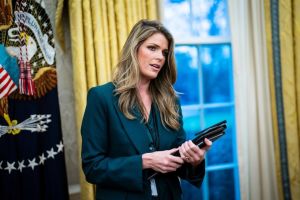 Near the outset of the hearing, Comey’s defense attorney and longtime friend, Patrick Fitzgerald, entered the not guilty plea on behalf of his client.
After the arraignment, Comey was released on his own recognizance….
Fitzgerald said he will argue that Halligan acted improperly before the grand jury and that she should be disqualified due to the circumstances of her appointment. Fitzgerald also said he will seek to have the case thrown out as a vindictive and selective prosecution, as well as on the grounds of outrageous government conduct.
![]() Nachmanoff, a Biden appointee, presided over the 30-minute arraignment. Comey intends to ask the judge to toss the charges on grounds that the former FBI director is being vindictively prosecuted by Trump over a personal grudge stemming from the 2016 probe.
Nachmanoff, a Biden appointee, presided over the 30-minute arraignment. Comey intends to ask the judge to toss the charges on grounds that the former FBI director is being vindictively prosecuted by Trump over a personal grudge stemming from the 2016 probe.
Halligan nodded along with the proceedings — her first ever as a prosecutor in front of a federal judge. Before being named as the U.S. attorney days before Comey was indicted, her legal background was as an insurance lawyer. She tapped two relatively junior prosecutors from North Carolina — rather than her office in the Eastern District of Virginia — to lead the case.
Halligan did not speak during the hearing, except to identify herself. One of the prosecutors from North Carolina, Assistant U.S. Attorney Tyler Lemons, did the talking for the government. When the judge posed questions, he often deferred to Fitzgerald to speak first.
ABC News: Central witness undermines case against James Comey, prosecutors concluded: Sources.
Federal prosecutors investigating former FBI Director James Comey for allegedly making false statements to Congress determined that a central witness in their probe would prove “problematic” and likely prevent them from establishing their case to a jury, sources familiar with their findings told ABC News.
Comey, who pleaded not guilty at his arraignment Wednesday, was indicted last month on charges of making a false statement and obstruction related to 2020 testimony before the Senate Judiciary Committee — but Justice Department officials have privately expressed that the case could quickly unravel under the scrutiny of a federal judge and defense lawyers.
Daniel Richman — a law professor who prosecutors allege Comey authorized to leak information to the press — told investigators that the former FBI director instructed him not to engage with the media on at least two occasions and unequivocally said Comey never authorized him to provide information to a reporter anonymously ahead of the 2016 election, the sources said.
According to prosecutors who investigated the circumstances surrounding Comey’s 2020 testimony for two months, using Richman’s testimony to prove that Comey knowingly provided false statements to Congress would result in “likely insurmountable problems” for the prosecution.
Investigators detailed those conclusions in a lengthy memo last month recommending that the office not move forward in charging Comey, according to sources familiar with the memo’s contents.
Read the rest at ABC News. Of course the point is not necessarily to convict Comey. Trump just wants him to go though the process of dealing with the courts and paying attorney fees.
The government shutdown continues. Here’s the latest:
CBS News: Government shutdown live updates as Senate prepares to vote again.
– Republicans and Democrats remain at an impasse over how to end the government shutdown, now on its eighth day.
– For the sixth time, the Senate is set to consider dueling measures to fund the government around midday Wednesday. The bills fell short of the 60 votes needed for a fifth time on Monday.
– On Tuesday, confusion spread over whether the 750,000 furloughed federal workers would receive back pay, after a memo from the White House’s Office of Management and Budget suggested they might not. Congressional leaders have pushed back, insisting that furloughed workers would be made whole.
– At the Capitol, House Speaker Mike Johnson told reporters he would not call back the House to vote on a separate bill to pay members of the military, saying Senate Democrats should support the GOP bill to reopen the government: “The House is done. The ball is now in the Senate’s court.”
Senate Majority Leader John Thune reiterated to reporters Wednesday morning that Republicans are “happy to sit down with a group and figure out what the path forward might look like” on Democrats’ push to address health care issues, but “we’ve got to open up the government” first.”The conversation will happen when we open up the government,” Thune said. “Nothing’s changed. We all understand what they want to do, and we’re not averse, as I’ve said repeatedly, to having that conversation. At some point, they have to take yes for an answer.”
Democrats have insisted that they need more than assurances on their demands to extend health insurance tax credits.
Politico: Trump’s off-script comments cause shutdown headaches for GOP.
One week into the government shutdown, top Republican leaders appear to have lost the plot.
President Donald Trump, Speaker Mike Johnson and Senate Majority Leader John Thune are straining to project a united front against Democrats, just barely concealing tensions over strategy that have snowballed behind the scenes since agencies closed last week.

Speaker Mike Johnson
In one stark example, Trump scrambled the congressional leaders’ messaging Monday when he told reporters in the Oval Office he would “like to see a deal made for great health care” and that he was “talking to Democrats about it,”
Within hours, Trump walked it back: “I am happy to work with the Democrats on their Failed Healthcare Policies, or anything else, but first they must allow our Government to re-open,” he wrote on Truth Social hours after his initial comments.
Johnson said Tuesday he “spoke with the president at length yesterday” about the need to reopen agencies first, while Thune told reporters there have been “ongoing conversations” about strategy between the top Republicans.
A White House official granted anonymity to speak about the circumstances behind the president’s statements said the Truth post was “issued to make clear that the [administration] position has not changed” and was not done at the behest of the two leaders.
But tensions surfaced again Tuesday after a White House budget office memo raised questions about a federal law guaranteeing back pay for furloughed federal workers — one that Johnson and Thune both voted for in 2019.
There would not be enough air traffic controllers in the tower at Chicago’s O’Hare International Airport Tuesday night, the Federal Aviation Administration warned. In Nashville, so many controllers have stayed home, the facility – which guides planes into and out of the airport – is closing.
Now, after more than a week of the government shutdown, same scenarios are unfolding at FAA offices across the country, with ripple effects hitting flights almost everywhere.
The approach and departure facilities for Houston, Newark and Las Vegas did not have enough controllers working for at least part of Tuesday evening, along with the facilities that handle planes in the Boston, Atlanta, Philadelphia and Dallas areas, FAA operations plans noted.
Houston’s two major airports, Hobby and George Bush Intercontinental Airport, were both expected to see ground delays due to staffing shortage.
The aviation problems come as Transportation Secretary Sean Duffy says more controllers are calling out sick. Like Transportation Security Administration officers, air traffic controllers are considered essential employees and must work without pay during the shutdown.
Organized job actions like strikes or sickouts are prohibited by federal law, but since air traffic control staffing is so tight, a small number of employees taking unscheduled time off can be enough to cause problems.
More details at the CNN link.
CNN: White House draws out mass federal firings timeline as GOP grows squeamish in funding fight.
- September 12: ICE agents shoot and kill Chicago resident Silverio Villegas González in Franklin Park. ICE claimed that González was shot after he “seriously injured” an ICE agent. But bodycam footage shows the same agent immediately after the encounter describing his injuries as “nothing major.”
- September 30: Some 300 federal agents raid an apartment building in the dead of night. Some rappel from a Black Hawk helicopter positioned over the building. They ransack apartments and detain not only children but several U.S. citizens, including one Rodrick Johnson, who spoke with Block Club Chicago:
Rodrick Johnson, who lives in the building and is a U.S. citizen, said he heard “people dropping on the roof” before FBI agents kicked in his door. He was stuffed inside a van with his neighbors for what felt like several hours until agents told them the building was clear, he said.
“They didn’t tell me why I was being detained,” Johnson said. “They left people’s doors open, firearms, money, whatever, right there in the open.”
- October 4: CPB agents shoot an unarmed woman, Marimar Martinez. They claim that she provoked them by ramming their vehicle with her car. Martinez’s lawyer tells the Chicago Sun-Times that there is bodycam footage that shows an agent turning left into Martinez’s vehicle, after which an agent says, “Do something, bitch.” The agent then gets out of the vehicle and shoots Martinez.
- October 7: A masked federal agent is caught on camera aiming a weapon at a resident who is reportedly doing nothing more than documenting his activity.
Please read the rest at The Bulwark link. it’s a very important post.
The Chicago Tribune via Yahoo News: Gov. JB Pritzker says President Trump deploying troops to Chicago due to ‘dementia’ and obsessive fixations.
In a scathing critique of President Donald Trump, Gov. JB Pritzker on Tuesday accused the Republican president of deploying National Guard troops to the Democratic cities of Chicago and Portland based on fixations that stem in part from his being mentally impaired.
“This is a man who’s suffering dementia,” Pritzker said in a telephone interview with the Tribune. “This is a man who has something stuck in his head. He can’t get it out of his head. He doesn’t read. He doesn’t know anything that’s up to date. It’s just something in the recesses of his brain that is effectuating to have him call out these cities.
“And then, unfortunately, he has the power of the military, the power of the federal government to do his bidding, and that’s what he’s doing.”
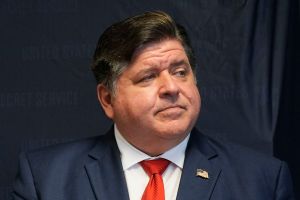
Illinois Gov. JB Pritzker
The governor’s comments came as National Guard troops from Texas were assembling at a U.S. Army Reserve training center in far southwest suburban Elwood and Trump’s administration was moving forward with deploying 300 members of the Illinois National Guard for at least 60 days over the vocal and legal objections of Pritzker and other local elected leaders.
The Trump administration has said the troops are needed to protect federal agents and facilities involved in its ongoing deportation surge and has sought to do much the same in Portland, Oregon, though those efforts have been stymied so far by temporary court rulings. A federal judge in Chicago is expected to hold a hearing this week over the legal effort by Illinois and Chicago to block the deployments, which Pritzker and other local officials say is not only unnecessary but a violation of the Posse Comitatus Act that prohibits the use of U.S. military assets from taking part in law enforcement actions on domestic soil.
During the interview, Pritzker — who has been one of Trump’s harshest critics and is a potential 2028 presidential Democratic candidate — said the courts will play an integral role in challenging Trump’s efforts in Illinois and across the nation.
“We’re not going to go to war between the state of Illinois and the federal government, not taking up arms against the federal government,” Pritzker said. “But we are monitoring everything they’re doing, and using that monitoring to win in court.”
Illinois state Rep. Lilian Jiménez, District 4 at MSNBC: Trump is trying to make an example out of Chicago. We won’t stand for it.
While many families prepared their children for school Monday morning, Sept. 29, I woke up to calls from parents in Chicago too afraid to leave their homes. Rumors of immigration enforcement were spreading, and the simple act of walking a child to school felt like too much of a risk. I am a mother and an Illinois state representative, and these calls hit me in two places at once: as a parent who wants my child to grow up free from fear and as an elected official entrusted to protect the rights and dignity of my community.
Some of our worst fears were realized the next day when, as NBC Chicago reported, ICE agents rappelled from helicopters onto a housing complex during a 1 a.m. raid and zip-tied people, including U.S. citizens and children, in the South Shore neighborhood. That’s near where my family has lived for decades. By all accounts the federal administration has used this exaggerated staging as a media opportunity without producing a shred of evidence that its use of excessive force was justified.
 By Friday, the scene in my Chicago neighborhood included helicopters flying above and armed convoys patrolling our streets. In broad daylight, federal agents released multiple tear gas canisters into a crowd across the street from an elementary school. In a second instance, as a local TV station reported, agents released tear gas outside an emergency room in my community, and Alderwoman Jessie Fuentes, our City Council representative, posted a video of being handcuffed by ICE briefly after she questioned agents at that medical facility.
That is what makes President Donald Trump’s latest threat, that Chicago is one of the cities he wants to use as a “training ground” for the military, even more chilling. Trump is not only scapegoating our city and other cities for political gain; he is openly plotting to experiment on working families, immigrants and communities of color by turning our neighborhoods into staging grounds for authoritarian force. We must not turn away at this moment.
I know what militarization looks like, and it is not safety, it is fear. It looks like children crying when their parents don’t come home. It looks like families going underground, skipping school or work, because they are terrified of who might be waiting outside their doors. Militarization leads to trauma that lingers long after the raids end.
I know how this feels because I grew up with a mother who was undocumented. I grew up not knowing whether my mother would be there when I came home from school. I also know what real safety looks like. It looks like parents walking their kids to school. It’s stable housing, a living wage, health care and classrooms where children can learn without fear.
CNN: Trump calls for jailing of Illinois leaders as court showdowns over troop deployments near.
The running battle between President Donald Trump and Democratic-led cities is nearing a new inflection point, as National Guard troops gather near Chicago while lawyers prepare for critical court hearings 2,000 miles away from each other.
The Trump administration is tying planned deployments in Chicago and Portland, Oregon, to increasingly tense protests outside Immigration and Customs Enforcement facilities, as well as citing the shooting at an ICE facility in Dallas. Two ICE detainees were killed there. Trump has called it an attack on law enforcement.
The president ramped up his criticism Wednesday of Chicago Mayor Brandon Johnson and Democratic Gov. JB Pritzker, who called the Guard call-up “Trump’s invasion” over the weekend.
“Chicago Mayor should be in jail for failing to protect Ice Officers! Governor Pritzker also!” Trump wrote on Truth Social.
One more before I wrap this up.
Tom Nichols at The Atlantic (gift link): The Civil-Military Crisis Is Here. The leaders of the U.S. military may soon face a terrible decision.
To capture a democratic nation, authoritarians must control three sources of power: the intelligence agencies, the justice system, and the military. President Donald Trump and his circle of would-be autocrats have made rapid progress toward seizing these institutions and detaching them from the Constitution and rule of law. The intelligence community has effectively been muzzled, and the nation’s top lawyers and cops are being purged and replaced with loyalist hacks.
Only the military remains outside Trump’s grip. Despite the firing of several top officers—and Trump’s threat to fire more—the U.S. armed forces are still led by generals and admirals whose oath is to the Constitution, not the commander in chief. But for how long?
Trump and his valet at the Defense Department, Secretary of Physical Training Pete Hegseth, are now making a dedicated run at turning the men and women of the armed forces into Trump’s personal and partisan army. In his first term, Trump regularly violated the sacred American tradition of the military’s political neutrality, but people around him—including retired and active-duty generals such as James Mattis, John Kelly, and Mark Milley—restrained some of his worst impulses. Now no one is left to stop him: The president learned from his first-term struggles and this time has surrounded himself with a Cabinet of sycophants and ideologues rather than advisers, especially those at the Pentagon. He has declared war on Chicago; called Portland, Oregon, a “war zone”; and referred to his political opponents as “the enemy from within.” Trump clearly wants to use military power to exert more control over the American people, and soon, top U.S.-military commanders may have to decide whether they will refuse such orders from the commander in chief. The greatest crisis of American civil-military relations in modern history is now under way.
I write these words with great trepidation. When I was a professor at the Naval War College, I gave lectures to American military officers about the sturdiness of civil-military relations in the United States, a remarkable historical achievement that has allowed the most powerful military in the world to serve democracy without being a threat to it. I so revered this system that I went to Moscow just before the fall of the U.S.S.R. and told an audience of Soviet military officers that they should look to the American military as a model for how to disentangle themselves from the Communist Party and Kremlin politics. I regularly reminded both my military students and civilian audiences that they had good reason to have faith in American institutions and the constitutional loyalty of U.S. civilian and military leaders.
This new and dangerous moment has arrived for many reasons, including Trump’s antics in front of young soldiers and sailors, through which he has succeeded in pulling many of them into displays of partisan behavior that are both an insult to American civil-military traditions and a violation of military regulations. Senior military leaders should have stepped in to prevent Trump from turning addresses at Fort Bragg and Naval Station Norfolk into political rallies; the silence of the Army and Navy secretaries, the Joint Chiefs of Staff, and some top generals and admirals is appalling. To their credit, those same officers listened impassively as Trump and Hegseth subjected them to political rants during a meeting at Quantico last week. But young enlisted people and their immediate superiors take their cues from the top, and one day of decorum from the high command cannot reverse Trump’s influence on the rank and file.
Please use the gift link to read the rest. We are in deep deep trouble, folks.
That’s it for me today. Please take care of yourselves, and don’t give up!
Did you like this post? Please share it with your friends:
Posted: May 24, 2012 | Author: bostonboomer | Filed under: Catfood Commission, Democratic Politics, morning reads, U.S. Economy, U.S. Military, U.S. Politics | Tags: Alan Simpson, austerity, Barack Obama, Bush tax cuts, CBO, Charles P. Pierce, CIA leak case, Corey Booker, education policy, Emptywheel, eurozone crisis, fiscal cliff, Iraq War, Joe Wilson, John Maynard Keynes, Mark Halperin, Massachusetts public schools, Mitt Romney, Patrick Fitzgerald, Scooter Libby, Social Security, unemployment, Valerie Plame |

Good Morning!! I’ve got a potpourri of interesting links for you today, so I’ll get right to it.
Yesterday Mitt Romney gave an interview to Mark {Gag!} Halperin of Time. Halperin asked the putative Republican nominee to say specifically what the unemployment rate would be after his first year as POTUS. You may recall that not long ago, Romney stated that unemployment should be below 4 percent and that anything higher than that is unacceptable. But now he’s singing a different tune.
Romney: I can’t possibly predict precisely what the unemployment rate will be at the end of one year. I can tell you that over a period of four years, by virtue of the policies that we’d put in place, we’d get the unemployment rate down to 6%, and perhaps a little lower. It depends in part upon the rate of growth of the globe, as well as what we’re seeing here in the United States, but we’d get the rate down quite substantially, and frankly, the key is we’re going to show such job growth that there will be competition for employees again. And wages – we’ll see the end of this decline we’re having. The median income in America is down 10% in just the last four years. That’s got to stop. We’ve got to start seeing rising wages and job growth.
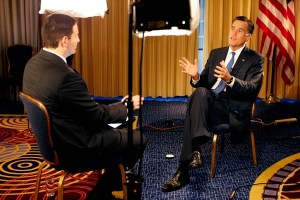
Romney gave no specifics about how he would achieve this with the policies he has been promoting–cutting taxes on the rich, raising them on people with lower incomes, and cutting everything except defense spending, which he would increase substantially. Halperin did ask for more specifics, but Romney just babbled a bunch of nonsense:
Halperin: One more question generally about jobs. For people out there, for voters who want to know what you’re about in terms of job creation, is there some new idea, some original idea, that hasn’t been part of the debate in American politics before, that you have that you think would lead to a lot of new jobs?
Romney: Well the wonderful thing about the economy is that there’s not just one element that somehow makes the whole economy turn around, or everybody in the world would have figured that out and said there’s just one little thing we have to do – you know, Greece is settled, and France and Italy are all back and well again. No, it’s a whole series of things. It’s a system of factors that come together to make an economy work. What is it that makes America’s economy the strongest in the world, the most robust, over a century? It’s a whole series of things – everything from our financial service sector, to the cost of our inputs, our natural resources, to the productivity of our workforce, to our labor and management rules and how they work together, to our appreciation for fair trade and free trade around the world, and negotiating trade arrangements that are favorable to us. It is a whole passel of elements that come together to create a strong economy, and for someone who spent their life in the economy, they understand how that works. And it’s very clear, by virtue of the President’s record, that he does not, and he is struggling. Look at him right now. He just doesn’t have a clue what to do to get this economy going. I do. I laid out a 59-step plan that encompasses a whole series of efforts that will together get this economy going and put people back to work.
But from what I could make out in wading through all the blather, it really comes down to the confidence that will wash through all of us once we know that Mr. Fixit, Willard Mitt Romney is going to save us.
Romney: Well actually if I’m lucky enough to be elected the consumers and the small-business people in this country will realize that they have a friend in the White House, who is actively going to encourage economic growth, and there will be a resurgence in confidence in this country and a willingness to take risks, to invest, to add employees. I think it will be very positive news to the American economy. Will I be able to get done between January 1 and January 20 the things that I’d like to do? Of course not, I’m not in office. But I believe that we will be able to have a grace period, which allows us to tackle these issues one by one and put in place a structure, which is very much designed to get America working again.
Romney also gave a speech about education policy in which he proposed to further privatize America’s education system:
Mitt Romney proposed a series of steps to overhaul the public education system, reigniting the debate over school choice as his campaign intensifies its effort to introduce the presumptive Republican presidential nominee to a general-election audience.
The education plan, detailed in a speech today in Washington, would create a voucher-like system to give low- income and disabled students federal funds to attend charter schools, private institutions and public schools outside their district.
“I don’t like the direction of American education, and as president, I will do everything in my power to get education on track for the kids of this great land,” Romney told a gathering of Latino business owners at the U.S. Chamber of Commerce.
No new ideas there. To be perfectly honest, I strongly doubt that Romney knows the first thing about American public schools. But let me refer you to an expert on Willard’s past history in dealing with public education, the one and only Charles P. Pierce. Pierce writes about what Romney did to the public education system of Massachusetts during his one term as Governor:
Read the rest of this entry »
Did you like this post? Please share it with your friends:




 peej
peej Carissa
 bostonboomer
 dakinikat
 ecocatwoman
 mablue2
 Mama Lopez
 peggysue22
 quixote
 skydancingguestblogger
 Mona (aka Wonk the Vote)



 Sky Dancing
Recent Comments