
Mostly Monday Reads: Oy mishigas!
Posted: March 24, 2025 Filed under: #FARTUS, #MAGAnomics, American Fascists, Broligarchy, corporate greed, democracy is threatened, kakistocracy, Middle East, Polycrisis | Tags: @repeat1968, Broligarchy, FARTUS, Mafia Don, oligarchy, Paul Krugman, Vladimir Putin 7 Comments
“Putin addresses the residents of his newly acquired territory.” John Buss, @repeat1968, @johnbuss.bsky.social
Good Day, Sky Dancers!
I am having an ongoing debate with myself about the current administration. Is it the stupidity, the arrogance, or the meanness that most damaged our Constitutional democracy? Or is it the greed? I’m tagging all my posts here with the words Polycrisis, Kakistocracy, and Oligarchy or Broligarchy. It’s getting to be a tough search to find a few journalists who will actually tell it like it is.
This article in The Guardian early this month by Jonathan Freeland describes the current president thusly. “Donald Trump is turning America into a mafia state. The pattern is inescapable – with just one caveat: organised crime bosses occasionally display more honour.” I’ll just add a local New Orleans colloquialism. True Dat.
Behold Donald Corleone, the US president who behaves like a mafia boss – but without the principles. Of course, one hesitates to make the comparison, not least because Donald Trump would like it. And because the Godfather is an archetype of strength and macho glamour while Trump is weak, constantly handing gifts to America’s enemies and getting nothing in return. But when the world is changing so fast – when a nation that has been a friend for more than a century turns into a foe in a matter of weeks – it helps to have a guide. My colleague Luke Harding clarified the nature of Vladimir Putin’s Russia when he branded it the Mafia State. Now we need to attach the same label to the US under Putin’s most devoted admirer.
Consider the way Trump’s White House conducts itself, issuing threats and menaces that sound better in the original Sicilian. This week the president said that a deal ending Russia’s war on Ukraine “could be made very fast” but “if somebody doesn’t want to make a deal, I think that person won’t be around very long”. You didn’t need a translator to know that the somebody he had in mind was Volodymyr Zelenskyy.
On Thursday, Trump was confident that the Ukrainians would soon do his bidding “because I don’t think they have a choice”. Almost as if he had made them an offer they couldn’t refuse. Which of course he had. By ending the supply of military aid and the sharing of US intelligence, as he did this week, he had effectively put a Russian revolver to Ukraine’s temple, its imprint scarcely reduced by Trump’s declaration today that he is “strongly considering” banking sanctions and tariffs against Moscow, a move that looked a lot like a man pretending to be equally tough on the two sides, but which should fool nobody. He expects Zelenskyy to sign away a huge chunk of Ukraine’s minerals, the way Corleone’s rivals surrendered their livelihoods to save their lives.
This is how the US now operates in the world. Dispensing with the formalities during his annual address to Congress on Tuesday, Trump repeated his threat to grab Greenland: “One way or the other, we’re going to get it.” That recalled his earlier warning to Copenhagen to give him what he wants or face the consequences: “maybe things have to happen with respect to Denmark having to do with tariffs”. Nice place you got there; would be a shame if something happened to it.
It’s the same shakedown he’s performing on the US’s northern neighbour. Canada’s outgoing prime minister Justin Trudeau spelled it out this week, accusing Trump of trying to engineer “a total collapse of the Canadian economy because that will make it easier to annex us”, adding that: “We will never be the 51st state.” It’s a technique familiar in the darker corners of the New Jersey construction industry: a series of unfortunate fires that only stops when a recalcitrant competitor submits.
Both the substance and the style are pure mafia. Note the obsession with respect, demonstrated in last week’s Oval Office confrontation with Zelenskyy. Between them, JD Vance and Trump accused the Ukrainian leader three times of showing disrespect, sounding less like world leaders than touchy Tommy DeVito, the Joe Pesci character in Goodfellas.
Note too the humiliation of subordinates. In his address to Congress, the president introduced secretary of state Marco Rubio as the man charged with taking back the Panama canal. “Good luck, Marco,” said Trump, with a chuckle. “Now we know who to blame if anything goes wrong.” Cue anxious laughter from the rest of the underlings, briefly relieved that it wasn’t them.
It’s hard for aides and opponents alike to keep up because power is exercised arbitrarily and inconsistently. Tariffs are imposed, then suspended. Indeed, one reason why import taxes so appeal to Trump is that they can be enforced instantly and by presidential edict. That extends to the exemptions Trump can offer to favoured US industries. As MSNBC’s Chris Hayes observed: “This is very obviously going to be a protection racket, where Trump can at the stroke of a pen destroy or save your business depending on how compliant you are.”
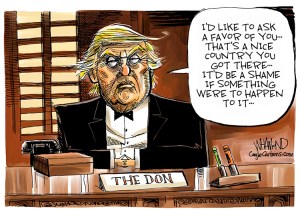 This characterization of Trump is so spot on that you really should go read the rest. I’m using this description of FARTUS as a background to the absolutely appalling crap that’s going on today. It’s hard to mentally deal with how quickly he’s disassembled so many long-standing U.S. Institutions in such a short time. This is especially true because it appears that the massive amount of incompetence and ignorance that his appointments display just escalates the damage. Look at this headline in The Atlantic. It’s reported by Jeffrey Goldberg. “The Trump Administration Accidentally Texted Me Its War Plans. U.S. national-security leaders included me in a group chat about upcoming military strikes in Yemen. I didn’t think it could be real. Then the bombs started falling.” WTAF?
The world found out shortly before 2 p.m. eastern time on March 15 that the United States was bombing Houthi targets across Yemen.
I, however, knew two hours before the first bombs exploded that the attack might be coming. The reason I knew this is that Pete Hegseth, the secretary of defense, had texted me the war plan at 11:44 a.m. The plan included precise information about weapons packages, targets, and timing.
This is going to require some explaining.
The story technically begins shortly after the Hamas invasion of southern Israel, in October 2023. The Houthis—an Iran-backed terrorist organization whose motto is “God is great, death to America, death to Israel, curse on the Jews, victory to Islam”—soon launched attacks on Israel and on international shipping, creating havoc for global trade. Throughout 2024, the Biden administration was ineffective in countering these Houthi attacks; the incoming Trump administration promised a tougher response.
This is where Pete Hegseth and I come in.
On Tuesday, March 11, I received a connection request on Signal from a user identified as Michael Waltz. Signal is an open-source encrypted messaging service popular with journalists and others who seek more privacy than other text-messaging services are capable of delivering. I assumed that the Michael Waltz in question was President Donald Trump’s national security adviser. I did not assume, however, that the request was from the actual Michael Waltz. I have met him in the past, and though I didn’t find it particularly strange that he might be reaching out to me, I did think it somewhat unusual, given the Trump administration’s contentious relationship with journalists—and Trump’s periodic fixation on me specifically. It immediately crossed my mind that someone could be masquerading as Waltz in order to somehow entrap me. It is not at all uncommon these days for nefarious actors to try to induce journalists to share information that could be used against them.
I accepted the connection request, hoping that this was the actual national security adviser, and that he wanted to chat about Ukraine, or Iran, or some other important matter.
Two days later—Thursday—at 4:28 p.m., I received a notice that I was to be included in a Signal chat group. It was called the “Houthi PC small group.”
A message to the group, from “Michael Waltz,” read as follows: “Team – establishing a principles [sic] group for coordination on Houthis, particularly for over the next 72 hours. My deputy Alex Wong is pulling together a tiger team at deputies/agency Chief of Staff level following up from the meeting in the Sit Room this morning for action items and will be sending that out later this evening.”
The message continued, “Pls provide the best staff POC from your team for us to coordinate with over the next couple days and over the weekend. Thx.”
The term principals committee generally refers to a group of the senior-most national-security officials, including the secretaries of defense, state, and the treasury, as well as the director of the CIA. It should go without saying—but I’ll say it anyway—that I have never been invited to a White House principals-committee meeting, and that, in my many years of reporting on national-security matters, I had never heard of one being convened over a commercial messaging app.
 Definitely go read this one. I’ve been missing reading John le Carré. I’m assuming anyone with a background in spying would have saucer eyes by this time. Trump’s love of playing checkers with the countries of the world is dangerous and immoral. He plays with everyone’s life like a mad king. This is from Oliver Darcy at Status. It’s a remarkable indictment of how the press enables his heinous policies and statements. “Gulf of Fear. When news anchors tiptoe around the name Gulf of Mexico, it’s not just semantics—it’s a glimpse at how the press starts to flinch under political pressure.”
In China, Taiwan doesn’t exist—at least not as a country. On official maps, it’s a province. The government enforces strict language about Taiwan’s status, shaping how its people—and the rest of the world—talk about it. The goal, of course, is far more significant than the name on a map. It’s not about semantics. It’s about wielding influence and asserting dominance. Controlling the language people use, particularly in relation to global geography, is a powerful capability to possess.
In the United States, that kind of top-down dictation might feel like a distant threat, the kind of thing that happens in authoritarian regimes or dystopian novels like “1984,” not in a country built on free speech safeguarded by the First Amendment. Americans tend to believe our press is too independent and and too proud to ever bow to government pressure. We assume that if a president ever tried to dictate language, the Fourth Estate would resist. We assume that we’re immune from such pressures.
But an important segment of the press—the television news media—over the past week quietly demonstrated that it is far less adversarial and far more compliant than the breathless promos these networks air hyping themselves as fearless truth-tellers. When the eyes of the world fixated on the stranded NASA astronauts being rescued and touching down back on Earth, every channel danced around what precisely to call the body of water they splashed into. A review of transcripts, courtesy of SnapStream, revealed an alarming reality: not one of the outlets could muster up the courage to simply refer to it as the Gulf of Mexico, the water feature’s name since the 16th century.
Instead, television news organizations tied themselves in knots, performing linguistic gymnastics to stay out of Donald Trump’s crosshairs, while also tiptoeing around audiences who would have surely been incensed to see them bend the knee and call it the “Gulf of America.” On ABC News, “World News Tonight” anchor David Muir referred to “spectacular images from off the coast of Florida.” On the “NBC Nightly news,” anchor Lester Holt spoke about the astronauts “splashing down off the Florida Gulf coast.” On the “CBS Evening News,” it was referred to simply as “the Gulf.” And on CNN, anchor Jake Tapper tried to seemingly have it both ways, noting the U.S. government refers to it as the “Gulf of America,” but the rest of the world calls it the Gulf of Mexico.
In fact, I could only one find instance on a television newscast where a journalist referred to the body of water as the Gulf of Mexico. During an appearance on MSNBC, NBC News correspondent Tom Costello used the term, but then quickly corrected himself, almost as if he had realized he was forbidden from doing so. “Six hours from right now, there will be a splashdown in the Gulf of Mexico,” he said, before backtracking. “Sorry, however you want to call the Gulf. It will be splashing down in the Gulf.”
Suffice to say, none of this was an accident.
 We first saw the capitulation of the tech bros and their social media platforms, including Jeff Bezos, who has ruined The Washington Post. This week, the situation there is getting worse. The first thing any autocrat wants to do is to come for any vestige of a free media. This is from MEDIAITE as reported by David Gilmour. “Trump Claims Jeff Bezos Trashed the ‘Crazy People’ in His Own Newsroom: ‘They’re Out of Control’.
President Donald Trump claimed that billionaire Washington Post owner Jeff Bezos privately expressed regret over the newspaper’s editorial direction and trashed his own “out of control” newsroom for writing “bad articles” about him.
The comments came during a sit-down with OutKick’s Clay Travis aboard Air Force One on Saturday after Travis suggested “it seems” that Bezos may be attempting to make The Washington Post “more fair” in coverage towards Trump.
Trump agreed and didn’t hesitate to praise Bezos, telling Travis “I think it’s great.”
Travis later asked whether Trump had discussed how the newspaper had come after him “like crazy” in the past, AND the president replied: “At length, I talked to him about it. [Bezos is] a good guy. I didn’t really know him in the first term. I mean, it’s such a difference between now and the first time.”
Pressed on what Bezos had said he had planned for The Post’s coverage, Trump said: “Just that. He’s really trying to be more fair.”
Trump continued: “They actually did a couple of bad articles on him. He said, ‘This is crazy, I lose my fortune running this thing and they, you know, they’re out of control.’ These people are crazy. They’re crazy people. They’re out of control.”
“And he’s a actually a very good guy,” the president added. “If you look at the inauguration, look at the people that were on that stage, here was a who’s who of a world that was totally against me the first time. It’s a much different presidency. I have much more support.”
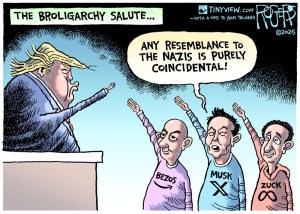 And now, we have the capitulation of top law firms. How many more legs of democracy will we lose? The Bulwark draws the line today. “Stop Making Excuses for Not Fighting Trump. The capitulations and acquiescence we’ve seen so far will only make opposition more difficult down the road.” This is written by William Kristol under the lede “No Excuse.”
Among those who might be expected to stand up against Donald Trump’s authoritarianism, the hills are alive with the sound of excuses.
You’re an elected official. The Trump administration has rounded up individuals and sent them, without any due process and with much carelessness about who’s been seized, to a mega-prison in El Salvador. The administration is boasting about what it’s done and heralding it a prelude to further actions in the same vein.
You’re thinking of condemning these truly grotesque violations of constitutional rights and human decency. Maybe I should say this isn’t right?
Whoa, Nellie! Not so fast, your political advisers hasten to instruct you. The polls on this issue aren’t great. This really isn’t the hill to die on.
You take their advice. But you tell yourself, and you assure others, that of course you will fight one day—on some other hill, on some faraway hill, some time far in the future.
But to fight now? Bad idea. That would simply play into Trump’s hands. After all, Trump and his allies are good at fighting. If you try to do something, there’s a risk they’ll turn it against you. Whereas if you say nothing, nothing can be used against you.
You might worry for a second that silence and acquiescence just plays into Trump’s hands. But you’re not a sophisticated Democratic operative. So you take their advice.
And anyway, there’s a better plan. That plan is that, eventually, Trump will become less popular. Then, the public will rise up. And then you can speak up. It all works out.
It also works out if you’re in the private sector. In fact, if you’re the head of a huge law firm, capitulation isn’t just a regrettable necessity, it’s your duty. You’re acting in the best interests of your clients. It would be wrong and irresponsible to act otherwise.
What’s more, No one in the wider world can appreciate how stressful it is to confront an executive order like this until one is directed at you.
The people in the “wider world”—those serving in the military or waiting tables or cleaning offices at Paul Weiss—they just can’t appreciate the stress that comes from occupying that corner office at 51st and 6th.
Ugh.
All of these excuses—and there are many more!—are distasteful. But what’s worse is that they make it easier and more likely that others will capitulate. They make it seem that you’re kind of a chump if you actually fight Trump’s authoritarian takeover. The excuses offered for capitulation increase the damage done by capitulation.
As usual, Shakespeare saw all. Here’s Pembroke in Act IV, Scene 2 of King John:
And oftentimes excusing of a fault
Doth make the fault the worse by th’ excuse,
As patches set upon a little breach
Discredit more in hiding of the fault
Than did the fault before it was so patched.The excuses offered by our elites for not standing up to authoritarianism have the effect of helping the authoritarians gain further ground.
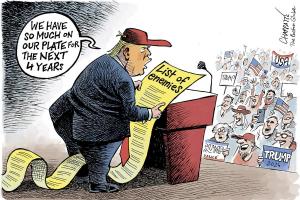 Zach Beauchamp writes at VOX, “There’s a pattern in Trump’s power grabs. The White House strategy demands we defend alleged criminals and those with unpopular views.”
After rising to power, Nazis pitched power grabs as efforts to address the alleged threat posed by menaces like “Judeo-Bolshevism,” harnessing the powers of bigotry and political polarization to get ordinary Germans on board with the demolition of their democracy.
What’s happening in America right now has chilling echoes of this old tactic. When engaging in unlawful or boundary-pushing behavior, the Trump administration has typically gone after targets who are either highly polarizing or unpopular. The idea is to politicize basic civil liberties questions — to turn a defense of the rule of law into either a defense of widely hated groups or else an ordinary matter of partisan politics.
The administration’s first known deportation of a green card holder targeted a pro-Palestinian college activist at Columbia University, the site of some of the most radical anti-Israel activity. For this reason, Columbia was also the first university it targeted for a funding cutoff. Trump has also targeted an even more unpopular cohort: The first group of American residents sent to do hard labor in a Salvadoran prison was a group of people his administration claimed without providing evidence were Tren de Aragua gang members.
Trump is counting on the twin powers of demonization and polarization to justify their various efforts to expand executive authority and assail civil liberties. They want to make the conversation less about the principle — whether what Trump is doing is legal or a threat to free speech — and more a referendum on whether the targeted group is good or bad.
There is every indication this pattern will continue. And if we as a society fail to understand how the Trump strategy works, or where it leads, the damage to democracy could be catastrophic.
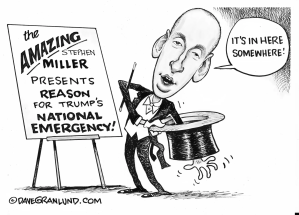 This, too, is a long read that deserves a look. A lot of this goes back to White House aid Stephan Miller. This guy needs to have an entire press detail following him. I’m going to end with a few articles on economics. The first comes from Paul Krugman and will clarify what’s happening with Social Security. “Social Security: A Time for Outrage. Trump’s policies attack his own base — but who will tell them?” I often find myself in conversations with friends, and we all wonder if Trump Supporters will ever show a glimmer of intelligence.
Donald Trump is often described as a “populist.” Yet his administration is stuffed with wealthy men who are clueless about how the other 99.99 percent lives, while his policies involve undermining the working class while enabling wealthy tax cheats.
What is true is that many working-class voters supported Trump last year because they believed that he was on their side. And that disconnect between perceptions and reality ought to be at the heart of any discussion of what Democrats should do now.
Right now the central front in the assault on the working class is Social Security, which Elon Musk, unable to admit error, keeps insisting is riddled with fraud. The DOGE-bullied Social Security Administration has already announced that those applying for benefits or trying to change where their benefits are deposited will need to verify their identity either online or in person — a huge, sometimes impossible burden on the elderly, often disabled Americans who need those benefits most. And with staff cuts and massive DOGE disruption, it seems increasingly likely that some benefits just won’t arrive as scheduled.
Oh, and Leland Dudek, the acting Social Security administrator, threatened to shut the whole thing down unless DOGE was given access to personal data.
Not to worry, says Howard Lutnick, Trump’s Commerce secretary. Only “fraudsters” would complain about missing a Social Security check:
Let’s say social security didn’t send out their checks this month. My mother who’s 94, she wouldn’t call and complain. She’d think something got messed up, and she’ll get it next month. A fraudster always makes the loudest noise, screaming, yelling and complaining.
There’s so much wrong with that statement that it’s hard to know where to start. But it’s clear that Lutnick — like many affluent people — has no idea how important Social Security is to the finances of most older Americans. According to a Social Security Administration study, half of Americans over 65 get a majority of their income from Social Security; a quarter depend almost entirely on Social Security, which supplies more than 90 percent of their income. I doubt that these people would shrug off a missed check.
Reliance on Social Security isn’t evenly distributed across the population; it’s strongly correlated with socioeconomic status. In particular, it very much depends on education, with less-educated Americans much more reliant on the program than those with more education:
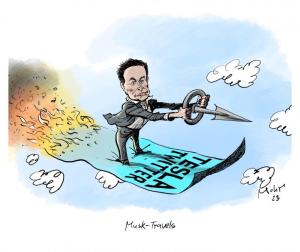 That Lutnick quote cannot be repeated enough. The last read I’m sharing today comes from The Economist. “Musk Inc is under serious threat. The world’s richest man has lost focus. His competitors are taking advantage.” Well, isn’t that special?
UNTIL RECENTLY Elon Musk had little need to look over his shoulder. He once described competition for Tesla, his electric-vehicle (EV) company, as “the enormous flood of gasoline cars pouring out of the world’s factories every day”, rather than the “small trickle” of other EV-makers. SpaceX, his rocket firm, had so undercut and outwitted the bloated aerospace incumbents that it had developed an almost invincible aura.
Yet if Mr Musk can tear himself away from the intoxication of shredding the American government, he may notice something. It is not just that the political firestorms he has whipped up this year are singeing his companies’ brands. It is that the two businesses that underpin his corporate empire—accounting for around 90% of its value and probably all its profit—are facing increasingly stiff competition. The world’s richest man has lost focus—and now has a target on his back.
Start with SpaceX. Last year it conducted five out of every six of the world’s spacecraft launches. Through its Starlink division, it owns 60% of satellites in space. In December it sold shares at a valuation of $350bn, two-thirds higher than its previous level. Starlink, its main profit engine, is on track to generate more than $11bn of revenue this year and $2bn of free cash flow, says Chris Quilty of Quilty Space, a consultancy.
Now, however, Mr Musk’s bomb-throwing interventions are alarming SpaceX customers, and at a time when rivals are growing more capable. His on-again, off-again threats to end Starlink’s support for Ukraine have raised the difficult question of trust. European politicians are pondering how reliable Mr Musk will be as a long-term provider of strategic satellite communications. The search for alternatives has helped spur a more than tripling of the share price of Eutelsat, the French owner of OneWeb, which provides satellite services to broadband companies.
No European supplier could come close to matching the 7,000 satellites Starlink has in low orbit. (Eutelsat has a mere 600.) Nor could any compete on price. As Simon Potter of BryceTech, another space consultancy, puts it, for now the concerns are “more noise than action”. Yet Starlink may soon face meaningful competition from Amazon’s Project Kuiper, which aims to put over 3,000 satellites into low orbit, creating a space-based broadband network. If it achieves that, some customers outside America may decide they have more confidence in an Amazon product than in one belonging to the mercurial Mr Musk.
Jeff Bezos, Amazon’s founder, is also stepping up the pace in the launch business with Blue Origin. His rocket firm is separate from Project Kuiper, but has contracts to fly many of its satellites. In January Mr Bezos’s New Glenn rocket reached orbit on its first try. If Blue Origin manages to make repeated successful journeys with reusable rockets, it could become a meaningful competitor to SpaceX. So could Rocket Lab, SpaceX’s closest rival by number of launches, which is due to debut Neutron, a new rocket, this year.

Here comes the Rooster.
It’s like we’re in a very bad dystopian novel and can’t escape. Anyway, I’m not shutting up any time soon.
What’s on your Reading and Blogging list today?
Here’s a picture of this big boy who keeps crossing the road in front of my house. The rain just stopped, and the sun cleared up, so he’s been yelling at the sun for about an hour now. I feel like he’s some kind of omen.
Here’s an Alice in Chains song about the Vietnam War. That ought to cheer you up.
Monday Reads
Posted: July 7, 2014 Filed under: Barack Obama, morning reads, U.S. Economy, U.S. Politics | Tags: Bill Moyers, child sexual abuse, Constitutional originalism, Down's syndrome in history, E.J. Dionne, economic inequality, Glory Kathurima, Jill Lepore, Joseph Fishkin, Malaika Kathurima, Norfolk NE July 4 parade, oligarchy, pedophile priests, Pope Francis, Racism, Tea Partiers, U.S. Constitution, William E. Forbath 26 Comments
Good Morning!!
Today is another slow news day, and that could be bad news for some folks in Norfolk, Nebraska. Dakinikat alerted us to the story yesterday, and now it’s in the process of going viral. So far the headlines on the story seem highly understated. From the Lincoln Journal-Star: Obama float at Norfolk parade sparks controversy.
It was the parade float that elicited the loudest cheers Friday at Norfolk’s Fourth of July parade. The crowd lining the streets clapped and laughed as the flatbed truck went by.
But one loud voice rose above the rest: “This is not OK,” Glory Kathurima said. “That’s not OK.”
She kept repeating herself as the float passed, she says. She started to raise her phone to take a picture of the blue truck with the outhouse on its flatbed, along with a dark figurine in overalls propped up by a metal walker.
And nailed to the sides of the wooden privy, two signs in all-black capital letters: “OBAMA PRESIDENTIAL LIBRARY.”
Kathurima’s daughter Malaika saw the disrespectful depiction of the President of the United States, and asked her mom, “Mommy, what does that mean? What’s so funny?”
Kathurima moved to Nebraska from Kenya when she was Malaika’s age and became a naturalized citizen a few years ago. She’s raised her daughter in Norfolk and has found ways to explain the meaning of skin color. She’s turned on the TV and pointed to President Obama, showing Malaika that there was someone that looked like her — half Kenyan, half American.
“I’m angry and I’m scared,” Kathurima said. “This float was not just political; this was absolutely a racial statement.”
If a 9-year-old can see the problem, you’d think the parade organizers in Norfolk would have at least foreseen what the reaction to the float would be from normal people across the country. But apparently they didn’t.

Parade committee member Rick Konopasek said the float wasn’t meant to be any more offensive than a political cartoon would be….
“We don’t feel its right to tell someone what they can and can’t express,” he said. “This was political satire. If we start saying no to certain floats, we might as well not have a parade at all.”
Konopasek and parade announcer Wally Sonnenschein said the outhouse float was the most popular one in the parade, and the three judges awarded it an honorable mention.
“It’s obvious the majority of the community liked it,” Konopasek said. “So should we deny the 95 percent of those that liked it their rights, just for the 5 percent of people who are upset?”
Konopasek and Sonnenschein actually claimed that the float demonstrated the freedom of speech and independence that the country celebrates on the Fourth of July, and that “the man who built the float has been a longstanding member of the community, and people shouldn’t be quick to judge him for expressing his opinions.” How odd then that the “man who built the float” didn’t put his name on his handiwork and he is still anonymous, according to Omaha.com.
A Fourth of July parade float that depicted a figure standing outside an outhouse labeled the “Obama Presidential Library” has created a stir on social media and is also receiving criticism in Norfolk, Nebraska.
The float, in Norfolk’s annual Independence Day parade, was on a flatbed trailer being pulled by a blue pickup truck. The figure was dressed in overalls and standing next to a walker outside of the outhouse. The hands and head of the figure were greenish and appeared to be zombielike; the hands were pressed against the sides of the figure’s head. Miniature American flags were atop the float and on the truck.
Neither the float nor the pickup identified a sponsor; a sign in the windshield said it was entry No. 29.
Why isn’t “the man who built the float” expressing pride in his creation?
Actually the design of the float wasn’t original. I’ve seen this depiction of Obama before. From Huffington Post:
The presidential library outhouse comparison has become somewhat of a conservative meme in recent years. A similar structure was on display at Montana’s state Republican convention in 2012. And last fall, an outhouse with a “presidential library” sign drew criticism in a small New Mexico town.
It will be interesting to see how this story plays out in the next few days. Certainly if this is not racism per se (I think it is), it demonstrates a shocking lack of respect for the office of the Presidency. Will Norfolk parade officials continue to defend the float? Will “the man who built the float” come forward and defend what he did? Stay tuned.
In other news,
In his latest column, E.J. Dionne calls attention to “an article in draft” by Joseph Fishkin & William E. Forbath called “The Anti-Oligarchy Constitution” (PDF). The article addresses the issue of economic inequality, and is the basis for a planned book by Fishkin.
Dionne writes that Tea Partiers and other “conservatives” constantly talk about the Constitution to justify their extreme views on multiple issues. Dionne argues that “progressives” should “think constitutionally” too, and “challenge conservative claims about what the Constitution really demands.”
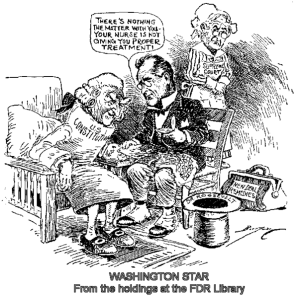
In the May issue of the Boston University Law Review, Joseph R. Fishkin and William E. Forbath of the University of Texas School of Law show that at key turning points in our history (the Jacksonian era, the Populist and Progressive moments and the New Deal), opponents of rising inequality made strong arguments “that we cannot keep our constitutional democracy — our republican form of government — without constitutional restraints against oligarchy and a political economy that maintains a broad middle class, accessible to everyone.”
Their article is called “The Anti-Oligarchy Constitution,” though Forbath told me that he and Fishkin may give the book they’re writing on the topic the more upbeat title “The Constitution of Opportunity.” Their view is that by empowering the wealthy in our political system, Supreme Court decisions such as Citizens United directly contradict the Constitution’s central commitment to shared self-rule.
“Extreme concentrations of economic and political power undermine equal opportunity and equal citizenship,” they write. “In this way, oligarchy is incompatible with, and a threat to, the American constitutional scheme.” …. they make a similar critique of what they call an excessively “court-centered” approach to constitutionalism. “Constitutional politics during the 19th and early 20th centuries” was very different and the subject of democratic deliberation. In earlier eras, they say, the Constitution was seen as not simply permitting but actually requiring “affirmative legislation . . . to ensure a wide distribution of opportunity” and to address “the problem of oligarchy in a modern capitalist society.”
The authors remind us of Franklin Roosevelt’s warning that “the inevitable consequence” of placing “economic and financial control in the hands of the few” would be “the destruction of the base of our form of government.” And writing during the Gilded Age, a time like ours in many ways, the journalist James F. Hudson argued that “imbedded” in the Constitution is “the principle” mandating “the widest distribution among the people, not only of political power, but of the advantages of wealth, education and social influence.”The idea of a Constitution of Opportunity is both refreshing and relevant. For too long, progressives have allowed conservatives to monopolize claims of fealty to our unifying national document. In fact, those who would battle rising economic inequalities to create a robust middle class should insist that it’s they who are most loyal to the Constitution’s core purpose. Broadly shared well-being is essential to the framers’ promise that “We the people” will be the stewards of our government.
Fishkin’s proposed book sounds like a worthwhile companion to Thomas Picketty’s Capital in the Twenty-First Century.
A somewhat related article from Raw Story by Bill Moyers and Co., July 4th note to tea partiers: Your politics would baffle the Founding Fathers.
Editor’s note: These days, if you see a protester donning a tricorn hat and waving a Gadsden Flag, it’s a safe bet that he or she is a Republican activist who’s furious about “death panels” or the prospect of the government meddling in the Medicare program. But the tea party movement isn’t the first to claim itself to be the true defenders of the Constitution, or to enlist its Framers in a political cause. Throughout American history, activists across the ideological spectrum have insisted that the Framers would roll over in their graves upon encountering the perfidy of their political opponents.
The reality is that the Framers disagreed about almost everything, and produced a Constitution that was filled with expedient compromises. As Jill Lepore, a professor of American history at Harvard University, pointed out in her book, The Whites of Their Eyes: The Tea Party’s Revolution and the Battle Over American History, “Beginning even before it was over, the Revolution has been put to wildly varying political purposes.” Between 1761, when the first signs of discontent with England became apparent in the Colonies, and 1791, when the Bill of Rights was ratified, Lepore wrote that Americans debated an “ocean of ideas” from which “you can fish anything out.”
One of the few areas where the Framers approached a consensus was a belief that their Constitution shouldn’t be fetishized. According to Lepore, it was none other than Thomas Jefferson who wrote, “Some men look at constitutions with sanctimonious reverence, and deem them like the arc of the covenant, too sacred to be touched. They ascribe to the men of the preceding age a wisdom more than human.”
Read an excerpt on Constitutional originalism from Jill Lepore’s book at the Raw Story link.
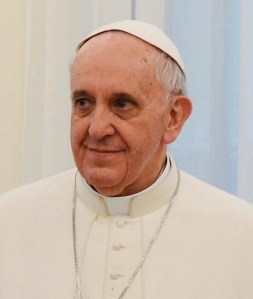
From NBC News: Pope Francis Meets Abuse Victims, Begs Forgiveness for Church.
The pontiff invited six victims of abuse from Ireland, Germany and Britain to attend an early-morning private Mass at the Domus Sanctae Marthae, the residence next to St. Peter’s Basilica where he lives.
Francis called the abuse a “grave sin” decrying how it was hidden for “so much time” and “camouflaged with a complicity that cannot be explained.”“I ask for the grace to weep, the grace for the Church to weep and make reparation for her sons and daughters who betrayed their mission, who abused innocent persons,” the pope said in his homily. “I beg your forgiveness, too, for the sins of omission on the part of Church leaders who did not respond adequately to reports of abuse.” ….
Francis strongly praised the victims’ courage in speaking up and shedding “light on a terrible darkness,” telling the mass he is deeply aware of their deep and unrelenting pain.
“Sins of clerical sexual abuse against minors have a toxic effect on faith and hope in God,” he said, adding that the victims’ willingness to come to the Vatican “speaks of the miracle of hope, which prevails against the deepest darkness.”
I guess it’s a start, but I agree with victims advocates who say it’s too little, too late. What concrete actions is the Church going to take to identify abusers and potential abusers before they act out? Child sexual abuse is a systemic problem that has continued for centuries. It’s difficult to see how it can be overcome with apologies and meetings with a few survivors.
I’ll end with a fascinating story from New Scientist, via Raw Story: Oldest case of Down’s syndrome from medieval France.
The oldest confirmed case of Down’s syndrome has been found: the skeleton of a child who died 1500 years ago in early medieval France. According to the archaeologists, the way the child was buried hints that Down’s syndrome was not necessarily stigmatised in the Middle Ages….
The new example comes from a 5th- and 6th-century necropolis near a church in Chalon-sur-Saône in eastern France. Excavations there have uncovered the remains of 94 people, including the skeleton of a young child with a short and broad skull, a flattened skull base and thin cranial bones. These features are common in people with Down’s syndrome, says Maïté Rivollat at the University of Bordeaux in France, who has studied the skeleton with her colleagues….
Oldest case of Down’s syndrome from medieval France – life – 04 July 2014 – New Scientist#.U7qdknlOXEd <!—->
Rivollat’s team has studied the way the child with Down’s syndrome was buried, which hasn’t been possible with other ancient cases of the condition. The child was placed on its back in the tomb, in an east-west orientation with the head at the westward end – in common with all of the dead at the necropolis.
According to Rivollat, this suggests the child was treated no differently in death from other members of the community. That in turn hints that they were not stigmatised while alive.
Another researcher of Down’s Syndrome in ancient history, John Starbuck of Indiana University, says drawing cultural conclusions from the method of burial is very difficult. Read more at the link.
What stories are you following today? Please post your links in the comment thread.
Friday Reads: American Oligarchy, South Korean Tragedy, and Hillary Under the Microscope
Posted: April 18, 2014 Filed under: morning reads, Republican politics, U.S. Politics | Tags: Benjamin I. Page, Clinton Derangement Syndrome, ethnic diversity, Hillary Clinton, Larry Bartels, Martin Gilins, oligarchy, Republican Party, South Korean ferry disaster, white voters 39 Comments
Good Morning!!
Yesterday Dakinikat quoted from a WaPo article by Larry Bartels on the Republican Party’s increasing identification as white and anti-every other ethnic group. (Of course he failed to mention that Republicans also focus almost exclusively on the needs of men who identify as Christians, but I’ll let that go for now.)
Bartels, a professor of political science at Vanderbilt University, is the author of Unequal Democracy:The Political Economy of the New Gilded Age. In the WaPo article, Bartels argues based on his research that, despite its seeming choice to ignore the needs of the majority of Americans and the growing ethnic diversity in the U.S. population, the demise of the GOP may not be immanent. Bartels writes:
Even momentous demographic changes occur slowly; non-Hispanic whites will remain a majority of the U.S. population for the next 30 years, and (allowing for differences in age profiles, citizenship status and turnout) a majority of the electorate even longer. (According to Census Bureau tabulations, non-Hispanic whites were 65 percent of the U.S. population in 2012, but 74 percent of the electorate.) Thus, if white voters “continue to migrate toward the Republican Party” in response to demographic change, “it will be a long time before it finds itself unable to win elections.”
Just look at demographically diverse but stubbornly Republican Texas, always just about to turn blue. The changing American polity may come to look more like Texas than like the multicultural Democratic stronghold of California. In an increasingly diverse America, identity politics will continue to cut both ways.
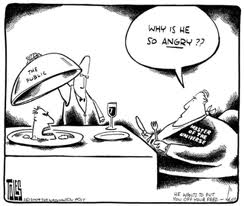
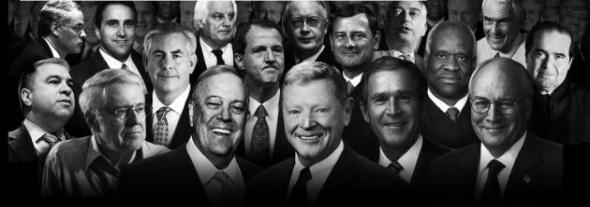
Take a look at the illustration at the top of this post and you’ll see why Bartels is probably right. According to a recently released study (pdf) by Martin Gilins and Benjamin I. Page of Princeton and Northwestern Universities respectively, we are no longer living in a democracy. The U.S. has already become an oligarchy. Sure we knew that already, but now we have confirmation from a scientific study. From BBC News:
[T]he two professors have conducted exhaustive research to try to present data-driven support for this conclusion. Here’s how they explain it:
“Multivariate analysis indicates that economic elites and organised groups representing business interests have substantial independent impacts on US government policy, while average citizens and mass-based interest groups have little or no independent influence.”
In English: the wealthy few move policy, while the average American has little power.
The two professors came to this conclusion after reviewing answers to 1,779 survey questions asked between 1981 and 2002 on public policy issues. They broke the responses down by income level, and then determined how often certain income levels and organised interest groups saw their policy preferences enacted.
“A proposed policy change with low support among economically elite Americans (one-out-of-five in favour) is adopted only about 18% of the time,” they write, “while a proposed change with high support (four-out-of-five in favour) is adopted about 45% of the time.”
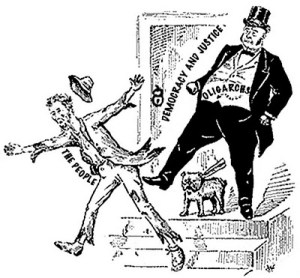
On the other hand, Gilins and Page conclude:
because of the strong status quo bias built into the US political system, even when fairly large majorities of Americans favour policy change, they generally do not get it.…
Americans do enjoy many features central to democratic governance, such as regular elections, freedom of speech and association and a widespread (if still contested) franchise. But we believe that if policymaking is dominated by powerful business organisations and a small number of affluent Americans, then America’s claims to being a democratic society are seriously threatened.
These study’s results reinforce Larry Bartels’ findings about the tendency of white Americans to support the goals of the super rich even when it is not in their own best interest. Another quote from the study via Gawker:
The central point that emerges from our research is that economic elites and organized groups representing business interests have substantial independent impacts on U.S. government policy, while mass-based interest groups and average citizens have little or no independent influence. Our results provide substantial support for theories of Economic Elite Domination and for theories of Biased Pluralism, but not for theories of Majoritarian Electoral Democracy or Majoritarian Pluralism…
Recent research by Larry Bartels and by one of the present authors (Gilens), which explicitly brings the preferences of “affluent” Americans into the analysis along with the preferences of those lower in the income distribution, indicates that the apparent connection between public policy and the preferences of the average citizen may indeed be largely or entirely spurious.
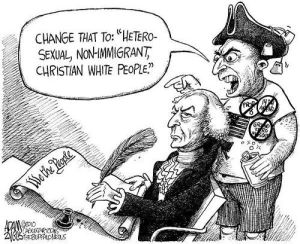
Hamilton Nolan at Gawker:
The theory of Economic Elite Domination is fairly self-explanatory. The theory of Biased Pluralism holds that policy outcomes “tend to tilt towards the wishes of corporations and business and professional associations.” In essence, the researchers found that government policy changes are correlated with the wishes of the wealthy and with interest groups, but not with the wishes of the average American—even though the whole idea of “Democracy” is to ensure that the wishes of the majority tend to carry the day.
The study notes that the position of the median American and the position of the affluent American are often the same; therefore, regular people tend to think that their political interests are being represented when they see the triumph of some political position that they agree with. In fact, the researchers say, this is a mere coincidence. Yes, the average American will see their interests represented—as long as their interests align with the interests of the wealthy.
Yes, it’s extremely depressing, but we have long sensed this and now science has confirmed our intuitions. Now we have to figure out how to change it.
In other news . . .

We haven’t talked much about the disastrous sinking of a ferry loaded with South Korean students and their families. So far 28 people are known to be dead and 268 are still missing–including 246 students. From the Wall Street Journal:
On Monday night, Kim Si-yeon and her family took her mother out for a late birthday dinner. Ms. Kim pushed for a cheap Korean barbecue restaurant and family members say they reluctantly obliged because the young musician and actress was leaving the next day for a four-day high school trip.
The next morning, the father of Cho Eun-jung, another student at the same school, didn’t want to wake his daughter before he left for work. So he cuddled her in his arms and kissed her forehead, he said in an interview.
Student Lee Hye-gyeong later that morning said a quick goodbye to her boyfriend as she left for the bus ride to the ferry port where the three students and more than 300 of their classmates would set sail for a 13-hour journey to Jeju Island, a popular South Korean vacation spot.
An annual trip for high-school juniors from Danwon High School in Ansan, a suburb of Seoul, the trip was designed as a break before the students began intense preparations for college entrance exams next year. Last year’s class was the first to take the boat; in the past, student groups had flown.
What happened next, not long after sunrise on Wednesday morning, has become a national tragedy in South Korea. The students had just finished a breakfast of bulgogi, a Korean beef dish, rice and kimchi when the ferry capsized and sank.
So heartbreaking. From NBC News: South Korea Ferry: 30-Minute Evacuation Delay Trapped Dozens.
A half-hour delay in evacuation orders may have trapped hundreds on board the doomed South Korea ferry, according to new details which emerged Friday about how the disaster unfolded.
A transcript of a ship-to-shore exchange, and interviews with surviving crew members, reveal that the vessel was listing too heavily for passengers to escape by the time the captain issued orders to abandon ship….
Oh Yong-seok, a helmsman on the ferry with 10 years of shipping experience, told The Associated Press that when the crew gathered on the bridge and sent a distress call, the ship was already listing more than five degrees, the critical angle at which a vessel can be brought back to even keel.
The first instructions from the captain were for passengers to put on life jackets and stay where they were, Oh said. A third mate reported that the ship could not be righted, and the captain ordered another attempt, which also failed, Oh said.
A crew member then tried to reach a lifeboat but fell because the vessel was tilting, prompting the first mate to suggest to the captain that he order an evacuation, Oh said.About 30 minutes after passengers were told to stay in place, the captain finally gave the order to evacuate, Oh said, adding that he wasn’t sure in the confusion and chaos on the bridge if the order was relayed to the passengers.
“We couldn’t even move one step. The slope was too big,” said Oh, who escaped with about a dozen others, including the captain.
I guess the old saying that the captain must go down with the ship no longer holds true. There is an arrest warrant out for the captain though. From the WSJ again:
SEOUL—Arrest warrants were issued for the captain and two crew members of the sunken South Korean ferry on Friday, as a crew member confirmed accounts that the captain was among the first to abandon the sinking ship.
In an interview with The Wall Street Journal, crew member Oh Yong-seok, who isn’t a target of an arrest warrant, re-created the chaotic final moments before the ship capsized on Wednesday morning. He said that while members of the crew did abandon the boat, they did everything they could to first evacuate the vessel’s passengers.
The focus on the crew members’ final actions came during a third day of frustration, confusion and tragedy that offered no new breakthroughs in attempts to rescue the nearly 300 passengers who remain missing.
Investigators also didn’t appear to be any closer to understanding why the ship made what it called a “radical right turn” shortly before it began to sink.
In another tragedy, a vice principal who escaped the sinking ferry has committed suicide. First Coast News:
SEOUL – The vice principal rescued from the doomed South Korean ferry has been found hanged, Korean police said Friday.
Out of the ferry’s 475 passengers, 325 had been second year high school students from Danwon High School in Ansan, about 20 miles south of Seoul. They were on a four-day trip to the island of Jeju, a popular South Korean tourist destination.
The vice principal was identified only by his surname, Kang. He was on the island of Jindo, where rescued passengers had taken shelter. A police officer said he was hanging from a tree.
Read more details at the link.
Prepare yourself for another outbreak of Clinton Derangement Syndrome.

The New York Times reports: New Batch of Clinton Documents to Be Released.
The National Archives on Friday was preparing to release its largest batch yet of previously withheld documents from the Clinton administration, with topics to include the conflicts in Somalia and Rwanda, Middle East peace negotiations, the Oklahoma City bombing and public figures like Richard M. Nixon, Steven Spielberg and Oprah Winfrey.
The bundle that is likely to receive the most attention, though, is one that covers Hillary Rodham Clinton’s ill-fated attempt as first lady to overhaul the health care system. Mrs. Clinton, who ran for president in 2008, is considering a second attempt in 2016.
The roughly 7,500 documents — consisting of memos, transcripts, speeches and emails — were to be posted by the Clinton Presidential Library at 1 p.m.
Also from the NYT, the claim that Hillary Clinton Struggles to Define a Legacy in Progress.
It was a simple question to someone accustomed to much tougher ones: What was her proudest achievement as secretary of state? But for a moment, Hillary Rodham Clinton, appearing recently before a friendly audience at a women’s forum in Manhattan, seemed flustered.
Mrs. Clinton played an energetic role in virtually every foreign policy issue of President Obama’s first term, advocating generally hawkish views internally while using her celebrity to try to restore America’s global standing after the hit it took during the George W. Bush administration.
But her halting answer suggests a problem that Mrs. Clinton could confront as she recounts her record in Mr. Obama’s cabinet before a possible run for president in 2016: Much of what she labored over so conscientiously is either unfinished business or has gone awry in his second term.
From Russia’s aggression in Ukraine and the grinding civil war in Syria to the latest impasse in the Middle East peace process, the turbulent world has frustrated Mr. Obama, and is now defying Mrs. Clinton’s attempts to articulate a tangible diplomatic legacy.
Horrors! I guess Hillary should just drop out then (“Why won’t that nasty bitch quit?”). And now that she’s going to be a grandma, she probably should give up all her ambitions and become a babysitter. From The Christian Science Monitor: Chelsea Clinton baby: Will Hillary Clinton be less likely to run in 2016? Would anyone ask that about a man running for president?

There are tons of Hillary headlines today, so I’ll give you a sampling:
NPR: Hillary Clinton’s Presidential Chess Board.
WaPo: Poll: Hillary Clinton’s numbers worst since 2008, as GOP brand surges (Sigh . . . Whatever. 2016 is a long way down the road.)
WaPo: Hillary Clinton says she’s ‘a huge supporter’ of immigration reform.
Bloomberg: Hillary Clinton’s Diplomacy Memoir Will Be Called ‘Hard Choices’
Snarky commentary on the upcoming book by Joe Coscarelli at New York Magazine: Hillary Clinton Wants You to Know That She Faces Very ‘Hard Choices,’ Like, For Instance, Running for President in 2016
So . . . what else is happening out there in the world? Please share your links in the comment thread and have a fantastic Friday!!
Saturday Reads: Dr. Martin Luther King’s Dreams, Waiting for Irene, and Bernanke’s Complaint
Posted: August 27, 2011 Filed under: Barack Obama, Civil Rights, Domestic Policy, Economy, jobs, morning reads, poverty, U.S. Economy, U.S. Politics | Tags: Barack Obama, Ben Bernanke, Cornel West, Federal Reserve Bank, Hurrican Irene, I Have A Dream speech, leadership vacuum, Martin Luther King, media frenzy, oligarchy, revolution 63 Comments
By Mr. Fish, Truthdig.org
Good Morning! We are approaching the 48th anniversary of the March on Washington for Jobs and Freedom (remember those?) and Martin Luther King’s “I have a dream” speech. Perhaps it is fitting that the ceremony to be held tomorrow to commemorate the anniversary has been postponed indefinitely. After all, King’s dream of ending poverty in American has certainly been postponed indefinitely. Ironically, we now have a “Black President” who as different from Dr. King as night from day. Oh, if only King were here today to speak truth to this sorry excuse for a President!
A reminder from the Center for American Progress: Dr. King’s Legacy Relevant in Today’s Budget Battles
In the 1960s, Americans had a government that refused to deliver basic human rights to its people. Over time, after battles in the courts and the political arena, laws such as the Civil Rights Act of 1964 and the Equal Employment Opportunity Act of 1972 were passed. But despite these great accomplishments the fight continued because many Americans of all racial backgrounds were still living below the poverty line.
So in 1967, Dr. King and the Southern Christian Leadership Conference decided to organize and lead the Poor People’s Campaign to combat poverty. The goal was to push Congress to create an “Economic Bill of Rights” that would establish how the federal government would address and solve the country’s poverty issues. It called for full employment, affordable housing, reasonable living wages, and equitable education opportunities for the poor. Momentum built up around the country, but unfortunately the campaign ended early due to the tragic assassination of Dr. King and lack of organization to continue the efforts.
Cornel West had a very appropriate op-ed in the NYT a couple of days ago: Dr. King Weeps From His Grave Here is a relevant excerpt:
The age of Obama has fallen tragically short of fulfilling King’s prophetic legacy. Instead of articulating a radical democratic vision and fighting for homeowners, workers and poor people in the form of mortgage relief, jobs and investment in education, infrastructure and housing, the administration gave us bailouts for banks, record profits for Wall Street and giant budget cuts on the backs of the vulnerable.
As the talk show host Tavis Smiley and I have said in our national tour against poverty, the recent budget deal is only the latest phase of a 30-year, top-down, one-sided war against the poor and working people in the name of a morally bankrupt policy of deregulating markets, lowering taxes and cutting spending for those already socially neglected and economically abandoned. Our two main political parties, each beholden to big money, offer merely alternative versions of oligarchic rule.
The absence of a King-worthy narrative to reinvigorate poor and working people has enabled right-wing populists to seize the moment with credible claims about government corruption and ridiculous claims about tax cuts’ stimulating growth. This right-wing threat is a catastrophic response to King’s four catastrophes; its agenda would lead to hellish conditions for most Americans.
King weeps from his grave. He never confused substance with symbolism. He never conflated a flesh and blood sacrifice with a stone and mortar edifice. We rightly celebrate his substance and sacrifice because he loved us all so deeply. Let us not remain satisfied with symbolism because we too often fear the challenge he embraced. Our greatest writer, Herman Melville, who spent his life in love with America even as he was our most fierce critic of the myth of American exceptionalism, noted, “Truth uncompromisingly told will always have its ragged edges; hence the conclusion of such a narration is apt to be less finished than an architectural finial.”
King’s response to our crisis can be put in one word: revolution. A revolution in our priorities, a re-evaluation of our values, a reinvigoration of our public life and a fundamental transformation of our way of thinking and living that promotes a transfer of power from oligarchs and plutocrats to everyday people and ordinary citizens.
Yes we need a revolution. We desperately need to revise our priorities and values and to end the transfer of wealth and power from the people to the oligarchs. Who will lead that revolution? We have never been more in need of strong, honest, caring leaders and yet we have a complete vacuum of leadership. What is to become of our country?
Of course Hurricane Irene is the more immediate focus and the object of the media sharks’ feeding frenzy for today. Nothing so pedestrian as putting people back to work or ending poverty could interest them. Interestingly, big media seems to be ignoring the fact that the hurricane has weakened significantly and that the eye has collapsed, meaning that there is unlikely to be any more intensification of the storm. I suppose it could still do quite a bit of damage along the coastline, but as a Bostonian I’ve seen so many of these huge storms fail to live up to the hype that I’m skeptical of this one. I hope I’m right this time.
Jeff Masters at Weather Underground yesterday:
Satellite data and measurements from the Hurricane Hunters show that Irene is weakening. A 9:21 am EDT center fix by an Air Force Reserve aircraft found that Irene’s eyewall had collapsed, and the central pressure had risen to 946 mb from a low of 942 mb this morning. The highest winds measured at their flight level of 10,000 feet were 125 mph, which would normally support classifying Irene as a Category 3 hurricane with 115 mph winds. However, these winds were not mixing down to the surface in the way we typically see with hurricanes, and the strongest surface winds seen by the aircraft with their SFMR instrument were just 90 mph in the storm’s northeast eyewall. Assuming the aircraft missed sampling the strongest winds of the hurricane, it’s a good guess that Irene is a mid-strength Category 2 hurricane with 100 mph winds. Satellite imagery shows a distinctly lopsided appearance to Irene’s cloud pattern, with not much heavy thunderstorm activity on the southwest side. This is due to moderate wind shear of 10 – 20 knots due to upper-level winds out of the southwest. This shear is disrupting Irene’s circulation and has cut off upper-level outflow along the south side of the hurricane. No eye is visible in satellite loops, but the storm’s size is certainly impressive. Long range radar out of Wlimington, North Carolina, shows that the outermost spiral bands from Irene are now beginning to come ashore along the South Carolina/North Carolina border. Winds at buoy 41004 100 miles offshore from Charleston, SC increased to 36 mph as of 10 am, with significant wave heights of 18 feet.
And from last night: “Irene continues to weaken.”

Satellite data and measurements from the Hurricane Hunters show that Irene continues to weaken. A 1:32 pm EDT center fix by an Air Force Reserve aircraft found that Irene’s eyewall is still gone, and the central pressure had risen to 951 mb from a low of 942 mb this morning. The winds measured in Irene near the surface support classifying it as a strong Category 1 hurricane or weak Category 2. Satellite imagery shows a distinctly lopsided appearance to Irene’s cloud pattern, with not much heavy thunderstorm activity on the southwest side. This is due to moderate southwesterly wind shear of 10 – 20 knots. This shear is disrupting Irene’s circulation and has cut off upper-level outflow along the south side of the hurricane. No eye is visible in satellite loops, but the storm’s size is certainly impressive. Long range radar out of Wilmington, North Carolina, shows that the outermost spiral bands from Irene have moved ashore over North Carolina. Winds at buoy 41004 100 miles offshore from Charleston, SC increased to 47 mph, gusting to 60 mph at 3 pm EDT, with significant wave heights of 25 feet.
New York City has ordered 250,000 people to evacuate from coastal areas.
New York City officials issued what they called an unprecedented order on Friday for the evacuation of about 250,000 residents of low-lying areas at the city’s edges — from the expensive apartments in Battery Park City to the roller coaster in Coney Island to the dilapidated boardwalk in the Rockaways — warning that Hurricane Irene was such a threat that people living there simply had to get out.
Officials made what they said was another first-of-its kind decision, announcing plans to shut down the city’s entire transit system on Saturday — all 468 subway stations and 840 miles of tracks, and the rest of nation’s largest mass transit network: thousands of buses in the city, as well as the buses and commuter trains that reach from Midtown Manhattan to the suburbs.
Underscoring what Mayor Michael R. Bloomberg and other officials said was the seriousness of the threat, President Obama approved a request from Gov. Andrew M. Cuomo of New York to declare a federal emergency in the state while the hurricane was still several hundred miles away, churning toward the Carolinas. The city was part of a hurricane warning that took in hundreds of miles of coastline, from Sandy Hook, N.J., to Sagamore Beach, Mass.
From what I’ve heard, the Jersey Shore may get hit worse than NYC, but who knows? I know we have a few commenters from NJ, so I hope they will keep us updated on the situation there. In Boston, they are getting warnings about the storm surges for people along the coast and the Cape and islands.
BOSTON — As Hurricane Irene began to batter the Carolina Coast on Friday afternoon, a hurricane warning was issued for Cape Cod, Martha’s Vineyard, New York City and coastal Connecticut.
A tropical storm warning was issued for the North and South shores, and a tropical storm watch was issued for areas of southern New England further inland….
Massachusetts Gov. Deval Patrick declared a state of emergency ahead of the storm. He said he is particularly concerned because Irene will likely take a path through central Massachusetts, with fierce, damage-causing winds and storm surges on the eastern, coastal side of the state, and at least 10 inches of heavy rain leading to flooding to the west.
Here’s a little comic relief. Some ESPN guy (a former golfer) got in trouble for mocking President Obama on Twitter (has the First Amendment been repealed or what?)
ESPN is coming down on Paul Azinger for mocking President Obama on Twitter. The golf analyst tweeted Thursday the commander in chief plays more golf than he does — and that Azinger has created more jobs this month than Obama has.
On Friday ESPN ‘reminded” Azinger his venture into political punditry violates the company’s updated social network policy for on-air talent and reporters.
“Paul’s tweet was not consistent with our social media policy, and he has been reminded that political commentary is best left to those in that field,” spokesman Andy Hall told Game On! in a statement.
ESPN’s Hall would not comment on whether Azinger, who won the 1993 PGA Championship, will be fired, suspended or punished in some way. “We handle that internally,” he said.
In economics news, Ben Bernanke gave his eagerly anticipated speech yesterday, and basically said that the politicians have screwed up the economy and he hopes they won’t completely sink it with their insanely stupid policies based on Reagan era fantasies. If you’re interested, here are a few links to reactions to Bernanke’s speech.
Derek Thompson at The Atlantic: Bernanke: The Debt Ceiling Debate Nearly Broke the Recovery
Andrew Leonard at Salon: Bernanke Declines to Commit Treason
Jenine Aversa at Bloomberg: Bernanke Scholar Advises Bernanke Fed Chief to Be Bold on Monetary Policy
Those are my reading recommendations for today. What are you reading and blogging about?
Thursday Reads
Posted: December 16, 2010 Filed under: morning reads | Tags: Afghanistan, Barack Obama, Black Agenda Report, Bob Feller, Bradley Manning, Glen Ford, Glenn Greenwald, Julian Assange, oligarchy, Peter DeFazio, Reagan Democrats, Torture, Wikileaks 48 Comments
Good Morning!!
I’ll start out with a shocking story that, unfortunately, doesn’t surprise me. Bradley Manning, the young man who is suspected of giving information about U.S. war crimes to Wikileaks, is being exposed to conditions that decent people would call torture. I’ve been worried about the treatment Manning would receive in prison, and have repeatedly said I was afraid he’d be tortured.
Keep in mind that Manning has not been charged with any crime, but has been imprisoned for seven months–the first two months in Kuwait and the rest of the time in Quantico, VA. Glenn Greenwald writes that, although Manning has been a model prisoner, he has been living
under conditions that constitute cruel and inhumane treatment and, by the standards of many nations, even torture. Interviews with several people directly familiar with the conditions of Manning’s detention, ultimately including a Quantico brig official (Lt. Brian Villiard) who confirmed much of what they conveyed, establishes that the accused leaker is subjected to detention conditions likely to create long-term psychological injuries.
[….]
From the beginning of his detention, Manning has been held in intensive solitary confinement. For 23 out of 24 hours every day — for seven straight months and counting — he sits completely alone in his cell. Even inside his cell, his activities are heavily restricted; he’s barred even from exercising and is under constant surveillance to enforce those restrictions. For reasons that appear completely punitive, he’s being denied many of the most basic attributes of civilized imprisonment, including even a pillow or sheets for his bed (he is not and never has been on suicide watch). For the one hour per day when he is freed from this isolation, he is barred from accessing any news or current events programs. Lt. Villiard protested that the conditions are not “like jail movies where someone gets thrown into the hole,” but confirmed that he is in solitary confinement, entirely alone in his cell except for the one hour per day he is taken out.
In sum, Manning has been subjected for many months without pause to inhumane, personality-erasing, soul-destroying, insanity-inducing conditions of isolation similar to those perfected at America’s Supermax prison in Florence, Colorado: all without so much as having been convicted of anything. And as is true of many prisoners subjected to warped treatment of this sort, the brig’s medical personnel now administer regular doses of anti-depressants to Manning to prevent his brain from snapping from the effects of this isolation.
This is a disgrace. President Obama should be hanging his head in shame. But he probably can’t be bothered about little things like torture. He had a big important meeting today with the head honchos of the oligarchy.
Hoping to mend fences with business leaders and spur more hiring, President Obama spent more than four hours with chief executives of 20 major companies in a “working meeting” that both sides said paved the way for better cooperation.
Mend fences?! Obama has pretty much been down on his knees to these guys for years. The super-rich just never get enough, do they? But Obama will keep on endlessly cowering before them in hopes of one day pleasing them.
The session was another step in Obama’s move toward the political center after big Republican gains in last month’s mid-term elections. A year after referring to Wall Street executives as “fat-cat bankers,” Obama is taking a less confrontational approach.
Administration officials have chafed at being labeled anti-business and have been trying to dispel that criticism. They initiated business-friendly moves in recent weeks, such as completing a trade pact with South Korea and making a deal with congressional Republican leaders to extend the Bush-era tax cuts and other tax breaks helpful to U.S. companies.
If Obama moves and further to the “center,” he’s going to fall off the rightward edge of the political spectrum.
The President said he “made progress” in the meeting with the CEOs:
The business leaders, who included UBS AG Chairman for the Americas Robert Wolf and Honeywell International Inc. Chairman David Cote, met with Obama for more than four hours today for a discussion aimed at fostering cooperation and finding ways to spur U.S. economic growth.
“We focused on jobs and investment, and they feel optimistic that by working together we can get some of that cash off the sidelines,” Obama said as he left the session, referring to the almost $2 trillion that he said companies have amassed.
The meeting at Blair House, across Pennsylvania Avenue from the White House, was convened by the president as part of an outreach to business to confer on issues such as education, exports, regulation and the budget deficit. It comes as his administration works to heal a strained relationship with the business community and to collaborate on ways to boost jobs, with the nation’s unemployment rate at 9.8 percent.
I just don’t get all this talk about a “strained relationship” with business. What a bunch of hooey!
The President must have made big promises to the oligarchs at this meeting, because he’s been spending the day making phone calls and whining to Congress critters about how his presidency will be over if they don’t pass his lousy tax-cuts-for-the-rich-bill.
Obama is telling members of Congress that failure to pass the tax-cut legislation could result in the end of his presidency, Rep. Peter DeFazio (Ore.) said.
“The White House is putting on tremendous pressure, making phone calls, the president is making phone calls saying this is the end of his presidency if he doesn’t get this bad deal,” he told CNN’s Eliot Spitzer.
The White House issued a denial after DeFazio’s appearance on CNN. But I believe DeFazio, because he’s not a proven liar like Obama is. What does DeFazio think about Obama’s chances of being reelected?
“…I think this is potentially the end of his possibility of being reelected if he gets this deal,” he said.
Glenn Ford has another must-read post up at Black Agenda Report. Of course you have to read the whole thing, but here’s a sample:
Now that self-proclaimed progressives have passed the point of disenchantment with Barack Obama and entered the stage of active anger at their once-imagined ally, they should quickly take the next step and acknowledge that he is what we at Black Agenda Report have been saying for six years: a right-wing Democrat who has long been aligned with the corporate Democratic Leadership Conference, and whose mission is to expand U.S. empire and put the American state at the service of Wall Street. He has been remarkably successful in both endeavors.
Of necessity, these strategic goals require Obama to wage war against the left hemisphere of his own Party, the main obstacle, in the absence of effective grassroots progressive movements, to forging a grand coalition with Republicans. The president, whom deluded Progressives for Obama hallucinated might become the kind of “transformative” leader that would galvanize Left constituencies into a ready-mix, shake-and-bake “movement,” also sees himself as a transformative figure, but of the opposite kind. He presented his candidacy as the antidote to what he described during the Nevada presidential primary as the “excesses” of the Sixties and Seventies. His reverence for Ronald Reagan is genuine. Indeed, if Obama were not Black, and if his supporters had not been busy getting drunk in a wishing-well, he would have been widely recognized as a stylistically updated Reagan Democrat.
Yup, Obama is transformative alright. He transformed the Democratic Party right out of existence.
Yesterday, The New York Times reported that two classified intelligence reports say that the Afghanistan debacle is getting even worse than anyone knew.
The reports, one on Afghanistan and one on Pakistan, say that although there have been gains for the United States and NATO in the war, the unwillingness of Pakistan to shut down militant sanctuaries in its lawless tribal region remains a serious obstacle. American military commanders say insurgents freely cross from Pakistan into Afghanistan to plant bombs and fight American troops and then return to Pakistan for rest and resupply.
The findings in the reports, called National Intelligence Estimates, represent the consensus view of the United States’ 16 intelligence agencies, as opposed to the military, and were provided last week to some members of the Senate and House Intelligence Committees. The findings were described by a number of American officials who read the reports’ executive summaries.
Robert Greenwald commented on this situation at FDL:
On Thursday, December 16, 2010, the White House will use its December review to try to spin the disastrous Afghanistan War plan by citing “progress” in the military campaign, but the available facts paint a picture of a war that’s not making us safer and that’s not worth the cost.
Let’s take a look at just the very broad strokes of the information. After more than nine years and a full year of a massive escalation policy:
– the insurgency continues to gain in size and strength,
– more U.S. troops are dying than ever,
– more civilians are dying than ever,
– violence in the country continues to spike,
– Pakistan is playing a double game with the U.S. and
– the military strategy lacks credible prospects for a turnaround.And yet, we are told we can expect a report touting security gains and “progress,” and that there’s virtually zero chance of any significant policy change from this review. It sort of begs the question: just what level of catastrophe in Afghanistan would signal that we need a change in direction?
That’s a very good question. We need to get the hell out of Afghanistan, Iraq, and Yemen ASAP.
According to The New York Times, the U.S. hopes to develop conspiracy charges against Wikileaks editor Julian Assange.
Justice Department officials are trying to find out whether Mr. Assange encouraged or even helped the analyst, Pfc. Bradley Manning, to extract classified military and State Department files from a government computer system. If he did so, they believe they could charge him as a conspirator in the leak, not just as a passive recipient of the documents who then published them.
Among materials prosecutors are studying is an online chat log in which Private Manning is said to claim that he had been directly communicating with Mr. Assange using an encrypted Internet conferencing service as the soldier was downloading government files. Private Manning is also said to have claimed that Mr. Assange gave him access to a dedicated server for uploading some of them to WikiLeaks.
I’m sure they’ll figure out some trumped up charges, since the U.S. no longer operates under the rule of law.
From Raw Story, some TSA news:
Adrienne Durso, a resident of California, was selected for an enhanced pat-down after walking through a metal detector at Albuquerque International Sunport airport, according to a lawsuit.
Durso, a recent breast cancer survivor, said the TSA security officer forcefully searched the area of her recent mastectomy, leaving her in pain and on the verge of crying.
[….]
When her son [age 17] confronted a security supervisor about the incident, asking why his mother had been selected for a pat-down but not him, the supervisor allegedly replied that the son was not selected because “you don’t have boobs.”
After her experience, Durso joined three other plaintiffs in a lawsuit against Homeland Security Secretary Janet Napolitano and TSA administrator John Pistole.
Nice, huh?
Finally, baseball fans will be saddened to learn that Hall of Fame pitcher Bob Feller has died. He was 92.
Bob Feller, who came off an Iowa farm with a dazzling fastball that made him a national celebrity at 17 and propelled him to the Hall of Fame as one of baseball’s greatest pitchers, died Wednesday at a hospice. He was 92.
[….]
Joining the Cleveland Indians in 1936, Feller became baseball’s biggest draw since Babe Ruth, throwing pitches that batters could barely see — fastballs approaching 100 miles an hour and curveballs and sinkers that fooled the sharpest eyes. He was Rapid Robert in the sports pages. As Yankees pitcher Lefty Gomez was said to have remarked after three Feller pitches blew by him, “That last one sounded a little low.”
A high-kicking right-hander, Feller was a major league phenomenon while still in high school in Van Meter, Iowa. His debut as an Indians starter, during his summer vacation, was spectacular: he struck out 15 batters.
Three weeks later he struck out 17, tying Dizzy Dean’s major league record. He pitched a no-hitter, the first of three in his 18-year career, when he was 21. (He went on to throw an astonishing 12 one-hitters.) He had more than 100 victories at age 22.
Feller was truly one of the greats.
Sooooo… what are you reading this morning?

 peej
peej Carissa
 bostonboomer
 dakinikat
 ecocatwoman
 mablue2
 Mama Lopez
 peggysue22
 quixote
 skydancingguestblogger
 Mona (aka Wonk the Vote)



 Sky Dancing
Recent Comments