
Tuesday Reads: Occupy Boston, Occupy Wall Street, and a Modern Day Whisky Rebellion
Posted: October 4, 2011 Filed under: Economy, morning reads, U.S. Economy, U.S. Politics | Tags: American Revolution, Boston Tea Party, civil liberties, NYPD, Occupy, Occupy Los Angeles, occupy Wall Street, Whiskey Rebellion 35 Comments
Good Morning!! Today I want to focus on articles about Occupy Wall Street protests, which despite the critiques of those on both the right and left, are still going on in NYC and many other U.S. cities, including Boston, I’m happy to say. The Boston Phoenix has a blog to document the protests. On September 28, Chris Faraone wrote:
At this early juncture it’s already safe to say that Occupy Wall Street has succeeded. I’m not being sarcastic. Yesterday I wrote about the media storm that’s showered their protests from early on, and that’s rained down even harder since the New York Police Department began brutalizing demonstrators. And after last night’s Occupy Boston meeting on the Common, I’m convinced that the hordes have achieved something even greater than attracting press: regardless of what they actually accomplish in the end, Occupy has already become the hottest protest franchise since the Tea Party. Which is why it makes sense that contrarian Boston is emerging as the first city to strike while the brand is hot.
Last night’s kickoff meeting was at least a testament to the popularity of this movement. People have been angry for some time, but for many it was Occupy that motivated them – not the countless other protests that take place every week around here. Roughly 300 showed –with a significant number of reporters on the scene documenting –despite the event having been announced less than a day ahead of time, and almost exclusively through social media (Steve Annear, who you should follow on Twitter if you’re keeping tabs on the actions, also broke the story in the Metro). By a show of hands, a few dozen folks on the Common got their feet wet in Liberty Square during the first stretch of Occupy Wall Street. But for the most part, these were people – mostly young, but overall from a mix of backgrounds, ages, and ethnicities – who’d become interested by what they’d seen online and in the news.

Occupy Boston meeting on Boston Common
The Guardian even published an article about the Boston organization:
There were socialists, anti-poverty campaigners, students, anarchists, computer hackers, the unemployed, and workers ranging from a vet to an accountant.
And, numbering around 200 and meeting to plot until late in the night, a group of Bostonians have decided to recreate the anti-Wall Street protests that are gripping New York.
Unlike previous attempts, such as a march that fizzled out in Chicago with just 20 people, the people behind Occupy Boston showed a strong dose of media savvy and organisational skill on Monday night, as they drew a committed crowd of volunteers to their cause: to occupy a slice of the city. Local TV crews were in attendance at the evening mass planning meeting, and it had been flagged on the front pages of Boston’s newspapers.
The move raises the first serious prospect of the Wall Street protests spreading beyond New York and comes as other events are also being planned in Los Angeles and Washington.
Noam Chomsky even made a youtube video of support.
This thing is really growing. Could it be that the young people of this country are really going to stand up and fight? I sure hope so. Is this happening where you live? If so, please share what you know. I’m starting to get excited about this!
Getting back to the New York protests, Emptywheel had a post today on the NYPD and their history of violations of civil liberties. I’m not going to excerpt from it, because you really need to read the whole thing–it’s not very long.
At FDL, David Dayen has a post about Van Jones’s Take Back the American Dream organization and how it is “building off #Occupy Wall Street.”
The Campaign for America’s Future expected their conference to be a launching pad for an American Dream Movement that would be a counterpart to the Tea Party, a left populist movement that would branch out across the country. And that movement has built itself up over the past couple months, and was in part responsible for the invisible town hall revolution over August.
But CAF found itself caught by an organic protest movement, a disparate movement organized by a simple theme, an expression of the feeling of mass injustice. Nobody on the left was totally prepared for #OccupyWallStreet, which sprung up on its own. But the groups that have been organizing in similar ways and with a similar theme were more than prepared to support it.
The spirit of #OccupyWallStreet has given a booster shot to this Take Back the American Dream Conference, which last year was completely moribund. The first session at the conference was a paean to #OccupyWallStreet, with video from New York City (the live feed crashed, unfortunately) and even one organizer who camped out in Zuccotti Park speaking. “If we demand something from Wall Street, we’re telling them that they have the power, but we do,” said the organizer from the Working Families Party in New York.
“They went down there to the scene of the crime against our future,” said Van Jones at his keynote address, in admiration of the #OccupyWallStreet protesters. “They’ve been beaten, they’ve been pepper sprayed, they’ve been falsely arrested, but they never broke their discipline. They told the police officers who were arresting them, we are the 99%, we’re fighting for you, we’re fighting for your pensions too.”
“Something’s happening in America. Don’t you give up on this movement!” Jones concluded.
Yes, something is finally happening. Will it continue to grow? I sure hope so!
I also want to call your attention to an interesting piece at Salon by William Hogeland, author of three books on the revolutionary period in American history. Hogeland compares the Occupy Wall Street movement to the so-called Whisky Rebellion. Hogeland writes about radical protests movements against our founding fathers, who were, after all, the elites of their day. Here’s just a sample:
The difficulty in dealing with our founding battle for democratic economics arises in part because the movement was not against England but against the very American banking and trading elites who dominated the resistance to England. That complicates our founding myth, possibly unpleasantly. Also, it was a generally losing battle. With ratification of the Constitution, Hamiltonian finance triumphed, and people looking to Jefferson and Madison for finance and economic alternatives to Hamilton are barking up the wrong tree, since what those men knew, or even really cared, about finance could be written on a dime. (Anyway, in pushing for creating a nation, Madison supported Hamiltonian finance down the line. Their differences came later.) When Occupy Wall Street protesters say “It’s We the People!” they’re actually referring to a preamble, intending no hint of economic democracy, to a document that was framed specifically to push down democratic finance and concentrate American wealth for national purposes. Not very edifying, but there it is.
The Tea Party, meanwhile, has taken up founding economic issues from a right-wing point of view, associating itself with the upper-middle-class Boston patriots (often mistaken for populist democrats) who led a movement against overrreaching British trade acts in the 1760′s and were important to the impulse toward American independence. I’ve written fairly extensively about where and how I think the Tea Party goes wrong on the history of the founding period. But at least they’re framing their objections to current policy, and framing the historical roots of their ideas, not mainly in cultural but in economic terms.
Like it or not, though, it is Occupy Wall Street that has the most in common, ideologically, not with those Boston merchants and their supporters but with the less well-known, less comfortably acknowledged people who, throughout the founding period, cogently proposed and vigorously agitated for an entirely different approach to finance and monetary policy than that carried forward by the famous founders. Amid horrible depressions and foreclosure crises, from the 1750′s through the 1790′s, ordinary people closed debt courts, rescued debt prisoners, waylaid process servers, boycotted foreclosure actions, etc. (More on that here and here.) They were legally barred from voting and holding office, since they didn’t have enough property, so they used their power of intimidation to pressure their legislatures for debt relief and popular monetary policies. Their few leaders in legit politics included the visionary preacher Herman Husband, the weaver William Findley, and the farmer Robert Whitehill.
I found this article absolutely fascinating!
At the LA Times, there’s an editorial about the “message” of the “Occupy” protests along with a photo of protesters at LA City Hall.
The political left has been searching for the last couple of years to find an answer to the tea party. Some hoped last year’s rally in Washington led by TV comedians Jon Stewart and Stephen Colbert, a response to right-wing rallies attended by such conservative media celebrities as Glenn Beck, would spark a national movement. That didn’t happen. Now they’re pinning their hopes on Occupy Wall Street, which in many ways is a mirror image of the tea party. Both groups are motivated by frustration over the rotten economy and are vague about causes and solutions, though if their positions could be summed up in a one-line manifesto, it might be: The tea party, dominated by elderly conservatives, blames government overspending and overreach for our economic problems and would therefore like to cut federal spending, while Occupy Wall Street, dominated by young liberals, blames corporate greed and would therefore like to tax the rich and decrease corporate political power.
It is, of course, far too early to suggest that Occupy Wall Street represents a resurgence of the left. But we do seem to recall that in its initial days the tea party was similarly dismissed by pundits, especially those on the left who preferred to see the protesters as kooks rather than the vanguard of a political shift. What matters isn’t the size of the protest, the attire of the demonstrators or the misspellings on their signs; it’s whether the relatively tiny number of people who can be bothered to show up and march can inspire and energize other like-minded people enough to get them to the polls.
Finally, at Huffpo, there’s a piece by Judith Samuelson: A Baby Boomer’s Advice to the Millennials Occupying Wall Street
Whether their disgust with Wall Street is fueled by a lack of jobs or a more complex analysis was not apparent to me, but I trust we will be hearing more from the Millennials. Scholars are suggesting they will be a force to be reckoned with. In fact, you might already be experiencing their tendency to want to be heard in the workplace, in the classroom or at the dinner table, for example.
There are a lot of them; 90 million by some count, comprising the largest generation in our history. They are the most racially diverse generation ever, and they have been, and are being, shaped by remarkable events such as 9/11 and the ongoing global recession; by their parents — the boomers of yore; and, of course by technology — the first generation to take instant communications for granted. I believe that Millennials will shape our response to issues that bedevil us — through their passion about social issues, their facility with technology and social networking, and through their continued willingness to vote — as they did in big numbers in the last Presidential election.
Many of them will go to business school — or are already there. A quarter of post-graduate degrees are in business, and 20 percent of undergraduates are pursuing business degrees. Even at liberal arts colleges that may not offer “business” as a major, students flock to economics instead, or as close as they can get to the subject. This may be the result of parental pressure to exit school with some hope of finding a job (unlike baby boomers, Millennials are close to their parents and apparently even listen to them) but it is also in pursuit of the skills, language and heroes they have grown up with — more Steve Jobs and Mark Zuckerberg than Bob Dylan and Robert Redford.
The question I have been thinking about is how they will bridge these two worlds — passion for social issues, and comfort with technology and business. I know from experience that real change is hard; that to influence business, and Wall Street, requires people skills as well as analytics, patience, and multiple approaches to gain the attention and commitment of the power brokers who set the rules and design the reward systems. Protest is a not an insignificant part of the puzzle, however, and always has been; just ask Walmart, Nike or Nestle.
In the spirit of Baby Boomers’ sharing their experience, strength, and hope with the Millennials, here’s a boomer anthem that might be appropriate:
What are you reading and blogging about today? Please share!
Friday Reads
Posted: September 30, 2011 Filed under: 2012 presidential campaign, Catfood Commission, collective bargaining, Congress, financial institutions, Health care reform, Labor unions, morning reads, Republican politics, Republican presidential politics, SCOTUS | Tags: Bachmann running out of campaign funds, budget cuts, Collin Woodard, GOP spending cut priorities, Labor Unions, Mortgage modification mess, occupy Wall Street, SCOTUS and the health care reform law, US regions 18 Comments Good Morning!
I can hardly believe we’re headed into the last quarter of 2011. Such a year we’ve had!
So, the GOP is going after some of the things for which I will happily contribute tax dollars. They’ve got some pretty whacked values as far as I’m concerned.
Setting a collision course with Democrats that could drag out for months, House Republicans on Thursday unveiled plans to cut federal money for job training, heating subsidies and grants to better-performing schools.
The draft measure for labor, health and education programs also seeks to block implementation of President Barack Obama’s signature health care law, cut off federal funds for National Public Radio and Planned Parenthood, and reduce eligibility for grants for low-income college students.
Democrats and tea party Republicans opposed the bill, blocking it from advancing through even the easy initial steps of the appropriations process on Capitol Hill. Instead of moving through the Appropriations Committee and the House as a whole, the $153 billion measure is instead expected to be wrapped into a larger omnibus spending bill this fall or winter that would fund the day-to-day operating budgets of Cabinet agencies.
Negotiations between Republicans controlling the House, the Democratic Senate and the White House are sure to be arduous. The measure is laced with conservative policy “riders” opposed by Democrats that would affect worker protections under federal labor laws and block the Education Department from enforcing rules on for-profit colleges that are often criticized for pushing students to take on too much debt.
“It looks like we’re in for a long, difficult process,” said Rep. Rosa DeLauro, D-Conn.
House Appropriations Committee Chairman Harold Rogers, R-Ky., said excessive and wasteful spending over the years had put many programs and agencies on “an irresponsible and unsustainable fiscal path.”
Actually all of those Dubya Tax cuts and wars and letting Wall Street Run amok with speculation instead of investment is what put us on that “irresponsible and unsustainable fiscal path” and most of them voted for all of it. I’m not willing to bail out any more of their donor base with my hard earned dollars by defunding the future of our children. What on earth can we do about these evil people and the feckless dems that won’t fight them?
The court fights over the new health care law have been stepped up and SCOTUS has come into play in a big way. Which of the justices are likely to uphold AEIcare-cum-ChafeeCare-cum-DoleCare-cum-RomneyCare-cum-Obamacare?
The four more liberal justices on the court — Ruth Bader Ginsburg, Stephen Breyer and Obama appointees Sonia Sotomayor and Elena Kagan — should have no trouble reading the Constitution as bestowing broad powers on the federal government to regulate all manner of commerce. Although the court in recent years has pinched back congressional efforts to use the Commerce Clause to promulgate laws prohibiting guns near schools and those targeting violence against women, these were clearly non-commercial activities and quite different from the health-care law and its regulation of the medical insurance marketplace. Stronger and more directly applicable precedents remain, in which the court blessed the government’s regulation of wheat and marijuana production because these activities had an impact on interstate commerce.
The marijuana case (known formally as Gonzales v. Raich) may be particularly important because two of the more conservative justices — Antonin Scalia and Anthony Kennedy — joined with their more liberal colleagues to uphold the law under the government’s Commerce Clause powers.
Chief Justice John G. Roberts Jr. and Samuel A. Alito — both George W. Bush appointees — shouldn’t be counted out either. Roberts and Alito joined an opinion in 2010 that recognized the government’s “broad authority” to enact a civil detention scheme for sexual predators under a different constitutional provision. This provision allows federal lawmakers “to make all laws which shall be necessary and proper” to uphold the powers assigned to Congress — including the power to regulate interstate commerce.
Michelle Bachmann’s campaign is running out of cash. Even the NY Post thinks she may not make it to the Iowa Caucuses.
Will Michele Bachmann make it to Iowa? Insiders are whispering that the Tea Party darling’s financials are grim and she may be out of the race before she makes it to the Iowa caucus in February, even though she has a strong base in the state. Sources tell us say Bachmann’s skeletal staff are holding their collective breath until the deadline to disclose her fundraising report on Oct. 15. Meanwhile, we hear a computer vendor has called her campaign headquarters threatening to shut down the power due to an outstanding bill. Sources say she had about $400,000 at the beginning of September, but also stacks of bills. “She does not like to ask for money. She should have been focusing on big donors about three months ago,” a source said. “She’s only cultivated low dollar donors with direct mailings and that’s hurt her.” But at a rally in Virginia yesterday, Bachmann declared that she does not intend to back out of the race. “We intend to be the comeback kid in this race,” she said. Her rep said, “None of that is true.”
There’s a two part series at Bloomberg written by Collin Woodard on how the U.S. is really a country of regions. Part One is here. Part Two is here. It’s a really interest read and something I have thought about for some time as I’ve tried to find some place in this country where I can live in peace. For one, I’m trying to leave any region that’s described as bible buckle, bible belt, or bible anything!
Forget the state boundaries. Arbitrarily chosen, they often slash through cohesive cultures, creating massive cultural fissures in states like Maryland, Oregon and New York. Equally burdensome are the regional designations with which we try to analyze national politics — the Northeast, West, Midwest and South. They’re illusions masking the real forces driving the affairs of our sprawling continent: the 11 regional cultures of North America.
These 11 nations — Yankeedom, Tidewater, New Netherland, New France, Deep South, Greater Appalachia, the Midlands, First Nation, the Far West, the Left Coast, El Norte — have been hiding in plain sight throughout our history. You see them outlined on linguists’ dialect maps, cultural anthropologists’ maps of material culture regions, cultural geographers’ maps of religious regions, campaign strategists’ maps of political geography and historians’ maps of the patterns of settlement across the continent. I’m not the first person to have recognized the importance of these regional cultures. In 1969, Kevin Phillips, then a Republican campaign strategist, identified the distinct boundaries and values of several of these nations and used them to accurately prophesize the Reagan Revolution in his “Emerging Republican Majority,” a political cult classic.
More and more groups are joining the move to take on and occupy Wall Street. The New York Transportation Workers are the latest to announce they will join the protest today.
Occupy Wall Street has been picking up some decent support from unions in the past few days. Yesterday we reported that the Teamsters Union declared their support for protestors, and we also found out that the United Pilots Union had members at the protest demonstrating in uniform.
Today we learned the Industrial Workers of the World put a message of support on their website as well.
UPDATE: Verizon union workers have joined the protestors in NYC.
McClatchy reports that mortgage modification are still a mess even after four years. Quelle surprise!
Today there are at least 4.2 million homeowners who, like Palomo, are late on their mortgage payments or somewhere in the delinquency and foreclosure process. The first wave of foreclosures came during the 2008 financial crisis as subprime mortgages given to weak borrowers imploded. Now the subsequent economic downturn and high unemployment keep housing depressed.
The administrations of George W. Bush and Barack Obama both offered incentives for lenders to help homeowners modify their mortgages. Those efforts haven’t achieved much.
And four years into the housing crisis, banks and their bill collectors, known as mortgage servicers, are still under fire for their response to troubled borrowers.
“I would say they are somewhat better than they were three years ago, but still woefully inadequate to meet the demand, given the still remarkably high levels of distressed borrowers they are attempting to deal with,” said Paul Leonard, director of the California office of the Center for Responsible Lending, a Durham, N.C.-based advocacy group.
From December 2009 through June, more than 1.6 million government-backed mortgage modifications had been started, but only 791,000 became permanent. These numbers remain well below the goal of 4 million modifications that the Obama administration set for itself.
That should give you a few juicy bits to chew on with some coffee!! What’s on your reading and blogging list today?
Thursday Reads: Obama and CBC, Judging Protesters, Net Neutrality, SCOTUS, and Sly Stone
Posted: September 29, 2011 Filed under: Barack Obama, Black Agenda Report, Health care reform, Human Rights, Media, morning reads, net-neutrality, SCOTUS, the blogosphere, The Media SUCKS, U.S. Economy, U.S. Politics, Violence against women | Tags: Congressional Black Caucus, FCC, individual mandate, net neutrality, occupy Wall Street, progressives, Sly and the Family Stone, Sly Stone, U.S. Supreme Court 23 Comments
Good Morning!! Let’s start out with a little fire and brimstone. Glen Ford had a rousing rant at the Black Agenda Report about Obama’s disgusting treatment of the CBC last weekend. Here’s just a sample:
…in the same week that he bowed down to Israeli Prime Minister Benjamin Netanyahu before the assembled nations of the world, in New York City, Obama took his church voice to the Congressional Black Caucus annual awards dinner to very pointedly demand that Blacks stop bugging their president about the economic catastrophe that has befallen them, and his own role in it. “Take off your bedroom slippers. Put on your marching shoes,” Obama hectored. “Shake it off. Stop complainin’. Stop grumblin’. Stop cryin’. We are going to press on. We have work to do.”
Black Caucus chairman Rep. Emanuel Cleaver had earlier told reporters, “If Bill Clinton had been in the White House and had failed to address this [Black unemployment] problem, we probably would be marching on the White House.” But Obama came to lay down the law: any marching that you might do will be for my re-election.
The well-oiled crowd cheered….
The Black Caucus, as a body, meekly murmured and mumbled as the administration transferred the equivalent of the U.S. gross domestic product to the banks while Black America disintegrated. Now, with Obama’s numbers falling, he has very publicly commanded them to shut up and perform what he believes is their only legitimate function: to get him re-elected. In the looming contest, he will again resort to Black-baiting whenever it is useful to shore up white support. In that – as with his foreign and domestic policies – Obama is no different than white corporate politicians. His one great distinction, is to have a core constituency that cares more for his security and dignity, than their own.
Sad but true.
In yesterday’s morning post, Minx highlighted the way so many “progressives” are criticizing Occupy Wall Street for all kinds of irrelevant reasons. Glenn Greenwald wrote a very good piece about it: What’s behind the scorn for the Wall Street protests? But I especially liked Kevin Gosztola’s piece at FDL.
Traditional media have characterized the plurality of voices and the number of issues the occupation is seeking to challenge as a weakness. Establishment media has been openly condescending. Ginia Bellafante’s report in the New York Times has generated significant attention for her focus on the fact that some “half-naked woman” who looks like Joni Mitchell to her is the leader of this movement of “rightly frustrated young people.” Bellafante accuses the protesters of lacking “cohesion” and “pantomiming progressivism rather than practice it knowledgeably.” NPR reiterated NYT’s focus on the “scattered nature of the movement” in its coverage of the occupation (and tellingly used a photo of a man holding a sign that reads “Satan Controls Wall St”). Local press have treated the occupiers as if they are a tribe or a group of nomads focusing on occupiers’ behavior instead of trying to understand the real reason why people are in the park.
Liberals have shown scorn, too, suggesting the occupation is not a “Main Street production” or that the protesters aren’t dressed properly and should wear suits cause the civil rights movement would not have won if they hadn’t worn decent clothing.
The latest show of contempt from a liberal comes from Mother Jones magazine. Lauren Ellis claims that the action, which “says it stands for the 99 percent of us,” lacks traction. She outlines why she thinks Zuccotti Park isn’t America’s Tahrir Square. She chastises them for failing to have one demand. She claims without a unified message police brutality has stolen the spotlight. She suggests the presence of members of Anonymous is holding the organizers back writing, “It’s hard to be taken seriously as accountability-seeking populists when you’re donning Guy Fawkes masks.” And, she concludes as a result of failing to get a cross-section of America to come out in the streets, this movement has been for “dreamers,” not “middle class American trying to make ends meet.”
First off, nobody in the last week can claim to be reporting on Occupy Wall Street and genuinely claim it isn’t gaining traction. Ellis conveniently leaves out the fact that Occupy Wall Street is inspiring other cities to get organized and hold similar assemblies/occupations. Second, if the protesters did have one demand, does Ellis really think that would improve media coverage? Wouldn’t pundits then be casting doubt on whether the one demand was the appropriate singular demand to be making? Third, so-called members of Anonymous are citizens like Ellis and have a right to participate in the protest. It is elitist for Ellis to suggest Occupy Wall Street should not be all-inclusive. And, finally, there is no evidence that just “dreamers” are getting involved. A union at the City University of New York, the Industrial Workers of the World, construction workers, 9/11 responders and now a postal workers and teachers union have shown interest in the occupation.
Gosztola is a young guy who replaced Emptywheel after she left FDL. He focuses on human rights issues, and he does a nice job.
It’s interesting that the progs keep comparing the Occupy Wall Street protesters to those in Civil Rights Movement of the ’50s and ’60s, claiming that protesters should wear suits! Obviously these “very serious” yuppie bloggers don’t recall the ’60s anti-war movement. I can just imagine their shock at some of the outfits we wore in those days.
The New York Times published an odd interpretation of the world-wide protest phenomenon that minimized demonstrations: As Scorn for Vote Grows, Protests Surge Around Globe, by Nicholas Kulish. Kulish explains the protests as disillusionment with voting. And why shouldn’t we all be turned off by voting when it gets us nothing but a bunch of corrupt, greedy a$$holes who stab taxpayers in the back repeatedly and suck up to the top 1%?
Not surprisingly, there is only one reference to the anti-Wall Street protests, and the organizers, Occupy Wall Street aren’t mentioned at all. Also not mentioned are the supportive protests beginning in other U.S. cities. And Kulish never mentioned Wisconsin at all!
Last week the FCC announced new net neutrality rules, and now lawsuits from both sides of the issue are starting.
Verizon and Metro PCS, both wireless carriers, had already made clear their intention to sue and were widely expected to be the first to do so. Instead, they were beaten to court by the activist group Free Press—one of the strongest supporters of network neutrality.
Free Press has asked a federal appeals court to review the FCC’s rules—not because it finds them too strong, but because it finds them too weak. The group particularly objects to the way in which wireless companies are exempted from most of the meaningful anti-discrimination policies in the rules. While wireless operators can’t block Internet sites outright, and can’t simply ban apps that compete with their own services, they can do just about anything else; wired operators can’t.
Free Press complains about the “decision to adopt one set of rules for broadband access via mobile platforms and a different set of rules for broadband access via fixed platforms.” The distinction, it says, is “arbitrary and capricious” and it violates the law.
In a statement, Free Press Policy Director Matt Wood said, “Our challenge will show that there is no evidence in the record to justify this arbitrary distinction between wired and wireless Internet access. The disparity that the FCC’s rules create is unjust and unjustified. And it’s especially problematic because of the increasing popularity of wireless, along with its increasing importance for younger demographics and diverse populations who rely on mobile devices as their primary means for getting online.
Here is a summary of the final FCC rules, from Connected Planet:
The FCC highlighted a total of four rules, which specify that:
— A person engaged in the provision of broadband Internet access service shall publicly disclose accurate information regarding the network management practices, performance and commercial terms of its broadband Internet access services sufficient for consumers to make informed choice regarding use of such services and for content, application, service and device providers to develop, market and maintain Internet offerings
— A person engaged in the provision of fixed broadband Internet access service . . . shall not block lawful content, applications, services or non-harmful devices, subject to reasonable network management.
— A person engaged in the provision of fixed broadband Internet access service . . . shall not unreasonably discriminate in transmitting lawful network traffic over a consumer’s broadband Internet access service.
— A person engaged in the provision of mobile broadband Internet access service, insofar as such person is so engaged, shall not block consumers from accessing lawful websites, subject to reasonable network management; nor shall such person block applications that compete with the provider’s voice or video telephony services, subject to reasonable network management.
A DIY glass partition designs is taking into account of the particular architecture and technology of the future service.” Furthermore, if you’re interested to know the seo site architecture guide, visit templatemonster.com
I’m sure you’ve heard that the Justice Department has asked the Supreme Court to rule on the health care law ASAP. Dalia Lithwick at Slate had an interesting article on the case: The Supreme Court is less interested in ruling on Obama’s health care law than you think.
Apparently the Obama administration believes that 2012 will not be crazy enough already. That would explain why it has decided not to appeal a ruling from a three-judge panel of the 11th Circuit Court of Appeals striking down the individual mandate at the heart of its health reform law. Instead of asking the full, 11-member court to hear the case, the administration has voluntarily cleared the path toward the Supreme Court as early as this spring. That means there could be a ruling by the end of June, just a few months before the election.
Right now the individual mandate has been upheld, by a 2-1 margin by the Sixth Circuit and struck down 2-1 at the 11th Circuit, while the Virginia lawsuit challenging the act was dismissed on procedural grounds at the Fourth Circuit. This split between the federal appeals courts almost demands that the high court agree to hear the case, as does the fact that it’s the Justice Department filing the appeal.
Lithwick discusses the opinions of other writers on why the administration is doing this now. Then she offers her own assessment:
I remain unsure that there just are five justices at the high court eager to have the court itself become an election-year issue. I don’t think Chief Justice John Roberts wants to borrow that kind of partisan trouble again so soon after Citizens United, the campaign-finance case that turned into an Obama talking point. And I am not certain that the short-term gain of striking down some or part of the ACA (embarrassing President Obama even to the point of affecting the election) is the kind of judicial end-game this court really cares about. Certainly there are one or two justices who might see striking down the ACA as a historic blow for freedom. But the long game at the court is measured in decades of slow doctrinal progress—as witnessed in the fight over handguns and the Second Amendment—and not in reviving the stalled federalism revolution just to score a point.
That’s why I suspect that even if there are five justices who believe the individual mandate is unconstitutional, there probably aren’t five votes to decide that question in this instant. Lyle Denniston over at Scotusblog reminds us that the court has a lot of options to forestall a showdown with the president. If the justices opt to consider the technical question raised at the Fourth Circuit—about who has legal standing to challenge the mandate in the first place—the court could dodge the constitutional question altogether until 2015, when the first penalties will be paid. It’s not so much a matter of the court having to decide whether to bring a gavel to a knife fight. It’s just that this isn’t really this court’s knife fight in the first place.
Roman Polanski is back in the news, because he supposedly “apologized” to the woman he raped when she was only 13.
In a documentary about his life, the Oscar-winning director, 78, admitted Samantha Geimer had been left scarred by his exploitation three decades ago. The Polish-French film maker publicly apologised for the first time for his “mistakes” that included the sexual attack on Mrs Geimer, now 47.
The director of Rosemary’s Baby and Chinatown admitted she was a “double victim” after being caught up in the subsequent media storm, forcing her to move to Hawaii for privacy.
The married mother-of-three successfully sued him and accepted a private apology in 2009, saying she had been left more traumatised by ensuing legal battles to bring him to justice than the assault itself.
Finally, here’s another celebrity story: According to the New York Post, 1960s rock star Sly Stone is homeless, living in a van in L.A.
Today, Sly Stone — one of the greatest figures in soul-music history — is homeless, his fortune stolen by a lethal combination of excess, substance abuse and financial mismanagement. He lays his head inside a white camper van ironically stamped with the words “Pleasure Way” on the side. The van is parked on a residential street in Crenshaw, the rough Los Angeles neighborhood where “Boyz n the Hood” was set. A retired couple makes sure he eats once a day, and Stone showers at their house. The couple’s son serves as his assistant and driver.
Inside the van, the former mastermind of Sly & the Family Stone, now 68, continues to record music with the help of a laptop computer.
“I like my small camper,” he says, his voice raspy with age and years of hard living. “I just do not want to return to a fixed home. I cannot stand being in one place. I must keep moving.”
It’s a pretty nice van, BTW. But the LA Times says if Stone is homeless, it’s his own choice.
If Sly Stone is homeless, it’s by choice and not necessity, according to sources close to the funk legend.
Stone’s attorney Robert Alan has supposedly rented a four-bedroom home in Woodland Hills for his client, one unnamed source told Showbiz411 exclusively. “He’s too paranoid to come inside,” another source told writer Roger Friedman. That person was described as a friend of the singer.
Though Alan wouldn’t comment on the rental house, Friedman said, the lawyer confirmed that Sly Stone documentarian Willem Alkema had paid the singer $5,000 upfront for a recent interview. (An additional $2,000, source unknown, was reportedly paid when the story was picked up.) Alkema, whom Friedman says is trying relaunch his documentary and could benefit from the publicity, co-wrote Sunday’s “Sly Stone Is Homeless and Living in a Van” article for the New York Post.
That’s not to say Stone hadn’t admitted struggling with drugs, nor that he isn’t in financial trouble of the maybe-a-$50-million-lawsuit-will-fix-it variety — he sued former manager Jerry Goldstein in early 2010, alleging fraud and the diversion of $20 million to $30 million in royalties.
I’m just glad to know that Sly is still with us. What a great band he had. I remember seeing Sly and the Family Stone at an outdoor concert at Harvard Stadium–I think it was in 1969. It was fabulous! So in honor of Sly and nostalgia…
So…. what are you reading and blogging about today?
Tuesday Reads
Posted: September 27, 2011 Filed under: 2012 presidential campaign, Barack Obama, Democratic Politics, U.S. Economy, U.S. Military, U.S. Politics | Tags: Arch West, civil right violations, Dead Sea Scrolls, Deputy Inspector Anthony V. Bologna, Doritos, Gallup poll, government shutdown, jobs, LBJ, NYPD, occupy Wall Street, Paul Street, pepper spray, police brutality 21 Comments
Good Morning!! I’ve got a bit of a potpourri of news reads for you this morning. First, a followup to my post from Sunday night on the Occupy Wall Street protests in New York City.
The police officer who so enjoyed pepper spraying young women at the protest has been identified.
Saturday’s peaceful Occupy Wall Street protests in New York City were marred by what appears to be excessive use of force by several police officers, as video shows, and one officer who calmly walked up to police-fenced protesters and pepper-sprayed them, point blank, has been identified as Deputy inspector Anthony V. Bologna, of NYPD Patrol Borough Manhattan South, according to Common Dreams.
In response to the video (embedded in this article), the Police Department’s chief spokesman, Paul Browne, said the officer used pepper spray “appropriately,” according to the New York Times. “Pepper spray was used once,” he said, adding “after individuals confronted officers and tried to prevent them from deploying a mesh barrier, something
that was edited out or otherwise not captured in the video.”
I don’t buy that argument, and I doubt if many reasonable people will. Why was the mesh barrier even necessary in the first place? The Common Dreams link above has information on where to send complaints about Bologna’s behavior.
According to the UK Guardian, Bologna was accused of civil rights violations previously:
The Guardian has learned that the officer, named by activists as deputy inspector Anthony Bologna, stands accused of false arrest and civil rights violations in a claim brought by a protester involved in the 2004 demonstrations at the Republican national convention.
Then, 1,800 people were arrested during protests against the Iraq war and the policies of president George W Bush.
Alan Levine, a civil rights lawyer representing Post A Posr, a protester at the 2004 event, told the Guardian that he filed an action against Bologna and another officer, Tulio Camejo, in 2007. The case, filed at the New York Southern District Court, is expected to be heard next year.
Levine said that when he heard about the pepper spray incident “a bunch of us were wondering if any of the same guys were involved”.
You can read the details at the Guardian link.
You probably heard that the Senate has passed a “stopgap” bill that is designed to prevent a government shutdown by Republican America haters. From the Wall Street Journal:
The Senate, on a 79-12 vote, approved a bill late Monday to fund the government through Nov. 18. The vote came after the main sticking point in negotiations between the two parties was resolved.
Lawmakers had been in a standoff over Republicans’ demands for new budget cuts as a condition for sending additional money to the Federal Emergency Management Agency to aid victims of natural disasters through the end of the fiscal year on Friday.
But that dispute vanished Monday when FEMA announced that it may not run out of money before then—giving it more breathing room than expected. FEMA’s new statement about its finances cleared the way for Congress to put in place a funding mechanism for at least the start of the fiscal year that begins Saturday….
Under the compromise struck Monday night, the Senate approved two bills. One would keep the government running through Nov. 18, which the House is expected to pass when it returns from a recess next week. But to keep the government afloat until the House returns, a second measure was approved for funding through Oct. 4. That is expected to clear the House by voice vote before week’s end.
Apparently Boehner has given the bill his blessing. So I guess we can relax now and look forward to another squabble over keeping the government going in November.
Yesterday, Gallup reported that Americans are really disgusted with the U.S. government–and in “historic” numbers.
A record-high 81% of Americans are dissatisfied with the way the country is being governed, adding to negativity that has been building over the past 10 years.
Majorities of Democrats (65%) and Republicans (92%) are dissatisfied with the nation’s governance. This perhaps reflects the shared political power arrangement in the nation’s capital, with Democrats controlling the White House and U.S. Senate, and Republicans controlling the House of Representatives. Partisans on both sides can thus find fault with government without necessarily blaming their own party.

There’s a lot more at the link. Obama must be delusional if he thinks he’s going to be reelected just on the basis of some “inspiring” speeches. He’d better get busy, stay off the golf course and basketball court, and actually do something about jobs pretty soon or he’s a goner.
I learned from Dakinikat yesterday that Paul Street, who has authored two books about Obama, agrees with me that it’s time for this President to do an LBJ.
What does Obama have to look forward to in the future if he insists on trying for a second term? The stalled profits system seems ready to double dip back into full technical recession (the human recession never stopped beneath the mild statistical recovery), fitting him with the same fatal yoke of economic powerlessness that deep-sixed Herbert Hoover, Jimmy Carter and the first George (H.W) Bush’s hopes for second term. Unemployment remains sky high, contributing to a recent low in American history: the largest number U.S. citizens (46 million) ever recorded below the federal government’s notoriously inadequate poverty level. Obama’s job approval is at an all time low (43 percent), 7 points under his disapproval rating (50 percent). A preponderant majority of Americans say that the country is “on the wrong track.”
Four months after his empty, politically calculated execution and sea-dumping of Osama bin-Laden., Obama is widely perceived as weak and ineffective, as too eager to compromise with – and as incapable of standing up to – his (supposed) right-wing enemies. His party has recently lost two special House elections and one of those defeats came in a district Democrats had previously held for 88 years in a row. He has staked his future prospects on a highly flawed jobs bill – legislation that may well not pass the House and that is scaring off many conservative Democratic legislators. Most Americans think the bill won’t work.
The president is starting to look like the potential victim of a landslide in November of 2012. The Democratic base is widely disillusioned with him. Even many among his fake-progressive pseudo-liberal dead-end defenders sometimes squawk about his conservative corporatism and unwillingness to govern in accord with his idealistic campaign promises. Liberal and progressive Democratic elected officials in the House and Senate have been grumbling about his center-right proclivities for some time now. It is one thing to rightwardly triangulate on the backs of welfare mothers and declining unions in the mode of Bill Clinton; it is another thing to do so at the expense of the broadly popular programs Social Security and Medicare, all while passing on hyper-regressive Republican tax cuts for the obscenely rich and powerful.
And so on. If you haven’t read the whole thing yet, please do. Especially this part:
If he cared about his party, Obama would step down and give the nomination to Hillary Clinton, determined by a recent Bloomberg poll to be “the most popular national political figure in America today.” Ms. Clinton has distinct advantages over Obama in running against Perry or Mitt Romney in 2012. She is not a member of Congress, which has even lower popular approval than Obama. She is associated with economic prosperity thanks to the long neoliberal Clinton boom of the 1990s. And she carries a reputation for toughness, quite different from Obama’s emerging legacy as a 98-pound weakling who gets kicked around on the policy beach by bullies like John Boehner, Sean Hannity, and Eric Cantor. (For those of us on the radical left, a Hillary Clinton presidency might have the benefit of inducing at least some less confusion and tepidness among progressives than “the first black president.”)
Of course Obama doesn’t care about his party, but maybe he’ll care about his own reputation after a few more humiliating defeats by the Republicans. One can only hope.
In other news, Arch West, the inventor of Doritos, has died.
When Arch West, the man credited with inventing Doritos, is buried on Oct. 1, he will be joined by a sprinkling of the bright orange chips that have become a cheesy, tangy, American institution.
His daughter, Jana Hacker of Allen, Texas, told the Dallas Morning News that the family plans on “tossing Doritos chips in before they put the dirt over the urn.”
West, who was 97 when he died of natural causes last week, was a former Frito-Lay executive. He reportedly came up with the idea of Doritos when he was on vacation with his family in Mexico and came upon a snack shack selling fried tortilla chips.
The Dallas Morning News reports that Frito-Lay officials were not too impressed with the idea, but they rolled out the chips after consumer testing proved positive. Doritos were first introduced in Southern California in 1964, according to a Frito-Lay spokesperson; Doritos Toasted Corn launched nationally in 1967.
Finally, I was very excited to learn that the Dead Sea Scrolls can now be viewed on line.
High-quality digitized images of five of the 950 manuscripts were posted for free online for the first time this week by Google and the Israel Museum in Jerusalem, where the scrolls are housed. The post includes an English translation and a search feature to one of the texts, the Great Isaiah Scroll.
The scroll, one of seven animal skin parchments discovered in 1947 a cave in Wadi Qumran in the West Bqnk, is the largest and best preserved in the collection.
“Some of these images are appearing for the first time in Google — what no one has seen for 2,000 years and no scholar since the Dead Sea Scrolls were found,” says James Charlesworth, director and editor of the Princeton Dead Sea Scrolls Project, who is one of the few who has handled the ancient pieces of parchment. “Now images and letters that were never found are appearing in Google.”
Charlesworth said the new images allow him to decipher in 30 minutes fragments of documents that once took 14 hours to analyze. The digital project will preserve documents that were eaten by worms and so fragile they’re turning to dust or rotting away.
Here’s some more information on the project from the Google blog.
That’s all I’ve got for today. What are you reading and blogging about?
The First Amendment is Well and Truly Dead.
Posted: September 25, 2011 Filed under: Human Rights, jobs, Labor unions, Patriot Act, The Bonus Class, The Media SUCKS, U.S. Economy, U.S. Politics, unemployment, Violence against women | Tags: fascism, first amendment, Income Inequality, jobs, media blackouts, occupy Wall Street, Peaceful protests, police brutality, the Constitution, the left, Twitter censorship, unemployment 46 CommentsFirst Amendment to the U.S. Constitution: “Congress shall make no law respecting an establishment of religion, or prohibiting the free exercise thereof; or abridging the freedom of speech, or of the press; or the right of the people peaceably to assemble, and to petition the Government for a redress of grievances.”
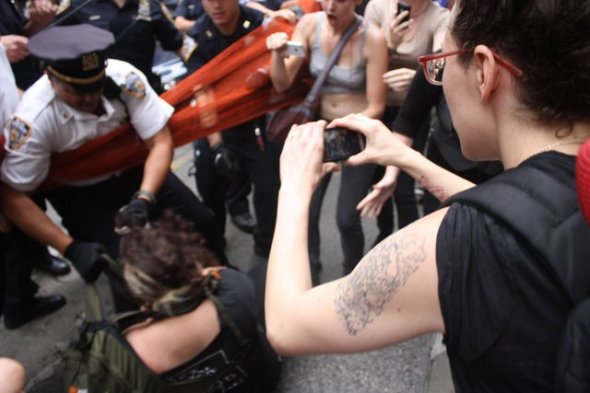
NYC Policeman reaches over barricade and pulls hair of female protester
From the New York Daily News: Wall Street protesters cuffed, pepper-sprayed during ‘inequality’ march
Hundreds of people carrying banners and chanting “shame, shame” walked between Zuccotti Park, near Wall St., and Union Square calling for changes to a financial system they say unjustly benefits the rich and harms the poor.
Somewhere between 80 and 100 protesters were arrested, and according the Occupy Wall Street website, some of them were held in a police van for more than an hour, including a man with a severe concussion. Back to the Daily News article:
Witnesses said they saw three stunned women collapse on the ground screaming after they were sprayed in the face.
A video posted on YouTube and NYDailyNews.com shows uniformed officers had corralled the women using orange nets when two supervisors made a beeline for the women, and at least one suddenly sprayed the women before turning and quickly walking away.
Footage of other police altercations also circulated online, but it was unclear what caused the dramatic mood shift in an otherwise peaceful demonstration.
“I saw a girl get slammed on the ground. I turned around and started screaming,” said Chelsea Elliott, 25, from Greenpoint, Brooklyn, who said she was sprayed. “I turned around and a cop was coming … we were on the sidewalk and we weren’t doing anything illegal.”
It’s over folks. We live in a police state. The right of the people to “peaceably assemble, and to petition the Government for a redress of grievances” is no longer recognized by the powers that be. In the age of the Patriot Act, peaceful protest is no longer permitted. The government requires that groups have a permit before they can gather on the sidewalks of New York. Oh, and BTW, a number of people were arrested yesterday because they filmed incidents of police brutality.
Via Yves at Naked Capitalism, Amped Status reports that Twitter is now following the example of the corporate media in ignoring or blocking information about peaceful protests in the U.S.
On at least two occasions, Saturday September 17th and again on Thursday night, Twitter blocked #OccupyWallStreet from being featured as a top trending topic on their homepage. On both occasions, #OccupyWallStreet tweets were coming in more frequently than other top trending topics that they were featuring on their homepage.
This is blatant political censorship on the part of a company that has recently received a $400 million investment from JP Morgan Chase.
We demand a statement from Twitter on this act of politically motivated censorship.
It’s all very exciting when Egyptians or Libyans protest their governments, but when it happens here, well, the media pretends its not happening. So much for the First Amendment.
In an op-ed at The New York Times yesterday, Michael Kazin asks: Whatever Happened to the American Left?
America’s economic miseries continue, with unemployment still high and home sales stagnant or dropping. The gap between the wealthiest Americans and their fellow citizens is wider than it has been since the 1920s.
And yet, except for the demonstrations and energetic recall campaigns that roiled Wisconsin this year, unionists and other stern critics of corporate power and government cutbacks have failed to organize a serious movement against the people and policies that bungled the United States into recession.
Instead, the Tea Party rebellion — led by veteran conservative activists and bankrolled by billionaires — has compelled politicians from both parties to slash federal spending and defeat proposals to tax the rich and hold financiers accountable for their misdeeds. Partly as a consequence, Barack Obama’s tenure is starting to look less like the second coming of F.D.R. and more like a re-run of Jimmy Carter — although last week the president did sound a bit Rooseveltian when he proposed that millionaires should “pay their fair share in taxes, or we’re going to have to ask seniors to pay more for Medicare.”
I’m sure Kazin is a good guy–after all he is a co-editor of Dissent Magazine and wrote a book on the changes the American Left has accomplished. His op-ed is a fine historical article, but still, he does mention Wisconsin. It might have been nice if he had noticed that some young people are attempting to organize a peaceful protest on Wall Street and are being victimized by brutal NYC police for their efforts. Perhaps Kazin didn’t know about the NYC protests because of the media blackout.
At the Guardian UK, David Graeber had some kind words for the Wall Street protesters.
Why are people occupying Wall Street? Why has the occupation – despite the latest police crackdown – sent out sparks across America, within days, inspiring hundreds of people to send pizzas, money, equipment and, now, to start their own movements called OccupyChicago, OccupyFlorida, in OccupyDenver or OccupyLA?
There are obvious reasons. We are watching the beginnings of the defiant self-assertion of a new generation of Americans, a generation who are looking forward to finishing their education with no jobs, no future, but still saddled with enormous and unforgivable debt. Most, I found, were of working-class or otherwise modest backgrounds, kids who did exactly what they were told they should: studied, got into college, and are now not just being punished for it, but humiliated – faced with a life of being treated as deadbeats, moral reprobates.
Is it really surprising they would like to have a word with the financial magnates who stole their future?
I salute the young men and women from Occupy Wall Street who are fighting back as best they can against corporate-fascist law enforcement and the corporate-controlled media. I really hope it’s not too late for these young people to make a difference.

 peej
peej Carissa
 bostonboomer
 dakinikat
 ecocatwoman
 mablue2
 Mama Lopez
 peggysue22
 quixote
 skydancingguestblogger
 Mona (aka Wonk the Vote)



 Sky Dancing
Recent Comments