“The end is nigh. Gas prices haven’t dropped, electric bills have gone up, groceries are ridiculous, a year later, Putin is still killing Ukrainians, there is no peace in the Middle East, tariff costs are still passed on to consumers, America is once again the laughing stock of the world, need I say more?” John Buss, @repeat1968
Good Day, Sky Dancers!
There has been another bit of good news to complement last week’s. However, we cannot let our guard down or our actions slacken. Even a few battles won will not end a war. Today, the Supreme Court dismissed a case to overturn its landmark decision legalizing same-sex marriage.
There is a distinct possibility that a stronger attempt may be underway, so vigilance is necessary. More analysis is likely to come out as court watchers ponder the decision.
This is from the AP’s Mark Sherman. “Supreme Court rejects call to overturn its decision legalizing same-sex marriage nationwide.” The dissenting voices hint that more compelling cases may come before them.
The justices, without comment, turned away an appeal from Kim Davis, the former Kentucky court clerk who refused to issue marriage licenses to same-sex couples after the high court’s 2015 ruling in Obergefell v. Hodges.
Davis had been trying to get the court to overturn a lower-court order for her to pay $360,000 in damages and attorney’s fees to a couple denied a marriage license.
Her lawyers repeatedly invoked the words of Justice Clarence Thomas, who alone among the nine justices has called for erasing the same-sex marriage ruling.
Thomas was among four dissenting justices in 2015. Chief Justice John Roberts and Justice Samuel Alito are the other dissenters who are on the court today.
Roberts has been silent on the subject since he wrote a dissenting opinion in the case. Alito has continued to criticize the decision, but he said recently he was not advocating that it be overturned.
Justice Amy Coney Barrett, who was not on the court in 2015, has said that there are times when the court should correct mistakes and overturn decisions, as it did in the 2022 case that ended a constitutional right to abortion
But Barrett has suggested recently that same-sex marriage might be in a different category than abortion because people have relied on the decision when they married and had children.
The basis of Davis’ complaint may be the reason why the religious fanatics placed on SCOTUS by extreme right-wing theocrats might have been encouraged to wait for a more direct call to overrule Obergfell. This is explained in this NBC News analysis by Lawrence Hurley.
But reconsidering Obergefell was not the main legal question presented in Davis’ appeal.
Although the court has a 6-3 conservative majority, none of the other justices joined Thomas’ opinion.
Just last month, Justice Samuel Alito, who authored the abortion ruling, indicated he was not pushing for Obergefell to be overturned.
Davis, represented by the conservative group Liberty Counsel, refused to issue any marriage licenses in the immediate aftermath of the Obergefell decision. She said that as a conservative Christian who opposed same-sex marriage, she should have a religious right not to put her name on marriage licenses involving same-sex couples.
Her office in Rowan County, Kentucky, denied licenses to several such couples, including David Moore and David Ermold, who subsequently filed a civil rights lawsuit.
Davis was ordered to issue a license for Moore and Ermold, but defied the court injunction and still refused to do so. The judge then held her in contempt, and she was jailed for six days.
While she was jailed, Moore and Ermold were able to obtain their marriage license.
Subsequently, the state changed the law in order to address the controversy, allowing for a license to be issued without the clerk’s name on it.
But Davis’ case continued, with Moore and Ermold seeking damages for the initial refusal.
After lengthy litigation, a jury awarded $100,000 in damages. Davis was also required to pay $260,000 in attorney’s fees, according to her lawyers.
Davis then appealed, claiming that she should have been able to cite as a defense her right to the free exercise of religion under the Constitution’s First Amendment.
After losing an appeal at the Cincinnati-based 6th U.S. Circuit Court of Appeals in March this year, Davis turned to the Supreme Court, raising that question, as well as the much more contentious issue of whether Obergefell should be overturned.
While the Supreme Court has for now given no indication it would seek to overturn Obergefell, it has in other rulings in the last decade strengthened religious rights at the expense of LGBTQ rights, including by expanding the ability of people to seek exemptions from laws they object to because of their faith.
Are they just waiting for a better case to come along? That is the question from me and others. Only time will tell.
The other big headline is the end of the government shutdown. The circumstances surrounding the resolution are far from ideal. There are a large number of articles expressing anger and disgust at the actions of eight Democrats in cutting this deal. It’s quite challenging to keep up with the decline of the world’s once-great democracy. This is the headline from Politico‘s Katherine Tully-McManus. “The 8 Senate Democratic Caucus members who voted to end the shutdown. There are few obvious threads connecting the group who broke the partisan impasse.”
That’s fewer than the 10 Democrats who broke ranks in March to advance a previous GOP-led stopgap funding bill — a move that sparked a huge backlash against Minority Leader Chuck Schumer.
There are few obvious threads connecting the group who broke the partisan impasse this time. Some of them helped broker the agreement with Republicans over the opposition of Schumer and most other Democrats, who wanted a guaranteed extension for expiring federal health insurance subsidies.
Most, but not all, previously held state-level office — including four former governors. Most, but not all, come from presidential swing states. Two have announced they are retiring from the Senate after their current terms end, and two are senior members of the Senate Appropriations Committee.
None are up for reelection in 2026.
More on these eight senators at the link. There are numerous punditry thoughts on what is being called “The Great Cave-in.” This first take is from MSNBC’s Steve Benen. “As the Senate advances a plan to end the government shutdown, what happens now? As the shutdown continued, the pieces were in place for Democrats to stand firm in support of a popular cause. Eight senators folded anyway.”
As the ongoing government shutdown was poised to begin in late September, three members of the Senate Democratic caucus — Nevada’s Catherine Cortez Masto, Pennsylvania’s John Fetterman and Maine’s Angus King — broke party ranks and voted with the Republican majority to prevent the breakdown. That gave GOP leaders 55 votes, five short of the 60-vote threshold.
At that point, the Republican plan, in a nutshell, could be summarized in one word: wait.
GOP leaders, in the White House and on Capitol Hill, assumed that just enough Senate Democrats would cave under pressure. Those assumptions proved true. MSNBC reported overnight:
After nearly six weeks of a painful shutdown, a critical number of Senate Democrats backed a Republican funding bill to reopen government — with little to show for holding out so long. The breakthrough, which came together suddenly on day 40 of the shutdown, offers Democrats few new concessions beyond what Republicans had already proposed.
There’s quite a bit to this, so let’s unpack the details.
Is the shutdown over?
Not yet. The Sunday-night vote in the Senate was a procedural vote to advance a bill intended to end the shutdown. It received 60 votes, but the underlying legislation still needs to pass.
Who caved?
In addition to Cortez Masto, Fetterman and King, who’ve consistently voted with Republicans to end the shutdown, five other Senate Democrats sided with the GOP on the procedural vote: Dick Durbin of Illinois, Maggie Hassan of New Hampshire, Tim Kaine of Virginia, Jackie Rosen of Nevada and Jeanne Shaheen of New Hampshire. (Durbin and Shaheen, it’s worth noting for context, are retiring at the end of their current terms.) Republican Sen. Rand Paul of Kentucky, meanwhile, voted with most Democrats against the package.
Did they get anything in exchange for their votes?
Not much. The deal, to the extent that it can fairly be described as such, includes three full-year appropriations bills to fund some federal departments through the end of the fiscal year and money to fully fund the Supplemental Nutrition Assistance Program (SNAP). It also reverses Donald Trump’s shutdown layoffs (also known as “reduction in force” notifications, or RIFs).
What about the Affordable Care Act, which was largely the point of the shutdown?
Republicans promised Democrats there will soon be a vote on extending the expiring ACA subsidies.
For health care advocates, does this offer some reason for hope?
Not really. Even if there is a vote, there’s no reason to assume it will pass the GOP-led chamber. And even if it were to pass, there’s no guarantee that the Republican-led House would care.
So why in the world did these eight senators cave?
According to King, it was time to surrender because the status quo “wasn’t working.”
This final analysis is by Sarah Ewall-Wice, writing at The Daily Beast. “Dems Skewer ‘Trainwreck’ Schumer for Caving Over Shutdown. WHAT THE CHUCK?! The Senate minority leader is facing calls to resign despite his “no” vote.”
Democrats from across the political spectrum are livid with Minority Leader Chuck Schumer after a group of Senate Democrats caved and reached a deal with Republicans to end the government shutdown.
Schumer, 74, came out against the bipartisan plan and voted against moving it forward in the Senate on Sunday night.
However, eight Democrats joined Republicans in a 60-40 vote to proceed, sparking turmoil within the party.
“Tonight is another example of why we need new leadership. If @ChuckSchumer were an effective leader, he would have united his caucus to vote ‘No’ tonight and hold the line on healthcare,” wrote Democratic Rep. Seth Moulton, who is challenging Massachusetts Senator Ed Markey in the primary.
He called on Markey to join him in a pledge not to vote for Schumer as Senate leader.
Democratic Rep. Jared Moskowitz posted an image of Schumer photoshopped into the Amy Schumer movie ‘Trainwreck’ with the caption “Different Schumer, same title.”
“Senator Schumer is no longer effective and should be replaced,” wrote progressive Rep. Ro Khanna. “If you can’t lead the fight to stop healthcare premiums from skyrocketing for Americans, what will you fight for?”
He replied that he was a “fan” of Sen. Chris Van Hollen in response to political commentator Krystal Ball’s suggestion that he should become the leader.
We know what or who the basic problem is. Who wouldn’t love aSubstack titled “Are you f’ng kidding me?” That’s a daily question around here these days. This is the brainchild of JoJoFromJerz. The title is even hotter. “Portrait of a Man Who Doesn’t Give a Fuck. Starring: indifference, ego, and forty-two million people he is actively fighting to starve.” Yup, are president is the ultimate example of Anti-social Personality Disorder.” He comes replete with a lifetime of examples. And there’s that photo that keeps showing up everywhere, including this blog when I peeled it on Monday.
This photo should be hung in the Louvre of moral decay.
Look at it. The tableau is so absurd it feels storyboarded by Voldemort and Liberace’s real estate LLC. A man collapses on the floor where presidents once ended wars and launched moon missions. Now the room has all the gravitas of a Vegas timeshare bathroom, festooned with Chinese-made American flags marinated in Drakkar Noir. It’s as if history’s most consequential decisions are now being made in the world’s tackiest escape room.
Aides kneel. Hands reach. Chaos unfolds.
And Donald Trump just stands there — bored, irritated, visibly put-out — like the collapse in front of him is a personal scheduling conflict. His face isn’t concern. It is inconvenience.
His jaw hangs open in that dopey, defeated pout you only see when a chain-steakhouse diner learns their “Buy One Get One Ribeye” coupon expired yesterday. His eyes aren’t searching for a pulse; they’re searching for the nearest camera.
He’s not seeking help. He’s seeking a close-up.
If Dante were alive today, he wouldn’t write The Inferno. He’d pitch a reality show called Keeping Up With the Collapse and hiss to the crew, “We don’t need CGI. Just let him talk.”
The entire scene looks like Norman Rockwell painted The Death of Empathy, directed by Jeffrey Dahmer and executive produced by Satan. Hang this next to The Scream and the painting would lean over and whisper, Is that guy okay.
It feels like someone pitched, What if Succession had a baby with Idiocracy and then handed the baby the nuclear codes. It should not be funny. But it is. It should not be real. And yet here we are.
Because this photo is not merely symbolic of who he is.
This is who he is.
A convicted felon. Found liable for sexual abuse in a court of law. A man whose closest approximation to empathy is jabbing the close door button in an elevator while someone sprints toward it.
This is who Donald Trump is.
He doesn’t give a fuck about anyone but himself.
A man collapses behind him. Just as our country has been collapsing behind him for the entirety of this second so-called term.
And he doesn’t give a fuck.
He is not thinking, Is that man okay. He is thinking, How dare he steal my scene.
This is who Donald Trump is.
He doesn’t give a fuck about anyone but himself.
He isn’t numb to suffering—he feeds on it. Suffering is his currency, his spotlight, his scepter. Every ounce of pain around him inflates his sense of importance. He doesn’t create, build, or inspire; he only knows how to conquer by making others smaller, hungrier, emptier. His power is measured in what he can take away. He is a parasite of misery, thriving on the wounds he inflicts.
Go read the entire post. She’s right. He doesn’t give a fuck about anyone but himself. And here’s more evidence, as Trump pardons all of those election-denying cronies while possibly looking forward to handing one to that miserable sex-trafficking ghoul Gislane Maxwell. The first article comes from Politico‘s Kyle Cheney. “Trump pardons top allies who aided bid to subvert the 2020 election. Pardon recipients include Rudy Giuliani, Mark Meadows, John Eastman and dozens more.” I weep for justice in my country today.
President Donald Trump has pardoned a long list of prominent allies who backed his effort to subvert the 2020 election, according to Justice Department Pardon Attorney Ed Martin, who posted the relevant document Sunday night.
Among those who received the “full, complete and unconditional” pardons were Rudy Giuliani, who helped lead an effort to pressure state legislatures to reject Joe Biden’s victories in key swing states; Mark Meadows, Trump’s chief of staff in 2020 and a crucial go-between for Trump and state officials; John Eastman and Kenneth Chesebro, two attorneys who helped devise a strategy to pressure then-Vice President Mike Pence to overturn the election on Jan. 6, 2021; Boris Epshteyn, a longtime Trump adviser; and Sidney Powell, a conservative attorney who launched a fringe legal assault on election results in key swing states.
The pardons are largely symbolic — none of those identified were charged with federal crimes. The document posted by Martin is also undated, so it’s unclear when Trump signed it. The White House and Justice Department did not immediately respond to requests for comment.
Giuliani, Eastman and Powell were among those identified by former special counsel Jack Smith as Trump’s co-conspirators, though he never brought charges against them. The pardons would preclude any future administration from potentially pursuing a criminal case against them.
The language of the pardon is broad, applying to “all United States citizens for conduct relating to the advice, creation, organization, execution, submission, support, voting activities, participation in or advocacy for or of any slate or proposed slate of presidential electors … as well for any conduct relating to their efforts to expose voting fraud and vulnerabilities in the 2020 presidential election.”
Though Trump has long insisted he has the power to pardon himself for federal crimes — an untested proposition — it appears he is not yet prepared to test that theory. Though the pardon document indicates it could apply to others who fit the same criteria, it explicitly excludes Trump.
In addition to his inner circle, Trump pardoned dozens of GOP activists who signed paperwork falsely claiming to be legitimate presidential electors, a key component of the bid to pressure Pence.
Regarding the potential pardon for Maxwell, this information comes from Scott MacFarlane of CBS News. “Ghislaine Maxwell plans to ask Trump to commute prison sentence, House Democrats say.”
Ghislaine Maxwell, Jeffrey Epstein’s sex trafficking co-conspirator, is planning to apply for a commutation of her federal prison sentence, which is set to run through 2037, according to documents obtained by Democrats on the House Judiciary Committee and seen by CBS News.
In a letter to President Trump on Monday, also seen by CBS News, Judiciary Committee Democrats wrote that Maxwell “is preparing a ‘Commutation Application’ for your Administration to review, undoubtedly coming to you for your direct consideration. The Warden herself is directly helping Ms. Maxwell copy, print, and send documents related to this application.”
The letter says the information received demonstrates “either that Ms. Maxwell is herself requesting you release her from her 20-year prison sentence for her role as a co-conspirator in Jeffrey Epstein’s international child sex trafficking ring, or that this child sex predator now holds such tremendous sway in the second Trump Administration that you and your DOJ will follow her clemency recommendations.”
“Federal law enforcement staff working at the camp have been waiting on Ms. Maxwell hand and foot,” says the letter signed by Rep. Jamie Raskin, the ranking Democrat on the committee.
It appears that something needs to be done to address the fundamental nature of the Presidential Pardon. It’s supposed to be the last chance at justice for the wrongly accused. It was never supposed to be an article of power handed to an autocrat to rewrite the guilt and punishment of evil minions.
I’ve also been crying and listening to Warren Zevon songs since his induction into the Rock and Roll Hall of Fame, as featured on David Letterman. I love his lyrical melodies and his strong rhythms and beats. His lyrics tell stories that are both funny and sad, full of vivid characters. I have finally uncovered the underlying sadness behind most of his lyrics and can no longer unhear them. They’ve burrowed into my heart. And so, I cry, which is quite uncharacteristic for me. But then, it seems American life these days requires tears.
What’s on your Reading, Action, and Blogging list today?
Did you like this post? Please share it with your friends:
Not surprisingly, there is quite a bit of Supreme Court news today. The right wing justices seem determined to help Trump prevent his criminal trials from going forward before the November election. We are waiting for SCOTUS to release a decision on Trump’s claim of “presidential immunity” for crimes he committed in office, and it looks like they are going to hold off announcing that decision until the bitter end.
And, of course, District Court Judge Aileen Cannon is working to help Trump avoid being tried for stealing and hoarding top secret government documents in a bathroom, a ballroom stage, an unsecure storage area, and of course, in his bedroom and even his desk.
Here’s the latest on the Supreme Court’s activities:
The Supreme Court released a slew of new rulings on Friday morning, but, once again, none of them included the decision weighing heaviest on Americans’ minds—whether Donald Trump should be granted king-like immunity for his criminal indictments.
Friday marks 114 days since the case was accepted by the high court—an inexcusable amount of time to rule on something so consequential to the country, a top legal expert tells The Daily Beast.
Laurence Tribe, a constitutional law professor at Harvard University, said Friday it’s clear that the Supreme Court, which has operated with a comfortable conservative majority since Trump’s presidency, is doing the ex-president’s bidding.
With each day that passes without a decision, the chances of a Trump trial before the 2024 election grow slimmer.
“They’re obviously delaying to benefit Donald Trump,” he said.
Tribe said, realistically, an appropriate time for the court to reach a decision on Trump would have been sometime in December, and Trump’s trial would’ve been completed by now.
Instead, it’s taken the Supreme Court more than twice the time to rule on Trump’s immunity—a matter an appeals court comprehensively rejected—than it took to rule on the much more complex United States vs. Richard Nixon case, which took 54 days.
Robert Reich agreed, saying that the court is in effect giving Trump immunity by their delay tactics. Another legal expert, Robert J. DeNault, told Fiallo:
While just a theory, he said it’s possible the court is contemplating two things—slating Trump’s case for “re-argument,” which would delay things even longer, or potentially ruling that special prosecutors like Jack Smith, whose team brought the election-subversion charges at the heart of Trump’s case, are unconstitutional
With their slow-walking of this case, the court has deliberately interfered in the 2024 election.
For those looking for the hidden hand of politics in what the Supreme Court does, there’s plenty of reason for suspicion on Donald Trump’s as-yet-undecided immunity case given its urgency. There are, of course, explanations that have nothing to do with politics for why a ruling still hasn’t been issued. But the reasons to think something is rotten at the court are impossible to ignore.
On Feb. 28, the justices agreed to hear Mr. Trump’s claim that he is immune from prosecution on charges that he plotted to subvert the 2020 election. The court scheduled oral arguments in the case for the end of April. That eight-week interval is much quicker than the ordinary Supreme Court briefing process, which usually extends for at least 10 weeks. But it’s considerably more drawn out than the schedule the court established earlier this year on a challenge from Colorado after that state took Mr. Trump off its presidential primary ballot. The court agreed to hear arguments on the case a mere month after accepting it and issued its decision less than a month after the argument. Mr. Trump prevailed, 9-0.
Nearly two months have passed since the justices heard lawyers for the former president and for the special counsel’s office argue the immunity case. The court is dominated by conservatives nominated by Republican presidents. Every passing day further delays a potential trial on charges related to Mr. Trump’s efforts to remain in office after losing the 2020 election and his role in the events that led to the storming of the Capitol; indeed, at this point, even if the court rules that Mr. Trump has limited or no immunity, it is unlikely a verdict will be delivered before the election….
Mr. Trump’s lawyers put together a set of arguments that are so outlandish they shouldn’t take much time to dispatch. Among them is the upside-down claim that, because the Constitution specifies that an officer who is convicted in an impeachment proceeding may subsequently face a criminal trial, the Constitution actually requires an impeachment conviction before there is any criminal punishment.
That gets things backward: The Constitution confirms that impeachment is not a prerequisite to criminal prosecution. And yet Mr. Trump’s lawyers continued to take the untenable position, in response to questioning, that a president who orders the assassination of a political rival could not face criminal charges (absent impeachment by the House and conviction in the Senate).
It does not take weeks to explain why these arguments are wrong.
In a ruling delivered Friday, the Supreme Court decided 6–3 that U.S. citizens have no constitutional interest in their noncitizen spouses being able to enter the United States—despite the fact that a married person has an inherent interest in their spouse being able to live in the same country as they do. Supreme Court Justice Sonia Sotomayor warned the ruling is an obvious sign the court will seek to overturn protections for marriage equality next.
Sotomayor issued a dire warning in her dissent, accusing the conservative supermajority of chipping away at constitutional protections for married couples and saying they’re making “the same fatal error” as they did in Dobbs v. Jackson, the 2022 Supreme Court ruling that overturned federal abortion protections.
By Stephanie Lambourne
“The majority, ignoring these precedents, makes the same fatal error it made in Dobbs: requiring too ‘careful [a] description of the asserted fundamental liberty interest,’” Sotomayor wrote. “The majority’s failure to respect the right to marriage in this country consigns U.S. citizens to rely on the fickle grace of other countries’ immigration laws to vindicate one of the ‘basic civil rights of man’ and live alongside their spouses.”
The case involved Sandra Muñoz, a U.S. citizen whose husband was denied a visa by the U.S. consulate in El Salvador. That denial came from a broad provision in U.S. immigration law that disqualifies a person from obtaining a visa if the consulate knows “or has reasonable ground to believe” that a person is trying to enter the U.S. “to engage solely, principally, or incidentally in” unlawful activity. Her husband was denied because of tattoos he has, which a court-appointed gang tattoo expert later determined were not gang-related.
Muñoz sued the State Department, arguing that her husband’s inexplicable denial of entry into the U.S. infringed on her constitutional liberty interest in her husband’s visa application and their inability to start a life together in the U.S. In upholding the denial, the Supreme Court’s conservative justices decided not just that the State Department doesn’t need to provide reason for denying a visa but that a citizen’s right to be married doesn’t supersede the state’s strict, and often questionable, immigration processes. The conservative supermajority of the Supreme Court’s ruling chips away at the core of Obergefell v. Hodges—the landmark ruling that legalized same-sex marriage in 2015—which decided that citizens have a right to marriage.
In her dissent, Sotomayor cast urgent warnings on the impact of restricting who is allowed to be married in the U.S., noting that the conservative decision will extend to couples “like the Lovings and the Obergefells, [who] depend on American law for their marriages’ validity.”
We knew this was coming. Clarence Thomas told us so after the Dobbs decision.
Yesterday, Judge Aileen Cannon began holding hearings on the question of whether the appointment of Special Counsel Jack Smith was unconstitutional.
The federal judge overseeing Donald Trump’s classified documents case grilled special counsel Jack Smith’s prosecutors Friday on how closely Attorney General Merrick Garland oversees their work.
Under persistent questioning from U.S. District Judge Aileen Cannon, the prosecutors declined to divulge details and seemed caught off-guard by the inquiries. At one point, Smith deputy James Pearce said he was “not authorized” to discuss the level of communication that occurred between the attorney general and the special counsel.
“I don’t want to make it seem like I’m hiding something,” Pearce then said.
The questioning came at the end of a five-hour hearing focused on a long-shot effort by Trump to have the charges against him thrown out. Smith has accused Trump of hoarding national secrets at his Mar-a-Lago estate after his presidency and obstructing the government’s efforts to retrieve them.
Trump contends that Smith’s appointment by Garland as special counsel in November 2022 is unconstitutional and that Smith lacked the legal authority to bring the case against the former president.
Sophie Sperlich’s Solo Cat
Though other courts have uniformly swept aside similar challenges to the validity of special counsel appointments, Cannon — a 2020 Trump appointee to the bench — scheduled lengthy oral arguments on the matter, a sign that she was taking it seriously. During Friday’s proceedings, she gave little indication of how she intends to rule….
In questioning prosecutors about Garland’s supervision, Cannon seemed to be trying to determine how much independent authority Smith has in practice.
Smith’s team, led by Pearce, sharply rebutted arguments that Smith’s appointment was illegal and described Smith’s role as an uncontroversial exercise of Garland’s ability to organize the Justice Department as he sees fit. Pearce emphasized that Smith was “in compliance” with longstanding Justice Department rules and regulations regarding his appointment and his handling of the case.
The exchanges marked the beginning of a three-day stretch of intense hearings called by Cannon that will continue Monday and Tuesday. Monday’s hearing will focus on another aspect of Trump’s effort to invalidate Smith’s appointment — a claim that he is being improperly funded by an indefinite Justice Department budget line item.
The judge’s intense dive into an issue that has been brushed aside by most other courts has caused head-scratching in the legal community and drawn renewed criticism of her handling of the sensitive case. Adding to the unusual dynamic: Cannon permitted three outside experts — two in favor of Trump’s position and one in favor of Smith’s — to address the court for 30 minutes apiece, nearly unheard of in criminal matters.
The good news is that if Cannon does decide that Smith was illegally appointed, he will be able to appeal the decision to the 11th Circuit Court of Appeals–which is why Cannon probably won’t decide that. She’ll just keep wasting time until it’s too late to try the case before the election.
The rest of this post is devoted to insane Trump news, so be forewarned.
“OF COURSE WE aren’t fucking bluffing.” That’s the message one close Trump adviser and former administration official — who requested anonymity to speak candidly — wants to get across to the press and public, when asked about Donald Trump’s 2024 campaign vows of “retribution,” unprecedented force, and militaristic action.
Indeed, this sentiment is shared widely among the upper echelon of Trumpland and the MAGAfied Republican Party, with various officials and conservatives with a direct line to the former president insisting that so-called “moderates” or alleged “establishment” types will be tamed or purged, if Trump retakes power next year.
Rolling Stone spoke with a dozen sources who are playing roles in Trump’s “government-in-waiting” or are in regular contact with the ex-president, including GOP lawmakers, Trump advisers, MAGA policy wonks, conservative attorneys, and former and current Trump aides. They universally stress that the former (and perhaps future) U.S. president and top allies are serious about following through on his extreme campaign pledges. These promises run the gamut from siccing active duty military units on not just American cities but also Mexican territory, all the way to prosecuting and potentially imprisoning Trump foes.
Several of these sources say that a wide range of litmus tests, loyalty screenings, and “guardrails” are already being implemented, or discussed with Trump, to root out so-called “RINOs” (Republicans in Name Only) and MAGA-skeptical conservatives from embedding themselves within a possible second Trump administration. These processes would be largely aimed at drastically curtailing the number of squishy Republican officials who would be able to get in Trump’s ear to, in the words of one GOP lawmaker on Capitol Hill, try to “scare Trump off of what needs to be done or should be.” This lawmaker cited former senior administration officials such as Mark Esper and John Kelly who, at times, urged the then-president to moderate his policy desires.
The long engagement, by Susan Herbert
One idea regularly kicked around Trump’s government-in-waiting is a dramatic increase in the use of “lie detectors” across the federal apparatus, to root out or charge leakers and other subversives. These devices, called polygraphs, are frequently unreliable and inadmissible in courts of law….
Sources close to the former president and several of those counseling him on second-term policy add that one big reason they feel confident a revived Trump White House won’t be, in their minds, tamed in the ways it was during the first term is because Trump presumably won’t be running for reelection….
Further, many of Trump’s political and policy allies feel emboldened by the federal judiciary being (thanks to Trump) significantly more right-wing than it was when he first came into office. This would allow Team Trump, in the words of one conservative attorney close to the ex-president, to “get away with a lot more” than elected Republicans used to, in the face of an expected barrage of constitutional challenges to their executive actions or policies, if Trump wins in November.
There’s more at the link if you can get past the paywall. I got through by just wiping out my search history.
Donald Trump privately hinted at a shift in immigration policy at a Business Roundtable meeting last week. He told the group “we need brilliant people” in this country, according to one of the attendees, who was granted anonymity to describe a private meeting. And when he talked about finding ways to keep American-educated talent at home, some top CEOs, like Apple’s Tim Cook, were seen nodding their heads.
The public move came a week later: On “The All-In Podcast” on Thursday, Trump said foreign nationals who graduate from U.S. colleges and universities should “automatically” be given a green card upon graduation.
It was the latest major policy shift from a candidate who has proven equal parts hardline and chameleon-like over time. Trump’s pivot on immigration followed his reversal on TikTok, embracing an app he once tried to ban, and his shift on cryptocurrency.
To the former president’s allies, the reversals are evidence of a nuanced politician taking thoughtful new positions on rapidly changing issues.
But there is also plainly a pattern of Trump aligning his political stances with the views of wealthy donors and business interests.
An automatic green card on graduation? Wouldn’t that attract even more immigrants to the U.S.? And hasn’t Trump said he was going deport all immigrants, whether they are here legally or not? I wonder how Stephen Miller feels about this latest Trump policy?
Donald J. Trump said he would push for a program that would automatically give green cards to all foreign college students in America after they graduate, a reversal from restrictions he enacted as president on immigration by high-skilled workers and students to the United States.
But hours after Mr. Trump’s remarks aired, his campaign’s press secretary, Karoline Leavitt, walked back the former president’s comments, saying in a statement that there would be an “aggressive vetting process” that would “exclude all communists, radical Islamists, Hamas supporters, America haters and public charges” and that the policy would apply only to the “most skilled graduates who can make significant contributions to America.”
By Dee Nickerson
Appearing with the host David Sacks, a Silicon Valley investor who backs the former president’s 2024 campaign, on a podcast that aired Thursday afternoon, Mr. Trump had repeated his frequent criticism of high levels of immigration as an “invasion of our country.” But he was then pressed by Jason Calacanis, another investor who hosts the podcast, to “promise us you will give us more ability to import the best and brightest around the world to America.”
“I do promise, but I happen to agree,” Mr. Trump said, adding “what I will do is — you graduate from a college, I think you should get automatically, as part of your diploma, a green card to be able to stay in this country, and that includes junior colleges.”
It would have been a sweeping change that would have opened a vast path to American citizenship for foreigners. The State Department estimated that the United States hosted roughly one million international students in the academic year that ended in 2022 — a majority of whom came from China and India. The United States granted lawful permanent residence to roughly one million people during the year that ended in September 2022, so such a policy change would significantly increase the number of green cards issued.
Mr. Trump suggested on the podcast that he had wanted to enact such a policy while in office but “then we had to solve the Covid problem.” The Trump administration invoked the pandemic to enact many of the immigration restrictions that officials had wanted to put in place earlier in Mr. Trump’s term.
Mr. Trump also lamented “stories where people graduated from a top college or from a college, and they desperately wanted to stay here, they had a plan for a company, a concept, and they can’t — they go back to India, they go back to China, they do the same basic company in those places. And they become multibillionaires.”
The history-making felony conviction of former President Donald J. Trump has raised some historic questions for the House’s rules of decorum, which have existed for centuries but can be bent to the will of whichever party controls the majority-driven chamber.
The Republicans who now hold the majority have used those rules to impose what is essentially a gag order against talking about Mr. Trump’s hush-money payments to a porn actress or about the fact that he is a felon at all, notwithstanding that those assertions are no longer merely allegations but the basis of a jury’s guilty verdict. Doing so, they have declared, is a violation of House rules.
Scene from a Train, by Richard Adams
In short, perhaps the only place in the United States where people are barred from talking freely about Mr. Trump’s crimes is the floor of what is often referred to as “the people’s House,” where Republicans have gone so far as to erase one such mention from the official record.
In recent weeks, Republican leaders have cracked down on Democrats who refer to Mr. Trump’s court cases on the floor, citing the centuries-old rules of decorum, which date back to the days of Thomas Jefferson. Merely mentioning that Mr. Trump is a felon prompts an admonishment from whomever is presiding when the offending fact is uttered. (Mr. Trump is also indicted on felony charges in cases related to his handling of classified documents and attempting to overturn the 2020 election.)
“The chair would remind members to refrain from engaging in personalities toward presumptive nominees for the office of the president,” is now a common phrase heard in the chamber after the mention of the words “Trump” and “felon.”
On one occasion, Republicans barred Representative Jim McGovern, Democrat of Massachusetts, from speaking for the rest of the day and deleted his comments from the Congressional Record after he railed against Mr. Trump and his court cases.
“When they censor any mention of Donald Trump’s criminal convictions, they are essentially trying to ban a fact,” Representative Jamie Raskin of Maryland, the top Democrat on the Oversight Committee, said in an interview. “I am not aware of any precedent where factual statements have been banned in our lifetime.”
You can’t say you weren’t warned: At the upcoming presidential debate on June 27, Donald Trump plans to highlight a handful of horrific murders—allegedly by undocumented migrants—and blame them on President Biden. We know this because Trump told us so right on his Truth Social feed.
“We have a new Biden Migrant Killing—it’s only going to get worse, and it’s all Crooked Joe Biden’s fault,” Trump seethed, referring to the horrible death of a 12-year-old Texas girl. “I look forward to seeing him at the Fake debate on Thursday. Let him explain why he has allowed MILLIONS of people to come into our Country illegally!”
Now that Trump has telegraphed this coming assault, the Biden campaign has time to prepare a response. What should it be?
First, let’s be clear on why this line of attack is pure nonsense. Trump and MAGA figures have aggressively highlighted such killings lately, in many forms: Trump sometimes brings up victims at campaign events. MAGA lawmakers put them on T-shirts. Fox News airs visuals of migrant mug shots. And as Aaron Rupar shows, Fox sometimes even puts individual crimes in chyrons.
The argument is always that Biden’s policies are to blame for these horrors. But at the most obvious level, this is absurd, because immigrants do not commit crimes at higher rates than native-born Americans do. That includes undocumented immigrants. There is no link between immigration and violent crime.
Of course, the real Trump-MAGA message is that all undocumented immigrants should be presumed violent and dangerous, regardless of what any pointy-headed statistics say. MAGA figures are highlighting specific killings to smear millions—that is, they’re arguing by anecdote.
But even at the anecdotal level, the claims implode under scrutiny. Take Rachel Morin, a young mother who was horrifically murdered in Maryland, allegedly by a migrant from El Salvador. Trump highlighted her at a recent rally, and MAGA figures regularly cite her to criticize Biden’s new legal protections for the undocumented spouses of U.S. citizens.
We’ll just have to wait and see what happens on Thursday. I’m sure Trump’s behavior will be deranged and nonsensical. I don’t know if I can stand to watch it. At least we know that their mikes will be shut off while the other candidate is speaking.
That’s all the politics news I have for you today. I hope the cat art will make it somewhat bearable.
Did you like this post? Please share it with your friends:
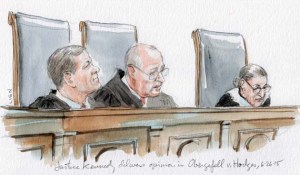
Justice Kennedy delivers opinion in same sex marriage
How very ironic that it is my day to post and it’s the very day that all my gay friends get access to the one institution that I tell every one I know and love to avoid like a plague. You can ask my daughters. My first response is that you really don’t have to do this because you’re educated, can make your own life, and you don’t have to continually have your assets, energy, will to live, and dreams drained away from you over time. Just hang out with him until the inevitable drift to hell becomes obvious. Please, don’t do it. It hasn’t worked so far. Just a few months ago, yet another long time, long married friend confessed to me that she–and others she knows–would have the kids and everything else but never do the husband thing again. That’s pretty much where I’m at with an institution designed to make you disappear into chattel v. meal ticket status.
No one can make you happy but you. That’s basically a head trip. Marriage, however, absolutely gives another person the right to make you miserable in ways that you’d never even dreamed about when you’re lost to bonding hormones. You can’t ever ever know how to properly enunciate “till death to us part” until you’ve been stuck at least a good 15 -20 years in the institution. Then you realize, it’s pretty much akin to a death row sentence where the things you really wanted to do with your life were left outside the doors.
Bill Murray showed up–seemingly drunk–on Lawrence O’Donnell’s show in May when the nice young gay couple looking to get married that were filmed in that Hillary Clinton commercial were interviewed. He pretty much expressed my views exactly. I really hope you all make a better situation out of it than straight people generally do. Knock yourselves out! I want nothing to do with any of it! I frankly think that there’s hope for some change given the rigid expectations that come with an institution that’s generally been defined by really awful stereotypical sex roles and where it may not treated as a purely breeder institution.
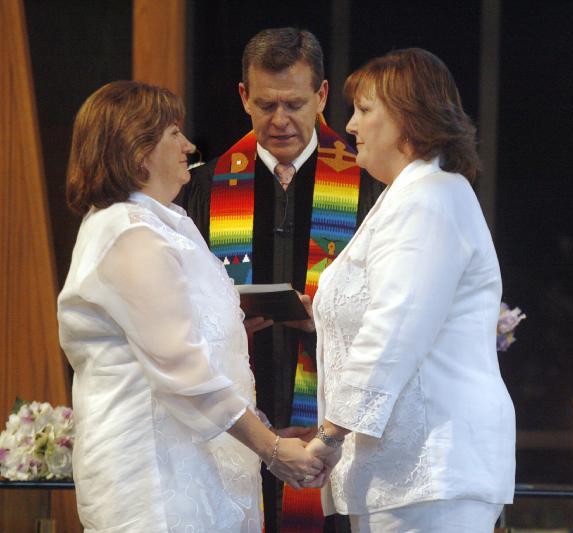
So, with you knowing that I am a conscientious objector to the entire institution for any one, I give you the day that marriage equality happened in the USA. To my knowledge, nobody’s church has crumbled to the ground and no one’s sanctified marriage has been taken away by any angry sky fairy. This gives legal access to huge numbers of subsidies, tax benefits, and rights that were never available to gay couples before. For that, I am very happy. All the spoils that government provides the institution should be available to any one that wants to try to go the distance; especially if they do so with children.
“Under the Constitution, same-sex couples seek in marriage the same legal treatment as opposite-sex couples, and it would disparage their choices and diminish their personhood to deny them this right,” Justice Anthony Kennedy wrote in the majority opinion. He was joined in the ruling by the court’s liberal justices Ruth Bader Ginsburg, Stephen G. Breyer, Sonia Sotomayor and Elena Kagan.
All four of the court’s most conservative members — Chief Justice John G. Roberts Jr. and Justices Antonin Scalia, Clarence Thomas and Samuel A. Alito Jr. — dissented and each wrote a separate opinion, saying the court had usurped a power that belongs to the people.
That sums it up and it happened just about the way every one thought it would. Kennedy has always seemed open to the idea that civil marriage was a civil right. I’m not sure how access to a legal institution basically is a power that belongs to the people, but that appears to be the argument by the court’s hyper religious sour grapes.
Putting itself back in the forefront of the gay rights revolution, the Supreme Court ruled by the narrowest margin on Friday that same-sex couples across the nation have an equal right to marry. The five-to-four decision was based firmly on the Constitution, and thus could be undone only by a formal amendment to the basic document, or a change of mind by a future Supreme Court. Neither is predictable.
Explicitly refusing to hold off deciding the issue to see how other parts of society may deal with the rising demand for gay acceptance and legitimacy, the Court declared that two clauses in the Fourteenth Amendment mean that a “fundamental right to marry” can no longer be denied because the partners are of the same sex. It did not create a new right, but opened a long-existing one to those partners.
The ruling was the most important victory in a cultural revolution that began almost exactly forty-six years ago, when patrons of a gay bar — the Stonewall Inn in New York City’s Greenwich Village — fought back against a police raid. The events that began on the night of June 28, 1969, are widely known as the beginning of “gay pride” and an unapologetic campaign for equality.
The decision in Obergefell v. Hodgesexpressly overruled the Court’s only prior ruling directly on same-sex marriage — a one-line decision in the 1972 case of Baker v. Nelson, declaring that a claim to such marriage did not raise “a substantial question” for the Court to resolve.
Over the last two years, the right to marry has been extended rapidly and widely for gays and lesbians, ultimately expanding the places where they may marry legally to thirty-six states and Washington, D.C., through new laws, court rulings, or voters’ approval. From a 2003 ruling by the highest state court in Massachusetts allowing same-sex marriage, the movement to gain marital rights had spread from coast to coast, with lawsuits in every state where the right had not yet been recognized.
The decision on Friday will open marriage legally in the remaining fourteen states, and will give new legal protection for those who got married under court rulings that actually could not be considered truly final until the Supreme Court itself had decided the constitutional question. The decision nullified bans on same-sex marriage as well as bans on official recognition of such marriages performed outside a state. Both prohibitions, it said, violate the Fourteenth Amendment’s guarantees of due process and equal protection.
Chief Justice John Roberts not only dissented from the Court’s ruling but also read a summary of his dissent from the bench. It was the first time that he has done so in his ten Terms on the Court, and it signaled how strongly he disagreed with the Court’s ruling. Roberts forcefully criticized the majority for side-stepping the democratic process and declaring that same-sex couples have the right to marry when, in his view, such a right “has no basis in the Constitution.” The Court’s decision, he complained, “orders the transformation of a social institution that has formed the basis of human society for millennia, for the Kalahari Bushmen and the Han Chinese, the Carthaginians and the Aztecs.” “Just who,” Roberts laments, “do we think we are?” The other three Justices echoed Roberts’s sentiments, sometimes in even more strident terms: Justice Antonin Scalia characterized the decision as a “judicial Putsch” and suggested that, before he signed on to an opinion like the majority’s, “I would hide my head in a bag.”
Closely endogamous marriages between uncles and nieces (and sometimes half-siblings), marriages in which women retained almost no property rights or independence and were regularly both physically segregated and violently abused, and a system in which marriage was designed explicitly to increase and safeguard the property of closely related men while encouraging the production of definitely legitimate male heirs to those men through tightly restricting access to their wives.
“‘The nature of marriage is that, through its enduring bond, two persons together can find other freedoms, such as expression, intimacy, and spirituality,'” he quoted from the majority opinion before adding, “Really? Who ever thought that intimacy and spirituality [whatever that means] were freedoms? And if intimacy is, one would think Freedom of Intimacy is abridged rather than expanded by marriage. Ask the nearest hippie.”
“Guided by my faith, I believe in traditional marriage. I believe the Supreme Court should have allowed the states to make this decision. I also believe that we should love our neighbor and respect others, including those making lifetime commitments. In a country as diverse as ours, good people who have opposing views should be able to live side by side. It is now crucial that as a country we protect religious freedom and the right of conscience and also not discriminate.”
Ah, yes, HIS faith should triumph, every one else’s can go to hell, and if we don’t agree with his faith than were oppressing him. His brain should explode from this basket of contradiction if it were functional enough to fire a synapse to set off the explosion.
Rubio actually tried the pragmatic dogmatic approach. I’ll be interested in seeing how that flies with the hate groups that now comprise the republican base.
I believe that marriage, as the key to strong family life, is the most important institution in our society and should be between one man and one woman. People who disagree with the traditional definition of marriage have the right to change their state laws. That is the right of our people, not the right of the unelected judges or justices of the Supreme Court. This decision short-circuits the political process that has been underway on the state level for years.
“While I disagree with this decision, we live in a republic and must abide by the law. As we look ahead, it must be a priority of the next president to nominate judges and justices committed to applying the Constitution as written and originally understood.
The first line of the U.S. Supreme Court’s decision in Obergefell v. Hodges, on the legality of same-sex marriage in the United States, is as breathtaking as it is legalistic.
The Fourteenth Amendment requires a State to license a marriage between two people of the same sex and to recognize a marriage between two people of the same sex when their marriage was lawfully licensed and performed out-of-State.
There it is, the ruling that gay-marriage advocates and opponents have been waiting for since April when the Court took up the case—but really, for years long before that. There is now a constitutional right for people of the same sex to get married in the United States.
He even crafted the ruling’s logic to follow the precedent of similar constitutional rights.
Second, Kennedy writes, marriage is a distinctive institution: “It supports a two-person union unlike any other in its importance to the committed individuals.” Here, he points to the Court’s opinion in Griswold v. Connecticut, which affirmed the right of married couples to use birth control. “Same-sex couples have the same right as opposite-sex couples to enjoy intimate association.”
So, my gay friends and family, you have total access to the institution of marriage in these United States. Please make it a better arrangement for everyone!
Did you like this post? Please share it with your friends:
The Sky Dancing banner headline uses a snippet from a work by artist Tashi Mannox called 'Rainbow Study'. The work is described as a" study of typical Tibetan rainbow clouds, that feature in Thanka painting, temple decoration and silk brocades". dakinikat was immediately drawn to the image when trying to find stylized Tibetan Clouds to represent Sky Dancing. It is probably because Tashi's practice is similar to her own. His updated take on the clouds that fill the collection of traditional thankas is quite special.
You can find his work at his website by clicking on his logo below. He is also a calligraphy artist that uses important vajrayana syllables. We encourage you to visit his on line studio.


 The basis of Davis’ complaint may be the reason why the religious fanatics placed on SCOTUS by extreme right-wing theocrats might have been encouraged to wait for a more direct call to overrule Obergfell. This is explained in this
 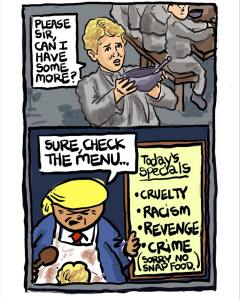 Are they just waiting for a better case to come along? That is the question from me and others. Only time will tell.
 More on these eight senators at the link. There are numerous punditry thoughts on what is being called “The Great Cave-in.”
  This final analysis is by Sarah Ewall-Wice, writing at
  We know what or who the basic problem is. Who wouldn’t love a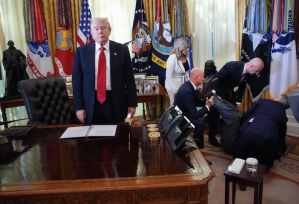
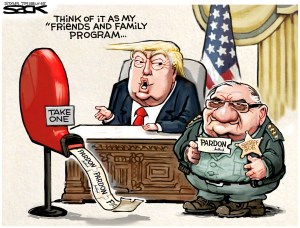 Go read the entire post. She’s right. He doesn’t give a fuck about anyone but himself. And here’s more evidence, as Trump pardons all of those election-denying cronies while possibly looking forward to handing one to that miserable sex-trafficking ghoul Gislane Maxwell. The first article comes from
 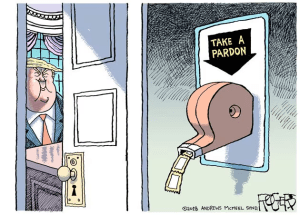 Regarding the potential pardon for Maxwell, this information comes from








 makes what Rubio said flagrantly out to lunch
 peej
peej Carissa
 bostonboomer
 dakinikat
 ecocatwoman
 mablue2
 Mama Lopez
 peggysue22
 quixote
 skydancingguestblogger
 Mona (aka Wonk the Vote)



 Sky Dancing
Recent Comments