
Crowd Heckles Romney at NH Polling Place
Posted: January 10, 2012 Filed under: 2012 presidential campaign, Mitt Romney, U.S. Politics | Tags: 2012 Republican nomination, Mitt Romney, New Hampshire primary 11 Comments
Mitt Romney in Manchester, NH today
Buzzfeed reports that Mitt Romney was Heckled a couple of hours ago at a Manchester, NH polling place. Voters seemed unhappy about Romney’s statement yesterday that he likes to fire people.
At what was meant to be an invigorating warmup to Mitt Romney’s primary-day victory lap here, the candidate’s flub at a Chamber of Commerce breakfast yesterday continued to dog him.
Stopping by a polling place at Webster School in Manchester, Romney was greeted by enthusiastic crowds of supporters chanting, “Let’s go MItt!” and rowdy libertarian voters shouting “Ron Paul! Ron Paul!”
But as media surrounded him to collect obligatory quotes about how “the entire nation is watching,” antagonists were committed to continuing the narrative of Romney’s record of a heartless job-slasher.
As the candidate held one voter’s infant, an activist repeatedly shouted, “Are you going to fire the baby?” Another shouted, “I don’t like firing people!”
Romney attempted to explain that his comment was taken out of context. He meant that he thinks people should be able to fire their insurance companies. I guess he doesn’t know that if he gets rid of Obamacare, as he has promised, nothing will prevent insurance companies from dropping sick people and refusing to insure people with preexisting conditions.
Funny how when you’re worth a quarter of a billion dollars, little problems like that don’t seem so troubling.
Nevertheless, Romney is anticipating a big win tonight. But the LA Times suggests that unless he gets more than 37% of the vote, a win may still be perceived as a loss because of the media expectations game.
Romney could still lose ground in the eyes of the media and professional political strategists if he fails to win by a convincing margin here, a northeastern state where he’s been campaigning for years.
How big a vote does Romney need to look like a winner? Reporters and pundits –- the unofficial Board of Expectations, if you will -– have been debating that question in Manchester’s restaurants and bars for the last week.
Here’s what they say: Romney’s standing in New Hampshire polls over the last month has ranged between 33% and 46%. If the former Massachusetts governor comes in at the low end of that range — say, 35% or below — most reporters will see it as a setback. But at 40% or higher, Romney will be declared a clear winner, with momentum that can carry him through the next contests in South Carolina and Florida –- even though he won’t have come near a majority.
We’ll know the outcome later tonight. Be sure to join us for Dakinikat’s live blog of the returns at 8PM Eastern.
Tuesday Reads: Gordon Gekko for President?
Posted: January 10, 2012 Filed under: 2012 presidential campaign, Barack Obama, Hillary Clinton, Mitt Romney, morning reads, Newt Gingrich, Republican presidential politics, U.S. Economy, U.S. Politics, unemployment | Tags: Citizen's United, corporate raiders, leveraged buyout firms, Massachusetts Governor's race 2002, Mitt Romney, New Hampshire primary, Newt Gingrich, Robert Reich, Roberts Court, SCOTUS, Wall Street 27 Comments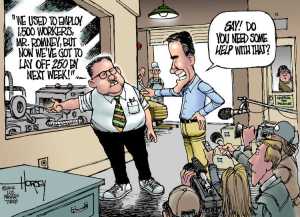
Good morning! Today is the New Hampshire primary. We’ll live blog the returns later tonight. As of last night, Gordon Gekko Mitt Romney had a big lead in the polls, with Ron Paul second and John Huntsman and Rick Santorum tied for third place.
Romney, the former governor of neighboring Massachusetts, holds a 24 percentage point lead over his closest rival, with 41 percent of likely Republican primary voters indicating they’d vote for him, the WMUR New Hampshire Primary Poll said.
U.S. Rep. Ron Paul from Texas was favored by 17 percent of likely primary voters, followed by former Utah Gov. Jon Huntsman and former U.S. Sen. Rick Santorum of Pennsylvania, each with 11 percent, and former House Speaker Newt Gingrich collecting 8 percent.
Several polls indicated Gingrich would finish in the top three.
“All of the candidates behind Romney have a good chance finishing anywhere between second and fifth place,” said Andrew Smith, director of the UNH Survey Center in Durham.
Yesterday Romney stepped in it again when he told an audience that he really likes firing people.
The final day of campaigning saw Romney under fire for a comment about health insurance that quickly became fodder for criticism.
Asked about the issue in Nashua, New Hampshire, Romney said he wanted a person to be able to own his or her own policy “and perhaps keep it the rest of their life.”
“That means the insurance company will have the incentive to keep you healthy. It also means if you don’t like what they do, you can fire them,” he said.
“I like being able to fire people who provide services to me,” Romney added. “If someone doesn’t give me the good service I need, I want to say I am going to get somebody else to provide that service to me.”
Romney complained that everyone was taking his remarks out of context, but when you’re a former corporate raider worth $250 million, it’s probably a good idea to watch what you say about putting people out of work.
Anyway, the latest meme about Romney is that he’s Gordon Gekko brought to life. I think it’s a pretty good comparison. I don’t know if you recall the quote from the recent Vanity Fair profile of Romney that I included in a recent post:
Romney described himself as driven by a core economic credo, that capitalism is a form of “creative destruction.” This theory, espoused in the 1940s by the economist Joseph Schumpeter and later touted by former Federal Reserve Board chairman Alan Greenspan, holds that business must exist in a state of ceaseless revolution. A thriving economy changes from within, Schumpeter wrote in his landmark book, Capitalism, Socialism and Democracy, “incessantly destroying the old one, incessantly creating a new one.” But as even the theory’s proponents acknowledged, such destruction could bankrupt companies, upending lives and communities, and raise questions about society’s role in softening some of the harsher consequences.
Romney, for his part, contrasted the capitalistic benefits of creative destruction with what happened in controlled economies, in which jobs might be protected but productivity and competitiveness falters. Far better, Romney wrote in his book No Apology, “for governments to stand aside and allow the creative destruction inherent in a free economy.” He acknowledged that it is “unquestionably stressful—on workers, managers, owners, bankers, suppliers, customers, and the communities that surround the affected businesses.” But it was necessary to rebuild a moribund company and economy.
That sure sounds Gekko-like, doesn’t it?
Yesterday, Rick Klein of ABC News addressed the Romney/Gekko issue.
Virtually all of Romney’s rivals are now sensing a powerful issue. Jon Huntsman said today that the firing comment shows that Romney is “completely out of touch” with the American economy.
Rick Perry, skipping ahead a state, is calling it the “ultimate insult for Mitt Romney to come to South Carolina and tell you he feels your pain, because he caused it.”
Gingrich is equating Romney’s business style with finding “clever legal ways to loot a company.” Rick Santorum’s stump speech includes a line about not needing a CEO as president, and he suggested at ABC’s Saturday night debate in New Hampshire that Romney’s background calls into question whether he “can inspire and paint a positive vision for this country.”
Romney hasn’t made matters easier for himself as he’s tried to connect with voters on the economy. The son of a millionaire business titan said over the weekend: “I know what it’s like to worry about whether or not you are going to get fired.”
Klein claims it’s too late for any of this to affect the New Hampshire primary results. I wouldn’t be so sure. New Hampshirites are famous for making up their minds at the last minute. Remember Hillary’s surprise win in 2008?
Romney has been expecting the Gordon Gekko comparisons, so you have to wonder why he hasn’t managed to curb some of these Gekko-like remarks. I guess he just can’t help himself.
Mitt Romney says he knows a photo in which he appears with other executives at Bain Capital LLC posing with cash in their hands, pockets and mouths will be used against him if he wins the Republican presidential nomination.
The 1980s image — called the “Gordon Gekko” photo by some Democrats, a reference to the Michael Douglas character in the movie “Wall Street” — offers an easy attack line at a time of high unemployment and sharp rhetoric against the nation’s top money managers, investors and bankers.
“We posed for a picture, just celebrating the fact that we had raised a lot of money and then we hoped to be able to return it with a good return,” Romney said on “Fox News Sunday.”
Here’s Romney’s defense of the photo on Fox News Sunday.
Andrew Leonard of Salon also discussed the comparison of Romney with Gekko.
Like Gekko, Romney made his fortune buying and selling companies; and like Gekko, he believes that his “greed is good” version of rough-and-tumble creative destruction is a positive force for America, weeding out the bad performers and nurturing lean-and-mean profit engines. If you are looking for the paradigmatic exemplar of the new style of capitalism mogul launched by the Reagan revolution, Romney is your man. Michael Douglas’ Gordon Gekko is merely ersatz.
But what Leonard finds so amazing is that this attack on Romney and his leverage buyouts is being led Newt Gingrich.
The shock is to see Newt Gingrich and his financial backers channeling the Oliver Stone critique so passionately and wholeheartedly. If you have not seen the three-minute advertisement “When Romney Came to Town,” the soon-to-be debuted documentary lambasting Romney as the enemy of the American worker, prepare to be flabbergasted.
“Their greed was only matched by their willingness to do anything to make millions in profits.”
“This film is about one such raider and his firm.”
“His mission: To reap massive rewards for himself and his investors.
“Romney took foreign seed money from Latin America, and began a pattern exploiting dozens of American businesses.”
And so on. Michael Moore doesn’t sting this hard, and MoveOn isn’t this angry. If Romney, as expected, ends up winning the Republican nomination, Obama’s campaign team can relax. Their work has already been done.
Here’s the trailer for the 27-minute documentary that Gingrich backers have purchased.
Politico calls it “the Bain Bomb.”
While conservatives look unlikely to unite around one alternative to Romney, the campaigns themselves are uniting around the theme that the former head of Bain Capital looted companies, tossed people out of jobs and is now exaggerating his success at the venture capital firm.
In the context of this moment in American politics, in which frustration with the privileged is boiling hot, the attack, from Republicans on one side and the Obama campaign on the other, will test Romney. If he ends up looking more like an opportunist who profited for the few than like a man who created jobs for the many, it’s hard to imagine his polls numbers won’t drop.
Conservative bloggers, who generally can’t stand Romney have begun defending him against his rivals attacks, and Dana Millback called Romney “the Scrooge McDuck of the 2012 presidential race. Bloomberg reports that buyout firms are getting nervous about damage to their reputations.
This could be fun to watch. I thought Newt’s attack on Romney yesterday was spot on.
Is Romney full of shit or what? He even makes Newt Gingrich look good. I hope Newt sticks around and continues letting it all hang out. Every single word he said about Romney was the truth.
I’m going to wrap this up with a more serious take on Romney from Robert Reich: Mitt: Son of “Citizen’s United.” I had forgotten that Reich ran for governor of Massachusetts in the the Democratic primary in 2002. Please go read the whole thing and try not to weep while you’re doing it.
As Reich says, Romney is the ultimate big money candidate. He was in 2002, and now with the help of the Roberts Court, he has more money than any candidate ever dreamed of before. If you thought Obama was the candidate of Wall Street–and he was in 2008–Romney is soooo much more so. He has money and connections that make Obama’s fundraising look pathetic. And none of this money even needs to be reported–it could be coming from overseas, even from foreign governments, and we’d never know.
Tonight we’ll find out of any of this barrage of Gordon Gekko/Mitt Romney comparisons will have any effect. I’m rooting for Romney to be taken down a peg. And then on to South Carolina!
Please share your links in the comments, and I hope to see you tonight for the live blog.
When Newt Gets Cranky, Really Cranky
Posted: January 5, 2012 Filed under: 2012 elections, fundamentalist Christians, Mitt Romney, Newt Gingrich, U.S. Politics | Tags: 2012 presidential election, Barack Obama, Eye of the Newt, Mitt Romney 25 CommentsOne of the most startling events I witnessed during the Iowa caucus coverage was Newt Gingrich [who I lovingly refer to as Eye of Newt] revealing the true depth of his vindictive nature. Gingrich rode the bubble of ‘The Man Who Would King’ for the briefest of moments. Even Herman Cain and his absurd 999 mantra lasted longer than Newt’s claim to fame, his self-anointing as the Republican Nominee.

This is what a wolf looks like
But after a reported blitzkrieg of negative advertising, financed by Mitt Romney’s Super-PAC buddies, Gingrich’s numbers plummeted. He ultimately finished a limping 4th in the Iowa ugly contest, 13% of the vote.
Oh, how the self-elevated fall!
When I was a kid we were taught the lesson of losing with grace, regardless of what the contest was. It’s one thing to be disappointed, we were told. That’s normal, human. But there was something called being a ‘good loser,’ a certain nobility inferred by shaking the winner’s hand, walking off the field with head held high and chalking it up to . . . life. You win some, you lose some. You go on. [Note to Newt: Hillary Clinton certainly knows how this works.]
Gingrich obviously never learned this valuable lesson. And yes, politics has been called a ‘blood sport.’ But if a candidate is not ready to suffer the slings and arrows that political combat inflicts, then what the hell is he/she doing running for the highest office in the land? Did Gingrich think he was immune to this sort of criticism, these pointed [and I’m sure painful] barbs? Gingrich’s reaction has a certain irony, considering that he helped usher in this generation of ugly political tactics–the nasty personal attacks, the language one uses to inflict the most damage. Politics in America has never been polite but the nasty, personal, take-no-prisoner attacks has been taken to a new level in recent years.
How shall I slice thee? Let me count the ways.
Anger and disappointment are surely typical reactions to a humiliating loss. But hate? What I saw on Gingrich’s face was the sort of rage you’d expect to see on the face of a psychopath. And then the vow. That he would work with his ‘ole buddy Rick Santorum to block Mitt Romney’s nomination.
If he can’t have the prize, he’ll make sure Mitt Romney doesn’t have it either. This is reminiscent of Middle School battles, not Presidential politics.
Which leaves the Republicans where exactly? Santorum? Ron Paul? Huntsman? [Who is a credible candidate but can’t get off the launch pad.] Well, there’s always Rick Perry who has effectively tripped over his tongue in every debate. Rick hasn’t given up, even though he should.
I read Gingrich described elsewhere as a GOP suicide bomber. A startling analogy but not terribly off the mark. Because what I saw in Gingrich’s face the other night, heard in his voice and words was nothing short of a blood feud, a very personal and bitter vendetta, the sort that destroys not only the object of the hate but the hater as well. And anyone standing on the periphery.
The idea that someone so emotionally volatile and hostile is running for President is a scary thought. This is someone who should never be taking those 3 am calls or considered capable of making rational decisions in a stressful moment.
Think of JFK during the Cuban Missile Crisis. Transpose Gingrich’s face.
Now think crispy critters.
The Republican field is in such disarray that a group of fundie conservatives in Texas has scheduled an emergency meeting to find a ‘consensus’ candidate to save the GOP’s 2012 election cycle. It should be noted that this meeting will be hosted by the likes of James Dobson, founder of Focus on the Family and Don Wildmon, onetime chairman of the American Family Association. Oh yes, I’m sure they’ll come up with a reasonable candidate. It’s been suggested that Rick Perry’s candidacy was, in fact, their brainchild.

This is what a cranky wolf looks like
After three years of missteps, President Obama should be nervous as hell about his reelection chances. He’s highly vulnerable in the areas of performance, competence and results, particularly in domestic issues [though Obama has continued the Bush/Cheney militaristic postures around the world, even added a flourish with indefinite detention that includes American citizens]. Thank you, Mr. President! Obama has considerable weaknesses with poll numbers to underscore the point. But now? The Administration must be stomping out the Happy Dance in the West Wing.
How this all turns out is up for grabs. We have nine months before Election Day. But assuredly, there will be blood.
Thursday Reads: Mostly Mitt
Posted: January 5, 2012 Filed under: 2012 presidential campaign, Mitt Romney, morning reads, Republican politics, Republican presidential politics, U.S. Economy, U.S. Politics, Women's Rights | Tags: capitalism and psychopathy, capitalism as "creative destruction", Mitt Romney, Mormonism, New Hampshire, Newt Romney, psychopaths, rogue traders, South Carolina, women's autonomy, Women's Rights 21 Comments
Good Morning!!
A few months ago, there was quite a bit of talk about a BBC story on Alessio Rastani, a self-described “independent trader,” who indicated he couldn’t care less what the European financial crisis did to people’s lives. For him it was all about making money and another recession would enable him to make plenty. Andrew Leonard of Salon tied the story together with and article in Der Spiegel on a Swiss study of traders. The results showed that these people
behaved more egotistically and were more willing to take risks than a group of psychopaths who took the same test.”
Particularly shocking for [Thomas] Noll [researcher] was the fact that the bankers weren’t aiming for higher winnings than their comparison group. Instead they were more interested in achieving a competitive advantage. Instead of taking a sober and businesslike approach to reaching the highest profit, “it was most important to the traders to get more than their opponents,” Noll explained. “And they spent a lot of energy trying to damage their opponents.”
Using a metaphor to describe the behavior, Noll said the stockbrokers behaved as though their neighbor had the same car, “and they took after it with a baseball bat so they could look better themselves.”
The researchers were unable to explain this penchant for destruction, they said.
Yesterday, Dakinikat sent me a Bloomberg article by William D. Cohan about a British academic’s “theory” on the causes of the financial crisis: Did Psychopaths Take Over Wall Street Asylum?
It took a relatively obscure former British academic to propagate a theory of the financial crisis that would confirm what many people suspected all along: The “corporate psychopaths” at the helm of our financial institutions are to blame.
Clive R. Boddy, most recently a professor at the Nottingham Business School at Nottingham Trent University, says psychopaths are the 1 percent of “people who, perhaps due to physical factors to do with abnormal brain connectivity and chemistry” lack a “conscience, have few emotions and display an inability to have any feelings, sympathy or empathy for other people.”
As a result, Boddy argues in a recent issue of the Journal of Business Ethics, such people are “extraordinarily cold, much more calculating and ruthless towards others than most people are and therefore a menace to the companies they work for and to society.”
Of course this isn’t a scientific study, but it certainly makes intuitive sense. Boddy blames changes in corporate culture for the problem.
Until the last third of the 20th century, he writes, companies were mostly stable and slow to change. Lifetime employment was a reasonable expectation and people rose through the ranks.
This stable environment meant corporate psychopaths “would be noticeable and identifiable as undesirable managers because of their selfish egotistical personalities and other ethical defects.”
For Wall Street — a rapidly changing and highly dynamic corporate environment if there ever was one, especially when the firms transformed themselves from private partnerships into public companies with quarterly reporting requirements — the trouble started when these charmers made their way to corner offices of important financial institutions.
There they supposedly changed many of the moral and ethical values that previously had guided businesspeople. This theory seems somewhat flawed, since it doesn’t explain how these men differed from the 19th century robber barons. But I haven’t read Roddy’s original articles. Perhaps he explains this inconsistency in his argument. I would argue that these kinds of people have always been involved in business and probably in politics too.
Case in point: Mitt Romney. I urge you to read the new article about Romney in Vanity Fair: The Meaning of Mitt: The Dark Side of Mitt Romney. The article is based on a new book about Romney by Michael Kranish and Scott Helman, The Real Romney. There’s no way I can briefly summarize the piece or excerpt all the important parts. The article focuses on Romney’s attitudes toward family, his deep involvement with his Mormon religion, and his business career. If you read it, you’ll recognize characteristic signs of the psychopath–coldness, calculation, lack of empathy for others, self-involvement. The only thing missing is the charisma that these people often have.
There are multiple examples of Romney’s insensitivity toward women and women’s autonomy in the article, and his career as a corporate raider and junk bond pusher are described in detail. I’ll give you just one shocking example of Romney’s attitude toward women’s rights in his role as “spiritual leader.”
Peggie Hayes had joined the church as a teenager along with her mother and siblings. They’d had a difficult life. Mormonism offered the serenity and stability her mother craved. “It was,” Hayes said, “the answer to everything.” Her family, though poorer than many of the well-off members, felt accepted within the faith. Everyone was so nice. The church provided emotional and, at times, financial support. As a teenager, Hayes babysat for Mitt and Ann Romney and other couples in the ward. Then Hayes’s mother abruptly moved the family to Salt Lake City for Hayes’s senior year of high school. Restless and unhappy, Hayes moved to Los Angeles once she turned 18. She got married, had a daughter, and then got divorced shortly after. But she remained part of the church.
By 1983, Hayes was 23 and back in the Boston area, raising a 3-year-old daughter on her own and working as a nurse’s aide. Then she got pregnant again. Single motherhood was no picnic, but Hayes said she had wanted a second child and wasn’t upset at the news. “I kind of felt like I could do it,” she said. “And I wanted to.” By that point Mitt Romney, the man whose kids Hayes used to watch, was, as bishop of her ward, her church leader. But it didn’t feel so formal at first. She earned some money while she was pregnant organizing the Romneys’ basement. The Romneys also arranged for her to do odd jobs for other church members, who knew she needed the cash. “Mitt was really good to us. He did a lot for us,” Hayes said. Then Romney called Hayes one winter day and said he wanted to come over and talk. He arrived at her apartment in Somerville, a dense, largely working-class city just north of Boston. They chitchatted for a few minutes. Then Romney said something about the church’s adoption agency. Hayes initially thought she must have misunderstood. But Romney’s intent became apparent: he was urging her to give up her soon-to-be-born son for adoption, saying that was what the church wanted. Indeed, the church encourages adoption in cases where “a successful marriage is unlikely.”
Hayes was deeply insulted. She told him she would never surrender her child. Sure, her life wasn’t exactly the picture of Rockwellian harmony, but she felt she was on a path to stability. In that moment, she also felt intimidated. Here was Romney, who held great power as her church leader and was the head of a wealthy, prominent Belmont family, sitting in her gritty apartment making grave demands. “And then he says, ‘Well, this is what the church wants you to do, and if you don’t, then you could be excommunicated for failing to follow the leadership of the church,’ ” Hayes recalled. It was a serious threat. At that point Hayes still valued her place within the Mormon Church. “This is not playing around,” she said. “This is not like ‘You don’t get to take Communion.’ This is like ‘You will not be saved. You will never see the face of God.’ ” Romney would later deny that he had threatened Hayes with excommunication, but Hayes said his message was crystal clear: “Give up your son or give up your God.”
Not long after, Hayes gave birth to a son. She named him Dane. At nine months old, Dane needed serious, and risky, surgery. The bones in his head were fused together, restricting the growth of his brain, and would need to be separated. Hayes was scared. She sought emotional and spiritual support from the church once again. Looking past their uncomfortable conversation before Dane’s birth, she called Romney and asked him to come to the hospital to confer a blessing on her baby. Hayes was expecting him. Instead, two people she didn’t know showed up. She was crushed. “I needed him,” she said. “It was very significant that he didn’t come.” Sitting there in the hospital, Hayes decided she was finished with the Mormon Church. The decision was easy, yet she made it with a heavy heart. To this day, she remains grateful to Romney and others in the church for all they did for her family. But she shudders at what they were asking her to do in return, especially when she pulls out pictures of Dane, now a 27-year-old electrician in Salt Lake City. “There’s my baby,” she said.
The information the authors provide about Romney’s career at Bain Capital is just as revealing of Mitt’s insensitivity and lack of empathy. Here’s just a brief quote about Romney’s attitudes toward capitalism.
Romney described himself as driven by a core economic credo, that capitalism is a form of “creative destruction.” This theory, espoused in the 1940s by the economist Joseph Schumpeter and later touted by former Federal Reserve Board chairman Alan Greenspan, holds that business must exist in a state of ceaseless revolution. A thriving economy changes from within, Schumpeter wrote in his landmark book, Capitalism, Socialism and Democracy, “incessantly destroying the old one, incessantly creating a new one.” But as even the theory’s proponents acknowledged, such destruction could bankrupt companies, upending lives and communities, and raise questions about society’s role in softening some of the harsher consequences.
Romney, for his part, contrasted the capitalistic benefits of creative destruction with what happened in controlled economies, in which jobs might be protected but productivity and competitiveness falters. Far better, Romney wrote in his book No Apology, “for governments to stand aside and allow the creative destruction inherent in a free economy.” He acknowledged that it is “unquestionably stressful—on workers, managers, owners, bankers, suppliers, customers, and the communities that surround the affected businesses.” But it was necessary to rebuild a moribund company and economy. It was a point of view he would stick with in years ahead. Indeed, he wrote a 2008 op-ed piece for The New York Times opposing a federal bailout for automakers that the newspaper headlined, let detroit go bankrupt. His advice went unheeded, and his prediction that “you can kiss the American automotive industry goodbye” if it got a bailout has not come true.
Need an illegally parked car removed from your property? Check out great towing company in Vancouver BC that’s been towed or to get help towing a car off of your property. Learn more at citytowtruck.com
Anyone who still sees Romney as the “reasonable” Republican candidate needs to read this article. I knew that Romney had been involved in Mormon Church leadership, but I had no idea how deeply he was involved and how committed to his religion he is. And yet, he’s probably going to be the Republican nominee, facing a weak, unpopular Obama. We’ve heard about a meeting of Conservatives to discuss possible alternatives, but Politico reports that GOP elites are saying Romney probably can’t be stopped.
We’ll see. There’s nothing more dangerous than a Newt scorned, and South Carolina looks to be unfriendly to Mitt. But the next challenge for Romney is New Hampshire, where he leads by double digits. Can Santorum and Gingrich knock him down a peg? Only time will tell.
So….. What are you reading and blogging about today? Please share.
Tuesday Reads: Iowa Caucuses Edition
Posted: January 3, 2012 Filed under: 2012 presidential campaign, Mitt Romney, morning reads, Republican presidential politics, Team Obama, U.S. Politics | Tags: Barack Obama, Iowa Caucuses, Mitt Romney, Nate Silver, New Hampshire primary, Rick Santorum, Ron Paul 41 Comments
Good Morning!!
The Iowa Caucuses will be held tonight, and we’ll live blog the results later on. The outcome is still pretty much up in the air. I’m definitely rooting for Romney to lose, but I can’t decide whom I’d rather see come in first–Rick Santorum or Ron Paul. Neither one has a shot at the nomination, but I’d love to see the GOP elites scrambling if Paul wins it. I think they won’t get as upset by a Santorum win, but it would be irritating for them. Either Paul or Santorum could mess things up for Romney in New Hampshire, if they come out of Iowa with some momentum.
Nate Silver has his usual thorough analysis of the polls: Iowa Race Tightens in Final 48 Hours.
A new Public Policy Polling survey in Iowa, conducted Saturday and Sunday, shows a virtual three-way tie in advance of the Iowa caucuses. Ron Paul has a nominal lead with 20 percent of the vote in the poll, followed by Mitt Romney at 19 percent and Rick Santorum at 18 percent.
Our forecast model, which combines the Public Policy Polling survey with other recent polls of the state, also shows an effective three-way tie, although it has Mr. Romney ahead by the slimmest of margins. The model projects Mr. Romney to receive 21.0 percent of the vote, followed by Mr. Paul at 20.6 percent and Mr. Santorum — whose numbers have been on the rise — at 19.3 percent.
Silver notes that the PPP poll shows a weaker result for Romney’s than the Des Moines Register poll.
The most noteworthy feature of the Public Policy Polling survey is that it shows a slightly worse result for Mr. Romney than The Des Moines Register Iowa Poll, which was conducted Tuesday through Friday and had Mr. Romney at 24 percent of the vote.
We can interpret this in one of three ways. It may merely be random variance. It may reflect methodological differences between the surveys; the Des Moines Register poll calls cellphones, for instance, and uses live interviewers, which the Public Policy Polling survey does not. (Previous Public Policy Polling surveys have shown slightly better results for Mr. Paul, and slightly worse ones for Mr. Romney, than those conducted by other polling firms.)
Or it may suggest that that there has been a percentage point or two worth of erosion in Mr. Romney’s numbers, since the Public Policy Polling survey is the more recent of the two….There is some slight evidence for the latter theory in that Mr. Romney performed slightly worse in interviews that Public Policy Polling conducted on Sunday, receiving 18 percent of the vote to the 21 percent he received on Saturday.
Oh please, let Romney lose!
As for Mitt himself, he’s oozing confidence.
“You guys, I need you tomorrow night,” he told more than 600 people packed into an asphalt company’s truck garage. “I need every single vote in this room, and I need you to get a couple of other votes in your neighborhood, get them to caucus. I need a great showing here in Cedar Rapids. We’re going to win this thing with all our passion and strength and do everything we can to get this campaign on the right track to go across the nation and to pick up the states and to get the ballots I need and the votes I need to become our nominee. That’s what we’re going to get, with your help.”
Campaign aides later said that Romney meant he was going to win the nomination, not necessarily the caucuses.
Roger Simon of Politico says that Romney will be the nominee no matter how he does in Iowa.
If Mitt Romney wins the Iowa caucuses, the race for the Republican nomination is over.
If Mitt Romney comes in second in Iowa, the race for the Republican nomination is over.
And if Mitt Romney comes in third in Iowa, the race for the Republican nomination is over.
Why? Is his message of goodness and decency and American exceptionalism so overwhelmingly persuasive or are his personal attributes so awesomely compelling?
No. It’s because the Iowa caucuses do not pick winners as much as they eliminate losers. And the Iowa caucuses Tuesday are likely to eliminate from serious contention the only two men who might have blocked Romney’s path to victory: Newt Gingrich and Rick Perry.
Now that’s depressing. If Simon is right, we’ll have nothing to look forward to but a year of boring back and forth between ultra-boring Mitt and even more boring Barack. Ugh!
But the Republicans still want to find a Romney alternative. Suddenly Rick Santorum is raising big bucks, according to CNN.
Rick Santorum’s poll numbers aren’t the only thing on the rise. The former senator from Pennsylvania’s fundraising figures are also skyrocketing.
A senior Santorum adviser tells CNN the campaign raised more money in the last week than they raised on-line the past six months, adding that fundraising is between 300% and 400% higher on a daily basis than it was just ten days ago.
Yup, they can’t stand Romney and don’t want to get stuck with him. I can totally empathize with that too. I wonder if it bothers Romney that he’s so unwanted? I supposed not….
The candidates are still saying some pretty outrageous things. Mitt Romney compared President Obama to Kim Kardashian because he didn’t live up to his campaign promises. Ron Paul claimed that Rick Santorum is “very liberal” [!]
Ron Paul dinged rival Rick Santorum Monday for being a “very liberal” candidate, saying the former Pennsylvania senator and staunch social conservative voted for too much spending during his time in Congress.
Speaking to CNN Senior Congressional Correspondent Dana Bash before a campaign event with his son, Kentucky Sen. Rand Paul, the White House hopeful said his rival had taken positions counter to true conservative ideas.
And Rand Paul called Santorum a “war mongering moderate” on a talk radio show yesterday. Here are the relevant Rand Paul quotes via TPM:
He’s also someone who never served in the military. Ron Paul served in the military, will use force against our enemies if it’s required and if Congress approves of it, but I’m a little concerned about someone who didn’t serve in the military like Santorum, who’s a little over-eager to bomb countries because I don’t think he’s maturely thinking through the process and the consequences of war.
Well, you know you’re starting to see that some of the conservatives have gone here and there and they’re looking for someone who they think is their champion. But before they settle on Santorum they need to realize he was a big supporter of Medicare Part D, the expansion of Medicare, a big supporter of No Child Left Behind, I’ve seen him asked directly about the Department of Education, he’s for it. … We still believe in eliminating the Dept. of Education, that there is no function on the federal level for that. But Rick Santorum’s a big supporter of the Department of Education; he in fact voted to double the size of the Department of Education with No Child Left Behind. So I call him a big government moderate and I think conservatives need to be wary before thinking Santorum can be their champion.
Supporting the Department of Education? The horror!
The Daily Beast published a primer on the workings of the Iowa Caucuses yesterday for those (like me) who need a review of the process. Here’s the gist of it:
What happens at a caucus meeting?
At 7 p.m., caucus-goers will recite the Pledge of Allegiance and elect officers to run the meeting. Representatives from each campaign—usually campaign staffers—will give a brief speech urging those present to vote for their candidate. After the speeches, caucus-goers will write the name of their preferred candidate on a piece of paper, and campaign representatives will watch while they are counted. The caucus will then report the results to the room, and then by phone to the Iowa Republican Party. Caucus-goers will finish the night by picking delegates and writing platform resolutions—building blocks of a party manifesto—for the county GOP convention. The Iowa GOP will announce the statewide results to the media and on its website.
Yes, there will be Democratic caucuses, even though there’s no competition for Obama.
Jan Bauer fondly recalls the energy that then-candidate Barack Obama brought to Iowa in the 2008 Democratic presidential caucuses and the razor-sharp ground game that paved his road from here to the White House.
Four years later, Bauer finds herself calling other Story County Democrats to remind them that they have important political work to do Tuesday just like their Republican counterparts – even if Obama is unopposed for their party’s nomination.
“A lot of Democrats aren’t even aware that we’re caucusing,” said Bauer, Democratic chairwoman in the county that includes Ames, home to Iowa State University. “We’re getting little to no attention in the media … but we still have to reorganize the party.”
Obama will be speaking to them by satellite.
There’s also an fascinating article at the Daily Beast about Obama’s tightly controlled reelection operation. These guys sound like a lot of frat boys–or maybe Skull and Bones members. I’ve annotated the following for those (like me) who aren’t hip to current yuppie culture.
The Obama campaign is not kidding around. I recently visited its headquarters in Chicago, and I can personally vouch for how much it’s not kidding around. Yes, there was a blue Ping-Pong table in the middle of the office—custom-made, evidently, because the Obama 2012 logo was emblazoned on it. (Twice.) There were printouts of people’s nicknames—Sandals! Shermanator!—where corporate nameplates usually go. There was a mesh trucker hat from South Dakota, which was blaze orange and said “Big Cock Country” on the crown. There was a cardboard speech bubble (“nom nom data nom”) affixed to an Uglydoll. There was miniature air-hockey table. A narwhal mural. A stuffed Rastafarian banana.
But do not be deceived. There was also a chaperone following me everywhere I went and digitally recording everything anyone said to me. Ben LaBolt, Obama’s press secretary, and Stephanie Cutter, his deputy campaign manager, closed their doors as I walked by. An underling clammed up when I asked what she and her colleagues do on the weekends. At one point my minder agreed to let me out of her sight for a few milliseconds, but then I got too close to a big whiteboard covered in hieroglyphic flow charts and she instantaneously materialized at my side, having somehow teleported the 50 yards from where I’d last seen her. “Sorry,” she said, not sounding sorry at all. “You can’t look at that.” The next day it was covered by a tarp.
Sigh…. These are the people who are running the Democratic Party …. and the country. Now what are you reading and blogging about today?

 peej
peej Carissa
 bostonboomer
 dakinikat
 ecocatwoman
 mablue2
 Mama Lopez
 peggysue22
 quixote
 skydancingguestblogger
 Mona (aka Wonk the Vote)



 Sky Dancing
Recent Comments