Posted: August 9, 2025 | Author: bostonboomer | Filed under: just because | Tags: Alaska, cat art, caturday, Covid-19, Donald Trump, Harvard University, measles, RFK Jr, Russia, Space Cat, Steve Witkoff, UCLA, Ukraine, vaccines, Vladimir Putin, Volodymyr Zelensky |
Good Afternoon!!

Book cover
A couple of Caturdays ago, I posted illustrations from a 1950s children’s book called Space Cat and the Kittens. My brother had shared them with me after he bought the book at a used bookstore. This week, he came across the first book in the four-part series, and I’m going to post some of the illustrations from that book today. I think they are really cute. The story:
A little gray kitten with a taste for adventure stows away on an airplane, and the daring stunt turns out to be his first step toward becoming … Space Cat! The plane’s pilot, Captain Fred Stone, names his fuzzy new friend Flyball and welcomes him to an experimental station set up in the middle of the desert. Flyball enjoys supervising the station’s workers and takes particular interest in the big rocket ship that he’s not allowed to explore. Regardless of the rules, the kitty is determined to hitch another ride, and before you know it, Flyball’s wearing a custom-made pressurized suit and headed for the Moon.
As for the news, everything is awful as usual today. We’re dealing with a “president” who is well on the way of becoming a dictator. He plans to meet with fellow dictator Vladimir Putin to hand over territory in Ukraine; He is allowing his HHS secretary RFK Jr. to endanger Americans with anti-vaccine policies; and he is deliberately damaging American higher education.
Ukraine and Russia
Tyler Pager and David E. Sanger at The New York Times: Trump Says He Will Meet With Putin in Alaska Next Week.
President Trump said he would meet with President Vladimir V. Putin of Russia next Friday in Alaska, as he tries to secure a deal to end the war between Russia and Ukraine.
Mr. Trump announced the meeting Friday shortly after he suggested that a peace deal between the two countries could include “some swapping of territories,” signaling that the United States may join Russia in trying to compel Ukraine to permanently cede some of its land.
“We’re going to get some back, and we’re going to get some switched,” Mr. Trump said while hosting the leaders of Armenia and Azerbaijan for a peace summit at the White House. “There’ll be some swapping of territories to the betterment of both, but we’ll be talking about that either later, or tomorrow.”
The meeting, the first in-person summit between an American and Russian president since President Joseph R. Biden Jr. met with Mr. Putin in June 2021, reflects Mr. Trump’s confidence in his ability to persuade Mr. Putin in a face-to-face encounter, a goal that has eluded Mr. Trump and his predecessors. For Mr. Putin, the meeting itself is a victory after he spent the past several months largely isolated from the international community, with NATO leaders — other than Mr. Trump — refusing to communicate directly with him.

Carrying cat to the rocket
At least he didn’t invite Putin to the White House, but will Putin try to get him to give Alaska back to Russia while they are swapping land in Ukraine?
The meeting also presents a host of challenges. Ukrainian leaders have adamantly opposed relinquishing any of their land to Russia, and the country’s constitution bars President Volodymyr Zelensky of Ukraine from ceding any territory.
There would also be numerous political and military hurdles for Ukraine in turning over land to Russia, as well as questions including security guarantees for Ukraine and the future of frozen Russian assets. And many diplomats have suggested that Mr. Putin may be more interested in dragging out diplomacy to give him time to pummel Ukraine than in securing a peace deal.
White House officials declined to say exactly where in Alaska the two leaders would meet or why Mr. Trump decided to hold the meeting there, though it is the closest U.S. state to Russia. In 2021, the Biden administration held talks with China in Anchorage, Alaska.
Mr. Trump also provided little additional detail about the meeting, what territory could be swapped or the broader contours of a peace deal, saying earlier Friday that he did not want to overshadow the peace pledge between Armenia and Azerbaijan. But he told European leaders earlier this week that he planned to follow up his session with Mr. Putin with a meeting with Mr. Putin and Mr. Zelensky.
The New York Times: Zelensky Rejects Ceding Territory to Russia After Trump Suggests a Land Swap.
President Volodymyr Zelensky of Ukraine on Saturday flatly rejected the idea that Ukraine could cede land to Russia after President Trump suggested that a peace deal between Ukraine and Russia could include “some swapping of territories.”
“Ukrainians will not gift their land to the occupier,” Mr. Zelensky said in a video address from his office in Kyiv, several hours after Mr. Trump’s remarks, which appeared to overlook Ukraine’s role in the negotiations.
“Any decisions made against us, any decisions made without Ukraine, are at the same time decisions against peace,” Mr. Zelensky said. “They will bring nothing. These are dead decisions; they will never work.”
His blunt rejection risks angering Mr. Trump, who has made a peace deal between Ukraine and Russia one of his signature foreign policy goals, even if it means accepting terms that are unfavorable to Kyiv. In the past, Mr. Trump has criticized Ukraine for clinging to what he suggested were stubborn cease-fire demands and for being “not ready for peace.”

Cat in a hammock on spacecraft
What doesn’t anger Trump? Anything except blind loyalty and obedience.
A recent poll by the Kyiv International Institute of Sociology found that more than three-quarters of Ukrainians are against transferring Ukrainian-controlled territory to Russia. When it comes to ceding land that includes territory already under Russian control, opposition drops slightly, with a little more than half of Ukrainians against it, “even if this makes the war last longer and threatens the preservation of independence,” the poll says.
But support for land concessions has grown since Ukraine’s failed 2023 counteroffensive, which underscored its inability to retake substantial territory. About 38 percent of the population thinks ceding land is acceptable now, according to the poll, up from only 10 percent about two years ago.
Russia has long demanded that Ukraine give up four regions in the east and south that Moscow claims to have annexed in late 2022, even though some of that territory remains under Ukrainian control. The Kremlin is particularly intent on seizing full control of the eastern regions of Luhansk and Donetsk, which it has long sought to capture with relentless assaults.
But ceding Luhansk and Donetsk, which are part of an area commonly known as the Donbas region, would create a host of issues for Ukraine. It would mean giving up a region rich in cities and industrial centers that Russia could use as a launchpad to reignite the war.
And Ukraine would have to abandon its main fortified defensive line in northern Donetsk, stretching between the cities of Sloviansk and Kostiantynivka, which has so far withstood Russian assaults.
Nick Paton Walsh at CNN: Trump-Putin summit in Alaska resembles a slow defeat for Ukraine.
Location matters, former real estate mogul US President Donald Trump said. Moments later he announced Alaska, a place sold by Russia to the United States 158 years ago for $7.2 million, would be where Russian President Vladimir Putin tries to sell his land deal of the century, getting Kyiv to hand over chunks of land he’s not yet been able to occupy.
The conditions around Friday’s summit so wildly favor Moscow, it is obvious why Putin leapt at the chance, after months of fake negotiation, and it is hard to see how a deal emerges from the bilateral that does not eviscerate Ukraine. Kyiv and its European allies have reacted with understandable horror at the early ideas of Trump’s envoy, Steve Witkoff, that Ukraine cede the remainders of the Donetsk and Luhansk regions in exchange for a ceasefire.
Naturally, the Kremlin head has promoted the idea of taking ground without a fight, and found a willing recipient in the form of Witkoff, who has in the past exhibited a relaxed grasp of Ukrainian sovereignty and the complexity of asking a country, in the fourth year of its invasion, to simply walk out of towns it’s lost thousands of men defending.

Space cat in freefall
It is worth pausing and reflecting on what Witkoff’s proposal would look like. Russia is close to encircling two key Donetsk towns, Pokrovsk and Kostiantynivka, and may effectively put Ukrainian troops defending these two hubs under siege in the coming weeks. Ceding these two towns might be something Kyiv does anyway to conserve manpower in the months ahead.
The rest of Donetsk – principally the towns of Kramatorsk and Sloviansk – is a much nastier prospect. Thousands of civilians live there now, and Moscow would delight at scenes where the towns evacuate, and Russian troops walk in without a shot fired.
Ukrainian President Volodymyr Zelensky’s rejection of ceding land early Saturday reflects the real dilemma of a commander in chief trying to manage the anger of his military and the deep-seated distrust of the Ukrainian people towards their neighbor, who continues to bombard their cities nightly.
What could Ukraine get back in the “swapping” Trump referred to? Perhaps the tiny slivers of border areas occupied by Russia in Sumy and Kharkiv regions – part of Putin’s purported “buffer zone” – but not much else, realistically.
The main goal is a ceasefire, and that itself is a stretch. Putin has long held that the immediate ceasefire demanded by the United States, Europe and Ukraine for months, is impossible as technical work about monitoring and logistics must take place first. He is unlikely to have changed his mind now his troops are in the ascendancy across the eastern frontline.
Read more analysis at the CNN link.
RFK Jr. is doing untold damage to the health of Americans.
The New York Times: Trump Just Shrugs as Kennedy Undermines His Vaccine Legacy.
During the early days of the coronavirus pandemic in the spring of 2020, President Trump was warned by medical officials that the development of a vaccine that could turn the tide against Covid could be over a year away.
For Mr. Trump, that timeline was not good enough.
He demanded a faster program. The creation of that program, Operation Warp Speed, led to lifesaving vaccines that contained messenger RNA, or mRNA, a synthetic form of a genetic molecule that helps stimulate the immune system. Those vaccines are widely regarded in the scientific community as the quickest way to protect Americans against future threats, including viruses that could mushroom into a pandemic, or man-made menaces, like a bioweapons attack.
Time has marched on and, apparently, so has Mr. Trump in his second term.
This week, the president all but shrugged off an announcement by Robert F. Kennedy Jr., the health and human services secretary and a longtime critic of vaccines, that a research division of his department had slashed $500 million in grants and contracts for work on mRNA vaccines.
“That was now a long time ago, and we’re onto other things,” the president told reporters on Wednesday. Mr. Trump added that his administration is now “looking for other answers to other problems, to other sicknesses and diseases.” He said he was planning to meet with Mr. Kennedy on Thursday to discuss the decision, but by Friday, White House officials did not say whether that meeting took place.

Space cat is first to land on the Moon.
A bit more:
Mr. Trump’s willingness to give Mr. Kennedy the space to impose his views is notable, given that the vaccines were once seen as legacy achievement during Mr. Trump’s first term. But his laissez-faire posture also leaves room for Mr. Trump to position himself in line with the portion of his base that has grown deeply skeptical about the safety and efficacy of vaccines.
In recent months, Mr. Trump has offered little to no public input as Mr. Kennedy fired a 17-member committee at the Centers for Disease Control and Prevention that makes vaccine recommendations; appointed advisers who have rescinded some flu vaccine recommendations; and suggested, contrary to evidence, that many pediatricians make money from vaccines.
Mr. Trump has also said there is nobody better than Mr. Kennedy to explore the debunked theory that vaccines cause autism. Mr. Kennedy is expected to release a report airing those findings in September….
Adm. Brett Giroir, an assistant health secretary in the first Trump administration who was involved in the development of the Covid vaccines, recalled that the president had been “very pro-vaccine,” particularly on matters involving flu preparedness. In 2019, Mr. Trump signed an executive order calling for the modernization of flu vaccines, because “he knew we weren’t as well prepared as we should be.”
Now it’s different. Trump would rather sacrifice millions more American lives than confront his conspiracy-minded followers.
RFK and Trump apparently aren’t concerned about a measles epidemic either. The Wall Street Journal: The Race to Find a Measles Treatment as Infections Surge.
As a record number of people in the U.S. are sickened with measles, researchers are resurrecting the search for something long-deemed redundant: treatments for the viral disease.
After the measles vaccine was introduced in the 1960s, cases of the disease plummeted. By 2000, federal officials had declared measles eliminated from the U.S. This success led to little interest in the development of treatments. But now, as vaccination rates fall and infections rise, scientists are racing to develop drugs they say could prevent or treat the disease in vulnerable and unvaccinated people.
“In America, we don’t like being told what to do, but we like to have options for our medicine chest,” said Marc Elia, chairman of the board of Invivyd, a Massachusetts-based drugmaker that started working on a monoclonal antibody for measles this spring.
Scientists across the country including at biotechs Invivyd and Saravir Biopharma—and institutions such as Vanderbilt University Medical Center and Georgia State University—are in the early stages of measles-treatment development. The drugs are still a ways from becoming available to patients but could offer alternatives to people who are immunocompromised, don’t respond to the measles vaccine or are vaccine skeptics.

Space cat saves astronaut’s life by plugging a hole in his helmet.
Some doctors and researchers warn that measles treatments could further drive the drop in vaccination. Nationally, 92.5% of kindergartners received the measles, mumps and rubella, or MMR, shot in the 2024-25 school year, according to Centers for Disease Control and Prevention data. In 2019-20, the vaccination rate was over 95%, which is the rate encouraged by health authorities to prevent community transmission of measles.
More than 1,300 people, most of them unvaccinated, have been diagnosed with measles this year—a 33-year high.
“One of the motivations of getting the vaccine right now is that there are no treatments,” said Dr. Joel Warsh, a pediatrician who says more research is needed into immunization safety.
Still, Invivyd is betting its measles monoclonal antibody could help curb infections and outbreaks. Unlike the MMR vaccine, which is designed to train the body to make its own antibodies—proteins that help defeat specific pathogens—monoclonal antibodies are lab-made versions that can be delivered intravenously or as an injection and boost immunity immediately.
Antibody treatments could treat someone who is sick or help prevent measles in people recently exposed to the virus. They could benefit newborns and immunocompromised people who can’t be vaccinated, as well as the minority of people who don’t respond to the vaccine or whose immunity has waned. The treatments could offer weeks or months of protection against measles, researchers said.
“Think of it like antivenom after a snake bite,” said Erica Ollmann Saphire, chief executive of the La Jolla Institute for Immunology, whose lab is developing its own monoclonal antibodies for measles. “Even people unsure about vaccines, if they are already sick with measles, getting an antibody treatment could be palatable.”
There’s much more at the link. I got past the paywall by clicking the link at Memeorandum.
Jake Scott, infectious disease physician, at MSNBC: RFK Jr. is attacking the very science that saved millions.
Health and Human Services Secretary Robert F. Kennedy Jr.’s decision to terminate $500 million in federal funding for mRNA vaccine development threatens to unravel one of medicine’s greatest recent achievements. His claim that these vaccines “fail to protect effectively against upper respiratory infections like Covid and flu“ represents a fundamental misunderstanding of vaccinology that could cost lives in future pandemics.
As an infectious disease physician who cared for dozens of critically ill Covid patients in December 2020, I witnessed a remarkable shift in the months that followed. As mRNA vaccines became available in early 2021, severe cases among vaccinated individuals became extremely rare. Deaths were almost exclusively among those who declined vaccination, which was tragic given how preventable these outcomes had become.

Space cat in the moon cave
No vaccine for respiratory viruses has ever provided complete, lasting protection against all infections. Not the flu vaccine. Not RSV vaccines. That never should have been the expectation. Some vaccines, like those for measles or polio, can effectively prevent infection and transmission, but these target fundamentally different viruses that don’t constantly mutate and reinfect the respiratory tract. The purpose of respiratory virus vaccines is to prevent severe disease, hospitalization and death. By that measure, mRNA vaccines have been revolutionary.
The data confirms what I witnessed firsthand. According to research by the Centers for Disease Control and Prevention, unvaccinated individuals had 53 times the risk of death compared to those who had been fully vaccinated during the Delta wave in 2021. A New England Journal of Medicine study analyzing over 6 million Covid cases found that protection against death remained above 90% and remarkably durable, even as protection against infection declined.
In winter 2020, my hospital’s ICU overflowed with COVID patients. Like many colleagues worldwide, I watched patient after patient die despite our best efforts. It was unlike anything any of us had ever seen. By summer 2021, after vaccines rolled out widely, the change was undeniable. Far fewer patients arrived with respiratory failure. Nursing homes saw deaths plummet.
As vaccine expert Paul Offit stated in December 2020: “All you want to do is keep people out of the hospital and keep them out of the morgue and I think this vaccine can certainly do that.” Even then, before vaccines were widely available, experts understood the real goal.
There’s more at the link.
Trump vs. higher education
AP: Trump administration seeks $1 billion settlement from UCLA, a White House official says.
The Trump administration is seeking a $1 billion settlement from the University of California, Los Angeles, a White House official said Friday, after the Department of Justice accused the school of antisemitism and other civil rights violations.
UCLA is the first public university to be targeted by a widespread funding freeze over allegations of civil rights violations related to antisemitism and affirmative action.
President Donald Trump’s administration has frozen or paused federal funding over similar allegations against elite private colleges. In recent weeks, the administration has struck deals with Brown University for $50 million and Columbia University for $221 million but has explored larger settlements, such as in its ongoing battle with Harvard University.
The White House official did not detail any additional demands the administration has made to UCLA or elaborate on the settlement amount. The person was not authorized to speak publicly about the request and spoke on condition of anonymity.
The university had drawn widespread criticism for how it handled dispersing an encampment of Israel-Hamas war protesters in 2024. One night, counterprotesters attacked the encampment, throwing traffic cones and firing pepper spray, with fighting that continued for hours, injuring more than a dozen people, before police stepped in. The next day, after hundreds defied orders to leave, more than 200 people were arrested. Later, Jewish students said demonstrators in encampments blocked them from getting to class.
Read the rest at the link.
The Wall Street Journal: Trump Administration Threatens to Take Over Harvard’s Patents.
The Trump administration is warning Harvard University that it could take over its patents, worth hundreds of millions of dollars, if a review finds the university hasn’t complied with federal law, an escalation of the continuing negotiations between the White House and America’s oldest university.
Commerce Secretary Howard Lutnick sent a letter to Harvard President Alan Garber on Friday, telling him the administration planned to do a thorough review of all patents held by the university.
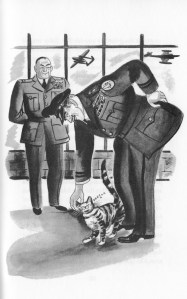
General likes Space Cat.
“We believe that Harvard has failed to live up to its obligations to the American taxpayer and is in breach of the statutory, regulatory, and contractual requirements tied to Harvard’s federally funded research programs and intellectual property arising therefrom, including patents,” the letter says.
A Harvard spokesperson called the move “yet another retaliatory effort targeting Harvard for defending its rights and freedom.” The university’s technology and patents help save lives and redefine industries, and Harvard is committed to complying with all federal laws around the patenting of work from federally funded research, the spokesperson said.
The letter is another point of leverage for the Trump administration in its effort to punish the university for allegedly failing to stop antisemitism on campus. The administration has frozen billions of dollars in Harvard’s federal research money and cut the university off from future grants.
Lutnick told Garber that he had until Sept. 5 to respond with a list of all patents that have stemmed from federally funded research grants and to provide information showing it complied with federal regulations, including a 1980 act by Congress known as Bayh-Dole that allowed institutions to retain ownership of a patent even if the innovation used taxpayer dollars.
A bit more, because of the paywall:
Harvard has more than 5,800 patents, according to its website. In its fiscal year ended in June, the university was issued 159 patents. Startups from Harvard range from pharma and biotech companies to manufacturing.
Federal regulations under Bayh-Dole require a litany of disclosures for a patent, including how the American people benefit from an invention. If a patent holder fails to make these disclosures, the government has the right to take ownership of the invention.
Lisa Ouellette, a law professor at Stanford, said the Trump administration’s move appears to be unprecedented in the four and a half decades of the Bayh-Dole Act. “I have never seen the government step in to reclaim control of a university’s patents in any sense,” she said. The Biden administration considered using a provision of the act to try to lower pharmaceutical prices, but the proposal never came to pass, Ouellette said.
The Trump administration has been in talks with several universities, including the University of California, Los Angeles, Cornell and Northwestern, and sees striking a deal with Harvard as an essential mission. The White House has already reached a $200 million settlement with Columbia and a $50 million deal with Brown.
This is breathtaking.
That’s all I have for today. What’s on your mind?
Did you like this post? Please share it with your friends:
Posted: May 3, 2025 | Author: bostonboomer | Filed under: cat art, caturday, Donald Trump, Elon Musk, just because, Welfare Queen Elon Musk | Tags: Australia elections, fluoride, measles, Public Health, RFK Jr, Social Security, Trump Tariffs, Trump vs. the arts, universities |
Good Afternoon!!

Cats in space, vintage postcard, 1911
As usual, much of today’s news is awful. Trump is working hard to destroy the U.S. Government, but his actions here have had a positive effect on the leadership of two of our allies. First liberals took over in Canada and now they’ve done it in Australia.
Michael E. Miller at The Washington Post: Australia’s Labor Party, buoyed by anti-Trump bump, wins reelection.
SYDNEY — Australia’s center-left government convincingly won reelection Saturday in a remarkable turnaround driven partly by anger over President Donald Trump’s disruptive trade war and its impact on the close U.S. military ally.
Anthony Albanese became the first Australian prime minister to win a second term in more than two decades as his Labor Partydramatically increased its parliamentary majority. It marked a stunning comeback for the progressive leader, who trailed in the polls two months ago.
In a jubilant victory speech, the 62-year-old struck a tone of unity while also alluding to his opponent’s failed embrace of Trump-like policies.
“We do not need to beg or borrow or copy from anywhere else,” Albanese said to a raucous Sydney crowd. “We do not seek out our inspiration overseas. We find it right here in our values and in our people.”
Trump’s tariffs — first 25 percent on Australia’s aluminum and steel, then 10 percent across the board — had driven voters toward the even-keeled incumbent and away from his conservative opponent, Peter Dutton, whose plans and rhetoric had echoed the American president, said Sean Kelly, a political columnist for the Sydney Morning Herald.
“Trump has absolutely dominated the trajectory of this election,” Kelly said, adding that the global uncertainty unleashed by Trump had made “Albanese’s boringness quite an appealing commodity.”
By Hilary Whiteman and Angus Watson at CNN: Australia’s center-left Labor Party retains power in vote seen as test of anti-Trump sentiment.
Australia’s Prime Minister Anthony Albanese has secured a second term in office in a disastrous night for his conservative rivals, as voters chose stability over change against a backdrop of global turmoil inflicted by US President Donald Trump.
Australia’s return of a left-leaning government follows Canada’s similar sharp swing towards Mark Carney’s Liberal Party, another governing party whose fortunes were transformed by Trump. The loss of Liberal Party leader Peter Dutton’s seat mirrors that of Conservative Party leader Pierre Poilievre.
While Australia wasn’t facing the same threats to its sovereignty as Canada, Trump’s global tariffs and policy swings have undermined Australians’ trust in the US, according to recent surveys.
Albanese’s victory makes him the first Australian Prime Minister to win re-election for two decades and he will start his second term with at least 87 seats in the 150-seat lower house, according to the most recent estimates.
A clearly emotional Albanese took the stage to cheers just before 10 p.m. local time to thank Australians for choosing a majority Labor government, defying predictions both major parties would lose seats.
“In this time of global uncertainty, Australians have chosen optimism and determination,” Albanese said, at the Labor victory party in Sydney.
Dutton, who had hoped to end the night as prime minister, lost the outer-suburban Brisbane seat that he’s held for more than 20 years, ending a brutal night for the veteran politician who held senior seats in the last Coalition government.
 Here in the USA, things aren’t so great. Trump’s tariffs are kicking in, the economy is struggling, he is trying to destroy education and the arts, RFK Jr. is working to make Americans sick, and Elon Musk and DOGE are wreaking havoc in government agencies. Here’s the latest.
Elisabeth Buchwald and Ramishah Maruf at CNN: A massive tariff on millions of Americans’ purchases just went into effect — cue the chaos.
Many Americans might not have felt major effects from President Donald Trump’s sweeping tariffs — until now.
That’s because a major shipping loophole expired at one minute past midnight on Friday. The de minimis exemption, as it’s known, allowed shipments of goods worth $800 or less to come into the United States duty-free, often more or less skipping time-consuming inspections and paperwork.
The loophole helped reshape the way countless Americans shop, allowing ultra-low-cost Chinese e-commerce sites like Shein, Temu and AliExpress to pour everything from yarn to patio furniture, clothes to photography equipment and more into US homes.
Its impending end has rung alarm bells across social media, with a baseline tariff as high as 145% depending on the carrier set to take effect on Chinese imports, potentially more than doubling the cost for all those cheap products deal-hungry Americans scooped up.
And the end of the de minimis exemption for Chinese goods will also distill abstract, complicated, messy, hard-to-follow trade policy into something much easier to understand: a receipt.
Major carriers like UPS, FedEx, DHL and the United States Postal Service say they’re prepared for the changes. The government says it, too, is set; a US Customs and Border Protection spokesperson told CNN that “We are prepared and equipped to carry out enhanced package screenings and enforce orders effectively.”
But whether regular American shoppers are ready for the changes is another matter.
Read more at CNN.
Caroline Petrow-Cohen and James Rainey at The Los Angeles Times:
Amid a wave of unprecedented tariffs, anxiety is running high for truck drivers like Helen, who makes her living delivering cargo containers from the Los Angeles and Long Beach harbors to warehouses and other customers around Southern California.
After a strong start to the year, the number of jobs has started to slip in recent days and truck drivers have heard reports predicting a sharp decline in incoming cargo for May and June….
“There’s real concern that we’re going to be struggling,” said Helen, a Downey resident who declined to give her last name for fear she might lose work if she is considered disgruntled. “If ships are not coming in and there are no loads, then there is no work. If there is no work there’s no money.”
As President Trump’s aggressive tariffs rattle business owners and shake the foundation of American importing, the men and women who work on the ground at the country’s busiest port are feeling the effects too.
Thousands of dockworkers, heavy equipment operators and truck drivers support a flurry of activity at the Port of Los Angeles, which covers 7,500 acres on San Pedro Bay and processed more than 10 million 20-foot-long cargo units in 2024. The neighboring Port of Long Beach moved 9.6 million 20-foot equivalent units, or TEUs, last year.
With a 145% tariff on China, a 25% tariff on Canada and Mexico, and 10% tariffs on dozens of other countries, the flow of goods into the U.S. is expected to slow drastically.
Fewer shipments into the ports of Los Angeles and Long Beach mean less work for the Californians who move cargo, said Raman Dhillon, chief executive of the North American Punjabi Trucking Assn.
“The truckers are scrambling right now,” he said. “They are at the verge of collapsing. The administration needs to move quickly, or it’s going to be chaos and price hikes and empty shelves.”
Trump isn’t worried about a recession and he doesn’t care how it will affect Americans. It’s just a transition period, he says.
Alexandra Marquez at NBC News: Trump downplays recession fears, saying the U.S. would be ‘OK’ in the long term.
President Donald Trump on Friday downplayed concerns about potential economic trouble, saying everything would be “OK” in the long term, even if the U.S economy experienced a recession in the short term.

Cat Astronaut, Michael Raiano
Asked twice by “Meet the Press” moderator Kristen Welker whether it would be OK in the long run if there were a recession in the short term, the president said, “Look, yeah, it’s — everything’s OK. What we are — I said, this is a transition period. I think we’re going to do fantastically.”
Following up, Welker asked Trump if he was worried about a recession, to which he responded, “No.” Asked whether he thinks one could happen, Trump replied, “Anything can happen, but I think we’re going to have the greatest economy in the history of our country.”
The remarks come as analysts on Wall Street are increasingly worried that the country could face a recession due to Trump’s changing tariff policy.
“Well, you know, you say, ‘Some people on Wall Street say’ — well, I tell you something else. Some people on Wall Street say that we’re going to have the greatest economy in history. Why don’t you talk about them?” Trump said during the interview at his Mar-a-Lago resort in Florida.
“There are many people on Wall Street say this is going to be the greatest windfall ever happen,” the president added.
Really? Who are those people? Name one.
Trump doesn’t want the government to support the arts.
Michael Paulson at The New York Times: Trump Seeks to Eliminate the National Endowment for the Arts.
President Trump proposed eliminating the National Endowment for the Arts and the National Endowment for the Humanities in the budget he released Friday, taking aim once again at two agencies that he had tried and failed to get rid of during his first term.
The endowments, along with the Institute of Museum and Library Services, were among the entities listed in a section titled “small agency eliminations” in his budget blueprint for the next fiscal year. The document said that the proposal was “consistent with the president’s efforts to decrease the size of the federal government to enhance accountability, reduce waste, and reduce unnecessary governmental entities” and noted that Mr. Trump’s past budget proposals had “also supported these eliminations.”
In 2017, during his first term, Mr. Trump proposed eliminating both the arts and the humanities endowments. But bipartisan support in Congress kept them alive, and in fact their budgets grew during the first Trump administration.
Since Mr. Trump returned to office this year, his administration has taken aim at the National Endowment for the Humanities and the Institute of Museum and Library Services, canceling most of their existing grants and laying off a large portion of their staffs. But the arts agency had yet to announce major cuts.
The proposal to eliminate the endowments drew a quick and furious reaction from Democrats. One, Senator Jack Reed of Rhode Island, vowed to fight the plan to eliminate the N.E.A. “tooth and nail.”
Representative Chellie Pingree of Maine, who serves as the top Democrat on the House subcommittee overseeing the N.E.A., said in an interview that Mr. Trump was “making a broad-based attack on the arts, both for funding and content.” She cited his proposals to eliminate the endowments as well as his takeover of the John F. Kennedy Center for the Performing Arts in Washington and his efforts to influence the Smithsonian Institution.
“We were able to restore the funding last time,” she said, “but as you know, based on the first 100 days of this administration, they’re in no mood to keep much of government alive anymore, and their attack is focused on everything, and the arts have already got a bull’s-eye on their back.

Outerspace laser cats (greeting card)
Of course Trump is also attacking our vital educational institutions. The latest is his threat to remove Harvard’s tax-exempt status. Here in Boston, Harvard and MIT are gearing up to fight back.
Andrew Duehren, Maggie Haberman and Alan Blinder at The New York Times: Harvard Signals It Will Resist Trump’s Efforts to Revoke Tax-Exempt Status.
Harvard University signaled Friday that it would resist President Trump’s renewed threat to revoke the school’s tax-exempt status, a move for which it said there was “no legal basis” as the president escalated his bitter dispute with the nation’s oldest university.
Harvard stopped short of explicitly pledging a legal challenge to a revocation of its tax status, a change that would upend the university’s finances. But a spokesperson for the university said in a statement that there was “no legal basis to rescind Harvard’s tax-exempt status.”
“Such an unprecedented action would endanger our ability to carry out our educational mission,” the statement said. “It would result in diminished financial aid for students, abandonment of critical medical research programs and lost opportunities for innovation. The unlawful use of this instrument more broadly would have grave consequences for the future of higher education in America.”
Mr. Trump declared Friday morning on social media that the government would be “taking away Harvard’s Tax Exempt Status.” Mr. Trump added, “It’s what they deserve.”
Despite Mr. Trump’s assertion online and Harvard’s sharp response, it was not immediately clear Friday whether the I.R.S. was in fact moving forward with revoking Harvard’s tax-exempt status, a change that could typically occur only after a lengthy process. Federal law prohibits the president from directing the I.R.S. to conduct tax investigations, and I.R.S. employees who receive such a command are required to report it to an internal government watchdog.
Hilary Burns at The Boston Globe: At MIT, leaders discussed a strategy for navigating Trump administration funding cuts in private meeting.
The unrelenting high-velocity attacks from the Trump administration have forced leaders of the nation’s premier universities to navigate an extraordinary and bruising balancing act, choosing when to take a stand in the face of continued threats while trying to mitigate the loss of federal funding.
Among the schools where that intense drama is playing out is the Massachusetts Institute of Technology, where the sobering realities of the administration’s funding cuts were discussed at a meeting convened by senior leaders in April.
Under one scenario presented at that meeting by treasurer Glen Shor, MIT risks losing the equivalent of 23 percent of revenues for its central budget, according to a recording of the presentation to school staff obtained by the Globe.
“Unfortunately, we should expect a prolonged period of challenge,” MIT president Sally Kornbluth told staff, according to the recording. “We really have to balance things. And I have to say, I feel a grave responsibility to you all . . . to ensure the livelihoods of this community and to make sure that we can continue to function. I need to balance all of these goalsthat are, again, often in great tension with each other.”
Kornbluth also outlined how she is trying to preserve institutional independence while being pragmatic with so much money hanging in the balance. MIT needs to “adapt” where necessary to the priorities of the federal government, she said, but also resist by suing when it feels the administration had overreached. Senior leaders are also working to improve the university’s reputation in Washington, D.C., and among the broader public.
The recording offers a rare inside look into how institutions are trying to respond to a fast-moving and ever-changing dynamic, with new lines of pressure from the administration coming from unforeseen angles.
I’m terrified by what is happening to public health under RFK Jr. Here’s the latest on that.
Jessica Glenza at The Guardian: World may be ‘post-herd immunity’ to measles, top US scientist says.
A leading immunologist warned of a “post-herd-immunity world”, as measles outbreaks affect communities with low vaccination rates in the American south-west, Mexico and Canada.
The US is enduring the largest measles outbreak in a quarter-century. Centered in west Texas, the measles outbreak has killed two unvaccinated children and one adult and spread to neighboring states including New Mexico and Oklahoma.
“We’re living in a post-herd-immunity world. I think the measles outbreak proves that,” said Dr Paul Offit, an expert on infectious disease and immunology and director of the Vaccine Education Center at Children’s Hospital of Philadelphia.
 “Measles – because it is the most contagious of the vaccine-preventable diseases, the most contagious human disease really – it is the first to come back.”
The US eliminated measles in 2000. Elimination status would be lost if the US had 12 months of sustained transmission of the virus. As of 1 May, the US Centers for Disease Control and Prevention (CDC) reported 935 confirmed measles cases across30 jurisdictions.Nearly one in three children under five years old involved in the outbreak, or 285 young children, have been hospitalized.
Three large outbreaks in Canada, Mexico and the US now account for the overwhelming majority of roughly 2,300 measles cases across the World Health Organization’s six-country Americas region, according to the health authority’s update this week. Risk of measles is considered high in the Americas, and has grown 11-fold compared with 2024.
Is RFK Jr. concerned about this situation? Not really.
Teddy Rosenbluth at The New York Times: Kennedy Orders Search for New Measles Treatments Instead of Urging Vaccination.
With the United States facing its largest single measles outbreak in 25 years, Health and Human Services Secretary Robert F. Kennedy Jr. will direct federal health agencies to explore potential new treatments for the disease, including vitamins, according to an H.H.S. spokesman. The decision is the latest in a series of actions by the nation’s top health official that experts fear will undermine public confidence in vaccines as an essential public health tool.
The announcement comes as Mr. Kennedy faces intense backlash for his handling of the outbreak. It has swept through large areas of the Southwest where vaccination rates are low, infecting hundreds and killing two young girls. On Friday, the Centers for Disease Control and Prevention reported more than 930 cases nationwide, most of which are associated with the Southwest outbreak.
Critics have said Mr. Kennedy has focused too much on untested treatments — such as cod liver oil supplements — and offered only muted support for the measles vaccine, which studies show is 97 percent effective in preventing infection.
The decision to put more resources into potential treatments, rather than urging vaccination, could have grave consequences at the center of the outbreak….
Scientists have already thoroughly studied various vitamins and medications as potential treatments for measles, said Michael Osterholm an epidemiologist at the University of Minnesota.
Decades of research have turned up no miracle treatment for the measles virus, which can cause pneumonia, making it difficult for patients to get oxygen into their lungs, and brain swelling, which can cause blindness, deafness and intellectual disabilities.
RFK also wants to eliminate fluoride from our water. And check this out from Texas. Beth Mole at Ars Technica: Texas goes after toothpaste in escalating fight over fluoride.
Texas Attorney General Ken Paxton is investigating two leading toothpaste makers over their use of fluoride, suggesting that they are “illegally marketing” the teeth cleaners to parents and kids “in ways that are misleading, deceptive, and dangerous.”

Space cats from Mars, Damien Northmore
The toothpaste makers in the crosshairs are Colgate-Palmolive Company, maker of Colgate toothpastes, and Proctor & Gamble Manufacturing Co., which makes Crest toothpastes. In an announcement Thursday, Paxton said he has sent Civil Investigative Demands (CIDs) to the companies.
The move is an escalation in an ongoing battle over fluoride, which effectively prevents dental cavities and improves oral health. Community water fluoridation has been hailed by health and dental experts as one of the top 10 great public health interventions for advancing oral health across communities, regardless of age, education, or income. But, despite the success, fluoride has always had detractors—from conspiracy theorists in the past suggesting the naturally occurring mineral is a form of communist mind control, to more recent times, in which low-quality, controversial studies have suggested that high doses may lower IQ in children.
These people are insane.
Just a few Elon Musk stories before I wrap this post up.
Lindsay Whitehurst at the AP: Trump administration asks Supreme Court to let DOGE access Social Security systems.
The Trump administration asked the Supreme Court on Friday to clear the way for Elon Musk ’s Department of Government Efficiency to access Social Security systems containing personal data on millions of Americans.
The emergency appeal is the first in a string of applications to the high court involving DOGE’s swift-moving work across the federal government.
It comes after a judge in Maryland restricted the team’s access to Social Security under federal privacy laws. The agency holds personal records on nearly everyone in the country, including school records, bank details, salary information and medical and mental health records for disability recipients, according to court documents.
The government says the team needs access to target waste in the federal government. Musk, now preparing to step back from his work with DOGE, has been focused on Social Security as an alleged hotbed of fraud. The billionaire entrepreneur has described it as a “ Ponzi scheme ” and insisted that reducing waste in the program is an important way to cut government spending.
Solicitor General John Sauer argued Friday that the judge’s restrictions disrupt DOGE’s important work and inappropriately interfere with executive-branch decisions. “Left undisturbed, this preliminary injunction will only invite further judicial incursions into internal agency decision-making,” he wrote.
I shudder to think what the Supreme Court will do with this.
Matthew Cunningham-Cook at Rolling Stone: Elon Musk and His DOGE Bro Have Cashed In on Americans’ Retirement Savings.
In the lead up to the April 1 election for the Wisconsin state Supreme Court, a little-known private equity executive by the name of Antonio Gracias joined Tesla billionaire Elon Musk on stage as the latter launched into a tirade clearly inspired by the white supremacist Great Replacement Theory — the discredited canard that the Biden administration was letting in millions of “illegals” to engage in mass voter fraud.
 On the dais, Gracias described how his foray into Social Security had revealed something already widely known to immigration policymakers: that the Biden administration had substantially expanded the Temporary Protected Status program, allowing millions of immigrants to enter and work in the country legally. These noncitizens were given Social Security numbers, as is completely standard — in fact, the process was automated during Trump’s first term — but Gracias and Musk, the world’s richest man, treated it like a scandal.
“We started at the top of the system mapping the whole system of Social Security to understand where the fraud was — this is what jumped out at us,” Gracias said. “When we saw these numbers, we asked ‘What is this?’ In ‘21, you see 270,000 people, it goes all the way to 2.1 million in ‘24. These are noncitizens that are getting Social Security numbers. … This literally blew us away. We went there to find fraud, and we found this by accident.” Noting that his parents and siblings, like Musk, are immigrants, Gracias added, “I’m pro-legal immigration — this is about America and the future of America.”
The crowd of conservatives gasped as the billionaires made it sound as if they and their team at Trump’s so-called Department of Government Efficiency had finally found proof of the waste, fraud, and abuse in the Social Security Administration that Musk has repeatedly talked about — examples that might help justify the massive upheaval that DOGE has created within the agency that manages America’s core retirement program.
Check this out:
Despite all of Musk and Gracias’ rhetoric about rooting out waste, fraud, and abuse in Social Security, scant attention has been paid to how the pair has become phenomenally wealthy with support from Americans’ retirement funds.
It’s well-known that Musk’s space company, SpaceX, has long cashed in on federal contracts — a trend turbocharged by Trump’s administration. Gracias, for his part, has relied on significant investments from public retirement systems to fund his firm’s deals. In the past decade, Gracias’ private equity firm, Valor Equity Partners, has received at least $1.7 billion in investment commitments from state and local pension funds — which manage the retirement savings of unionized teachers, firefighters, social workers, bus drivers, and cops — according to a Rolling Stone review of public documents.
Much of this money has come from Democratic states and locales. For its most recent fund, Valor received $800 million in investment commitments from a range of state and local pension funds. Investors include the California Public Employees’ Retirement System; the California State Teachers’ Retirement System; the Illinois Municipal Retirement Fund; the New York State Teachers’ Retirement System; a range of New York City pension funds; the Philadelphia Board of Pensions and Retirement; and the Hartford Municipal Employees Retirement Fund in Connecticut.
There’s much more at the link. If you clear your cache, you should be able to read it.
That’s all I have for you today. What’s on your mind?
Did you like this post? Please share it with your friends:
Posted: February 12, 2015 | Author: bostonboomer | Filed under: morning reads, U.S. Politics | Tags: Bob Simon, Jeb Bush, measles, Ukraine |

Good Morning!!
The top story in the news today is the supposed peace deal on Ukraine reached overnight. From The LA Times, Ukraine cease-fire deal reached after marathon talks.
After two days of hard negotiations, four European leaders have agreed on a cease-fire deal in eastern Ukraine, Russian leader Vladimir Putin announced Thursday.
Ukrainian President Petro Poroshenko, French President Francois Hollande, German Chancellor Angela Merkel and Putin worked nonstop for seven hours Wednesday and for a few more hours Thursday before they arrived at a compromise to stop the violence.
“We agreed on a cease-fire that takes effect Sunday,” Putin said in a televised statement after the talks in Belarus’ capital of Minsk. “The second position which I think is of extreme importance is the withdrawal of heavy weaponry from the current front line for Ukrainian troops and the demarcation line agreed upon in the Sept. 19 Minsk agreements for the Donbass armed forces.”
Two regions of Donbass engulfed by the armed conflict will get wider special powers in the course of a constitutional reform yet to be conducted in Ukraine.
The Russian leader complained that the night of the talks was “not the best night of my life.”
But is the agreement real? Most commentators are skeptical. Forbes:
In the talking point of the hour, the newly agreed ceasefire offers a“glimmer of hope” for averting a full-scale interstate war and for cautiously deescalating Europe’s worst security crisis in a generation.
The Russia-Ukraine ceasefire, to be sure, is clearly a lot better than nothing. Given the failure of previous attempts on the part of Germany and France to mediate between Kiev and Moscow it’s clear that there very easily could have been no deal at all. One can quite easily imagine a scenario in which Putin and Poroshenko left that conference without signing anything and in which we’d all be one step closer to world war 3. It’s a small victory, but it is at least movement in the right direction. It even got the Russians to free Nadiya Savchenko, a fighter pilot captured by pro-Russian separatists and then sent to Russia where she is currently on trial for a litany of (largely fictitious) offenses
The problem with the ceasefire, however, is in the details. Probably the single most glaring deficiency is that it doesn’t actually start until Sunday the 15th. Until then, as far as I can tell from reading the relevant press reports, the two sides are free to blast away at each other until their heart’s content. For another few days, then, the status quo ante reigns much as it has for the past several months.
Another huge problem is that it is only after Sunday that both sides are supposed to remove their heavy weapons from the front line. And even after they start to remove these weapons, the agreement allows them a full two weeks to finish the process. Given the nastiness of the conflict to date, and its tendency to flare-up immediately after a lull, quite a lot of mayhem and destruction can happen between now and when the heavy weapons are finally removed to a safe distance.

At Business Insider, Michael B. Kelley writes: The new Economist cover says it all.
As Vladimir Putin engaged in marathon peace negotiations with Germany, France, and Ukraine in the capital of Belarus, Russian tanks were allegedly rolling into Ukraine.
So as a inherently flawed peace deal is in place, the circumstances surrounding the agreement say a lot more than the “glimmer of hope” provided by the latest compromise.
“The EU and NATO are Mr Putin’s ultimate targets,” The Economist writes. “To him, Western institutions and values are more threatening than armies. He wants to halt their spread, corrode them from within and, at least on the West’s fragile periphery, supplant them with his own model of governance.”
From Reuters via Business Insider, Ukraine: 50 Russian tanks and 40 missile systems rolled into the country while Putin talked peace.
About 50 tanks, 40 missile systems, and 40 armored vehicles crossed overnight into eastern Ukraine from Russia via the Izvaryne border crossing into the separatist Luhansk region, a Kiev military spokesman said on Thursday.
“The enemy continues to strengthen its forces in the most dangerous areas, especially in northeast Luhansk region and in the direction of Debaltseve,” spokesman Andriy Lysenko said in a daily briefing, referring to a strategic transport hub that has been the focus of heavy fighting in recent weeks.
He said the tanks and other military hardware had crossed the border “despite statements by Russian officials about the absence of Russian military equipment and forces on Ukrainian territory.”
Read the whole article at The Economist, Putin’s war on the West, and read more commentary at Bloomberg View, A Time Bomb Wrapped in a Ukrainian Peace Deal, by Leonid Bershidsky. Also at Bloomberg, a backgrounder: Standoff in Ukraine.
Follow me below the fold for more breaking news.
Read the rest of this entry »
Did you like this post? Please share it with your friends:
Posted: January 22, 2015 | Author: bostonboomer | Filed under: morning reads, U.S. Politics | Tags: anti-vaccination movement, anti-vaxxers, Disneyland, legislation, measles, neo-liberals, vaccinations |

Woman Reading on a Settee, William Churchill
Good Morning!!
I’m going to focus on just one story today. I wanted to try to understand something I’m curious about–what’s causing the rapid spread of measles in California?
The outbreak of measles that started at Disneyland in December is spreading rapidly across California, into other states, and even into Mexico. Five Disneyland employees have now been diagnosed with the disease (three have recovered and others are being tested), and the number of reported cases traced to Disneyland has passed 60.
Last week I wrote about an unvaccinated woman who contracted the measles virus in Disneyland and then took two airline flights to the Seattle area during the holidays before she was diagnosed. How many other people did she infect? Measles is highly infectious, airborne virus that can be spread by coughing and sneezing, like the common cold. From the CDC website:
Measles is a highly contagious virus that lives in the nose and throat mucus of an infected person. It can spread to others through coughing and sneezing. Also, measles virus can live for up to two hours on a surface or in an airspace where the infected person coughed or sneezed. If other people breathe the contaminated air or touch the infected surface, then touch their eyes, noses, or mouths, they can become infected. Measles is so contagious that if one person has it, 90% of the people close to that person who are not immune will also become infected.
Infected people can spread measles to others from four days before to four days after the rash appears.
Another case was recently identified in Eugene, Oregon. The man is so sick that he hasn’t been able to talk to anyone, but his wife says he was in Disneyland and also went to the Rose Bowl game and then flew back home before he started showing symptoms. How many other people did he infect? UPDATE: It turns out the man did not go to the game–see story in comment thread.
Measles cases are also turning up in Northern California, according to SFGate: Disneyland measles outbreak spreads to Bay Area.
A large outbreak of measles that started at two adjacent Disney theme parks in December has now sickened people all over California, including a handful of Bay Area residents, and is prompting public health authorities to urge everyone to get vaccinated if they aren’t already.
California has reported 59 cases of measles since mid-December, the bulk of them in people who either visited or had close contact with someone who had been to Disneyland or California Adventure Park in Anaheim, public health officials said in a media conference call Wednesday. Seven measles cases have been reported in the Bay Area: in Alameda, San Mateo and Santa Clara counties.
Most of the people who have become infected were unvaccinated. Because of the threat of infection, public health officials said people who aren’t vaccinated — either because they can’t get the vaccine or they choose not to — should avoid public places where large groups of people, especially international travelers who may carry measles, congregate.
“We can expect to see many more cases of this vaccine-preventable disease unless people take precautionary measures,” said Dr. Gil Chavez, deputy director of the Center for Infectious Diseases with the California Department of Public Health. “I am asking unvaccinated Californians to consider getting immunized to protect themselves and family and community at large.”
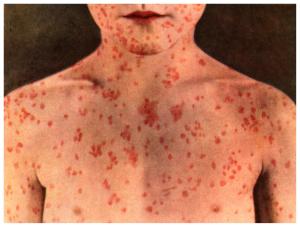
I had measles as a child, and fortunately I didn’t develop any of the complications, such as blindness, severe ear infections, pneumonia, and encephalitis (rare). But now that we have a vaccine for measles, children don’t need to risk these possible dangerous consequences of getting the virus. Sadly, we have a lot of people in this country who believe conspiracy theories about vaccines.
How do the anti-vaxxers avoid the vaccines? Most states require vaccinations for children attending school, but most states also allow religious exemptions. Here’s a list of vaccine requirements in each state. Every state but Mississippi and West Virginia allows religious exemptions; a few states also allow “philosophical” exemptions. Only California allows “objections based on simply the parent(s) beliefs.” I’m guessing some parents avoid vaccinating their children by home-schooling them.
Bloomberg reports that Orange County has banned unvaccinated kids from attending school because of the measles outbreak.
Health officials in Orange County, Calif. have banned two dozen students who have no immunization records from attending high school in the wake of a measles outbreak that has been traced back to Disneyland.
Sixty-seven confirmed measles cases have been reported in California in the current outbreak. One student from Huntington Beach High School who was infected with the disease attended class following winter break, exposing fellow students to the highly contagious illness, especially those who did not receive a childhood vaccination against it.
“If there is a case in the school and their child is not immunized, they will be removed from the school for 21 days,” Dr. Eric Handler, the Orange County public health officer, told the Los Angeles Times. “From an epidemiological standpoint, in order to prevent spread of the disease, this is a necessary measure.”
Now check this out:
In Southern California…many schools now report that upwards of 10 percent of students have not received childhood vaccinations. In Northern California, the figures are even worse, with clusters of under-vaccinated children in the San Francisco Bay Area resulting in one out of every four children going without the recommended immunizations.
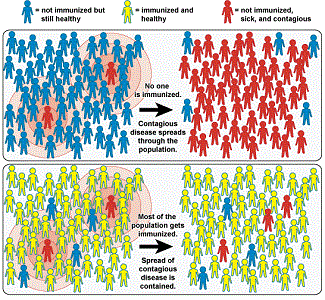
Herd Immunity
Most of the parents who opt out of having their kids vaccinated are relatively affluent and well-educated, according to science writer Tara Haelle at Forbes. She notes two reasons why measles is spreading so rapidly in California.
Those two things are the extreme infectiousness of the disease and the low levels of herd immunity, or community immunity, in pockets of southern California. Measles infects 9 out of every 10 non-immune individuals it finds. It’s airborne and hangs around up to two hours after an infected person leaves the area. It doesn’t take much for this disease to spread through a population that isn’t immune from previous exposure or through vaccination. Or, to put it another way, in an unvaccinated population, each person infected with the measles will transmit the disease to 12 to 18 other people. If no one were vaccinated against measles, we would be up to hundreds, perhaps thousands, of cases by now. We aren’t because there are some levels of herd immunity, but it’s because herd immunity has been weakened that we’re seeing additional cases at all.
She also debunks the notion that undocumented immigrants are spreading the virus.
Meanwhile, one of the biggest myths popping up in comment threads and on social media is that undocumented immigrants have something to do with this outbreak, or any other outbreak of a vaccine-preventable disease. We don’t yet know who Patient 0 – the first person with the disease – was at Disneyland, but we don’t really need to know. It’s not undocumented immigrants we should be pointing the finger at. It’s home-grown, upper-middle class, well-educated, mostly white southern California parents who have chosen not to vaccinate their children we should be giving the side-eye to. When vaccination rates in the region are below some developing countries’ rates, you don’t need undocumented immigrants to bring in the disease. Unvaccinated Americans do a fine job of that all on their own. A look at past cases makes this clear.
When the CDC tracked measles cases for the first half of 2013, they found that 159 cases resulted from 42 importations of the disease – but more than half those importations were U.S. residents returning to the States from abroad. Similarly, the outbreak of close to 400 cases in Ohio last year began with unvaccinated U.S. travelers returning from a visit to the Philippines. And the largest outbreak in San Diego since 1991 occurred in 2008 after an intentionally unvaccinated 7-year-old boy returned from a vacation in Switzerland with his family and brought back the measles. That last case is particularly of interest because the boy was a patient of Dr. Bob Sears, who has been spreading misleading information about measles in the midst of this outbreak.
Interestingly, she says that some people who have been vaccinated will still get the disease. But someone who hasn’t been vaccinated is 35 times more likely to get measles than someone who has had the vaccine.

Dr. Bob Sears
Here’s some more information about Dr. Bob Sears, and Orange County pediatrician and author of “The Vaccine Book: Making the Right Decision for Your Child.” From the LA Times: Vaccination controversy swirls around O.C.’s ‘Dr. Bob.’
While the vast majority of physicians are troubled by the anti-vaccination movement, Sears, 45, lends a sympathetic ear. About half his patients forgo vaccines altogether. To others, he offers “Dr. Bob’s” alternative and selective vaccination schedules, which delay or eliminate certain immunizations.
At a conference this year in Rancho Mirage, Sears told a roomful of pregnant women, new mothers and healthcare professionals that vaccines work well and are responsible for the nation’s low disease rate, something parents who don’t want to immunize can take advantage of.
“I do think the disease danger is low enough where I think you can safely raise an unvaccinated child in today’s society,” he said. “It may not be good for the public health. But … for your individual child, I think it is a safe enough choice.”
That approach frustrates infectious-disease experts, who in recent years have found themselves combating some celebrities’ anti-vaccination beliefs.
“We eliminated endemic measles in the U.S. in 2000. It’s now 2014 and we’re at 400 cases. Why?” Dr. Paul Offit, chief of infectious diseases at Children’s Hospital of Philadelphia, said in an interview in June. The number of cases has since risen to nearly 600. “Because people listen to Bob Sears. And, frankly, I blame him far more than I do the Jenny McCarthys of this world. Because he’s a doctor. And he should know more.”
Here’s an interesting article from The New Republic, The Best Way to Combat Anti-Vaxxers Is to Understand Them A new study underlines the similarity between “neo-liberal” thinking and the anti-vaccination movement. Well The New Republic should certainly understand neo-liberal thinking–they practically invented it. An excerpt:
“Anti-vaxxers,” as they are often referred, are an easy group to stereotype and a difficult group to humor. In most thinking circles, they are cast as “the other”; people either too stupid to understand the science behind vaccination, or too selfish to care about the impact of their choices on those around them.
But vaccine skeptics aren’t as different from their critics as we might like to think. And their rise in number over the past decade has less to do with stupidity, or even selfishness, than it does with beliefs about knowledge, trust, and freedom of choice that are pervasive throughout our culture, whether you choose to vaccinate your kids or not.
Dr. Jennifer Reich, a sociologist at the University of Colorado Denver, has been researching the anti-vaccination movement since 2007, seeking to understand the processes by which people come to reject vaccines. Over the past seven years, she has conducted in-depth interviews with parents who refuse mainstream vaccine recommendations, along with doctors, alternative healers, and public policymakers.
Not all of the parents Reich spoke with were “anti-vaxxers” in the sense that we typically think of the term; only a small minority identified as activists in the Jenny McCarthy mold, campaigning other parents not to vaccinate or advocating for policy change. Nor did they necessarily abstain from vaccination completely.
Rather, what united them was a sense that vaccines were up for negotiation: to be administered or rejected depending on the convictions of the parent and the needs of the child. Reich’s interviewees saw themselves as critical consumers of information. They engaged with doctors not as authorities to be obeyed, but as another data point to be evaluated, embraced, or discarded. They continually assessed risk: How likely was it that their child would be exposed to Disease A? What would be the consequences if they contracted Disease B?

It seems to me that what these anti-vaxxers have in common with neo-liberals is that they have lost the sense that as Americans we are all in this together. They focus only on their own needs and ignore the ways in which their choices about whether to vaccinate their children could impact others and society as a whole.
Just one more article before I wrap this up.
From Philly.com: California Measles Outbreak Shows How Quickly Disease Can Resurface in U.S.
Fifteen years after measles was declared eliminated in the United States, the recent outbreak traced to two Disney parks in California illustrates how quickly a resurgence can occur….
Experts explain the California outbreak simply.
“This outbreak is occurring because a critical number of people are choosing not to vaccinate their children,” said Dr. Paul Offit, director of the Vaccine Education Center and an attending physician at The Children’s Hospital of Philadelphia’s Division of Infectious Diseases.
“Parents are not scared of the disease” because they’ve never seen it, Offit said. “And, to a lesser extent, they have these unfounded concerns about vaccines. But the big reason is they don’t fear the disease.” ….
Researchers have found that past outbreaks of vaccine-preventable diseases are more likely in places where there are clusters of parents who refuse to have their children vaccinated, said Saad Omer, an associate professor of global health, epidemiology and pediatrics at Emory University School of Public Health and Emory Vaccine Center, in Atlanta.
“California is one of the states with some of the highest rates in the country in terms of exemptions, and also there’s a substantial clustering of refusals there,” Omer said….Other reasons include the belief that their children will not catch the disease, the disease is not very severe and the vaccine is not effective, Omer noted.
In California, vaccine exemptions have increased from 1.5 percent in 2007 to 3.1 percent in 2013, according to an analysis by the Los Angeles Times.
So, in a sense California is endangering people in other states. Omer says there’s recent legislation to make it more difficult to get exemptions, but “it is too soon to know the effects of the new law.”
So . . . comment on this issue if you wish; but feel free to treat this as an open thread. Have a great day Sky Dancers.
Did you like this post? Please share it with your friends:


 peej
peej Carissa
 bostonboomer
 dakinikat
 ecocatwoman
 mablue2
 Mama Lopez
 peggysue22
 quixote
 skydancingguestblogger
 Mona (aka Wonk the Vote)



 Sky Dancing
Recent Comments