
Mostly Monday Reads: What would Martin Do?
Posted: January 19, 2026 Filed under: #We are so Fucked, democracy is threatened, Foreign Affairs, freedom of speech, GOP Crimes Against Humanity, Greenland, Norway | Tags: @johnbuss.bsky.social John Buss, attacks on DEI, Greenland, Martin Luther King's Birthday, Norway 3 Comments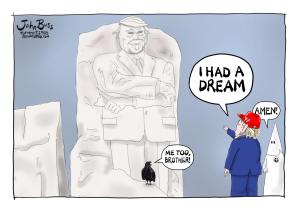
“Wait until you see the Washington Monument makeover!” John Buss, @repeat1968
Good Day, Sky Dancers!
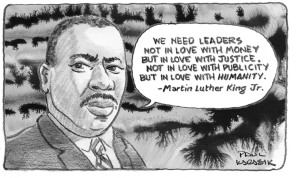
We’re a long way from the kinds of dreams we used to have as Americans. That seems particularly important as we celebrate the Birthday of civil rights hero Dr. Martin Luther King. I frequently wonder what he would be saying about the current DEI war led by one of the most racist presidents we’ve ever had. Here’s a quote from former President Obama about today’s holiday, posted on Instagram.
Dr. Martin Luther King, Jr. dedicated his life fighting for equity and justice. He taught us that even in the face of intimidation and discrimination, we must never stop working towards a better future – a lesson that feels especially relevant today.
Change has never been easy. It takes persistence and determination, and requires all of us to speak out and stand up for what we believe in. As we honor Dr. King today, let’s draw strength from his example, and do our part to build on his legacy.
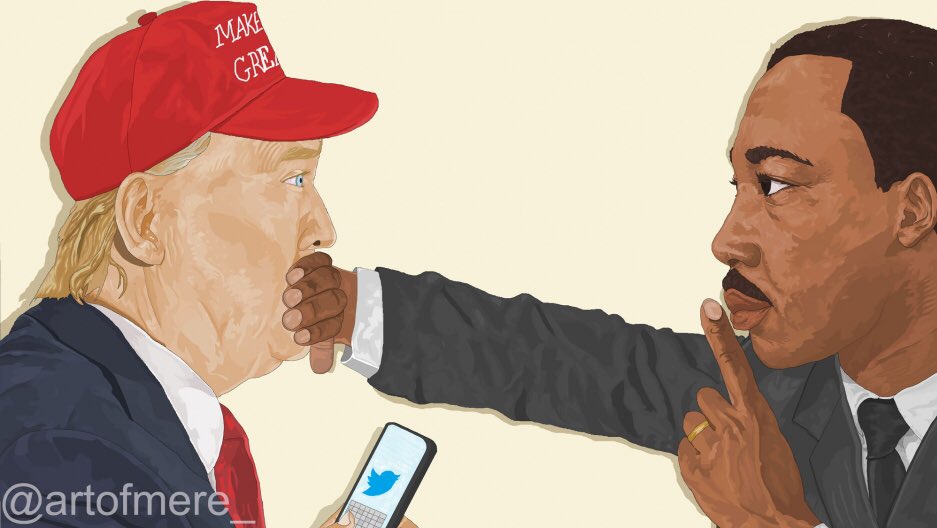
 Here are a few reads to think about today’s holiday. This one is from AXIOS. In Trump’s land of remaking that dream of the little Jim Crow over there on John’s Featured Cartoon today. “Trump’s DEI crackdown is changing MLK Day.” Jason Lalljee has this analysis.
Martin Luther King Jr. Day will look different in many parts of the country this year after a series of administration moves to limit observances — part of President Trump’s broader crackdown on diversity, equity and inclusion.
- “Since the start of Trump’s second term, we have seen a coordinated effort to erase or rewrite parts of American history, especially Black history and the legacy of the Civil Rights Movement,” Martin Luther King III, son of the civil rights leader, told Axios.
Here’s what we know:
Across government Trump removed a bust of Martin Luther King Jr. from the Oval Office last summer. It had been there since 2009.Following Trump’s signing of a sweeping executive order overhauling federal DEI programs last January, the Defense Intelligence Agency ordered a pause of all activities and events related to MLK Day.
- The DIA also paused programming for Black History Month, Juneteenth, LGBTQ Pride Month, Holocaust Remembrance Day and other “special observances” to comply with Trump’s order, per NBC News.
The White House did not respond to request for comment.
National Parks
Free entry to national parks will now be granted on Trump’s birthday but no longer on MLK Day or Juneteenth, the White House announced last month.
Beyond its elimination of a “fee-free” MLK Day, the Trump administration is administering an extensive purge of exhibits across the nation’s parks that includes a substantial removal of materials related to MLK, said Kristen Brengel, Senior Vice President of Government Affairs at the National Parks Conservation Association.
- The Department of the Interior last May required every park to conduct a review of “public monuments, memorials, statues, or similar properties” complying with a Trump executive order targeting “race-centered ideology” and “narratives that portray American and Western values as inherently harmful and oppressive.”
- The DOI’s order said that it would flag items for removal that violated the executive order. The NPCA has a database of items flagged by the DOI based on reports from current National Parks Service employees, which Axios has viewed. Those items include exhibits, films, books, and youth-oriented materials such as junior ranger pamphlets.
The DOI identified “about 80” items for removal at the Selma to Montgomery National Historic Trail, where King led a march in support of the Voting Rights Act, according to Brengel.
-
- Brengel said that materials related to slavery, Reconstruction, and Jim Crow were also flagged, adding that they are featured at a diverse range of parks, including the National Mall, the Louis and Clark National Historic Trail, and Revolutionary War sites.
- “When you look at the totality of everything identified throughout the parks system, African American history is being targeted more than anything,” she said.
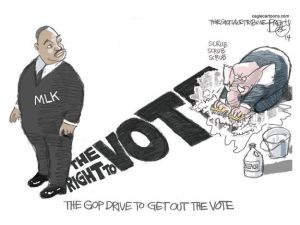 There’s more at the link. This next piece is written by Jenna Prestininzi and published in the Detroit Free Press. “Did Trump get rid of MLK Jr Day? How the holiday is different in 2026.”
Monday, Jan. 19, is Martin Luther King Jr. Day, honoring the prominent civil rights leader, but, thanks to President Donald Trump’s administration, national park visitors won’t get a free visit to sites because of new federal guidelines.
Although the Trump administration can’t cancel or end the holiday, the administration changed the lineup for National Park Service free entry days and eliminated Martin Luther King Jr. Day, Jan. 19, from list. The federal holiday previously was among dates national parks and other sites offered a free visit, recognizing a key figure in African American history.
For 2026, eight free entry days — which are now limited to U.S. citizens and residents — will begin with Presidents Day, Feb. 16.
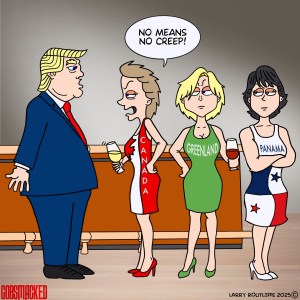 The worst news of the day comes from Trump’s obsession with Greenland and other countries with which he has a Monroe Doctrine complex. This is from the New York Times. “Trump Links His Push for Greenland to Not Winning Nobel Peace Prize. In a text, President Trump told Norway’s prime minister that he no longer felt obliged to “think purely of Peace” and that the U.S. needed the island for global security.” Trump’s mental, physical, and emotional illnesses are on full display. Jeffrey Gettleman and Henrik Pryser Libell share the lede.
President Trump is now claiming that one reason he is pushing to acquire Greenland is that he didn’t win the Nobel Peace Prize, according to a text message he sent to Norway’s prime minister over the weekend.
Jonas Gahr Store, Norway’s leader, received the text message on Sunday, an official in the prime minister’s office said on Monday.
“Considering your Country decided not to give me the Nobel Peace Prize for having stopped 8 Wars PLUS, I no longer feel an obligation to think purely of Peace, although it will always be predominant, but can now think about what is good and proper for the United States of America,” Mr. Trump wrote in the message, which was first published by PBS.
Mr. Trump also questioned Denmark’s claim to Greenland, saying, “There are no written documents,” and adding, “The World is not secure unless we have Complete and Total Control of Greenland. Thank you!”
The tensions over Greenland have sharply escalated in the last week, and the message injected a new level of uncertainty into Mr. Trump’s thinking and his campaign to gain control of the island.
Greenland has been part of the Danish Kingdom for more than 300 years, and world leaders have condemned Mr. Trump’s insistence that the United States take over the territory, a giant icebound island in the Arctic region.
According to copies of the messages provided by the Norwegian prime minister’s office, Mr. Trump’s message was a response to one that Mr. Store sent Mr. Trump on Sunday. It was co-signed by the president of Finland, Alexander Stubb, a leader with whom Mr. Trump is close.
The European leaders asked to speak to Mr. Trump about Greenland and his threat of using tariffs to pressure Denmark into selling it, which Denmark has refused to do. They asked for a phone call and struck a collaborative tone, writing, “We believe we all should work to take this down and de-escalate — so much is happening around us where we need to stand together.”
After Mr. Trump’s response, Mr. Store said in a statement, “As regards the Nobel Peace Prize, I have on several occasions clearly explained to Trump what is well known, namely that it is an independent Nobel Committee, and not the Norwegian government, that awards the prize,” Mr. Store said.
 Anne Applebaum, writing for The Atlantic, has this terse analysis. “Trump’s Letter to Norway Should Be the Last Straw. Will Republicans in Congress ever step in?”
Let me begin by quoting, in full, a letter that the president of the United States of America sent yesterday to the prime minister of Norway, Jonas Gahr Støre. The text was forwarded by the White House National Security Council to ambassadors in Washington, and was clearly intended to be widely shared. Here it is:
Dear Jonas:
Considering your Country decided not to give me the Nobel Peace Prize for having stopped 8 Wars PLUS, I no longer feel an obligation to think purely of Peace, although it will always be predominant, but can now think about what is good and proper for the United States of America. Denmark cannot protect that land from Russia or China, and why do they have a “right of ownership” anyway? There are no written documents, it’s only a boat that landed there hundreds of years ago, but we had boats landing there, also. I have done more for NATO than any person since its founding, and now, NATO should do something for the United States. The World is not secure unless we have Complete and Total Control of Greenland. Thank you! President DJT
One could observe many things about this document. One is the childish grammar, including the strange capitalizations (“Complete and Total Control”). Another is the loose grasp of history. Donald Trump did not end eight wars. Greenland has been Danish territory for centuries. Its residents are Danish citizens who vote in Danish elections. There are many “written documents” establishing Danish sovereignty in Greenland, including some signed by the United States. In his second term, Trump has done nothing for NATO—an organization that the U.S. created and theoretically leads, and that has only ever been used in defense of American interests. If the European members of NATO have begun spending more on their own defense (budgets to which the U.S. never contributed), that’s because of the threat they feel from Russia.
Yet what matters isn’t the specific phrases, but the overall message: Donald Trump now genuinely lives in a different reality, one in which neither grammar nor history nor the normal rules of human interaction now affect him. Also, he really is maniacally, unhealthily obsessive about the Nobel Prize. The Norwegian Nobel Committee, not the Norwegian government and certainly not the Danish government, determines the winner of that prize. Yet Trump now not only blames Norway for failing to give it to him, but is using it as a justification for an invasion of Greenland.
Think about where this is leading. One possibility, anticipated this morning by financial markets, is a damaging trade war. Another is an American military occupation of Greenland. Try to imagine it: The U.S. Marines arrive in Nuuk, the island’s capital. Perhaps they kill some Danes; perhaps some American soldiers die too. And then what? If the invaders were Russians, they would arrest all of the politicians, put gangsters in charge, shoot people on the street for speaking Danish, change school curricula, and carry out a fake referendum to rubber-stamp the conquest. Is that the American plan too? If not, then what is it? This would not be the occupation of Iraq, which was difficult enough. U.S. troops would need to force Greenlanders, citizens of a treaty ally, to become American against their will.
For the past year, American allies around the world have tried very hard to find a theory that explains Trump’s behavior. Isolationism, neo-imperialism, and patrimonialism are all words that have been thrown around. But in the end, the president himself defeats all attempts to describe a “Trump doctrine.” He is locked into a world of his own, determined to “win” every encounter, whether in an imaginary competition for the Nobel Peace Prize or a protest from the mother of small children objecting to his masked, armed paramilitary in Minneapolis. These contests matter more to him than any long-term strategy. And of course, the need to appear victorious matters much more than Americans’ prosperity and well-being.
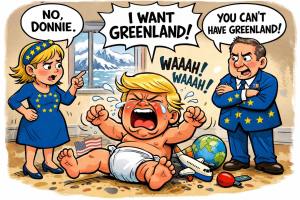 These remarkable comments have rattled our European allies. John Irish and Nora Buli, writing for Reuters, have this headline today. “Trump links Greenland threat to Nobel Peace Prize snub, EU prepares to retaliate.”
U.S. President Donald Trump has linked his drive to take control of Greenland to his failure to win the Nobel Peace Prize, saying he no longer thought “purely of Peace” as the row over the island threatened to reignite a trade war with Europe.
Asked by NBC News in a brief telephone interview on Monday if he would use force to seize Greenland, Trump said “No comment,” adding he would “100%” follow through on plans to hit European nations with tariffs without a Greenland deal.
Trump has intensified his push to wrest sovereignty over Greenland from fellow NATO member Denmark, prompting the European Union to weigh hitting back with its own measures.
The dispute is threatening to upend the NATO alliance that has underpinned Western security for decades and which was already under strain over the war in Ukraine and Trump’s refusal to protect allies which do not spend enough on defence.
Trump’s threat has rattled European industry and sent shockwaves through financial markets amid fears of a return to the volatility of 2025’s trade war, which only eased when the sides reached tariff deals in the middle of the year.
In a text message on Sunday to Norway’s Prime Minister Jonas Gahr Stoere, Trump said: “Considering your Country decided not to give me the Nobel Peace Prize for having stopped 8 Wars PLUS, I no longer feel an obligation to think purely of Peace, although it will always be predominant, but can now think about what is good and proper for the United States of America.”
Norway’s government released the messages on Monday under the country’s freedom of information act.
Stoere had sent an initial message on behalf of himself and Finnish President Alexander Stubb, calling for de-escalation of tensions and suggesting a call, eliciting a response from Trump less than half an hour later.
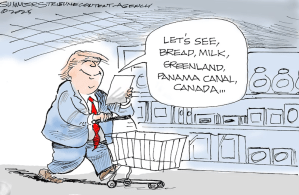 We’re all wondering exactly how Trump plans to do this, and whether it will involve force. So far, the biggest threats are tariffs, which, of course, hurt American consumers and businesses more than anyone else. This is from NBC News. “Trump won’t say whether he would use force to seize Greenland. The president was guarded in how far he’ll go to take control of the semi-autonomous Danish territory in an exclusive interview with NBC News.” This lede is shared by Peter Nicholas and Alexander Smith.
As tensions escalate over President Donald Trump’s efforts to acquire Greenland, he was guarded Monday in how far he’ll go to take control of the semi-autonomous Danish territory.
Asked if he would use force to seize Greenland, the president said, “No comment,” in a brief telephone interview with NBC News.
Trump has stepped up his push to take possession of Greenland. He said Saturday he would impose 10% tariffs on Denmark and seven other European nations until a deal is struck for America’s acquisition of Greenland.
The president then introduced a new wrinkle to his standoff with longtime European allies, linking Greenland to his failure to win the Nobel Peace Prize last year in a text message Sunday to Norwegian Prime Minister Jonas Gahr Støre. The Norwegian leader released his text message exchange with Trump under Norway’s public disclosure laws, his press office said.
“Considering your Country decided not to give me the Nobel Peace Prize for having stopped 8 Wars PLUS, I no longer feel an obligation to think purely of Peace, although it will always be predominant, but can now think about what is good and proper for the United States of America,” Trump said in the message, which was first reported by PBS and confirmed as accurate in a statement by the Norwegian prime minister.
Norway was one of the countries hit with the new tariffs, which would kick in Feb. 1, according to a post Trump wrote on his social media platform.
In a statement Monday, Støre said, “Norway’s position on Greenland is clear. Greenland is a part of the Kingdom of Denmark, and Norway fully supports the Kingdom of Denmark on this matter.”
A five-member committee appointed by Norway’s parliament awards the Nobel Peace Prize each year. In 2025, the committee chose Maria Corina Machado, the Venezuelan opposition leader, for the honor. As a show of gratitude for his ouster of Venezuela’s repressive leader Nicolás Maduro in a military strike, Machado gave Trump her 18-karat gold medal in a visit to the White House last week.
Trump dismissed the idea that Norway has no sway over the Nobel Peace Prize competition and that the decision is entirely up to the committee.
“Norway totally controls it despite what they say,” he told NBC News.
Everything this rotter does these days is just amazingly wrong, stupid, and immoral. Again, his hallmark is cruelty. WTF is wrong with the Republican Party that they allow this to go on?
What’s on your Reading, Action, and Blogging list today?
Martin Luther King Day reads
Posted: January 20, 2020 Filed under: just because | Tags: Martin Luther King's Birthday 28 Comments
I have no fear about the outcome of our struggle in Birmingham, even if our motives are at present misunderstood. We will reach the goal of freedom in Birmingham and all over the nation, because the goal of America is freedom. Abused and scorned though we may be, our destiny is tied up with America’s destiny. Before the pilgrims landed at Plymouth, we were here. Before the pen of Jefferson etched the majestic words of the Declaration of Independence across the pages of history, we were here. For more than two centuries our forebears labored in this country without wages; they made cotton king; they built the homes of their masters while suffering gross injustice and shameful humiliation—and yet out of a bottomless vitality they continued to thrive and develop. If the inexpressible cruelties of slavery could not stop us, the opposition we now face will surely fail. We will win our freedom because the sacred heritage of our nation and the eternal will of God are embodied in our echoing demands.
—Martin Luther King Jr, Letter from a Birmingham Jail, Apr 16, 1963
Let us celebrate the man and his legacy today.
From Charles Blow:
I had been taught only the “Dream” King. That is what America wants King to remain: Frozen in perpetual optimism, urging more than demanding, appealing to America’s better angels rather than ruthlessly calling out its persistent demons.
But, that must not be done. That must not be done.
As King said in a 1967 interview when asked about the “Dream” speech, after much soul-searching he had come to see that “some of the old optimism was a little superficial, and now it must be tempered with a solid realism.”
That evolution, toward a more “solid realism,” toward the more rational King, toward the more radical King, is why I happen to believe that one of King’s most consequential speeches is a little-discussed address he gave in 1967 at Stanford University. It was called “The Other America.”
In it, King blasted “large segments of white society” for being “more concerned about tranquillity and the status quo than about justice, equality, and humanity.”
He slammed what he called the “white backlash” for being the cause of black discontent and demands for black power, rather than the result of it, calling it “merely a new name for an old phenomenon.”
And he declared that true integration “is not merely a romantic or aesthetic something where you merely add color to a still predominantly white power structure.”
This speech was delivered after the passage of the Civil Rights Act of 1964 and the Voting Rights Act of 1965. As King put it in the 1967 interview, passage of those acts came at “bargained rates.”
He explained: “It didn’t cost the nation anything. In fact, it helped the economic side of the nation to integrate lunch counters and public accommodations. It didn’t cost the nation anything to get the right to vote established. And, now we are confronting issues that cannot be solved without costing the nation.”
Collectively, the 101 black teens participating in the study reported more than 5,600 experiences of racial discrimination over two weeks. That boils down to an average of more than five instances per day for each teenager. That’s more than 70 over two weeks.
Those findings may not be surprising to those who face routine discrimination, but they reflect a higher frequency of racism than has previously been reported.
What caused the increase? Researchers say that the study was the first to include so many expressions of racial bias, 58 in all, and to ask participants to record them daily. Previous studies have typically asked participants to recall experiences from the past, which researchers say is not as accurate.
Although there has been an increase in hate crimes during the Trump administration, this study measures incidents that occurred when Barack Obama was in the White House.
From Michelle Alexander:
“We are now living in an era not of post-racialism but of unabashed racialism, a time when many white Americans feel free to speak openly of their nostalgia for an age when their cultural, political and economic dominance could be taken for granted — no apologies required. Racial bigotry, fearmongering and scapegoating are no longer subterranean in our political discourse; the dog whistles have been replaced by bullhorns. White nationalist movements are operating openly online and in many of our communities; they’re celebrating mass killings and recruiting thousands into their ranks.”
Have a blessed day. The struggle continues. March on.
What’s on your reading and blogging list today?
MLK Holiday Reads
Posted: January 19, 2015 Filed under: morning reads, SOTU | Tags: 2016 presidential race, Martin Luther King's Birthday 22 Comments Good Morning!
It’s our holiday to celebrate the contributions of Reverend Doctor Martin Luther King! No holiday celebration is complete without drawings by grade school children!!
President Obama will give his SOTU address tomorrow and will call for raising taxes on the wealthy to provide tax cuts for the middle class. This is an interesting strategy and I’m sure the Republicans are planning on screaming “class war” for the next few days.
President Obama will use his State of the Union address to call on Congress to raise taxes and fees on the wealthiest taxpayers and the largest financial firms to finance an array of tax cuts for the middle class, pressing to reshape the tax code to help working families, administration officials said on Saturday.
The proposal faces long odds in the Republican-controlled Congress, led by lawmakers who have long opposed raising taxes and who argue that doing so would hamper economic growth at a time the country cannot afford it. And it was quickly dismissed by leading Republicans as a nonstarter.
But the decision to present the plan during Tuesday’s speech marks the start of a debate over taxes and the economy that will shape both Mr. Obama’s legacy and the 2016 presidential campaign.
It is also the latest indication that the president, untethered from political constraints after Democratic losses in the midterm elections, is moving aggressively to set the terms of that discussion, even as he pushes audacious moves in other areas, like immigration and relations with Cuba.
The president’s plan would raise $320 billion over the next decade, while adding new provisions cutting taxes by $175 billion over the same period. The revenue generated would also cover an initiative Mr. Obama announced this month, offering some students two years of tuition-free community college, which the White House has said would cost $60 billion over 10 years.
The centerpiece of the plan, described by administration officials on the condition of anonymity ahead of the president’s speech, would eliminate what Mr. Obama’s advisers call the “trust-fund loophole,” a provision governing inherited assets that shields hundreds of billions of dollars from taxation each year. The plan would also increase the top capital-gains tax rate, to 28 percent from 23.8 percent, for couples with incomes above $500,000 annually.
Those changes and a new fee on banks with assets over $50 billion would be used to finance a set of tax breaks for middle-income earners, including a $500 credit for families in which both spouses work; increased child care and education credits; and incentives to save for retirement.
The initiative signals a turnabout for Mr. Obama, who has spoken repeatedly about the potential for a deal with Republicans on business tax reform but little about individual taxation, an area fraught with disagreements.
“Slapping American small businesses, savers and investors with more tax hikes only negates the benefits of the tax policies that have been successful in helping to expand the economy, promote savings and create jobs,” said Senator Orrin G. Hatch, Republican of Utah and chairman of the Finance Committee. “The president needs to stop listening to his liberal allies who want to raise taxes at all costs and start working with Congress to fix our broken tax code.”
Republicans have already referred to it as “trolling” given that they run both houses of the US Congress and will pass neither one. This does,  however, have very bad optics for them. It puts them squarely in league with the uberwealthy.
“It’s not surprising to see the president call for tax hikes, but now he’s asking Congress to reverse bipartisan tax relief that he signed into law,” said Don Stewart, deputy chief of staff to Senate Majority Leader Mitch McConnell (R-Ky.).
Stewart said that “Republicans believe we should simplify America’s outdated tax code; that tax filing should be easier for you, not just those with fancy accountants; and that tax reform should create jobs for families, not the [Internal Revenue Service].”
Meanwhile, a spokeswoman for Rep. Paul Ryan (R-Wis.), who chairs the House Ways and Means Committee, also criticized the proposal.
“This is not a serious proposal,” said Ryan spokesman Brendan Buck in a public statement. “We lift families up and grow the economy with a simpler, flatter tax code, not big tax increases to pay for more Washington spending.”
 Plan details include hitting big banks and inheritance taxes. These suggestions really go at the types of tax cuts that incent gambling and increase financial wealth rather than industrial and business wealth that create jobs and economic growth.
During his State of the Union address on Tuesday, President Barack Obama will lay out a plan to extend tax credits to the middle class by hiking taxes on wealthier Americans and big banks, according to senior administration officials.
Under the plan, the capital gains tax for couples with income over $500,000 per year would be raised from its current level of 23.8 percent up to 28. The plan would also strip a tax break, known as a “step-up,” that allows heirs to avoid capital gains taxes on large inheritances.
In addition, the plan would institute a new tax on the biggest financial institutions, basing the fee on liabilities in order to discourage risky borrowing. The administration says the fee would hit the roughly 100 banks that have assets of $50 billion or more.
The president’s plan would use revenues from those tax code changes to finance credits aimed at the middle class, officials said. That includes extending the earned income tax credits to families without children, which would benefit an estimated 13 million low-income workers, while also tripling the maximum tax credits for child care in low- and middle-income homes.
“This proposal is probably the most impactful way we can address the manifest unfairness in our tax system,” an administration official said.
The tax hikes on capital gains would run into heavy opposition from Republicans in the GOP-controlled Congress. Other elements of the president’s plan, however, have enjoyed some degree of bipartisan support. House Ways and Means Committee Chairman Dave Camp (R-Mich.) has proposed a similar tax on big banks, and many Republicans favor the idea of broadening the earned income tax credit.
According to officials, the capital gains tax reforms would impact “almost exclusively” the top 1 percent of earners, carving out the majority of middle-income families from the hikes.
![scan0002[17]](https://skydancingblog.com/wp-content/uploads/2015/01/scan000217.jpg?w=234&h=300) Here’s an essential outline for the items up for revision in the President’s plan. Is it his Piketty moment? This one is my personal favorite but they’re all good.
Here’s an essential outline for the items up for revision in the President’s plan. Is it his Piketty moment? This one is my personal favorite but they’re all good.
Raise the top capital gains tax rate from 23.8 to 28 percent. This is straightforward enough. Money you get from investments is taxed less than money you get from, you know, actually working, and while that might be good for the economy, it’s not good for a basic sense of fairness. Not when the top 400 households are getting 16 percent of all capital gains, and the top 0.1 percent are getting half of them. That’s why, as theCongressional Budget Office (CBO) dryly puts it, “preferential tax rates on dividends and capital gains provide almost no benefit to households in the bottom four quintiles, but provide notable benefits to households in the top quintile”.
So Obama wants to push the top capital gains tax rate, which only applies to couples making more than $500,000, up from its current level of 23.8 percent to 28 percent, where it was when Ronald Reagan left office. In all, the White House calculates that increasing the capital gains tax and getting rid of step-up basis would raise 99 percent of its money from the top 1 percent, with 80 percent of that coming from the top 0.1 percent.
This is one of the items that has really drawn money out of doing business and into stock market gambling. Why work when you can day trade your life into a lower tax bracket as a wealthy person?
Here’s a few political things sure to give you some fits and giggles. Lady Lindsey is said to be considering a run at the Presidency.
Sen. Lindsey Graham acknowledged on Sunday he’s seriously exploring a bid for the Republican presidential nomination.
Asked on NBC’s “Meet the Press” if he had started polling voters about his chances in 2016, Graham said he is not polling, “but we set up a testing-the-waters committee under the IRS code that will allow me to look beyond South Carolina as to whether or not a guy like Lindsey Graham has a viable path.”
“I don’t know where this will go, but I’m definitely going to look at it,” said Graham, the senior senator from South Carolina.
![MLK picture_thumb[1]](https://skydancingblog.com/wp-content/uploads/2015/01/mlk-picture_thumb1.jpg?w=590)
A new CBS poll shows 29 percent of Republicans would like to see Christie run for the Republican nomination for president. But 44 percent say no. CBS points out “Only former Alaska Gov. Sarah Palin’s numbers are more underwater: 30 percent of Republicans say they’d like to see her run, but 59 percent disagree.”
Fifty-nine percent of Republicans would like to see Mitt Romney jump into the 2016 race, while 26 percent believe he should stay out.
“Fifty percent of Republicans would like to see former Florida Gov. Jeb Bush on the campaign trail as well, while 27 percent disagree,” pollsters said. “If both Romney and Bush run, analysts expect them to wage a competitive battle for the allegiance of the Republican establishment.”
Numbers for some of the others often mentioned:
– Former Arkansas Gov. Mike Huckabee: 40 percent of Republicans urge him to get in, and 29 percent say stay out.
– “Twenty-seven percent of Republicans would like Kentucky Sen. Rand Paul to mount a bid, but 34 percent disagree. Twenty-six percent would like Florida Sen. Marco Rubio to run, while 19 percent would not. Twenty-one percent want Texas Sen. Ted Cruz to run, while 25 percent want him to not run.”
– Gov. Rick Perry of Texas: 21 percent yes, 29 percent no.
– Gov. Bobby Jindal of Louisiana: 14 percent yes, 20 percent no.
– Gov. Scott Walker of Wisconsin: 22 percent yes, 12 percent no.
Maybe winning isn’t everything after all. “Republicans, by a 61 to 35 percent margin, believe it’s more important to have a nominee who agrees with them on the issues than a nominee who can win the general election,” according to the poll.
Eeeshhh.
Well, that’s it for today! We’ll see you with a live blog for the SOTU tomorrow!! Have a great holiday!
What’s on your reading and blogging list today?
Monday Reads
Posted: January 17, 2011 Filed under: Corporate Crime, Gulf Oil Spill, morning reads, U.S. Economy, U.S. Politics, Women's Rights | Tags: Andrew Bacevich, Bank of America, BP Oil Gusher, dispersants, Dwight D. Eisenhower, Gulf Of Mexico, Julian Assange, Martin Luther King's Birthday, military-industrial complex, Ms Magazine, Naomi Klein, New Yorker Magazine, oil, Rep. Gabrielle Giffords, Sargent Shriver, Sexism, Wikileaks 24 Comments
Good Morning!! Today is the official Martin Luther King birthday holiday. I hope everyone has the day off. I think I have a few interesting reads for you this morning.
I’ll start with this in depth report by Naomi Klein on scientific studies of the impact of the BP oil gusher on the ecology of the Gulf of Mexico. While the government reassures Americans that everything down in the gulf is safe safe safe, scientists are finding plenty of evidence that that’s not the case. According to
Ian MacDonald, a celebrated oceanographer at Florida State University. “The gulf is not all better now. We don’t know what we’ve done to it.”
MacDonald is arguably the scientist most responsible for pressuring the government to dramatically increase its estimates of how much oil was coming out of BP’s well. He points to the massive quantity of toxins that gushed into these waters in a span of three months (by current estimates, at least 4.1 million barrels of oil and 1.8 million gallons of dispersants). It takes time for the ocean to break down that amount of poison, and before that could happen, those toxins came into direct contact with all kinds of life-forms. Most of the larger animals—adult fish, dolphins, whales—appear to have survived the encounter relatively unharmed. But there is mounting evidence that many smaller creatures—bacteria, phytoplankton, zooplankton, multiple species of larvae, as well as larger bottom dwellers—were not so lucky. These organisms form the base of the ocean’s food chain, providing sustenance for the larger animals, and some grow up to be the commercial fishing stocks of tomorrow. One thing is certain: if there is trouble at the base, it won’t stay there for long.
There is evidence of permanent changes in organisms likely caused by the oil and dispersants, and those changes may be passed on to future generations as mutations. In addition, the damage to creatures at the lower end of the food chain is so extensive that it may lead to collapses and even extinctions in larger species. While it will be difficult to directly pin all the damage on BP, there really isn’t much doubt that the oil and dispersants are at the root of the problems. It’s very bad, folks.
Ms Magazine has gotten involved in a protest against the New Yorker.
Last week, Anne Hays put her latest copy of the New Yorker back in the mail, with a note explaining that the august publication owed her a refund for putting out the second issue in a row featuring almost no pieces by women. In a December issue of the New Yorker content by women made up only three pages of the magazine’s 150; one January issue contained only two items by women, a poem and a brief “Shouts and Murmers” item.
“I am baffled, outraged, saddened, and a bit depressed that, though some would claim our country’s sexism problem ended in the late ’60s, the most prominent and respected literary magazine in the country can’t find space in its pages for women’s voices in the year 2011,” wrote Hays in the letter, promising to send back every issue containing fewer than five female bylines. “You tend to publish 13 to 15 writers in each issue; five women shouldn’t be that hard,” she concluded.
Her letter, posted to Facebook and widely circulated last week, has prompted Ms. magazine to start an online petition reminding the magazine’s editors that there are in fact lots of women in the world and that many of them write feature articles, reviews and poems, and that the premier literary/current events magazine in the country should reflect that fact.
According to the article, the New Yorker is not alone in ignoring women writers. Read it and weep.

 peej
peej Carissa
 bostonboomer
 dakinikat
 ecocatwoman
 mablue2
 Mama Lopez
 peggysue22
 quixote
 skydancingguestblogger
 Mona (aka Wonk the Vote)



 Sky Dancing
Recent Comments