
Thursday Reads: Will It Come Down to Rubio Vs. Cruz?
Posted: November 12, 2015 Filed under: morning reads, Republican politics, U.S. Politics | Tags: 2016 Republican nomination race, immigration, Marco Rubio Ted Cruz 32 Comments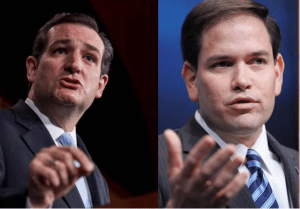 Good Morning!!
I’m beginning to get the feeling that Marco Rubio will be the GOP nominee. He seems to be the favorite of the money men, the “establishment” Republicans, and the corporate media. The only problem for him is that he’s still not very popular with voters.
But honestly, who else are the Republicans going to nominate? Trump is a know-nothing, egotistical blowhard, Carson is fabulist who spouts bizarre biblical fantasies and nutty conspiracy theories, Cruz is hated by just about everyone who has ever met him, Bush is the worst candidate evah, and Paul and Kasich are also-rans.
Rubio is young, baby-faced, and clean cut–never mind the fact that he is corrupt, ignorant, inexperienced, and would change any of his beliefs or policies and, if necessary, attack his own mother in order to win. Just look how he has treated his own mentor, Jeb Bush.
The latest media narrative is that Rubio and Ted Cruz are on a collision course.
Politico: The coming fight between Marco Rubio and Ted Cruz.
Going into the week, Jeb Bush and Marco Rubio seemed to be the rivalry to watch in the GOP primary. After the fourth Republican debate, that’s been replaced by a new and perhaps more consequential storyline: the coming collision of Rubio and Ted Cruz.
The two Cuban-Americans, both 40-something, first-term senators with tea party credentials, continue to trail outsider candidates Donald Trump and Ben Carson in the polls. But they’re increasingly viewed as the candidates to beat in their respective lanes — Rubio as the new establishment front-runner and Cruz beginning to consolidate support from the party’s more conservative wing. The consensus view that they outperformed their rivals Tuesday has served only to cement that impression.
“There’s this growing sense that Rubio’s the best candidate and that people are getting pretty comfortable with him,” said Bruce Haynes, a Republican strategist. “You can feel Carson and Trump losing support. Cruz is a quiet tide in the night that is beginning to wash out the base on Donald Trump. Now, I think, people are looking at Cruz as the candidate who’s best positioned in a lane to run with Rubio and give him a real fight.”
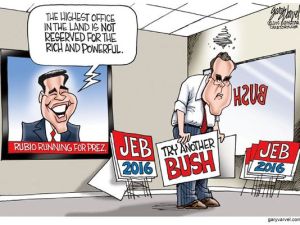
Both Cruz and Rubio are incredibly mean and ambitious, but I have to believe that Rubio will win out in the long run because Cruz is already the most hated man in DC. I have to believe that event Republican voters will hate him once they get to know him better.
At the NYT, Jeremy W. Peters writes: Confrontation Brews as Ted Cruz and Marco Rubio Vie for Conservative Vote.
That fight, which could be the most decisive but unpredictable element of the nomination contest, increasingly appeared to be heading toward a confrontation between two first-term senators both elected with Tea Party support but who have since taken different paths: Ted Cruz of Texas and Marco Rubio of Florida.
Each made his pitch in subtle but unmistakable ways during the debate and afterward, as they left Milwaukee for a day of campaigning across the country.
The most glaring difference between the two that surfaced during the debate — and continued in interviews each gave in the hours afterward — was over the issue of immigration policy. Mr. Cruz tried to portray Mr. Rubio as a moderate beholden to the Republican establishment, while Mr. Rubio argued that his approach was the most reasonable and workable conservative solution.
Yesterday as Cruz was campaigning in New Hampshire, Peters asked him to distinguish between his immigration policies and Rubio’s.
“It is not complicated,” Mr. Cruz said, then paused before adding, “that on the seminal fight over amnesty in Congress, the Gang of Eight bill that was the brainchild of Chuck Schumer and Barack Obama, that would have granted amnesty to 12 million people here illegally, that I stood with the American people and led the fight to defeat it in the United States Congress.”
Mr. Cruz said: “In my view, if Republicans nominate for president a candidate who supports amnesty, we will have given up one of the major distinctions with Hillary Clinton and we will lose the general election. That is a path to losing.
“And part of the reason the debate last night was so productive is you started to see clear, meaningful policy distinctions, not just between what people say on the campaign trail. Talk’s cheap. But between their records. When the fight was being fought, where did you stand? That speaks volumes about who you are and where you will stand in the future. And we’re entering the phase now in the presidential race where primary voters are starting to examine the records of the candidates.”
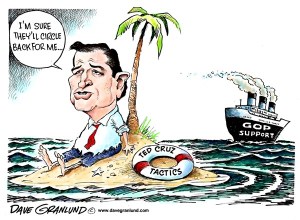
Peters also notes that Rubio tried to clarify his immigration views yesterday on Fox News.
“The lesson I learned from that is the people of the United States do not trust the federal government on immigration,” Mr. Rubio said as he listed a tough set of policies he said would “realistically but responsibly” address the problem.
“If you’re a criminal, you’ll be deported,” he said. “If you’re not a criminal, and have been here longer than 10 years, you have to learn English. You have to start paying taxes. You’re going to have to pay a fine. And then you’ll get a work permit.” He did not mention the question that enrages so many conservative voters: whether to eventually grant citizenship to undocumented immigrants.
The problem Rubio has is that he hopes to get support from some Latinos and from moderate Republicans; Cruz is only interested in the right wing nuts.
Reihan Salam at Slate: Where Does Marco Rubio Stand on Immigration?
Back in the 1980s, Pat Schroeder, a liberal congresswoman from Colorado, dubbed Ronald Reagan “the Teflon president” for the way he managed to avoid any blame for the scandals that erupted around him in his second term. One wonders whether Rubio is emerging as the Teflon candidate. With the possible exception of the silver-tongued Carly Fiorina, no Republican presidential candidate has helped himself more over the course of the first four debates than Rubio. On Tuesday night, Rubio fared well again. He wasn’t quite as strong as Ted Cruz, who, as Slate’s Josh Voorhees argues, was the night’s biggest winner. More than usual, Rubio seemed to be drawing on his stock references to his hardscrabble upbringing and his immigrant parents, and his optimistic homilies about the healing power of the American Dream. What was really striking about Rubio’s performance, however, is the way he dodged, yet again, getting drawn into a debate over immigration policy….
It would be one thing if Rubio only avoided talking about comprehensive immigration reform on the debate stage, but the Florida senator has soft-pedaled the issue throughout his campaign, only occasionally explaining why he decided to abandon his comprehensive immigration reform bill, which offered a path to citizenship to unauthorized immigrants and substantially increased legal immigration, among other things. Instead of repudiating the months he spent crafting an immigration compromise, Rubio emphasizes that he couldn’t trust President Obama as a partner, or that the timing wasn’t right. He insists that he pushed the comprehensive immigration reform bill in as conservative a direction as he could.
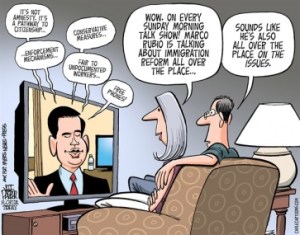
Yet we don’t have a clear sense of where, in an ideal world, Rubio would like U.S. immigration policy to go. On his nattily designed website, Rubio excerpts a passage from American Dreams, his biography, in which he makes the case for securing the border first, a conservative-friendly stance. He calls for moving from an immigration policy that emphasizes family ties to current U.S. citizens to one that is instead based on skills, which is sensible and broadly acceptable to the Republican right. What we don’t know is what this would mean in practice. Can we really say that we have a skills-based immigration policy if we also have a guest worker program for less-skilled workers, and if guest worker status can be renewed indefinitely? One assumes that guest workers will form families on U.S. soil and that many of them will be reluctant to leave the country once their guest worker visas run out. And though Rubio discusses immigration policy in broad strokes, he doesn’t really tell us about numbers. Will we admit more immigrants under the approach he favors? Or fewer? Even after abandoning comprehensive immigration reform, Rubio has backed legislation that would dramatically expand the H-1B visa program. What does he think about the evidence that the H-1B program is being gamed by offshoring companies with less than sterling records? These are questions I’d like to see Rubio answer at a future debate.
Other elements of Rubio’s immigration approach are likely to prove even more controversial. For example, he makes it clear that he intends to offer some form of legal status to unauthorized immigrants who already live in the U.S., a position that puts him at odds with many Republicans.* If Rubio intends to stick with this position, as I think he does, he’s going to have to actually make the case for it.
It’s difficult for me to understand the Republicans’ attitudes toward immigration, but it does appear that it is one of the most important issues for their base.
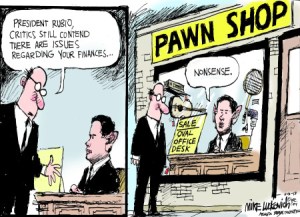
Another problem Rubio has is his possible past financial indiscretions. Has he continued this kind of dishonesty in Washington? Will Rubio’s “Teflon” work on this issue too?
The Miami Herald via Raw Story: New info raises more questions: Did Marco Rubio use his GOP credit card to subsidize his life?
For five years, Marco Rubio has tried to put behind him the controversy of his spending on a Republican Party of Florida credit card, taking the unusual step over the weekend of making public nearly two years of American Express statements to show how he spent the party’s money.
In some ways, however, the statements, which he previously refused to make public, raise more questions about how Rubio used the card, rather than laying them to rest.
Some big-ticket expenses he rang up on the card — $1,625 at the St. Regis Hotel in New York, $527 for food and drinks at Disney, $953 for a meal at Silver Slipper, the Tallahassee steakhouse — are the kind of eye-catching charges expected for someone doing party business.
But a slew of small charges at gas stations and for cheap meals — at a time when Rubio was struggling with his personal finances — suggest Rubio made the most of the ample leeway and little oversight party leaders gave employees and lawmakers to spend the party’s cash.
The Florida GOP issued corporate cards, intended for business use, during flush years a decade ago. A spending scandal threw the party into crisis five years later, around 2010, when some of the AmEx statements — including Rubio’s from 2007-08 — were made public. Rubio’s presidential campaign released the remaining two years of statements from 2005-06 on Saturday to show Rubio had repaid the party when he misused the card for personal charges.
An analysis by the Herald/Times of the new statements, however, found Rubio spent freely on the sort of items that are difficult to prove — or disprove — as party business expenses.
There’s much more at the link, and it makes Rubio look like a petty crook. Is there more to this story?
Although I see Rubio as a lightweight, it looks like the “very important people” see him as their best shot to get a Republican in the White House. I think he’s scary because he comes across as so sweet and innocent.
What do you think? Please post your thoughts and links on any topic in the comment thread.

 peej
peej Carissa
 bostonboomer
 dakinikat
 ecocatwoman
 mablue2
 Mama Lopez
 peggysue22
 quixote
 skydancingguestblogger
 Mona (aka Wonk the Vote)



 Sky Dancing
Recent Comments