
The Tax Payer-Funded Dumbing of America
Posted: January 26, 2013 Filed under: Bobby Jindal, public education, religion, religious extremists, Republican politics, Rick Perry, the GOP | Tags: Arizona, charter schools, cherry picking charter schools, corruption, creation myths taught as science, Creationism, Louisiana, LSEA, New Orleans, radical evangelical madrassas, religious myth, Texas 27 Comments It’s hard to believe that we’re living in a political environment where elected officials are bemoaning waste in all levels of government while sending so many public funds and assets to underwrite religious indoctrination and profit private businesses. Southern states are the bottom crawlers of any measurement of academic outcomes. My state of Louisiana is no exception. Texas is definitely a problem. However, it’s a national problem so those of you that live in other parts of the country shouldn’t feel smug or think it couldn’t happen to your children or grandchildren. Two fellow Louisianans–Melissa Harris Perry and Zack Kopplin– have found that vouchers spread creationism. That cannot be good for a future that’s dependent on educated people who need to know real science. Let’s examine exactly what our tax dollars are funding.
First, here’s the results of Zack’s study. Zack is currently studying at Rice University.
I first began investigating creationist school vouchers as my part of my fight against creationism in my home state of Louisiana. Over the past few months, I’ve learned creationist vouchers aren’t just a Louisiana problem—they’re an American problem. School vouchers are, as James Gill recently wrote in the New Orleans Times-Picayune, “the answer to a creationist’s prayer.”
Liberty Christian School, in Anderson, Indiana, has field trips to the Creation Museum and students learn from the creationist A Beka curriculum. Kingsway Christian School, in Avon, Indiana, also has Creation Museum field trips. Mansfield Christian School, in Ohio, teaches science through the creationist Answers in Genesis website, run by the founder of the Creation Museum. The school’s Philosophy of Science page says, “the literal view of creation is foundational to a Biblical World View.” All three of these schools, and more than 300 schools like them, are receiving taxpayer money.
So far, I have documented 310 schools, in nine states and the District of Columbia that are teaching creationism, and receiving tens of millions of dollars in public money through school voucher programs.
There is no doubt that there are hundreds more creationist voucher schools that have yet to be identified. The more than 300
schools I have already found are those that have publicly stated on their websites that they teach creationism or use creationist curricula.
There are hundreds more voucher schools, across the country, that are self-identified Christian academies, that appear very similar in philosophy to the ones I’ve identified in my research as teaching creationism. These schools may not blatantly advertise that they teach creationism on their websites, or often don’t even have a website, but there is a good chance that hundreds more voucher schools are also teaching our children creationism. Some states, Arizona and Mississippi, haven’t even released lists of schools participating in their voucher programs for the public to audit.
Here are a few highlights from creationist voucher schools I have identified:
- The Beverly Institute in Jacksonville, Florida, teaches “Evidence of a Flood,” and “Evidence against Evolution,” and ”The Evolution of Man: A Mistaken Belief.”
- Creekside Christian Academy in McDonough, Georgia says,“The universe, a direct creation of God, refutes the man-made idea of evolution. Students will be called upon to see the divine order of creation and its implications on other subject areas.
- Life Christian Academy in Oklahoma City, Oklahoma says their life science class will “lead the student to recognize that God created all living things and that these living things are fearfully and wonderfully made.” Evolution is taught only in history class, where students “evaluate the theory of evolution and its flaws.” The school uses the creationist Bob Jones and CSI curriculums.
- The principal of the Claiborne Christian School, in West Monroe, Louisiana, says in a school newsletter, “Our position at CCS on the age of the Earth and other issues is that any theory that goes against God’s Word is in error.” She also claims that scientists are “sinful men” trying to explain the world “without God” so they don’t have to be “morally accountable to Him.”
- Trinity Academy, in Gary, uses the creationist A Beka curriculum and says it “presents the universe as the direct creation of God and refutes the man-made idea of evolution.”
- Rocky Bayou Christian School, in Niceville, Florida, says in its section on educational philosophy, “God mandates that children be discipled for Christ. They must be trained in the biblical world view which honors Jehovah, the sovereign Creator of the universe. It recognizes that man was created in the image of God” and says “Man is presumed to be an evolutionary being shaped by matter, energy, and chance… God commands His people not to teach their children the way of the heathen.”
- Wisconsin Lutheran High School, in Milwaukee, Wisconsin, says in its biology syllabus that it teaches, “evolutionists are ‘stuck’ because they have no god, therefore they must believe in evolution” and “young earth evidence a disaster to evolutionists.”
This year, we may see even more creationist school vouchers. Both Tennessee and Texas are considering passing voucher programs. Indiana and Georgia may expand their programs.
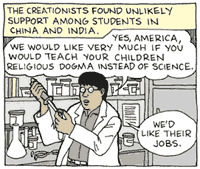 We’ve seen some horrible examples what now passes as “science” in Louisiana thanks to the LSEA or the Lousiana Science Education Act pushed and signed by Bobby Jindal and some of the whackier senators in the Louisiana Legislature in 2008. You can learn more about the law itself in the youtube. We’re not the only state that’s having problems now with taxpayer funded religious screeds.
The Texas Freedom Network has documented examples in Texas. Texas passed a law that lets schools teach bible courses under the guise of discussing the importance of religion in history and literature. They don’t even have vouchers draining funds to their evangelical madrassas yet. It’s in the works. Right now, all this is going on in regular public schools. The stories from TFNEF are not very pretty and includes a lot of students basically getting lessons in anti-Semitism. Here’s some examples of what they’ve found being taught in Texas.
Today the Texas Freedom Network Education Fund released a report, authored by a religious studies professor at Southern Methodist University in Dallas, that examines what students are learning in the 57 school districts and three charter schools that teach Bible courses. Examples from Texas public schools:
- Instructional material in two school districts teach that racial diversity today can be traced back to Noah’s sons, a long-discredited claim that has been a foundational component of some forms of racism.
- Religious bias is common, with most courses taught from a Protestant — often a conservative Protestant — perspective. One course, for example, assumes Christians will at some point be “raptured.” Materials include a Venn diagram showing the pros and cons of theories that posit the rapture before the returning Jesus’ 1,000-year reign and those that place it afterward. In many courses, the perspectives of Roman Catholics, Orthodox Christians and Jews are often left out.
- Anti-Jewish bias — intentional or not — is not uncommon. Some courses even portray Judaism as a flawed and incomplete religion that has been replaced by Christianity.
- Many courses suggest or openly claim that the Bible is literally true. “The Bible is the written word of God,” students are told in one PowerPoint presentation. Some courses go so far as to suggest that the Bible can be used to verify events in history. One district, for example, teaches students that the Bible’s historical claims are largely beyond question by listing biblical events side by side with historical developments from around the globe.
- Course materials in numerous classes are designed to evangelize rather than provide an objective study of the Bible’s influence. A book in one district makes its purpose clear in the preface: “May this study be of value to you. May you fully come to believe that ‘Jesus is the Christ, the son of God.’ And may you have ‘life in His name.’”
- A number of courses teach students that the Bible proves Earth is just 6,000 years old.
- Students are taught that the United States is a Christian nation founded on the Christian biblical principles taught in their classrooms.
- Academic rigor is so poor that many courses rely mostly on memorization of Bible verses and factoids from Bible stories rather than teaching students how to analyze what they are studying. One district relies heavily on Bible cartoons from Hanna-Barbera for its high school class. Students in another district spend two days watching what lesson plans describe a “the historic documentary Ancient Aliens,” which presents “a new interpretation of angelic beings described as extraterrestrials.”
How could such courses have gone so wrong? The 2007 law included numerous guidelines designed to help public schools create academically rigorous and constitutionally appropriate courses. But the Legislature failed to appropriate funding to develop in-service training for teachers of Bible courses, and most school districts simply ignored the requirement that teachers get such training. Moreover, the State Board of Education — under the control of religious conservatives at the time — refused to adopt serious curriculum standards to help guide school districts as they planned their courses.
Jindal’s voucher experiment was recently found unconstitutional but not for the reasons that you think. It was basically a technicality of funding and educational funding guidelines prescribed in the state’s constitution that got the law thrown out. Address this issue and the vouchers could stick and stay. Here’s some of the more recent news concerning what’s draining tax payer funds and passing as ‘education’ in Louisiana.
Jindal defended vouchers without once using the oft-toxic term, instead calling them scholarships, or putting them under the broader umbrella of school choice. “It is my sincere hope that what we are now putting in motion in Louisiana can be done across the country,” Jindal said. “I believe we’ve got an economic and a moral imperative to provide school choice and a quality education to every child, every student in America.”
Jindal made the case for making vouchers bipartisan. “I do not accept the notion that equal opportunity in public education should be a partisan issue,” Jindal said. Vouchers have been a third-rail policy among liberals, causing the Obama administration to do rhetorical summersaults. They’re controversial among liberals because they funnel tax dollars to private institutions — often, parochial schools that teach religion. In Louisiana, the private schools accepting voucher money have been found to teach about both creationism and the existence of the mythical Loch Ness monster.
Additionally, the schools that receive vouchers are not subjected to basic standards required of public schools AND many don’t even meet basic federal standards for basic services to special needs students.
Jindal said private schools in and near New Orleans that accepted vouchers saw more growth in student proficiency rates recently than schools statewide. (Proficiency rates are rarely reliable, since they measure two different groups of students.) Jindal also asserted that the vouchers serve all students. “It’s the money of a grandmother who wants to make sure her special education grandbaby gets the education she needs,” he said.
But according to public records, several private schools that opened their doors to voucher students with special needs had no services for such students. For example, the St. Angela Merici school’s application indicated it had no services for students with autism, mental disabilities or learning disabilities.
As for Jindal’s claims about high performing “charter” schools. I can offer you just a few links that show charter schools really aren’t performing as Jindal claims. Again, the biggest problem is that these schools do not effectively address children with disabilities. Schools that don’t address children with the highest needs can hardly be called anything but dysfunctional and discriminatory. There are currently many lawsuits and stories concerning children with special needs and various charter schools. These schools are cherry-picking students.
Families have attempted to place their disabled children in schools, but they have either been told that the school doesn’t have special-needs services or been told, gently, that their child would be better served at another school. These problems occur often enough that a due-process complaint has been filed against the Louisiana Department of Education on behalf of 4,500 students in the city with disabilities.
These issues have conveniently been left out of a number of Pollyanna-ish media reports touting the messianic nature of charter schools, and how Hurricane Katrina was a “blessing” to New Orleans’ children. A recent article at The Grio, “New Orleans Charter Schools Redefine Education Reform,” reads: “The standardized test results for fourth, eighth and tenth grade public school students have gone up since the storm hit in 2005. This may have something to do with the increasing presence of charter schools, though it is not clear.”
But test scores in those grades were already rising before the storm hit. Between 2003 and 2005, fourth-grade math results grew by 9 percent. Between 2007 and 2009, those results grew by 9.5 percent. In eighth-grade math, the growth in the percentage of kids scoring above basic levels between 2003 and 2005 was greater than the gains between 2007 and 2009. There has been a slight improvement in eighth-grade English and in math at the high school graduate level, but in both categories, the improvement in test scores builds on progress that was already occurring before the mass chartering of New Orleans.
We’ve also had problems with charter schools deliberately cheating on tests.
There’s a natural conflict there, experts say, in that most school districts are less than eager to announce they’ve found corruption in their midst.
At charter schools, the conflict might be more acute, some say, because charter boards play a role in investigations. Board members can be recruited by a school’s administrators, which might make it even more difficult for them to take a hard look at allegations.
“If you are committed to finding out the truth, you need individuals who are not connected in any way to the individuals involved,” said Robert Schaeffer, public education director of the National Center for Fair & Open Testing.
In Louisiana’s current setup, there is “a conflict of interest all the way up the line,” and not just as it relates to charter schools, said Gregory Cizek, a professor of educational measurement at the University of North Carolina at Chapel Hill. “No one has a really strong interest in investigating in a really searching manner,” he said.
That’s why some states have started putting such investigations under the jurisdiction of the state attorney general’s office or another independent entity, he said.
Asking the school’s own board of directors or district to handle a probe, Cizek said, is like having the IRS tell a taxpayer: “We have a problem with your tax return. Would you look it over?”
Studies of Arizona charter schools have found instances of tax payer “fleecing”.
In her examination of Arizona’s 50 largest nonprofit charter schools and all of Arizona’s nonprofit charter schools with assets exceeding $10 million, Ryman found “at least 17 contracts or arrangements, totaling more than $70 million over five years and involving about 40 school sites, in which money from the non-profit charter school went to for-profit or non-profit companies run by board members, executives or their relatives.” That says to me that in Arizona, at least, charter-school corruption isn’t the exception. It’s the rule. And that’s just in the nonprofit charter schools. Documentation for the for-profit schools is not publicly available. What are the odds that charter-school proprietors operating in the dark are less inclined to enrich themselves at public expense?
The self-dealing is entirely legal. All you have to do is get yourself an exemption from state laws requiring that goods and services be bid competitively. Clearly these exemptions aren’t difficult to acquire, because 90 percent of Arizona’s charter holders—not 90 percent of the charter schools surveyed by the Arizona Republic, but 90 percent of all the state’s charter schools—have acquired permanent exemptions from state competitive bidding requirements. No exemption has ever been withdrawn by the state. If you are a charter-school officer and you stand to benefit personally from some financial transaction with the school, you may not vote on whether to make the purchase. But that’s about the only rule.
The result? “The schools’ purchases from their own officials,” Ryman writes, “range from curriculum and business consulting to land leases and transportation services. A handful of non-profit schools outsource most of their operations to a board member’s for-profit company.”
Clearly, our state and many others have set up systems rife with self-dealing, cherry-picking and curricula that should stand in clear violation of the first amendment. My bottom line here? If any of these school reform initiatives come your way in your state, fight them like hell. They are just simply ways to bust teacher unions, deliver tax dollars to corporate cronies, and fund radical evangelical madrassas and religious indoctrination in the guise of science, literature, and history. Of course, this means if you have a Republican governor, be prepared to vote and fight.
A Sad Legacy: Louisiana’s Prison Economy
Posted: May 15, 2012 Filed under: Criminal Justice System, New Orleans | Tags: Angola Prison, Bobby Jindal, Louisiana, prison state, prisoners, Warden Cain 14 Comments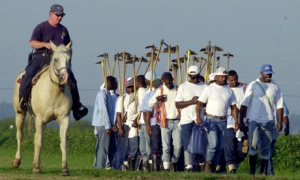 This is the stuff that creates documentaries and sad movies. It is the prison state that is Louisiana.
Louisiana is the world’s prison capital. The state imprisons more of its people, per head, than any of its U.S. counterparts. First among Americans means first in the world. Louisiana’s incarceration rate is nearly triple Iran’s, seven times China’s and 10 times Germany’s.
The hidden engine behind the state’s well-oiled prison machine is cold, hard cash. A majority of Louisiana inmates are housed in for-profit facilities, which must be supplied with a constant influx of human beings or a $182 million industry will go bankrupt.
Several homegrown private prison companies command a slice of the market. But in a uniquely Louisiana twist, most prison entrepreneurs are rural sheriffs, who hold tremendous sway in remote parishes like Madison, Avoyelles, East Carroll and Concordia. A good portion of Louisiana law enforcement is financed with dollars legally skimmed off the top of prison operations.
If the inmate count dips, sheriffs bleed money. Their constituents lose jobs. The prison lobby ensures this does not happen by thwarting nearly every reform that could result in fewer people behind bars.
READ THE
ENTIRE SERIES from NOLA.Com.Meanwhile, inmates subsist in bare-bones conditions with few programs to give them a better shot at becoming productive citizens. Each inmate is worth $24.39 a day in state money, and sheriffs trade them like horses, unloading a few extras on a colleague who has openings. A prison system that leased its convicts as plantation labor in the 1800s has come full circle and is again a nexus for profit.
In the past two decades, Louisiana’s prison population has doubled, costing taxpayers billions while New Orleans continues to lead the nation in homicides.

It is a shameful situation. Here are some stories from Angola. It’s probably the most infamous prison in the world. It’s known for its rodeo and its harsh treatment of prisoners who basically are subjected to “Faith-Based Slavery”. It seems that when a state can’t produce real jobs that it produces prisons.
“Unique” is one way Warden Burl Cain likes to describe his prison, and it would be impossible to argue otherwise. With grazing cattle and rolling hills in the distance, it’s hard not to admire its strange, sprawling beauty, even as the towers come into view. The prison itself is absent from my GPS’s “points of interest,” yet Angola’s Prison View Golf Course—the first public golf course on the grounds of a state penitentiary—is not. At Angola’s official museum, opened by Cain in 1998, a retired electric chair and rusty prison contraband are displayed adjacent to a gift shop selling mugs and tote bags reading: “Angola: A Gated Community.”
Angola is the largest maximum security in the country, sitting on 18,000 acres of farmland and home to 5,200 men. Louisiana has the highest incarceration rate of adult prisoners in the United States; thanks to the state’s unforgiving sentencing laws, at least 90 percent of Angola’s prisoners will die there. It’s a large-scale embodiment of a national phenomenon: elderly inmates are the country’s fastest growing prisoner population.
Yet Angola is also lauded as a revolution in corrections, its story told many times: Angola was once the “bloodiest prison in America,” where inmates slept with magazine catalogs strapped to their chests to protect themselves from stabbings. Things began to turn around in the 1970s, when a federal judge ordered a major overhaul. But most of the credit has gone to Warden Cain for imposing order through a new model of incarceration.
Like all of Angola’s wardens, Cain has continued the tradition of hard labor: most inmates work in the fields eight hours a day, five days a week, harvesting hundreds of acres of soybeans, wheat, corn, and cotton—picked by hand and sold by Prison Enterprises, the business arm of the Louisiana Department of Corrections. But unlike his predecessors, Cain, an evangelical Christian, has also made it his mission to bring God to Angola. Inmate ministers tell new prisoners that they can either work on their “moral rehabilitation” or remain a “predator”—“the choice is yours.” The radio station plays gospel music. On the walls leading to the execution chamber are two murals: Elijah ascending to Heaven and Daniel facing the lion. One of Cain’s favorite anecdotes is the execution of Antonio James, a born-again Christian whose hand he held just before giving the go-ahead to end his life. As James lay on the gurney waiting for lethal drugs to enter his veins, Cain said, “Antonio, the chariot is here…you are about to see Jesus.”
You should really read this MJ article to get the full feel of life inside Angola. It’s called “Gods Own Warden”.
Everyone was there except the person I had come to see: Warden Burl Cain, a man with a near-mythical reputation for turning Angola, once known as the bloodiest prison in the South, into a model facility. Among born-again Christians, Cain is revered for delivering hundreds of incarcerated sinners to the Lord—running the nation’s largest maximum-security prison, as one evangelical publication put it, “with an iron fist and an even stronger love for Jesus.” To Cain’s more secular admirers, Angola demonstrates an attractive option for controlling the nation’s booming prison population at a time when the notion of rehabilitation has effectively been abandoned.
What I had heard about Cain, and seen in the plentiful footage of him, led me to expect an affable guy—big gut, pale, jowly face, good-old-boy demeanor. Indeed, former Angola inmates say that prisoners who respond to Cain’s program of “moral rehabilitation” through Christian redemption are rewarded with privileges, humane treatment, and personal attention. Those who displease him, though, can face harsh punishments. Wilbert Rideau, the award-winning former Angolite editor who is probably Angola’s most famous ex-con, says when he first arrived at the prison, Cain tried to enlist him as a snitch, then sought to convert him. When that didn’t work, Rideau says, his magazine became the target of censorship; he says Cain can be “a bully—harsh, unfair, vindictive.”“Cain was like a king, a sole ruler,” Rideau writes in his recent memoir, In the Place of Justice. “He enjoyed being a dictator, and regarded himself as a benevolent one.” When a group of middle school students visited Angola a few years ago, Cain told them that the inmates were there because they “didn’t listen to their parents. They didn’t listen to law enforcement. So when they get here, I become their daddy, and they will either listen to me or make their time here very hard.”
Another former prisoner, John Thompson—who spent 14 years on death row at Angola before being exonerated by previously concealed evidence—told me that Cain runs Angola “with a Bible in one hand and a sword in the other.” And when the chips are down, Thompson said, “he drops the Bible.”
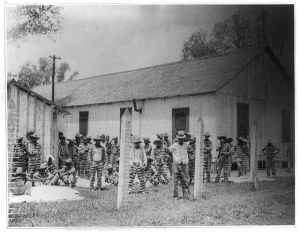 We’ve talked about Angola’s horrible legacy before. Here’s a recent UK Guardian Story on two men that have spent 40 years in solitary confinement. This is the stuff that causes insanity. Every human rights group actively opposes this kind of treatment.
“I can make about four steps forward before I touch the door,” Herman Wallace says as he describes the cell in which he has lived for the past 40 years. “If I turn an about-face, I’m going to bump into something. I’m used to it, and that’s one of the bad things about it.”
On Tuesday, Wallace and his friend Albert Woodfox will mark one of the more unusual, and shameful, anniversaries in American penal history. Forty years ago to the day, they were put into solitary confinement in Louisiana‘s notorious Angola jail. They have been there ever since.
They have spent 23 hours of every one of the past 14,610 days locked in their single-occupancy 9ft-by-6ft cells. Each cell, Amnesty International records, has a toilet, a mattress, sheets, a blanket, pillow and a small bench attached to the wall. Their contact with the world outside the windowless room is limited to the occasional visit and telephone call, “exercise” three times a week in a caged concrete yard, and letters that are opened and read by prison guards.
A new documentary film takes us into that cell, providing rare insight into the personal psychological impact of such prolonged isolation. Herman’s House tracks the experiences and thoughts of Wallace as he reflects on four decades banged away in a box.
Our own Governor wants to turn our Prison Economy into a privatized, money-making scheme for corporate donors. Fortunately, his bill didn’t get very far. But, this is because so many local politicians make money off of renting out prisoners to their own local donor base. They also get to use them for services that would normally go to paid workers. No wonder no one can find these types of jobs unless you are in prison.
A bill strongly backed by Gov. that would have allowed for the sale of the Avoylles Correctional Facility has been abandoned, as support for it was limited, according to the Associated Press. Now, the prison may be run under a new plan. Here is some more information.
* The original bill would have allowed for the Avoyelles Correctional Facility to be sold for $35 million to a private firm that would be responsible for operating it, according to the Town Talk.
* The state would then pay the company that buys it a daily fee to operate it.
* Rep. (R- Haughton) sponsored the bill, House Bill 850.
* Opposition from the privatization of the prison stems from the fact that 296 jobs would be lost in the sale.
* One group, the , made a plea to representatives to vote against the bill, saying that if the prison was run privately, the company could demand an exorbitant amount of money from Louisiana taxpayers to run the prison, and that the sale would actually cost Louisiana residents more.
* The bill was rewritten on Wednesday to allow for a private firm to be contracted to run the facility, but not to buy it.
* The contract would be for 10 years and the approval of the contract would be by the House and Senate budget committees.
* On Wednesday, the House voted 62-43 to pass the new amendment to the bill, according to Gambit.
* The bill was not sent to the Senate for approval, however, as Burns says that he is giving legislators time to look over the new bill, according to the Capitol News Bureau.
* There is still a lot of disapproval of the new bill as well, as opponents still cite the decreased wages for employees that are working for private companies as opposed to wages for state employees as unacceptable.
* Safety is also a concern, as Rep. Robert Johnson cited the lower wages as attracting lower quality workers to guard the prison, which would mean an unsafe environment, according to The Times-Picayune.
* The privatization of Avoyelles is a part of a larger plan by Gov. Jindal to privatize more prisons in Central Louisiana and close the and move those prisoners to Avoyelles, according to the Town Talk.
* Alexandria Mayor Jacques M. Roy has come out against the plan, saying that it would decrease public safety and would not save the state any money.
Any one in Louisiana lives among this prison legacy. Prisoners clean up our roads. They are brought out to shore up levees. They make our license plates. They are visible everywhere doing jobs that would usually be given to parish employees. No place is this more true than in small communities where sheriffs can make a good living off of renting them out to local business. Kinda makes you proud of that old entrepreneurial spirit doesn’t it? Take some time to read the series at the Times Picayune. I think you will find out more about my part of the good ol’ USA than you really would like.
Saturday: Big Easy Reads
Posted: May 7, 2011 Filed under: morning reads | Tags: BP oil spill, Climate change, disaster capitalism, dispersants, Gulf coast, Louisiana, New Orleans 28 CommentsMorning, news junkies.
I’m going to start this Saturday with my history pick first:
La Nouvelle-Orléans (New Orleans) was founded May 7, 1718, by the French Mississippi Company, under the direction of Jean-Baptiste Le Moyne de Bienville, on land inhabited by the Chitimacha.







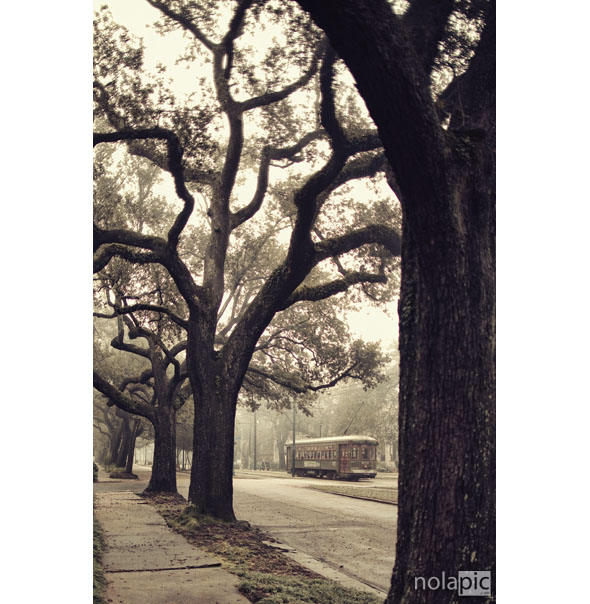
Click thumbnails for HQ views at pompo.com. Photography by Alfonso Bresciani.
I know we’ve had the perfunctory “Gulf oil spill: one year later” press coverage over the last few weeks, but since today marks the anniversary of New Orleans’ founding, I thought it would be prudent to take time out to dig deeper and get beyond the soundbytes. So this Saturday’s link dump is going to focus exclusively on the Gulf.
So how are NOLA and the Gulf Coast really doing?
Vanity Fair has posted a web exclusive from New Orleans-based photographer and CBS-affiliate videographer Jackson Fager, documenting the faces of shrimpers, fisherman, and oysterman along LA’s coastline, many of whom had their livelihoods snatched from them when the oil spill struck. Please check out Fager’s observations, thoughts, and photos. Here are the faces of the two women included in his slideshow (click for HQ and descriptions at the VF site):


Next up, from an interview (posted April 27th) with an environmental justice organizer with the Sierra Club:
BETWEEN THE LINES: And the Vessels of Opportunity, that was what BP set up to hire local fisher folks to clean up the spill, right?
DARRYL MALEK-WILEY: Right, that was funded by BP to hire people to go out and do clean-up work. A number of problems with that…No. 1, the Louisiana Environmental Action Network actually purchased safety gear and gave it to a number of fishermen to wear — respirators and things like that — because the environmental community knew about the dangers of the health impacts. And BP basically told fishermen and Vessels of Opportunity that if they wore the protective gear, they would no longer be working for BP.
In the interview, Malek-Wiley discusses a new organization called GO FISH (Gulf-Organized Fisheries in Solidarity and Hope), which is mobilizing fishermen and their families all the way from Alabama to Texas to fight for fair compensation from BP. Here’s what Malek-Wiley says these fishermen on the frontlines have to say about the official government spin that the oil has mostly disappeared:
DARRYL MALEK-WILEY: Yeah, what they say is that the oil is still here. We see it daily…tar balls are washing up all along the Gulf Coast. Just the way the winds blow…in the wintertime, the wind blows offshore so it’s blowing out into the Gulf; in the summertime we start getting southern winds blowing stuff back on shore. So we’re starting seeing tar balls come in; some of the oil come in. Because all the dispersant did was put it on the bottom of the Gulf, and so we’re starting to see some of that oil and dispersant coming back up and impacting a number of different coastal areas.
And, on dispersant:
DARRYL MALEK-WILEY: There is still a wide range of opinion. You know, the environmental community and fishermen basically agree that the use of dispersants without the needed scientific data on the long-term impacts of the stuff was not a smart thing. One point eight million gallons of dispersants into the Gulf of Mexico — nobody’s ever put that amount of dispersant anywhere in the world, so we don’t know what the impact of that is going to be. Some of the people who are sick, they’re taking samples of their blood and they’re finding the chemicals that make up the dispersants in their blood, as well as Louisiana sweet crude, and having serious health impacts.
Check out the rest of the interview to read more about those serious health impacts. It’s rather alarming, especially when you consider we’re talking about a population that has been out of work and lost their health insurance.
Dispersants: Questions remain
Last week the FDA declared seafood safe in Barataria, the coastal area hardest hit by the BP oil spill. The Miami Herald/AP article at the link says that means 99% of LA’s waters are open for fishing. The only meat I eat is seafood, and down along the Gulf we’ve gotten repeated “assurances” that our food supply isn’t tainted, but even all the way here in Houston a local chef who serves seafood still has unresolved concerns about dispersants:
“The thing that scares me the most about the oil situation is the dispersants, and from everybody that I talked to — from scientists to fisherman that’s the one thing that sit there and they hold onto,” he said.
Government scientists say their tests show no trace of any oil or dispersant in any seafood. They say the dispersant breaks down faster than oil in the water. NOAA says dispersant is simply not a concern, and for now, Caswell says he believes them.
“I eat it,” he said.
I eat it too, though I have cut back and still find myself wondering whether our public and private institutions are leveling with us on just how much they don’t know about the long-term impact of having these chemicals in our ecosystem and food supply and how far the reach of these effects might be. How many people have to get sick before they’ll admit anything?
Take for example this report out of Raceland, LA on fisherman Brandon Cassanova, who has mysteriously fallen ill, possibly due to exposure to dispersants. For months, Cassanova has been experiencing seizures, abdominal pain, memory loss, racing heartbeat, and elevated blood sugar, and his symptoms appear to be getting more acute. His lifelong primary-care physician, Dr. Mike Robichaux, believes Cassanova’s illness matches a “bizarre cluster” of symptoms experienced by people who say they have been exposed to dispersants and other toxins related to the oil spill. Robichaux, a former state senator and longtime advocate for locals exposed to pollutants, has written to Sen. Landrieu and others demanding the government for answers. He isn’t buying the line that the Gulf seafood is safe to eat, either.
While formal data collection by the LA Dept. of Health & Hospitals and long-term NIEHS research are underway, the task of proving causality between exposure and symptoms remains a hurdle. According to Tulane’s Dr. Luann White, most of the cases being reported are of a short-term and mild nature and dilution by the Gulf waters makes detecting chemicals and pathway of exposure to the public difficult. Anecdotally, however, Lafayette-based toxicologist Wilma Subra–who researched the chemistry of dispersants and came up with a list of possible effects–says she’s seen 600-700 people exhibiting this cluster of symptoms after being exposed to dispersants and crude, and that each of these cases seems to know of yet others going through the same thing.
A Thought Experiment on the Gulf Coast
This next one is interesting food for thought. Via geekosystem: What if the Gulf Oil Spill Never Happened? It’s a 2-minute animation clip by Chris Harmon, entitled Oil’d…please give it a look if you haven’t seen it yet:
Vodpod videos no longer available.
The Gulf Coast Oil Spill and Climate Change
I want to touch on the impact of the spill in terms of the broader environmental challenges for the Gulf…it seems like disaster capitalism struck this region and went into overdrive right at the time when it was most vulnerable and needed improvements in infrastructure and conservationist attention more than ever. Funny timing, that.
Over at Greenanswers.com, Chelsea Cooley paints a bleak picture with this headline… Last Days of Louisiana’s Bayous:
The 2010 BP Oil spill in the Gulf of Mexico harmed Louisiana’s coastal eco-system in some obvious ways and in many other ways yet undiscovered. One unsettling truth is that the diminishing state of the wetlands actually aided the widespread effects of the oil spill, as the wetlands might otherwise have provided a protective barrier, preventing oil seepage into the bayous’ central regions. Barataria Bay, for example, a popular nesting ground for Louisiana’s pelicans, was one of the areas most polluted by the spill. The crisis compounded problems faced by an already delicate ecosystem.
However, the wetlands are also suffering due to a dramatic rise in sea-level associated with Global Warming. According to one professor of earth science from Tulane University, the sea-level rise in the Gulf Coast is occurring at a rate five times faster than it did in the 1000 years preceding the Industrial Revolution. The implications of human activity are on the table for all to see.
Also take a look at this SciAm/Reuters headline the other day that Dakinikat passed along to me… Seas Could Rise Up to 1.6 meters by 2100:
OSLO (Reuters) – Quickening climate change in the Arctic including a thaw of Greenland’s ice could raise world sea levels by up to 1.6 meters by 2100, an international report showed on Tuesday.
Such a rise — above most past scientific estimates — would add to threats to coasts from Bangladesh to Florida, low-lying Pacific islands and cities from London to Shanghai. It would also, for instance, raise costs of building tsunami barriers in Japan.
“The past six years (until 2010) have been the warmest period ever recorded in the Arctic,” according to the Oslo-based Arctic Monitoring and Assessment Programme (AMAP), which is backed by the eight-nation Arctic Council.
And, this piece at Huffpo brings it altogether. Pre-Spill, Coastal Threats Cannot Be Ignored, Environmentalists Say…It’s breathtaking to read the entire piece and the extent of the challenges the Gulf region is up against. I’m just going to quote a few snippets:
Dr. Virginia Burkett, senior science advisor for Climate and Land Use Change at the U.S. Geological Survey, said the spill contributed to Louisiana’s wetlands loss, which was already well underway because of multiple stressors. And, she said, a year after BP’s rig explosion, cumulative effects of climate change and the spill are still poorly understood. Climate change itself, however, has been well studied.
[…]
Louisiana is in the grip of global, environmental change. “Temperatures and ocean waters are rising because of increased greenhouse or heat-trapping gases, like carbon monoxide, in the atmosphere,” Burkett said. “Glacial mass and annual snowcover are declining more rapidly than many scientists had predicted.” Ocean temperatures and acidity are increasing, and rainfall volume has grown. But spacing between rain events has expanded so droughts are more frequent in some regions of the world, she said. And in several ocean basins around the globe, hurricanes have become more intense.
As much as our government tries to pretend like the oil that gushed out into the Gulf last year just disappeared, they cannot wipe away the consequences of the larger pattern of environmental destruction that the BP oil spill has contributed to in the area. The spill last year wasn’t the first domino to fall, and it won’t be the last:
Burkett said events that hastened coastal erosion in recent decades won’t be the last.”When I was a child, Hurricane Camille was the big benchmark event, then it was Katrina.” And in the current decade, the Gulf oil spill is the gorilla.
What can we do?
Burkett offers these suggestions:
“Barrier islands and wetlands can be restored for hurricane protection,” Burkett said. “River sediment can be used to build marsh, instead of letting sediment wash out to sea.” Preparations can be made for more intense drought and wildfires.
“Home owners and communities can elevate houses, and cities can adapt infrastructure to the rising sea. In some areas, however, retreat may be the most effective option.” Her parents, for example, moved inland when they lost their home in Biloxi, MS to Hurricane Katrina.
So how much ‘ruin there is left in a nation’ may very well depend on just how much ‘retreat’ there is in it.
And, our ability to retreat depends on us even knowing we’re in danger in the first place. We saw the failures to get people out in time during Katrina and the several weeks it took for the current Administration to really respond to the BP oil spill, but what about the mini-disasters that build up cumulative damage yet go virtually unnoticed, leaving people unaware of the true extent of the daily threat they’re up against and how unsustainable their living spaces are becoming. Wired.com had a really interesting read recently on what can be done to better track crude leaking into the Gulf using satellite imagery… Gulf Oil Shouldn’t Spill Beneath the Radar:
A year after the Deepwater Horizon blowout sent 200 million gallons of crude oil into the Gulf of Mexico, smaller leaks still bubble across the Gulf — but unlike big spills, they’re largely ignored.
A nonprofit organization called SkyTruth, which uses public and commercial satellite imagery to assess environmental damage, recently added airplanes and ships to its Gulf monitoring. But the group can still investigate just a tiny fraction of spills and leaks that may be reported, underreported or not reported at all by oil companies.
SkyTruth founder John Amos, a geologist and a former oil-company research scientist, thinks roughly $3 million per year could buy the necessary data and provide the first continuous, accurate assessment of Gulf oil pollution.
“The oil industry has done a great job convincing the public that modern drilling pollution is nonexistent. But we’ve discovered wells damaged by hurricanes in 2005 that are still leaking,” said Amos, who may have caught an oil company grossly under-reporting one of its leaks. “We have some tools available to do investigations, but in many cases it’s just not enough. For smaller spills, we need an up-close look from satellite imagery.”
On the proactive side of things, over here at Houston’s Reliant Center, the Offshore Technology Conference this past week has yielded some interesting results:
A possible tool for preventing oil spills like last year’s Gulf disaster arrived on the floor of Houston’s Reliant Center this week, courtesy of an auto industry refugee and a jackknife can opener.
The Latest Threat
As mentioned earlier, the BP oil spill isn’t the first or last threat the area is facing. Here’s the latest trouble, via the Daily Comet… Flood will deal blow to struggling oystermen.
Via the Sun Herald… Another slam for the Gulf:
GULFPORT — The U.S. Army Corps of Engineers plans to open the Bonnet Carre Spillway on Monday, sending a flood of fresh water through Lake Pontchartrain, through a strait and into the Gulf.
It’s something officials don’t do often, because of the effect it has on the marine life and the Mississippi Sound.
But the Mississippi River — already high at 1.6 million cubic feet per second flowing past Natchez — is expected to increase to 2.45 million cubic feet per second by May 22.
Knowing that volume is coming down the river, opening the Bonnet Carre is an attempt to divert some of it before it gets to New Orleans.
But scientists who study marine life in the Gulf cringe.
“It will change things, that’s for sure,” said Bill Hawkins, director of USM’s Gulf Coast Research Lab. But how much change depends on the volume and duration of the diversion.
Jay Alford has more — The Coming Waters (h/t Dakinikat):
There’s more water on the upper Mississippi River right now than any time in history, period, in any time in history,” said Garrett Graves, chairman of the Coastal Protection and Restoration Authority. “This overwhelms the volume of water that was in the river in 1927, 1937, 1997, 2008. An extraordinary flow is coming down the river.”
That water levels are expected to be above crest for seven to 10 days doesn’t inspire much confidence. Graves said there are “vulnerabilities everywhere from the levees in Baton Rouge to the levees in south Louisiana.”
Final Thought
I’ll close with the WSJ’s review this Saturday, of Rowan Jacobsen’s Shadows on the Gulf: A Journey Through Our Last Great Wetland.
The headline says a lot in itself… A Gulf Requiem:
Click to view on Amazon.
“Most of the Gulf Coast has not been touched by the oil spill,” Mr. Jacobsen reports, “and is beautiful and vital as ever.”
Yet these early avowals of glass-half-fullism notwithstanding, it’s hard not to hear the mournful sounds of a pipe organ on nearly every page. And you have to wonder why all the people—oystermen, oilmen, shrimpers, tourists—are so grim-faced, as if shuffling past what appears to be a Gulf-sized casket.

It’s a true shame that we’d let an area that is one of our national treasures become a laboratory for climate change and disaster capitalism in this fashion. Take a good look, because what’s happening to the Southern Louisiana area and the rest of the Gulf is foreshadowing of the rest of our country’s future, if the interests of profit continue to be put before people, unabated, and people get pushed off further to the margins of the margins.
Wouldn’t it have been nice if our president would have responded to the death of OBL by using the new presidential force behind the bully pulpit to restore our attention to the Gulf Coast and all that has been neglected over the past decade… too bad any reminder of the Gulf and the struggles of ordinary people conflicts with the fierce urgency of Obama’s permanent campaign.
[originally posted at Let Them Listen; crossposted at Taylor Marsh and Liberal Rapture]
The Blob Lives On!
Posted: April 21, 2011 Filed under: Environment, Environmental Protection, Gulf Oil Spill | Tags: BP, coastal restoration, Deepwater Drilling, Deepwater Horizon, Louisiana, Oil Gusher, wetlands 11 Comments It’s been a year since the explosion of the Deepwater Horizon killed 11 people outright and destroyed an entire ecosystem. It’s the worst environmental catastrophe to ever hit the US. The US celebrates Earth Day on Friday, yet, I never hear one politician make hay over the “lessons of 4/20”. This is because policy makers refuse to learn the lessons. They’d rather sell oil and tainted seafood than deal with the real issues of the disaster.
Most of the coastline of Louisiana is still coated with oil either right in the marshes or just below the surface. The Oyster populations are way down. Dead Dolphins and Sea Turtles are washing up onto the beaches in record numbers. Where is the outrage? Where is the move to seek justice? Where are the calls about what we’re going to leave to our children?
No one who could make this right is carrying the banner to do so. Thousands of small businesses that rely on the Gulf are still hurting and going under. Those that are hurting include people who fish, oyster, shrimp, and run services businesses that support other businesses or tourist trade. It’s an ongoing tragedy and one that’s been ignored for the most part. The Times Picayune editorial staff and even Republican Politicians in the area who are obsessed with drilling for oil and the oil industry here aren’t shying away from pointing fingers and blame. BP is doing the same half-assed job of cleaning up that they did of drilling on the Deepwater Horizon. There is no justice and no peace down here on the Gulf. Real people are dying and local economies are going under. There has been more guffaw in Washington DC over defunding Planned Parenthood than making things right for people impacted by the BP Oil Gusher. Just ask Congressman Markey who has tried endlessly to pass bills to make it right and hasn’t got one through yet.
The oil lurking just under the soil in the marshes of Pass a Loutre Wildlife Management Area is a testament to that. The area was thick with roseau cane a year ago, Wildlife and Fisheries Secretary Robert Barham told reporters this week. “It was a thick, luscious, green tropical marsh,” he said. Now it is “weathered, stressed, unhealthy.”
The shoreline has visibly retreated in the past year, shrinking several yards from where the water line had been marked in the days after the spill. That is discouraging to Louisianians and ought to worry all Americans, given the importance of our coastal wetlands to the creation of fish and other marine life.
The state created the Pass a Loutre Wildlife Management Area nearly 100 years ago, and it has been an important refuge for migratory birds. Now, the state is using air cannons to keep the birds away from the oily marshes.
This is just one spot on the Gulf Coast that is still suffering from the massive amount of oil that spilled from BP’s well last spring and summer.
In some locations, we are losing 5 feet of marshes and shore line a day. Deep Horizon oil is everywhere and making things much worse. All you have to do is talk to the people that live in the affected areas like Grand Isle or Plaquemines Parish or Barataria Bay to see and hear about oil oozing along the coastline.
The noise of the cannons, combined with the swish and flash of metallic strips flapping from poles above the cane, are designed to keep birds from settling into the oily area.
“This is the very terminal end of the Mississippi Flyway,” said Todd Baker, biology program manager for Wildlife & Fisheries. “You get a wide variety of birds, waterfowl, neotropical migrants, raptors, all of them. When they come through, this is the first piece of land they see. When they leave, this is the last place they rest up before they jump across the Gulf of Mexico.
“The hazing cannons are not foolproof,” Baker said, as a Louisiana red-winged blackbird chirped from atop a cane stalk a few yards away.
About 15 miles away as the birds fly — or 30 by boat — Graves used a shovel and his hands to dig about a foot beneath the surface of a spit of sandy beach at the end of South Pass, turning over black-stained sand that smelled like diesel.
Here’s some testimony from people whose health has been impacted by working on the clean-up. There will probably be lots more of them in the coming months in years.
What does it say about a government that will not make right injustices done to so many people for the benefit of a profit-seeking company? What does it say that our media only shows up to report this story on anniversary days? How do we explain to our children that we no longer have an entire lifestyle or set of animals and birds or group of human beings because oil is more important than anything?
The silence of Congress is deafening and deadly. They’ve been more concerned with gutting the EPA than learning the lessons from this deadly oilspill and its omnipresent aftermath. Shame on them and every one else who has forgotten their fellow Americans and the country they profess to love. This is killing people and it’s killing our land. We should be talking about the lessons of 4/20 daily. Instead, we’re just learning how much more Congress loves their donors than the people they are supposed to represent. It’s a damn shame.
Gulf Gusher Update
Posted: May 15, 2010 Filed under: Gulf Oil Spill | Tags: Coastline, Gulf Oil Spill, Louisiana Comments Off on Gulf Gusher UpdateIt was very stormy today and I am still grading finals but I managed to catch a few things on the local news that show the level of  frustration down here with BP and the response to the tragedy unfolding in the Gulf. There’s so much speculation as to how desperate the situation will be that every one wants more information and it doesn’t appear very forthcoming.
A group of fishermen got angry at officials at a meeting in the two hard hit parishes here. That would be Plaquemines and St. Bernard. Both were slammed by Hurricanes Katrina and Rita and haven’t really recovered to any place you’d call normal. Most of the folks that have stayed there have livelihoods that depend on the gulf including shrimpers and folks that live on commercial and sport fishing. These families are about at the end of their ropes and most have been in the area and in the business for generations. It’s more than just a living to them.
The fishermen said they feel like their livelihood is being threatened and they’re being punished twice — first by the spill and now by their parish and BP.
“We have to suffer because of their damn mistakes,” said Suzanna Guidroz, who works as a deckhand. “They should have had a backup plan for this oil spill before it even happened. It should have been in the works years ago.”
More of the frustration stemmed from the pay that captains and deckhands are being offered, which is far less than they’re used to making.
“I dropped out of seventh grade to do this,” fisherman Michael Thonn said. “I’ve been doing this my whole life, since I was a kid. It’s all I know. How am I supposed to pay my bills? I got family to take care of. I got kids.”
“These fishermen make a lot more than $17 an hour and $250 a day for their boat,” Guidroz said. “They could not compare to what these guys are making out there right now.”
Meanwhile, confusion over the testimony at last week’s congressional hearing has caused Homeland Security Secretary Janet Napolitano to fire off a letter to the CEO of BP. Since no one was claiming any responsibility, she felt the urge to get a little clarification.
The letter specifically mentions an interview with Reuters on April 30 in which BP CEO Dr. Anthony Hayword said, “We are taking full responsibility for the spill and we will clean it up, and where people can present legitimate claims for damages we will honor them. We are going to be very, very aggressive in all of that.”
As recent as May 11, Lamar McKay, the chairman and president of BP America, was reported as making similar claims before the Senate Energy and Natural Resources Committee. In his testimony, Napolitano’s letter said that McKay agreed that BP will pay all claims, even if they exceed what he described as an “irrelevant” statutory cap of $75 million per incident.
If this winds up in court ala the Exxon Valdez and the AMOCO Cadiz, people will most likely be dead before they have hope of recovering any of the damages. The Napolitano letter followed up the White House Rose Garden speech where TOTUS instructed POTUS to be very angry. I think this means the buck is going to stop on the back of those of us that live on the Gulf right now. Believe me, the pain will spread too. If this thing gets up into the Mississippi, there is no telling what will happen. That’s a major artery for commerce as well as the source of a lot of drinking water. The President seems to think his administration’s response has been okey dokey.
With the Gulf spill, he said, the response was “comprehensive and fast” and the Coast Guard and Interior Department were on the scene almost immediately.
Yeah. That was the same group that pulled us off of roofs during Hurricane Katrina. I’m beginning to trust the Louisiana Department of Wildlife and Fisheries over just about any body else in the country, frankly. How about sending us a few brilliant engineers to figure out how to plug up the gusher?

All of the waters directly affected by the spill remained closed to commercial and recreational fishing, so no seafood from the region is at risk of oil contamination.
It is almost certain, however, that the life cycle of shrimp in the Gulf will be affected by the spill. Shrimp reproduce and lay their eggs in the Gulf, which is now largely covered in dispersed and floating oil, and then move inshore to the estuaries, which are are also at risk.
I think we’re all kinda tired of making history down here.
You can consider this an open thread, but I have to tell you, there’s not much on my mind right now but how bad this is going to be.

 peej
peej Carissa
 bostonboomer
 dakinikat
 ecocatwoman
 mablue2
 Mama Lopez
 peggysue22
 quixote
 skydancingguestblogger
 Mona (aka Wonk the Vote)



 Sky Dancing
Recent Comments