
Tuesday Reads: The Long War Against Covid-19
Posted: August 3, 2021 Filed under: Afternoon Reads | Tags: Centers for Disease Control, coronavirus pandemic, Covid-19, Delta variant, eviction moratorium, Florida, Joe Biden, Louisiana, Mississippi, Texas 12 Comments
Without Hope, 1945, by Frida Kahlo
Good Afternoon!!
Thanks to the Delta variant, and people refusing to be vaccinated, Covid-19 cases are rising around the country, particularly in Florida, Texas, Mississippi, and Louisiana. At least Louisiana’s Democratic Governor John Bel Edwards is trying to get the situation under control. But in the other three states, governors are working against public health.
The Advocate: ‘Do you give a damn?’ John Bel Edwards reissues mask mandate in dire COVID surge update.
When Gov. John Bel Edwards lifted Louisiana’s mask mandate at the end of April, he warned that loosening restrictions wasn’t a “one way street” and that he would reimpose the rules if COVID-19 came roaring back.
On Monday, as hospitals statewide buckled under an unprecedented surge in patients, Edwards followed through on his word.
Schools, businesses, universities, churches, and any other indoor public settings in Louisiana will require a face mask for entry beginning on Wednesday, under a proclamation Edwards signed that expires September 1.
“It has become extremely clear that our current recommendations on their own are not strong enough to deal with Louisiana’s fourth surge of COVID. In fact, nobody should be laboring under the misapprehension that this just another surge,” Edwards told reporters Monday in announcing the order he had already signed. “This is the worst one we’ve had thus far.”
The return to restrictions comes as the pandemic enters a new stage defined by the delta variant, a highly contagious strain of COVID-19 first identified in India that now accounts for most new cases in Louisiana. On Monday, the state reported 11,109 new confirmed and probable infections of COVID-19. More than 2,000 of those cases were among children.

Tree of Hope, Remain Strong, 1946, by Frida Kahlo
CNN: Florida and Texas had one-third of all US Covid-19 cases in past week, official says.
One-third of all US Covid-19 cases reported in the past week were in just two states – Florida and Texas – according to White House Covid-19 response coordinator Jeff Zients.
The cases are mainly in areas where vaccination rates remain low, Zients said at a briefing Monday.
“In fact, seven states with the lowest vaccination rates represent just about 8- 1/2% of the US population, but account for more than 17% of cases, and one in three cases nationwide occurred in Florida and Texas, this past week,” Zients said.
In the past two weeks, daily case rates have gone up fourfold, according to Dr. Francis Collins, director of the National Institutes of Health.
The increase comes as the Delta variant spreads and the percentage of fully vaccinated Americans hovers around 49.7%, according to the US Centers for Disease Control and Prevention. Hospitals are once again filling up with patients as the virus tears through the unvaccinated population.
“There are still about 90 million eligible Americans who are unvaccinated,” Zients said. “And we need them to do their part, roll up their sleeves and get vaccinated. Each and every shot matters.”
It doesn’t seem to matter to some Republican Governors.
Mother Jones: COVID Is Spiking in Florida and Mississippi. Their GOP Governors Are Waging War Against Masks.
On Saturday, Florida recorded 21,683 new cases of COVID-19, breaking its one-day record for new cases. But even as the state swells with fresh infections, Republican Gov. Ron DeSantis remains hellbent on his war against mask mandates. He even recently barred school districts from instituting mask mandates when classes reconvene in August.
The Sick Child, 1907, by Edvard Munch
DeSantis feels so good about his war on masks, he’s even laughing about it. “Did you not get the CDC’s memo?” DeSantis joked to a largely maskless crowd at a conference for the American Legislative Exchange Council in Utah last week, referring to the Centers for Disease Control and Prevention’s updated guidelines recommending mask-wearing amid the surge of the Delta variant. “I don’t see you complying.”
He continued, prompting applause, “I think it’s very important that we say unequivocally, ‘No to lockdowns, no to school closures, no to restrictions, and no mandates.’ Floridians are free to choose and all Americans should be free to choose how they govern their affairs, how they take care of themselves and our families.”
The governor, who is reportedly eyeing a bid for president in 2024, has spent most of the pandemic fiercely opposing COVID safety measures—a stance public health officials say has allowed the virus to run rampant across the state and has now made Florida the epicenter of the pandemic in this country. To DeSantis’ sort-of credit, he has made recent efforts to boost vaccinations, though at the same time he’s selling anti-Anthony Fauci merchandise on his website.

In Mississippi:
In Mississippi, where ICU beds are nearing capacity with a surge of unvaccinated individuals, Republican Gov. Tate Reeves blasted the CDC’s mask guidelines as “foolish” and claimed that it reeked of “political panic.”
“It has nothing, let me say that again: It has nothing to do with rational science,” Reeves said on Thursday.
Except that it does. As Dr. Fauci warned on Sunday, “Things are going to get worse.” The country’s top expert on infectious diseases told ABC’s This Week, “You want them to wear a mask so that if in fact they do get infected, they don’t spread it to vulnerable people, perhaps in their own household, children, or people with underlying conditions.”
In Texas, Governor Abbott is also trying to kill his constitutents. The New York Times: Gov. Greg Abbott bars mandates for vaccinations and masks in Texas.
In an executive order issued on Thursday, Gov. Greg Abbott, the Republican governor of the nation’s second-largest state, prohibited local governments and state agencies from mandating vaccines, saying that protection against the virus should be a matter of personal responsibility, not forced by a government edict.
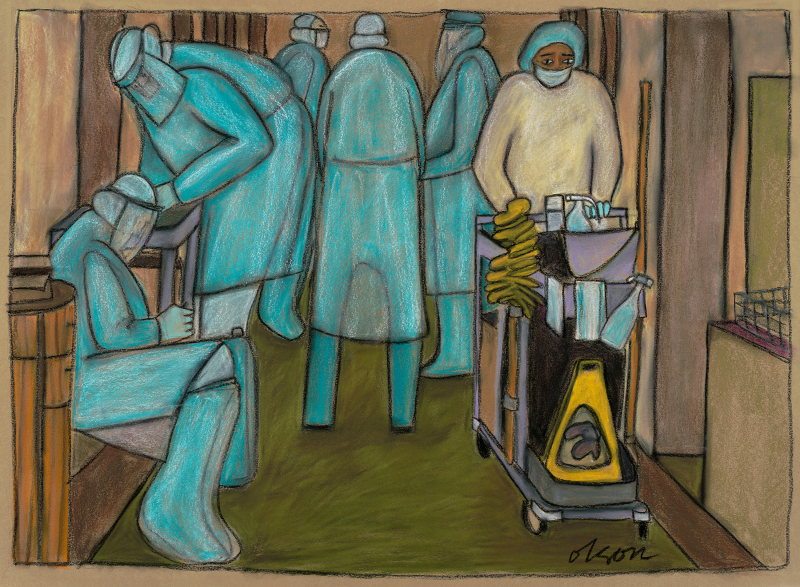
Hospital Workers, by Carolyn Olson
The order also reinforced his prior directive prohibiting local officials from requiring face masks, despite growing calls from city leaders for greater flexibility to reverse the renewed spread of Covid.
The daily average of cases in Texas as of Friday was 8,820, according to a New York Times database, a 209 percent increase over the past 14 days. Cities across the state are facing a surge in hospitalizations reminiscent of the alarming spikes that occurred before Covid cases began nosing downward with the arrival of vaccines.
With 56 percent of the state’s population unvaccinated — including nearly five million children under 12 who are not eligible — health officials have expressed concern about the state’s vulnerability.
It was always going to be a long battle against the coronavirus, but many Americans didn’t want to face that fact. At STAT News, Megen Molteni writes: For many, the belated realization that Covid will be ‘a long war’ sparks anger and denial.
In May, when the CDC said fully vaccinated people could ditch masks and social distancing, it seemed to signal a return to normalcy. But epidemiologists cautioned at the time that the move wasn’t likely to be permanent, and shouldn’t be interpreted as the end of Covid-19 as a daily concern. Colder weather or a right hook in the virus’s evolution could bring restrictions right back.
Still, Americans seem shocked by the recent turn of events. Last week, the Centers for Disease Control and Prevention advised everyone — even those who’ve gotten Covid-19 shots — to go back to indoor masking, a decision driven by new data showing the hyper-contagious Delta variant colonizes the nose and throat of some vaccinated people just as well as the unvaccinated, meaning they may just as easily spread this new version of the virus, while stilling being protected against the worst manifestations of the disease.
The prospect of contending with a prolonged outbreak phase — and adjusting again to a constantly evolving roster of restrictions — has brought back another feature of pandemic living in America: anger.
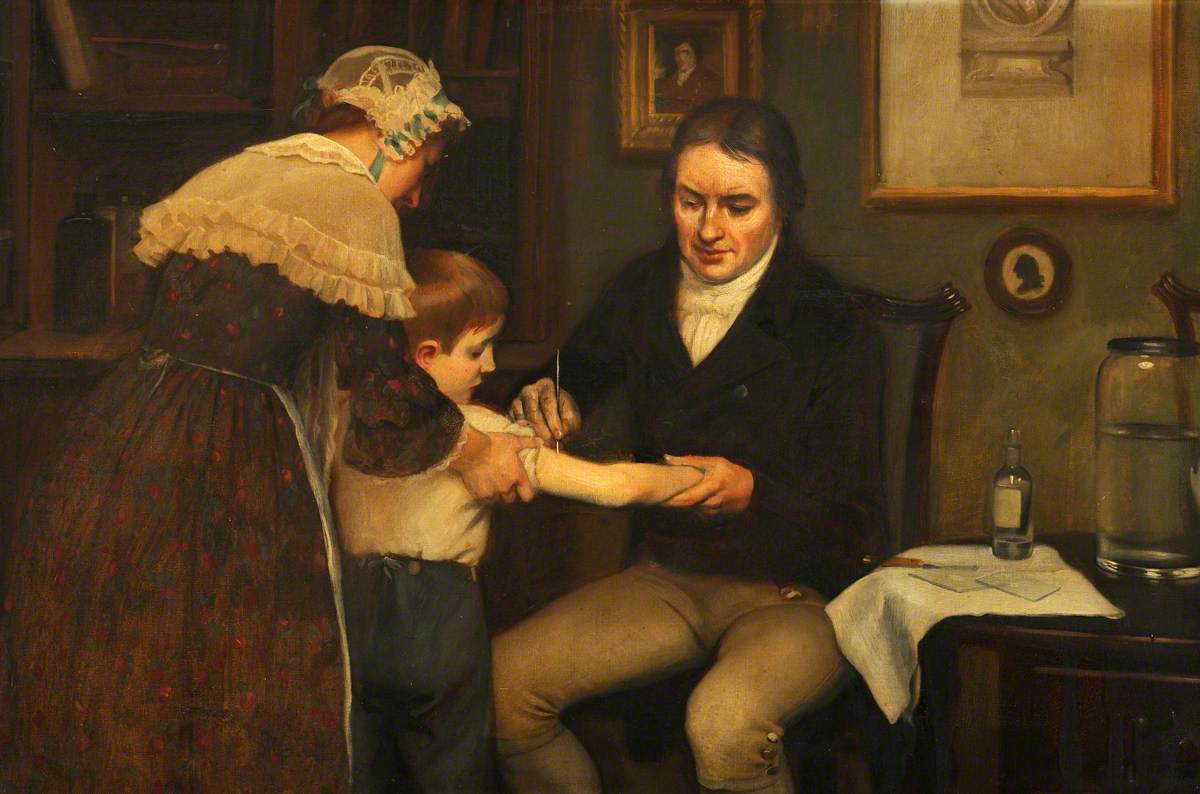
Board, Ernest; Vaccination: Dr Jenner Performing His First Vaccination, 1796
This time it’s not just the mostly Republican anti-masking refrain rearing its defiant head (though fights over school mask mandates have returned with a vengeance). Coast to coast, and across the political spectrum, contempt for unvaccinated people is rising. “It’s the unvaccinated folks that are letting us down,” Alabama Governor Kay Ivey, a Republican, said on July 22, as her state, with one of the lowest vaccination rates in the country, reeled from a 530% rise in Covid-19 hospitalizations in just three weeks.
Among the vaccinated, there’s a sense that the freedoms they gained by getting the shots — travel, eating out, concerts, sports, school, seeing friends — are now being jeopardized by those who are still holding out.
Though this new flavor of outrage might look and sound like righteous indignation, mental health professionals say that what’s behind it is fear.
“It’s scary to admit that somebody else has power over you and you’re at their mercy and you’re afraid of them, but showing that is not a very American ideal,” said David Rosmarin, an associate professor of psychiatry at Harvard Medical School and a clinician at McLean Hospital. “Instead of expressing that fear, it’s a lot more comfortable to blame somebody else.”
Anger is what people in his profession refer to as a “secondary emotion.” It’s a feeling that arises in response to a more primal emotion, like fear and anxiety over having some aspect of your life threatened. “The reality is that there are millions of people who are miseducated about something, they’re making a big mistake that will have massive consequences that might affect you and your family and that makes you scared,” Rosmarin said. “But nobody is saying that.”
Unfortunately, there’s another looming disaster caused by the pandemic: the CDC eviction ban is expiring, and in Washington everyone is accusing everyone else of being responsible for dealing with the situation. And it’s complicated by a Supreme Court ruling.
Yahoo News: White House says it has been unable to find way to extend eviction moratorium.
The White House said Monday that it was unable to find a legal means to extend the eviction moratorium, despite the fact that millions of Americans could soon lose their homes even as the Delta variant of COVID-19 continues to spread.
The Centers for Disease Control and Prevention has “been unable to find legal authority for a new, targeted eviction moratorium,” White House press secretary Jen Psaki said in a statement. “Our team is redoubling efforts to identify all available legal authorities to provide necessary protections.”
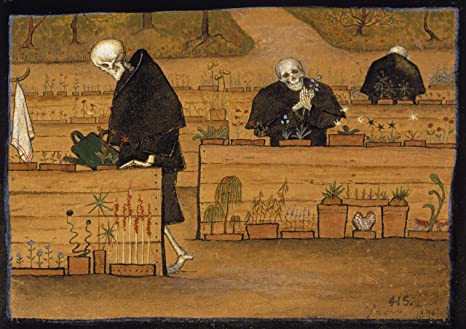
The Garden of Death, Hugo Simberg, 1897
Citing a Supreme Court decision issued in late June, the White House said it was unable to unilaterally extend the moratorium for evictions. Late last week, Psaki issued a statement pressuring Congress to act, but the House went into recess before a vote could be held. Were it to pass the House, it is unclear if an extension of the moratorium would be able to pass the Senate.
The federal eviction moratorium expired over the weekend, yet more than 6.5 million U.S. households are currently behind in rental payments totaling more than $20 billion, according to a study by the Aspen Institute and the COVID-19 Eviction Defense Project. Without federal protections in place, many renters will now need to pay months of back rent.
“On this particular issue, the president has not only kicked the tires, he has double, triple, quadruple checked,” Gene Sperling, the White House COVID-19 economic relief coordinator, said at a briefing on Monday, adding, “The rise off the Delta variant is particularly harmful for those who are most likely to face evictions, and as that reality became more clear going into the end of last week, I think all of us started asking what more can we do.”
Mark Joseph Stern at Slate: The Supreme Court Caused the Looming Eviction Disaster. Why Won’t Democrats Say So?
On July 31, the federal government’s eviction moratorium expired, potentially forcing millions of Americans out of their homes during yet another COVID surge. In the days before the eviction cliff, House Democrats attempted to extend the moratorium, but Republicans easily blocked their measure. Democratic lawmakers then spent the weekend arguing over who was to blame for the looming catastrophe.
Curiously, most Democrats chose not to focus on the primary culprit: the Supreme Court. In late June, five conservative justices signaled that they would not let the White House extend the eviction ban beyond July 31 absent further congressional authorization. These Republican-appointed justices set the terms of the debate, yet were largely absent from Democrats’ blame game. As a result, most vulnerable Americans will likely not understand they face homelessness in a pandemic because of SCOTUS. This strange dynamic is symptomatic of a deeper pathology in contemporary American politics: Democrats appear incapable of explaining how the Supreme Court stymies their own agenda—and the resulting confusion shields the court from criticism, consequences, and accountability when its decisions wreak havoc.
Vaccination by Adolfo Flores
When House Speaker Nancy Pelosi urged Biden to extend the eviction moratorium on his own, she framed the issue as a matter of morality. But the president’s inaction was almost certainly a legal calculation. To understand his hesitation, it’s key to remember that the recently expired moratorium was not the same policy that had been in effect since the start of the pandemic. Congress passed its first eviction ban in March 2020, explicitly prohibiting landlords from kicking out tenants who could not afford rent because of the pandemic. After this provision expired that August, Donald Trump issued an executive order asking the CDC to take action. The CDC responded in September with its own eviction moratorium set to run through the end of 2020. It was rooted in a federal law that allows the agency “to make and enforce such regulations” that are “necessary to prevent” the “spread of communicable diseases” between states. In December, Congress passed legislation that explicitly extended the CDC’s moratorium through Jan. 31, 2021. The agency then extended the ban several more times.
While the CDC kept the moratorium in place, a group of landlords sued to block it, claiming it exceeded the agency’s authority. On May 5, U.S. District Judge Dabney Friedrich sided with the plaintiffs against the ban but stayed her order. One month later, the U.S. Court of Appeals for the District of Columbia Circuit court refused to block the ban. The plaintiffs then appealed to SCOTUS, which came within an inch of ending the moratorium. Five justices—Clarence Thomas, Sam Alito, Neil Gorsuch, Brett Kavanaugh, and Amy Coney Barrett—believed it violated the law. But Kavanaugh, who cast the decisive fifth vote, wrote separately to explain that although he believed the CDC had “exceeded its existing statutory authority,” he would not invalidate the ban. Instead, weighing the “balance of equities,” he would allow it to remain for “a few weeks.”
“In my view,” the justice declared, “clear and specific congressional authorization (via new legislation) would be necessary for the CDC to extend the moratorium past July 31.”
Kavanaugh’s analysis is dubious at best. (Maybe that’s why Chief Justice John Roberts didn’t join it, instead quietly voting to keep the moratorium in place.) Congress already gave the CDC expansive powers to fight the “spread of communicable diseases” between states. The agency acted pursuant to this law when it determined that mass evictions would force many Americans to live unhoused or crammed together in close quarters, transmitting the virus more widely. Crucially, when Congress chose to extend the moratorium, it simply passed a law extending the CDC’s own ban. By doing so, lawmakers chose “to embrace” the agency’s action and “expressly recognized” that it had the authority to issue the ban, in the words of the D.C. Circuit. It would not make a lick of sense for Congress to extend the CDC’s moratorium if it did not believe the CDC had authority to issue it.

More eviction reads:
The Washington Post Editorial Board: Opinion: There’s plenty of money to avoid evictions. States just have to spend it.
NPR: White House Calls On States To Do More After Federal Eviction Ban Expires.
The Washington Post: Liberals erupt in fury at White House over end of eviction moratorium. [the “liberals” referred to in the headline are actually far left Bernie bro types]
The New York Times: Yellen and Pelosi will discuss rental assistance as an eviction crisis looms and Democrats demand answers.
That’s it for me today. Sorry this post is such a downer. As always, this is an open thread.
Monday Reads: Modernizing Policy to the 21st Century and Beyond!
Posted: May 10, 2021 Filed under: just because | Tags: Arizona recount, kingfish, Louisiana, oil hack, sanctuary state for oil and gas 10 Comments
Helen Frankenthaler, Mountains and Sea, 1952.
Good Day Sky Dancers!
It’s pouring here again and flooding. This seems to be the new state of affairs as Climate Change goes beyond noticeable in more places than the Maldives and the gone, gone gone, beyond barrier islands and glaciers of the planet. Our infrastructure here in New Orleans was made for 1910, not 2021, and certainly not for this kind of constant extreme weather which we might as well start calling our weather all the time.
Oh, and by the way, attacks on our country are more than just the North Korean government lobbing missiles into the air with pictures of the stern face of Dear Leader in its government-run press. We just had a cyberattack on the Oil Pipeline infrastructure that look’s like the kind of thing the Last Guy’s bestie Putin likes to do.
Meanwhile, the Republicans are debating every policy like it’s 1959. Are we certain the interstate highway system isn’t a sign that Eisenhower has been co-opted by Commies? So, what’s stopping us from getting some new-fangled, up-to-date, technologically, and scientifically consistent policies based on what’s real?
Oh, yeah, Joe Manchin and Republicans …
So, let’s look at that attack on our oil infrastructure.
And enjoy the artwork of Helen Frankenthaler active in the 1950sl, m.
The federal government issued a rare emergency declaration on Sunday after a cyberattack on a major U.S. pipeline choked the transportation of oil to the eastern U.S.
The Colonial Pipeline, responsible for the country’s largest fuel pipeline, shut down all its operations Friday after hackers broke into some of its networks. All four of its main lines remain offline.
The emergency declaration from the Department of Transportation aims to ramp up alternative transportation routes for oil and gas. It lifts regulations on drivers carrying fuel in 17 states across the South and eastern United States, as well as the District of Columbia, allowing them to drive between fuel distributors and local gas stations on more overtime hours and less sleep than federal restrictions normally allow. The U.S. is already dealing with a shortage of tanker truck drivers.

Helen Frankenthaler, Open Wall, 1953
There are declared emergencies in 17 states and DC. From Axios:
Why it matters: Friday night’s cyberattack is “the most significant, successful attack on energy infrastructure” known to have occurred in the U.S., notes energy researcher Amy Myers Jaffe, per Politico.
- The Department of Transportation’s Federal Motor Carrier Safety Administration issued a regional emergency declaration for 17 states and Washington, D.C., to keep fuel supply lines open.
The big picture: Colonial Pipeline carries 45% of fuel supplies in the eastern U.S. Some 5,500 miles of pipeline has been shut down in response to the attack.
- While gasoline and diesel prices aren’t expected to be impacted if pipeline operations resume in the next few days, fuel suppliers are becoming “increasingly nervous” about possible shortages, Bloomberg notes.
What’s happening: The emergency declaration covers: Alabama, Arkansas, D.C., Delaware, Florida, Georgia, Kentucky, Louisiana, Maryland, Mississippi, New Jersey, New York, North Carolina, Pennsylvania, South Carolina, Tennessee, Texas and Virginia.

Painted on 21st Street “Untitled” (1951), in a show at Gagosian on Helen Frankenthaler’s early period.
Darkside –a Russian Criminal group–is considered the hacker per NBC. “Russian criminal group suspected in Colonial pipeline ransomware attack. The group, known as DarkSide, is relatively new, but it has a sophisticated approach to extortion, sources said.”
The system, which runs from Texas to New Jersey, transports 45 percent of the East Coast’s fuel supply. In a statement Sunday, the company said that some smaller lateral lines were operational but that the main lines remained down.
“We are in the process of restoring service to other laterals and will bring our full system back online only when we believe it is safe to do so, and in full compliance with the approval of all federal regulations,” the company said.
Raimondo said on CBS’ “Face the Nation” that the effort to restart the network was “an all-hands-on-deck effort right now.”
“We are working closely with the company, state and local officials to make sure that they get back up to normal operations as quickly as possible and there aren’t disruptions in supply,” she said, adding: “Unfortunately, these sorts of attacks are becoming more frequent. They’re here to stay.”
A White House official said Sunday that the Energy Department is leading the government’s response. Agencies are planning for a number of scenarios in which the region’s fuel supply takes a hit, the official said.
On Saturday, Colonial Pipeline blamed the cyberattack on ransomware and said some of its information technology systems were affected. It said it “proactively” took “certain systems offline to contain the threat.”

Helen Frankenthaler, Abstract Landscape, 1951
I think having Arizona QAnon crazies search for bamboo in ballots is just really missing the threat and mark. Don’t you? Well, read this Vice article about the QAnon plan to steal Arizona for Trump and be relieved our justice department has been called in.
A group of Arizona citizens, including one Republican Congressional candidate, is asking the state’s Supreme Court to invalidate all election results since 2018 and remove all elected officials from their offices immediately.
And who should replace the ousted election officials? Well, the citizens who filed the lawsuit, of course.
The legal petition claims all officials elected in Arizona since 2018 are “inadvertent usurpers” because the elections they won were conducted by vote-counting equipment that was not properly certified.
The plaintiffs claim the evidence to back up this staggering claim will be provided in the lawsuit’s appendix, which unfortunately they had not submitted at the time of writing.
The plaintiffs claim that the court has the authority to void the terms of the named officials—which include Gov. Doug Ducey and Secretary of State Katie Hobbs—and install themselves as appropriate replacements.
“When in the past citizens have been appointed by the Governor to finish out a Senate term due to unusual circumstances, the Governor has typically chosen pedigreed, well-known politicians, but this is not necessary. Any Arizona resident meeting the minimum qualifications is entitled to and has the right be appointed to a seat in unusual situations,” the lawsuit claims.
The legal filing is the latest harebrained effort by pro-Trump and QAnon supporters in Arizona to get the results of November’s election overturned. There is currently an audit of 2.1 million votes being conducted in Maricopa County. The GOP-sanctioned recount is being conducted by a Florida-based company called Cyber Ninjas, which has no experience conducting audits.
I can’t imagine a more embarrassing state to live in at the moment than Arizona. I live and have lived in pretty embarrassing states so I’m an authority on that.
The U.S. Department of Justice’s Civil Rights Division is asking Arizona Senate President Karen Fann to respond to concerns the department has about the security of ballots and potential voter intimidation as the Senate’s contractors perform an audit of November’s presidential election in Maricopa County.
In a letter sent to Fann on Wednesday, Pamela S. Karlan, principal deputy assistant attorney general in the division, asked for Fann’s response to its concerns with an explanation of “the steps that the Arizona Senate will take to ensure that violations of federal law do not occur” during the audit.
The department’s concerns may have been prompted in part by a letter it received Thursday from three organizations, including the Leadership Conference on Civil and Human Rights, asking the department to dispatch federal monitors to oversee the audit. That letter raised the same concerns that the department said it has, regarding the security of ballots and potential voter intimidation.

Helen Frankenthaler, March 1960.
Anyway, don’t even get me started on Louisiana where the lege is trying to make us a “sanctuary state” for oil and gas. This is basically an industry that is killing us while making a few people quite rich.
A state lawmaker wants to make Louisiana a “fossil fuel sanctuary state,” quixotically asserting special sovereignty to nullify any federal law, regulation or tax that in any way harms the oil and gas industry.
Rep. Danny McCormick, a Republican from Oil City, a town of about 1,000 residents in northwest Louisiana, says his House Bill 617 is a “preemptive effort” to protect the industry from the future policies of President Joe Biden’s administration.
“What he’ll do, I can’t answer yet,” McCormick said Wednesday, shortly after the bill was introduced in the House Natural Resources and Environment Committee. “There may be no limit to his attacks on the fossil fuel industry.”
The bill was partially inspired by the cities and other local jurisdictions that defied the immigration policies of former President Donald Trump’s administration. These so-called “sanctuary cities” refused to hand over immigration detainees for deportation.
Okay, so that’s pretty embarrassing for the state of Louisiana.
Anyway, I’ve just about had it with folks trying to redefine the future as back to the past. State legislatures are Trumpier than the country can afford. Phillip Bump of WAPO puts it this way: “Refusal to accept reality is doing unquestionable damage to democracy”. There are dangers out there but it’s not bamboo in ballots or transgender children.
The challenge, of course, is that the ramifications of rejecting the results of an election are obviously more dire than not having a chance to compete in a singing competition. Trump is both leveraging and accentuating a pattern of refusing to acknowledge defeat that poses real dangers for the American democratic system.
Trump’s refusal to acknowledge that he lost hinges on myriad assertions that something dubious or suspicious happened during the 2020 presidential contest. The sheer volume of claims is itself often cited as evidence that something needs to be done about election security, a claim that’s a bit like advocating legislation for mandated chimney locks given how many Americans (most of them under the age of 7) believe in Santa Claus.
There remains no credible evidence of the 2020 results being influenced or shifted in any way that would suggest widespread fraud. (Quite the opposite.) But there is a substantial industry predicated on claiming that voting results are suspect, claims into which Trump and others could tap.

Helen Frankenthaler’s “Weeping Crabapple.” 2009
Well, there’s a business well-suited for devils and demons. There are no communists under your beds but there are a lot of disturbed politicians in your statehouses. Greg Sargent reminds us that the GOP has been radicalizing for some time. It’s interesting to note that we’re on our second McCarthy in the House supporting conspiracy theories.
This is not the act of a “coward” who “fears Trump,” and would vouch for the integrity of the election if only he could do so without consequences.
Rather, it is the act of someone who is fully devoted to the project of continuing to undermine confidence in our elections going forward.
This is for purely instrumental purposes. Republicans are employing their own invented doubts about 2020 to justify intensified voter suppression everywhere. Banks neatly crystallized the point on Fox, saying those doubts required more voting restrictions — after reinforcing them himself.
Indeed, with all this, Republicans may be in the process of creating a kind of permanent justification for maximal efforts to invalidate future election outcomes by whatever means are within reach.
I’ve already detailed the possibility that a GOP-controlled House could refuse to certify a contested state’s election results in 2024. Brian Beutler suggests other ways Republicans could use official power to undermine legitimate outcomes, such as institutionalizing “sham audits” like the Arizona one or punishing state officials who certify Democratic victories.
So, it’s not fear itself we should fear these days. That ought to keep you up at night. There’s tons of technology to hack our creeky old infrastructure. There are also all these chemicals and fossil fuels that are killing everything. Can’t we just forget the good old days and move forward to face the new? Well, we could if we keep our democracy and get back to reality.
Anyway, time for Dakinikat Downer to go grade some papers and trying to calm any students that feel for DogeCoin. Just when I thought bitcoin was the only Ponzi Scheme preying on our children. Elon Musk strikes again!
Have a good week! We’ll be here!
What’s on your reading and blogging list today?
Thursday Reads: Women’s Bodies, Women’s Lives
Posted: May 16, 2019 Filed under: morning reads, U.S. Politics | Tags: abortion rights, Alabama, anti-abortion laws, Brett Kavanaugh, incest, Indiana, John Roberts, Louisiana, Missouri, Ohio, rape, U.S. Supreme Court, women's bodily autonomy 16 Comments
Peonies, by Claude Monet
Good Morning!!
Even as we worry about Trump and Bolton starting a war with Iran and about the Democrats refusing to follow the Impeachment road map provided by Robert Mueller, American women must face the fact that our very personhood is being attacked.
Personally, I have decided that I will not vote for any man for president. The right of women to make decisions about our own bodies is too important.
Here’s the latest on the War on Women:
NBC News: Missouri Senate passes bill to outlaw abortion at 8 weeks.
Missouri’s Senate has passed what its authors call one of the nation’s most stringent anti-abortion bills, which would outlaw nearly all abortions at eight weeks of pregnancy.
The Republican-led Senate passed the bill, dubbed Missouri Stands With The Unborn, by a margin of 24 to 10 early Thursday morning….
Missouri’s move comes hours after Alabama Gov. Kay Ivey signed a bill that would introduce a near-total abortion ban in that state. Kentucky, Mississippi, Ohio and Georgia have approved bans on abortion once a fetal heartbeat is detected, which can occur in about the sixth week of pregnancy.
Louisiana is following suit with its own “heartbeat” abortion ban, which was approved unopposed by the Louisiana House Health and Welfare Committee on Wednesday.
Abortion right activists are mobilizing in Alabama. The Washington Post: Governor signs Alabama abortion ban, which has galvanized support on both sides, setting up a lengthy fight.
MONTGOMERY, Ala. — As a crop duster with a banner saying “Abortion is okay” hummed above the capitol, circling back and forth around the governor’s mansion, a group of women below let out a cheer.
Amaryllis by Piet Mondrian (1910)
“Just another day in Alabama,” said Mia Raven, director of People Organizing for Women’s Empowerment and Rights (POWER) House. “We knew this would pass and we got ready.”
Amanda Reyes, who works with an abortion fund, was wearing an “I’m on the pill” T-shirt, complete with instructions printed on the back detailing how to get a medical abortion. She also looked skyward: “Here it comes again! That’s just the coolest thing.”
Hours after the Alabama Senate voted late Tuesday to ban abortions in almost all circumstances — including in cases of rape and incest — women’s rights activists and abortion rights advocates said the decision to approve the nation’s strictest abortion measure has energized them. Knowing that the bill was designed to challenge Roe v. Wade, they are gearing up for the fight.

The Washington Post: Louisiana ‘heartbeat’ abortion ban nearing final passage.
BATON ROUGE, La. — A proposal to ban abortions in Louisiana as early as the sixth week of pregnancy continued to speed through the state legislature Wednesday, the same day Alabama’s governor signed the nation’s most restrictive law against the procedure.
Without objection, the Louisiana House Health and Welfare Committee backed legislation to prohibit abortions when a fetal heartbeat is detected, similar to laws passed in several conservative states that are aimed at challenging the U.S. Supreme Court’s 1973 decision that legalized abortion. Louisiana’s ban, however, only would take effect if a federal appeals court upholds a similar law in Mississippi.
Louisiana’s so-called fetal “heartbeat bill” is sponsored by state Sen. John Milkovich, one of several measures that lawmakers are advancing to add new restrictions on abortion. Senators already have supported the bill, which will next receive full House consideration, one step from final passage. Democratic Gov. John Bel Edwards has indicated he will sign the measure if it reaches his desk.
The New York Times sums up the current abortion landscape: ‘The Time Is Now’: States Are Rushing to Restrict Abortion, or to Protect It.
Alex Katz, Tulips 4, 2013
States across the country are passing some of the most restrictive abortion legislation in decades, deepening the growing divide between liberal and conservative states and setting up momentous court battles that could profoundly reshape abortion access in America….
The national race to pass new legislation began last fall, after President Trump chose Brett M. Kavanaugh to replace Justice Anthony M. Kennedy on the Supreme Court, adding what some predicted would be a fifth vote to uphold new limits on abortion. Red states rushed to pass more restrictions and blue states to pass protections.
Now, as state legislative sessions draw to a close in many places, experts count about 30 abortion laws that have passed so far.
That is not necessarily more than in past years, said Elizabeth Nash, a legal expert at the Guttmacher Institute, which supports abortion rights.
What’s different is the laws themselves, which have gone further than ever to frontally challenge Roe v. Wade, the Supreme Court’s 1973 ruling that established federal protections for abortion.

Read the rest at the NYT.
Interestingly, these extreme laws could be interfering with right wing plans to overturn Roe v. Wade.

Flowers in a Glass Vase by John Constable (c. 1814)
Even Pat Robertson thinks the Alabama law is too “extreme.” The Washington Post: Televangelist Pat Robertson: Alabama’s abortion ban is ‘extreme’ and has ‘gone too far.’
Longtime televangelist Pat Robertson decried Alabama’s new abortion ban as “extreme,” saying on his show on Wednesday that the state legislature has “gone too far.”
Alabama’s law, which has been passed by the legislature and signed by the governor, includes a penalty of up to 99 years in prison for doctors who perform abortions and has no exceptions for rape or incest, Robertson noted on his show.
“They want to challenge Roe vs. Wade, but my humble view is I don’t think that’s the case I’d want to bring to the Supreme Court because I think this one will lose,” Robertson told viewers of CBN’s “The 700 Club” on Wednesday.
David G. Savage at The Los Angeles Times: Supreme Court is not eager to overturn Roe vs. Wade — at least not soon.
The Supreme Court justices will meet behind closed doors Thursday morning and are expected to debate and discuss — for the 14th time — Indiana’s appeal of court rulings that have blocked a law to prohibit certain abortions.
The high court’s action — or so far, nonaction — in Indiana’s case gives one clue as to how the court’s conservative majority will decide the fate of abortion bans recently passed by lawmakers in Alabama and Georgia. Republican Gov. Kay Ivey of Alabama signed her state’s ban into law on Wednesday.
Pot of Geraniums, Henri Matisse
Lawmakers in those states have said they approved the bans in an effort to force the high court to reconsider Roe vs. Wade, the 1973 decision that legalized abortion nationwide.
The justices have many ways to avoid such a sweeping ruling, however. And Chief Justice John G. Roberts Jr., in his 14 years on the high court, has typically resisted moving quickly to decide major controversies or to announce abrupt, far-reaching changes in the law.
Roberts’ history, along with the court’s handling of abortion cases in recent years, suggests he will not move to overturn the right to abortion soon, or all at once, and is particularly unlikely to do so in the next year or two with a presidential election pending.

At Slate, Dahlia Lithwick makes a similar argument: Alabama’s Extremist Abortion Bill Ruins John Roberts’ Roe Plan.
One could feel sorry for Chief Justice John Roberts. He is, after all, caught in an unsightly squeeze play between anti-abortion zealots in Alabama, and slightly less wild-eyed anti-abortion zealots in Georgia, Ohio, Tennessee, and Indiana (the court seems unable to make a decision on whether to grant the Indiana petition it has been sitting on for months now). There’s finally a five-justice majority within striking distance of a decades-long dream to overturn Roe v. Wade, and the anti-choice activists are getting ahead of themselves like slurring drunks at a frat party and making everything more transparently nasty than it need be.
Hibiscus by Hiroshige (c. 1845)
There are easy and near invisible ways for the high court to end Roe. That has always been, and remains, the logical trajectory. As Mark Joseph Stern has shown, when Brett Kavanaugh came onto the court, with his dog whistles and signaling around reproductive rights, it became clear that he would guide the court to simply allow states to erect more and more barriers to abortion access (dolphin-skin window coverings on every clinic!). The five justices in the majority would do it all while finding ways to say that such regulations were not an “undue burden” on a woman’s right to choose. The courts and state legislatures could continue their lilting love songs to the need for the states to protect maternal health and to help confused mommies make good choices, and nobody need dirty their hands by acknowledging that the real goal of three decades’ worth of cumbersome clinic regulations and admitting privileges laws were just pretexts for closing clinics and ending abortion altogether.

Read the rest at Slate.
(Mostly) male legislators are ignoring the realities of actual women’s lives.
When Senator Clyde Chambliss, a Republican, for example, was asked if the law would allow for incest victims to obtain abortions, he responded: “Yes, until she knows she’s pregnant.”
He did not elaborate on how someone would have an abortion before she knows she’s pregnant, outside of claiming, “It takes time for all the chromosomes to come together.”
Flower Garden by Gustav Klimt, 1905
Women’s bodies, lives, and futures are quite literally in the hands of men who seemingly couldn’t pass a high school health class. That’s part of what’s so hard about watching these debates: It’s not just that women’s rights and autonomy are being legislated away, but that it’s being done by complete morons.
This lack of remedial understanding of women’s bodies is not limited to Alabama. Representative John Becker of Ohio, a Republican, for example, sponsored a bill to limit insurance coverage for abortions, but claimed that it would have an exception for ectopic pregnancies, when the fertilized egg implants outside the uterus. “That treatment would be removing the embryo from the fallopian tube and reinserting it in the uterus,” he said, explaining a procedure that doesn’t exist and isn’t medically possible.
There is also Texas state Representative Dan Flynn, a Republican, who believes abortion requires cutting into a woman’s uterus, or Vito Barbieri, the Idaho state Representative, a Republican, who thought you could give a woman a remote gynecological exam by having her swallow a tiny camera.

Shannon Dingle at USA Today: I was 12 years old and pregnant. Alabama’s abortion ban bill would punish girls like me.
Roses and Lillies by Henri Fantin-Latour (1888)
I was that 11-year-old pregnant by rape in Ohio, except I had just turned 12 and lived in Florida….She is 11. She has experienced and is experiencing violating trauma. Maybe someday she will tell her story, but today is not that day.
I can tell my story, though. I was newly 12. I lived in a suburb of Tampa. I had gotten my period a couple years before, and it came regularly once it started. I knew to expect it every 32 days.
It was July, the summer between sixth and seventh grade, when days 33, 34, 35 and more passed with no period. I had read in one of my sister’s Seventeen magazines that periods aren’t always regular, so I figured this was my first one of those.
It wasn’t….I never chose to have sex at such a young age, but abusers in my family chose to rape me. I had lost count of the number of times by then. With a dad high ranking in the county sheriff’s office, I didn’t trust going to the police. I had tried to tell teachers and church volunteers, but that never went anywhere, either.

Please go read the rest if you haven’t already.
Women and girls in the U.S. are in real danger. For me this is the number one issue for women in the upcoming presidential election.
As always, this is an open thread.
Lazy Saturday Reads: Primary Voting Moves West
Posted: March 19, 2016 Filed under: Barack Obama, morning reads, U.S. Politics | Tags: 2016 presidential primaries, AR-15, Bernie Sanders, Bobby Jindal, Daniel Barden, Donald Trump, gun laws, Hillary Clinton, Jackie Barden, Kansas, Louisiana, Mark Barden, Newtown massacre, paintings by Arizona artists, Sam Brownback, Sandy Hook Elementary School, Tea Party policies 42 Comments
Arizona Landscape, Jose Aceves
Good Afternoon!!
On Tuesday, Democratic voters in the West will be voting in the Arizona primary and the Idaho and Utah caucuses. In each of these states, only registered Democrats can vote. The biggest delegate prize is in Arizona, where 85 delegates will be up for grabs. Republicans will also vote in the Arizona and Utah caucuses. For Republicans, Arizona is winner take all and Utah is proportional. All Democratic primaries are proportional.
I was hoping we were finally done with TV debates and town halls, but CNN has announced it will hold a town hall on Monday night that includes the five remaining candidate from both parties. CNN press release:
CNN announced today that Anderson Cooper and Wolf Blitzer will host a three-hour primetime event with both Republican and Democratic presidential hopefuls on Monday March 21 from 8 to 11 pmET. The event will take place just before the ‘Western Tuesday’ primary contests in Arizona, Utah and Idaho (D).
Donald Trump, Texas Senator Ted Cruz, Ohio Governor John Kasich and Former Secretary of State Hillary Clinton will each be individually interviewed in the CNN Election Center in Washington, D.C. while Vermont Senator Bernie Sanders will be interviewed from the campaign trail.
The event will air from 8-11 pm ET on CNN, CNN International and CNN en Espanol, and will be live-streamed online and across mobile devices via CNNgo.

Scattered Rain, Grand Canyon, Ed Mell
The Sanders campaign believes that Western states will provide good opportunities for him to pick up delegates, but there won’t be masses of Independents voting for him this time. He’ll have to appeal to Democrats. As of today, FiveThirtyEight estimates that Clinton has a 51.1 percent chance of winning Arizona and Sanders has a 22.7 percent chance. RealClearPolitics has Clinton leading 48.5 to 21.5. There hasn’t been much polling of the state though. Donald Trump is strongly favored on the GOP side.
As Dakinikat wrote yesterday, the Sanders campaign is still claiming the Hillary can only win in red states in the Deep South. Never mind that she won Iowa, Nevada, Massachusetts, Florida, Ohio, Illinois, and Ohio. He is also still peddling the fantasy that he is the candidate who is better equipped to defeat Trump in the general election, even though he has so far won far fewer popular votes than either Clinton or Trump. He bases this claim on his big rallies, his supposed ability (not demonstrated so far) to increase voter turnout and the media-generated meme of an “enthusiasm gap.”

Grand Canyon, Maxfield Parrish
At FiveThirtyEight, Harry Enten explains why primary results can’t be used to project general election turnout: Primary Turnout Means Nothing For The General Election.
Republican turnout is up and Democratic turnout is down in the 2016 primary contests so far. That has some Republicans giddy for the fall…And some commentators are saying that Democrats should be nervous.
But Democrats shouldn’t worry. Republicans shouldn’t celebrate….voter turnout is an indication of the competitiveness of a primary contest, not of what will happen in the general election. The GOP presidential primary is more competitive than the Democratic race.
Indeed, history suggests that there is no relationship between primary turnout and the general election outcome. You can see this on the most basic level by looking at raw turnout in years in which both parties had competitive primaries. There have been six of those years in the modern era: 1976, 1980, 1988, 1992, 2000 and 2008.
Check out Enten’s charts and detailed analysis of the question at the link.

Moon Rising, Barbara Gurwitz
This one is for Dakinikat. Eric Levitz at New York Magazine: The Republican Party Must Answer for What It Did to Kansas and Louisiana.
In 2010, the tea-party wave put Sam Brownback into the Sunflower State’s governor’s mansion and Republican majorities in both houses of its legislature. Together, they implemented the conservative movement’s blueprint for Utopia: They passed massive tax breaks for the wealthy and repealed all income taxes on more than 100,000 businesses. They tightened welfare requirements, privatized the delivery of Medicaid, cut $200 million from the education budget, eliminated four state agencies and 2,000 government employees. In 2012, Brownback helped replace the few remaining moderate Republicans in the legislature with conservative true believers. The following January, after signing the largest tax cut in Kansas history, Brownback told the Wall Street Journal, “My focus is to create a red-state model that allows the Republican ticket to say, ‘See, we’ve got a different way, and it works.’ ”
[…]
Louisiana has replicated these results. When Bobby Jindal moved into the governor’s mansion in 2008, he inherited a $1 billion surplus. When he moved out last year, Louisiana faced a $1.6 billion projected deficit. Part of that budgetary collapse can be put on the past year’s plummeting oil prices. The rest should be placed on Jindal passing the largest tax cut in the state’s history and then refusing to reverse course when the state’s biggest industry started tanking. Jindal’s giveaway to the wealthiest citizens in the country’s second-poorest state cost Louisiana roughly $800 million every year. To make up that gap, Jindal slashed social services, raided the state’s rainy-day funds, and papered over the rest with reckless borrowing. Today, the state is scrambling to resolve a $940 million budget gap for this fiscal year, with a $2 billion shortfall projected for 2017. Like Bizarro Vermont, Louisiana can no longer afford to provide public defenders for all its criminal defendants. Its Department of Children and Family Services may soon be unable to investigate every reported instance of child abuse. Education funding is down 44 percent since Jindal took office. The state’s hospitals are likely to see at least $64 million in funding cuts this year.

Superstition Mountains, Carol Sabo
As we all know, Brownback’s and Jindal’s policies brought both states to their knees economically. For more detailed analysis, go to the link and read the entire piece. So why haven’t Republican presidential candidates been asked to explain why they are pushing the same tired policies that destroyed two states?
What has happened to these states should be a national story; because we are one election away from it being our national story. Ted Cruz claims his tax plan will cost less than $1 trillion in lost revenue over the next ten years. Leaving aside the low bar the Texas senator sets for himself — my giveaway to the one percent will cost a bit less than the Iraq War! — Cruz only stays beneath $1 trillion when you employ the kind of “dynamic scoring” that has consistently underestimated the costs of tax cuts in Kansas. Under a conventional analysis, the bill runs well over $3 trillion, with 44 percent of that lost money accruing to the one percent. John Kasich’s tax plan includes cutting the top marginal rate by more than ten percent along with a similar cut to the rates on capital gains and business taxes. Even considering Kasich’s appetite for Social Security cuts, his plan must rely on the same supply-side voodoo that Kansas has so thoroughly discredited. As for the most likely GOP nominee, even with dynamic scoring, his tax cuts would cost $10 trillion over the next ten years, with 40 percent of that gargantuan sum filling the pockets of Trump’s economic peers.
If any of these men are [sic] elected president, they will almost certainly take office with a House and Senate eager to scale up the “red-state model.” Senate Majority Leader Mitch McConnell has said of Brownback’s Kansas, “This is exactly the sort of thing we (Republicans) want to do here, in Washington, but can’t, at least for now.” Speaker of the House Paul Ryan’s celebrated budgets all depend on the same magical growth that has somehow escaped the Sunflower State.

Maxfield Parish, Cowboys’ Hot Springs AZ
In an important op-ed at The Washington Post, Mark Barden and Jackie Barden respond to comments Bernie Sanders made during the Democratic debate in Flint, Michigan. The Bardens’ son Daniel was murdered in the massacre at Sandy Hook Elementary School in Newtown, Connecticut.
Sanders is wrong about the lawsuit we filed after our son’s murder in Newtown.
Our son, our sweet little Daniel, was just 7 when he was murdered in his first-grade classroom at Sandy Hook Elementary School on Dec. 14, 2012. We are among the 10 families suing the manufacturer, distributor and retail seller of the assault rifle that took 26 lives in less than five minutes on that terrible day.
We write in response to Sen. Bernie Sanders’s comments about our lawsuit at the recent Democratic presidential debate in Michigan. Sanders suggested that the “point” of our case is to hold Remington Arms Co. liable simply because one of its guns was used to commit mass murder. With all due respect, this is simplistic and wrong.
This case is about a particular weapon, Remington’s Bushmaster AR-15, and its sale to a particular market: civilians. It is not about handguns or hunting rifles, and the success of our lawsuit would not mean the end of firearm manufacturing in this country, as Sanders warned. This case is about the AR-15 because the AR-15 is not an ordinary weapon; it was designed and manufactured for the military to increase casualties in combat. The AR-15 is to guns what a tank is to cars: uniquely deadly and suitable for specialized use only.
We have never suggested that Remington should be held liable simply for manufacturing the AR-15. In fact, we believe that Remington and other manufacturers’ production of the AR-15 is essential for our armed forces and law enforcement. But Remington is responsible for its calculated choice to sell that same weapon to the public, and for emphasizing the military and assaultive capacities of the weapon in its marketing to civilians.
Indeed, Remington promotes the AR-15’s capacity to inflict mass casualities. It markets its AR-15s with images of soldiers and SWAT teams; it dubs various models the “patrolman” and the “adaptive combat rifle” and declares that they are “as mission-adaptable as you are”; it encourages the notion that the AR-15 is a weapon that bestows power and glory upon those who wield it. Advertising copy for Remington’s AR-15s has included the following: “Consider your man card reissued,” and “Forces of opposition, bow down. You are single-handedly outnumbered.”
Please go read the rest at the WaPo. I really hope Bernie Sanders reads it carefully.

Arizona, Jose Aceves
Finally, here’s just one reason I believe Hillary Clinton will crush Donald Trump or any other GOP candidate in November.
CNN: Obama plans to campaign hard, with legacy on his mind.
Expect to see a whole lot of President Barack Obama this campaign season as he works to spell out what he sees as the stakes in the 2016 election and tries to defend his legacy.
As he approaches the end of his term in the midst of an election year that has been defined by heated, often controversial rhetoric coming from the leading Republican candidates, like GOP front-runner Donald Trump, the President is vowing to do all he can to make sure a Democrat replaces him at 1600 Pennsylvania Avenue. He also wants to retake the Senate and win more seats in the House of Representatives.
So far, he has headlined 35 fundraisers since the 2014 midterm elections and he has already endorsed 10 candidates at the state level, according to the Democratic National Committee.
“The President has been clear that as we get closer to the general election, it will become even more important that the American people understand what is at stake,” said White House Deputy Press Secretary Jennifer Friedman. “Do we continue to build on the policies that reward hard-working American families, advance our economic and national security, and address challenges for future generations, or do we stop in our tracks, reverse our progress and move in the wrong direction? This is a choice that the President does not take lightly, and is something he will lay out for the American people with increased frequency in the weeks and months ahead.”
Obama has implicitly endorsed Hillary four times now, and he has said he would not campaign for any candidate who doesn’t support “commonsense gun laws.” If she is the nominee, there will be an awesome team behind her–President Obama, former President Bill Clinton, as well as other prominent Democrats. Can you just imagine what a team Barack and Hillary will make on the campaign trail? I can’t wait.
What stories are you following today? Please post your thoughts and links in the comment thread and have a great weekend!
Monday Reads: Ch-ch-ch-changes
Posted: January 11, 2016 Filed under: Afternoon Reads | Tags: Bobby Jindal, David Bowie, Louisiana 8 Comments Good Afternoon!
The year is young but I’ve already had more lessons in impermanence than normal. Late last night, I got the news that David Bowie–icon of my youth and as I’m learning the icon of nearly everyone around my age and younger–died after 18 months of living with cancer. I’ve been listening to Bowie’s new album with its haunting images and melodies. The accompanying videos aren’t easy to process. Blackstar felt like it was bringing many things full circle to me. Now I realize that’s what Bowie was about especially after reading a press release from his producer. I woke this morning to find that Bowie’s final body of work was labelled a “gift to fans”. Bowie was the consummate artist and public intellectual. I feel blessed to live in a time when I could see him unfold and that he could provide nuance, context, and soundtracks to my life and loves.
David Bowie’s last release, Lazarus, was ‘parting gift’ for fans in carefully planned finale
The producer of Blackstar confirms David Bowie had planned his poignant final message, and videos and lyrics show how he approached his death.
Like most kids my age, I heard Bowie’s Space Oddity from a small am radio and found it odd but compelling. It wasn’t until my freshman year in college I found myself in love with some one quite obsessed with the newly released Diamond Dogs and the older Ziggy Stardust music. I loved the Movie “Man who Fell to Earth”. I saw it several times because it was so fascinating. My favorite album will always be Changes. So, early Bowie will always be my Bowie. To my daughters, Bowie is the Goblin King.
Bowie threaded together lots of interests of mine. He had an amazing sense of fashion and the theatric along with with his gift for composing and arranging music. He didn’t have a great voice but it was  expressive and worked well with what he tackled. He also managed to lace things with social commentary and a vision for a freer society as well as a love of science fiction. Every project of Bowie’s was intelligent and visually arresting. He kept my attention with each one over my entire romance with his body of work of over 40 years.
The singer-songwriter and producer excelled at glam rock, art rock, soul, hard rock, dance pop, punk and electronica during an eclectic 40-plus-year career.
David Bowie died Sunday after a battle with cancer, his rep confirmed to The Hollywood Reporter. He was 69.
“David Bowie died peacefully today surrounded by his family after a courageous 18-month battle with cancer. While many of you will share in this loss, we ask that you respect the family’s privacy during their time of grief,” read a statement posted on the artist’s official social media accounts.
The influential singer-songwriter and producer excelled at glam rock, art rock, soul, hard rock, dance pop, punk and electronica during his eclectic 40-plus-year career. He just released his 25th album, Blackstar, Jan. 8, which was his birthday.
Bowie’s artistic breakthrough came with 1972’s The Rise and Fall of Ziggy Stardust and the Spiders From Mars, an album that fostered the notion of rock star as space alien. Fusing British mod with Japanese kabuki styles and rock with theater, Bowie created the flamboyant, androgynous alter ego Ziggy Stardust.

The BBC has a great tab full of all things Bowie including interviews. You can find many things because Bowie was and did many things. Will Gompertz, BBC Arts editor had this to say about the artist. (I have to let you know that Merce Cunningham–one of his influences–was my brother-in-law’s Uncle.) Bowie did continue the avant-garde tradition of the early 20th century and carried it into a future yet to be realized.
David Bowie was the Picasso of pop. He was an innovative, visionary, restless artist: the ultimate ever-changing postmodernist.
Along with the Beatles, Stones and Elvis Presley, Bowie defined what pop music could and should be. He brought art to the pop party, infusing his music and performances with the avant-garde ideas of Merce Cunningham, John Cage and Andy Warhol.
He turned pop in a new direction in 1972 with the introduction of his alter ego Ziggy Stardust. Glam rock was the starting point, but Ziggy was much more than an eyeliner-wearing maverick: he was a truly theatrical character that at once harked backed to pre-War European theatre while anticipating 1980s androgyny and today’s discussions around a transgender spectrum.
He was a great singer, songwriter, performer, actor, producer and collaborator. But beyond all that, at the very heart of the matter, David Bowie was quite simply – quite extraordinarily – cool.
I still like to think of him as more than an artist because of his sense of social justice. He was an important figure in bringing GLBT culture into the mainstream as well as bringing the sexual revolution into every  one’s face. He also had a political side. Bowie was all about freedom of expression in all forms.
In June 1987, David Bowie returned to the divided city of Berlin for a concert that some Germans, rightly or wrongly, still view as having helped change history.
Bowie knew West Berlin well. He’d lived there for three years in the late 1970s, sharing an apartment in the Schöneberg neighborhood with Iggy Pop, escaping from the drugs and over-the-top glam of his early career into the city’s expressionism and art pop. It was there that Bowie recorded three of the albums for which, upon his death today from cancer at the age of 69, he is still remembered and cherished.
In 1977, the year Bowie recorded Heroes, the second of his three Berlin albums, East German border guards shot and killed 18-year-old Dietmar Schwietzer as he tried to flee west across the wall; a few months later, 22-year-old Henri Weise drowned trying to cross the Spree River. Heroes was haunted by the Cold War themes of fear and isolation that hung over the city. Its still-famous title track tells a story of two lovers who meet at the wall and try, hopelessly, to find a way to be together.A decade later, when, in 1987, Bowie returned for the Concert for Berlin, a three-day open-air show in front of the Reichstag, he chose “Heroes” for his performance. By then the city’s Soviet-dominated East had become safer, but it had not become more free. Rock music was treated as a destabilizing threat.
But the wall couldn’t keep out radio waves; the West German–operated, US-run radio station Radio in the American Sector was popular in the East, and had secured rare permission from the performing acts to broadcast the show in its entirety. (Record labels typically opposed this in the 1980s, knowing listeners would record the broadcasts, undercutting album sales.) The concert was held near enough to the border that many East Berliners crowded along the wall to listen to the forbidden American and British music wafting across the city, allowing these two halves of the city to hear the same show, divided but together.
I love this tribute to him. It’s a thanks from all the “weird kids” who can count me in their number. I spent my youth feeling totally out of place and time. Bowie made being out of  place and time feel special and easier to bear.
I do not believe it is a wild exaggeration to say that there are on this earth today many people who would not be here without David Bowie — either because their parents procreated to his music or because (and this is I believe the more important group) he gave them a reason to stay alive when perhaps they did not want to. He was the patron saint of all my favorite fellow travelers: the freaks, the fags, the dykes, the queers, the weirdos of all stripes, and that most dangerous creature of all: the artist. He was the crown prince(ss) of the unusual. He was so marvelously, spectacularly weird, and he gave so many oddballs, including this one, hope.
So, 2016 is resplendent in lessons for me on surfing Samasara as I’ve mentioned before. While the world processes the news over David Bowie with awe and grief, Louisiana celebrates being a rid of “Governor” Bobby Jindal. We are officially out of his clutches but not out of the huge mess the man leaves all around us. Our new Governor was sworn in today and has promised to at least stabilize the budget.
Saying he won’t be a “business-as-usual” leader, Louisiana Gov. John Bel Edwards took his oath of office Monday, promising to stabilize the budget and end cycles of financial crises that threaten public health services and colleges.
As he placed his hand on the family Bible for the swearing-in ceremony, Edwards became the only Democratic governor in the Deep South after an improbable victory.
He follows term-limited Republican Bobby Jindal, inheriting a budget mess that will require him to work with a majority GOP Legislature. Edwards pledged bipartisanship in his approach, which he said needed to end Louisiana’s use of stopgap, short-term financial maneuvers that create new budget troubles annually.
“We can no longer afford to lurch from year to year, cobbling together temporary fixes and expecting to realize permanent sustainability. If we don’t fix the structural budget deficit, we can’t fix any of our other problems,” the new governor said at the inaugural ceremony held on the steps of the Louisiana Capitol.
The Edwards administration estimates Louisiana faces a shortfall of up to $750 million in the state’s $25 billion budget for the remaining six months of the current fiscal year and a gap more than twice that amount for next year.
While he talked of working across party lines, however, Edwards also outlined a decidedly Democratic agenda.
He said he will ask lawmakers to increase the minimum wage, pass a new equal pay law and work to make college more affordable, to combat poverty in Louisiana. And he said he’ll start the process for expanding Medicaid on Tuesday, as allowed under the federal health care law.
“Your tax dollars should not be going to one of the 30 other states that have expanded Medicaid when we are one of the states that expansion will help the most,” he said.
But the governor called addressing the financial mess his top priority, saying he’ll seek to make budget cuts and “rework the failed system of tax incentives, credits and rebates, which bleed the state’s revenue and too often leave little to show for the spending.”
 I’m not sure all our idiot Republicans are going to go along with this but hopefully, enough will that we can start digging out.
So, I’m really late today and I’m anxiously awaiting how you’re processing the world without David Bowie.
I’m releasing it all to the Greater Ethos for the moment.
Be well and love yourself and others. We really don’t have as much time as we think.

 peej
peej Carissa
 bostonboomer
 dakinikat
 ecocatwoman
 jjlolatina
 mablue2
 Mama Lopez
 peggysue22
 quixote
 skydancingguestblogger
 Mona (aka Wonk the Vote)



 Sky Dancing
Recent Comments