Recently, Dakinikat has been writing about the notion of kakistocracy, government of the worst people. That is obviously where we are headed with Trump and his appointments of completely inappropriate and incompetent people to his cabinet, White House staff, and ambassadorships. The latest example is his nomination of Herschel Walker as Ambassador to the Bahamas.
The term “kakistocracy” (rule by the worst) emerged from obscurity during the first Trump administration. The word, which was previously used to describe troubled foreign governments, gained mainstream usage as critics pointed to controversial appointments such as Tom Price at the Department of Health and Human Services and Scott Pruitt at the Environmental Protection Agency—officials whose qualifications and conduct drew widespread criticism.
With President-elect Donald Trump’s imminent return to power, “kakistocracy” is back in public conversation. As the Economist noted by making it “word of the year,” Google searches for the term spiked in November: first after Trump’s victory, then after he nominated controversial officials for cabinet positions, including Matt Gaetz for attorney general and Robert F. Kennedy Jr. for secretary of health and human services, and again when Gaetz withdrew his nomination amid criticism. And Trump’s recent nomination of Kash Patel to lead the FBI has only intensified concerns about an impending kakistocracy.
More than just a problem of policy or politics, kakistocracy undermines a core constitutional principle: Functioning democracies need qualified individuals to hold public trust. Trump’s nominees threaten key constitutional norms in unprecedented ways: through their flaws, their number, and Trump’s willingness to skirt the procedural safeguards that ensure the Senate’s role in the appointments process. And like with so many of Trump’snorm-bustingactions in his first term, constraints will mostly have to come from the political process rather than the legal one….
The Constitution’s framers were obsessed with the quality of American public officials. Thomas Jefferson extolled “a natural aristocracy among men[,] the grounds of [which] are virtue [and] talents. … [T]he natural aristocracy I consider as the most precious gift of nature, for the instruction, the trusts, and government of society.” He argued, “[M]ay we not even say that that form of government is the best which provides the most effectually for a pure selection of these natural aristo[crats] into the offices of government?” Similarly, in the Federalist Papers, Alexander Hamilton recognized that personnel is policy, predicting that “judicious choice of men for filling the offices of the Union” would determine the “character of its administration,” while John Jay predicted that “when once an efficient national government is established, the best men in the country will not only consent to serve, but also will generally be appointed to manage it.”
The founders expected presidents to appoint competent and distinguished candidates for roles in their administrations.
Unsurprisingly, the Constitution carefully addresses the appointment of government officials. First, it makes the president primarily responsible for appointments. This decision—to have a single person, rather than a collective body, nominate officials—both strengthens the executive and, as Hamilton explained, increases the quality of the appointments, since having a single individual in charge increases their political accountability in case of bad appointees. In contrast, with a committee of appointments, “while an unbounded field for cabal and intrigue lies open, all idea of responsibility is lost.”
By Leonora Carrington
Second, the Constitution requires Senate consent to the appointment of high-level officers, subject to the limited exception of temporary appointments when the Senate is in recess. Hamilton argued that this limitation on the president’s appointment power would be an “excellent check upon a spirit of favoritism in the President, and would tend greatly to prevent the appointment of unfit characters from State prejudice, from family connection, from personal attachment, or from a view to popularity.”
Beyond the constitutional procedures of presidential nomination and Senate confirmation, the appointments process functions, as do so many parts of the Constitution, less as a matter of law than of norms. The expectation is that the president will nominate competent officials to run the executive branch and the Senate will exercise its confirmation power responsibly and block bad presidential nominees….
Trump’s nominations represent an unprecedented triple assault on constitutional appointment norms: First, many are unqualified or hostile to their agencies’ missions. Second, rather than making a few controversial picks, Trump has flooded the zone, nominating an entire slate of problematic candidates that burdens the Senate’s capacity for proper vetting. And third, Trump has signaled willingness to circumvent the confirmation process through legally dubious tactics such as forced Senate adjournment. Together, these moves threaten to transform the appointments process from a constitutional safeguard into a vehicle for installing loyalists regardless of competence.
There’s much more to read at Lawfare.
One of Trump’s goals in appointing his loyalist cabinet is to carry out his revenge against anyone who criticized him in the past or present. Kash Patel, whom Trump nominated as FBI director, already has an enemies list. Here’s the list, as posted at The New Republic:
Michael Atkinson (former inspector general of the intelligence community) Lloyd Austin (defense secretary under President Joe Biden) Brian Auten (supervisory intelligence analyst, FBI) James Baker (not the former secretary of state; this James Baker is former general counsel for the FBI and former deputy general counsel at Twitter) Bill Barr (former attorney general under Trump) John Bolton (former national security adviser under Trump) Stephen Boyd (former chief of legislative affairs, FBI) Joe Biden (president of the United States) John Brennan (former CIA director under President Barack Obama) John Carlin (acting deputy attorney general, previously ran DOJ’s national security division under Trump) Eric Ciaramella (former National Security Council staffer, Obama and Trump administrations) Pat Cippolone (former White House counsel under Trump) James Clapper (Obama’s director of national intelligence) Hillary Clinton (former secretary of state and presidential candidate) James Comey (former FBI director) Elizabeth Dibble (former deputy chief of mission, U.S. Embassy, London) Mark Esper (former secretary of defense under Trump) Alyssa Farah (former director of strategic communications under Trump) Evelyn Farkas (former deputy assistant secretary of defense for Russia, Ukraine, Eurasia under Obama) Sarah Isgur Flores (former DOJ head of communications under Trump) Merrick Garland (attorney general under Biden) Stephanie Grisham (former press secretary under Trump) Kamala Harris (vice president under Biden; former presidential candidate) Gina Haspel (CIA director under Trump) Fiona Hill (former staffer on the National Security Council) Curtis Heide (FBI agent) Eric Holder (former FBI director under Obama) Robert Hur (special counsel who investigated Biden over mishandling of classified documents) Cassidy Hutchinson (aide to Trump chief of staff Mark Meadows) Nina Jankowicz (former executive director, Disinformation Governance Board, under Biden) Lois Lerner (former IRS director under Obama) Loretta Lynch (former attorney general under Obama) Charles Kupperman (former deputy national security adviser under Trump) Gen. Kenneth Mackenzie, retired (former commander of United States Central Command) Andrew McCabe (former FBI deputy director under Trump) Ryan McCarthy (former secretary of the Army under Trump) Mary McCord (former acting assistant attorney general for national security under Obama) Denis McDonough (former chief of staff for Obama, secretary of veterans affairs under Biden) Gen. Mark Milley, retired (former chairman, Joint Chiefs of Staff) Lisa Monaco (deputy attorney general under Biden) Sally Myer (former supervisory attorney, FBI) Robert Mueller (former FBI director, special counsel for Russiagate) Bruce Ohr (former associate deputy attorney general under Obama and Trump) Nellie Ohr (wife of Bruce Ohr and former CIA employee) Lisa Page (former legal counsel for Deputy Director Andrew McCabe at FBI under Obama and Trump; exchanged texts about Trump with Peter Strzok) Pat Philbin (former deputy White House counsel under Trump) John Podesta (former counselor to Obama; senior adviser to Biden on climate policy) Samatha Power (former ambassador to the United Nations under Obama, administrator of AID under Biden) Bill Priestap (former assistant director for counterintelligence, FBI, under Obama) Susan Rice (former national security adviser under Obama, director of the Domestic Policy Council under Biden) Rod Rosenstein (former deputy attorney general under Trump) Peter Strzok (former deputy assistant director for counterintelligence, FBI, under Obama and Trump; exchanged texts about Trump with Lisa Page) Jake Sullivan (national security adviser under President Joe Biden) Michael Sussman (former legal representative, Democratic National Committee) Miles Taylor (former DHS official under Trump; penned New York Times op-ed critical of Trump under the byline, “Anonymous”) Timothy Thibault (former assistant special agent, FBI) Andrew Weissman (Mueller’s deputy in Russiagate probe) Alexander Vindman (former National Security Council director for European affairs) Christopher Wray (FBI director under Trump and Biden; Trump nominated Patel to replace him even though Wray’s term doesn’t expire until August 2027) Sally Yates (former deputy attorney general under Obama and, briefly, acting attorney general under Trump)
Last week, I noted with alarm that House Republicans were shrugging off—or even approving of—Donald Trump wanting to jail some of their past and current colleagues who served on the January 6th Committee. As it turns out, I underestimated their bloodthirstiness.
Yesterday, a key House Republican released a report directly calling for a criminal investigation into former Rep. Liz Cheney for her committee work.
The report came from Rep. Barry Loudermilk (R-Ga.), whom House Republicans tapped two years ago to spearhead the House Administration Committee’s probe into the actions of the January 6th Committee itself. It was clear from the start that Loudermilk’s primary goal was to shift blame for the attempted insurrection away from Trump. His report works plenty hard at that.
False Profits by Mear One
What wasn’t expected was what Loudermilk would bring forward as his number-one “top finding”: “Former Representative Liz Cheney colluded with ‘star witness’ Cassidy Hutchinson without Hutchinson’s attorney’s knowledge. Former Representative Liz Cheney should be investigated for potential criminal witness tampering based on the new information about her communication.”
Testimony from Hutchinson, a former aide to Trump’s one-time chief of staff Mark Meadows, featured prominently in the January 6th Committee’s work. Loudermilk focuses in on the fact that Hutchinson, who by her own account originally intended to keep her head down and clam up—even asking Team Trump for a lawyer to represent her through her interactions with the committee—had a change of heart midway through. Bracing to break with Trumpworld, Hutchinson reached out to Cheney for advice, and they had several conversations without Hutchinson’s Trump-issued lawyer present.
“Representative Cheney’s influence on Hutchinson is apparent from that point forward by her dramatic change in testimony and eventual claims against President Trump using second- and thirdhand accounts,” the report reads.
This is incredibly weak milktea on any level. Hutchinson clearly intended to open up to Cheney’s committee before Cheney ever spoke with her. That’s obvious from the fact that it was Hutchinson who initiated the contact, not Cheney. The idea that this amounted to witness-tampering on Cheney’s behalf would be too stupid to entertain if not for the fact that the country’s most powerful people are trying to pass it off with a straight face.
In a statement, Cheney denounced Loudermilk’s report as “a malicious and cowardly assault on the truth.” “No reputable lawyer, legislator or judge,” she added, “would take this seriously.”
President-elect Donald Trump reignited his longstanding feud with former Rep. Liz Cheney, saying she “could be in a lot of trouble” following a House subcommittee report accusing her of wrongdoing while serving on the panel that investigated the Jan. 6, 2021, attack on the Capitol.
Trump’s post cites a 128-page report released Tuesday by the House Administration Oversight Subcommittee chaired by GOP Rep. Barry Loudermilk that accuses Cheney of colluding with top witnesses and calls for her to be investigated for witness tampering. “Liz Cheney could be in a lot of trouble based on the evidence obtained by the subcommittee,” Trump wrote. “Which states that ‘numerous federal laws were likely broken by Liz Cheney, and these violations should be investigated by the FBI.’”
The report also accuses members of the Jan. 6 committee of withholding evidence and failing to preserve records from its investigation. It places blame for the attack on a “series of intelligence, security, and leadership failures at several levels and numerous entities” rather than Trump, who urged his supporters to march on the Capitol that day during an earlier rally near the White House.
Cheney responded:
In a statement, Cheney defended her work while taking a shot at Trump.
“January 6th showed Donald Trump for who he really is — a cruel and vindictive man who allowed violent attacks to continue against our Capitol and law enforcement officers while he watched television and refused for hours to instruct his supporters to stand down and leave,” Cheney said in a statement.
“Now, Chairman Loudermilk’s ‘Interim Report’ intentionally disregards the truth and the Select Committee’s tremendous weight of evidence, and instead fabricates lies and defamatory allegations in an attempt to cover up what Donald Trump did.”
This is frightening. Trump isn’t even waiting until he takes office to try to prosecute anyone who opposes him.
Donald Trump and his Republican allies are planning to target progressive groups they perceive as political enemies in a sign of deepening “authoritarianism”, a US watchdog has warned.
The president-elect could potentially use the justice department and Internal Revenue Service (IRS) to target non-profits and researchers, launch politically motivated investigations and pass legislation to restrict their activities.
Playing God, Troy Jacobson
“Trump has made it clear that he plans to use his second term to attack the progressive ecosystem and his perceived enemies,” Adrienne Watson of the Congressional Integrity Project (CIP) told the Guardian. “This is a worrying progression of Trump’s authoritarianism that would undermine our democracy.”
The CIP announced on Wednesday that it will aim to counter such abuses of power with a new initiative to defend progressive groups and individuals. The Civic Defense Project will be led by Watson, a former White House and Democratic National Committee spokesperson.
Fears have been raised by the Trump second term agenda’s considerable overlap with Project 2025, a policy blueprint from the Heritage Foundation think tank that includes plans to attack non-profits, researchers and civil society groups that have challenged election denial narratives.
Activists say the threat extends beyond political investigations and includes leveraging government agencies such as the justice department and IRS to investigate, prosecute and shut down organisations that oppose the administration’s policies.
Democrats may be in the minority, but they are not yet an opposition.
What’s the difference?
An opposition would use every opportunity it had to demonstrate its resolute stance against the incoming administration. It would do everything in its power to try to seize the public’s attention and make hay of the president-elect’s efforts to put lawlessness at the center of American government. An opposition would highlight the extent to which Donald Trump has no intention of fulfilling his pledge of lower prices and greater economic prosperity for ordinary people and is openly scheming with the billionaire oligarchs who paid for and ran his campaign to gut the social safety net and bring something like Hooverism back from the ash heap of history.
An opposition would treat the proposed nomination of figures like Robert F. Kennedy Jr., Kash Patel and Pete Hegseth as an early chance to define a second Trump administration as dangerous to the lives and livelihoods of ordinary Americans. It would prioritize nimble, aggressive leadership over an unbending commitment to seniority and the elevation of whoever is next in line. Above all, an opposition would see that politics is about conflict — or, as Henry Adams famously put it, “the systematic organization of hatreds” — and reject the risk-averse strategies of the past in favor of new blood and new ideas.
By Jhonata Aguiar
The Democratic Party lacks the energy of a determined opposition — it is adrift, listless in the wake of defeat. Too many elected Democrats seem ready to concede that Trump is some kind of avatar for the national spirit — a living embodiment of the American people. They’ve accepted his proposed nominees as legitimate and entertained surrender under the guise of political reconciliation. Senator Richard Blumenthal of Connecticut, for example, praised Elon Musk, a key Trump lieutenant, as “the champion among big tech executives of First Amendment values and principles.” Senator Chris Coons of Delaware similarly praised Musk and Vivek Ramaswamy’s so-called Department of Government Efficiency, a glorified blue-ribbon commission, as a potentially worthwhile enterprise — “a constructive undertaking that ought to be embraced.” And a fair number of Democrats have had friendly words for the prospect of Kennedy going to the Department of Health and Human Services, with credulous praise for his interest in “healthy food.”
“I’ve heard him say a lot of things that are absolutely right,” Senator Cory Booker of New Jersey said last week. “I have concerns, obviously, about people leading in our country who aren’t based in science and fact.” But, he continued, “when he speaks about the issues I was just speaking about, we’re talking out of the same playbook.”
And at least two Democrats want President Biden to consider a pardon for incoming President Trump. “The Trump hush money and Hunter Biden cases were both bullshit, and pardons are appropriate,” Senator John Fetterman of Pennsylvania wrote in his first post on Trump’s social networking website.
Representative Jim Clyburn of South Carolina also said that Biden should consider a pardon for Trump as a way of “cleaning the slate” for the country.
Reading that makes me feel like throwing up. We are going to have to fight the Democrats and the media if we want to save what’s left of our democracy.
In the wake of Donald Trump’s election victory and promised revenge tour, a number of individuals have proposed the creation of an organization or fund which would take on the job of defending the various lawsuits, prosecutions and generalized legal harassment Trump will bring to the table in the next four years. It’s a very good idea. It’s a necessary one. Over the last six weeks I’ve had a number of people reach out to me and ask who is doing this. Where should they send money to fund this effort? This includes people who are in the small-donor category and also very wealthy people who could give in larger sums. So a few days ago I started reaching out to some people in the legal world and anti-Trump world to find out what’s going on, whether any efforts are afoot and who is doing what.
What I found out is that there are at least a couple groups working toward doing something like this. But the efforts seem embryonic. Or at least I wasn’t able to find out too much. And to be clear, I wasn’t reaching out as a journalist per se. I was explicitly clear about this. I was doing so as a concerned citizen, not to report anything as a news story but as someone who wants such an entity to come into existence. The overnight news that Trump is now suing Ann Selzer and the Des Moines Register over her final election poll for “election interference” makes me think that these efforts aren’t coming together soon enough or can’t come together soon enough. (If you’re not familiar with the details, Selzer is a pollster of almost legendary status and in what turned out to be her final public poll, dramatically missed not only the result of the election but the whole direction of it.) So what I’m going to write here is simply my take on why such an effort is important and what shape it should take….
Waldemar von Kosak, We are the Robots
Trump’s retribution may focus on individuals, but it’s a collective harm. So it makes sense to spread the cost of dealing with it. If person X is targeted for defending the rule of law or democracy or related equities, those are things we all have an interest in defending. So it makes sense to spread the burden.
When a powerful person (and in this case a president) targets individuals, he is trying to overwhelm them, force them to knuckle under because they lack the resources to fight. That does more damage to the civic equities we’re trying to defend. The point of such retribution is to make an example of someone and cast a penumbra of fear that keeps other people from getting out of line. If people are confident their costs — literal and figurative — will be covered they will be more likely to speak their minds, do the right thing, run risks.
These two points are straightforward. But they’re worth articulating. First, fairness: targeted individuals shouldn’t alone bear the costs of protecting collective goods. Second, self-protection: people who believe in democracy and the rule of law have a clear interest in guaranteeing these defenses and preventing the spread of civic fear.
A bit more:
But there’s another need that may not be as clear and its a role some group like this should fill.
Let’s take the Selzer/Des Moines Register suit as our example. Trump is claiming that he was damaged and should be made whole because of a poll that showed him behind and turned out to be wrong. His lawyers are trying to shoe-horn this claim into an Iowa consumer fraud statute. But we shouldn’t be distracted by that. The idea that a political candidate has a cause of action over a poll is absurd on its face. And really that is precisely the point. I’ve written a number of times recently about the ways Trump casts penumbras of power and fear with talk, how he holds public space, how he keeps opponents off balance and guessing. This is another example.
As I noted above, a lot of the power and point of such an exercise is precisely the absurdity of it. It is meant to spur a chorus of “You can’t do that” and “How can he do that?” But he does do it. We have that same mixture of outrage, incomprehension, uncanny laughter, the upshot of which is an overwhelming and over-powering belief that the rules somehow don’t apply to this guy. That’s the power and that is the point. It is a performance art of power enabled by a shameless abuse of the legal system.
It was a dark and drizzly night, not one to make the rounds to all the Halloween parties in the hood. So, I settled into watching a friend from around Flagstaff, Arizona, stream a set of Horror Movies on Discord to a bunch of us who play a Zombie survival game together. It was like a pajama party with the girls, except my girls are all furry, and everyone else was scattered all over the country. I retwisted my ankle last night which was still hurting from a Tuesday mishap and feeling really old. The live Oaks of New Orleans’ Avenues drop acorns that rapidly become a coffee ground-like mess everywhere. That was the trick. I was glad that I stocked up on treats and wine earlier because I just missed the fog and the mist rolling in over the city. A very apt setting for Interview with a Vampire. I was hurting, traumatized by the DonOld Garbage Truck Cosplay spewing from the News Channels, and thought settling down to some movies would be a good break.
I saw a new version of Children of the Corn and was treated to several movies, including two of the “The Hills Have Eyes” franchises. It was hard to believe that the original version by Wes Crave had come out when I was at university. The fact the newest version of Children was centered in Nebraska was not lost on me. The original of that one came out when I was finishing my Masters. Back then, I’d take out the Beta tapes of the old Vincent Price horror movies that I recorded off the few cable channels back then.
The more I watched the Hill films, the more I could see Trump supporters in all the cannibal zombies in the Hills. Seriously, right down to their caps, their messy English, and the way they treated the two women in that National Guard Unit, I could swear I was watching a MAGA ambush. The creepy preacher in Children of the Corn and his implied “sin” against the little girl Eden was like the perfect metaphor for all those white Christian nationalist men whose arrest mug shots for crimes against children keep popping up on my X feed.
I had watched the news earlier and the meltdown that MAGA husbands are having at the idea their wives might get in the voting booth and vote their conscience instead of the will of their Patriarchal captor. One dude on Fox likened it to committing adultery, at which point the women on the panel laughed, and then he looked straight at the camera and told his chattel Emma that it would be finished if he found she’d done that. I thought she should get a lawyer to get her share, then Run Emma, RUN!! That and go have some fun with some young men that know what they’re doing! Just don’t bring them home or marry them.
This is from Vanity Fair. The analysis is provided by Bess Levin. “Fox News Host Says He’d Divorce His Wife for Voting for Kamala Harris. “If I found out Emma was going into the voting booth and pulling the lever for Harris, that’s the same thing as having an affair.” If you’d like, I can reference the part from the Hill movie where the mutant grabs a woman National Guard soldier, starts grabbing and raping her, and says, “You make nice babies!” Who among us can’t see DonOld in his prime doing that same thing?
How much respect do Donald Trump’s male supporters have for women? So much that at least one of them has said he’d end his marriage if his wife exercised her constitutional right to vote for Kamala Harris.
On an episode of The Five this week, Fox News host Jesse Watterstold fellow panelists that if he learned his wife, Emma, cast her ballot for the vice president, after letting him think she was voting for Trump, he would consider it a betrayal on par with having an extramarital affair and it would be “over.”
“If I found out Emma was going into the voting booth and pulling the lever for Harris, that’s the same thing as having an affair,” Watters said. “That, to me, violates the sanctity of our marriage. What else is she keeping from me? What else has she been lying about?” Asked by cohost Jeanine Pirro, “Why would she lie to you? Have you threatened her?” Watters responded, “Why would she do that and then vote Harris? Why would she say she was voting…. And I caught her and then she said, ‘I lied to you for the last four years—’”
“So you admit you intimidate people,” Pirro interjected. “It’s over, Emma!” Watters said. “That would be D-Day!”
Watters and co. were discussing an ad put out in support of the Harris campaign that reminds women, “You can vote any way you want, and no one will ever know.” Which is apparently a necessary point to make to women who are married to extremely fragile Trump-supporting men.
I know that once they think they’ve got you, they show their true colors, but seriously, who could stand to live like that? Salonhas this great article up with an even more wonderful headline. “”It is so disastrous”: MAGA men are freaking out that wives may be secretly voting for Kamala Harris, “That’s the same thing as having an affair,” Fox News host argues as women fuel early vote in key states.” The entire concept of Control Freak is not hyped enough for these guys. Charles R Davis takes them on.
When you’re a star, Donald Trump has said more than once, women will let you do whatever you want to them. As president, that meant putting three right-wing justices on the Supreme Court and stripping half the country of a constitutional right, enabling people like him — their self-proclaimed “protector” — to have the final word on what any woman does with her body.
“I’m going to do it whether the women like it or not,” the former president asserted at a campaign stop on Wednesday. “I am going to protect them.”
Women, it turns out, do not care for this — a large majority of them, at least. While millions will still vote for the Republican candidate, perhaps hating immigrants more than they love reproductive rights, the only certainty at this point is that many millions more will vote for Vice President Kamala Harris. In the latest ABC News/Ipsos national poll, the Democrat enjoyed a 14% advantage with women over Trump; among women with a college degree, that number rose to 23%; among women voters under 40, it rocketed to 34%.
According to the Brookings Institution, Harris’ strength among women angered by the 2022 Dobbs decision could explain why Democrats, for the first time in forever, are polling better with older voters than Republicans. The think tank’s Michael Hais and Morley Winograd noted that, per the ABC News/Ipsos survey, there has been a 10-point swing to Harris among voters over the age of 65 compared to 2020.
“Some observers think this shift is driven by the ‘revenge of Boomer feminists’ among the women of that famous generation, all of whom are now over 65 but who cut their political teeth in the battle for equality when they were much younger,” Hais and Winograd wrote. Younger voters may be angry over losing a right they had never lived without, but older people have seen hard-fought progress rolled back. They are also the most reliable group of voters — and they tend to vote early.
In battleground states, that appears to be exactly what’s happening. According to an analysis of early-voting tallies by Politico, women account for 55% of all ballots cast thus far in states such as Wisconsin, Michigan and Pennsylvania.
That, in turn, is causing some MAGA commentators to break from their usual posture of feigned confidence to outright panic.
“Early vote has been disproportionately female,” Charlie Kirk, head of Turning Point USA and helping to lead the Trump campaign’s get-out-the-vote effort, posted on social media. “If men stay at home, Kamala is president. It’s that simple.” (Kirk, seeking to motivate these voters, offered Orwellian misogyny: “If you want a vision of the future if you don’t vote, imagine Kamala’s voice cackling, forever.”)
Donald Trump’s two strongest personality traits each had a moment on the campaign trail yesterday.
At a rally in Albuquerque, New Mexico, the buffoon: “I’m here for one very simple reason. I like you very much, and it’s good for my credentials with the Hispanic and Latino community.”
And later, on stage with Tucker Carlson in Glendale, Arizona, the menace. Here he was on former GOP Rep. Liz Cheney: “She’s a radical war hawk. Let’s put her with a rifle standing there with nine barrels shooting at her, okay? Let’s see how she feels about it, you know, when the guns are trained on her face.”
U.S. News has this headline. “Trump Says Liz Cheney Might Not Be Such a ‘War Hawk’ if She Had Rifles Shooting at Her. Donald Trump is calling former Rep. Liz Cheney, who’s one of his most prominent Republican critics, a “war hawk” and he’s suggesting she might not be as willing to send troops to fight if she had guns shooting at her.”
Donald Trump is suggesting that former Rep. Liz Cheney, one of his most prominent Republican critics, should have rifles “shooting at her” to see how she feels about sending troops to fight. It was his latest suggestion that his rivals should be targeted with violence.
Cheney responded by branding the GOP presidential nominee a “cruel, unstable man who wants to be a tyrant.”
The Republican presidential candidate has been using increasingly threatening rhetoric against his adversaries and talked of “enemies from within” undermining the country. Some of his former senior aides and Vice President Kamala Harris have labeled him a fascist in response.
At an event late Thursday in Arizona with former Fox News host Tucker Carlson, Trump was asked whether it was strange to see Cheney campaign against him. The former Wyoming congresswoman has vocally opposed Trump since the Jan. 6, 2021, attack on the U.S. Capitol and endorsed Democrat Kamala Harris, joining the vice president at recent stops as they try to win over Republicans disaffected with Trump.
Trump called Cheney “a deranged person” and added, “But the reason she couldn’t stand me is that she always wanted to go to war with people. If it were up to her we’d be in 50 different countries.”
The former president continued: “She’s a radical war hawk. Let’s put her with the rifle standing there with nine barrels shooting at her. OK, let’s see how she feels about it. You know, when the guns are trained on her face.
The results of Donald Trump’s first reign of Terror are killing women. The Republican appointees to the Supreme Court have the blood of innocents on their hands. ProPublicahas once again followed the trail of deaths left in Texas by the hypocrites who scream they are “pro-life.” “A Pregnant Teenager Died After Trying to Get Care in Three Visits to Texas Emergency Rooms. It took three ER visits and 20 hours before a hospital admitted Nevaeh Crain, 18, as her condition worsened. Doctors insisted on two ultrasounds to confirm “fetal demise.” She’s one of at least two Texas women who died under the state’s abortion ban.”
Candace Fails screamed for someone in the Texas hospital to help her pregnant daughter. “Do something,” she pleaded, on the morning of Oct. 29, 2023.
Nevaeh Crain was crying in pain, too weak to walk, blood staining her thighs. Feverish and vomiting the day of her baby shower, the 18-year-old had gone to two different emergency rooms within 12 hours, returning home each time worse than before.
The first hospital diagnosed her with strep throat without investigating her sharp abdominal cramps. At the second, she screened positive for sepsis, a life-threatening and fast-moving reaction to an infection, medical records show. But doctors said her six-month fetus had a heartbeat and that Crain was fine to leave.
Now on Crain’s third hospital visit, an obstetrician insisted on two ultrasounds to “confirm fetal demise,” a nurse wrote, before moving her to intensive care.
By then, more than two hours after her arrival, Crain’s blood pressure had plummeted and a nurse had noted that her lips were “blue and dusky.” Her organs began failing.
Hours later, she was dead.
Fails, who would have seen her daughter turn 20 this Friday, still cannot understand why Crain’s emergency was not treated like an emergency.
But that is what many pregnant women are now facing in states with strict abortion bans, doctors and lawyers have told ProPublica.
“Pregnant women have become essentially untouchables,” said Sara Rosenbaum, a health law and policy professor emerita at George Washington University.
Texas’s abortion ban threatens prison time for interventions that end a fetal heartbeat, whether the pregnancy is wanted or not. It includes exceptions for life-threatening conditions, but still, doctors told ProPublica that confusion and fear about the potential legal repercussions are changing the way their colleagues treat pregnant patients with complications.
In states with abortion bans, such patients are sometimes bounced between hospitals like “hot potatoes,” with health care providers reluctant to participate in treatment that could attract a prosecutor, doctors told ProPublica. In some cases, medical teams are wasting precious time debating legalities and creating documentation, preparing for the possibility that they’ll need to explain their actions to a jury and judge.
Dr. Jodi Abbott, an associate professor of obstetrics and gynecology at Boston University School of Medicine, said patients are left wondering: “Am I being sent home because I really am OK? Or am I being sent home because they’re afraid that the solution to what’s going on with my pregnancy would be ending the pregnancy, and they’re not allowed to do that?”
There is a federal law to prevent emergency room doctors from withholding lifesaving care.
Passed nearly four decades ago, it requires emergency rooms to stabilize patients in medical crises. The Biden administration argues this mandate applies even in cases where an abortion might be necessary.
No state has done more to fight this interpretation than Texas, which has warned doctors that its abortion ban supersedes the administration’s guidance on federal law, and that they can face up to 99 years in prison for violating it.
ProPublica condensed more than 800 pages of Crain’s medical records into a four-page timeline in consultation with two maternal-fetal medicine specialists; reporters reviewed it with nine doctors, including researchers at prestigious universities, OB-GYNs who regularly handle miscarriages, and experts in emergency medicine and maternal health.
“I am an American woman. I am the daughter of Guadalupe Lupe Rodríguez and David Lopez, a proud daughter and son of Puerto Rico. I am Puerto Rican,” Lopez said, restating the final point in Spanish. “And yes, I was born here. And we are Americans.”
In his much-maligned comedy routine at Trump’s Madison Square Garden rally on Sunday, right-wing comedian Tony Hinchcliffe referred to Puerto Rico as a “floating island of garbage.” His comments, Lopez said, should offend “anyone of decent character.”
“It’s about us, all of us, no matter what we look like, who we love, who we worship, or where we’re from,” Lopez said. “[Harris’s] opponent, on the other hand, doesn’t see it that way. He has consistently worked to divide us. At Madison Square Garden, he reminded us who he really is and how he really feels.”
Trump‘s rally featured a parade of extremist speakers, though it was Hinchcliffe’s act that really dominated headlines. In it, he claimed Latinos “love making babies,” a riff whose anti-immigrant punchline fell flat, and threw in some racist stereotypes about Black people as well.
Trump’s enablers cannot stop him from his hate-filled speeches and comments.
“It wasn’t just Puerto Ricans who were offended that day,” Lopez added. “It was every Latino in this country, it was humanity.”
J.Lo went on to say that, “with an understanding of our past, and a faith in our future,” she‘s proud to vote for Harris. “You can’t even spell American without Rican,” she said. “This is our country, too, and we must exercise our right to vote.”
Towards the end of her speech, Lopez appeared to fight back tears. “I promised myself I wouldn’t get emotional,” she told the audience. “But you know what? We should be emotional. We should be upset. We should be scared and outraged, we should. Our pain matters. We matter. You matter. Your voice and your vote matters.”
“This election is about your life,” J.Lo continued. “It‘s about you, and me, and my kids, and your kids. Don‘t make it easy; make them pay attention to you. That’s your power. Your vote is your power.”
“Your vote is your power” is the line I want everyone to remember today. Another one is a quote from the late Senator Paul Wellstone from Minnesota. Five Days until we get the opportunity to never hear that man or his zombie cultists again.
What’s on your reading and blogging list today?
Did you like this post? Please share it with your friends:
Yesterday we got some earth-shaking news: Dick Cheney endorsed Kamala Harris for president. His daughter Liz had announced her endorsement a couple of days ago. Of course neither Cheney is announcing agreement with Harris’s policies, but they both see the danger that another Trump term would pose for our country and for democracy here and around the world. With just two months to go before the 2024 election, we the people are building a coalition of people with differing political views who will act together to save us from the forces of fascism.
CHEYENNE, Wyo. (AP) — Former Vice President Dick Cheney, a lifelong Republican, will vote for Kamala Harris for president, he announced Friday.
Liz Cheney, who herself endorsed Harris on Wednesday, first announced her father’s endorsement when asked by Mark Leibovich of The Atlantic magazine during an onstage interview at The Texas Tribune Festival in Austin.
“Wow,” Leibovich replied as the audience cheered.
Like his daughter, Dick Cheney has been an outspoken critic of former President Donald Trump, notably during Liz Cheney’s ill-fated reelection campaign in 2022.
Dick Cheney put out a statement Friday confirming his endorsement, which read almost entirely as opposition to Trump rather than support of Harris.
“He can never be trusted with power again,” the statement said. “As citizens, we each have a duty to put country above partisanship to defend our Constitution. That is why I will be casting my vote for Vice President Kamala Harris.” [….]
Jen O’Malley Dillon, Harris’ campaign chair, released a statement saying, “The Vice President is proud to have the support of Vice President Cheney, and deeply respects his courage to put country over party.”
Former Vice President and influential Republican Dick Cheney released a statement announcing his endorsement of Democratic nominee Vice President Kamala Harris for President. Speaking out against the Republican nominee, former President Donald Trump, Cheney said that he can “never be trusted with power again.”
“In our nation’s 248 year history, there has never been an individual who is a greater threat to our republic than Donald Trump,” Cheney, 83, said in the statement shared on Sept. 6. “He tried to steal the last election using lies and violence to keep himself in power after the voters had rejected him,” he continued, referencing the events of Jan. 6, 2021.
Cheney, who served as Vice President under President George W. Bush between 2001 and 2009 went on to say that American citizens have a “duty” to prioritize the nation over partisan politics.
Cheney’s endorsement marks the most high profile Republican politician to announce that they will vote for Harris over Republican nominee Trump, further spotlighting other former establishment Republicans who have yet to come out to endorse Trump during this run for the presidency—many of whom have been critical of Trump in the past—including his own former Vice President Mike Pence, former President George W. Bush, and former Republican nominee for President Mitt Romney.
Miroco Machiko, 1981-present
Liz Cheney also announced that she will vote for Democrat Colin Allred, who is challenging Ted Cruz for the Senate.
Former Rep. Liz Cheney (R-Wyo.) said she would be backing Rep. Colin Allred (D-Texas) in the Texas Senate race, endorsing the House member over the Republican incumbent, Sen. Ted Cruz (R-Texas).
“I want to say specifically, though, here in Texas, you guys do have a tremendous, serious candidate running for the United States Senate,” Cheney said during her Friday appearance at the Texas Tribune Festival in Austin, stopping as she was cut off by a raucous applause.
“Oh, well, it’s not Ted Cruz, but Colin Allred is somebody I served with in the House, and somebody who really, when you think about the kind of leaders our country needs, and going to this point about, you know, you might not agree on every policy position, but we need people who are going to serve in good faith,” she said.
“We need people who are honorable public servants and in this race that is Colin Allred so I’ll be working on his behalf.”
Allred, who is waging an uphill run to unseat the third-term Cruz, thanked Cheney shortly after on social media, saying the former No. 3 leader of the House Republican Conference is a “patriot who continuously puts country over party because she believes in the importance of protecting our democracy.
“I am so honored to have her support. In the Senate, I will work across party lines to get things done for Texas,” Allred said.
Naturally, the mainstream media is not treating this news with the seriousness it deserves. So far the NYT is AWOL.
As Nicolle Wallace exclaimed on her show Friday, Liz Cheney and Dick Cheney, Alexandria Ocasio-Cortez and Bernie Sanders have all gathered together around a cause. That cause is democracy and its standard bearer is Kamala Harris.
This is a momentous time in the United States, unprecedented at least in this century and likely since long before the Civil War. It is the biggest story in my journalism career. The question is whether our national media will understand this moment — or whether they will continue to insist on their trope of a divided America.
By Tetsuhiro Wakabayashi
It is not a divided America. Patriots are gathering together and putting past differences aside to forestall a next civil war, to support and defend the Constitution. The movement that matters is not Trump’s and the Republicans’ fascist insurrection, which is the one that gets attention in news media. The movement that matters now is this one: the movement for democracy.
In recent days, in The Times, Nick Kristof scolded liberals, telling us why we should not demean Trump voters. A few days later in The Washington Post, Matt Bai rebutted, saying he understands Trump voters but asking why he should give them empathy. I say both framings are wrong, for each centers Trump and his fascists.
A much more profound phenomenon is growing — not on the “other side” of the fascists, but instead at the new and true core of American politics and governance. The question is not whether we should demean or understand or empathize with fascists. What we should be concentrating on instead is welcoming those who will stand for democracy in a larger movement.
Jarvis pleads with the both-sides-ing political press:
For God’s sake, political reporters, stop framing these two movements — one to tear down democracy, one to build it up — as equivalent sides across your imaginary continental divide. Stop your false balance. Stop washing the insanity of the fascist party’s leader — and the insanity of his followers for following him. Stop normalizing his and their patently abnormal and abhorrent behavior. Stop trying to predict (in this unprecedented moment, all your “models” and experience and presumptions are worthless). Stop hoping for bad news. Stop making the story about yourself — yes, I am looking at you, A.G. Sulzberger — and please try to understand the threats to democracy, liberty, and life from the perspectives of those who do not share the power and privilege of your platforms. Stop ignoring the rising chorus of critics who are trying to make you and your journalism better — to save journalism from your lapses of judgment. Stop your amnesia about what Trump and company have already shown us to be. Stop making up new white-gloved euphemisms for racism, misogyny, lies, insurgency, corruption, hatred, and grift — call these things what they are, otherwise you are not doing journalism, not informing and explaining reality to your publics.
Yesterday, Trump made a fool of himself again–what else is new? He attended a court hearing on his effort to appeal the jury verdict in the E. Jean Carroll defamation case. Afterward he gave a “press conference” in which he for some strange reason described in detail some of the accusations against him by various women. Trump took no questions as this purported “press conference.”
Former President Trump appeared before a federal appeals court Friday where his attorney argued that he should get a new trial in writer E. Jean Carroll’s lawsuit accusing him of sexual abuse and defamation that ended in a multimillion-dollar jury verdict.
Cat and butterfly Woodblock print by Ohara Koson
The argument delved into whether Trump’s trial judge erred by allowing the jury to hear from two other women who accused the former president of sexual assault and the infamous “Access Hollywood” tape, in which Trump can be heard bragging about groping women without their permission.
“It’s very hard to overturn a jury verdict based on evidentiary rulings,” noted Circuit Judge Denny Chin.
The three-judge panel on the 2nd U.S. Circuit Court of Appeals, all appointed by Democratic presidents, heard arguments for less than a half-hour, hewing closely to the allotted argument time….
Trump himself attended Friday’s proceeding after not attending any of the trial and later blaming his lawyers for the loss….
Much of the argument revolved around the former president’s claim that his trial judge erred in allowing the jury to hear from two women who accused Trump of sexual assault on a 1979 airplane flight and during a magazine interview in 2005.
Donald Trump railed against women who have accused him of sexual assault. He baselessly blamed the Biden-Harris administration for his legal difficulties. He appeared to criticize the physical appearances of some of his accusers. “She would not have been the chosen one,” he said of one, later adding that he would “not want to be” involved with another accuser, even as he acknowledged his advisers urged him not to make such a comment.
And those were only some of the ways he veered away from topics voters have said they care most about in what his campaign billed as a “press conference” Friday, with the first ballots to be cast soon in the presidential election. Trump took no questions from the news media.
It was yet another striking strategic choice by the former president, who is in a toss-up race with Vice President Kamala Harris in the polls and facing what could be a historic gender gap in November as he struggles to appeal to women voters. After attending oral arguments Friday morning in his appeal of the verdict that found him liable for sexually abusing advice writer E. Jean Carroll decades ago, he went before the cameras and repeatedly impugned his accusers. He dismissed a string of allegations as entirely meritless as he leaned into his core message that he is a victim of political persecution.
In a roughly 49-minute appearance that sometimes verged into a stream-of-consciousness rant that was hard to follow, Trump also reminisced about his early career as a real estate mogul and reality television star. (“I was,” he said, “a celebrity for a long time.”) He lamented his two impeachments, calling them “impeachment hoax number one, impeachment hoax number two.” And he mentioned Monica Lewinsky, the former White House intern who had an affair with President Bill Clinton, at least three times.
“This is the weaponization of justice at a level that nobody’s ever seen in this country before,” Trump said, blaming the Biden-Harris administration’s Justice Department for his state and federal legal entanglements, even though there is no evidence that the White House has sought to influence any of Trump’s criminal cases. “You see it in Third World countries. You see it in banana republics, but you don’t see it in the United States of America. And it’s a very sad thing. And I think I’m doing a great service by having gone through it.”
“She would not have been the chosen one.” In other words, she was not attractive enough for him to force his sexual attentions on.
Former president Donald Trump is near a crucial juncture of the 2024 campaign. Mail ballots are due to go out soon, his only scheduled debate with Vice President Kamala Harris is happening in four days and Trump is trying to reverse the momentum Harris has generated in her six-plus weeks as a presidential candidate.
By Kanoko Takeuchi
With that as the backdrop, Trump decided to spend nearly an hour Friday rehashing old grievances, offering a laundry list of false and debunked claims, criticizing his lawyers and going into great and seemingly ill-advised detail about the sexual assault allegations and verdicts against him.
Trump even acknowledged he was advised not to say some of what he said, either because it raised the possibility of yet more legal jeopardy or because it was obviously counterproductive politically.
Trump’s ability to go off-message and rant in ways that make his advisers — and, potentially, voters — squirm is unmatched. But even against that backdrop, this was on another level.
The impetus for the media event at Trump Tower was Trump’s appeal of the E. Jean Carroll sexual assault and defamation civil verdict, which was argued Friday morning. (This is the $5 million verdict against Trump — compared to the later $83.3 million case in another Carroll defamation suit.)
Some examples from Trump’s insane rant:
Trump began by repeating many claims he has made before, including that he doesn’t know Carroll and never met her, despite a photo showing the two of them meeting at one point. He said she made up the story of his assaulting her. The claims closely resembled the ones that were found to be defamatory in both of his cases. Carroll could seemingly sue again, an option her lawyer has reserved in the past when Trump kept saying such things. Her lawyer raised the prospect again Friday.
But Trump actually took things a step further.
At one point, he suggested that the 1987 photo of him and Carroll showing them, in fact, meeting “could have been AI-generated.” (This is the photo in which Trump in a deposition mistook Carroll for his ex-wife Marla Maples.) This is as nonsensical as Trump’s claim that recent images of Harris’s crowd size were faked. The photo first circulated in 2019, when Carroll brought her allegations forward.
At another point, Trump echoed his previous claims about another woman who accused him of sexual misconduct, suggesting that she wouldn’t have been desirable enough — a theme he returned to repeatedly throughout the appearance.
“I know you’re going to say it’s a terrible thing to say, but it couldn’t have happened,” Trump said of the other woman, Jessica Leeds, before adding that “she would not have been the chosen one. She would not have been the chosen one.”
The “chosen one” being the one he would choose to assault? Even the most generous interpretation of his bizarre comment makes it hard to conclude otherwise.
Trump has previously suggested he wasn’t attracted to the women who have accused him. But here he was casting assaulting women as something of a selection process.
Trump dwelled on that point, too, despite indicating that a lawyer had told him, “Please don’t say that I would not want to be involved with her.” He said at another point that his “people” told him not to say that, before saying it: “I would not want to be involved with her.”
Trump used a speech to the New York Economic Forum on Thursday to set out his fiscal plans, which included claiming that he would pay for child care by raising tariffs on imports—but left many who saw it confused and unable to explain it.
Among them were the co-anchor of CNBC’s Squawk Box Becky Quick, who was on stage watching while Trump spoke for half an hour.
On Friday morning, she said she couldn’t make any sense of his plans for tariffs.
“The idea you are going to raise a lot of money through tariffs and not have it be inflationary does not make a lot of sense to me,” Quick said on Friday morning’s Squawk Box.
Quick added, “You are either changing behavior or raising money. If you are raising money from it, it is inherently inflationary. Your consumers are not getting low prices.”
Quick’s co-host, Joe Kernen—named in court papers as one of the people on Trump’s contact list when he was in the White House—was equally perplexed at how Trump planned to hike tariffs on foreign goods without sending inflation into overdrive. He called Trump’s plan a “bad, populist idea.”
Trump’s incoherent rant Thursday on tariffs came after—of all things—he was asked what sort of legislation he’d support to make child care affordable.
“If you win in November,” a nonprofit founder asked, “can you commit to prioritizing legislation to make child care affordable, and, if so, what specific piece of legislation will you advance?”
Trump suggested that he’d bring down prices for parents by subsidizing it with money made from higher tariffs on countries like China, but offered no explanation on how that would actually work. His answer went on for two minutes and totaled 360 words, but was mocked by critics as an “absolute word salad.” [….]
I wish someone in the media would follow Lawrence O’Donnell’s suggestion to ask Trump to explain what a tariff is. He describes it as a “tax” on foreign countries, and either doesn’t understand or is lying about the fact that tariffs are simply added to price Americans pay for foreign goods and are obviously inflationary.
One more story before I wrap this up. We haven’t heard much about Ron DeSantis since failed miserably in the Republican primaries. But he is still down in Florida pushing his fascist agenda.
Isaac Menasche remembers being at the Cape Coral farmer’s market last year when someone asked him if he’d sign a petition to get Florida’s abortion amendment on the ballot.
He said yes — and he told a law enforcement officer as much when one showed up at the door of his Lee County home earlier this week.
Cat in Bamboo, Hiroshima, by Jimmy Tsutomu Mirikitani
Menasche said he was surprised when the plainclothes officer twice asked if it was really Menasche who had signed the petition. The officer said he was looking into potential petition fraud.
Though the officer was professional and courteous, Menasche, who has had little interaction with police in his life, said the encounter left him shaken.
“I’m not a person who is going out there protesting for abortion,” Menasche said. “I just felt strongly and I took the opportunity when the person asked me, to say yeah, I’ll sign that petition.”
The officer’s visit appears to be part of a broad — and unusual — effort by Gov. Ron DeSantis’ administration to inspect thousands of already verified and validated petitions for Amendment 4 in the final two months before Election Day. The amendment would overturnFlorida’s six-week abortion ban by proposing to protectabortion access in Florida until viability.
Since last week, DeSantis’ secretary of state has ordered elections supervisors in at leastfour counties to send to Tallahassee at least36,000 petition forms already deemed to have been signed by real people. Since the Times first reported on this effort, Alachua and Broward counties have confirmed they also received requests from the state.
One 16-year supervisor said the request was unprecedented. The state did not ask for rejected petitions, which have been the basis for past fraud cases….
Menasche later posted on Facebook that it was “obvious to me that a significant effort was exerted to determine if indeed I had signed the petition.” He told the Times that the officer who showed up at his door had a copy of Menasche’s driver’s license and other documents related to him.Menasche said he does not recall which agency the officer was with.
I’m so glad I live in a blue state.
That’s all I have for you today. Have a nice weekend!
Did you like this post? Please share it with your friends:
Today is the third anniversary of the January 6, 2001 Capitol insurrection, which Trump incited and applauded. It was a failed coup attempt–a last ditch effort to keep Trump in power after all his legal efforts had failed.
Yesterday, President Biden spoke about the insurrection in the first speech of his campaign for reelection, and it was a barn-burner.
This time it’s personal. On Friday Joe Biden tore into his predecessor Donald Trump as never before. He brimmed with anger, disdain and contempt. He apparently had to stop himself from swearing. So much for “when they go low, we go high” – and plenty of Democrats will be just fine with that.
If Biden was seeking to jolt his half-conscious 2024 re-election campaign into life, this may have done the trick. The palpable loathing of Trump took a good 10 or 20 years off him. Keep hating like this and he might do a Benjamin Button all the way to election day.
There is no better illustration of Biden’s evolution than a speech he delivered on the first anniversary of the January 6 insurrection. On that occasion, he denounced a “web of lies” but never mentioned Trump by name, preferring to cite the “former president”. Those were still the days when he would talk about “the former guy” and get a laugh.
Two years on, in an address near Valley Forge, Pennsylvania, Biden spoke the name “Trump” more than 40 times in less than an hour as he warned that his likely 2024 opponent would sacrifice American democracy to put himself in power. The 81-year-old president generally seems like a grandfatherly figure predisposed to give people the benefit of the doubt, which makes his detestation of Trump all the more striking.
Trump’s failure to act as a violent mob stormed the US Capitol, despite the pleas of staff and family members, was “among the worst derelictions of duty by a president in American history”, Biden said, noting that Trump went on to lose 60 court cases that took him back to the truth “that I had won the election and he was a loser”….
The president went on to recall how Trump has called the insurrectionists “patriots” and claimed there was a “lot of love” on January 6. At that, Biden shook his head, blinked and let out a gasp of disbelief, as if stunned anew by the assertion. “The rest of the nation, including law enforcement, saw a lot of hate and violence,” he said.
Biden furiously denounced political violence and Trump’s habit of joking about the big lie-influenced intruder who attacked Paul Pelosi, the former House speaker Nancy Pelosi’s husband, with a hammer, saying: “And he thinks that’s funny. He laughed about it. What a sick – ”
He halted. At the last moment, the president of the United States had saved himself from uttering a profanity. The urge coursed through his body and found relief in his hands, which clenched into fists, as the crowd filled in with laughter and whooping. “My God,” Biden said. “I think it’s despicable, seriously, not just for a president but for any person to say that.”
Read the rest at The Guardian. Read the full transcript of Biden’s speech at The White House site.
President Biden on Friday delivered a ferocious condemnation of Donald J. Trump, his likely 2024 opponent, warning in searing language that the former president had directed an insurrection and would aim to undo the nation’s bedrock democracy if he returned to power.
On the eve of the third anniversary of the Jan. 6, 2021, attack on the Capitol by Mr. Trump’s supporters, Mr. Biden framed the coming election as a choice between a candidate devoted to upholding America’s centuries-old ideals and a chaos agent willing to discard them for his personal benefit.
“There’s no confusion about who Trump is or what he intends to do,” Mr. Biden warned in a speech at a community college not far from Valley Forge in Pennsylvania, where George Washington commanded troops during the Revolutionary War. Exhorting supporters to prepare to vote this fall, he said: “We all know who Donald Trump is. The question is: Who are we?”
In an intensely personal address that at one point nearly led Mr. Biden to curse Mr. Trump by name, the president compared his rival to foreign autocrats who rule by fiat and lies. He said Mr. Trump had failed the basic test of American leaders, to trust the people to choose their elected officials and abide by their decisions.
“We must be clear,” Mr. Biden said. “Democracy is on the ballot. Your freedom is on the ballot.”
The harshness of Mr. Biden’s attack on his rival illustrated both what his campaign believes to be the stakes of the 2024 election and his perilous political standing. Confronted with low approval ratings, bad head-to-head polling against Mr. Trump, worries about his age and lingering unease with the economy, Mr. Biden is turning increasingly to the figure who has proved to be Democrats’ single best motivator.
In a speech in New Hampshire, Liz Cheney also issued a dire warning.
On the eve of the third anniversary of the Jan. 6 insurrection, former Rep. Liz Cheney (R-WY) warned the 2024 election could be the nation’s last.
Speaking to a room full of Dartmouth College students, Cheney expressed her belief that former President Donald Trump would refuse to hand over the reins of power if elected to a second term.
“He won’t leave office,” Cheney said. “He already tried not to leave office once. So I think there’s a lot of living in a fantasy world that’s going on with Republicans telling themselves, ‘Look, we’ll vote for him, it won’t be so bad.’ It may well be the last real vote you ever get to cast. It will be that bad.”
Giant Cats, artist unknown
What’s more, Cheney looks at her former colleagues in Congress and sees a group of enablers who would happily acquiesce to Trump’s designs and help muscle him back to power if the 2024 election result is in doubt.
The biggest enabler of all, Cheney said, might be her former “good friend” Mike Johnson—the backbencher turned Speaker of the House.
If no presidential candidate is able to secure 270 electoral votes in November, the decision could head to a House floor controlled by Johnson, the architect of the House GOP’s legal efforts to swing the last election to Trump.
“I think we need to be concerned about a Mike Johnson speakership, particularly in an instance where there’s a contested election,” Cheney said on Friday. “It’s a dangerous situation if the Republicans are in the majority.”
Authorities are still working to identify more than 80 people wanted for acts of violence at the Capitol and to find out who placed pipe bombs outside the Republican and Democratic national committees’ offices the day before the Capitol attack. And they continue to regularly make new arrests, even as some Jan. 6 defendants are being released from prison after completing their sentences.
The cases are playing out at the same courthouse where Donald Trump is scheduled to stand trial in March in the case accusing the former president of conspiring to overturn his 2020 election loss in the run-up to the Capitol attack….
More than 1,230 people have been charged with federal crimes in the riot, ranging from misdemeanor offenses like trespassing to felonies like assaulting police officers and seditious conspiracy. Roughly 730 people have pleaded guilty to charges, while another roughly 170 have been convicted of at least one charge at a trial decided by a judge or a jury, according to an Associated Press database.
Only two defendants have been acquitted of all charges, and those were trials decided by a judge rather than a jury.
About 750 people have been sentenced, with almost two-thirds receiving some time behind bars. Prison sentences have ranged from a few days of intermittent confinement to 22 years in prison. The longest sentence was handed down to Enrique Tarrio, the former Proud Boys national chairman who was convicted of seditious conspiracy for what prosecutors described as a plot to stop the transfer of power from Trump, a Republican, to Joe Biden, a Democrat….
Defense attorneys and prosecutors are closely watching a case that will soon be heard by the U.S. Supreme Court that could impact hundreds of Jan. 6 defendants. The justices agreed last month to hear one rioter’s challenge to prosecutors’ use of the charge of obstruction of an official proceeding, which refers to the disruption of Congress’ certification of Biden’s 2020 presidential election victory over Trump.
More than 300 Jan. 6 defendants have been charged with the obstruction offense, and so has Trump in the federal case brought by special counsel Jack Smith. Lawyers representing rioters have argued the charge was inappropriately brought against Jan. 6 defendants.
The justices will hear arguments in March or April, with a decision expected by early summer. But their review of the obstruction charge is already having some impact on the Jan. 6 prosecutions. At least two defendants have convinced judges to delay their sentencings until after the Supreme Court rules on the matter.
On the pipe bombs:
One of the biggest remaining mysteries surrounding the riot is the identity of the person who placed two pipe bombs outside the offices of the Republican and Democratic national committees the day before the Capitol attack. Last year, authorities increased the reward to up to $500,000 for information leading to the person’s arrest. It remains unclear whether there was a connection between the pipe bombs and the riot.
Giant Cat with a Wireless Tail, by 3d1viner
One of the biggest remaining mysteries surrounding the riot is the identity of the person who placed two pipe bombs outside the offices of the Republican and Democratic national committees the day before the Capitol attack. Last year, authorities increased the reward to up to $500,000 for information leading to the person’s arrest. It remains unclear whether there was a connection between the pipe bombs and the riot….
The explosive devices were placed outside the two buildings between 7:30 p.m. and 8:30 p.m. on Jan. 5, 2021, but officers didn’t find them until the next day. Authorities were called to the Republican National Committee’s office around 12:45 p.m. on Jan. 6. Shortly after, a call came in for a similar explosive device found at the Democratic National Committee headquarters. The bombs were rendered safe, and no one was hurt.
Video released by the FBI shows a person in a gray hooded sweatshirt, a face mask and gloves appearing to place one of the explosives under a bench outside the DNC and separately shows the person walking in an alley near the RNC before the bomb was placed there. The person wore black and light gray Nike Air Max Speed Turf sneakers with a yellow logo.
In other news, the Supreme Court has agreed to decide whether Trump can be kept off the Colorado primary ballot. Their decision will obviously affect the other similar cases in multiple states. This week, efforts to disqualify Trump based on the 14th Amendment were initiated in Illinois and Massachusetts.
The Supreme Court agreed on Friday to decide whether former President Donald J. Trump is eligible for Colorado’s Republican primary ballot, thrusting the justices into a pivotal role that could alter the course of this year’s presidential election.
The sweep of the court’s ruling is likely to be broad. It will probably resolve not only whether Mr. Trump may appear on the Colorado primary ballot after the state’s top court declared that he had engaged in insurrection in his efforts to subvert the 2020 election, but it will most likely also determine his eligibility to run in the general election and to hold office at all.
Not since Bush v. Gore, the 2000 decision that handed the presidency to George W. Bush, has the Supreme Court taken such a central role in an election for the nation’s highest office.
The case will be argued on Feb. 8, and the court will probably decide it quickly. The Colorado Republican Party had urged the justices to rule by March 5, when many states, including Colorado, hold primaries.
The case is one of several involving or affecting Mr. Trump on the court’s docket or on the horizon. An appeals court will hear arguments on Tuesday on whether he has absolute immunity from prosecution, and the losing side is all but certain to appeal. And the court has already said that it will rule on the scope of a central charge in the federal election-interference case in a decision expected by June.
Mr. Trump asked the Supreme Court to intervene after Colorado’s top court disqualified him from the ballot last month. That decision is on hold while the justices consider the matter.
Cathedral of St. Paul, by JReischl on Deviant Art
The Supreme Court also agreed to hear an abortion case yesterday, and, since it *only* involves women’s lives and safety, it was overshadowed by the Trump eligibility case. But this one is horrific.
The Supreme Court said Friday it will review a case challenging Idaho’s strict abortion ban, which the Biden administration says conflicts with a federal law requiring emergency room doctors to perform the procedure in some circumstances.
Idaho’s attorney general asked the justices to intervene after a lower-court judge blocked a section of Idaho’s abortion statute targeting doctors. The judge said the provision violates a federal law that requires hospitals receiving Medicare funding to guarantee emergency care. In its brief order Friday, the justices allowed the Idaho law to take full effect for now and said they would review the matter on an expedited basis in April.
The Biden administration turned to the Medicare law as a narrow way to challenge state-level abortion bans in federal court after the Supreme Court’s conservative majority overturned the fundamental right to an abortion established decades earlier in Roe v. Wade. The effort was seen as one of the few paths the administration could pursue to preserve access to abortion, which remains a galvanizing and divisive issue across the country in the lead-up to the 2024 presidential election.
The issue of access to abortion in health emergencies is not the only reproductive-rights case to reach the high court this term. The justices also will decide whether to limit access to the widely used abortion medication mifepristone, first approved by the Food and Drug Administration more than 20 years ago.
Idaho was one of several states to pass a “trigger” law before the 2022 decision in Dobbs v. Jackson Women’s Health, with the expectation that it would automatically take effect if the high court overturned Roe. The Idaho law, passed in 2020, bans most abortions and imposes penalties of up to five years in prison on doctors who perform the procedure, with an exception when “necessary to prevent the death of a pregnant woman.”
Abortion rights advocates and medical experts say the Idaho law, and similar bans in more than two dozen other states, have put doctors and hospitals at legal risk as they navigate life-or-death decisions for pregnant patients and seek to interpret vague medical exceptions to decide whether it is permissible in some circumstances to terminate a pregnancy.
The Supreme Court on Friday allowed Idaho to enforce its strict abortion ban, even in medical emergencies, while a legal fight continues.
The justices said they would hear arguments in April and put on hold a lower court ruling that had blocked the Idaho law in hospital emergencies, based on a lawsuit filed by the Biden administration.
The Idaho case gives the court its second major abortion dispute since the justices in 2022 overturned Roe v. Wade and allowed states to severely restrict or ban abortion. The court also in the coming months is hearing a challenge to the Food and Drug Administration’s rules for obtaining mifepristone, one of two medications used in the most common method of abortion in the United States.
In the case over hospital emergencies, the Biden administration has argued that hospitals that receive Medicare funds are required by federal law to provide emergency care, potentially including abortion, no matter if there’s a state law banning abortion.
U.S. District Judge B. Lynn Winmill in Idaho agreed with the administration. But in a separate case in Texas, a judge sided with the state.
Idaho makes it a crime with a prison term of up to five years for anyone who performs or assists in an abortion.
Today’s Supreme Court order allows Idaho’s extreme abortion ban to go back into effect and denies women critical emergency abortion care required by federal law. The overturning of Roe v. Wade has enabled Republican elected officials to pursue dangerous abortion bans like this one that continue to jeopardize women’s health, force them to travel out of state for care, and make it harder for doctors to provide care, including in an emergency. These bans are also forcing doctors to leave Idaho and other states because of laws that interfere with their ability to care for their patients. This should never happen in America.
The Vice President and I believe that health care decisions should be made by women and their doctors, not politicians. We will continue to defend a woman’s ability to access emergency care under federal law. As this case continues, the stakes could not be higher for women across America. Congress must immediately restore the protections of Roe v. Wade so that women in every state can access the health care they need.
That’s it for me today. What else is happening?
Did you like this post? Please share it with your friends:
I hope you are all having a nice weekend. It’s finally starting to feel more like Spring here in Greater Boston after weeks of unseasonably cool weather. It’s bright and sunny and in the 70s today and it looks like the good weather will continue into next week. We might even see some 80-degree days midweek.
It looks like we might be getting closer to a comeuppance for Trump and his merry band of conspiracy nuts. I don’t want to get my hopes up too much, but Democrats in the House have finally decided to try to set up an independent commission to investigate the January 6 insurrection.
A group of House Democrats and Republicans announced Friday that they had struck a deal to establish an independent commission to investigate the Jan. 6 attack on the U.S. Capitol, a significant breakthrough after months of partisan standoff over the mandate for such a panel — and whether it should exist at all.
Zombie’s Mother, by Katherine Goncharova
The proposed 10-member commission, which emulates the panel that investigated the causes and lessons of the 9/11 terrorist attacks, would be vested with subpoena authority and charged with studying the events and run-up to Jan. 6 — with a focus onwhy an estimated 10,000 supporters of former president Donald Trump swarmed the Capitol grounds and, more important, what factors instigated about 800 of them to break inside. Trump’s critics in both political parties view it as a means to bring further public scrutiny to his role in inspiring the violence.
“There has been a growing consensus that the January 6th attack is of a complexity and national significance that what we need [is] an independent commission to investigate,” said Rep. Bennie Thompson (D-Miss.), chairman of the House Homeland Security Committee, announcing that he had reached agreement with the panel’s top Republican, Rep. John Katko (N.Y.). “The creation of this commission is our way of taking responsibility for protecting the U.S. Capitol.”
Democrats also proposed a bill to increase security in the Capitol.
The bill puts over a half-billion dollars toward hardening the Capitol and congressional office buildings with movable fences, door and window reinforcements, and additional security cameras and checkpoints. It also dedicates $21.5 million to stepping up security details for members facing threats, whether in Washington, their home districts or traveling between the two — and $18 million to better train and equip the U.S. Capitol Police to respond to riot situations.
But the largest part of the hefty spending bill — nearly $700 million — is simply to pay money owed to the Capitol Police, D.C. police, the National Guard and other federal agencies for costs they incurred in responding to the riot and its aftermath. It also dedicates more than $200 million to the federal courts to address threats to judges and to meet various other costs related to prosecuting those charged in connection with the insurrection.
Both the spending bill and the commission legislation face unique challenges as proponents seek to build enough bipartisan support to get the measures through both chambers of Congress. Thus far, no Republicans have voiced support for the Democrats’ spending bill. And although the commission proposal is bipartisan, and is likely to have enough backing to clear the House when it comes to a vote next week, it is unclear how many Republicans will support it.
In a statement, Cheney said: “All members, especially House and Senate leaders, should support this effort and there should be no delay in passing this bill to find the facts and the truth about what happened on January 6th and the events leading up to it.
“In the aftermath of national crises, such as Pearl Harbor, the Kennedy assassination, or September 11th, our nation has established commissions so the American people know the truth and we can prevent these events from happening again. The same thing is needed for January 6th and this commission is an important step forward to answering those fundamental questions.”
Telling CNN’s Jake Tapper on “The Lead” that there are “more members who believe in substance and policy and ideals than are willing to say so,” Cheney cited the impeachment vote earlier this year, in which she was one of only 10 House Republicans who voted to hold Trump accountable for the Capitol riot.
“If you look at the vote to impeach, for example, there were members who told me that they were afraid for their own security — afraid, in some instances, for their lives,” she said. “And that tells you something about where we are as a country, that members of Congress aren’t able to cast votes, or feel that they can’t, because of their own security.”
Hours earlier on Friday, New York Republican Rep. Elise Stefanik, a vocal ally of the former President who has a less conservative voting record than Cheney, was elected House GOP conference chairwoman. The key difference between the two women is that Stefanik has supported Trump’s baseless claims of widespread fraud in the 2020 election while Cheney has repeatedly rebutted them, leading House Republicans to complain that the Wyoming Republican is undermining the party’s message of promoting Trump’s brand of politics.
Cheney said her role as a member of Congress obligated her to oppose the widespread lie of fraud in the election and she believes that “we’ve had a collapse of truth in this country.”
“We’ve seen an evolution of, you know, a general situation where conspiracy theories are rampant, where good people in a lot of instances have been misled and believe things that are not true,” Cheney continued. “And so, I think that we all have an obligation to make sure we’re doing everything we can to convey the truth, to stand for the truth and to stand for the Constitution and our obligations.”
On Friday morning, big news hit: Democrats and Republicans in the House had reached a compromise to set up a bipartisan, independent commission that would investigate the January 6 assault on the US Capitol. For weeks, GOPers had opposed a proposal from House Speaker Nancy Pelosi to establish such a body, complaining it permitted Democrats to appoint a majority of the commissioners. But last month, she pitched a new deal with equal representation. And under the agreement concocted by Rep. Bennie Thompson (D-Miss.), who chairs the Homeland Security Committee, and Rep. John Katko (R-N.Y.), the top Republican on the panel, the Democratic and Republican leaders of the House and Senate would each get to appoint five members of the 10-person body, which will be modeled on the 9/11 commission. (The Dems will name the chair, the Republicans the vice chair.) Yet there is one big wrinkle: Though this commission will have the power to subpoena witnesses, subpoenas must be approved by either the chair and vice-chair or by a majority of the commissioners. That means the Republicans on the commission will have the power to block any subpoena.
It is not hard to envision numerous scenarios in which the commission—which would have to be approved by the Senate—could become immersed in conflict over the question of who to interview, what information to seek, and which witnesses to subpoena. After all, there is no way for the commission to do its job thoroughly without fully scrutinizing the actions of various Republicans, pro-Trump activists, the Trump White House, and former President Donald Trump himself. And if some of these potential subjects refuse to voluntarily cooperate with the commission’s investigators, the only recourse will be subpoenas. But will Republican-appointed commissioners okay subpoenas for GOP witnesses?
Corn offers a list of necessary witnesses, including Donald Trump, Mike Pence, Rudi Giuliani, Roger Stone, Jared Kushner, and Ivanka Trump. Would Republicans on the commission go along with subpoenaing those important witnesses? He conclues:
The public deserves a complete, no-holds-bar accounting of the January 6 tragedy. But there is no way for any commission to fully uncover and report the whole truth without questioning Republicans and past and present members of Trump’s inner circle. This attack was a Trump production, and some of the most important eyewitnesses of that day are prominent Republicans and Trumpers. Should a commission be established—and it’s no done-deal yet—will Republican commissioners actually allow their gumshoes to haul in these sorts of witnesses? If not, this exercise could end up being yet another GOP assault on American democracy.
The Matt Gaetz investigation seems to be heating up. Here’s the latest.
A former confidant of Representative Matt Gaetz admitted in court papers on Friday to an array of federal crimes, including sex trafficking of a 17-year-old girl, and agreed to cooperate with the Justice Department’s ongoing investigations.
The plea deal by Joel Greenberg, the onetime associate of Mr. Gaetz who had served as a tax collector in Seminole County, Fla., north of Orlando, until he was indicted last year, provided prosecutors a potential key witness as they decide whether to charge Mr. Gaetz, the Florida Republican who is a close ally of former President Donald J. Trump.
Mr. Gaetz is said to be under investigation over whether he violated sex trafficking laws by having sex with the same 17-year-old.
Mr. Greenberg did not implicate Mr. Gaetz by name in court papers filed by prosecutors in Federal District Court in Orlando. But Mr. Greenberg admitted that he “introduced the minor to other adult men, who engaged in commercial sex acts” with her, according to the documents, and that he was sometimes present. The others were not named.
Mr. Greenberg, who has been meeting with prosecutors for at least five months, has told investigators that Mr. Gaetz had sex with the girl and knew that she was being paid, according to a person briefed on the inquiry.
When Rep. Matt Gaetz attended a 2019 GOP fundraiser in Orlando, his date that night was someone he knew well: a paid escort and amateur Instagram model who led a cocaine-fueled party after the event, according to two witnesses.
The Florida congressman’s one-time wingman, Joel Greenberg, will identify that escort to investigators as one of more than 15 young women Gaetz paid for sex, according to a source familiar with the investigation.
By Ernst Ludwig Kirchner
But what distinguishes this woman, Megan Zalonka, is that she turned her relationship with Greenberg into a taxpayer-funded no-show job that earned her an estimated $7,000 to $17,500, according to three sources and corresponding government records obtained by The Daily Beast.
On Oct. 26, 2019, Gaetz attended the “Trump Defender Gala” fundraiser as the featured speaker at the Westgate Lake Resort in Orlando. Two witnesses present recalled friends reconvening at Gaetz’s hotel room for an after-party, where Zalonka prepared lines of cocaine on the bathroom counter. One of those witnesses distinctly remembers Zalonka pulling the drugs out of her makeup bag, rolling a bill of cash, and joining Gaetz in snorting the cocaine.
While The Daily Beast could not confirm that Gaetz and Zalonka had sex that night, two sources said the pair had an ongoing financial relationship in exchange for sex. “She was just one of the many pieces of arm candy he had,” said one source familiar with the encounters between Gaetz and Zalonka.
The congressman—who has declared that he “never paid for sex”—wrote off the stay at the hotel as a campaign expense, with his donors picking up the tab.
Yuck. I can’t believe Gaetz is still in Congress and on the House Judiciary Committee.
The General Services Administration has provided House Democrats with documents related to former President Donald Trump’s Washington hotel, in the second case this week where the Biden administration gave the House information that the Trump administration had blocked it from obtaining….
House Transportation Chairman Peter DeFazio, an Oregon Democrat, requested a slew of records in March related to the Trump International Hotel lease of the Old Post Office Building, which is not far from the White House. It was a request he had resubmitted to the GSA after it had been blocked by the Trump administration.
By Jan F. Welker
The GSA responded in a letter to DeFazio last week that it was turning over some of the requested records, including monthly financial statements from the Trump hotel, audits and lease amendments — though the GSA declined to provide legal memorandums, arguing that those records were part of “internal executive branch legal advice.” The letter from the GSA said it was still working to fulfill DeFazio’s request for memos and communications from the White House or other federal agencies related to the lease of the Old Post Office Building….
The GSA’s willingness to provide documents to the House comes around the same time that the Justice Department struck an agreement with the House Judiciary Committee this week for the long-sought testimony of former Trump White House counsel Don McGahn. The House’s agreement with the Justice Department came ahead of a scheduled court hearing on the matter.
There are still several other outstanding court cases in which the House is fighting for Trump-related documents — most notably the effort by the House Ways and Means Committee to obtain Trump’s tax returns from the IRS. That case has a status update scheduled for May 28.
Have a great Caturday, Sky Dancers!! As always, this is an open thread.
Did you like this post? Please share it with your friends:
The Sky Dancing banner headline uses a snippet from a work by artist Tashi Mannox called 'Rainbow Study'. The work is described as a" study of typical Tibetan rainbow clouds, that feature in Thanka painting, temple decoration and silk brocades". dakinikat was immediately drawn to the image when trying to find stylized Tibetan Clouds to represent Sky Dancing. It is probably because Tashi's practice is similar to her own. His updated take on the clouds that fill the collection of traditional thankas is quite special.
You can find his work at his website by clicking on his logo below. He is also a calligraphy artist that uses important vajrayana syllables. We encourage you to visit his on line studio.





 I had watched the news earlier and the meltdown that MAGA husbands are having at the idea their wives might get in the voting booth and vote their conscience instead of the will of their Patriarchal captor. One dude on Fox likened it to committing adultery, at which point the women on the panel laughed, and then he looked straight at the camera and told his chattel Emma that it would be finished if he found she’d done that. I thought she should get a lawyer to get her share, then Run Emma, RUN!! That and go have some fun with some young men that know what they’re doing! Just don’t bring them home or marry them.
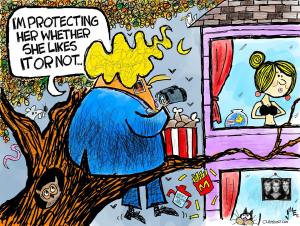 I know that once they think they’ve got you, they show their true colors, but seriously, who could stand to live like that?
 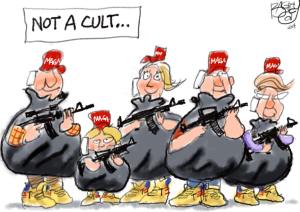 I feel seen for once, hopefully, not by the Children of the Garbage Bags and AR-15s. DonOld really has gone over the edge. During his rally in New Mexico, he made a loosely veiled threat at former Congresswoman Liz Cheney. This is from
 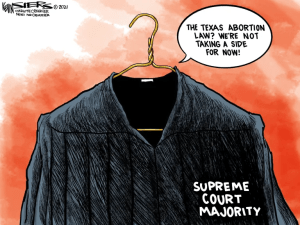 The results of Donald Trump’s first reign of Terror are killing women. The Republican appointees to the Supreme Court have the blood of innocents on their hands.
 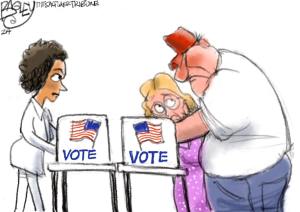 Puerto Rican Americans continue to speak out about the horrible racist slurs spoken by #DonOld about their Island home and their presence on the mainland. Does he understand that Puerto Ricans are Americans and that they live everywhere in this country? This is from The Daily Beast.
  Trump’s enablers cannot stop him from his hate-filled speeches and comments.












 The Idaho case gives the court its second major abortion dispute since the justices in 2022







 peej
peej Carissa
 bostonboomer
 dakinikat
 ecocatwoman
 mablue2
 Mama Lopez
 peggysue22
 quixote
 skydancingguestblogger
 Mona (aka Wonk the Vote)



 Sky Dancing
Recent Comments