Posted: November 15, 2025 | Author: bostonboomer | Filed under: just because | Tags: Bill Clinton, cat art, caturday, China soybean purchases, Donald Trump, Epstein Files, Jeffrey Epstein, Larry Summers, Nicolas Maduro, Pam Bondi, Reid Hoffman, Steve Bannon, TACO Trump, Trump Tariffs, Venezuela |
Good Afternoon!!

Elizabeth Taylor with her Siamese cat, 1956, photo by Sanford Roth
Epstein, Epstein, Epstein. He’s everywhere in the news. We still haven’t seen the DOJ Epstein files, but we’re already learning more about Epstein’s relationship to Trump from the recently released text messages. We don’t know yet how bad it will get when the files are released, but the extent to which Trump is publicly panicking suggests it will be very bad for him.
In Trump’s latest effort to control the Epstein story, he ordered Attorney General Bondi to investigate Democrats who had connections to the child sex trafficker.
AP: At Trump’s urging, Bondi says US will investigate Epstein’s ties to Clinton and other political foes.
Acceding to President Donald Trump’s demands, U.S. Attorney General Pam Bondi said Friday that she has ordered a top federal prosecutor to investigate sex offender Jeffrey Epstein’s ties to Trump political foes, including former President Bill Clinton.
Bondi posted on X that she was assigning Manhattan U.S. Attorney Jay Clayton to lead the probe, capping an eventful week in which congressional Republicans released nearly 23,000 pages of documents from Epstein’s estate and House Democrats seized on emails mentioning Trump.
Trump, who was friends with Epstein for years, didn’t explain what supposed crimes he wanted the Justice Department to investigate. None of the men he mentioned in a social media post demanding the probe has been accused of sexual misconduct by any of Epstein’s victims.
Hours before Bondi’s announcement, Trump posted on his Truth Social platform that he would ask her, the Justice Department and the FBI to investigate Epstein’s “involvement and relationship” with Clinton and others, including former Treasury Secretary Larry Summers and LinkedIn founder and Democratic donor Reid Hoffman.
Trump, calling the matter “the Epstein Hoax, involving Democrats, not Republicans,” said the investigation should also include financial giant JPMorgan Chase, which provided banking services to Epstein, and “many other people and institutions.”
There’s no evidence that any of the people Trump is targeting were involved in sexual abuse or sex trafficking.
A JPMorgan Chase spokesperson, Patricia Wexler, said the company regretted associating with Epstein “but did not help him commit his heinous acts.”
“The government had damning information about his crimes and failed to share it with us or other banks,” she said. The company agreed previously to pay millions of dollars to Epstein’s victims, who had sued arguing that the bank ignored red flags about criminal activity.
Clinton has acknowledged traveling on Epstein’s private jet but has said through a spokesperson that he had no knowledge of the late financier’s crimes. He also has never been accused of misconduct by Epstein’s known victims.
Clinton’s deputy chief of staff Angel Ureña posted on X Friday: “These emails prove Bill Clinton did nothing and knew nothing. The rest is noise meant to distract from election losses, backfiring shutdowns, and who knows what else.” [….]
Summers and Hoffman had nothing to do with either case, but both were friendly with Epstein and exchanged emails with him. Those messages were among the documents released this week, along with other correspondence Epstein had with friends and business associates in the years before his death.
Nothing in the messages suggested any wrongdoing on the men’s part, other than associating with someone who had been accused of sex crimes against children.
At Letters from an American, historian Heather Cox Richardson writes:
In a transparent attempt to distract from the many times his own name appears in the documents from the Epstein estate members of the House Oversight Committee released Wednesday, President Donald J. Trump asked Attorney General Pam Bondi to investigate Democrats whose names appeared in the documents. He singled out former president Bill Clinton, former treasury secretary Lawrence H. Summers, and Reid Hoffman, who founded LinkedIn and who is a Democratic donor.
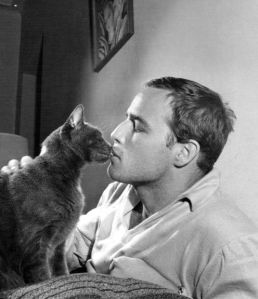
Marlon Brando and cat
Although the attorney general is the nation’s chief law enforcement officer and is supposed to be nonpartisan in protecting the rule of law, Bondi responded that the Department of Justice “will pursue this with urgency and integrity.” Maegan Vazquez and Shayna Jacobs of the Washington Post note that reporters have already covered the relationship of Epstein with Clinton, Summers, and Hoffman for years, and that in July, Justice Department officials said an examination of the FBI files relating to Epstein—a different cache than Wednesday’s—“did not uncover evidence that could predicate an investigation against uncharged third parties.”
Meidas Touch noted: “In normal times, it would be a major scandal for the President to direct his AG to criminally investigate his political opponents to deflect from his own involvement in a major scandal—and for the AG to immediately announce she is doing it. The Epstein scandal and cover up just got even bigger.”
This scandal truly has Trump flailing. I hope this will be the one that really brings him down, but he somehow seems to wriggle out of every scandal. But he certainly is terrified of the Epstein files being released.
Politico: House plans to vote Tuesday on releasing Epstein files.
House Republican leaders are planning to hold a vote Tuesday on legislation to force the release of federal files related to Jeffrey Epstein, according to three people granted anonymity to discuss internal plans ahead of a public announcement.
The tentative scheduling decision follows a successful effort by Reps. Thomas Massie (R-Ky.) and Ro Khanna (D-Calif.) to sidestep Speaker Mike Johnson and force a floor vote on their bipartisan bill to compel the Justice Department to release all of its records related to the late convicted sex offender.
President Donald Trump has made repeated attempts to kill the effort, which continued in a series of Truth Social posts Friday. But Johnson said Wednesday he intends to move quickly to hold the vote and put the matter to bed.
Under the current GOP plan, the House Rules Committee would approve a procedural measure Monday night to advance eight bills for floor consideration, including language to tee up the Epstein legislation. If that measure is approved on the floor, likely early Tuesday afternoon, debate and a final vote on the Epstein bill could immediately follow. GOP leaders are considering whether to postpone the Epstein vote until Tuesday evening….
The four Republicans who signed on to the discharge petition forcing the vote — Massie, plus Reps. Lauren Boebert of Colorado, Marjorie Taylor Greene of Georgia and Nancy Mace of South Carolina — are likely to examine Johnson’s moves very closely. They could together block any procedural measure that would undercut the Epstein legislation, postpone it or otherwise alter it.
One more story on the Epstein texts from Jason Wilson at The Guardian: Steve Bannon advised Jeffrey Epstein for years on how to rehab his reputation, texts show.
Hundreds of texts over almost a year show Maga influencer Steve Bannon and convicted sex offender Jeffrey Epstein workshopping legal and media strategies to protect Epstein from the legal and publicity quagmire that enveloped him in the last year of his life.
The texts, released by the House oversight committee on Wednesday, show that as early as June 2018, the pair were devising responses to the gathering storm of public outrage about Epstein’s criminal history, his favorable treatment by the justice system, and his friendships with powerful figures in business, politics and academia.
Bannon conspiratorially described the renewed scrutiny of Epstein as a “sophisticated op”, and over time he counseled Epstein in his adversarial responses to media outlets, the justice system and his victims.
All the while, both men were also strategizing how best to promote Bannon’s rightwing populist agenda, and the political fortunes of its standard bearer, Donald Trump.
In all of Epstein’s messages, the identity of his correspondent is redacted. But Bannon’s identity in the threads cited in this reporting is clear from contextual clues including his documented activities at the time, details of his business and media pursuits, and other disclosures. In one document, the sender’s phone number is not redacted – and it is the same number linked to Bannon in a legal case against Trump adviser Roger Stone.
Read the rest at The Guardian.
Trump is also beginning to panic about the economy and the negative effects of his insane tariffs.
David J. Lynch at The Washington Post: Trump goes on defense over tariffs as prices on everyday items keep rising.
President Donald Trump’s bid Friday to sootheconsumers by dropping tariffs on a wide array of groceries, including coffee, beef, bananas and tomatoes — contradicting his repeated claims that the levies were not affecting retail prices — shows he is on the defensive over his signature policy initiative.
Public opposition, eroding support on Capitol Hill and a potentially lethal challenge before the Supreme Court have Trump scrambling to defend his economic strategy even as the administration notches diplomatic agreements that are cementing its high-tariff approach to rebalancing global trade.

Sophia Loren with her cat, 1959
Public opinion is the immediate worry, following recent Democratic electoral victories in Virginia and New Jersey that were fueled by Americans’ ire over the cost of living. By a nearly 2-to-1 margin, registered voters disapproved of the president’s tariffs in a recent Washington Post-ABC News-Ipsos poll, a finding that has been consistent all year and could imperil Republican candidates in next year’s congressional elections.
The president on Friday issued an executive order rolling back import taxes on many foods, his most significant retreat on the emergency tariffs he imposed in April, which were billed at the time as loophole-free. In September, the White House had signaled that some products that are not generally produced in the United States could be spared tariffs once nations where they originate reached trade deals with the United States. But Friday’s exemptions apply to products from any nation, even those that have not agreed on trade terms.
“They know that they shouldn’t have imposed a lot of these tariffs and that they’re hurting affordability for consumers. Now they’re looking for a way to justify lowering them. And that’s fine. But did we really need to go through all this in the first place?” said Christopher Padilla, senior adviser to the Brunswick Group and a former trade official in the George W. Bush administration….
This week’s tariff cuts appear aimed at responding to public concern over high prices. Inflation overall is running at an annual rate of 3 percent, above the Federal Reserve’s 2 percent target for price stability but well down from the mid-2022 peak of 9.1 percent.
Prices on many everyday items, however, continue to soar. Through September, the most recent data available, coffee prices were up 19 percent over the previous 12 months, according to the Bureau of Labor Statistics. Bananas were up 7 percent.
Elizabeth Buchwald at CNN: Trump’s latest tariff TACO probably won’t make your life more affordable.
Americans could soon see some goods get cheaper after President Donald Trump exempted certain agricultural imports from a set of tariffs on Friday. But any price drops likely won’t be enough to make life feel more affordable any time soon.
The executive order exempted products like coffee, beef and some fruit from Trump’s “reciprocal” tariffs, which began rolling out in April.
The new exemptions are part of what traders have dubbed TACO, or Trump Always Chickens Out, to describe times when the president backs off a policy after unintended consequences pop up. In the case of tariffs, Trump has already reversed a number of his measures, a sign that the administration is reshaping his signature economic tool.
The latest TACO comes after voters, worried about affordability, gave Republicans a drubbing in recent off-year elections.
Why this likely won’t help consumers much:
Nevertheless, US Trade Representative Jamieson Greer said the new exemptions generally won’t help improve affordability.
“It depends on what the importers do with the tariff,” he said in a CNBC interview on Friday. “So when you look at the overall price trend, it hasn’t been because of tariffs. It’s been because of these other events going on and just supply and demand.”

Steve Martin and cat
But in cases where tariffs have been passed along to consumers, prices could drop, Greer said.
One potential example: bananas. American consumers are paying about 8% more for bananas than before Trump’s second term began.
The US largely imports bananas from South American countries. With bananas exempt from “reciprocal” tariffs that started at 10%, prices could go back to where they were earlier this year, said Sarah House, senior economist at Wells Fargo. But it’s unlikely to be something most consumers notice unless they’re buying bananas often, she added.
But not everyone is convinced it will even do that much.
“It is not clear that lowering tariffs will lower prices — it depends on what retailers think they can get away with. The import price of bananas has fallen since tariffs were imposed, but the US consumer price has risen,” Paul Donovan, chief economist at UBS global wealth management, said in a note last week. (The United States tracks import prices before accounting for tariffs. In some cases, import prices have fallen as exporters lower what they charge as a way to share in the tariff expense importers pay.)
More analysis at the CNN link.
Another flop: Trump’s soybean deal with China may have just been a mirage. AP: USDA data casts doubt on China’s soybean purchase promises touted by Trump.
New data the Agriculture Department released Friday created serious doubts about whether China will really buy millions of bushels of American soybeans like the Trump administration touted last month after a high-stakes meeting between President Donald Trump and Chinese leader Xi Jinping.
The USDA report released after the government reopened showed only two Chinese purchases of American soybeans since the summit in South Korea that totaled 332,000 metric tons. That’s well short of the 12 million metric tons that Agriculture Secretary Brooke Rollins said China agreed to purchase by January and nowhere near the 25 million metric tons she said they would buy in each of the next three years.
American farmers were hopeful that their biggest customer would resume buying their crops. But CoBank’s Tanner Ehmke, who is its lead economist for grains and oilseed, said there isn’t much incentive for China to buy from America right now because they have plenty of soybeans on hand that they have bought from Brazil and other South American countries this year, and the remaining tariffs ensure that U.S. soybeans remain more expensive than Brazilian beans.
“We are still not even close to what has been advertised from the U.S. in terms of what the agreement would have been,” Ehmke said.
Beijing has yet to confirm any detailed soybean purchase agreement but only that the two sides have reached “consensus” on expanding trade in farm products. Ehmke said that even if China did promise to buy American soybeans it may have only agreed to buy them if the price was attractive.
Will Trump try to distract from the Epstein files and his failures on the economy by taking us to war with Venezuela?
David E. Sanger, Eric Schmit, Tyler Pager, and Zolan Kanno-Youngs at The New York Times (gift link): Trump Escalates Pressure on Venezuela, but Endgame Is Unclear.
The Trump administration is rapidly escalating its pressure campaign against Venezuela, with America’s largest aircraft carrier, the Ford, about to take up a position within striking distance of the country, even as President Trump’s aides provide conflicting accounts of what, exactly, they are seeking to achieve.
Mr. Trump held back-to-back days of meetings at the White House over the past two days, reviewing military options, including the use of Special Operations forces and direct action inside Venezuela.

Marlyn Monroe with her cat
It is still not clear whether Mr. Trump has made a decision about what kind of action to authorize, if any. On Friday, he told reporters on Air Force One that “I sort of made up my mind.” “I can’t tell you what it is,” he said, “but we made a lot of progress with Venezuela in terms of stopping drugs from pouring in.”
It is possible Mr. Trump is relying on the arrival of so much firepower to intimidate the government of Nicolás Maduro, who the United States and many of its allies say is not Venezuela’s legitimate president. Mr. Maduro has put his forces on high alert, leaving the two countries with their weapons cocked and ready for war.
There were signs that the administration was moving into a new and more aggressive posture. Shortly after a meeting on Thursday, Defense Secretary Pete Hegseth posted on social media that the mission in the Caribbean now had a name — “Southern Spear.” He described its goal in expansive terms, saying the operation “removes narco-terrorists from our Hemisphere.”
“The Western Hemisphere is America’s neighborhood,” he wrote, “and we will protect it.” With the arrival of the Ford and three accompanying missile-firing Navy destroyers, there are now 15,000 troops in the region, more than there have been at any time in decades.
The only thing missing is a strategic explanation from the Trump administration that would clarify why the United States is amassing such a large force. Mr. Hegseth’s posting on X was only the latest in a series of statements from administration officials that, at best, are in tension with one another. Some are outright contradictory.
Mr. Trump has been the most consistent, saying it is all about drugs. But that would not explain why the Ford was rushed from the eastern Mediterranean Sea to the Caribbean region, adding to an American force that has now reached 15,000 soldiers and sailors, to attack small boats that until early September had been intercepted by the Coast Guard. Nor would it explain why Colombia or Mexico — Mexico being the main conduit for fentanyl — are not in the Navy’s sights.
Dan Lamothe, Tara Copp, Michael Birnbaum, and Noah Robertson: Trump weighs Venezuela strikes as U.S. forces prepare for attack order.
President Donald Trump said Friday night that he has “sort of made up my mind” about how he will proceed with the possibility of military action in Venezuela, following a second consecutive day of deliberations at the White House that included top national security advisers.
Trump’s vague remarks aboard Air Force One were delivered as he traveled for the weekend to his Mar-a-Lago estate in Florida, and included no additional new details. The comments came as U.S. forces in the region awaited possible attack orders and after days of high-level discussions about whether — and how — to strike in Venezuela, according to people familiar with the matter who spoke on the condition of anonymity because the matter is highly sensitive. Joining Trump in deliberations Friday were Vice President JD Vance, Defense Secretary Pete Hegseth, Joint Chiefs Chairman Gen. Dan Caine, Secretary of State Marco Rubio and Deputy Chief of Staff Stephen Miller, these people said.

Robert Redford with his cat
Earlier in the day, an administration official said “a host of options” had been presented to the president. Trump is “very good at maintaining strategic ambiguity, and something he does very well is he does not dictate or broadcast to our adversaries what he wants to do next,” the official said.
Any strike on Venezuelan territory would upend the president’s frequent promises of avoiding new conflicts and betray promises made to Congress in recent weeks that no active preparations were underway for such an attack. It also would further complicate U.S. cooperation with other Latin American countries, and deepen suspicions — there and in Washington — over whether Trump’s endgame is the forced removal of Venezuela’s president, Nicolás Maduro, whom Trump has accused of sending drugs and violent criminals to the United States.
Maduro, a socialist strongman, came to power in Caracas in 2013 and increasingly has become a fixation for Trump.
In August, U.S. officials increased the reward for information leading to his arrest and conviction from $25 million to $50 million, citing alleged ties to drug cartels and U.S. beliefs dating back to the Biden administration that he lost Venezuela’s 2024 presidential election and refused to step down.
“The United States is very plugged into what’s going on in Venezuela, the chatter among Maduro’s people and the highest levels of his regime,” the administration official said. “Maduro is very scared, and he should be scared. The president has options on the table that are very bad for Maduro and his illegitimate regime. … We view this regime as illegitimate, and it’s not serving the Western Hemisphere well.”
CNN: Trump likely to face long military commitment and chaos if he ousts Maduro in Venezuela, experts say.
President Donald Trump has said he believes Venezuelan President Nicolas Maduro’s days are numbered, and that land strikes inside Venezuela are possible.
Experts say that the US doesn’t currently have the military assets in place to launch a largescale operation to remove Maduro from power, though Trump has approved covert action within Venezuela, CNN has reported.

Bette Davis with cat
But if Trump did order strikes inside Venezuela aimed at ousting Maduro, he could face serious challenges with fractured opposition elements and a military poised for insurgency, according to experts, as well as political backlash at home for a president who promised to avoid costly entanglements overseas.
CNN reported that Trump received a briefing earlier this week to review updated options for military action inside Venezuela, a concept the White House has been weighing. The administration had not made a decision on whether to launch strikes, CNN reported, though the US military has moved more than a dozen warships and 15,000 troops into the region as part of what the Pentagon branded Operation Southern Spear in an announcement Thursday.
The concentration of military assets and threats of further attacks beyond the ongoing drug boat campaign have served to increase pressure on Maduro, with administration officials saying he needs to leave office while arguing that he’s closely tied to the Tren de Aragua gang and leading drug trafficking efforts.
But if Maduro does flee Venezuela or is killed out in a targeted strike, experts worry about a military takeover of the country or the boosting of another dictator similar to Maduro.
Read the rest at CNN.
Those are my recommended reads. I’ll add a few more links in the comment thread. What stories are you interested in today?
Did you like this post? Please share it with your friends:
Posted: September 16, 2013 | Author: dakinikat | Filed under: morning reads | Tags: Koch Brothers, Larry Summers, Maya Grave Site, obesity studies |

Good Morning!
I’ve not been in a very good mood the last few days. I’m trying to get my manuscript camera ready and have found that the adjustments to the font size and smaller margins have just about done me in. It’s really messed up the pagination and my seemingly endless tables of statistics. I am about ready to chew off all my nails and pull out quit a bit of hair. It’s very nerve wracking.
Here’s a few links to get you start this morning. I’ve been trying to read some interesting things in the hopes of finding some inner calm.
The best news of the weekend came when Larry Summers withdrew his name from consideration for FED chair. The last thing we needed was yet another financial market sycophant in position that matters as much as that one. The Fed has been one of the few functional institutions and thankfully, it looks like even congress respected the need for its independence.
The decision marks a disappointing turn of events for the renowned economist, who had operated at the highest levels of academia and government. But he has been dogged by controversies. Summers has come under fire for his support for deregulating parts of the banking sector while he was Treasury secretary under President Bill Clinton. While president of Harvard University in 2005, he also sparked controversy for his comments on women’s aptitude in math and science.
People close to the White House said Summers faced not only a rebellion among liberal Democrats but also other challenges, including a debate over whether to launch a military strike against Syria that stretched out the Fed process and gave more time for opposition to build.
The major opposition for Summers came from Democratic Senators.
Summers was a top initial candidate for the Fed job among senior current and former White House officials. Obama was also inclined to appoint Summers to the post, people close to the White House said. But the longer time dragged on without a nomination, the more liberal groups and some Democratic senators were able to organize to oppose Summers, who many on the left viewed as too close to Wall Street and not strong enough on financial regulation.
Opposition to Summers among Senate Democrats has been obvious for weeks but it escalated on Friday when Sen. Jon Tester (D-Mont.) announced he would vote against Obama’s former economic adviser if he was nominated.
At least three other Democrats on the Senate Banking Committee were expected to oppose Summers — Sherrod Brown (D-Ohio), Jeff Merkley (D-Ore.) and Elizabeth Warren (D-Mass.) – raising the politically uncomfortably scenario of Obama needing to rely on Republican votes just to get his choice for a Fed chief out of committee.
Obama has said the other candidates for the job are Fed Vice Chair Janet Yellen and former Fed Vice Chair Donald Kohn. But Summers was said to be the president’s first choice and it’s unclear if he will fall back on one of these two candidates or look elsewhere.
There are some interesting studies on obesity and the way different people process food. I found this article while reading my copy of The Economist. Links to  the studies are provided in the article. A lot of the differences may have to do with bacteria found in your digestive tract.
Even more intriguing is the notion that the same diet may be treated differently by different people. Four recent papers explored this theme. In one, published in Science in July, Joseph Majzoub, also of Boston Children’s Hospital, deleted in mice a gene called Mrap2. Dr Majzoub and his colleagues showed that this helps to control appetite. Surprisingly, however, even when the mutant critters ate the same as normal mice, they still gained more weight. Why that is remains unclear, but it may be through Mrap2’s effect on another gene, called Mc4r, which is known to be involved in weight gain.
The second and third papers, published as a pair in Nature in August, looked at another way that different bodies metabolise the same diet. Both studies were overseen by Dusko Ehrlich of the National Institute of Agricultural Research in France. One examined bacteria in nearly 300 Danish participants and found those with more diverse microbiota in their gut showed fewer signs of metabolic syndrome, including obesity and insulin resistance. The other study put 49 overweight participants on a high-fibre diet. Those who began with fewer bacterial species saw an increase in bacterial diversity and an improvement in metabolic indicators. This was not the case for those who already had a diverse microbiome, even when fed the same diet.
Jeffrey Gordon, of Washington University in St Louis, says these two studies point to the importance of what he calls “job vacancies” in the microbiota of the obese. Fed the proper diet, a person with more vacancies may see the jobs filled by helpful bacteria. In the fourth paper, by Dr Gordon and recently published in Science, he explores this in mice. To control for the effects of genetics, Dr Gordon found four pairs of human twins, with one twin obese and the other lean. He collected their stool, then transferred the twins’ bacteria to sets of mice. Fed an identical diet, the mice with bacteria from an obese twin became obese, whereas mice with bacteria from a thin twin remained lean.
So,BB found this great article on a discovery of a Mayan mass grave site.
Archaeologist Nicolaus Seefield found the gravesite in an “artificial cave,” which he explains to LiveScience had likely functioned as a water reservoir before the burial “since the cave’s floor was perfectly clean.”
The skeletons found there were not “in their original anatomical articulation,” he says. “The observed hatchet marks on the cervical vertebra are a clear indication of decapitation”; most had their lower jaw detached, and the “spatial pattern” of the bones is consistent with dismemberment.
The archaeologists believe the dead were either prisoners of war or Uxul nobles; they hope upcoming isotope analysis will reveal whether they were from Uxul — which is near what is now the Guatemala border — or elsewhere. Neat fact from LiveScience: “Uxul” means “at the end.”
It wasn’t the only Mayan discovery of the summer: A “lost” Maya city was discovered in June.
 There are many things that depress me about how eager Republicans are to punish poor people for whatever their perverse reasons. What really gets me is how they continue to ensure that poor children will have no chance. Early childhood education has usually be the one program that every one agrees on because it’s efficacy is amazing. The sequestration has led to a large number of children being tossed out of Head Start. I find this beyond troubling. Early childhood education has been shown to be one very effective way to fight inequality. Here’s yet another article on how this country has started to do things all wrong.
In many ways, we do education backwards in this country. We skimp and shortchange the poor children who need education the most, while at the same we lavish public moneys on those who need it least. Take, for instance,this article about the outrageous practice of taxpayer subsidies for the legacy admits of rich alumni of elite colleges.
In this context, advocacy for educational programs that alleviate, rather than exacerbate, inequality is particularly welcome. That’s why I especially appreciated today’s New York Times’ Opinionator blog, in which economist James Heckman writes a great op-ed about the dramatic impact of early childhood education in the lives of poor children. Heckman, as you may know, is a Nobel Prize winning economist from the University of Chicago. He’s a typical University of Chicago economist in that yes, he’s a free market true believer type. But he’s been studying pre-K programs for poor kids for years, and he supports them for conservative reasons: because they are economically rational. Early childhood education for at-risk kids is one of those (relatively) rare government programs that the free market types like because it produces not just equity, but also efficiency.
Here’s an interesting piece on the connections between the Koch Brothers and the Tea Party. It seems the Kochs just have their nasty little fingers in every thing that is unraveling our democracy.
Politico.com, the Washington insider website, has the money-in-politics scoop of the year: It has unmasked a previously unknown political money laundering operation, set up by the energy billionaires and libertarian Koch brothers, that raised $256 million and secretly spent almost all of it last year against Democrats.
The “Koch brothers’ secret bank,” which is what the website calls the Virginia-based group, whose formal name is Freedom Partners, is the glue that has been holding together the right-wing pantheon of pro-corporate, anti-regulatory, anti-Obama, anti-labor front groups that are against everything from healthcare reform to labor unions to financial market reform to progressive taxation.
“The group has about 200 donors, each paying at least $100,000 in annual dues,” Politico reported, saying Freedom Partners would soon be filing papers with the IRS disclosing its existence. “It raised $256 million in the year after its creation in November 2011, the [IRS] document shows. And it made grants of $236 million—meaning a totally unknown group was the largest sugar daddy for conservative groups in the last election, second in total spending only to Karl Rove’s American Crossroads and Crossroads GPS, which together spent about $300 million.”
The fact that secretive right-wingers could amass and spend a quarter-billion dollars in a presidential election cycle and go undetected under federal campaign finance law is an astounding indictment of the American electoral system, revealing that all the laws intending to inform the public about who is slinging political mud are meaningless. The mockery goes even further when considering the section of the federal tax code the group is operating under: 501(c)6. That designation is for trade associations, which lets the group conceal its donors.
Trade asociations, like trade unions, were created to represent single industries or crafts. Freedom Partners’ “trade” is the business of political assassination. What follows is Politico’s list of the groups, causes and amounts received from the Kochs’ cartel. The group’s members are drawn from the energy barons’ semiannual political conferences, which feature speeches by Congress’ Republican leadership.
So, that’s a little this and that from me this morning. What’s on your reading and blogging list today?
Did you like this post? Please share it with your friends:
Posted: August 27, 2013 | Author: dakinikat | Filed under: open thread | Tags: Federal Debt, Health care, Larry Summers, Syria |
 Well, only a few days and I already really miss JJ Here are a few headlines to get us through the evening.
There’s no money for these kinds of things:
Before becoming speaker in 2011, Boehner said, he’d watched leaders of both parties delay a long-term solution to a baby-boom-fueled benefit crisis.
“I made up my mind that we weren’t going to kick the can down the road any more,” Boehner, R-Ohio, told a Boise lunch crowd at a fundraiser for Idaho’s 2nd District Congressman Mike Simpson. “We’re not going to inflict all of this pain and suffering on our kids and our grandkids.”
The government will reach its $16.7 trillion borrowing limit this fall. Boehner rejected calls from some quarters to let the government shut down rather than agree to a compromise with President Obama and the Democratic Senate.
“There is no reason for the government to run out of money,” Boehner said. “Our goal here is to stop Obamacare. Our goal here is to cut spending.”
Boehner said GOP control of the House has forced Democrats to agree to three straight years of lower discretionary spending, which accounts for about one-third of the federal budget, savings that will reach $2.5 trillion over 10 years.
“Now, it’s time to deal with the mandatory side,” Boehner said, winning applause from a crowd of 430 at the Boise Centre on The Grove. “I’ve made it clear that we’re not going to increase the debt limit without cuts and reforms that are greater than the increase in the debt limit.
“The president doesn’t think this is fair, thinks I’m being difficult to deal with. But I’ll say this: It may be unfair but what I’m trying to do here is to leverage the political process to produce more change than what it would produce if left to its own devices. We’re going to have a whale of a fight.”
Recalling the 2011 battle over raising the federal debt ceiling, Boehner recalled negotiations that spooked financial markets, prompted Standard & Poor’s to downgrade the U.S. credit rating and angered ordinary Americans. He warned the audience to expect more of the same.
But there’s always money for war.
The U.S. could hit Syria with three days of missile strikes, perhaps beginning Thursday, in an attack meant more to send a message to Syrian  President Bashar al-Assad than to topple him or cripple his military, senior U.S. officials told NBC News on Tuesday.
The State Department fed the growing drumbeat around the world for a military response to Syria’s suspected use of chemical weapons against rebels Aug. 21 near Damascus, saying that while the U.S. intelligence community would release a formal assessment within the week, it was already “crystal clear” that Assad’s government was responsible.
Vice President Joe Biden went even further, bluntly telling an American Legion audience in Houston: “Chemical weapons have been used.”
“No one doubts that innocent men, women and children have been the victims of chemical weapons attacks in Syria, and there’s no doubt who’s responsible for this heinous use of chemical weapons in Syria: the Syrian regime,” Biden said.
Fox Expert says that since women have breasts they should pay more for health care. Where do they get these guys?
A Fox News medical expert on Tuesday argued that President Barack Obama’s administration was wrong to force gender equality for health insurance rates because men “only have the prostate,” while women “have the breasts, they have the ovaries.”
“Look, it’s not bias, I’m not saying this as a man,” Fox News Medical A-Team contributor Dr. David Samadi told the hosts of Fox & Friends. “They go through a lot of preventive screenings, they give birth, they have the whole mammogram, the Pap smear. Guys, we don’t like to go to doctors, right? Seventy percent of health care decisions are made by women. In my own practice, I see it’s the women who bring the guys, who say, go get screened.”
“Yeah, but shouldn’t that earn us a discount?” Fox News host Gretchen Carlson interrupted. “Basic fact that we are responsible for getting our men to come to the doctor? And what about the fact that women, because they do all this preventative care, maybe their health issues end up costing less than men’s, who don’t go to the doctor until it’s a crisis and a big deal.”
“Yes, that’s a good point, except that, you know, women live longer,” Samadi asserted. “Women live until age 81 and men live only until 76. So, we’re using the health care system much less.”
“In this case, it’s not equal,” co-host Brian Kilmeade agreed. “You have a better time on Earth than we do, you’re here a lot more. You have six years of heaven, where you just have no men around.”
Carlson pointed out that women were blamed for maternity costs, “but men and women have babies together.”
“I agree with you that it’s a shared responsibility,” Samadi said. “But just the way the system are — in my field, we only have the prostate. Women have the breasts, they have the ovaries, they have the uterus. They get checked in every part.”
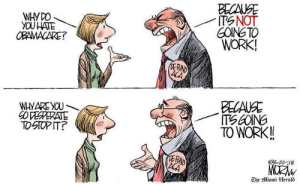 OH, Please say this isn’t so!!! Oh the Humanity!! Obama source predicts Summers will be named Fed chief soon. Looter Larry as Fed Chair!!!
A source from Team Obama told CNBC that Larry Summers will likely be named chairman of the Federal Reserve in a few weeks though he is “still being vetted” so it might take a little longer.
It’s largely come down to a two-horse race between Summers, a former Treasury secretary, and Fed Vice Chairman Janet Yellen for the next Fed chief.
It is widely expected that the current Fed Chairman Ben Bernanke will resign by the end of the year as his term ends in January. President Obama has already said that Bernanke has “already stayed a lot longer” in the role than he expected. Those remarks came in an interview with Charlie Rose on PBS in June.
Did you like this post? Please share it with your friends:
Posted: August 12, 2013 | Author: dakinikat | Filed under: morning reads | Tags: Christie Paul rift, drought, Fed Chair, fracking, Hiroshima bomb, Larry Summers, Martin Luther King, Paul Tibbets, state funded crisis pregnancy center shams, Texas, water shortage |
Good Morning!
Here’s a little bit of this and that to get your political juices flowing for the week.
The NYT profiles potential FED chair candidate La La Summers as some one that has many flaws but much power and personal wealth. He has the credentials and the connections but does he really have the gravitas for the job?
Mr. Summers’s wealth comes mainly from two periods of private sector work between government postings. After a lengthy tenure at the Treasury Department in the 1990s, he became the president of Harvard — a job that Robert E. Rubin, who preceded Mr. Summers as Treasury secretary, helped him obtain.
But in 2006, Mr. Summers was forced out of the university presidency for a variety of reasons, including remarks he made questioning why few women engage in advanced scientific and mathematical work. Soon after, a young Harvard alum brought him into the hedge fund world with a part-time posting at D. E. Shaw. That firm, one of the largest in the industry, paid Mr. Summers more than $5 million.
Mr. Summers’s wealth soared from around $400,000 in the mid-1990s to between $7 million and $31 million in 2009, when he joined the Obama administration, according to a financial disclosure he filed at the time. Before returning to government service, he earned $2.7 million from speeches in one year alone.
As for his current work, representatives for Citigroup, Nasdaq and D. E. Shaw declined to disclose his pay. His speaking rates today run into the six figures, according to an associate who spoke on the condition of anonymity, and Mr. Summers has spoken to Wall Street companies like Goldman Sachs, JPMorgan Chase and Citigroup.
The job that is likely to generate the most scrutiny for Mr. Summers is his work with Citigroup, which was rescued from the brink of bankruptcy by the federal government’s bailout. Though he does not have an office there, two people with direct knowledge of the matter said he was a regular consultant. In a statement, Citigroup said he provided “insight on a broad range of topics including the global and domestic economy” to prestigious clients, and attended internal meetings.
Citigroup hired Mr. Summers in part to advise Vikram S. Pandit, who resigned as chief executive last year. With his work there, Mr. Summers followed in the footsteps of his friend, Mr. Rubin, who joined Citigroup after he left the government and earned more than $100 million.
Another political analyst–this one writing for Bloomberg–thinks that the Republicans are inching towards civil war and that the next election may look like  1964. The focus has been on the Paul-Christie rift.
As Republicans continue to sort through their future, having lost the popular vote for president in five of the last six elections, they are having intramural battles with echoes of 1964, when Barry Goldwater won the nomination at a convention rife with division over the role of the U.S. in the world and civil rights at home. Derided as an extremist, he went on to lose to President Lyndon Johnson in a landslide.
Now, Republicans are squabbling over the National Security Agency surveillance program, immigration and gay marriage. The Christie-Paul rift last week highlighted the divide, with the governor calling the senator’s criticism of the NSA program “dangerous” and the Kentuckian responding that his critic must have forgotten the Bill of Rights.
“It’s always healthy to have discussions from different wings of the party as the party works on its identity going into the midterms,” said LaTourette, who chose not to seek re-election to Congress in 2012 citing the extreme positions among some of his Republican colleagues. “It wouldn’t be so healthy if this was next year or 2015 and the focus is on who the presidential nominee will be.
Martin Luther King III has a written a book on what it meant to grow up the footsteps of his father. Even better, you can get it to read with your child or grandchildren because it is written for children!! You can read about or listen to an NPR interview with King here.
Martin Luther King III recounts this and other stories from his childhood in his new children’s book, My Daddy, Dr. Martin Luther King, Jr. Martin Luther King III had been thinking about writing about his child’s-eye view of his father for almost a decade, but the 50th anniversary of the March on Washington became a personal deadline. The book, written for young children, has just been published, three weeks ahead of the anniversary.
Now Martin Luther King III and his wife, Andrea, have a 5-year-old daughter, Yolanda Renée. She was named for Martin Luther King III’s oldest sister, who died suddenly in 2006. In the book, young Martin Luther King III tells readers about the games he played with his father.
Martin Luther King III also retells stories of accompanying his father on marches from time to time. On one, they were confronted by a police officer “with a huge dog that growled at me. I was terrified.” That is, he was scared until his dad took his hand and told him they would be fine.
“I felt safe. My dad was not a tall man, but he always made me feel like he was a giant. I was never afraid when I was with him,” Martin Luther King III writes.
Long after his father’s death, Martin Luther King III has had to deal with others’ expectations that he would take up the cause. King is deeply grateful that decades ago, his mother relieved him of some of that pressure.
“You don’t have to be your father,” Coretta Scott King told him. “Just be your best self, whatever that is. We are going to support you.”

This has to be the worst use of tax dollars that I’ve seen in years. A report shows State-Funded Crisis Pregnancy Centers Talk Women Out Of Birth Control and Condoms. Is this really the way to prevent unwanted pregnancies and abortions?
When a woman walked into a state-funded “crisis pregnancy center” in Manassas, Va., this summer and told the counselor she might be pregnant, she was told that condoms don’t actually prevent STDs and that birth control frequently causes hair loss, memory loss, headaches, weight gain, fatal blood clots and breast cancer.
“The first three ingredients in the birth control pill are carcinogens,” the CPC counselor said, adding that she always tries to talk women out of taking it.
The counselor also told the woman that condoms are not effective at preventing pregnancy or sexually transmitted diseases because they are “naturally porous.”
“Safe sex is a joke,” she said. “There’s no such thing.”
NARAL Pro-Choice Virginia recorded the exchange, released Wednesday, as part of its undercover investigation into the 58 state-funded “crisis pregnancy centers” in Virginia. The organizations are part of a national network of about 2,500 Christian centers that advertise health and pregnancy services, but do not offer abortions, contraception or prenatal care. Instead, they are intended to talk women out of having abortions and to advocate abstinence until marriage.
These organizations receive state money through the sale of “Choose Life” license plates at the Virginia Department of Motor Vehicles. Ken Cuccinelli, Virginia’s Republican gubernatorial candidate, sponsored the legislation that established that fundraising system during his time in the state senate.
NARAL sent undercover women into several crisis pregnancy centers throughout Virginia and recorded their interactions. The investigation revealed that 71 percent of the CPCs in Virginia give out medically inaccurate information about the health consequences and effectiveness of birth control, condoms and abortion.
According to the report, in addition to criticizing the use of birth control and condoms, 40 of the CPCs told women that abortion causes long-term psychological damage and leads women to develop eating disorders and drug addictions. One counselor allegedly told NARAL’s undercover investigator that if she was a certain blood type, the abortion could cause her body to create antibodies that would attack her fetus the next time she tried to get pregnant.
Greg Mitchell recalls interviewing the man that dropped the A-Bomb on Hiroshima in this blog post.
Paul W. Tibbets, pilot of the plane, the “Enola Gay” (named for his mother), which dropped the atomic bomb over Hiroshima on August 6, 1945. died at 92 in 2007, defending the bombing to the end of his life. Some of the obits noted that he had requested no funeral or headstone for his grave, not wishing to create an opportunity for protestors to gather.
I had a chance to interview Tibbets nearly 30 years ago, and wrote about it for several newspapers and magazines and in the book I wrote with Robert Jay Lifton, Hiroshima in America.
The hook for the interview was this: While spending a month in Japan on a grant in 1984, I met a man named Akihiro Takahashi. He was one of the many child victims of the atomic attack, but unlike most of them, he survived (though with horrific burns and other injuries), and grew up to become a director of the memorial museum in Hiroshima. The August 6 bombing led to the deaths of at least 75,000 people in a flash and at least that many more in the days and years that followed. At least 90% of them were civilians, mainly women and children.
Takahashi showed me personal letters to and from Tibbets, which had led to a remarkable meeting between the two elderly men in Washington, D.C. At that recent meeting, Takahashi expressed forgiveness, admitted Japan?s aggression and cruelty in the war, and then pressed Tibbets to acknowledge that the indiscriminate bombing of civilians was always wrong.
But the pilot (who had not met one of the Japanese survivors previously) was non-committal in his response, while volunteering that wars were a very bad idea in the nuclear age. Takahashi swore he saw a tear in the corner of one of Tibbets’ eyes.
So, on May 6, 1985, I called Tibbets at his office at Executive Jet Aviation in Columbus, Ohio, and in surprisingly short order, he got on the horn. He confirmed the meeting with Takahashi (he agreed to do that only out of “courtesy”) and most of the details, but scoffed at the notion of shedding any tears over the bombing. That was, in fact, “bullshit.”
“I’ve got a standard answer on that,” he informed me, referring to guilt. “I felt nothing about i.” .I’m sorry for Takahashi and the others who got burned up down there, but I felt sorry for those who died at Pearl Harbor, too….People get mad when I say this but — it was as impersonal as could be. There wasn’t anything personal as far as I?m concerned, so I had no personal part in it.
“It wasn’t my decision to make morally, one way or another. I did what I was told — I didn’t invent the bomb, I just dropped the damn thing. It was a success, and that’s where I?ve left it. I can assure you that I sleep just as peacefully as anybody can sleep.” When August 6 rolled around each year “sometimes people have to tell me. To me it’s just another day.”
So, we have a few Texas Sky Dancers here. This Guardian article on Texas being all Oil and no Water is kind’ve frightening.
Beverly McGuire saw the warning signs before the town well went dry: sand in the toilet bowl, the sputter of air in the tap, a pump working overtime to no effect. But it still did not prepare her for the night last month when she turned on the tap and discovered the tiny town where she had made her home for 35 years was out of water.
“The day that we ran out of water I turned on my faucet and nothing was there and at that moment I knew the whole of Barnhart was down the tubes,” she said, blinking back tears. “I went: ‘dear God help us. That was the first thought that came to mind.”
Across the south-west, residents of small communities like Barnhart are confronting the reality that something as basic as running water, as unthinking as turning on a tap, can no longer be taken for granted.
Three years of drought, decades of overuse and now the oil industry’s outsize demands on water for fracking are running down reservoirs and underground aquifers. And climate change is making things worse.
In Texas alone, about 30 communities could run out of water by the end of the year, according to the Texas Commission on Environmental Quality.
Nearly 15 million people are living under some form of water rationing, barred from freely sprinkling their lawns or refilling their swimming pools. In Barnhart’s case, the well appears to have run dry because the water was being extracted for shale gas fracking.
The town — a gas station, a community hall and a taco truck – sits in the midst of the great Texan oil rush, on the eastern edge of the Permian basin.
A few years ago, it seemed like a place on the way out. Now McGuire said she can see nine oil wells from her back porch, and there are dozens of RVs parked outside town, full of oil workers.
But soon after the first frack trucks pulled up two years ago, the well on McGuire’s property ran dry.
No-one in Barnhart paid much attention at the time, and McGuire hooked up to the town’s central water supply. “Everyone just said: ‘too bad’. Well now it’s all going dry,” McGuire said.
Ranchers dumped most of their herds. Cotton farmers lost up to half their crops. The extra draw down, coupled with drought, made it impossible for local ranchers to feed and water their herds, said Buck Owens. In a good year, Owens used to run 500 cattle and up to 8,000 goats on his 7,689 leased hectares (19,000 acres). Now he’s down to a few hundred goats.
The drought undoubtedly took its toll but Owens reserved his anger for the contractors who drilled 104 water wells on his leased land, to supply the oil companies.
So, what is on your reading and blogging list today?
Did you like this post? Please share it with your friends:
Posted: July 31, 2013 | Author: dakinikat | Filed under: Economy | Tags: fiscal policy, Larry Summers, the Fed, US economic growth |
 There are so many elegant things about my chosen field that I do, in fact, still get excited when I introduce huge numbers of undergraduates to Economics. I don’t do much of that anymore given that I am better paid and easier employed as a graduate finance teacher churning out hapless MBAs. But, part of me still knows that we have lots of answers to the big policy questions. The problem is that Republican Revisionism and Big Money from Big Finance has totally overwhelmed the main stories and theories that we all know well. The worst situation is that the cult of the Austrian School is being taken seriously by a select group of young, white male journalists and getting more virtual ink than it truly deserves. Then, there is the absolute fail of the urgency of fiscal policy when unemployment is this high and this pervasive. The one bright light–despite the howling of goldbugs and Birchers–has been the FED. There are still economists over there in that outfit. If you’re used to deconstructing markets like I am, you can see that the markets trust the FED’s policy. It’s not that the FED directly benefits them any more. Those days of buying up nasty assets are behind us. It’s that the Fed understands its priorities are stable financial markets and banking systems and tackling either inflation or unemployment depending on the priority.
Inflation is the thing that is most directly impacted by FED policy. It hasn’t been an issue since Paul Volcker got rid of it and the FED announced its Taylor Rule boundaries. It’s the legacy of Milton Friedman and the monetarists which is actually the school that I most fit as a financial economist of a certain age. That legacy and the legacy of fiscal policy as established by the models and hypotheses first provided by J.M. Keyenes and later proved and improved by a slew of brainy economists with computers and databases–like Paul Samuelson–has been under attack with no theoretical or empirical basis. It is all political and screed journalist based. The nonsense has been amplified by a President who seems completely unwilling to trust real economists and relies on lawyers with emphasis on economic policy. That’s like having a biologist that watches bears in the woods go over your blood work imho. I don’t care how much freaking experience you have writing policy law, it’s not the same as being grounded in the theory and totally aware of the empirical proofs and disproofs.
So, as the speculation about a possible new fed chair pops up, we get stuff like this. Obama is defending Larry Summers. The man is an economist but the man is also not what you would call a particularly skillful leader as witnessed by his tenure at Harvard. He also has said some things about women and science and math that are not very artful and certainly not very helpful to those of us that struggle to be credible despite our obvious genitalia.
Barack Obama has strongly defended Larry Summers against opposition from the left to the possible appointment of the president’s former economic adviser as the next chair of the Federal Reserve.
Mr Obama, speaking at a closed meeting of the Democratic caucus of the House of Representatives, reacted strongly at an otherwise friendly meeting when Ed Perlmutter, a congressman from Colorado, urged him not to appoint Mr Summers.
According to members of Congress present at the meeting on Capitol Hill, Mr Obama urged Democrats to give Mr Summers a “fair shake” and said he had been a loyal and important adviser when the president took office in the midst of a deep recession in 2008.
Mr Summers, a former Treasury Secretary and president of Harvard University, and Janet Yellen, the vice-chair of the Fed, are the leading contenders for the job.
Mr Obama also mentioned by name a third person, Don Kohn, as a possible candidate. He said he had yet to make up his mind on whom he would nominate for the job.
The president said there was little in the nature of policy differences between them, saying you “would have to slice the salami very thin” to find areas in which they diverged.
Don Kohn is a Fed insider and pretty well known as a monetary policy dove just as Obama appears to be a fiscal policy dove. Let me qualify that description. They both come from the let people suffer unnecessarily and let the markets work things out school of thought. In good economic times, that’s an okay stand. In the face of persistent unemployment that is basically looking at a huge number of people and saying let them eat cake. That last option is unnecessary because the bottom line is that we know better and can do better by these folks. It kills me to know what I know and watch the passivity of Obama and the retch-inducing ignorance of Republicans in the face of great suffering. If, in the long run we are all dead, in the short run we all suffer and face economic and personal devastation in the face of incremental steps and not whole-hearted policy wars on dire economic situations. Frankly, I think Obama has a problem with the Janet Yellen because she’s likely to tell him to off if she doesn’t like what he has to say. I really do. She’s a hard boiled economist with a no nonsense approach.
It’s not that we’re doing badly. It’s that we’re creeping along and not growing fast enough in the face of all this deep, long, persistent unemployment and no one’s hair is on fire that can do anything about it.
Real gross domestic product — the output of goods and services produced by labor and property located in the United States — increased at an annual rate of 1.7 percent in the second quarter of 2013 (that is, from the first quarter to the second quarter), according to the “advance” estimate released by the Bureau of Economic Analysis. In the first quarter, real GDP increased 1.1 percent (revised).
The Bureau emphasized that the second-quarter advance estimate released today is based on source data that are incomplete or subject to further revision by the source agency (see the box on page 3 and “Comparisons of Revisions to GDP” on page 18). The “second” estimate for the second quarter, based on more complete data, will be released on August 29, 2013.
The increase in real GDP in the second quarter primarily reflected positive contributions from personal consumption expenditures (PCE), exports, nonresidential fixed investment, private inventory investment, and residential investment that were partly offset by a negative contribution from federalgovernment spending. Imports, which are a subtraction in the calculation of GDP, increased.
The acceleration in real GDP in the second quarter primarily reflected upturns in nonresidential fixed investment and in exports, a smaller decrease in federal government spending, and an upturn in state and local government spending that were partly offset by an acceleration in imports and decelerations in private inventory investment and in PCE.
We cannot creep our way back to prosperity.
The fact that the donor class and corporate profits are doing well is what’s driving this anemic policy response. The people most effected by the inactivity are either fighting it out with racial resentment or feeling the usual helplessness that goes with being a picked-on out class. That infighting is helping those at the top ignore the plight of the folks that find they are quickly losing ground. That is why any of these FED appointments is basically a win for the status quo. It is also why the though of Larry Summers as FED chair gives me the heebiejeebies.
Like I said, real economists reacted to this news today like this: Economists React: Better GDP, but Trend Still Sluggish. Here’s some examples.
While this is a better than expected report, it isn’t very strong. If you look at the past three quarters, the economy has not done very much. That is the economic environment facing the Fed as it meets today. –Joel Naroff, Naroff Economic Advisors
The fact that declining federal spending continues to be a drag on economic growth is another reminder that now is not the time for Washington to impose self-inflicted wounds on the economy. The Administration continues to urge Congress to replace the sequester with balanced deficit reduction, and promote the investments our economy needs to put more Americans back to work, such as by rebuilding our roads and bridges. –Alan Krueger, White House Council of Economic Advisers
–The U.S. economy grew modestly in the second quarter because of hefty fiscal restraint, but growth exceeded expectations and looks to turn convincingly higher in the second half of the year. Sequestration chopped federal nondefense spending 3.2% annualized in the quarter, and civic worker furloughs slowed consumer spending to 1.8%, despite motor vehicle sales hitting five-year highs. On the plus side, residential construction clocked in with a fourth consecutive double-digit gain, exports bounced back strongly, and state and local government expenditure rose for the first time in a year. Most importantly, businesses appeared less concerned about the knock-on effects of sequestration. –Sal Guatieri, BMO Capital Markets Economics
All during this economic bust up we’ve had government as a drag on the economy. This has been at every level of government. It is a massive fail on the part of our modern democracy.
Again, we cannot creep our way back to prosperity. This is especially true if all levels of government are holding back everything but the profits of a few large corporations and the taxes of the people who have gained so much over the last three decades. It just ain’t right and it just isn’t good economic policy.
Did you like this post? Please share it with your friends:


 peej
peej Carissa
 bostonboomer
 dakinikat
 ecocatwoman
 mablue2
 Mama Lopez
 peggysue22
 quixote
 skydancingguestblogger
 Mona (aka Wonk the Vote)



 Sky Dancing
Recent Comments