
Juneteenth Reads !!!
Posted: June 19, 2020 Filed under: Black Lives Matter | Tags: Juneteenth 16 Comments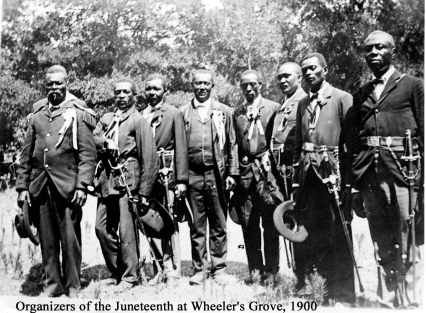
Happy Juneteenth!
Yes. This is a regular post here at Sky Dancing! It’s not something we all just discovered. I went back into our archives and searched for the Juneteenth tag and discovered that Mona, JJ, BB, and I had all written posts for the occasion.
That link goes to the one I wrote in 2017 and it includes pictures, history, and a link to Black Lives Matter plus a police brutality case in Seattle where police shot and killed a mother of four waving a knife around. There is also a link to the outrage in the Twin Cities over the acquittal of officers involved with the death of Philando Castille plus bonus links on gerrymandering in Wisconsin and how difficult it is to climb out of poverty. It’s like reading headlines today with different names and none of the Trump chaos and malfeasance.
This link has some exciting news for a history nerd like me. “An original ‘Juneteenth’ order found in the National Archives. The handwritten document informed the enslaved in Texas they were free on June 19, 1865.” This is via WAPO.
The National Archives on Thursday located what appears to be an original handwritten “Juneteenth” military order informing thousands of people held in bondage in Texas they were free.
The decree, in the ornate handwriting of a general’s aide, was found in a formal order book stored in the Archives headquarters building in Washington. It is dated June 19, 1865, and signed by Maj. F.W. Emery, on behalf of Union Maj. Gen. Gordon Granger.
“The people of Texas are informed that, in accordance with a proclamation from the Executive of the United States, ‘all slaves are free,’ ” the order reads.
“This involves an absolute equality of personal rights and rights of property between former masters and slaves and the connection heretofore existing between them becomes that between employer and hired labor.”

So, if only we did a better job living up to the promises our country made to every one. Jamelle Bouie writes this for the NYT: ‘Why Juneteenth Matters. It was black Americans who delivered on Lincoln’s promise of “a new birth of freedom.’
Neither Abraham Lincoln nor the Republican Party freed the slaves. They helped set freedom in motion and eventually codified it into law with the 13th Amendment, but they were not themselves responsible for the end of slavery. They were not the ones who brought about its final destruction.
Who freed the slaves? The slaves freed the slaves.
“Slave resistance,” as the historian Manisha Sinha points out in “The Slave’s Cause: A History of Abolition,” “lay at the heart of the abolition movement.”
“Prominent slave revolts marked the turn toward immediate abolition,” Sinha writes, and “fugitive slaves united all factions of the movement and led the abolitionists to justify revolutionary resistance to slavery.”
Juneteenth this year will have a different feel. This is from the AP:
For many white Americans, recent protests over police brutality have driven their awareness of Juneteenth’s significance.
“This is one of the first times since the ’60s, where the global demand, the intergenerational demand, the multiracial demand is for systemic change,” said Cornell University professor Noliwe Rooks, a segregation expert. “There is some understanding and acknowledgment at this point that there’s something in the DNA of the country that has to be undone.”
Friday’s celebrations will be marked from coast to coast with marches and demonstrations of civil disobedience, along with expressions of black joy in spite of an especially traumatic time for the nation. And like the nationwide protests that followed the police involved deaths of black men and women in Minnesota, Kentucky and Georgia, Juneteenth celebrations are likely to be remarkably more multiracial.
And from WAPO:
This year, invigorated by weeks of protests that began after the police killing of George Floyd, more than 20 rallies, marches and events are scheduled for Friday in the District — with hundreds more in at least 45 states, according to the Movement for Black Lives.
Starting about 8 a.m., protesters will gather at symbolic landmarks, including the U.S. Education Department, the Lincoln Memorial, the National Museum of African American History and Culture, Freedom Plaza, the African American Civil War Memorial, Meridian Hill Park (also known as Malcolm X Park) and the White House. Other rallies, vigils and demonstrations in the Northern Virginia and Maryland suburbs also are planned.
Here’s some hopeful news:
Amy Walter / The Cook Political Report: New 2020 Electoral College Ratings — With just under five months until the election, President Trump is a severe underdog for re-election. Polls show that voters do not trust him to handle the two most pressing issues of the day — the coronavirus pandemic and race relations — which has helped drive his job approval to 41 percent.
Cat Zakrzewski / Washington Post: Twitter labels Trump video tweet as manipulated media, continuing its crackdown on misinformation — The label marks the fourth time Twitter has added labels to the president’s tweets. — Twitter on Thursday evening took the rare step of appending a warning label to one of President Trump’s tweets …
So, the first reference I found to our Juneteenth blog celebration was from 2010 and Wonk wrote it. She’s from Texas so she has a lot more familiarity with the holiday than most of us did but yet, we all found out about it way before Donald Trump and way before the sudden interest of white people in its celebration. Today, I think about the number of black Americans dying at the hands of police, black women dying from inadequate pregnancy care, black elders with comorbidities that should not exist in a country as rich as ours dying from COVID 19.
I think about all the systemic hurdles our country has placed in front of the black community. I think about the hope of the Emancipation and the Dream of MLK and the basic justice and equality built into the US Constitution that never quite becomes true for all of us at the same time.

Perhaps, this is a Juneteenth that serves as a new Emancipation watermark. However, just looking back on the last 10 years I realize that it’s going to take a hell of a lot more legislative action to make any of those Promises and Dreams a reality. Which brings me to Mitch McConnells’ reign of terror in the Senate. We could’ve done a lot more without him.
At a time when Confederate symbols are being removed from public places it’s time to think about what we can do to get rid of the NeoConferates in the Senate like Mitch (and Lindsey too). He’s taken cover behind Trumpist chaos to block all legislation except those huge horrid tax cuts and a few minor others. He has worked tirelessly just to put unqualified judges with NeoConfederate ideology on federal benches in life time appointments. None of the hard work of getting laws passed is going to get through him if he can help it.
We need to get rid of these old NeoConfederates in the Senate this year or it’s going to be another log slog down the road to freedom and justice. The struggle continues.
What’s on your reading and blogging list today?
Juneteenth Reads!!!
Posted: June 19, 2017 Filed under: morning reads | Tags: #BLM, differences. rural vs. urban, Juneteenth 17 Comments and yes, it’s Monday!
Today is Juneteenth. Juneteenth marks the end of slavery in this country.
Every year on June 19, African Americans across the country gather to celebrate the end of slavery in the United States.
It was on June 19, 1865 that Union General Gordon Granger traveled to Galveston, Texas to force the state to free its slaves, over two years after President Abraham Lincoln’s issued his Emancipation Proclamation. The executive order, signed on Jan. 1, 1863, freed all slaves in the southern United States.
According to Juneteenth.com, Texas was one of the last states to follow the order due to a low number of Union troops in the area to enforce it.
Granger read the famed General Order Number 3 which stated, “The people of Texas are informed that, in accordance with a proclamation from the Executive of the United States, all slaves are free. This involves an absolute equality of personal rights and rights of property between former masters and slaves, and the connection heretofore existing between them becomes that between employer and hired labor.”
As freed slaves began to leave Texas, they took their celebrations of the day to other regions of the south. Cookouts, dancing and prayer services are just some of the celebrations taking place Monday.
Some have even pushed for Juneteenth to be recognized as a national holiday. In 1980, Texas became the first state to officially recognize the day as a holiday, calling it “Emancipation Day.”
 Today, we still experience our slavery history in the way our institutions treat Black Americans. The #BlackLivesMatter movement is perhaps the most noticeable movement resulting from this unequal institutional racism that still pervades our country. ‘Seattle police fatally shoot black mother of four who they say confronted officers with a knife.’
Seattle police officers shot and killed a 30-year-old mother of four at her apartment Sunday morning in front of “several children” when the woman “confronted” them with a knife, according to a statement from authorities. The Seattle Times said she had called police to report a possible burglary.
At a vigil Sunday night, family identified the woman as Charleena Lyles, reported the Times, and said she had a history of mental health struggles. She was three months pregnant with her fifth child, her family said, and too “tiny” for officers to have felt threatened by her — even if she had a knife.
“Why couldn’t they have Tased her?” Lyles’s sister, Monika Williams, told the Seattle Times. “They could have taken her down. I could have taken her down.”
 This follows a disheartening verdict in this police shooting case from the Twin cities. ‘Relief and outrage as a St. Anthony police officer is acquitted in Philando Castile’s shooting death’ three days ago. Read more about Castile on Saturday’s thread by BB.
The highly anticipated trial unfolded over three weeks, with testimony lasting five days.
Yanez, among several who took the stand, testified, sometimes through tears, that he had no choice but to shoot Castile after he said he saw Castile gripping his pistol in his front right shorts pocket despite the officer’s orders for him not to reach for the gun.
“I was scared to death. I thought I was going to die,” Yanez told the jury from the witness stand. “My family was popping up in my head. My wife. My baby girl.”
The state argued Castile was trying to access his wallet to hand over the driver’s license Yanez had requested when the officer “jumped to conclusions” and needlessly shot him.
It made no sense that Castile — who was wearing a seat belt while traveling home with his girlfriend and her small child from the grocery store — would choose to grab his gun and shoot the officer after being stopped for a broken taillight, prosecutors said.
State law allows police officers to use deadly force when faced with a threat to themselves or someone else. The officer’s conduct must be in line with what another reasonable officer would do under the same circumstances.
Had Castile only listened to Yanez’s commands, two experts hired for the defense testified in court, Castile would still be alive. But when he went for his gun, they said Yanez was forced to shoot.
We’re still learning about the ways we’re divided in this country. This is why voting is so important. SCOTUS has accepted a case that looks at Gerrymandering in Wisconsin.
About an hour after the Court issued its order agreeing to hear this case, it issued a second order, on a 5-4 vote, granting a stay of the lower court order in this case. The four liberal Justices dissented. As I explained last night,
Once the Court grants a hearing, the question will be whether the Court stays a lower court order requiring the WI legislature to redistrict by November so that there will be new districts ready for 2018. WI has asked for that lower court order to be put on hold until resolution of the case at the Supreme Court, and given the likely timing of things, granting the stay would almost certainly mean the old districts would have to be used for the 2018 elections no matter what the Supreme Court does, as there would be no chance to create new districts.
The granting or denial of a stay requires the Court to weigh many factors, but one of the biggest factors is likelihood of success on the merits. In other words, granting of a stay is a good (but not necessarily great) indication that the Supreme Court would be likely to reverse. That means the stay is a good indication the partisan gerrymander finding of the lower court would be reversed.
So this stay order raises a big question mark for those who think Court will use the case to rein in partisan gerrymandering.
Why did this order not come with the Court’s regular orders agreeing to hear the case? Perhaps not all the Justices had voted on the stay by the time the Court had finalized today’s order list.]
As expected, the Supreme Court has agreed to hear Gill v. Whitford next term, with a decision expected by a year from June. (Technically the Court “postponed jurisdiction” pending a hearing on the merits, but this has to do with the nature of this coming up on appeal, rather than a cert. petition, and the open question about whether partisan gerrymandering claims are justiciable.]
 We’re still trying to figure out what divides us and why the elections of 2016 went so terribly wrong. Here’s Jonathan Chait writing for New York Magazine.
The Democracy Fund Voter Study Group has a new survey of the electorate that explodes many of the myths that we believe about American politics. Lee Drutman has a fascinating report delving into the data. I want to highlight a few of the most interesting conclusions in the survey.
1. The Democratic Party is not really divided on economics.You think the Bernie Sanders movement was about socialism? Not really. Sanders voters have the same beliefs about economic equality and government intervention as Hillary Clinton supporters. On the importance of Social Security and Medicare, Sanders voters actually have more conservative views:

People living in rural communities across the US face difficult odds. American economic growth and recovery is concentrated in a small number of highly populated urban counties, such as LA County in California and Miami-Dade in Florida. The rural population is declining, from more than half of the US population in 1910 to just 20% in 2010. The abandoned main streets show the wear and tear of an economy that has shifted away from rural people, and of public policy that has forgotten to pay attention.
You could say that low-income neighbourhoods in our cities show similar scars. But there is no sense of common cause here. It is the cities that are home to the decision-makers who have brought on this mess, according to rural Wisconsin. This includes corporate CEOs, but more importantly, in their view, it includes government, and Democrats who say more government is the answer.
The same conditions that might lead you to believe people in such places would turn towards government are instead seemingly causing a desire to overhaul it – to “drain the swamp”.
Even in one left-leaning group, the “Brunch Bunch”, who meet in an artsy tourist enclave in the north-west corner of the state, I have heard women talk with resentment about the advantages that city people have, directly attributed to public policy.
The Brunch Bunch is made up of older white women who gather once a week (originally in a private room in an American-style restaurant, but now in a protestant church because the restaurant went out of business), and again represent a mix of political leanings. Some called themselves “Obama Girls”. Others openly support Republican governor Scott Walker.
But Democrat or Republican, they regularly wonder aloud about the unfairness of their location. Sally believes cities get too much public money. “The cost of the water and sewer here is outrageous compared to what they pay in Madison,” she said. “So here is big rich Madison, with all the good high-paying jobs, getting the cheapest water, and we have people up here who have three months of employment [because of the short tourist season], what are they paying? There should be more sharing – less taxes going to Madison.”
 WAPO also has some analysis up on the Rural/City divide. This focuses on cultural differences.
The political divide between rural and urban America is more cultural than it is economic, rooted in rural residents’ deep misgivings about the nation’s rapidly changing demographics, their sense that Christianity is under siege and their perception that the federal government caters most to the needs of people in big cities, according to a wide-ranging poll that examines cultural attitudes across the United States.
The Washington Post-Kaiser Family Foundation survey of nearly 1,700 Americans — including more than 1,000 adults living in rural areas and small towns — finds deep-seated kinship in rural America, coupled with a stark sense of estrangement from people who live in urban areas. Nearly 7 in 10 rural residents say their values differ from people who live in big cities, including about 4 in 10 who say their values are “very different.”
That divide is felt more extensively in rural America than in cities: About half of urban residents say their values differ from rural people, with about 20 percent of urbanites saying rural values are “very different.”
 Here’s an amazing article from MIT Economist Peter Temin writing for The Atlantic. ‘Escaping Poverty Requires Almost 20 Years With Nearly Nothing Going Wrong’
A lot of factors have contributed to American inequality: slavery, economic policy, technological change, the power of lobbying, globalization, and so on. In their wake, what’s left?
That’s the question at the heart of a new book, The Vanishing Middle Class: Prejudice and Power in a Dual Economy, by Peter Temin, an economist from MIT. Temin argues that, following decades of growing inequality, America is now left with what is more or less a two-class system: One small, predominantly white upper class that wields a disproportionate share of money, power, and political influence and a much larger, minority-heavy (but still mostly white) lower class that is all too frequently subject to the first group’s whims.
Temin identifies two types of workers in what he calls “the dual economy.” The first are skilled, tech-savvy workers and managers with college degrees and high salaries who are concentrated heavily in fields such as finance, technology, and electronics—hence his labeling it the “FTE sector.” They make up about 20 percent of the roughly 320 million people who live in America. The other group is the low-skilled workers, which he simply calls the “low-wage sector.”
Another mass resignation has come from an advisory panel of experts on HIV/AIDS to protest the Trump Administration. How many people have refused to deal with this administration now?
Six members of the Presidential Advisory Council on HIV/AIDS (PACHA) resigned in protest of the Trump administration, which they allege “has no strategy to address the on-going HIV/AIDS epidemic.”
Scott Schoettes, Counsel and HIV Project Director at Lambda Legal, explained in a Newsweek op-ed Friday that he and five colleagues decided to leave their posts on the council for a number of reasons.
But their largest expressed gripe was that the Trump administration has not sought input from the council when formulating HIV policy.
Schoettes, who is HIV positive, added that the White House is also pushing legislation that would harm people with HIV and “reverse gains made in the fight against the disease.”
I never have had a good understanding of why people feel so threatened by differences. We all came here differently but we’re all in it together now.
What’s on your reading and blogging list today?
Wednesday Reads II
Posted: December 29, 2010 Filed under: Democratic Politics, Feminists, Gitmo, Human Rights, morning reads, POTUS, U.S. Economy, Women's Rights | Tags: "necessary and proper", 2010 in review, Between Barack and a Rand Place, DADT, healthcare, Juneteenth, mona eltahawy, Natalya Estemirova, Native Americans, obama derangement, Oleg Orlov, Texas history, Tillie Brackenridge, vast right wing rumor mill, Wall Street WATBs, Wikileaks, wingnuts have huge issues 30 CommentsGood morning, Sky Dancers!
Minkoff Minx is under the weather and needs to rest up, so I’m filling in for her on today’s roundup. Here’s hoping things ease up for her soon!
I’ll start us off with some historical trivia for today.

Tillie Brackenridge on the porch of Mrs. William Vance's residence at Navarro and Travis Streets in San Antonio, where she was employed, c. 1900—Tillie formerly was a slave in James Vance's elegant home on East Nueva Street and told of seeing Robert E. Lee, a frequent visitor to the house. (from texancultures.com)
On December 29th, 1845, Texas enters the Union and becomes the 28th state (link goes to the History Channel site):
The citizens of the independent Republic of Texas elected Sam Houston president but also endorsed the entrance of Texas into the Union. The likelihood of Texas joining the Union as a slave state delayed any formal action by the U.S. Congress for more than a decade. In 1844, Congress finally agreed to annex the territory of Texas. On December 29, 1845, Texas entered the United States as a slave state, broadening the irrepressible differences in the United States over the issue of slavery and setting off the Mexican-American War.
Reminds me of this indelible photo of Juneteenth (Emancipation Day), taken in the year 1900, at what I believe used to be called Wheeler’s Grove in Austin (today it is known as Eastwoods Park). Here’s another poignant photo of the first official Juneteenth Committee, from the same place and same day as the first photo.
While I was digging around for decent links to these two iconic images, I stumbled across this post back in June 2009 about the holiday, from the Smithsonian’s “Around the Mall” blog — it’s fairly brief and there’s a neat and concise Q&A at the end if you have the time.
Just a little Juneteenth in December from your Texan on the frontpage.
Also a reminder of the countless unsung and ordinary heroes and heroines throughout the course of human history who have played a role in that most painstaking and arduous of endeavors–fighting the good fight to secure, maintain, protect, and strengthen all human and civil rights.
Texas became a state on December 29, 1845, but it did not become a free state until two decades later on June 18/19, 1865.
I’m just waiting for us to turn into a blue state again…I like picturing my mayor Annise Parker leading the way to defeat Guv Goodhair one of these days. Hey, a lefty wonk-gal in Texas can dream!
Speaking of human rights, I recommend checking out Clifford Levy’s piece yesterday from the NYT‘s “Above the Law” series. It’s called “An Accuser Becomes the Accused.” That’s the video version, but there’s also a text article in case that’s more convenient — “In Russia, an Advocate Is Killed, and an Accuser Tried.”
From the text:
MOSCOW — In a small courtroom in Moscow, friends of Natalya K. Estemirova crowded onto wooden benches, clasping photographs of her. It was 16 months after the murder of Ms. Estemirova, a renowned human rights advocate in the tumultuous region of Chechnya, and now the legal system was taking action.
A defendant was on trial, and his interrogators were demanding answers about special operations and assassination plots.
But the defendant was not Ms. Estemirova’s suspected killer. It was her colleague Oleg P. Orlov, chairman of Memorial, one of Russia’s foremost human rights organizations.
The authorities had charged Mr. Orlov with defamation because he had publicly pointed the finger at the man he believed was responsible for the murder: the Kremlin-installed leader of Chechnya. If convicted, Mr. Orlov could face as many as three years in prison.
The shooting of Ms. Estemirova, 51, in July 2009 has so far produced only an incomplete investigation, and no charges have been filed against anyone involved. Her case has instead turned into an example of what often happens in Russia when high-ranking officials fall under scrutiny. Retaliation follows, and the accuser becomes the accused.
Be it Wikileaks or the shooting of Estemirova, distracting far away from the original story under investigation seems to be the name of the game.
Now I’m not saying the Wikileaks circumstance is equal in nature or degree to the situation surrounding Estemirova’s murder. Justice is clearly being denied in the latter, whereas the former is far more complex. But either way, the detours from the initial topic of investigation do nothing but breed more suspicion and doubt at a time when trust in public and private institutions is on the decline.
Speaking of distractions, file this next one under Obama Derangement. From TPM — “Latest Right-Wing Freak-Out: Obama Wants To Give Manhattan Back To Native Americans“:
Read the rest of this entry »

 peej
peej Carissa
 bostonboomer
 dakinikat
 ecocatwoman
 jjlo
jjlo mablue2
 Mama Lopez
 peggysue22
 quixote
 skydancingguestblogger
 Mona (aka Wonk the Vote)



 Sky Dancing

Recent Comments