
Thursday Reads: Aftermath of SCOTUS Voting Rights Decision
Posted: June 27, 2013 Filed under: 2014 elections, Civil Rights, court rulings, Elections, morning reads, open thread, racism, Real Life Horror, Republican politics, U.S. Politics | Tags: Antonin Scalia, GOP Southern strategy, hypocrisy, Judicial Activism, SCOTUS, U.S. Supreme Court, Voter ID laws, Voting Rights Act 66 Comments
Good Morning!!
This is going to be a quickie post, because I’m feeling kind of sick this morning.
Although I’m thrilled with the DOMA decision yesterday, I still can’t get past my anger and sadness about the Supreme Court’s gutting of the Voting Rights Act. So I’m just going to post the (above) “official 2013 photo” of the U.S. Supreme Court and some accompanying links that demonstrate the damage the Court has done in its horrendous decision on the Voting Rights Act.
I’ll begin with this excellent post by Linda Greenhouse at The New York Times: Current Conditions, which neatly summarizes the Court’s “conservative” wing’s blatant “judicial activism,” to quote a frequent charge of conservatives against “liberal” judges.
These have been a remarkable three days, as the Supreme Court finished its term by delivering the only four decisions that most people were waiting for. The 5-to-4 decisions striking down the coverage formula of the Voting Rights Act and the Defense of Marriage Act will go far toward defining the Roberts court, which has concluded its eighth year. Monday’s place-holding ruling on affirmative action in higher education, although it decided very little, is also definitional, for reasons I’ll explain. There is a great deal to say about each decision, and about how each reflects on the court. My thoughts are preliminary, informed by that phrase in the chief justice’s voting rights opinion: current conditions.
By this phrase, the chief justice meant to suggest that there is a doctrinal basis for drawing a boundary around Congressional authority, for judicial insistence that a burden that Congress chooses to impose on the states has to be justified as a cure for a current problem. In the context of voting rights, an area over which the 15th Amendment gives Congress specific authority, this is a deeply problematic position that Justice Ruth Bader Ginsburg’s dissenting opinion demolishes.
Please go read the whole column–it’s difficult to get Greenhouse’s thesis into an excerpt. The blatant hypocrisy of the “conservative” justices–especially Scalia is mind-boggling, especially when the stunning effects of the Voting Rights decision on “current conditions” are already obvious and dramatic–just as were the disastrous effect of the Citizens United decision. A few examples.
The Guardian: Texas rushes ahead with voter ID law after supreme court decision
Officials in Texas said they would rush ahead with a controversial voter ID law that critics say will make it more difficult for ethnic minority citizens to vote, hours after the US supreme court released them from anti-discrimination constraints that have been in place for almost half a century.
The Texas attorney general, Greg Abbott, declared that in the light of the supreme court’s judgment striking down a key element of the 1965 Voting Rights Act he was implementing instantly the voter ID law that had previously blocked by the Obama administration. “With today’s decision, the state’s voter ID law will take effect immediately. Photo identification will now be required when voting in elections in Texas.”
Greensboro News and Record: NC senator: Voter ID bill moving ahead with ruling
Voter identification legislation in North Carolina will pick up steam again now that the U.S. Supreme Court has struck down part of the Voting Rights Act, a key General Assembly leader said Tuesday.
A bill requiring voters to present one of several forms of state-issued photo ID starting in 2016 cleared the House two months ago, but it’s been sitting since in the Senate Rules Committee to wait for a ruling by the justices in an Alabama case, according to Sen. Tom Apodaca, R-Henderson, the committee chairman. He said a bill will now be rolled out in the Senate next week.
The ruling essentially means a voter ID or other election legislation approved in this year’s session probably won’t have to receive advance approval by U.S. Justice Department attorneys or a federal court before such measures can be carried out.
Northwest Ohio.com: Voter ID and restricted early voting likely after SCOTUS ruling
ATLANTA (AP) — Across the South, Republicans are working to take advantage of a new political landscape after a divided U.S. Supreme Court freed all or part of 15 states, many of them in the old Confederacy, from having to ask Washington’s permission before changing election procedures in jurisdictions with histories of discrimination.
After the high court announced its momentous ruling Tuesday, officials in Texas and Mississippi pledged to immediately implement laws requiring voters to show photo identification before getting a ballot. North Carolina Republicans promised they would quickly try to adopt a similar law. Florida now appears free to set its early voting hours however Gov. Rick Scott and the GOP Legislature please. And Georgia’s most populous county likely will use county commission districts that Republican state legislators drew over the objections of local Democrats.
AL.com: Alabama photo voter ID law to be used in 2014, state officials say
MONTGOMERY, Alabama — Today’s U.S. Supreme Court decision clears the way for Alabama’s new photo voter ID law to be used in the 2014 elections without the need for federal preclearance, state officials said.
Alabama Attorney General Luther Strange and Secretary of State Beth Chapman said they believed the voting requirement, which is scheduled to take effect with the June 2014 primaries, can simply move forward.
“Photo voter ID will the first process that we have gone through under this new ruling,” Chapman said today.
Memphis Business Journal: Mississippi voter ID law could start next year
Voters in Mississippi may have to start showing a photo ID to vote by the middle of 2014, according to Secretary of State Delbert Hosemann.
According to the Associated Press, Hoseman spoke Tuesday after the U.S. Supreme Court ruled that certain state and local governments no longer need federal approval to change election laws. That ruling opens up the possibility that Mississippi will implement a voter identification requirement.
According to Think Progress, Arizona and South Dakota will likely be trying to pass Voter ID laws soon. I’m sue that won’t be the end of it.
Just a few more links:
Joan Walsh: The ugly SCOTUS voting rights flim-flam
Ari Berman: What the Supreme Court Doesn’t Understand About the Voting Rights Act
Stephen Hill: So the Voting Rights Act Is Gutted—What Can Protect Minority Voters Now?
I’ll end there and leave it up to you guys to link to other important news stories. What are you reading and blogging about today?
Thursday Evening News Wrapup
Posted: April 5, 2012 Filed under: 2012 presidential campaign, abortion rights, Austerity, Barack Obama, Corporate Crime, corruption, Domestic terrorism, fetus fetishists, Hillary Clinton, Medicaid, Medicare, Mitt Romney, Newt Gingrich, Planned Parenthood, SCOTUS, SDB Evening News Reads, Social Security, the villagers, Women's Healthcare | Tags: Affordable Care Act, Augusta Golf Club, Greece, Jamie Dimon, JP Morgan Chase, Judicial Activism, judicial restraint, Lizzie Borden, Masters Tournament, murder, Supreme Court 27 Comments
Afternoon Tea, by Mary Cassat
Good Evening! I’ll start off with some good news. Minkoff Minx has arrived home from the hospital and is doing well. She’ll be resting for I a few days, but she should be back to posting regularly sometime next week. I sure do miss her cheery evening reads! I’m doing my best to fill in again tonight.
It’s been a slow news day, but there are a few things happening even though most of Washington, DC–including Congress and many pundits are on a two-week Easter vacay. Why do they get such long vacations anyway? They only work about three days a week and they accomplish very little.
President Obama has waked up to the reality of women’s electoral power. Today we learned that he thinks it’s high time that Augusta Golf Club, which hosts the Masters Tournament, should start accepting women members.
Not to be outdone, and because he obviously has no original thoughts, Mitt Romney announced that he, too, And he discussed the issue in his usual stuffy manner.
When asked if women should be admitted, the Republican presidential frontrunner responded: “Of course.”
“I am not a member of Augusta. I don’t know if I would qualify. My golf game is not that good,” Romney told reporters after an energy-themed event in Tunkhannock, Pennsylvania. “Certainly if I were a member, if I could run Augusta, which isn’t likely to happen, of course I’d have women into Augusta.”
Newt Gingrich thinks his wife Callista would be “great member,” and Callista herself tweeted that she “wants in.” No word on how he-man woman-hater Rick Santorum feels about the issue.
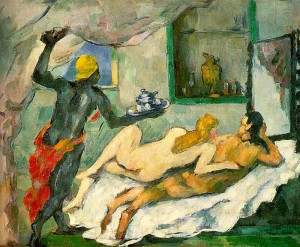
Afternoon Tea, by Cezanne
It’s looking like Romney has the Republican nomination all sewn up–he’s even leading in Santorum’s home state of Pennsylvania now. But at the Daily Beast, Michelle Goldberg explains why conservatives still want Santorum to stay in the race.
Conservative Iowa radio host Steve Deace isn’t convinced. “In the minds of social conservatives, it’s not even close to over,” he says. “The real question is how committed someone like Rick Santorum is to fighting this out all the way to the end. If he’s committed to doing this on a personal level, there’s plenty of social conservatives that will ride him to the finish line.”
Indeed, despite the best efforts of the Republican establishment, many on the religious right are far from ready to accept Romney’s inevitability, or to coalesce behind him. They remain distrustful of his record on abortion, and unsure they can believe his campaign promises. And the harder party elites push Romney on them, the more alienated they become. “The biggest story that everyone in the media has missed this cycle is how frustrated and fed up the Republican Party base is with the Republican Party,” says Deace. “It’s unlike anything I’ve ever seen.”
Goldberg quotes a number of conservative sources who just won’t accept a Romney candidacy and think Santorum to fight to the bitter end at the convention. They sound a lot like Hillary supporters who in 2008 wanted her to take the fight to the convention. Hillary is a loyal Democrat and so she ended up going with the flow, but Santorum is more of a renegade with a lot less to lose than Hillary. In any case, it seems as if the bases of both corporate parties are disgusted with their party elites.

Afternoon Tea Party, by Mary Cassatt
Also at the Daily Beast, Michael Tomasky writes that the Supreme Court is “on the ropes.” Back in the ’80s, Conservative starting pushing for “judicial restraint.” But now that the shoe is on the other foot and there is a Conservative majority on the court, suddenly they love the notion of “judicial activism” that they once reviled (just like they now despise the Heritage Foundaton health care plan now that Democrats have written it into law).
John Roberts has to know and see all this. He has to know that Fifth Circuit Judge Jerry Smith, who asked federal prosecutors for a homework assignment in the wake of Obama’s remarks—a brief stating the Justice Department’s position on judicial review, that had to be at least three pages, single-spaced!—is making conservatives look silly and cheapening the bench. And he has to know that the court’s reputation will suffer an immense blow if it overturns the mandate. It will be seen by a large majority—even a lot of people who weren’t crazy about the law—as completely political. Remember, they didn’t have to take the case in an election year in the first place. They could have put it off. But the court said it must do this now. If it then overturns the ACA, it will look and smell like a political hit job to many Americans. And the court would be saying to America, “We know what you think, and we don’t give a damn.”
What would happen to the court then? Slowly—no; probably quickly—it will come to be seen by most Americans as just another cesspool of political mud wrestling; just another arena where the rich get what they want while everyone else gets screwed (Citizens United); just one more ideological whorehouse full of patrons pretending to be just the piano player.
Despite what we’re all brought up to believe, nothing about the court is sacrosanct. Lifetime appointments can be changed to fixed-year terms. It’d take some doing, but it can be done. And there’s nothing anywhere that says it has to be nine justices. That’s just tradition, but it’s nowhere in the Constitution. It just needs to be an odd number; could be three or 23. For that matter, Congress could disregard Marbury v. Madison. Yep. It could. Tom DeLay used to speak of this from time to time, back in the dear old Terri Schiavo days. He never specifically invoked M v. M, but, referring to judges who would have let Schiavo die, he said things like they had “thumbed their noses at Congress and the president” and would someday pay. He meant a campaign against judicial review. He never got around to it, having been indicted and convicted and all, but that’s what he meant. There’s nothing to prevent liberals from mounting a similar campaign. So far they’ve has held back by their respect for the institution. But that may soon be gone.

There is a heartbreaking story out of Greece: Pensioner’s Suicide Continues to Shake Greece.
Dimitris Christoulas, a divorced and retired pharmacist, took his life on Wednesday in Syntagma Square, a focal point for frequent public demonstrations and protests, as hundreds of commuters passed nearby at a metro station and as lawmakers in Parliament debated last-minute budget amendments before elections, expected on May 6.
In a handwritten note found near the scene, the pensioner said he could not face the prospect “of scavenging through garbage bins for food and becoming a burden to my child,” blaming the government’s austerity policies for his decision.
The incident has prompted a public outpouring, with passers-by pinning notes of sympathy and protest to trees in the square, as well as comment from politicians across the spectrum. A solidarity rally on Wednesday night turned violent when the police clashed with hooded demonstrators in scuffles that left at least three people injured.
I guess we can look forward to similar tragedies here in the U.S. if Congress succeeds in gutting Medicare, Medicaid, and Social Security. And I don’t exempt the Democrats from my cynicism about support for the social safety net among the Villagers.
Speaking of the rich, powerful, and selfish, Jamie Dimon is once again on the top of the heap in terms of CEO compensation. Richard Escrow writes:
JPMorgan Chase CEO Jamie Dimon is still the poster child for today’s morally degraded, self-entitled banker mentality. I don’t know why he keeps talking, but he’s the gift that keeps on giving.
At every major junction in the post-crisis debate about banking, Dimon has stepped in with a perfectly tactless remark that illustrates both the vacuity and the moral corruption of his industry. This week was no exception.
Excrow provides a number of specific examples of Dimon’s and Chase’s lack of ethics. And yet, Dimon is still whining about “excessive” government regulation.
Dimon just complained that regulators “made the recovery worse than it otherwise would have been” — which is not only wrong, but avoids addressing the issue of the recovery’s cause, which was banks like Dimon’s. Dimon added that the government forced banks to de-leverage “”at precisely the wrong time” — which is precisely wrong. The government’s real error was in not breaking up too-big-to-fail banks like Dimon’s.
“Complexity and confusion should have been alleviated, not compounded,” complains Dimon.
So Dimon and his cronies have formed a superpac to intimidate liberal Congresspeople. Please go read the whole article. It’s really frightening.
The domestic terrorist who tried unsuccessfully to blow up a Planned Parenthood office in Wisconsin has explained his motivation.
Francis Grady, 50, spoke to reporters who were covering his first appearance in federal court since the Sunday night attack. The Green Bay Press-Gazette posted video of him walking through the courthouse followed by a short clip of him speaking to reporters outside.
“There was no bomb,” Grady said. “It was gasoline.”
A reporter asked why Grady attacked the clinic.
“Because they’re killing babies there,” he responded.
The newspaper also got more from inside the federal courtroom, where Grady reportedly interrupted the judge to ask, ““Do you even care at all about the 1,000 babies that died screaming?”
“Screaming?” Fetuses that are aborted in the first trimester aren’t “babies,” and they don’t have nervous systems to feel pain or the ability to scream. The ignorance of these people is beyond belief.
Lizzie Borden
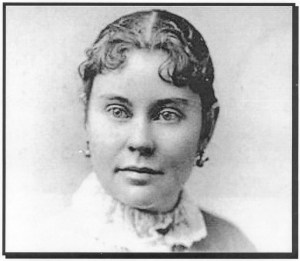
Finally, some new evidence has been found in the Lizzie Borden murder case–journals kept by her attorney.
Borden was acquitted in 1892, and much of the evidence in the case ended up with Andrew Jackson Jennings, Borden’s attorney. The two journals, which Jennings stored in a Victorian bathtub along with other evidence from the case, including the infamous “handless hatchet,” were left to the Fall River Historical Society by Jennings’ grandson, who died last year.
The society received the fragile journals about a month ago but won’t be exhibited until they are properly preserved, curator Michael Martins said.
Each journal is about 100 pages. One contains a series of newspaper clippings, indexed using a lettering and number system that Jennings devised. The second contains personal notes that Jennings assembled from interviews he conducted. Some of the individuals interviewed are people mentioned in the newspaper clippings Jennings retained.
“A number of the people Jennings spoke to were people he knew intimately, on a social or business level, so many of them were perhaps more candid with him than they would have been otherwise,” Martins said. “But it’s also evident that there are a number of new individuals he spoke to who had previously not been connected with the case.”
I hope at least some of those links will pique your interest. What stories have you been following this afternoon and evening?
Judicial Restraint My Old Lady A$$
Posted: March 29, 2012 Filed under: Affordable Care Act, SCOTUS | Tags: Judicial Activism, Kennedy, Scalia, Thomas 20 Comments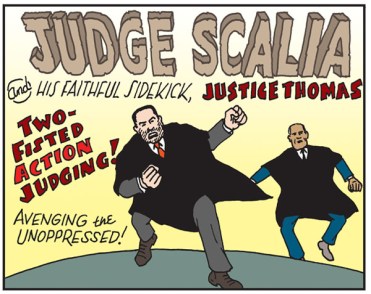 Methinks these Justices protest too much. It’s actually pretty telling too. Scalia seems to be getting his questions from old Fox News shows and Thomas has once again proven that no questions are necessary when you know exactly how you’re expected to vote to keep the perks pouring in. It makes one wonder if Roberts is the least bit concerned about how “his” court will go down in history. If comparing the health care market to broccoli is a sign of great intellect, please, buy my a ticket to Palookaville. Here’s how Charlie Pierce puts it.
It is plain now that Scalia simply doesn’t like the Affordable Care Act on its face. It has nothing to do with “originalism,” or the Commerce Clause, or anything else. He doesn’t think that the people who would benefit from the law deserve to have a law that benefits them. On Tuesday, he pursued the absurd “broccoli” analogy to the point where he sounded like a micro-rated evening-drive talk-show host from a dust-clotted station in southern Oklahoma. And today, apparently, he ran through every twist and turn in the act’s baroque political history in an attempt to discredit the law politically, rather than as a challenge to its constitutionality. (What in hell does the “Cornhusker Kickback” — yet another term of art that the Justice borrowed from the AM radio dial — have to do with the severability argument? Is Scalia seriously making the case that a banal political compromise within the negotiations from which bill eventually is produced can affect its ultimate constitutionality? Good luck ever getting anything passed if that’s the standard.) He’s really just a heckler at this point. If he can’t do any better than that, he’s right. Being on the court is a waste of his time.
Better yet, check out Jonathan Chait’s piece on Conservative Judicial Activists Run Amok. It reintroduces an essay by Jeffrey Rosen from 2005 on how the court was undergoing some fairly radical changes. The Rosen essay specifically references a Thomas decision written with an amazing amount of paraphrasing from a libertarian kook named Richard Epstein who is obsessed with protecting property at all costs; including human ones.
As Epstein sees it, all individuals have certain inherent rights and liberties, including ”economic” liberties, like the right to property and, more crucially, the right to part with it only voluntarily. These rights are violated any time an individual is deprived of his property without compensation — when it is stolen, for example, but also when it is subjected to governmental regulation that reduces its value or when a government fails to provide greater security in exchange for the property it seizes. In Epstein’s view, these libertarian freedoms are not only defensible as a matter of political philosophy but are also protected by the United States Constitution. Any government that violates them is, by his lights, repressive. One such government, in Epstein’s worldview, is our government. When Epstein gazes across America, he sees a nation in the chains of minimum-wage laws and zoning regulations. His theory calls for the country to be deregulated in a manner not seen since before Franklin D. Roosevelt’s New Deal.
After Thomas joined the Supreme Court, Biden’s warnings seemed prescient. In 1995, echoes of Epstein’s ideas could be clearly heard in one of Thomas’s opinions. By a 5-4 majority in United States v. Lopez, the court struck down a federal law banning guns in school zones, arguing that the law fell outside Congress’s constitutional power to regulate interstate commerce. Lopez was a judicial landmark: it was the first time since the New Deal that the court had limited the power of the federal government on those grounds. Thomas, who sided with the majority, chose to write a separate opinion in which he suggested that even his conservative colleagues had not gone far enough. The real problem, he wrote, was not just with the law at hand but with the larger decision of the court during the New Deal to abandon the judicial doctrines of the 19th century that established severe limits on the government’s power. He assailed his liberal colleagues for characterizing ”the first 150 years of this Court’s case law as a ‘wrong turn.”’ He continued, ”If anything, the ‘wrong turn’ was the Court’s dramatic departure in the 1930’s from a century and a half of precedent.”
Thomas did not cite Epstein directly in his opinion. But to anyone familiar with Epstein’s writings, the similarities were striking. Indeed, Thomas’s argument closely resembled one Epstein had made eight years earlier in ”The Proper Scope of the Commerce Power” in the Virginia Law Review — so closely, in fact, that Sanford Levinson, a liberal law professor at the University of Texas, accused Thomas of outright intellectual theft. (”The ordinary standards governing attribution of sources — the violation of which constitutes plagiarism — seem not to apply in Justice Thomas’s chambers,” Levinson wrote in the Texas Law Review.) Biden’s fear that Epstein’s ideas might be written into law had apparently been realized. And the fear would continue to be realized in other courts throughout the 90’s as a small but energetic set of lower-court judges, sympathetic to libertarian arguments, tried to strike down aspects of the Clean Water Act, the Endangered Species Act and other laws, challenging powers of the federal government that had come to be widely accepted during the second half of the 20th century.
Chait takes this essay into the present and the analysis presents a chilling future of judicial activism unlike anything we’ve seen before. The hearings this week on the ACA imply a SCOTUS willing to rewrite legislation in the name of ideology. The so-called swing vote, Justice Kennedy, has created loopholes in cases before that have allowed state legislatures to drive huge right-depriving laws through constitutional rights. By introducing the factually inaccurate, unscientific idea of “fetal pain” in Gonzales V Carhart, Kennedy opened a can of whoop ass based on religious propaganda on American Women.
Writing for the majority, Justice Anthony Kennedy said:
“States . . . have an interest in forbidding medical procedures which, in the State’s reasonable determination, might cause the medical profession or society as a whole to become insensitive, even disdainful, to life, including life in the human fetus . . . A State may take measures to ensure the medical profession and its members are viewed as healers, sustained by a compassionate and rigorous ethic and cognizant of the dignity and value of human life, even life which cannot survive without the assistance of others.”
The National Right to Life Committee thinks that Kennedy’s directive, particularly the bit at the end —”even life which cannot survive without the assistance of others”—leaves open the possibility of revising the viability standard. As Olivia Gans, an NRLC spokesperson, told me a few weeks ago, before the law had passed, “What Kennedy was saying was that states can and should look at other variables to figure out what’s in the best interest of the state.”
This is to medical science as the broccoli argument is to economics. It’s clear that the justices are venturing into something beyond judging constitutionality. Consider this thought offered by Chait.
The spectacle before the Supreme Court this week is Republican justices seizing the chance to overturn the decisions of democratically-elected bodies. At times the deliberations of the Republican justices are impossible to distinguish from the deliberations of Republican senators. They are litigating the problem of adverse selection, and doing it very poorly. (Here are health economists Henry Aaron and Kevin Outterson tearing their hair out over the justices’ bungled attempts to describe the economic dynamics at work.)
Scalia himself offers the most blatant case. His famed thunderings against meddlesome judges are nowhere to be found. He is gleefully reversing his previous interpretation of the Commerce Clause, now that it is being deployed against big government liberals rather than pot smokers. He is railing against Obamacare like an angry Fox News-watching grandfather:
In the morning session — in which the court weighed how much of the law should stand if the mandate is ruled unconstitutional — Scalia cited the horsetrading required to pass the bill — including the politically embarrassing, and failed, Cornhusker Kickback. He also admitted that he’d like to see the whole law fall if the mandate is ruled out of bounds.
In the afternoon, he took pains to remind the court of the unpopularity of the individual mandate.
The exchange occurred when Solicitor General Donald Verrilli Jr. rejected a hypothetical that relied on the notion of Congress passing a massive new tax. This, he argued, would have to overcome massive political constraints.
At that point Scalia chimed in: He would’ve thought the individual mandate would also be too much of a political liability to ever pass Congress.
In fact, the “Cornhusker Kickback” was stripped out before the final bill, but Scalia seems not to know that.
Just two years ago, the idea that conservatives might win the health-care fight in Court rather than the Senate seemed absurd. Just seven years ago, the notion that Republican jurisprudence would be defined by aggressive economic judicial activism seemed even more fantastical. But just as there are few atheists in foxholes, there aren’t a lot of justices of any persuasion willing to walk away from a chance to overturn a duly-passed law that they personally detest.
Whatever issue you may have with the ACA, it was passed by an overwhelming number of Senators and Representatives after a year of hearings, testimony, and rewrites. It deserves a fair hearing before something other than a Kangaroo Court.

 peej
peej Carissa
 bostonboomer
 dakinikat
 ecocatwoman
 mablue2
 Mama Lopez
 peggysue22
 quixote
 skydancingguestblogger
 Mona (aka Wonk the Vote)



 Sky Dancing
Recent Comments