
Lazy Saturday Reads: Victorian Photo Tricks, Homeschooling Horrors, and Hillary and Boko Haram
Posted: May 10, 2014 Filed under: Foreign Affairs, morning reads, Republican politics, U.S. Politics | Tags: Boko Haram, child abuse, education, hidden mother photos, Hillary Clinton, homeschooling, Josh Powell, memento mori, Nigerian kidnappings, Twelve Tribes, Victorian photography 32 Comments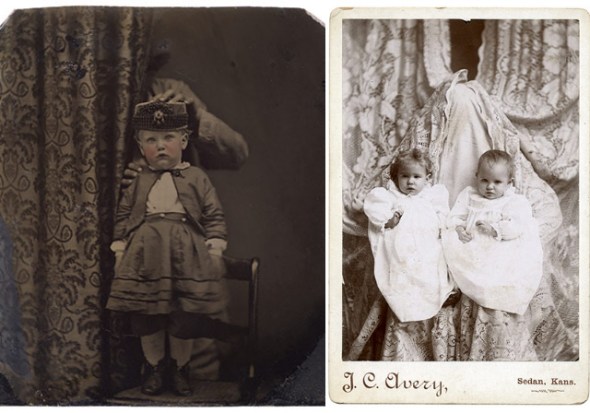
Happy Saturday!!
This might turn out to be a strange post; I’m not really sure yet. I’m writing it somewhat in response to Dakinkat’s Friday offering. I was really taken with the images she used of Victorian women and babies with bat wings, so I decided to share some Victorian baby pictures I came across recently.
In addition, following on what Dak wrote about home-schooling, I have some articles on people who survived homeschooling horrors. I think it’s an outrage that child abuse like this is permitted in supposedly civilized countries. The government should not be kowtowing to fundamentalist Christian sects that engage in uncivilized behaviors. I’m still trying not to think too much about politics, but I have some follow-up info on Boko Haram and it’s use in the latest Hillary-bashing episode.
The Hidden Mother

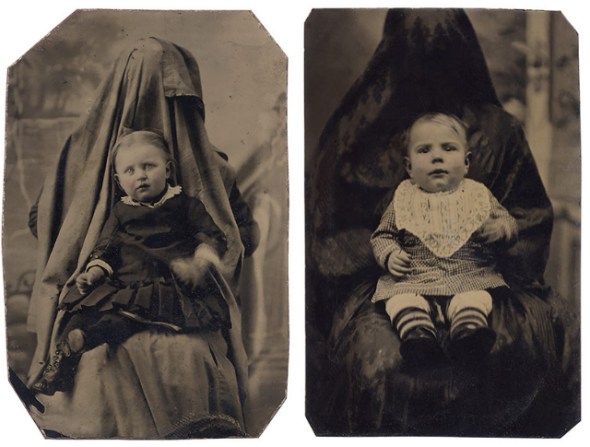
I originally saw these photos on Twitter (of course), but I found them so fascinating that I tried to find out a little more about them. You’ll notice in the photos at the top of this post that there are ghostly fabric things behind or beside the children. Those are the hidden mothers keeping their kids still for the slow-developing cameras of those days. Lots of the photos look really eerie, and they hardly ever show the children smiling. Here’s an article from the Guardian from December 2013 that provides an introduction to the strange Victorian practice of “hidden mother” photography: The lady vanishes: Victorian photography’s hidden mothers.
Babies may be insatiably photogenic, but somehow they don’t really suit the whole business of photography. The flash makes them startle. They wriggle. They cry. They blink. You prop them up with cushions – and seconds later, they’re upside down gnawing their own toes. They make Dr Evil hand-signals. They fall asleep. They drool.
And if it’s bad now, it was worse then. Now we have cameraphones to record every last gurgle, but for the Victorians it was much more complicated. A 19th-century parent would have to dress the baby in a starchy gown, transport it and perhaps its siblings to the nearest photographer’s (orambrotypist’s) studio as early in the morning as possible, climb several flights of stairs to the skylit attic, arrange the family group against the studio backdrop, get everyone to remain completely still for 30 seconds or so, part with a large chunk of money, and then wait several days for the copies to be finished, before sending them round to family and friends as calling cards, or pasting them into albums.
The main problem was the length of the exposure. However bright the photographer’s studio, it took up to half a minute for an image to register on wet collodion. Getting an adult to sit completely still for half a minute is a challenge, but getting a wakeful baby to do so is near-impossible. The photographer could position anyone old enough to sit on a chair by placing an electric chair-style head clamp behind them, but the only way of photographing a baby was for the mother to hold it (or dope it with enough laudanum to keep a grown man rigid for a week).
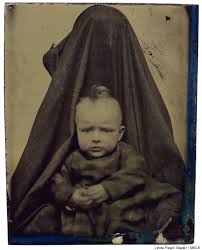
These photos recently came to light in a book called The Hidden Mother, by Linda Fregni Nagler
Though there are plenty of Victorian studio portraits of family groups, there are also many in which the mothers are concealed: they’re holding babies in place while impersonating chairs, couches or studio backdrops. They wanted a picture of just the baby, and this was the best way to achieve it. Sometimes, the figures are obvious, standing by the side of a chair and waiting to be cropped out later; sometimes, they really do appear as a pair of curtains or as disembodied hands. To a 21st-century viewer, the images look bizarre – all these unsmiling children strangled by smocking and framed by what appears to be a black-draped Grim Reaper, or by an endless succession of figures in carpets and chintz burqas.
The book also highlighted another weird Victorian practice–photographing the dead. Some of the children in the photos are dead.
Until the 1880s and the advent of mass-market photography, most people might only have a snapshot taken once in a lifetime. Since many children did die in infancy, the only memento the parents might have would be the single posthumous photograph of their baby propped up to look as if it was merely asleep.
It turns out that not just children were memorialized in photos after death. Below you can see a photographer taking a postmortem picture of a corpse propped up in a chair with eyes open.

Weird, huh? Sometimes they even painted in eyes to make the person look more alive. Another “Victorian photo trick” was “headless photographs.” Here’s an example:
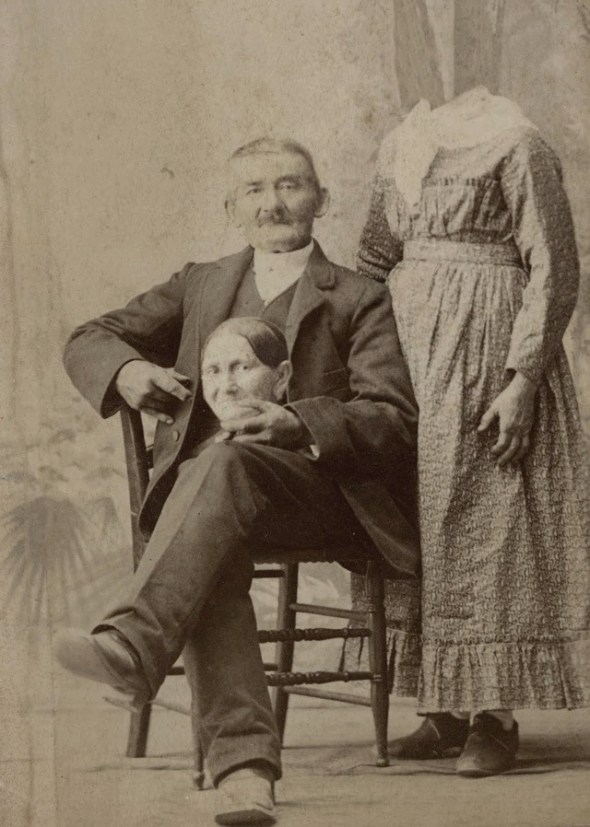
You can read more about these strange Victorian photographic practices and see more examples at the following links.
Hyperallergic art blog: Victorian Photo Tricks, From Hidden Mothers to Eyes on the Dead (1/2014)
Daily Life: Why did mothers once conceal themselves in photographs?
Pinterest: Mothers, Photographs, and Memento Mori.
Flickr page, Hidden Mother: Tintypes and Cabinets
Home Schooling Horrors
Again I came across this on Twitter. There’s apparently a Twitter group made up of home schooling survivors, and they were having some kind of home schooling awareness day awhile back to call attention to a law in Virginia that gives religious exemptions to parents who don’t want to send their kids to school. I started reading their descriptions of what they had experienced, and I was just horrified. I saved a few links at the time that I’ll share. From The Washington Post: Student’s home-schooling highlights debate over Va. religious exemption law.

Josh Powell wanted to go to school so badly that he pleaded with local officials to let him enroll. He didn’t know exactly what students were learning at Buckingham County High School, in rural central Virginia, but he had the sense that he was missing something fundamental.
By the time he was 16, he had never written an essay. He didn’t know South Africa was a country. He couldn’t solve basic algebra problems.
“There were all these things that are part of this common collective of knowledge that 99 percent of people have that I didn’t have,” Powell said.
Powell was taught at home, his parents using a religious exemption that allows families to entirely opt out of public education, a Virginia law that is unlike any other in the country. That means that not only are their children excused from attending school — as those educated under the state’s home-school statute are — but they also are exempt from all government oversight.
School officials don’t ever ask them for transcripts, test scores or proof of education of any kind: Parents have total control.
Powell’s family encapsulates the debate over the long-standing law, with his parents earnestly trying to provide an education that reflects their beliefs and their eldest son objecting that without any structure or official guidance, children are getting shortchanged. Their disagreement, at its core, is about what they think is most essential that children learn — and whether government, or families, should define that.
Josh’s story is heartbreaking and inspiring. The scariest thing about this law is that the children wishes are given no consideration at all. After years of struggle, Josh finally cobbled together an education managed to get accepted to Georgetown, but it was a long road and at the time of this article he still worried about his siblings who had not been able to escape the home schooling nightmare.
In 2008, Josh Powell wrote to Buckingham school officials, telling the board that he didn’t share his parents’ religious objections to public school and asking to enroll.
He said the administrator he spoke with was kindly but dismissive.
Crushed, he tried a home-school co-op for a while, then a class to study for a high-school equivalency test. “I figured if I can’t make any headway with my parents, can’t make any headway with the school board, what . . . am I going to do?” he said.
He Googled “financial aid” and applied to Piedmont Virginia Community College. A neighbor gave him a ride, an hour each way every day, until he had earned enough to afford an apartment nearby. It was terrifying, he said, as he was unsure how to behave in a classroom or whether he was going to embarrass himself answering questions. But he was thrilled.
“With the addition of lectures, the structure, the support, the tutoring — things just finally clicked. I remember my first semester sitting in my developmental math class. No one wanted to be there except for me. I was thinking, ‘Oh, my God, I have a chance to learn!’ ”
It’s a long article, but well worth reading in full. Here are a few more links for more info:
An interview with Josh Powell at NPR: Brother Wants Parents To Stop Siblings’ Homeschooling
Anthony B. Susan blog: It’s Time To Rethink Virginia’s Homeschool Laws.
A blog devoted to Homeschooling’s Invisible Children – “Shining a Light on Abuse and Neglect in Homeschooling Environments.”
It doesn’t just happen in the U.S. Some information on a homeschooling religious cult in Germany:
Der Spiegel: Life after the sect: “I have no roots and no strength to fly. The google translation is horrible, but you can read all about the Twelve Tribes cult here:
Yeshua Here I Am (Part 11, with links to parts 1-10).
Hillary Clinton and Boko Haram Follow-up
As I wrote on Thursday, the latest GOP attack on Hillary is over her supposed failure to deal with Nigeria’s Boko Haram when she was Secretary of State by adding them to the State Department’s list of terrorist groups. I’m not going to get deeply into this argument, because it just makes me tired; but here are a couple of in-depth treatments of the issues involved.
Tom Cohen at CNN: Clinton’s handling of Boko Haram questioned.
Howard LaFranchi at The Christian Science Monitor: Why Hillary Clinton’s State Dept. didn’t list Boko Haram as a terrorist group.
Chris McGreal at The Guardian UK: Nigeria kidnapping: why Boko Haram is a top security priority for the US
And from Mother Jones, a background article on Boko Haram: What is Boko Haram and Why Do Its Members Kidnap Schoolgirls?
So . . . What’s on your mind today? Please share your thoughts and links in the comment thread.
Friday Evening Reads: Scientific Discoveries, Cats from Hell, and Romney Reads
Posted: February 10, 2012 Filed under: 2012 presidential campaign, 2012 primaries, U.S. Politics | Tags: AIDS, Antarctica, antiretroviral drugs, Catholic Bishops, cats, crime, horseflies, Jackson Galaxy, Josh Powell, Lake Vostok, Mitt Romney, My Cat From Hell, pedophile enablers, Susan Powell, Toxoplama gondii, toxoplasmosis, zebras 45 Comments
Good Evening Sky Dancers! I’m filling in for Minkoff Minx tonight. I’m a little weary of all the nonsensical arguments fomented by the right wing nuts and the red beanie pedophile enablers, so I’m going to avoid those issues in tonight’s roundup. Instead, I’m going to go with some odds and ends that piqued my fancy today.
Russian scientists have finally reached Lake Vostok in Antarctica.
Opening a scientific frontier miles under the Antarctic ice, Russian experts drilled down and finally reached the surface of a gigantic freshwater lake, an achievement the mission chief likened to placing a man on the moon….
Lake Vostok could hold living organisms that have been locked in icy darkness for some 20 million years, as well as clues to the search for life elsewhere in the solar system….
The Russian team made contact with the lake water Sunday at a depth of 12,366 feet (3,769 meters), about 800 miles (1,300 kilometers) east of the South Pole in the central part of the continent.
Scientists hope the lake might allow a glimpse into microbial life forms that existed before the Ice Age and are not visible to the naked eye. Scientists believe that microbial life may exist in the dark depths of the lake despite its high pressure and constant cold — conditions similar to those believed to be found under the ice crust on Mars, Jupiter’s moon Europa and Saturn’s moon Enceladus.
That sounds pretty amazing. Read the whole article to learn about the possibilities and goals of the study.
Did you ever wonder why Zebras have stripes? To be honest, I never did, but now that someone has discovered the likely reason, I do find the answer kind of interesting. It turns out that zebras have stripes because they discourage horseflies.
While it is widely-known in the scientific community that horseflies and other insects prefer animals with dark skin to animals with white skin, a study published this week in the Journal of Experimental Biology examines evidence that zebra stripes actually discourage horseflies from biting. Prior to the study, researchers thought that the primary purpose of zebra stripes was to confuse predators. However, the study suggests that predator confusion is secondary to horsefly deterrence.
“We demonstrate that a zebra-striped horse model attracts far fewer horseflies (tabanids) than either homogeneous black, brown, grey or white equivalents,” the researchers write in the study’s abstract.
Horseflies, which can carry diseases and distract their victim from feeding or drinking, are unwelcome visitors to zebras and other animals that graze. According to Gábor Horváth, one of the study’s authors, horseflies are attracted to horizontally polarized light because the sunlight that reflects off of water is horizontally polarized. When horseflies and other aquatic insects discover water they can mate and lay eggs. The female variety of horseflies, however, are also attracted to linearly polarized light that reflects off of the hides of their victims.
Is your pet making you crazy? Do you have a cat? Then you might want to read this article at The Atlantic–or maybe not. It’s about a scientist who believes that a feline parasite, Toxoplasma gondii, is affecting his brain and altering his personality.
As a student of development, I’m familiar with this parasite, because it has to be avoided by pregnant women because it can affect the fetus and lead to severe brain damage or death. The parasite is excreted by cats, so pregnant women must not change cat litter boxes or get too close to them But Jaroslav Flegr suspects it may be causing other problems in non-pregnant humans. For one thing,
T. gondii is also a major threat to people with weakened immunity: in the early days of the AIDS epidemic, before good antiretroviral drugs were developed, it was to blame for the dementia that afflicted many patients at the disease’s end stage.
Is is commonly believed that:
Healthy children and adults, however, usually experience nothing worse than brief flu-like symptoms before quickly fighting off the protozoan, which thereafter lies dormant inside brain cells…
Au contraire, says Flegr.
the “latent” parasite may be quietly tweaking the connections between our neurons, changing our response to frightening situations, our trust in others, how outgoing we are, and even our preference for certain scents. And that’s not all. He also believes that the organism contributes to car crashes, suicides, and mental disorders such as schizophrenia. When you add up all the different ways it can harm us, says Flegr, “Toxoplasma might even kill as many people as malaria, or at least a million people a year.”
An evolutionary biologist at Charles University in Prague, Flegr has pursued this theory for decades in relative obscurity. Because he struggles with English and is not much of a conversationalist even in his native tongue, he rarely travels to scientific conferences. That “may be one of the reasons my theory is not better known,” he says. And, he believes, his views may invite deep-seated opposition. “There is strong psychological resistance to the possibility that human behavior can be influenced by some stupid parasite,” he says. “Nobody likes to feel like a puppet. Reviewers [of my scientific papers] may have been offended.” Another more obvious reason for resistance, of course, is that Flegr’s notions sound an awful lot like fringe science, right up there with UFO sightings and claims of dolphins telepathically communicating with humans.
But after years of being ignored or discounted, Flegr is starting to gain respectability. Psychedelic as his claims may sound, many researchers, including such big names in neuroscience as Stanford’s Robert Sapolsky, think he could well be onto something.
eeeeeeeek! Go read the article if you dare!
The headline of that article reminded me a great show I recently saw on the Animal channel, My Cat from Hell. It’s a “reality” show that documents the adventures of an “animal behaviorist” named Jackson Galaxy. He’s a rock musician by night and helps people with crazy cats by day. I thought I’d share a couple of clips from the show with you. The first one is an introductory promo.
Here’s a clip from one of the episodes.
Here’s a video of Galaxy working with a cat from hell.
I love this show! It’s even better than It’s Me or the Dog.
I’ve got a couple of crime stories for you. First, police in Washington state searched a storage facility owned by Josh Powell, the man who recently murdered his two sons and killed himself by blowing up his house. They found a comforter that tested positive for blood.
Investigators had considered Josh Powell a person of interest since his wife, Susan Powell, disappeared in Utah in 2009. At the time, Powell said he took his two sons ice camping in subfreezing temperatures.
Pierce County Prosecutor Mark Lindquist said presumptive tests are conducted with a field kit and that a determination of blood won’t be confirmed until the item is examined in the lab. “Field tests are not infallible,” he said.
Lindquist said he expects the finding will be something law enforcement will share with colleagues in Utah who have been investigating Susan Powell’s disappearance.
I wonder why that storage facility wasn’t searched sooner?
In Illinois, an off-duty sheriff’s deputy pulled a gun on a pregnant woman because she had two many items in a self-serve line at Walmart. Her husband was arrested for trying to defend her.
Just one week from her due date, Nicole Thurmond said she feared for her life while checking out at a Walmart store in Oswego on a recent Sunday.
“I felt someone close behind me. He started being really rude and said, ‘Don’t you know how to count? You are holding up the whole store,” Thurmond recalled.
Thurmond said she didn’t know it at the time, but the man in plain clothes was off-duty deputy Craig French.
Thurmond’s husband had been getting eggs at the time and said he could see his wife was upset when he returned to the checkout area.
“There was a guy in her face, yelling at her,” said Jason Thurmond. “In an aggressive manner he steps toward me, and I just push him back to keep him away from my wife and myself, and before I knew it I just froze because he pulled out a gun.”
Jason Thurmond said the man didn’t show his badge, was “waving a gun in a store,” and at one point asked them if they were on welfare.
The case is now being investigated.
Well, of course you know I have to indulge my Mitt Romney obsession, so I have a few Romney reads. Have you heard that Romney “can’t wait to get his hands on Washington?” He said so at CPAC today.
Republican presidential candidate Mitt Romney on Friday tried to convince attendees at the Conservative Political Action Conference (CPAC) to vote for him by reminding them of his “severely conservative” record, including preventing Massachusetts from becoming “the Las Vegas of gay marriage.”
“History will record the Obama presidency as last gasp of liberalism’s great failure and a turning point for the conservative era to come,” the candidate predicted. “I know this president will never get it, but we conservatives aren’t just proud to cling to our guns and our religion, we are also proud to cling to our Constitution.”
“As governor of Massachusetts, I had the unique experience of defending conservative principles in the most liberal state in the nation,” Romney said. “Even with a legislature that was 85 percent Democrat, I cut taxes 19 times and balanced the budget all four years. I cast over 800 vetoes and cut entire programs. … And I can’t wait to get my hands on Washington!”
Ooooooooh! He was “severely conservative.” How impressive.
This one is a little old, but it’s so funny that I had to share it. It’s a brief humor column from the New Yorker by one of my favorite writers, Calvin Trillin, called “President Romney Meets Other World Leaders.” It’s based on a New York Times article that addressed some of Romney’s “peculiar habits” on the campaign trail. Here’s the relevant excerpt:
When Mitt Romney introduces himself to voters, he has a peculiar habit of guessing their age or nationality, often incorrectly. (A regular query: “Are you French Canadian?”)
When making small talk with locals, he peppers the conversation with curious details. . . . Mr. Romney has developed an unlikely penchant for trying to puzzle out everything from voters’ personal relationships to their ancestral homelands. . . . Mr. Romney likes to congratulate people. For what, exactly, is not always clear.
And here’s just a bit of Trillin’s piece playing off that quote:
The moment President Romney entered the room where the opening reception of his first G-8 summit was being held, he was approached by a small man who shook his hand and said, “Je suis Nicolas Sarkozy.”
“Are you of French-Canadian origin?” President Romney said, smiling broadly.
“I am French,” Sarkozy replied, looking somewhat puzzled. “I am, in fact, the President of France.”
“Congratulations,” President Romney said. “Lipstick contains a substance made from fish scales.”
Before Sarkozy could reply—in fact, before he could think of anything to say on the subject of lipstick manufacturing—they were approached by Angela Merkel, of Germany, who looked eager to greet the newest leader in the G-8. President Romney peered at her briefly and then said to Sarkozy, “Your aunt? Your mother?”
“This is Angela Merkel, Chancellor of the Federal Republic of Germany,” Sarkozy said.
Please go read the rest–it’s very short but funny.
Here is Charlie Pierce’s latest blog on our former Governor: What the Self-Manufacturing of Romney Hath Produced
The transformation is now complete. Willard Romney, my former governor, the man who campaigned here for the Senate and lost, and who campaigned for governor here and won, has fashioned himself into the most carefully manufactured fake in the recent history of American politics. I used to call him the Piltdown Man of American politics — a candidate fashioned from a jawbone picked up here and a shinbone picked up there and whatever position on whatever issue he happened to find at hand at the time — but that may no longer be sufficient to explain him. After all, and even though it took more than 40 years, eventually they busted the Piltdown Man as a hoax. Willard’s transformation, from what he was here in Massachusetts, to what he is now, is so full and thorough that he has successfully constructed an entirely new Willard for himself. Of course, they had to hurry him off the assembly line because of the urgency injected into the race by the stunning (if remarkably delegate-free) triple play pulled off on Tuesday by Rick Santorum, who has never taken a breath in which he was not the authentically wingy wingnut that Willard has labored so hard to make of himself.
I’ll let you savor the rest at Charlie’s place. I hope everyone has a great Friday night and a fabulous weekend!
Tuesday Reads: More Caucuses and a Beauty Contest; Dems Support Anti-Union Bill; and Protecting Children vs. Parents’ Rights
Posted: February 7, 2012 Filed under: 2012 presidential campaign, 2012 primaries, Mitt Romney, morning reads, Newt Gingrich, Reproductive Rights, Republican presidential politics, U.S. Politics, Women's Rights | Tags: Braden and Charlie Powell, breast cancer, Colorado caucuses, Josh Powell, Komen Foundation, Maine caucuses, Minnesota caucuses, Missouri primary, Nancy Brinker, NEGATIVE campaigning, Rick Santorum, Susan Powell 51 Comments
Good Morning!!
There are four more Republican caucuses and one “primary” coming up this week. Tomorrow, Minnesota and Colorado will hold caucuses and Missouri has a beauty contest, a non-binding primary (actual delegates will be apportioned by the Missouri Republican party on March 17). Maine holds it’s caucuses on Saturday. After that, we get a two-week respite with no primaries. Won’t that be great?
Right now, Rick Santorum is leading in the polls in Minnesota, and Mitt Romney has wasted no time in turning his mean-spirited attacks on the new upstart. Wall Street Journal:
In a radio interview in Minnesota on Monday, Mr. Romney criticized Mr. Santorum for voting to raise the country’s borrowing limit, allowing earmark spending to proliferate and letting government spending explode.
“His approach was not effective and, frankly, I happen to believe if we’re going to change Washington we can’t just keep on sending the same people there in different chairs,” he said in an interview on WCCO.
The Romney camp also circulated a research memo to challenge Mr. Santorum’s contention that Mr. Romney imposed a “top-down, government-run” health-care system in Massachusetts that led to higher costs and longer wait times. For good measure, the Romney team rereleased Mr. Santorum’s endorsement of Mr. Romney in the 2008 race.
Romney is currently leading in Colorado, but there are suggestions that Santorum could do well there too–maybe even take first place. From CNN:
Could Rick Santorum pull off a surprise victory in this week’s caucuses? Newt Gingrich thinks so.
“I think that Santorum’s going to have a pretty good day tomorrow and he will have earned it. He targeted differently than I did,” Gingrich told reporters gathered outside an energy forum in Golden, Colorado….
Speaking to reporters after the same forum, Santorum opted against setting any expectations for the caucuses. But he questioned Mitt Romney’s ability to close the deal with Republican voters, noting the former Massachusetts governor has failed to attract as many voters as he did in 2008 in some previous contests.
“He’s underperformed from four years ago. And I suspect he will again,” Santorum said about Tuesday’s caucuses.
Former Pennsylvania senator Rick Santorum has spent the past few days shuttling among Minnesota, Missouri and Colorado hoping that a good showing in one or all Tuesday would show the conservative electorate was not solidly behind former Massachusetts governor Mitt Romney.
“Our hope is conservatives are stepping back and looking at the race and making the same calculations that I’ve just made that a Romney nomination will not be in the best interest of us winning the general election,” Santorum told reporters here Monday. “We need to have a conservative alternative and my feeling is that Speaker Gingrich has sort of had his chance in the arena and came up short in Florida and Nevada, and now it’s our turn.”
Santorum has spent a great deal of time in Missouri while the other candidates were competing in Nevada. He apparently thinks the “show me” state will help him launch a comeback in the race.
Tomorrow’s primary in Missouri is the staging ground for Rick Santorum’s latest campaign message—that he is the real conservative alternative to Mitt Romney and that he is the person who can best compete with Barack Obama.
A win in Missouri would be absolutely crucial in keeping Santorum’s campaign afloat. His chances look good there because Newt Gingrich—whose campaign has been plagued by logistical missteps such as failing to get on the ballot in Virginia—decided not to sign up for tomorrow’s primary.
Unfortunately for Santorum, a win won’t get him any delegates.
Yesterday, Democrats in the Senate joined their right-wing colleagues in passing an anti-union FAA bill.
The Senate passed a Federal Aviation Administration bill on Monday that includes an anti-union measure bitterly opposed by labor groups.
The bill, which modernizes America’s air traffic control system and funds the FAA through 2014, was fought over for four years, leading to a partial shutdown of the FAA last summer because of anti-union measures added by the Republican-controlled House.
It passed 75 to 20, with a majority of Democrats backing it.
Among the controversial provisions were changes to labor law for rail and airline workers — backed by the airline industry — that would count anyone who did not vote in an election for a union as voting against it, making it much more difficult to certify attempts to organize new unions.
What’s the point of voting for Democrats if they’re no different from Republicans?

Braden and Charlie Powell
This story makes me so sad that I had to share it with you. It demonstrates one of the worst thing about U.S. family courts–they care more about parents rights than they do children’s safety and well-being. Yesterday, the husband of a missing Utah woman, Susan Powell, committed suicide and chose to take his two sons along with him.
The deaths of a Washington man and his two sons in what authorities believe was a murder-suicide may mean the 2009 disappearance of the children’s mother may never be solved.
Josh Powell, a suspect in the disappearance of Susan Cox-Powell, died Sunday along with his two sons, 5-year-old Braden and 7-year-old Charlie, in what police believe was an intentionally set fire in Powell’s Puyallup, Washington, home.
It was a tragic development in a puzzling case that began two years ago in the Salt Lake City suburb of West Valley City, Utah, when Susan Cox-Powell, 28, went missing.
Josh Powell was never charged in her disappearance, and was embroiled in a bitter custody dispute with his wife’s parents.
Why was this man allowed access to his children? If the court believed he had the right to see them, why not arrange for the meeting to take place in a neutral location? Not only was this man a strong suspect in the murder of the children’s mother, but also he had allowed the boys to live with his father who was arrested awhile ago for possession of child pornography. The arrest led to Powell’s in-laws getting custody of the two boys. Powell apparently had been planning the murder suicide for some time.
Authorities say Josh Powell planned the deadly house fire that killed him and his young sons for some time, dropping toys at charities and sending final emails to multiple acquaintances.
Powell, the husband of missing Utah woman Susan Powell, died along with his children Sunday.
Authorities say they found 10 gallons of gasoline inside the home. A five-gallon can was spread throughout the house and used as an accelerant in the huge blaze. Another can was found by the bodies.
They say Josh Powell did send longer emails to some people, including his cousin and pastor, with instructions such as where to find his money and how to shut off his utilities
The motive for killing the boys might have been the fact that once they were away from their father, they began talking about the night their mom disappeared.
The children of missing woman Susan Cox Powell have said for years that “Mommy’s in the mine,” an attorney representing the Cox family said on Monday….adding the boys mentioned their mother may have been looking for crystals in the mine.
Another lawyer representing the Cox family said the children had started talking to their grandparents about things they remembered from the night their mother vanished.
“They were beginning to verbalize more,” said attorney Steve Downing. “The oldest boy talked about that they went camping and that Mommy was in the trunk. Mom and Dad got out of the car and Mom disappeared.”
The attorney said Charlie Powell drew a disturbing picture as a part of a school assignment several months ago. The drawing depicted the boy’s father driving the van with Charlie and Braden sitting in the backseat, and their mother in the trunk.
“There was a subsequent question with regard to, ‘Why is your mother in the trunk?’ And his response was simply that he didn’t know, but his mother and father had gotten out of the van, and his mother then got lost,” said Downing.
So why was the man allowed access to his children? A psychologist quoted in an article in the Christian Science Monitor seems troubled by the decision.
Joy Silberg, a psychologist who specializes in child protection and abuse cases, says courts often place more value on parental rights than a child’s safety – or see them as equal concerns, when in her view, the parental rights should be secondary.
“I have situations where the child has disclosed very clear disclosures about a parent, or terror at being near a parent … and the judge still orders a child to go [to visitation] because the parental right is seen as having so much more power,” says Dr. Silberg.
While she doesn’t know all the facts of the Powell case, she adds, “it’s hard for me to believe that this was completely out of the blue and that no one knew he was this destructive. People usually leave clues.”
In fact, Powell was named a “person of interest” by the authorities when his wife, Susan Cox-Powell, disappeared two years ago. But he was never officially charged with any crime, and no details have ever been made public linking him with the case.
I don’t like to end with an utterly heartbreaking story like that, so I’ll add this one from The Daily Beast on Nancy Brinker and her really really bad decision to defund Planned Parenthood. Apparently Brinker is real meanie when it comes to competition with other groups raising funds for breast cancer.
“Komen plays hardball and is determined to stay on top,” says a member of another cancer organization, who declined to be identified. “Let’s be honest about all this: people think of breast cancer as a charity, but it’s really a major business.”
I’m going to keep that in mind the next time I get a request for funds for breast cancer. I’ll especially want to find out what each group’s attitude is toward women’s autonomy. More from the article:
…in the early ’80s, she [Nancy] met and married multimillionaire restaurateur Norman Brinker, a major Republican donor. He had previously been married to Grand Slam tennis star Maureen “Little Mo” Connnelly, who had died from ovarian cancer.
When they tied the knot, the union provided Nancy with a network of A-list political connections and friends, plus the funds to lead a luxurious lifestyle and create the Komen Foundation, now the Susan G. Komen for the Cure with affiliates in 170 communities in 50 nations. (Interesting note: the largest Race for the Cure, a three-day run, is held in Rome, Italy.)In 1993 Norman Brinker suffered severe head injuries during a polo match and remained on crutches for the rest of his life. Several years later the couple divorced and with a hefty settlement, formidable drive, and her chum George W. Bush in the White House, Nancy was ready to step onto the world stage. First the [resident appointed her ambassador to Hungary and then U.S. chief of protocol.
Did Nancy dump her rich hubby because his health problems were a pain in the a$$. Inquiring minds want to know. There’s more gossipy stuff in the article if you’re interested.
Now what are you reading and blogging about today?

 peej
peej Carissa
 bostonboomer
 dakinikat
 ecocatwoman
 mablue2
 Mama Lopez
 peggysue22
 quixote
 skydancingguestblogger
 Mona (aka Wonk the Vote)



 Sky Dancing
Recent Comments